International Research Journal of Pharmaceutical and Biosciences (IRJPBS) 5 (1) 1
RESEARCH ARTICLE
International Research Journal of Pharmaceutical and Biosciences
Pri
-
ISSN: 2394 - 5826http://www.irjpbs.com e-ISSN: 2394 - 5834
Cardioprotective Effect of Hydroethanolic Extract
Artocarpus
altilis
In Isoproterenol Induced Myocardial Rats
*Doss VA,Monisha and Sowndarya. R
Department of Biochemistry, PSG College of Arts & Science, Coimbatore, Tamil Nadu, India.
Article info Abstract
Article history: Received 27 JULY 2018 Accepted 10 JAN 2019
*Corresponding author:
Copyright 2019 irjpbs
International Research Journal of Pharmaceutical and Biosciences (IRJPBS) 5(1) 2 INTRODUCTION
Myocardial Infarction (MI) is an acute condition of the necrosis of the myocardium that occurs as a result of imbalance between coronary blood supply and myocardial demand [1]. Congestive heart failure (CHF) after MI is a common clinical syndrome with a grave prognosis. Loss of contracting myocardium due to MI results in a chronic increase in the workload of the remaining viable myocardium. In this regard, data from animal experiments have suggested that increases in free radical formation and subsequent oxidative stress associated with the occurrence of a relative deficit in the endogenous antioxidant reserve may be one of the
mechanisms for the development of CHF [2].Ischemia is regarded as the main mechanism
that induces myocardial injury and subsequent cardiomyocyte (CM) loss. The low regenerative capacity of CM’s results in scar formation and a decrease in pump force [3]. Complications of MI include Arrhythmia, Congestive heart failure, Cardiogenic shock, Ventricular aneurysm, Pericarditis, Dressler syndrome and pulmonary embolism. Increased oxidative stress and the generation of the free oxygen radicals can result in modification of LDL to oxidized LDL that could lead to Atherosclerotic lesions [4]. L-Isoproterenol (ISO), a synthetic catecholamine causes myocardial cell damage when administered in large doses. Repeated subcutaneous administration of ISO also produces myocardial necrosis in rats and
serves as a good model for acute MI [5]. Propranolol is a medication of the beta
blocker type. It is used to treat high blood pressure, a number of types of irregular heart rate, thyrotoxicosis, capillary hemangiomas, performance anxiety, and essential tremors [6].
International Research Journal of Pharmaceutical and Biosciences (IRJPBS) 5(1) 3
Artocarpus altilis belongs to the family Moraceae and it is commonly called as Bread fruit.
Artocarpus species consists of phenolic compounds. Artocarpus extracts and metabolites
from leaves, stem, fruit and bark contain numerous beneficial biologically active compounds and these compounds are used in the various biological activities inclulding antibacterial, antitubercular, anti-viral, anti-fungal, anti-platelet, anti-arthrtitic, tyrosinase inhibitory and
cytotoxicity [7]. Hence, in the current study, the possible role of Artocarpus altilis (250 mg/kg,
per oral [po]) and Propranolol (10 mg/kg, po) in cardioprotection against ISO-induced cardiotoxicity was examined.
MATERIALS AND METHODS
Chemicals
Isoproterenol was purchased from Sigma-aldrich and all the chemicals and drug were of analytical grade.
Plant Collection
The fruits of Artocarpus altilis were collected from Namakkal district, Tamilnadu. The plants
were identified and authenticated (No: BSIS/RC/5/23/2016/Tech) by the taxonomist, at Botanical Survey of India (BSI), Agricultural University, Coimbatore, Tamilnadu.
Preparation of artocarpus altiliss extract
The fruits of the plant Artocarpus altilis were collected, dried and ground to coarse powder.
The coarse powder was extracted using 50 % ethanol (1:3) and kept in a dark room for 72 hours with intermittent shaking. Then the extracts were evaporated to dryness using rotator evaporator. Crystals obtained were stored in decicator and orally administrated to the
experimental rats for the treatment of myocardial infarction[4].
Animals
Male Albino Wistar rats weighing about 120-150g procured from Kovai Medical Centre
International Research Journal of Pharmaceutical and Biosciences (IRJPBS) 5(1) 4 Experimental setup
The experimental rats were divided into 4 groups of 6 animals (Table 1) in each group [5]
Table 1: Experimental setup
Groups Experimental animals No of rats
Group I Normal rats 6
Group II Isoproterenol induced (85 mg/kg) 6
Group III Propanolol (10 mg/kg b.w) + Isoproterenol 6
Group IV Crude extract of plant(250mg/kg) + Isoproterenol 6
After pretreatment with Artocarous altilis (250 mg/kg b.w orally) and propranolol (10 mg/kg
b.w) for 4 weeks, the experimental animals were administrated with subcutaneous injection
of ISO (85 mg/kg per day, for 2 days at an interval of 24 hours i.e., 29 or 30th day ) to induce
MI. At the end of the experimental period that is, 18 hours after the second dose of ISO injection, all the rats were anesthetized and sacrificed under mild anesthesia. Blood was collected through heart puncture and the serum separated was used for the determination of cardiac marker enzymes. The heart tissue was excised immediately and washed with ice-cold isotonic saline. The heart tissue and the serum were used for the further biochemical analysis. The isolated hearts are used for Histopathological examinations [5].
BIOCHEMICAL ANALYSIS
The collected serum were used for the estimation for Creatine Kinase - MB (CK-MB), Aspartate Transaminase (AST), Alanine Transaminase (ALT) and Lactate Dehydrogenase (LDH) using commercially available (AUTOSPAN diagnostic) kits according to manufacturer protocol.
HISTOPATHOLOGICAL ANALYSIS
The heart excised out was washed in saline (0.9% NaCl) and tissues were immediately fixed in 10% buffered formalin solution. After fixation, tissues were embedded in paraffin and serial sections were cut and each section was stained using hematoxylin and eosin. After repeated dehydration and cleaning, the sections were mounted and observed under light microscope with magnification of 100x for histological changes [8].
STATISTICAL ANALYSIS
International Research Journal of Pharmaceutical and Biosciences (IRJPBS) 5(1) 5 RESULTS AND DISCCUSSION
Effect of Artocarpus altilis on Cardiac Marker Enzymes
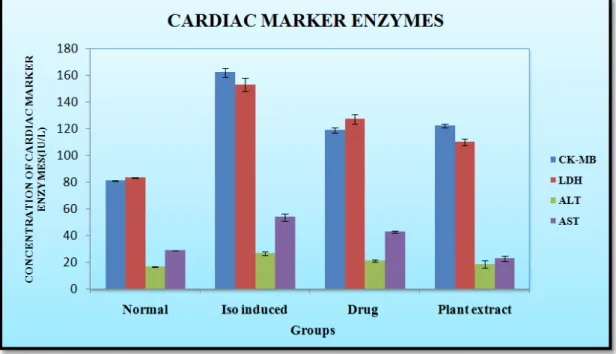
Isoproterenol - induced myocardial rats showed a significant increase in the levels of CK-MB, LDH, AST and ALT in serum, confirms the onset of myocardial necrosis produced by isoproterenol. The high dose of isoproterenol has ability to destroy myocardial cells and increases the levels of cyotosolic enzymes such as CK-MB, LDH, AST and ALT. So amount of enzymes released serve as a diagnostic marker for myocardial tissue damage [9].
Figure 1: Effect of Artocarpus altilis Levels of CK-MB, LDH, AST, ALT in serum of control and experimental rats
Artocarpus altilis pretreatment significantly decreased the levels of CK-MB, LDH, AST and ALT
in the serum of ISO induced myocardial rats as shown in figure 1, which may be due to the phenolic compounds present in it. Previous studies have also reported the decrease of these
cardiac enzymes after the pretreatment with the plant extract [10].
Histopathological studies
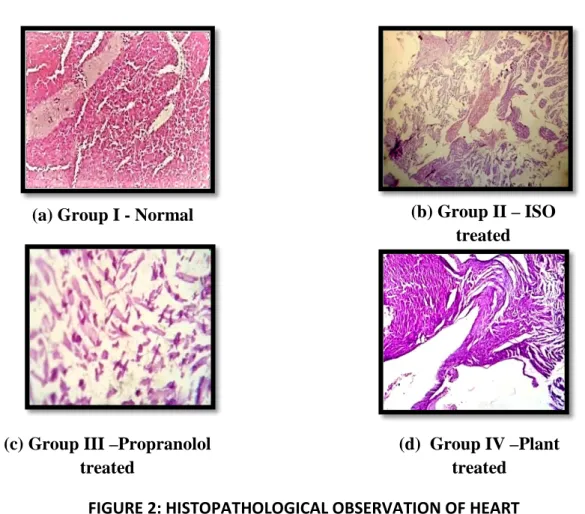
Histological observations (Figure 2) showed no pathological changes in myocardium in control rats, whereas in the isoproterenol induced rats showed severe tissue degeneration and
necrosis. Pretreatment with Artocarpus atillis (Group IV) reversed the changes showing
International Research Journal of Pharmaceutical and Biosciences (IRJPBS) 5(1) 6
FIGURE 2: HISTOPATHOLOGICAL OBSERVATION OF HEART
Figure 2: Histopathological observation of heart:- (a) Group I: Normal architecture of heart,
(b) Group II (ISO induced): Severe tissue degeneration and necrosis, (c) Group III
(Propranolol): Mild tissue degeneration and necrosis, (d) Group IV (Artocarpus altilis extract):
Moderate tissue regeneration and necrosis.
CONCLUSION
In summary, the present study implies that the hydroethanolic extract of Artocarpus altilis
showed a significant decrease in the elevated cardiac marker enzymes which may be due to the phytochemical compounds present in it. The histological findings suggested that, the
heart tissues affected by isoproterenol were recovered by the administration of Artocarpus
altilis. So it has been concluded from the biochemical and histopathological studies that the
Artocarpus altilis at 250 mg/kg of body weight produced a significant cardioprotection in
isoproterenol induced myocardial rats. Thus, our study clearly indicated a significant
cardioprotective activity of hydroethanolic extract of Artocarpus altilis. Further research is
required to isolate the respective bioactive compound responsible for the cardioprotective effect.
(a) Group I - Normal (b) Group II – ISO
treated
(c) Group III –Propranolol treated
International Research Journal of Pharmaceutical and Biosciences (IRJPBS) 5(1) 7 REFERENCES
1. Gayathri V, Ananthi S, Chandronitha C, Ramakrishnan G, Sundaram R, and Vasanthi
HR. Cardioprotective effect of Nerium oleander flower against Isoproterenol induced
Myocardial Oxidative stress in Experimental Rats. Journal of Cardiovascular Pharmacology and Therapeutics, 2011, 16(1) : 96-104.
2. Hill MF and Singal PK. Antioxidant and Oxidative Stress changes during heart failure
subsequent to Myocardial Infarction in Rats. American Journal of Pharmacology, 1996, 148 (1): 487-500.
3. Mazo M, Benard P, Abizanda G, Pelacho B, Leoban B, Gavira JJ. Transplantation of
Adipose derived stromal cells is associated with functional improvement in a Rat model of Chronic Myocardial Infarction. European Journal of Heart Failure, 2008, 10: 454-462.
4. Radhika S, Smila KH, Muthezhilan R. Cardioprotective activity of Hybanthusendea
spermus (linn) in Isoproterenol induced Rats. Indian Journal of Fundamental and
Applied life sciences, 2011, 1 (3): 90-97.
5. Bhandari U, Ansari MN, Islam F. Cardioprotective effect of Aqueous extract of
Embellaribes Burm fruits against Isoproterenol induced Myocardial Infarction in Albino
Rats. Indian Journal of Experimental Biology, 2008, 1:40-52.
6. Steenen SA, van Wijk AJ, van der Heijden GJ, van Westrhenen R, de Lange J, de Jongh
A. Propranolol for the treatment of anxiety disorders: Systematic review and meta-analysis. Journal of Psychopharmacology, 2015, 30(2): 128–139.
7. Sikarwal MS, Hui BJ, Subramaniam K, Valeisamy BD, Yean LK, Balaji K. A Review on
Artocarpus altilis (Parkinson) Fosberg (Breadfruit). Journal of Applied Pharmaceutical
Science, 2014, 4 (08): 91-97.
8. Al-Rasheed NM, Al-Oteibi MM, Al-Manee RZ, Al-Shareef NM, Hasan IH, Mohamad RA,
Mahmoud AM. Simvastatin prevents isoproterenol-induced cardiac hypertrophy through modulation of the JAK/STAT pathway. Drug Design, Development and Therapy, 2015, 9: 3217-3229.
9. Trivedi CJ, Balaraman R, Majithiya JB, Bothara SB. Effect of atorvastatin treatment on
isoproterenol – induced myocardial infarction in rats. Pharmacology, 2006, 77: 25 – 32.
10. Mohamed Sadiq A, Sivakumar V, Muruganandam D. Evaluation of Cardioprotective
activity of Terminalia arjuna Linn. In isoproterenol induced myocardial infracted