Research Article
a
April
2018
Computer Science and Software Engineering
ISSN: 2277-128X (Volume-8, Issue-4)
Optimization of WMN Performance for Different Propagation
Environment
Er. Reshi Isfaq Qadir
M.Tech Scholar, CSE Deptt., SIET, Aliyaspur Ambala, Haryana, India
Er. Anuradha Saini
A.P., CSE Deptt., SIET, Aliyaspur Ambala, Haryana, India
Abstract— Wireless mesh networks are multihop systems in which contrivances avail each other in transmitting packets through the network, especially in arduous conditions. We can drop these ad hoc networks into place with minimal preparation, and they provide a reliable, flexible system that can be elongated to thousands of contrivances. The wireless mesh network topology developed is a point-to-point-to-point, or peer-to-peer, system called an ad hoc, multi-hop network. A node can send and receive messages, and in a mesh network, a node withal functions as a router and can relay messages to its neighbours. A mesh network offers multiple redundant communications paths throughout the network. If one link fails for any reason, the network automatically routes messages through alternate paths. In a mesh network, we can abbreviate the distance between nodes, which dramatically increases the link quality. If we reduce the distance by a factor of two, the resulting signal is at least four times more puissant at the receiver. This makes links more reliable without incrementing transmitter power in individual nodes. In a mesh network, we can elongate the reach, integrate redundancy, and amend the general reliability of the network simply by integrating more nodes. One of the most astronomically immense issues in routing is to providing copacetic performance while scaling the wireless mesh network. It is fascinating, however, to investigate what transpires when routing nodes are expanded in different propagation environment and how that affects routing metrics. In this thesis, we examine the utilization of different proactive, reactive and hybrid protocols in such a way so that we may be able to build a cost function which avails in culling the finest grouping of routing protocols for a particular urban wireless mesh network. The key parameters are network throughput and average end to culminate delay. The performance of Bellman ford, DYMO, STAR and ZRP protocols have been examined with different node densities. A non-linear cost function equation has been proposed corresponding to each routing parameter taken. Bitrate is taken as constant (CBR).
Keywords: WMN, throughput, Bellman ford, DYMO, STAR, and ZRP, Propagation Models
I. INTRODUCTION
ISSN(E): 2277-128X, ISSN(P): 2277-6451, pp. 76-83 measurements that are modestly contrasted with the wavelength, and where the quantity of snags per unit volume is cosmically tremendous. Scattered waves are caused by harsh surfaces, minute items, or by different anomalies in the channel. So it is speaking to picture the execution of WMNs with these deterrents and investigate the best-fit amalgamation of directing conventions. In our postulation, we are thinking about the execution of four conventions. They are bellman passage (BF) convention, dynamic on request Manet (DYMO) directing convention, source tree versatile (STAR) steering convention and zone directing convention (ZRP). These conventions radiate from the group of master dynamic, responsive and mixture compose conventions. The considering execution parameters are normal throughput and come full circle to come full circle delay. The throughput is measured in bits every second while the postponement is evaluated in seconds. The way misfortune factor is mulled over. Way misfortune can be communicated as the proportion of the strength of the transmitted flag to the intensity of a similar flag got by the beneficiary, in a given way. It is an element of the proliferation separate. Estimation of way misfortune is extremely fundamental for outlining and conveying remote correspondence systems. Way misfortune is subject to various factors, for example, the radio recurrence utilized and the idea of the territory. We use a reproduction display predicated on Qual Net 5.0. Our execution assessments are predicated on the reproductions of 25 remote versatile hubs that shape a remote specially appointed system over a rectangular (1500 X 1500 m) level space. In these re-enactments, we made outcomes related to two parameters to be specific throughput and come full circle to-end delay. The throughput of an association between two hubs is evaluated as the number of bytes disseminated per time unit. The end-to-end bundle delay is ascertained as the time interim when the parcel is caused and yare for the transmission until the point when it is appropriated to the getting application at the goal hub. It incorporates transmission delay, engendering postponement and preparing delay.
II. RELATEDLITERATURESURVEY
Initiated in the 1970's with PDAs. Out of the blue, individuals had a convenient of correspondence that endorsed them to contact any other person who had a telephone. From original to display time remote correspondence transmutes a considerable measure of innovation. The remote framework can be worked for next to no cost contrasted with customary wired choices. The time and exertion saved by approaching the sizably voluminous-scale system of data convert into riches on a nearby scale, as more work should be possible with a lessening of time and with less exertion. In like manner, the system turns into all the more profitable as more individuals are associated with it. Voice interchanges, email, and other information can be traded for next to no cost [1]. Remote work systems are multi-bounce frameworks in which inventions bolster each other in transmitting parcels through the system. We can drop these specially appointed systems into put with insignificant planning and they give a solid, adaptable framework that can be stretched to monstrously goliath number of inventions. The remote work arranges topology created is point-to-point-to-point frameworks called a multi-jump organize [2] [3]. A hub can send and get messages and furthermore works as a switch and can hand-off messages for its neighbours. On the off chance that one connection comes up short for any reason, the system naturally courses messages through interchange ways. A work arrange isn't just intrinsically solid, it's withal very versatile. On the off chance that a contraption or its connection comes up short, messages are sent around it through different inventions. Loss of at least one hubs doesn't compulsorily influence the system's activity. A work arrange is self-reviving in light of the fact that human intercession isn't mandatory for re-steering of messages [4]. Some of the time, giving system network can be grave, extravagant, tedious or unpleasant. Firetide develops WMNs solidly designed for giving network [5]. An impromptu steering convention is a standard that controls the system by which the hubs choose which approach to course bundles between registering contraptions in a portable specially appointed system [6]. The steering can be ordered as
• Pro-dynamic (table-driven) steering
These kinds of directing conventions keep up crisp arrangements of goals and their courses by occasionally disseminating steering tables all through the system [7].
• Reactive (on-request) steering
This kind of directing conventions finds a course on request by flooding the system with Route Request bundles [8] [9].
• Hybrid (both star dynamic and receptive) directing
ISSN(E): 2277-128X, ISSN(P): 2277-6451, pp. 76-83 time, where |V| and |E| are the number of vertices and edges separately. The basic components in STAR incorporate the discovery of neighbours and trade of topology data (refresh message) among hubs [14]. In Reactive (On-Demand) Routing Protocols, a sourcing hub (sender) starts course disclosure when it requires sending a parcel to a goal. Once the course is found, the hub stores it in its course reserve with a specific end goal to use it for sending bundles [9] [15]. DYMO convention for instance of this family. The Dynamic MANET On-request (DYMO) convention is a responsive directing convention being created inside IETF's MANET working gathering [12] [16]. In Hybrid Routing Protocols, an amalgamation of Reactive and Proactive steering conventions subsists. ZRP is a case of this family. The Zone Routing Protocol (ZRP) takes the benefit of genius dynamic disclosure inside a hub's nearby neighbourhood and using a responsive convention for correspondence between these areas. ZRP isolates its system in various zones [17]. But the half-breed nature of the ZRP appears to assign that it is a various levelled convention, it is significant to bring up that the ZRP is, in reality, a level convention [18]. ZRP is more effectiveness for cosmically gigantic systems.
Constant Bit Rate (CBR)
Constant Bit Rate (CBR) is an encoding technique that keeps the bit rate same rather than variable piece rate (VBR), which fluctuates the bit rate [19].
Radio Propagation Models
Radio waves are presented for reflection, diffraction or disseminating prompting multipath spread [20] [21]. Way misfortune assumes a vital part of proliferation. Way misfortune can be communicated as the proportion of the power of the transmitted flag to the puissance of a similar flag got by the collector, in a given way. It is an element of the proliferation remove. Estimation of way misfortune is extremely vital for outlining and conveying remote correspondence systems [22] [23]. We introduce four-way misfortune models in our re-enactments. Free space proliferation models construe zero shadowing.
1. Okumara - Hata Model
This model is very lucky for cosmically colossal cell versatile frameworks, yet not for individual correspondences frameworks that cover around the zone of roughly 1 km in sweep [24]. It might be noticed that the Okumura-Hata show contains three basic components: starting balance parameter, introductory framework plan parameter and, determinately, the parameter building up the incline of model bend [25].
2. Free Space Model
The free space engendering model induces the perfect spread condition that there is just a single clear line-of-visual discernment way between the transmitter and recipient [26]. The free space demonstrates basically speaks to the correspondence extend as a hover around the transmitter. In the event that a collector is inside the circle, it gets all parcels Otherwise, it loses all bundles.
3. Two Ray Propagation Model
The model proposes that the flag achieves the recipient through two ways, one a line-of-visual discernment way, and the other the way through which the reflected (or refracted, or scattered) wave is gotten [26] [27].
4. Cost 231 Walfisch – Ikegami Model
This experimental model is a cumulating of the models from J. Walfisch and F. Ikegami. It was additionally created by the COST 231 task [28].
III. EXPERIMENTAL RESULTS AND ANALYSIS
We use a simulation model based on Qual Net 5.0 in our evaluation [30]. The throughput of a connection between two nodes is measured as the number of bytes delivered per time unit. Formally, Throughput =Total bytes received.
Proposed Methodology
ISSN(E): 2277-128X, ISSN(P): 2277-6451, pp. 76-83 The hubs are put erratically in a 1500m X 1500m territory. Hubs in the reenactment set up move as indicated by a model that is noticeable as the "irregular waypoint" display [29]. The kineticism situation records we used for every recreation are described by a delay time. The hub winnows a self-assertive goal in the 1500m x 1500m space and peregrinates to that goal at a scurry appropriated consistently. After achieving the goal, the hub stops again for delay time seconds, winnows another goal, and continues there as a foretime depicted, emphasizing this department for the length of the reproduction. Every reproduction kept running for 100 seconds of mimicked time. The following sections categorize and present the simulation parameters used in our experiments:
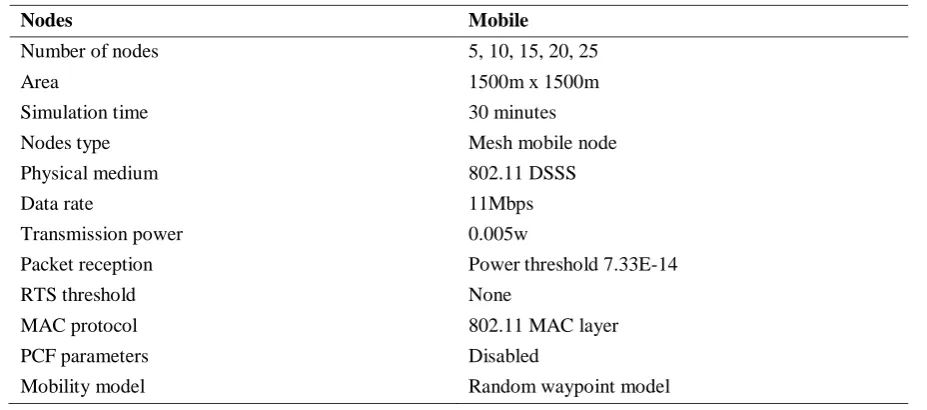
Table 1 Network and Communication Parameters
Nodes Mobile
Number of nodes 5, 10, 15, 20, 25
Area 1500m x 1500m
Simulation time 30 minutes
Nodes type Mesh mobile node
Physical medium 802.11 DSSS
Data rate 11Mbps
Transmission power 0.005w
Packet reception Power threshold 7.33E-14
RTS threshold None
MAC protocol 802.11 MAC layer
PCF parameters Disabled
Mobility model Random waypoint model
Simulation Results for Throughput
The following figures in this section show the network Throughput results obtained from the simulation scenarios. The obtained results are according to the mobility considerations.
Table 2 Throughput Values for Okumara Hata Model
No. of nodes BF DYMO STAR ZRP
5 3465 5586 4337 4323
10 5460 8434 4411 4410
15 2494 5477 4914 4778
20 5461 5477 5461 5460
25 3644 4457 4253 4926
ISSN(E): 2277-128X, ISSN(P): 2277-6451, pp. 76-83
Table 3 Throughput Values for Free Space Model
No. of nodes BF DYMO STAR ZRP
5 4275 4293 4290 4276
10 3561 4096 3510 3561
15 3383 4096 3315 3383
20 2849 4165 3855 2673
25 2606 3339 2651 1428
Fig. 2. Throughput details in Free Space propagation model
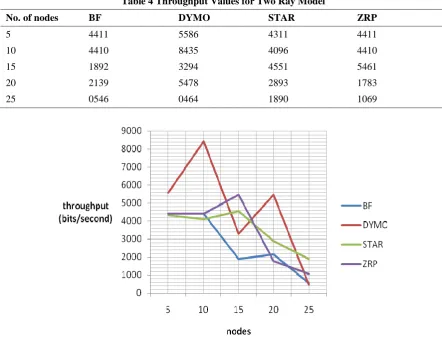
Table 4 Throughput Values for Two Ray Model
No. of nodes BF DYMO STAR ZRP
5 4411 5586 4311 4411
10 4410 8435 4096 4410
15 1892 3294 4551 5461
20 2139 5478 2893 1783
25 0546 0464 1890 1069
ISSN(E): 2277-128X, ISSN(P): 2277-6451, pp. 76-83
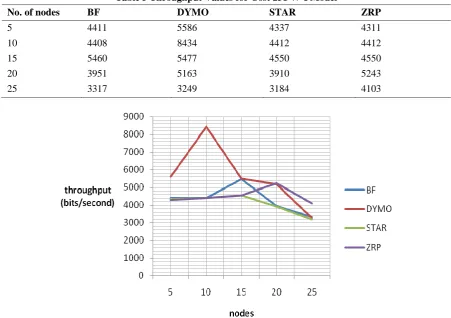
Table 5 Throughput Values for Cost 231 W-I Model
No. of nodes BF DYMO STAR ZRP
5 4411 5586 4337 4311
10 4408 8434 4412 4412
15 5460 5477 4550 4550
20 3951 5163 3910 5243
25 3317 3249 3184 4103
Fig. 4 Throughput details in Cost 231 W-I propagation model
Table 6 Rating of Cost Function for Okumara Hata Model
No. of nodes Bellman ford DYMO STAR ZRP
5 Average Good Good Good
10 Good Good Good Good
15 Average Good Good Good
20 Good Good Good Good
25 Average Good Good Good
Table 7 Rating of Cost Function for Free Space Model
No. of nodes Bellman ford DYMO STAR ZRP
5 Good Good Good Good
10 Average Good Average Average
15 Average Good Average Average
20 Average Good Average Average
25 Average Average Average Average
Table 8 Rating of Cost Function for Two Ray Model
No. of nodes Bellman ford DYMO STAR ZRP
5 Good Good Good Good
10 Good Good Good Good
15 Average Average Good Good
20 Average Good Average Average
ISSN(E): 2277-128X, ISSN(P): 2277-6451, pp. 76-83
Table 9 Rating of Cost Function for Cost 231 W-I Model
No. of nodes Bellman ford DYMO STAR ZRP
5 Good Good Good Good
10 Good Good Good Good
15 Good Good Good Good
20 Good Good Average Good
25 Average Average Average Good
IV. CONCLUSION
After studying the throughput and delay behavior of these proactive, reactive and hybrid protocols, we notice that DYMO protocol helps in obtaining high throughputs but many delays in the transmission of data packets do not make this proactive protocol reliable for urban wireless mesh networking for long distances. The Bellman-Ford protocol is best suited for lower node densities and STAR/ZRP protocols are appreciable more on intermediate or higher node densities.
As for the propagation model is concerned, we can conclude that reactive and/or hybrid routing can be best suited for Okumara-Hata model. In case of Free Space model, proactive and/or reactive routing may perform well. For Two Ray propagation model, proactive, reactive and/or hybrid routing can achieve good results and so in the case of Cost 231 W – I model.
REFERENCES
[1] T. Rappaport, “Wireless Communication: Principles and Practice”, Prentice Hall, 2002
[2] I.F. Akyildiz and X. Wang, “A Survey on WMNs”, IEEE Communication Magazine, September 2005
[3] G. Askoxylakis and N. Mechin, “Usage Scenarios and Application Requirements for Wireless Mesh Networks”, IEEE proceedings, 978-1-4244-4439, March 2009
[4] V. Mynampati, D. Kandula, R. Garimilla and K. Srinivas, “Performance and Security of Wireless Mesh Networks” Blekinge Institute of Technology, June 2009
[5] http://en.wikipedia.org/wiki/Firetide
[6] D. Bisen, P. Suman, S. Sharma and R. Shukla, “Effect of Pause Time on DSR, AODV and DYMO Routing Protocols in MANET “, RGPV University, November 2009
[7] D.O. Jorg, “Performance Comparison of MANET Routing Protocols in Different Network Sizes”, Computer Science Project, Institute of Computer Science and Applied Mathematics, Computer Networks and Distributed Systems (RVS), University of Berne, Switzerland, 2003
[8] S. Karthik, S. Kannan, M.L. Valarmathi, V.P. Arunachalam and T. Ravichandran, “A Performance Analysis and Comparision of Multi-hop Wireless Ad-hoc Network Routing Protocols in MANET”, International Journal of Academic Research, vol. - 2, no.- 4. July 2010
[9] N.S. Yadav and R.P.Yadav, “Performance Comparison and Analysis of Table- Driven and On-Demand Routing Protocols for Mobile Ad-hoc Networks”, International Journal of Information Technology, vol. - 4, no. - 2, 2008 [10] M. Oh, “A Hybrid Routing Protocol for Wireless Mesh Networks”, IEEE networks, Oct 2004
[11] C.S.R. Murthy and B.S. Manoj, “Ad-Hoc wireless networks: architectures and protocols”, Prentice Hall Communications Engineering and Emerging Technologies Series. Prentice-Hall, May 2004
[12] www.ietf.org, August 2007
[13] A.B. Malany, V.R.S. Dhulipala and R.M. Chandrasekaran, “Throughput and Delay Comparisions of MANET Routing Protocols”, International Journal Open Problem Compt. Math., vol.- 2, no.- 3, September 2009
[14] J. J. Garcia and M. Spohn, “Source-Tree Routing in Wireless Networks,” Proceedings of 7th International Conference on Network Protocols, 1999
[15] A. Rahman, S. Azad and F. Anwar, “Performance Analysis of On-Demand Routing Protocols in Wireless Mesh Networks”, Informatics Economică, vol. - 13, no. - 2, September 2009
[16] N. Sivakumar and S.K. Jaiswal, “Comparison of DYMO protocol with respect to various quantitative performance metrics”, Malardalen University, May 2007
[17] http://www.tct.hut.fi/opetus/s38030/k02/Papers/08-Nicklas.pdf
[18] J. Schaumann, “Analysis of the Zone Routing Protocol”, December 2002
[19] C.S. Chang, K.C. Chen and M.Y. You, “Guaranteed Quality-of-Service Wireless Access to ATM Networks, IEEE Journal on Selected Areas in Communication, vol. - 15, no. - 1, January 1997
ISSN(E): 2277-128X, ISSN(P): 2277-6451, pp. 76-83 [21] P.K. Sharma, “Comparative Analysis of Propagation Path loss Models with Field Measured Data”, International
Journal of Engineering Science and Technology, vol. - 2(6), 2010
[22] M. J. Feuerstein, K. L Blackard, T. S. Rappaport, S. Y. Seidel and H. H. Xia, “Path Loss, Delay Spread, and Outage Models as Functions of Antenna Height for Macro cellular System Design,” IEEE Transactions on Vehicular Technology, VT-43, 3, pp. 487-498, August 1994
[23] S. R. Saunders and F. R. Bonar, “Explicit Multiple Building Diffraction Attenuation Function for Mobile Radio Wave Propagation,” Electronics Letters, pp. 1276-1277, July 1991
[24] A. Medeisis and A. Kajackas, “On the Use of the Universal Okumura-Hata Propagation Prediction Model in Rural Areas”, IEEE proceedings, 0-7803-571, 2000
[25] M. Hata, “Empirical Formula for Propagation Loss in Land Mobile Radio Service,” IEEE Transactions on Vehicular Technology, pp. 317-325, March 1980
[26] A. Kathirvel and R. Srinivasan, “Analysis of Propagation Model using Mobile Ad Hoc Network Routing Protocols, International Journal of Research and Reviews in Computer Science (IJRRCS), vol.- 1, no.- 1, 2010 [27] K. Jain, J. Padhye, V.N. Padmanabhan and L. Qiu, “Impact of Interference on Multi-Hop Wireless Network
Performance”. Proceedings of the Ninth Annual International Conference on Mobile Computing and Networking, pp. 66-80, September 2003
[28] H.K.Sharma, S. Sharma and K.K. Pandey, “Survey of propagation Model in wireless Network”, IJCSI International Journal of Computer Science Issues, vol.- 8, Issue 3, no.- 2, May 2011
[29] MK Priyan and GU Devi –“Energy efficient node selection algorithm based on node performance index and random waypoint mobility model in internet of vehicles” Cluster Computing, 2017