International Journal of Innovative Technology and Exploring Engineering (IJITEE) ISSN: 2278-3075, Volume-8 Issue-6S, April 2019
Abstract: Over the last decade, the Federal Democratic Republic of Ethiopia has made tremendous development gains in education, health, and food security. In 2017, GDP growth was 10.3 percent (World Bank). The Ethiopian tourism industry is not supported by Information Communication Technology automation, for this reason, its development was slowed down a meaning while research shows will grow. Smart technologies reach into almost all aspects of life nowadays, although they are often not yet noticed by users and taken as a given in a lot of cases. Smart tourism industry technological advancement every nations metropolis till remain in a foundation development stage and why it is difficult to really meet the needs of tourists. The smart tourism is discussed as a comprehensive approach that something useful such as tourism information, service related to travel, such as destination, food, transportation, reservation, and travel guide, conveniently to tourists through ICT devices. So in this paper, we will view the general idea of designed smart tourism architecture for Ethiopia by collaborating the internet of everything with a cloud system for improving and giving a solution for the problem stated below. In this paper, we focus on developing the design architectural model of smart tourism system using internet of everything’s over cloud platform to achieve the goal of Ethiopia Tourism Organization and as part of the fulfillment of the requirement for the degree of masters of technology. And also the paper explores with the design the integration of internet of everything technology and tourism to get an easy way to manage tourism information and other related infrastructures for travelers, agents, and other related stakeholders. The development of smart tourism architecture for Ethiopia deals with having the objective of evaluating practices & innovative tools to support a cultural property that is inherited. On the other hand, the thesis is centered in Ethiopian context and survey is conducted.
Keywords: Architecture, Cloud platform, ICT, IOE, Smart Tourism
I. INTRODUCTION
During recent years tourism has become one of the world’s largest and most powerful industries. As in the paper [4] indicated tourist information management system is a product which is required when tourism develops to a certain stage by allows tourism resources to be effectively managed. Nowadays Tourism has become one of the most growing rapidly industry in the world as explained ETO [5]. Tourism industry development mainly depends on how to manage tourism information. In Ethiopia, tourism information management became increasingly popular but this tourism information mainly managed based on paper and oral.
Revised Manuscript Received on April 06, 2019.
Amanuel Getachew Bulti, School fo Computer Engineering, Kalinga Institute of Industrial Technology Deemed to be University/ Bhubaneswar, India.
Abhishek Ray, School fo Computer Engineering, Kalinga Institute of Industrial Technology Deemed to be University/ Bhubaneswar, India.
Prachet Bhuyan, School fo Computer Engineering, Kalinga Institute of Industrial Technology Deemed to be University/ Bhubaneswar, India.
People are more and more dependent on such systems especially in developing countries such as Africa continent country.
As the industry develops and competition increases, destinations are creating new value for tourists, business operators, and stakeholders by collecting data, supporting the exchange and interconnectivity of this data, and by processing this data for analysis and development of intelligent applications. Smartness takes advantage of interlinkage and the ability to exchange and use information of incorporated technologies to rethinking and redesign procedures and information. This rethinking and redesigning empower forming items, actions, procedures, and services progressively, through engaging various partners/stakeholders simultaneously to rearrange the collective overall performance and competitiveness and produce agile solutions and value for all associated within the system value. This research paper concentrates on demonstrating the necessity and effectiveness of smart tourism which delivers travelers information resource within cost effective and real time. Also, our study overview how ETO Information technology operation manages each channel, website, Social media network service, applications and finally suggests the smart tourism future direction for the successful realization and develop best architecture of smart tourism for Ethiopia by used and analysed in case of international practices in the way to get some other characteristics of smart tourism in other countries.
I.
The theoretical concept of smart tourism
A.
Structure of Smart Tourism
The smart system exploits innovation of technology to procedure data in actual time to provide products and services which are of incentive for all included. Smartness is the glue of interoperable, interlinked and jointly commonly helpful frameworks and partners and gives the information organization for the value creation for all. Intelligence is cultivated by open advancement, bolstered by interests in human and social capital, and supported by participatory administration, so as to build up the aggregate intensity of the travel industry goals to improve social, economic and environmental prosperity for all partners and produce values for tourists.
Generally, the word "smart" has turned into another popular expression to portray technological, financial and social improvements fueled by the innovation of information technology. Based on sensors, big data analytics, and open information, better approaches for connectivity or availability and interchange of data (e.g., NFC, IOT, and RFID) just as capacities to induce and reason. Just, it portrays multi-usefulness and abnormal amounts of availability called as intelligent or smart.
Smart tourism is characterized as the travel and tourism industry upheld by coordinated endeavors at a vacation spot to gather and combined/more information got from the physical framework, authorities/organizational sources, social associations and human bodies/minds in combination with the utilization of advanced innovations.
Smart tourism is the developments of e-tourism or smart information exchange system in the case of travel and Amanuel Getachew Bulti, Abhishek Ray, Prachet Bhuyan
Smart Tourism System Architecture Design
using the Internet of Everything(IOE) over
tourism as shown in Fig. 1. Based on the above definition and research [1], we have redesigned the structure of smart tourism system information exchange techniques for overall intelligent tour and travel applications as shown in Fig. 1.
Figure 1: Smart tourism information exchange system structure
B.
E-Tourism vs Smart Tourism
According to research [5], the key contrasts among smart tourism and e-Tourism is the system application and client base. A thoroughly considered arrangement for reserving and purchasing tickets well ahead of time is considerably less dependent on the momentary refreshing that intelligent systems frameworks are prepared to do. On the other side, the regular availability of Smart Tourism permits, or draws, clients that wouldn't mind doing ultimate minute reservations and adjustments to their arrangements. Generally, the two structures right now serve some capacity and a few characteristics inside the expansive idea of present-day tourism and travel industry, where e-tourism is utilized when the excursion and Smart Tourism amid the journey.
Table 1: The Difference between e-Tourism and Smart Tourism system [5]
C.
The concept of the IOE
The IOE technology which consolidates cloud computing generation gathers and organizes information, facts & statistics by using wireless sensor and RFID then transmits it to the software or software layer of the cloud computing framework.
Internet of everything includes a variety of technology and standardization structures, it's business chain is big and extensive, its advancement wishes the authorities’ coverage help (authorities’ policy aid), mutual cooperation and exchange among companies, the joint efforts of the enterprise. It’s ideal community resources & the large purchaser is used to establishing the basis of net facts transmission bearing frame. Furthermore, enterprise call is utilized
for pushing the systems networking administration innovation and undertaking advancement.
The IOE will upgrade our lives hugely, as even one unassuming component will have clearing suggestions for business, social associations, and prosperity when all is said in done. Astounding things will occur, and stunning encounters will be made. Internet of Everything (IOE) have sorted their pillars into four: [10] [11] People: let’s consider as "end-nodes" associated over the web (internet) to share data. So model consists of social networks, wellbeing and wellness sensors, amongst others.
Associated individuals make behavioral adjustments dependent on their get right of entry to data. At the same time, their changed conduct influences that data created. This is called an input feedback loop that connecting peoples in progressively significant ways. Associations use information created by associated individuals or connected peoples to refine and focus on their advertising systems. Things: Physical sensors, gadgets, actuators, & different things producing or getting data/information from unrelated sources. For the IoE to work, the majority of the gadgets that are a piece of the expected IoE arrangement must be associated together so they can impart. There are two manners by which gadgets can be associated; either wired or remotely.
Data: Raw or unanalyzed data prepared into valuable data to empower smart decisions and manipulate mechanisms. Big Data implies to the huge measure of information produced each hour by billions of associated/communicated gadgets. Big data calls for new products and strategies to manipulate, store, and analyze it. Processes: -happen between a group of individuals, things, and information/data. Nowadays, the IoE brings all of them collectively through combining M2M, M2P, and P2P connections. Utilizing network among information, things, and a group of individuals known as people to add values.
"IOE" sets up an end-to-end ecosystem of interconnection includes processes, technologies, and innovation ideas utilized overall interconnection use-cases. Any further groupings or classification –, for example, the Internet of Humans, Internet of Digital, Industrial Internet of Things, communication/correspondence advancements and the Internet itself – will, in the long run, establish a subset of IoE if not considered in that capacity as of now.
These works are mainly improving the system based on the literature and previous existing systems in Ethiopia, as well as the World. When we said that problem statement, we want to explain why we need to do such vast and big research base problem to define new system who answer those problems as answers. So let’s explain those problems in details.
[image:2.595.48.287.488.615.2]International Journal of Innovative Technology and Exploring Engineering (IJITEE) ISSN: 2278-3075, Volume-8 Issue-6S, April 2019
Figure 2: Four Key Pillars of the Internet of Everything (IOE) [11]
helps us to do transform smart city environment in the near future. So before seen the detailed picture of the review related literature, lets recap about the problem in the previous system works. 1.A visitor needs full data on what he/she ought to expect at the
goal and desires to have full information on what he/she has to count on at the destination. And also traveler needs a visit direct that will encourage him/her to explore the goals of the decision.
2.Travelers from our world over are constantly prepared to discover new destinations, but the hassle is that most at times they end up being dissatisfied after journeying a few websites. That is as a result of incorrect information and a shortage of making plans by the website manager’s maximum at times.
3.A vacationer needs to have an excursion guide in an effort to assist him/her to navigate around the locations of choice. 4.Not so productive in giving data, User-friendly, Network
accessibility issues.
5.Prediction of right places as per reasonable costs was not there. And also Searching for somewhere and someone data or information is time taking and it also increases the workload of the workers?
6.No central database can be created as information is not available in the database to anyone as a country to serve all Ethiopian people, governments and tourists. There is no centralized full content providing systems for Customers. So we imply this as Absence of well-organized data communication in the reporting mechanism.
7.Disorganized data recording method and no backup system in another place. And also in recording system redundancy may occur in many cases and in the retrieval and manipulating process workers are near to do a mistake by nature.
8.Lack of personalized plan system, finding a tourism destination is difficult and loss of data/files.
9.Entering the industry of unapproved persons by different methods.
10. Information about issue/return of the tourists are not properly maintained, there is no well-formed structure information about of tour and travel agency and fast report generation is not possible.
II. PROPOSED ARCHITECTURAL MODEL Before going much deeper in the details of smart tourism architectural model, let’s discuss little in why do we need Smart Tourism using IOE and cloud System?
In smart tourism, we use internet of everything to read/write data from/to cloud service in both of our system operations. So here, IoE acts as Communication media. Also, the internet of everything helps in the future improvement of the system to next-generation
technologies by adding to techniques of utilizing this intelligent system.
A.Modes of Operation and Assumption
Generally, we are motivated to contribute/ address to the goal of general of an architectural model design of smart tourism technology system using the internet of things and cloud services. The main goal of the system is to provide the design of a general architectural model for Ethiopia as well as other countries for further computing work sequence.
As our newly developed system is trying to serve visitor (traveler), government and other stakeholders such as hotel, tour and travel agencies, car rental service organization and etc. So to meet the needs of our user/client the new smart system was designed to provide service as the following operation modes of operation interface.
1) Web-based system: Such type of operation service system based on using internet web technologies to provide information. Generally, here we implement smart tourism web-based system to monitor/ tracking the overall system and also based user role they used for several listed in the below section.
2)Phone-based system: In phone-based system mainly did planning tour package and used as a travel guide, Emergency help module, and query/feedback. And also operated on the application. Generally, we implement here to help the tourist in managing his activity system.
B.New working system functional Sequence Architecture
Here, we use cloud system application for storing and fetching data by using big data technique of searching and filtering known as Hadoop (Map Reduce). Map reduce has advantages of filtering to easily evaluates every record individually and decides, based on query condition, whether it should stay or go. We define more than six actions in the overall architecture functional modular as defined theoretically and figuratively in Fig. 3. In our system, every main module of the system have submodules of the smart tourism system.
Figure 3: The functional modular architecture of smart tourism
i.
Registration and Login Module System: -
In this module, they have service of registration for future usability of the system based on their user role.ii.
Tour and Travel Guide Module System: -Generally, by using this service module the user is access location map and get updated information about the presence of his/her needs service in the area. In this module we design the subsystem service that have functionalities such as find current location, locate shortest path in map, calculate distance between different location and also helps to get tour and travel guidance in form of audio, video, text by embedding information application with QR code, NFC reader technology and other and so on. This subsystem mainly implemented in the phone-based application.iii.
Reservation and Booking Module System:-
Here mainly focused on hotel, [image:3.595.307.562.417.554.2]system architecture under reservation and booking module, we have hotel submodule pages that deals with the various hotel details. Hotel module details generally we will maintain a hotel module. It has all the details like the hotel name, the address of the hotel, the type of hotel, contact person details, number of rooms in the hotel and facilities available in that hotel. Here we will maintain hotel tariff according to the room type, bed type, sharing type, seasonal wise age group wise i.e. adult. Junior, child, corporate and rake rate wise.
iv.
Planning Module System: -This module has sub services like Map/GPSthat can help a foreigner to locate location based on longitude and latitude as similar to google map. And easily select the heritage/ Tourist point that he/she wants to visit. Also, they have subsystem like planning tour/travel package.Itinerary Module deals with client profile, Settled visiting bundles, its calendar and custom agendas in this holding of hotels and vehicles and so forth have been taken care of. In this planning Total bundle cost and grown-up value, youngster value breakups will come consequently. Client master screen likewise incorporated into this module. Client contact data, assemble subtleties, breakups of individual landings and flights in the gathering, client code age technology and following will be there. Gathering should be possible clients insightful, Guide and driver's distribution will be finished. In this module, we will have 3 different pages like Client Profile, Fixed Itineraries Booking, and Custom Itineraries Booking. v. Tracking and Report Module System: - This module helps
our client or all beneficiary of this system in various ways. For example, in the report module, we can generate the various MIS Reports to monitor the income, client measurements specialist's execution, month astute, amid the days and year insightful and so on, Voucher where produced for the client for all the convenience and transport offices asked by the client.
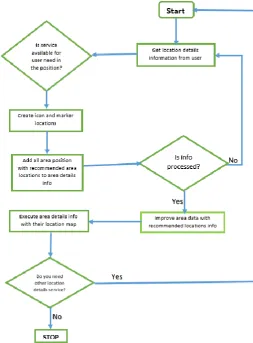
Also, traveler (user) tracks their location through a web map and manage as described in flowchart Fig. 4. This operation helps to find nearby hotels, vehicles, police station, hospital, different types of the recreation center.
vi.
Renting and Shopping Module System: - This module helps our system customer in a way to get a better experience without bounding location, time to fulfill their need.vii.
Local Service Module System: - Here in this module, the system has local services provides such as short term local festival features, online/offline smart tourism system help desk features, system administrator and coordinator communication features.viii.
Query and Feedback Module System: - In this module, we facilitate such as asking a query and also give feedback for any services based on clients will.ix.Personalized module system: - This module designed mainly for the administrator of the system. But the page is necessary for several agents’ customer officer, traveler, and developer.
Generally, the system service will integrate with the cloud system and the internet of everything. In data, requirements must store in the cloud because it’s vast and comes from many directions. Also, access location of various service details as shown in Fig. 4: C. System Components Services
As a researcher overall design of system architecture consists of different components such as the internet of everything (IoE), end-user internet service and cloud service [9]. But, we develop a new technical component of smart tourism to achieve more smartness of the system. So, as shown in Fig. 5, they have at least four different elements such as the Internet of Everything (IOE),
connected things (QR code, bar code, and NFC tag), big data analytics techniques (MapReduce) and also must have end user of the system. For example, QR code provides information monuments, museums, tourist device, and location for users in the system.
[image:4.595.307.539.123.259.2]Figure 4: Basic Components of the New Enhanced Smart Tourism System Structure
Figure 5: Flowchart of location information details service system
[1] Cloud Service Infrastructure
Cloud-based smart tourism system started in the past five years to pool various Tour and travel ICT resources into large clouds to able to transmit data automatically and easily. This cloud-based smart tourism system has consists central database server, unified interface Middleware (UIM) and an
[image:4.595.312.566.312.656.2]International Journal of Innovative Technology and Exploring Engineering (IJITEE) ISSN: 2278-3075, Volume-8 Issue-6S, April 2019
[2] Internet of Everything
Here, IOE serves in various ways including as communication barriers cloud central data services and connected unwearable and wearable smart things.
[3] Techniques of analyses data
In such an intelligent system, the data is big and vast, so it needs to filter and recommend the required data. Thus why the big data analytics techniques applied over a system. So, I use MapReduce to filter analyze data by using Hadoop from the cloud. Big Data implies the way to collect and analyze vast stores of data for understanding that can help recognize patterns, foresee conduct, and qualify decision maker’s tools.
[4] Connected Things
As an author presented based on paper Ahmad H. Al-Omari [4] stated different types of technologies such as the Internet of Everything (IOE), Quick Response code (QR), radio frequency identification (RFID) and Near Field Communication (NFC) that is required to remodel involvement of ICT in the tour and travel industry to call as smart tourism. For Example, in this work, we implemented NFC and QR codes to get tourism and travel information for tourist as a tour guide by connecting with internet for a sort of streaming video about a destination and linking with several websites that is useful for travel.
III.
DISCUSSION ON DESIGNED CASE STUDYThe main innovation of our system is when compared to other competitors is collective functionalities and administered central data system for the whole country and also they are many technologies used under this intelligent system.
Tourists can see information about nearby historic places and can view where they are and which direction they need to proceed. This makes it very helpful for tourists as they can now roam around without having to worry about losing their way in a place they are not familiar with, thanks to technological advancements in GPS and AR. Using AR, information can be displayed on the screen indicating directions, weather, road conditions, and traffic information as well as alerts to potential hazards in their path. We can consider 2000 of the main tourist place belonging to the city of Ethiopia, including churches, museums, monuments, gardens, towers, and historic buildings. Each tourist can select from 1 to 10 spots which can be reached either by public or private transport or walking: each transportation mode represents a different cost, expressed in a number of minutes. In order to evaluate the cost to get from one POI to the other, the Google Maps APIs have been used in an initial phase also traffic analytics and augmented reality taken into consideration the engine will provide predictive analytics based suggestions.
To compute the right time step at which the cost value has to be computed, we also considered the time spent by a tourist in past at each spot, supposing that they need an average of 30 minutes to visit each spot.
Tourist Route Selection Algorithm Based on Predictive Analytics and Augmented Reality: I- traffic conditions (GOOGLE APP), J-weather condition, K-shortest route
Algorithm:
1: For I in Tourism Path list then 2: For J in Tourism Path list then 3: For K in range (1, Route number) then 4: For M in the transport facility list then 5: Retrieve path time IJK [M]
6: End For
7: path cost [I, J, K] = min (path time IJK) 8: queue cost [J, K.M] = retrieve queue time JK 9: Compute cost [I, J, K]
10: End For
11: Find all opt route that solves with analytics and augmented reality
12: If there is more than 1 opt route then
13: Assign opt route to the one that corresponds to the shortest path 14: End If
When we conclude this discussion, the newly designed architecture of smart tourism system case study for Ethiopia has many advantages such as
- Simplicity and reliability - Supports the local economy - Flexibility and collaboration - Privacy and Security System - Operates environmental friendly
- Ensure quality and safety of the travel operation - Modified the organization of the tourism industry
- The Faster and more convenient tour guide operation for clients - The ability to profit from a flexible fare pricing scheme - Allow small businesses to compete internationally
- Allow setting rate (fee) in actual time to assist control demand and entertaining travel industry. Can set cost progressively to help oversee request and engaging the travel industry
- Dispose of unwanted inventory (these systems pose problems as well)
VII. CONCLUSION AND FUTURE WORKS
As we know, this system was designed in the first phase. So in near future, we enhanced the system in various ways to meet the needs of any tourism stakeholders and to solve the limitation of such technologies available currently in our world by extending the system from Ethiopia to the world. In more the detailed phase of implementation the whole enhanced smart tourism system working on it. The system allows for a platform to implement the following new things such as Improvement of Algorithm for planning of domestic trip based on their user plan and services consumers, security enhancement in order to increase confidentiality for users privacy, system has been made keeping in mind the fact that it should be as user friendly as possible and news updates and flashes about the city through appropriate information source. And also many smart object features added such as visitor and traveler crowdedness avoidance subsystem and many other services. In another way, we enhance business oriented intelligent digital marketing system. This system most used by tourists are those that give the possibility to locate, move on the territory, and managing planning tours.
Smart tourism based on cloud and IoE is a connecting platform for tourism, travel and hospitality alumni and industry stakeholders to create, promote sustainable and responsible tourism ecosystem in Ethiopia. This newly developed smart tourism system case study have many foundations in terms of reliability, scalability, flexible and extensive platform, security, integration with enterprise applications, minimization of cost, maintainability and system management. So, we are designing this case study of the system for the purpose of stay connected and stay united. And also adding many more intelligent features in the future
ACKNOWLEDGMENT
I accept this open door to remember and recognize the co-activity, generosity, and support both ethical and specialized reached out by a few people out of which the possibility of making this paper had advanced. Thus, I am enormously elated and appreciative to my consultant Dr. Abhishek Ray, who had upheld. By him, I need to be grateful for my co-advisor Dr. Prachet Bhuyan. And furthermore, I am appreciative my family GM-ASD and companions (particularly Mr. Tesfaye T ).
REFERENCES
[1]Wei Zhu, Lingyun Zhang and Nao LiDan Wang, Xiang (Robert) Li, Yun Peng Li, China's smart tourism initiative: A taste of service-dominant, Journal of Destination Marketing & Management, Volume 2, Issue 2, June 2013, Pages 59-61.
[3]Ahmad H. Al-Omari, Abdulsamad Al-Marghirani, “Smart Tourism Architectural Model: Case study base on KSA“, International Journal of Advanced Computer Science and Application, Volume 8. No. 10, 2017 [4]Amanuel Getachew Bulti, The Design of Smart Tourism Architecture
Case Study for Ethiopia. KIIT University, Computer Engineering. bhubaneswar: Researchgates pages 6-14, 2017 unpublished.
[5]Ulrike Gretzel & co. Smart tourism: Foundations and developments. Electronic Markets, volume 25, Issue 3, pp 179-188
[6]Buhalis, D., & Amaranggana, A. (2015). Smart Tourism Destinations: Enhancing Tourism Experience through Personalisation of Services. In I. Tussyadiah & A. Inversini (Eds.), Information and Communication Technologies in Tourism 2015 (pp. 377–389). Heidelberg: Springer [7]Buhalis, D., & Amaranggana, A. (2014). Smart Tourism Destinations.
In Z. Xiang & I. Tussyadiah (Eds.), Information and Communication Technologies in Tourism 2014 (pp. 553–564). Heidelberg: Springer [8]Rui, Jiang, and Sun Danpeng. "Architecture Design of the Internet of
Things Based on Cloud Computing", 2015 Seventh International Conference on Measuring Technology and Mechatronics Automation, 2015.M. Young, The Technical Writer’s Handbook, Mill Valley, CA: University Science, 1989.
[9]Wang, D., Li, X.R. & Li, Y. (2013) China's “smart tourism destination” initiative: A taste of the service-dominant logic, Journal of Destination Marketing & Management
[10] Session 1: what is the IoE?: The Open University https://www.open.edu/openlearn/ocw/mod/oucontent/view.php?id=484 44&printable=1
[11]Session 2: Pillars of the IOE- The Open University
https://www.open.edu/openlearn/ocw/pluginfile.php/716037/mod_ou content/oucontent/35833/65119f09/7b5c8b5d/2-1-1.small.jpg
AUTHORSPROFILE
Mr. Amanuel Getachew Bulti received his Bachelor of Science in Electrical and Computer Engineering with specialization in computer engineering from Dire Dawa University, Dire Dawa, Ethiopia. And Also completed his M.Tech with specialization in Computer Engineering from Kalinga Institute of Industrial technology deemed to be university, Bhubaneswar, Odisha. He had 2 years of experience of teaching at UG level. He served as assistance lecturer at faculty of the department of Computer Engineering at Mizan Tepi University, Mizan Teferi, Ethiopia. Also currently doing in various industry. He has various publications to his credit in leading journal indexed in scopus listing ad international conference. His areas of research interest are Embedded System, Internet of Everythings, Cloud Computing, Data Mining, Grid Computing, Data Analytics, Big Data, Machine Learning etc.
Dr. Abhishek Ray received his B.E
(CS&E) from Utkal University,
Odisha. M.Tech with specialization in CS from REC, Rourkela, Odisha. Completed his Ph. D. in Computer Science & Engineering from KIIT University, Bhubaneswar, Odisha. He had more than 20 year’s of vast experience of teaching at UG and PG level. He served as a faculty of the Department of Computer Science and Engineering at Gandhi Institute of Engineering & Technology, Gunupur, Odisha, from 1998 to 2005. He joined KIIT University from July 2005 and has risen from Sr. Lecturer to Associate Professor. He is also the member of Industry Engagement Cell (IEC) of KIIT University.He has various publications to his credit in leading Journals indexed in Scopus listing and International conferences. His areas of research interest are Program Slicing,
Software Testing, Soft computing, Bigdata, Cloud Computing, IoT, etc. He is member of various technical organizations like IET, ISTE, ISC and he is a member of ISAET (International Scientific Academy of Engineering & Technology) in its Scientific Technical Committee.
![Table 1: The Difference between e-Tourism and Smart Tourism system [5]](https://thumb-us.123doks.com/thumbv2/123dok_us/8211574.263294/2.595.48.295.97.321/table-difference-e-tourism-smart-tourism.webp)
![Figure 2: Four Key Pillars of the Internet of Everything (IOE) [11]](https://thumb-us.123doks.com/thumbv2/123dok_us/8211574.263294/3.595.307.562.417.554/figure-key-pillars-internet-ioe.webp)