m f
0000073288
A stody on short term load f o r e d n g using back propagation neural network / Abdul Hasif Abdul Ham.
A STUDY ON SHORT TERM LOAD FORECASTING USING BACK PROPAGATION
NEURAL NETWORK
Abdul Hasif Bin Abdul Halim
Bachelor of Electrical Engineering (Industrial Power)
"I hereby declared that I have read through this report entitle " A Study On Short
Term Load Forecasting Using Back Propagation Neural Network " and found that it
has comply the partial fklfillment for awarding the degree of Bachelor of Electrical
Engineering (Industrial Power)"
Signature
...
...
Supervisor's Name : E MIN BIN A Z M I
A STUDY ON SHORT TERM LOAD FORECASTING USING BACK
PROPAGATION NEURAL NETWORK
ABDUL HASIF BIN ABDUL HALIM
A report submitted in partial fulfillment of requirements for the degree of Bachelor In Electrical Engineering (Industrial Power)
Fakulti Kejuruteraan Elektrik
UNIVERSITI TEKNIKAL MALAYSIA MELAKA
"I declare that this report entitle "Short Term Load Forecasting Using Back Propagation Neural Network Algorithm" is the result of my own research except as cited in the
references. The report has not been accepted for any degree and is not concurrently submitted in candidature of any other degree.
Dedicated to my beloved Mother and Father,' my siblings and all mypiends
ACKNOWLEDGEMENT
In the name of Allah S.W.T, the most gracious and merciful, praise to Allah the
lord of universe and may blessing and peace of Allah be upon his messenger Muhammad
S.A.W. First, and foremost thank to Allah for giving me wellness and ideas to complete
this project report. Without any of it, I surely cannot complete this project in the time
given.
I would like to express my appreciation to my project supervisor, En. Aimie
Nazmin Bin Azmi for giving brilliant advices and guidance to me as well as provision of
the valuable time management, encouragement and patience during the time period of
completing this project.
I also would like to extent our thanks to other lecturers for generosity in spending
time and providing a lot of commitment in the way to finish this report and also giving as
well as sharing the experience, advice, opinion and encouragement in process to complete
my Final Year Project 2.
Last but not least, I like to express my very thankful and send our gratefbl to my
entire friend and my family for the moral and financial support. To those that I forget to
ABSTRACT
Artificial Neural Networks (ANN) has been applied to many fields in recent years.
Among them, the neural networks with Back Propagation algorithm appear to be most
popular and have been widely used in applications such as forecasting and classification.
This project is to predict or forecast the load flow for economic dispatch by using ANN.
The main objective of this project is to develop ANN model that will give a faster result
.compared with conventional method. The load forecasting is an important component in
the operation and planning of electrical power generation. In order to minimize the
operating cost, an electrical supplier will use a forecasted demand to control the number of
running generator units. The short-term load forecasting
(STLF)
provides load data inhourly forecasting and it is important for daily maintenance of power plant. This project
will predict future load data is peninsular Malaysia. The input that will use for forecasted
are is half hourly load data for seven weeks and the actual load data that used for compared
are was loaded data fkom eight week. The end of this project, the result between forecasted
load data using Matlab will compared with actual load data to get the error and to achieve
ABSTRAK
Jaringan Saraf Buatan (ANN) telah diperkenalkan dalam perbagai bidang sejak
bertahun-tahun yang lepas. Antaranya, jaringan saraf dengan kaedah algoritma Penyebaran
kebelakang adalah paling mudah dan telah digunakan dengan meluas dalam aplikasi
seperti peramalan dan pengelasan. Projek ini adalah untuk meramalkan atau mengandaikan
aliran beban dengan menggunakan satu rangkaian neural buatan (ANN). Projek ini juga
.adalah untuk membangunkan ANN yang akan memberi keputusan yang cepat berbanding
dengan kaedah biasa. Peramalan beban adalah satu komponen penting dalam operasi dan
perancangan penjanaan kuasa elektrik. Dengan tujuan meminimumkan kos operasi,
sesebuah syarikat pembekal elektrik akan menggunakan data yang diramalkan untuk
mengawal jurnlah unit penjana yang akan beroperasi. Peramalan Beban Jangka Pendek
(STLF) memberikan peramalan data beban dalam setiap jam dan ia amat penting untuk
penyengaraan harian bagi sesebuah jana kuasa. Projek ini akan meramalkan beban akan
datang bagi semenanjung Malaysia. Beban masukkah yang digunakan adalah daripada data
setiap setengah jam untuk tujuh minggu dan data sebenar untuk membuat perbandingan adalah daripada data beban minggu ke lapan. Pada akhir projek ini, keputusan data diantara
data beban rarnalan menggunakan Matlab dan data sebenar akan dibandingkan untuk
TABLE OF CONTENTS
m R TITLE
SUPERVISOR CONJ?IRMATION
PROJECT TFliZE PAGE DECLARATION
DEDICATION
ACKNOWLEDGEMENT ABSTRACT
ABSTRAK
TABLE OF CONTENTS
LIST OF TABLES LIST OF FIGURES
LIST OF ABBREVIATION LIST OF APPENDIX
INTRODUCTION 1.1 Objective
1 -2 Problem statement 1.3 Scope of work
LITERATURE REVIEW 2.1 Introduction
2.2 Background
PAGE i ii iii iv v v i vii
v i i i
xi
xii
xiv
2.3 The Components of Back Propagation Algorithm 2.3.1 Input and Output Factor
2.3.2 Weighting Factor 2.3.3 Neuron Model 2.3.4 Transfer Function
2.3.5 Single layered Neural Network 2.3.6 Multilayered Neural Network 2.3.7 Hidden Layers and Nodes
2.3.8 Leaming Rate 2.3.9 Momentum Rate
2.4 Study of Related Journals
2.4.1 Application of Neural Network to Load Forecasting in Nigerian
2.4.2 Short Term Load Forecasting based on Neural
Network and Moving Average
2.4.3 Short-Term Load Forecasting for the Holidays Using Fuzzy Linear Regression Method
METaODOLOGY
3.1 Introduction
3.2 Network Structure 3.3 Pattern Data
3.4 Overview of Matlab
3.5 Flow Chart of Overall Process
3 -5.1 Literature Review 3.5.2 Data Collection
3.5.3 Data Analysis
RESULT
4.1 Single Network
4.2 Result for Load Forecasting
4.3 Comparison Results
ANALYSIS
AND
DISCUSSIONRESULTS
5.1 Training Phase
5.2 The Network ANN without Indicator
5.2.1 Training Performance
5.2.2 Regression
5.3 The Network ANN with Indicator
5.4 Training Function
5.5 Training Phase
CONCLUSION AND RECOMMENDATION 6.1 Conclusion
6.2 Recommendation
REFERENCES
LIST OF TABLES
TABLE TITLE PAGE
Absolute Mean Error (%)
Comparison between neural network and moving average
Actual and Forecast load data with percentage error for Monday
Actual and Forecast load data with percentage error for Tuesday
Actual and Forecast load data with percentage error for Wednesday
Actual and Forecast load data with percentage error for Thursday
Actual and Forecast load data with percentage error for Friday
Actual and Forecast load data with percentage error for Saturday
Actual and Forecast load data with percentage error for Sunday
Mean Absolute Percentage Error (%)
LIST OF FIGURES
FIGURE
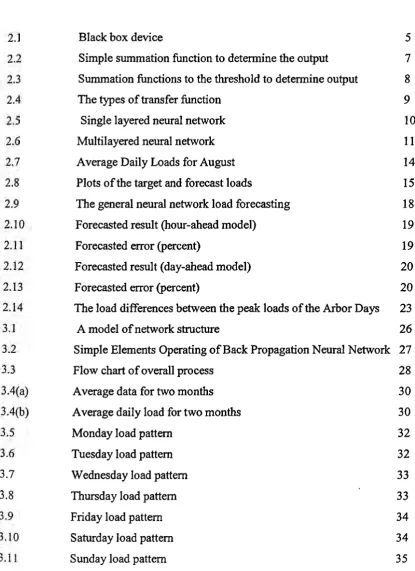
TITLE PAGEBlack box device 5
Simple summation fimction to determine the output 7
Summation functions to the threshold to determine output 8
The types of transfer function 9
Single layered neural network 10
Multilayered neural network 11
Average Daily Loads for August 14
Plots of the target and forecast loads 15
The general neural network load forecasting 18
Forecasted result (hour-ahead model) 19
Forecasted error (percent) 19
Forecasted result (day-ahead model) 20
Forecasted error (percent) 20
The load differences between the peak loads of the Arbor Days 23
A model of network structure 26
Simple Elements Operating of Back Propagation Neural Network 27
Flow chart of overall process 28
Average data for two months 30
Average daily load for two months 3 0
Monday load pattern 32
Tuesday load pattern 32
Wednesday load pattern 3 3
Thursday load pattern 3 3
Friday load pattern 34
Saturday load pattern 3 4
3.12 3.13 4.1 4.2 4.3 4.4 4.5 4.6
:. 4.7
4.8
5.1 (a)
5.1
0))
5.1 (c) 5.1 (d) 5.1 (e) 5.2(a) 5-20)) 5.2(c) 5.2(d) 5.2(e) 5.3(a) 5.3(b) 5.4 5.5 5.6 5.7 5.8 5.9(a) 5.9(b) 5.9(c) 5.10
Flow chart of training process 3 7
Flow chart of testing process 3 8
Sunday load forecast 40
Monday load forecast 41
Tuesday load forecast 41
Wednesday load forecast 42
Thursday load forecast 42
Friday load forecast 43
Saturday load forecast 43
Comparison of MAPE for two model 53
Change the Momentum rate parameter for the network 56
Change the Learning rate parameter for the network 57
Change the Epoch rate parameter for the network 57
Change the Goal parameter for the network 5 8
Change the Hidden nodes parameter for the network 5 8
Regression of the Momentum rate 5 9
Regression of the Learning rate 60
Regression of the Epoch 60
Regression of the Goals 6 1
Regression of the Training function 6 1
The training performance for the single ANN 62
The regression value of the single ANN 63
A graph of regression value for hidden nodes 64
A graph of regression value for learning rate 65
Momentum rate parameters for the network with indicators 65
Changes in network parameters for Epoch (500) 66
Changes in network parameters for Goal (1 e-05) 66
Changes in network parameters using training function (traingd) 67
Changes in network parameters using training fbnction (traingda) 68
Changes in network parameters using training function (traingdm) 68
LIST OF ABBREVIATION STLF ANN BPNN FFNN MLP
' 8 PE
AME MAPE MW GW ARMA MV NN
Short Term Load Forecasting
Artificial Neural Network
Back Propagation Neural Network
Feed Forward Neural Network
Multilayer Perceptron
Processing Element
Absolute Mean Error
Mean Absolute Percentage Error
Megawatt
Gigawatt
Automatic Regressive Moving Average
Moving Average
LIST OF APPENDIX
TITLE
Coding for program Matlab
PAGE
CHAPTER 1
INTRODUCTION
1.1 Objectives
The objectives of this project are:
1) To study and analyze the characteristics of load data taken.
2) To use important architectures of Neural Network, Back Propagation
model for short term load forecasting.
3) To do the simulation and analysis using Matlab software for
forecasting load data.
4) To develop ANN that will give a faster result compared with
conventional method.
5) To predict the future load within 24 hours for a day or a week with to
1.2 Problem statement
The total amount of electricity power consumed by people must be balanced with
the amount of generated power. There is no efficient way to store large amounts of
electricity energy. To maintain this power balance between production and consumption, it
should be forecast future power needs. A broad spectrum of factors affects the system load
level such as trend effects, cyclic-time effects, weather effects and also random effects like
human activities, load managements, and thunderstorms.
In order to supply high quality electric energy to the customer in a secure and
' : economic mani.ler, an electric company faces many economical and technical problems in
operation, planning, and control of an electric energy system. For the purpose of optimal
planning and operation of this large scale system, modem system theory and optimization
techniques are being'applied with the expectation of considerable cost savings. In
achieving this goal, the knowledge of future power system load is the first prerequisite;
therefore, short-term load forecasting is very important to forecast future load data. [2][3]
Many methods have been used for load forecasting in the past.
This
includesstatistical methods such as regression, fuzzy logic, expert systems and vector machines. An
artificial neural network back propagation has been used in this project. The back
propagation algorithm used to change or adjust the weights of the neural network. In back
propagation, the gradient vector of the error surface is calculated. This vector points along
the direction of steepest descent fi-om the current point, so that a movement over a short
distance along the vector decreases the error. A sequence of such moves will eventually
1.3 Scope of work
The performance and reliability of Artificial Neural Network (ANN) depends on
several factors which include the quality of training data, the initial weights used, the
structure and the activation function used. The trained network then can make a
prediction based on the relationships learned during training. For this project, Back propagation Neural Network (BPNN) method will be used to predict the future load in
peninsular Malaysia within 24 hours for a day or a week ahead, to find minimum
forecasting error.
\ , The load data
in two month will be used in training and testing process. The input
that used for forecasted are is half hourly load data for seven weeks and the actual load
data that used for compared are was loaded data from eight week. Matlab software will be
used to simulate and analysis forecasting load data. The result between forecasted loads
CHAPTER 2
LITERATURE REVIEW
2.1 Introduction
This project will focus on application of Artificial Neural Network to forecast or
predict the load flow for economic dispatch. Neural networks have seen-an explosion of
interest over the few years and are being successfully applied across an extraordinary range
of problem domains, in areas as diverse as finance medicine, engineering, geology and
physics. Indeed, anywhere that there are problems of prediction, classification or control,
neural networks are being introduced. Neural networks could be defined as an
interconnection of simple processing elements whose hctionality is based on the
biological neuron. Biological neuron is a unique piece of equipment that canies
information or a bit of knowledge and transfers it to other neurons in a chain of networks.
2.2 Background
Artificial Neural Networks (ANNs) refer to a class of models inspired by the
biological nervous system. The models are composed of many computing elements,
denoted neurons and each neuron has a number of inputs and one output. It also
has a set of nodes called synapses that connect to the inputs, output, or other neurons. [I]
Most ANN models focused in connection with short-term forecasting use Multi-
Layer Perceptron
(MLP)
networks. The attraction of MLP can be explained by the ability of the network to learn complex relationships between input and output patterns, whichwould be difficult to model with conventional methods.
A number of different models intended to initiate some fhnction of human brain, using certain part of it basic structure described as neural network. It consists of large
number of simple processing elements called neurons or nodes or simply processing units
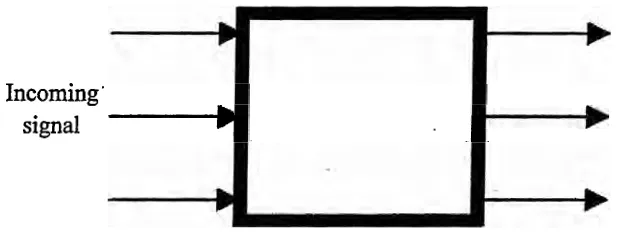
which are interconnected to each other. It also can be described as black box device such
as shown in figure 2.1. [2]
Incoming'
P
output [image:21.500.52.366.447.563.2]signal . .
2.3 The Components of Back Propagation Algorithm
Back propagation was created by generalizing the Widrow-Hoff learning rule to
multiple-layer networks and nonlinear differentiable transfer functions. Input vectors and
the corresponding target vectors are used to train a network until it can approximate a
function, associate input vectors with specific output vectors, or classify input vectors in an
appropriate way as defined. The term back propagation refers to the manner in which the
gadient is computed for nonlinear multilayer networks. There are a number of variations
on the basic algorithm that are based on other standard optimization techniques, such as
conjugate gradient and Newton methods.
The simplest implementation of back propagation learning updates the network
weights and biases in the direction in which the performance function decreases most
rapidly, the negative of the gradient. One of iteration of this algorithm can be written as
Where
Xk
is a vector of current weights and biases, gk is the current gradient, and crkis the learning rate.
2.3.1 Input and Output Factor
During applying back propagation algorithm to the problem, selection of input is
the most important part that has an impact on the desired output. In Back Propagation
Neural Network (BPNN) the neurons in the input layer are not neurons in processing
elements (PEs) sense, they act as simple fan out devices which passes the input to the
various neurons in the next (hidden) layer without doing any processing. Therefore, the
number of input layer neurons is fixed by the number of scalars in the input vector. As
each neuron provides only a single output, the number of neurons required in the output
layer will be equal to the number of scalars in the output vector. Improper selection of
input will cause divergence, longer learning time and inaccuracy reading, that is greater
23.2 Weighting Factor
Relative weighting will be installing in each input and this weighting will affected
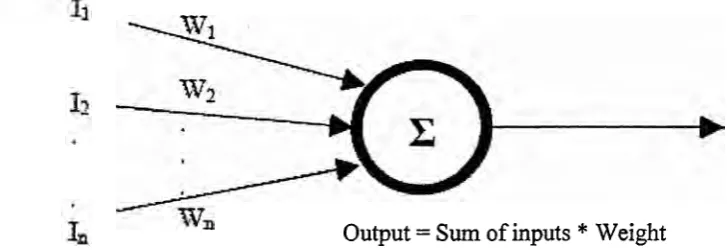
the impact the input as shown in Figure 2.2. Weights determine the intensity of the input
signal and are adaptive coefficients within the network. To various input, the initial weight
for PE can be modified and according to the network's own rules for modification.
[image:23.499.42.406.225.350.2]Output = Sum of inputs
*
WeightFigure 2.2: Simple summation function to determine the output
The inputs and the weights on the inputs can be seen as vectors mathematically,
such as (I1, I2
. . .
In) and (W1, W2. . .
Wn). Each component of I vector by corresponding :omponent of the W vector and add up the entire product as an example : (Input 1 = I1*
2.3.3 Neuron Model
Neuron also known as a processing element and several important activities are
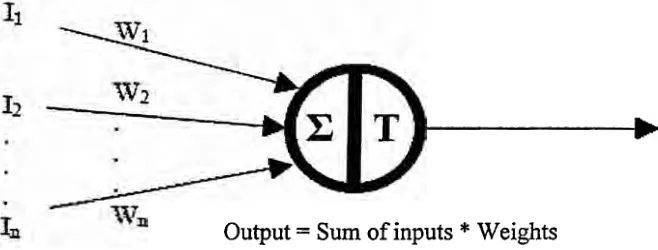
taking place within the design of this processing element. The summation hnction was
first which is represented in Figure 2.2 and Figure 2.3. It will be more than a
simple summation after all products was summed and then was compared to some
threshold to determine the output. If the threshold is less than the sum of the output, the
processing element generates a signal. If the threshold is greater than the sum of the inputs,
there is no signal was generated.
[image:24.500.83.412.296.421.2]Output = Sum of inputs