International Journal of Innovative Technology and Exploring Engineering (IJITEE) ISSN: 2278-3075,Volume-8 Issue-12, October, 2019
Abstract: In this paper, 8x8x8 3D-DCT/IDCT processor based on CORDIC architecture for high data rate of image processing and video coding with reduced hardware has been presented. It uses two stages of CORDIC DCT processor i.e. one is 1D-DCT and another one is 2D-DCT processor based on fully pipelined unfolded CORDIC architecture with RAM buffer. The one-dimensional DCT is useful in processing of speech waveforms. For images and video signal processing, we need a 3D version of the DCT/IDCT data, especially in coding for compression and decompression, for its best performance. This processor performs both the DCT and IDCT simultaneously with the help of CORDIC algorithm of both 3D-DCT and IDCT which has boost the speed of the processor. Ease the use of less computation based unfolded CORDIC architecture in the processor reduces complexity and power consumption. With the working frequency approximately 414 MHz less power dissipation, low latency and high throughput can be obtained.
The processor has been implemented on Xilinx ISE 14.7 and design is simulated in DE-2 board. This processor has not only reduces the complication but also increases the speed which lead to broad use in image and video processing.
Keywords : CORDIC , 3D-DCT/IDCT, RCF, XILINX ISE 14.7.
I. INTRODUCTION
Now a day, video compression is important for signal processing applications such as MPEG, JPEG, H.265, HDTV etc. Everything from the storage of medical images to the transmission of digital HDTV benefits improves by using compression algorithms. In latest CMOS technology, 2D-DCT has been employed in many of the compression methods [1]. While there was research done on three dimensional DCTs as well as IDCT with moderate success as far back as 1977, the three dimensional DCT has not enjoyed similar popularity [2]. The reasons for the lack of the success include the high computational load and complexity in calculation of three dimensional DCT/IDCT, the existence of aggravating artifacts at block boundaries at low bit rates. With this phenomenon in high rate, frequency, computational power since 1977, the computational load issue does not seem as formidable.
The compression technique has been applied to 3D-DCT data based on 4x4x4 cubes resulting 6:1 compression ratio. The technique of “natural “extension of 2D-DCT with two stages
Revised Manuscript Received on October 10, 2019
* Correspondence Author
Bharati Masram, Department of Electronics & Telecommunication Engineering, Yeshwantrao Chavan College of Engineering ,RTM University, Nagpur, India. Email: [email protected]
P.T.Karule, Department of Electronic Engineering, Yeshwantrao Chavan College of Engineering, RTM University, Nagpur, India. Email:
of 1D-DCT and similarly 3D-DCT with 2D transform followed with 1D-DCT (or vice-versa ) has been used[3]. In this proposed [3] vector implementation based on 8x8x8 spatial and temporal frequency with a successive frames in a video sequence. 3D-DCT computation has been carried out using Row-Column –frame (RCF).This architecture consist of three identical 1D-DCT processor and two set of transpose register which has been achieved 400MHz frequency . As CORDIC algorithm is a well-known iterative technique to perform various basic arithmetic operations. The algorithm is very attractive for the hardware implementation because it uses only elementary shift-and-add operation to perform the vector rotation in 2D plane. However the major problem is its slow computational speed. The problem is solved with the technique used known as Angle Rotation technique (AR), Extended Elementary Angle Set (EESA) scheme. This scheme has effect of reducing the rotation angle error of the CORDIC algorithm with scaling approach. Improving further scaling approach we can reduce the number of iteration. The basic concept of rotation and vector operation modes used in CORDIC algorithm leads to fast computation of complex problem [20]. In this paper, CORDIC-based approach to the implementation of fast 3D-DCT/IDCT processor is presented. In section 2, Literature Review on 3D DCT/IDCT is done. In section 3, the proposed architecture of 3D-DCT/IDCT processor in which selection line is used to select the mode of DCT and IDCT processor. Section 4, has explained the method of increasing the high throughput in proposed processor. Hardware implementation and simulation results are discussed in Section 5. Finally the paper ends with the conclusion of the 3D DCT/IDCT processor.
II. LITERATUREREVIEWON3DDCT/IDCT Video Compression and decompression is important for many 3-D applications as mentioned earlier to develop high speed algorithm which has been implemented in literature [4-13]. As literature survey on 3D-DCT of 3D blocks by different motion estimation performed on each frame of 8*8*8 which can be used as application of High Definition Television (HDTV). These blocks are generated from non-interlaced, these 3D video sequences has been used to exploit the high degree of temporal correlation between successive frame [3] [8] and [9]. The image compression technique has been identified as a milestone in recent years. [10-13].
Efficient VLSI based CORDIC architectures is very much admired as best design using 2 stage DCT [14]. In the recent past , 2D-DCT based CORDIC algorithm implemented as hardware efficient architectures and for the computation of the 3D DCT[14] [19].
High Throughput CORDIC Architecture Based
3D-DCT/IDCT Processor
The Row- Column- Frame (RCF) approach has been taken into consideration for the computation of the 3D DCT, hence either using 3- stages of 1D DCT computation or 2- stages of 2D-DCT and one stage of 1D-DCT to perform matrix and volume based transpositions. Row-column approach has been extensively found as its fundamental units to most 2D DCT architectures reported in literature. Hence the major issue that is needed to be taken care in 3D DCT computation is the volume transposition design resulting the computation of the final 1D DCT. The architecture proposed in [15] consider three 1D DCTs which accept the input data serially i.e. one pixel per clock cycle. The outputs of the 2D DCT are fed into computational memory, reshuffling to allow the correct reading for the final N-point 1D DCT. The transposition operation performed in N2 x N memory needed before the third 1D DCT cannot be performed in the conventional manner , due to the fact that this matrix is not square and that each element of the N-point data fed to the final 1D DCT are collected every N2 cycles. In [16], this memory is divided into N distinct N x N memories and a switching network to enable a fast and simple read/write system. The 3D-DCT with different architecture is compared for the processing frequency and think on area consumption of architecture such serial and parallel architecture but investigation on power consumption still be the research [17] [18] [19]. We address the quality issue, and present a method for improved coding of the 3D DCT as well as 3D-IDCT coefficients. Performance gain is achieved through the use of dynamically CORDIC algorithms. A compression ratio greater than to 100:1 for an excellent reproduction with less computation which increases the speed. In the proposed work based on CORDIC algorithm, the 3D DCT /IDCT processor is present with the two select lines of S0 and S1 for simultaneous working of DCT and IDCT block. The expression for 3D DCT for an N*N*N is given by the expression as equation (1) .
111213 1 2 3
0 0 0 1 2 3
1 2 3
(2 1) (2 1) (2 1)
( , , ) ( ) ( ) ( ) ( , , ) cos cos cos
2 2 2
0,1,... 1 , 0,1,... 1 , 0,1,... 1
N N N
III III
x y z
x u x v x w
C u v w u v w f x y z
N N N
where
u N v N w N
and ( ) 1
( ) , 0;
2 k k k k u isdefinedas N u ifu N (1)
The computation of the expression needs use of CORDIC algorithm for evaluating the image matrix cosine terms. In the proposed algorithm [24] we decompose 3D-DCT into the successive operations of the 2D-DCT and 1D-DCT on the input video data, and it only needs to compute the 2D-DCT for newly added frames as well as the 1D-DCT along the third dimension, resulting in high computational efficiency [21].
III. PROPOSEDARCHITECTUREOF3DDCT/IDCT PROCESSOR
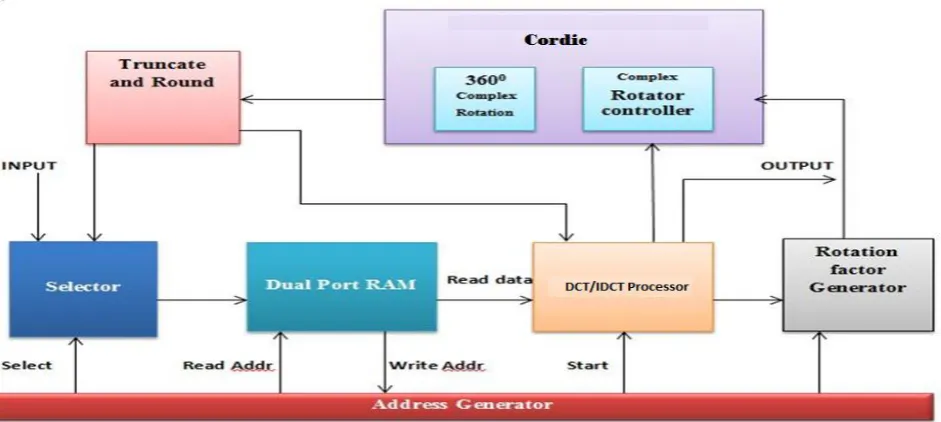
The novel idea behind the CORDIC based 3D-DCT/IDCT processor is to find the calculation of the forward and inverse transform process in the same system. The design of proposed unfolded CORDIC based architecture [20] of 3D-DCT/IDCT Processor as shown in Fig.2. It consist of CORDIC block , Rotation factor generator ,DCT/IDCT processor ,Dual port
RAM ,Selector ,Truncate and Round block which are explained as below .
A. Selector
The Selector block has 3 inputs and 1 output given to the dual Port RAM block .Out of 3 inputs one input is used for the selection of mode such as „0‟ for DCT & „1‟ for IDCT and other two inputs are binary vector (image co-efficient) and input as Truncate and Round block output (angle coefficients).
B. Dual Port RAM
RAM buffer is used to store the data of the processor .Dual Port RAM consists of two inputs and two outputs .One Selector output either „0‟ or „1‟ is given as a input to the RAM buffer . Data can be read and write through it.
C. DCT/IDCT Processor
The data is feed to the processor through the RAM; the system start with the signal “start” through the selector will select the processor DCT or IDCT .The complexity in the computation of it solved by the CORDIC block.
D. CORDIC Blocks
The CORDIC block consists of 3600 complex rotation and complex rotator controller as shown in Fig 1 .In the CORDIC algorithm, shift and add method gives the rotation operation at each shifting of angle either by increment and decrement . Complex rotation of angle upto 3600 controlled by the rotator controller .As shown in Fig 2. X and Y are vector component similarly X‟ and Y‟ are another vector component after the increment of angle. In this way number of iteration can be calculated by rotation direction di= + 1upto the nth iterations.
Fig.1: Rotation operation in CORDIC algorithm [2] Equation of the basic CORDIC algorithm of the ith iteration are as follows:
x i+1 = xi – yi .di. 2
-i
(2)
y i+1 = yi + xi .di. 2-i (3)
z i+1 = zi – di tan-1 ( 2-i ) (4)
Q ={45ο, 26.56 ο,14.036 ο,7.125 ο,3.576 ο,1.79 ο, 0.895 ο,
0.448 ο ,0.2238 ο}
Condition : di = -1 if zi < 0
+1, if zi ≥ 0
International Journal of Innovative Technology and Exploring Engineering (IJITEE) ISSN: 2278-3075,Volume-8 Issue-12, October, 2019
25ο ={ 45ο -26.565 ο +14.036 ο -7.125 ο-3.576 ο+ 1.79 ο + 0.895 ο+0.448 ο +0.2238 ο } = 25.1268 ο
As the 25.1268 is the approximate answer and the number of iteration required is N = 8.As per above CORDIC algorithm another calculations upto to 16 iteration are given in Table 1.
E. Rotation factor Generator
The rotation factor will generate depends on the condition of di. The i
th
rotation for nth iteration for the n= 16 iteration is given in the following Table.1. This rotation factor given back to the CORDIC block for the computation of any floating point angle.
In this way, proposed architecture of DCT/IDCT processor can be work on the rotation factor generator system. Now the 3D-DCT/IDCT processor has calculate with the help of N*N*N leads to the high data rate or throughput output.
IV. THROUGHPUTIMPROVEMENTIN
3D-DCT/IDCTPROCESSOR
The 3D-DCT [21] and 3D-IDCT [15] worked on the different parameters such as no. of register required in design frequency required with different video standards such as QCIF, SIF, CCIR, CIF, HDTV etc .The CORDIC based 3D-DCT and IDCT system work on the same proposed system therefore the computational time depends on the maximum combinational time delay between input and output time. In this way instead of processing individual block we have increases the throughput output by processing both the CORDIC based DCT and IDCT processor.
[image:3.595.324.528.238.445.2]
Table 1: CORDIC Rotation Angles [2] 2-i arctan
(2-i)*360/2Л 45*2
-i
0 1 45
1 0.5 26.56505118 4.065051177 22.5
2 0.25 14.03624347 0.753717879 11.5
3 0.125 7.1250163349 0.106894615 5.625
4 0.0625 3.576334375 0.013826201 2.8125
5 0.03125 1.789910608 0.001743421 1.40625
6 0.015625 0.89517371 0.000218406 0.703125
7 0.0078125 0.447614171 2.73158E-05 0.3515625
8 0.00390625 0.2238105 3.41494E-06 0.17578125
9 0.001953125 0.111905677 4.26882E-07 0.087890625
10 0.000976563 0.055952892 5.33607E-08 0.043945313
11 0.000488281 0.027976453 6.6701E-09 0.021972656
12 0.000244141 0.013988227 8.33763E-10 0.0.0109863 28
13 0.00012207 0.006994114 1.0422E-10 0.005493164
14 6.10352E-05 0.003497057 1.30276E-11 0.002746582
15 3.05176E-05 0.0017485228 1.62844E-12 0.001373291
16 1.52588E-05 0.000874264 2.03555E-13 0.000686646
V. HARDWAREIMPLEMENTATIONAND
EXPERIMENTALRESULTS
In this section, proposed architecture is implemented on an FPGA board .The architecture processor is initially simulated using VHDL language on the Xilinx ISE 14.7.
A. Implementation Of 3D-DCT/IDCT
The theoretical analysis of CORDIC based 3D- DCT/DCT processor already discussed in earlier section as per results shown in this section the comparative analysis done with the results of conventional 3D-DCT [16],[17] & [19].
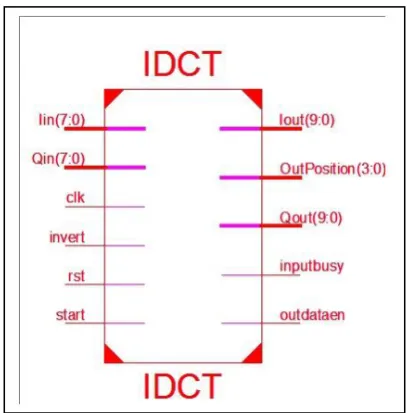
The HDL synthesis of Top level 3D DCT/IDCT RTL Schematic generated using Xilinx ISE14.7 is as shown in Fig.3. and the RTL View of 3D-DCT/IDCT as shown in Fig.4
VI. CONCLUSION
[image:3.595.45.293.429.731.2]Fig.2. Proposed CORDIC based Architecture of 3D-DCT/IDCT Processor
Table 2: Signal Description Of Pins
Fig.4: RTL view of 3D-DCT/IDCT processor
[image:4.595.303.553.529.692.2]Fig. 5: Simulation results of Selection invert mode ‘0’ for DCT
Table 3. Comparisons of Throughput and Latency of processor
Parameters
Various 3D DCT/IDCT Processor
Proposed CORDIC based 3D-DCT/ID
CT
3D-DCT Architecture
[19]
N-serial Archite
cture [16]
Fully Parallel
3dDCT Architecture
[17] Max.operati
ng Frequency
414.190
MHz 400MHz 360MHz 360MHz
Minimum
Time period 2.414 ns 2.5ns 2.77ns 2.77ns
Latency 2
B. Simulation results of 3D DCT/IDCT
The simulation of CORDIC based is as shown in Fig 5 and Fig 6. The processor will select DCT system as per selector. The Simulation result of selection invert mode „0‟ for DCT is as shown in Fig 5.
Signal Type Description
RESET pin Input Active HIGH
INVERT Output
Mode Selection „0‟ for DCT & „1‟ for IDCT
START Input Active HIGH
lin and Qin
Input Active HIGH
Input busy Input
Active HIGH for process otherwise „0‟
Iout Output Output data
Clk Input Active HIGH
Qout Output Output data
Outposition Output Output data
International Journal of Innovative Technology and Exploring Engineering (IJITEE) ISSN: 2278-3075,Volume-8 Issue-12, October, 2019
Fig.6. Simulation results of Selection invert mode ‘1’ for IDCT
The Simulation result of selection invert mode „1‟ for IDCT is as shown in Fig 6. The design is scripted as a VHDL file and synthesized using Xilinx ISE 14.7 .The design is synthesized into Vertex-5.
Fig.7 Power estimation with the help of X -Power Analyzer
The simulation result for the power consumption is as shown in Fig.7. The Power Estimation for the Dynamic power dissipation comes out 10 mW with the help X-power Analyzer in Xilinx 14.7 ISE simulator.
C. Comparative Results Analysis of 8*8*8 3D- DCT/IDCT Processor
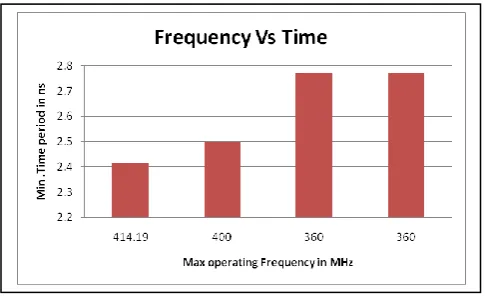
The CORDIC based 3D-DCT/IDCT has been implemented using Virtex-5 device of the Xilinx FPGA .From the timing summary maximum operating frequency for the CORDIC based 3D-DCT/IDCT is 414.19 MHz, Similarly for 3D DCT architecture proposed in [19], N-serial architecture in [16] and Fully parallel 3D-DCT architecture in [17] has achieved comparative frequency as shown in the following Table 3 . As seen from the Table 3, our proposed architecture has achieved high throughput output than the other Architecture. This is possible only because of both DCT and IDCT operations are performed simultaneously with help of selector. The Minimum Time period for the proposed CORDIC Based 3DDCT/IDCT is 2.414ns and it is less as compared with the [19], [16], [17].Hence the latency achieved for the proposed processor is 2.
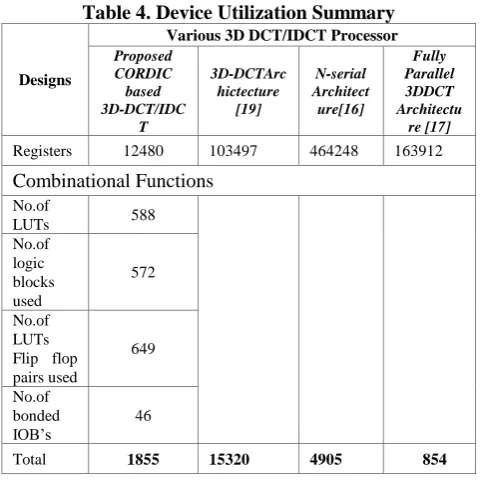
The device utilization summary is as shown in Table 4. For the proposed processor area has been reduced to about 88%
[image:5.595.307.549.121.361.2]as compared with the architecture in [19] and gives 73% reduction when compared with the other architectures. Less number of registers and combinational function are used in present 3D DCT/IDCT processor. Hence we can say area has been reduced.
Table 4. Device Utilization Summary
Designs
Various 3D DCT/IDCT Processor
Proposed CORDIC based 3D-DCT/IDC
T
3D-DCTArc hictecture
[19]
N-serial Architect ure[16]
Fully Parallel 3DDCT Architectu
re [17]
Registers 12480 103497 464248 163912
Combinational Functions No.of
LUTs 588
No.of logic blocks used
572
No.of LUTs Flip flop pairs used
649
No.of bonded IOB‟s
46
Total 1855 15320 4905 854
The resource utilization especially for the 3D-DCT architecture has been reduced about 88% as compared with [19]. The proposed architecture has an advantage in terms of area, power consumption and latency .This proposed architectures has application for the different video processing standard format such as MPEG, JPEG, HDTV, H.265 and H.266 etc. Furthermore this architecture gives high through put output for the high data rates in image and a video processing application which has been also implemented on cost effective based FPGA (Field Programmable Gate Array) for the best performance.
320 340 360 380 400 420
Fr
e
q
in
M
H
z
Various 3D DCT/IDCT Processor
Max.operating Frequency
Fig.8: Comparative Frequency of various 3D DCT architecture with proposed architecture.
[image:5.595.52.287.305.464.2] [image:5.595.308.546.504.672.2]Fig. 9: Frequency Vs Time Result analysis of different 3D-DCT architecture.
VI. CONCLUSION
In this paper, an optimized CORDIC based 3D-DCT/IDCT processor is presented. The main contribution of CORDIC algorithm is to compute the all elementary or trigonometric functions such as sine, cosine, terms in the DCT and IDCT transform. This algorithm has reduces the area ,power consumption and gives the high throughput output in terms of frequency .The new proposed processor has reduces the 88% area compared with the RCF based 3D DCT algorithm with number of registers and number of combinational functions .Latency is 2 which is the maximum output required time after clock for the processor .It offers maximum operating frequency is 414 MHz while computing all the video standards .The presented fast CORDIC based 3D DCT /IDCT in this work is an fastest algorithm which allows us to meet the high complex computation in transform. In future , motion detection in real time video processing ,compression in low power VLSI can be proposed work using discrete cosine transform and algorithm.
Therefore for the fast processing of data , our proposed architecture is very much useful mainly for the image and video processing applications.
REFERENCES
1. K.Rao and P.Yip,Discrete Cosine Transform :Algorithms,Advantages ,application,Academic Press,Inc.,1990.
2. N. Ahmed, T. Natarajan, and K. R.Rao,( 1974) “Discrete cosine transform,”IEEE Trans. Comput.,vol. C-23, pp. 90–94.
3. M. Servais and G. De Jager, “Video Compression Using the Three Dimensional Discrete Cosine Transform,” Proc. of the South African Symposium on Communications and Signal Processing, pp. 27-32, 1997
4. S. Boussakta and H. O. Alshibami, “Fast algorithm for the 3D DCT-II” IEEE Trans. On Signal Processing, Vol. 52 (4), pp. 992-1001, 2004. 5. S.C. Tai et al., “An adaptive 3-D discrete cosine transform coder for medical image compression”, IEEE Trans. Infor. Tech. in Biomed., 4 (3) pp. 259–263, 2000
6. V.K. Padmaja and B. Chandrasekhar , “Literature review of image compression effects on face recognition” International Multidisciplinary Research Journal, 2(8), pp. 17-20, 2012. 7. H.Y. Huang et al., “A video watermarking algorithm based on pseudo
3D DCT”, IEEE CIIP’09, pp. 76-81, 2009.
8. J. K. Sunkara, et. al., “A New Video Compression Method using DCT/DWT and SPIHT based on Accordion Representation” I.J. Image, Graphics and Signal Processing, vol. 4, pp. 28-34, 2012. 9. D. A. Adjeroh, S.D. Sawant, “Error-Resilient Transmission for 3D
DCT Coded Video”, IEEE Transactions on Broadcasting, vol. 55 (2), pp. 178-189, 2009.
10. N. P. Sgouros, et.al., “Use of an adaptive3D DCT scheme for coding multiview stereo images”, Proc. of the IEEE int. Symposium on Signal Processing and Information technology, pp. 180-185, 2005. 11. M. Zamarin, et. al., “A novel multi-view image coding scheme based
on view-warping and 3D-DCT” Journal of Visual Communication and Image Representation, vol. 21(5-6), pp. 462-473, 2010
12. R. Zaharia, A. Aggoun and M. McCormick: “Adaptive 3D-DCT compression algorithm for continuous parallax 3D integral imaging” Journal of Signal Processing: Image Communications, vol. 17(3), pp. 231-242, 2002.
13. A. Aggoun, “A 3D DCT Compression Algorithm for Omnidirectional Integral Images” Proceedings of IEEE ICASSP 2006, vol. 2, pp.517 - 520, 2006.
14. B.Y.Masram ,Dr.P.T.Karule “,A power performance analysiso f 111 MHz frequency compression implementation of efficient CORDIC based 2D-DCT using FPGA”pp 423-427,DOI no. 978-1-5386-4304-4/18.in int conf IEEE EECCMC- 2018.
15. Anas Hatim ,Said Belkouch,Moha Hassani,”Fast 8*8*8 RCF 3D-DCT/IDCT Transform for real time video compression and its FPGA implementation “international journal of Advamces in Engineering & Technology,Vol.7,Issue2,pp.292-307May-2014 16. I. Jollah, A. Aggoun and M. McCormick, “A 3D DCT Architecture for
Compression Of Integral 3D Images” Proceedings of IEEE workshop on Signal Processing Systems, SiPS, pp. 238-244, 2000.
17. I. Jalloh and A. Aggoun, “A Parallel 3D DCT Architecture for the compression of Integral 3D Images,” Proceedings of the 8th IEEE International conference on Electronics, Circuits and Systems, pp. 229-232, 2001.
18. S. Saponara, L. Fanucci and P. Terreni, “Low-power VLSI architectures for 3D discrete cosine transform (DCT)” Proceedings of the 46th IEEE International Midwest Symposium on Circuits and Systems, 2003, Vol. 3, Dec. 2003, pp. 1567-1570.
19. A. Aggoun, “A three dimensional DCT/IDCT Architecture” Proceedings of International Journal of Advances of in Engineering and Technology, vol. 6,isuue 2 , pp.648-658.May 2013.
20. B.Y.Masram,Dr.P.T.Karule,”High performance analysis of CORDIC based Architecture based on FPGA:A comparative Approach”, in IEEE –int’l conf.ICACCT-2014,pp.569-574,May2014.
21. B.Y.Masram,P.T.Karule,”Video compression of 295 MHz 3D-DCT coefficients using CORDIC algorithm” in International journal of Computer and communication System Engineering (IJCCSE),Vol.3,issue No. 1 , pp-18-22, Feb-2016
22. Yuki IKEGAKI,Toshiaki MIYAZAKI,Stanislav G.SEDUKHIN,”3D-DCT Processor and its FPGA implementation,”IEICE trans.Inf & system Vol.E94-D,No.7 July 2011.
23. I. Jalloh and A. Aggoun, “A Parallel 3D DCT Architecture for the compression of Integral 3D Images,” Proceedings of the 8th IEEE International conference on Electronics, Circuits and Systems, pp. 229-232, 2001.
24. B.Y.Masram,P.T.Karule,"High Speed 3D-DCT/IDCT CORDIC Algorithm for DSP " in European Journal of Advances in Engineering and Technology, 2017, 4(12): 941-950 .
AUTHORSPROFILE
Bharati Masram has received her Master degree in Electronics Engineering from Yeshwantrao Chavan College of Engineering (Autonomous) in 2010.She is currently Ph.D. candidate of the Department of Electronics Engineering, YCCE, RTM Nagpur University, India. Her research interest is mainly in VLSI Signal Processing, Communication; 3D Image processing etc .She has published her total 10 research based papers in national, international conferences and also in International journal. She had also published one patent on Wireless apparatus in 2018.
P.T.Karule has received his Ph.D. in the area of Medical Image Processing & Neural Network from Amravati University in 2010, He is currently Professor & Head of Department of Electronic Engineering in
International Journal of Innovative Technology and Exploring Engineering (IJITEE) ISSN: 2278-3075,Volume-8 Issue-12, October, 2019