Evidence Report 47
July 2012
Understanding Training Levies:
Final Report
Professor Howard Gospel
Management Department King’s College, University of London, Said
Business School and SKOPE, University of Oxford
Paul Casey
Project Manager
UK Commission for Employment and Skills
Foreword
The UK Commission for Employment and Skills is a social partnership, led by Commissioners from large and small employers, trade unions and the voluntary sector. Our ambition is to transform the UK’s approach to investing in the skills of people as an intrinsic part of securing jobs and growth. Our strategic objectives are to:
• Maximise the impact of employment and skills policies and employer behaviour to
support jobs and growth and secure an internationally competitive skills base;
• Work with businesses to develop the best market solutions which leverage greater
investment in skills;
• Provide outstanding labour market intelligence which helps businesses and people
make the best choices for them.
The third objective, relating to intelligence, reflects an increasing outward focus to the UK Commission’s research activities, as it seeks to facilitate a better informed labour market, in which decisions about careers and skills are based on sound and accessible evidence. Relatedly, impartial research evidence is used to underpin compelling messages that promote a call to action to increase employers’ investment in the skills of their people.
Intelligence is also integral to the two other strategic objectives. In seeking to lever greater investment in skills, the intelligence function serves to identify opportunities where our investments can bring the greatest leverage and economic return. The UK Commission’s third strategic objective, to maximise the impact of policy and employer behaviour to achieve an internationally competitive skills base, is supported by the development of an evidence base on best practice: “what works?” in a policy context.
Our research programme provides a robust evidence base for our insights and actions, drawing on good practice and the most innovative thinking. The research programme is underpinned by a number of core principles including the importance of: ensuring ‘relevance’ to our most pressing strategic priorities; ‘salience’ and effectively translating
and sharing the key insights we find; international benchmarking and drawing insights
from good practice abroad; high quality analysis which is leading edge, robust and
action orientated; being responsive to immediate needs as well as taking a longer term
perspective. We also work closely with key partners to ensure a co-ordinated approach
to research.
This study, undertaken by Professor Howard Gospel, of King’s College London and the
examined a range of policy levers conducive to encouraging employers to collectively
invest in workforce skills.Since its publication, the UK Commission has further developed
its policy advice, in the form of producing a ‘best market solutions’ framework and a vision for Employer Ownership.
Best market solutions illustrates potential policy levers open to employers for them to decide which would be most appropriate to raise workforce skills. Training levies is one such policy option, alongside other levers like occupational regulation, human capital reporting, Investors in People and inter employer networks. Along with a vision for greater employer ownership, which envisions employers having the responsibility for the design, development and delivery of training to fit their own needs, these policy initiatives put the employer at the heart of deciding what is best for their business and their industry.
In its most rudimentary definition, a training levy is a mechanism whereby firms, within an industry or locality, come together with the express aim of increasing workforce skills, via a mandatory or voluntary agreement. This study examines their effect on employer behaviour, through qualitative research, focusing on three training levies within the UK. The research also identifies different types of training levies, provides a historical and comparative perspective of levies in the UK, and also considers the design factors policy architects would have to take into account in order to establish a levy.
Sharing the findings of our research and engaging with our audience is important to further develop the evidence on which we base our work. Evidence Reports are our chief means of reporting our detailed analytical work. All of our outputs can be accessed on the UK Commission’s website at www.ukces.org.uk
But these outputs are only the beginning of the process and we are engaged in other mechanisms to share our findings, debate the issues they raise and extend their reach
and impact. These mechanisms include our Changing Behaviour in Skills Investment
seminar series and the use of a range of online media to communicate key research results.
We hope you find this report useful and informative. If you would like to provide any feedback or comments, or have any queries please e-mail [email protected], quoting the report title or series number.
Lesley Giles Deputy Director
Acknowledgements
Table of Contents
Executive Summary ... i
1
Introduction ... 1
2
Research methodology and approach ... 3
3
Theoretical starting points ... 5
4
Definitions, taxonomies, and design considerations ... 9
4.1 Introduction ... 9
4.2 Purpose ... 9
4.3 Single or multiple functions ... 9
4.4 General revenue-raising and sectoral levy-grant schemes ... 10
4.5 Levy-grant and levy-exemption systems ... 10
4.6 Scope ... 11
4.7 Calculation of the levy ... 11
4.8 The grant ... 12
4.9 Governance, management, and accountability ... 12
4.10 Assessment and evaluation ... 13
4.11 Renewal ... 13
5
Historical and comparative perspectives and assessments ... 14
5.1 Introduction ... 14
5.2 Historical perspective ... 14
5.3 International comparisons and assessments ... 16
6
Construction Industry Training Board – Construction Skills ... 19
6.1 Industry background ... 19
6.2 The CITB and the levy-grant ... 20
6.3 Governance and management ... 21
6.4 The grant and training ... 22
6.5 Views of stakeholders ... 24
6.6 Conclusions ... 26
7
Engineering Construction Industry Training Board ... 29
7.1 Industry background ... 29
7.3 Governance and management ... 31
7.4 The grant and training ... 32
7.5 Views of stakeholders ... 34
7.6 Conclusions ... 37
8
Creative Skillset and the Skills Investment Fund ... 39
8.1 Industry background ... 39
8.2 The Skills Investment Fund (SIF) ... 40
8.3 Governance and management ... 41
8.4 The grant and training ... 41
8.5 The pursuit of a statutory levy ... 43
8.6 Views of stakeholders ... 44
8.7 Conclusions ... 46
9
Conclusions ... 48
Tables
List of Acronyms
Acronym Full title
ACE Assuring Competence in Engineering Construction
ALI Adult Learning Inspectorate
BECTU Broadcasting Entertainment and Theatre Union
BFI British Film Institute
BIS Department for Business, Innovation and Skills
BTEC British and Technology Education Council
CBI Confederation of British Industry
CCNSG Client Contractor National Safety Group
CITB Construction Industry Training Board-Construction Skills
CSCS Construction Skills Certification Scheme
Cedefop European Centre for the Development of Vocational
Training
CPCS Construction Plant Competence Scheme
ECITB Engineering Construction Industry Training Board
EITB Engineering Industry Training Board
EU European Union
FITB Film Industry Training Board
HND Higher National Diploma
ILO International Labour Organisation
ITO Industrial training organisation
LOSC Labour only subcontracting
MEECI Mechanical and Electrical Engineering Construction
Industry committee
NAECI National Agreement for the Engineering Construction
Industry
NAO National Audit Office
NDPB Non departmental public body
NSA National Skills Academy
NTA National training academy
NCC National Construction College
NTO National Training Organisation
OECD Organisation for Economic Co-operation and Development
OFSTED Office for Standards in Education
OSAT Onsite assessment and training
PAYE Pay as you earn
SIF Skills Investment Fund
SFA Skills Funding Agency
SME Small to Medium sized Enterprise
SSC Sector Skills Council
TEC Training and Enterprise Council
TUC Trades Union Congress
Executive Summary
This report provides a qualitative understanding of the benefits of training levies and their impacts in order to better understand how levies affect employer behaviour. To achieve this, the research sets out the following objectives at a high level:
• What does an effective training levy system look like?
• What is the impact of the current levy systems?
• What lessons can be learned in order to encourage employers to participate in levy
type systems more widely? What features are most attractive/persuasive to employers?
These objectives have been pursued through a combination of desk research and a small number of interviews with levy operators, employers and stakeholders. The research provides indicative findings to further develop our understanding about employer attitudes and opinions on these issues.
The research covers three training levies: that operated by the Construction Industry Training Board-Construction Skills (CITB), for the construction industry, in England, Scotland and Wales; that run by the Engineering Construction Industry Training Board (ECITB), for engineering construction, in England, Scotland and Wales; and that operated by Creative Skillset, in the form of the Skills Investment Fund (SIF) for the film industry across the UK, with proposals to have a statutory levy covering England and Wales. The first two levies are statutory and the last is voluntary.
A simple framework is developed which suggests that levies may be best considered where there are skill shortages and gaps caused by market failures of specific kinds. A basic taxonomy and design considerations are also outlined covering the following: purpose, single and multiple function, levy-grant v. levy-exemption systems, levy scope, methods of calculation, grant arrangements, governance and management, and accountability.
There follow three sections which deal in detail with the CITB, the ECITB, and the SIF as operated by Creative Skillset. Each section considers the industry background, a brief history of the levy-grant, the operation of the system at the present time, its relationship to training, the governance and management of the system, and employer and stakeholder views.
The research finds evidence that the three levies have the support of most employers in their sectors. In the case of the film industry, the employers support the establishment of a statutory levy and have adhered to this despite the long process of introducing such a system (see page 43).
The research also found that the administrative costs of collecting the levy and paying out the grant are real, but not substantial, in particular in the case of collection. The levy operators contend that against these costs should be set the fact that they ease free-rider and informational problems and more training is done. They also pointed out that their other activities bring in money which, minus costs, can be added to levy funds.
Overall, on the basis of the interviews and other evidence, the levies seem to have a net positive effect on the quantity and quality of training. In terms of employer behaviour, on balance, employers report doing more training under these arrangements than would otherwise be the case. However, there is some evidence that they also ‘game’ the system (see page 7) so as to make sure they obtain some return on the levy paid. The interviews also suggest that under these arrangements training gets built into behavioural routines and employers have come to think rather more long-term and strategically about training.
For many employers and for the sectors as a whole, they therefore add something. However, this is not to deny that some employers, especially large employers, feel they are better able to source and deliver training themselves. There is some evidence of a deadweight effect, but, on balance, the employers interviewed felt this was not the case. Most of the employers felt they were not paying for a training activity they would have done anyway, but rather they were paying for training in a different way.
The research found no evidence that either large firms or small firms benefit most or are particularly disadvantaged. Where there is a small business exemption, there is a redistribution of resources towards small enterprises.
of cost and benefits, and changes in legislation to make it easier to establish statutory systems where employers so wish.
A final point to stress concerns government funding. The levy-grant systems per se are
not publicly funded, they require only a small monitoring cost, and they therefore have no effect on public sector borrowing requirements.
1
Introduction
In 2011 the Department for Business, Innovation, and Skills (BIS) requested the UK Commission for Employment and Skills (UKCES) to carry out a qualitative study of the working of British training levies and employers’ attitudes to them. One focus was to be on how levies have affected employers’ behaviour and propensity to train, since to-date there is a paucity of evaluation evidence on these matters.
The main aim of the study and the principal objectives are as follows:
• To provide an understanding of the benefits of training levies and what impact they
have had/have and why.
• To understand how training levies affect employer behaviour.
Further research questions considered are as follows:
• What does an effective training levy system look like?
• What is the impact of the current levy systems?
• What lessons can be learned in order to encourage employers to participate in
levy-systems more widely?
• What features are most attractive/persuasive to employers?
In terms of scope the report covers three levies: that operated by the Construction Industry Training Board-Construction Skills (henceforward CITB), for the construction
industry, covering England, Scotland and Wales;1 that run by the Engineering
Construction Industry Training Board (ECITB), for engineering construction, also covering England, Scotland and Wales; and the voluntary levy operated by Creative Skillset, in the form of the Skills Investment Fund (SIF) for the film industry across the UK, with proposals to have a statutory levy covering England and Wales.
A number of initial points are made concerning the scope and limitations of the study.
• The report covers the three industries (construction, construction engineering and
film), which are subject to levy-grant systems, within the geographical scope as described above. Tentative generalisation is therefore possible, on the basis of the three levy schemes explored, within the geographical boundaries mentioned in the previous paragraph.
1 There is also a separate CITB, CITB-ConstructionSkills Northern Ireland, which has sole responsibility for the construction
• In order to understand training levies, it is necessary to have some perspective on the history and legal status of Industrial Training Boards (ITBs) in the UK. This is provided in section 5, which also has a short comparative overview of other countries again to provide context. This section also provides an evaluation based on the existing literature.
• As will be explained in the research methods section, which immediately follows,
interviews were conducted with employers, mostly those paying into the levy, but also some non payers as well. Other stakeholders, trade associations and trade unions, were also interviewed. However, because of restrictions of the research design (time
constraints and available resources), the number of interviews is limited and opinions
expressed are indicative rather than representative of the respective populations of interest. Nonetheless, the findings herein will provide an understanding of employer attitudes and opinions towards their respective levies.
The structure of the report is as follows. The next section, 2, outlines the methodology
and approach. It explains the parameters of the research and how it was conducted.
Section 3 provides a brief starting point by way of introducing the theoretical issues
concerning the establishment of a training levy, including the dimensions of market failure
that would warrant a levy. Section 4 then presents definitions and considers design
issues. Section 5 gives some historical and comparative context and draws some
assessments based on the literature. The next three sections, 6, 7 and 8, then deal with
each of the levies in turn and considering the industry background, a brief history of the levy-grant, the operation of the system at the present time, its relationship to training, the governance and management of the system, and employer and stakeholder views.
2
Research methodology and approach
The research carried out for this study incorporated a number of stages intended to provide background, context and up-to-date assessments of the workings of the three British based levies.
Desk research produced various materials - secondary materials (already published studies and data in the public domain) and primary materials (original documentation, some of which was not in the public domain) from English language sources initially identified from online databases, meta search engines, and the author’s own knowledge of the field. Those stakeholders interviewed also were a useful source of secondary literature. These were used as the basis for sections 6, 7 and 8, and to inform the rest of the research, including the design of the research instruments, semi-structured interview schedules. Schedules were designed for levy operators, employers (covering both those paying into the levy and non payers) and other stakeholders, such as trade associations and trade unions.
Face-to-face interviews were conducted with levy operators at their headquarters and, in each case, staff at strategic and more operational levels were interviewed. These included chief executives, other senior managers, and operational staff engaged in collecting and paying out the levy and organising training. Interview visits lasted from half a day to two days. More staff were interviewed in the case of the CITB than the other two organisations. This, in part, reflects the size of the CITB and also the availability of levy operator personnel at the time of conducting the research. In addition, primary and secondary materials were provided by each of the levy operators.
The interview schedules were used as the basis for conducting telephone interviews with employers, trade associations, and trade unions. Employer sampling has been based on employer size and geographical location. As well as employers, the sampling included organisations which play a role in these levy systems and have a close-hand experience of them, including trade associations and trade unions. Where possible, samples have been generated to provide a good mix of these characteristics. A comment on employer sample selection is important here.
to the composition of corporate entities in that industry. Therefore, it should be acknowledged that despite best efforts selection bias could be a possibility here. All fieldwork was conducted between November 2011 and January 2012.
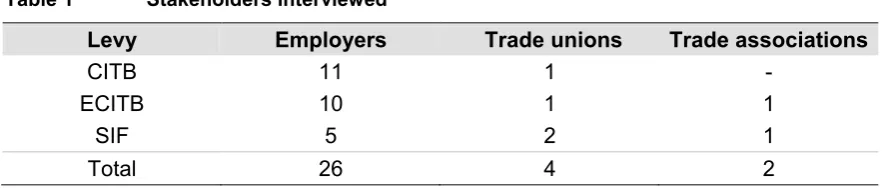
Table 1 Stakeholders interviewed
Levy Employers Trade unions Trade associations
CITB 11 1
-ECITB 10 1 1
SIF 5 2 1
Total 26 4 2
Telephone interviews of stakeholders lasted 20 minutes each on average. In total, 32 interviews were conducted in confidence with individuals, providing them with anonymity so as to encourage them to speak freely on the subject matter (see table above). Added value was derived from interviews, with some interviewees signposting or providing primary and secondary materials for the research. The results were analysed on a common analytical grid which provided for data on size, levy payment, grant receipt, governance and management, evaluation, and areas for improvement.
Overall, given the restrictions of the research design, such as the limitations of sampling (size and selection), and the (convenience) sampling approach taken, a good selection of employers and stakeholders, by way of size, geographical location, and sub-sector focus has been achieved in order to provide an understanding of attitudes and opinions towards the respective training levies.
3
Theoretical starting points
The usual starting point for the theoretical consideration of levies begins with skills shortages and gaps, in the context of market failure, and questions as to who pays for training. In theory, in terms of decisions on training, in a free market it would seem to be ideal economy to rely on market forces of supply and demand and individual initiatives by employers and potential and actual trainees. Individuals or the state will pay for training which is general or even occupationally-specific and employers will pay for training which is firm-specific. However, this classic distinction between forms of training is difficult to make in practice and market forces do not always work. There can be market failures of
various kinds.2
• Poaching externalities. Since in practice skills usually have general, occupational, and firm-specific elements, much training is in transferable skills which are of use to several firms. In these circumstances, some firms may seek to avoid the costs of training and try to secure already trained workers from other firms. There is thus a threat to the training firm, and this will dissuade such firms from future training. This is essentially the poaching or free-rider problem.
• Informational imperfections. Firms and individuals may have insufficient information about the likely returns to training. Thus an individual may not know whether his/her training will be seen through to the end by the employer – the employer may lay off trainees because of business conditions or may go bankrupt. Similarly a firm may underestimate the benefits and overestimate the costs of training. These are problems associated with imperfect information about returns. Better information on costs and returns and on the external availability of labour may result in more training.
• Informational asymmetries. Firms and individuals may wish to invest in training, but lack the necessary funds. In this case they should be able to approach lenders such as a bank to borrow funds. However, the potential lender may well lack the necessary information to calculate the payoff of the training and therefore will be hesitant to lend. This constitutes a credit constraint on training.
Levy-grant systems are intended to deal with these problems. If it is assured that all the firms in an industry will train or at least pay a training tax, then all firms will be ‘in the same boat’ and no one will feel disadvantaged. If a levy is established in such a way that potential trainees know that, rather than a single firm, a whole industry will support them during their period of training, they will be more likely to enter onto a particular course of training. Similarly, if a levy agency provides information on costs and benefits of training
and on the costs of relying on the external market, then this will make firms more willing to train. If a levy operator in effect operates a fund on which employers and individuals can call, then this will ease the credit constraint referred to above. There are two ways of dealing with market failure by setting up levy-type arrangements.
First, firms within an industry or locality may voluntarily come together and create some sort of system to deal with the problems involved and to set minimum training requirements. This could take the form of an agreement between the firms to train a certain proportion of staff to a certain level. Such an agreement might also involve other stakeholders, such as a trade union or professional association which represents employees and trainees. The advantages of voluntary agreements are that they are entered into willingly and do not involve compulsion or state intervention which may impose costs. Voluntary agreements of this kind used to exist in British industry under multi-employer agreements and still exist in a country like Germany, albeit in the latter
case underpinned by legal supports.3 The problem, however, with voluntary agreements
is defining them in detail and enforcing them in practice. One way to define voluntary agreements in more detail and potentially to monitor them is attach monetary values to them and provide a system of incentives in the form of taxes and returns. In other words, this is to establish a voluntary levy and grant system.
Second, given the problems of creating and monitoring systems of voluntary self-regulation, there is the possibility that the state may be invited to step in, or decide to intervene, to deal with the market failure and the enforcement of a levy. In other words, this implies a statutory levy and grant system. The merits of such a statutory system are that state action overcomes reluctance on the part of potential participants and agreements can be enforced by law. Under the law, firms may also be obliged to provide information and thus reduce informational imperfections and asymmetries. These are then the advantages of levy-grant systems.
The potential disadvantages of levy-grant systems (both statutory and voluntary) are various.
• There may be transactional losses caused by paying into and drawing out of the
system and via the upkeep of the bureaucracy which administers the arrangements. In other words, levies may not provide additional funds, but only pay back or redistribute funds, minus any transaction costs.
• Firms may ‘game’ the system. For example, they may re-package planning and production meetings as training to comply with eligibility requirements in order to benefit from the grant.
• There may be ‘deadweight’ loss4 – employers will use the training grant to subsidise
training which would have provided anyway. Hence schemes may end up being a windfall for some firms which already train or they may have a ‘levelling effect’ as firms which may have otherwise invested in training may train less, others may train
more, but there may be no net effect.5
• There may be negative effects on the type of training. Levies may bias training to
more formal and externally provided courses and away from on-the-job training which is less assessable, but which may be as, or more, valuable. It may also bias training towards sector-specific workers or skills and discourage training of cross-sector workers and broader skills.
• Finally, levies may be unfair to some firms. Thus, because of their greater
administrative capability, big firms may be more able to claim back grants. In these circumstances, disadvantaged firms may see the levy as tantamount to a tax. Levies may also be unfair to some workers – they may benefit already skilled workers and a minority doing high-skill programmes, such as apprenticeships, but to the disadvantage of unskilled workers.
Three final points should be made about the funding of levy systems. First, some or all of the cost may be passed onto employees in the form of lower pay. This is most likely to be trainees, but could conceivably cover other employees as well. Such cost sharing may be good, if it benefits employees in the longer term and leads to higher levels of productivity, more secure jobs, and higher pay. Of course, it could be the case that the cost is not passed onto all workers equally: thus, for example, unskilled workers receiving
no training may be subsidising more skilled workers who receive more training.6 Second,
some or all of these costs may be passed onto clients, customers, and the public in the form of higher prices. However, again this would be offset if productivity rises commensurately. Finally, there is a consideration for government. Levies are usually not publicly funded and have little effect on public sector borrowing requirements, since the costs of levy-grant systems (for government) are the set-up cost of legislation, and any on-going monitoring (which may be small), rather than the payment of grants for training.
4 In the training area, deadweight loss is usually taken to refer to situations where there is a subsidy or grant paid to an
employer for training which would have been carried out anyway in the absence of the subsidy or grant.
See Table 2 below for a summary of potential advantages and disadvantages of levy-grant systems.
Table 2 Potential advantages/strengths and disadvantages/weaknesses of levy-grant systems
Advantages/Strengths Disadvantages/weaknesses
Spread funding load and reduce poaching
externalities Additional tax which reduces competitiveness
Increase resources available for training Transactional/administrative costs
Opportunity costs
Stabilisation/mutualisation of resources
through pooling Potential of ‘common pool’ problem and overtraining especially in some
areas
Captive resources Gaming
Increase incentive to train and therefore
quantity of skills Deadweight or re-packaging effect
Increase pressure for broader training and
therefore quality of skills Bias training to formal and externally-provided courses
Focus on sector specific needs Excessive focus on certain skills
Insufficient focus on cross-sector skills
Raises training to a higher common
denominator Risk of minimum compliance and ‘levelling effect’
Reduce informational imperfections and asymmetries and therefore risk and credit constraints
Increase company awareness of importance of training/capability
Synergy with other activities e.g. research,
consultancy Empire building
Positive spillovers Negative spillovers
Increase social inclusion Too wide a focus
Possibilities for better dialogue within industry Employers dominate to exclusion of
employees, educationalists
Bring in SMEs Not all firms benefit e.g. SMEs and
very large firms
Do not add to public borrowing; a sheltered source of funds
4
Definitions, taxonomies, and design
considerations
4.1
Introduction
The literature identifies various types of levy systems, in addition to the voluntary/statutory distinction already made above. Around these are some of the basic design and assessment considerations.
4.2
Purpose
Levies can be for different purposes. Thus, in addition to training levies, they may be
established in an industry to support research and development.7 They may also be
created to promote certain social objectives, such as the employment of disabled people,
as is the case in Japan.8 Here, we are concerned solely with systems which are intended
to raise the quantity and quality of skills.
4.3
Single or multiple functions
Levies may perform a single or multiple functions. Thus, they may be solely concerned with the raising of the levy and the paying out of grants for training. In addition, they may also:
• be involved with the creation of training courses;
• select/appoint training providers or act as providers or managing agents themselves;
• collect labour market information and carry out research; and
• offer consultancy type activity.
In the UK context, the CITB, as a registered charity, is the levy-grant operator, a Sector Skills Council (SSC), a managing agent for training, a training provider, and an organisation providing consultancy services. According to the European Centre for the Development of Vocational Training (Cedefop), in most systems in Europe, the levy is the
main source of income and usually accounts for more than 75 per cent of all revenue.9
7 Stoneman (1991). 8 Stoneman (1991).
9 As well as the UK, Cedefop examined training levies in Belgium, Denmark, Spain, France, Italy, Cyprus and the
We will see this is the case with the ECITB, but not with the CITB nor with Creative
Skillset and the SIF.10
4.4
General revenue-raising and sectoral levy-grant schemes
A distinction may be made between general revenue-raising levy schemes and sectoral levy-grant schemes. General revenue-raising systems are statutory schemes under which taxes raised from firms go into a public budget for training. The levy is collected and administered by a government agency. By contrast, sectoral levy-grant schemes are ones where firms are taxed within a particular sector and the levy money is eligible for disbursement to firms within the sector. Those which train receive a part back, the whole back, or the return may even exceed their levy payments. Training usually has to be recognised or accredited in some sort of way. Non-trainers become net payers into the system.
Sectoral schemes may be established and administered in various ways. First, they may be set up unilaterally by the employers in a sector who then run the scheme. Second, they may be established bilaterally though collective bargaining with trade unions and jointly administered by them, as is the system in the Netherlands and Denmark. Under such schemes, the social partners agree to clauses in collective agreements which specify minimum levels of training expenditure, sometimes with additional funds supplied by government. Third, they may be established by government, after consultation with employers and other stakeholders. Such schemes may be ‘employer-led’ or in cooperation with employees and may involve stakeholder parties. Given their origins, the systems have varying degrees of accountability to government.
4.5
Levy-grant and levy-exemption systems
Some schemes are levy-grant or rebate schemes, while others are levy-exemption
schemes.11
Levy-grant schemes collect training levies from firms and pay out grants to eligible firms. They are ‘pay and claim’ schemes. By contrast, levy-exemption schemes allow exemptions from paying, if employers can show that their training exceeds a set level. These are ‘train or pay’ schemes. The latter schemes give the levy operator less control and provide more discretion for firms.
10 Levy revenue reportedly makes up around 87 per cent of total income for the ECITB (2011, p.32); 60 per cent for the
CITB (2011, p.40); and around 55 per cent for Creative Skillset’s SIF (as supplied to the author).
11 In terms of exemptions, under the Industrial Training Act, ITBs are able to provide these for those that train, via
4.6
Scope
As has been outlined above, schemes may be national payroll levies where all firms (or all firms above a certain size) are the unit of accounting. Such levies are inter-sectoral. Other levies are sector-specific, though, as we will see, there are often issues defining
the scope of an industry.12 Levies could also conceivably be geographically-specific or
project-specific e.g. one might conceive of a levy of firms operating in a big city or working on a very large project. The scope of schemes might also be delimited by the type of labour e.g. levies could conceivably cover just new entrants or lower/intermediate skill levels and exclude existing employees or higher level managerial staff.
4.7
Calculation of the levy
There is then the question of the calculation of the levy. Levies may be based on various criteria such as payroll, turnover, output, contract value, production costs, or profits. Arguments may be made for all of these, and, as we will see in the case of the film industry (p.40), it was decided to institute a levy based on production costs and the sector wishes this basis to be carried over into a statutory levy. The other two levies considered
here and most training levies are based on payroll.13
In turn, payroll poses the question as to whether this should be head count or based on the payroll wages bill. The former is usually considered too simple since firms may differ in their skill mixes and requirements. The wages bill is preferred in most systems. However, there are then further questions, which we will see are important in construction and engineering construction, as to whether one includes indirect staff, such as agency workers and labour only sub-contractors. The argument against including the employed is that it is often difficult to calculate the levy and to pay out grant to self-employed individuals. Moreover, it might be argued: why should the employer pay a levy on staff when they are not his/her own employees? The argument in favour is that in some sectors such workers constitute a large proportion of the labour force. They, as well as future generations, need to be trained.
There is then the question as to the rate at which the levy should be set.14 It may be set
at a uniform rate for all firms. Alternatively, it may be set at different rates for different sizes of firms, with smaller firms paying less or even being exempted, or, as in the case
12 As industries and occupations change there are instances where sub sectors, within the scope of an established
sector-specific training levy, may wish to come out of scope for whatever reason. See in this report: CITB (pp.15, 20) and ECITB (p.31).
13 Under the Industrial Training Act, a training levy must be based on emoluments (i.e. payroll/wages bill). Furthermore, a
an exemption threshold for small firms must be in situ, although it is up to the industry to determine at what level this should be.
14 Research on compulsory levy systems in Europe indicates that levies are based on the enterprises’ payroll and range
of the film industry, very large productions capped on the amount they pay. The levy may also be set at different rates for different types of workers, thus at a lower rate for directly employed staff and a higher rate for indirect or agency staff, as is the case in construction. It may also be set at different rates for staff most closely involved in production and at a lower rate for office staff, as is the case with off-site staff in engineering construction.
4.8
The grant
There are also choices as to how the grant is paid. There are questions as to whether the grant is paid in kind viz. services or whether it is paid in cash. In both cases, the grant may cover only direct costs, such as course materials, attendance on courses, examinations etc. It may also cover wage costs of anyone providing on-the-job training. In addition, it may cover part of whole of the wages of the trainee, in which case it is a wage subsidy.
4.9
Governance, management, and accountability
In terms of governance and management, levy-grant systems involve some sort of governing body and executive agency to provide strategic oversight and operational management. In turn, such governing bodies and agencies have to be responsible to those covered by the system and, if the scheme is statutory, subject to oversight by government. This raises a number of issues.
First, there is the issue as to whether the governing body should be employer-led or whether it should be bipartite involving employee representatives. Or it could be tripartite, involving representatives of others, such as educationalists, government, clients, and customers. Initially, in the UK, ITBs were tripartite. But they are now employer-led, though in all three present cases with employee representation (via union
representatives).15 In continental Europe, they remain more social partner-led. Second,
there is the question as to how the administrative agency should be funded. In practice, they are usually funded by the levy, but there may be other sources of funding in terms of government grants and commercial income. Needless to say grant payers and recipients look to minimise the administrative costs and maximise the amount payable in grants.
15 The CITB Board also has ‘education members’ representing further and higher education. See:
4.10 Assessment and evaluation
In terms of design, there is the question of assessment or evaluation in terms of cost effectiveness and value for money. Here the calculation has to be in terms of how monies received relate to monies expended and what does the levy add in terms of increasing the quantity and quality of training and influencing employer and trainee behaviour. These are difficult questions at the level of the trainee, the firm, the sector, and broader society. Each involves complex counterfactual and deadweight calculations.
4.11 Renewal
Finally, there is the question of renewal mechanisms. This is less of an issue with voluntary systems, where the parties can make their own arrangements and may speedily disband or renew any system. With statutory systems, review and renewal mechanisms will be more complex.
5
Historical and comparative perspectives and
assessments
5.1
Introduction
So as to better understand those training levies under consideration within this research, it is important to understand how they developed historically in the UK, since the past has shaped present arrangements and poses questions about any future developments. It is also relevant to see levies in comparative perspective and this is also used for an assessment of the existing literature.
5.2
Historical perspective
From the late 1950s onwards, there were growing concerns about the training system in
the UK, in particular intermediate level training of an apprenticeship kind.16 In the early
1960s, these concerns were added to with anxieties about rising youth unemployment, especially in the context of the feed through into the labour market of the post war baby boom. A number of commentators and interest groups proposed a levy-grant type system, citing France as an example of effective arrangements.
In this context, after a number of enquiries and reports, in 1964 a Conservative government introduced the Industrial Training Act. This met with all-party support. The Act established a series of ITBs for most private sector industries with the legal power to operate levy-grant systems. The boards were based on a tripartite structure, consisting of employer, trade union, and educational representatives. Between 1964 and 1969 27 ITBs were established covering 15 million workers.
Studies of the Act and the ITBs were produced at the time,17 but there was no robust
statistical evaluation of the kind which might be attempted today of such policy measures. What research there was suggested mixed outcomes – some positive effects at reforming training arrangements, some increase in the quantity and especially quality of training, but with administrative costs, especially for smaller firms. The fullest overview of the
literature is provided by Senker (1992) who provides a generally positive evaluation.18
Criticisms of the system of the ITBs led the incoming Conservative government in 1970 to announce that it would conduct a thorough review of the system. This created a situation of uncertainty which was criticised in a joint letter by the CBI and TUC. On the basis of its
16 See Senker (1992) chapters 2 and 3 for a useful summary.
review, however, the government then announced that it intended to revise the system
and again this met with some protests from employers and unions.19
The subsequent 1973 Employment and Training Act provided that levies set at more than one per cent of emoluments were subject to an affirmative resolution by Parliament – the so-called Levy Order. Since the requirements for exemption were not strictly drawn, many firms applied for, and were given, exemptions. In engineering, for example, 58 per cent of the workforce had become exempt by as early as 1974/75 and this had risen to 85 per cent by 1976/77 in the case of larger firms. Refusals to grant exemptions were rare. Large firms were more likely to claim exemption, but often still claimed funds. In these circumstances there were severe pressures on the system. Given these developments, the government announced that it was prepared itself to contribute to the financing of
boards and the support of training. 20
Under the 1974 and 1979 Labour government, plans for collective funding by employers
and government of initial training were developed but never reached Cabinet.21
The Conservative government elected in 1979 strongly believed that the ITB system
should be terminated.22 The 1982 Industrial Training Act laid down new requirements for
the establishment, operation, and termination of ITBs. Over the next few years, boards were wound up and in 1988 the government announced that all the ITBs were to be abolished, with the exception of construction and engineering construction where employers had lobbied for the continuation of a levy-grant system on the grounds of the special characteristics of their sectors. The 1989 Employment Act removed the statutory
right for union representation on boards.23
Since the late 1980s, one major sub-sector has come out of scope viz. electrical contracting which left the CITB in 1990. Some other sectors have tried to come out of scope e.g. exhibition contracting and kitchen installation. Some sectors have considered introducing a levy-grant system e.g. glass manufacturing. It was not possible to ascertain the circumstances and events in these cases. Only one sector has pursued the introduction of a statutory levy-grant to any length viz. the film industry. However, as will be seen, their pursuit of a statutory levy has been prolonged.
19 Senker (1992, p. 166). 20 Senker (1992, pp. 86-87). 21 Senker (1992, p. 167).
22 For references see Senker (1992, Chapters 3 and 4).
23 Despite this statutory change, the governance structures of the CITB, ECITB and Creative Skillset levy frameworks
A number of general points may be made here about the history of levy-grants in the UK. First, they were initially introduced by a Conservative government, but with all-party support. The withdrawal from them began with a Conservative government in the early 1970s, and the following Labour government did not halt or reverse this withdrawal. They were finally abolished by a Conservative government in the 1980s, without strong opposition. Second, the evidence-base for decisions about introducing, modifying, and
terminating the arrangements was somewhat limited.24
Third, the intention behind the modification and termination of the system was to reduce administrative bureaucracy and to shift decisions about training and its funding to individual employers. The subsequent history of training has seen a number of sector bodies (training and enterprise councils (TECs), industrial training organisations (ITOs), National Training Organisations (NTOs), SSCs, and National Training Academies (NTAs). Though employers may be spending more of their own money on training than was the case in the past, it is also the case that government financial support for youth
and apprenticeship type training has increased.25
The present legal framework regulating ITBs and levy-grants is to be found in the 1982 Industrial Training Act (as amended) and related Regulations and Orders. Together these cover the establishment and winding up of ITBs, their operation, and processes of review and renewal. There are three key statutory instruments – the Scope Order, the Levy Order (every three years), and the Reasonable Steps Regulations. The latter
requires that up to every three years26 the ITB has to show that over half the employers
who are likely to pay the levy are supportive and that those who are consulted have to be paying more than half the levy. At present ITBs are statutory non-departmental public bodies (NDPBs) accountable to parliament. However, it should be noted that they differ from most NDPBs in that they do not receive grant-in-aid direct from government.
5.3
International comparisons and assessments
This section refers briefly to comparisons with levy-grant schemes in other countries and uses these to make an initial assessment, based on the existing literature, of the working of such systems.
Unfortunately the literature is diffuse and unstructured, with a tendency to run together general revenue raising schemes, sectoral levy-grant schemes, and levy-exemption
24 For the evidence base, see Senker (1992, Chapters 4, 5, and 6). 25 Senker, 1992, pp. 82-96); Gospel and Edwards (2012).
26 ITBs are encouraged to have three year Levy Orders but one and two year orders are also permissible. The Levy Orders
schemes. It also runs together collective bargaining-based and statutory schemes. Much of the literature is also about developing countries, where the studies often concern general revenue raising schemes and where it is usually stated that there are
administrative problems.27 The clearest comparisons with the UK would seem to be
France, the Netherlands, Germany (for construction), Denmark, Korea, and Singapore. However, again these are very mixed systems – the French system is a national inter-sectoral scheme, Singapore is a general revenue raising scheme, and the Netherlands and Denmark have collective bargaining-based arrangements, albeit underpinned by law.
The evidence in the literature on these schemes is often unclear, out-of-date, and tends to draw on the same studies. There are a very few econometric studies, with good sample sizes and robustness tests. A French econometric study suggests that, under
their scheme, large firms and more highly skilled employees benefit most.28 However,
against this must be set the fact that this is the case with most training. Two statistically-based Dutch studies failed to find evidence that levies encouraged either initial or
continuing training.29 There have been no statistically-based studies of the UK levy
systems.
There are a number of overview studies, but unfortunately these recycle the same materials and are limited by the lack of strong evidence. Thus, one study concluded that levies are ineffective in the distribution of training expenditure between firms. Firm size
and employee characteristics were said to typically shape access to training.30 Another
study, while not having levies as its main focus, referred in general terms to the lack of evidence and difficulty of drawing firm conclusions. However, it concluded that the evidence suggests that, where levy systems fail, it is often due to design issues, which result in significant administrative costs and manipulation and compliance problems and, therefore, the schemes do not succeed in allocating funding to the right employers. In
such circumstances, they become unpopular with employers and are abandoned.31
The nearest to a meta-analysis analysis is that by Dar et al for the World Bank which also
draws on Organisation for Economic Co-operation and Development (OECD) and Internal labour Organisation (ILO) studies. This uses mainly qualitative materials and
points out that good evaluations are ‘extremely uncommon’.32 However, they conclude
the scattered evidence suggests these schemes have had, in general, a positive impact
27 Dar et al. (2003) 28 Goux and Maurin (1997).
29 Van den Berg et al. (2006) and Kamphuis et al. (2010). 30 Smith and Billett (2005).
on the quantity of training. As evidence of this, for example, they cite France and Singapore and also point out that S. Korea saw a decline in training once the levy-grant system was replace by levy-exemption in the mid-1970s. However, they also conclude that better educated and more highly skilled employees working for large firms are the main beneficiaries. Finally, they refer to a ‘levelling effect’ viz. firms which may have otherwise invested in training. They tend to reduce their effort to the level required by law.
Needless to say, it would be useful to have a better understanding of the operation of schemes in certain countries, and here France, Netherlands, Denmark, Australia, Singapore, and Korea would seem to be useful comparisons. The high apprentice training countries of continental Europe (Germany, Austria, and Switzerland) do not rely on levy-grant systems, though these exist in the construction industry in Germany. However, these countries also have wider collective arrangements whereby employers share the costs and benefits of training with one another and with their employees.
The next three sections, 6, 7 and 8, examine each of the levies in turn to consider their
6
Construction Industry Training Board –
Construction Skills
6.1
Industry background
Construction is an extremely large and diverse sector central to the UK economy. It covers a wide spread, including design and planning, construction and civil engineering, and maintenance and refurbishment. Clients extend from government, to major private sector organisations, to individual home owners. On a definition which is close to the CITB footprint, there are around 168,000 firms in construction, the majority of which
employ less than 10 people.33 Many of the larger household name companies do not
now employ much manual labour directly but rely on labour only subcontracting (LOSC). The entry and exit of firms from the sector is high. The industry is essentially project-based and depends on complex sub-contracting chains. The industry has always been
highly seasonal and cyclical, but, at the present time, it is in severe recession.34 It
anticipates future demand in areas such as infrastructure and energy.
The broad construction sector employs over 2 million workers, but the footprint of the
CITB is roughly half of that.35 Around three quarters of the total are manual workers.
The labour force is highly mobile and comprises a large number of self-employed, up to one third in total and two thirds in specialist areas. The baseline for skills is level 2 and, compared to other industries, construction has a significantly high proportion of apprentice-trained labour. Training is needed at all levels – managerial, professional, craft, and up-skilling the unqualified. However, given the characteristics of the industry described above, training is difficult to organise. Skill shortages and gaps appear quickly during cyclical upswings, and presently exist in areas such as plant operators, carpenters/joiners, floorers, painters/decorators, and civil engineering workers. In future, there is likely to be an increasing demand for higher level skills and broader knowledge of new products, in particular connected with energy infrastructure and carbon technology.
33 Information provided via interview with CITB staff. 34 Ibid.
35 There is also a separate CITB, CITB-ConstructionSkills Northern Ireland, which has sole responsibility for the
6.2
The CITB and the levy-grant
36The CITB was established following the 1964 Industrial Training Act. It has statutory powers to raise a levy from firms, within the scope of the industry, and to use this to support training. The 1992 Scope Order lays down the boundaries of the industry and requires that to be in scope firms have to be wholly or mainly engaged in construction. The 2009 Levy Order set the rate of the levy for three years, leaving this unchanged from the previous period, at 0.5 per cent on direct labour payments (PAYE – pay as you earn) and 1.5 per cent on LOSC payments, with a small firm’s exemption set at £80,000. However, small firms within this exemption rate can qualify for grants and support.
Over the years, there have been scope issues, and it was noted above that in 1990 the electrical contracting industry came out of scope (page 15). Others have considered or tried unsuccessfully to come out of scope e.g. kitchen installation and exhibition
contracting.37 Some scope issues still remain within a couple of sub sectors in the
industry (such as open cast mining and dry lining). In principle, the CITB opposes firms coming out of scope, unless it could be shown that suitable alternative arrangements would be put into place.
In 2010, the number of employers on the levy-grant register was 80,337, of whom 41,095 were zero-rated because their payroll for the previous year fell below £80,000. The levy income for that year was £167.4m – a fall over previous years because of reductions in employment in the present economic climate. After deducting the cost of collecting the levy and processing grants (£4.3m), this left net £163.1m. The CITB, which is also a SSC, a managing agent, a training provider, and a National Skills Academy (NSA), has other sources of funds, from government and other public bodies, for non-levy-grant
activities. These amounted to £10.6m – again down on the previous year.38 It also has
income from various commercial activities, including certain types of training, card schemes, health and safety testing, and research and consultancy. For 2010 the total
non-levy income was £110m.39 Thus, the levy makes up around 60 per cent of total
income.
In 2010, of the £163.1m in net levy income, £113.2m went in training grants and a further £29.6m in direct payments on behalf of employers for training. Apprentice grants were
36 The information and data in this and the following sections, ‘Governance and management’ and ‘The grant and training’,
is based either on interviews with relevant CITB staff or on documentation; in the latter case, where possible, it is cited in the footnotes and the bibliography.
37 Exhibition contractors made a formal request to leave the scope of the of the construction levy.
38 Income of £10.6m has been derived from contested funding opportunities and excludes grant-in-aid and apprenticeship
funding.
the main item and amounted to £60.2m. In 2010, firms which paid no levy claimed £21.9m in grant.
The levy is collected in the following way. First, it should be noted that there is no obligation on firms to register. Rather the CITB levy team have to ‘identify’ firms and this they do from various sources, such as trade directories and journals. Inevitably larger firms are more likely to be registered. Second, in April every year, employers on the register are asked to complete a return with information on wages and LOSC payments. Firms find it most difficult to calculate their LOSC payments. Firms which do not fill in the return receive an estimate. A team of verifiers checks on firms on a risk basis. There is an appeals process for employers who are aggrieved. Firms which refuse to send in a return or submit a false return, may be taken to court. However, this seldom happens, given that the vast majority of transgressors are the smallest employers and bearing in mind the costs involved. It is a measure of last resort although a CITB spokesperson
commented, ‘we have a duty to all the other employers who pay’.40
Third, on the basis of the information provided the CITB then calculates the levy and requests payment. Around 65 per cent now pay the levy by direct debit. One of the main problems in collecting the levy is turnover, with as many firms leaving the register as joining each year. But again these are mainly small companies. One new development, from 2010, is that firms which do not submit a return are not able to claim grant. How the levy is spent is explored below.
6.3
Governance and management
The CITB is a NDPB accountable to parliament. The board of the CITB is appointed by the Secretary of State and is responsible for raising the levy and for policy and strategy concerning grant expenditure. A majority on the board are employers who are the only ones who can vote on levy rate. Other members of the board include representatives of trade associations, unions, and public interest bodies. Employer representation is both direct viz. individual employers who sit on the board and other committees and forums and indirect viz. representative of the employers’ and trade associations which exist in the industry. As a large and complex organisation, there is an extensive network of regional and local forums and groups.
The day-to-day management rests with the chief executive and his staff which in 2010 amounted to 1,389 at national, regional, and local level. According to a CITB interviewee
40 If an employer refuses to submit a levy return the CITB would raise an estimated levy assessment, based on publicly
and from background information provided by BIS, in recent years the management has worked through a major reform and change programme designed to make savings and improve services. In particular it has sought to streamline the link between levy payment and grant support.
There are two key aspects of governance. First, the CITB and the levy are subject to government and parliamentary oversight via BIS and the renewal of the Levy Order in parliament. Second, the CITB has to show positive employer consent and support. The CITB does this in two ways: (1) Prescribed employers’ and trade associations, the so-called ‘consensus federations’, are asked as to their opinion; (2) A tracking survey is
carried out by an independent research organisation41 which directly samples the views
of both federated and non-federated employers and both levy-paying and non-paying employers.42
As stated above, the CITB is a multifunctional organisation in that it is an ITB, SSC, training provider, managing agent, a NSA, an awarding body, and an organisation with significant commercial activities. This prompts the question as to conflicts of interest. For its part, a CITB interviewee commented that ‘Being all of these widens our base and impact’. The suggestion was that there are economies of scale and scope to be gained. On the other hand, two of the 11 employers interviewed did think there were conflicts of interest, in particular, in terms of the CITB both raising the levy and acting as a training provider and a managing agent. As one employer put it, ‘they have become too diversified’.
6.4
The grant and training
The following principles apply to CITB grants and training. Any in-scope firms may claim, but it is firms and not individuals which claim. Levy funds are spent in both actual training support and on recruitment, training advice, and market intelligence. The grant is not intended to be a wage subsidy for the trainee, though it may support the time of a skilled trainer. Grant money can be spent on training ranging from level 2 to 5; it can be for both attendance and achievement, but it should be mainly to support recognised awards and qualifications. Courses may be long or short duration. Money from other non-levy sources is added to grant money to support training. Finally, the CITB acts as coordinator, managing agent, and trainer, which also includes ‘trainer of last resort’ in areas where the market does not provide e.g. certain geographical areas and specialist trades (such as heavy plant training and steeplejacking).
41 IFF (2011).
42 In order to calculate consensus of opinion the views of non-federated employers, who pay towards the levy, are
Not surprising, given the diversity of the industry, there is a wide range of training supported. Though the number of types of grants have been reduced and simplified, to the outsider, they are still extremely complex. The interviews with employers show that
some of them also found types of training and claiming for grants complex.43 Here we
present the types according to rough size of money expended.
First, around 60 per cent of grant spend goes on new entrants, primarily apprenticeship training for which grants amounted to £60.2m in 2010. Not all construction trainees are
CITB, but in 2010 it was claimed that 20,200 were CITB supported in some way.44 Grant
money goes to support pre-apprentice programmes, allowances, college fees, assessment, and a subsidy for the National Construction College (NCC) which the CITB operates throughout the country and where it directly takes on apprentices.
However, for the most part, the CITB acts as a managing agent where it finds candidates, assesses placements, assists employers and trainees, and liaises with colleges and other training providers. CITB money is put together with Skills Funding Agency (SFA) money - available to all employers - to finance the training process. About one third of CITB
supported apprentices are with non-levy paying firms, within scope of the levy.45 Much of
the training is to level 2, but it was claimed that many employers only require and want this. In total 82 per cent were said to complete level 2. In turn, 50 per cent progress to level 3, as against an industry average of 32 per cent. Of those who start it, 95 per cent complete level 3.
Second, most of the rest of the grant goes for training to up-skill the existing labour force. The majority of the money has in the past been for employees who have some experience, but without the actual qualifications, and here there is on-site assessment and training (OSAT) which helps formalise workers’ experience through the achievement of qualifications. This has become increasingly important on large sites because of the Construction Skills Certification Scheme (CSCS) which requires qualifications on
competency and health and safety.46 Funding also covers another card for the
Construction Plant Competence Scheme (CPCS). In addition, there are grants available for technical, professional, and managerial staff on courses such as BTEC, HND, Foundation Degrees, and other short courses. Finally, the CITB is involved with health and safety training, which has become increasingly important for access to large sites.
43 For a simplified overview, see CITB Your Easy Guide to the 2011/12 Grants Scheme, Bircham Newton, CITB. 44 Information provided via interview with CITB staff.
45 Information provided via interview with CITB staff.
46 The CSCS Card Scheme is administered under contract by the CITB but is owned by a consortium of organisations
A number of general points may be made about the grant and training. However, it must be stressed that these are based on the limited evidence collected for this research:
• The CITB clearly has scale and scope and the ability to maintain training through
peaks and troughs of the business cycle.
• There are obviously considerable amounts of training being done at all levels, and
especially at entry level. However, there is also a large amount of on-site accreditation being carried out which is in part being driven by CSCS and health and safety considerations. It was not possible to assess how much training is involved in this.
• In the case of apprenticeship training, the numbers on level 3 courses and on
advanced apprenticeships is not always easy to locate.
• It is not always clear who was paying for training, especially upgrade training. It is not
apparent how it is funded between the grant and employers.
• It was not possible to ascertain whether employers benefited differentially by size. It
appears that large employers are most likely to use the grant, but many large employers no longer train, whereas smaller employers take on large numbers of apprentices and are significantly helped by the grant. However, many small employers do not pay the levy, but claim grant funding.
• Though there is a large amount of statistical data available on the grant and on
courses, it is not always easy to interpret this given differences in definitions and the populations covered.
• Finally, training grants go to employers, but the sector also has a large proportion of
self-employed individuals. Here, it is possible for them to receive grant money for continuation training as some self-employed workers are employers in their own right and thus eligible to claim grant. Furthermore, many self-employed workers are trained by contractors/labour agencies who claim grant for this training.
6.5
Views of stakeholders
The methodology of this part of the research was outlined in section 2, but here again we stress that the number of those interviewed is limited and opinions are thus indicative rather than representative.
construction, general building, maintenance, refurbishment, plant hire, roofing, and painting and decorating. They were spread throughout Great Britain.
One of the 11 employers did not pay the levy, but had claimed. Another employer, which was a new company with a very small direct labour force, but a large user of LOSC, was in some disagreement with the CITB about payment and had not claimed. Of those paying the levy, payments ranged from £530,000 for direct labour and about £300,000 for LOSC down to £3,000 for direct alone. All those who paid the levy said it was easy to pay into the levy fund.
Three of the 11 claimed not to have had grant money back at all or in rece