Evaluation of the Phonics Screening
Check: First Interim Report
Research report
May 2013
Matthew Walker, Shelley Bartlett, Helen Betts, Marian
Sainsbury & Palak Mehta
2
Contents
Table of figures 4
Executive Summary 5
Introduction 5
Scope of the evaluation 5
Methods 5
Key Findings 6
Phonics teaching 6
The phonics screening check 6
Conclusions 8
1. Introduction 10
1.1 Overview 10
1.2 The Phonics Screening Check 10
1.3 Aims of the evaluation 11
1.4 Methodology 12
1.5 Analysis and reporting 17
2. Phonics teaching 18
Key Findings 18
2.1 Views about phonics and literacy teaching 18
2.2 Phonics teaching practices 22
2.3 Phonics training 24
3. The phonics screening check 26
Key findings 26
3.1 Preparation for the check 27
3.2 Administration of the check 28
3 3.4 Suitability of the check with different groups of learners 32
3.5 Communicating with parents/carers 40
3.5.1 Information provided prior to the check 40
3.5.2 How the results of the check were communicated 41
3.5.3 Additional information provided 43
3.6 Impacts of the check 43
3.6.1 Impacts at school level 44
3.6.2 Impacts at teacher level 45
3.6.3 Support children will receive 46
3.6.4 Use of the results in teachers’ general teaching 48
3.7 Views on the value of the check 50
3.8 Towards a typology of schools 53
4. Conclusions 56
4.1 Phonics teaching and the phonics screening check 56
4.2 Summary of findings on the Year 1 evaluation questions 57
4
Table of figures
Table 1 Survey response rates 13
Table 2 Representation of participating primary schools compared to schools nationally (based on
responses to Year 1 teacher survey) 14
Table 3 Profile of staff responding to the literacy coordinator questionnaire 15 Table 4 Selected characteristics of the 14 schools involved in the case-study phase of the
evaluation 16
Table 5 Teachers’ views about phonics as an approach to teaching reading 19 Table 6 Teacher reports of their school’s approach to phonics teaching 23 Table 7 Schools’ use of published phonics resources (in addition to ‘core’ programmes) 24 Table 8 Other ways of learning about phonics (apart from training) 25 Table 9 Reasons given by surveyed Year 1 teachers for disapplication of children 30 Figure 1 Reactions of teachers with experience of administering the check with the relevant group
of pupils 34
Figure 2 Reactions of teachers with experience administering the check with the relevant group of
pupils 38
Figure 3 Information provided to parents/carers prior to the check 41
Figure 4 How the results of the check were communicated 42
Table 10 Teacher reports of changes to practice in anticipation of the phonics screening check 44
Figure 5 Support different children will receive 46
Figure 6 Evidence used to inform support provided 47
Table 11 Use of the results in teachers’ general teaching 48
Table 12 Actions taken following the administration of the phonics screening check 49 Table 13 Degree of literacy coordinator agreement with the statement: ‘The phonics screening
check provides valuable information for teachers’. 50
5
Executive Summary
Introduction
This first interim report sets out the emerging findings from an evaluation of the Phonics Screening Check, commissioned by the Department for Education and undertaken by the National
Foundation for Educational Research (NFER). This report provides an overview of participating schools’ phonics teaching practices and the implementation and emerging impacts associated with the phonics screening check. It draws on data collected from case-study interviews with staff in 14 primary schools and baseline surveys of 844 literacy coordinators and 940 Year 1 teachers in schools. Data collection commenced the week following the administration of the check in June 2012. Further interim reports will be produced as the evaluation continues, culminating in a final report in Spring 2015.
Scope of the evaluation
The evaluation has two main aims:1. To explore whether issues raised in the pilot evaluation1 have been addressed, specifically:
the confidence of teachers in the administration of the screening check and how schools have prepared for it; and,
the appropriateness of the screening check for specific groups of pupils (specifically, those with Special Educational Needs (SEN) and English as an Additional
Language (EAL)).
2. To identify and track the impact of the check on teaching and learning, including:
understanding the impact of the teaching of phonics in primary schools;
assessing the impact of the phonics screening check on teaching of the wider literacy curriculum; and,
quantifying the impact of the check on the standard of reading and assessing its value for money.
Methods
The methods used in the first year of the evaluation include interviews with senior school leaders, literacy coordinators, Year 1 and 2 teachers and reception teachers in 14 case-study schools. Survey responses were collected from 844 literacy coordinators and 940 Year 1 teachers. Data
1 DfE recruited 300 primary schools to take part in piloting the Phonics Screening Check in 2011. The process
evaluation report from the pilot can be found at:
6 collection commenced the week beginning 25th June 2012 which was the week after the
administration of the check. Subsequent years of the evaluation will involve a value for money analysis as well as the collection of parental feedback as part of the case-studies.
Key Findings
Phonics teaching
Teachers were overwhelmingly positive about phonics as an approach to teaching reading, and its contribution towards early reading development.
In the majority of schools, however, other strategies alongside phonics were also supported.
More than half (53 per cent) of teachers reported that they taught systematic synthetic phonics ‘first and fast’ (i.e. they used a systematic synthetic phonics programme as the prime approach to decoding print), although teachers’ responses regarding the use of other methods to teach children to decode words were not wholly consistent with this data.
More than 90 per cent of teachers taught phonics to all children in Reception, Year 1 and Year 2, more often than not using Letters and Sounds as their core programme.
Almost half the literacy coordinators surveyed (47 per cent) reported that their staff had attended external training specifically on phonics teaching during the past school year. The majority of case-study schools had undertaken either external or internal training on
phonics. Both sets of data indicate that teachers and teaching assistants received this training.
The phonics screening check
Preparation for the check Nearly all teachers surveyed prepared for the check by familiarising themselves with the Check Administrators’ Guide and many watched the online video Scoring the year 1 phonics screening check training video.
In case-study schools, about half of teachers reported attending external training
specifically on the check while about half of teachers reported making no special preparations for the check.
Costs and benefits of introducing the check
The median additional financial cost incurred by schools in supporting the introduction and administration of the check was £400; there was large variation in this cost between
7
Some benefits of the check were acknowledged in a number of case-study schools,
including confirming the results of other assessments and placing an emphasis on phonics teaching.
Suitability of the check with different groups of learners
Year 1 teachers had mixed views on whether the standard of the check was appropriate,
with slightly more teachers suggesting it was too difficult.
Some issues were raised about the suitability of the check for pupils with special
educational needs, high ability pupils and those with English as an additional language.
Communicating with parents/carers
Almost all of the responding literacy coordinators (98 per cent) reported that they had or would communicate the results of the check to parents/carers, with most using (or planning to use) a number of different approaches. For example, two thirds of schools communicated (or planned to communicate) the results as part of the child’s individual end of year written reports, while almost four out of ten (37 per cent) communicated (or planned to
communicate) the results in a separate letter to parents/carers.
Many schools appeared to be providing (or planning to provide) additional information to
parents/carers. For example, almost three quarters of schools (73 per cent) were providing (or planning to provide) information to parents/carers about how they could support their child and 61 per cent were providing (or planning to provide) information about the type of in-school support planned.
Impacts of the check
A third of schools reported making changes to phonics teaching in anticipation of the check. These changes included: increased assessment of progress in phonics; increasing the time devoted to phonics teaching; and starting to use a phonics programme more systematically.
The results from the screening check appear to have prompted a lot of discussion between teachers, with the majority of Year 1 teachers responding to the survey reporting that they planned to discuss the results of the check with Year 2 teachers (61 per cent) and the literacy coordinator (52 per cent).
The majority of literacy coordinators (80 per cent) reported that the results would inform the identification of children experiencing difficulties with phonics while 61 per cent reported that the results would inform the design of specific teaching plans for children experiencing difficulties with phonics.
8 Views on the value of the check
Literacy coordinators had mixed views on whether the outcomes from the check provided valuable information for teachers, with most leaning towards the view that it did not.
Case-study interviewees did see some additional benefits to the check, including giving a performance benchmark and focussing their teaching on phonics. However, these were mostly expressed as minor benefits.
Both of these views on the value of the check somewhat contradict the positive impacts of the check identified above.
Conclusions
One of the key messages to emerge from the evaluation so far is that many schools appear to believe that a phonics approach to teaching reading should be used alongside other methods. Evidence from the case-studies and surveys suggests that most teachers are overwhelmingly positive about phonics teaching and its contribution to reading development. However, it is less certain that this is an endorsement of the recommended approach of systematic synthetic phonics
taught first and fast. Whilst nine out of ten literacy coordinators agree, at least to some extent, that
the teaching of systematic synthetic phonics has value in the primary classroom, a similar proportion, somewhat contradictorily, feel that a variety of different methods should be used to teach children to decode words, suggesting there is widespread misunderstanding of the term ‘systematic synthetic phonics’. Thus, it appears more likely that the reported level of agreement with the value of systematic synthetic phonics actually represents support of the more general use of phonics within the primary classroom, and that teachers in general have not yet fully adopted the practices recommended in the Department for Education’s policy and evidence paper, The Importance of Phonics: Securing Confident Reading.
Against this background, a distinction emerged between attitudes towards the phonics screening check as an assessment of phonic knowledge and understanding, and the position of teachers regarding phonics as an approach within literacy teaching. While the positive views about the latter were widespread, views on the check were more mixed; many were negative and a few were positive, while others regarded the check as broadly acceptable but unnecessary. When asked directly for their opinions, only a quarter of literacy coordinators expressed the view that the check provided useful information for teachers. Most of the teachers interviewed as part of the case-study visits to schools reported that the check would have minimal, if any, impact on the standard of reading and writing in their school in the future. This view appeared to stem from the fact that many thought the outcomes from the check told them nothing new. These views are consistent with the suggestion, discussed in the report, that respondents may not have been fully aware of the rationale behind the introduction of the check.
9 reported to be the subject of discussions between literacy coordinators, Year 1 teachers, the
teachers of Reception and Year 2 or the special educational needs coordinator (SENCO). A large majority of literacy coordinators said they would use the results to help identify children
experiencing difficulties with phonics. Some respondents reported that they would make specific teaching plans in the light of the results, and some Year 1 teachers intended to review the way they taught phonics. It is also noteworthy that, in addition to reporting the results of the check to parents/carers, as they were required to do, a majority of schools also gave parents/carers additional information about supporting children in their phonics work.
10
1. Introduction
1.1 Overview
This first interim report sets out the emerging findings from an evaluation of the Phonics Screening Check, commissioned by the Department for Education and undertaken by the National
Foundation for Educational Research (NFER). This report provides an overview of participating schools’ phonics teaching practices and the implementation and emerging impacts associated with the phonics screening check. It draws on data collected from case-study interviews with staff in 14 primary schools and baseline surveys of 844 literacy coordinators and 940 Year 1 teachers in schools. Data collection commenced the week following the administration of the check in June 2012. Further interim reports will be produced as the evaluation continues, culminating in a final report in Spring 2015.
1.2 The Phonics Screening Check
A number of research studies, most recently in this country Torgerson et al. (2006)2, attest to the effectiveness of systematic phonics programmes in early literacy teaching. Similarly, the Ofsted report Reading by Six3 emphasised the importance of ‘diligent, concentrated and systematic
teaching of phonics’ in successful early literacy.
Following the election of the Coalition Government, systematic synthetic phonics has been a central element in policy guidance. This guidance4 includes a set of criteria for high quality phonic work, presenting the key features of an effective, systematic, synthetic phonics programme. This envisages phonics as ‘the prime approach to decoding print, i.e. a phonics ‘first and fast’
approach’. Further guidance specifies that children should ‘apply phonic knowledge and skills as their first approach to reading and spelling even if a word is not completely phonically regular’ and notes that ‘children should not be expected to use strategies such as whole-word recognition and/or cues from context, grammar, or pictures’. This guidance fits within a context where phonic work is seen not as one of a range of optional methods or strategies for teaching reading but as a body of knowledge and skills about how the alphabet works which all children should be taught. Since the 2010 Schools White Paper, there has been a clear commitment to ensure that the teaching of phonics is firmly established in the first years of school. This is supported by the core criteria for phonics programmes and also by a stronger focus in Ofsted inspections. The phonics screening check, which was piloted in 300 schools in the summer of 2011, is now statutory and complements these as a central strand of policy implementation.
2 Torgerson, C.J., Brooks, G. and Hall, J. (2006).
A Systematic Review of the Research Literature on the Use of Phonics in the Teaching of Reading and Spelling, DfES Research Report 711, London: DfES.
3 Office for Standards in Education (2010
). Reading by Six: How the Best Schools Do It. London: Ofsted.
11 The phonics screening check is a short, light-touch assessment, the specified purpose of which is to confirm whether individual pupils have learnt phonic decoding to an expected standard. From June 2012, the check is administered annually to all Year 1 pupils in maintained schools,
academies and Free Schools. It aims to identify the children who need extra help so that they are given support by their school to improve their decoding skills. These children will then be expected to retake the check at the end of Year 2 so that schools can monitor progress in phonic decoding through to the end of Key Stage 1.
1.3 Aims of the evaluation
The evaluation has two main aims:1. To explore whether issues raised in the pilot evaluation have been addressed, specifically:
the confidence of teachers in the administration of the screening check and how schools have prepared for it; and,
the appropriateness of the screening check for specific groups of pupils (specifically, those with Special Educational Needs (SEN) and English as an Additional
Language (EAL)).
2. To identify and track the impact of the check on teaching and learning, including:
understanding the impact of the teaching of phonics in primary schools;
assessing the impact of the phonics screening check on teaching of the wider
literacy curriculum; and,
quantifying the impact of the check on the standard of reading and assessing its value for money.
Specifically, the evaluation aims to explore the following research questions: Year 1: the national roll-out of the check
1. How suitable is the check for specific groups of pupils?
2. How did teachers identify the children who were disapplied from the check?
3. What use has been made of phonics training and classroom materials for the teaching of phonics?
12 Years 2 and 3 (using baseline data gathered in Year 1): understanding the impact of the check on teaching and learning
5. What will/ has been the impact of the check on the teaching of phonics in primary schools during Reception and Years 1 and 2?
6. Has the phonics screening check changed the teaching of the wider literacy curriculum? 7. Will/has the introduction of the phonics screening check have/had an impact on the
standard of reading and writing?
1.4 Methodology
The methods used in the first year of the evaluation include in-depth qualitative research with senior school leaders, literacy coordinators and Year 1 and 2 teachers in primary schools, as well as extensive quantitative data collection in the form of baseline surveys with literacy coordinators and Year 1 teachers. The synthesis of these different elements will provide the optimum
understanding of participating schools’ phonics teaching practices and the implementation and emerging impacts associated with the introduction of the phonics screening check.
The research conducted with schools to date has focussed on Aim 1 of the evaluation, as detailed in Section 1.3 above. As such, the emphasis has been on establishing the baseline position and the confidence and experience of teachers in the administration of the screening check. Where information on impacts has been sought, for example as part of the case-studies, this was with the understanding that such impacts were likely to be tentative, or indicative, at this early stage of the national roll-out of the check.
More detail on these different areas of data collection activity is provided below. An outline of the research tasks that will inform subsequent interim reports is included in Chapter 4.
Baseline surveys of literacy coordinators and Year 1 teachers
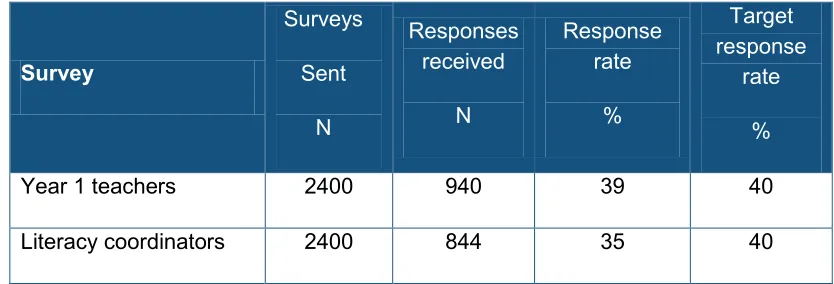
NFER distributed baseline surveys to literacy coordinators and Year 1 teachers in a nationally representative sample of primary schools in June 2012. Data collection commenced the week beginning 25th June 2012 which was the week after the administration of the check.
13
Table 1 Survey response rates
Survey
Surveys
Sent
N
Responses received
N
Response rate
%
Target response
rate
%
Year 1 teachers 2400 940 39 40
Literacy coordinators 2400 844 35 40
Source: NFER survey of literacy coordinators and Year 1 teachers, 2012
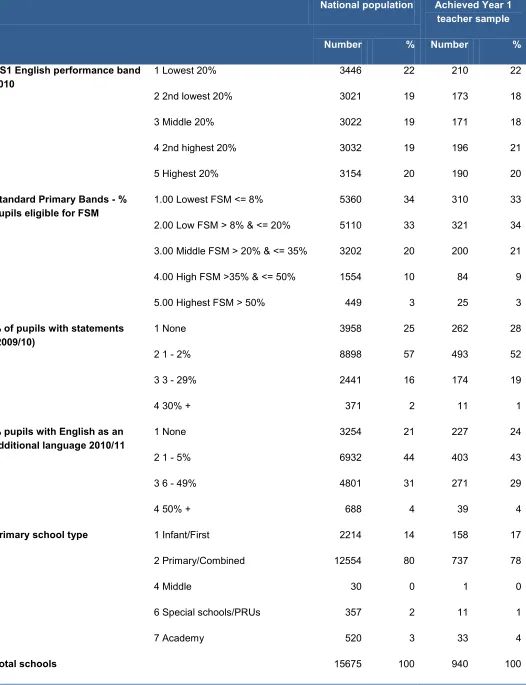
Analysis of the school characteristics of those Year 1 teachers responding to the survey, across characteristics such as Key Stage 1 performance band and the proportion of pupils eligible for free school meals, revealed that the sample of achieved Year 1 teacher respondents5 were from schools that exhibited broadly similar characteristics to primary schools nationally (see Table 2 below). Given this, the sample sizes achieved are large enough to detect statistically significant differences.
5 A separate analysis revealed that the literacy coordinator sample was also broadly similar to primary schools
14
Table 2 Representation of participating primary schools compared to schools nationally (based on responses to Year 1 teacher survey)
National population Achieved Year 1 teacher sample
Number % Number %
KS1 English performance band
2010 1 Lowest 20% 3446 22 210 22
2 2nd lowest 20% 3021 19 173 18
3 Middle 20% 3022 19 171 18
4 2nd highest 20% 3032 19 196 21
5 Highest 20% 3154 20 190 20
Standard Primary Bands - % pupils eligible for FSM
1.00 Lowest FSM <= 8% 5360 34 310 33
2.00 Low FSM > 8% & <= 20% 5110 33 321 34
3.00 Middle FSM > 20% & <= 35% 3202 20 200 21
4.00 High FSM >35% & <= 50% 1554 10 84 9
5.00 Highest FSM > 50% 449 3 25 3
% of pupils with statements
(2009/10) 1 None 3958 25 262 28
2 1 - 2% 8898 57 493 52
3 3 - 29% 2441 16 174 19
4 30% + 371 2 11 1
% pupils with English as an
additional language 2010/11 1 None 3254 21 227 24
2 1 - 5% 6932 44 403 43
3 6 - 49% 4801 31 271 29
4 50% + 688 4 39 4
Primary school type 1 Infant/First 2214 14 158 17
2 Primary/Combined 12554 80 737 78
4 Middle 30 0 1 0
6 Special schools/PRUs 357 2 11 1
7 Academy 520 3 33 4
15
The profile of those in the literacy coordinator role
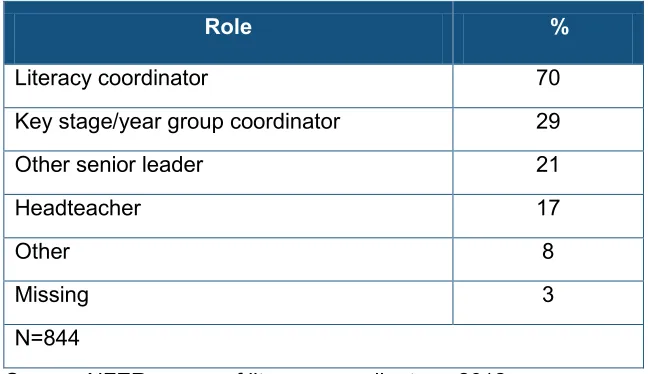
[image:15.595.70.394.188.375.2]One of the questionnaires was aimed at those staff ‘with responsibility for the school literacy policy affecting the teaching of phonics and the use of the Year 1 phonics screening check’ (hereafter referred to as the literacy coordinator questionnaire). Those staff responding to this questionnaire were asked to indicate the role(s) in which they were responding to the questions. The findings are presented in Table 3 below.
Table 3 Profile of staff responding to the literacy coordinator questionnaire
Role %
Literacy coordinator 70
Key stage/year group coordinator 29
Other senior leader 21
Headteacher 17
Other 8
Missing 3
N=844
Source: NFER survey of literacy coordinators, 2012
More than one answer could be given so percentages may sum to more than 100
The majority (70 per cent) identified themselves as being the literacy coordinator, while a notable minority were in a Key Stage/year group coordinator, headteacher or other senior leader role.
School case-studies
In order to gather a more in-depth understanding of the early implementation of the phonics screening check, a series of school case-studies were undertaken between June and July 2012, focussing on the experiences of 14 schools. The case-studies commenced the week beginning 25th June 2012 which was the week after the administration of the check.
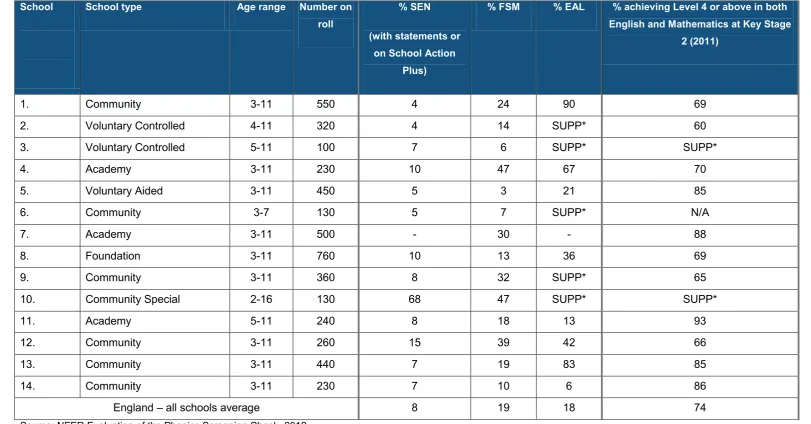
The schools were randomly selected to capture a diverse geographical spread, as well as diversity in terms of size, school type, and the proportion of pupils in receipt of free school meals (FSM), with special educational needs (SEN), and who have English as an additional language (EAL). The characteristics of the schools are presented in Table 4.
Nine of the 14 case-studies involved a visit to the school, while five were conducted by telephone. The case-studies consisted of qualitative interviews with senior school leaders, literacy
coordinators, Year 1 and 2 teachers and reception teachers.
16
Table 4 Selected characteristics of the 14 schools involved in the case-study phase of the evaluation
School School type Age range Number on
roll
% SEN
(with statements or on School Action
Plus)
% FSM % EAL % achieving Level 4 or above in both
English and Mathematics at Key Stage 2 (2011)
1. Community 3-11 550 4 24 90 69
2. Voluntary Controlled 4-11 320 4 14 SUPP* 60
3. Voluntary Controlled 5-11 100 7 6 SUPP* SUPP*
4. Academy 3-11 230 10 47 67 70
5. Voluntary Aided 3-11 450 5 3 21 85
6. Community 3-7 130 5 7 SUPP* N/A
7. Academy 3-11 500 - 30 - 88
8. Foundation 3-11 760 10 13 36 69
9. Community 3-11 360 8 32 SUPP* 65
10. Community Special 2-16 130 68 47 SUPP* SUPP*
11. Academy 5-11 240 8 18 13 93
12. Community 3-11 260 15 39 42 66
13. Community 3-11 440 7 19 83 85
14. Community 3-11 230 7 10 6 86
England – all schools average 8 19 18 74
Source: NFER Evaluation of the Phonics Screening Check, 2012
17
1.5 Analysis and reporting
This report draws on an analysis of the data collected as part of the baseline surveys,
supplemented with data gathered from case-study visits to 14 schools. The report is structured as follows:
Chapter 2 explores survey and case-study schools’ approaches to teaching phonics, their views about phonics and literacy teaching, details of any phonics training that has been undertaken and their self-reported state of preparedness for effective phonics teaching.
Chapter 3 reports on survey and case-study schools’ views on the phonics screening check, their experiences of administering the check, the costs of introducing the check, and views on the appropriateness of the check with different groups of learners.
The concluding chapter draws together the key messages from the different strands of the
evaluation and provides an initial assessment of the extent to which the phonics screening check is meeting its stated aims. It also outlines the next steps for the evaluation.
Findings from descriptive analysis are reported within the chapters; for further details, please refer to the technical appendix published alongside this report. The main variables discussed
throughout relate to the type of respondent. Through statistical modelling known as latent class analysis we have built a typology of teachers’ engagement with the phonics agenda which we have related to the phonics screening check and Key Stage 1 outcomes in the sample schools. Further details are provided in Chapter 3.
Key findings are summarised at the beginning of each of the chapters.
18
2. Phonics teaching
Key Findings
Teachers were overwhelmingly positive about phonics as an approach to teaching reading, and its contribution towards early reading development.
In the majority of schools, however, other strategies alongside phonics were also supported.
More than half (53 per cent) of schools reported that they taught systematic synthetic
phonics ‘first and fast’, although teachers’ responses regarding the use of other methods to teach children to decode words were not wholly consistent with this data.
More than 90 per cent of schools taught phonics to all children in Reception, Year 1 and Year 2, more often than not using Letters and Sounds as their core programme.
Almost half the survey schools (47 per cent) reported that staff had attended external training specifically on phonics teaching during the past school year. The majority of case-study schools had undertaken either external or internal training on phonics. Both sets of data indicate that teachers and teaching assistants received this training.
This chapter presents findings from the surveys and case-studies regarding teachers’ views and attitudes towards phonics teaching. It looks at school approaches to teaching phonics, and offers insight into current classroom practice. The chapter explores the level of phonics training received by those teachers involved in the evaluation, and reports on whether this was perceived to be of value.
2.1 Views about phonics and literacy teaching
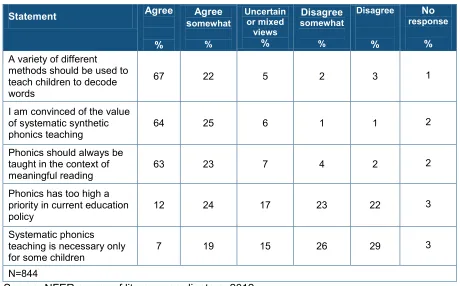
It was important to be able to distinguish between attitudes towards the phonics screening check as an assessment of phonic knowledge and understanding, and the position of teachers regarding phonics as an approach within literacy teaching. As such, the literacy coordinator questionnaire and the case-study interview schedules contained focused questions designed to establish an understanding of teachers’ views about phonics teaching, independent of their feelings towards the phonics screening check itself. In the survey, those responding to the literacy coordinator questionnaire were asked to indicate the extent to which they agreed with a series of statements relating to their views about phonics and literacy teaching.
19
Table 5 Teachers’ views about phonics as an approach to teaching reading
Statement Agree
% Agree somewhat % Uncertain or mixed views % Disagree somewhat % Disagree % No response %
A variety of different methods should be used to teach children to decode words
67 22 5 2 3 1
I am convinced of the value of systematic synthetic
phonics teaching 64 25 6 1 1 2 Phonics should always be
taught in the context of
meaningful reading 63 23 7 4 2 2 Phonics has too high a
priority in current education
policy 12 24 17 23 22 3
Systematic phonics teaching is necessary only
for some children 7 19 15 26 29 3 N=844
Source: NFER survey of literacy coordinators, 2012
Due to percentages being rounded to the nearest integer, they may not sum to 100
Table 5 shows that a large majority of respondents (89 per cent) felt to some extent that the teaching of systematic synthetic phonics has value in the primary classroom, with 64 per cent ‘agreeing’ fully with this statement. However, 89 per cent also ‘agreed’ or ‘agreed somewhat’ that a variety of different methods should be used to teach children to decode words.
Responses to these two statements in particular may reveal some misunderstanding of the
term ‘systematic synthetic phonics’ as it is understood in current policy. The Department for
Education’s policy and evidence paper, The Importance of Phonics: Securing Confident Reading6
is downloadable from the Phonics Screening Check webpage and defines ‘systematic synthetic phonics’ as follows:
Children are taught the correspondences between sounds (phonemes) and letters. They identify and blend different letter sounds and letter combinations together (‘synthesise’ them) to make a word - for example, pronouncing each phoneme in shop /sh/-/o/-/p/ and then blending those phonemes to produce the word….A systematic approach to teaching synthetic phonics means teachers take a planned, thorough approach, teaching children the simplest sounds first and progressing all the way through to the most complex
combinations of letters. (p.2).
6
20 Further policy guidance7 includes a set of criteria for high quality phonic work, presenting the key features of an effective, systematic, synthetic phonics programme. This envisages phonics as ‘the prime approach to decoding print, i.e. a phonics ‘first and fast’ approach’. Within the criteria it is specified that children should ‘apply phonic knowledge and skills as their first approach to reading and spelling even if a word is not completely phonically regular’ and it is noted that ‘children should not be expected to use strategies such as whole-word recognition and/or cues from context,
grammar, or pictures’. This guidance fits within a context where phonic work is seen not as one of a range of optional methods or strategies for teaching reading but as a body of knowledge and skills about how the alphabet works which all children should be taught.
Against this background, the notion of favouring systematic synthetic phonics, but at the same time arguing that it is not the only way of teaching children to decode, is somewhat contradictory. It is possible that this level of agreement with the value of systematic synthetic phonics actually represents support of the more general use of phonics within the primary classroom. Teachers may tend to see phonics working alongside other strategies, particularly for words that are not phonically regular. These somewhat inconsistent questionnaire responses are explored in more detail in Section 2.2, which focuses on the phonics teaching practices reported by participants in the evaluation.
Evidence from the case-studies supports the survey data in that interviewees were positive
about phonics teaching and its contribution to reading development.The following
observations typify overall opinion: ‘I think phonics should play an absolutely pivotal and core part in learning to read’ (Headteacher); ‘[Phonics is] vital ... [Without it], children stumble at the first block’ (Reception teacher). Many teachers felt that learning to read using phonics allows children to feel a sense of achievement by building reading skills in small steps, and that it is especially important in a child’s early educational experience. Responses also highlight a real impact of phonics in schools, with several very experienced teachers reporting differences between older children in the school who were taught without phonics compared with those year groups for whom systematic phonics was used at the outset. One literacy coordinator summarised the situation in her school: ‘We see gaps in our current Years 4, 5 and 6 who missed out on phonics teaching in Key Stage 1 and Early Years Foundation Stage (EYFS), especially recognising split digraphs, alternate spellings of sounds and tricky words.’
Also in accordance with responses from the survey was one of the key messages to
emerge from the case-studies: that a phonics approach to teaching reading should be used alongside other methods. This opinion was frequently held even where teachers thought that phonics should be the primary approach to teaching reading, a view encapsulated by this headteacher: ‘[It is] not possible to teach [reading] without phonics but children need a range of skills and strategies’. Teachers in the case-study schools reported encouraging the use of other strategies such as using context cues, visual memory and picture cues. Responses overall also indicated a strong tendency for teachers to consider individual differences in children, arguing that ‘A variety of approaches based on the [needs of the] child is best’ (Headteacher), and ‘I don’t think phonics should be the only way; it won’t meet the needs of every single child’ (Headteacher).
7
21 Similarly, in the case study interviews, responses referring specifically to ‘systematic synthetic phonics’ were uncommon, despite positive reactions generally to ‘using phonics to teach reading’. Views such as those of this literacy coordinator, supporting the sole use of phonics, were rare: ‘in my experience synthetic phonics is the only way that children learn to read. I completely agree with phonics as a programme and as a method of teaching’. Even in this case, other teachers in the same school, whilst showing extremely positive attitudes towards phonics teaching, referred to the use of other methods of teaching and to other reading strategies.
Further evidence of teacher support for a phonic-based approach to reading is provided by responses to the final statement in Table 5 (‘Systematic phonics teaching is necessary only for some children.’) Only a minority (seven per cent) agreed, with a further 19 per cent selecting ‘somewhat agree’. More than half (56 per cent) disagreed to some extent with the statement, emphasising the fact that phonics is seen as necessary and suitable for most children.
Interviewees in case-study schools provided some insight into this matter which are explored in Chapter 3, Section 3.5.
The survey data showed a high proportion of respondents (86 per cent) agreeing that phonics should be taught in the context of meaningful reading. This view was supported by several of those involved in the case-study interviews, who described children who have good phonic decoding skills alongside poor comprehension of what they are reading. One headteacher explained that ‘high-quality guided reading is critical to support understanding of text.’
Just over a third of survey respondents (36 per cent) felt in some way that phonics has too high a priority in current education policy, indicating that even among those who value the role of phonics in the primary classroom, there is some concern about the prominence it should have in policy. In contrast, almost half of respondents (46 per cent) disagreed to some extent with this statement, a finding that is more consistent with the generally high levels of support for phonics. Interestingly, this statement relating to education policy generated the highest percentage of reports of
‘uncertain’ or ‘mixed views’ (17 per cent), highlighting the discrepancy between what teachers feel comfortable doing in practice, and what they want to see included in policy. Only a small number of teachers involved in the case-studies raised the issue of policy, this comment from a literacy coordinator representing their views: ‘The phonics agenda is overly biased towards phonics at the expense of other types of reading ... I think there are very few areas of education where one size fits all...’
The case-study interviews were used to ascertain teachers’ views towards the government’s match-funding programme, offering schools financial assistance to invest in resources or training for systematic synthetic phonics. Teachers were, for the most part, welcoming towards the financial support and positive about the content of the catalogue of approved products. This Year 1 teacher epitomised teachers’ views: ‘It’s been fantastic, it’s made our budget go a lot further.’ Only one school reported that the catalogue did not contain the specific programme they wanted, and one teacher thought the size of the catalogue could be overwhelming for
22 The majority (eight of the 14 case-study schools) reported that they had already used their
funding, and those who had not were in the process of carefully considering what to buy. In the main, schools used the match-funding to buy supplementary phonics resources rather than core phonics programmes (which they had already): phase-appropriate phonic boxes, flash cards and games were among those referred to, as well as specific books bought primarily for guided
reading, e.g. Phonics Bug, Project X, Oxford Reading Tree phonics books and Ruth Miskin guided reading books. Match-funding was used by three schools for external phonics training, and
responses from teachers in these schools were particularly enthusiastic: ‘We used the match-funding for the training that we all went on, which was brilliant. We spent two days there, all the staff together, and got some brilliant resources’ (Year 1 teacher).
2.2 Phonics teaching practices
The evaluation aimed to establish current teaching practices regarding phonics, including any changes made to teaching as a result of introducing the phonics screening check.
Responses from teachers in both the survey and case-study schools revealed that almost all schools have committed to teaching phonics to some degree, and that, within literacy teaching, considerable emphasis is placed on phonics as a method of teaching children to learn to decode. In an extremely high percentage of survey schools, school policy required that (or typical practice was such that) phonics was taught to all pupils in Reception (96 per cent), Year 1 (95 per cent) and Year 2 (93 per cent). Most schools reported that this phonics teaching took place daily, and on average this equated to just over two hours of phonics teaching per week. All the case-study schools also indicated a strong school focus on phonics, with daily phonics sessions for children from Foundation Stage through to at least Year 2 reported by most.
At Key Stage 2, as would be expected, a different picture emerged in the survey data: phonics was typically taught to all pupils in Year 3 by 36 per cent of schools, in Year 4 by 24 per cent of schools and in Year 5/6 by only 15 per cent of schools – considerably lower proportions than throughout the Foundation Stage and Key Stage 1. However, in cases where phonics was not taught to all pupils, it was still used by many schools as a teaching approach for some pupils in Years 3-6, and almost half of schools (45 per cent) reported still having dedicated phonics
sessions at Year 3. This finding is supported by information from the case-studies, in which some teachers described continued use of phonics into Key Stage 2 as necessary, particularly for those still having difficulties with spelling.
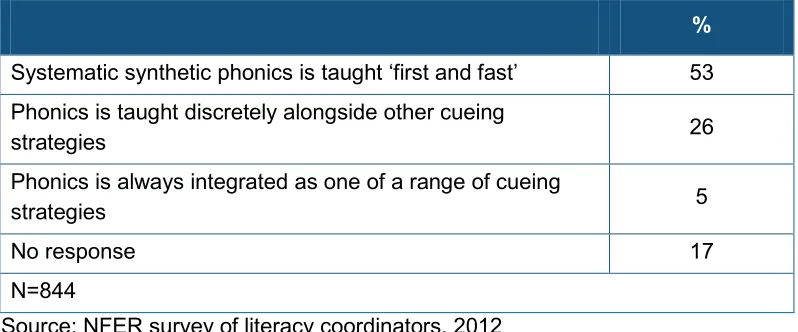
23 sessions referred to above, although for some it is likely to be a description of the school’s overall approach to teaching reading. As Table 6 shows, a small minority of schools (five per cent)
[image:23.595.72.471.141.307.2]described their overall approach towards phonics as ‘always integrated as one of a range of cueing strategies’.
Table 6 Teacher reports of their school’s approach to phonics teaching
% Systematic synthetic phonics is taught ‘first and fast’ 53 Phonics is taught discretely alongside other cueing
strategies 26
Phonics is always integrated as one of a range of cueing
strategies 5
No response 17
N=844
Source: NFER survey of literacy coordinators, 2012
Due to percentages being rounded to the nearest integer, they may not sum to 100
The findings described above indicate that the majority of those teaching phonics do so in the context of focused sessions. However, some confusion was evident among those who identified themselves as teaching phonics using a ‘first and fast’ approach. Of these schools, 85 per cent ‘agreed’ or ‘agreed somewhat’ with the contradictory statement ‘A variety of different methods should be used to teach children to decode words’, as discussed in Section 2.1.
This contradiction in teacher responses reflects the misunderstanding described in Section 2.1 regarding what ‘systematic synthetic phonics’ means, and what ‘first and fast’ in this context implies. The guidance makes it clear that phonics alone should be taught initially, and that
teaching other strategies alongside phonics is not recommended. It would seem that the figure of 53 per cent of schools who claim to be teaching systematic synthetic phonics ‘first and fast’ is potentially misleading, and does not provide an accurate representation of actual practice in phonics teaching. A high proportion of schools are clearly teaching phonics, but not necessarily in the way a systematic synthetic approach would prescribe.
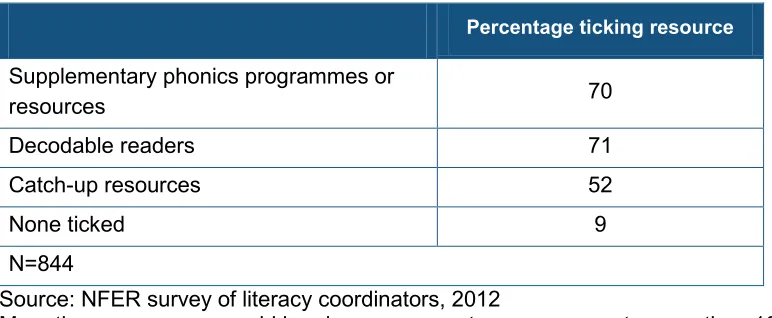
In order to provide a fuller picture of how schools teach phonics, information was collected
24
Table 7 Schools’ use of published phonics resources (in addition to ‘core’ programmes)
Percentage ticking resource
Supplementary phonics programmes or
resources 70
Decodable readers 71
Catch-up resources 52
None ticked 9
N=844
Source: NFER survey of literacy coordinators, 2012
More than one answer could be given so percentages may sum to more than 100
Table 7 shows the proportions of survey schools who reported making regular use of other kinds of published phonics resources in school, in addition to any ‘core’ programme(s). The data
suggests that teachers are making considerable use of phonics resources, with additional analysis revealing that around two thirds of respondents (67 per cent) said they used at least two kinds of these additional resources. In the case-study schools, the majority of interviewees made reference to one or more additional resources, including those they had bought using match-funding (see Section 2.3).
The case-studies provided further insight into how schools organise phonics teaching within the overall literacy curriculum. Whilst many children were taught phonics in their class groups, a small number of teachers reported that children were taught in ability groups for general literacy,
discrete phonic sessions, or both. Two schools also reported that they had plans to introduce differentiated phonics teaching in this way in the future, perhaps indicating a shift in schools towards an increased focus on phonics, and changing attitudes regarding its importance.
2.3 Phonics training
Survey participants were asked whether teachers in their school had received externally provided training specifically focused on the teaching of phonics during the school year 2011/2012. Almost half (47 per cent) responded ‘yes’ to this question, indicating a steer towards this method of teaching reading, and again reflecting current policy priorities. Further details given by
respondents show that Reception, Year 1 and Year 2 teachers were most likely to have received such training, and in several schools, both Key Stage 1 and Key Stage 2 teachers attended. The data shows some schools sent teaching assistants on training, but fewer than those who sent teachers. In the majority of cases, training was supplied by local authorities, with some more commercial training-providers also mentioned, the most frequent being Read, Write, Inc.
25 massive impact on phonics, which has had a massive impact on reading and writing’ (Year 1 teacher). Some of the training attended by teachers was more recent; in other cases it had taken place during a previous school year, depending on when the school had implemented phonics teaching across the school. The importance of ensuring teaching assistants received such training and subsequently felt confident in supporting phonics learning was emphasised by several
teachers, including this headteacher: ‘I think the training had a huge impact on the confidence of TAs in particular...’ Some schools also made reference to holding or organising in-house training to make sure all applicable staff felt secure in the area of phonics.
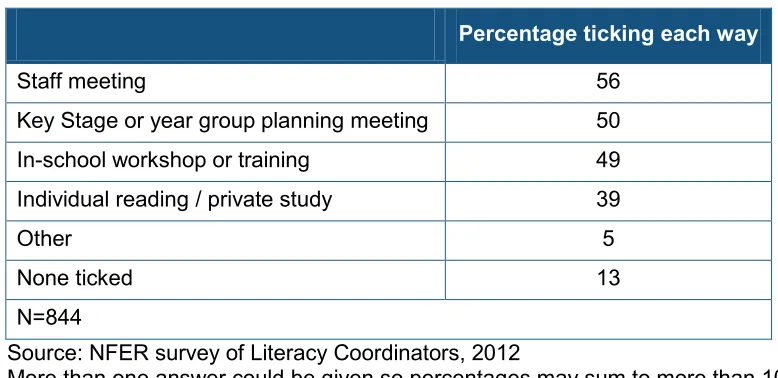
[image:25.595.69.458.364.553.2]The survey data shows that, as well as external training, teachers learned about phonics teaching in a variety of ways during the 2011/2012 school year. Table 8 lists the percentages selecting each way. Staff meetings, in-school workshops or training, and Key Stage or year group planning meetings were each identified by around half of respondents as having helped teachers learn about phonics, and teachers also undertook private study. ‘Other’ ways, reported by a minority of respondents, included observations, peer-working, training courses and local authority updates. These responses indicate that a considerable number of schools are placing emphasis on phonics teaching, and are using in-school opportunities to enhance staff knowledge and understanding, as well as organising internal training specific to this area.
Table 8 Other ways of learning about phonics (apart from training)
Percentage ticking each way
Staff meeting 56
Key Stage or year group planning meeting 50
In-school workshop or training 49
Individual reading / private study 39
Other 5
None ticked 13
N=844
Source: NFER survey of Literacy Coordinators, 2012
More than one answer could be given so percentages may sum to more than 100
Among case-study interviewees, there was also a clear message from several schools that a collegiate approach to sharing knowledge, understanding and practice was an effective way of increasing confidence and expertise in the area of phonics. One literacy coordinator reported that she had undertaken a lot of phonics training in a previous role, and was now capitalising on this to support others across the school. A Year 1 teacher described her role as the school’s ‘phonics lead’, which involved holding workshops with teaching assistants, observing phonics teaching in other schools with the aim of improving teaching in her current school, and organising phonics resources to ensure they were used to full effect.
26
3. The phonics screening check
Key findings
Preparation for the check
Nearly all teachers surveyed prepared for the check by familiarising themselves with the Check Administrators’ Guide and many watched the online video Scoring the year 1 phonics screening check training video.
In case-study schools, about half of teachers reported making no special preparations for the check, while about half reported attending external training specifically on the check.
Costs and benefits of introducing the check
The median additional financial cost incurred by schools in supporting the introduction and administration of the check was £400; there was large variation in this cost between
schools.
Some benefits of the check were acknowledged in a number of case-study schools,
including confirming the results of other assessments and placing an emphasis on phonics teaching.
Suitability of the check with different groups of learners
Year 1 teachers had mixed views on whether the standard of the check was appropriate, with slightly more teachers suggesting it was too difficult.
Some issues were raised about the suitability of the check for pupils with special
educational needs, high ability pupils and those with English as an additional language.
Communicating with parents/carers
Almost all of the responding literacy coordinators (98 per cent) reported that they had or would communicate the results of the check to parents/carers, with most using (or planning to use) a number of different approaches. For example, two thirds of schools communicated (or planned to communicate) the results as part of the child’s individual end of year written reports, while almost four out of ten (37 per cent) communicated (or planned to
communicate) the results in a separate letter to parents/carers.
As recommended in the Check Administrators Guidance, many schools appeared to be providing (or planning to provide) additional information to parents/carers. For example, almost three quarters of schools (73 per cent) were providing (or planning to provide) information to parents/carers about how they could support their child and 61 per cent were providing (or planning to provide) information about the type of in-school support planned.
Impacts of the check
27
However, a third of schools reported making changes to phonics teaching in anticipation of the check. These changes included: increased assessment of progress in phonics;
increasing the time devoted to phonics teaching; and starting to use a phonics programme more systematically.
The check also appears to have prompted discussion between teachers with the majority of Year 1 teachers responding to the survey reporting that they planned to discuss the results of the check with Year 2 teachers (61 per cent) and the literacy coordinator (52 per cent).
The majority of literacy coordinators (80 per cent) reported that the results would inform the identification of children experiencing difficulties with phonics while 61 per cent reported that the results would inform the design of specific teaching plans for children experiencing difficulties with phonics.
Views on the value of the check
Literacy coordinators had mixed views on whether the outcomes from the check provided valuable information for teachers, with most leaning towards the view that it did not.
Case-study interviewees did see some additional benefits to the check, including giving a performance benchmark and focussing their teaching on phonics. However, these were mostly expressed as minor benefits.
This chapter explores teachers’ preparation for the phonics screening check and their experience of administering it, including the extent to which they had to disapply children from the check. The chapter also explores the costs incurred by schools in administering the screening check and teachers’ views on the suitability of the check with different groups of learners. Finally, it presents findings from the surveys and case-studies regarding teachers’ views and attitudes towards the check.
3.1 Preparation for the check
Nearly all surveyed teachers reported preparing for the check via reading the Check
Administrators’ Guide, and most had watched the online video Scoring the year 1 phonics
screening check training video. In case-study schools, about half of teachers reported
attending external training specifically on the screening check, while about half reported
making no special preparations for the check.Year 1 teachers in nearly all schools surveyed
(97 per cent) prepared for the check by reading the Check Administrators’ Guide8. Watching the
online video Scoring the year 1 phonics screening check training video9 was also commonly used
8 The National Curriculum assessments, Check Administrators Guide, Year 1 phonics screening check 2012 gave
guidance on the administration of the check. It was available from http://www.education.gov.uk/ks1 and was sent to schools prior to the check administration.
9 Scoring the Year 1 phonics screening check training video gave examples of the check questions, format and
28 as a form of preparation (in 82 per cent of schools) and 61 per cent of teachers reported preparing for the check via a discussion with the literacy coordinator. A similar proportion of teachers
prepared by year group or Key Stage meetings (56 per cent) as those who prepared by attending externally provided training specifically focused on the phonics screening check (54 per cent). Mostly this training was provided by the local authority (LA).
About half of the case-study schools either reported that they had not been on any training related specifically to the administration of the check, had done their own research, or had been on only general phonics assessment training not related to the check itself. Comments of this type included:
We’ve had some external training on assessment of phonics for both teachers and TAs, but nothing specific on the phonics check itself. I did my own research around this.
Literacy coordinator
No training was undertaken by staff, the test isn’t hard. We’re all educated people.
Headteacher
However, in about half of case-study schools, at least one member of staff had been on some form of external training specifically on the check, usually given by the LA. This training was mostly brief and frequently involved watching video clips of the check being administered, although it was unclear if this was the DfE video Scoring the Year 1 phonics screening check training video. For example, one literacy coordinator said ‘[Staff went to] an evening meeting
organised by the LA where they were shown example video clips of children taking the check.’ In these schools, various staff were reported to have attended the training and they gave mixed views on its usefulness. There did not appear to be any relation between preparation for the check and school engagement with it, although the number of schools involved is small.
3.2 Administration of the check
Of Year 1 teachers who completed the survey, 61 per cent of their pupils met the required standard, close to the 58 per cent of pupils nationally who met the standard.
Pupils could be disapplied from the phonics screening check prior to its administration, meaning
they did not have to undertake the check because it was deemed to be an inappropriate
assessment for them. Of the surveyed teachers, 40 per cent did not disapply any children from the check. Of those who did, most did not disapply many pupils. Out of all the responding Year 1 teachers, 33 per cent disapplied one pupil, 20 per cent disapplied two or three pupils, and only six
29 per cent disapplied four or more pupils. Where a child was disapplied from the check, the Year 1 teacher and the headteacher have been most frequently involved in this decision (in 91 per cent and 72 per cent of cases respectively).
In the case-study schools, the majority of teachers said they did not disapply any pupils. This was mostly because it was felt to disapply pupils would be detrimental to them: ‘We might damage children’s confidence, etcetera, if they were singled out’ (literacy coordinator). However, a few did note that, with hindsight, there were children who they wished they had disapplied, or that
disapplication would be approached differently in the future:
Looking back I wish I hadn’t put the one very low ability child through it because I knew he wasn’t going to achieve it.
Year 1 teacher
We wanted to know where all the children were … In the future, the decision may be different.
Literacy coordinator
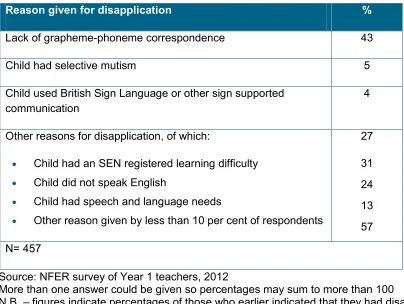
Where teachers had been involved in disapplying children, most reported that the lack of grapheme-phoneme correspondence was the major reason for disapplication, but
30
Table 9 Reasons given by surveyed Year 1 teachers for disapplication of children
Source: NFER survey of Year 1 teachers, 2012
More than one answer could be given so percentages may sum to more than 100
N.B. – figures indicate percentages of those who earlier indicated that they had disapplied one or more pupils
N.B. – figures exclude missing responses.
The Year 1 teachers surveyed were asked what criterion they had applied in making a judgement of a child having no grapheme-phoneme correspondence. This question was applicable to 379 teachers, of which, 22 per cent said the criterion they used was that ‘the child had not yet
developed letter sound recognition’. This was followed by 15 per cent who said the criterion they used was ‘the child had basic letter sound recognition but was unable to fully blend’.
Teachers stopped the check early for a small number of pupils but reported that they found
it easy to judge if and when to do so. On average, each teacher stopped the check early with
one or two pupils. Just over half of all teachers surveyed (52 per cent) reported it was ‘quite easy’ (30 per cent) or ‘very easy’ (23 per cent) to judge if and when to stop the check early due to a child struggling. Only 5 per cent of teachers found this ‘quite hard’ (3 per cent) or ‘very hard’ (2 per cent). For one in three teachers (33 per cent) the issue did not occur at all.
The most common reason given for stopping the check early was the child beginning to struggle, which was cited by 59 per cent of Year 1 teachers. Just under half of the Year 1 teachers surveyed said they stopped the check early due to it becoming obvious that the child would not reach the threshold (47 per cent) and the child getting several questions in a row incorrect (46 per cent). The child becoming tired or distracted was also a common reason for stopping the check early, cited by 40 per cent of teachers. The child taking a long time either to answer an item or to complete the check were given as reasons much less frequently (12 per cent and 8 per cent respectively). A similar proportion of teachers gave an ‘other’ reason for stopping the check early (12 per cent). Of these, the most common reason given was the child becoming
Reason given for disapplication %
Lack of grapheme-phoneme correspondence 43
Child had selective mutism 5
Child used British Sign Language or other sign supported communication
4
Other reasons for disapplication, of which:
Child had an SEN registered learning difficulty Child did not speak English
Child had speech and language needs
Other reason given by less than 10 per cent of respondents
31 distressed (36 per cent of teachers giving an ‘other’ reason). Four additional reasons relating to child unhappiness were mentioned, but relatively infrequently (range 1 per cent to 8 per cent of teachers who ticked ‘other’).
Few pupils from the case-study schools had the check stopped early or took a break during the check, which corroborates the findings from the survey data. The majority of those who were given breaks or had the check stopped early were SEN pupils. One school reported SEN pupils had the check stopped early due to it having an adverse emotional effect on them: ‘It was stressful for them [SEN pupils] and ‘pointless’ to carry on as it wasn’t going to get any easier. They weren’t upset, but they were disheartened’ (Year 1 teacher), but breaks were mostly given for more
intrinsic reasons: ‘It was a concentration thing for them [SEN pupils]. It felt natural for them to have a break’ (Year 1 teacher).
3.3 Costs and benefits of introducing the check
Literacy coordinators were asked in the survey what additional financial costs, if any, their school had incurred in supporting the introduction and administration of the check (this might, for example include the costs of training staff in the check administration or providing supply cover while
administering the check). The median costs reported by schools was £40010. The costs
incurred for the administration of the check ranged from zero to over £5,000 for supply cover. Some higher costs were recorded, but these appeared to be for phonics teaching resources, so were not included in this range. However, it is noted they are included in the median cost reported above.
Case-study schools reflected the range in financial costs seen in the survey data; varying between several hundred pounds and no financial costs at all, for example:
We had [as a cost] training by the LA, and four day’s supply cover at £180 a day.
Headteacher
There’s no financial costs really.
Headteacher
Literacy coordinators were also asked in the surveys what additional time costs, if any, their school had incurred in supporting the introduction and administration of the check. The median
additional time costs were reported to be 6 hours11. Responses ranged from zero hours to
over 40 hours of Year 1 teacher time and over 10 hours of senior leader time.
32 Most case-study schools echoed the findings from the survey data, stating the main time cost was between one and four days’ supply cover. Some schools found this easier to manage than others:
We just shuffled people around and we covered it so that was fine.
Headteacher
It involves a huge amount of manpower and covering people who should be doing other things. For a school this size with 120 Year 1 pupils, it is almost an unmanageable task. We have made it manageable but a huge amount of time, energy and resources of internal teachers have been invested.
Headteacher
Costs and benefits from the check: What the case-studies showed
When asked directly, only two case-study schools said they could see some benefit to the check. The majority of schools felt that there were no benefits to the check at all, often because any potential benefits were negated as they were advantages already gained from elsewhere, as explored below in Section 3.7. For example: ‘I can’t think of any pupil benefit to be honest … you should reflect on your practice anyway, not as a result of the phonics screening test’
(Headteacher); ‘[the check] confirms we know where our children are at, but that would be the only one [benefit] (Headteacher).
A frequently mentioned disadvantage of the check was the extra pressure placed on teachers, in terms of ‘time and energy’ (Headteacher), ‘worry about how parents will perceive the school’ (Headteacher) and demoralisation (‘them [the children] not achieving a certain score on a check, it’s demoralising when you already know’ – Headteacher). The main other disadvantage
mentioned was a possible negative effect on children’s self esteem. Further to this, one Headteacher mentioned a distrust of the DfE, as seen again later in Section 3.7.
Some schools did cite positive messages when asked for benefits of the check, commenting that the check ‘confirms we know where our children are at’ (Headteacher), places ‘an emphasis on phonics’ (Year 1 teacher) and ‘flags up any issues that parents need to be made aware of’ (Literacy coordinator). Over and above these benefits already noted, one school saw a further benefit of the check outside its intended use, in using it with younger children, to ‘give us an idea of their levels’ (Headteacher).
3.4 Suitability of the check with different groups of learners
33 was ‘slightly too difficult’ (40 per cent); however, an additional 11 per cent said the standard of the check was ‘much too difficult’. In contrast, one per cent of Year 1 teachers said the standard was ‘slightly too easy’, and no teachers said the check was ‘much too easy’.
The views of case-study participants echoed those of teachers responding to the survey, with slightly more teachers suggesting the check was too difficult. Teachers in the case-study schools, however, focussed more on the appropriateness of the words used, rather than the correct level for the standard. The following quotes illustrate the range of comments given:
The test was too hard. The standard was too high. Some words were really tricky.
Year 1 teacher
[The] check seemed to cater for the whole range of ability within the class.
Year 1 teacher
It didn’t incorporate enough of Phase 5; it seemed quite easy for a lot of the children.
Year 1 teacher
Year 1 teachers were also asked in the survey for their views on the suitability of the check with specific groups of children. Teachers were asked in the survey instruments to respond regarding only those children who were working at the expected level. Case-study participants were asked their views only in regard to those with whom they administered the check. It is assumed,
therefore, that the views expressed by teachers presently are in relation to those pupils who are working at the appropriate level.
Figure 1 shows the reactions of Year 1 teachers who reported they had experience of
administering the check with pupils who had: sight impairments; hearing impairments; English as an additional language; other learning difficulties; and those who had speech, language or
communication needs. It is of note that the number of respondents with experience of
34
Figure 1 Reactions of teachers with experience of administering the check with the relevant group of pupils
Source: NFER survey of Year 1 teachers, 2012
Due to percentages being rounded to the nearest integer, they may not sum to 100
N.B. Only those who indicated they had experience of administering the check with the relevant group of pupils are included
For further details of the number of respondents with the relevant experience of each pupil group please see the technical appendices.
Most teachers felt that the check was not suitable for children with speech, language or communication needs and children with other learning difficulties. However, more mixed views were reported regarding the appropriateness of the check for EAL pupils and for pupils with sight or hearing impairments.
Two thirds of Year 1 teachers (66 per cent) reported they had experience of administering the check with pupils who had speech, language or communication needs. Of these responses, 49 per cent thought the check was unsuitable for this group of pupils (19 per cent said it was ‘very unsuitable’, 31 per cent ‘quite unsuitable’), and 26 per cent thought it was of average suitability (the neutral response). The main issue cited for why the check was unsuitable for this group of learners was that the children struggled to clearly communicate their answers.
Only two case-study schools mentioned the check in relation to a child with speech, language or communication needs. One child was disapplied from the check, and for the other child two teachers were present during the check and discussed the child’s responses after its
administration to ensure accuracy; this teacher appeared happy with this solution to the issues presented by pupils with speech, language or communication needs during the check.
35 suitable’). The main reasons given for the check not being suitable for pupils with other learning difficulties were that the pupils were ‘distracted’ and got confused by the pseudo words.
Many case-study interviewees made comments on the suitability of the check with pupils with SEN generally. On the whole these comments were mixed and thus reflected the survey data regarding pupils with other learning difficulties, for example:
They [pupils with SEN] enjoyed doing it. Being taken out of the classroom with the teacher made them feel ‘special and grown up’.
Year 1 teacher
With SEN children … it was difficult to ask them to keep going and you can’t give them any indication of how they’re doing. If they struggled with the first few they had more difficulties going on and it was a lot to ask of those children.
Literacy coordinator12
There was additionally some limited evidence of comments regarding the unsuitability of the check for those with more severe needs, such as severe autism13, in terms of phonics itself and the procedure of the check:
The check approach, and indeed the whole notion of decoding unfamiliar words, is not well suited to children with autism. They nee