ABSTRACT
BackgroundHeart failure (HF) is common in long-term care (LTC). Diagnostic uncertainty is important barrier to optimal HF management, stemming from inadequate health information transfer upon LTC admission. We determine the utility of admission clinical information to confirm a HF diagnosis in new LTC residents.
Methods
This was a prospective cohort study. From February 2004 to November 2006, information about new residents from 41 LTC homes in Ontario, Canada, was collected from residents and caregivers, and all available health records. A prior HF diagnosis was confirmed by consensus review of available data by two independent experts. Multivariate modelling was utilized to determine the utility of the admission clinical assessment in confirming a prior HF diagnosis.
Results
A total of 449 residents were included for analysis, aged 84.3±6.5 years, and 21.6% had a prior HF diagnosis. The most useful clinical item for diagnosing HF was a “history of HF”. The final model included “history of HF’ (OR [odds ratio] 13.66, 95% CI 6.61–28.24), “fluid on the lungs” (OR 2.01, 95% CI 1.04–3.89), “orthopnea” (OR 1.76, 95% CI 0.93–3.33), “taking β-blocker” (OR 2.09, 95% CI 1.10– 3.94), “taking loop diuretics” (OR 2.11, 95% CI 1.12–3.98), and “history of coronary artery disease” (OR 2.83, 95% CI 1.42–5.64).
Conclusion
Elements of the clinical assessment for new LTC residents can help confirm a prior HF diagnosis. An admission history of HF is highly predictive.
Key words: heart failure, elderly, nursing home, long-term care, diagnosis, transition
INTRODUCTION
Heart failure (HF) predominantly affects seniors, many of whom are frail and disabled.(1-4) According to a recent systematic review, the prevalence of HF in long-term care (LTC) homes, which provide 24-hour nursing care to frail persons no longer able to reside in the community, reaches 20%.(5,6) The one-year mortality of HF in LTC reaches 40%, a rate 50% higher than among residents without HF.(7-9) HF accounts for approximately 20% of transfers of LTC residents to hospital, and it is considered that many admissions and resulting complications could be prevented with better HF management in LTC.(7,10-16)
Older persons with HF are less likely to be prescribed recommended HF therapies, despite evidence that these can be beneficial even among frail seniors.(17,18) An important barrier to appropriate prescribing of HF medications to frail seniors is diagnostic uncertainty.(19,20) The diagnosis, treat-ment, and prognosis of HF in older adults is often complicated by geriatric syndromes including frailty and psychogeriatric disorders.(17,19) Frail older HF patients, particularly those with difficulty completing activities of daily living, often manifest atypical signs and symptoms, leading to diagnostic delays, inappropriate prescribing, functional decline, and increased health care utilization.(19,21) Frail persons may have
The Value of Admission Clinical Data for
Diagnosing Heart Failure in Long-term Care
George A. Heckman, MD, MSc, FRCPC1, Andrea D. Foebel, PhD2, Joel A. Dubin, PhD3, Jennifer Ng, MSc4, Irene D. Turpie, MB, FRCPC5, Patricia Hussack, RN6, Robert S. McKelvie, MD, PhD, FRCPC7
1Research Institute for Aging and School of Public Health and Health Systems, University of Waterloo, Kitchener, ON; 2School of Public Health and Health Systems, University of Waterloo, Kitchener, ON; 3Department of Statistics and
Actuarial Sciences and School of Public Health and Health Systems, University of Waterloo, Kitchener, ON; 4Population
Health Research Institute, McMaster University, Hamilton, ON; 5Department of Medicine, McMaster University, Hamilton,
ON; 6McMaster University Health Sciences Centre, Hamilton, ON; 7Department of Cardiology, McMaster University,
Ham-ilton, ON
DOI:http://dx.doi.org/10.5770/cgj.16.70
difficulty providing accurate information to health providers. (22) Furthermore, when an older person is admitted to LTC, the transfer of health information from sending organiza-tions is often inadequate.(22) Such poor transitions have been associated with suboptimal care and an increased risk of hospitalization and complications.(23) Ensuring the adequacy of diagnostic information upon LTC admission is crucial for optimal HF management.
The objective of this paper is to determine the utility of the admission clinical assessment for LTC residents in con-firming a prior HF diagnosis.
METHODS
The Geriatric Outcomes and Longitudinal Decline in Heart Failure (GOLD-HF) study took place in South-Central On-tario from February 2004 to November 2006, and included Hamilton (25 LTC homes), Cambridge (seven homes), and Kitchener-Waterloo (nine homes). The GOLD-HF study was a prospective longitudinal study designed to compare over a one-year period the clinical course of newly admitted LTC residents with HF to those without HF. This study complies with the Declaration of Helsinki, was approved by the Re-search Ethics Board of McMaster University, and informed consent was obtained from all subjects or guardians. Participants
Newly admitted and consecutive LTC residents aged 65 years or over were considered for inclusion. Excluded were resi-dents with advanced malignant or non-malignant illness and expected to die within 6 weeks; those admitted from another LTC home (unless they had been residing there less than 6 weeks); those admitted to LTC for temporary respite to pri-mary caregivers and expected to return to the community; and those for whom informed consent could not be obtained. Staff at participating homes sought permission from new residents or substitute decision-makers for referral to study nurses, who were then allowed to formally approach potential participants for consent. The period of 6 weeks for inclusion into the study was required by LTC homes to complete routine admission procedures prior to resident recruitment.
Data Collection Baseline Assessment
A trained research nurse assessed all participants and reviewed the LTC home chart. For patients with communication dif-ficulties or cognitive impairment, history was obtained from family caregivers. Baseline information collection included demographic data and medical history, HF signs and symp-toms, and the most recent diagnostic investigations. Medical history information included the following disease diagnoses: pulmonary disease, coronary artery disease, valvular heart disease, hypertension, atrial fibrillation, hyperlipidemia,
peripheral vascular disease (PVD), cerebrovascular events, diabetes mellitus, dementia, arthritis, osteoporosis and/or fragility fractures, cancer, renal insufficiency, and mood disorders. Prior smoking exposure and baseline function and cognition were also recorded. Prescribed medications were recorded and a medication count of regularly taken medications was created. Specific note was made of baseline use of angiotensin converting enzyme inhibitors (ACEi), an-giotensin receptor blockers (ARB), beta-adrenergic receptor blockers (β-blockers), spironolactone, digoxin, loop diuret-ics, anti-platelets, anticoagulants, calcium channel blockers, antidepressants, and major and minor tranquilizers. Residents underwent a targeted physical examination. Assessment of functional, cognitive, and neuropsychiatric status, based on a review of the LTC chart and interview with the resident’s primary caregiver or nurse, was performed using the Barthel Index (BI),(24) the Minimum Data Set Cognitive Scale,(25) the Cohen-Mansfield Agitation Inventory,(26) and Neuropsychi-atric Inventory.(27)
Ascertaining a Prior Heart Failure Diagnosis In order to ascertain a prior HF diagnosis, the research nurse obtained consent from participants (or substitute decision-makers) to search for medical records from previous physi-cians, hospitalizations, and diagnostic procedures, information generally not readily available to admitting LTC homes.(16,22) All data thus gathered were reviewed independently by two experts (GAH, RSM), who categorized the diagnosis of HF as true, possible, nor not present; disagreements resolved through discussion. Of 546 resident charts reviewed, there were 75 cases in which reviewers disagreed and 12 cases in which both reviewers were initially uncertain (Weighted Kappa = 0.73); all cases were resolved by discussion. The diagnosis of HF was based on accepted diagnostic criteria. (18,28) The presence of other diagnoses was also verified from review of this information.
Statistical Considerations
Baseline characteristics were summarized using mean and standard deviation for continuous measures, frequency, and percentage for categorical measures, and compared using
t-test and Chi-square test, respectively. Unconditional es-timates of sensitivity, specificity, positive predictive value, negative predictive value, and c-statistic were calculated for an admission “history of HF”, “history of fluid on the lungs”, symptoms and signs of HF, baseline physical findings, and calculated creatinine clearance.(29) Other indicators consid-ered were co-morbidities, including hypertension, coronary artery disease (CAD), diabetes mellitus, atrial fibrillation, and renal insufficiency (defined as a calculated creatinine clearance < 60 mls/min), and use of HF medications (loop diuretics, ACEi, β-blockers, and digoxin). Multiple logistic regression was used to identify the strongest predictors of a prior HF diagnosis. Multi-collinearity was considered and
determined not to be significant, with estimates of the Pear-son correlation less than 0.7 and variance inflation factors less than 2.5. Stepwise elimination was used to develop the final model, with remaining variables significant at the 5% level. Model fit was assessed using the likelihood ratio test, comparing the full and reduced models, and was found not to be significant. The integrated discriminant improvement (IDI) index was determined by sequentially adding variables in order of most to least informative c-statistic using the SAS ROCPLUS macro.(30,31) Variables were included in the final model if inclusion resulted in significant improvement at the 5% level. All analyses were conducted in SAS version 9.1 (SAS Institute Inc., Cary, NC).
RESULTS
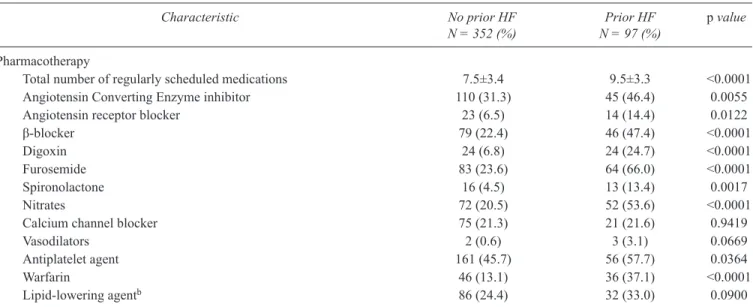
The study enrolled 546 residents, and analysis will focus on 449 residents for whom creatinine clearance could be esti-mated. Mean age was 84.3±6.5 years and 66% were women, and a prior HF diagnosis was confirmed in 97 (21.6%) resi-dents. Table 1 presents baseline characteristics of the sample. Almost half were admitted from hospital, with HF patients more likely to have been so. Participants had multiple medical co-morbidities, were prescribed multiple medications, and had significant functional and cognitive deficits. Residents with prior HF were older, more likely to have hypertension, CAD and atrial fibrillation, and had more acute care visits prior to LTC admission, than those with no prior HF. Results of an echocardiogram were available for 69 (71%) of residents with prior HF, 67% of whom had a left ventricular ejection fraction greater than 40% (preserved ejection fraction).
Table 2 presents data from the admission clinical assess-ment. A “history of HF” and symptoms and signs of HF were more common in patients with prior HF. However, some were also common in residents without HF, such as peripheral ede-ma, which was reported by almost 60% of residents without HF. Among residents without prior HF, 17.9% claimed such a history. There were no statistically significant differences in the prevalence of physical findings of peripheral edema and auscultatory rales between both groups. Jugular venous pressures (JVP) were generally in the normal range and third heart sounds infrequent, suggesting that most residents are clinically stable following LTC admission.
Table 3 presents diagnostic properties of elements from the admission clinical assessment pertinent to HF. The most useful item is “history of HF”. Elements pertaining to dys-pnea have more modest sensitivities and specificities; speci-ficity generally rises while sensitivity falls with increasing dyspnea severity. Orthopnea and paroxysmal nocturnal dys-pnea (PND) were relatively specific, though not very sensi-tive. In contrast, “history of peripheral edema” was sensitive, but non-specific. There are notable differences between the properties of elements derived from the LTC chart and those obtained from the resident/caregiver interview. For histories of peripheral edema and varying degrees of dyspnea, the
sensitivity of chart-derived information is uniformly lower, and the specificity higher, than that of interview-derived information. However, differences are less marked for ele-ments suggestive of severe HF, such as PND, orthopnea, or dyspnea at rest or when performing basic activities of daily living. With respect to physical findings, both auscultatory rales and peripheral edema had poor sensitivity and positive predictive value, and modest specificity and negative predic-tive values. The utility of the JVP and auscultion for a third heart sound was limited in this sample. Table 4 presents the utility of cardiovascular co-morbidities and admission medi-cations with respect to a prior HF diagnosis. The absence of cardiovascular morbidities was associated with good to very good negative predictive values, particularly a history of CAD. The sensitivity and specificity of individual prescribed medications were modest, other than for digoxin, which ap-pears to be specific for a prior HF diagnosis.
Logistic regression models were derived to determine which combination of elements from the admission assess-ment was most predictive of a prior HF diagnosis. Results are shown in Table 4. The final model includes histories of “HF”, “fluid on the lungs”, orthopnea, CAD, and the use of β-blockers and furosemide. The c-statistic was 0.910; the IDI method arrived at the same final model.
DISCUSSION
This study confirms the high prevalence of HF in LTC and the complexity of residents with this condition. Ensuring an accurate HF diagnosis during the transition of residents into LTC is crucial for optimal management of this condition. This study provides important information on the value of the admission assessment of new LTC residents in confirming a prior HF diagnosis. Our findings are consistent with other literature showing that features of HF can be non-specific in frail seniors.(19,21,32) For example, dyspnea, a cardinal symptom of HF, is only reported for 38.5% to 62.4% residents with prior HF.
We observed differences in the sensitivity and specific-ity of elements of the admission assessment depending on whether information was obtained from the resident chart or from resident/caregiver interview. Direct history was more sensitive but less specific than chart information for peripheral edema, orthopnea, and dyspnea, though differences were less marked for more severe symptoms such as resting dyspnea. These suggest discrepancy in the importance ascribed to HF symptoms by residents and by LTC staff recording observa-tions in resident charts. Symptoms are experienced subjectively by patients, and thus LTC staff charting may be inherently sensitive to symptom identification than resident reporting. These data are consistent with a recently reported communi-cation gap(33) between LTC staff and residents, either leading to under-reporting of mild symptoms by residents, or to staff erroneously dismissing milder symptoms as “normal aging”. These data reinforce the critical importance of a thorough
history, including collection of collateral information, in order to accurately assess frail seniors with HF.(19)
That a “history of HF” is predictive of a prior HF diag-nosis may seem self-evident, but it is an important finding given the uncertainty surrounding the accuracy of health information available to clinicians about new LTC residents. There are a number of explanations for this finding. Older persons with HF are often hospitalized repeatedly, experi-ence functional decline, and ultimately discharged to LTC. (34-36) In our study, almost 60% of participants were admitted from acute care. It is therefore likely that because most new LTC residents with HF had a recent hospitalization, available
clinical information was more reliable. Furthermore, all LTC residents in Ontario undergo standardized assessment using the RAI (Home Care) instrument prior to admission.(37) The RAI family of instruments have been shown to have a high positive predictive value for HF.(38)
Our data suggests that the idiom “fluid on the lungs” may be useful to explain HF to lay persons (www.heartfailure.org/ eng_site/hf_lungs.asp). While the low sensitivity implies that the idiom is not universally used, the high specificity suggests that it is an effective descriptor. Specifically, using this idiom when interviewing a LTC resident/caregiver improves the predictive value of the assessment.
TABLE 1.
Baseline characteristics of LTC residents
Characteristic No prior HF
N = 352 (%) N = 97 (%)Prior HF p value
Age (in years) 83.8±6.5 85.9± 6.3 0.0048 Male 115 (32.7) 36 (37.1) 0.4122 Admitted from
Hospital Home
Retirement home/senior’s residence
160 (45.5) 130 (36.9) 62 (17.6) 58 (59.8) 28 (28.9) 11 (11.3) 0.0394
No. of hospitalizations or ED visits in year prior to admission to LTC 1.3±1.2 1.9±1.5 0.0014 Cardiovascular history Hypertension Diabetes mellitus Hyperlipidemia CAD PVD CVD Atrial fibrillation Echocardiogram available LVEF > 50% LVEF 40%–50% LVEF 25%–40% LVEF <25% 252 (71.6) 87 (24.7) 132 (37.5) 142 (40.5) 46 (13.1) 165 (46.9) 81 (23.0) 109 (31.0) 100 (91.7) 8 (7.3) 1 (0.9) 0 83 (85.6) 28 (28.9) 43 (44.3) 79 (81.4) 18 (18.6) 50 (51.5) 55 (56.7) 69 (71.1) 29 (29.9) 17 (17.5) 14 (14.4) 5 (5.2) 0.0051 0. 4070 0.2220 <0.0001 0.1744 0.4148 <0.0001 <0.0001 Co-morbidities Pulmonary disease Renal insufficiencya
Venous thromboembolic disease
Mood disorder Anxiety disorder Dementia
Parkinson’s disease or related disorder
Arthritis
Osteoporosis or fragility fracture History of cancer 126 (35.9) 47 (13.4) 27 (7.7) 141 (40.1) 73 (20.7) 236 (67.0) 39 (11.1) 235 (66.8) 199 (56.5) 77 (21.9) 49 (51.0) 37 (38.1) 15 (15.6) 33 (34.0) 22 (12.7) 48 (49.5) 6 (6.2) 73 (75.3) 49 (50.5) 27 (27.8) 0.0071 <0.0001 0.0182 0.2799 0.6784 0.0015 0.1553 0.1104 0.2912 0.2180 Functional and neuropsychiatric measures
MDS-Cog Barthel Index
Cohen Mansfield Agitation Inventory
Neuropsychiatric Inventory 3.6±2.6 10.9±5.4 37.1±2.5 7.5±11.7 2.9±2.6 10.7±5.3 33.6±9.8 5.5±9.9 0.0235 0.7796 0.0040 0.1238
TABLE 1. Continued
Characteristic No prior HF
N = 352 (%) N = 97 (%)Prior HF p value
Pharmacotherapy
Total number of regularly scheduled medications Angiotensin Converting Enzyme inhibitor Angiotensin receptor blocker
β-blocker
Digoxin Furosemide Spironolactone Nitrates
Calcium channel blocker
Vasodilators Antiplatelet agent Warfarin Lipid-lowering agentb 7.5±3.4 110 (31.3) 23 (6.5) 79 (22.4) 24 (6.8) 83 (23.6) 16 (4.5) 72 (20.5) 75 (21.3) 2 (0.6) 161 (45.7) 46 (13.1) 86 (24.4) 9.5±3.3 45 (46.4) 14 (14.4) 46 (47.4) 24 (24.7) 64 (66.0) 13 (13.4) 52 (53.6) 21 (21.6) 3 (3.1) 56 (57.7) 36 (37.1) 32 (33.0) <0.0001 0.0055 0.0122 <0.0001 <0.0001 <0.0001 0.0017 <0.0001 0.9419 0.0669 0.0364 <0.0001 0.0900
a Renal insufficiency is define as a calculated creatinine clearance < 60 mls/min, according to the Cockcroft-Gault equation.
b All residents on lipid lowering agents were receiving HMG-CoA reductase inhibitors, and one resident was also receiving treatment with a fibrate.
hf = heart failure; ltc = long-term care; ed = emergency department; cad = coronary artery disease (history of myocardial infarction, angina/
unstable angina, or history of coronary revascularization); pvd= peripheral vascular disease (history of intermittent claudication, revascu
-larization, or abdominal aortic aneurysm); cvd = cerebrovascular disease (history of transient ischemic attack, stroke, or revascularization
procedure); lvef = left ventricular ejection fraction
TABLE 2.
Heart failure history, symptoms, and signs elicited at the baseline assessment either from the resident/caregiver interview or from the LTC home chart review
Element of the LTC Admission Clinical Assessment No HF
(N=352) (N=97)HF p value
History of
Heart failure 63 (17.9%) 85 (87.6%) <0.0001 Fluid on the lungs 37 (10.5%) 49 (50.5%) <0.0001
Peripheral edema 209 (59.4%) 82 (84.5%) <0.0001
Orthopnea 63 (17.9%) 44 (45.4%) <0.0001
Paroxysmal nocturnal dyspnea 34 (9.7%) 30 (30.9%) <0.0001
Dyspnea on moderate activity 123 (35.0%) 59 (60.8%) <0.0001 Dyspnea compared to peers 54 (15.4%) 37 (38.1%) <0.0001 Dyspnea walking on a level surface 91 (25.9%) 59 (60.8%) <0.0001 Dyspnea with activities of daily living 56 (16.0%) 49 (50.5%) <0.0001 Dyspnea at rest 36 (10.3%) 35 (36.1%) <0.0001
Physical findings by research nurse of
Peripheral edemaa 109/336 (32.4%) 34/85 (40.0%) 0.1886
Auscultatory rales 64/328 (19.5%) 26/91 (28.6%) 0.0626 Third heart sound 7/338 (2.1%) 4/89 (4.5%) 0.2516 Jugular venous elevation 2.5±0.8 cm (N=287) 2.6±1.2 cm (N=78) 0.5311
a Not all residents underwent a complete physical examination by the research nurses due to refusal to do so, limited cooperation, significantly
Our data are consistent with other studies in older patients. Our findings that orthopnea and PND are specific but not very sensitive are similar to those from several community-based epidemiologic studies in the U.S. and Europe.(39-42) A systematic review of studies of the utility of signs and symptoms for detecting HF in primary care showed sensitivities of 29–47% and 44%, and specificities of 73–98% and 89%, for PND and orthopnea, respectively. (39) In contrast, our study found lower specificities for histories of peripheral edema and dyspnea, likely reflect-ing the non-specific presentation of HF in LTC residents. Physical findings of HF were infrequent in this sample and unhelpful for confirming a prior HF diagnosis, pos-sibly reflecting the relative clinical stability of new LTC residents. These results do not negate the importance of these physical examination maneuvers when assessing acutely unwell residents.(43,44)
Cardiovascular co-morbidities were common in the entire sample. Not surprisingly, CAD and hypertension were relatively sensitive for a prior HF diagnosis,(18) though only CAD was included in the final model. Admission HF medica-tions had poor to modest sensitivity for prior HF, consistent with their underuse in older patients.(45) The absence of HF medications from the admission drug profile makes a prior HF diagnosis less likely.
Our study has a number of strengths and limitations. Data were collected prospectively, and we obtained substan-tial clinical information from multiple sources to facilitate the confirmation of a prior HF diagnosis by two independent reviewers. This information is not readily available in usual practice. Though our procedures may have missed a small proportion of residents with mild HF who might never have been hospitalized, it is likely that the majority of those with prior HF were identified. The prevalence of HF in our sample
TABLE 3.
Properties of individual elements of the admission clinical assessment to predict the diagnosis of HF
Element From the Chart From Resident History Chart or Resident History
Sn Sp Sn Sp Sn Sp PPV NPV c-statistic
Admission assessment history of:
HF 0.856 0.875 0.412 0.903 0.876 0.821 0.574 0.960 0.849 Fluid on the lungs 0.268 0.986 0.381 0.901 0.505 0.895 0.570 0.868 0.700
Peripheral edema 0.443 0.761 0.794 0.443 0.845 0.406 0.282 0.905 0.626 Orthopnea 0.175 0.977 0.381 0.827 0.454 0.821 0.411 0.845 0.637
PND 0.134 0.991 0.258 0.906 0.309 0.903 0.469 0.826 0.606 Dyspnea on moderate activity 0.021 0.974 0.608 0.664 0.608 0.650 0.324 0.857 0.629 Dyspnea compared to peers 0.010 0.989 0.381 0.855 0.381 0.846 0.407 0.832 0.614 Dyspnea walking on the level 0.278 0.926 0.526 0.766 0.608 0.741 0.393 0.872 0.674 Dyspnea with ADLs 0.237 0.937 0.402 0.889 0.505 0.840 0.467 0.860 0.673 Dyspnea at rest 0.216 0.957 0.227 0.915 0.361 0.897 0.493 0.836 0.629 Cardiovascular comorbidities:
Coronary Artery Disease Atrial Fibrillation Hypertension Diabetes mellitus 0.763 0.546 0.722 0.278 0.644 0.795 0.347 0.770 0.660 0.216 0.670 0.237 0.735 0.915 0.446 0.773 0.814 0.567 0.856 0.289 0.595 0.770 0.284 0.753 0.357 0.404 0.248 0.243 0.921 0.866 0.877 0.793 0.705 0.668 0.570 0.521
Physical findings by research nurse of:a
Rales on auscultation N/A N/A N/A N/A 0.286 0.805 0.289 0.802 0.545
Peripheral edema
Third heart sound Jugular venous elevation
N/A N/A N/A N/A N/A N/A N/A N/A N/A N/A N/A N/A 0.400 0.876 0.051 0.676 0.040 0.983 0.238 0.204 0.444 0.817 0.636 0.792 0.538 0.511 0.517 Admission HF medications:
Furosemide N/A N/A N/A N/A 0.660 0.764 0.435 0.891 0.712 ACE inhibitor N/A N/A N/A N/A 0.464 0.688 0.290 0.823 0.576
β-Blocker N/A N/A N/A N/A 0.474 0.776 0.368 0.843 0.625
Digoxin N/A N/A N/A N/A 0.247 0.932 0.500 0.818 0.590
a Not all residents underwent a complete physical examination by the research nurses due to refusal to do so, limited cooperation, significantly
limited bed mobility or inability to transfer.
hf = heart failure; pnd = paroxysmal nocturnal dyspnea; sn = sensitivity; sp = specificity; ppv = positive predictive value; npv = negative pre
is consistent with that of a recent systematic review.(5) We re-lied on residents/caregivers to accurately recall their medical history, and LTC staff to identify and accurately document symptoms and signs among residents for whom they cared, limitations that reflect the clinical conditions under which Canadian LTC clinicians operate. Since the completion of this study, the indications for aldosterone antagonists in the care of HF with reduced ejection fraction have expanded.(18) While it is possible that this has translated into greater usage of this class of medications in the LTC setting, it is not clear whether this would improve upon the diagnostic accuracy of HF in LTC, given the limited utility of other HF medica-tions in this regard. Finally, the average accrual rate for this study was lower than expected.(46) Recruitment required that potential participants be first contacted by LTC staff within six weeks of admission, a period of turmoil during which clinical and administrative priorities take precedent over
research studies. Recruitment difficulties were compounded by frequent turnover of LTC staff. Finally, nine LTC homes underwent significant expansion and were unable to partici-pate in our study, but also diverted all new admissions from other participating homes for extended periods. Despite these concerns, clinical characteristics of residents enrolled in this study are similar to those from other studies,(7,9) providing reassurance as to the representativeness of the sample.
CONCLUSION
In summary, HF is prevalent LTC. Correctly diagnosing HF is crucial to ensure that affected residents receive optimal man-agement. Our data suggest that the most useful indicator of a prior HF diagnosis in new LTC residents include histories of HF, fluid on the lungs, orthopnea, CAD, and use of loop diuret-ics and β-blockers. The transfer of health information during
TABLE 4.
Results of the multivariate analysis to predict the diagnosis of HF based on admission clinical characteristics, cardiovascular co-morbidities, and medication profile
Clinical Characteristic Full Model Reduced Model
AOR (95% CI) p value AOR (95% CI) p value c-statistic IDI p value
Admission assessment history of:
HF 11.65 (4.55, 29.83) 13.66 (6.61, 28.24) <0.0001 0.910 0.02 0.0682 Fluid on the lungs 1.96 (0.83, 4.65) 0.1254 2.01 (1.04, 3.89) 0.0373
Peripheral edema 0.87 (0.30, 2.57) 0.8042
Orthopnea 1.72 (0.69, 4.27) 0.2443 1.76 (0.93,3.33) 0.0834
PND 1.03 (0.36, 2.92) 0.9599 Dyspnea on moderate activity 0.62 (0.21, 1.84) 0.3920 Dyspnea compared to peers 0.26 (0.07, 0.90) 0.0337 Dyspnea walking on the level 3.17 (1.01, 9.90) 0.0475 Dyspnea with ADLs 3.15 (1.07, 9.31) 0.0377 Dyspnea at rest 0.72 (0.26, 2.02) 0.5336 Cardiovascular comorbidities:
Coronary Artery Disease Atrial Fibrillation Hypertension Diabetes mellitus 2.83 (1.12, 7.15) 1.20 (0.50, 2.91) 0.85 (0.27, 2.66) 0.83 (0.33, 2.09) 0.0282 0.6809 0.7752 0.6979 2.83 (1.42, 5.64) 0.0216 Physical findings:a Rales on auscultation 0.88 ( 0.46, 1.69) 0.6988 Peripheral edema
Third heart sounds Jugular venous elevation
1.00 ( 0.54, 1.85) 1.19 (0.20, 7.01) 0.76 (0.08, 7.31) 0.9989 0.8445 0.8116 Admission HF medications: Furosmide ACE inhibitor β-blocker Digoxin 3.70 (1.52, 9.02) 1.20 (0.54, 2.64) 2.60 (1.15, 5.85) 1.41 (0.43, 4.59) 0.0040 0.6575 0.0216 0.5716 2.11 (1.12, 3.98) 2.09 (1.10, 3.94) 0.0216 0.0234
a Not all residents underwent a complete physical examination by the research nurses due to refusal to do so, limited cooperation, significantly
limited bed mobility or inability to transfer.
aor = adjusted odds ratio; ci = confidence interval; hf = heart failure; pnd = paroxysmal nocturnal dyspnea; adls = activities of daily living; idi = integrated discrimination improvement index
the transition to LTC is problematic, and clinicians must rely on limited information upon which to formulate a diagnosis of HF. Our findings reinforce the importance of a thorough his-tory, including collateral information from family caregivers, when assessing frail seniors upon admission to LTC.
ACKNOWLEDGEMENTS
The authors wish to thank staff from participating LTC homes for assistance in completing this study. We particularly wish to thank participating residents and their family caregivers for sharing their time and providing us with their valuable health information. Collaborating homes included:
In Hamilton: Arbour Creek LTC home, Blackadar Continu-ing Care Centre, Clarion NursContinu-ing Home, Extendicare Hamilton, Grace Villa Nursing Home, Hamilton Continuing Care, Heri-tage Green Nursing Home, Idlewyld Manor, Macassa Lodge, Parkview Nursing Centre, Pine Villa Nursing Home, Queens Garden, Regina Gardens, Ridgeview Long Term Care, Shalom Village Nursing Home, St. Joseph’s Villa, Stoney Creek Lifecare Centre, The Meadows Long Term Care Centre, The Village of Wentworth Heights, The Wellington, The Willowgrove Long Term Care Centre, Townsview Lifecare Centre, Versa-Care Cen-tre, Victoria Gardens Long Term Care, and Wentworth Lodge. In Kitchener-Waterloo: Forest Heights Long-Term Care Centre, Sunnyside Home, Trinity Village Care Centre, The Village of Winston Park, Columbia Forest Long-Term Care Centre, Parkwood Mennonite Home Inc., Pinehaven Nursing Home, The Westmount, and Lanark Place.
In Cambridge: Fairview Mennonite Home, Golden Years Nursing Home, Hilltop Manor, Riverbend Place, Saint Andrews Terrace, Saint Luke’s Place and Stirling Heights Long-Term Care Centre.
The authors wish to thank Mr. Rizwan Afzal at the Popula-tion Health Research Institute, McMaster University, Hamilton, Ontario, Canada, and Dr. Christopher Patterson at McMaster University, for advice on the methods and statistical analysis for this project. We also wish to acknowledge the administrative support of Ms. Nisreen Murad, Ms. Christie Gennings, and Ms. Colleen Saunders.
This study was funded by a Grant-in-Aid from the Canadian Institutes of Health Research (CIHR; Study ID 117947-BCA-CEBA-126289). CIHR did not play a role in the design or conduct of the study, collection, management, analysis or interpretation of data, or preparation, or review of approval of the completed manuscript.
CONFLICT OF INTEREST DISCLOSURES
The authors declare that no conflicts of interest exist.REFERENCES
1. Rich MW. Heart failure in the 21st century: a cardiogeriatric
syndrome. J Gerontol A Biol Sci Med Sci. 2001;56(2):M88–M96.
2. Smith E. A special issue on chronic heart failure [editorial].
Can J Cardiol. 2003;19(4):345–46.
3. Bleumink GS, Knetsch AM, Sturkenboom MCJM, et al.
Quantifying the heart failure epidemic: prevalence, incidence
rate, lifetime risk and prognosis of heart failure. Eur Heart J. 2004;25(18):1614–19.
4. Lee DS, Johansen H, Gong Y, et al. Regional outcomes of heart
failure in Canada. Can J Cardiol. 2004;20(6):599–607. 5. Daamen MA, Schols JM, Jaarsma T, et al. Prevalence of heart
failure in nursing homes: a systematic literature review. Scand
J Caring Sci. 2010;24(1):202–08.
6. Fahey CJ. Culture change in long-term care facilities: changing
the facility or changing the system? In: Weiner AS and Ronch
JL, editors. Culture change in long-term care. Binghamton, NY:
Haworth Press; 2003. p.35–52.
7. Wang R, Mouliswar M, Denman S, et al. Mortality of the insti-tutionalized old-old hospitalized with congestive heart failure.
Arch Intern Med. 1998;158(22):2464–68.
8. Porock D, Oliver DP, Zweig S, et al. Predicting death in the
nursing home: development and validation of the 6-month minimum data set mortality risk index. J Gerontol A Biol Sci
Med Sci. 2005;60(4):491–98.
9. van Dijk PTM, Mehr D, Ooms ME, et al. Comorbidity and 1-year mortality risks in nursing home residents. J Am Geriatr Soc. 2005;53(4):660–65.
10. Heckman GA, Misiaszek B, Merali F, et al. The management of heart failure in canadian long-term care facilities. Can J
Cardiol. 2004;20(10):963–69.
11. Canadian Institute for Health Information. Patient pathways:
transfers from continuing care to acute care. Ottawa: CIHI; 2009.
12. Finucane P, Wundke R, Whitehead C, et al. Use of in-patient hospital beds by people living in residential care. Gerontology. 2000;46:133–38.
13. Bowman CE, Elford J, Dovey J, et al. Acute hospital admissions from nursing homes: some may be avoidable. Postgrad Med J. 2001;77(903):40–42.
14. Coburn AF, Keith RG, Bolda EJ. The impact of rural residence
on multiple hospitalizations in nursing facility residents.
Ger-ontologist. 2002;42(5):661–66.
15. Finn JC, Flicker L, Mackenzie E, et al. Interface between residential aged care facilities and a teaching hospital emergency department in Western Australia. Med J Aust. 2006;184(9):432–35.
16. Rizza P, Bianco A, Pavia M, et al. Preventable hospitalization
and access to primary health care in an area of Southern Italy.
BMC Health Services Research. 2007;7:134.
17. Bergman H, Ferrucci L, Guralnik J, et al. Frailty: an emerging research and clinical paradigm--issues and controversies. J
Gerontol A Biol Sci Med Sci. 2007;62(7):731–37.
18. McKelvie RS, Moe GW, Ezekowitz JE, et al. The 2012 Cana-dian Cardiovascular Society heart failure management guide-lines update: focus on acute and chronic heart failure. Can J
Cardiol. 2013;29(2):168–81.
19. Heckman GA, Demers C, McKelvie RS, et al. Heart failure in
20. Gross JS, Neufeld RR, Libow LS, et al. Autopsy study of the elderly institutionalized patient: review of 234 autopsies. Arch
Intern Med. 1988;148(1):173–76.
21. Jarrett PG, Rockwood K, Carver D, et al. Illness presentation in elderly patients. Arch Intern Med. 1995;155(10):1060–64. 22. Coleman EA. Falling through the cracks: challenges and
oppor-tunities for improving transitional care for persons with continu-ous complex care needs. J Am Geriatr Soc. 2003;51(4):549–55.
23. LaMantia MA, Scheunemann LP, Viera AJ, et al. Interventions to improve transitional care between nursing homes and hospi-tals: a systematic review. J Am Geriatr Soc. 2010;58(4):777–82. 24. Wade DT, Collin C. The Barthel ADL Index: a standard measure
of physical disability? Int Disabil Stud. 1988;10(2):64–67.
25. Morris JN, Fries BE, Mehr DR, et al. MDS Cognitive Perfor -mance Scale. J Gerontol. 1994;49(4):M174–M182.
26. Cohen-Masnfield J. Agitated behaviours in the elderly. II. Pre -liminary results in the cognitively deteriorated. J Am Geriatr Soc. 1986;34(10):722–27.
27. Cummings JL, Mega MS, Gray K, et al. The Neuropsychiatric Inventory: comprehensive assessment in psychopathology in dementia. Neurology. 1994;44(12):2308–14.
28. Dickstein K, Cohen-Solal A, Filippatos G, et al. ESC guidelines for the diagnosis and treatment of acute and chronic heart failure 2008. Eur Heart J. 2008;29(19):2388–442.
29. Cockcroft DW, Gault MH. Prediction of creatinine clearance
from serum creatinine. Nephron. 1976;16(1):31–41.
30. Pencina MJ, D’Agostino RB Sr., D’Agostino RB Jr., et al. Evaluating the added predictive ability of a new marker: from
area under the ROC curve to reclassification and beyond. Stats Med. 2008;27(2):157–72.
31. Bergstralh E. SAS ROCPLUS macro. Rochester, NM: Mayo
Clinic; 2008. Available from: http://www.mayo.edu/research/ documents/rocplussas/DOC-10027441.
32. Tresch DD. The clinical diagnosis of heart failure in older patients. J Am Geriatr Soc. 1997;45(9):1128–33.
33. Newhouse IJ, Heckman G, Harrison D, et al. Barriers to the management of heart failure in ontario long-term care homes: an interprofessional care perspective. J Res Interprofessional
Pract Edu. 2012:2(3):278–95.
34. Burns RB, McCarthy EP, Moskowitz MA, et al. Outcomes for older men and women with congestive heart failure. J Am
Geriatr Soc. 1997;45(3):276–80.
35. Croft JB, Giles WH, Pollard RA, et al. National trends in the initial hospitalization for heart failure. J Am Geriatr Soc. 1997;45(3):270–75.
36. Howlett JG, Johnstone DE, Sketris I, et al. Identifying op-portunities to address the congestive heart failure burden: the
Improving Cardiovascular Outcomes in Nova Scotia (ICONS) study. Can J Cardiol. 2003;19(4):439–44.
37. Bernabei R, Gray L, Hirdes J, et al. International gerontology. In: Halter JB, Ouslander JG, Tinetti ME, Studenski S, High
KP, Asthana S, editors. Hazzard’s geriatric medicine and
gerontology, 6th edition. New York (NY): McGraw Medical; 2009. p. 69–96.
38. Mor V, Intrator O, Unruh MA, et al. Temporal and geographic variation in the validity and internal consistency of the
Nurs-ing Home Resident Assessment Minimum Data Set 2.0. BMC
Health Serv Res. 2011;11:78.
39. Mant J, Doust J, Roalfe A, et al. Systematic review and indi-vidual patient data meta-analysis of diagnosis of heart failure, with modelling of implications of different diagnostic strategies in primary care. NIHR Health Technol Assess. 2009;13:1–207. 40. Fonseca C, Morais H, Mota T, et al. The diagnosis of heart
failure in primary care: value of symptoms and signs. Eur J
Heart Fail. 2004;6(6):795–800,821–22.
41. Ekundayo OJ, Howard VJ, Safford MM, et al. Value of or -thopnea, paroxysmal nocturnal dyspnea, and medications in prospective population studies of incident heart failure. Am J
Cardiol. 2009;104(2):259–64.
42. Ahmed A, Allman RM, Aronow WS, et al. Diagnosis of heart failure in older adults: predictive value of dyspnea at rest. Arch
Gerontol Geriatr. 2004;38(3):297–307.
43. Conn RD, O’Keefe JH. Cardiac physical diagnosis in the digital
age: an important but increasingly neglected skill (from stetho-scopes to microchips). Am J Cardiol. 2009;104(4):590–95.
44. Laukkanen A, Ikäheimo M, Luukinen H. Practices of clinical
examination of heart failure patients in primary health care.
Cent Eur J Public Health. 2006;14(2):86–89.
45. Foebel AD, Heckman GA, Hirdes JP, et al. Clinical, demo-graphic and functional characteristics associated with phar-macotherapy for heart failure in older home care clients: a retrospective, population-level, cross-sectional study. Drugs
Aging. 2011;28(7):561–73.
46. Hirdes JP, Mitchell L, Maxwell CJ, et al. Beyond the ‘iron lungs’
of gerontology: using evidence to shape the future of nursing homes in Canada. Can J Aging. 2011;30(3):371–90.
Correspondence to: George A. Heckman, md, msc, frcpc, Research Institute for Aging and School of Public Health and Health Systems, BMH 3734, University of Waterloo, 200 University Ave. West, Waterloo, ON N2L 3G1, Canada