Exploring Bourdieu for engineering education research
J. Devine
Lecturer, Construction engineering and management University of Southern Queensland
Toowoomba, Australia [email protected]
Conference Topic: Gender and Diversity in Engineering Education Keywords: Diversity, Student success, Bourdieu, Habitus
INTRODUCTION
This paper explores the potential for the work and theories of Pierre Bourdieu to provide an alternative approach to engineering education research on student diversity. Bourdieu’s theories were developed as a means of exploring the role of social class on individual aspirations and behaviour. Current governmental and institutional aims to diversify the intake of engineering students [1] renders it appropriate for researchers to explore the motivations behind student decisions to study engineering. Issues of academic performance, retention and progression in an engineering program can be better understood against the background of individual student choice and behaviour.
Bourdieu, an eminent French sociologist of the late 20th century, was most concerned with identifying and articulating the societal factors that perpetuate the ‘status-quo’ of a hierarchical social structure [2]. He saw educational systems as a key factor in the perpetuation and reproduction of social structures and so focused much of his work on educational settings [3]. Bourdieu’s concept of habitus and its relationship to his concepts of field, cultural capital and dispositions form a theoretical framework and the basis of a methodology which enable the rigorous investigation of human actions and interactions [4]. His theories can be directly applied to questions of why students choose a particular career path and their subsequent behaviour and academic performance once within an educational institution [3]. He proposes that whether students stay in school or drop out is largely determined by their perceptions of the probability of success for students of their background [5].
1 DIVERSITY IN ENGINEERING EDUCATION
Many countries around the world have stated goals of increasing both access to and participation in higher education [1]. The recent global financial crisis has highlighted the economic importance of these goals for both individuals and national economies [1]. As national economies increasingly shift from mass production to a ‘knowledge economy’ employment in science and technology occupations is expected to further increase [1]. This combination of factors could reasonably be expected to continue increasing the already strong demand for engineering education as well as the diversity of students undertaking engineering undergraduate degrees.
A ‘traditional’ higher education student can be considered to be a “19 year old, newly graduated from high school, mostly from families of medium-high socio-cultural status” [6] and in engineering this description could also include ‘male’. Students who do not fit this profile, who have been broadly referred to as ‘non-traditional’, are increasingly taking up the opportunity to access higher education. Gilardi and Giugliemetti [6] identify three broad means of identifying non-traditional students that have been used in the literature: age, demographic background and other risk factors. This last category being students who have delayed enrolment, part time attendance, part time work, financial independence, dependents other than a spouse or who lack a high school diploma. These students will clearly have different needs, motivations and expectations than the more homogeneous and ‘elite’ cohorts of students accessing higher education in previous generations.
The need to embrace diversity within engineering education research has been well recognised [7] and reflects prominent themes in the wider area of higher education research. It is thus appropriate that we consider a wider range of frameworks with which to investigate engineering education. Bourdieu’s theory of habitus may be one which is applicable.
2 WORK ON RETENTION, PROGRESSION AND STUDENT PERFORMANCE
With an increasingly diverse student profile there is a growing interest in the factors that predict student retention, progression and performance. There has been a great deal of work done on these areas both within higher education research and within engineering education research. It is not the purpose of this paper to give a comprehensive literature review of this area but to give an over view of the type of work that has been done on these topics within engineering education research.
Research on progression, retention and academic performance of students largely revolves around identifying characteristics or predictors of success or failure. These characteristics can be loosely grouped into demographic, psychological, academic and sociological categories. The following is a brief description of the factors that have been explored under the banner of engineering education research. Within each of these categories echoes of Bourdieu’s theory of habitus can be heard, suggesting that his theories can provide a useful framework for further exploring the underlying reason that these factors occur in various students and why they affect subsequent performance.
2.1 Demographic factors
Students who study by distance, have full time work, have dependents other than a spouse, are the first in their family to attend university, have a disability or are part of a minority group have been shown in various studies to be ‘at risk’ in terms of academic performance and retention. All of these categories of student contribute to the growing diversity of engineering cohorts.
2.2 Psychological factors
Motivational theories such as self-efficacy and expectancy-value theory have become an important tool for examining the achievement and persistence of engineering undergraduates [8, 9]Self-efficacy is a measure of a person’s belief in their own ability to perform a task in a specific domain [8] and has been found to be linked to a student’s academic performance and persistence [10].
Expectancy value theory, which has only recently been used in engineering education research, predicts that student performance is linked to both their expectancies for success in a particular situation and their value they assign to success in that situation[9]. Recent work by Matusovich et al.[9] found that this theory could shed light on student persistence and performance. Jones et al. [8] concluded that although both expectancy constructs and value related constructs were both relevant to studies of academic performance and persistency within engineering although they predicted different outcomes.
Approaches to learning, learning styles & the academic development of engineering students have also been widely studied (see for example [11]) as a means of understanding student diversity.
2.3 Academic Factors
Cognitive abilities, in particular spatial abilities, have been shown to be clearly relevant to engineering student performance [12]. Other studies have found that previous academic performance is the best predictor of future academic performance.
2.4 Sociological factors
The most significant sociological theory associated with university persistence and performance used in engineering educational research is Vincent Tinto’s 1975 theory of integration [10]. He suggests that the matching of student academic ability and motivation with institutional social and academic qualities affects the academic and social integration of the student into the university.
2.5 Summary of factors
The factors identified by these types of study indicate that the broad category of non-traditional students tend to struggle in engineering courses. However, the identification of student characteristics influencing the success or otherwise of students does not explain the underlying question of why such students display these characteristics in an educational setting and their effect on subsequent performance. Bourdieu’s theory of habitus has the potential to illuminate the attitudes and psychologies of engineering students from diverse demographics and the impact on them of the institutional systems and environment in which they study.
3 BOURDIEU’S THEORY OF HABITUS AS AN ALTERNATIVE FRAMEWORK
3.1 Background to Bourdieu
fields of philosophy, social anthropology and sociology [2] to develop his own sociological theories dealing with the stratification of contemporary society and its implications for individuals. His writings were voluminous and not terribly accessible to the those who are new to his work [5] which may explain why his concepts have been widely used in sociological explorations of higher education but not yet been widely adopted within the field of engineering education research.
3.2 Bourdieu’s theory of habitus
Bourdieu is notorious for not succinctly defining the concepts on which his theory is based and for using them in a fluid manner throughout his writing. However a working description of habitus is that it is a collection of mostly subconscious dispositions, which an individual initially acquires in early childhood via familial interactions and which are then constantly modified by subsequent life experiences [5]. An individual’s dispositions will be expressed as their thoughts, preferences, beliefs and aspirations, concerning themselves and the structure of the social world around them [3]. These dispositions then influence how a person will behave in a particular situation.
Individuals from a particular socio-economic group will usually have many aspects of their habitus in common. Habitus is both shaped by the social structures within which it is formed and regulates the actions of an individual within those social structures [14]. A person’s dispositions will include beliefs about their chances of success in a given endeavour; Bourdieu postulates that one’s aspirations, and subsequent actions, are then adjusted to the perceived probability of success. He refers to this idea as the “causality of the probable” [5]. Bourdieu uses his concept of ‘Field’ as a metaphor for all the organisations and individuals involved in a particular social or cultural arena and the interactions between them [5]. He sees every field as a situation of struggle, competition or conflict, the objective for each individual being to optimise their accumulation or retention of ‘capital’. Bourdieu’s concept of capital extends beyond mere economic capital to also encompass symbolic, cultural, social and linguistic capital. Each of these types of capital has a social value and can be ‘inherited’, through the circumstances of one’s early upbringing, or accumulated, exchanged and leveraged, much like economic capital [5].
Bourdieu’s work is acclaimed by Rogers Brubaker [14] as one of the most significant attempts to adapt sociological theory to the empirical study of contemporary society. Bourdieu made an epistemological break with the two contemporary competing sociological camps of ‘ethnomethodology’ (subjectivist) and ‘structuralism’(objectivist) to produce what has become known as a ‘reflexive, post-structuralist’ theory. He articulated a reflexive position whereby individuals influence the fields within which they operate while concurrently being influenced by their own habitus; a construct of societal structures (including various fields) both past and present within which they have interacted [5, 14, 15]. In this way he found a theoretical ‘middle ground’ on which to model human interactions in a society.
3.3 Bourdieu on Educational systems
Bourdieu proposes that the educational decisions made by students (where and what to study) are the result of their dispositions, which in turn have been developed as a result of their personal habitus [3].
The topic of student achievement or success is also addressed by Bourdieu. He proposes that whether students stay in school or drop out is largely determined by their perceptions of the probability of success for students of their background (the causality of success) [5]. This is reflected in other studies showing the importance of student expectations on academic achievement [8, 9]. Bourdieu further argues that a child’s expectations of education and career are largely determined by their parents and early educational influences during the formation of their habitus.
3.4 The use of Bourdieu’s theoretical framework in education research
Having been refined in the context of the French educational system the validity of Bourdieu’s theories for applications in other cultures has been raised [15]. However Bourdieu was very interested in the applicability of the particular to explain the universal in society and his latter writings address the adoption of his concepts by English readers [15]. Reay [4] and Robbins [15] both point to extensive use in British educational sociology research. Berger [18] extensively discusses the increasing popularity of Bourdieu’s theory in the USA as a conceptual framework for exploring inequities in educational achievement, higher education organisational studies, student persistence and retention.
It has been argued that Bourdieu’s theories have been widely misused [4, 15], particularly by English speaking sociologists, who tend to examine their data using Bourdieu’s theories rather than underpinning their research methodology with the theoretical framework that Bourdieu can provide. Reay [4] argues that Bourdieu’s theory of habitus is meant as a research methodology, a means of informing the nature and form of investigations undertaken rather than simply as a lens thorough which to view the data collected in a study.
Bourdieu’s own data collection methods combine statistical techniques with observations and interrogation of relevant interactions, discourses and documentation [19]. He advocates the use of whatever methodological procedure is most appropriate to the question at hand, the close attention to the underlying theory of every aspect of the research design and implementation and a continual methodological review and refinement [19].
4 APPLICATION OF HABITUS TO RESEARCH DESIGN
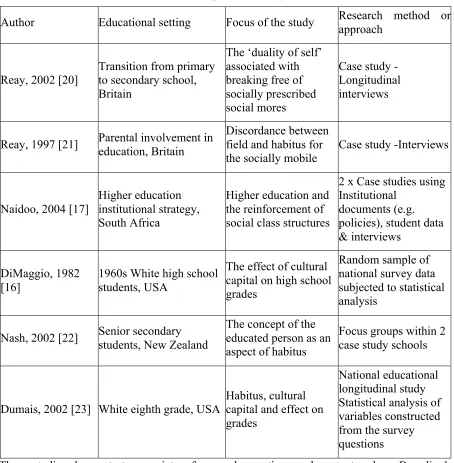
Table 1. Educational studies operationalizing Bourdieu’s theories1
Author Educational setting Focus of the study Research method or approach
Reay, 2002 [20] Transition from primary to secondary school, Britain
The ‘duality of self’ associated with breaking free of socially prescribed social mores
Case study -Longitudinal interviews
Reay, 1997 [21] Parental involvement in education, Britain
Discordance between field and habitus for
the socially mobile Case study -Interviews
Naidoo, 2004 [17]
Higher education institutional strategy, South Africa
Higher education and the reinforcement of social class structures
2 x Case studies using Institutional
documents (e.g. policies), student data & interviews
DiMaggio, 1982 [16]
1960s White high school students, USA
The effect of cultural capital on high school grades
Random sample of national survey data subjected to statistical analysis
Nash, 2002 [22] Senior secondary students, New Zealand
The concept of the educated person as an aspect of habitus
Focus groups within 2 case study schools
Dumais, 2002 [23] White eighth grade, USA
Habitus, cultural capital and effect on grades
National educational longitudinal study Statistical analysis of variables constructed from the survey questions
These studies demonstrate a variety of research questions and contexts where Bourdieu’s theory is an appropriate framework for investigation. His theories can be applied outside the context of French education [15] and are even appropriate within societies which increasingly regard themselves as ‘classless’ [21].
Using Bourdieu’s theories as a framework also allows, indeed encourages, the tailoring of research methodologies to the question at hand. Qualitative, quantitative and mixed methods studies can all be used as appropriate. Having said that, the nature of enquiries that look at human dispositions to explain why individuals not only act in a particular way but display certain psychological traits in a given situation lend themselves to the use of qualitative data. Understanding the (sub-conscious) dispositions of an individual requires subtle interpretations of their words and actions. Bourdieu’s work allows for the experience and understanding of an individual to underpin a wider explanation of a particular phenomenon, allowing the explanation of the particular to elucidate the general.
1To fully understand the implications of the study descriptions in Table 1 one needs to be familiar with the
5 CONCLUSION
A deeper understanding of student habitus and the effect on them of institutional systems and environments can assist with the quest to support, accommodate and facilitate the engagement and learning of diverse cohorts. This paper presents only a preliminary introduction to Bourdieu’s complex work and is intended as an initial investigation into the possibilities it presents for engineering education research. Bourdieu’s challenge to English readers regarding the adoption of his theories (contained in his 1998 work Homo Academicus, as cited by Robbins, 2004) can be extended to engineering educators as a call to adopt or adapt this theoretical framework for underpinning new research methodologies and analyses of engineering education phenomena.
REFERENCES
[1] Organisation for Economic Co-operation and Development (OECD), (2012), Education indicators in focus series, in Working Papers Series, No. 1-5, OECD Publishing.
[2] Reay, D., et al., (2004), Editorial, British Journal of Sociology of Education, Vol. 25, No. 4, pp. 411-413.
[3] Swartz, D., (1997), Culture and Power, University of Chicago Press, Chicago.
[4] Reay, D., (2004), ‘It's all becoming a habitus’: beyond the habitual use of habitus in educational research, British Journal of Sociology of Education, Vol. 25, No. 4, pp. 431-444.
[5] DiMaggio, P., (1979), On Pierre Bourdieu, American Journal of Sociology, Vol. 84, No. 6, pp. 1460-1474.
[6] Gilardi, S. and C. Guglielmetti, (2011), University Life of Non-Traditional Students: Engagement Styles and Impact on Attrition, Journal of Higher Education, Vol. 82, No. 1, pp. 33-53.
[7] Baillie, C., et al., (2011), Advancing Diverse and Inclusive Engineering Education Practices through Interdisciplinary Research and Scholarship, Journal of Engineering Education, Vol. 100, No. 1, pp. 6-13.
[8] Jones, B.D., et al., (2010), An Analysis of Motivation Constructs with First-Year Engineering Students: Relationships Among Expectancies, Values, Achievement, and Career Plans, Journal of Engineering Education, Vol. 99, No. 4, pp. 319-336.
[10] McKenzie, K. and R. Schweitzer, (2001), Who Succeeds at University? Factors predicting academic performance in first year Australian university students, Higher Education Research & Development, Vol. 20, No. 1, pp. 21-33.
[11] Felder, R. and Brent, R., (2005), Understanding student differences, Journal of Engineering Education, Vol. 94, No. 1, pp. 57-72.
[12] Burton, L. and D. Dowling, (2009), Key factors that influence engineering students’ academic success: A longitudinal study, Proc. of the Research in Engineering Education Symposium, Palm Cove, QLD.
[13] Webb, J., et al., (2002), Understanding Bourdieu, Allen & Unwin, Crows Nest.
[14] Brubaker, R., (1985), Rethinking Classical Theory: The Sociological Vision of Pierre Bourdieu, Theory and Society, Vol. 14, No. 6, pp. 745-775.
[15] Robbins, D., (2004), The transcultural transferability of Bourdieu's sociology of education, British Journal of Sociology of Education, Vol. 25, No. 4, pp. 415-430.
[16] DiMaggio, P., (1982), Cultural Capital and School Success: The Impact of Status Culture Participation on the Grades of U.S. High School Students, American Sociological Review, Vol. 47, No. 2, pp. 189-201.
[17] Naidoo, R., (2004), Fields and institutional strategy: Bourdieu on the relationship between higher education, inequality and society, British Journal of Sociology of Education, Vol. 25, No. 4, pp. 457-471.
[18] Berger, J.B., Part I: Revising Tiato's Theory: Optimizing Capital, Social Reproduction, and Undergraduate Persistence, 2000, Vanderbilt University Press. p. 95-124.
[19] Wacquant, L., Pierrre Bourdieu, in Key Sociological Thinkers, R. Stones, Editor 2008, Palgrave Macmillan: Hampshire. p. 261-277.
[20] Reay, D., (2002), Shaun's Story: Troubling discourses of white working-class masculinities, Gender and Education, Vol. 14, No. 3, pp. 221-234.
[21] Reay, D., (1997), Feminist theory, habitus, and social class: Disrupting notions of classlessness, Women's Studies International Forum, Vol. 20, No. 2, pp. 225-233.
[22] Nash, R., (2002), The Educated Habitus, Progress at School, and Real Knowledge, Interchange, Vol. 33, No. 1, pp. 27-48.