Effectively publishing and
developing Framework for
Excellence: Analysis of user needs
Final Report
Effectively Publishing and Disseminating
Framework for Excellence (FfE): Analysis of User
Needs
Final Report
Learning and Skills Council
Final Report
April 2009
30 St Paul’s Square, Birmingham B3 1QZ
Tel: 0121 2338900; Fax: 0121 2120308
Document Control
Document Final Report Job No. J5122
CONTENTS
1 INTRODUCTION... 1
1.1 Background to the Research ... 1
1.2 Methodology ... 2
1.3 Structure of the report... 3
2 CURRENT INFORMATION USES AND SOURCES ... 4
2.1 Introduction ... 4
2.2 User decision making processes... 4
2.3 Current information and sources used ... 6
2.4 Conclusion ... 13
3 PUBLISHING FfE INFORMATION... 15
3.1 Introduction ... 15
3.2 User views on the information contained in the FfE ... 15
3.3 Accessing the FfE via the internet... 18
3.4 Publishing the FfE in spring 2009... 18
3.5 Publishing the FfE in spring 2010 and 2011... 20
3.6 Conclusion ... 22
4 CONCLUSIONS ... 23
4.1 Conclusions ... 23
4.2 Recommendations... 23
5 ANNEX ONE – BIBLIOGRAPHY ... 25
6 ANNEX TWO – FOCUS GROUP INFORMATION ... 27
6.1 Card A: Types of information... 27
6.2 Card B: Sources of information ... 28
6.3 Card C: Information in the FfE... 29
TABLES
Table 1-1 Focus groups of users... 2
Table 2-1 Information and sources used by young people ... 7
Table 2-2 Information and sources used by Connexions PAs ... 8
Table 2-3 Information and sources used by Adult and Non learners... 9
Table 2-4 Information and sources used by Adult IAG advisers ... 10
Table 2-5 Information and sources used by Employers... 12
Table 2-6 Information and sources used by Train to Gain brokers... 12
Table 3-1 - FfE Information – Most and Least Useful ... 16
1
INTRODUCTION
1.1 Background to the Research
GHK Consulting Ltd was appointed by the Learning and Skills Council National Office (LSC NO) to undertake an Analysis of User Needs for Effectively Publishing and Developing Framework for Excellence (FfE). This is with the intention of exploring how users currently choose learning provision, and how best to publish FfE information so that it effectively informs users’ future choices. For the purpose of the study ‘users’ are identified as “those who are anticipated to have an interest in Framework scores (learners, employers, skills brokers, connexions and learndirect service advisors, parents and represented bodies of the aforementioned) with the exception of providers, commissioning and regulatory bodies” (LSC ITT specification, July 2008).
The research is charged specifically with:
Reviewing existing research evidence concerning learners’, employers’ and other ‘users’ (within the parameters of the study) choice of education and training;
Determining how users currently choose education and training courses and providers – building a picture of how users may make this choice in the future;
Determining how learning and training information related to users’ choice of provision is effectively marketed and communicated;
Determining the way in which FfE information is best published and disseminated to different user groups in spring 2009 – working within the boundaries of the data that will be available;
Determining the way in which FfE information is best published and disseminated to different user groups in 2010 and 2011 – including individual group requirements for drill down capability; and,
Making recommendations for the future development of FfE to ensure the needs of users are met following the Machinery of Government Changes from 2012 onwards.
The study is therefore predominantly qualitative in nature, due to the focus on FfE information outputs in terms of the actual needs and requirements of identified user groups. Whilst there has been a great deal of development work on the FfE, this has tended to focus on the technical aspects, and the robustness, validity and reliability of the information. Attention is now focusing on the communication and presentation aspects of the FfE, especially how different groups of users will/want to access and use the information.
1.2 Methodology
The first stage of the project included a literature review to determine what information and processes users choose in making decision about provision and providers. A bibliography of sources used is detailed at Section 5.
In addition, a series of stakeholder interviews were undertaken covering a similar range of questions. Stakeholders included: LSC NO, Department for Children, Schools and Families (DCSF), Department for Innovation, Universities and Skills (DIUS), Union Learning, The Confederation of British Industry (CBI), UK Commission for Employment and Skills (UKCES), the National Institute of Adult Continuing Education (NIACE), the Federation of Small Businesses (FSB), Train to Gain Skills Brokers, The National Union of Students (NUS), Learndirect, and The Adult Advancement Careers Service (AACS).
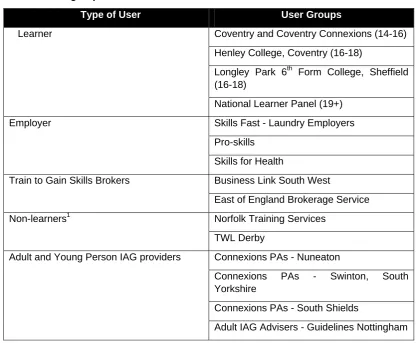
[image:7.595.90.510.284.627.2]The main part of the research involved a series of focus groups with key user groups – learners, employers and IAG intermediaries.
Table 1-1 Focus groups of users
Type of User User Groups
Coventry and Coventry Connexions (14-16)
Henley College, Coventry (16-18)
Longley Park 6th Form College, Sheffield (16-18)
Learner
National Learner Panel (19+)
Skills Fast - Laundry Employers
Pro-skills Employer
Skills for Health
Business Link South West Train to Gain Skills Brokers
East of England Brokerage Service
Norfolk Training Services Non-learners1
TWL Derby
Connexions PAs - Nuneaton
Connexions PAs - Swinton, South Yorkshire
Connexions PAs - South Shields Adult and Young Person IAG providers
Adult IAG Advisers - Guidelines Nottingham
The focus groups asked users:
What information and sources of information they used at the moment, and which were the most important;
1
In what format (level, detail and form of access) did they find this information most useful;
Would the information in the FfE be of use to them;
Which format would they prefer the FfE information to be in;
What were the advantages and disadvantages of accessing this information via the internet; and;
Users were shown a series of mock ups of how the FfE could be presented to them via the internet, and asked how useful these would be.
The detailed findings from these stages of the research are contained in a series of reports submitted to the LSC NO throughout the study.
This report brings these main findings together to answer the key questions identified by the LSC NO in its tender specification. In addition, an additional literature search and review was undertaken, and a series of final stakeholder interviews with the LSC NO, DCSF and DIUS.
1.3 Structure of the report
The report contains three further sections and two Annexes:
Section Two reports on users’ current use of information in making choices about their future learning and skills opportunities, and the sources of that information;
Section Three presents users’ views on the information included in the FfE and ways in which it should be presented;
Section Four provides the main conclusions and recommendations;
Annex 1 contains the bibliography, and;
2
CURRENT INFORMATION USES AND SOURCES
2.1 Introduction
This section looks at the information users currently use in making decision about provision and providers, where they get that information from, access to that information and sources, level of detail and format, and improvements. It brings together the findings from the literature review, stakeholder consultations and the user focus group.
2.2 User decision making processes
[image:9.595.89.516.289.564.2]It is important to put the main findings of the study in the context of users’ decision making processes when choosing learning and skills providers. Whilst we did not specifically ask users about these processes, the decision making models emerged quite strongly from our focus group consultations. Figure 1 summarises this process.
Figure 1 User decision making process
Decis
io
n
• Initial decision
to undertake
learning
and skills
Delivery
• Who delivers the
course/programme?
Access
• How close/accessible
is that provision?
Quality
• Is the provider good
enough?
People and employers decide to invest in learning and skills for a number of reasons: redundancy, supporting children’s education, returning to work, promotion, career changes, compulsion, improving performance, and to adopt and adapt to new practices and technologies. Some people are already on progression pathways, for example, professional workers, and young people who know which career they want and this provides certain parameters of choice of provision and provider.
Whatever the motivating factor most people and employers decide at some point to undertake learning and skills provision. In making that initial decision, the choice of which course and which provider is often made as well. This could be because:
Only one provider in the area delivers that provision or in a format that is accessible to that particular user, e.g. there is only one provider that is accessible in terms of distance or learning needs or an employer requires specialist provision. Choice is seen as particularly limited below Level 3 and especially at the level of the Foundation Learning Tier (FLT).
The career or progression pathway leads to an obvious choice, e.g. moving from GCSEs to A Levels or moving from E2E into an apprenticeship.
Whoever funds the user chooses the provision and provider, for example, employers and Jobcentre Plus.
Therefore in many cases the decision to invest in learning and skills often identifies the programme and provider as well.
When the decision to invest in learning and skills has been made without identifying the provision or provider, the first question is who delivers it? There are usually a number of sources of information but the most common are providers themselves through provider prospectuses (paper and internet), listings, advertising, and/or direct ‘phone calls to a provider.
Having chosen the provider(s) the next decision is how accessible are they. Proximity to where someone lives and works is often the most important piece of information because people tend to go to the provider closest to them. However, accessibility is not just about distance but could be because that provider meets a specific learning need or provides certain support, delivers learning at a certain time (in the evenings, at weekends) or delivers in a certain way, e.g. via the internet, has particular machinery, or delivers to a particular religious, gender, age, sectoral or occupational group.
The next question revolves around the quality of that provider. As we shall see, there is an assumption that most publicly funded provision is of a sufficient standard and so the issue of quality arises only in a minority of cases. The issue of quality usually arises if the most accessible provider (in most cases the closest) fails to meet certain quality standards, for example, it has failed an inspection, had poor success rates etc. It is important to note that the decision is influenced by the failure to meet a quality standard rather than achieving a quality standard.
Furthermore, as we shall see later in the report, most information on the quality of a provider comes from informal sources, especially the views of peers.
A recent LSC report2 identified a series of ‘non-negotiable’ and ‘negotiable’ factors that need to be in place for a learner to choose that particular course or provider. The non-negotiable factors were: the qualification offered at the end of the course; the quality of teaching; the location of the provider, and; the time of the course.
Therefore, most users have a fairly straightforward decision making process requiring little formal information of the type that would be included in the FfE because often the choice of provision and/or provider is obvious.
Whilst this may be perceived as a stark decision making process it is a sufficient and successful one3 used by learners, employers and IAG intermediaries alike. If it was not then learner and employer satisfaction ratings of publicly funded provision would not be as
2
‘Understanding choice and the empowered learner’, LSC, March 2009 http://readingroom.lsc.gov.uk/lsc/National/LSC_Empowered_Learner_report_final_March09.pdf
3
high as they are. The more recent National Learner Satisfaction Survey (NLSS) 20074 showed that at least nine out of ten learners were satisfied with their ‘current learning experience’ in each of the four provider types, with at least one quarter ‘extremely satisfied’ and less than one in ten ‘dissatisfied’. Similarly, according to the National Employer Skills Survey (NESS) in 20075, 84% of employers were ‘quite satisfied’ or ‘very satisfied’ with the ‘quality of teaching or training received at FE colleges’ and just under half (48.3%) were ‘very satisfied’. Less than 6% were ‘not very satisfied’ or ‘not at all satisfied’.
This point is further underlined by pilot work on learner satisfaction for the FfE. A key issue in developing the Responsive to Learners Performance Indicator (PI) 1 – Learner Views was differentiating between different provider learner satisfaction ratings because they were in such a narrow range.
Therefore the reason why there is not a more sophisticated decision making process is because, for the large majority of users there is either limited choice and/or there is a good enough provider close by.
2.3 Current information and sources used
2.3.1 Young learners
The literature review and stakeholder interviews found that young people’s learning and skill choices are determined predominantly by:
Type of learning and provider they are currently in – in terms of whether there are clear and identifiable progression routes within their current provider or outside it. This is linked to previous choices about careers.
Location – for example, proximity to home and/or work, and access issues, especially in rural locations.
‘Fit’ with ability – whether the learner meets enrolment criteria; this also involves making a personal judgement on the likelihood of success.
‘Fit’ with needs – meeting individual requirements for a recognised qualification and its potential personal and/or professional uses/value.
Duration– the length of time and commitment required to complete learning; longer courses and/or intensive courses can be daunting for some learners.
Support – financial and other pastoral support available.
Choice of peers – where their friends are going and the choices they are making.
In the focus groups we asked users to identify which sources of information they currently used6 (unprompted) and then presented them with a list if information and asked them which would be of use to them.
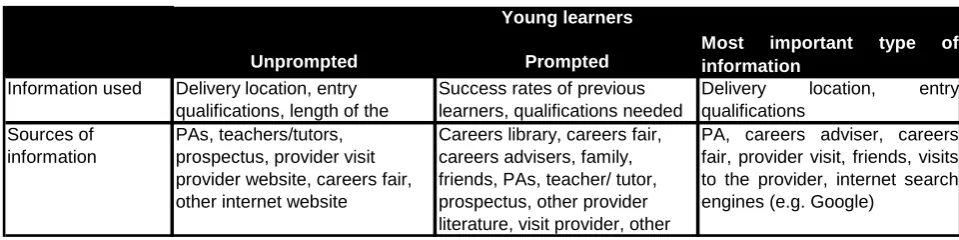
When unprompted, young learners mentioned location, entry qualifications; length of the course, expected benefits of doing the course (e.g. achieving a particular qualification, and progression). Table 2-1 provides a summary of the prompted and unprompted responses.
4
See http://readingroom.lsc.gov.uk/lsc/National/NLSS_Highlights_Report_final_July08.pdf
5
See http://researchtools.lsc.gov.uk/ness/home/home.asp#
6
This is largely consistent with the findings from the literature review and stakeholder interviews above.
Table 2-1 Information and sources used by young people
Unprompted Prompted
Most important type of information
Information used Delivery location, entry qualifications, length of the
Success rates of previous learners, qualifications needed
Delivery location, entry qualifications
Sources of information
PAs, teachers/tutors, prospectus, provider visit provider website, careers fair, other internet website
Careers library, careers fair, careers advisers, family, friends, PAs, teacher/ tutor, prospectus, other provider literature, visit provider, other
PA, careers adviser, careers fair, provider visit, friends, visits to the provider, internet search engines (e.g. Google)
Young learners
Source: GHK FfE user needs focus groups
When provided with the full list of information types the 14-16 user group reported most of these would be useful, including success rates as a measure of quality. This was the only user group not to mention location as an important factor.
The 16-19 user groups reported a more limited range of factors - specifically location, entry requirements and peer recommendations; they considered most of the types of information shown to them would not be useful. The reasons for this related to the degree of subjectivity of the information (e.g. based on particular learner views), which is available elsewhere and in a better format (such as learner views from people they trusted). Otherwise, these users considered the indicators did not measure what they wanted, for example, learner destinations may not show entry into the specific jobs they wanted.
The evidence gathered for this research demonstrates the reliance on limited types of information relates to the reality that for many learners there is no choice. Furthermore, that what is nearest potential learners is to them seen to be of sufficient quality necessitating that they do not need to look beyond this. This is also a perfectly rationale choice: why spend time travelling further afield if what you want is on the door step, and is good enough?
In terms of sources of information, the focus groups, literature review and stakeholder interviews found that younger learners used a wide range of sources including: IAG intermediaries (PAs, careers advisers); other people (such as, teachers, family and friends); websites; provider prospectuses; provider visits; and, telephone helplines. The most useful sources were: PAs; careers advisers; careers fairs; visits to providers; friends and family; and internet search engines. However, provider websites were seen by one group as the least useful because they often don’t provide the specific information users need.
The LSC’s ‘Empowered Learner’ research found that young people were generally passive consumers of IAG information i.e. preferring to receive it than seek it out. They used a range of formal (such as, careers advisers and teachers) and informal (including friends and parents/carers) IAG sources. Experiential sources of IAG are valued as being more informative.7
Broadly, young people were happy with the information available to them, their knowledge of them, the sources of information and access to them, a finding echoed by the
7
‘Empowered Learner’ research.8 They could suggest no improvements. They usually wanted information about a specific course, although provider level information could be helpful, such as, facilities. They wanted to be able to access this information themselves but also to discuss it with an IAG intermediary if required.
All users would prefer information available in a variety of formats, digital (including CD-ROM) and paper based.
2.3.2 Connexions Personal Advisers (PAs)
The findings from Connexions PAs come solely from the focus groups as no secondary data was available on this user group at the time of the research.
Overall, in terms of the ability to exercise choice PAs thought that there was a gap in the range of provision available for young people; for those young people with 5+ GCSEs there was a lot of choice, but for other young people there was no or limited choice.
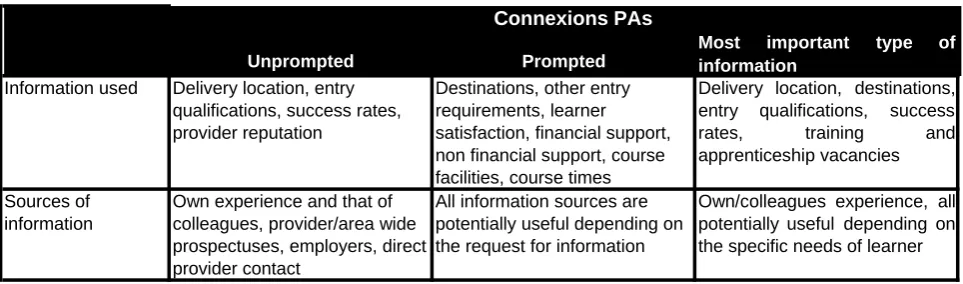
[image:13.595.80.562.355.497.2]When asked which information they used, PAs mentioned a variety of sources: location of provision; entry qualifications; success rates; destinations; other entry requirements; learner satisfaction; financial and non-financial support; course facilities; and, times. However, as was the case with young learners, the full range of information was mentioned only when prompted (see Table 2-2).
Table 2-2 Information and sources used by Connexions PAs
Source: GHK FfE user needs focus groups
Unprompted, key information related to provider location, non-financial support (especially for learners with learning difficulties and/or disabilities), and success rates. Destinations were only important but only if it provided specific information about the sorts of jobs people got. For example, is someone undertaking a Level 1 in construction going into a construction job? Provider facilities (except childcare) and reputation (because it can be subjective) were of least importance.
PAs tended to rely on their or their colleagues experience and expertise as the main source of information, provider/area wide prospectuses and provider websites. When prompted, PAs said that all sources were potentially useful, for certain individuals or groups of young people.
PAs would like information at mostly at course level but some at provider level depending on the needs of particular clients. The main improvement they suggested was more timely information as their interviews with young people start in September but information only comes through in October.
8 Ibid.
Unprompted Prompted
Most important type of information
Information used Delivery location, entry qualifications, success rates, provider reputation
Destinations, other entry requirements, learner satisfaction, financial support, non financial support, course facilities, course times
Delivery location, destinations, entry qualifications, success rates, training and apprenticeship vacancies
Sources of information
Own experience and that of colleagues, provider/area wide prospectuses, employers, direct provider contact
All information sources are potentially useful depending on the request for information
Own/colleagues experience, all potentially useful depending on the specific needs of learner
2.3.3 Adult learners
The literature review and stakeholder interviews found that the choices of younger and adult learners are similar but with key differences. For example, adults are much more likely to have not participated in learning and skills for a number of years, require provision close to where they work rather than where they live, have different access issues (e.g. car parks rather than public transport), and require childcare support. Adults are more likely to have other commitments and so the timing of provision is more important.
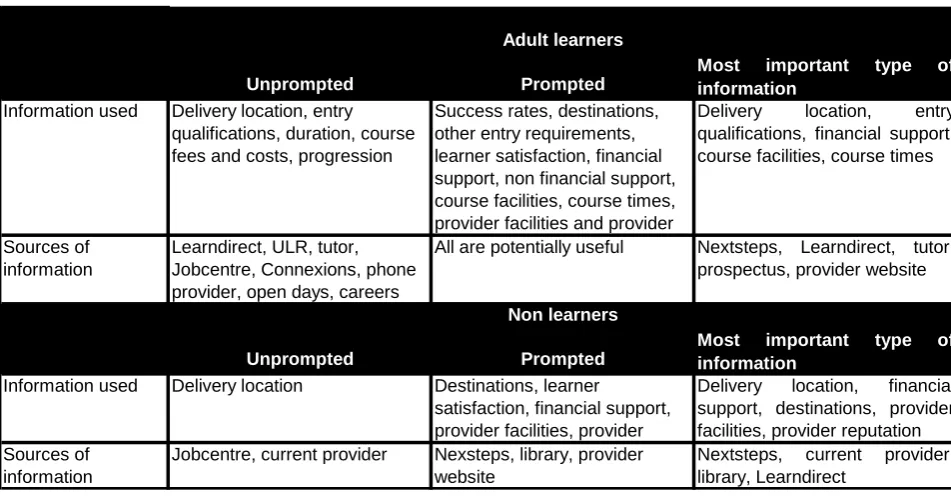
[image:14.595.80.556.229.477.2]In the user focus groups we spoke with adult learners and ‘non learners’ who were unemployed people undertaking DWP pre-employment courses e.g. employability skills.
Table 2-3 Information and sources used by Adult and Non learners
Unprompted Prompted
Most important type of information
Information used Delivery location, entry qualifications, duration, course fees and costs, progression
Success rates, destinations, other entry requirements, learner satisfaction, financial support, non financial support, course facilities, course times, provider facilities and provider
Delivery location, entry qualifications, financial support, course facilities, course times
Sources of information
Learndirect, ULR, tutor, Jobcentre, Connexions, phone provider, open days, careers
All are potentially useful Nextsteps, Learndirect, tutor, prospectus, provider website
Unprompted Prompted
Most important type of information
Information used Delivery location Destinations, learner
satisfaction, financial support, provider facilities, provider
Delivery location, financial support, destinations, provider facilities, provider reputation Sources of
information
Jobcentre, current provider Nexsteps, library, provider website
Nextsteps, current provider, library, Learndirect
Adult learners
Non learners
Source: GHK FfE user needs focus groups
When unprompted, adult learners mentioned delivery location, entry qualifications, duration, course fees and costs, and progression. For non learners, location was the only information mentioned (see Table 2-3).
Like younger learners, adult learners mentioned almost the full range of information sources, particularly when prompted. Whilst they had not necessarily used this information, it might be useful to know and they would not necessarily rule out any source. Non learners mentioned destinations, learner satisfaction, financial support, provider facilities, provider reputation and course times.
Delivery location, entry qualifications, financial support, destinations (especially for unemployed people), financial support, course times, course and provider facilities (especially childcare), and course reputation were the most important to adult and non learners. The ‘Empowered Learner’ research concurred with these findings concluding that the qualification, quality of teaching, location, and course timings and costs were the most important.9
Success rates and destinations (but not for unemployed people) were the least useful because they could be based on learners who were different to themselves. Unemployed
people said that they had not heard of most of the sources of information (although may find them potentially useful).
Adult learners raised concerns over accessing information for particular groups of learners (e.g. people with learning difficulties and/or disabilities) if it was not available in an accessible format.
Both adult and non learners said that information should be available in a range of formats, accessible by yourself or with an adviser.
Adult learners and non learners identified a number of sources of information including IAG intermediaries, provider visits and ‘phone calls, Jobcentre Plus, provider websites, but felt that all of the sources could be potentially useful.
Nextsteps, learndirect, the current provider and tutor, prospectus, provider website and the library were the most important sources. However, some adults thought that some of these sources were not useful for various reasons, for example, Union Learning Representatives (ULRs) only dealt with union members and Jobcentre Plus staff were seen as unhelpful (they did not know what provision was available). Family and friends were seen by some as not useful because they would have a narrow perspective.
In terms of improvements to sources of information, adults wanted information to be up-to-date and prospectuses should include financial support information. Non learners wanted Jobcentre Plus staff to be better trained providing IAG.
2.3.4 Adult IAG advisers
[image:15.595.79.559.430.538.2]The findings on Adult IAG advisers come solely from the focus groups as no research was available on this user group.
Table 2-4 Information and sources used by Adult IAG advisers
Unprompted Prompted
Most important type of information
Information used Delivery location, entry qualifications, other entry requirements, course fees,
Success rates, destinations, non financial support (childcare), provider facilities
Delivery location, entry qualifications, financial support, destinations, provider facilities Sources of
information
Prospectus, provider visit, provider website
Learndirect, careers fairs, Jobcentre, non provider websites (e.g. UCAS), sector
Learndirect, prospectus, provider visit, provider website, Jobcentre Plus (for unemployed
Adult IAG advisers
Source: GHK FfE user needs focus groups
Table 2-4 shows that when prompted, Adult IAG advisers mentioned most sources of information as useful, which is similar to adults. Unprompted, Adult IAG advisers mentioned location, entry qualification, other entry requirements, course fees, financial support and course times.
Location, entry qualifications, financial support, destinations and provider facilities (especially childcare) were identified as the most important types of information.
Provider facilities (except for childcare) and reputation (because it could be subjective and unfounded) were viewed as the least useful.
Timeliness of information could be an issue because things can change so quickly.
The most important sources were learndirect, provider visits, prospectuses and websites, and Jobcentre Plus for unemployed clients. However, they would like to be able to speak directly to tutors, and have easier navigation of provider websites. ULRs and libraries were seen as the least useful sources of information.
2.3.5 Employers
The literature review and stakeholder surveys found that, as with previous groups of users, they are a heterogeneous group and their needs will vary by size, sector, nature of the organisation (multi national/sole trader) and location. Generally, large employers are more likely to plan and budget for their learning and skills needs.
The literature review and stakeholder interviews identified a number of factors which affect employers’ training choices when choosing training provision and providers. However, key factor affecting employer choice could be identified as being determined by (in order of importance):
Compulsion - the need for accredited learning arising from business need and identified workforce skill gaps.
Location – locally-based providers offering obvious advantages in terms of accessibility. Employers were, however, prepared to look further afield to source a provision with a particular sectoral or vocational specialism.
Pre-existing relationships with providers – much of the existing evidence base identifies this as a key factor for sourcing training provision.
Flexibility – in terms of the provision itself and the ability to tailor provision to meet employer need (on the job, bite sized provision etc., and in terms of the mode of delivery (e.g. WBL).
Provider reputation.
Financial – availability and level of support, and value for money.
While much of the existing evidence base reveals that sourcing training provision relies heavily on existing relationships between employers and providers, there was some evidence that external reviews, and the testimonials of past learners and other employers could be of influence. Word of mouth passed through a variety of employer networks was a very important source of information.
The literature review and stakeholder consultations identified word of mouth, networking, existing provider links and the internet as the main source of information for employers when sourcing training providers and provision. The next most popular route was through Business Link (telephone contact for those unable to access the Business Link website).
Table 2-5 Information and sources used by Employers
Unprompted Prompted
Most important type of information
Information used Delivery location Success rates of previous learners, location, course times, financial support, non financial support, provider facilities, type of delivery, provider reputation, provider flexibility, Brokers
Delivery location, course times, financial support, provider facilities, type of delivery, provider flexibility
Sources of information
Direct provider contact, employers guide, tendering, professional bodies, personal recommendation
Prospectuses, websites, all the sources have potential, Train to Gain Skills Broker, Other Skills Broker, Prospectus/other provider literature, other internet
Direct provider contact, provider websites, sector provider directory, no provider websites (e.g. sector specific), specialist professional body.
Employers
Source: GHK FfE user needs focus groups
One employer focus group thought that learner views, destinations, employer views, and financial health would not be useful to them because they only sourced training for bespoke qualifications. However, the other two groups said that all information was potentially useful, even if they have not used it themselves.
As far as sources of information are concerned, employers mentioned most as potentially useful. When asked to identify the most useful sources, they mentioned provider contact, provider websites, sector provider directories, other websites (sector specific), and professional bodies. Some employers already know the providers so they would tend to access information directly from them, or need this contact in order to build a relationship with them.
Skills brokers (too general), learndirect, libraries, ULRs were seen as the least useful.
As with the other groups, employers wanted both course and provider level information, and available in a variety of formats.
2.3.6 Train to Gain brokers
The findings on Train to Gain brokers come solely from the focus groups as no research was available on this user group.
Table 2-6 Information and sources used by Train to Gain brokers
Unprompted Prompted
Most important type of information
Information used Delivery location, flexibility of provision
Success rates, entry
qualifications, financial support, non financial support, provider reputation, type of delivery
Delivery location, success rates, course times, provider reputation, financial support, flexibility of provision
Sources of information
Own experience and that of colleagues, ULRs,
employer/sector organisations, library, provider website,
All information sources are potentially useful depending on the request for information
Own/colleagues experience, direct provider contact, provider websites, employer/sector organisations
Train to Gain Brokers
Source: GHK FfE user needs focus groups
[image:17.595.79.565.545.679.2]When asked to identify the most important types of information, they mentioned location, success rates, course times, financial support, provider reputation and the flexibility of provision.
One broker group said that destinations and course facilities (because provision would take place on the employer’s premises) as the least useful, but the other two focus groups thought that all the information types could be potentially useful.
Brokers relied on their own or their colleagues experience for sourcing this information, as well as direct provider contact, provider websites, and employer or sector organisations. ULRs (too general or eclectic) and libraries were the least useful sources.
One broker group said that they tended to know what provision was available because they focused on a particular sector and/or geographical area and so knew who delivered what. Formal (e.g. evaluation forms) and informal employer feedback was the main indicator of quality. If they were unsure about what provision was available, they would seek advice from their colleagues or use the Employer Guide to Training.10
The other broker focus group said that they would like a definitive, on-line directory of which courses were available, but who would update and manage it?
2.4 Conclusion
People and employers decide to invest in learning and skills for a number of reasons, and in making this decision often help decide which course to do and where to study it. This is because there is limited choice available.
Having chosen a particular course, the next question is who delivers it? On-line or paper prospectuses usually answer that question. Proximity is a key factor for learners (and thereby for their advisers) and then quality of provision. Users usually choose the provision closest to them. This is usually of sufficient quality for their needs, as is evidenced by the results of user satisfaction surveys. The large majority of users are satisfied with their provision, a significant minority are often very satisfied, and very few are dissatisfied.
Therefore users usually want to know who delivers the course they want, which of these providers is nearby and, unless there is evidence to the contrary, believe it is of the quality they require.
This decision making model provides the context for other types and sources of information they use:
Younger learners – require information primarily about proximity and entry requirements. Other information is not to be ignored and is of potential value but is not central to their decision. They often use and consult with a wide range of information sources, especially Connexions PAs, careers advisers, provider prospectuses, provider visits, and friends and family. They are happy with current types and sources of information and how accessible they are.
Connexions PAs - PAs thought that there was limited choice of provision available, especially for those young people with fewer than 5+ GCSEs. For PAs, delivery location, destinations, entry qualifications, success rates, training and apprenticeship vacancies were the most important types of information. PAs tended to rely on their or their colleagues experience and expertise as the main source of information, although all sources were potentially useful.
10
Adult learners - Delivery location, entry qualifications, financial support, destinations (especially for unemployed people), financial support, course times, course and provider facilities (especially childcare), and course reputation were the most important types of information to adult and non learners. IAG intermediaries, current tutor and provider, provider prospectuses and websites were the most useful sources, but all types and sources of information could be potentially useful.
Adult IAG advisers - location, entry qualifications, financial support, destinations and provider facilities (especially childcare) were identified as the most important types of information. They were happy to consider and use a range of sources depending on their client’s needs, although other intermediaries and provider information were the most important.
Employers - location, course times, financial support, provider facilities, type of delivery and provider flexibility were identified as the most useful types of information. Direct provider contact, provider websites, sector provider directories, other websites (sector specific), and professional bodies were the most important sources although most were potentially useful.
Train to Gain brokers - location, success rates, course times, financial support, provider reputation and the flexibility of provision. Brokers relied on their own or their colleagues experience for sourcing this information, as well as direct provider contact, provider websites, and employer or sector organisations.
3
PUBLISHING FfE INFORMATION
3.1 Introduction
This section looks at the ways in which FfE information should be published and disseminated to the different user groups in spring 2009, spring 2010 and beyond.
The interim report, based on the literature review and stakeholder interviews concluded that:
Of the information contained in the first publicly available version of the FfE in spring 2009 (Version 1) the most useful to users will be destinations and Qualification Success Rates (QSRs) but they will not be available at the level which most users want them i.e. course level.
Of the information to be contained in full publicly available version of the FfE published in spring 2010 (Version 2) and subsequent versions of the FfE, the most useful is likely to be destinations, QSRs, and learner and employer satisfaction.
Of the financial PIs, only use for resources is likely to interest users. However, the PI itself is unlikely to be helpful as users want to know about the end result of this use of resources i.e. quality of equipment, facilities and buildings.
Users will require information at course level for it to be of most use to them.
Users will also require qualitative information rather than statistics. For example, whilst learner or employer satisfaction ratings will be of use, they would also like to read about why learners and employers were satisfied/dissatisfied and which elements they were satisfied/dissatisfied with.
Much information which users require is descriptive of the course and provider and will not be included in the FfE but is available from other sources.
3.2 User views on the information contained in the FfE
Users were shown the types of information that would be included in the full version of the FfE. They were asked which information would/would not be of use to them when making decisions about provision and providers; how they would use that information and how they would prefer to access it.
The PIs were not defined but were explained in more detail if responses from users suggested that they did not fully understand what the PI meant. This was particularly the case with use of resources. Users were interested in such a measure if it could be used to measure how much providers invested in learner facilities and resources, however, that particular PI is a technical and composite indicate covering funding economy, resource efficiency, and capital.
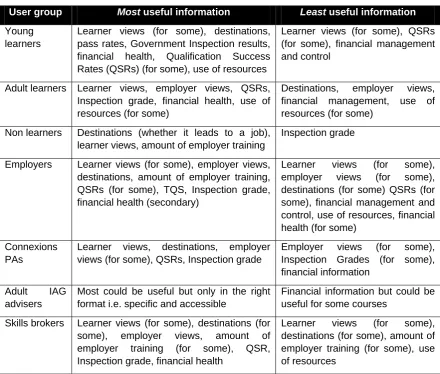
Table 3-1 shows which users groups found the information in the FfE to be most and least
useful.
Most users said that the views of employers and learners would be useful. However, care must be taken in interpreting this. No user groups identified employers and learner views as the most important in the first part of the focus. In addition, users are likely to want more qualitative and course specific information rather than an overall rating.
into a specific type of job rather than employment per se). One user said that it doesn’t matter how many people have passed it, you have to be committed yourself.
Destinations and reputation were the only areas identified by any user focus group in the first part of the focus groups as being most useful to them that could be measured by FfE PIs. However, destinations were also identified as being the least useful by at least some user focus groups because they need a particular level of detail.
This implies that although users may identify certain types of information of being useful to them, it will only be meaningful if it measures particular aspects of provision in a particular way.
[image:21.595.80.521.274.648.2]Generally the PIs in the financial dimension were found to be the least useful to users. However, some learners and employers thought that financial management and control would be useful because they would not want to choose a provider at risk of going bust.
Table 3-1 - FfE Information – Most and Least Useful
User group Most useful information Least useful information
Young learners
Learner views (for some), destinations, pass rates, Government Inspection results, financial health, Qualification Success Rates (QSRs) (for some), use of resources
Learner views (for some), QSRs (for some), financial management and control
Adult learners Learner views, employer views, QSRs, Inspection grade, financial health, use of resources (for some)
Destinations, employer views, financial management, use of resources (for some)
Non learners Destinations (whether it leads to a job), learner views, amount of employer training
Inspection grade
Employers Learner views (for some), employer views, destinations, amount of employer training, QSRs (for some), TQS, Inspection grade, financial health (secondary)
Learner views (for some), employer views (for some), destinations (for some) QSRs (for some), financial management and control, use of resources, financial health (for some)
Connexions PAs
Learner views, destinations, employer views (for some), QSRs, Inspection grade
Employer views (for some), Inspection Grades (for some), financial information
Adult IAG advisers
Most could be useful but only in the right format i.e. specific and accessible
Financial information but could be useful for some courses
Skills brokers Learner views (for some), destinations (for some), employer views, amount of employer training (for some), QSR, Inspection grade, financial health
Learner views (for some), destinations (for some), amount of employer training (for some), use of resources
Source: FfE user needs focus groups GHK
Users were asked for the information they thought would be most important to them, how would they use this information, how they would like to get hold of it, and what level of detail would they need:
Qualitative information would be important e.g. not just whether learners were satisfied with their course but why they were satisfied with it. For those who might find FfE information useful, this would be of secondary importance to them.
Adult learners – location was important for adult learners and so this necessarily limited the amount of comparisons that could be done. Adults would prefer the FfE information to be available via the internet (so it is more likely to be up to date), although they would also like it available in other formats – paper (e.g. in booklet form that they can carry around and consult when convenient), DVDs and contained alongside other information in prospectuses. They would like to be able to compare providers and have access to an adviser if they need to discuss it with someone.
Non learners – location and job entry were important to non learners: “If it is offering something other than a job I am not interested”. Many non learners were unaware of the information and sources discussed ion the focus group but felt that it was potentially useful. FfE information needs to be presented at the level of course, and they would like to access it alongside an adviser so they could discuss it with them.
Employers – would like information on both course and provider: “course first, then provider”. They would use it to supplement information gained elsewhere (word of mouth, networking events), and would like it on the internet, and in a format that enabled them to make comparisons.
Connexions PAs – would like the information in a paper-based format so they can carry it around with them and consult when necessary and on the internet. However, if it is to be an internet based source it needs to be up to date and have the same information for each provider. PAs would want the information broken down by level of provision as well as course.
Adult IAG advisers – comparison between providers at course level, so clients can make a choice (but this depends on there being a choice available).
Train to Gain brokers – felt that the FfE would duplicate information available elsewhere: “We don’t want another website”. There should be links to other, qualitative information but there should be: “one mandatory database [sic i.e. website], not more!”
Thus most respondents want the information at a more detailed level than that of provider. Many would not find provider level information useful, although some would want to assess the overall performance of that provider. This has implications for the overall scoring grade as this will only be available at provider level.
Most users wanted the information available in both paper and digital format. Paper-based formats (e.g. a booklet that can be printed or is generally available) has the advantage that it is portable and can be more conveniently consulted where there is not internet access. Having the FfE available on a website would make comparisons easier and it could be brought up to date more regularly and immediately. It would also facilitate links to other websites (especially provider websites). Some users would also like qualitative information in addition to quantitative data, especially learner views about the provision.
other sources are more useful because they are based on more personalised information. For example, many IAG intermediaries would use their own/colleagues knowledge and employer feedback, one large employer does not commission provision without a formal tendering process, so there are limitations for some users on how important the FfE could be to them.
3.3 Accessing the FfE via the internet
The LSC wanted us to specifically ask users about accessing information via the internet. This was not a problem for users as it was an accessible and flexible source of information, and most of them were using it anyway.
However, users would want information available in other, more transportable, formats, especially paper documents. This was because there were other limitations to the internet, especially the digital divide, and connectivity. No users mentioned issues over security when accessing the internet.
Users were presented with mock ups of how the FfE may look as a website (see Section 6.4. Generally, users liked the look of them but would like to be able to select providers by distance, and be able to select, rank and sort the information. Some could not understand the usefulness of presenting provider level information only. Users would need help in understanding the PIs.
Some IAG intermediaries felt that they look like and would duplicate other information, such as, area prospectuses. What they wanted was FfE information to be available on current websites rather than have to go to yet another source to get this information. One Connexions PA queried whether they would be able to access local information for national providers. For example, they would want to know the destinations and success rates of learners from their area, not across the whole country.
3.4 Publishing the FfE in spring 2009
A version of the FfE will be published in June 2009. In the version which will be made public, three performance indicators (PIs) will be available11 – learner destinations;
qualification success rates and the Inspection Grade. Information will be available for every LSC funded provider as long as their learner destination survey is statistically valid. This will be published on the FfE website based on an underlying database of information. There will be little functionality e.g. being able to select and sort information.
The PIs will only be available at the level of the provider and so users will not be able to, for example, identify the success rates of particular provision, curriculum areas or specific courses.
In terms of the usefulness of the PIs publicly available, few users mentioned success rates, destinations and Inspection Grades when unprompted. When prompted most user groups did mention success rates and destinations, however this was not of major importance for those consulted; most users reported wanting more detail e.g. success rates by course, and destinations into particular jobs. Few mentioned Inspection Grades.
Consequently, the information that will be available in spring 2009 through the FfE, and how it is made available, is unlikely to meet the needs of most users. This has important
11
implications for the FfE in terms of managing expectations in the short-term given that few users will find much value in it.
The strategic position of the FfE is also developing. Whilst most stakeholders are aware of the FfE, few can comment on how it should be developed as these discussions are just beginning to take place. For example, there is little understanding of how the FfE would relate to the developing AACS, and none of the Advancement Network Prototypes (ANPs) prototypes refer to the FfE.
Key issues that it would be important to consider as part of publishing the FfE in spring 2009 ahead of full implementation in 2010 and 2011 would need to include: :
Linking in with IAG developments and changes in IAG services for adults and young people; what are the implications of the Qualifications and Curriculum Framework (QCF); is there potential for including other areas of publicly funded learning and skills provision, such as, DWP funded training?
Users want to be able to select, group and sort information. The June 2009 version could start to develop the ability of users to select providers within a certain area (e.g. miles radius), they may want to select only those indicators of interest to them, they may want to select providers that meet a certain threshold.
Links with other information – apart from where provision is located, many users wanted information about the course itself e.g. entry requirements, course fees and costs, financial support, flexibility of provision etc.
The FfE will be only one of a large number of IAG sources, both publicly and non-publicly funded. Users mentioned Connexions, providers, learndirect, area prospectuses and Employer Guide to Training websites, but they also mentioned prospectuses, and wanting the ability to discuss course and provider information with an IAG intermediary, peer or other person (e.g. a family member). In addition, there are a number of private IAG providers and other sources of information available through social networking sites.
Media formats - users had few concerns about accessing FfE information over the internet but they also reported requiring it in other formats, particularly paper based, but also other digital media, such as, CD-ROM. This is so information can be accessed when users are unable to go on-line, but also to be able to sit down and discuss it with someone.
The research demonstrates there is limited strategic and wider operational awareness of the FfE at present. None of the IAG intermediaries consulted were aware of the FfE. IAG should be treated as a process and the FfE as an element in that process. Users’ decision making is unlikely to become more sophisticated unless it becomes part of a process, and links with IAG intermediaries, careers advice and planning within schools, employers becoming more sophisticated in their learning and skills planning and budgeting are all elements in improving the sophistication of the decision making process of which the FfE could form an important part.
3.5 Publishing the FfE in spring 2010 and 2011
By the spring of 2010, the whole of the FfE will be widely available. It is intended that users will be able to search by postcode and type of provision. It will link into other websites, such as the Vacancy Matching Service (VMS) and the Employer Guide to Training. By this time Machinery of Government (MOG) changes will mean the responsibilities of the LSC will have been passed on to the Skills Funding Agency, the DCSF and the National Apprenticeship Service (NAS). There are likely to be other important developments, including a possible change of Government, which are likely to impinge on the further development of the FfE.
Technological changes will also mean that digital information, how it is presented and used will also change. Therefore advising on how the FfE should be published needs to be based on what we know at the moment.
The elements identified in the previous section – strategic links, functionality, links with other information and sources etc. - will have to be monitored and linked into the FfE’s development. Also the use of the limited version of the FfE must be monitored and used to inform the FfE’s further development.
There are likely to be three major changes which will impinge on the FfE:
Technological developments – there will be important changes in the way in which people access and interact with digital information. Technological convergence will mean that there will be much broader access to internet based information. At the moment we are seeing increasing usage of the internet by mobile phones, but in the next few years, digital TVs, MP3 players, games consoles etc. may all be used for a variety of different functions, including internet access. Simultaneously broadband speeds and memory are increasing and so the types and complexity of information (especially moving images) on hand held devices will also increase. Content will also be required to be available on all these different platforms, and also transferable between them.
Information convergence – with the development of Web 2.0, social networking, and aggregation, there will also be a convergence of digital information. At the moment, accessing different web sites, and the information within them, has to be undertaken sequentially. It is likely that future developments will mean that this can be done simultaneously, with web tools available to bring together a range of information into one place. This could be through a much more sophisticated version of RSS feeds or by giving users the ability to select, download and combine information from several sources. For example, at the moment rather than going to a career website, a provider website to find out course details, the FfE for success rates, and another website about financial support available, this information could all be brought together in one place by the user.
about courses and providers. Users will also be able to communicate with other users more effectively through web based social networks and other social networks, such as, Twitter. The role of IAG will have to change from providing IAG to helping users access and intelligently use the plethora of information sources available to them.
There are tools that are currently being available which link the IAG process of school pupils at different stages, for example, the information contained in Individual Learner Plans (ILPs) is directly fed into area prospectuses. This forms the basis of consultations with IAG advisers but also feeds into post-16 providers planning of the demand for particular types of provision because future options and careers are identified in ILPs.
The implications of these trends for the FfE are that it will have to compete with a broader range of formal and informal information sources, must be available in a range of formats, and integrate with a broader range of information sources. This means that the FfE will have to be enhanced to be more attractive and useful to users, for example:
Being available at the level of detail users want, especially at course level and by type of destination (i.e. not that people got a job but what types of jobs);
Including qualitative information from the learner and employer views survey in addition to data giving proportions of learners or employers who are satisfied or dissatisfied – why are they satisfied or dissatisfied;
Include podcasts or vodcasts of learners who have left the course and what they are doing now, e.g. ‘A day in the life of…’;
Include videos of activities which the provision includes, for example, one learner during a provider visit for a forensics course had a montage of a crime scene and associated activities, this could be presented on-line;
Case studies of learners and employers by different types of user;
Have more information available in graphs and charts;
Create tools to allow users to benchmark and compare different providers and provision;
Availability in a wide range of formats, including paper based; and,
Contain more information/links to information about the course, especially entry requirements, costs, financial and non-financial support available.
The implications for the FfE in 2010 and beyond is not in the performance rating information but what other information is available, how users use the FfE, and links with other information.
However, whilst the FfE must be aware of these technological, and use of technology developments, it also needs to pay attention to more practical and mundane issues, such as:
Keeping information up to date;
Ensuring ease of navigation;
Ensure that all learners, potential learners and non learners have access to it; and,
3.6 Conclusion
Generally, users were positive about the idea of the FfE overall and that some of the information it contained could be potentially useful. However, they felt that the information it contained was secondary to how they made their decisions or would not be available in the level of detail they required.
The PIs in the financial dimension were found to be the least useful to users.
Most respondents want the information at a more detailed level than that of provider. Many would not find provider level information useful, although some would want to assess the overall performance of that provider.
Most users wanted the information available in both a paper and digital format.
Accessing the FfE through the internet was not considered a problem, although users would want it available in a more transportable, paper based format as well.
Users generally liked the look of the mock ups we presented to them and liked the functionality of being able to select and sort information. However, some IAG intermediaries felt that they looked like and would duplicate other information, such as, area prospectuses. What they wanted was FfE information to be available on current websites rather than have to go to yet another source to get this information.
The information that will be available in spring 2009 through the FfE, and how it is made available, is unlikely to meet the current needs of most users. The strategic position of the FfE is also still developing, particularly as wider strategic discussions on the role of the FfE in informing users decisions are only just beginning to take place.
Therefore, attention should be given to linking the FfE in with other IAG developments; how users can select, sort, rank and benchmark information; links to other information and sources; positioning the FfE relative to often well used and regarded existing sources of information; making the FfE available in different formats; strategic and operational promotion of the FfE, especially with the developing AACS, Connexions and Train to Gain services and IAG intermediaries, and; developing explanatory information which can be understood by a diverse range of users.
By the spring of 2010, the whole of the FfE will be publicly published. The further development of the FfE will take place against a radically changing strategic, organisational and operational background (especially the MOG changes), as well as important political and economic changes.
There will also be important technological development in hardware, software and the ways in which people use and manage information. The implications of these technological trends for the FfE are that it will have to compete with a broader range of formal and informal information sources, must be available in a range of formats, and integrate with a broader range of information sources. This means that the FfE will have to be enhanced to be more attractive and useful to users.
4
CONCLUSIONS
4.1 Conclusions
Most users utilise types and sources of information about learning and skills providers and provision within a limited decision making process. The decision making process is confined because choice is restricted, either because there is only one accessible provider who delivers that provision or most providers are of a similar but sufficient quality so proximity is the key determining variable.
Therefore, users primary information needs are who delivers the provision they want and how far away are they. They then require additional information about the course, especially, what the entry requirements are, but may also require information about the times of the course, costs and facilities. This information is currently readily available, and users access it through IAG intermediaries, provider visits, prospectuses or on-line sources.
Sometimes users require information about quality and responsiveness but this is usually in a qualitative format gathered from the views of peers.
Users usually require information at the course level and in a variety of formats.
The information in the FfE does not currently meet users needs. Even of the type of information appears useful to them it will not be available in the format they require i.e. at the level of the course. The FfE could potentially be useful to some users but it does not meet their primary information requirements.
4.2 Recommendations
Evidence from this research has shown that it is the potential drill down functionality and links into other sources where the FfE has the opportunity to add most value from a user perspective, enabling comparison of providers within a specific distance, and performance data at curriculum and course level. There is a danger that by promoting and disseminating the FfE too widely before this type of data is available could result in the FfE being discounted as a potential valuable resource. Working within the boundaries of the data that will be available for publication in the short-term it will therefore be important to manage expectations both internally and externally; a limited roll out of the FfE in spring 2009 could support this.
The publishing of FfE in June 2009 does however present opportunities for further development. This could usefully involve further piloting work to refine and consolidate:
Strategic links – how does the FfE relate to important IAG developments and changes in IAG services for adults and young people; what are the implications of the QCF; is there potential for including other areas of publicly funded learning and skills provision, such as, DWP funded training?
Functionality – users want to be able to select, group and sort information. The June 2009 version could start to develop and test drill down capabilities such as regional, distance comparisons of providers and provision, success rates by curriculum areas and course types, which this research has identified as being of most value to user groups.
Links with other information and sources of information – the FfE will be only one of a large number of IAG sources, both publicly and non-publicly funded. The June 2009 version could start to identify what other information is available and how best it can be linked into the FfE.
Media formats - an important finding of the study is that users want the information available in a variety of formats. Thought must be given to how the FfE could be made available: on paper, printing and/or downloading pamphlets or booklets; and accessibility through a variety of formats, such as, podcasts, facebook, Skills Accounts, area prospectuses etc.
Supporting information – explaining the FfE and its indicators in a user friendly way will be a challenge, especially for the financial dimension, if users are to use the information correctly.
The next version of the FfE can start to explore these elements but it must do so by involving users in its design and development.
5
ANNEX ONE – BIBLIOGRAPHY
- ASW Consulting (2003) Client Needs for Information, Advice and Guidance Services on Learning and Work, Department for Education and Skills: Research Brief 749.
http://www.dcsf.gov.uk/research/data/uploadfiles/RB479.pdf
- British Chambers of Commerce report (2008), UK Skills: Making the Grade
- Credit Works (January 2006), Adult Learning, Skills and Progression to Level 2: a study of market failure
- ECOTEC (May 2007) 14-19 Education and Skills Workshops with Young people: An Events Reports for the DfES
http://www.dcsf.gov.uk/14-19/documents/Young%20People%20Event%20Workshops.pdf
- Edexcel (2008) Taking Stock: CBI Education and Skills Survey http://www.cbi.org.uk/pdf/skills_report0408.pdf
- GHK Consulting Ltd, (2007) National Evaluation of the Career Development Loans Programme
- GHK Consulting Ltd. (2009) Independent Review of Framework for Excellence
- GHK for DfES (2002), Evaluation of the Connexions Service Pilots
- GHK for LSC Humberside, North Yorkshire and West Yorkshire (2006), Evaluation of the Cluster and Sector Skills Development Initiative
- GHK for LSC NO (2004), Barriers to Participation in Sparsely Populated Areas
- GHK for LSC Shropshire (2007), Reasons for the Underachievement and Lack of Participation of Young Males In Shropshire
- GHK for LSC South Yorkshire (2007), Evaluation of the 14-19 Pathfinders in Doncaster and Sheffield
- GHK for the LSC Black Country (2006), Strategic Area Review of 16-18 provision in Dudley
- GHK for the LSC NO (2008 unpublished), The Train to Gain Supply Chain Review
- IFF Research Ltd. (2007), Workforce Training in England 2006, for DfES Research Report No. 848
- Institute for Employment Studies (2007) Reasons for Early Leaving from FE and Work-based Learning Courses, Institute for Employment Studies
- Institute for Employment Studies (February 2007), Assessing the Net Added Value of Adult Advice and Guidance
- KPMG FfE Pilot Evaluation Reporting (2008)
- Learning and Skills Network and NUS (2008), The True Cost of College
- LSC (2005) National Learner Satisfaction Survey: Guidance on the core methodology and core questionnaire
- LSC (2006) FfE Consultation Response Paper
- LSC (2007) FfE Raising Standards and Improving Choice: LSC
- LSC (March 2008) Empowered Learner Presentation, Summary Paper