FINAL REPORT FOR OFQUAL
ALTERNATIVES TO TEST
ACCOMMODATION: NEW MODELS FOR
PUPILS WITH SPEECH AND LANGUAGE
DIFFICULTIES
THE SUPPORT MODEL
Ayesha Ahmed and Alastair Pollitt
CamExam
June
2010
Ofqual/10/4782
Executive
Summary
The aim of this study is to test the suitability of the Support Model methodology for use with pupils with Speech and Language Difficulties (SLDs).
The Support Model assesses a pupil’s ability based on the amount of support they need to complete a task. Support is given in the form of systematically delivered prompts, and all pupils complete the task, and so end with a positive sense of achievement.
Prompts are categorised as: Reading prompts, Understanding prompts, Activation prompts, Writing prompts and Affective prompts. The prompts allow us to use the Support Model to assess the pupils’ understanding of the important concepts in a subject, without their Speech and Language
Difficulties getting in the way. The scoring system can be altered to include different categories of demand as ‘construct relevant’.
In general, there is threat to validity when we put exam tasks into words to communicate to pupils. The Support Model deals with this by allowing an interaction, so that pupils understand fully what the task is and can show their understanding, even when the task is not clearly communicated via the
question. Pupils with SLDs are likely to be more affected than other pupils by construct irrelevant language demands.
The prompts are standardised, so that every pupil receives, or at least may receive, exactly the same science-related prompts. The assessor gives each pupil every prompt they might need, and they are therefore assessed in a standardised way.
Participants were 7 pupils aged from 10 to 11 years, in Years 5 and 6 of a primary school in Cambridgeshire with a Speech and Language Centre attached to it. Each pupil had a different profile of SLDs; 3 were classified as ‘mild’ and 4 as ‘moderate’.
The materials used were three questions from past papers in Key Stage 2 science.
The pupils showed evidence of understanding the science concepts and being able to carry out the tasks, but had difficulty reading and interpreting the tasks, and putting their answers into appropriate words.
The results show that these pupils were able to use the prompting system successfully and that it allowed them to show science knowledge and understanding that otherwise may have been masked by their Speech and Language Difficulties.
Pupils using the Support Model are likely
to get higher scores than they would have done without it. In effect there is a bias against all pupils who are not given this kind of language support. The solution is to find a method of establishing a fair equating so that all pupils are assigned the correct level, whether or not they had this language support.
The present system will need a human interpreter for each pupil, and this assessor will need to have been trained briefly on how to use the prompts. In order to remove the need for a human interpreter, we hope to develop an automated system which will evaluate the pupils’ responses and select the appropriate prompt.
Contents
Table of Contents
Summary...2Executive ...4
Contents... Introduction...5
The ‘explain’ question... 6
The Support Model... 5
Speech and Language Difficulties ... 6
A Model of the Question Answering Process ... 7
... 8
Validity ... Methodology...8
Pa evious research... 8
rticipants ... 9
Mild SLDs... 9
Moderate SLDs ... 9
Pr Materials ...10 Procedure ...10 The Prompts ...13
Data Capture and analysis...13
Coding ...14 s...14 Ethic Results... 14
Interpretation of scores ...15
Scoring ...14
Pa Co rticular words that caused difficulty ...16
mments and quotes from transcripts...16
Explain questions... 16
Understanding the words of the question ... 16
n of the scientific concepts... 17
n answer into words... 18
Activatio Putting a Conclusions...18
ring ...18
Reliability ... 19
Sco Validity and bias...19
Pupils’ evaluation of the prompt system...20
Confidence...20 Manageability...21 Teacher Assessment and Formative Application...21
Summary... 22
References... 23
Appendix 2 – The prompts ... 34
Appendix 3 ‐ A sample transcript ... 38
Introduction
How can we assess children with Speech and Language Difficulties fairly? Should we adapt existing assessments or should we design something new, specifically targeted to these children? The Support Model offers a third approach: it is a new and
innovative method which can be used with existing tasks or completely new ones, to enable every child to perform to their full potential. It allows us to assess children’s ability without ‘the question getting in the way’.
The standard approach to assessing pupils with SLDs is to modify the paper in a way that is designed to help them to understand the task they are being asked to complete and to communicate their response to the assessors. This leads to concerns about the reliability of the modifications, as assessors try to anticipate the difficulties that particular pupils will face. The Support Model provides a standardised form of
prompting pupils to complete a task, and it does so in an interactive and reactive way, tailored to each pupil’s needs.
Our aim in this study is to discover the suitability of the Support Model for assessing students with SLDs. We wish to find out whether the Support Model can compensate for the pupils’ communication difficulties and so provide a fairer assessment of their science ability. This study is designed to be exploratory, using a small sample of pupils, with the emphasis being on qualitative data collection.
The Support Model
Traditional assessments can be classified as following either a Difficulty Model or a Quality Model (Pollitt, 1990). The Difficulty Model involves a student getting over hurdles, each more difficult than the one before it, until they can no longer clear the hurdle. The point at which they fail gives their level - rather like a high jump. The Quality Model involves the student producing a piece of work that is judged on its quality: students are assessed based on how well they performed.
The Support Model differs from the two traditional models as it does not assess how difficult a task a child can complete, or how well a child can complete a given task. Instead, the assessment is based on the amount of support the child needed to complete the task. Support is given in the form of prompts, and assessment is based on the number and nature of prompts needed. With this model all students ‘pass’ and complete the task, and so end with a positive sense of achievement.
in the question, whilst not penalising them for prompts which simply helped them to read and understand the task.
This is an advantage for all pupils as it allows us to assess what is important in a subject area (Pollitt & Ahmed, 2009); if we do not want to assess their reading or even their writing, we can assign a level based only on what we do want to assess. For pupils with Speech and Language Difficulties this has even more obvious advantages. We can use the method to assess the pupils’ understanding of the important concepts in a subject, without their Speech and Language Difficulties getting in the way.
The ‘explain’ question
From our recent studies of questions and mark schemes at GCSE level (Pollitt, Ahmed, Baird, Tognolini & Davidson, 2008), as well as previous work on
comprehension failures (Pollitt & Ahmed, 2000), question wording (Pollitt & Ahmed, 2001) and Sources of Difficulties in exam questions (Ahmed & Pollitt, 1999), we have compelling evidence of the effects of the wording of questions on the suitability of a test to assess what it is intended to assess: that is, the threat to validity which comes about when trying to put exam tasks into words to communicate them to the pupils.
Many of these communication issues can be dealt with by ensuring that question writers are aware of the way in which pupils read in an exam, and of how to ensure that the language of a question is as clear as possible. However, we cannot
realistically eliminate all construct irrelevant language demands from an exam. Furthermore, there are some types of task that are very difficult to communicate clearly in a written paper for any pupil and in particular for those with SLDs. The most challenging of these in our experience is the ‘explain question’ or the ‘why question’, which led us to conceive of a new approach to assessment: the Support Model.
We originally designed the Support Model to address the issue of ‘the explain question’(Ahmed & Pollitt, 2010) as very often pupils will write an answer to an ‘explain’ question and examiners reading their script wish they could probe further by asking them ‘Yes but why?’. The examiners are looking for a deeper explanation, or the next level of explanation, and often the pupils may know the deeper explanation but not have realised that was what was expected. The Support Model deals with this by allowing an interaction, so that pupils understand fully what the task is and can show their understanding, even when the task has not been clearly communicated by the question.
The application of the Support Model for pupils with SLDs was an obvious next step. These pupils are likely to be more affected than other pupils by construct irrelevant language demands. We chose to use questions from KS2 Science in this project as there is a clear distinction between the science content of the question and the communication of that content.
Speech and Language Difficulties are considered to affect a pupil’s ability to understand language and/or to produce language.
In Ofqual’s 2008 report (Lampreia-Carvalho, 2008) states that: “Candidates with delayed language development may:
omit or substitute sounds
experience articulation difficulties
not understand, learn or remember the meaning of words
fail to understand and use abstract concepts (time, space, quantity, emotions)
encounter difficulty in finding appropriate words
interpret language literally
struggle with verbal reasoning involving cause and effect, deduction, prediction and inference
find it hard to order events in sequence.” And:
“Contrary to cases of delayed development, speech and language 'disorder' encompasses cases of severe delay and abnormality in the development of language comprehension and/or use. It is very hard for young people with this type of SLD to develop complex language skills.”
Currently pupils with these difficulties could be offered a variety of aids such as a reader, an amanuensis, a rest break or an Oral Language Modifier.
The pupils involved in the current study had a range of Speech and Language Difficulties. All attended the Speech and Language Centre in the mornings and the mainstream school in the afternoons. More detail on the specific SLDs of each of the pupils can be found in the Methodology section below.
A Model of the Question Answering Process
The prompting system used for the Support Model was designed using our Model of the Question Answering Process (Pollitt & Ahmed, 1999). This model was developed in order to help assessors to understand the psychological processes involved when a pupil meets an exam question, and so to improve the wording and presentation of questions and mark schemes. The model has six phases:
Phase 0 Learning Phase 1 Reading
Phase 2 Searching }
Phase 3 Matching } Activation Phase 4 Generating }
Phase 5 Writing
intentions. The following three phases, searching, matching and generating, are processes of activation of concepts in the pupil’s mind, which result in an idea of an answer which is then usually put into words in the writing phase. For the purposes of this study we can group Phases 2-4 and call them Activation.
We used the phases of the Question Answering Process to guide the writing of
prompts for each question. Thus the prompts needed to help a pupil answer a question can be put into three categories: Reading prompts, Activation prompts and Writing prompts. There is also a fourth category of prompts which has proved critical in all of our studies using the Support Model, and this is Affective prompts to give praise and encouragement to the pupils.
In the current study we adapted the prompt categorisation further and this is described below. (See Methodology – The Prompts).
Validity
How much ability does a pupil have? How well have they learned the important concepts in the subject? These are the questions a valid assessment must answer. The key to achieving this is in what is happening in the pupils’ minds while they are answering an exam question. Are their minds doing the things we want them to show us they can do?. As assessors we have to be in control of what is happening in the pupils’ minds, so that we get the evidence we need in order to make judgements and give credit (Ahmed & Pollitt, 2008).
Validity must be built into any assessment from the start. At every step of the
assessment process some of this validity can be lost, and this often occurs when there is a breakdown in communication between question writer and pupil or pupil and marker (Pollitt & Ahmed, 2009). Our aim is to reduce any threats to validity from the start, and throughout the process of assessment. The Support Model is a post-hoc approach to circumvent the problems in communicating the task to pupils. Its
interactive potential allows pupils to form a clear understanding of any task, even one that has proved difficult to word clearly. Judgements can then be based solely on the amount and nature of support the pupil needed to complete the task, and not on support needed to understand the question or to formulate a response. In this way validity is maintained in the assessment.
Methodology
Previous research
In our previous studies using the Support Model (Ahmed & Pollitt, 2010) we have shown that:
1. the prompting methodology is successful when used with low ability 15 year olds, who are able to respond to the prompts and complete the tasks.
3. the prompting system can be implemented on computer, with a human
assessor, and these pupils are able to use the interface successfully to complete the tasks.
4. the methodology can be used successfully with 11 year old pupils, who are able to respond to the prompts and complete the tasks (Ahmed, 2009).
A senior computational linguist advised us that full automation of the computer-based procedure would be feasible, given about one person-year of further development.
In this study the aim is to test the suitability of the Support Model methodology for use with pupils with Speech and Language Difficulties. The intention was to use the computerised format with these pupils, but this proved to be inappropriate because of the extent of their reading difficulties. A version with voice-over for the questions and prompts would have overcome this problem, but could not be implemented within the timescale of the current project. There is no difficulty in principle with adding voice-over to the prompts delivered on computer, but it is time-consuming to set this up. Since we have already shown that the computerised version is equivalent to the human version of systematic prompt delivery (Ahmed & Pollitt, 2010), there was no need to do this to establish the efficacy of the method.
Participants
The participants were 7 pupils aged from 10 to 11 years old, in Years 5 and 6 of a primary school in Cambridgeshire with a Speech and Language Centre attached to it. There were six boys and one girl.
Each pupil had a different profile of SLDs and we will describe each pupil, using only an initial to identify them. These descriptions are based on information from the Language Support Advisor.
Mild SLDs
E has good understanding of language but poor speech. Her expressive language is impaired and she often makes errors with pronouns, and has difficulty pronouncing some consonants. She is due to re-enter mainstream school in September.
B has a mild autistic diagnosis. His understanding is good when he is listening but he tends to tune out. He finds it difficult to respond to ‘why’ questions.
N has a speech disorder. His understanding is good and he has recently improved a lot in expressive language. He gets self-conscious and anxious about his speech.
Moderate SLDs
T has clear speech and his understanding is not bad. His expressive language is limited and he can get distressed by this.
P has good vocabulary retention but his ability to remember concepts and ideas, and his expressive language are limited. His speech is fine. His difficulties are not specific to language – he also performs poorly on non-verbal tasks.
J has a good understanding of language but has problems with word finding and expressive language. He finds it hard to give explanations and to talk about things that he has done. He can get upset if he is unable to express himself.
Materials
The materials used were three questions from past papers in Key Stage 2 science: Q6 Straw Sounds, Q4 Fish Tank and Q9 Periwinkles. See Appendix 1 for the original questions and mark schemes.
Procedure
The researcher worked individually with each pupil, first talking generally about school and science lessons in order to put the pupil at ease and ensure that he or she was comfortable talking to the researcher. The pupil was then shown the first question and asked to read each part out loud. Help was given when necessary with the
reading, and prompts were given towards the completion of each part of each
question. The whole interaction was recorded on audio tape to be analysed afterwards. Each session lasted 20-25 minutes. Six out of the seven pupils completed all three questions, and one pupil completed two of the questions and was too tired to continue.
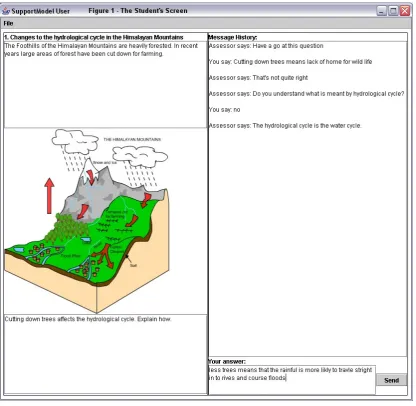
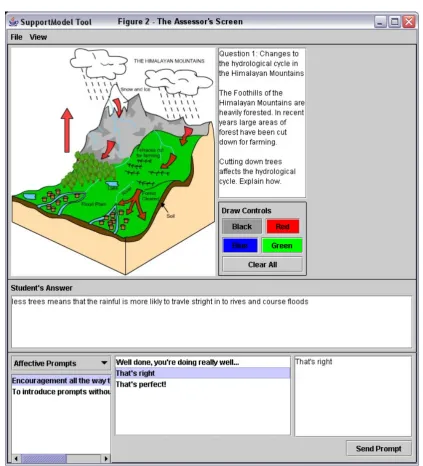
In our previous study using the Support Model (Ahmed & Pollitt, 2010) GCSE questions were presented on a laptop screen and pupils answered by typing their answer in a response window on the screen. Pupils were sent prompts from the
Figure 2 below shows the assessor’s screen.
However, on talking to our Language Support Advisor, we decided that computer delivery would not be appropriate for the pupils in the current study. These pupils would need help with the reading of the questions and would not be able to manage prompts presented on screen, but instead would need oral prompts.
It was therefore decided that this study should follow the method used in Phase 2 of our previous study (Ahmed & Pollitt, 2010) in which the assessor gives a series of systematically derived prompts in an oral interview situation. The assessor simulates a computer, delivering a fixed set of prompts in a fixed order. This method was
themselves could choose whether to use the voice-over, and we would have a record of which pupils clicked for the voice-over and when.
Also, in the current study, pupils were not required to write answers to the questions, but just to answer orally. In any future study pupils would be given the opportunity to type their responses on screen, with an option to answer orally into a voice recorder if needed.
All of this, although time-consuming to set up, is technically quite trivial to add and would not change the conclusions from this study about the feasibility of the method for use with these pupils.
The Prompts
The prompts were based on our psychological model of the question answering process (Pollitt & Ahmed, 1999). For a full list of prompts for each question see Appendix 2.
In the original Support Model studies (Ahmed & Pollitt, 2010) the prompts were categorised as Reading, Activation, Writing or Affective prompts. This categorisation allowed us to develop prompts systematically for each question. Reading prompts help the pupil to understand the task by interpreting the question. Activation prompts help with the concepts in the questions: these are critical in terms of the assessment of the pupils’ ability. Writing prompts help the pupil to put their answer into appropriate words.
The prompts are ordered in a strict sequence; for each one, the assessor (or the system if it is automated) decides, on the evidence of responses so far and with reference to the mark scheme, whether or not the pupil needs to be given that prompt.
In the current study we found that we needed an extra category of prompts. These pupils needed prompts to help them to read the words in the question as well as prompts to help them to understand the task by interpreting the words in the question. The Reading prompts category was therefore split into Reading prompts (reading the words) and Understanding prompts (interpreting the words).
Some pupils reached an answer without the need for any prompts, but in other cases the pupil could not reach an answer and in these cases the answer was given, as a final prompt. Affective and motivational prompts were also critical in this study, perhaps even more than in our earlier work.
Data Capture and analysis
Coding
The transcripts were coded according to which prompts were needed by each pupil for each question. The codes were as follows:
- Prompt needed to Read words in question R - Prompt needed for Understanding of the question U - Activation prompt needed for scientific concepts A - Prompt needed to form the Words for an answer W
- Prompt Giving the answer G
- No prompt needed N
Ethics
Approval was gained from the Headteacher of the school involved, and from the head of the Speech and Language Centre at the school. Parental permission was also
obtained for all the children who took part. Each child was told that they could choose to stop working through the questions if they felt tired or had simply had enough. One child chose to stop after the second question, but the others were happy to continue to the end of the third question.
Results
Scoring
Each pupil was given a science score for each question. This was calculated by counting the number of A prompts, G prompts and N prompts from all parts of the question and applying the formula:
Raw science score = - A - G + N
As this gave a negative score it was then subtracted from a nominal 40 marks for each question, to give each pupil a positive mark.
Final science mark = 40 + raw science score.
Each pupil was also given a communication score. This was calculated by counting the number of R, U and W prompts:
Raw communication score = - R - U - W
Again a final communication mark was derived by subtracting this from a nominal 40 marks.
Final communication mark = 40 + raw communication score
that the numbers in the table are not meaningful in themselves, but only relative to each other as indicators of ability.
Q6 Sci Q6 Comm Q4 Sci Q4 Comm Q9 Sci Q9 Comm Total Sci Total Comm Sci minus Comm Pupil
E (mild) 32 37 31 34 38 31 101 102 -1
B (mild) 29 39 36 36 31 38 96 113 -17
N (mild) 36 35 34 36 40 33 110 104 6
L (mod) 29 34 42 25 36 33 107 92 15
T (mod) 36 32 38 22 33 25 107 79 28
P (mod) 31 25 32 17 31 14 94 56 38
J (mod) 28 20 32 22 ---- ---- 60 42 (18)
Average 31.6 35.7 35.0 27.4 34.8 29.0
Interpretation of scores
The scoring system has not been perfected but seems to work well enough. It is a development of the one used in our paper (Ahmed & Pollitt, 2010) which was
validated by a senior examiner but has been extended to highlight the communication versus subject knowledge distinction. We would hope to improve the scoring with some further empirical exploration.
In questions 4 and 9 the communication marks are generally lower than the science marks, indicating that these were difficult questions to read and understand, but that the pupils did well on the science.
This is a clear indication of the success of the Support Model approach, as the pupils showed evidence of understanding the science concepts and being able to carry out the task, but had difficulty reading and interpreting the task. Without the Support Model approach we would not be able to assess their ability in science fairly since we would simply not have seen the evidence of their understanding.
Question 6 presents a less clear picture, and it appears that the science itself was also difficult in this question.
Three of the pupils, T, P and J, scored higher on the science than on communication for all three questions. This indicates that their science understanding was good but that they would have found it difficult to show this in a traditional exam setting without communication support. It is significant that all three were in the group with moderate language difficulties. The other ‘moderate’ pupil – L – and one of the ‘mild’ group – N – showed the same pattern on two out of the three questions.
Particular words that caused difficulty
There were some words in the questions that many of the pupils had difficulty
reading. Six out of the seven pupils could not read ‘caused’ and ‘identical’ in question 6, and ‘algae’ in question 4. Four out of the seven could not read ‘Neil’ and ‘scrapes’ in Question 4. Six of the pupils completed Question 9, and four out of the six could not read ‘periwinkles’ or ‘seashore’.
Comments and quotes from transcripts
The following examples from the transcripts illustrate how the pupils responded to the prompts.
Explain questions
There were some examples of ‘explain’ questions in which pupils gave a first level of explanation without going as deep as the assessor wanted. One example is Question 6 d (ii). One pupil responded as follows:
Cos one straw she might be blowing not so hard and the other one she might blow really hard.
Exactly right so why does that mean it’s not a fair test?
Because if you blow hard and not so hard it will make a different sound.
Yes and why would that mean it was not a fair test?
Similarly in Question 4 c:
Because one of them will have a S on and one of them will have an N on
Thats right yeah ok and so what happens?
When the one with S on goes closer it will connect
Thats right it will connect do you know what the word is for that in science?
No
Attraction – they are attracted to each other.
So you’re absolutely right they connect together well done.
Understanding the words of the question
Do you know what a function is?
No
It’s something the shell is used for. Can you describe a function of the shell?
Silence
What do you think the Periwinkle’s shell is for?
To protect the animals
Well done that’s absolutely right well done.
Activation of the scientific concepts
Question 9 a
Periwinkle B is the big one and Periwinkle A is the little one
That’s right but can you think of something that isn’t to do with size?
The other one’s taller?
That’s also to do with size isn’t it? Anything else that looks different?
One is white one is grey
That’s right the colour is different. Well done.
……….
What do you think might vibrate to cause the sound?
The straw
The straw well done what else do you think might vibrate?
Umm umm she’s blowing
Yes what happens when she blows?
You go drrrrrrrrrrrrr
That’s right it does and what comes out of her mouth when she blows?
That’s right and that’s what they want you to say, fantastic well done.
Putting an answer into words
Question 4 c
Puts fists together and moves them upwards and makes a scraping sound.
Right you’ve shown me. Can you tell me?
Cos there was a glass and magnetic can go through glass. And if there was like a magnetic um um metal tank then magnetic B would go but magnetic A sticks. They stick to each other
Do you know what it’s called when one magnet sticks to another one?
Um they stay together?
What is the word for that in science?
Silence
They are attracted to each other.
The results show that these pupils were able to use the prompting system successfully and that it allowed many of them to show their science knowledge and understanding that otherwise may have been masked by their Speech and Language Difficulties.
Conclusions
Scoring
In this study, we used a simple scoring system to measure the amount of support with science concepts each pupil needed in order to complete the task successfully. The resulting scores are plausible enough to show that the method can generate valid assessments of the scientific understanding of pupils with SLDs. This needs to be confirmed through a validation study on a larger scale in which subject specialists could confirm the assessment judgements on a greater number of questions for a greater number of pupils, as in our previous study (Ahmed & Pollitt, 2010).
One issue which would need discussion with a subject specialist would be when it might be appropriate to penalise for reading, for example of technical terms, and when it is not appropriate because it is part of normal reading. The point is that in most exam questions the reading demands are not construct relevant demands: we do not want pupils to lose marks if they cannot read the question. The role of the
are a few instances (apart from the obvious reading tests) in which an examiner may consider the reading of a technical term to be a construct relevant demand. It is not always easy for a non-subject specialist to distinguish these two, for example the technical use of an everyday word or phrase, such as ‘reaction’ in Chemistry or Physics, or ‘power’ in Physics or Politics.
We specifically set out to assess science understanding, and to exclude the ability to communicate that understanding in writing or orally. The Support Model allows us to choose which demands we consider relevant, or important, for any particular
assessment: if the ability to communicate is to be included in the assessment then we would simply modify the scoring scheme so that pupils are penalised for needing ‘writing’ prompts.
Reliability
There are two key ‘threats’ to reliability that need to be considered. As in any assessment, the internal consistency of the questions needs to be high, and for the Support Model we need to be sure that the prompting system does not affect this. Because the prompts are generated from a model for ensuring the validity of the assessment process, they are expected to maintain high construct relevance – higher in fact than might be expected without prompting. There is no reason therefore to expect internal consistency to be any lower for a Support Model system than for a standard system.
The second issue is the role of the assessor. It is important to understand that the prompts are standardised, so that every pupils receives, or at least may receive, exactly the same science-related prompts. The assessor gives each pupil every prompt they might need, and they are therefore penalised in a standardised way. The assessor is free to give affective and motivational prompts whenever they seem appropriate, and these should not affect scores in a way that would threaten reliability.
The modification of the language in the Support Model method is standardised, and theoretically driven. A clear distinction is drawn between instances where this change affects the pupil’s understanding of the science, where a penalty is applied, and those where only communication is affected, where no penalty is applied. The assessor is not free to make any other modifications than those specified, and so the Support Model does not suffer from the same kinds of threat to reliability that other marking methods may.
Validity and bias
readability level of an exam to suit the age or level of the pupils, but there is every reason to make the language as clear as possible for every pupil in every case. The only purpose of an exam question is to communicate the task as clearly as possible to the pupils (Pollitt & Ahmed, 2009).
Pupils using the Support Model are likely to get higher scores than they would have done without it. If they are now to be compared to pupils in general at this age, are we introducing a bias in favour of pupils with SLDs?
Pupils who do not have specific SLDs but have difficulty understanding the questions and therefore the tasks being set will score lower than their science understanding suggests they should. This was established in our previous study (Ahmed & Pollitt, 2010). In effect there is a bias against all pupils who are not given this kind of language support.
If we were to extend this method to assess all pupils using the Support Model, we would remove the issue of bias. However, this may not be feasible in practice. The alternative solution is to find a method of establishing a fair equating so that all pupils are assigned the correct level, whether or not they had language support. There are significant difficulties with equating in this context, and it may be that simply extending the method for all pupils is the preferred solution.
Pupils’ evaluation of the prompt system
The Support Model method was successful in assessing the 11 year old pupils with SLDs. The pupils were able to respond to the prompts and use them as support towards completing the tasks. They were able to respond to activation prompts that helped with the science in the questions, and also to prompts that helped them to read and understand the questions and turn their answers into suitable words.
The pupils reported enjoying the assessment process. One pupil commented ‘I like these I do’ halfway through the session.
Confidence
The Support Model method can also help pupils who lack confidence: it encourages them to make a first attempt at a task that seems too difficult, as they know that support is available if they get stuck. In a traditional setting they might have simply left that question blank and scored zero. This again raises the issue of bias and equating as discussed above.
The issue of confidence can be illustrated by an example:
Periwinkles Q 9e Describe what happened to the water in the rockpool during the five hours.
Well it’s got a bit smaller
I don’t know.
Where has some of the water gone?
It might have evaporated.
Perfect that’s exactly right. Well done.
This pupil knew the answer but started by saying he didn’t know, then gave a perfect response after a prompt.
Manageability
The Support Model procedure will be easy to implement on a computer screen with a voice-over for pupils with reading difficulties. Those with difficulties in expressing their answers are supported by the prompts which help them to formulate their response. Some may be able to respond by typing; for others the human assessor will need to interpret oral responses to select the next appropriate prompt.
In all cases, the present system will need a human interpreter for each pupil, and this assessor will need to have been trained briefly on how to use the prompts. In order to remove the need for a human interpreter, we hope to develop an automated system which will evaluate the pupils’ responses and select the appropriate prompt. This requires the use of language processing software similar to the automarking software developed by Sukkarieh, Pulman & Raikes (2003) or a dialogue system which could be trained and tested using transcripts from the current approach. A dialogue system would identify patterns in the pupils’ responses which could trigger the selection of appropriate prompts. More detail on these systems is available in our paper (Ahmed & Pollitt, 2010).
In our recent meeting with Ofqual and Synapse (May 2010) we discussed the possibility of using a Computer Adaptive Testing (CAT) system to implement the Support Model. The system would be designed to decide on the basis of previous responses, whether or not the next prompt is needed. The Support Model is
significantly different from a standard CAT system in that it would involve qualitative analysis of responses rather than declaring them right or wrong. In the interim a human assessor would be needed to monitor the effectiveness of the system.
Teacher Assessment and Formative Application
Once we have an early and imperfect automated system it can be used formatively in the classroom. The prompts would be delivered automatically, providing support for the pupil, and leading always to an appropriate answer to the question. If, sometimes, the system delivers an unnecessary prompt there will be no serious consequence, and any argument between the pupils and the system may even be rewarding.
In both of these applications the low stakes nature means that the same few questions with their system of prompts can be used many times.
Summary
There are clear advantages in using the Support Model to assess pupils with SLDs. We can assess their subject knowledge and understanding without the question getting in the way. In this study we were able to assess the pupils, giving each one a science mark and a separate communication mark. All pupils were able to complete the tasks, some with more support than others on the science, and some with more support with the language. The pupils ended their sessions with a positive feeling of achievement, and reported enjoying the experience of assessment.
The method can be extended to assess other subjects: a series of prompts for mathematics questions would be easy to produce and there are existing interactive assessments for mathematics that use devices similar to our prompting system, although they are based on components of the task rather than a theoretical model of the question answering process (e.g. McAlpine & Ware, 2003). The application of the method to the assessment of English is considerably more complex and would require exploring the issue of what would constitute valid language support. For example, questions should still not get in the way of pupils’ ability to respond, even in a language exam.
The method can be standardised further, by delivering the prompts on-screen, adding a voice-over facility for pupils with SLDs: this would not require very much
additional work. Full automation, using language processing software to evaluate responses and select prompts, is feasible but would need a separate study to build an appropriate system. Scoping work carried out within UCLES a few years ago
suggested that this might require about one year’s development by a post-doctoral researcher. The method could then be used in a much wider range of ways to support learning and assessment.
We have shown that the Support Model is suitable for assessing pupils with SLDs. In principle it could be used with every pupil and many would benefit from the increased clarification of the task, in particular with ‘explain’ questions.
The most competent pupils almost never need help to understand the task, although even they can have problems with ‘explain’ questions; at the other end there will always be some pupils who need considerable help (e.g. pupils with severe SLDs). The problem of communication can be tackled using language modification (see for example the guidance in the BATOD/NATED Training Materials on Language Modification) which aims to allow as many pupils as possible to understand exam tasks without the need for interactive support. The Support Model tackles the problem from the other end by aiming to provide each pupil with just the support they need, while ensuring that the support is delivered in a completely standardised way. Thus reliability – and validity – can be optimised.
From our previous work we know that the Support Model method can generate scores that are considered reliable and valid by an expert examiner. This relates to reliability within the group of pupils assessed using the Support Model, but does not deal with the issue of equating these scores to those of a group assessed in the traditional way: this would need to be addressed separately, perhaps involving a separate Level Setting event.
The Support Model is based on the use of standardised prompts which are theoretically grounded and systematically generated. This is a significant
improvement on any approach which either pre-determines the wording modification before any interaction with the pupil, or is reactive but non-systematic.
References
Ahmed, A. (2009) Conceptualising an assessment for gifted students – how can we assess creativity? Paper presented at the International Association for Educational Assessment conference, Brisbane, September 2009.
Ahmed, A. & Pollitt, A. (2010) The Support Model for Interactive Assessment. Assessment in Education 17 (2) pp 133-167.
Ahmed & Pollitt (2008) It’s judging the evidence that counts – introducing OSCA. Paper presented at the International Association for Educational Assessment conference, Cambridge, September 2008.
Ahmed & Pollitt (1999) Curriculum demands and question difficulty. Paper presented at the International Association for Educational Assessment conference, Slovenia, May 1999.
Allan, S. McGhee, M. & van Krieken, R. (2005) Using readability formulae for examination questions. Report to QCA.
BATOD/NATED Training Materials on Language Modification
http://www.batod.org.uk/content/articles/resources/training-materials/language-modification/Training%20materials%20for%20language%20modification.pdf
McAlpine, M. & Ware (2003) Introducing computer-assisted assessment in Scotland: Laying the foundations for an integrated approach. Paper presented at the
International Association for Educational Assessment conference, Manchester, October 2003.
Pollitt, A. & Ahmed, A. (2009) The importance of being valid. Paper presented at the Association for Educational Assessment – Europe conference, Malta, November 2009.
Pollitt & Ahmed (2000) Comprehension failures in educational assessment. Paper presented at the European Conference on Educational Research, Edinburgh, September 2000.
Pollitt & Ahmed (2001) Science or reading? How students think when answering TIMSS questions. Paper presented at the International Association for Educational Assessment Conference, Rio de Janeiro, May 2001.
Pollitt, A & Ahmed A. (1999). A New Model of the Question Answering Process. Paper presented at the International Association for Educational Assessment Conference, Slovenia, May 1999.
Pollitt, A., Ahmed, A., Baird, J-A., Tognolini, J. & Davidson, M. (2008) Improving the quality of GCSE Assessment. Report to QCA.
Pollitt, A (1990). Giving students a sporting chance: assessment by counting and by judging. In Alderson, C. & North, B. (Eds) Language Testing in the 1990s, pp 46-59. Macmillan: London.
Appendix
2
–
The
prompts
(Prompts for reading the words of the question are not listed as they simply involved giving the word)
Prompts for Straw Sounds 6a
Do you know what Vibrations are? U
Vibrations are small movements that cause a sound. U What do you think might vibrate to cause the sound? A
What else do you think might vibrate? A
What happens when she blows? A
What comes out of her mouth when she blows? A
What moves through the straw when she blows? A
What is her breath made of? W
The air vibrates. G
The straw vibrates. G
6b
Do you know what is meant by the note? U
The note is the sound she makes by blowing through the straw. U Do you know the word for how high or low a note is? A Do you know what is meant by a high note and a low note? A
Can you sing a high note and a low note? A
How would you describe the difference between the two notes? W
Do you know the word for that in science? W
It is called the pitch. G
6c
Do you understand what identical means? U
They are identical before they are cut shorter. U
Then they are all different lengths. U
The ends are cut as well. U
Do you know which straw will produce the highest note? A
What makes the note high? A
Which straw will produce the lowest note? A
What makes the note low? A
How does the length affect the note? A
The question. A
The longest straw will give the lowest note. G The shortest straw will give the highest note. G
6di
Do you know what is meant by a fair test? U
Why might it not be a fair test? A
Will everyone blow the same? A
Do you think some people might blow harder than others? A Why isn’t it a fair test if they all blow differently? A Can they tell what causes the different notes? A
If they don’t all blow the same we can’t tell what is causing the different notes so it is
6dii
Do you understand what is happening here? U
Do you understand how it is different from the first part? U This time the same person is blowing into all of the straws. U
Do you think she will always blow the same? A
Why is that not a fair test? A
If she doesn’t blow the same each time
Prompts for Fish tank 4a
What will happen to the algae with more sunlight? A
What happens to plants when they get sunlight? A
What about if they get just the right amount of sunlight? A
They grow more quickly. G
4b
Do you know what a food chain is? U
You need to write in these boxes. U
You need to write down what is getting eaten by what. A The arrow means ‘is eaten by’. Can you put them in the right boxes? A
What gets eaten by the water snails? A
What gets eaten by the Clown Loach Fish? A
What eats the algae? A
What eats the water snails? A
4c
Can you tell me what is happening in this picture? U
What is Neil holding? U
What is he doing with the magnet B? U
What is happening to Magnet A? U
What is happening to the Algae? U
Why does Magnet A move when Magnet B moves? A
Why do they stick together? A
What kind of force is it? A
What is it called when one magnet is pulled towards another one? W
What is it called when they stay/stick together? W
What is the word for that in science? W
Attraction. They attract. G
They are attracted to each other. G
The North pole of one magnet is attracted to the South pole of the other and vv. G
4di
What temperature does it say the water is in Neil’s tank? U What temperature is shown on the thermometer in the picture? U What temperature does it need to be to keep the fish healthy? A
Is this the same? A
No. G
4dii
Is 35 hotter or colder than 25? A
So why wont the fish keep healthy? A
Prompts for Periwinkles 9a
What looks different? U
Can you think of something that isn’t to do with size? A
Anything else apart from the size? A
Is the colour different? A
Which one is darker? A
Is the shape different? A
Periwinkle B is darker than Periwinkle A G
They are different shapes G
9b
Do you know what a function is? U
A function is something the shell is used for. U
It is a way in which the shell helps the periwinkle. U What do you think the Periwinkle’s shell is for? A
Why might it need a shell? A
What do you think it would be like without a shell? A
So how can the shell help? A
Why is that useful? A
Where do periwinkles live? Why might they need a shell? A
The shell protects the Periwinkle G
9c
Do you understand what the scientist is doing? U
What does he want to find out? U
Do you know what a sample is? U
It is a selection of periwinkles. He chooses some of the periwinkle shells
to measure from each area. U
He chooses 20 from each area. U
Why would measuring 20 be better than measuring one? A Would all the periwinkles in one area be the same size? A If they aren’t all the same size, why is it helpful to measure 20 of them? A What can the scientist find out if he measures 20 that he cant find out
if he measures only one? A
If he only measures one it might be an extra big one or an extra small one.
He needs to measure 20 G
9d
Why should they go back where they were found? U
What would happen to the periwinkles if they were put back in a different place? A Why might they die if they were put back in a different place? A
Do you know another word for an animal’s home? A
Why do they need to be where they normally live? A
They may not survive in a different place. G
They may not be adapted to living in a different place. G
9e
Do you understand what is happening here? U
What has happened to the water? A
Where has some of the water gone? A
That’s not it. Where else could it have gone? A
Do you know the scientific word for this? W
It has evaporated. G
Appendix
3
‐
A
sample
transcript
Straw Sounds
Reads Q 6a with help with straw, caused, vibration, vibrate
Silence
Do you know what vibrations are? U
Yeah when you tap things it vibrates. That’s right.
If we tap the lead it vibrates.
You’re right so can you name two things that vibrate to cause the sound? A
The straw.
Perfect and what else? A
Her mouth.
You’re right but what comes out of her mouth? A
The air. Fantastic.
Reads Q 6b with help with changing, note, scientific
We turn volume up.
Yes volume is how loud it is but do you know the word for how high or low a note is?A
No..
Do you know what is meant by a highnote and a low note? A
Yes.
Do you know the word for that in science? W
No.
Shall I tell you? Yes.
It’s called the pitch. Have you heard that before? G
Yeah in out big class.
Reads Q 6c with help with identical, different, gently, describe, affects
Do you know which straw will produce the highest note? A
I think the longest one
Actually it’s the other way round. Good guess but the shortest straw will give the
highest note. The longest straw will give the lowest note. G
Low note. That’s right.
Reads Q 6d(i) with help with different
Do you know what’s meant by a fair test? U
People need to be the same. That’s right.
Yes so why might it not be a fair test? A They are from different families.
Ok, think about ... will everyone blow the same? A
No some might be low notes and some might be high notes.
That’s right and do you think some people might blow harder than others? A
Yeah
If they don’t all blow the same we can’t tell what is causing the different notes so it is
not a fair test. G
Reads Q d (ii) help with even
Um it wont be a fair test.
Yeah that’s right and can you think why? A
Silence
This time the same person is blowing into all of the straws. U
Do you think she will always blow the same? A
No
If she doesn’t blow the same each time we cant tell what causes the different notes. G
Fish Tank
Reads Q4a with help with tropical, clown loach fish, algae, also, dark corner, tick
I’ve got a gold fish. I think stop growing.
Do you lets think about that. Why do you think sunlight will make it stop growing? A Because the sun will stop them growing.
Mm What happens to plants when they get sunlight? A
It will dry them out.
Yes too much sunlight will dry them out but what if they get just the right amount of
sunlight? A
Silence
If they had lots of water and just the right amount of sun? A
Grow.
Yeah so that’s our answer well done.
Reads Q 4b with help with algae, water snails, he, then, clown loach fish, chain
Do you know what a food chain is? No
You need to write down what is getting eaten by what. The arrow means ‘is eaten by’.
Can you put them in the right boxes? A
Snails
Snails. Who’s going to eat the snails? A
The fish.
So where do we need to put snails and where do we need to put the fish? A
I think that one. Yeah.
What goes in there? What gets eaten by the snails? A
Fish.
Yes you’ve worked it out. Fantastic.
Reads Q 4c with help with Neil, uses, magnets, algae Magnet B, outside
Chats about his fish tank at length. Right why?
Because magnet B is inside and the other one is outside so it sticks together.
Do you know what it’s called when magnets stick together? W
No.
The magnets attract. G
Well done. Perfect.
Reads Q 4 d(i) Silence.
What temperature does it say the water is in Neil’s tank? U
30 degrees. 30?
35.
35 and what does it need to be to keep the fish healthy? U
25.
Right so... No.
Reads Q 4d(ii)
Because the fish will die
Yes why will they die? A
Because the temperature if it goes right up to the top they will be dead.
Yes so is the water too... A
Hot. He needs to tip some cold water in. That’s right. Well done.
Periwinkles
Reads Q 9a with help with animals, seashore, describe, other
What looks different? U
Periwinkle B is the big one and Periwinkle A is the little one.
Thats right but can you think of something that isn’t to do with size? A
The other one’s taller?
That’s also to do with size isn’t it? Anything else that looks different? A
One is white one is grey.
That’s right the colour is different. Well done.
Reads Q 9b with help with have, bodies, shell, describe, function.
Do you know what a function is? U
No.
It’s something the shell is used for. Silence.
Why might it need a shell? A
Reads Q 9c with help with area, affects, measures, sample, different areas, seashore, instead
Because they’ll have different skin.
Why is measuring 20 better than measuring one? A
Because in case one’s got a cold. Do you think periwinkles get colds? No.
Right so what can the scientist find out if he measures 20 that he can’t find out if he
only measures one? A
He needs to measure all the shells of different colours.
Yes OK and if he only measured one it might be an extra big one or an extra small
one. G
Yup.
Reads Q 9d with help with return, animals, same, collected
Becasue they get allergic to something.
They might, what else might happen to the periwikles if they are put back in a
different place? A
Get hurt.
Yes they might not be able to survive that’s right. G
Reads Q 9e (very tired from reading now) with help with level, during, leak
Probably the animals did drink it.
Actually that’s not what happened, something else has happened what do you think? Sigh.
Where has some of the water gone? A
Well it has been sinking a little bit?
Yes well it does say none has leaked so there’s somewhere else the water could have
gone. A
Over.
It can go up is that what you mean ? Into the Air!
Yes that’s right! And do you know the scientific word for this? W
Make a rainbow?
Yes it might make a rainbow, but when water goes up into the air like that it’s called
Ofqual wishes to make its publications widely accessible. Please contact us if you have any specific accessibility requirements.
First published by the Office of Qualifications and Examinations Regulation in 2010
© Crown copyright 2010
Office of Qualifications and Examinations Regulation
Spring Place 2nd Floor
Coventry Business Park Glendinning House
Herald Avenue 6 Murray Street
Coventry CV5 6UB Belfast BT1 6DN
Telephone 0300 303 3344 Textphone 0300 303 3345 Helpline 0300 303 3346