A Longitudinal Study funded by the DfEE
department for
education and skills
Technical Paper 4 – June 1999
Parent, family and child
characteristics in relation to type of
pre-school and socio-economic
differences
The Effe
ctiv
e Provi
sio
n of Pre
-School
Educ
atio
n (EPP
E) Pro
jec
The Effective Provision of Pre-School
Education [EPPE] Project
A longitudinal Study funded by the DfES
(1997 – 2003)
Technical Paper 4 – June 1999
Parent, family and child characteristics
in relation to type of pre-school
and socio-economic differences
Address for correspondence:
EPPE Project
University of London
Institute of Education Tel:+44 (0) 207 612 6219
Technical Paper 4
P
ARENT
,
FAMILY AND CHILD CHARACTERISTICS
IN RELATION TO TYPE OF PRE
-
SCHOOL
AND SOCIO
-
ECONOMIC DIFFERENCES
A
UTHORS
:
Edward Melhuish
Kathy Sylva
Pam Sammons
Iram Siraj-Blatchford
Brenda Taggart
Anne Dobson
Marjorie Jeavons
Katie Lewis
Maria Morahan
Sharon Sadler
A
CKNOWLEDGEMENT
T
HE
EPPE
R
ESEARCH
T
EAM
Principal Investigators
Professor Kathy Sylva
Department of Educational Studies, University of Oxford
Professor Edward Melhuish
Birkbeck, University of London
Professor Pam Sammons
Institute of Education, University of London
Professor Iram Siraj-Blatchford
Institute of Education, University of London
Research Co-ordinator
Brenda Taggart
Institute of Education, University of London
Regional Research Officers
Anne Dobson
Isabella Hughes
Marjorie Jeavons
Margaret Kehoe
Katie Lewis
Maria Morahan
Sharon Sadler
First Published in September 1999 by the Institute of Education University of London 20 Bedford Way, London WC1H 0AL
Pursuing Excellence in Education
ISBN 085473 594 1
Printed by Formara Ltd. Southend on Sea. Essex.
The views expressed in this report are the authors’ and do not necessarily reflect those of the Department for Education and Skills.
Contents
Page Number
Overview of the Project
1 – 10
Executive Summary
i – ii
Introduction
1
The Sample
1
Data collection and analysis
1
The Parents
2
Labour market participation and socio-economic characteristics
2
Comparing the EPPE sample with the UK population
3
Types of pre-school and socio-economic status
5
Level of parental employment
6
Level of parental employment and use of childcare
8
Marital status
11
Parental age
12
Educational qualifications of the parents
15
Summary of parental characteristics
18
The Family
19
Family composition
19
Type of pre-school centre
19
Ethnicity and language
20
Summary of family characteristics
23
Child’s previous health, development and behaviour
24
Perinatal period
24
Health, development and behaviour
25
Physical health since birth
25
Development problems since birth
26
Behaviour problems since birth
27
Total health, developmental and behavioural problems
28
Recent health (last 6 months)
29
Life events for child
30
Summary of health, development and behaviour
31
Children’s activities in the home
`
32
Educational activities
32
Television watching in the home
33
Rules
34
Summary of children’s activities in the home
35
Pre-school provision and childcare history
36
The target pre-school centre
36
Age of starting target pre-school centre
37
Reasons for attending the target centre
38
Parental visits to the pre-school centre
39
Childcare history
42
Type of pre-school centre
42
Contents
Page Number
Summary
46
References
47
Table 1 Socio-economic characteristics of the EPPE sample
2
Table 1.2 Occupational classification of mother
3
Table 1.3 Educational qualifications of mother
3
Table 1.4 Educational qualifications of father
3
Table 1.5 Occupational classification of mother
4
Table 1.6 Comparison with all UK women 16 – 59 years old
5
Table 1.7 Socio-economic status and use of pre-school centres
5
Table 1.8 Maternal employment and type of pre-school centre
6
Table 1.9 Maternal employment and socio-economic status
7
Table 1.10 Paternal employment and type of pre-school centre
7
Table 1.11 Paternal employment and socio-economic status
8
Table 1.12 Correlations between parents’ current hours of paid
employment and previous childcare use
9
Table 1.13 Sessions in centre and level of mother’s employment
10
Table 1.14 Correlations between parent’s hours of paid employment
and use of target pre-school centre
10
Table 1.15 Marital status and type of pre-school centre
11
Table 1.16 Marital status and socio-economic status of family
12
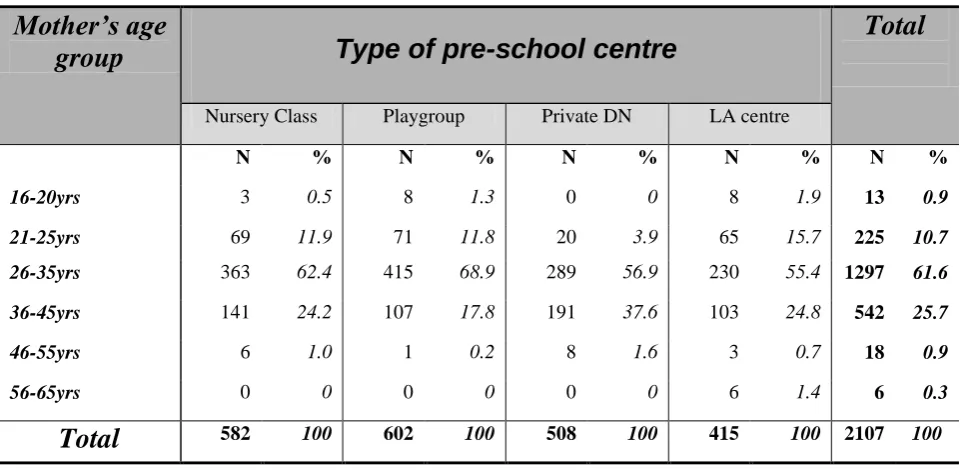
Table 1.17 Mother’s age and type of pre-school centre
12
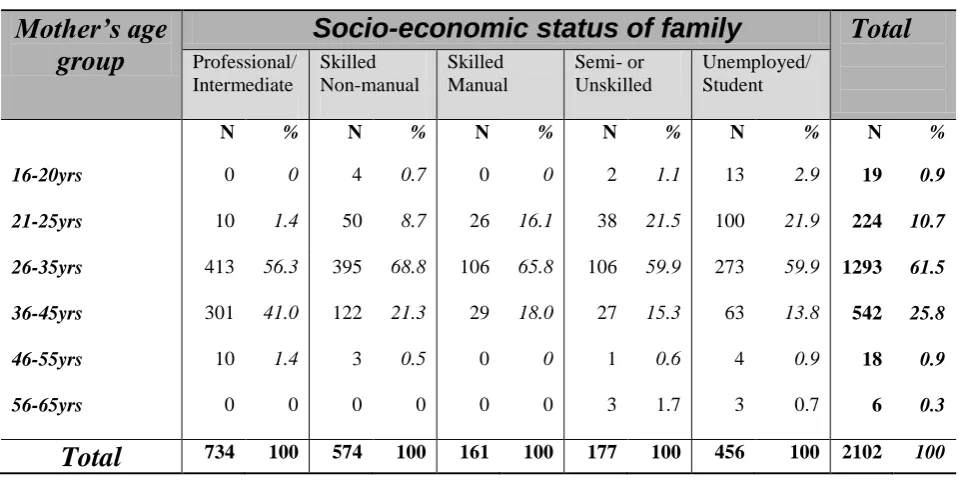
Table 1.18 Mother’s age and socio-economic status of family
13
Table 1.19 Father’s age and type of pre-school centre
13
Table 1.20 Father’s age and socio-economic status of the family
14
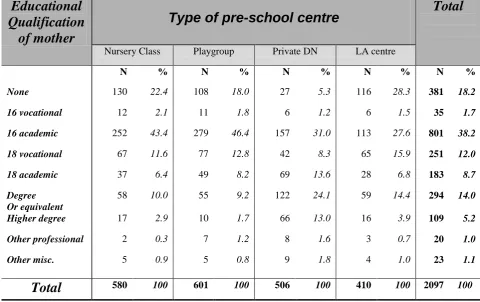
Table 1.21 Educational qualifications of mother and type of pre-school centre
15
Table 1.22 Educational qualifications of mother and socio-economic status
of family
16
Table 1.23 Educational qualifications of father and type of pre-school centre
17
Table 1.24 Father’s qualifications and socio-economic status
18
Table 2.1 Type of pre-school centre and family type
19
Table 2.2 Socio-economic status and family type
20
Table 2.3 First language of child and type of pre-school centre
20
Table 2.4 First language of child and socio-economic status of family
21
Table 2.5 Ethnicity and type of pre-school centre
22
Table 2.6 Ethnicity and socio-economic status
23
Table 3.1 Perinatel period and type of pre-school centre
24
Table 3.2 Perinatel period and socio-economic status of the family
25
Table 3.3 Previous health problems and type of pre-school centre
25
Table 3.4 Previous health problems and socio-economic status
26
Table 3.5 Previous development problems and type of pre-school centre
26
Table 3.6 Previous development problems and socio-economic status
27
Table 3.7 Behaviour problems and type of pre-school centre
27
Table 3.8 Behaviour problems and socio-economic status of the family
28
Table 3.9 Overall previous problems and type of pre-school centre
28
Table 3.10 Overall previous problems and socio-economic status of the family
29
Table 3.11 Health index for last 6 months by type of pre-school centre
29
Contents
Page Number
Table 3.13 Number of disruptive life events and type of pre-school centre
30
Table 3.14 Number of disruptive life events and socio-economic status of family 31
Table 4.1 Educational environment and type of pre-school centre
32
Table 4.2 Educational environment and socio-economic status
32
Table 4.3 Amount of TV and type of pre-school centre
33
Table 4.4 Amount of TV and socio-economic status of family
33
Table 4.5 Rules for TV or video and type of pre-school centre
34
Table 4.6 Rules for TV or video and socio-economic status
34
Table 4.7 Rules relating to bedtime and type of pre-school centre
35
Table 4.8 Rules relating to bedtime and socio-economic status of the family
35
Table 5.1 Sessions attended and type of pre-school centre
36
Table 5.2 Sessions attended and socio-economic status
37
Table 5.3 Age of starting centre and type of pre-school centre
37
Table 5.4 Age of starting centre and socio-economic status
38
Table 5.5 Reasons for choice of centre varied by type of pre-school centre
38
Table 5.6 Reasons for choice of centre varied by socio-economic status of family 39
Table 5.7 Parental visits to centre varied with type of pre-school centre
40
Table 5.8 Parental visits to centre varied with socio-economic status
40
Table 5.9 Reasons for visiting the centre in relation to type of pre-school centre 41
Table 5.10 Reasons for visiting the centre in relation to socio-economic status
of family
41
Table 5.11 Pre-target childcare (no. of hours in child’s life) and type of
pre-school centre
43
Table 5.12 Pre-target childcare (no. of hours) and socio-economic status
44
Table 5.13 Total of non-parental caregivers and type of pre-school centre
45
1
Effective Provision of Pre-school Education
“EPPE”
Overview of the Project
This series of 12 reports describes the research on effective pre-school provision funded by the UK Department for Education & Employment (DfEE). Further details appear in Technical Paper 1 (Sylva, Sammons, Melhuish, Siraj-Blatchford & Taggart 1999). This longitudinal study assesses the attainment and development of children followed longitudinally between the ages of 3 and 7 years. Three thousand children were recruited to the study over the period January 1997 to April 1999 from 141 pre-school centres. Initially 114 centres from four types of provision were selected for the study but in September 1998 an extension to the main study was implemented to include innovative forms of provision, including ‘combined education and care’ (Siraj-Blatchford et al. 1997).
Both qualitative and quantitative methods (including multilevel modelling) have been used to explore the effects of individual pre-school centres on children's attainment and social/behavioural development at entry to school and any continuing effects on such outcomes at the end of Key Stage 1 (age 7). In addition to centre effects, the study investigates the contribution to children’s development of individual and family characteristics such as gender, ethnicity, language, parental education and employment. This overview describes the research design and discusses a variety of research issues (methodological and practical) in investigating the impact of pre-school provision on children’s developmental progress. A parallel study is being carried out in Northern Ireland.
There have been many initiatives intended to improve educational outcomes for young children. Will these initiatives work? Will they enable children to enter school ‘more ready’ to learn, or achieve more at the end of Key Stage 1? Which are the most effective ways to educate young children? The research project described in this paper is part of the new emphasis on ensuring ‘a good start’ for children.
P
REVIOUS
R
ESEARCH ON THE
E
FFECTS OF
E
ARLY
E
DUCATION IN THE
UK
There has been little large-scale, systematic research on the effects of early childhood education in the UK. The ‘Start Right’ Enquiry (Ball 1994; Sylva 1994) reviewed the evidence of British research and concluded that small-scale studies suggested a positive impact but that large-scale research was inconclusive. The Start Right enquiry recommended more rigorous longitudinal studies with baseline measures so that the ‘value added’ to children’s development by pre-school education could be established.
occurred. To date no research using multilevel models (Goldstein 1987) has been used to investigate the impact of both type of provision and individual centre effects. Thus little research in the UK has explored whether some forms of provision have greater benefits than others. Schagen (1994) attempted multilevel modelling but did not have adequate control at entry to pre-school.
In the UK there is a long tradition of variation in pre-school provision both between types (e.g. playgroup, local authority or private nursery or nursery classes) and in different parts of the country reflecting Local Authority funding and geographical conditions (i.e. urban/rural and local access to centres). A series of reports (House of Commons Select Committee 1989; DES Rumbold Report 1990; Ball 1994) have questioned whether Britain's pre-school education is as effective as it might be and have urged better co-ordination of services and research into the impact of different forms of provision (Siraj-Blatchford 1995). The EPPE project is thus the first large-scale British study on the effects of different kinds of pre-school provision and the impact of attendance at individual centres.
O
VERVIEW OF
R
ESEARCH
M
ETHODS
The EPPE project is a major study instituted in 1996 to investigate three issues which have important implications for policy and practice:
• the effects on children of different types of pre-school provision,
• the ‘structural’ (e.g. adult-child ratios) and ‘process’ characteristics (e.g. interaction styles) of more effective pre-school centres, and
• the interaction between child and family characteristics and the kind of pre-school provision a child experiences.
An educational effectiveness research design was chosen to investigate these topics because this enabled the research team to investigate the progress and development of individual children (including the impact of personal, socio-economic and family characteristics), and the effect of individual pre-school centres on children's outcomes at both entry to pre-school (the start of Reception which children can enter between the ages of 4 and 5 plus) and at the end of Key Stage 1 (age 7 plus). Such research designs are well suited to social and educational research with an institutional focus (Paterson & Goldstein 1991). The growing field of school effectiveness research has developed an appropriate methodology for the separation of intake and school influences on children's progress using so called 'value added' multilevel models (Goldstein 1987, 1995). As yet, however, such techniques have not been applied to the pre-school sector, although recent examples of value added research for younger ages at the primary level have been provided by Tymms et al. 1997; Sammons & Smees 1998; Jesson et al. 1997; Strand 1997; and Yang & Goldstein 1997. These have examined the relationship between baseline assessment at reception to infant school through to Key Stage 1 (age 7 plus years).
The 8 aims of the EPPE Project
• To produce a detailed description of the 'career paths' of a large sample of children and their families between entry into pre-school education and completion (or near completion) of Key Stage 1.
• To compare and contrast the developmental progress of 3,000+ children from a wide range of social and cultural backgrounds who have differing pre-school experiences including early entry to Reception from home.
• To separate out the effects of pre-school experience from the effects of education in the period between Reception and Year 2.
• To establish whether some pre-school centres are more effective than others in promoting children's cognitive and social/emotional development during the pre-school years (ages 3-5) and across Key Stage 1 (5-7 years).
• To discover the individual characteristics (structural and process) of pre-school education in those centres found to be most effective.
• To investigate differences in the progress of different groups of children, e.g. second language learners of English, children from disadvantaged backgrounds and both genders.
• To investigate the medium-term effects of pre-school education on educational performance at Key Stage 1 in a way which will allow the possibility of longitudinal follow-up at later ages to establish long-term effects, if any.
• To relate the use of pre-school provision to parental labour market participation.
The sample: regions, centres and children
In order to maximise the likelihood of identifying the effects of individual centres and also the effects of various types of provision, the EPPE sample was stratified by type of centre and geographical location.
• Six English Local Authorities (LAs) in five regions were chosen strategically to participate in the research. These were selected to cover provision in urban, suburban and rural areas and a range of ethnic diversity and social disadvantage. (Another related project covering Northern Ireland was instituted in April 1998 [Melhuish et al. 1997]. This will enable comparison of findings across different geographical contexts.)
• Six main types of provision are included in the study (the most common forms of current provision; playgroups, local authority or voluntary day nurseries, private day nurseries, nursery schools, nursery classes, and centres combining care and education. Centres were selected randomly within each type of provision in each authority.
In order to enable comparison of centre and type of provision effects the project was designed to recruit 500 children, 20 in each of 20-25 centres, from the six types of provision, thus giving a total sample of approximately 3000 children and 140 centres1. In some LAs certain forms of provision are less common and others more typical. Within each LA, centres of each type were selected by stratified random sampling and, due to the small size of some centres in the project (e.g. rural playgroups), more of these centres were recruited than originally proposed, bringing the sample total to 141 centres and over 3000 children.
1 The nursery school and combined centre samples were added in 1998 and their cohorts will be
Children and their families were selected randomly in each centre to participate in the EPPE Project. All parents gave written permission for their children to participate.
In order to examine the impact of no pre-school provision, it was proposed to recruit an additional sample of 500 children pre-school experience from the reception classes which EPPE children entered. However in the five regions selected a sample of only 200+ children was available for this ‘home’ category.
The progress and development of pre-school children in the EPPE sample is being followed over four years until the end of Key Stage 1. Details about length of sessions, number of sessions normally attended per week and child attendance have been collected to enable the amount of pre-school education experienced to be quantified for each child in the sample. Two complicating factors are that a substantial proportion of children have moved from one form of pre-school provision to another (e.g. from playgroup to nursery class) and some will attend more than one centre in a week. Careful records are necessary in order to examine issues of stability and continuity, and to document the range of pre-school experiences to which individual children can be exposed.
Child assessments
Around the third birthday, or up to a year later if the child entered pre-school provision after three, each child was assessed by a researcher on four cognitive tasks: verbal comprehension, naming vocabulary, knowledge of similarities seen in pictures, and block building. A profile of the child’s social and emotional adjustment was completed by the pre-school educator who knew the child best. If the child changed pre-school before school entry, he or she was assessed again. At school entry, a similar cognitive battery was administered along with knowledge of the alphabet and rhyme/alliteration. The Reception teacher completed the social emotional profile.
Further assessments were made at exit from Reception and at the end of Years 1 and 2. In addition to standardised tests of reading and mathematics, information on National Assessments will be collected along with attendance and special needs. At age 7, children will also be invited to report themselves on their attitudes to school.
Measuring child/family characteristics known to have an impact on children’s
development
1) Information on individual ‘child factors’ such as gender, language, health and birth order was collected at parent interview.
2) Family factors were investigated also. Parent interviews provided detailed information about parent education, occupation and employment history, family structure and attendance history. In addition, details about the child's day care history, parental attitudes and involvement in educational activities (e.g. reading to child, teaching nursery rhymes, television viewing etc) have been collected and analysed.
Pre-school Characteristics and Processes
‘Process’ characteristics such as the day-to-day functioning within settings (e.g. child-staff interaction, child-child interaction, and structuring of children's activities) were also studied. The Early Childhood Environment Rating Scale (ECERS) which has been recently adapted (Harms, Clifford & Cryer 1998) and the Caregiver Interaction Scale (Arnett 1989) were also administered. The ECERS includes the following sub-scales:
• Space and furnishings • Personal care routines • Language reasoning • Activities
• Interaction
• Programme structure • Parents and staffing
In order that the more educational aspects of English centres could be assessed, Sylva, Siraj-Blatchford, Taggart & Colman (unpublished) developed four additional ECERS sub-scales describing educational provision in terms of: Language, Mathematics, Science and the Environment, and Diversity.
Setting the centres in context
In addition to describing how each centre operated internally, qualitative interviews were conducted with centre managers to find out the links of each setting to local authority policy and training initiatives. Senior local authority officers from both Education and Social Services were also interviewed to find out how each local authority implemented Government early years policy, especially the Early Years Development Plans which were established to promote education and care partnerships across providers in each local authority.
Case Studies
In addition to the range of quantitative data collected about children, their families and their pre-school centres, detailed qualitative data will be collected using case studies of several “effective” pre-school centres (chosen retrospectively as ‘more effective’ on the basis of the multilevel analyses of intake and outcome measures covering the period baseline to entry into reception). This will add the fine-grained detail to how processes within centres articulate, establish and maintain good practice.
The methodology of the EPPE project is thus mixed. These detailed case studies will use a variety of methods of data gathering, including documentary analysis, interviews and observations and the results will help to illuminate the characteristics of more successful pre-school centres and assist in the generation of guidance on good practice. Particular attention will be paid to parent involvement, teaching and learning processes, child-adult interaction and social factors in learning. Inevitably there are difficulties associated with the retrospective study of process characteristics of centres identified as more or less effective after children in the EPPE sample have transferred to school and it will be important to examine field notes and pre-school centre histories to establish the extent of change during the study period.
A
NALYTIC
S
TRATEGY
Identifying individual centre effects and type of provision at entry to school
Longitudinal research is essential to enable the impact of child characteristics (personal, social and family) to be disentangled from any influence related to the particular pre-school centre attended. Multilevel models investigate the clustered nature of the child sample, children being nested within centres and centres within regions. The first phase of the analysis adopts these three levels in models which attempt to identify any centre effects at entry to reception class.
Given the disparate nature of children's pre-school experience it is vital to ensure that the influences of age at assessment, amount and length of pre-school experience and pre-school attendance record are accounted for when estimating the effects of pre-school education. This information is also important in its own right to provide a detailed description of the range of pre-school provision experienced by different children and any differences in the patterns of provision used by specific groups of children/parents and their relationship to parents' labour market participation. Predictor variables for attainment at entry to reception will include prior attainment (verbal and non-verbal sub scales), social/emotional profiles, and child characteristics (personal, social and family). The EPPE multilevel analyses will seek to incorporate adjustment for measurement error and to examine differences in the performance of different groups of children at entry to pre-school and again at entry to reception classes. The extent to which any differences increase/decrease over this period will be explored, enabling equity issues to be addressed.
After controlling for intake differences, the estimated impact of individual pre-school centres will be used to select approximately 12 ‘outlier’ centres from the 141 in the project for detailed case studies (see ‘Case Studies’ above). In addition, multilevel models will be used to test out the relationship between particular process quality characteristics of centres and children's cognitive and social/behavioural outcomes at the end of the pre-school period (entry to school). The extent to which it is possible to explain (statistically) the variation in children's scores on the various measures assessed at entry to reception classes will provide evidence about whether particular forms of provision have greater benefits in promoting such outcomes by the end of the pre-school period. Multilevel analyses will test out the impact of measures of pre-school process characteristics, such as the scores on various ECERS scales and Pre-School Centre structural characteristics such as ratios. This will provide evidence as to which measures are associated with better cognitive and social/behavioural outcomes in children.
Identifying continuing effects of pre-school centres at KS1
Cross-classified multilevel models have been used to examine the long term effects of primary schools on later secondary performance (Goldstein & Sammons, 1997). In the EPPE research it is planned to use such models to explore the possible mid-term effects of pre-school provision on later progress and attainment at primary school at age 7. The use of cross classified methods explicitly acknowledges that children's educational experiences are complex and that over time different institutions may influence cognitive and social/behavioural development for better or worse. This will allow the relative strength of any continuing effects of individual pre-school centre attendance to be ascertained, in comparison with the primary school influence.
T
HE
L
INKED
S
TUDY IN
N
ORTHERN
I
RELAND
1998-2003
Ireland: playgroups, day nurseries, nursery classes, nursery schools and reception groups and classes. The data from England and Northern Ireland offer opportunities for potentially useful comparisons.
S
UMMARY
This “educational effectiveness” design of the EPPE research study enables modelling of the complicated effects of amount and type of pre-school provision (including attendance) experienced by children and their personal, social and family characteristics on subsequent progress and development. Assessment of both cognitive and social/behavioural outcomes has been made. The use of multilevel models for the analysis enables the impact of both type of provision and individual centres on children's pre-school outcomes (at age 5 and later at age 7) to be investigated. Moreover, the relationships between pre-school characteristics and children's development can be explored. The results of these analyses and the findings from the qualitative case studies of selected centres can inform both policy and practice. A series of 12 technical working papers will summarise the findings of the research.
EPPE Technical Papers in the Series
Technical Paper 1 – An Introduction to the Effective Provision of Pre-School Education (EPPE) Project
ISBN: 0 85473 591 7 Published: Autumn 1999 Price £3.50
Technical Paper 2 – Characteristics of the Effective Provision of Pre-School Education (EPPE) Project sample at entry to the study ISBN: 0 85473 592 5 Published: Autumn 1999 Price £4.00
Technical Paper 3 – Contextualising EPPE: Interviews with Local Authority co-ordinators and centre managers ISBN: 0 85473 593 3 Published: Autumn 1999 Price £3.50
Technical Paper 4 – Parent, family and child characteristics in relation to type of Pre-School and socio-economic differences ISBN: 0 85473 594 1 Published: Autumn 1999 Price £4.00
Technical Paper 5 – Report on centre characteristics in the EPPE Study : (Interviews)
ISBN: 0 85473 595 X Published: Autumn 2000 Price £5.00
Technical Paper 6 – Characteristics of the Centres in the EPPE Sample: Observational Profiles ISBN: 0 85473 596 8 Published: Autumn 1999 Price £5.00 Technical Paper 6A – Characteristics of Pre-School Environments
ISBN: 0 85473 597 6 Published: Autumn 1999 Price £3.50
Technical Paper 7 – Social/behavioural and cognitive development at 3–4 years in relation to family background ISBN: 0 85473 598 4 Published: Spring 2001 Price £5.00
Technical Paper 8a – Measuring the Impact of Pre-School on Children's Cognitive Progress over the Pre-School Period ISBN: 0 85473 599 2 Published : Autumn 2002 Price £8.00
Technical Paper 8b – Measuring the Impact of Pre-School on Children's Social Behavioural Development over the Pre-School Period ISBN: 0 85473 684 2 Publication Date: Spring 2003
Technical Paper 9 – Report on age 6 assessment ISBN: 0 85473 600 X Publication Date: Summer 2003
Technical Paper 10 – Case Studies ISBN: 0 85473 601 8 Publication Date: Summer 2003
Technical Paper 11 – Report on the continuing effects of pre-school education at age 7
ISBN: 0 85473 602 6 Publication Date: Autumn 2003
Technical Paper 12 – The final report ISBN: 0 85473 603 4 Publication Date: Spring 2004
The Early Years Transition and Special Educational Needs (EYTSEN) is a linked project which draws on data from the EPPE study . EYTSEN Papers :
Technical Paper 1 – Special needs across the Pre-School Period ISBN 085473 680 8
Published Autumn -2002 Price £6.00 Technical Paper 2 – Special needs in the Early Years at Primary School ISBN 085473 681 6
Publication Date Summer 2003.
Technical Paper 3 – Special needs in the Early Years : The Parents’ Perspective ISBN 085473 682 4 Publication Date Summer 2003.
Ordering information
The Bookshop at the Institute of Education. 20, Bedford Way. London WC1H OAL. Tel: 00 44 (0) 207 612 6050 Fax: 0207 612 6407 Email: [email protected] website: www.johnsmith.co.uk/ioe
or The EPPE Office. The University of London, Institute of Education. 20 Bedford Way, London. WC1H OAL. U.K. Tel: 00 44 (0) 207 612 6219 Fax: 00 44 (0) 207 612 6230 Email: [email protected]
Website: http://www.ioe.ac.uk/projects/eppe
R
EFERENCES
Arnett, J. (1989) Caregivers in Day-Care Centres: Does training matter? Journal of Applied Developmental Psychology, 10, 541-552.
Ball, C. (1994) Startright: The Importance of Early Learning, London: RSA.
Borge, A., & Melhuish, E., (1995) A Longitudinal Study of Childhood Behaviour Problems, Maternal Employment and Day-care in Rural Norwegian Community, International Journal of Behavioural Development, 18, 23-42.
Davies, J. & Brember, I. (1992) The Effects of Gender, Attendance Period and Age on Children's Adjustment to Nursery Classes, Research in Education, 47, 89-103.
Davies, J, & Brember, I. (1997) The Effects of Pre-School Experience on Reading Attainment: a four year cross-sectional study, Educational Psychology, 178, 3, 255-266.
Department of Education & Science (1990) The Report of the Committee of Inquiry into the Quality of the Educational Experience offered to 3- and 4-year olds (Rumbold, A), London: HMSO.
Feinstein, L., Robertson, D. & Symons, J. (1998) Pre-school Education and Attainment in the NCDS and BCSI Centre for Economic Performance, London
Goldstein, H. (1987) Multilevel Models in Educational and Social Research, London: Charles Griffin and Co.
Goldstein, H. (1995) Multilevel Statistical Models (2nd Edition), London: Edward Arnold.
Goldstein, H. & Sammons, P. (1997) The Influence of Secondary and Junior Schools on Sixteen Year Examination Performance: A Cross-Classified Multilevel Analysis, School Effectiveness and School Improvement, 8, (2): 219-230.
Harms, T., Clifford, R. & Cryer, D. (1998) Early Childhood Environment Rating Scale Revised, New York and London: Teachers' College Press.
Hill, P. & Rowe, K. (1996) Multilevel Modelling in School Effectiveness Research, School Effectiveness and School Improvement, 7, (1): 1-34.
House of Commons Select Committee (1989) The Education of Children 3-5, London: HMSO.
Jesson, D., Bartlett, D., & Machon, C., (1997) Baseline Assessment and School Improvement - the use of data from the assessment of children on entry to school to support the raising of standards, paper presented to the annual conference of the British Educational Research Association, University of York, September 1997.
Luyten, H. (1994) Stability of School Effects in Dutch Secondary Education: The impact of variance across subjects and years, International Journal of Educational Research, 21, (2): 197-216.
Luyten, H. (1995) Teacher Change and Instability Across Grades, School Effectiveness and School Improvement, 1, (1): 67-89.
Melhuish, E.C. (1993) Pre-school care and education: Lessons from the 20th and the 21st century, International Journal of Early Years Education, 1, 19-32.
Melhuish, E.C., Lloyd, E., Martin, S. & Mooney, A. (1990) Type of day-care at 18 months: ii Relations with Cognitive and Language Development, Journal of Child Psychology and Psychiatry, 31, 861-870.
Melhuish, E.C., Sylva, K., Sammons, P. & Siraj-Blatchford, I. (1997) Effective Pre-School Provision in Northern Ireland, proposal to the DfEE for research linked to the Effective Provision of Pre-school Education Project.
Mortimore, P., Sammons, P., Stoll, L., Lewis, D. & Ecob, R. (1988) School Matters: The Junior Years, Wells: Open Books.
Paterson, L. & Goldstein H. (1991) New statistical methods of analysing social structures: an introduction to multilevel models, British Educational Research Journal, 17, (4): 387-393.
Sammons, P. (1996) Complexities in the judgement of school effectiveness. Educational Research and Evaluation, Vol. 2 113 – 149
Sammons, P. & Smees, R. (1998) Measuring Pupil Progress at Key Stage 1: using baseline assessment to investigate value added. School Leadership and Management, Vol. 18, No. 3, pp.389 – 407
Schweinhart, L.J. & Weikart, D.P., (1997) Lasting Differences, The High/Scope preschool curriculum comparison through age 23. High/Scope Press, Ypsilanti, Michigan.
Siraj-Blatchford, I. (1995) Expanding Combined Nursery Provision: Bridging the gap between care and education, in P Gammage and J Meighan The Early Years: The Way Forward, Nottingham: Education New Books.
Siraj-Blatchford, I., Sylva, K., Melhuish, E. & Sammons, P. (1997) Studying the Effects of Innovations in Nursery School Provision, a proposal to the DfEE for research linked to the Effective Provision of Pre-school Education Project
Strand, S. (1997) Pupil Progress during Key Stage 1: A value added analysis of school effects, British Educational Research Journal, 23, (4): 471-487.
Sylva, K., Sammons, P., Melhuish, E., Siraj-Blatchford, I. & Taggart, B. (unpublished) Technical Paper 1. An Introduction to the EPPE Project
Sylva, K., Siraj-Blatchford, I., Taggart, B. & Colman, P. (forthcoming) The Early Childhood Environment Rating Scales: 4 Curricular Subscales, London: Institute of Education.
Sylva, K. (1994) A Curriculum for Early Learning. In Ball, C. (Ed.) Startright: The Importance of Early Learning, London: RSA.
Sylva, K. & Wiltshire, J. (1993) The Impact of Early Learning on Children's Later Development. A review prepared for the RSA enquiry 'Start Right', European Early Childhood Education Research Journal, 1, (1): 17-40.
Tizard, P., Blatchford, P, Burke, J., Farquhar, C. & Plewis, I. (1988) Young Children at School in the Inner City, Hove: Lawrence Erlbaum Associates Ltd.
Tymms, P., Merrell, C. & Henderson, B. (1997) The First Year at School: A quantitative Investigation of the Attainment and Progress of Pupils, Educational Research and Evaluation, 3, (2): 101-118.
Technical Paper 4
Parent, family and child characteristics in relation to type of
pre-school and socio-economic differences
EXECUTIVE
SUMMARY
Information on the characteristics of the parents, families, and children in the Effective
Provision of Pre-school education (EPPE) project was collected by parental interview at
the start of the study. This information was used to describe the sample in terms of the
parents (labour market participation, socio-economic characteristics, qualifications,
marital status and age), the family (composition, ethnicity and language
), the child’s
health, development and behaviour, the child’s activities in the home, the use of
pre-school provision and childcare history.
The sample’s socio-economic characteristics were compared to those of a recent
national sample of parents of similar age children and the EPPE sample was found to be
somewhat over-represented at the lower end of the socio-economic spectrum. This was
anticipated because the project sampled from Local Authorities which were chosen to
maintain a reasonable representation of social disadvantage and ethnic deversity.
The sample described in this paper was recruited from four types of pre-school centre;
nursery class, playgroup, private day nursery and Local Authority (LA) centre. This
paper considers how the variation of
the sample’s characteristics is related to the
different types of pre-school centre and also to socio-economic status. Consideration
was given to whether type of pre-school centre differences reflect socio-economic status
or whether the differences between the users of different types of pre-school centre go
beyond differences in socio-economic status.
Parental characteristics of level of employment, marital status, parental age and
qualifications all varied with socio-economic classification and the variation by type of
pre-school centre reflected this variation. In addition to variation linked to
socio-economic status, maternal levels of paid employment were also linked to type of
pre-school centre and amount of previous childcare used. Both maternal employment and
previous childcare use were highest for the private day nurseries and LA centres. Family
composition, ethnicity and language use within the sample were described and again
these varied by socio-economic classification and this was reflected in the distribution by
type of pre-school centre.
When the child’s health, development and behaviour was considered, to a large extent,
a similar pattern emerged of type of pre-school differences following the pattern of
socio-economic differences. However, for the child’s health, development and behaviour an
exception to this pattern was the lower level of problems reported for the nursery class
group which would not have been expected from their socio-economic status. Recent
health and potentially disruptive life events for children appeared to be related neither to
social class nor type of pre-school centre.
reflecting these socio-economic differences in the pre-school groups. Rules regarding
TV and bedtime, however, did not entirely follow this pattern.
Parents use of and involvement with pre-school centres, demonstrated relationships with
socio-economic differences. For example, parents from higher socio-economic groups
were more likely to visit centres and more likely to be attending meetings with staff and
to be involved in policy discussions. Parents from higher socio-economic groups were
also more likely to be concerned with the atmosphere and educational activities in their
choice of pre-school centre. However, there were a number of differences which were
related to type of pre-school centre rather than deriving from parental socio-economic
differences. These included:
- the age of starting which was lower for both private day nurseries and LA centres.
-
the number of sessions attended which showed a different pattern for each type of
pre-school centre.
-
the relationship between maternal level of paid employment was linked to use of the
target pre-school centre for private day nurseries and LA centres but not for nursery
classes or playgroups.
-
also visits to centres were more likely in playgroups than other types of centre and for
playgroups, visits by parents included spending time with children and fundraising
activities more often than for the other types of pre-school centre.
The childcare histories of the children revealed enormous diversity across the whole
sample and for children within each type of pre-school centre. Overall the children using
private day nurseries and LA centres had more than twice as much non-parental care as
the children in the nursery classes and playgroups. This difference was largely
accounted for by the time spent at their current pre-school centre where they had started
earlier and were attending for more sessions and hours per week. There was also a
strong association between level of maternal paid employment and previous childcare
use. Those mothers who were employed for longer hours had a history of using greater
amounts of childcare. The socio-economic differences in childcare histories largely
reflect the differential use of types of pre-school centre and differential levels of maternal
paid employment by the different socio-economic groups. For further details concerning
the relationship between children’s personal and family characteristics and their cognitive
attainment at entry to the EPPE study see Technical Paper 2, Characteristics of the
EPPE Project : sample at entry to the study. (Sammons et al, 1999).
The EPPE researchers will be studying the developmental progress of the children until
age seven. This range of differences within the sample will need to be considered in
explaining children’s progress through pre-school and into primary school. Some of
these factors may be related to developmental outcomes and later stages of the study
can investigate this possibility and where necessary allow for such factors in evaluating
the contribution of pre-school to developmental progress.
A
CKNOWLEDGEMENT
I
NTRODUCTION
The Effective Provision of Pre-School Education (EPPE) project is a research study of children's progress and development from age three to seven years, and how progress relates to their pre-school centre experience and family background. An overview of the study including the aims is contained in Overview of the Project at the beginning of this technical paper. Further details are provided in the first technical paper of this series. The Effective Provision of Pre-School Education (EPPE) Project : Technical paper One (Sylva et al., 1999) .
In the first stage of the study parents were interviewed concerning child and family characteristics. A central focus of this project is the development and progress of the children in the study. Children’s development may be influenced by the pre-school environment and it will certainly be influenced by family background. Hence any study which has the aim of investigating the possible effects of pre-school experience must firstly consider the variation in family background of children who use different types of pre-school provision. Hence this paper describes the socio-economic characteristics of the sample included in the first stage of the project, and relates the sample in terms of these characteristics to nationally representative data. Subsequently variations in parental, family and child characteristics between the groups of parents and children using different types of pre-school centre are examined. Consideration is given to the extent to which differences can be understood in terms of the socio-economic variation between users of different types of pre-school, and to what extent the variation reflects other differences linked to the type of pre-school centre used.
This information will be used to inform the later analyses and interpretation of results which will occur later in the project and which will be the subject of later Technical Papers in this series. However understanding the variation in parental, family and child characteristics amongst users of different types of pre-school centres may well be useful in the planning of future provision.
T
HE SAMPLE
The focus of the EPPE study is on the effectiveness of pre-school centres. The EPPE sample was stratified by type of centre and geographical location, as described in the overview.
The first stage of the study involved 2146 children recruited from 114 pre-school centres, including 588 children from nursery classes, 609 children from playgroups, 516 children from private day nurseries and 433 children from Local Authority centres. The children were aged between 3 years and 4 years 3 months (mean 40.4 months; s.d. =4.3 months) at the beginning of the study. For 26 families, parents were unavailable for interview. Hence this paper is based on the analysis of data from 2120 parental interviews.
D
ATA COLLECTION AND ANALYSIS
Parents were interviewed either in person when they were at the pre-school centre, or by telephone. The interview followed a semi-structured format with answers to most questions being coded into an established set of categories, and a small number of open-ended questions that were coded post-hoc. The length of the interviews varied, depending on the complexity of the information to be collected, the conciseness of the parents and other factors. A typical interview might take between fifteen and forty minutes of the parent’s time depending upon the complexity of the information supplied by the parent. The interview contained questions dealing with the parents, the family, the child’s health, development and behaviour, the child’s activities in the home, the use of pre-school provision and the childcare history. These topics are considered in terms of the type of pre-school centre used i.e. nursery class, playgroup, private day nursery or Local Authority (LA) centre, and also in terms of the socio-economic status of the family
T
HE
P
ARENTS
Labour market participation and socio-economic characteristics
The parental interview collected information on the employment of the parents. The occupations of the parents were classified according to the OPCS (1995) occupational classification. Hence the paternal and maternal occupational classifications are available as a basis for a classification of socio-economic status. The socio-economic characteristics of the sample based upon
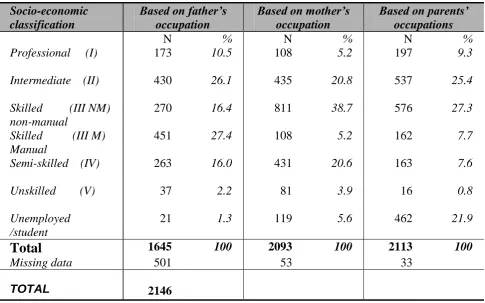
[image:21.595.55.541.470.773.2]father’s and mother’s current or last job is shown in table 1.1. While in much research the father’s occupational status is used for the classification of the socio-economic status of the family, in this study there are many fathers (501, 23% of the sample) for whom data are unavailable, often these are absent fathers. An alternative is to use the occupational classification of the mother, but many mothers live in households with the father as sole breadwinner. A way of overcoming these problems is to assign to the family a socio-economic classification based upon the occupation of the parent with the highest occupational status. This strategy has been adopted here based upon employment at the start of the study. The sample’s socio-economic characteristics formulated according to his method are shown in the last column of table 1.1.
TABLE 1.1: SOCIO-ECONOMIC CHARACTERISTICS OF THE EPPE SAMPLE
Socio-economic
classification
Based on father’s
occupation
Based on mother’s
occupation
Based on parents’
occupations
N
%
N
%
N
%
Professional (I)
173
10.5
108
5.2
197
9.3
Intermediate (II)
430
26.1
435
20.8
537
25.4
Skilled (III NM)
non-manual
270
16.4
811
38.7
576
27.3
Skilled (III M)
Manual
451
27.4
108
5.2
162
7.7
Semi-skilled (IV)
263
16.0
431
20.6
163
7.6
Unskilled (V)
37
2.2
81
3.9
16
0.8
Unemployed
/student
21
1.3
119
5.6
462
21.9
Total
1645
100
2093
100
2113
100
Missing data
501
53
33
Note that the unemployed/student category includes families where neither parent was in employment at the start of the study and includes some cases where a parent was a student. This category does not take into account where the parents were claiming unemployment benefit. In subsequent discussion analysis will be based on a sample of 2120 due to 26 parents being unavailable for interview
.
Comparing the EPPE sample with the UK population
While the EPPE sample was not designed to be wholly representative of the population of the UK, it is useful to know the relationship between the sample and the wider population. Recently, a nationally representative sample of parents with a pre-school child has been surveyed for the DfES (Prior et al., unpublished). Using this survey as the basis for statistics on a national sample, it is possible to compare the EPPE sample with a national sample of parents of 3-4 year old children. Table 1.2 shows such a comparison for maternal occupational status, where mothers have been employed. Occupation is either current occupation or last occupation if currently unemployed.
TABLE 1.2: OCCUPATIONAL CLASSIFICATION OF MOTHER
Occupational classification EPPE Sample National Sample
% %
Professional/ Intermediate I&II 27.5 26.9
Skilled non-manual IIInm 41.1 46.3
Skilled manual IIIm 5.5 20.9 Semi-skilled and Unskilled IV&V 25.9 5.9
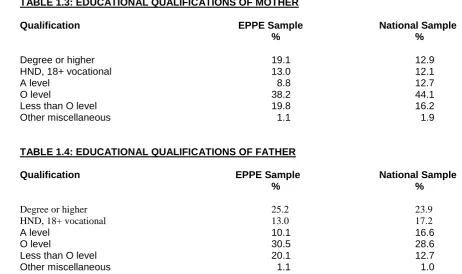
[image:22.595.45.508.455.729.2]It is possible to construct similar comparisons for mother’s and father’s educational qualifications as shown in table 1.3 and 1.4.
TABLE 1.3: EDUCATIONAL QUALIFICATIONS OF MOTHER
Qualification EPPE Sample National Sample
% %
Degree or higher 19.1 12.9
HND, 18+ vocational 13.0 12.1
A level 8.8 12.7
O level 38.2 44.1
Less than O level 19.8 16.2
Other miscellaneous 1.1 1.9
TABLE 1.4: EDUCATIONAL QUALIFICATIONS OF FATHER
Qualification EPPE Sample National Sample
% %
Degree or higher 25.2 23.9
HND, 18+ vocational 13.0 17.2
A level 10.1 16.6
O level 30.5 28.6
Less than O level 20.1 12.7
Other miscellaneous 1.1 1.0
from the comparisons based on father’s qualifications. The EPPE sample does not appear to be as over-represented at the bottom end of the educational qualification spectrum when the comparison is based on mother’s qualifications. Mother’s qualifications indicate a slight over-representation at the top end and bottom end of the spectrum. However, the comparison based on father’s qualifications clearly shows a very similar pattern to maternal occupational status with a larger over-representation at the bottom end of the socio-economic spectrum. Specifically there is an under-representation of the skilled non-manual occupations and an over-representation of the semi-skilled and unskilled occupations.
The national sample is drawn from all parents of 3-4 year old children, regardless of whether their child attends a pre-school centre. The EPPE sample is specifically drawn from users of four types of pre-school centre; nursery classes, playgroups, private day nurseries and LA centres. The classification by mother’s occupational status, where mothers have been employed, for these centres is compared with the National Sample in table 1.5.
TABLE 1.5: OCCUPATIONAL CLASSIFICATION OF MOTHER
Occupational
classification
Type of pre-school centre
National
Sample
(Prior et al.)
Nursery Class Playgroup Private DN LA centre
% % % % %
Professional/ Intermediate I&II
19.9 16.9 51.1 23.2
26.9
Skilled
non manual IIInm
38.4 49.6 35.8 39.1
46.3
Skilled manual IIIm
6.0 5.5 4.4 6.1
20.9
Semi-skilled/ Unskilled IV&V
35.8 27.9 8.7 31.7
5.9
It is clear that mothers who use private day nurseries are frequently of higher occupational status. Mothers from the other three groups (nursery class, playgroups and LA centres) are more likely to have been in the semi-skilled or unskilled occupations than the mothers in the national sample. On the basis of comparisons with the national sample reported by Prior et al. (unpublished), for all pre-school groups, mothers who have been in the skilled manual occupations are under-represented and women who have been in semi-skilled and unskilled occupations are over-represented. The consequence of these variations is that the EPPE sample is over-represented at the lower end of the socio-economic spectrum. This would appear to be a direct result of the strategic sampling of Local Authorities. For two of these types, nursery classes and LA centres it is often the local authority’s policy to target such provision in areas of socio-economic disadvantage. Hence over-representation at the bottom end of the socio-economic spectrum is not unexpected.
TABLE 1.6: COMPARISON WITH ALL UK WOMEN 16-59 YEARS OLD
Occupational classification EPPE mothers UK women 16-59
who have been in recent employment
employed
% %
Professional/ Intermediate I&II 27.5 31.0
Skilled non-manual IIInm 41.1 35.7
Skilled manual IIIm 5.5 8.3
Semi-skilled and Unskilled IV&V 25.9 25.0
On the basis of this comparison the EPPE sample does not vary markedly from the national distribution of occupational status for women overall.
Type of pre-school centre and socio-economic status
A more detailed breakdown of how the type of pre-school centre attended varies according to the socio-economic status classification of the family is shown in table 1.7.
TABLE 1.7: SOCIO-ECONOMIC STATUS AND USE OF PRE-SCHOOL CENTRES
Socio-economic
status
Type of pre-school centre
Total
Nursery Class Playgroup Private DN LA centre
N % N % N % N % N %
Professional 38 6.5 23 3.8 121 23.4 15 3.5 197 9.2
Intermediate 115 19.6 125 20.5 214 41.5 83 19.2 537 25.0
Skilled non manual 159 27.0 202 33.2 118 22.9 97 22.4 576 26.8
Skilled manual 60 10.2 64 10.5 19 3.7 19 4.4 162 7.5
Semi-skilled 64 10.9 53 8.7 12 2.3 34 7.9 163 7.6
Unskilled 4 0.7 4 0.7 0 0 8 1.8 16 0.7
Unemployed/student 138 23.5 133 21.8 27 5.2 163 37.6 461 21.5
Data unavailable 10 1.7 5 0.8 5 1.0 14 3.2 34 1.6
Total
588 100 609 100 516 100 433 100 2146 100Thus the socio-economic ordering is that the highest are the users of the private day nursery group, the nursery class and playgroup users are next and very similar to each other, and then the families using LA centres have the lowest socio-economic profile.
The consequences of these socio-economic differences between the families using different types of pre-school are that many differences associated with type of pre-school will actually derive from socio-economic differences. In particular where differences in a characteristic mirror the differences revealed in table 1.7 then this strongly indicates that the cause of the difference may be socio-economic.
Level of parental employment
Information from questions concerning the hours of employment for the mother and father were used to consider the issue of level of employment for parents. Firstly mothers’ paid employment was considered.
TABLE 1.8: MATERNAL EMPLOYMENT AND TYPE OF PRE-SCHOOL CENTRE.
Mother
Full/part
employment
Type of pre-school centre
Total
Nursery Class Playgroup Private DN LA centre
N % N % N % N % N %
Unemployed 321 55.5 350 53.2 140 27.6 215 51.9 996 47.4
1-8 hours 32 5.5 32 5.3 19 3.7 6 1.4 89 4.2
9-19 hours 78 13.5 92 15.3 84 16.5 43 10.4 297 14.1
20-29 hours 55 9.5 79 13.1 92 18.1 40 9.7 266 12.7
Full-time 92 15.9 78 13.0 173 34.1 110 26.6 453 21.6
Total
578 100 601 100 508 100 414 100 2101 100TABLE 1.9: MATERNAL EMPLOYMENT AND SOCIO-ECONOMIC STATUS.
Mother
Full/part
employment
Socio-economic status of family
Total
Professional/Intermediate
Skilled Non-manual
Skilled Manual
Semi- or Unskilled
Unemployed/ Student
N % N % N % N % N % N %
Unemployed 218 29.9 192 33.4 71 44.9 60 33.9 456 100 997 47.6
1-8 hours 34 4.7 25 4.3 11 7.0 18 10.2 0 0 88 4.2
9-19 hours 110 15.1 121 21.0 28 17.7 37 20.9 0 0 296 14.1
20-29hours 110 15.1 103 17.9 20 12.7 32 18.1 0 0 265 12.6
Full-time 258 35.3 134 23.3 28 17.7 30 16.9 0 0 450 21.5
Total
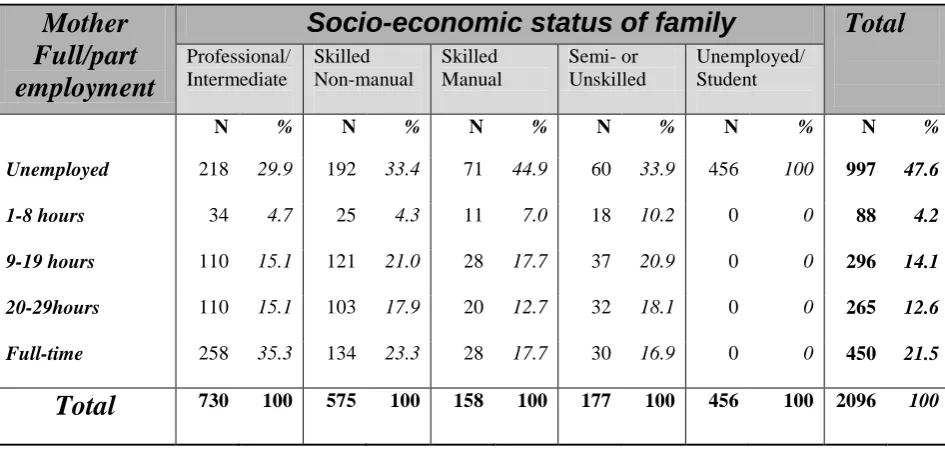
730 100 575 100 158 100 177 100 456 100 2096 100Note the unemployment/student group contains parents seeking work but unemployed, not seeking work and students. The level of maternal employment in the sample shows a clear socio-economic trend such that higher socio-economic groups have higher levels of maternal employment (Spearman’s rs = .439, p< .0001). This pattern holds when only those in
[image:26.595.62.535.86.311.2]employment are considered. However, it is clear that part-time employment (less than 30 hours per week) is more common overall, and even for the highest socio-economic groups, that have the highest levels of full-time employment, the level of part-time employment is almost equal to the level of full-time employment.
TABLE 1.10: PATERNAL EMPLOYMENT AND TYPE OF PRE-SCHOOL CENTRE.
Father
full/part
employed
Type of pre-school centre
Total
Nursery Class Playgroup Private DN LA centre
N % N % N % N % N %
unemployed
78 16.4 57 11.9 11 2.5 60 27.1 206 12.71- 8 hours
2 0.4 0 0 0 0 0 0 2 .19-19 hours
7 1.5 4 0.8 3 0.7 4 1.8 18 1.120-29 hours
9 1.9 10 2.1 4 0.9 7 3.2 30 1.9Full time
381 79.9 407 85.1 425 95.9 150 67.9 1363 84.2Total
477 100 478 100 443 100 221 100 1619 100TABLE 1.11: PATERNAL EMPLOYMENT AND SOCIO-ECONOMIC STATUS.
Father
Full/part
employment
Socio-economic status of family
Total
Professional/Intermediate
Skilled Non-manual
Skilled Manual
Semi- or Unskilled
Unemployed/ Student
N % N % N % N % N % N %
Unemployed 13 1.9 15 3.0 4 2.7 7 6.0 167 100 206 12.8
1-8 hours 0 0 0 0 1 0.7 1 0.9 0 0 2 0.1
9-19 hours 5 0.7 4 0.8 4 2.7 5 4.3 0 0 18 1.1
20-29 hours 9 1.3 11 2.2 1 0.7 8 6.9 0 0 29 1.8
Full-time 657 96.1 469 94.0 138 93.2 95 81.9 0 0 1359 84.2
Total
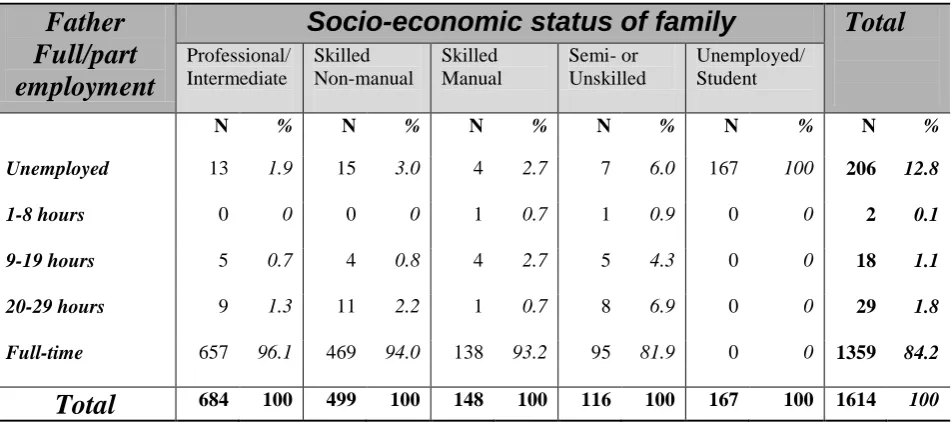
684 100 499 100 148 100 116 100 167 100 1614 100There is a clear socio-economic trend in paternal employment (rs = .106, p< .0001, for employed
fathers only), but not as marked as for maternal employment. The differences in the level of employment for mothers and fathers are very great, with part-time employment a rarity for fathers, but more common than full-time for mothers.
While the level of father’s employment for families using different types of pre-school centre appear to follow socio-economic differences, the same is only partly true for mother’s level of paid employment. Mother’s level of full-time employment is greatest for the private day nursery and LA centre groups. While the private day nursery group clearly has a much higher proportion of mothers in higher status jobs, the same is not true of the LA centres. However private day nurseries and LA centres offer the highest level of provision, usually up to full time. It is rare for nursery classes and playgroups to offer full-time provision, and when they do the actual hours of provision are still less than for private day nurseries and LA centres. Hence the higher level of maternal employment associated with private day nurseries and LA centres is linked to the higher level of provision. The next section considers the level of parental employment and the use of childcare.
Level of parental employment and use of childcare
TABLE 1.12: CORRELATIONS BETWEEN PARENTS’ CURRENT HOURS OF PAID EMPLOYMENT AND PREVIOUS CHILDCARE USE.
Type of pre-school centre
Total
Nursery Class Playgroup Private DN LA centre
Mother’s hours X Hours of previous childcare
0.42 0.40 0.57 0.53 0.52
Father’s hours X Hours of previous childcare
0.15 0.08 0.006 0.30 0.13
There are significant substantial correlations across all pre-school groups between mother’s current hours of paid employment and total childcare used up to the start of the study. The relationships are most pronounced for the private day nursery and LA centre groups. Clearly, mother’s level of current paid employment is strongly related to previous childcare use.
The pattern of correlations between father’s paid employment and previous use of childcare is rather different. There is no significant relationship for the playgroup and private day nursery parents. There is a slight relationship (r = 0.15) for the nursery class parents and there is a stronger relationship for the LA centre parents (r = 0.30). This pattern follows the pattern of correlations between mother’s and father’s hours of paid employment. There is no significant relationship between mother’s and father’s hours of paid employment for the playgroup and private day nursery parents. There are significant relationships for the nursery class parents (r = 0.22) and the LA centre parents (r = 0.41).
Overall, there are strong relationships between mother’s hours of paid employment and previous childcare. These relationships are strongest for the private day nursery and the LA centre parents. It would appear that the relationships between father’s hours of paid employment and previous childcare are a consequence of the pattern of correlations between mother’s and father’s hours of paid employment.
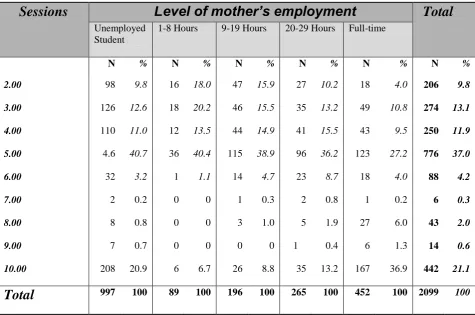
TABLE 1.13: SESSIONS IN CENTRE AND LEVEL OF MOTHER’S EMPLOYMENT.
Sessions
Level of mother’s employment
Total
UnemployedStudent
1-8 Hours 9-19 Hours 20-29 Hours Full-time
N % N % N % N % N % <