DIAS report
DIAS report
DIAS report
Niels Halberg (ed.)
Life Cycle Assessment in the Agri-food sector
Proceedings from the 4
thInternational Conference,
October 6-8, 2003, Bygholm, Denmark
DIAS r eport • Animal Husbandry • no. 61 • October 2004 DIAS report • Animal Husbandry • no. 61 • October 2004 •
Life Cycle Assessment in the Agri-food sector
DIAS Foulum
Research Centre Foulum P.O. Box 50, DK-8830 Tjele
Tel. +45 8999 1900 . Fax +45 8999 1919 [email protected] . www.agrsci.dk
Board of Directors Administration
Dept. of Food Science
Dept. of Animal Breeding and Genetics Dept. of Animal Nutrition and Physiology Dept. of Animal Health and Welfare Dept. of Agroecology
Dept. of Farm Management and Research Facilities Communication Department
Centre Management, Foulum
DIAS Aarslev
Research Centre Aarslev
Kirstinebjergvej 10, DK-5792 Aarslev Tel. +45 6390 4343 . Fax +45 6390 4390
Dept. of Horticulture
DIAS Flakkebjerg
Research Centre Flakkebjerg Flakkebjerg, DK-4200 Slagelse Tel. +45 5811 3300 . Fax +45 5811 3301
Dept. of Plant Biology Dept. of Crop Protection Centre Management, Flakkebjerg
DIAS Bygholm
Research Centre Bygholm Schüttesvej 17, P.O. Box 536 DK-8700 Horsens
Tel. +45 7629 6000 . Fax +45 7629 6100
Dept. of Agricultural Engineering Centre Management, Bygholm
Units at other locations
Dept. of Variety Testing
Teglværksvej 10, Tystofte DK-4230 Skælskør
Tel. +45 5816 0600 . Fax +45 5816 0606
Askov Experimental Station
Vejenvej 55, DK-6600 Vejen
Tel. +45 7536 0277 . Fax +45 7536 6277
Experimental Station for Organic Farming Rugballegaard
P.O. Box 536 DK-8700 Horsens
Tel. +45 7629 6000 . Fax +45 7629 6102
Foulumgaard
P.O. Box 50 DK-8830 Tjele
Tel. 8999 1900 . Fax +45 8999 1919
Jyndevad Experimental Station
Flensborgvej 22, DK-6360 Tinglev Tel. +45 7464 8316 . Fax +45 7464 8489
Life Cycle Assessment in the Agri-food sector
Proceedings from the 4
thInternational Conference,
October 6-8, 2003, Bygholm, Denmark
DIAS report • Animal Husbandry • no. 61 • October 2004
Niels Halberg (ed.)
Danish Institute of Agricultural Sciences Department of Agroecology
DIAS reports primarily contain research results and trial statements aimed at Danish conditions. Also, the reports describe larger completed research projects or acts as an appendix at meetings and conferences. DIAS reports are published in the series:
Plant production, Animal Husbandry and Horticulture. Prices:
Up to 50 pages: 55,- kr. pr. stk. Up to 75 pages: 85,- kr. pr. stk. More than 75 pages: 110,- kr. pr. stk.
Subscribers obtain 25% discount. Subscription can be taken out by contacting:
Danish Institute of Agricultural Sciences P.O. Box 50, DK-8830 Tjele
Tlf. +45 8999 1028
How may Quality Assurance Systems in food chains include environmental
aspects based on Life Cycle Methodology?
Niels Halberg
Danish Institute of Agricultural Sciences, Department of Agroecology, Research Centre Foulum, P.O. Box 50, DK-8830 Tjele. Tel: +45 8999 1206 - Fax: +45 8999 1200. E-mail: [email protected]
Abstract:
The number of Quality Assurance Systems (QAS) for food products is increasing and the so is the topics they cover, from traditional intrinsic product characteristics such as percent meat in slaughtered pigs and protein content in milk to food safety issues such as zoonoses and pesti-cide residues and in some cases aspects of animal welfare. This development is linked to de-mands for risk controlling systems such as HACCP and traceability systems that would allow food safety problems to be traced to a small number of producers or farms. The large retail companies (supermarkets) are an important driving force for this development because of their efforts to build consumer trust in food products and loyalty to the companies own brands. Envi-ronmental characteristics of food products and information on their production methods are be-coming part of some QAS but not mostly in the form of qualitative information e.g. certification that the farmers have used Good Agricultural Practice (GAP). The paper gives examples of this and then discuss this development in relation to LCA based environmental appraisal of food products. The development of quantitative (tools for) environmental appraisal of agriculture and food production is becoming more productoriented improving the possibilities of assessing the regional and global impacts of food production chains and consumption. But these systems building on LCA does not so far seem to be linked with the development of QAS for food. The paper finally discuss the possibilities for linking the food safety related traceability systems and gives an example of on-going work to establish LCA based QAS in a meat processing system.
Introduction
environ-mental impacts through the production chain even though these may be considered as equally important attributes of food products from a societal point of view.
Consumers appreciate a number of different quality aspects of food products among which are both intrinsic and extrinsic. Following Steenkamp (1990) the intrinsic characteristics include the organo-leptic or sensoric quality such as colour, taste, visible fat (called “quality cues” if they are observable before purchase and “experience attributes” if they may first be ascertained while consuming the product). Intrinsic characteristics that relate to food safety may often not be re-vealed immediately (“credence attributes”) and it is off course no surprise that many consumers have become interested in information regarding the risk of zoonoses, bacteria or other food haz-ards when choosing food products. Extrinsic characteristics – besides price - relate to the condi-tions of livestock in the production chain (animal welfare), to the resource use and environmental impact from the production and to other aspects not observable from the product itself (e.g. GMO free, organic production, regional product)(Brom, 2000; Verbeke and Viane, 2000).
It has been proposed that the environmental information from e.g. Life Cycle Assessment (LCA) may be used to guide consumer choices (Nilsson et al., 2004) at least in public procurement (Anonymous, 2002). The EU Integrated Product Policy (IPP) considers LCA as one of the cor-nerstones (Anonymous, 2003) for improvement of the knowledge and transperancy concerning the environmental impacts related to production and consumption. However, it is not clear how significant environmental labelling is for consumers’ preferences and other aspects of food qual-ity are probably more important (Brom, 2000; Verbeke and Viane, 2000; Nilsson et al., 2004). It seems as if presently environmental aspects has less priority compared with food safety issues in the development of traceability and documentation in QAS (maybe because food contamination can have direct impact on specific consumers while most environmental issues have a less direct impact on particular consumers using a specific product). But in a larger context the environ-mental characteristics of food production chains are important because the food production and consumption is one of the larger contributors to a family’s environmental impact (Anonymous, 1996; Wilting et al., 1999; Spangenberg & Lorek, 2002). Livestock products are particularly im-portant for the emissions of nutrients and greenhouse gasses (see several papers in this volume) and for land use (Gerbens-Leenes et al., 2002) and projections of global food demands and pro-duction foresee a significant global rise in consumption of meat and milk (Delgado et al., 1999). Therefore, it seems relevant to seek ways to improve environmental appraisal of agriculture and food chains with the aim of reducing the environmental load per kg product produced and con-sumed.
con-scious consumer groups. Also, a number of food processing plants like slaughterhouses and dair-ies have used energy accounting tools or other environmental management tools and some have become ISO 14001 certified such as the Danish slaughterhouse “Tican”. However, often the most significant environmental impacts from food production are happening in the primary pro-duction rather than the processing stages. Therefore, attempts to describe, appraise and document environmental characteristics of food products should include the whole production chain. A number of European tools for farm level environmental appraisal and reporting exist for volun-tary use, some of which are linked to advisory tools for farm planning (Halberg et al., 2004). But these tools are seldom linked with the rest of the food chain and existing labels for environmen-tally friendly production are usually not based on quantitative information of potential environ-mental impact from the specific producers (Nilsson et al., 2004).
The aim of this paper is therefore
• to discuss trends in Quality Assurance Systems (QAS) used in European food chains and the different methods used for appraisal of environmental characteristics of food products
• to propose that environmental appraisal as part of QAS should be based on quantified in-formation through the product chain and be linked to traceability principles.
Quality Assurance Systems in European food sector
A number of QAS for food products exist in Europe and other countries differing in both their organisational set-up and in the degree to which they build on international certification stan-dards (Schiefer, 2004). Meat and animal products have been at the core of food scandals in the last decade and not surprisingly some of the strongest QAS are to be found within pork produc-tion, such as the Dutch IKB (Trijp et al., 1997), a relatively new German system called QS (Quality and Safety for Food Products, from Producer to Consumer" (Nienhoff, 2004; www.q-s.info) and the “Danish” brand (Anonymous, 2003). These management schemes aim at securing a high degree of traceability through a strong information flow where results from tests and measurements along the production chain are continuously fed backwards with the aim of im-proving performance (e.g. feeding back information to farmers on carcass quality or bacterial counts in milk). Most often this relates to analyses of ”classical” quality parameters such as fat content, freezing point and bacterial counts and for medicine residues and other more recent tests such as Aflatoxines. Thus, most often QAS builds on two key concepts: Traceability and
HACCP. HACCP (Hazard Analysis and Critical Control Points (CFSAN, 2004; Danske Slag-terier, 2003) is a systematic approach to monitoring quality and risks of contamination of food products during a production process and is standardised among others in Denmark and Holland and internationally in ISO 22000.
chain as documentation coming with the product. However, when it comes to information re-garding the extrinsic characteristics such as animal welfare and environmental performance such information is presently not accumulated and exchanged through the value chain in a quantitative form. The QS system for example includes demand for compliance with other German regulation of manure use but no quantification of nutrient surplus or losses. Likewise, the French QAS “Agri Confiance” for certification of a variety of livestock products and processed crop products has only recently started to include environmental aspects in a separately managed ISO 14001 scheme called Agri Confidence® Quality-Environment (www.cooperation-agricole.asso.fr cit. Cederberg, 2004). The intention of labels such as IKB are to add value to a product (pork) in the eye of the consumer by guaranteeing that it is produced according to some criteria, which are be-lieved to be important (Trijp et al., 1997). This added value should then give an advantage in the form of either higher prices or increased consumer loyalty to products labelled with the IKB brand.
In addition to the brands and QAS of the food processing industry large retail companies also begin to focus on traceability and documentation of the origin and quality of the products they sell. There seems to be a trend towards non-price competition (competing on the products’ qual-ity attributes) and building consumer loyalty towards the retail companies’ own brands. An in-creasing proportion of the retail sale of food and household commodities happens under the retail companies’ own brands (Arfini and Mancini, 2004). The British Tesco and Sainsbury for exam-ple both have their own brands that account for over 50% of their total sales, the French Carre-four and Intermarche sell 20 and 29% of their turnover in their own brands and this proportion is increasing also in the Nordic COOP chain. This has economical advantages for the retail busi-ness and gives them stronger control and flexibility (e.g. they may change their suppliers without the consumers noticing). To minimise the risk of loosing consumer confidence in these trade-marks due to food scandals the retail business is now very active in quality assurance and there-fore demand quality control measures and traceability backwards in the food chain.
contrac-tual requirements that suppliers of food products (also foreign) have to comply with when deal-ing with the members of BRC, which is the majority of the large retail chains in the UK.
According to Krieger and Schiefer (2004) the primary agricultural production (e.g. the pig fatten-ing facility) will become integrated in HACCP systems in the future and HACCP systems al-ready exist for fruits and vegetables (Hernandez-Souchez et al., 2004). However, the authors do not find it likely that these quality assurance schemes will be used to claim higher prices for the certified products. Rather these concepts will be considered the standard or basic quality for a number of food items. Contrary to this Broom (2000) argues that food safety may be assured by labelling schemes if they are backed by government control systems. Other issues that are not necessarily relevant to all consumers in their role as consumers - such as animal welfare or envi-ronmental issues – may also be assured by labelling. The European Commissions study on “ronmental product declaration schemes” (Anonymous, 2002) advise that information on the envi-ronmental performance of food products be considered in e.g. public procurement. Nilsson et al. (2004) find that existing labelling schemes often lack credibility in the sense that “they are per-ceived interesting and trusted by consumers” and should therefore be backed by a more factual appraisal of the actual production methods and their environmental impact. Whether the QAS will be used to give information to consumers or will remain primarily a process between agents in the food processing chain is not clear, but in both cases it seems relevant to discuss the poten-tial role of LCA or other forms of environmental assessment to supplement such systems.
Good Agricultural Practice and environmental Quality management of food products
Some initiatives aim at securing minimum standards for the environmental performance of agri-cultural products, especially through the establishment of certification schemes1. A major objec-tive among retail companies is to avoid pesticide scandals caused by either too high amounts of residues in the products or hazardous use by the farmers. This is primarily secured by either ban-ning certain pesticides in specific products or demanding rules for pesticide use and storage, see below. Other aspects are included such as the prudent use of water and fertiliser but most often in a non-quantitative form, which seem less rigorous than for the above mentioned meat quality and food safety issues. Therefore, it is relevant to discuss the possibility of using quantified informa-tion based on actual use of inputs and/or estimated emissions in the environmental assessment of food products.
A number of food products are produced and sold under labels claiming some form of environ-mental consideration. One example is the bread wheat and rye sold under the NATUR+ label
1 Certified organic farming is off course also a certification that certain practices have been followed and that no
(Cederberg, 2004; Swedish Seal, 2004) owned by the Swedish farmers and used for most bread and flour sold in Scandinavian supermarkets such as COOP in Denmark and Sweden. The
NATUR+ label guarantees that no chemical “plant growth regulators” have been used (following specific worries for food safety of this otherwise legal crop treatment) and the rules also ban pre-harvest Round-up use and use of sewage sludge. It may be discussed whether these rules in real-ity address a consumer concern for chemical residues in the bread rather than care for the envi-ronment, but recently also rules for fertiliser planning and minimum requirements for “green zones” on the farm have been included.
Under the British Farm Standard logo of a “Little Red Tractor” exists a number of guidelines for assured production with rules of how farmers should take environmental considerations in their planning and management. One example is the Assured Produce Scheme (APS), which promotes safe and environmentally responsible production of fruit, salads and vegetables through the use of integrated crop management (ICM). According to the home page (Anonymous, 1993) APS “is designed to maintain consumers' confidence in the safety and integrity of the produce they eat”. Growers must follow the best production advice contained in the crop specific protocols that form the basis of the scheme. For example, the use of fertiliser should be based on crop norms and soil analyses and pesticides should only be used after observation of a critical level of a pest in the crops. APS thus follows a logic of Good Agricultural Practice (GAP) and is crop/field level based, not product oriented. APS is an independently assessed assurance scheme and farm-ers have to be certified and inspected to sell products labelled with the Little Red Tractor. Other QAS under the little red tractor cover e.g. pigs (Assured British Pigs) and chicken (Assured Chicken Production).
The APS is one of many examples of a labelling scheme certified under the umbrella EurepGAP, which is an initiative owned by a consortium of European retail companies (supermarket chains). The EurepGAP is based on the socalled FoodPLUS / STATUTES which have the objectives to:“Encourage adoption of commercially viable Farm Assurance Schemes, which promotes the minimisation of agrochemical inputs, within Europe and world wide.
Develop a Good Agricultural Practice (GAP) Framework for benchmarking existing Farm As-surance Schemes andStandards including traceability.” (EurepGAP, 2003).
not been realized. However, the Danish IP label is credited for the relatively high proportion of Danish produced vegetables sold in supermarkets. The Danish IP is currently undergoing ad-justments to comply with the EurepGAP standards. This implies some changes in the level of documentation and in specific rules for e.g. storage of pesticides but not in the actual environ-mental performance of the farms. This is because the EurepGAP standards do not include spe-cific quantified limits for e.g. fertiliser use or environmental impact.
Environmental assessment as part of quality assurance schemes
Why should the food business use precise documentation of environmental impacts of food products? There are a least two reason why documentation of environmental characteristics should be included in QAS. The first reason is related to the interests of the brands and food companies and the second is related to the societal interests in environmental improvements in the food chain.
1. The advantages for the food companies of branding builds partly on the ideas that the perceived better quality associated with the brand and other brand associations increases the consumers experience and satisfaction with a product (van Trijp et al., 1997). As dis-cussed in the introduction “quality” is more than the intrinsic characteristics of a product and includes external characteristics such as environment and animal welfare aspects of the production process. Therefore, it may be an advantage towards at least some parts of consumers to have documentation that environmental care is part of the brand policy. Or, at least the retail companies and the brand owners should try to avoid critical stories con-cerning the environmental impact from their suppliers, e.g. damaging losses of critical pesticides.
2. From a broader environmental perspective there could be an advantage of including envi-ronmental assessment in QAS because important envienvi-ronmental impacts from food con-sumption are regional and global such as nutrient losses and greenhouse gas emissions. The larger part of these environmental impacts happen in the primary production and there seems to be a potential for improvement as demonstrated by both LCA studies (de Boer, 2003; Haas et al., 2000; Halberg, 1999; Erzinger, 2004) and the tests of farm level green accounts (Halberg et al. in press). To record and report environmental information would facilitate better control, regulation and improvements based on incentives from e.g. the retail companies with their own brands. Following the ideas of the IPP informa-tion regarding the environmental impacts accumulated through the food processing chain would also facilitate better choices among retail companies and professionals in kitchens and restaurants.
used at all - is based mostly on GAP, adherence to decision rules etc., not on the actual result, e.g. resources used per kg product or LCA type of information. It should however be possible to use quantified environmental assessments because this type of information is the baseline of many types of green accounts for farms in Europe (Halberg et al., 2004), but these are most often not integrated with the product chain QAS. Nilsson et al. (2004) analysed the credibility of 58 eco-labelling schemes and conclude that presently ”There is no labelling system that covers the entire food production chain which could install ecoefficiency in the production chain”. The au-thors call for an “alternative approach [that] could measure appointed quality aspects in indica-tors for the whole food product chain and report them to interested parties and consumers” (Nils-son et al., 2004).
Some of the objectives for including environmental characteristics in QAS may be fulfilled by GAP type rules to be followed by the farmers, e.g. certification that they only use legal pesticides and only after pest-infections above a certain threshold have been observed by the farmer in his fields (such as is the generic rules in EurepGAP standards). From the point of view of the retail sector this approach seems to limit the risk of food scandals caused by misuse or overuse of pes-ticides by the primary producers. They may claim that they have done their best to limit this and thus avoid liability in case of such a case becoming public.
The quantitative, results based environmental information also has the advantage that they may describe the environmental impacts accumulated through the production chain, such as energy use and nutrient losses per kg product using LCA methods (as demonstrated in several papers in this volume). This would facilitate a product based environmental appraisal of food products in line with ideas of IPP (Anonymous, 2003). Therefore, it should be recommended to use quantita-tive environmental information based on the actual results from the production processes as part of QAS in the future. The existing LCA methodologies could be used as a starting point for this merge between IPP and QAS and supplemented with processes to include environmental aspects in product development (Nielsen & Wenzel, 2002).
To our knowledge the Dutch system “MPS” (Anonymous, 2004b) for green house production of flowers is the only environmental QAS for agricultural products which is both accredited by the retail sector in Europe, and builds on quantified information in a way that would fit in a product oriented environmental appraisal building on IPP/LCA principles. The MPS is accredited under EurepGAP but unlike most other GAP approaches this system is based on a quantification of the actual use of energy, pesticides and fertiliser per batch of flowers finished by the certified grow-ers. Thus MPS is an example of how environmental QAS may be used for both documentation towards retail chains and benchmarking between growers. Some of the major retail chains have recently demanded MPS certification of flowerpots for their stores. The growers under MPS have to report their use of energy, pesticides and fertiliser every four weeks to the MPS organisa-tion, where quarterly reports are compiled and sent out to growers with comparisons of their per-formance against standard limits and results of other growers. If a grower uses more of one input factor than the standard different measures are taken – depending on the severity of the exceed-ing and ultimately a grower may loose the certification for a period of time. The MPS approach demonstrates the feasibility of benchmarking between producers but the pot flower enterprises have a relatively short production chain from grower to retail compared with e.g. livestock prod-ucts. However when looking at the existing dataflow on product quality in the pork sector includ-ing environmental data does not seem impossible from a practical viewpoint.
in the primary production will be supplemented with environmental information from the slaugh-tering and other processes including transport to give an environmental profile per kg product de-livered to the retailers and professional kitchens. It will be part of the project to explore which type of information the professional buyers will be interested in and how to convert LCA type of information into a format that is understandable for these stakeholders. It is not the idea to pre-sent this information to ordinary consumers because the LCA based information itself is assumed to be too complicated for laymen to relate to in the purchasing situation.
Conlusions
Suppliers of feed and fertilisers
Farm 1 Farm 2 Farm 3
Processing plant (slaughterhouse, dairy)
Cooperative or private
Processing prepared meals
Retail Professionelkitchens
Consumers Products and
resources
Information
Transport and traders
2 2
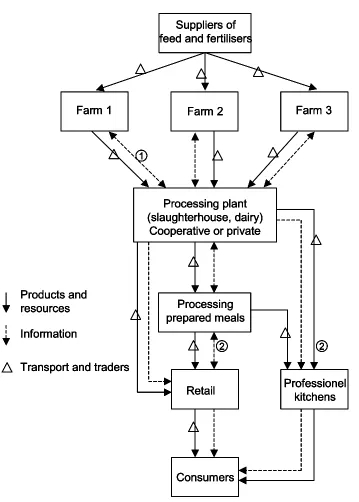
1 Input/output accounts on farm level transformed into environmental profile per kg product
from farms. Data for comparisons between farms re. ressource use and emissions per kg
product, (benchmarking).
2 Documentation of environmental profiles of products accumulated through the chain in
life cycle terminology
1
Suppliers of feed and fertilisers
Farm 1 Farm 2 Farm 3
Processing plant (slaughterhouse, dairy)
Cooperative or private
Processing prepared meals
Retail Professionelkitchens
Consumers Products and
resources
Information
Transport and traders
22 22
11 Input/output accounts on farm level transformed into environmental profile per kg product
from farms. Data for comparisons between farms re. ressource use and emissions per kg
product, (benchmarking).
22 Documentation of environmental profiles of products accumulated through the chain in
life cycle terminology
[image:13.595.84.443.94.596.2]11
Figure 1.Simplified description of a food chain with physical flow of products and
(potential) flow of information regarding quality and enviromental characteristics.
Suppliers of feed and fertilisers
Farm 1 Farm 2 Farm 3
Processing plant (slaughterhouse, dairy)
Cooperative or private
Processing prepared meals
Retail Professionelkitchens
Consumers Products and
resources
Information
Transport and traders
2 2
1 Input/output accounts on farm level transformed into environmental profile per kg product
from farms. Data for comparisons between farms re. ressource use and emissions per kg
product, (benchmarking).
2 Documentation of environmental profiles of products accumulated through the chain in
life cycle terminology
1
Suppliers of feed and fertilisers
Farm 1 Farm 2 Farm 3
Processing plant (slaughterhouse, dairy)
Cooperative or private
Processing prepared meals
Retail Professionelkitchens
Consumers Products and
resources
Information
Transport and traders
22 22
11 Input/output accounts on farm level transformed into environmental profile per kg product
from farms. Data for comparisons between farms re. ressource use and emissions per kg
product, (benchmarking).
22 Documentation of environmental profiles of products accumulated through the chain in
life cycle terminology
11
Figure 1.Simplified description of a food chain with physical flow of products and
(potential) flow of information regarding quality and enviromental characteristics.
Suppliers of feed and fertilisers
Farm 1 Farm 2 Farm 3
Processing plant (slaughterhouse, dairy)
Cooperative or private
Processing prepared meals
Retail Professionelkitchens
Consumers Products and
resources
Information
Transport and traders
2 2
1 Input/output accounts on farm level transformed into environmental profile per kg product
from farms. Data for comparisons between farms re. ressource use and emissions per kg
product, (benchmarking).
2 Documentation of environmental profiles of products accumulated through the chain in
life cycle terminology
1
Suppliers of feed and fertilisers
Farm 1 Farm 2 Farm 3
Processing plant (slaughterhouse, dairy)
Cooperative or private
Processing prepared meals
Retail Professionelkitchens
Consumers Products and
resources
Information
Transport and traders
22 22
11 Input/output accounts on farm level transformed into environmental profile per kg product
from farms. Data for comparisons between farms re. ressource use and emissions per kg
product, (benchmarking).
22 Documentation of environmental profiles of products accumulated through the chain in
life cycle terminology
11
Figure 1.Simplified description of a food chain with physical flow of products and
References
Anonymous, 1993. Assured produce scheme, available on-line (sept. 2004) at:
http://www.assuredproduce.co.uk/aproduce/
Anonymous, 1996. Miljøbelastningen ved familiens aktiviteter (Environmental impact from the family’s activities), Danish Consumer Board, report 1996. 1, 78 pp.
Anonymous, 2002. Evaluation of Environmental Product Declaration Schemes. Final Report. European Commission, DG Environment, 120 pp.
Anonymous, 2003. Integrated Product Policy – Building on Environmental Life-Cycle Thinking. Communication from the commission to the council and the European Parliament. Com-mision of the European Communities, Brussels, 18.06.2003,. COM (2003) 302 final. Anonymous, 2004a: Danish IP: Gartneribrugets Afsætningsudvalg (GAU) Available on-line
(sept. 2004) http://www.dansk-ip.dk.
Anonymous, 2004b: Miljø Programma Sierteelt. Available on-line (sept. 2004): www.my-mps.com
Arfini, F., Mancini, M.C, 2003. British Retail Consortium (BRC) Standard: a New Challenge for Firms Involved in the Food Chain. Analysis of Economic and Managerial Aspects. (ed.) G. Schiefer, U. Rickert. Proceedings of the 82nd Seminar of the European Association of Agri-cultural Economists (EAAE), May 14-16, Bonn, Germany. Vol. A, 23-31.
Brom, F.W.A., 2000. Food, consumer concerns, and trust: Food ethics for a globalizing market. Journal of Agricultural and Environmental Ethics 12, 127-139.
Cederberg, C., 2004. Systems for assurance of farm production in Western Europe. In. Thodberg et al. Produktorienteret miljøindsats i landbrugssektoren - forudsætninger og fremsyn. Re-port no. 900. App. E, p. 185-204 (in English). Available on-line (Sept. 2004) at
www.mst.dk/hompage (publications)
Cederberg, C., Mattsson, B., 2000. Life Cycle Assessment of Milk Production - A Comparison of Conventional and Organic Farming. J. Cleaner Prod. 8, 49-60.
CFSAN, 2004. Center for Food Safety & Applied Nutrition. Hazard Analysis and Critical Con-trol Point. HACCP overview. Availble on-line (Sept. 2004):
http://vm.cfsan.fda.gov/~lrd/haccp.html
Dalgaard, T., Halberg, N. and Porter, J.R., 2001. A model for fossil energy use in Danish agricul-ture used to compare organic and conventional farming. Agriculture, Ecosystems & Envi-ronment87(1): 51-65.
Danske Slagterier, 2003: Description of the 'Danish Quality Guarantee', HACCP and traceability. Available on-line (Sept. 2004):
http://www.danskeslagterier.dk/smcms/Danish_English/Danish_Quality/Index.htm?ID=1968
Delgado, C., M. Rosegrant, H. Steinfeld, S. Ehui, and C. Courbois, 1999. Livestock to 2020: The next food revolution. IFPRI. Discussion paper 28, 70 pp. Available on-line (August 2004):
http://www.ifpri.org/2020/dp/dp28.pdf
EEA, 2001. Environmental benchmarking for local authorities: From concept to practice. Envi-ronmental issue report no. 20. European EnviEnvi-ronmental Agency.
Erzinger, S. and Badertscher Fawaz, R., 2001. Life Cycle Assessment of animal housing systems as part of an overall assessment. Proceedings International Conference on LCA in Foods, p. 118-122. SIK-Report Nr. 643. Swedish Institute for Food and Biotechnology, Gothenburg. EurepGAP, 2004: FoodPLUS principles and generic rules for GAP, available on-line (sept.
2004) at: http://www.eurep.org/sites/index_e.html
Gerbens-Leenes, P.W., Nonhebel, S., 2002. Analysis – Consumption patterns and their effects on land required for food. Ecological Economics 42, 185-199.
Grønborg Eskesen, 1999. Danske gartnerier og MPS. Gartneritidende uge 29-30, 2003. Tilgæn-gelig online: http://www.gartneritidende.dk/artikler.
Haas, G., Wetterich, F., Geier, U., 2000. Life Cycle Assessment Framework in Agriculture on the Farm level. Int. J. LCA 5, 345-348.
Halberg, N., 1999. Indicators of ressource use and environmental impact for use in a decision aid for Danish Livestock Farmers. Agriculture, Ecosystems and Environment 76, P. 17-30. Halberg, N., Verschuur, G. & Goodlass, G. 2004. Farm level environmental indicators; are they
useful? An overview of green accounting systems for European farms. Agriculture, Ecosys-tems and Environment. In Press.
Krieger, S., Schiefer, G., 2003. Quality Management Schemes in Europe and Beyond. In: G. Schiefer, U. Rickert (eds.). Proceedings of the 82nd Seminar of the European Association of
Agricultural Economists (EAAE), May 14-16, Bonn, Germany. Vol. A, 35-47.
Larsson, I., 2004. Possible of the benefits from using LCA in the agro-food chain, example from Arla Foods. In: Halberg, N. (ed.) Life Cycle Assessment in the Agri-food sector. Proceed-ings of the 4th International Conference, October 6-8, 2003, Horsens, Denmark.
McKeown, P.J., 2001. The application of LCA methodology to the life of frozen vegetables. In: Proceedings of International Conference on LCA in Foods, Gothenburg, Sweden, 26-27 April 2001. SIK-document 143, 83-87.
Nienhoff, H.J., 2004. QS Quality and Safety: A Netchain Quality management Aggroach. In: G. Schiefer, U. Rickert (eds.). Proceedings of the 82nd Seminar of the European Association of Agricultural Economists (EAAE), May 14-16, Bonn, Germany. Vol. A, 627-629.
Nilsson, H., Tuncer, B, Thidell, Å., 2004. The use of eco-labeling like initiatives on food prod-ucts to promote quality assurance – is there enough credibility? Journal of Cleaner produc-tion 12, 517-526.
Schiefer, G., 2004. From Enterprise Activity ‘Quality Management’ to Sector Initiative ‘Quality Assurance’: Development, Situation and Perspectives. In: G. Schiefer, U. Rickert (eds.). Proceedings of the 82nd Seminar of the European Association of Agricultural Economists
(EAAE), May 14-16, Bonn, Germany. Vol. A, 3-20.
Spangenberg, J.H. & Lorek, S., 2002. Environmentally sustainable household consumption: From aggregate environmental pressures to priority fields of action. Ecological Economics, 43, 127-140.
Steenkamp, J-B. E.M., 1990. Conceptual Model of the Quality Perception Process. Journal of Business Research 21, 309-333.
Steenkamp, J-B. E.M., 1997. Dynamics in consumer behavior with respect to agricultural and food products. In: B. Wierenga, A. Van Tilburg, K. Grunert, J-B. E.M. Steenkamp, M. Wedel. (eds.). Agricultural Marketing and Consumer Behavior in a Changing World. Chap-ter 8, 143-188.
Swedish Seal, 2004. About Swedish Seal of Quality. Available on-line (Sept. 2004): www.svensktsigill.com.
Van Trijp, H.C.M., Steenkamp, J-B. E.M., Candel, M.J.J.M., 1997. Quality labelling as instru-ment to create product equity: The case of IKB in the Netherlands. In: B. Wierenga, A. Van Tilburg, K. Grunert, J-B. E.M. Steenkamp, M. Wedel (eds.). Agricultural Marketing and Consumer Behavior in a Changing World, 201-216.
Verbeke, W.A.J., Viaene, J., 2000. Ethical challenges for livestock production: Meeting con-sumer concerns about meat safety and animal welfare. Journal of Agricultural and Envi-ronmental Ethics 12, 141-151.