STABILITY STUDIES ON CELLULAR-WALLED
CIRCULAR CYLINDRICAL SHELLS
by
RONG DAR ZOU B.E., M.E.
Submitted in fulfilment of the requirements for the degree of
DOCTOR OF PHILOSOPHY
in the
Department of Civil and Mechanical Engineering UNIVERSITY OF TASMANIA
AUSTRALIA
DECLARATION
I hereby declare that this thesis contains no material which has been accepted for the award of any other degree or diploma in any tertiary institution and that, to the best of my knowledge and belief, this thesis contains no material previously published or written by another person, except when due reference is made in the text of the thesis.
Rong dar Zou
~
5. Access to. and copying of. thesis
The thesrs copy lodged rn the University Lrbrary shall be made available by the Unrversrty for consu ltatron but. for a perrod of two years after the thesrs rs lodged, rt shall not be made available for loan or photocopying wrthout the wrrtten consent of the author and rn accordance wrth the laws of copyright
After a thesrs has been examined, the following authority wrlf apply Please complete your request, and sign below
(r) I agree/do-flet agree that the thesrs may be made available for loan
(rr) I agree/do-not agree that the thesis may be made available for photocopying
(rir) I note that my consent rs requrrnd c:nly to cover the two-year perrod following approval of my thesrs for the award of my deqree After this. acce;s :r, the Lrbrary copy wrll be subject only to any general restrrctrons lard down rn Library regulation~
To
'
ABSTRACT
The present study deals with the stability behaviour of cellular-walled cylindrical shells subjected to simultaneous loading of axial compression and external pressure. In particular, the effect of high fluid pressure within the cells on the buckling behaviour of the shell is considered.
The cellular-walled cylindrical shell can be characterized as a pseudo-orthotropic cylindrical shell with the principal directions axially and circumferentially oriented. Different effective Young's moduli had to be used for tension and bending. A theoretical analysis, based on Flugge's linear buckling theory, resulted in simple interaction formulas for buckling under external pressure, axial c01~1pression and cell pressure.
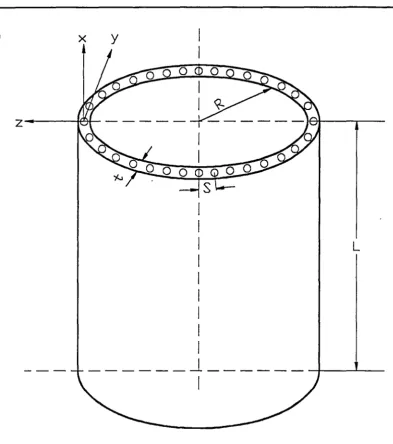
Cellular-walled model shells have been made out of epoxy by an adaptation of the spin casting process developed by Tennyson6. These shells have 360 longitudinal holes each of 0.7mm diameter, shell internal diameter 153mm, wall thickness 1.2mm and length 245mm. The tests of the model shells were carried out on a rigid test machine with parallel platens. Since the shells are cast with a free surface on the inside they are internally reflective. An optical system making use of the reflective surface was used to monitor buckling and prebuckling deformations. Test data was logged into a PC. Southwell plots were then employed to predict axial buckling loads. Because of the likelihood of the shell shattering on buckling, actual collapse loads were the final values obtained. Test data confirmed the theoretical predictions.
ACKNOWLEDGEMENTS
I would like to express my sincere gratitude to my supervisor Dr. C. G. Foster and associate supervisor Dr. E. Melerski, for their constant guidance, encouragement and advice during every stage of this study.
My appreciation must be extended to many others without whose assistance this study could not have been completed. In particular I would like to thank
Mr. Basil Stiberc and the other staff of the engineering workshop for the manufacture of the end-rings and other apparatus used in the model shells testing.
All the other academic as well as non-academic staffs in the engineering faculty for their encouragement and support.
Dr. John Morris, of the department of computer science, for his valuable advice in writing the computing programs.
Mrs Gail Wilson for checking draft of the thesis.
Mr. Michael Koutsoukis, Reza Izadnegahdar and Ashay Prabhu, for many valuable discussions and their support.
Professor M. R. Davis for providing the opportunity to undertake this study in the Department of Civil and Mechanical Engineering.
and the University of Tasmania for providing Postgraduate Research Scholarship during Sept. 1988 to Sept. 1992.
TABLE OF CONTENTS
ABSTRACT
ACKNOWLEDGEMENTS
CHAPTER 1 INTRODUCTION
CHAPTER 2 BUCKLING OF ISOTROPIC CYLINDRICAL
lV
vi
1
SHELLS - HISTORICAL BACKGROUND ... 9
2.1 Classical Linear Theory ... .. .. . .. ... .. .. . .. ... .. .. . .. ... .. . 13
2.2 Development of Large-Displacement Theory ... 15
2.3 Effect of Initial Imperfections ... 19
2.4 Effect of Prebuckling Deformation and Boundary Condition 2.5 Experiments on Near Perfect Shells CHAPTER 3 BUCKLING OF ORTHOTROPIC AND ANISOTROPIC CYLINDRICAL SHELLS 25 26 - A REVIEW OF CURRENT LITERATURE 28 3.1 Classical Buckling Theories - Perfect Cylindrical Shells ... 30
3.2 Limitations in the Classical Buckling Theories ... 34
3.3 Buckling of Geometrically Imperfect Orthotropic Cylindrical Shells ... 36
3.4 Experimental Data on Orthotropic Cylindrical Shells ... 38
CHAPTER 4 THEORETICAL BUCKLING ANALYSIS OF ORTHOTROPIC AND CELLULAR-WALLED CIRCULAR CYLINDRICAL SHELLS ... 41
4.1 Buckling Criterion of An Orthotropic Circular Cylindrical Shell Under Combined Loading of Axial Compression and External Pressure ... 43
4.1.1 Basic Equations ... 43
4.1.2 Buckling under Combined Loading ... 49
4.2 Buckling Criterion of A Cellular-Walled Circular Cylindrical Shell Under Combined loading of Axial Compression and External Pressure ... 61 4.2.1 Buckling under Combined Loading ... 62 4.2.2 Buckling under External Pressure Only ... 63 4.2.3 Buckling under Axial Compression Only .. .. 64 Notations
CHAPTER 5 NUMERICAL ESTIMATION OF AVERAGE PROPERTIES OF CELLULAR-WALLED
66
CIRCULAR CYLINDRICAL SHELLS ... 69 5.1 Determination of Equivalent Cell Pressure to
Internal Pressure ... 73 5.1.1 Structure Analysis and Elements 73 5.1.2 The Empirical Relations of the Effect of Cell
Pressure to That of Internal Pressure ... 75 5.2 Determination of Average Properties of
Cellular-Walled Circular Cylindrical Shells ... 78 5.2.1 Determination of Average Young's Modulus
Ei ... 78 5.2.2 Determination of Average Young's Modulus
E1 ... 81 5.2.3 Determination of Poisson's Ratios µ1 and µ2 82 5.2.4 Determination of Average Young's Modulus
Eb1 ... 84 5.2.5
Notations
Determination of Average Young's Modulus
Eb2 ··· 84
89
CHAPTER 6 THEORETICAL PERFORMANCE OF CELLULAR-WALLED CIRCULAR CYLINDRICAL SHELLS 91 6.1 Buckling under Combined Axial Compression and
External Pressure ... ... .. . . .. . ... ... .. ... . . .... .. . . 92 6.2 Buckling Including the Effects of Cell Pressure ... 106 6.3 Calculation of Buckling Loads ... 108
Notations 111
7.1 Nylon Line Cage ... 114
7 .2 Model Shell Casting ... ... .. ... ... .. ... ... .. ... 116
7.3 Finishing Work... 121
CHAPTER 8 EXPERIMENTAL SET UP ... ... .. .... .... ... .. ... .. .... . 125
8.1 Optical System ... 126
8.2 End Rings ... 133
8.3 Loading Frame ... 136
8.4 Data Logging ... 139
8.5 Southwell Plot ... 141
CHAPTER 9 MEASURED BEHAVIOUR OF MODEL SHELLS 145 9.1 Test Procedure ... : ... :... 148
9.2 Buckling under Combined Loading ... 152
9.3 Buckling under Axial compression ... 168
CHAPTER 10 CONCLUSIONS AND RECOMMENDATIONS 173 10.1 Conclusions ... 174
10.2 Discussions and Recommendations REFERENCES APPENDIX A CALCULATED DATA OF RADIAL DISPLACEMENTS w1 AND w2 FOR VARIOUS 175 177 GEOMETRIC CONFIGURATIONS ... 191
APPENDIX B PROGRAM LISTING USED IN NON-LINEAR LEAST SQUARES FITTING ... 218
APPENDIX C PROGRAM LISTING USED IN DETERMINE THEORETICAL BUCKLING LOADS AND MODE APPENDIX D PROGRAM LISTING USED IN DATA 230 LOGGING ... 236
APPENDIX E CALIBRATION PLOTS... 240 APPENDIX F PROCEDURE LISTING USED IN
CHAPTER 1
CHAPTER 1
INTRODUCTION
The present study was undertaken with the objective of investigating the buckling behaviour of a form of cellular shell suggested by fossil shell remains belonging to the Nautiloid Cephalopods group.
Nautiloid Cephalopods are a family of interesting fossil shellfish. These extinct animals, relatives of the modern day Pearly Nautilus, grew to about 300mm in length and had an exoskeleton in the form of a conical shell with a small apex angle. However, the unique feature of the shell of this fish was that it contained small, closely spaced holes running longitudinally in the shell wall. Interest in these fossil shells originated from discussions with Dr. M.R. Banksl, a paleontologist at the University of Tasmania. The problem encountered by Dr. Banks was to discover the reason the shell is built in such a particular form. Aside from the obvious conclusion that a cellular wall has better bending stiffness than a solid wall of the same mass, there appeared to be no particular reason for the specific form of this shell. Animal structures are usually very efficient, and a cellular wall made with circumferential or spiral cells would have similar bending stiffness while providing an easier path for the manufacture of the shell.
Figure 1.1
Artists impression of Nautllold cephalopod
I
shell fish together with a sketch of a section through the shell wall. This sk~tch
..
is taken from actual fossil specimens. The structure is_
essentially a thin-walled circular shell with small, closely spaced '
holes running longitudinally through the wall. In addition, there are a large number of considerably smaller holes connecting these longitudinal channels with the outside of the shell. The purpose of the longitudinal holes and the smaller connecting holes is not clear. One likely explanation is that the longitudinal holes were filled __ __with muscle while the v~ry ~ip.all connecting hol~~ may -~av_~_ be_e1_1
for some form of nerve tissue (i.e., sensing element).
From a strength point of view, there appears to be no advantage 1n the shell having longitudinal holes over circumferential or spiral holes. However, if the small longitudinal holes contained muscle then it can be observed that by contracting the muscle, pressure could be applied to the inside of the holes. Large pressures could be achieved with muscle contraction, which appear to be equivalent to small pressures applied to the inside of the shell.
much lower internal pressure, it was thought that the purpose of the cells may have been to provide such high pressure through muscle contraction. The contraction would have been triggered by the nerve "sensing element" attached directly to the muscle and connected through the secondary holes to the outside of the shell.
If the shell did function in this manner, then it seems likely that nature had provided a solution which may have an engineering significance, hence the reason for this investigation. The equivalent structure which appeared to have possibility as a submarine containment shell was a thin-walled cylindrical shell with closely spaced longitudinal holes and with high fluid pressure applied inside the holes. Such a structure could be made somewhat lighter than a uniform shell. It could have smooth external and internal surfaces, and the inside of the shell could be maintained at relatively low pressure, e.g. suitable for human occupation.
direction. Average wall properties had to be established from a consideration of local wall geometry.
Since the shell form originated from a marine animal, and also since the most likely application of the shell form would be as a submarine structure; this investigation concentrated_ on the load condition of axial compression and external pressure.
The theoretical buckling analysis presented in this thesis was based on Flugge's linear elastic theory5. The shell was treated as homogeneous and pseudo-orthotropic. A simple form of solution for the buckling of cellular-walled cylindrical shells under simultaneous loading of axial compression and external pressure was derived, which can be simplified to the form of exact orthotropic shells, and further to the form of isotropic shells. The effect of cell pressure on the buckling load of the shell was considered.
been carried out on a rigid compression testing machine with parallel platens and incorporated with the optical examination system.
The first three chapters in the thesis, including this one, are introductory. Chapter Two gives a survey of the developments in research on the buckling behaviour of isotropic cylindrical shells loaded in axial compression, external pressure, or a combination of the two; while in Chapter Three, a review of the buckling behaviour of orthotropic cylindrical shells under various load conditions is presented. Some necessary background for the work presented in the thesis is provided in these chapters.
properties of cellular-walled cylindrical shells were established using the energy method, from a consideration of local wall geometry. These properties were used m the theoretical performance of cellular-walled cylindrical shells, which is presented 1n Chapter Six. The buckling of shells with different geometric configurations were presented and compared. The effects of shell geometric configurations on buckling were discussed. In particular, l_ _ the effects of cell pressure to the
buckling of shells were demonstrated.
The experimental work of this thesis is presented in Chapters Seven, Eight and Nine. In Chapter Seven, the model shell manufacture and the main problems experienced in the processes are described. Experimental set-up, the optical examination system, end rings design, loading frame, data logging board and PCLAB program used in the test are described in Chapter Eight. The results of the tests on buckling loads are presented in Chapter Nine.
CHAPTER 2
BUCKLING OF ISOTROPIC
CYLINDRICAL SHELLS
CHAPTER 2
BUCKLING OF ISOTROPIC CYLINDRICAL SHELLS
- HISTORICAL BACKGROUND
The problem of cylindrical shell buckling bas been a widespread topic of research interest over several decades, and the results have been reported in innumerable publications. Certain aspects of cylindrical shell buckling have been emphasized, namely the effect of boundary conditions and nonlinear prebuckling deformations, external loading conditions (axial compression, external pressure, torsion), postbuckling behaviour and accompanying imperfection sensitivity, and the role of material properties (isotropic, orthotropic, anisotropic).
In general, thin-walled shell structures are stiff in axial or in-plane deformations but flexible in bending. When they are subjected to axial or in-plane forces they often lose stability at very low stress levels, resulting in large bending deformations. Thus, examining the buckling problem and ' determining the critical load has been one of the most important investigations in the development of light-weight structures.
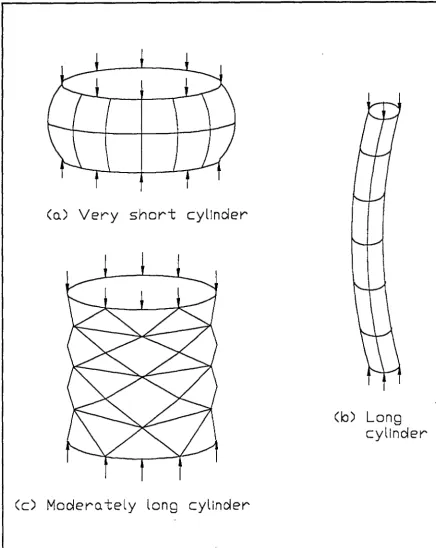
Relatively thick-walled shells buckle into the axisymmetric "ripple"
pattern illustrated in Figure 2.1. This type of buckling usually
leads to yielding. Very short, thin-walled cylinders behave like flat
plates that are supported along the loaded edges and are free along
the unloaded edges. They buckle into a single half sine wave in the
axial direction with no waves in the circumferential direction as
shown in Figure 2.2a. By comparison, very long cylinders with small diameters buckle like Euler columns with minimal distortion
of the circumferential cross-section (Fig. 2.2b). A third group
consists of moderately long cylinders that fail by local buckling.
The surface of these cylinders buckles into a series of diamond
shaped dimples which are well known as Yoshimura patterns (Fig.
2.2c).
Figure 2.1 Inelastic axial ripple buckling (Foster38)
(o.) Very short cylinder
(c) Modero. tely long cylinder
[image:21.570.67.504.59.608.2](b) Long cylinder
The Batdorf parameter Z is normally used to separate short cylindrical shells from moderately long cylindrical shells 7
Z=
(L/R)2(R/t)~
(2.1)where µ is Poisson's ratio. Those cylindrical shells with Z < 2.85 can be characterised as very short cylindrical shells and those with Z > 850 as very long cylindrical shells. Cylindrical shells with Z between 2.85 and 850 can be considered as moderately long.
The single most important characteristic of moderately long cylindrical shells is that they often fail at loads well below the critical load obtained using classical linear theory. It is with this group of cylindrical shells that this thesis is mainly concerned. The major developments in both theoretical and experimental work on buckling of moderately long cylindrical shells are summarized m the following sections.
2.1 CLASSICAL LINEAR THEORY
Within the limits of elastic small-deformation linear theory, the behaviour of unstiffened isotropic cylindrical shells is usually considered to be governed by Donnell's equation8,9, i.e.,
(2.2)
where D
=
Et3 /[12(1-µ2)] is the flexural rigidity, E Young'smodulus, t shell thickness, R shell radius, ax axial stress, x coordinate in axial direction, w displacement in radial direction;
V2=
aa:
2 + : :2 is biharmonic operator; V4 signifies the applicationof v2 twice and vs four times. When there is only axial stress
applied on a shell, ::- Donnell's equation (2.2) becomes:
For moderately long cylindrical shells, the critical stress can be
obtained by solving equation (2.3):
E
O'er = [3(1-µ2)]1/2 (t/R) (2.4) According to St. Venant's principle, only the surface adjacent to the
loaded edges of the cylinder is affected by the restraint along those
edges. Hence the critical stress for a cylindrical shell of
intermediate length, given by equation (2.4 ), is valid for clamped or
built-in as well as simply supported edges.
The equation (2.4) is regarded as a classical solution.
It was first obtained in 1910-1911 by Timoshenko, Lorentz and
Southwe1110,11 who applied the energy method in a cylindrical shell
assuming axisymmetrical buckling. However, buckling experiments
of this value. This discrepancy between theory and experiment has
led to a great deal of research both theoretically and
experimentally. The cause of this discrepancy is generally believed
to be the unstable post-buckling behaviour of the shell, which
causes the shell to be extremely sensitive to even small initial
geometrical imperfections.
2.2 DEVELOPMENT OF LARGE-DISPLACEMENT THEORY
The first attempt to explain the discrepancy between
theory and experiment was made in 1934 by Donnell8,9 who
introduced a set of simplified non-linear equations for the large
deflection analysis of cylindrical shells. Donnell's theory is based
on the assumptions of the Kirchhoff-Love hypotheses ·and shallow
shell approximations. The latter assumption restricts the validity
of the theory to situations in which the normal deflection
predominates over the in-plane displacements. Despite its limits of
applicability, owing to its relative simplicity and practical accuracy
for short and moderately long cylinders, Donnell's theory has been
widely used for analysing both buckling and post-buckling
problems of cylindrical shells. A more complete non-linear theory
without the limitation of the shallow shell approximation was
developed around the same time by Flugge5. Flugge's theory is
considered to be more refined and is often employed to check the
accuracy of Donnell's equations or in situations where the latter is
were followed by numerous theoretical and experimental
investigations, which have led to a more complete understanding of
the phenomenon of shell buckling and post buckling.
A major breakthrough to explain the discrepancy
between theory and experiment was made in 1941 by Von Karman
and Tsien12-15 who demonstrated that an analysis of the buckling of
thin shells by means of the small-displacement linear theory is
insufficient to establish the practical limits of the load-carrying
capacity of thin shells. Instead, they used Karman-Donnell type
large displacement equations and for the first time showed that the
highly unstable post-buckling behaviour of axially compressed
cylindrical shells was the main cause of the large discrepancy
between theory and experiment. They found that, subsequent to
reaching the critical load, the load that an initially perfect shell can
support drops sharply with increasing deformations. As indicated
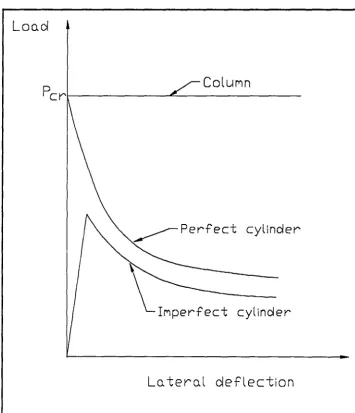
in Figure 2.3, the post-buckling behaviour of the shell is in sharp contrast to the way a simple column buckles. Whereas the load
that a column can support subsequent to the onset of buckling
remains fairly constant before rncreasrng again with large
.
.
deflections, the load-carrying capability of the shell drops
precipitously once buckling begins.
The unstable post-buckling behaviour of cylindrical
shells discovered by Von , Karman anq Tsien indicates that
equilibrium is possible in a deformed configuration at loads well
that the presence of initial imperfections, or that of external
disturbances, would cause the shell to jump to these lower
equilibrium positions before reaching the critical load. As
illustrated in Figure 2.3, the initially imperfect shell never reaches
the critical load given by the linear theory for a perfect shell.
Instead, the initially imperfect shell exhibits a maximum load that
is considerably lower than the critical load of the perfect shell.
Loa.d
ColuMn
Peri--~~~~~~~~~~~~~~~
cylinder
\ : !Mperfect cylinder
[image:26.569.79.435.249.662.2]La. tera.l deflection
Figure 2.3
Many investigators followed in the footsteps of Von Karman and Tsien. Most of them attempted to obtain more accurate results for the cylindrical shell under axial compression16-18, in particular finding the minimum load that the shell can support in the buckled state. It was then proposed that this minimum post-buckling load could be taken as the safe design load, on the grounds that the shell could always support at least this much load and that even imperfections would not reduce the postbuckling load below this value. However, by increasing the number of terms used to express the. deflection and minimizing the total potential energy with respect to the thickness to radius ratio as well as the wave number parameter, lower and lower values of the minimum post-buckling load were produced; until Hoff, Madsen and Mayers19 showed that as the number of terms used to express the deflection is increased indefinitely, the minimum load required to maintain the post-buckled state approaches zero, the thickness to radius ratio of the shell tends to zero, and the deflection pattern approaches the exact Yoshimura pattern (a series of diamond shaped facets).
postbuckling equilibrium states with lower energy than the prebuckled state. Since the stiffness of the shell is proportional to the cube of its thickness, to a thin shell, the energy involved in bending is small, and the total strain energy contained in the buckled configuration is much smaller than the extensional strain energy in the compressed state just before buckling. This explains the sudden snapping with loud report caused by the release of energy and the small value of the load required to maintain the buckled shell. Obviously, if the thickness were vanishingly small, the resistance to bending would be negligible; hence the shell would buckle to the exact Yoshimura pattern, and no load would be required to maintain this shape.
2.3 EFFECT OF INITIAL IMPERFECTIONS
The effect of initial imperfections on the buckling behaviour of axially compressed cylindrical shells has posed baffling problems to engineering in the past several decades. Much research has been carried out on the subject and many review papers have been published21-28.
' When cylindrical shells are subjected to certain loads, the shells buckle at stresses lower then those predicted by classical theory. The reasons for this discrepancy are manifold; such as nonuniform shell thickness, nonuniform loading,
modelled boundary conditions, influence of
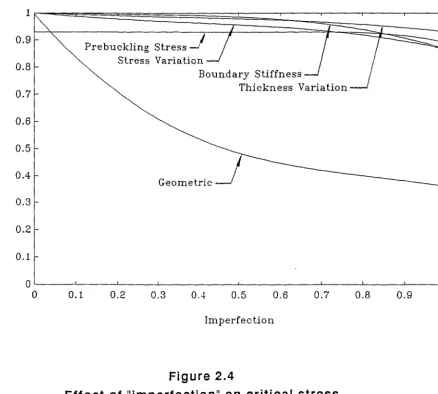
from perfect shell geometry. The item that is most important is the
last: geometric imperfections. This buckling behaviour was
qualitatively displayed by Babcock27. Figure 2.4 is reproduced
from that source, where each influence is displayed for a cylindrical
shell under axial compression. Elastic buckling is assumed. The
horizontal axis is artificially scaled to reflect the reasonable
magnitudes of the "imperfections". This figure demonstrates that
geometric imperfections are extremely important.
1
0.9
Pre buckling Stress_/ /
0.8 Ul Ul c.> ;... 0.7 ...,)
Stress Variation
J
Boundary Stiffness
Thickness Variation
en
~
.:: 0.6
-.!.: CJ-
0.5 -c::: "CJc.> 0.4
N
-
~Geometric~
E
0.30
z 0.2
0.1
0
0 0.1 0.2 0.3 0.4 0.5 0.6 0.7 0.8 0.9
[image:29.577.109.548.307.702.2]Imperfection
Figure 2.4
Effect of "imperfection" on critical stress
of cylindrical shells under axial compression (Babcock27)
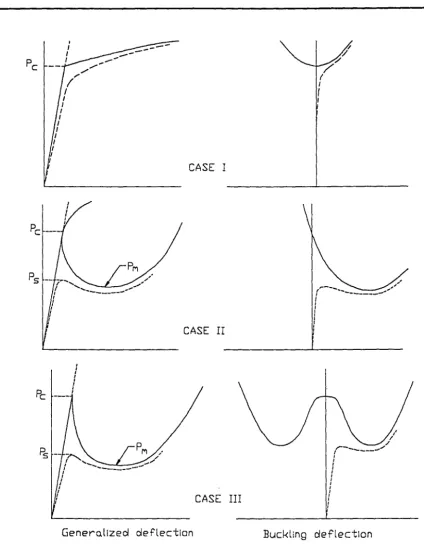
In 1945, Koiter29 developed a general theory of post-buckling behaviour which confirms the conclusions aforementioned, i.e., initial geometric imperfections are responsible for the fact that failure loads are significantly lower than the classical buckling load. Classifying the bifurcation point into three types, stable symmetric, asymmetric and unstable symmetric, Koiter showed that imperfection sensitivity of a shell depends on the type of bifurcation point associated with it (See Figure 2.5, here reproduced from reference 21). The load corresponding to the bifurcation point of the perfect shell is commonly called the classical buckling load and is denoted here by P cl· In each of the
three cases, the prebuckling state of the perfect shell is stable for P < P cl and is unstable for P > P cl where it is shown as a dotted
curve. Case one illustrates a shell with a stable postbuckling behaviour which can support loads in excess of the classical buckling load P cl in the buckled state. The behaviour of a slightly
Pc ,,,,,.,,,.,.----I I I I ,,,. I I I I I I I I I
Pc
----I I I I I I I I I I :
---
--Ps -- ""'
p l"l / I ' -"""I
---' I I I I I I I I
CASE I
CASE II
CASE III
Generalized deflection
Figure 2.5
( I I I / '/ ~ ~
/"'
________
,,I I I I I I I I I I I I I I
Buckling deflection /' /
[image:31.578.64.488.84.640.2]buckling deflection and in which initial postbuckling behaviour is always unstable under prescribed loading conditions.
Based on the work of Koiter and that of Budiansky and Hutchinson21-23, the concept of imperfection sensitivity has been developed. In accordance with this theory, one is able to calculate a parameter which is a measure of the steepness of the post-buckling curve. This parameter can then be used to estimate the degree to which initial imperfections reduce the strength of a shell below its classical critical load. In other words, the deeper the post-buckling curve, the greater will be the imperfection sensitivity of the shell and the further below the critical load will be the maximum load that the shell can support. Using an analysis of this type, it can be shown that axially compressed cylindrical shells are highly imperfection sensitive. Even very small initial imperfections can cause these shells to fail at loads well below the critical load given by the linear theory. A quantitative measure of the sensitivity of the shell to axisymmetric geometric imperfections can be calculated.
the exact cylindrical shape is known.
Koiter's asymptotic theory was later extended to the case of general random imperfections by Hansen31 using a probabilistic approach. Hansen's studies have indicated that on the buckling of axially loaded cylindrical shells, non-axisymmetric and general random imperfections can have a greater degrading effect then axisymmetric imperfections.
Experimental verification of Koiter's predictions on the effect of axisymmetric imperfections was obtained by Tennyson and Muggeridge32, who conducted an extensive testing program on accurately made spun-cast epoxy shells containing various types of axisymmetric imperfections. Their studies indicated that minimum buckling load is obtained when the wavelength of the axisymmetric imperfection is equal to that of the classical axisymmetric buckling mode.
The effect of actual imperfections was first investigated by Arbocz and Babcock33-36. Their theoretical predictions for the buckling load were obtained by representing the actual initial deviations of the shell wall as a Fourier series and were in reasonable agreement with observed test values.
pattern. The load carrying capacity of cylindrical shells with diamond-shaped defects similar to the facets of a buckled cylinder can be estimated. He also experimentally investigated the effect of changes in the defect size on the collapse load and the influence of more than one defect.
2.4 EFFECT OF PREBUCKLING DEFORMATION AND BOUNDARY CONDITIONS
Several researchers45-54 have investigated the effect of boundary conditions and the prebuckling bending deformation caused by edge restraints. The linear theory of cylindrical shells assumes that only membrane stresses and no bending stresses exist in the shell prior to buckling. In other words, the shell is free to expand laterally along its entire length prior to buckling and will consequently have the same shape. Actually, cylindrical shells are usually prevented from expanding at their ends by the supports and bending stresses do exist prior to buckling. However, it was shown by Stein47 in 1962 that the effect of these prebuckling bending stresses is small and that their omission in the classical theory is therefore not a primary reason for the difference between the theoretical predictions and actual collapse loads.
Almroth53 that cylinders whose edges are free to move in the tangential direction buckle at a stress one half as large as that given by equation (2.4). Since this edge condition rarely exists in actual shells, initial imperfections and not boundary conditions are believed to be responsible for the discrepancy between classical theory and test results.
2.5 EXPERIMENTS ON. NEAR PERFECT SHELLS
Up to now, considerable advances have been made m experimental techniques. It is possible to subject the shell to uniform loading conditions without the problems of misalignment and eccentricity by using sophisticated testing equipment. With advanced manufacturing techniques such as electroplating55,56 and spincasting6,44,57,58, geometrically "near-perfect" cylindrical shells could be made.
Prior to 1960, the conclusion that initial imperfections are responsible for the discrepancy between linear theory and actual buckling loads was based primarily on theoretical studies. However, experimental verification of the role that imperfections play has been obtained as well. Tennyson6,57,58 in 1963, by careful fabrication procedures, manufactured geometrically "near-perfect" circular cylindrical shells. Using these "near-perfect" circular cylindrical shells and clamped end constraints, he was able to obtain experimental buckling loads equal to 0.9aci. thus minimising
agreement with the reduced theoretical value taking into account
the edge restraints and prebuckling bending deformations and
confirmed that the classical theory is valid for perfect cylindrical
CHAPTER 3
BUCKLING
OF
ORTHOTROPIC
AND
ANISOTROPIC
CYLINDRICAL SHELLS
CHAPTER 3
BUCKLING OF ORTHOTROPIC AND ANISOTROPIC-CYLINDRICAL SHELLS
- A REVIEW OF CURRENT LITERATURE
Aerospace structure design, by its very nature, requires the engineer to strive for minimum weight configurations. This in turn has led to the development of a variety of advanced thin-walled structures. These include stiffened thin-walled shell structures which are fabricated from a wide variety of light-weight materials, bonded constructions with honeycomb or foam cores, and laminated composite shells. The material behaviour of these shells can be considered as orthotropic.
Although for isotropic cylindrical shells in the elastic domain, the problem of buckling may now be considered to be solved completely. However, for orthotropic and anisotropic cylindrical shells, due to their co-mplexity, both theoretical and experimental investigations still lag far behind -those for isotropic shell structures.
savings can be achieved. The designer has the advantage of being able to tailor his material and structure properties to meet specific requirements. It is necessary to develop an adequate background for analysing orthotropic structures that can result from the assembly of these material systems into various· structural configurations.
A review of main developments in this field is presented in the following sections.
3.1 CLASSICAL BUCKLING THEORIES PERFECT
CYLINDRICAL SHELLS
In general, classical buckling theories assume linear relationships between stress/strain and strain/ displacement. Furthermore, a membrane prebuckled shape is often considered in order to satisfy, either partially or completely, various end boundary conditions, although an "infinite" length shell model can also be employed. There have been many buckling analyses of orthotropic cylindrical shells.
satisfied. An early general buckling analysis of anisotropic cylindrical shells was presented by Cheng and Ho62 who derived the buckling characteristic equation for cylinders subjected to combined axial compression, external pressure, and torsion with arbitrary boundary conditions. Their general analysis was later applied to obtain numerical results for buckling under these kinds of loadings: external radial pressure63 combined radial pressure and torsion63, axial compression64, combined axial compression and external radial pressure64, torsion65, combined torsion and axial compression65, · bending65, combined bending and axial compression65, combined bending, axial compression, external radial pressure and torsion66.
/
by Chao69 usmg Timoshenko's buckling equilibrium equations. Combined loading of external pressure and torsion with different boundary conditions were considered. Similar agreement was also found. A modified form of Cheng and Ho's analysis was presented by Lei and Cheng64 who investigated the buckling of orthotropic
laminated shells including the effects of simply supported and clamped boundary conditions corresponding to the membrane prebuckled state. Buckling results were then obtained for various combinations of boundary conditions and varying length-to-radius ratios. Axial compression, radial pressure and combined loading were considered.
Other investigations of buckling of anisotropic cylindrical shells have also been published. Holston 70 studied the effect of the length-to-radius ratio on the axial compressive buckling load. By neglecting coupling between shearing and extensional strain, he showed that there are no significant effects on the buckling load for ratio values greater than 1.5. In buckling due to bending, U gural and Cheng 71 found that coupling between
strange phenomenon is really a shear-type buckle due to the induced torque arising from the presence of end constraints.
For buckling of orthotropic cylindrical shells, two types of basic equations, corresponding either to Flugge-type or Donnell-type linear equations for isotropic shells, have been formulated in the literature. In either case, a resulting single eighth-order differential equation may be deduced. A common difficulty with these eighth-order equations in isotropic or orthotropic shell theory is that their general solutions remain unknown because of the algebraic complexities involved. However, the eighth-order equation for orthotropic shells is more complicated than the corresponding one for isotropic shells. Recently, Cheng and He 73
have proposed a pair of complex conjugate fourth-order partial differential equations that govern the deformation of orthotropic circular cylindrical shells. Subsequently, Xiao and Cheng 74 applied these equations to orthotropic cylinders loaded in local external pressure. This pair of equations is deduced from a set of basic equations that is based on the Kirchhoff hypothesis, that is:
(a) The transverse normal stress is negligibly small, and
(b) Sections normal to the middle surface of the shell remam normal to the middle surface and undergo no change in length during deformation.
can be systematically and explicitly deduced. These fourth-order equations for orthotropic cylindrical shells are of practical importance because they can be easily solved in closed forms and yet retain practically the same accuracy as the original eighth-order equation. Using these fourth-order equations, a particular problem of loss of stability of cylindrical shells due to pressure applied on part of their surfaces has been solved by Xiao and Cheng 74. The
critical loads of orthotropic shells under this particular configuration were compared with those calculated from the corresponding equations given by Flugge5. Results show that the difference between the two equations is negligibly small.
3.2 LIMITATIONS IN THE CLASSICAL BUCKLING THEORIES
All of the theoretical works mentioned so far considered classical buckling theories undergoing small deflections in which several limitations were involved. Firstly, a linear stress and strain relation was used in basic equations. Secondly, membrane pre buckled shape is assumed, i.e., the effect of boundary conditions on the prebuckling stress state is ignored. Thirdly, the difference between the elastic moduli in tension and compression is ignored. Lastly, a geometrically "perfect" shell is always applied in classical buckling theories.
property tests on 'Scotchply' Type 1002 preimpregnated epoxy/ glass were performed by Tennyson75. His results show that although the axial tension and compression data in the main exhibit linearity, the shear behaviour is quite nonlinear. Hence some difficulty could arise in comparing torsional buckling loads with predicted values based on a constant shear modulus, although the initial load curve can be approximated reasonably well by a linear relation.
In the multitude of classical theories, prebuckling deformations caused by different boundary conditions are not included in the analysis, although buckling loads are affected by prebuckling deformations. However, for certain boundary conditions, such as the clamped case, the load reduction associated with the prebuckling displacements may only amount to 5%-10%.
One assumption generally made is that of a constant elastic modulus to describe both tension and compression. Jones76 has shown that variations in these material coefficients can cause significant differences in buckling loads, at least for the case he considered.
3.3 BUCKLING OF GEOMETRICALLY IMPERFECT ORTHOTROPIC CYLINDRICAL SHELLS
The effect of geometric shape imperfections on the
buckling strength of isotropic cylindrical shells has been well
known for some time. However, by comparison, relatively few
studies have been done to investigate shape imperfection effects on
the stability of orthotropic shells.
A theoretical analysis has been published by Khat 77-79
based on the anisotropic shell theory for axial compression. A
Donnell-type of analysis including nonlinear strain/displacement
relations was employed using an initial shape imperfection having
the form of the assumed buckling mode. The total potential energy
was minimized to yield the buckling loads. Load/ deflection curves
were then obtained as a function of the imperfection amplitude.
Khot's results indicated that any orthotropic cylindrical shell is less
imperfection sensitive then an isotropic one. Experimental data
on orthotropic cylindrical shells, which is presented in the ·next
section, supported Khot's prediction.
Koiter's imperfection shell theory was first applied to
anisotropic cylindrical shells by Card80 in 1969. In his analysis,
Koiter's theory was employed to examine the imperfection
sensitivity of laminated orthotropic cylindrical shells based on a
perturbation technique applied to a 'perfect' shell at the inception
associated with simple and clamped boundary conditions were
considered. Experimental data for filament-wound and glass-epoxy
cylindrical shells under axial compression were carried out and
compared with perfect shell prediction. The variation was 63% to
91 %. Calculations of the imperfection sensitivity were made for qualitative comparison with the experiments, but smce no
measurements of actual imperfection distributions were done, a
quantitative buckling loads comparison was not possible.
Also by usmg Koiter's theory, Tennyson et al.81
performed an axisymmetric imperfection analysis to determine the
effect of imperfect amplitudes on the axial compression buckling
load of anisotropic circular cylindrical shells as a function of fibre
orientation. The effect of_ boundary conditions was neglected.
Numerical results were presented only on orthotropic three-ply,
glass-epoxy composite cylindrical shells. They indicated that the
axisymmetric shape imperfection has a dominant effect on the axial
compress10n buckling load of orthotropic composite cylindrical
shells. For a perfect composite cylindrical shell, axial buckling
load can be increased by changing the fibre orientation, but it will
be accompanied by a corresponding increase in imperfection
sensitivity. So from a design point of view, it was suggested that
there is no significant advantage in selecting optimum fibre
orientations that would give maximum buckling load for a perfect
shell if there is some inherent axisymmetric shape imperfection
introduced in the manufacture process. Subsequently, axial
Muggeridge82 on three-ply, glass/ epoxy cylindrical shells.
Experimental results were compared with predicted values which
was based on the analysis of Reference 81, and a good agreement
was found.
Investigation of the effect of local shape defects on the
buckling of orthotropic' cylindrical shells was just started by Muir83.
He tested three sets of 4-ply carbon-fibre epoxy composite
cylindrical shells in axial compression for lamina orientations of 30,
45 and 60 degrees. Diamond-shaped defects were imposed on the
shell wall. However, because only a few shells were tested, no
clear conclusions have arrived.
3.4 EXPERIMENTAL DATA ON ORTHOTROPIC CYLINDRICAL SHELLS
Preliminary experimental data on orthotropic plywood
cylindrical shells under axial compression was published in 1943 by Norris and Kuenzi84. Card and Peterson85 and Card86 reported on
the results of 51 tests of filament-wound glass/ epoxy circular
cylindrical shells under axial compression. The experimental
buckling loads averaged approximately 85% of analytical
predictions based on a Donne.II-type orthotropic analysis. Tasi et
aI.87 have -also investigated the buckling behaviour of
filament-wound glass/ epoxy cylindrical shells under axial compression and
and Ho's linear theory. Their experimental buckling loads were
found to range from 66 % to 85 % of analytical predictions.
Buckling under external pressure of orthotropic
fiberglass cylindrical shells has been studied by Schneider and
Hofeditz88. Test data on 53 glass fibre orthotropic cylindrical
shells were reported and compared with theoretical buckling
pressure. All of the experimental buckling external pressures were
found to be more than 85 % of theoretical predictions.
Torsional buckling of orthotropic filament-wound
glass-epoxy cylinders was studied by Wall and Card89 who compared their
test data with the theoretical analysis by Chao69. About 67% of the
theoretical predictions were found in their experimental buckling
results. Tennyson 75 has also conducted experiments on the
torsional buckling of preimpregnated type wound glass-epoxy
cylindrical shells. Experimental torsional loads were compared
with the theoretical predictions which were based on the linear
Donnell-type equations. A very good agreement was obtained; all
of the experimental values were more than 80% of the theoretical
predictions with an average of 90%.
For buckling under combined loading, an extensive
study of filament-wound glass-epoxy cylindrical shells was
undertaken by Hoston et aI.90 for various loading modes, including
axial compression, torsion, bending, combined torsion and axial
linear buckling theory based on the work by Cheng and Ho, axial compression values were found to be 67%-90% of the theoretical predictions while bending critical loads were essentially equal to the axial compression values.
CHAPTER 4
THEORETICAL BUCKLING
ANALYSIS
OF
ORTHOTROPIC AND
CELLULAR-WALLED
CHAPTER 4
THEORETICAL BUCKLING ANALYSIS OF
ORTHOTROPIC AND CELLULAR-WALLED CIRCULAR
CYLINDRICAL SHELLS
As described in the last chapter, there have been many buckling analyses of orthotropic shells. Among them, Cheng and Ho's63 theory was represented as a general theory of buckling of heterogeneous anisotropic cylinders under combined loading with arbitrary boundary conditions. Although it is based on a very accurate Flugge-type shell theory which is considered to be more refined than the linear Donnell-type stability theory, their analysis is rather lengthy; considerable numerical analysis is required to obtain the critical load.
in moderately long cylindrical shells there is almost no difference in buckling loads between these two boundary conditions. Thus, the solution for buckling loads presented in this report has a practical significance.
First, a general orthotropic cylindrical shell was considered. Based on Flugge's linear theory _ for isotropic cylindrical shells, a general buckling solution under combined axial compression and external pressure was derived in this chapter. For moderate-length orthotropic cylindrical shells loaded in either external pressure or axial compression, buckling loads are formulated in a simple form.
Subsequently, the buckling criterion for a cellular-walled circular cylindrical shell under combined loading was developed. The cellular wall was modified to approximate a uniform orthotropic form. The modified wall was then treated as pseudo-orthotropic.
4.1 BUCKLING CRITERION OF AN OTHOTROPIC CIRCULAR CYLINDRICAL SHELL UNDER COMBINED LOADING OF
AXIAL COMPRESSION AND EXTERNAL PRESSURE
4.1.1 BASIC EQUATIONS
Let R be the radius of the midsurface of the shell; x,y,z the axial, circumferential, and radial coordinates; and a,{3,-y the dimensionless coordinates of x, y and z (a= x/R, {3
=
y /R, 'Y=
z/R). The three displacement components ua., u~ and Uy of an arbitrary point of the shell can be expressed in terms of midsurface displacements u, v and w as follows5 :where
Uy= W
aw
oa'
aw
w~
=
(atf-
v),(4.1)
Now, let <la. and u~ be the normal stresses along a ,{3 respectively; Ta.~ be the shear stress in the a,{3 plane; ea. and e~ be the normal strains and 'Ya.~ be the shear strain. The stress-strain relations for orthotropic materials91,92 are
(4.2)
characterizes the change of angles between principal directions a
and {3; µ1 = µpa is the Poisson's ratio that characterizes the decrease in a direction due to tension applied in {3 direction, and
µ2 = µa.J3 is the Poisson's ratio that cha~acterizes the decrease in {3 direction due to tension applied in the a direction. Among these material constants there exists a relation91:
(4.3)
The components of strain at any arbitrary point of the shell are related to the midsurface displacements by5
1
av
1 a2wep = R <a{3 + w)-R(l+'Y) <a(32 + w),
The bending ( T/a., 77p) and twisting strains ( 77a.p) are
1 a2w T/ et. -- - - -R2 aa2'
(4.4)
(4.5)
and D2 the bending stiffnesses along the principal directions a and
{3 respectively,
and we let
E2 k =-E
1'
Ezt3
Dz
=
-12-(-l--µ-1µ_2_) ' (4.6)(4.7)
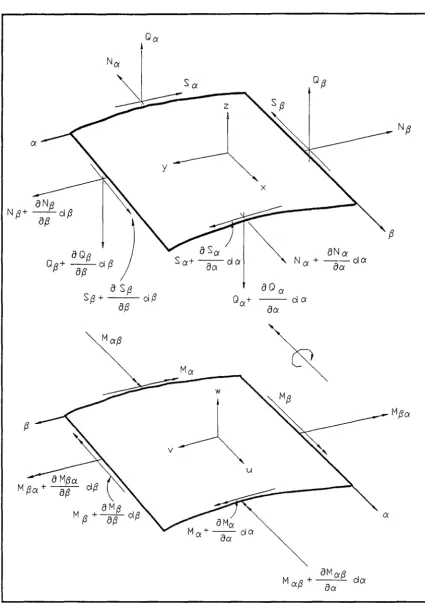
Let Na. and Np be the normal stress resultants, Sa. and Sp the shear stress resultants, Ma. and Mp the bending moments, Ma.p and Mpa.
the twisting moments, and Oa. and Op the transverse stress resultants. Under the combined loading of axial compression P and
external pressure p, the equations of static equilibrium are (see
a
Qf3Qp+ --cJ.{3
ap
Q {3
aN a N a + - - c i a al'(
Figure 4.1 Shell element
[image:56.567.98.524.70.673.2]In the equations (4.8), these stress resultants (N,S,Q) and couples (M) per unit length of the midsurface are related to the midsurface displacements through the stress-strain relations as:
t/2
[N a.,Sa.,MwMa.p]
=
f
([<Ta., T a.p ,Z<Ta.,ZT a.pD [ 1 + z/R] dz-t/2
t/2
[N p,Sp,Mp,Mpa.]
=
f ([
<1p, rpa.,Z<1p ,zrpa.Ddz-t/2
t/2
[Qa.,Op]
=
J
([Ta.z,Tpz])dz-t/2
which resulted in
(4.9)
t2
in which c2 = lZR 2 , and
(tanh-1'1Jc-'1Jc)
0
=
-
h -1\/3.c3
- 2
[.!.
.!_ -
h 2! -
h 4l
- 9c 5 + 7(\./3 c) + 9(\./3 c) + ...
4.1.2 BUCKLING UNDER COMBINED LOADING
Substituting these stress resultants (N,S,Q) and couples
(M) in equation ( 4.10) into the equation of static equilibrium ( 4.8),
a system of three differential equations is obtained for the three
basic displacement functions (u,v,w)
a1
a1
a1
[(l-q2)
aa2
+ {k1[1+c2(1+o)] -q1}a.s2Ju +(k1+µ1)aaa.Bv
a
a3 a3+ {(µ1 + qi)aa - c2[aa3 -
ki(l+o)aaae2n
w=
0,a2
a2
a2
[(k1+µ1)aaaeJu +{(k-q1)ae2 + [k1(1+3c2) - q1Jaa2}v
a
a3
a
a3
a3
a
a3
(µ1 +qi)
acx
-c2[acx3-k1 (1 + o)acxa.a2]u
+ [(k-q1) a.a-c2(3k1 + µl)acx2a.slv
a1
a1
a4
a4
+ {k + qia.a2 + q2aa2 +
c2[aa4
+ ( 4k1+2µ1 + ok1)acx2a.a2
a1
+ k(l + o)(a.B2+1)2]}w
=
o
in which q1 and q2 are dimensionless loads,
( 4.12)
It may be observed ·that these load parameters are
small quantities. We introduce a solution for equation ( 4.11) of
the form:
where
u = A cos(t,a)cos(m.B)
v = B sin(f..a)sin(m.B)
w = C sin(f..cx)cos(m.B)
n11"R
A
=L,
(4.13)
and n is an integer. The solution describes a buckling mode with n
half- waves along the length of the cylinder and with 2m half-waves
around its circumference. We assume the edges of the cylinder to
be at ex= 0 and a =L/R. We can see that at the ends v = w = 0 and from the stress resultants that Na.= 0, Ma.= 0. Thus, the solution
tangential and radial directions but are neither restricted in the
axial direction nor clamped. (This has been classified as one of the
simply-supported boundary conditions, namely SS3, by Lei &
Cheng2).
When the solution (4.13) was introduced into the
differential equations ( 4.11), the trigonometric functions drop out
entirely and we are left with the following equations:
A [-A.2(1-q2) - m2{ki[l+c2(1+o)] -qi}]+ B [A. m(ki +µi)]
+
c
[A.(µi + qi) - c2{- A,3 + ki(l + o)A. m2}]=
0, A [A. m(ki + µi)] + B [-m2(k-qi) - A. 2{ki(l + 3c2) - q2}]+ C [-m(k - qi) - c2(3ki + µi) mA.2]
=
0,A [A. (µi + qi) + c2{ A,3 -ki(l + o)A. m2}] + B [-m(k - qi)
- c2(3ki + µi)m A.2] + C[-k + qi m2 + q2 A.2
( 4.14)
- c2{ A.4 + (4ki+2µi+oki)m2 f.2 + k(l+o)(m2-1)2}]
=
o
These are three linear equations with the buckling
amplitudes A,B,C as unknowns and with the brackets as
coefficients. These equations admit in general, since they are
homogeneous, only the solution A
=
B=
C=
0, indicating that theshell is not in neutral equilibrium. Only if the determinant of the
nine coefficients equals zero is a nonvanishing solution A,B,C
possible. Thus the vanishing of this determinant is the buckling
condition of the shell. The coefficients of the above equations are
therefore, a polynomial of the third degree in these parameters.
Since they are very small quantities, it is sufficient to keep only the
linear terms and to write the buckling condition as:
( 4.15)
The coefficients c1 ... c4 of equation ( 4.15) may be found by
expanding the determinant of equation ( 4.14 ):
c2
=
A.8k1 -A. 6m2(µ12-k-4k12)- 2 A. 4m4 ( 4k1 µ 12 + 4k12µ 1-3kk1 + µ1 3-kµ1)
- A.2m6k(µ 12-k-4k12) + m8k2k1-2 A.2m4k(k-µ 12 + 4k12-k1µ 1) -2A. 4m2(3kk1 + kµ 1-4k1 µ 12-µ 13-4k12µ 1)
- A.2m2k( µ 12-k-4k12+2k1µ1) -2 A.6k1 µl
-2m6k2k1 - A. 4k1 (3 µ12-4k) + m4k2k1
c3
=
A. 2m 4(k-2k 1µ 1-µ 12) + m6kk1 + A. 2m2(2k1µ 1 + µ 12-kk1-k)-m4kk1 + A. 4m2k1+2k1µ 1 A. 4
C4
=
A.6k1 + A.4m2(k-2k1µi- µ12) + A.2m4kk1+ A,2m2kk 1 + A_4(k+kk1- µ 12)
( 4.16)
Since c1 turns out to be proportional to A.4, we may drop the term with A. 4 in all other coefficients. By using the relation E 1µ1
=
E2µ2 ,( 4.17)
in which ~ and ~ are geometric mean values for the Youngs modulus E and Poisson's ratio µ, respectively, it may be shown that
(2k1 + µ1)2 = 4k12 + µ12 + 4k1µ1
G2(l-µ1µ2) 2 G(l-µ1µ2) = 4 E 2 + µ12 + 4 E µ1
1 1
= k
(1-~)
2 +µ1 2 +'1k
2µ1(1-~)
=['1k.(1-~)
+µ1J2= k ( 4.18)
and
( 4.19)
By substituting the above equations ( 4.18) and ( 4.19) into equation ( 4.16), the four coefficients can be further simplified as:
c2= ki( '1,2 + '1km2 )4 -2 '1,6k1 µ1 -6kk1 '1,4m2 -2'1.2m4kk1 ( 4'1k - µ1) - 2m6k2k1
These co-efficients are still relatively complicated. Under combined loading of axial compression and external pressure, the buckling condition, equation ( 4.15), not only depends on material properties (Eb E2, µ1' µ2, G12) but also on the buckling mode (m,n), i.e., number of waves along axial and circumferential directions.
4.1.3 BUCKLING UNDER EXTERNAL PRESSURE ONLY
Now, if an orthotropic cylindrical shell was loaded under external pressure alone, i.e. when q2
=
0. Then the equation( 4.15) yields
where
C1
-- = (k- µi 2)k1 /.. 4 / {k1 m2( )..2 + \jk m2 )2
C3
C2
- k
1
(2~+
k)t..2m2 -m4kk1}{k1 (t..2
+
'.fkrn.2 )4 -2 /.. 6k1µ1 -6kk1 /.. 4m2-2/..2rn.4kk1 ( 4~-µ1)-2m6k2k1+2)..2rn.2kk1(2..Jk-µ1) + rn4k2k 1} / {k1 m2()..2 + ~rn.2)2 -k1 (2..jk
+
k)t..2m2( 4.21)
It may be shown by analyzing equation ( 4.22) that a minimum value of q1 is obtained when A. or n (the number of
half-wavelengths in the axial direction) has its smallest value; namely
n = 1, hence A.= A. 1
=
'11"R/L. As a consequence, a circular cylindricalshell under external pressure buckles into a single half-wavelength
in the axial direction. For moderate-length cylinders, it may ~e
assumed that
( 4.23)
as used by Gerard94 for isotropic cylinders. Thus, equa.tion ( 4.22)
reduces to:
= (k-µ12)k1 A.14 /m6kk1
µ12
= (1-T) A.14/m6 = (l-µ1µ2) A.14/m6
= km2
So, equation (4.21) becomes
where
ql = (l-µ1µ2) A.1 4/m6 + (km2)c2
= H/x3 + (kx)c2,
H
( 4.24)
( 4.25)
x
=
m2and the minimum value of q1 will occur when
( 4.26)
which results in:
So the critical load qcr is:
PcrR qcr =
-Ki
=
[kc2r/
4
H 3H +
[3Hr
4
k kc2 .c2
=
~
(3H)l/4 (kc2)3/4 ( 4.27)and the critical external pressure load for a moderate-length
cylindrical shell is:
= 4?r( l-µ 1µ2)1/4D1 k3/4 33/4R2Lcl/2 ( 4.28)
This formula can be used as long as the condition of equation
( 4.23) for moderate-length cylinde.rs is satisfied. This result exactly
agrees with the result derived by Xiao and Cheng74 using a quite
uniform external pressure, the preceeding formula ( 4.28) becomes:
2?rEt2 ~
{I_
Per = 3'\.f6(1-µ.2)3/4RL
-\jR
( 4.29)4.1.4 BUCKLING UNDER AXIAL COMPRESSION ONLY
For an orthotropic cylindrical shell loaded with axial
compression alone, the buckling condition of equation ( 4.15)
becomes:
In which
( 4.30)
{(t..2 +'1km2)4 -2/..6 µ.1 -6k t..4m2 -2 t..2m4k(4\.fk- µ.1 )
- 2m6k2 + 2 t..2m2k(2'./k- µ.1) + m4k2}
/[t..2()\2 + '1km2)2 + t..2m2k] ( 4.31)
In general, this buckling condition is again complicated. However,
there are two special cases in which the condition can be further
considered (or simplified). These cases are represented by }..2
being either much less or much greater than unity.
cylinders. We may neglect :h2 compared with 1 or m2, but in the first term ( c1/ c4) we must do so separately for the term without the small factor c2. We thus obtain the approximate relation
=
=
(k-µ 12):h 4+ c2m4k2(m4-2m2 + 1) :h2m2k(m2+ 1)
(1-µ 1µ2):h4+ c2m4k(m4-2m2+ 1)
:h2m2(m2+ 1)
from which we see that
m2(m2-1)2 c-Jk + m2+ 1 . :h2\)l-µ1µ2
( 4.32)
(4.33)
This is a unique expression describing the non-dimensional axial buckling load q2 modified by the quantity c\)(1-µ1µ 2)k in terms of
.,_
2
~fii-
and the number of circumferential waves in the buckling-µ1µ2
pattern. From the definitions of k,c and A we find that
c-}k
( 4.34)
compared with A.2. This yields the formula
= (k-µ 12)A.
4 + c2(A.2--Jk.m2)4
A.2(A.2 +-Jk.m2)2
which may be written as
q2
(A.2 + ;Jkm2)2 c + >..2 . \)k(l-µ1µ2)
( 4.35)
( 4.36)
The left-hand term represents the non-dimensional axial buckling
load, while on the right-hand side one term is the reciprocal of the
other. We now must distinguish three further sub cases:
Case 2a: moderately long cylinders. In this case we
~k(l-µ1µ2)
have the condition of m > 0, and (n 7rR/L)2 < c or L/nR
71"-JC
W . . 1 d f. d> [k(l-µ
1µ2)]1/4· e may permit m to vary contmuous y an m
the minimum value of q2 by differentiating equation ( 4.36) with
respect to (A.2 + '1k.m2)2. The differentiation leads to the conclusion
that
jk(l-µ1µ2)
=
1..2~--' c
Substituting in equation ( 4.36), we find