Hungarian Association of Agricultural Informatics European Federation for Information Technology in Agriculture, Food and the Environment
Journal of Agricultural Informatics. Vol. 8, No. 2 journal.magisz.org
Factors affecting mobile phone usage by the farmers in receiving information on
vegetable cultivation in Bangladesh
Abu Salem Asif1, Mohammed Nasir Uddin2, Debashish Sarker Dev3, Md. Abdul Momen Miah4
I N F O
Received 19 Mar. 2017 Accepted 16 Jul. 2017
Available on-line 14 Aug. 2017 Responsible Editor: M. Herdon
Keywords: Personal
information space, information sources, regression analysis, ICT adoption, internet usage
A B S T R A C T
Mobile phone can reduce the transaction cost resulted in increasing the farm productivity. This paper mainly focuses on identifying the factors affecting the use of mobile phone by the farmers and determining the extent of use of mobile phone by the farmers in receiving information on vegetable cultivation. The study was carried out at three villages under Mymensingh sub- district of Mymensingh district in Bangladesh. Seventy farmers were interviewed using structured questionnaire. Appropriate scales were used in order to measure the concerned variables. Both descriptive and inferential statistics were used to analyze the collected data. The majority (70 %) of the vegetable farmers were low user of mobile phone compared to 30 percent were medium user. None of them was found under high mobile phone user. Vegetable farmers’ characteristics such as education and social participation had significant positive relationships with their use of mobile phone while age and farming experience had significant relationships with negative trend. Among them age alone explained 33.1 per cent of the variations to mobile phone usage was confirmed by the step-wise multiple regression model. However, age and social participation were the influential factors affecting the use of mobile phone by the farmers. Lack of mobile servicing centre, expensiveness and electricity problem were the major constraints that cause hindrance to the use of mobile phone in receiving information on vegetables cultivation. Government should take initiatives to ensure proper electricity supply in village area and provide subsidy to easily purchase of mobile phone by the farmers. Besides, field extension agents should encourage and assist the farmers to use mobile phone in receiving information on vegetable cultivation.
1. Introduction
As an agrarian country, the Government of Bangladesh always gives extra importance to agriculture sector of the country. Agriculture comprises almost 80 percent people’s involvement contributing 15.5 percent of the GDP (BBS, 2014). About 70 percent of the total population lives in the rural areas, 62 percent of them directly and others are indirectly engaged in a wide range of
1 Abu Salem Asif
Ex-MS student, Department of Agricultural Extension Education, Bangladesh Agricultural University, Mymensingh-2202, Bangladesh
2 Mohammed Nasir Uddin
2Associate Professor, Department of Agricultural Extension Education, Bangladesh Agricultural University,
Mymensingh-2202, Bangladesh [email protected]
3 Debashish Sarker Dev
3Assistant Professor, Department of Agricultural Extension Education, Bangladesh Agricultural University,
Mymensingh-2202, Bangladesh [email protected]
4 Md. Abdul Momen Miah
4Professor, Department of Agricultural Extension Education, Bangladesh Agricultural University,
Mymensingh-2202, Bangladesh
agricultural activities (BBS, 2012). Therefore, socioeconomic improvement of the rural areas mostly depended on increasing farm productivity. But, like most of the developing countries, farming in Bangladesh is still not well organized because of poverty and scarcities of resources such as income, lack of farmers’ need based policy and supports (Gerber, 2008). Besides, agricultural production can only be increased if appropriate technologies are used by the farmers who are the primary unit of adoption of improved practices. An increased agricultural production can play as an development engine for rural people that might have also contributed to economic development of the country. In connection to this, adoption of modern technologies by the farmers is essential. Where, technology is the “relationship between inputs and outputs” (Foster & Rosenzweig, 2010) and in agriculture inputs refer to improved cultivars (seeds), fertilizers and pesticides, whereas output refers to the agricultural production. Information of adequate quality is a necessary condition for improvement of all areas of agriculture (Mao, 2013). Information Communication Technology (ICT) could be one of helping solution to transfer information on new technologies, which depend on Information Technology (IT) infrastructure and network communications (Awuor et al., 2013). Improved information services through telecommunication technology have been proven to have a positive impact on rural incomes. In Peru, It was observed that per capita farm income was increased by 13 percent due to usage of mobile phone technology (Chong et al., 2005). Access to public telephones and especially individual mobile phones improves agricultural productivity, increases market access and expands marketing options for rural producers (Jansen et al., 2006). Donner distinguishes between different livelihood functions of mobile phones, including mediated agricultural extension, market information systems, virtual markets, financial services and direct livelihood support (Donner, 2008). Mobile applications can promote agricultural and rural development, including better access to extension services; better market links and distribution networks; and better access to finance, including credit, insurance and payment methods (Qiang, 2011). The role of mobile phones in supporting access to information about agricultural technologies and extension services is immense (Aker, 2011). Mobile phone technology has provided opportunities for increasing productivity and reducing socioeconomic inequalities in Bangladesh (Islam and Gronlund, 2011).
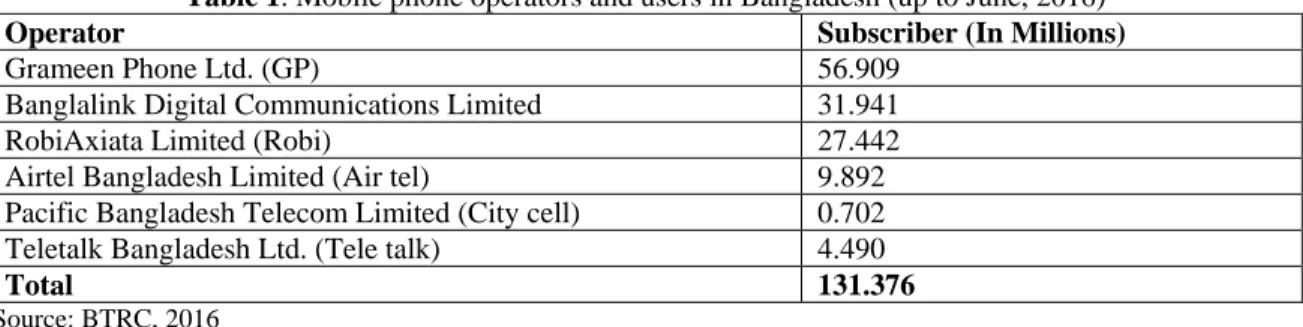
In recent years, the mobile industry in Bangladesh has dramatically developed both at urban and rural area. Bangladesh has 131.376 million mobile phone subscribers at the end of June, 2016 which is very high for a developing lower income country like Bangladesh. The Mobile Phone subscribers by the end of June, 2016 are shown in Table 1.
Table 1. Mobile phone operators and users in Bangladesh (up to June, 2016)
Operator Subscriber (In Millions)
Grameen Phone Ltd. (GP) 56.909
Banglalink Digital Communications Limited 31.941
RobiAxiata Limited (Robi) 27.442
Airtel Bangladesh Limited (Air tel) 9.892 Pacific Bangladesh Telecom Limited (City cell) 0.702 Teletalk Bangladesh Ltd. (Tele talk) 4.490
Total 131.376
Source: BTRC, 2016
information asymmetries (Overa, 2006). So, use of the mobile by the farmers may be the potential one for farm productivity. Several studies found that mobile phones reduced transportation costs where trips for social and business purposes were substituted with phone calls (Overa, 2006; Balasubramanian, 2010; Boadi, 2007; Frempong, et. al., 2007; Samuel, et el., 2005; Sife et al., 2010) which is beneficial for easily perishable crops like vegetables having less storage and market facilities (Kameswari et al., 2011). However, for better marketing of vegetable ensuring the bargaining capability of vegetable growers, they need to be connected with a greater ICT network specially the mobile based communication network for increasing their access to need based information on time (Jensen, 2007). But, very limited information about the factors affecting the mobile phone usage by the farmers in receiving agricultural information on vegetable cultivation was available. Hence, this study focuses the following objectives to accomplish its purpose: i) to determine the extent of use of mobile phone by the farmers in receiving information on vegetable cultivation, ii) to explore the influencing factors on the use of mobile phone in receiving information and iii) to identify the problems faced by the farmers in communicating through mobile phone in receiving information on vegetable cultivation.
2. Methodology
2.1 Study Area
The study was conducted at three villages of Mymensingh sub-district under Mymensingh district in Bangladesh. These three villages were purposively selected because of being newly accredited lands locally known as char area where vegetables are cultivated extensively. Mymensingh is the newest division of Bangladesh. It is one of the major vegetable growing areas of the country. Evidence of agro based researches is almost absent in this localities having poor transportation system was also the reason behind the chosen this area for this research.
2.2 Population and Sampling
Vegetable farmers of study area who were cultivated vegetables at least 0.1 hectare of land as well as use mobile phone as a communication media were considered as population of the study. The total numbers of the vegetable farmers using mobile phone in the study area were 280. Using the simple random selection method, 70 farmers were selected (25% of the population) as sample of the study assuming that this sample may be representing the whole vegetable growers of the study area.
2.3 Data Collection Technique
Both qualitative and quantitative means of data collection procedures were used in the study. Data were collected through the pre-tested questionnaire by face-to-face interview procedure during 1 April to 1 May, 2016. The interviews, lasting about one to two hours for each farmer, focused on the determination of extent of mobile phone use by the vegetable farmers. Cross-check interviews were conducted with Sub-Assistant Agriculture Officer (SAAO) and relevant non-government organization (NGO) workers. Data from questionnaire interviews were coded and entered into SPSS software package for analysis.
2.4 Measurement of Variables
information centre, pesticide dealer, seed dealer, fertilizer dealer, Sub-Assistant Agriculture Officer, Agricultural Extension officer, Upazila Agriculture Officer, NGO worker, Businessmen and mobile operator agricultural help desk. The study observed farmers use of mobile phone for getting vegetable cultivation related information from these sources. So, total possible score could ranges from 11 to 44, where ‘11’ indicated lowest user and ‘44’ indicates highest user of mobile phone in receiving information on vegetable cultivation. According to the possible score, the farmers were categorized into three groups considering equal score in each group i.e. Low usage group (up to score 22), moderate usage group (score 23 to 33) and high usage group (score above 33).
To identify the factors associated with the use of mobile phone for getting information on vegetable cultivation, coefficient of correlation and step-wise multiple regressions were used. The problems (mentioned in Table 7) faced by the farmers in using mobile phone were identified during pre-testing the questionnaire. Initially, twelve problems were included in the questionnaire. However, after analyzing the pre-tested questionnaire, nine possible problems were selected. A four point rating scale weighing 0, 1, 2, and 3 for not at all, low, moderate and high respectively was used to explore the extent of problems faced in using mobile phone. The possible scores of the respondent ranged from 0 to 27 where ‘0’ indicates the respondent had no problem and ‘27’ indicate his highest problem. According to the possible score, the farmers were categorized into three group considering equal score in each group i.e. Low problem (up to score 9), medium problem (score 10 to 18) and high problem (score above 18).
For better understanding of the extent of problems faced, Computed Problem confrontation Score (CPCS) was developed to make rank order the problems by the following formula.
PCS= Ph x 3 + Pm x 2 + Pl x 1 + Pn x 0 (1) Where,
PCS= Problem confrontation Score
Ph= Number of farmers indicating high problem Pm= Number of farmers indicating moderate problem Pl= Number of farmers indicating low problem Pn= Number of farmers indicating no problem at all
3. Results and Discussions
Table 2. Distribution of respondents according to their overall use of mobile phone Characteristics Farmer’s Categories
(scores) No. Percent Mean
Standard deviation
Use of mobile phone
Low usage (up to 22) 49 70
21.19 2.683 Moderate usage (23-33) 21 30
High usage (above 33) 0 0
Total 70 100
Source: Field Data, 2016
3.2. Relationship between the Selected Characteristics of the Vegetable Farmers and Their Use of Mobile Phone in Receiving Information on Vegetable Cultivation
To examine the relationships of each of the selected characteristics of vegetable farmers and their overall use of mobile phone in receiving information, a Pearson’s product moment coefficient of correlation analysis was used. The results of the correlation analysis between the concerned variables have been presented in Table 3.
Table 3. Correlation between selected characteristics of vegetable farmers and their use of mobile phone in receiving information on vegetable cultivation (N=70)
Focus variable Explanatory variables (selected characteristics)
Correlation coefficient (r) with 68 d.f.
Use of mobile phone by the farmers in receiving information on vegetable cultivation
Age -.575**
Education .391**
Family size -.205
Farm size .092
Annual income .092
Social participation .511**
Farming experience -.511**
Credit received .126 Knowledge on vegetable cultivation -.054
** Significant at 0.01 level of probability (table value 0.325 with 68 df)
The results show (Table 3) that only age, level of formal education, social participation and farming experience were found significantly correlated at 1% level of probability with the focus variable. Among the four, age and farming experience were found negatively significant with the focus variable. It is indicated that both increases farmers’ age and farming experience, the tendency to use mobile phone for getting vegetable cultivation related information decreases significantly. It is quite obvious that old person are more traditional in nature and they believe in their customary system of cultivation. Studies also showed that young ( Richardson, et al., 2000) and middle aged people are more prone to mobile phone usage while as the age goes beyond 50, mobile phone usage remains far behind (Islam and Gronlund, 2011; Jain and Hundal, 2007). Besides, experienced farmers do not want to change their usual farming practices and they also have ample knowledge on the cultivation procedure. This makes the farmers less interested in seeking information.
influence by the peer group is stronger than individual characteristics in adoption of any technology (Kargin and Basoglu, 2007). When farmers participate in different social programs and visit their peer groups they come into know more on cultivation practices. This encourage them seeking information over the mobile phone as it is the easiest as well as quickest medium to get information.
3.3 Econometric Estimation on Identifying the Factors Affecting the Use of Mobile Phone by the Farmers
A step-wise multiple regression analysis was employed to identify the determinants of the use of mobile phone in receiving information on vegetables cultivation. The stepwise multiple regression analysis (Table 4) indicates that out of four explanatory variables (those showed significant relationship in correlation analysis) only two variables finally entered into the model and contributions of these variables (age of the respondents and social participation) which accounted for 41.1 per cent (adjusted R2 = 0.641 and F- values, p>.01) of the total variation in the use of mobile phone for getting vegetable cultivation related information.
Table 4. Step-wise multiple regression analysis showing contribution of the selected characteristics to the use of mobile phone
Variables entered in the model
Coefficient of determination
Multiple R2
Change in R2
Variance explained (%)
Significant
level F-value t-value
Age 0.575 0.331 0.331 33.1 0.000 33.645 -5.800
Social
participation 0.641 0.411 0.080 8.0 0.004 23.413 3.025
The first variable to enter the step-wise multiple regressions was the age of the respondents which solely had the highest contribution of 33.1 percent in predicting the influence on mobile phone usage. It indicates that age of the respondents mainly regulates the use of mobile for getting information. Having a negative t-value suggests that age influences the mobile phone usage reversely while the age increases, use of mobile phone decreases significantly. It is very much understandable that mobile phone is a high technical device and old people do not understand how to use it properly. Besides, it requires technical knowledge to operate it comparing to the young people who found it quite easy to use, mobile phone use is rather difficult for the old village people who have less formal education and low exposure to technologies. They also like to stick to the traditional living and keep distance to different up to dated technologies.
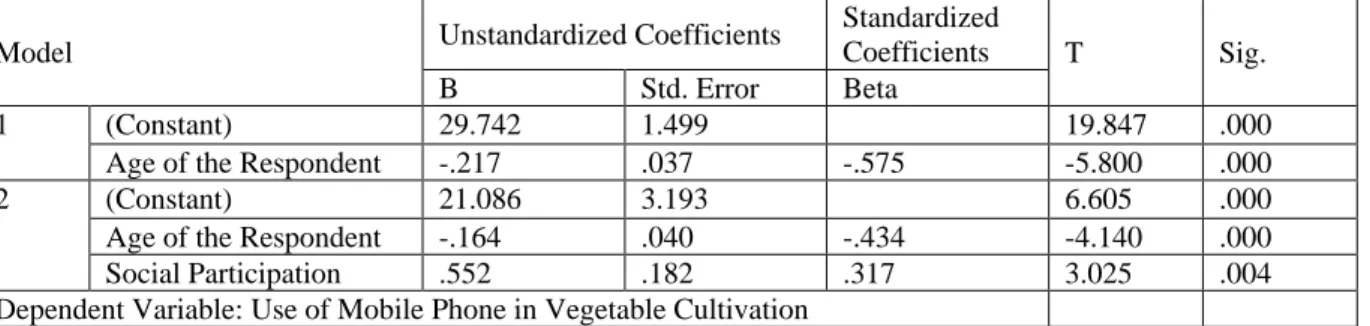
Table 5. Step-wise multiple regression model showing coefficients of dependent variable with the contributing characters
Model Unstandardized Coefficients
Standardized
Coefficients T Sig. B Std. Error Beta
1 (Constant) 29.742 1.499 19.847 .000
Age of the Respondent -.217 .037 -.575 -5.800 .000
2 (Constant) 21.086 3.193 6.605 .000
Age of the Respondent -.164 .040 -.434 -4.140 .000 Social Participation .552 .182 .317 3.025 .004 Dependent Variable: Use of Mobile Phone in Vegetable Cultivation
The following predicted equation (i) was developed using the results found in the Table 5.
Mobile phone usage by the vegetable farmers = 21.086- 0.164 (Age) + 0.552 (Social participation) (2)
The equation shows the probability of mobile phone usage by the farmers in receiving information. The contributing factors age and social participation will have influence on the usage as much as shown in the equation such as if social participation increases by one unit the mobile phone usage score will increase by 0.552 while age of the farmers increases one year, the mobile phone usage by the farmers will be decreased by 0.164. Besides, Standardized coefficient beta values shows that age of the respondents (-0.434) contributes more than the social participation (0.317) to the use of mobile phone for farm information. So we can say that if the social participation and communication of the farmers increase it is quite possible that farmers will be more interested in getting farm related information using mobile phones. Besides we should emphasis more on motivating the aged farmers as they are more involved in farming yet unwilling to use mobile phones. So we have to give more efforts to encourage the aged farmers than the young farmers to use mobile phones for agricultural purposes.
3.4 Problems Faced in Using Mobile Phone by the Farmers
Table 6. Categories of problems faced by the farmers in using mobile phone Possible
range
Observe
Range Categories
Farmers
Mean SD No. %
0 - 27 10 - 19
Low problem (up to 9) 0 0.00
14.11 1.975 Medium problem (10 to 18) 68 97.1
High problem (above 18) 02 2.9
Total 70 100.0
However, problem score for each statement was calculated by using problem confrontation score formula as stated earlier and it has been arranged in rank order according to their high problem and placed in Table 7.
Table 7. Problems of using mobile phone by the vegetable farmers with rank order
Problems
Number of respondents indicating constraints
PCS Rank
order
High Moderate Low Not at
all
Lack of servicing center 38 32 0 0 178 1
Expensive mobile set 15 47 8 0 147 2
Electricity problem 19 30 21 0 138 3
High cost of repairing 8 48 14 0 134 4
Mobile phone operating problem 9 31 27 3 116 5
Short length of battery
Charge 7 28 35 0 112 6
Network problem 0 33 35 2 101 7
Technical problem of
Phone 0 31 36 3 98 8
Unexpected calls 0 5 30 35 40 9
The results in the Table 7 revealed that among nine selected problem items lack of servicing centre ranked first followed by expensiveness and electricity problem of the mobile phone.
4. Conclusion and recommendations
The use of mobile phone in receiving information on vegetable cultivation was not satisfactory in the study area. Rather the use of mobile phone was very low in receiving agricultural information. This may be due to traditional mind set up of the farmers which restricts them using the new improved technologies like mobile phone. Besides, adequate electricity supply, lower farming experienced, low rate of literacy, low communication exposure, lack of technical knowledge etc. may be other important reasons of getting lower usage of mobile phone by the farmers in the study area. Farmers’ characteristics such as education and social participation had significant and positive relationships with their use of mobile phone while age and farming experience had significant and negative relationships. Among them age and social participation explained 41.1 per cent of the variations to mobile phone usage was confirmed by the step-wise multiple regression model. Lack of mobile servicing centre, costly and electricity problem were the major constraints that cause hindrance to the use of mobile phone in receiving information on vegetables cultivation. Increased use of mobile phone can be ensured better solution to pest attack, proper marketing and earning more from the existing facilities. Therefore, Government should take initiatives to ensure proper electricity supply in village area and provide subsidy to easily purchase of mobile phone by the farmers. Bedsides, government field level extension agents for instance Sub-Assistant Agricultural Officer (SAAO) should encourage and assist the farmers to use mobile phone in not only receiving but also sending information on vegetable cultivation.
Acknowledgments: The authors are greatly acknowledged to the farmers who given their opinion and make the research accomplished. The authors never forget to give thanks to Mrs. Helen Tabot who is working as Head Human Resources and Customer Service at MC Bauchemie, Ghana for her efforts to make English corrections.
Author Contributions: Abu Salem Asif is the primary author. He designed, formulates methodology and conceptualizes the whole work. This paper is written partly based on the MS thesis of the primary author. Mohammed Nasir Uddin had also significant contributed to design and conceptualize the whole study. In addition, he had also substantial contributed to interpret the results of the study. Debashish Sarker Dev was the data analyst and contributed to interpret the data. He also helps the primary author to write up the whole manuscript. Md. Abdul Momen Miah contributed on content in various sections including introductory and concluding remarks, description and justification of the methodological approaches and other related issues.
References
Aker, J C 2011 ‘Dial ‘A’ for Agriculture: Using Information and Communication Technologies for Agricultural Extension in Developing Countries’. Washington D.C.: Center for Global Development.
BTRC 2016 Bangladesh telecommunication Regulatory Commission. ‘Mobile Phone Operators and Users in Bangladesh’ Retrieved from http://www.btrc.gov.bd/newsandevents/mobile_phone_ subscribers / mobile_phone_ subscriber_june, _2016.php (searched date: 14 December 2016).
Ashraf, N, Gine, X and Karlan, D 2005‘Growing Export Oriented Crops in Kenya: An Evaluation of Drum-Net Services’. Ottawa: IDRC.
Awuor, F, Kimeli, K, Rabah, K and Rambim, D 2013 ‘ICT solution architecture for agriculture’. In IST-Africa Conference and Exhibition (IST-Africa), pp1–7.
Balasubramanian, K 2010‘Using mobile phones to promote lifelong learning among rural women in Southern India’. Distance Education, vol. 31, no.2, pp193–209. https://doi.org/10.1080/01587919.2010.502555
BBS 2014‘Statistical Yearbook of Bangladesh. Bangladesh Bureau of Statistics’, Statistics Division. Ministry of Planning, Government of the People’s Republic Bangladesh.
BBS 2012‘Statistical Yearbook of Bangladesh’. Bangladesh Bureau of Statistics, Statistics Division. Ministry of Planning, Government of the People’s Republic Bangladesh.
Chong, A., V. Galdo, M2005 ‘Torero.. Does privatization deliver? Access to telephone services and household income in poor rural areas using a Quasi-Natural experiment in Peru’. Inter-American Development Bank Working Paper No. 535. Washington, DC.
De Silva, H 2008 ‘Using ICTs to Create Efficiencies in Agricultural Markets: Some findings from Sri Lanka’. In the proceeding of IDRC. May.
DiMaggio, P and Cohen, J 2003 Information Inequality and Network Externalities: A Comparative Study of the Diffusion of Television and the Internet’. The Economic Sociology of Capitalism. pp 31.
Donner, J 2008 ’Research Approaches to Mobile Use in the Developing World: A Review of the Literature’. The Information Society, vol.24, no.3, pp140–159. https://doi.org/10.1080/01972240802019970
Fafchamps, M, and Hill, R, V 2005 ‘Selling at Farmgate or Traveling to Market.” American journal of Agricultural Economics, vol.87, no.3, pp 717-734. https://doi.org/10.1111/j.1467-8276.2005.00758.x
Foster, A D, and Rosenzweig, M R 2010 ‘Microeconomics of technology adoption. Annual. Review Economics, vol. 2, no.1,pp 395–424. https://doi.org/10.1146/annurev.economics.102308.124433
Frempong, G, Essegbey, G, and Tetteh, E 2007‘Survey on the use of mobile telephones for micro and small business development: The case of Ghana’, Accra: Science and Technology Policy Research Institute.
Furuholt, B and Matotay, E 2011 ‘The Developmental Contribution from Mobile Phones Across the Agricultural Value Chain in Rural Africa’. The Electrical. Journal of Information System in. Developing Countries, vol. 48, no.7, pp,1–16
Gerber, W 2008. Defining Developing Country in the Second Commitment Period of the Kyoto Protocol’. BC Int’l & Comp. Land Review, vol.31, pp327.
Islam, S M, and Gronlund, A G 2011 ‘Factors influencing the adoption of mobile phones among the farmers in Bangladesh: Theories and practices’. International Journal. on Advanced in ICT for Emerging Regions, vol. 4, no.1, pp 4-14.
Jain, A, and Hundal, B S, 2007 ‘Factors Influencing Mobile Services Adoption in Rural India’. Asia Pacific journal of Rural Development vol. 17, no.1,pp17-28.
Jansen, H G P, Pender, J,Damon, A, and Schipper, R 2006‘Rural development policies and sustainable land use in the hillside areas of Honduras’. A quantitative livelihoods approach. Research Report 147. International Food Policy Research Institute. Washington. D C.
Jensen, R 2007‘The Digital Provide: Information (Technology), Market Performance, and Welfare in the South Indian Fisheries Sector’. The Quarterly journal of. Economics, vol.122, no.3,pp 879 –924.
https://doi.org/10.1162/qjec.122.3.879
Kameswari, V L V, Kishore, D and Gupta, V 2011‘ICTs for Agricultural Extension: A Study in the Indian Himalayan Region’. The Electrical. Journal on Information System in. Developing Countries, vol. 48, no.3, pp 1–12.
Kargin, B and Basoglu, N 2007 ‘Factors Affecting the Adoption of Mobile Services’. PICMET Proceedings, Portland, USA, 5-9 August.
Khan, S 2016‘Effectiveness of Agricultural Information and Communication Center in Technology Transfer to the Farmers in Bangladesh’. A Master Thesis, Department of Agricultural Extension Education, Bangladesh Agricultural University, Mymensingh, Bangladesh.
Lee, K H and Bellemare, M F 2013‘Look who's talking: the impacts of the intra house hold allocation of mobile phones on agricultural prices’. The Journal of Development Studies. Vol. 49, no.5,pp 624-640.
https://doi.org/10.1080/00220388.2012.740014
Mao Y 2012 ‘Meaning and mode of mobile information services’ (in Chinese). Information Science, vol. 2. Musa, A H 2008‘Benefiting ICT for all’. Inaugural Lecture Series. Serdang: UPM Publisher.
Muto, M, and Yamano, T 2011‘Mobile Phone Coverage and Market Participation: The Case of Banana Marketing in Uganda Emerging Development of Agriculture in East Africa’. Springer. pp 99-113.
Qiang, C Z W 2011‘Mobile Applications for Agriculture and Rural Development’. Washington D.C.: World Bank.
Rashid, S M M, Islam, M R. Quamruzzaman, M. 2016 Which Factor Contribute Most to Empower Farmers Through e-Agriculture in Bangladesh?’Springer Plus, vol.5, pp1742, https://doi.org/10.1186/s40064-016-3443-3
Richardson, D, Ramirez, R and Haq, M 2000 “Grameen Telecom's Village Phone Programme: A Multi-Media Case Study”. CIDA, Canada.
Samuel, J, Shah, N and Hadingham, W 2005‘Mobile communications in South Africa, Tanzania and Egypt: results from community and business surveys. In Africa: The Impact of Mobile Phones’. The Vodafone Policy Paper Series No.3. Vodafone Group, 44–52.