A STUDY, USING A SIMULATED
SEA - WATER, OF THE
DISPOSAL OF
ACIDIC IRON EFFLUENT AT
SEA
C. W. GEORGE,
-
B.Sc,, B.E. (HoNs.) (SYDNEY)
SUBMITTED IN FULFILMENT OF THE REQUIREMENTS FOR
THE DEGREE OF
MASTER OF SCIENCE
UNIVERSITY OF TASMANIA
HOBART
To the best of my knowledge this thesis contains no material which has been accepted for the award of any other degree or diploma in any University and contains no copy or paraphrase of material previously published or written by another person, except where due reference is made in the text.
ACKNOWLEDGEMENTS
I wish to express my appreciation to Professor H. Bloom for his supervision and guidance during the period this research was undertaken.
I wish to thank fellow research students and staff of this department for valuable research discussions and their continued encouragement.
Thanks are due to Mrs. H. Hen, Mrs. B. Dix and Mrs. S. Petrie for their assistance in the preparation of this thesis.
CONTENTS
ABSTRACT
ABBREVIATIONS
CHAPTER 1 INTRODUCTION - ACIDIC FERROUS SULPHATE EFFLUENT
Page
1.1 Titanium Dioxide Manufacture 1
1.2 Treatment of Liquid Effluent
4
1.3 The Disposal of Effluent at Sea
8
1.4 Object of Research
14
1.5 References
16
CHAPTER 2 SOLUBILITY OF IRON IN SEA-WATER 18 2.1 The State of Iron in Natural Waters 18 2.2 Chemical Speciation in Sea-Water 23
2.3 Iron in Sea-Water 26
2.4 Ferric Iron Solubility in Sea-Water 27 2.4.1 Method of Calculation 27 2.4.2 Extension of Previous Calculations 29 2.4.3 Results and Discussion 32 2.5 Ferrous Iron Solubility in Sea-Water 35
2.5.1 Introduction 35
2.5.2 Method of Calculation 36 2.5.3 Results and Discussion 41 2.6 Interaction of Industrial Effluent with 48
Sea-Water
2.6.1 Introduction 48
CONTENTS (continued). Page
2.6.4 Results and Discussion 53
2.7 References 58
CHAPTER 3 KINETICS OF FERROUS IRON OXIDATION 60 . 3.1 Oxidation of Ferrous Iron in Acidic Liquors 60 3.2 Oxidation of Ferrous Iron in Natural 63
Waters
3.3 Present Kinetic Studies 66
3.3.1 Approach 66
3.3.2 Artificial Sea-Water 69 3.3.3 Experimental Method 71 3.3.4 Rate Analysis of Experimental Data 77
3.4 Results and Discussion 86
3.4.1 Closed Kinetic Runs at 25°C 86 3.4.2 Kinetic Analysis of Closed Runs at 93
25°C
3.4.3 Closed Kinetic Runs at 12oC 104 3.4.4 Closed Runs at 25°C Using Samples 109
of Real Sea-Water and Industrial Effluent
3.4.5 Open Kinetic Runs at 25°C 118
3.5 References 124
CHAPTER 4 THE PRODUCT OF FERROUS IRON OXIDATION 126 4.1 Iron Oxidation and Hydrolysis Products 126
4.2 Preparation of Reference Compounds 132 4.3 Investigation of Precipitates 134 4.3.1 Examination of Samples 134 4.3.2 Estimation of Crystallite Size 134
4.4 Results and Discussion 137
CONTENTS (continued)
Page
4.4.2 X-Ray Diffraction and Crystallite 143 Size
4.4.3 Electron Microscopy 154
4.5 References 156
CHAPTER 5 SUMMARY AND CONCLUSIONS 158
5.1 The Interaction of an Acidic Ferrous 158 Sulphate Effluent with Sea-Water
5.2 Suggestions for Further Work 168
5.3 References 170
APPENDICES
Appendix 1 171
Appendix 2 172
Appendix 3 176
Appendix 4 178
Appendix 5 180
• Appendix 6 181
AS TRACT
The titanium dioxide pigment industry at present disposes of a large quantity of acid-iron waste by dumping it at sea. The ensuing interactions result in a red discolouration of the environ-ment which is a source of increasing public concern. A study has been made of the reactions that occur when an effluent solution of ferrous sulphate in sulphuric acid is added to sea-water.
On addition of the effluent solution there is an initial rapid reaction between the effluent acid and the bicarbonate buffer of sea-water. The ferrous iron content is dispersed, is subsequently oxidised and precipitates as a form of ferric hydroxide. In sea-water ferrous iron solubility is controlled by the solubility of
ferrous carbonate. Solubility calculations, based on available thermo-dynamic data at 25°C, show that for the composition of typical
industrial effluents there is little possibility of ferrous carbonate precipitating on effluent dispersion in sea-water.
The kinetics of the ferrous oxidation reaction has been de-termined by following changes in dissolved oxygen concentration and pH in samples of a simulated artificial sea-water. The kinetics can be best described by the rate expression:
-d(Fe2+)
(Fe2+) (02) (OH-)2
dt
where k has a value of 5.7 ± 0.6 x 10 16 iitre3 mole-3 min-1 at
25°C for artificial effluents.
The product of ferrous oxidation has been examined by infra-red spectroscopy and by X-ray diffraction and has been found to be poorly crystalline lepidocrocite, y-Fe0OH. Average crystallite sizes for the oxidation precipitates formed have been estimated and have been found to lie in the range 5.5 nm to 14 nm.
ABBREVIATIONS
The following abbreviations and conventions are used in this thesis:
(A) = concentration of species A (as appears in the text).
JA] = concentration of species A (as appears on the diagrams).
initial ferrous iron concentration -mg/litre
Alk = alkalinity of solution - equivalents/litre
1
CHAPTER 1
INTRODUCTION — ACIDIC FERROUS SULPHATE EFFLUENT
1.1
TITANIUM DIOXIDE MANUFACTURE
The titanium pigment industry, barely established before 1930, has enjoyed a rapid rate of growth since the Second World War. Because of its brilliant whiteness, high refractive index, chemical stability and non-toxicity, titanium dioxide (Ti0 2) is extensively
used as a pigment in the paintand allied industries and is find- ing increasing application in many other industries, such as in plastics and paper manufacture. The chemical manufacturing process on which the titanium pigment industry was originally based is called "the sulphate process", and this process accounts for the bulk of the world's titanium dioxide production at the present time (1).
At most factories using the sulphate process the starting point in the manufacture of titanium pigments is ilmenite (Fe0-Ti02),
a combination of titanium oxide and iron oxides which is commonly obtained as a black beach sand. The raw sand is dried, ground to a fine powderand then reacted with concentrated sulphuric acid. On completion of acid digestion the iron present, which has been simultaneously dissolved, is fully reduced to the ferrous state. The resulting solution is then cooled to remove the iron by precipi-tation as hydrated ferrous sulphate (FeSO4-7H20). After filtration
Calcination of the hydroxide under controlled conditions forms the basic titanium dioxide. Subsequent treatment by both grinding and chemical surface coating produces the differing grades of pig-ment for specific industrial requirepig-ments (2). A flowchart of the process is given in Figure 1.
Because of the high proportion of iron in ilmenite, the most abundant titanium ore, the quantity of ferrous sulphate formed in the sulphate process is substantial, the rate being roughly 3.5 kilogrammes per kilogramme of titanium dioxide (3). Unfortunately hydrated ferrous sulphate, known commercially as "copperas" or
"green salt", can only be utilized to a limited extent. A relatively small amount is used as a flocculant for biological sludges. Larger amounts are used in sulphuric acid manufacture but the high water of crystallisation content presents problems in the roasting process (4), and more economic raw mater;a1 alternatives are readily available. Because of its solubility and acidic nature waste copperas cannot
be dumped as solid fill. Consequently, most pigment manufacturers redissolve their waste copperas in the spent acid remaining at the end of the sulphate process (Figure 1). This yields a final acidic effluent relatively high in iron and produced in large quantity. For example, the final effluent from the 32,000 tonne Tioxide Australia Pty. Ltd. plant at Burnie, Tasmania, has an average composition of 30 gm /1 Fe and 73 gm/1 H 2 SO4 (7.3% FeSO 4 and 6.6%
WEAK ACID FILTRATION
CRYSTALLIZATION FERROUS SULPHATE
HYDROLYSIS AND PRECIPITATION
NUCLEI --) TITANIUM
SALT
CALCINATION
Ti02, RUTILE OR ANATASE
FIGURE 1 - THE SULPHATE PROCESS FOR THE MANUFACTURE OF TiO2 PIGMENT
ILNENITE SULPHURIC ACID
NET REACTIONS A. DIGESTION
FeO.TiO
2 + 3112504 + 4H20 ----,- Ti(S04)2 + FeS0
4•7H20 B. HYDROLYSIS
Ti(S0
4)2 + 41120 Ti(OH)4 + 2H2SO4 CALCINATION
Ti(OH)
4 TiO2 + 2H20 DIGESTION
REDUCTION
CLARIFICATION SCRAP
IRON ---+
PIGMENT FINISHING AND COATING
1.2
TREATMENT OF LIQUID EFFLUENT
Both the titanium pigment industry and the stEel industry have for many years been faced with the problem of disposing of huge quantities of waste solution containing ferrous sulphate and free sulphuric acid. In the steel industry the product is the result of treating sheet steel with hot sulphuric acid to remove scale and rust, a process known as pickling. The waste liquor has generally the same composition as that discharged from titanium plants (6). Because of the high concentration of free acid and contained iron in the effluent simple treatment schemes such as neutralization and removal of precipitated iron are necessarily expensive, and such treatment still leaves the problem of the disposal of the large quantities of iron sludge produced. In addition, it is naturally preferable to manufacturers to try to recover their waste sulphuric acid from the effluent for reuse. However, in spite of an enormous amount of research over the last fifty years complete and economic regenerative processes for acidic ferrous solutions have yet to be developed.
proposed a new treatment process based on the bacteriological oxidation of ferrous iron and the precipitation of jarosite, a basic ferric sulphate (8).
The waste disposal problems of titanium dioxide producers have also been recently reviewed (9). As expected, most proposed treatment methods are identical to those investigated by the steel industry. Grishaeva (10) has presented a technical and economical evaluation of commercial scale and laboratory methods for processing spent sulphuric acid from pigment manufacture, but makes no mention of ferrous sulphate disposal. He concludes that methods based on
neutralization with lime or boiling down the spent acid to higher H
2SO4 concentrations are not economical. A stepwise treatment of
pigment effluent to produce fertilizers, such as (NH4)2SO4, and Fe ochre pigment is one of several treatment methods under recent investigation (11). In the present absence of any economic treatment or regenerative process,and faced with a large disposal problem, the majority of "sulphate process" pigment manufacturers employ the
relatively cheap expedient of dumping their acidic ferrous sulphate effluent at sea. With increasing community awareness of pollution, however, the environmental effects of wastes discharged to the sea are coming under closer and closer investigation and this method of
disposal is a growing source of controversy.
In 1973 the United States Environmental Protection Agency conducted a survey of the major inorganic chemical industries in order to help formulate effluent limitation guidelines. It was
Those producers with plants on the coast were generally barging theiracidic ferrous liquid waste to sea, but USEPA did not consider
this method of disposal satisfactory and believes the future of this alternative to be very uncertain.
In
an economic analysis of proposed effluent guidelines, USEPA considered two separate treatment approaches for sulphate process plants - acid neutralization and acid recovery (13). The exemplary method of acid neutralization was regarded to be with lime-stone, followed by lime treatment to raise the pH to approximately 8 so as to precipitate iron and other metallic oxides and hydroxides. This treatment reduces the waste load discharge to the solubility limits of calcium sulphate. When costed, it was found that the investment in treatment facilities necessary for acid neutralization and acid recovery represented 55% and 26% respectively of the cost of the net plant (13), indicating the sizable investment relative to existing plant required to attain zero discharge of waterborne wastes. Of the major inorganic chemicals, TiO 2 stood out as the productwhere the estimated effluent treatment costs represented the highest proportion of both selling price and profit margin. The economic analysis concluded that if strict effluent controls were enforced then several sulphate process producers would be faced with shutdown
decisions.
Because of the magnitude of the effluent disposal problem fac-ing the titanium pigment industry,and to a somewhat lesser extent the steel industry, both have developed alternative processes to lessen their waste load. In the steel industry hydrochloric acid is in-creasingly replacing sulphuric acid in the pickling baths (14).
also to relatively simple regeneration processes for treatment of iron-containing hydrochloric acid effluent liquors (7).
The alternative process for the manufacture of titanium dioxide is "the chloride process" developed in the early 1950's by American technology. The majority of new pigment plants built since 1956 are based on the chloride process and this method of pro-duction now accounts for approximately 20% of the world's pigment output (2). The basic raw material rutile, containing 95 + % TiO
2' is mixed with petroleum cake or other carbon-containing
material and exposed to chlorine at a temperature of 1000 °C. The titanium chloride formed is separated from other chlorides by distill-ation and reacted with oxygen at 1000°C. Titanium dioxide and chlorine are obtained. The drawback to this process is that, in comparison with ilmenite the raw material rutile is in short supply.
Much work has been undertaken into the upgrading of ilmenite into a "synthetic rutile" suitable for use in the chloride process and a "titanium slag" suitable for use in the sulphate process. In the latter case, ilmenite is treated metallurgically with coal and lime for the purpose of removing its iron content (15). However, until this enriched raw titanium dioxide is available in large quan-tities, and given the large investment in sulphate process plants around the world, the titanium pigment industry will continue to be faced with the problem of disposing of large volumes of acidic
1.3
THE DISPOSAL OF EFFLUENT AT SEA
The disposal of acidic ferrous sulphate effluent at sea rep-resents a large cost advantage over chemical treatment options and is achieved either by barging or by pumping through direct submarine pipelines. Some titanium dioxide manufacturers have transferred their plants to the coast in order to reduce the distance tc the sea (15). The use of the ocean as a dumping ground utilizes the alkaline nature of sea-water and relies on rapid dilution to neutralize the
spent acid in the effluent and disperse its iron content. A rapid initial dilution is necessary to avoid any toxic effects on the marine environ-ment in the area immediately around the outfall. Ocean currents are then relied upon for further dilution and dispersion.
Published environmental studies of marine pollution resulting from the discharge of acid-iron waste from titanium dioxide manufacture centre on two major dumping areas. Since 1950 a titanium plant of the National Lead Company has been disposing of its acid waters in an approved region 10-13 miles off the New Jersey (New York) coast. Discharge of tanker loads of similar liquid waste into an area of the German Bight began in May 1969.
Not long after barge dumping commenced off the New York coast, Redfield and Walford (16) investigated the effect of disposal on
the fisheries and on the composition of the sea water.
The waste, discharged into the propeller water of the tanker to achieve adequate initial dilution, contained 10% FeSO4 and 8.5%
H
2SO4 and was being dumped at a rate of about 4,050 tonnes per day.
that "within thirty seconds of discharge the waste is diluted with
more than 250 volumes of sea water and causes only a temporary deviation from the normal chemical balance. On discharge the waste acid is
rapidly neutralized, ferrous ions are oxidized and, as the sea water is saturated with respect to ferric ions, the iron is precipitated as colloidal ferric hydroxide. Sulphate, being one of the main constituents of sea water, is easily absorbed. Ferric hydroxide causes turbidity and does not settle very rapidly; this is advantag-eous as the precipitate is distributed widely by currents before settling to the bottom. The oxidation process is fairly slow and no more than 3-4 per cent of the oxygen present is used' (16). Biological investigations showed that the disposal of the waste temporarily
immobilized the zooplankton in the relatively small area of discharge but had no detectable effect on the bottom fauna or fish population ,.
Subsequent studies of the dumping area (17, 18) have shown no evidence of serious pollution and the region has become a good
fish-ing ground. Vaccaro and co-workers made an in-depth study of the ecological consequences arising from 22 years of barge disposal. They found that only 10-20% of the iron measured in the New York Bight
was in true solution or occurred as particles less than lpm in diameter, while the remaining iron fraction was in the form of particulate matter. The maximum concentration of iron in the water column (832 pg/1)
1
0nature of the waste material involved" (18).
In an investigation into the ocean disposal of titanium waste (14% FeSO4 and 10% H2SO4) in the German Bight, Rachor (19) states that on discnarge the waste acid is neutralized, ferrous iron is oxidized and the precipitated hydrated ferric oxide forms flakes which float above the bottom sediment with little or no permanent deposition. However, with time, the numbers of both individuals and species of macrofauna were found to have increased and the flakes of hydrated ferric oxide had not hindered the settlement of new species nor of some species previously found in the area. Weichart (20) studied physical and chemical changes in the water and on the sea bed resulting from the effluent discharge. Dilution of the acid waste was found to be rapid and about two hours after the release the pH value (initially about 6) had returned to nearly normal (pH 8), the oxygen concentration was nearly normal, and the iron concentration (initially 40 mg/1) was 2 mg/1, with no immediate effects on the sea bed. Six months after the first discharge the polluted zone was found to cover about 500 km2 and the maximum concentration of iron in the water was 500 pg/l. Reviewing the results of waste dumping in the German Bight, Steinert (21) notes that although according to prediction and experiment it was reasoned that the discharge of "dilute iron rich acid" and red mud (from bauxite beneficiation) must have a devastating effect on the fauna, the opposite has happened. He states that the hydrographic and sedimentologic processes of deposition following waste dumping have been given little consideration and calls for work to solve such questions as what size particle arises on iron hydroxide precipitation.
Several workers have undertaken laboratory toxicity studies with acidic ferrous sulphate effluent. After experiments with copepod
ferric hydroxide flakes have been found to have mechanical effects on mussels with no evidence of acute toxicity (24). Smith et al
(25, 26) studied the effect of lime neutralized iron hydroxide suspens-ions on the survival, growth and reproduction of both the juvenile brook trout and flathead minnow and determined safe levels of suspen- ded iron. It was assumed that impaired visibility due to high turbidity prevented the fish from feeding which in turn resulted in slow growth in high Fe concentrations.
Although environmental studies have, as yet, shown no adverse effects of acidic ferrous sulphate waste dumping on marine life, the so-called "visual pollution" due to the discolouration of the sea by
precipitated ferric hydroxide is a continual source of public protest. Italian fishermen recently protested violently at the dramatic red.hue taken on by the sea as a result of waste disposal by barging from a titanium dioxide plant at Scarlino (27). The problem of ocean colouration particularly applies to those pigment manufacturers who dis-charge their waste to the sea by direct pipeline. In this case, as well as the discolouration of offshore waters, local coastlines and beaches can be subject to staining with a concomitant rise in public outcry. Some producers have found that discolouration can be reduced by
extend-ing their pipelines further out from shore to take advantage of natural ocean currents (28).
Madeley, in a discussion of the waste disposal problems of the British chemical industry, believes that "the submarine pipeline as a form of effluent disposal should remain with us for many years, and in fact increase its application. It has been shown to offer an
economic as well as an environmentally acceptable solution when properly designed and controlled, compared with other methods" (29). He
12
these outfalls. Weber (15) also believes that the possibility of the sea as a dumping ground will become increasingly important for the inorganic chemicals industry in the future.
.Titanium pigment manufacturers who dispose of their waste through submarine pipelines are also faced with problems arising from the fact that, as noted by Rachor (19), ferric hydroxide tends to float above the ocean floor with little or no permanent deposition. This means that in the absence of natural dispersion currents large floating "deposits" of ferric hydroxide can be formed in relatively shallow coastal waters, easily stirred up by storm activity. Apart from the resultant periodically increased visual pollution, such
float-.
ing.depdOt's are theMselves Of'Possible Pollution concern on two accounts. Firstly, it is argued that the productivity of coastal waters can be affected by reduction of light penetration due to large amounts of suspended matter (29). Secondly, ferric hydroxide precipitates are known to be able to concentrate and accumulate heavy metals from dilute solutions.
13
period." The -'cloud' was found to contain high concentrations of heavy metals but the relative concentrations did not correspond closely with those in "pipe discharged iron-rich liquor." Although it was not
possible to establ .kh the precise nature of the cloud formation, the study
concluded that "it possibly originates from the chemical. precipitation of iron compounds in seawater and it is likely that heavy metals are taken up by the suspended particulates either by adsorption or biological accumulation."
14
1.4
OBJECT OF RESEARCH
The disposal of liquid effluent at sea is an economic and indeed vital practice for many titanium dioxide producers. Up to date the majority of scientific investigations have concentrated, naturally, upon the environmental impact of such disposal with only a short consideration of the chemical processes taking place. Present indications are that the acid - iron waste does not disrupt the marine ecology to any large extent, though the ability of iron hydroxide suspensionsto accumulate heavy metals may become of increas-ing concern. Possibly because of the concern with pollution, a
precise study of the chemical interaction of acidic ferrous sulphate effluent with sea-water does not appear to have been made. Such a study would appear to be warranted, particularly given the fact that it is the visual discolouration of the sea following the ferric
hydroxide precipitation process which greatly concerns the lay public. Moreover, the nature of the ferric hydroxide precipitate formed
following ferrous iron oxidation and the resultant particle size are important parameters in ecological considerations (21).
The present laboratory study aimed to investigate some aspects of the chemical interaction resulting on the introduction of an
acidic ferrous iron solution to sea-water. In particular,it was decided to concentrate on the following: the kinetics of the
15
16
1.5
REFERENCES
(1) "The Titanium Dioxide Industry" - Tioxide Australia Pty. Ltd., January 1974.
(2) "Progress" - a booklet produced by Tioxide Australia Pty. Ltd. (3) Weber H. H. - Pure and Applied Chemistry, 29, 67 (1972).
(4) Beeken D. W. - The Industrial Chemist, p604 (December, 1960). (5) Personal Communication.
(6) Bartholomew F. J. - Chemical Engineering, p 118 (August, 1950).
(7) Lacey D. T. - Rev. Pure and Applied Chemistry, 20, 23 (1970) (8) Lacey D. T. & Lawson F. - "A New Method for Treating and
Regenerating Spent Sulphuric Acid Pickle Liquor" - Dept. Chem. Eng., Monash University (1970).
(9) Bartolewski W. Chemik,27(2), 44 (1974) (Polish).
(10) Grishaeva V. A. & Buryak K. A. - .Tr., Nauch. Issled. Inst. Udobr. Insektofungits.1970, No. 216, 3-15 (Russian).
(11) Ganz S. N. et al - Vop. Khim. Khim. Tekhnol.,30, 193 • (1973) (Russian).
(12) "Development Document for Proposed Effluent Limitations Guidelines and New Source Performance Standards for the Major Inorganic Products Segment of the Inorganic Chemicals Manufacturing Point Source Category" - United States Environ-mental Protection Agency - August 1973.
(13) "Economic Analysis of Proposed Effluent Guidelines, Inorganic Chemicals, Alkali & Chlorine Industries (Major Products)" - United States Environmental Protection Agency - August 1973. (14) Chem. & Eng. News, March 3,• 38 (1969).
(15) Weber H. H. - Pure and Applied Chemistry, 29, 67 (1972). (16) Redfield A. C. & Walford L. A. - National Research Council of
the National Academy of Sciences, Publication No. 201, Washington D.C., 1951.
(17) Peschiera L. & Freiherr F. H. - J. Wat. Pollut. Control. Fed., 40, 127 (1968).
17
(21) Steinert H. - Frankfurtar Allgemeine Zeitung, No. 108, May 10 (1972).
(22) Grice G.D., Wiebe P. H. & Hoagland E. - Estuar. Coast. Mar. Sci., 1, 45 (1973).
(23) Ibid., p.51
(24) Winter J. 1: - Mar. Pollut. Sea Life, FAO, 392 (1972). (25) Smith E. J., Sykora J. L., Synak M. - Water Res., 6(8),
935 (1972). —
(26) Smith E. J., Sykora. J. L., Shapiro M. A. - J. Fish Res. Board Can., 30 (8), 1147, (1973).
-(27) The Chemical Engineer, 303, 634 (1975).
(28) "Environmental Control" - Tioxide Australia Pty. Ltd. - 21.4.76.
(29) Madeley J. R. - J. Inst. Fuel, 46(383), 63, (1973).
18
CHAPTER 2
SOLUBILITY OF IRON IN SEA—WATER
2.1
THE STATE OF IRON IN NATURAL WATERS
Iron compounds are generously distributed in nature and play an important role in water supplies, waste waters and in limnology. Soluble ferrous iron at natural water pH levels is perhaps the most common, and sometimes a difficult-to-remove, contaminant in domestic water (1). The United States Public Health Service drink-
-6
ing water standard for iron is a low 0.3 mg/1 (5.4 x 10 moles/1) (2) and water with a total Fe content above 1 mg/1 is visually coloured and totally unacceptable for domestic supply (3). Because an understanding of the behaviour of iron in natural water can be gained by a detailed consideration of the kind of conditions that favour its solution, the chemistry of aqueous iron has received a lot of attention. An excellent review of the subject has been given by Stumm and Lee (4).
19
In most natural groundwaters and in the hypolimnetic waters of lakes and reservoirs iron exists principally in the reduced ferrous form (6). In the absence of carbonate and sulphide species the solubility of ferrous iron is controlled by ferrous hydroxide (Fe(OH)
2) However most natural waters contain a degree of dissolved
calcium carbonate. The presence of calcium carbonate in carbon dioxide-containing water results in the buffering of natural waters at
pH 6-8 (7). The buffering can be assumed to be described by the equilibria (6):
H2 CO3 H+ + HCO3 ' • K
25° = 4.45 x 10 -7
(2A) NCO- 3 --- H+ + CO
3 2-
; K 5 4.69 x 10⁻¹¹ (28) v
Although at natural pH levels the majority of dissolved inorganic carbon is in the form of the bicarbohate ion (HCO 3), in most
alkalinity containing waters the carbonate ion (CO 321 concentration, even at low pH, is sufficient to limit ferrous solubility. Consequent-ly, in most natural waters the solubility of ferrous iron is controlled by the solubility of ferrous carbonate (FeCO 3). This applies up to a pH of about 9.
The solubility of ferrous iron in a bicarbonate containing water of alkalinity 2 x 10⁻³ equivalents per litre, as drawn by Stumm and Lee (4), is shown in Figure 2. The diagram indicates the principal soluble species contributing to ferrous solubility at different pH values. The alkalinity of a solution is the equivalent sum of bases titratable with strong acids and may be d fined for natural waters by the equation:
4 6 8 10 12 14
2 10
0
10-2
10 12 14 pH
A
FIGURE 2 - SOLUBILITY OF'FERROUS IRON IN A BICARBONATE CONTAINING WATER
ALKALINITY = 2 x 10⁻³ equivalents/litre (constant) TEMPERATURE = 25 ° C
(As per Stumm & Lee (4))
A - pH-dependent distribution of carbonate species
B - Dependence of Fe(II) solubility on pH
20
21
Another parameter commonly used to describe a natural water is the total inorganic carbon content or sum of carbonate species, CT. This is defined by:
C
T = (H2CO3) + (NCO - 3) + (CO32 1 (2D)
The distribution of the carbonate species as a function of pH and at a constant alkalinity is also illustrated in Figure 2. The distribution becomes zero at pH 11.3 since alkalinity includes the OH- ion concentration.
Both ferrous and ferric iron are generally not very soluble in natural bicarbonate waters. In a water of alkalinity 2 x 10 -3 equivalents/litre the maximum soluble concentration of ferrous iron at pH 8 and 25 ° C is calculated from equilibrium data to be about 10-6 moles/1 (0.056 mg/1). For ferric iron the corresponding figure is 3 x 10 -7 moles/1 (0.017 mg/1) (8). Because ferrous constituents tend to display a greater solubility than do ferric constituents, oxidation of ferrous rich waters is usually accompanied by precipi-tation of ferric hydroxide. This forms the basis for the iron re-moval process in water treatment plants (a).
Most ground waters contain high concentrations of dissolved carbon dioxide and their pH is usually <7. As water is aerated in the treatment plant dissolved carbon dioxide is stripped out of solution, oxygen is entrained and the pH rises. If the pH is raised high enough thenferrous carbonate can precipitate, competing with the ferrous oxidation process. Thus under certain conditions, dependent on the respective rates of the oxidation and precipitation processes, iron can be removed from solution as a mixed precipitate of ferrous car-bonate and ferric hydroxide. The situation can be regarded as
22
introduced to a natural water.
It has been suggested that the formation of a mixed precipi-tate may prove advantageous in the water treatment process, particu-larly as regards the ease of filtration (3). Olson and Twardowski (9) state that whereas iron hydroxide precipitates as amorphous gelatinous masses, ferrous carbonate precipitates as large, easily filtered, crystalline particles. They also suggest that ferrous car- bonate oxidises extremely slowly in an oxygenated water. In contrast, Stumm and Lee (4) point out that while the use of the better known equilibrium reactions and constants leads to solubility predictions
in accordance with observed behaviour, under practical conditions pure crystalline solid phases with the given formulas Fe(OH)2, FeCO3 are not
obtained, and that the occurrence of basic carbonates e.g. (Fe(OH)2.
FeCO
3 (s)) is probable. Experimental findings as regards iron
precipi-tates are discussed in Chapter 4.
Before moving to a discussion of iron solubility in sea-water, a note should be made on the iron-organic relationship in natural
water. Many organic bases form very strong soluble iron complexes with ferrous and ferric ions and consequently may increase the solubility
of aqueous iron. Complex formation with the organic acids, humic acid and tannic acid, has been found to retard the rate of ferrous iron oxidation
(1) and in natural surface waters high concentrations of organic material such as humic acids and lignin derivatives are frequently associated with high concentrations of soluble iron (4). Plumb (10) found that up to 20% of the iron in the yellow stained waters of .a natural lake was associated with organic matter. There is also evidence that organic compounds in natural waters act to stabilize colloidal ferric
23
2.2
CHEMICAL SPECIATION IN SEA-WATER
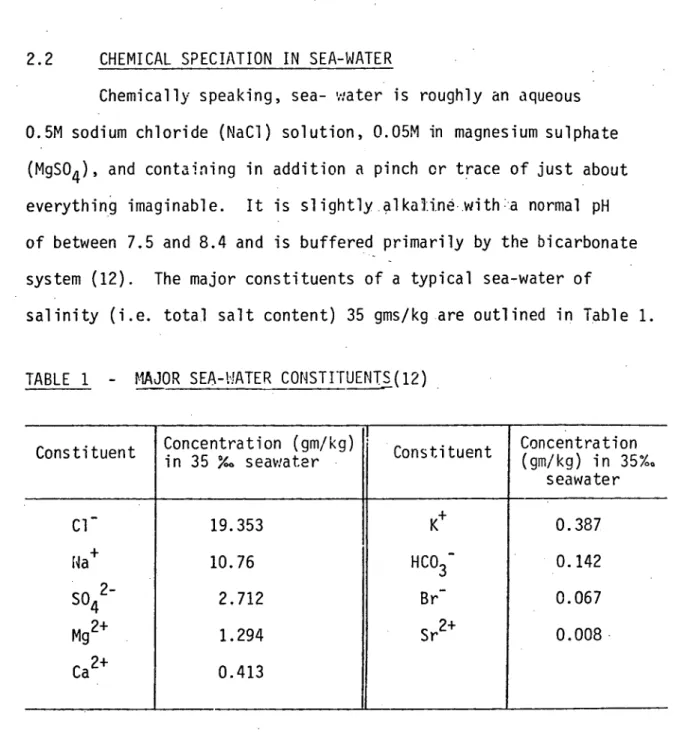
Chemically speaking, sea- water is roughly an aqueous 0.5M sodium chloride (NaC1) solution, 0.05M in magnesium sulphate
(MgSO4 ), and containing in addition a pinch or trace of just about everything imaginable. It is slightly alkaline with a normal pH of between 7.5 and 8.4 and is buffered primarily by the bicarbonate system (12). The major constituents of a typical sea-water of
salinity (i.e. total salt content) 35 gms/kg are outlined in Table 1.
TABLE 1
-MAJOR SEA-WATER CONSTITUENTS(12)
Constituent Concentration (gm/kg)
in 35 X. seawater Constituent
Concentration (gm/kg) in 35%.
seawater Cl - Na+ SO 4 2- Mg2+
Ca 2+
19.353 10.76 2.712 1.294 0.413 K+ _ HCO 3 Br Sr 2+
0.387 0.142 0.067 0.008
24
mere 'ion-pair in terms of the degree of combination of the hydra-tion sheaths of the separate charged species.
In order to determine the chemical form or forms of an elemental constituent in sea-water it is necessary to consider both simple
chemical equilibria and redox potentials. Solutes may be present as hydrated ions, complex ions or ion-pairs. In the case of metal cations the particular species preferred is usually a sensitive function of the metal concentration and pH (14). Garrels and Thompson (15)
developed a chemical model for sea-water from available thermodynamic data and from it calculated the degree of complexation between the major cations (Table 1) and the anions SO42- ,HCO3- and CO32- .
Ex-plicit in their calculations were the assumptions that the inter-actions between the ions under consideration resulted only in the formation of ion-pairs and that chloride complexes were negligible.
Zirino and Yamamoto (13) have expanded the approach developed by Garrels and Thompson to include higher order complex ions. Using available and estimated thermodynamic stability constants and indivi-dual ion activity coefficients, they developed a model for the
speciation of divalent Cu,Zn,Cd and Pb ions in sea-water. The model was used to calculate the degree of interaction between each of the metal ions and the anions Cl - , SO42-, HCO3 , CO32 and OH as a
function of pH. Their calculations indicated that all four metals are complexed to a considerable extent in sea-water.
Whitfield (16) has examined the ion-association model and the buffer capacity of the carbon dioxide system in sea-water at 25 ° C
25
(33.4 N/m2). At a typical pH of 8.2 the total inorganic carbon content, C
T (equation (20)), of sea-water was calculated to be
0.0027 moles/litre, in good agreement with experimentally measured values.
Unlike the situation in fresh waters, the components of the carbonate system are complexed (both as complex ions and as ion-pairs) in sea-water with the cations present. For example, Garrels and Thompson calculate (15) that at pH 831% of the total bicarbonate ion present in sea-water (HCO3;)is complexed, leaving 69% as free ion (HCO3i). Whitfield (16) expanded this work to calculate the
distribution, expressed as a percentar of C
T, of the components
26
2.3
IRON IN SEA-WATER
Iron is one of the more important minor constituents of sea-water. Apart from one work (20), the speciation of soluble iron in sea-water, both in the ferric and in the reduced ferrous form, would appear to have received little attention. Detailed study is hampered by a lack of thermodynamic data. Many authors have measured the concentration and distribution of iron in different oceanic waters, but measurements are frequently characterized by their lack of re-producibility (17). The erraticness of analytical results has been attributed to the presence, in situ, of colloidal particles of iron and the problem has been alleviated by recent refinements in analytical techniques. Literature data from 1953 to 1968 on the dissolved and particulate Fe contained in several sea-waters has been tabulated by Head (18). In a recent study Betzer (19) investigated particulate iron in the North Atlantic. The average concentration found in shallow open-ocean water was 0.177 ug/l.
As was the case with natural fresh waters, it is safe to say that ferric iron is the dominant form of iron in sea-water. Under the mildly oxidative conditions present in sea-water ferrous iron is unstable and is oxidized to ferric iron. The overall reaction in sea-water can be represented by (12):
4Fe2+ + 0
2 (dissolved) + 4H
+
4Fe3+ + 2H20 .03 = + 0.458 V 2
(2E)
27
2.4 FERRIC IRON SOLUBILITY IN SEA-WATER
2.4.1 Method of Calculation
Kester and Byrne (20) have calculated the relative amounts of the various soluble ferric iron sea-water complexes which contribute to total ferric solubility, from selected equilibrium constant data which best approximate the conditions in sea-water at 25 0 C and one atmosphere pressure. The chemical forms of ferric iron were then re-lated to the solubility of ferric hydroxide in sea-water to obtain an estimation of total ferric solubility as a function of pH.
The method employed by Kester and Byrne has been reproduced here and applied to both "normal" seawater and to an artificial sea-water. The method, basically similar to the metal speciation approach of Zirino and Yamamoto (13), can be summarized as follows:
(a) Consider all the types of metal (ferric iron) species which might exist in solution. This involves a con-sideration of all possible ion-pairs and higher order complex ions and is dependent to some extent on
available thermodynamic data. Call a particular species ML(i) n , representing the nth order complex between the metal M and the ith ligand L(i). Let the overall formation constant of this species be
(i)n-
28
(ML(i) n ) = a (i) n (M) (L(i))n yM(yL (i)) n
.... (2F) yML(i) n
where (M) = uncomplexed metal ion concentration (L(i)) = free concentration of ligand
yM,yL(i), yML(i) n = thermodynamic activity coefficient of the respective species
Note that in the case of hydroxide complex species the expression can be re-arranged to include a (e) term, and is thus pH dependent.
(c) Calculate the metal (ferric iron) speciation and solubility as follows:-
The total soluble metal concentration in solution is given by the total of the dissolved species i.e.
m
total =(1)
(mL(i)n)
(2G)Substituting equation (2F) we have
(M)
total = (M) (1 a (i)n (L(i»n YM(YL(i))--)( 1 YML(i) n ) for
or more simply, allowinglthe presence of hydroxide complexes,
(M)
total = (M) (1 + fn ((e))) (21)Clearly then, the percentage contribution of any species to the total solubility can be calculated as a function of pH via the expression:
wiL(i)n) = 100 (ML(i) n ) =
1O0
(i) n (L(i)) nyM(yL(4/yML(i)
n
( 1 + fn ((Hi)))(M)
total (2J)Moreover, if the solubility of the metal M is controlled by the solid species ML xwith solubility product K sp , then:
(M) = K
sp /yM(y0x(L)x (2K)
and the total solubility, as a function of pH, can be calculated by substituting equation (2K) into equation (2H) .
29
The preceding approach was applied by Kester and Byrne (20) to calculate ferric solubility and ferric speciation in sea-water as a function of pH. Consideration of ferric organic
plexes indicated That most types of organic compounds cannot com-pete with hydroxide for iron at the pH of sea-water.
2.4.2 Extension of Previous Calculations
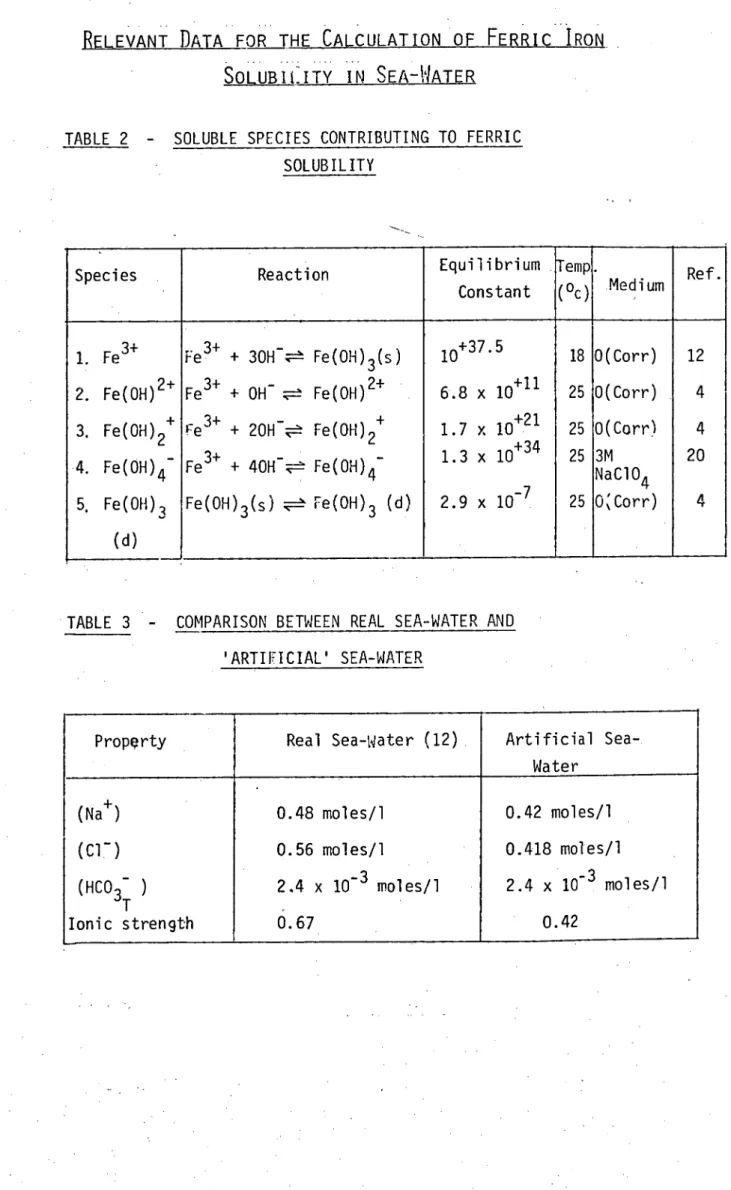
In the present study the work of Kester and Byrne has been repeated and extended along two lines. Firstly, after consideration of a whole range of ferric complex species, Kester and Byrne found that ferric solubility is described almost solely by ferric hydroxide complexes. None of the other ligands present in sea-water can compete effectively with OH- for iron. The complexes concerned are shown in
Table 2 (Nos. I to 4),together with relevant equilibria data. Kester and Byrne found that above pH 8 soluble ferric iron is almost totally in the form Fe(OH) 4 , and below pH 7 in the form Fe(OH)2+' A transition between the two species occurred from pH 7 to 8. However, Kester and Byrne did not consider the uncharged or undissociated molecular complex of ferric hydroxide, Fe(OH) 3 (d), a significant form of iron at the pH of sea-water and consequently omitted it in their calculations. This species has been suggested as an interpretation of the discrepancy between calculated solubilities and measured values for iron in sea-water (4). It was decided to
include this species in the solubility calculations (No. 5, Table 2) and compare resulting solubility distributions.
30
RELEVANT DATA FOR THE CALCULATION OF FERRIC IRON
SOLUBILITY IN SEA - WATER
TABLE 2
-SOLUBLE SPECIES CONTRIBUTING TO FERRIC
SOLUBILITY
Species Reaction Equilibrium
Constant
Temp
(oc)
.
MediumRef.
1. Fe3+ 2. Fe(OH)2+ 3. Fe(OH)2+ 4. Fe(OH)4 - 5. Fe(OH)3
(d)
Fe3+ + 30H ;----± Fe(OH)3(s) Fe3+ + OH- .7-± Fe(OH)2+ re3+ + 20H- - Fe(OH)2+ - Fell' + 40H--,='. Fe(OH)4
10+37.5 6.8 x 10+11 1.7 x 10+21 13 x 10. +34
2.9 x 10
18 25 25 25 0(Corr) 0(Corr) 0(Corr) 3M NaC10 4 0Corr) 12 4 4 20 4 Fe(OH)3(s) ---=?.. Fe(OH)3 (d)
TABLE 3
-COMPARISON BETWEEN REAL SEA-WATER AND
'ARTIFICIAL' SEA-WATER
Property Real Sea-water (12) Artificial Sea- Water
(Nat) (C1-) (HCO3 - )
T
Ionic strength
0.48 moles/1 0.56 moles/1
2.4 x 10⁻³ moles/1 0.67
0.42 moles/1 0.418 moles/1 2.4 x 10⁻³ moles/1
31
TABLE 4
-
ACTIVITY COEFFICIENTS
Species
ACTIVITY
COEFFICIENT
Real S.W.
Ref.
Artificial
S.W. Ref.
Fe3+
Fe(OH) 21-
Fe(OH)
2
+
Fe(OH)
4
-
Fe(OH)
3
(d)
OH -
0.1
20
0.34
13
0.74
13
0.74
13
1.0
13
Obtained directly as
0.06
Calc.
0.285
u
0.73
u
0.73
n
1.0
it
32
for this artificial solution, using activity coefficients calcula-ted from the Davies modification of the Debye-Huckel expression (21). Activity coefficients for species in real sea-water were, in general, taken from Zirino (13). Values are given in Table 4.
2.4.3 Results and Discussion
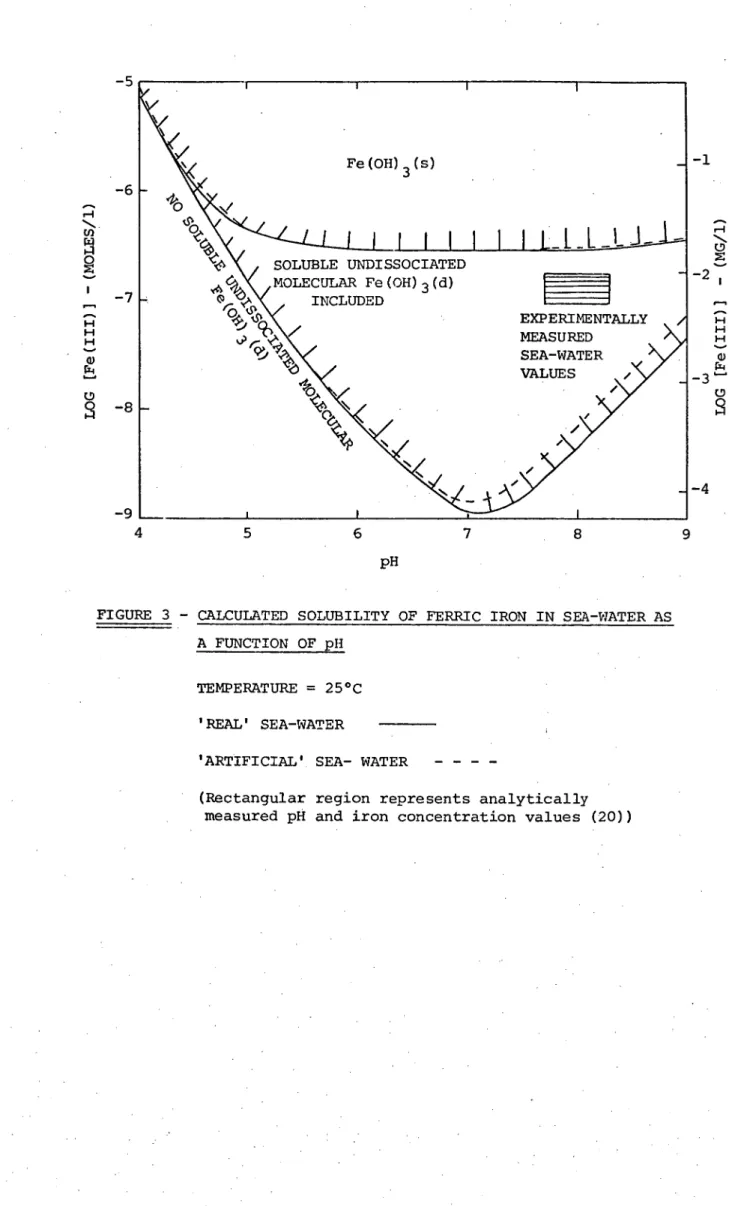
The results of the solubility calculations are summarised in the solubility diagram, Figure 3. The detailed equations from which the solubility distributions were calculated are given in Appendix 1. It can be seen that the inclusion of the proposed soluble undissociated molecular Fe(OH)
3(d) species makes a considerable difference to the calculated ferric solubility distribution. When included, this species predominates over the ferric hydroxide species over a pH range from 5 to 9, and raises the theoretical ferric iron solubility in sea-water by roughly two orders of magnitude. As expected, the inclusion of Fe(OH) 3 (d), using the suggested equilibrium constant (22), results in a theoretical solubility much closer (but still not equal) to the range of experimentally measured sea-water values (Fig. 3). However, until definite proof for such a species is forthcoming its existance must remain theoretical.
Fe(OH) 3 (s)
L _L
EXPERIMENTALLY MEASURED
SEA-WATER VALUES
' 5
6
SOLUBLE UNDISSOCIATED v4 MOLECULAR Fe(OH)3(d)
INCLUDED 0 0
33
4 5 6 7 8
pH
-1
-2 e-11
w -3
0
-4
FIGURE 3 - CALCULATED SOLUBILITY OF FERRIC IRON IN SEA-WATER AS
A FUNCTION OF pH
TEMPERATURE = 25°C 'REAL' SEA-WATER
'ARTIFICIAL' SEA- WATER
34
iron as that retained by a 0.45p filter, so any particular iron smaller in size is regarded as being in solution. A second explan-ation lies with the possible formexplan-ation of soluble complexes between silica and iron. Kester and Byrne did not consider ferric silicate complexes as contributing to iron solubility, presumably because of a lack of thermodynamic data. However, Schenk and Weber (23) point out that dissolved silica is a major constituent of most natural waters (the concentration in sea-water is 3 mg/1 (12)). They found that silicic acid greatly retards the hydrolysis of ferric iron and suggest that this may be due to soluble complex formation.
35
2.5
FERROUS IRON SOLUBILITY IN SEA-WATER
2.5.1Introduction
Ferrous iron solubility in natural fresh waters has already been discussed and is illustrated in Figure 2. Although ferrous solubility has been studied in groundwaters, a theoretical study of ferrous iron solubility and speciation in sea-water does not appear to have been made. Such a study is applicable to the situation arising when a reducing environment exists in the sea (e.g. due to the presence of H 2 S or anaerobic sediments (12)) or when a solution rich in ferrous iron is introduced into the sea. It is the latter case we are interested in here. A delineation of ferrous solubility is of interest as, given a slow rate of ferrous oxidation, ferrous iron compounds may deposit on the sea-bed. As has been previously mentioned, the situation is analogous to that arising in some ground-water treatment plants (section 2.1).
The question of ferrous solubility arises on a consideration of the formation of marine sedimentary iron ores. The particular mineral obtained when a ferrous-rich leach solution enters the sea depends on the redox potential (Eh) and the acidity (pH) of the environment. In oxygen-rich surface waters limonite (Fe(OH) 3 ) is formed, low pH CO2 -rich waters favour siderite (FeCO 3 ), while in H 2 S containing water pyrite (FeS 2 ) is formed (24). This suggests that in the absence of sulphide species and prior to oxidation the solubility of ferrous iron in bicarbonate-containing sea-water is controlled, as was the case in • low ionic strength natural waters, by the solubility of ferrous
36
2.5.2 Method of Calculation
The solubility and speciation of ferrous iron in both real sea-water and 'artificial' sea-water have been calculated using the method of Kester and Byrne (section 2.4.1). The complex ferrous species which were considered as possible contributors to ferrous solubility in sea-water are given in Table 5. No thermodynamic data for possible ferrous complexes with bromine, borate, phosphate and silicate anions could be found and therefore, if such complexes do exist, their relative contribution to total soluble ferrous iron could not be assessed. It is worth noting that ferric ions generally have a stronger tendency to form complexes than ferrous ions (4), and as Kester and Byrne (20) found that bromide, borate and phosphate complexes contribute negligibly to ferric solubility in sea-water, it is likely these ligands can be safely discarded in a consideration of ferrous solubility. The same argument applies to organic ferrous complexes.
In their calculation of the pH-dependent speciation of divalent Cu, Zn, Cd and Pb ions in sea-water,Zirino and
Yamamoto
(13) found it necessary only to consider interactionswith the anions Cl , SO 42-, HCO3 , CO32- and OH - . They also did not include polynuclear andmixed-ligand complexes. The species outlined in Table 5 would therefore seem to represent a reasonable starting point for a consideration of
ferrous iron solubility in sea-water.
RELEVANT DATA FOR THE CALCULATION OF FERROUS IRON SOLUBILITY
IN SEAWATER
TABLE 5
- SOLUBLE SPECIES CONTRIBUTING TO CALCULATED FERROUS SOLUBILITY
Species
Reaction
Equilibrium
Constant
Temp
Medium
(oc)
Ref
Fe
2+
Fe(OH) +
Fe(OH) 2 0
Fe(OH) 3 -
FeC1
+
FeC1
2
°
FeF +
FeS0
4
o
FeCO
3
o
Fe(HCO 3 ) +
A.
B.
Fe
2+
+ 20H -
k===h
Fe(OH)
(s)
Fe
2+
+ CO
2-
---"- FeCO(s)
6.3 x 10
+14
4.8 x 10+10
2.5 x 10
+5
10
+9
5.2 x 10
2.3
2.5
pa10
10
7.9 x 10
+5
2 x 10
+2
25
0 (corr)
25
0
25
0 (corr)
Estimated
25
0 (corr)
20
2M HC10
4
20
2M HC10
4
- -
25
1M NaC10
4
Estimated
Estimated
12
12
4
4
12
12
25
25
3,---
3
+ -
Fe
+ OH
2
R===?..
Fe(OH)
+
2+
_
0
Fe+ 20H
,
---:---'- Fe(OH)
2
_ -
Fe
2+
+ 30H
,-
-=---"— Fe(OH)
3
Fe
2+
+ Cl
FeC1
..,==±
+
-
Fe
2+
+ 2C1
:;===71' FeC1 0
Fe
2+
+
F
-
R..
FeF
+
o
Fe
2+
+ SO
2-
---
FeS0
4 '---
4_
Fe
2+
+ CO
3
2 7,-==t FeCO
3
o
Fe
2+
* ---7=?! Fe(HCO
3
) -1-
+ HCO
38
TABLE 6
ACTIVITY COEFFICIENTS
Species Activity Coefficient
Real Ref. Sea-water
Artificial Ref. Sea-water
Fe2+
Fe(OH) + ,Fe(HCO3) + Fe(OH)3-
Fe CO
30
'
Fe(OH)2 oH 2CO3 HCO 3 CO 3 2- OH -
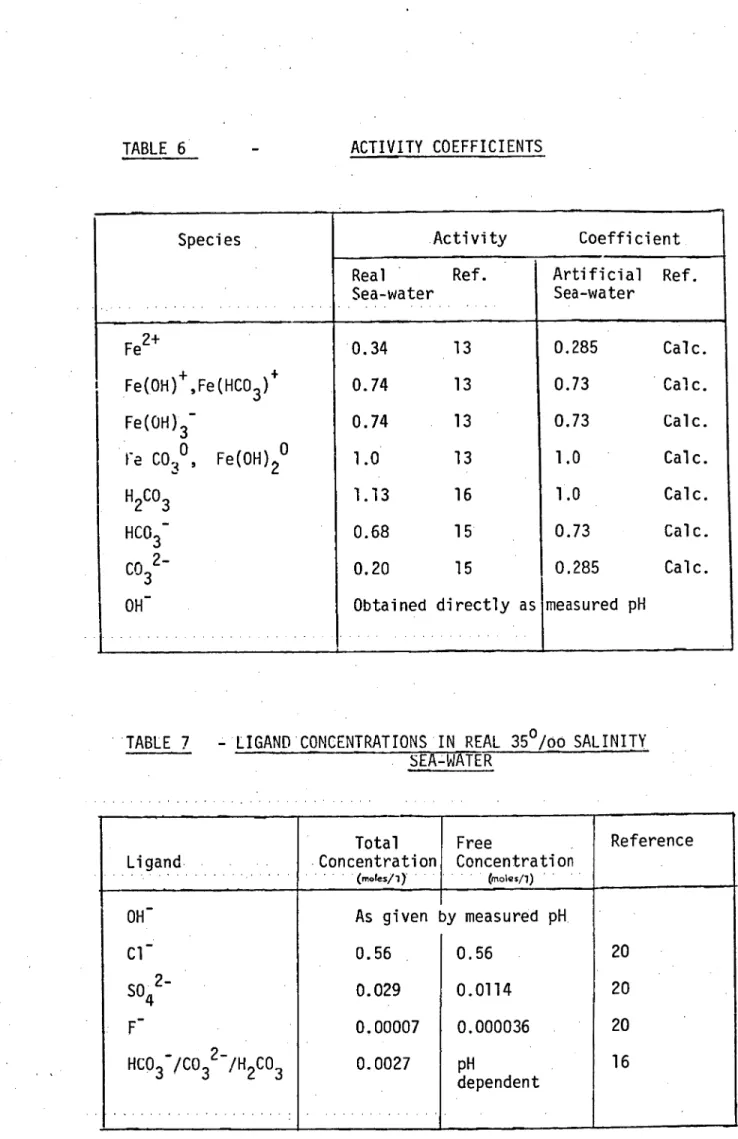
0.34 13 0.74 13 0.74 13 1.0 13 1.13 16 0.68 15 0.20 15
Obtained directly as
0.285 Calc. 0.73 Calc. 0.73 Calc. 1.0 Calc. 1.0 Calc. 0.73 Calc. 0.285 Calc. measured pH
"TABLE 7 LIGAND
.
CONCENTRATIONS IN REAL 35
0
/o0 SALINITY
SEA-WATER
Ligand
Concentration Total(motes/1)
Free
Concentration
(moles/1)
Reference
OH - As given by measured pH
Cl - 0.56 0.56 20
SO42 0.029 0.0114 20
F-
0.00007 0.000036 20HCO37CO32 7H2CO3 0.0027 pH
dependent
39
Table 6. The stability (equilibrium)constants for the ferrous car- bonate (FeCO
30) and ferrous bicarbonate (FeHCO3 +
) ion-pairs were
estimated in the same manner as employed by Zirino (13). The constant for FeCO
30 was estimated from a correlated dissociation constant v's
cation electronegativity graph, and that for FeHCO 3 via the relation- log
a
FeCO3 °ship 2.5. A value for the stability constant for loga FeHCO3+
the Fe(OH)
2 o
species was obtained by comparison with similar data for the Cu, Zn, Cd and Pb cations.
To calculate the degree of ferrous iron complexation in sea-water values for the free ligand concentrations (i.e. that proportion of each ligand not already complexed with the major sea-water cations) are required. These are summarised in Table 7. The
free chloride concentration in artificial sea-water was 0.418 moles/1 (Table 3). As carbonate species, both soluble and insoluble, are of paramount importance the free bicarbonate ion concentration
((HCO
3 F))as a function of pH must be known. The free carbonate ion
concentration ((CO32-F)) can then be calculated from the equilibrium relationship (reaction 28) and so,by rearrangement,the expression for total ferrous solubility (equation 2H) can be written in terms of (Hi) and (HCO3 - F) (see Appendix 2B).
The variation of (HCO
3-F) with pH was calculated on the basis
that the total inorganic carbon content of sea-water, C
T (equation 2D),
remained constant over the pH range of interest. For real sea-
40
for the problem under consideration C
T remains constant, is based on
the fact that the transfer of carbon dioxide across the sea-air inter- face is very slow (26), while in comparison the dissociation of dissolved carbon dioxide (reactions 2A and 2B) is very rapid (12). On the - introduction of an acidic ferrous iron solution to sea-water there is a rapid change of pH with the formation of excess carbonic acid, H 2CO3
(see section 2.6), but because the oversaturated solution only loses its excess carbon dioxide to the atmosphere at a very slow rate,the immediate effect is that the total inorganic carbon concentration re-mains the same. Calculations of ferrous solubility should therefore be made on the basis of a constant inorganic carbon content in solution.
In the case of real sea-water, the pH variation of (HCO3 - F),
expressed as a percentage of CT, has been calculated by Whitfield ((16)
and see section 2.2). His figures, applied to a constant CT of 0.0027
moles/litre, were used to obtain the required bicarbonate distribution for use in calculations. For artificial sea-water the pH variation of
(HCO
3-F) was calculated by a consideration of the various carbonate
equilibria involved and the degree of complex formation with sodium ions. The method and calculations are given in Appendix 2A.
After having obtained the pH variation of the free bicarbonate ligand concentration, (HCO3 - F), in both real and 'artificial'
41
2.5.3 Results and Discussion
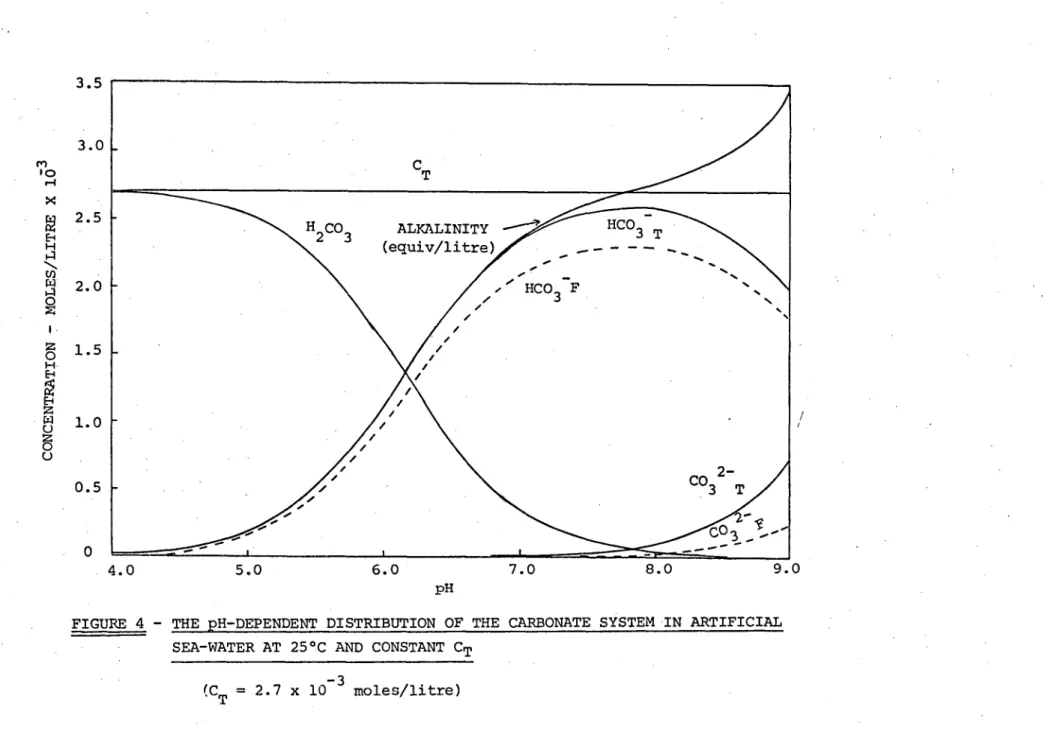
The calculated pH variation of the carbonate species in artificial sea-water is illustrated in Figure 4. As can be seen, over the pH range 7.5 to 8.5 (normal pH range for sea-water) the bicarbonate ion, HCO3 , accounts for the majority of the inorganic
carbon in solution and, of the HCO3 - present, roughly 10% is
com-plexed as an ion-pair with Na+. The carbonate ion, CO
3
2-, has negligible concentration below pH 8. At pH values below 6 the carbonic acid species, H2CO3, is predominant.
The distribution can be compared with that of Stumm and Lee, Figure 2A, which was calculated on the basis of constant alkalinity. It can be seen from Figure 4 that for pH values between
4
and 8 alkalinity (equation 2C) is approximately equal to the HCO 3-concen-tration, so that by assuming a constant alkalinity of 2 x 10
litre Stumm and Lee have used a much higher bicarbonate ion concen-tration at pH<6.5 than used in the present calculations. This means that their calculated ferrous solubility (Figure 2B) will be much lower in this region. Although the bicarbonate ion is more highly complexed in real water than in the simplified artificial sea-water, particularly due to the presence of the Mg 2+ and Ca2+
cations (12), the general distribution of the carbonate species illus-trated in Figure 4 can be taken as indicative of the carbonate
distribution in a real sea-water of identical C
T.
C T
•••••
8.0
5.0 6.0 7.0 9.0
H CO
3 ALKALINITY HCO 3 T
(squiv/litre) - -
HCO 3 F
CO 3
2-
10 u-I
3.5
3.0
2.5
■,
a 2.0
0 1.5
1.0 0
0.5
0
pH
FIGURE 4 - THE pH-DEPENDENT DISTRIBUTION OF THE CARBONATE SYSTEM IN ARTIFICIAL SEA-WATER AT 25 ° C AND CONSTANT CT
(C
T = 2.7 x 10 -3
moles/litre) '
-
-
Fe(OH)
2(s) C
T = 0
43 1000 500 (M G/ 1 - log s ca le ) 100 50 \ '.. \. \
LOCUS \ \
OF
H
H TIOXIDE \ \
--
10
\. \
w EFFLUENT \ \
N .\ • \ \ ' \ \ o. \
10-2
-3 10
0
FeCO
3 (s)
-3
C
T = 2.7 x 10 M
No‘
■
5.5 6.0 6.5 7.0 7.5 8.0 8.5 9.0
pH
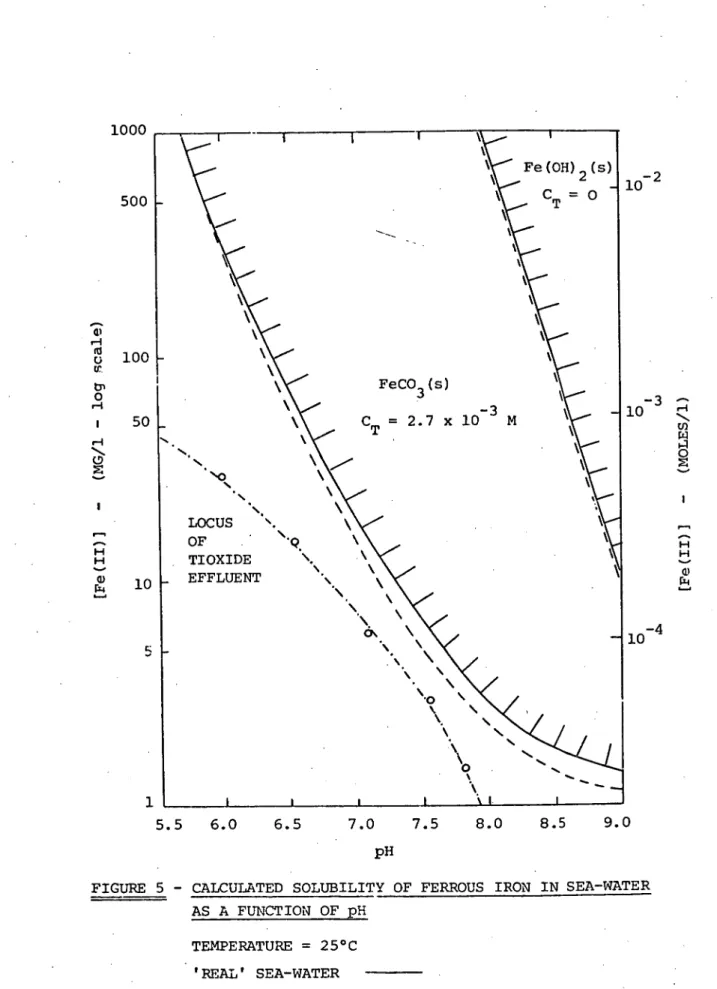
FIGURE 5 - CALCULATED SOLUBILITY OF FERROUS IRON IN SEA-WATER
AS A FUNCTION OF pH
TEMPERATURE = 25°C
'REAL' SEA-WATER
'ARTIFICIAL' SEA-WATER
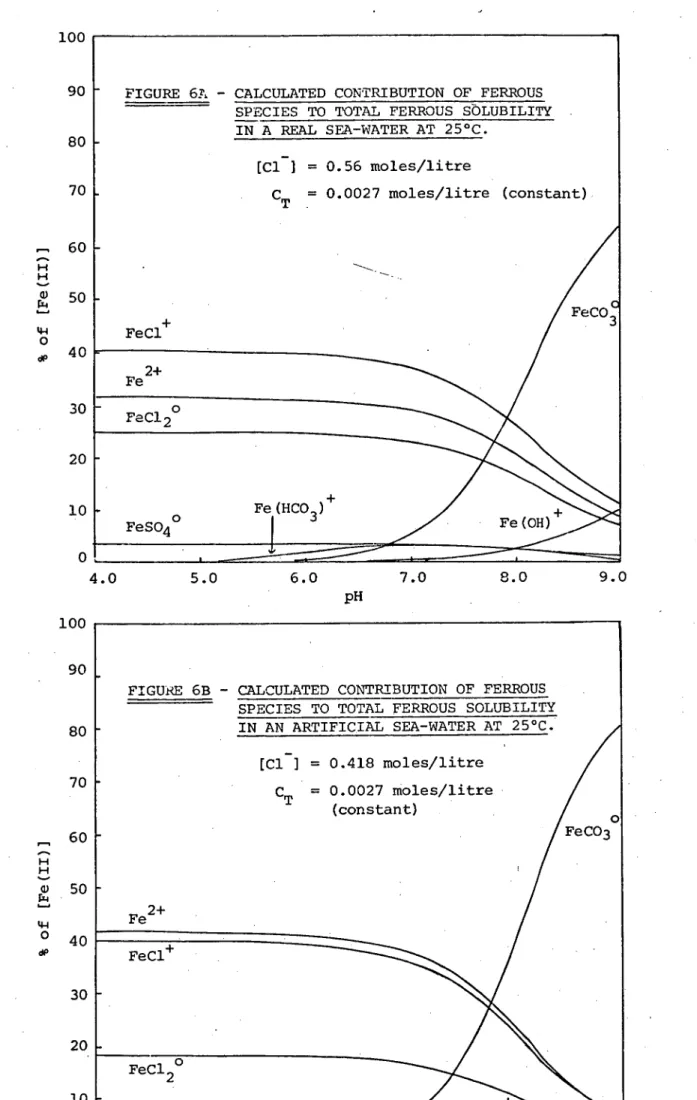
FIGURE 6B - CALCULATED CONTRIBUTION OF FERROUS SPECIES TO TOTAL FERROUS SOLUBILITY IN AN ARTIFICIAL SEA-WATER AT 25°C.
[Cl] = 0.418 moles/litre
C
T = 0.0027 moles/litre
(constant)
9.0 8.0
7.0
5.0 6.0
pH 4.0
Fe(HCO )+
44
100
90
80
70
FIGURE 6A - CALCULATED CONTRIBUTION OF FERROUS SPECIES TO TOTAL FERROUS SOLUBILITY . IN A REAL SEA-WATER AT 25°C.
(Cl] = 0.56 moles/litre
CT 7 0.0027 moles/litre (constant).
60
wa) 50
(4-1
4 dp 0
30
20
10
4.0 5.0 6.0 7.0 8.0 9.0
45
The speciation diagrams indicate that ferrous iron interacts primarily with the carbonate and chloride ions in sea-water. From pH 8 to 9 the majority of ferrous iron in solution is calculated to be in the form of the soluble ferrous carbonate ion-pair, FeCO 30 . At pH values below 7, corresponding to the decrease in the bicarbonate ion concentration (Figure 4), soluble ferrous iron exists predomin-antly in the form of chloride species, FeC1+ and FeC120 , and as
free ferrous ion, Fe2+. Between pH 7 and 8 there is a transition between the carbonate ion-pair and the chloride species plus uncom-plexed metal. The distribution of species contrasts with the speci-ation of soluble ferric iron, where it has been shown that soluble ferric hydroxide complexes predominate over the full pH range. It would appear that soluble ferrous hydroxide complexes contribute
neglig-ibly to ferrous iron solubility in sea-water over the pH range 4 to 9. Similarly, the sulphate and bicarbonate ion-pairs are of iicinor import-ance.
It is interesting to note that Zirino and Yamamoto (13) found that in sea-water lead interacts primarily with carbonate and chloride ions, cadmium with chloride ion, copper with hydroxide and carbonate ions,and zinc with hydroxide and chloride ions. They found that at the average sea-water pH of 8.1 the percentage of uncomplexed metal ion ranged from about 17% for zinc to about 1% for copper. Present calcu-lations indicate that at pH 8.1 roughly 20% of ferrous ions are
46
understanding of total ferrous solubility in a sea-water medium. The solubility diagram, Figure 5, shows that ferrous iron solubility increases dramatically as pH decreases. The increase is even more pronounced in a non-bicarbonate water where solubility is controlled by Fe(OH) 2 (s). At a constant pH the concentration differ-ence between ferrous solubility described by FeCO 3 (s) and that des-cribed by Fe(OH)
2 (s) gives the theoretical quantity of Fe 2+
which can be precipitated in sea-water as ferrous carbonate before the inorganic carbon content of solution is depleted. At pH 8.1 this quantity is calculated to be approximately 535 mg/l. The solubility of ferrous iron at pH 8.1 (average sea-water pH) is calculated to be 2.5 mg/1, though it must be remembered that in normal oxygenated water ferrous iron is unstable (being oxidized to ferric iron) so that this figure is only applicable to a temporary non-equilibrium situation.
The relative solubilities of ferrous iron and ferric iron can be compared by considering Figures 3 and 5. It is clear that the calculated ferrous iron solubility in sea-water is much greater than the calculated (and measured) ferric iron solubility. Consequently, one can expect the oxidation of ferrous iron in sea-water to be followed by the precipitation of a solid form of ferric hydroxide. The calcula-ted ferrous solubility in sea-water is also greater than Stumm and Lee's (4) calculated ferrous solubility in a bicarbonate-containing natural fresh water (Figure 2B). As has been explained this is due, in part, to those authors' assumption of constant alkalinity, but it would appear that ferrous solubility in sea-water, particularly at pH<7, is also
47
In the calculations undertaken possible ferrous-silicate complexes could not be assessed because of a lack of thermodynamic data. Similarly,the possibility of ferrous solubility in sea-water being controlled by that of ferrous silicate, FeS10 3 (s), could not be adequately investigated. However Schenk and Weber (23), in an in-vestigation of ferrous oxidation, found no precipitation occurred at a (Fe2+) (H4 SiO4' ) product greater than that encountered in a sea- water where Fe2+ is controlled by FeCO 3 (s) (assuming (H 4SiO4 ) = 3mg/1
(12)). We can thus infer that ferrous solubility is controlled by FeCO 3 (s) rather than by FeSiO 3 (s).
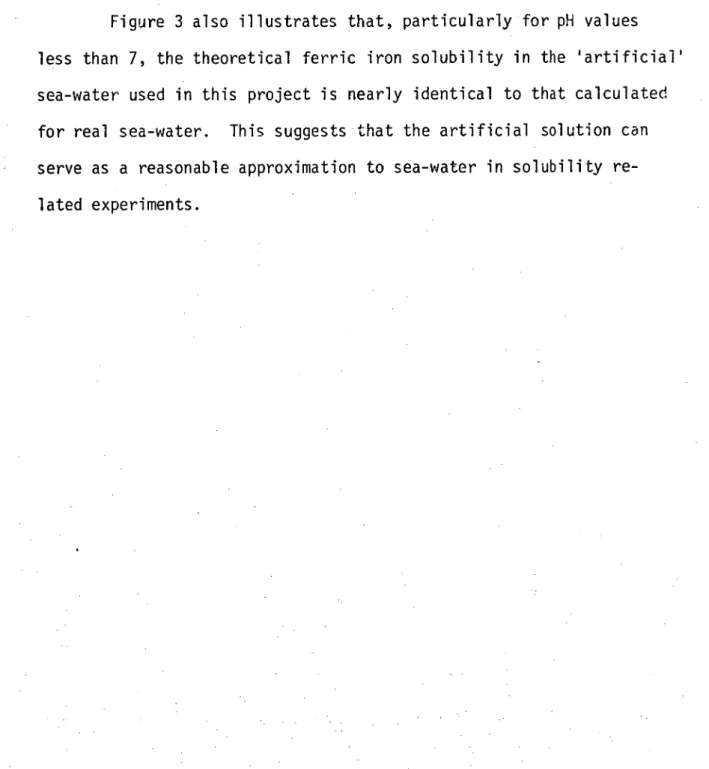
Finally, Figures 5 and 6 illustrate that, as was the case with ferric solubility, the artificial sea-water used in this project gives ferrous solubility predictions similar to those calculated for real sea-water. Both the ferrous speciation and the total ferrous solubil-ity distributionsof the two are alike. The simplified medium (Table 3) would thus seem to provide a good approximation to real sea-water for use
in laboratory experiments related to iron solubility. The relatively small difference in FeCO
48
2.6
INTERACTION OF INDUSTRIAL EFFLUENT WITH SEA-WATER
2.6.1Introduction
The calculated ferrous solubility diagram, Figure 5, indicates that if ferrous carbonate is to precipitate on the introduction of an acidic ferrous sulphate effluent to sea-water then, keeping in mind the rate of ferrous oxidation, the effluent should have as low an acid to ferrous iron ratio as possible. The greater the depression of the normal sea-water pH, the greater the estimated ferrous solubility and so the less chance of ferrous precipitation. Any soluble ferrous iron will eventually be oxidized and the resulting ferric iron will precipitate as ferric hydroxide.
The possible advantage of FeCO3 precipitation as opposed to
Fe(OH)
3 precipitation is the suggestion by Twardowski ((9) and see section
2.1) that the former precipitates as large,separate,crystalline
particles which are then, under water, relatively stable to subsequent oxidation. A precipitate of FeCO3, if formed in sea-water, might thus
be expected to settle to the sea-bed in contrast to the loose, poorly crystalline, floating flocks of Fe(OH)3 which are observed to form on ferrous oxidation and which cause titanium dioxide producers the visual and other pollution problems outlined in Chapter 1. Clearly, whether or not FeCO3 does precipitate in sea-water following the dis-charge of an industrial acid-iron waste depends on several factors, primarily the composition of the effluent, the rate of dilution by sea-water and the rate of ferrous oxidation.
The interaction of an acidic ferrous sulphate solution with sea-water can be considered to consist of two separate stages.
49
solution with the,bicarbonate buffer of sea-water. Secondly, there is the subsequent oxidation of the introduced ferrous iron (and consequent precipitation of Fe(OH)3) at the pH resulting from
the first reaction. If this pH is sufficiently high then ferrous precipitation may occur at the same time. Of course, in reality
the picture is much complicated by the continued dilution and dispersion of the effluent with what can be regarded as "new fresh sea-water", so that the pH is continually rising back to normal and the ferrous concentration is continually decreasing. By necessity laboratory ex-periments are best carried out at a static, constant, dilution ratio. This simplifies the situation and allows a more detailed investigation of the processes taking place to be made. Such an approach is not
un-realistic, as by undertaking work at various set dilution ratios it is possible to span at least part of the range of conditions encountered in the real situation. In this way the interaction of industrial effluent with sea-water can be thought of as "frozen" for study at different stages of dilution.
2.6.2 Dilution Experiments
As a preliminary investigation of the interaction reaction a series of dilution experiments were carried out using samples of real filtered sea-water and a sample of an industrial titanium dioxide effluent. The sea-water, filtered through a
4
millipore filter, was obtained via the marine research laboratory of the Tasmanian Fisheries Department. The industrial effluent was obtained from the Burnieplant of Tioxide Australia Pty. Ltd. and for the purposes of this report this effluent is classified as "Tioxide effluent".
50
Slow in highly acidic solutions (4), the Tioxide effluent was also stored in an air-tight plastic container prior to use to exclude oxygen. The degree of ferrous oxidation occurring between the time when the effluent was sampled arLd its use in the laboratory was thus kept to a minimum. The composition of the effluent is given in Table 8. The ferrous iron content was experimentally determined by titration with potassium permanganate solution, it being assumed that ferrous iron constituted the main oxidizable component of
the effluent. Any minor component oxidizable by permanganate at low pH was assumed to be negligible in comparison.
The acidity of the effluent was estimated by means of
Sulphuric Acid Acidity, H+ Ferrous Iron
64 t 2.5 gms/1 1.3 0.05 moles/1 28.2 t 0.3 gms/1
(prior to use) 74 gms/1
1.5 moles/1 30 gms/1 Nominal Concentration
(27)
Measured Concentration Component
51
TABLE 8
-COMPOSITION OF TIOXIDE EFFLUENT
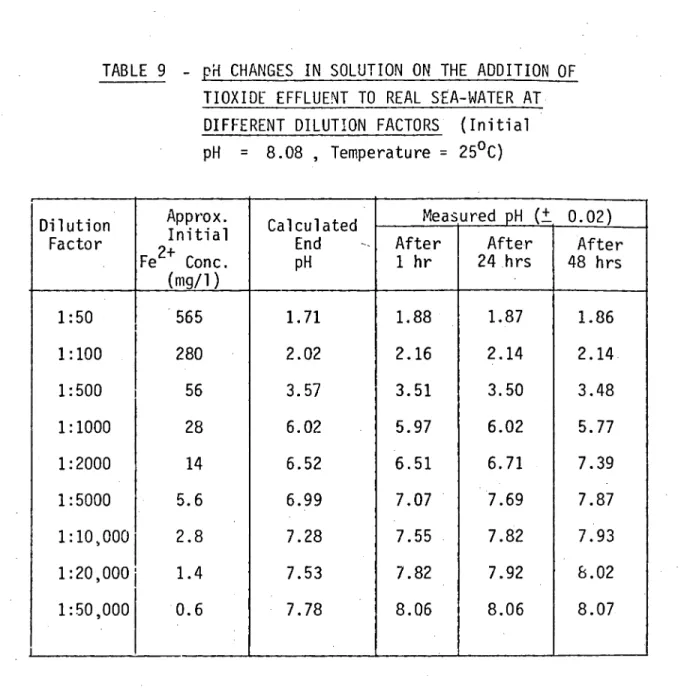
(Sample A - Collected 2/10/75)The dilution experiments were carried out by pipetting the required volume of Tioxide effluent into a stirred sample of freshly aerated sea-water. After one hour's stirring the pH was measured ard the solution was then left to stand open to the air. Subsequent pH measurements were made every 24 hours. Room temperature was controlled at around 25°C and a negligible amount of sample evapor-ation was observed over the period of the experiment. On aerevapor-ation the sea-water sample had a measured pH of 8.08 t 0.02, well within the pH range observed, in-situ, in the ocean (12). Results are dis-cussed in Section 2.6.4.
2.6.3
Prediction of Solution pH
The pH resulting on the introduction of a sulphuric acid solution to a bicarbonate-buffered natural water can be estimated by assuming that the buffering depends predominantly on the bicarbon-ate-carbonic acid equilibrium (equation 2A) i.e.
-7
H 2 CO
3H
+
+ HCO
3
-K25o = 4.45 x
10 moles/litreC