Selection, Inheritance, and the Evolution of
Parent-Offspring Interactions
Judith E. Lock, Per T. Smiseth, and Allen J. Moore*
School of Biological Sciences, University of Manchester, Manchester M13 9PT, United Kingdom
Submitted September 11, 2003; Accepted March 26, 2004; Electronically published May 13, 2004
abstract:Very few studies have examined parent-offspring inter-actions from a quantitative genetic perspective. We used a cross-fostering design and measured genetic correlations and components of social selection arising from two parental and two offspring be-haviors in the burying beetleNicrophorus vespilloides. Genetic cor-relations were assessed by examining behavior of relatives indepen-dent of common social influences. We found positive genetic correlations between all pairs of behaviors, including between parent and offspring behaviors. Patterns of selection were assessed by stan-dardized performance and selection gradients. Parental provisioning had positive effects on offspring performance and fitness, while re-maining near the larvae without feeding them had negative effects. Begging had positive effects on offspring performance and fitness, while increased competition among siblings had negative effects. Coadaptations between parenting and offspring behavior appear to be maintained by genetic correlations and functional trade-offs; par-ents that feed their offspring more also spend more time in the area where they can forage for themselves. Families with high levels of begging have high levels of sibling competition. Integrating infor-mation from genetics and selection thus provides a general expla-nation for why variation persists in seemingly beneficial traits ex-pressed in parent-offspring interactions and illustrates why it is important to measure functionally related suites of behaviors.
Keywords:begging, genetic correlations, parental care, performance gradients, selection gradients, social selection.
Social interactions are a ubiquitous feature of the life his-tory of many organisms, and these interactions can have a dramatic influence on an individual’s fitness. When be-havior expressed in social interactions influences fitness, a type of selection results that has been termed “social
* Corresponding author; e-mail: [email protected].
Am. Nat. 2004. Vol. 164, pp. 13–24.䉷2004 by The University of Chicago. 0003-0147/2004/16401-40110$15.00. All rights reserved.
selection” to distinguish it from selection that results from abiotic factors or ecological selection (Crook 1972; West-Eberhard 1983; Wolf et al. 1999). Similarly, traits expressed during social interactions, which typically are behaviors, have been termed “interacting phenotypes” (Moore et al. 1997, 1998) because such phenotypes are predicted to fol-low a different evolutionary trajectory than other mor-phological or life-history traits (Moore et al. 1997, 1998, 2002; Wolf et al. 1999). This altered evolutionary trajectory occurs because interacting phenotypes can be both an agent and a target of selection. Unlike abiotic factors in-fluencing fitness, this latter characteristic means that be-cause interacting phenotypes can have a heritable basis, they can themselves evolve, which leads to complex evo-lutionary dynamics (Moore et al. 1997, 1998, 2002). Thus information on both selection and inheritance is partic-ularly important for traits that influence social inter-actions.
In this study we set out to empirically determine the nature of inheritance and selection associated with parent-offspring interactions involving care. Our goal was two-fold: first, to determine whether there was coadaptation in parent-offspring communication in a species where both parental provisioning of food and begging for food can be quantified directly, and second, to quantify the strength and nature of selection arising from parenting or begging. We used a cross-fostering design to eliminate common environment effects on parenting or begging be-tween relatives, and we examined both genetic correlations and the influence of variation in parent and offspring traits on offspring performance and fitness using the burying beetleNicrophorus vespilloidesas our model. Burying bee-tles provide a convenient organism to study parental care and offspring begging under nearly natural environments in the laboratory (Eggert and Mu¨ller 1997; Scott 1998) and have proven useful in quantitative genetic studies of maternal effects (Rauter and Moore 2002a, 2002b). Cross-fostering is easily accomplished in burying beetles (Rauter and Moore 2002a). There are also theoretical reasons to expect variation in responses to care (Rauter and Moore 2002b) because burying beetles are not completely depen-dent on care. Offspring can either beg or self-feed, andN. vespilloideshas been described as a “partially begging” spe-cies (Smiseth and Moore 2002, 2004a, 2004b; Smiseth et al. 2003).
We first tested the hypothesis that parental care and offspring begging coevolve; that is, there is a genetic cor-relation between the two reflecting coadapted levels of expression (Wade 1998; Wolf and Brodie 1998; Wolf 2000). Next, we tested the hypothesis that parental and offspring behavior result in selection by quantifying how parental behavior associated with care and offspring behavior as-sociated with begging influence offspring growth and de-velopment (i.e., we calculated performance gradients; Ar-nold 1983). We also quantified selection by examining the association between growth and development with fitness (i.e., we calculated selection gradients; Lande and Arnold 1983). Calculation of performance and associated selection (fitness) gradients allows us to measure adaptive signifi-cance directly (Arnold 1983). We therefore adopted this quantitative genetic approach to both selection and in-heritance to provide an analysis of parent-offspring inter-actions based on formal evolutionary theory involving multivariate selection (Arnold 1983; Lande and Arnold 1983; Brodie et al. 1995). To the best of our knowledge, such an integrated approach quantifying both patterns of inheritance and the strength and pattern of multivariate selection has not been attempted in a single study.
Material and Methods
Burying Beetle Basic Biology
Burying beetles have a rapid generation time and well-described behavior and ecology (comprehensively re-viewed in Eggert and Mu¨ller 1997; Scott 1998). Further-more, burying beetles are easily reared in the laboratory under conditions very similar to nature, making them ex-cellent subjects for investigations of parental care, genetics, and evolution. Burying beetles breed on vertebrate car-casses, which form the sole food resource for offspring. Carcasses can be located either by males or by females. If a male locates the carcass, he emits pheromone to attract a female. If a female locates a carcass, she lays eggs some distance from the carcass. The female, or male and female together, then remove fur or feathers, roll the carcass into a ball, keep it free of fungus and bacteria, and prepare a cavity in the top of the carcass from which the offspring forage (self-feed) from partially digested meat. The parents can also forage for themselves from the carcass from this cavity area while they are partially digesting the carcass for the offspring (Scott and Gladstein 1993; S. Musa, P. T. Smiseth, and A. J. Moore, unpublished data).
At 20⬚C, larvae hatch approximately 60 h after the eggs are laid (P. T. Smiseth and A. J. Moore, unpublished data), and they crawl to the prepared carcass. Once they reach the carcass, Nicrophorus vespilloides larvae require direct provisioning of food from their parents for the first 12 h, with a decreasing reliance after that (Eggert et al. 1998). Parental care in burying beetles goes well beyond providing previously secured food for the larvae and involves direct and detailed social interactions between parents and off-spring. Larvae can either forage for themselves (self-feed) or beg for food from the parents (Smiseth and Moore 2002, 2004b; Smiseth et al. 2003). Begging can stimulate direct parental provisioning, which occurs by regurgitation of predigested carrion into the mouth of the larvae and is indicated by mouth-to-mouth contact between the par-ent and a larva (Rauter and Moore 1999, in press; Smiseth et al. 2003; Smiseth and Moore 2004a, 2004b; P. T. Smiseth, C. T. Darvell, and A. J. Moore, unpublished manuscript). Parents never feed larvae unless they are begging. Parental care inNicrophorusis consistent with most common ex-pectations for parental care reflecting our mammalian bias and with studies of avian parental care (Rauter and Moore 1999).
larvae disperse by crawling from the remains of the carcass, and they have no more contact with the parent. At this point, larvae have completed feeding and growth and enter a “wandering stage” for 7–10 d. These wandering larvae then bury themselves in the soil and pupate, emerging to adulthood after an additional 7–10 d. Adults are sexually mature 7–10 d after they emerge.
Although we conducted our study in the laboratory, we maintained conditions to resemble those in the field as closely as possible. Behavior expressed in the laboratory and field behavior are very similar (Scott 1998; Beeler et al. 1999). These beetles reproduce underground where temperature fluctuations should be minimized and the carcass can be relatively well hidden from predators and competitors. The lack of predators and competitors in our laboratory conditions may affect larval survival after dis-persal from the carcass, when the larvae burrow under-ground and pupate under the soil. However, mortality due to predation after dispersal would not reflect direct fitness effects of the interaction with parents, which was the focus of our study.
Experimental Design
Smiseth and Moore (2002) provide details on the field origin (Wales) and laboratory husbandry of the beetles studied. More than 100 beetles were collected from the field and maintained as outbred stock for several gener-ations in the laboratory. For the current study, 34 inde-pendent breeding pairs were established from newly emerged, randomly selected, nonsibling male and female virgin beetles. When the beetles reached sexual maturity, they were set up in a clear plastic container containing 1-cm-depth damp soil and placed in an observation room lit with red light. The following day the pair was provided with a 10–17-g mouse carcass, fresh frozen and thawed before the experiment (supplied by Livestock Direct, Shef-field). The mouse was provided 3–4 h before “sunset” (plights off), a time whenN. vespilloidestypically search for carrion in nature (Koca´rek 2001). The carcass was checked for the presence of larvae twice a day.
There were two rearing treatments for each family: off-spring reared by a related female (the biological mother as the caretaker) or by an unrelated female (a foster mother as the caretaker). Burying beetles use temporal cues in kin recognition (time of arrival of larvae to the carcass; Mu¨ller and Eggert 1990), which facilitates cross-fostering. In these experiments each female produced and reared two broods (one as a biological mother and one as a foster mother). Larvae that arrived at the carcass within 24 h (i.e., first instars) were removed, counted, and returned to the car-cass maintained by their natal mother or that of an un-related foster mother whose larvae hatched at the same
time. The order of the related or unrelated caretaker treat-ments was randomized for each family.
Once the family units were established, the carcasses and females were moved to new boxes with fresh soil in order to prevent the arrival of any additional larvae after the manipulation. At this time, the male was also removed so that behavioral observations were of female uniparental care only. The male was removed because uniparental and biparental care have equivalent effects on offspring fitness (Smiseth et al., in review). The manipulated broods were left for a further 24 h, and observations of larval begging and parental provisioning were then carried out when the larvae were∼48 h old and second instars.
Measures of Behavior
In this study we were interested in the covariances between natural levels of variation in direct parental care for the offspring and offspring performance (or fitness) rather than manipulating parental care as has been done previ-ously (e.g., Eggert et al. 1998; Rauter and Moore 2002b). Variations in parental behavior that did not involve direct interactions with the larvae (parental defense of the car-cass, maintenance of the carcass) may be important in-fluences on offspring fitness, but they are beyond the scope of this study, which focused specifically on interacting phe-notypes of parental and offspring behavior. Therefore, for this experiment we focused on behaviors expressed when parents and larvae are in close proximity (defined as within 1 pronotum length or less away from the larvae) and thus must involve an interaction. Close proximity is required for offspring begging; that is, offspring never beg to attract a parent because begging occurs only if parents are next to the offspring (Rauter and Moore 1999; Smiseth and Moore 2002).
the width of the parent’s pronotum (Rauter and Moore 1999; Smiseth and Moore 2002). The percent of time spent begging is therefore a measure of the average begging effort by each larva in the brood (Smiseth and Moore 2004a). The second trait indicator was the mean number of larvae begging in scans where at least one larva was begging. This measure reflects the proportion of siblings that, at a given time, are competing for food from the parent (Smiseth and Moore 2002).
Parental and larval behaviors were recorded using in-stantaneous scan sampling (Martin and Bateson 1986). Observations lasted for 30 m and were made 24 h after larvae arrived on the carcass. We chose this period for observation because, although there is consistent behavior within families (A. J. Moore, unpublished data), this is the day when there is the highest level of interaction between parents and larvae (Smiseth et al. 2003).
Coadaptation of Parenting and Begging
We adapted a method similar to that of Ko¨lliker et al. (2000; see also Agrawal et al. 2001) and used a cross-fostering design to examine the potential genetic covari-ance between parent-offspring interactions independent of family environment. The main difference between our study and these previous studies is that we measured the amount of begging or amount of parenting in direct sponse to an interaction with a caretaker rather than re-lying on an indirect measure of begging either inferred from offspring performance (Agrawal et al. 2001) or mea-sured from artificial recordings (Ko¨lliker et al. 2000). This latter study also measured parental provisioning as a re-sponse to manipulated playbacks.
The cross-fostering method we used eliminates the en-vironmental influences of parents on offspring and vice versa by eliminating sources of variation caused by a shared environment. With this design, begging behavior of offspring is measured when an unrelated caretaker rears them, and parenting of caretakers is measured when they interact with unrelated larvae. Any covariance between relatives must then reflect genetic influences because the only remaining common influence is shared inheritance. This measure may be inflated by additive components of epistasis, but using parent-offspring covariances eliminates dominance components of variation and so should be close to the additive genetic correlation. We therefore es-timated this genetic correlation using a Pearson product-moment correlation between behaviors of relatives ex-pressed in independent social contexts. Our complete design, where parents also took care of their biological offspring, allowed us to compare traits expressed in family and cross-fostered groups as well. Within–social environ-ment correlations (i.e., parents taking care of their own
offspring) will differ from between–social environment correlations (i.e., parents interacting with unrelated off-spring) by an amount that reflects common environmental influences, thereby permitting a further estimate of how common environment inflates family resemblance in in-teracting phenotypes.
Measures of Offspring Fitness and Performance
We scored components of offspring fitness as survival from one life-history stage to another until adult emergence. We also measured offspring performance based on traits that we know can be influenced by parental care (Rauter and Moore 2002a, 2002b; Smiseth et al. 2003) and that we predicted would be associated with fitness because they are fundamental life-history characters: mass of a larva at dispersal from the carcass (i.e., the point at which larval foraging and parental care ceased), the duration of time the larvae stayed on the carcass before dispersing as wan-derers, the duration of the developmental stage from dis-persal to entering the pupal stage (i.e., the wandering stage where larvae disperse off the resource and no longer for-age), and the duration of the pupal stage (i.e., from en-tering the pupal stage until emergence as an adult beetle). For duration of time the larvae spent on the carcass, there was no variation within families because all larvae disperse from the carcass at the same time.
Quantifying Selection Arising from Parental and Offspring Behavior: Selection and Performance Gradients
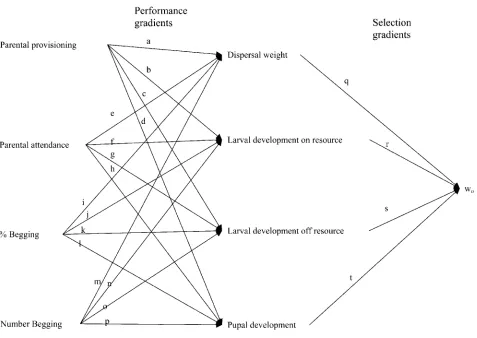
We used linear regression models to calculate standardized selection gradients (Lande and Arnold 1983) that affect life-history traits associated with larval performance. We also calculated performance gradients (Arnold 1983) re-lating parental and offspring behavior to offspring traits. This two-step process is necessary because, although we can measure the life-history characters or fitness of in-dividuals, we can only measure the behavior of parents toward entire families and the average amount of begging for the brood because individually identifiable marks on the larvae, either natural or applied, do not persist between larval stages (molts). However, analyzing parental perfor-mance gradients, offspring perforperfor-mance gradients, and fit-ness (selection) gradients allows us to integrate all of our measures in a formal evolutionary framework and model (fig. 1), put our work in terms that are used in equations for evolutionary change, and compare relative strengths of the effects (Arnold 1983; Lande and Arnold 1983; Brodie et al. 1995).
Figure 1:Model of social selection arising from parent-offspring interactions that was tested inNicrophorus vespilloides. Pathsa–hare parental performance gradients (bfz: the direct effect of parental care behaviorzpon offspring performancef, measured as growth and development), paths i–pare offspring performance gradients (bfz: the effects of offspring begging behaviorzoon offspring performancef), and pathsq–tare standardized linear selection gradients (bwf: the fitness gradient arising from the influence of the offspring performance traitfon relative fitness [wo], measured by survival). Values for pathsq–tare presented in table 2; values for pathsa–pare presented in table 4. See Arnold (1983) for interpretations of and methods of analysis for performance gradients and Lande and Arnold (1983) for interpretations of and methods of analysis for standardized selection gradients.
fitness was regressed on values of standardized life-history characters (meanp0 SD, p1) using general linear mod-els in SYSTAT to generate selection gradients (Lande and Arnold 1983; Brodie et al. 1995). Significance was deter-mined using logistic regression. Associations between off-spring life-history traits were investigated with Pearson product-moment correlation, and significance was deter-mined using Bonferroni corrections. The association be-tween survival and relatedness of caretaker (biological or foster mother) was tested using a contingency test.
Performance gradients were calculated by regressing parent family averages for offspring life-history characters on all measured parental and offspring behaviors. Effects of parental and offspring behavior on each performance trait in offspring were investigated with a separate regres-sion. Average values of the standardized offspring
perfor-mance characters were used to avoid inflating degrees of freedom because there was a single behavioral measure for each family.
Statistical Controls
min-imize any covariances that might be induced by mini-mizing the variation in these factors.
Providing a mouse of similar size to all families (meanp13.2g,SDp2.0) should minimize variation in the amount of resource available to affect parent and off-spring behavior. To confirm that our experiment con-trolled for this factor, we also examined the influence of carcass size statistically. A linear regression of carcass size on the parental behaviors confirmed that the range of carcass sizes we used had no significant effect on percent
of time parents spent near larvae ( 2 , ,
R !0.001 Fp0.005
, ) or the percent of time spent
pro-dfp1, 64 Pp.942
visioning ( 2 , , , ).
R !0.001 Fp0.049 dfp1, 64 Pp.825 A linear regression of carcass size on offspring behaviors further confirmed that carcass size had no significant effect on either number of begging larvae (R2p0.004, Fp
, , ) or the percent of time spent
0.282 dfp1, 63 Pp.598
begging by each larva (R2p0.002, Fp0.170 df, p
, ) or on brood size ( 2 ,
1, 62 Pp.681 R p0.010 Fp
, , ). These results are consistent
0.640 dfp1, 64 Pp.427
with previous studies that show that carcass size has little effect on parent or offspring behavior (Smiseth and Moore 2002, 2004a).
Rates of parental provisioning to offspring increase with very large differences in brood size (range 5–25 larvae; Rauter and Moore, in press). We therefore minimized var-iation in brood size as much as possible (meanp10.6 larvae, SDp4.7), matching brood size for fostered and natal families. We confirmed the success of this approach with linear regression. We found that the brood sizes we used in this study had no significant effect on either of the parental behaviors (percent of time near larvae:
, , , ; percent of
2
R p0.017 Fp1.129 dfp1, 64 Pp.292
time provisioning larvae: R2p0.001, Fp0.056 df, p
, ).
1, 64 Pp.813
Brood size can influence begging in N. vespilloides as well, but the influence is complex (Smiseth and Moore 2002). There is a curvilinear relationship between brood size and begging, with increasing levels of begging in very small broods (!5) or decreasing levels of begging in large broods (135). Our brood sizes did not include these ex-tremes, so any effects were expected to be minor. Sup-porting this, there was no significant linear relationship between total number of observations where begging was observed (R2p0.002,Fp0.105 df, p1, 64,Pp.747) or total number of begging acts observed (R2p0.019,
, , ). Nonetheless, in order
Fp1,257 dfp1, 64 Pp.266
to maintain consistency between studies, we used the same measures of begging as we have in other studies (Smiseth and Moore 2002, 2004a, 2004b; Smiseth et al. 2003) where brood size is in the denominator of the behavioral mea-sures of begging.
Each female cared for two different broods, and
al-though the order of caring for related or unrelated broods was randomized, females may behave differently when in-experienced or in-experienced as a parent. To check for this, we used repeated-measures analysis of variance to compare the parental care provided to the first and second clutches. Clutch order was found to have no significant effect on time spent in proximity of larvae (Fp0.023 df, p
, ) or provisioning of the larvae (
1, 32 Pp.880 Fp
, , ).
0.220 dfp1, 32 Pp.643
Results
Coadaptation of Parenting and Begging
Parents and offspring performed the same behaviors re-gardless of whether they were interacting with relatives or nonrelatives, and the patterns of correlations between be-havioral acts were similar (table 1). Begging and provi-sioning within biological families was more strongly cor-related than between uncor-related individuals (rp0.63 vs. ), although this is not a statistically significant
rp0.53
difference (t p0.986, P1.5). In general, common en-s
vironmental effects did not increase resemblance among relatives much beyond the effects of inheritance (table 1), and in some cases the effects appear to decrease the re-semblance among relatives (i.e., the correlation between average number of begging larvae and percent of time the parent spent in the cavity and the number of begging larvae and average percent time spent begging by a larvae). Fur-thermore, all of the correlations between relatives but con-trolling for common social experience are significantly dif-ferent from 0, suggesting that all social behaviors are influenced by genetics and that there is a genetic covari-ance between all combinations of parenting and begging traits. For example, investigating the hypothesized genetic relationship between begging and provisioning, there was a strong positive relationship within families between beg-ging to an unrelated caretaker and parental provisioning of food to unrelated larvae (fig. 2). Thus, families with high levels of begging have parents that show high levels of provisioning to the larvae, indicating a strong positive genetic correlation (rp0.51 SE, p0.09,Pp.003). This joint expression of begging and provisioning appeared to be beneficial; individuals reared by their biological mothers were more likely to survive than larvae reared by a foster mother (x2p13.308 df, p1,P!.001).
Quantifying Selection Arising from Parental and Offspring Behavior: Selection and Performance Gradients
Table 1:Family meancorrelationsⳲSEand levels of significance among parental and offspring behaviors
Behavior
Percent time a parent spent in the cavity
Percent time spent provisioning larvae
Average number of larvae begging
Percent time spent begging by a larva
Percent time a parent
spent in the cavity .551Ⳳ.084
(P!.001)
.511Ⳳ.088 (Pp .003)
.559Ⳳ.084 (P!.001)
Percent time spent
provisioning larvae .730Ⳳ.065
(P!.001)
.545Ⳳ.085 (P!.001)
.505Ⳳ.089 (Pp.003)
Average number of
larvae begging .199Ⳳ.113
(Pp .284)
.484Ⳳ.091 (Pp.006)
.461Ⳳ.092 (Pp.008)
Percent time spent
begging by a larva .744Ⳳ.064
(P!.001)
.634Ⳳ.076 (P!.001)
.124Ⳳ.118
(Pp .499)
Note: Below the diagonal are correlations between behaviors expressed within genetic families (i.e., by relatives in a shared social environment). Above the diagonal are correlations between behaviors of relatives expressed in an independent social environment (i.e., in a cross-fostered environment and therefore in an independent social environment). SE calculated for Pearson product-moment correlation as in Sokal and Rohlf (1995). Bold typep
with Bonferroni correction. significant
Figure 2: Relationship between provisioning by mothers, measured as percent time spent provisioning unrelated offspring, and begging by off-spring, measured as percent time spent begging by larvae to an unrelated parent. The 95% density ellipse is indicated on the figure, and the positive correlation between these traits (rp0.51Ⳳ0.09) is highly significant (Pp.003).
and off the carcass (table 3). In addition to the linear selection on the duration of wandering, or larval devel-opment off the carcass, there was significant nonlinear selection associated with selection against extremes (table 3). Nonlinear selection components were not significant for either mass at dispersal or duration of larval devel-opment on the resource.
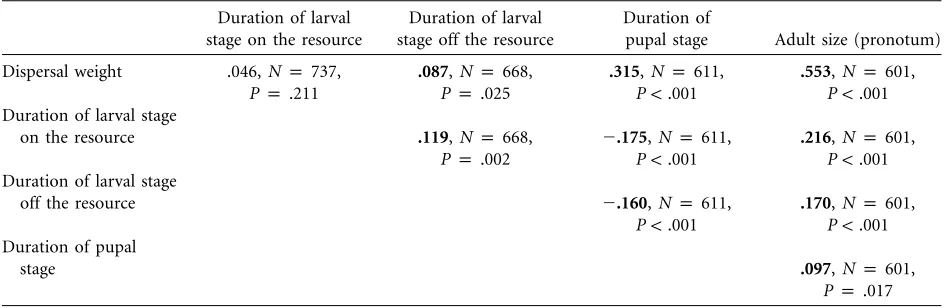
There were significant correlations among all four of our offspring performance measures except between dis-persal weight and duration of larval development on the resource. Combining the two periods of larval devel-opment, on and off the carcass, there was a highly sig-nificant negative correlation between total larval devel-opment and pupal develdevel-opment (rp⫺0.206,Np611, ). Shorter larval development is thus offset by
P!.001
longer pupal development—a trade-off that was seen in another burying beetle species in which it has a genetic basis (Rauter and Moore 2002a, 2002b). Controlling for body mass at dispersal, the partial correlation between larval development and pupal development was even stronger (rp⫺0.267).
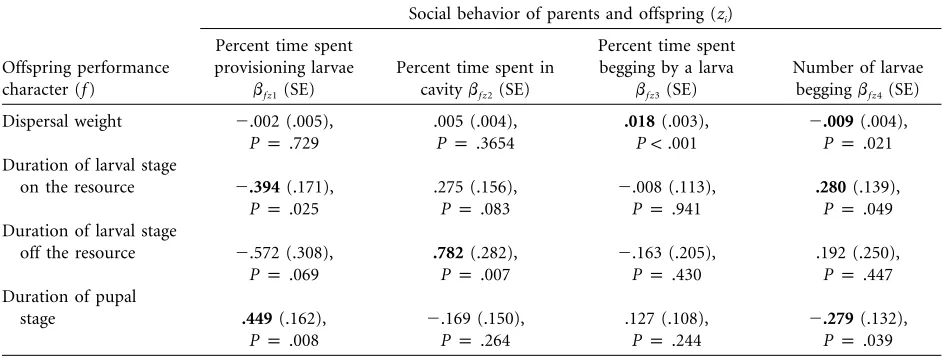
Maternal and offspring performance gradients suggest a consistent pattern of trade-offs in parental and offspring behavior (table 4). In all cases, there was a positive rela-tionship between levels of provisioning and offspring per-formance but a negative relationship between time spent in the crater without provisioning and offspring perfor-mance (table 4). This same pattern of balance between offspring behaviors was seen as well, with a positive effect of time spent begging but a negative effect of number of offspring begging on offspring performance (table 4). However, parental and offspring behavior appear to influ-ence different offspring performance characters.
[image:7.612.313.543.419.633.2]Table 2:Linear (bwf i) and nonlinear (gwf i) standardized selection gradients (Lande and Arnold 1983) relating the effect of offspring
performance characters on relative fitness (w) inNicrophorus vespilloides
Offspring performance
character (fi) N
Linear relationship
(bⳲSE) P
Nonlinear relationship
(gⳲSE) P
Mass at dispersal 737 .055(.017) .002 ⫺.012 (.011) .143
Duration of larval stage
on the resourcea 737 ⫺.049(.017) .005 .022 (.010) .805
Duration of larval stage
off the resourceb 668 ⫺.093(.014) !.001 ⫺.021(.006) !.001
Note: Boldtypepsignificantwith Bonferroni correction. aLarval development while foraging and being fed from the carcass.
b Larval development while no longer interacting with parents or siblings; also called the “wandering” stage (Eggert and Mu¨ller 1997).
in the cavity without provisioning had the opposite effects on development, although only the partial regression be-tween time in the cavity and duration of time spent as wandering larvae was significant (table 4). There was not a significant relationship between parental behaviors and differences in larval mass at dispersal (table 4).
In contrast to parental behavior, offspring performance gradients were largest in relation to larval mass (table 4). Increasing the amount of time a larva spent begging had a positive effect on the final mass of larvae, while increasing numbers of begging larvae had a negative effect on larval mass. The number of begging larvae also had significant negative influences on development. An increase in the number of begging larvae increased the time spent as a wandering larvae off the resource and decreased the time as pupae, both of which are negatively related to fitness (tables 3, 4). The amount of time a larva begged was not significantly related to changes in development, although the pattern of association remained consistent (table 4).
Discussion
This study is unique in simultaneously investigating the role of both selection and inheritance on parent-offspring interactions. We are therefore able to provide a more com-plete picture of how such interactions can evolve. We show that differences in the expression of parental and offspring behavior inNicrophorus vespilloidespersisted regardless of the social environment in which they were expressed (table 1). There were significant positive correlations between parent and offspring behavior related to the biological or-igins of the individuals assayed but independent of the social environment within which the behavior was per-formed, demonstrating that there was significant genetic covariation underlying pairs of parent and offspring be-havioral traits. We found significant natural selection on offspring performance (table 2) and corresponding pa-rental and offspring performance gradients arising from parental and offspring behavior, respectively, affecting off-spring performance (table 4). Thus, our study places
par-ent and offspring interactions within the framework of formal quantitative genetic theory and allows us to inter-pret patterns of selection and potential inheritance (Arnold 1983). Specifically, the environment-independent corre-lations support quantitative genetic theories of parent-offspring coadaptation (Wolf and Brodie 1998; Wolf 2000), and the selection and performance gradients suggest hy-potheses for how joint expression levels of provisioning and begging may be adaptive in this system.
Coadaptation of Parenting and Begging
Table 3:Correlations among offspring performance characters
Duration of larval stage on the resource
Duration of larval stage off the resource
Duration of
pupal stage Adult size (pronotum)
Dispersal weight .046,Np737,
Pp.211
.087,Np668,
Pp.025
.315,Np611,
P!.001
.553,Np601,
P!.001
Duration of larval stage
on the resource .119,Np668,
Pp.002
⫺.175,Np611,
P!.001
.216,Np601,
P!.001
Duration of larval stage
off the resource ⫺.160,Np611,
P!.001
.170,Np601,
P!.001
Duration of pupal
stage .097,Np601,
Pp .017
Note: Boldtypepsignificantwith Bonferroni correction.
Quantifying Selection Arising from Parental and Offspring Behavior: Selection and Performance Gradients
The offspring performance traits we measured were strongly related to fitness inN. vespilloides(table 2). There was selection for larger offspring and those that progressed faster through the larval stage. In addition, there was a negative correlation between the duration of the larval and pupal stages, suggesting that it is advantageous to spend as much time as possible in the pupal rather than the larval stage (table 3). These results are consistent with a previous study of Nicrophorus pustulatus (Rauter and Moore 2002b), which found evidence for a similar trade-off between components of trade-offspring development main-tained by negative genetic correlations between develop-mental stages inN. pustulatus. Overall, heavier larvae (and ultimately larger adults) took longer to develop (table 3), suggesting there may be an upper limit to selection for reduced development time because of trade-offs between components of development. Shifting development to dif-ferent stages may ameliorate this constraint. Finally, se-lection on offspring performance traits was not strictly directional (table 2). Although the relationship between larval size and fitness was linear, there was a significant nonlinear relationship between fitness and the duration of development. This further supports the idea of an upper limit to the rate of offspring development.
Given the strength and pattern of selection on offspring performance, the offspring performance gradients for the two begging behaviors we measured appeared to have con-flicting function or influence (table 4). The average time spent begging to a parent by each larva in the brood had a positive impact on offspring performance, increasing lar-val body mass at dispersal and thus adult size at eclosion. This supports a signaling function for begging that is pos-itively related to fitness because only begging offspring are fed by the parents (Smiseth and Moore 2004b). In contrast,
there was a negative performance gradient for the mean number of larvae begging during each begging bout for both dispersal weight and the duration of pupal devel-opment. These negative fitness effects are likely to arise from intrabrood competition for access to food provi-sioned by the parent (e.g., Stockley and Parker 2002; Wright and Leonard 2002) because the number of begging offspring is a measure of the number of siblings that, at a given time, are competing for food from the parents (Smiseth and Moore 2002). While this may also reflect an influence of brood size—larger broods may exhibit more competition—the effect is the same. More competition results in a negative effect on offspring performance.
Table 4:Performance gradients (bf z i) relating parental care behaviors and offspring begging behaviors to offspring performance measured as growth (mass) or rate of development
Social behavior of parents and offspring (zi)
Offspring performance character (f)
Percent time spent provisioning larvae
bf z1(SE)
Percent time spent in cavitybf z2(SE)
Percent time spent begging by a larva
bf z3(SE)
Number of larvae beggingbf z4(SE)
Dispersal weight ⫺.002 (.005),
Pp.729
.005 (.004),
Pp.3654
.018(.003), P!.001
⫺.009(.004), Pp .021
Duration of larval stage
on the resource ⫺.394(.171),
Pp.025
.275 (.156), Pp.083
⫺.008 (.113), Pp.941
.280(.139), Pp .049
Duration of larval stage
off the resource ⫺.572 (.308),
Pp.069
.782(.282), Pp.007
⫺.163 (.205), Pp.430
.192 (.250), Pp .447
Duration of pupal
stage .449(.162),
Pp.008
⫺.169 (.150), Pp.264
.127 (.108), Pp.244
⫺.279(.132), Pp .039
Note: Independent variables (parent and offspring behaviors) were standardized to a mean of 0,SDp1, to allow direct comparisons of strength of selection. Boldtypepsignificantwith Bonferroni correction.
to the larvae (Scott and Gladstein 1993). Personal foraging increases the potential future fitness of parents even though it decreases offspring fitness (Scott and Gladstein 1993; A. J. Moore, S. Musa, and P. T. Smiseth, unpublished data). Thus,N. vespilloidesparents are competitors for the food resource as well as caretakers to their offspring, re-sulting in potential parent-offspring conflict.
Integration of Selection and Inheritance: The Adaptive Nature of Parent and Offspring Behavior
Expressed in Interactions
If offspring benefit by both begging more and receiving more provisioning, why don’t all offspring and parents show high levels of begging and provisioning? Why should the genetic correlation be positive? Agrawal et al. (2001) suggest that the negative correlation in the burrower bugs they study is a coadaptation because there will be com-binations of high begging/low provisioning or low beg-ging/high provisioning that result in equal offspring fitness on average. A negative correlation equalizes the benefits and costs of both. Under this reasoning, a positive cor-relation would seem to be not adaptive given that high/ high combinations would be superior to low/low combinations.
Agrawal et al.’s (2001) argument is based on the results of a model of stabilizing selection on the interacting phe-notypes (Wolf and Brodie 1998). Selection is often more complex than pure stabilizing selection when there are parent-offspring interactions (Ko¨lliker 2003). Our results support a pattern of complex selection inN. vespilloides
that is often directional and sometimes includes nonlinear components. Further, the sign of the selection or
perfor-mance gradient depended on which traits were examined in our study. We suggest that the complex pattern of se-lection that we found arising from parent-offspring inter-actions in N. vespilloides, combined with genetic covari-ances among traits with contrasting effects, provides insights into why parent-offspring covariances may be dif-ficult to predict. It also allows us to suggest that the parent and offspring traits in N. vespilloides are coadapted re-gardless of the sign of the genetic correlations.
Our study suggests that in N. vespilloides, parents can have negative effects on their offspring by spending time in the cavity without feeding them. However, parents can-not feed their offspring unless they enter the cavity. Like-wise, a parent feeds only begging larvae, but there can be competition for food that has negative effects on offspring performance. The pattern of genetic covariances suggests that parents that are likely to spend more time feeding themselves while in the cavity also spend more time feed-ing their offsprfeed-ing and vice versa. Families that are likely to have high levels of larval begging also have higher num-bers of begging larvae and increased competition. This suggests that there are multiple stable combinations of behavior inN. vespilloides.
in-dependent of each other. Balancing the positive and neg-ative effects of interactions with relneg-atives therefore requires a traoff because larger individuals require a longer de-velopment time because individuals cannot easily grow quickly and grow to be large. A positive coadaptation over-comes some of the costs associated with larval competition and the presence of parents because the parents will pro-vision the offspring more often; that is, positive directional selection will result in increased provisioning even if more larvae beg and create more competition. If, in contrast, the parents do not associate with the offspring, the off-spring will not beg, in which case both the costs and the benefits of begging and the presence of parents will be minimized.
Parent-offspring interactions are complex interacting phenotypes and are both targets and agents of selection (Moore et al. 1998). Most models (Wolf and Brodie 1998; Wolf 2000) have focused on levels of offspring begging and parental provisioning, but we suggest that this may be too simplistic a view. Our results suggest that all be-haviors that are potentially functionally related should be taken into account when studying social selection and evo-lution in parent-offspring interactions.
Acknowledgments
We thank M. Gibbs and S. Musa for assistance with hus-bandry. C. Klingenberg, T. Moore, J. Wolf, three anony-mous reviewers, and especially B. Brodie and M. Ko¨lliker provided helpful discussions and comments on earlier ver-sions of the manuscript that greatly clarified our ideas and presentation. This research was supported by a National Environment Research Council (NERC) postgraduate fel-lowship to J.E.L. and a NERC grant to A.J.M.
Literature Cited
Agrawal, A. F., E. D. Brodie III, and J. Brown. 2001. Parent-offspring coadaptation and the dual genetic control of maternal care. Science 292:1710–1712.
Anduaga, S., and C. Huerta. 2001. Effect of parental care on the duration of larval development and offspring survival in Nicrophorus mexicanus Matthews (Coleop-tera: Silphidae). Coleopterists Bulletin 55:264–271. Arnold, S. J. 1983. Morphology, performance and fitness.
American Zoologist 23:347–361.
———. 1992. Constraints on phenotypic evolution. American Naturalist 140(suppl.):S85–S107.
Beeler, A. E., C. M. Rauter, and A. J. Moore. 1999. Pher-omonally mediated mate attraction by males of the burying beetleNicrophorus orbicollis: alternative calling tactics conditional on both intrinsic and extrinsic fac-tors. Behavioral Ecology 10:578–584.
Brodie, E. D., III, A. J. Moore, and F. J. Janzen. 1995.
Visualizing and quantifying natural selection. Trends in Ecology & Evolution 10:313–318.
Cheverud, J. M., and A. J. Moore. 1994. Quantitative ge-netics and the role of the environment provided by relatives in behavioral evolution. Pages 67–100inC. R. B. Boake, ed. Quantitative genetic studies of behavioral evolution. University of Chicago Press, Chicago. Clutton-Brock, T. H. 1991. The evolution of parental care.
Princeton University Press, Princeton, N.J.
Crook, J. H. 1972. Sexual selection, dimorphism and social organization in the primates. Pages 231–281 in B. Campbell, ed. Sexual selection and the descent of man, 1871–1971. Aldine, Chicago.
Eggert, A. K., and J. K. Mu¨ller. 1997. Biparental care and social evolution in burying beetles: lessons from the larder. Pages 216–236 in J. C. Choe and B. J. Crespi, eds. The evolution of social behavior in insects and arachnids. Cambridge University Press, Cambridge. Eggert, A. K., M. Reinking, and J. K. Mu¨ller. 1998. Parental
care improves offspring survival and growth in burying beetles. Animal Behaviour 55:97–107.
Hager, R., and R. A. Johnstone. 2003. The genetic basis of family conflict resolution in mice. Nature 421:533– 535.
Houle, D. 1991. Genetic covariance of fitness correlates: what genetic correlations are made of and why it mat-ters. Evolution 45:630–648.
Koca´rek, P. 2001. Diurnal activity rhythms and nice dif-ferentiation in a carrion beetle assemblage (Coleoptera: Silphidae) in Opava, the Czech Republic. Biological Rhythm Research 32:431–438.
Ko¨lliker, M. 2003. Estimating mechanisms and equilibria for offspring begging and parental provisioning. Pro-ceedings of the Royal Society of London B 270(suppl.): 110–113.
Ko¨lliker, M., and H. Richner. 2001. Parent-offspring con-flict and the genetics of offspring solicitation and pa-rental response. Animal Behaviour 62:395–407. Ko¨lliker, M., M. W. G. Brinkhof, P. Heeb, P. S. Fitze, and
H. Richner. 2000. The quantitative genetic basis of off-spring solicitation and parental response in a passerine bird with biparental care. Proceedings of the Royal So-ciety of London B 267:2127–2132.
Lande, R., and S. J. Arnold. 1983. The measurement of selection on correlated characters. Evolution 37:1210– 1226.
Martin, P., and P. Bateson. 1986. Measuring behaviour: an introductory guide. Cambridge University Press, Cam-bridge.
Moore, A. J., J. B. Wolf, and E. D. Brodie III. 1998. The influence of direct and indirect genetic effects on the evolution of behavior: social and sexual selection meet maternal effects. Pages 22–41inT. A. Mousseau and C. W. Fox, eds. Maternal effects as adaptations. Oxford University Press, Oxford.
Moore, A. J., K. F. Haynes, R. F. Preziosi, and P. J. Moore. 2002. The evolution of interacting phenotypes: genetics and evolution of social dominance. American Naturalist 160(suppl.):S186–S197.
Mu¨ller, J. K., and A.-K. Eggert. 1990. Time-dependent shifts between infanticide and parental behavior in fe-male burying beetles: a mechanism of indirect mother-offspring recognition. Behavioral Ecology and Socio-biology 27:11–16.
Rauter, C. M., and A. J. Moore. 1999. Do honest signalling models of offspring solicitation apply to insects? Pro-ceedings of the Royal Society of London B 266:1691– 1696.
———. 2002a. Evolutionary importance of parental care performance, food resources, and direct and indirect genetic effects in a burying beetle. Journal of Evolu-tionary Biology 15:407–417.
———. 2002b. Quantitative genetics of growth and de-velopment time in the burying beetleNicrophorus pus-tulatus in the presence and absence of post-hatching parental care. Evolution 56:96–110.
———. In press. Time constraints and trade-offs among parental care behaviours: effects of brood size, sex, and loss of mate. Animal Behaviour.
Rosenblatt, J. S., and C. T. Snowdon, eds. 1999. Parental care: evolution, mechanisms, and adaptive significance. Academic Press, San Diego, Calif.
Scott, M. P. 1998. The ecology and behavior of burying beetles. Annual Review of Entomology 43:595–618. Scott, M. P., and D. Gladstein. 1993. Calculating males?
the duration of parental care in burying beetles. Evo-lutionary Ecology 7:362–378.
Smiseth, P. T., and A. J. Moore. 2002. Does resource
avail-ability affect offspring begging and parental provision-ing in a partially beggprovision-ing species? Animal Behaviour 63: 577–585.
———. 2004a. Complex family dynamics: joint effects of social interactions and resource availability. Behavioral Ecology (in press).
———. 2004b. Signalling of hunger when offspring forage by both begging and self-feeding. Animal Behaviour (in press).
Smiseth, P. T., C. T. Darvell, and A. J. Moore. 2003. Partial begging: an empirical model for the early evolution of offspring signaling. Proceedings of the Royal Society of London B 270:1773–1777.
Sokal, R., and F. J. Rohlf. 1995. Biometry. 3d ed. W. H. Freeman, New York.
Stockley, P., and G. A. Parker. 2002. Life history conse-quences of mammal sibling rivalry. Proceedings of the National Academy of Sciences of the USA 99:12932– 12937.
Wade, M. J. 1998. The evolutionary genetics of maternal effects. Pages 5–21 inT. A. Mousseau and C. W. Fox, eds. Maternal effects as adaptations. Oxford University Press, Oxford.
West-Eberhard, M. J. 1983. Sexual selection, social com-petition, and speciation. Quarterly Review of Biology 58:155–183.
Wolf, J. B. 2000. Gene interactions from maternal effects. Evolution 54:1882–1898.
Wolf, J. B., and E. D. Brodie III. 1998. The coadaptation of parental and offspring characters. Evolution 52:299– 308.
Wolf, J. B., E. D. Brodie III, and A. J. Moore. 1999. In-teracting phenotypes and the evolutionary process. II. selection resulting from social interactions. American Naturalist 153:254–266.
Wright, J., and M. L. Leonard, eds. 2002. The evolution of begging: competition, cooperation and communi-cation. Kluwer Academic, Dordrecht.