α
decay of the
π
h
11/2isomer in
164Ir
M. C. Drummond,1D. O’Donnell,1,*R. D. Page,1,†D. T. Joss,1L. Capponi,2D. M. Cox,1I. G. Darby,3,‡L. Donosa,1 F. Filmer,1T. Grahn,3P. T. Greenlees,3K. Hauschild,3,4A. Herzan,3U. Jakobsson,3P. M. Jones,3,§R. Julin,3S. Juutinen,3
S. Ketelhut,3,M. Leino,3A. Lopez-Martens,3,4A. K. Mistry,1P. Nieminen,3P. Peura,3P. Rahkila,3S. Rinta-Antila,3 P. Ruotsalainen,3M. Sandzelius,3J. Sar´en,3B. Say˘gı,1C. Scholey,3J. Simpson,5J. Sorri,3A. Thornthwaite,1and J. Uusitalo3
1Department of Physics, Oliver Lodge Laboratory, University of Liverpool, Liverpool L69 7ZE, United Kingdom 2School of Engineering, University of the West of Scotland, Paisley PA1 2BE, United Kingdom
3Department of Physics, University of Jyv¨askyl¨a, PO Box 35, FI-40014 Jyv¨askyl¨a, Finland
4CSNSM, CNRS/IN2P3 and Universit´e Paris Sud, F-91405 Orsay, France 5STFC Daresbury Laboratory, Daresbury, Warrington WA4 4AD, United Kingdom
(Received 15 April 2014; published 16 June 2014)
Theα-decay branch of theπh11/2isomer in164Ir has been identified using the GREAT spectrometer. The164Ir
nuclei were produced using the92Mo(78Kr
,p5n)164Ir reaction and separated in flight using the recoil ion transport
unit (RITU) gas-filled separator. The measuredα-decay energy of 6880±10 keV allowed the excitation of the πh11/2state in160Re to be deduced as 166±14 keV. The half-life of164Ir was measured with improved precision
to be 70±10μs and anα-decay branching ratio of 4±2% was determined. Improved half-life and branching ratio measurements were also obtained for165Ir, but no evidence was found for the ground-state decays of either 164Ir or165Ir.
DOI:10.1103/PhysRevC.89.064309 PACS number(s): 23.60.+e,23.50.+z,27.70.+q
I. INTRODUCTION
Alpha radioactivity is the principal decay mode of neutron-deficient isotopes of elements from82Pb to94Pu. BelowZ=
82,αradioactivity is still dominant for even-Zelements down to76Os, although proton emission dominates for the lightest known isotopes of the odd-Zelements. One feature of proton emitters withN 84 is that most of the proton-emitting states also have a competingα-decay branch [1]. A typical example is17079Au, in which proton andα-particle emission have been observed from both the ground state and a low-lying isomeric state [2,3]. Measurements of the proton-decay energies, half-lives, and branching ratios indicate that the protons are emitted fromπd3/2andπh11/2orbitals, respectively. As in other odd-odd nuclei in this region, in both states the odd-odd proton is assumed to be coupled to a neutron in aνf7/2orbital [3]. The unhinderedαdecays from these states populate corresponding levels in166
77Ir, which also undergo both proton andα-particle emission [4].
In contrast, in the previous studies of 164Ir, the lightest known iridium isotope, only proton emission from aπh11/2 state was observed [2,5]. The α decay of this state would be expected to populate the πh11/2 state in 160Re, which is unique in this region because, instead of decaying by
*Present address: School of Physics and Astronomy, University of
Glasgow, Glasgow G12 8QQ, United Kingdom. †Corresponding author: [email protected]
‡Present address: Department of Nuclear Sciences and Applications, International Atomic Energy Agency, A-1400 Vienna, Austria.
§Present address: Department of Nuclear Physics, iThemba
Laboratory for Accelerator Based Sciences, PO Box 722, Somerset West 7129, South Africa.
Present address: TRIUMF, 4004 Wesbrook Mall, Vancouver, British Columbia, V6T 2A3 Canada.
proton orα-particle emission, it is observed toγ decay with a half-life of 2.8 μs to the πd3/2 ground state [6–8]. The
γ-ray cascade identified from the decay of thisπh11/2isomer comprises a 96 keVE2 transition followed by a 38 keVE1 transition. However, other unobserved transitions might be expected to form part of this cascade since the excitation energy of the isomer has been estimated from systematics to be 185±21 keV [9]. By using this estimate, partial half-lives for proton andα-particle emission can be predicted, and these values are significantly longer than that observed from theγ
decay of the state. However, half-lives for these decay modes vary rapidly withQvalue, so it is desirable to determine the excitation energy of this state experimentally.
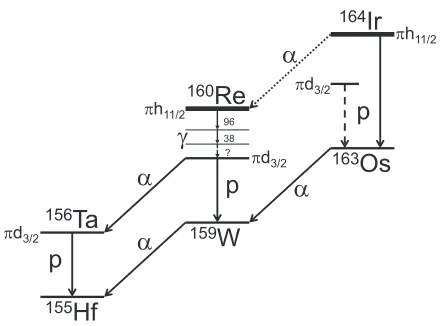
One method to establish the excitation energy of theπh11/2 state in160Re would be through a measurement of theQvalue of theαdecay of theπh11/2state164Ir (see Fig.1). TheQvalue for thisαdecay has been estimated from systematics [9], from which a branching ratio of∼8% could be expected. Such a low α-decay branch would have been below the sensitivity limits of the previous studies of164Ir, in which proton-decay yields of only ∼five events [2] and ∼eight events [5] were obtained.
The Qvalues for decays from theπd3/2 ground state of 164Ir can also be estimated from systematics. These suggest
FIG. 1. Schematic diagram showing the expected proton and α decays of states in 164Ir. The odd neutrons in 156Ta, 160Re, and 164Ir are proposed to occupy
νf7/2 orbitals [4,5]. The discovery of
theαdecay of theπh11/2isomer in164Ir shown by the dotted line is
presented in this work, but no evidence could be found for the proton decay of theπd3/2ground state indicated by the dashed line.
In the present work, theα-decay branch of theπh11/2state in 164Ir has been identified and its proton-decay properties have been determined with improved precision. A search has been performed for the proton decay of theπd3/2ground state of164Ir. Improved half-life and branching-ratio measurements were also obtained for theπh11/2state in165Ir.
II. EXPERIMENTAL DETAILS
The experiment was performed at the Accelerator Labora-tory of the University of Jyv¨askyl¨a. The164Ir nuclei were pro-duced in the fusion-evaporation reaction92Mo(78Kr,p5n)164Ir. The 78Kr beam provided by the K130 cyclotron bombarded the isotopically enriched, self-supporting92Mo target foil of thickness 500μm/cm2. Beam energies at the front of the target of 428, 435, and 450 MeV were used for periods of 21, 18, and 270 hours, respectively. The average beam intensity was 10 particle nA.
The164Ir ions recoiled out of the target and were transported using the gas-filled separator recoil ion transport unit (RITU) [11,12] to the GREAT spectrometer [13] situated at its focal plane. The flight time was estimated to be∼0.3μs. The ions passed through a multiwire proportional counter (MWPC) and were implanted into one of two adjacently mounted DSSDs. The energy-loss signal in the MWPC and the time of flight between the MWPC and the DSSDs allowed evaporation residues to be distinguished from beam-like particles.
Both of the DSSDs had an active area of 60 mm×40 mm and were 300 μm thick. The strips on their front and back surfaces were orthogonal and the strip pitch of 1 mm on both faces provided 4800 independent pixels. The 120 strips on the front face of the DSSDs were instrumented with the standard analog electronics, with the shaping times on the amplifiers reduced to their minimum value of 0.5μs. Even so, the dead time for extracting energy information from successive signals in a given strip was 7μs, which would have been too long to allow for a meaningful search for the decay of the ground state of 164Ir to be attempted. Therefore, the 80 strips on the rear
face of the DSSDs were instrumented with 16-channel, 14-bit Lyrtech VHS-ADC16 digital electronics modules, which had a sampling frequency of 100 MHz. Traces of length 10μs representing the electronic response to signals in these strips were recorded, allowing energy and timing information for short-lived decays to be extracted. These data were correlated with information on pileup recorded simultaneously from the strips on the front face, in order to identify traces which may have included a fast decay and to assign these traces to a specific DSSD pixel.
An array of 28 silicon PIN diodes was mounted around the perimeter of the DSSDs in a box-like arrangement. Each PIN diode had an active area of 28×28 mm2 and a thickness of 500μm. The PIN diodes were used to measure the energies of
αparticles emitted in the upstream direction that escaped from the DSSDs without depositing their full energy. These escaping
α particles form a background in the region of the DSSD energy spectrum where proton-decay peaks are expected. By vetoing energy signals in the DSSDs that are coincident with signals in the PIN diodes, this background can be suppressed. A planar double-sided germanium strip detector was mounted a few mm behind the DSSDs inside the same vacuum enclosure to measure the energies of x rays and low-energy
γ rays emitted during decay processes in the DSSDs. The energies of higher-energyγrays were measured using a clover germanium detector mounted outside the vacuum chamber above the DSSDs.
All detector signals were passed to the triggerless data acquisition system [14], where they were time stamped with a precision of 10 ns. The data were analyzed using theGRAIN [15] software package, which was also used to identify traces attributed to proton decays of164Ir through correlations with subsequent163Osαdecays.
III. RESULTS
100
101
102
103
104
0 10 20 30 40
Counts per 20 keV
1 2 3 4 5 6 7 8 9
Energy (MeV) 0
1 2 3 4
163
Os
155
Lu
156
Hf
164
Os
160
W,163Re
161
W
(a)
164
Ir
161
Re
165
Ir
164
Ir
158
W
(c) (b)
164
Ir
160
Re
FIG. 2. (a) Energy spectrum of decay events occurring within 0.5 ms of an ion being implanted into the same DSSD pixel. (b) Energy spectrum of these events that are followed within 28 ms by anαdecay of163Os. (c) Energy spectrum of decay events that
occur within 0.35 ms of an ion implantation and are followed within 3 ms by a daughter energy characteristic of160Re ground-state proton
decays. Escapingαparticles detected in the array of PIN diodes are not included in these spectra.
Figure2(c)shows the energy spectrum of decay events that occur within 350μs of an ion implantation and are followed within 3 ms by a ground-state proton decay of 160Re [7]. A peak comprising four counts can be seen at an energy of 6880±10 keV. Two of these recoil-alpha-proton decay chains were followed by159W
αdecays where the full energy was deposited in the DSSD, confirming the assignment of this new
α radioactivity as a decay branch from 164Ir. The half-life determined for the four events using the method of maximum likelihood was 69+–2941 μs. This is an order of magnitude shorter than would be expected for a state decaying by α-particle emission alone but is consistent with the value measured for proton emission from theπh11/2state in164Ir. This activity is therefore assigned as theα-decay branch of theπh11/2state in 164Ir.
Thisα decay of164Ir is expected to populate the πh11/2 state in 160Re, which undergoes electromagnetic decay to the πd3/2 ground state with a half-life of 2.8 μs [6–8]. Electron conversion of the transitions could lead to summing with theα-particle energy signals within the analog amplifier shaping time. The effect of this summing was investigated through Monte Carlo simulations of the response of the DSSDs and electronics, using internal conversion coefficients from Ref. [21]. The simulations indicated that∼25% of theα-decay
intensity would be shifted to higher energies. Given the low statistics, the observation of four events close in energy, with none shifted to higher energies as a result of summing, is consistent with this expectation.
The observed164Irα-decay yield corresponds to a branch-ing ratio of 4±2%, after correcting for the fraction of protons andαparticles that escaped from the DSSDs without depositing their full energy. A cross section of ∼4 nb was estimated for the population of theπh11/2 state in164Ir from the combined yield of both its decay branches. This cross section estimate assumes that 30% of all164Ir nuclei produced were implanted into the DSSDs [22].
A search for proton decays of the πd3/2 ground state of 164Ir was performed by analyzing traces correlated with events
characteristic of163Osαdecays. However, no evidence for the proton decay of this state was found. Possible explanations for this nonobservation could be that the half-life may have been too short (<0.5 μs), the yield too low (<50 pb), or a combination of these effects.
The present data were also analyzed to obtain improved measurements of the decays of theπh11/2state in165Ir, which was previously reported to have a half-life of 300±60μs and to decay by both proton andα-particle emission [4]. The upper panels of Fig.3show sections of a decay correlation matrix in which the decay energy of implanted nuclei is plotted against the decay energy of the daughter nuclei, while the lower panels show the projections of these matrix sections, in which both the proton- andα-decay branches of165Ir can be seen. In total, 270165Ir proton decays were correlated with164Osαdecays and 35αdecays were correlated withαdecays of theπh11/2 state in161Re. However, no correlations were observed of165Ir
6.0 6.1 6.2 6.3 6.4
Daughter Energy (MeV)
1.0 1.2 1.4 1.6 1.8 2.0 0
100 200 300
Counts per 20 keV
6.0 6.2 6.4 6.6 6.8
161
Re
164
Os
165
Ir
165
Ir
159
W
159W
157
Ta
158
Ta
161
Re
163
Os
162
Re
160
Re
Parent Energy (MeV)
(a) (b)
(c) (d)
FIG. 3. (a) A section of a parent-daughter decay correlation matrix showing the correlations between proton decays of160Re and 165Ir with the
αdecays of their respective daughters,159W and164Os.
The maximum time intervals between the implantation and parent decay and between the parent and daughter decays were 1 ms and 63 ms, respectively. (b) A section of the same decay correlation matrix featuring theαdecays of165Ir correlated with those of its daughter 161Re. Correlations of163Os-159W,161Re-157Ta, and162Re-158Ta are
[image:3.590.73.256.69.351.2] [image:3.590.306.550.444.620.2]αdecays with proton decays of161Re, for which the branching ratio is only a few percent [19,23]. Correcting for the daughter branching ratios [19,23,24], the α-decay branching ratio of 165Ir was measured to be 12±2%. A half-life of 340±40μs
was measured using the method of maximum likelihood, which agrees with the previously measured value [4]. No evidence was found for the decay of the ground state of165Ir.
IV. DISCUSSION
The measured α-decay energy for 164Ir corresponds to a
Q value of 7052±10 keV. This value is shown in Fig. 4, in which the α-decay Q values of πh11/2 states of odd-Z elements are plotted as a function of neutron number, together with those of the ground states of even-Zelements. The value for164Ir continues the nearly linear trend observed for lighter Ir isotopes, which is similar to that exhibited by the chain of Pt isotopes, whereas the light Os isotopes show a slight odd-even staggering in theirQvalues.
The Q values measured for the proton- and α-decay branches of164Ir in the present work can be combined with known Q values to calculate the excitation energy and the proton- and α-decay Qvalues of the πh11/2 state in 160Re (see Fig. 1). An excitation energy of 166±14 keV was determined for the πh11/2 isomer in 160Re, while the Q values deduced for proton and α-particle emission were 1438±12 keV and 6761±16 keV, respectively. Both of these
Qvalues are consistent with those estimated in Ref. [9], where partial half-lives of ∼10 ms and ∼1 ms were predicted for proton emission andα-particle emission, respectively. Neither of these decay modes is therefore able to compete effectively with the observedγ-decay branch from this 2.8 μs isomer. Furthermore, the deduced excitation energy means that any remaining transitions from the cascade that were not observed
FIG. 4. (Color online) Qvalues ofαdecays ofπh11/2states in
odd-Znuclei and the ground states of even-Znuclei. The measured value for 164Ir obtained in the present work and the
Q value for
160Re deduced from it are indicated by the larger red symbols.
Data are taken from Refs. [3,4,16–19,25–40]. The value plotted for
164Re
89corresponds to theα-particle energy of 5486 keV discussed
in Ref. [39].
by Darbyet al.[6,7] or by Sappleet al.[8] would be of low energy and would probably have a large internal conversion coefficient. The α-decay Qvalue is plotted in Fig. 4, from which it can be seen that160Re exhibits a larger increase inQ value than might be expected from theQvalues of its heavier isotopes. A similar increase inQvalue is also found for its Ta, W, and Os isotones that are plotted and for the ground states of Ta and Re isotopes atN =85.
The measured half-life and α-decay branching ratio for 164Ir give a partialα-decay half-life of 1.8±0.9 ms. Using the
method of Rasmussen [41] yields a reducedα-decay width of 33±17 keV, which is consistent with an unhinderedl=0 decay and is comparable to the value of 43±3 keV determined for166Ir [4].
The partial half-lives for proton emission from 164,165Ir deduced from the measurements in the present work are 73±10μs and 370±40μs, respectively. Comparison with Wentzel–Kramers–Brillouin (WKB) calculations using the global optical model of Becchetti and Greenlees [42] assuming proton emission from aπh11/2orbital yields reduced proton-decay widths of 0.29±0.04 and 0.30±0.05, respectively. As can be seen in Fig.5(a), both of these values are consistent with the value of 1/3 that would be expected from the low-seniority shell-model calculation proposed by Davidset al.[4] but are lower than spectroscopic factors calculated in the BCS theory using the proton pairing strength from Ref. [43] and proton single-particle energies from Ref. [44]. Figure5(b)shows the proton-decay half-lives calculated for theπh11/2states of Ta,
156 158 160 162 164 166 168 170 0.0
0.2 0.4 0.6 0.8
1.0 (a)
Au
Ir
Re
Ta
Reduced proton–decay width
156 158 160 162 164 166 168 170 Mass number A 0.0
0.5 1.0 1.5 2.0
2.5 (b)
Au
Ir
[image:4.590.334.517.410.667.2]Re
Ta
FIG. 5. Reduced proton-decay widths ofπh11/2states of Ta, Re,
[image:4.590.55.271.494.656.2]Re, Ir, and Au nuclei using the simple formula in Ref. [45] divided by the corresponding measured partial half-life. The experimental values for 164,165Ir are approximately a factor of two shorter than predicted, but there does seem to be a tendency for the formula to predict longer half-lives than are measured for the states that are plotted.
V. SUMMARY
The decay properties of the lightest-known iridium isotope 164Ir have been investigated, resulting in improved
measure-ments for its proton-decay branch. Theα-decay branch of the
πh11/2isomeric state in164Ir has been identified, establishing the excitation energy of the corresponding state in the daughter nuclide,160Re. The results agree well with values estimated from local extrapolations of the systematics of proton-decay
Q values [9]. Corresponding estimates for the even-lighter isotopes162,163Ir suggest that half-lives of 90 ns and 410 ns, respectively, could be expected [9], which may be too short for study using recoil separator devices such as that used in the present work. Extrapolating the nearly linear variation of α-decay Q values with neutron number for Ir isotopes
suggests that a partial half-life of∼300μs could be expected for the πh11/2 state in 163Ir. This would imply an α-decay branching ratio of only ∼0.1%. A similar branching ratio could be expected for 162Ir, assuming that its Q value has an increase similar to that seen in itsN =85 isotones. With such low branching ratios, short half-lives, and expected low production cross sections,164Ir could be the lightest Ir isotope in which anα-decay branch can be identified.
ACKNOWLEDGMENTS
Financial support for this work has been provided by the UK Science and Technology Facilities Council (STFC); the EU 7th Framework Programme “Integrating Activities-Transnational Access,” Project No. 262010 (ENSAR); and by the Academy of Finland under the Finnish Centre of Excellence Programme 2012–2017 (Nuclear- and Accelerator-Based Physics Pro-gramme at JYFL). T.G. acknowledges the support of the Academy of Finland, contract No. 131665. The authors would like to express their gratitude to the technical staff of the Accelerator Laboratory at the University of Jyv¨askyl¨a for their support.
[1] B. Blank and M. J. G. Borge,Prog. Part. Nucl. Phys.60,403
(2008).
[2] H. Mahmudet al.,Eur. Phys. J. A15,85(2002). [3] H. Kettunenet al.,Phys. Rev. C69,054323(2004). [4] C. N. Davidset al.,Phys. Rev. C55,2255(1997). [5] H. Kettunenet al., Acta Phys. Pol. B32, 989 (2001). [6] I. G. Darbyet al.,Phys. Lett. B695,78(2011). [7] I. G. Darbyet al.,Phys. Rev. C83,064320(2011). [8] P. J. Sappleet al.,Phys. Rev. C84,054303(2011). [9] R. D. Page,Phys. Rev. C83,014305(2011).
[10] R. Grzywacz, C. J. Gross, A. Korgul, S. N. Liddick, C. Mazzocchi, R. D. Page, and K. Rykaczewski,Nucl. Instrum. Methods Phys. Res., Sect. B261,1103(2007).
[11] M. Leinoet al.,Nucl. Instrum. Methods Phys. Res., Sect. B126,
320(1997).
[12] J. Uusitaloet al.,Nucl. Instrum. Methods Phys. Res., Sect. B
204,638(2003).
[13] R. D. Pageet al.,Nucl. Instrum. Methods Phys. Res., Sect. B
204,634(2003).
[14] I. H. Lazaruset al.,IEEE Trans. Nucl. Sci.48,567(2001). [15] P. Rahkila,Nucl. Instrum. Methods Phys. Res., Sect. A595,637
(2008).
[16] R. D. Page, P. J. Woods, R. A. Cunningham, T. Davinson, N. J. Davis, A. N. James, K. Livingston, P. J. Sellin, and A. C. Shotter,
Phys. Rev. C53,660(1996).
[17] C. R. Binghamet al.,Phys. Rev. C54,R20(1996). [18] S. Hofmannet al.,Z. Phys. A: At. Nucl.299,281(1981). [19] R. J. Irvineet al.,Phys. Rev. C55,R1621(1997).
[20] Stuart L. Meyer,Data Analysis for Scientists and Engineers (John Wiley and Sons, Inc., New York, 1975).
[21] T. Kib´edi, T. W. Burrows, M. B. Trzhaskovskaya, P. M. Davidson, and C. W. Nestor, Jr.,Nucl. Instrum. Methods Phys. Res., Sect. A589,202(2008).
[22] J. Sar´en, J. Uusitalo, M. Leino, and J. Sorri,Nucl. Instrum. Methods Phys. Res., Sect. A654,508(2011).
[23] K. Lagergrenet al.,Phys. Rev. C74,024316(2006).
[24] L. Biancoet al.,Nucl. Instrum. Methods Phys. Res., Sect. A
597,189(2008).
[25] S. Hofmannet al.,Z. Phys. A: At. Nucl.333,107(1989). [26] H. Mahmudet al.,Phys. Rev. C62,057303(2000). [27] S. Hofmannet al.,Z. Phys. A: At. Nucl.291,53(1979). [28] A. Rytz,At. Data Nucl. Data Tables47,205(1991).
[29] S. Della Negra, C. Deprun, D. Jacquet, and Y. Le Beyec, Ann. Phys. (Paris)7, 149 (1982).
[30] K. S. Tothet al.,Phys. Rev. C12,533(1975).
[31] D. A. Eastham and I. S. Grant, Nucl. Phys. A 208, 119
(1973).
[32] T. Hild, W.-D. Schmidt-Ott, V. Kunze, F. Meissner, C. Wennemann, and H. Grawe,Phys. Rev. C51,1736(1995). [33] L. Biancoet al.,Phys. Lett. B690,15(2010).
[34] C. Cabot, S. Della Negra, C. Deprun, H. Gauvin, and Y. Le Beyec,Z. Phys. A: At. Nucl.287,71(1978).
[35] C. Cabot, C. Deprun, H. Gauvin, B. Lagarde, Y. Le Beyec, and M. Lefort,Nucl. Phys. A241,341(1975).
[36] H. A. Enge, M. Salomaa, A. Sperduto, J. Ball, W. Schier, Arnfinn Graue, and Arne Graue,Phys. Rev. C25,1830(1982). [37] J. Uusitaloet al., Z. Phys. A: At. Nucl.358, 375 (1997). [38] R. D. Pageet al.,Phys. Rev. C75,061302(2007). [39] B. Hadiniaet al.,Phys. Rev. C80,064310(2009). [40] A. Thornthwaiteet al.,Phys. Rev. C86,064315(2012). [41] J. O. Rasmussen,Phys. Rev.113,1593(1959).
[42] F. D. Becchetti and G. W. Greenlees, Phys. Rev. 182, 1190
(1969).
[43] J. Dudek, A. Majhofer, and J. Skalski,J. Phys. G: Nucl. Phys.
6,447(1980).
[44] B. A. Brown, N. J. Stone, J. R. Stone, I. S. Towner, and M. Hjorth-Jensen,Phys. Rev. C71,044317(2005).
[45] D. S. Delion, R. J. Liotta, and R. Wyss, Phys. Rev. Lett.96,
072501(2006).