This is a repository copy of A grid-enabled problem solving environment for parallel computational engineering design.
White Rose Research Online URL for this paper: http://eprints.whiterose.ac.uk/1785/
Article:
Goodyer, C.E., Berzins, M., Jimack, P.K. et al. (1 more author) (2006) A grid-enabled problem solving environment for parallel computational engineering design. Advances in Engineering Software, 37 (7). pp. 439-449. ISSN 0965-9978
https://doi.org/10.1016/j.advengsoft.2005.09.007
[email protected] https://eprints.whiterose.ac.uk/
Reuse See Attached
Takedown
If you consider content in White Rose Research Online to be in breach of UK law, please notify us by
White Rose Consortium ePrints Repository
http://eprints.whiterose.ac.uk/
This is an author produced version of a paper published in Advances in
Engineering Software.
White Rose Repository URL for this paper: http://eprints.whiterose.ac.uk/1785/
Published paper
Goodyer, C.E., Berzins, M., Jimack, P.K. and Scales, L.E. (2006) A grid-enabled
problem solving environment for parallel computational engineering design.
A Grid-enabled Problem Solving Environment for Parallel
Computational Engineering Design
C.E. Goodyer1, M. Berzins1, P.K. Jimack1and L.E. Scales1,2
1School of Computing, The University of Leeds, Leeds, LS2 9JT
2Shell Global Solutions, Cheshire Innovation Park, Chester, CH1 3SH
Abstract
This paper describes the development and application of a piece of engineering
soft-ware that provides a Problem Solving Environment (PSE) capable of launching, and
interfacing with, computational jobs executing on remote resources on a computational
Grid. In particular it is demonstrated how a complex, serial, engineering optimisation
code may be efficiently parallelised, Grid-enabled and embedded within a PSE. The
en-vironment is highly flexible, allowing remote users from different sites to collaborate,
and permitting computational tasks to be executed in parallel across multiple Grid
re-sources, each of which may be a parallel architecture. A full working prototype has
been built and successfully applied to a computationally demanding engineering
opti-misation problem. This particular problem stems from elastohydrodynamic lubrication
and involves optimising the computational model for a lubricant based on the match
between simulation results and experimentally observed data.
Keywords: Parallel, Computational Grid, Problem Solving Environments
1
Introduction
The use of numerical simulation as part of the engineering design process is now
monplace. A major constraint on its applicability, however, is provided by the
use of computational Grids, either across a single large enterprise or between different
enterprises, provides significant opportunities for cost-effective access to large
compu-tational resources, promising to significantly enhance the scope and value of numerical
simulation [1, 2]. For example, large-scale parallel high performance computing (HPC)
applications may be tackled, or large parameter spaces explored through the use of
mul-tiple solutions of smaller problems. In this paper we present a new problem solving
environment (PSE) that enables users to launch, and interact with, jobs that execute on
remote Grid resources. As is typical, e.g. [3–5], the PSE has been implemented for one
highly challenging engineering application, however the design allows other
applica-tions to be swapped in without the need for fundamental changes.
Features of the Grid-enabled environment include the ability to launch jobs onto one or
more remote Grid resources, to obtain real-time intermediate results and visualise them
locally, and to steer the remote simulation by altering parameters such as physical
con-ditions, numerical parameters or even the underlying mathematical model. Furthermore
the PSE allows remote collaborators, working from other sites, to join a simulation and
to interact with it through both visualisation and steering.
This work builds on an earlier PSE [6–8] by adding flexible Grid-enabled functionality
and through the use of a challenging engineering optimisation problem as an industrially
motivated application.
The particular application that has been selected for this work comes from
elastohydro-dynamic lubrication (EHL) [9, 10]. This is described in detail in the following section.
Section 3 then explains how the fundamental EHL problems are embedded within an
op-timisation procedure that is used for selecting the best possible parameter values within
the simulation model.
Section 4 describes the necessary changes to turn the serial optimisation algorithm into
a distributed memory parallel application with fast solution times. Consideration of the
appropriate degree of parallelism for this application is given here. In Section 5 this
of the optimisation process itself, hence achieving a hierarchy of parallelism: this is
explained in the context of using distributed, remote Grid resources.
Having provided an explanation of the engineering application, and how it may be
exe-cuted in parallel across a computational Grid, Section 6 focuses on the PSE itself. This
is a vital tool in effective use of Grid resources since the ability to interact with a
sim-ulation, to guide the solution or to change the problem being solved, is very important.
From a PSE this can be done without recompilation of code or resubmission of the job
onto the Grid. As Grid cycle accountancy, through utility computing on demand,
de-velops in the coming years it will be important not to have wasted clock cycles, and
steering will assist with this. The Grid-enabling aspects of the PSE are also described
in this section, along with a description of how the gViz collaborative libraries [11] are
used. The output visualisations for such a complex problem are also very important in
being able to effectively use the PSE and these are described in Section 6.3.
2
Elastohydrodynamic Lubrication Modelling
Elastohydrodynamic lubrication problems occur, for example, in lubricated journal
bear-ings and gears where, at the centre of the contact region the load exerted over a very
small area causes extremely high pressures (up to 3 G Pa) resulting in both elastic
de-formation of the components and significant changes in the lubricant properties in this
area [9]. The mathematical models of these problems are therefore highly non-linear
and provide challenging tests for reliable numerical simulation. In recent years there
have been significant advances in the development of robust numerical methods for
these problems, summarised by Venner and Lubrecht [10]. In this work we consider
both one dimensional line contact cases, such as long (modelled by infinite) rollers, and
two dimensional point contact cases, such as journal bearings.
Mathematically EHL is described by a highly non-linear integro-differential equation
temperature, θ, solutions. The steady-state governing equations are given, in
non-dimensional form, by the following equations. First, the Reynolds Equation, shown
here for the point contact, governs the pressure distribution for a given geometry:
∂
∂X
ε∂∂P
X
+ ∂
∂Y
ε∂∂P
Y
−λ ∂(∂ρH)
X =0, (1)
whereε andλ are given by
ε = ρH
3
ηλ(ua+ub)
, (2)
and
λ = 6η0R
2
x a3p
h
. (3)
The film thickness equation defines the contact shape, for a given undeformed
geome-tryG. For line contact cases it is given by
H(X) = H00+G(X)−π1
Z ∞
−∞
lnX−X′
P(X′)dX′, (4)
and for point contact cases by:
H(X,Y) =H00+G(X,Y) + 2 π2 Z ∞ −∞ Z ∞ −∞
P(X′
,Y′)dX′dY′
p
(X−X′)2+ (Y
−Y′)2
, (5)
where H00is the central offset film thickness, which defines the relative positions of the
surfaces if no deformation was to occur. The force balance equation,
line contact:
Z ∞
−∞
P(X)dX =π
2 , (6)
point contact:
Z ∞
−∞ Z ∞
−∞
P(X,Y)dX dY = 3π
2 , (7)
More complex models may also be used, such as thermal cases where the temperature
is variable both within the lubricant and on the surfaces. A typical form of this model
is described in [12]. The lubricant models used in this work are thermal versions of the
Dowson and Higginson density expression [13] and the Roelands viscosity model [14].
Once solutions for these equations are found it is possible to derive the shear stress on
each surface [12]. For example on surface 1 the force is defined to be
τxz;1(x) = −
aphH
2R
∂P
∂X+
R a2η0
η
H(U2−U1) (8)
(9)
for surfaces 1 and 2 at z=0 and z=H respectively, moving at dimensionless speeds U1
and U2 respectively. From these expressions it is possible to work out the total friction
through a contact. In the line contact case, for example, this is given byF as:
F =
Z ∞
−∞
phτxz;1(x)dx. (10)
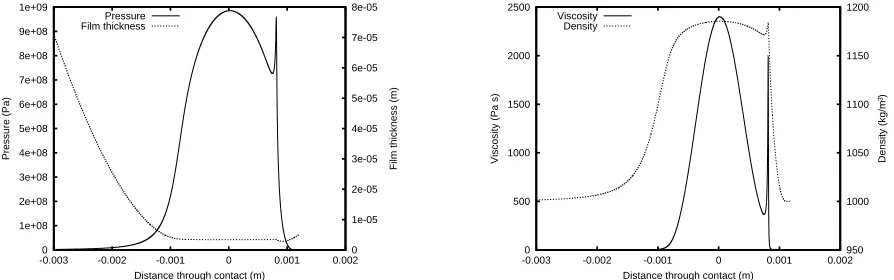
Example line contact solutions are shown in Figure 1 for (a) the pressure and surface
geometry (film thickness), and (b) the density and effective viscosity. Note the existence
of the pressure spike towards the outflow at the end of the contact region. This is a well
known physical feature of these highly loaded EHL contacts, and clearly requires
fine-scale numerical resolution.
In this work we make use of existing EHL software, described in [15–17]. More
gen-eral information about the techniques used in numerically solving EHL problems may
also be found in the work of Venner and Lubrecht [10]. Described briefly, the equations
are discretised on a regular mesh of N=(2k+1) points in each dimension. Both first and
second order finite differences may be used. The resulting non-linear algebraic systems
are solved using the multigrid techniques described in [10, 15, 16, 18] and the
multi-level multi-integration (MLMI) algorithm of Brandt and Lubrecht [19]. MLMI uses
calcula-tion (i.e. the integral in (5) fromO(N4) toO(N2ln N2). The single grid cost is so high
since the discrete version of Equation (5) is a multi-summation of the entire fine domain,
for each point. In this work we have used sixth order coarsening to restrict the finer grid
solutions through a hierarchy of grids to the coarsest grid. It is on this coarsest grid that
the multi-summation is performed, at a fraction of the cost. The calculated
contribu-tions to the deformation are then prolonged back through the hierarchy, correcting the
approximation to the summation near each point by having a more accurate summation
in the locale.
3
Optimisation for EHL
The EHL models described in the previous section contain a large number of parameters.
These can be split into those describing the physical conditions of a particular test, and
those describing the rheological properties of the lubricant being used. The physical
parameters include the loading of the contact, the ambient temperature and slide to roll
ratio, a measure of the amount of slip of one component past the other given by
S = 2(u2−u1) u1+u2
, (11)
where u1 and u2 are the speeds of surfaces 1 and 2 respectively. The lubricant requires
up to 40 parameters to specify its behaviour in a full non-Newtonian thermal EHL
simu-lation. These parameters are not easily measured for a given lubricant and so a practical
approach to assigning their values is to optimise these parameter values against
mea-sured experimental data for that lubricant.
The optimisation undertaken in this work is intended to find the set of lubricant model
parameters that best match the total friction through the contact from numerical
calcu-lations to the observed friction in experiments performed on a test rig under a sequence
of different physical conditions. In these examples the experiments have been run at
roll ratios, giving a total of 36 different cases, covering a wide range of the operating
conditions which lubricants may undergo in practice. By using a numerical solver it
is possible to run each of these cases for a particular input parameter set. Ten of the
lubricant rheology parameters have been varied to try to find the parameter set that most
closely matches the frictional behaviour of the real lubricant. For a given set of lubricant
parameters we define the total frictional residual,RF to be
RF =
36
∑
j=1
Fnum j −F
exp j
2
(12)
whereFnum
j andF exp
j are the numerical and experimental values of the friction for the
jth set of physical parameters, with the numerical value being calculated as given by
Equation (10), or its two-dimensional generalisation for the point contact case. With ten
physical parameters to vary the optimiser is thus trying to minimiseRF in ten
dimen-sional space. Furthermore each evaluation ofRF requires 36 separate, computationally
intensive, EHL problems to be solved.
The precise choice of optimisation algorithm used is not the focus for this work which is
on the fast and efficient evaluation of the optimisation function (and possibly its
deriva-tives) rather than the use of a particular minimisation code. For the examples given
in this paper a sequential simplex algorithm [20, 21] has been used from the NAG C
library [22]. This has the advantages of being simple, robust, and not requiring any
derivatives to be found. Although not used here, gradient based algorithms could equally
well have been employed, with gradients based upon finite difference or adjoint
calcu-lations, for example [23, 24]. For this work the choice of optimisation method is not
important since the PSE is independent of the particular choice of minimisation
algo-rithm.
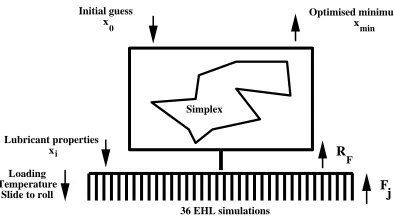
Each evaluation ofRF incurs the cost of performing 36 EHL solutions, and the typical
number ofRF evaluations required in a standard run is of the order of 103. An overall
36 EHL cases at the bottom and different xi, lubricant parameter sets, being supplied
by the optimiser from potential points in the simplex. Each EHL case returns anFj
contribution to theRF value for this particular x
i. Finally the optimiser returns a local
minimum solution, xmin, from the search space.
4
Parallelism of the Optimiser
In this section we focus on the EHL line contact problem. This is one-dimensional and
hence each of the individual EHL problems fits easily into memory and may be solved
efficiently on a single processor. This means that the first level of parallelism may be
focused at the level of the optimiser which performs multiple EHL calculations for each
RF evaluation. Each of the calculations has identical lubricant characteristics but
differ-ent operating conditions meaning that it is possible to run all the cases independdiffer-ently of
each other, since the result of one does not influence any of the others. However there
are great time savings to be made for EHL problems by using continuation methods.
That is, the result to one problem is often a very good guess for the solution to a similar
problem, hence by forming a chain of similar problems the relatively expensive ‘first
link’ in the chain can then give the next result with far less computational effort.
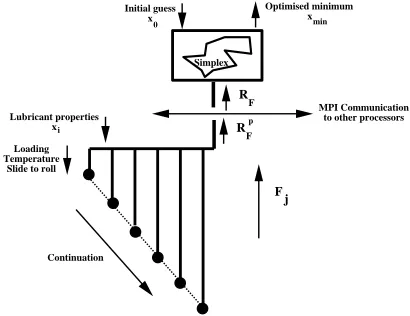
The overall work per processor is sketched in Figure 3, where each processor performs
one set of continued runs on a subset of the 36 EHL cases. The only communication
necessary is the addition of each individual processor’s contributionRp
F to the global
RF. Once the combined total has been accrued in parallel the optimiser itself continues
to function as for the serial case.
The use of continuation adds an extra level of robustness to the solver. Table 1 compares
various different continuation schemes and shows the results comparing the maximum
number of processors (36) where no continuation is possible; continuation with
increas-ing temperature (2 runs per processor); continuation with increasincreas-ing loadincreas-ing (3 runs per
can be clearly seen that maximising the amount of continuation used is very important
for increasing the overall efficiency. Where more processors are used continuation
be-tween results is less frequent meaning more full restarts, and hence the parallel speed-up
diminishes. The final line shows the comparative serial code using continuation along
lines of increasing slide-to-roll ratio. The variation in the number ofRF evaluations to
reach a local minimum is again due to the lack of continuation since a poor initial guess
can cause the numerical solver not to converge, meaning that the calculated friction is
given a 100% error for that case, therefore affecting the future behaviour of the simplex
algorithm.
The parallel software from this project is designed for computational grids such as the
White Rose Grid [25] with its mixture of shared and distributed memory machines,
in-cluding a 256-processor Beowulf style cluster. For reasons of portability the parallelism
is undertaken using MPI [26].
5
Parallelism of the Solver
The line contact problem discussed in the previous section illustrates how the
optimisa-tion process may be parallelised to increase the soluoptimisa-tion speed. The same optimisaoptimisa-tion
process may also be used for 2-d point contact problems however the computational
cost increases still further in this situation. This is overcome through the use of a
par-allel point contact solver, adapted from previous work [7, 27], in order to reduce the
computational time sufficiently to make the optimisation feasible.
5.1
A parallel EHL point contact code
The starting point for the parallelisation of the method described above is the large
amount of work done on parallel multigrid methods [28–31] and work by the authors on
shared memory machines [7]. Discussions as to why parallelisation of multigrid, an
McBryan et al. [30], Llorente et al. [28, 29] and Tuminaro and Womble [31]. The main
problems are the frequency with which coarse grids are encountered, meaning that there
are very high communications costs relative to the computation. This is especially true
once the critical level has been reached, namely the coarse grid where each processor
has the smallest non-trivial amount of computation. The choice left is whether to use
the critical level as the coarsest in the multilevel scheme; to agglomerate, by moving all
the work to a single processor as in Linden et al. [32, 33]; or to have idle processors,
such as used by Brown et al. [34].
In the case of EHL problems the addition of MLMI causes extra difficulties as even
more work is done at coarse mesh levels. In particular, since no significant computation
is done during the MLMI coarsening the communication costs are already a large factor
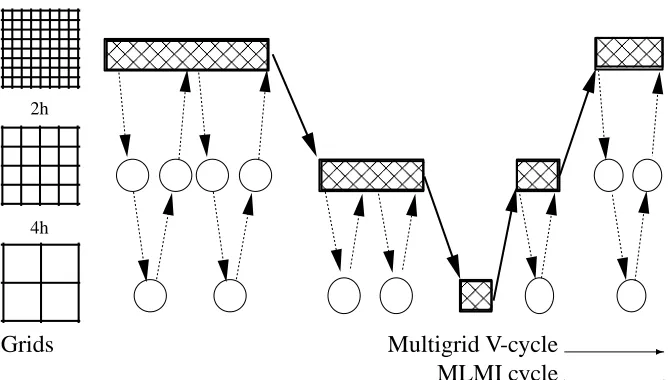
in terms of efficiency. A schematic of the overall algorithm is sketched in Figure 4
which shows a multigrid V cycle with multiple MLMI calls at each level. In contrast to
the multigrid method the most striking change is that there is no calculation other than
at the multi-summation and correction stages, all the work is in grid transfer.
The convergence properties of the standard solution methods mean that line solves are
the most efficient multigrid smoothers for these problems [18, 35], and hence such
smoothers have been considered during the parallelisation of the solver. The natural
geometric domain decomposition is therefore that of strips in the direction of the
lubri-cant entrainment. Due to regular grids being used in the solver, it is possible to ensure
that coarser grids are always decomposed onto the same processors as their coincident
finer grid points. This aids communication efficiency during grid transfer. More detailed
discussion of grid transfer is given in [27].
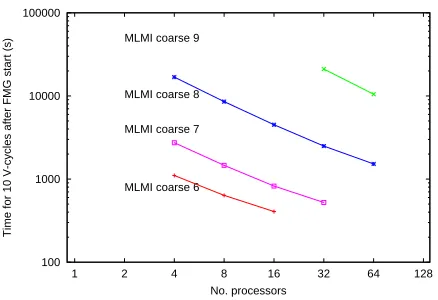
The overall performance of the parallel solver is shown in Figure 5, where the timings
are shown for a typical case on a grid of 4097×4097 points, on up to 64 processors. Note
that as the number of processors increases the size of the coarsest grid increases too, in
order to ensure that the coarsest grid can be partitioned across the processors. This leads
being done more accurately but at a much a higher overall cost. Conversely, if we fix
the size of the coarsest mesh there is a maximum number of processors that may be
used on it. For the cases shown in Figure 5, which is typical in this work, it is clear
that there is little point in going beyond 16 processors on an individual EHL case. A
more comprehensive discussion of these coarse grid issues may be found in [27], and
ways of improving the situation are proposed, although these all add significantly to the
complexity of the implementation.
In this work, however, it is clear from the previous section that additional parallelism is
possible if we make use of a hierarchical approach which combines this parallel solver
with the parallel optimisation described in the previous section. This aims to make
optimal use of the Grid resources available, as outlined in Section 5.2 below, rather
than simply using all the available processors on each single EHL case, which Figure 5
illustrates would be less efficient.
5.2
Hierarchical parallelism
The use of the parallel solver inside the parallel optimiser leads to the notion of
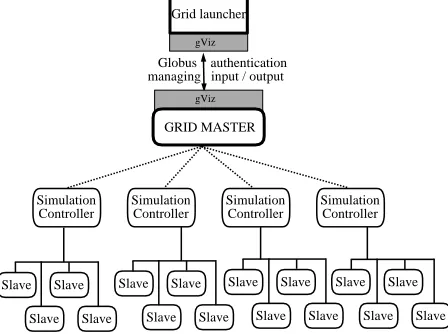
hier-archical parallelism. This is illustrated in Figure 6 where the Grid Master can be seen
to be communicating with a series Simulation Controllers, which, rather than being the
EHL simulations as in the line contact work, are now the lead processes of parallel EHL
simulations.
For reasons of portability the software produced in this work makes use of the MPI
li-brary [26]. In implementing this hierarchical strategy it has been necessary to introduce
additional MPI communication groups, to include local groups for each simulation and a
group for all of the Simulation Controllers. This latter group of processes is responsible
for synchronisation at the end of eachRF evaluation, with each Simulation Controller
posting its contribution to RF to the Grid Master. The Grid Master then broadcasts
within this group the necessary information (i.e. the parameter set xi) for the nextRF
worker processes via the local simulation group.
This communication paradigm means that it is possible to take advantage of the Grid,
rather than just traditional HPC technologies. In particular if, rather than a massively
parallel machine, multiple smaller resources are available, then it is possible to use
Globus with Grid-enabled MPI, MPICH-G2 [36], to split the computation sensibly
be-tween resources. This would allow frequent, data-heavy, high speed communication
within single resources for each EHL simulation, but slower speed TCP/IP traffic
be-tween Grid resources transferring small amounts of data only at the end of each
contin-uation series.
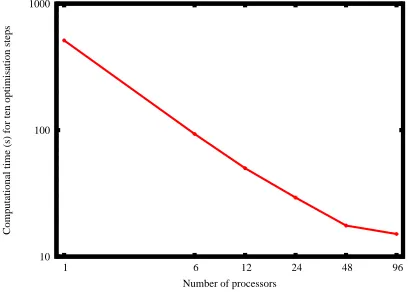
The solution speed for the hierarchical parallelism scheme is illustrated in Figure 7.
This shows the time taken for tenRF evaluations using the hierarchically parallel
op-timisation solver, each EHL solve consisting of ten multigrid V-cycles on a mesh of
1025×1025 points. It may be seen from this figure that the parallelisation of the
opti-miser, with parallelisation of the solver beneath is a good strategy. The issues concerned
with the loss in efficiency beyond 48 processors are three fold. First, the grid
resolu-tion, and hence high level of coarse grid communication is starting to effect the parallel
solution efficiency. The second issue is concerned with the EHL cases not all having
the same computational solution time when the physical parameters are varied. Most
importantly in a Grid setting, however, not all of the 96 processors used in this example
are identical. Hence if one set of parallel computations takes place on a slower set of
processors than the rest this will lead to a loss of overall efficiency. This last observation
raises some interesting issues regarding dynamic load balancing across Grid resources,
however these are beyond the scope of this paper.
6
A Grid-enabled PSE
Problem Solving Environments are a very useful way in which to combine simulation
is that it facilitates experimentation with minimal additional effort from the user. It
is the combination of these elements, combined with the knowledge of the user, that
make such systems potentially very powerful for obtaining understanding of the range
of problems being solved.
PSEs were first proposed by the landmark NSF report of Haber and McNabb [37] and
have become more readily built as software systems, especially visualisation packages,
have evolved. Commercial visualisation packages, such as NAG’s IRIS Explorer [38],
AVS, and IBM’s OpenDX, all have functionality for including simulation components.
Some open source PSEs have also been developed, most notable among them being
SCIRun [39] which has grown out of a more focused PSE for a particular (medical)
application, to become the more general system of its latest releases.
The integration of Grid technology with PSEs is now a natural step in this evolution.
The ideas of ‘workflow’ in Grid terminology correspond very closely with how PSEs
are generally constructed within any of the environments cited above. Besides the PSEs
designed for EHL problems, which are clearly the most relevant to this paper, [6, 7],
there are several other related works of note. A good example of a specific PSE being
extended to massively parallel computers is Uintah [40] which has extended SCIRun
through a common component architecture. Uintah is currently being developed further
using the Globus toolkit, as is the Cactus project [41].
6.1
The gViz libraries
Much of the new Grid-enabling work described in this paper makes use of the gViz
libraries which are described in full in [11]. In brief, gViz provides a communication
interface for a process running on a (typically) Grid resource to enable other users to
connect to the simulation and either visualise the results or steer the calculation. It does
this by providing a library of functions for communication of data between separate
programs.
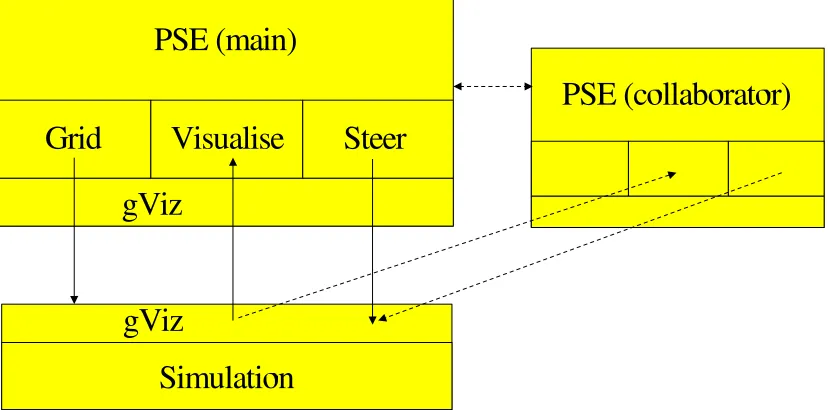
the main desktop PSE being connected to a remote simulation through channels labelled
‘Grid’, ‘Visualise’ and ‘Steer’. The functions are described in detail in the following
paragraphs. In addition Figure 8 also illustrates a second PSE that is able to connect with
the remote simulation. A connection is indicated between the two PSEs themselves,
representing the fact that some information may be shared at the desktop level, without
involving the remote simulation. Examples of such include camera position, adding
pointers to solution features, or sharing visualisation quantities.
When the simulation is launched from the main PSE it is important for the PSE to know
where to find the simulation, so that it can initiate the necessary connections through
the use of sockets. In the simplest scenario the ‘launcher’ specifies as command line
arguments its machine name and a specific port on which it will be listening. The
simulation then uses this advertised location to return the location of the running threads.
This destination location is kept the same for all new listeners to connect through. This
is referred to in Figure 8 as the ‘Grid’ channel. A more complicated scenario involves
the use of a gViz directory service. If specified at launch time then the simulation will
register here rather than with the desktop PSE. This enables the location of the running
simulation to be advertised in a more persistent manner, thereby aiding other desktop
PSEs wishing to connect for the purposes of collaboration or asynchronous steering.
Once the simulation on the Grid resource is running it must start its own ‘Visualise’ and
‘Steer’ channels. This is done through separate threads which wait until a “listener”
makes a connection. If a connection is made to one of these threads then an additional
thread will start and wait for the next listener. When the connection to a listener is
terminated, the thread is also closed to free the memory and the port. Throughout the
execution of the simulation it is these ‘Steer’ and ‘Visualise’ channels along which data
flows. User requests for computational steering are sent via the ‘Steer’ channel. The
main simulation thread will query the steering thread at suitable intervals to receive any
updates. The steering data is a predefined list of inputs to the simulation and hence this
multiple values at any time. Steering information is synchronised between connected
PSEs so changes made by one user are reflected on the desktop of any others.
Whenever an output dataset is ready it is made available through the ‘Visualise’ channel.
This data is typically far larger in quantity, and less regularly defined, than the steering
data and hence gViz requires the application developer to make available all the
in-formation needed by the desktop PSEs to create a visualisation. Typically this data is
broken down into coherent blocks of similar data, such as coordinates of mesh points,
and solutions values, along with basic variables such as the number of dimensions and
the number of datasets being returned. In order to receive this information the desktop
PSE must allocate memory of the appropriate size and so after receiving the number
of blocks being sent, the simulation will transmit the number of bytes in each block.
The PSE-end of the application can then convert the raw data into native data formats
for the particular PSE being used. Any listeners connecting to the simulation are able
to receive the latest dataset and hence all such information is retained at the simulation
end, rather than on the desktop. Visualisation conversions from gViz to PSE-package
specific formats have been successfully implemented for IRIS Explorer, SCIRun,
Mat-lab and VTK. Note that since raw data is being returned through the ‘Visualise’ channel,
different PSEs may choose to perform very different visualisations at the same time.
6.2
Architecture
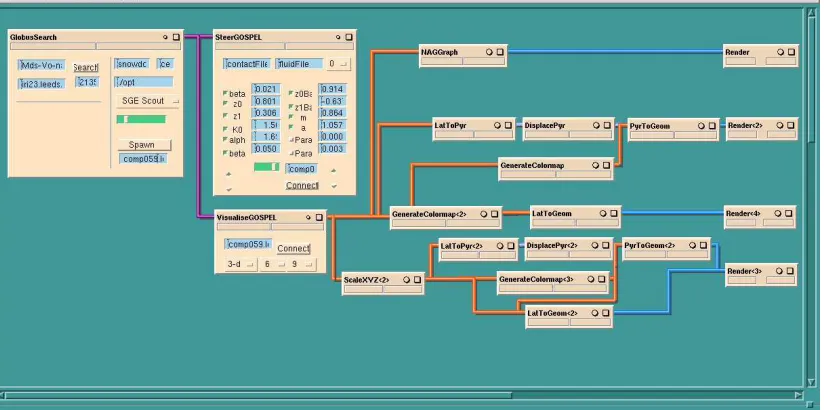
An example of a typical IRIS Explorer map for the EHL lubricant parameter
optimisa-tion PSE is shown in Figure 9 where the dataflow pipeline, generally from left to right,
is clearly visible. The majority of the modules are used in the visualisation process and
hence only the three modules on the left are described in the following paragraphs.
The first module in the map shown in Figure 9, GlobusSearch, interrogates a GIIS (Grid
Index Information Service) server to analyse the available resources and their current
statuses [42]. The user can then select a resource and choose a suitable launch method,
ex-tended the gViz library to include parallel launch mechanisms including writing a
par-allel job submission script or a Globus RSL (Resource Specification Language) script
which then gets submitted to Sun Grid Engine for scheduling onto a suitable node.
When the job is launched only one of the parallel processes will initiate the gViz library
and handle the communication between the Grid job and the desktop PSE. The
infor-mation returned to the desktop, described above, detailing the location of the Grid job is
then passed to the next two modules in the map, SteerGOSPEL and VisualiseGOSPEL.
Knowledge of where the simulation is running also allows any other user to access the
simulation through the gViz libraries. This means that one person, with Grid
certifica-tion, can start the simulation and other collaborators around the world can then all see
the results of that simulation and help to steer the computation [8,42]. In fact, the person
who originally launched the Grid job need not actually be involved from that point on.
Computational steering is the ability to change a simulation that is already running. One
example of this could be choosing to use a lower quality mesh in the early stages of the
solve, but as the solution gets near to a local optimum using a higher resolution mesh to
improve the accuracy of the solution obtained. The module SteerGOSPEL has several
uses. Firstly it shows the current best set of values found by the optimisation algorithm,
along withRF. This allows a user access to individual numbers from the simulation
rather than much larger datasets for visualisation purposes. These numbers can also
be used for steering. For example it is possible to resubmit this current best set to the
optimiser once a minimum has been found. The simplex algorithm will then build a new
simplex around this previous minimum, potentially allowing it to escape from local
minima. Similarly, a different point in the search space can be specified away from
regions in which the optimiser has previously searched. Alternatively, as mentioned
above, the accuracy can be changed. A further method that we have implemented in
this work is the ability to change the underlying mathematical model being used. In the
case of EHL simulations, for example, we permit the user to turn on (or off) the thermal
across the contact through addition of an energy equation) is much more expensive but
adds greater accuracy to the friction results obtained, especially for those cases where
more heat is generated [15].
Communication from the PSE to the simulation is done, as described above, through
the gViz libraries. At suitable points the simulation will check if any new input data has
been received. If a steering request is for additional accuracy, say, then these changes
can be introduced without changing the points of the current simplex and would
there-fore only apply to future calculations. If, on the other hand, a new simplex was requested
then the use of a communication flag inside the routine will cause the optimisation
rou-tine to terminate and then restart with the new simplex.
The VisualiseGOSPEL module communicates with the simulation to receive all of the
datasets for visualisation. These are then packaged up into standard IRIS Explorer
datatypes and sent down the rest of the map for visualisation. When the full datasets are
being shown then more information needs to be returned from the parallel nodes than is
necessary for just the optimisation process. Descriptions of the most significant output
datasets are provided in the following section.
6.3
Visualisation
A full optimisation run generates very large quantities of high-dimensional
multivari-ate data even though each single EHL simulation is reduced to just one number,Fnum j ,
from Equation (12). The distance each of these calculated values is away from Fexp j
is one piece of information that may be of interest to a user wishing to steer the
op-timisation. For example if the results were all good except at, say, very high ambient
temperatures then engineering knowledge of which parameters affect the accuracy at
such temperatures could be used to accelerate the optimisation process. A visualisation
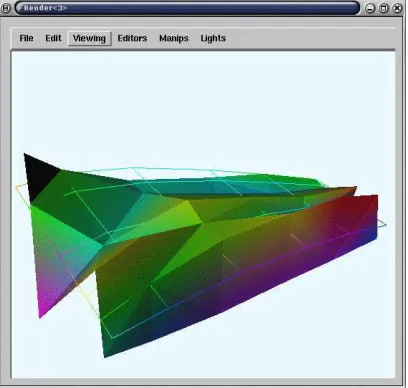
of such data is shown in Figure 10 which consists of a 2-d plane with increasing slide
to roll ratios plotted against experimental friction for each of the loadings and ambient
values. If a perfect solution was found this would collapse to lie exactly on the six lines
of experimental results.
The progress of the optimiser itself may also be visualised. The most useful information
would be to display the evolution of the best data set found thus far, however this
high-dimensional data cannot be represented easily. Other techniques are therefore required
to allow the user to visualise the progress of the optimiser. One of these is shown
in Figure 11 where the y-axis represents the relative change from the initial estimate
for each of the ten variable parameters, with progression along the x-axis being the
incremented for improvements in theRF value. In Figure 11 two different graphs are
shown. The first has the optimiser progressing without any steering, whilst the second
has a new simplex formed after the 80th improvement to the best point in the simplex,
see Figure 12. It is clear from Figure 12 that the new converged value is better than the
pre-steered converged value. Combining this information with the change in converged
solutions as shown in Figure 11 we can see that this significant improvement has been
obtained even though most of the individual parameters are similar to those reached for
the previous (local minimum) solution.
Other visualisation techniques are possible and have been implemented. The choice of
the most appropriate visualisation techniques to use is clearly dependent on the
partic-ular simulation being performed. Another approach that we have implemented is based
upon the use of parallel coordinates [44], where each component of the solution is
vi-sualised as a vertical displacement on a 2-d graph. These can be useful for identifying
dependencies between variables.
7
Evaluation
In this work we have demonstrated how a complex serial, engineering optimisation code
may be efficiently parallelised, Grid-enabled and embedded within a PSE. Through the
tak-ing advantage of the benefits of concurrent simulation and visualisation, and the use
of computational steering. The specific visualisation demands for this particular
ap-plication are driven by the needs of the users, so as to help them to gain insight into
a multidimensional parameter space; enabling them to escape from local minima, as
well as understanding the nature of the EHL simulations being computed. The use of
parallelism in the simulation has decreased the real-time execution of the simulation
sig-nificantly and the hierarchical parallelism approach has facilitated tackling much more
complex optimisation problems than had previously been feasible. The use of MPI for
the parallelism has allowed portability between Grid resources, and use of the open
source gViz libraries has ensured that the communication between different platforms
of PSE and Grid resource is similarly transparent.
In order to transform the PSE demonstrated in this work to a different problem domain
the following issues would need to be considered.
• Inputs – for many real engineering applications there can be large numbers of
input quantities used in the software. These will be a mixture of physical
descrip-tions, numerical parameters for the solver, and perhaps even choices of solution
methods to be used. Deciding which of these to expose to the user will depend on
their level of expertise.
• Steering – it is necessary to decide which of the input quantities to steer based
upon how changes in each of these are likely to affect the progress of the solver.
For instance in our scenario increasing the resolution of the domain is a relatively
minor change compared with switching the oil being tested.
• Outputs – choice of precisely what data to make available for output visualisations
can be non-trivial. In cases such as the optimisation example of this paper, the
large numerical solutions to the individual cases will generally be reduced to just
a few numbers, but these can be combined with other related results to produce
• Parallelism – we have demonstrated that the use of hierarchical parallelism can be
highly beneficial. However we have also seen that whenever there are independent
cases being solved results may be strung together in continuation chains to reduce
the degree of parallelism, but increase the overall performance. This issue is
therefore possibly the most problem specific matter that must be considered when
transforming the PSE.
At least two significant generic conclusions may be drawn from this work. The
con-cept of not only running a computationally intensive code on remote Grid resources,
but also of interacting with it in real time, has been demonstrated to be feasible for a
non-trivial engineering test-problem. This has important implications for the ways in
which computational scientists and engineers may work with large-scale off-site
com-pute resources, as well as allowing physically distributed team members to interact with
Grid-based simulations. Furthermore the concept of hierarchical parallelism, in which a
task is partitioned across more than one parallel computational resource on the Grid, has
also been demonstrated to be a powerful practical tool for Grid computing. This
partic-ular research conclusion is of potential significance whenever an ensemble of
compu-tationally intensive calculations are required, not only for optimisation problems of the
type considered here, but also when sensitivity analysis is necessary or when numerical
derivatives are being calculated for example.
One of the main areas for future expansion of these ideas is to undertake additional
research and development into the effective incorporation of data security. The data
used in engineering simulations is often commercially sensitive and so secure methods
of communicating this to and from remote Grid resources must be considered. This
particular work was undertaken using the White Rose Grid [25] which has a number of
standard security devices implemented, but is not designed to have the same levels of
security that one would expect from within a single organisation.
Another area for future expansion concerns more general bookkeeping. When multiple
to know more than the name and location of each simulation currently listed in the
directory service. More detailed information such as steering histories and current active
users could be very useful.
The final area of future research that we highlight here is that of dynamic load balancing
on the Grid. As we have seen in this work, when a job is partitioned across more
than one architecture on the Grid it is not necessarily a good load balancing strategy to
assume that all processors have the same performance. It would be helpful to establish
a robust dynamic load balancing strategy that could move work between resources as
and when it identified imbalances in their utilisation.
Acknowledgements
The authors wish to thank the DTI and EPSRC for funding this work with Shell Global
Solutions through Core Programme e-Science grant number GR/S19486/01. Jason
Wood is also gratefully acknowledged for supplying and supporting the gViz library
used in this work.
References
[1] G. C. Fox and W. Furmanski. High performance commodity computing. In I.
Fos-ter and C. Kesselman, editors, The Grid 2: Blueprint for a New Computing
Infras-tructure, pages 237–255. Morgan Kaufmann, 2004.
[2] K. L. Wang and A. J. Baker. A modular collaborative parallel CFD workbench.
Journal of Supercomputing, 22(1):45–53, 2002.
[3] C. R. Johnson, M. Berzins, L. Zhukov, and R. Coffey. SCIRun: Application to
atmospheric dispersion problems using unstructured meshes. In M. J. Baines,
editor, Numerical Methods for Fluid Mechanics VI, pages 111–122. ICFD ’98,
[4] H. Wright, K. W. Brodlie, and T. David. Navigating high-dimensional spaces to
support design steering. In VIS 2000, pages 291–296. IEEE, 2000.
[5] D. Dabdub, K. M. Chandy, and T. T. Hewett. Managing specificity and
general-ity: tailoring general archetypal PSEs to specific users. In E. N. Houstis, J. R.
Rice, E. Gallopoulos, and R. Bramley, editors, Enabling Technologies for
Com-putational Science: Frameworks, Middleware and Environments, pages 65–77.
Kluwer Academic Publishers, Boston / Dordrecht / London, 2000.
[6] C. E. Goodyer and M. Berzins. Eclipse and Ellipse: PSEs for EHL solutions using
IRIS Explorer and SCIRun. In P. M. A. Sloot, C. J. K. Tan, J. J. Dongarra, and
A. G. Hoekstra, editors, Computational Science, ICCS 2002 Part I, Lecture Notes
in Computer Science, volume 2329, pages 521–530. Springer, 2002.
[7] C. E. Goodyer, J. Wood, and M. Berzins. A parallel Grid based PSE for EHL
problems. In J. Fagerholm, J. Haataja, J. J¨arvinen, M. Lyly, P. R˚aback, and
V. Savolainen, editors, Applied Parallel Computing, Proceedings of PARA ’02,
Lecture Notes in Computer Science, volume 2367, pages 523–532. Springer, 2002.
[8] M. A. Walkley, J. Wood, and K. W. Brodlie. A distributed collaborative problem
solving environment. In P. M. A. Sloot, C. J. K. Tan, J. J. Dongarra, and A. G.
Hoekstra, editors, Computational Science, ICCS 2002 Part I, Lecture Notes in
Computer Science, volume 2329, pages 853–861. Springer, 2002.
[9] D. Dowson. Elastohydrodynamic and micro-elastohydrodynamic lubrication.
WEAR, 190:125–138, 1995.
[10] C. H. Venner and A. A. Lubrecht. Multilevel Methods in Lubrication. Elsevier,
2000.
[11] J. W. Wood, K. W. Brodlie, and J. P. R. Walton. gViz: Visualization and
[12] L. E. Scales. Quantifying the rheological basis of traction fluid performance.
In Proceedings of the SAE International Fuels and Lubricants Meeting, Toronto,
Canada. Society of Automotive Engineers, 1999.
[13] D. Dowson and G. R. Higginson. Elasto-hydrodynamic Lubrication, The
Funda-mentals of Roller and Gear Lubrication. Permagon Press, Oxford, Great Britain,
1966.
[14] C. J. A. Roelands. Correlational Aspects of the viscosity-temperature-pressure
relationship of lubricating oils. PhD thesis, Technische Hogeschool Delft, The
Netherlands, 1966.
[15] R. Fairlie, C. E. Goodyer, M. Berzins, and L. E. Scales. Numerical modelling of
thermal effects in elastohydrodynamic lubrication solvers. In D. Dowson et al.,
editor, Trobological Research and Design for Engineering Systems, Proceedings
of the 29thLeeds-Lyon Symposium on Tribology, pages 675–683. Elsevier, 2003.
[16] C. E. Goodyer. Adaptive Numerical Methods for Elastohydrodynamic Lubrication.
PhD thesis, University of Leeds, Leeds, England, 2001.
[17] C. E. Goodyer, R. Fairlie, D. E. Hart, M. Berzins, and L. E. Scales. Calculation
of friction in steady-state and transient ehl simulations. In A.A. Lubrecht and
G. Dalmaz, editors, Transient Processes in Tribology: Proceedings of the 30th
Leeds-Lyon Symposium on Tribology. Elsevier, 2004.
[18] C. H. Venner. Multilevel Solution of the EHL Line and Point Contact Problems.
PhD thesis, University of Twente, Endschende, The Netherlands, 1991. ISBN
90-9003974-0.
[19] A. Brandt and A. A. Lubrecht. Multilevel matrix multiplication and fast solution
of integral equations. Journal of Computational Physics, 90(2):348–370, 1990.
[20] J. A. Nelder and R. Mead. A simplex method for function minimization.
[21] J. M. Parkinson and D. Hutchinson. An investigation into the efficiency of variants
on the simplex method. In F. A. Lootsma, editor, Numerical Methods for
Non-linear Optimization, pages 115–135. Academic Press, 1972.
[22] NAG. C software library.
[23] A. Jameson, L. Martinelli, and N. A. Pierce. Optimum aerodynamics design using
the Navier-Stokes equations. Theoretical Computational Fluid Dynamics, 10:213–
237, 1998.
[24] M. B. Giles and N. A. Pierce. An introductiond to the adjoint approach to design.
Flow, Turbulence and Combustion, 65:393–415, 2000.
[25] P. M. Dew, J. G. Schmidt, M. Thompson, and P. Morris. The White Rose Grid:
practice and experience. In S. Cox, editor, Proceedings of the All Hands Meeting
2003, pages 172–179. EPSRC, 2003. ISBN: 1-904425-11-9.
[26] Message Passing Interface Forum. MPI: A message-passing interface standard.
International Journal of Supercomputer Applications, 8(3/4), 1994.
[27] C. E. Goodyer and M. Berzins. Efficient parallelisation of a multilevel
elastohy-drodynamic lubrication solver. Concurrency, submitted.
[28] I. M. Llorente, M. Prieto-Mat´ıas, and B. Diskin. An efficient parallel multigrid
solver for 3-d convection-dominated problems. Technical Report TR-2000-29,
ICASE, 2000.
[29] M. Llorente, F. Tirado, and L. V´azquez. Some aspects about the scalability of
scientific applications on parallel computers. Parallel Computing, 22:1169–1195,
1996.
[30] O. A. McBryan, P. O. Frederickson, J. Linden, A. Schuller, K. Solchenbach,
com-puters – a survey of recent developments. Impact of Computing in Science and
Engineering, 3:1–75, 1991.
[31] R. S. Tuminaro and D. E. Womble. Analysis of the multigrid FMV cycle on
large-scale parallel machines. SIAM Journal of Scientific Computation, 14(5):1159–
1173, 1993.
[32] J. Linden, G. Lonsdale, H. Ritzdorf, and A. Sch¨uller. Block-structured multigrid
for the navier-stokes equations: experiences and scalability questions. In
Visual-ization Development Environments 2000 Proceedings, volume Proceedings of the
Conference on Parallel Computational Fluid Dynamics 1992, Amsterdam, 1992.
Elsevier Science Publishers B.V.
[33] J. Linden, G. Lonsdale, H. Ritzdorf, and A. Sch¨uller. Scalability aspects of parallel
multigrid. Future Generation Computer Systems, 10(4):429–449, 1994.
[34] P. N. Brown, R. D. Falgout, and J. E. Jones. Semicoarsening multigrid on
dis-tributed memory machines. SIAM Journal on Scientific Computing, 21(5):1823–
1834, 2000.
[35] E. Nurgat, M. Berzins, and L. E. Scales. Solving EHL problems using iterative,
multigrid and homotopy methods. Trans. ASME, Journal of Tribology, 121(1):28–
34, 1999.
[36] N. Karonis, B. Toonen, and I. Foster. MPICH-G2: A Grid-enabled implementation
of the Message Passing Interface. Journal of Parallel and Distributed Computing,
63(5):551–563, 2003.
[37] R. B. Haber and D. A. McNabb. Visualization idioms : A conceptual model for
scientific visualization systems. In B. Shriver G.M. Nielson and L.J. Rosenblum,
[38] J. P. R. B. Walton. Now you see it – interactive visualisation of large datasets.
In C. A. Brebbia and H. Power, editors, Applications of Supercomputers in
Engi-neering III. Computatational Mechanics Publications / Elsevier Applied Science,
1993.
[39] C. Johnson, S. Parker, C. Hansen, G. Kindlmann, and Y. Livnat. Interactive
simu-lation and visualization. IEEE Computer, 32(12):59–65, 1999.
[40] D. de St. Germain, J. McCorquodale, S. Parker, and C. R. Johnson. Uintah: A
mas-sively parallel problem solving environment. In Ninth IEEE International
Sympo-sium on High Performance and Distributed Computing, 2000.
[41] G. Allen, E. Seidel, and J. Shalf. Scientific computing on the grid. Byte, pages
24–32, Spring 2002.
[42] K. W. Brodlie, S. Mason, M. Thompson, M. A. Walkley, and J. W. Wood. Reacting
to a crisis: benefits of collaborative visualization and computational steering in a
Grid environment. In Proceedings of the All Hands Meeting 2002, 2002.
[43] I. Foster and C. Kesselman. Globus: A metacomputing infrastructure toolkit.
In-ternational Journal of Supercomputer Applications, 11(2):115–128, 1997.
[44] A. Inselberg, T Chomut, and M. Reif. Convexity algorithms in parallel
0 1e+08 2e+08 3e+08 4e+08 5e+08 6e+08 7e+08 8e+08 9e+08 1e+09
-0.003 -0.002 -0.001 0 0.001 0.0020 1e-05 2e-05 3e-05 4e-05 5e-05 6e-05 7e-05 8e-05 Pressure (Pa)
Film thickness (m)
Distance through contact (m) Pressure Film thickness 0 500 1000 1500 2000 2500
-0.003 -0.002 -0.001 0 0.001 0.002950 1000 1050 1100 1150 1200
Viscosity (Pa s) Density (kg/m )
3
Distance through contact (m) Viscosity
Density
[image:29.612.109.556.36.176.2](a) Pressure (left hand axis) and film thickness (b) Effective viscosity (Left hand axis) and density
Initial guess x
Simplex
Lubricant properties x
Loading Temperature
Slide to roll
Optimised minimum x
R F
Fj
i
0 min
[image:30.612.200.397.31.140.2]36 EHL simulations
Loading Temperature
Slide to roll
Initial guess x
Lubricant properties x
Optimised minimum x
Fj
i
0 min
Simplex
R
F
p
MPI Communication to other processors
R
F
[image:31.612.197.402.33.191.2]Continuation
h
2h
4h
Grids Multigrid V-cycle
[image:32.612.134.468.42.232.2]-MLMI cycle
100 1000 10000 100000
1 2 4 8 16 32 64 128
Time for 10 V-cycles after FMG start (s)
No. processors 4097x4097
[image:33.612.189.408.44.194.2]MLMI coarse 6 MLMI coarse 7 MLMI coarse 8 MLMI coarse 9
Simulation Controller
Simulation Controller
Simulation Controller
Simulation Controller Grid launcher
Slave Slave
Slave Slave
Slave Slave
Slave Slave
Slave Slave
Slave Slave
Slave Slave
Slave Slave Globus authentication
managing input / output
GRID MASTER
gViz
[image:34.612.188.412.36.203.2]gViz
10 100 1000
1 6 12 24 48 96
Computational time (s) for ten optimisation steps
[image:35.612.196.401.38.184.2]Number of processors
(a) No steering (b) New simplex after 80 improvements
0.004 0.0042 0.0044 0.0046 0.0048 0.005
0 100 200 300 400 500 600
Rf value
Iteration number Before steering
[image:40.612.98.496.37.325.2]After steering
Figure 12: Convergence of theRF value, before (+) and after (×) steering; the iteration
Continuation
scheme Processors
Solution time (s)
Number ofRF
evaluations
Average time perRF
evaluation (s)
No continuation 36 2062 1009 2.04
Temperature 18 559 254 2.20
Loading 12 341 163 2.09
Slide to roll 6 531 217 2.45
Slide to roll 1 2560 217 11.80