parameter validated on one-electron self-interaction error
Glenn Moynihan,1,a)Gilberto Teobaldi,2, 3 and David D. O’Regan1 1)
School of Physics, CRANN and AMBER, Trinity College Dublin, Dublin 2, Ireland
2)Stephenson Institute for Renewable Energy and Department of Chemistry, The University of Liverpool,
L69 3BX Liverpool, United Kingdom
3)
Beijing Computational Science Research Center, Beijing 100094, China
(Dated: 27 April 2017)
In electronic structure methods based on the correction of approximate density-functional theory (DFT) for systematic inaccuracies, Hubbard U parameters may be used to quantify and amend the self-interaction errors ascribed to selected subspaces. Here, in order to enable the accurate, computationally convenient calculation ofUby means of DFT algorithms that locate the ground-state by direct total-energy minimization, we introduce a reformulation of the successful linear-response method for U in terms of the fully-relaxed constrained ground-state density. DefiningU as an implicit functional of the ground-state density implies the comparability of DFT + HubbardU (DFT+U) total-energies, and related properties, as external parameters such as ionic positions are varied together with their corresponding first-principlesU values. Our approach provides a framework in which to address the partially unresolved question of self-consistency overU, for which plausible schemes have been proposed, and to precisely define the energy associated with subspace many-body self-interaction error. We demonstrate that DFT+U precisely corrects the total energy for self-interaction error under ideal conditions, but only if a simple self-consistency condition is applied. Such parameters also promote to first-principles a recently proposed DFT+U based method for enforcing Koopmans’ theorem.
I. INTRODUCTION
Approximate density-functional theory (DFT)1,2 is a
central element in the simulation of many-body atom-istic systems and an indispensable partner to experi-ment3–5. DFT is prone, however, within its commonplace local-density (LDA)6, generalized-gradient (GGA)7, and hybrid8–10 exchange-correlation (xc) approximations, to
significant systematic errors11,12. The most widely
en-countered of these is the many-electron self-interaction error (SIE)6, or delocalization12 error, which is mani-fested as a spurious curvature in the total-energy pro-file of a system with respect to its total electron num-ber13. The SIE contributes to inaccuracies in
insulat-ing band gaps14, charge-transfer energies15,16, activation
barriers17 , binding and formation energies, as well as in
spin-densities and their moments. While the nature of SIE is well understood, it remains persistently challeng-ing to reliably avoid its introduction uschalleng-ing approximate xc functionals of a computationally tractable, explicit an-alytical form, even if exact exchange is incorporated (see, e.g., the B3LYP curve in Fig. 2 of Ref.18).
DFT+U (DFT + Hubbard U)11,19–23 is a
computa-tionally efficient24 and formally straightforward method
that has matured as a corrective approach for SIE in systems where it may be reasonably attributed to par-ticular selected subspaces25–27. Originally designed to
capture Mott-Hubbard physics in transition-metal ox-ides11,20,22,28, it now sees very diverse applications29–33.
a)Electronic mail:[email protected]
It has gained a transparent interpretation as an efficient corrective method for SIE particularly since the work of Kulik, Cococcioni, and co-workers in Ref. 25. The DFT+U corrective energy term is often invoked in its rotationally-invariant, simplified form23,25,31,34, given by
EU
ˆ
nIσ
=X
I,σ
UI 2 Tr
ˆ
nIσ−nˆIσnˆIσ
, (1)
where the density-matrices ˆnIσ = ˆPIρˆσPˆI are those for the subspaces I over which the SIE is to be corrected. Here, the Kohn-Sham density-matrix ˆρσ corresponds to the spin indexed byσ, which we hereafter suppress for simplicity, and the idempotent subspace projection oper-ators ˆPI = P
m|ϕ I
mihϕIm| are usually built from fixed, spin-independent, orthonormal, localized orbitals, which may also be nonorthogonal35 and self-consistent36.
The quadratic term of Eq. 1alters the intra-subspace self-interaction, on a one-electron basis in the frame of the individual orthonormal eigenstates of ˆnI, which may generally be expected to change as a result. The linear term then imposes the condition that the correction to the total-energy should vanish for each subspace eigen-state as its corresponding eigenvaluenIi approaches zero or one, implying that the xc functional is assumed to be correct for such eigenstates. This mirrors the well-known result that the total-energy of open systems at integer fill-ing is reasonably well described by conventional approx-imate xc functionals37. While the linear term does not
directly affect the SIE explicitly, it represents an impor-tant boundary condition on the SIE correction. Simul-taneously , the corresponding correction to the potential ˆ
vI
U =UI(ˆ1−2ˆnI)/2 vanishes at eigenvalues of one-half
and, when a Kohn-Sham gap is symmetry-allowed, the occupancy-dependence of the potential acts to energet-ically split states lesser and greater in occupancy than one-half by an energy interval on the order ofU29.
A. A one-electron litmus test: how DFT+U affectsH2+
As it exhibits no multi-reference or static correlation error effects, by definition, but a straightforwardly vari-able bonding regime, the dihydrogen cation H2+ is per-haps the ideal system for the study of pure SIE, also known as delocalization error12. It serves as a
conve-nient test bed for the exploration of system-specific ad-ditive corrections, such as DFT+U, and more generally for density-functionals which are, at least in part, im-plicitly defined via parameters to be calculated, such as the self-consistent Hubbard U. Particularly subject to the ideal population analysis and non-overlapping sub-space conditions available in the dissociated limit, H2+
will allow us to draw firm conclusions regarding the nu-merous plausible but different strategies currently in use for defining self-consistency over the HubbardU.
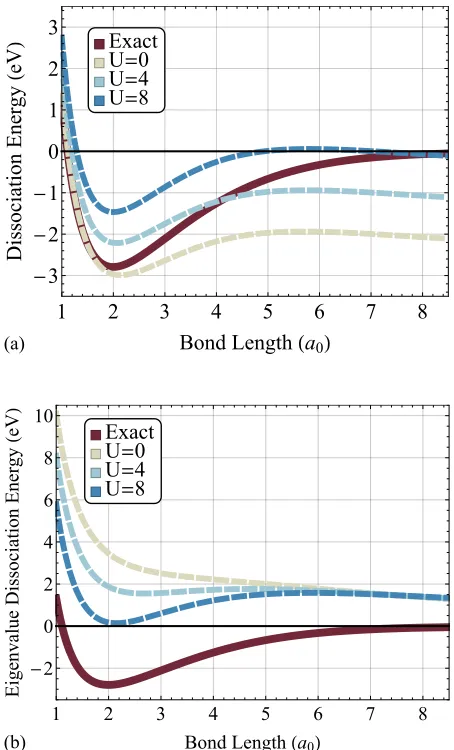
The action of the DFT+U functional under vary-ing bondvary-ing conditions may be observed in the disso-ciation curves of H2+ depicted in Fig. 1a. Here, the total-energy error in approximate DFT, specifically the PBE xc-functional7, is seen to grow significantly with bond-length as the electron count on each atom ap-proaches one-half. The result of the exact xc-functional, in which the Hartree and xc energies and potentials can-cel, is indicated by the solid line, and the results of DFT(PBE)+U = 0,4,8 eV, are indicated by the dashed lines38. The Hubbard U parameter required to correct the PBE total-energy to the exact value varies over ap-proximately 8 eV from the fully bonded to dissociated limits, highlighting the importance of chemical environ-ment dependent, and not just species-dependent,U pa-rameters, as previously shown, e.g., in Refs.39–41.
A critical and perhaps defining characteristic of an SIE-free system is its compliance with Koopmans’ con-dition42,43, and in a one-electron system such asH+
2 this
implies that the total-energy and the occupied Kohn-Sham eigenvalue εshould differ only by the ion-ion en-ergy. Thus, the dissociation curve ofH2+should be equiv-alently accessible by calculating the total energies for the dimer and its constituent atoms directly, or by us-ing total energies derived from the occupied eigenvalue and the expression E = ε+Eion-ion. Fig.1billustrates
the strikingly poor results of DFT+U when combined with this latter procedure44. AU &4 eV is required for the eigenvalue-derived dissociation curve to exhibit a lo-cal minimum. We observe that the non-compliance with Koopmans’ condition (disagreement between Figs. 1a
and 1b) broadly decreases both with bond-length and with the HubbardU, but that the effect of DFT+U on the eigenvalue is lost entirely in the dissociated limit since both factors drive the subspace occupancy to 1/2. Across
(a)
Exact
U=0
U=4
U=8
1
2
3
4
5
6
7
8
-3
-2
-1
0
1
2
3
Bond Length
(
a
0)
Di
ssoc
ia
ti
on
E
ne
rgy
(
eV
)
(b)
Exact
U=0
U=4
U=8
1 2 3 4 5 6 7 8
-2
0 2 4 6 8 10
Bond Length(a0)
E
ige
nva
lue
Di
ssoc
ia
ti
on
E
ne
rgy
(
eV
)
FIG. 1. (Color online) The dissociation energy curve ofH+ 2
calculated from (a) the total-energy and (b) the occupied Kohn-Sham eigenvalue using the exact xc-functional (solid), and PBE+U withU = 0,4,8 eV (dashed). PBE+U success-fully resolves the SIE in the total-energy, for a strongly bond-length dependent Hubbard U, but it does not address the inaccuracy in the Kohn-Sham eigenvalue, or non-compliance with Koopmans’ condition, which grows with bond-length.
the dissociation curve, the HubbardUrequired to enforce compliance with Koopmans’ condition, and that needed to attain the exact result typically differ substantially.
The facile correction of the total-energy of this system at each bond length with a varying but reasonable U
[image:2.612.330.557.49.424.2]B. The HubbardU as a first-principles response property: motivations for seeking a variational formalism
The Hubbard UI are external parameters that define the SIE correction strength applied to each subspace in DFT+U. They may be thought of as subspace-averaged SIEs quantifiedin situ23,25. Historically and to this day, the Hubbard U has frequently been determined via the empirical fitting of calculated DFT+U observables to ex-perimental data, typically spectral46,47; structural46,48,49
or energetic50,51. This approach is pragmatic and in
many cases very successful, but it is clearly inapplica-ble when the necessary experimental data is unavail-able or difficult to measure. If the Hubbard U param-eters are instead themselves calculated as properties of the electronic structure, however, becoming no longer free parameters but auxiliary variables, in effect, then DFT+U is restored to a first-principles status. If the HubbardU are calculated strictly as variational ground-state density-functional properties, even implicitly, i.e., one of the central developments of the present work, then DFT+U as whole becomes a fully self-contained, vari-ational first-principles method. Only under the latter condition would we expect the fully rigorous direct com-parability of the total energies, and their derived thermo-dynamic observables, calculated from different DFT+U
calculations with different system-specificU parameters. In this work, we build upon the very widely-used4,25,52–63and successful linear-response method
pro-posed in Ref.23, in which Cococcioni and de Gironcoli demonstrated that a small number of DFT calculations is sufficient to calculate first-principles Hubbard U pa-rameters by finite-differences, as well as upon the ear-lier linear-response scheme proposed by Pickett and co-workers22, and aspects of the modified constrained LDA
scheme of Aryasetiawan and co-workers64. In this linear-response DFT+U method23, a small, external uniform perturbation of strength α is applied to the subspace of interest and the interacting response functionχ, and its non-interacting Kohn-Sham equivalent χ0, are
com-puted, respectively, from the first derivatives of the self-consistent and non-self-self-consistent subspace total occu-panciesNI = Tr[ˆnI] with respect toα. The scalar Dyson equation UI = (χ−1
0 −χ−1)I yields U for a single
sub-space model, which may be further improved under self-consistency25,65,66. The Hubbard U parameters
appro-priate to a generalized model in which inter-subspace pa-rametersV are included67, as well as the inter-subspace
V themselves, may also be calculated23 by treating the
Dyson equation as a site-indexed matrix equation68.
To date, based on our extensive literature search, the linear-response method has only been used in conjunc-tion with the self-consistent field (SCF) algorithms very typically used to solve the Kohn-Sham equations for smaller isolated and periodic systems. In the SCF case, it is convenient to calculate the non-interacting response function χ0 following the first iteration of the SCF
cy-cle as prescribed in Ref. 23, i.e., following the initial
charge re-organization induced by the external poten-tial ˆvext = αIPˆI, but before any update of the
re-maining terms in the Kohn-Sham potential is carried out. This technique is impractical to implement, how-ever, in codes that utilize a direct minimization of the total-energy with respect to the density, Kohn-Sham or-bitals, or density-matrix to locate the ground-state, since there it is not efficient or customary to nest the den-sity and potential update processes. These codes com-prise a growing number of linear-scaling or large-system adapted packages, where explicit Hamiltonian diagonal-ization is typically avoided altogether where possible, such asONETEP69–71,
CONQUEST72,73,Siesta74,75,
BigDFT76, OpenMX77, and CP2K78, among others,
albeit that the SCF technique may also be available in some of these. We are therefore motivated to seek a linear-response formalism for the HubbardU that is read-ily compatible with direct-minimization DFT and large systems, particularly for linear-scaling DFT+U24.
In this work, we develop and present a minimal re-vision of the established ‘SCF linear-response’ approach (terminology specific to this article, introduced for the avoidance of ambiguity) for the HubbardU parameters, one based on the response of the fully relaxed ground-state density subject to a varying perturbation. We have implemented our ‘variational linear-response’ method for the U in the linear-scaling direct-minimization DFT package ONETEP69–71, where the cost of the method itself scales with the number of targeted subspaces to be assessed, multiplied by the total number of atoms present. It is thus readily applicable to systems that are both spatially disordered and electronically challenging. More generally, the variational linear-response method is equally applicable to direct-minimization and SCF DFT codes irrespective of the basis set used, and it may prove helpful in cases where the SCF non-interacting response
χ0is numerically problematic29. We find that it provides
a convenient framework in which to analyze a number of different criteria that have been proposed for defining the self-consistent Hubbard U and with it, for the par-ticular case of the variational linear-response Hubbard
U at least, we identify a well-defined best choice of self-consistency criterion supported by numerical results.
C. Article outline
In Section II, we investigate the conditions that must hold for a first-principles HubbardU parameter to cor-rect SIE subspace-locally by means of Eq. 1. Arriving at a simple, variational linear-response formulation in terms of fully-relaxed constrained density and its result-ing properties, we make the calculation of Hubbard U
SIE-affected total energy by means of DFT+U? In Sec-tionIV, we further analyse our results by means of nu-merically stringent DFT+U calculations along the disso-ciation curve of H2+, an ideal system for studying one-electron SIE79,80. Finally, in our concluding SectionVI,
we discuss the theoretical relationship between the SCF and variational linear-response formalisms, the relevance to the comparability of total-energies and other ther-modynamics quantities from DFT+U calculations with system-specific first-principles Hubbard U parameters, and our outlook on the practicability of such parameters.
II. A VARIATIONAL GROUND-STATE APPROACH TO THE LINEAR-RESPONSE HUBBARD U PARAMETER
In order to calculate the Hubbard U parameter re-quired to subtract the many-electron SIE attributed to a particular subspace, by means of Eq. 1, we may de-fine the parameter for each subspace as the net average electronic interaction acting within it. More specifically, we seek only the interactions at leading order in the sub-space density-matrices, that is those coupling to (nI
i)2, in order to comply with Eq. 1, Thus, for a particular site, we define the U on the basis of the interaction kernel
ˆ
fint = δ2Eint/δρˆ2 only, i.e., not ˆgint = δ3Eint/δρˆ3 etc.,
where Eint is the interacting contribution to the
total-energy. Furthermore, we require only the components of the interaction for each subspace that arise due to density variations within it, so that ˆfint must be appropriately
projected. In order to illustrate the requirements of such a projection, let us consider some candidate formulae for HubbardU parameters which do not meet them.
The many-electron SIE of an approximate xc func-tional, applied to an an open quantum system that does not interact with its bath for particle exchange, is char-acterized by the spurious non-zero second total-energy derivative with respect to the total occupancy. We may apply this definition to the individual DFT+Usubspaces, with occupancies given by N = Tr[ˆn] (suppressing sub-space indices), under the reasonable assumption that the subspace-bath interactions are negligible compared to the interactions within the subspace. By defining the Hub-bard U for each subspace as the net value of the lat-ter inlat-teraction, in a precise sense yet to be delat-termined, the DFT+U functional should act to correct the many-body SIE by subtracting the individual one-electron SIE of each eigenstate of the subspace density-matrix.
Immediately, we may rule out as a Hubbard U pa-rameter the straightforward fully interacting curvature
d2E/dN2, discussed in Ref.22, which may be calculated
as −dα/dN. Here, ˆvext = αPˆ is the external
poten-tial inducing the occupancy change. As discussed in Ref.23, this term comprises a substantial non-interacting contribution, which, in accordance with Dyson equa-tions quite generally, is superfluous to the definition of an interaction and must be subtracted. On the other hand, one may suggest the direct subspace projection
of the interaction kernel (Hartree, xc, any other elec-tronic interaction terms), denoted here for a single site by ˆP(δ2E
int/δˆn2) ˆP = ˆPfˆintPˆ. Any bare interaction of
this kind neglects the potentially substantial screening effects of density-matrix variations outside the subspace. Thus, it is also an unsuitable starting point for measur-ing many-body SIE, rulmeasur-ing it out. TheU must be bath-screened, yet remain bare of intra-subspace screening.
More interesting is the curvature of the interaction term in the total-energy, d2Eint/dN2, and the reasons
for its non-suitability are perhaps more subtle. Since the Hellman-Feynman theorem cannot be applied toEint
alone, its first total derivative with respect toN, i.e.,
dEint dN =
∂Eint ∂N + Tr
δE
int δρˆ
dρˆ
dN
(2)
yields not only the partial derivative (vanishing due to no explicitN-dependence in Eint, and only an implicit
dependence via the changes to the total density-matrix ˆ
ρ), but it also comprises a term proportional to the in-teraction potentialδEint/δρˆ, bath-screened sincedρ/dNˆ
couples to the external potential ˆvext=αPˆ. The second
total derivatived2Eint/dN2incorporates screening again,
and the resulting twice-screened objects are unphysical. This problem here is the opposite, in a sense, to that of
ˆ
PfˆintPˆ, from which one may surmise the correct
defini-tion is an intermediate case, where screening effects due to the complement of the subspace at hand should be incorporated, but only once. This motivates us to work not from the energy, but from the potential, i.e., from the unscreened functional derivative of the energy with respect to the density-matrix, and to differentiate byN. As a functional derivative, i.e., a generalized partial derivative, the interaction term in the Kohn-Sham poten-tial ˆvint =δEint/δρˆis bare of screening, as is its subspace
projection ˆP(δEint/δnˆ) ˆP = ˆPvˆintPˆ. The quantity then
given by Tr[ ˆP(dvˆint/dnˆ) ˆP]/Tr[ ˆP]2seems to fulfil many of
the requirements for a valid Hubbard parameter, namely, that it is a subspace-averaged, once-screened interaction that is non-extensive, i.e. it does not scale extensively with the subspace eigenvalue count Tr[ ˆP]. In practice, however, the screened kerneldvˆint/dnˆ is cumbersome to
calculate, even in orbital-free density-functional theory, and, more importantly, it includes screening effects due to density-matrix rearrangements within the subspace, which make it unsuitable as a quantifier for the subspace-bare interaction to be explicitly corrected by DFT+U. Instead, the object that we required is the average, net, subspace-bare but bath (i.e., environment) screened self-interaction of the subspace. We may meet these specifi-cations by taking the total derivative with respect to the total subspace occupancyN, and, finally, by defining
U ≡ dvint
dN , where vint≡
Tr[ˆvintPˆ]
Tr[ ˆP] (3)
etc.). Here, since the uniform potential α used in the linear-response method induces to first-order no micro-scopic density-variations within the subspace except for the uniform shift, the screening processes within the sub-spaces are effectively suppressed, much as in the con-strained random phase approximation64,81,82.
In practice, as we return to discuss around Eq.5. the proposed variational linear-response U for a single-site model may still be computed using the Dyson equa-tion, but with the response functions χ = dN/dα and
χ0 = dN/dvKS, where vKS ≡ Tr[ˆvKSPˆ]/Tr[ ˆP]. Here,
both χ and χ0 are to calculated at the end of the
min-imization procedure from the same set of constrained ground-state densities defined by α. Thus, while χ is identical to that used in the SCF linear-response intro-duced in Ref.23, ourχ0formula is somewhat different (at
least formally, the numerical differences remain unclear). The SCF and variational linear-response formalisms are equally compatible with SCF and direct-minimization DFT, as well as with the matrix Dyson equation required, e.g., for calculating longer-ranged inter-subspace param-etersV67 and their corresponding HubbardU values.
A. The subspace contribution to total-energy curvature
The subspace contribution to the interacting part of the total-energy SIE, specifically that corresponding to the variational linear-response Hubbard U, is the inte-gral of the the interacting part of the Kohn-Sham poten-tial over the subspace occupancy up to its ground-state value. To the same effect, we may use the negative of the integral over the external potentialαneeded to fully deplete that occupancy back to zero, as in
EintSIE(N) =
Z N
0
vint(N0) dN0 (4)
= −
Z ∞
0
vint(N0(α)) dN0
dα dα
=
Z ∞
0
vint(N0(α)) d2E
total dN002
N00(α)
!−1 dα
In the final line, we make the connection to the oc-cupancy curvature of the total-energy Etotal using the
result for the constrained DFT system, dEtotal/dN = −α. Although ESIE
int does not appear anywhere in our
DFT+U implementation in practice, we emphasise that for a single-site model, in the variational linear-response formalism at least, it is d2E
SIE/dN2 = U, and not
the total-energy curvature d2Etotal/dN2=−χ−1, which
yields the parameter required for DFT+U. Consider-ing the difference of the energy curvatures ascribed to the bath-screened subspace and the overall global sys-tem, both as a function of subspace occupancy, we find that d2(Etotal−ESIE)/dN2 = −χ−1−U =−χ−01 ≥0,
where the latter inequality was proven in Ref. 83. This result is reminiscent of the findings of Kulik et al. in
Ref27, to wit, that while the application of DFT+U can only be expected to mitigate subspace SIE, and at the very least it cannot disimprove the global SIE, albeit for a different sense of global pertaining to total occupancy.
The quantity ESIE
int differs from the full subspace
con-tribution to the total-energy SIE by a non-interacting contribution required to restore Koopmans’ condition. It is interesting to assume, for a moment, that the SIE kernel U = dvint/dN is Hartree-dominated and hence
approximately constant, so that vint(N) ≈ U N and ESIEint ≈ U N2/2. If we further assume that the sub-space is SIE-free at the nearest integer occupancy, N0,
as well as atN0±1, with a linear (i.e., non-interacting)
interpolation term being required between these points, then we may make the curvature-preserving modification
ESIE≈(U/2)[(N−N
0)2−|N−N0|]. Taking the negative
of this energy to estimate a total-energy correction, and considering single-orbital, single-spin sites, we effectively re-derive theEU of Eq.1. Even non-self-consistently, this turns out to be an acceptable energy correction for H2+
in the dissociated limit, with two subspaces ofU ≈8 eV andN≈1/2, yielding−ESIE≈2 eV≈Eexact−EPBE.
III. SELF-CONSISTENCY OVER THE HUBBARDU
Beginning with the work of Kulik and co-workers in Ref25, and in later works65–67, it has been demonstrated
that a self-consistently calculatedU can be required for certain systems where the nature of the electronic states (and corresponding response properties) in the DFT+U
ground-state differ qualitatively from those of the DFT ground-state11,34,84. In self-consistency schemes
gener-ally, incremental values ofUinare applied to the subspace
at hand, with varying ground-state orbitals and densities as a result, and a new first-principlesUout is computed
for each Uin. The numerical relationship Uout(Uin) is
then used to select the self-consistent U, using a pre-defined criterion. Its clear conceptual elegance aside, a self-consistentU has been shown to provide improve-ments in transition-metal chemistry26,34,85–91, biological
systems61, photovoltaics92–94, and high-density energy
storage31. While many researchers have used an original,
linear-extrapolation typeUscfin their studies26,61,85,88–95,
others have used the equality betweenUinandUoutas an
In order to compute variational linear-response Uout
for a single subspace already subject to a DFT+U term of strength Uin, the subspace-averaged interaction vint
must incorporate the DFT+U potential ˆvU, as well as the usual Hartree + xc term ˆvHxc. Each component in
the subspace-averaged interaction potentialvKS−vext≡ vint = vHxc +vUin must be defined in such a manner
that does not scale extensively with the orbital count of the subspace, Tr[ ˆP]. For Hartree + xc, the ap-propriate average is vHxc = Tr[ˆvHxcPˆ]/Tr[ ˆP] (the
op-erator ˆvHxc may approximately scale with N but the
averaging scheme does not), while the average differ-ential to the external potdiffer-ential is, similarly, dvext =
Tr[ ˆdvextPˆ]/Tr[ ˆP] = Tr[dαPˆPˆ]/Tr[ ˆP] =dα by the
idem-potency of ˆP. Unlike ˆvHxc, which acts on one state but
is generated by all occupied states, the DFT+U poten-tial ˆvUin =Uin( ˆP−2 ˆPρˆPˆ)/2 is intrinsically both specific
to and due to each subspace occupancy matrix eigen-vector individually. Thus, we find that the simple trace
vUin = Tr[ˆvUin] =Uin(Tr[ ˆP]−2N)/2 is that which scales
appropriately with N or, put another way, vUin would
be the average DFT+U potential acting on a subspace eigenvector were there Tr[ ˆP] copies of that eigenvector, and thus is comparable withvHxc. The factor Tr[ ˆP]
sep-arating the definitions ofvHxc and ˆvUinis consistent with
DFT+U correcting the Hartree + xc generated many-body subspace SIE, which is assumed to be proportional to N2 ≈ (Tr[ ˆP]hn
ii)2, by only Tr[ ˆP] one-electron SIE corrector terms on the order of hnii2. Finally we may write, for the single-site variational linear-response Hub-bardUout in the presence of a non-zeroUin, that
Uout=χ−01−χ
−1= dvKS−dvext
dN =
dvint dN
=dvHxc
dN −Uin=f ˆ P
Hxc(Uin)−Uin, (5)
where fPˆ
Hxc(Uin) ≡ dvHxc/dN is the subspace-averaged,
subspace-bare but bath-screened Hxc interaction calcu-lated at the fully-relaxed DFT+Uin ground-state.
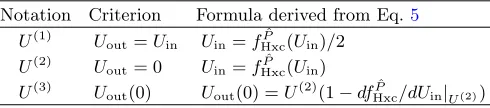
From Eq.5 we may readily identify three unique consistency criteria. The first is a very plausible self-consistency criterion, first proposed in Ref.67and later utilized in Refs.31and34, which requires thatUout=Uin
and thus givesUin=f ˆ P
Hxc(Uin)/2. ThisUin, denoted here
asU(1), appears to account for, i.e., cancel away one-half
of the subspace SIE that remains at that DFT+Uin. The
second criterion is given by Uout = 0, denoted here by U(2), which dictates thatU
in=f ˆ P
Hxc(Uin), implying that Uin fully cancels the subspace-related SIE computed at
the same DFT+inground-state. The third condition,
de-noted byU(3), matches (albeit with a different underling
linear-response procedure) the original self-consistency scheme25 where it is denoted U
scf. Here, the Uout(0)
of the DFT+U electronic structure is calculated by a linear-extrapolation ofUout(Uin) for sufficiently largeUin
to obtain a good fit, back toUin= 0 eV.
For our present purposes, it is reasonable to assume
that a DFT+U corrected electronic structure has been well-obtained atU(2), and thus performing the linear
ex-trapolation forU(3) aroundU(2), we find that
U(3)=U(2) 1− df ˆ P Hxc dUin
U(2)
!
. (6)
From this, a clear interpretation ofU(3) as screened
ver-sion of U(2) emerges, in a generalized sense of
screen-ing in which, instead of an externally applied potential being attenuated by relaxation of the electronic struc-ture, it is instead the externally appliedinteraction cor-rection which is attenuated. A normal dielectric screen-ing operator measures the rate of change of the potential with respect to an external perturbation, taking the form ˆ
−1 =dvˆ
KS/dvˆext = ˆ1 + ˆfHxcχˆ. A generalized screening
function here instead measures the rate of reduction in subspace-averaged SIE with respect toUin, and is given
by −U1 = −dUout/dUin = 1−df ˆ P
Hxc/dUin. Therefore,
while we require a DFT+U correction with parameter
U(2) to cancel the subspace-averaged SIE including all self-consistent response effects in the electronic structure, when we have done so we have in fact removed an SIE (with respect to DFT) of magnitude U(3) = −1
U U (2),
which is typically smaller in magnitude thanU(2). There
is a numerically relevant distinction between the exter-nal ‘bare’ Uin that we apply using DFT+U, and the
‘screened’ SIE quantifierUout that we then measure.
The SIE measure U(3), calculated around the U(2)
ground-state, is of particular interest, e.g., for quanti-fying the change in SIE in a subspace in response to an external parameter such as atomic position, or if compar-ing the SIE of an atom in two different charge states. We also expectU(3)to be suitable as an input HubbardU
pa-rameter for non-self-consistent protocols such as a post-processing DFT+U band-structure correction based on the DFT density, or a DFT + dynamical mean-field the-ory (DMFT) calculation with no density self-consistency.
U(3) linearly accounts for the resistance to SIE
reduc-tion thatwould be met were density self-consistency in response to U allowed. On the basis of the above anal-ysis, however, we conclude that the criterion U(2) rep-resents the appropriate self-consistency scheme for the variational linear-response method, wherever the stan-dard self-consistent response of the density occurs upon application of DFT+U. The value of U(2) may be
effi-ciently obtained, e.g., by the bisection method. The three self-consistency conditions are summarized in TableI.
Notation Criterion Formula derived from Eq.5
U(1) Uout=Uin Uin=f
ˆ
P
Hxc(Uin)/2
U(2) Uout= 0 Uin=f
ˆ
P
Hxc(Uin)
U(3) U
out(0) Uout(0) =U(2)(1−df ˆ
P
[image:6.612.317.562.624.678.2]Hxc/dUin|U(2))
IV. NUMERICAL RESULTS
A. Self-consistentU schemes applied to dissociatingH2+
In order to assess the potency of DFT+U for correct-ing SIE under varycorrect-ing bondcorrect-ing conditions without the complicating effects of static correlation error, we calcu-lated self-consistent HubbardU values and the resulting DFT+U electronic structure along the binding curve of the dissociating one-electron dimerH2+. A further advan-tage of the one-electron system is that the PBE and ex-act (i.e., for one electron, simply no Hartree or xc) func-tionals are available using the same first-principles code and pseudopotential, which ensures the accurate compa-rability of energies across the parameter space. Stringent numerical conditions were applied, with an extremely ac-curate small-core norm-conserving PBE pseudopotential and a plane-wave equivalent kinetic energy cutoff of ap-proximately 2650 eV, yielding deviations from 0.5 Ha within w (x) and y (z) on the isolated-atom total-energy and occupied Kohn-Sham eigenvalue, respectively, for the exact (PBE in parentheses) functional. The dissociated limit is of particular interest for confirming the relative appositeness of HubbardU self-consistency schemes that may yield numerically similar results since, in that limit, the neutral-atom PBE 1sorbitals used to define each of the two DFT+Usubspaces spatially overlap (i.e., double-count) and spill the total charge minimally, and the DFT+U population analysis for the PBE dimer becomes ideal. Furthermore, as we approach the dissociated limit, the assumption that each of the two DFT+U subspaces interacts relatively weakly with its bath (in each case, the other atom) becomes increasingly realistic, represen-ing the best available performance of DFT+U using an fixed atomic population analysis (i.e., one that is not de-pendent on the charge, appliedU, or other details of the electronic structure, as Wannier functions are36,97).
While conserving the overall charge, the external po-tentialαwas varied within the range ±0.05 eV and ap-plied to one atom. DFT+U was applied to both atoms equally, with Uin sampled from 0 eV up to the value
that yieldedUout= 0 eV. A typical calculation ofUout is
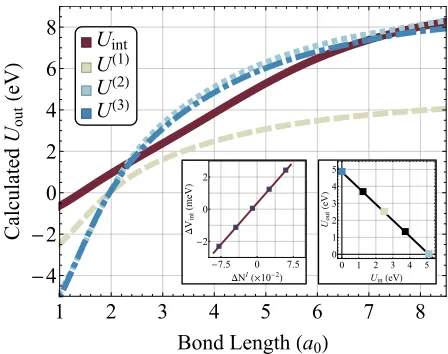
shown in the left inset of Fig.2. For each bond-length, a
UinversusUoutprofile was calculated according to Eq.5,
as illustrated in the right inset of Fig 2 with due care to error accumulation. These profiles were found to re-main highly linear across all bond-lengths for this par-ticular system and linear-response methodology, and we note that the slope remained greater than−1, signifying
dfPˆ
Hxc/dUin > 0 and a ‘resistance’ to SIE reduction, for
all but the small bond-lengths.1.3 a0 strongly affected
by subspace double-counting. The linear fit toUout(Uin)
was then used to evaluateU(1),U(2),U(3), according to
TableI, and their values are depicted by dashed, dotted and dot-dashed lines, respectively, in Fig. 2. For each bond-length, we also estimated, by interpolation, theUint
(solid line) required to recover the exact total-energy. The U(2) and U(3) schemes, and particularly the
for-U
intU
(1)U
(2)U
(3)1
2
3
4
5
6
7
8
-
4
-
2
0
2
4
6
8
Bond Length
(
a
0)
C
al
cul
at
ed
U
out(
eV
)
■ ■ ■ ■ ■
-7.5 0 7.5 -2
0 2
ΔNI(×10-2)
Δ
Vint
(
meV
)
■
■ ■ ■
■ ■
■ ■
0 1 2 3 4 5 0
1 2 3 4 5
Uin(eV)
Uout
(
eV
[image:7.612.328.552.49.226.2])
FIG. 2. (Color online) The estimated best U value, Uint
(solid), for correcting the total-energy SIE in H2+, shown
with theU(1) (dashed),U(2)(dotted), andU(3)(dot-dashed) values. (Inset left) A sample Uout calculation at 4 a0 and
Uin= 1.5 eV. (Inset right) A sampleUin vsUout profile used
to evaluateU(1),U(2),U(3)(highlighted points), via TableI.
U(2) and U(3) approximately equal Uint in the dissociation
limit, whileU(1)is serendipitously more successful at equilib-rium and below due to subspace overlap and double-counting.
mer, closely approximate theUintrequired to correct the
SIE in the total-energy in the dissociated limit, whereas
U(1) clearly represents an underestimation by a factor
of 2, as indicated by TableI. The numerical situation is reversed within the equilibrium bond-length of approxi-mately 2 a0, whereU(1) appears to perform better than
the alternatives. We emphasise that the latter result is misleading, however, sinceU(1) performs better at short
bond lengths only due to the cancellation of its factor-of-two magnitude reduction with the double-counting ef-fects of spatially overlapping DFT+U subspaces, as well as the breakdown, in the strong-bonding regime, of the subspace-bath separation underpinning DFT+U. This highlights a risk when assessing the relative merits of correction formulae of this kind solely on the basis of numerical results gathered under equilibrium conditions, where bonding or overlap effects complicate the analysis.
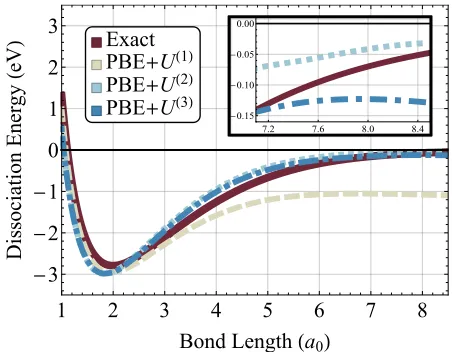
The total-energy based dissociation curves of H2+
were recalculated using the bond-length dependentU(1)
(dashed),U(2)(dotted), andU(3)(dot-dashed), for
com-parison with the exact total-energy (solid) in Fig.3. We note that any attempt to extend our bond length in-terval beyond 8.5 a0 resulted in numerical instabilities
due to the near-degeneracy of the Kohn-Shamσandσ∗
eigenstates, and present here are the results only of well-converging calculations. As already suggested by Fig.2,
U(1) fails to correct the SIE in the total-energy at
bond-lengths further from equilibrium, whereasU(2) andU(3)
of Fig.3illustrates, however, that the PBE+U(3)scheme, which is numerically equivalent to no Hubbard U self-consistency in this particular system, begins to under-perform with respect to PBE+U(2) in the dissociated
limit. The PBE+U(2) total-energy, meanwhile, seems
to converge upon the exact total-energy asymptotically. Our results confirm that DFT+U is capable of precisely correcting the total-energy SIE of a one-electron system under ideal population-analysis conditions but only, it seems, when using the simplest self-consistency scheme,
U(2). It is clear, notwithstanding, that DFT+U is an efficient and effective corrector for the SIE manifested in the total-energy, as discussed in detail in Refs.25–27.
Exact
PBE
+
U
(1)PBE
+
U
(2)PBE
+
U
(3)1
2
3
4
5
6
7
8
-
3
-
2
-
1
0
1
2
3
Bond Length
(
a
0)
Di
ssoc
ia
ti
on
E
ne
rgy
(
eV
)
7.2 7.6 8.0 8.4
-0.15
-0.10
-0.05 0.00
FIG. 3. (Color online) TheH2+dissociation curves of the
ex-act functional (solid), PBE+U(1) (dashed), PBE+U(2)
(dot-ted), and PBE+U(3) (dot-dashed). In the dissociated limit
(inset), theU(2)result tends asymptotically to the exact one, and theU(3)scheme begins to deviate from it non-negligibly.
B. Restoration of Koopmans’ condition: DFT+U1+U2
Despite the success of DFT+U in SIE-correcting the total-energy using a suitably calculatedU value, the fact remains that it is incapable of simultaneously correcting the highest occupied Kohn-Sham eigenvalue to minus the ionization potential in compliance with Koopmans’ con-dition, as indicated in Fig.1b. This issue has previously been explored in Ref.27, and by us in Ref.45where we constructed a generalized, two-parameter DFT+U func-tional, comprising separate parameters for the linear (U1)
and quadratic (U2) terms. In fact, Eq. 9 of Ref. 45
indicates that if a symmetric system of two one-orbital subspaces (a very good approximation forH2+, with ap-proximately constant subspace occupanciesN) is Koop-mans’ compliant (so that the KoopKoop-mans’ UK = 0), and it is then corrected using DFT+U for the SIE in the total-energy (it is possible for the interaction strength to be inaccurate, but for the system still to comply with Koopmans’ condition), then DFT+U will act to spoil
that condition unlessU1= 2U2(N−N2)/(1−2N). More
pragmatically, we expect the extra degree of freedom fur-nished byU1to be beneficial in cases where the quadratic
approximation to the subspace-averaged self-interaction does not remain valid all the way down to the ionized state, which is particularly relevant forH2+ since there that state corresponds to the low-density limit. For com-pliance with Koopmans’ condition, it seems unavoidable that data must be collected from both the approximate neutral and ionized (the total energy of which may be sufficient) systems, in order to calculateU1 andU2.
We carried out density non-self-consistent
DFT+U1+U2 calculations on the basis of the PBE
total energy and occupied Kohn-Sham eigenvalue, following the formulae given in Ref. 45. To put the method on a first-principles footing, we used the self-consistent value U(2) to calculate U1 and U2,
resulting in a density correction to the total-energy summing to ∆E = U(2)(N −N2). The corresponding
modification to the subspace potentials is given by ∆vU = U(2)(N −N2)−UK/2 where, for this system,
UK/2 =Eion-ion−EPBE+εPBE. Noting that the
correc-tion to the Kohn-Sham eigenvalue εPBE tends to ∆vU in the dissociated limit where changes to the occupied Kohn-Sham orbital are negligible, there we find that
εPBE+U1+U2 ≡εPBE+ ∆vU =εPBE+ ∆E−(Eion-ion−
EPBE + εPBE) = −(Eion-ion −EPBE+U1+U2) ≡ −IP,
if IP is the ionization potential, i.e., that Koopmans’ compliance is restored for a SIE correction strength of
U(2). Fig. 4 illustrates the result of this simple
tech-nique, which simultaneously reconciles the total energy
E and eigenvalueε derived dissociation curves with the PBE+U(2)dissociation curve of Fig.3, albeit imprecisely as this is a non-self-consistent post-processing step.
Our results highlights the potential of the DFT+U1+ U2 approach and its immediate compatibility with
self-consistently calculated Hubbard U parameters. To our knowledge, the SIE of approximate DFT has not previ-ously been simultaneprevi-ously addressed for the total-energy and the occupied Kohn-Sham eigenvalue using a first-principles correction method of DFT+U type, even for a one-electron system such as this. In the manner in which we have performed it here, non-self-consistent DFT+U1+U2requires only one total-energy calculation,
at the ionized state, on top of the usual apparatus of a linear-response DFT+U calculation, in order to simul-taneously, albeit approximately, correct the total energy and the highest occupied Kohn-Sham eigenvalue for SIE. Interesting avenues for the development of this method include its extension to multi-electron, heterogeneous, and non-trivially spin-polarized systems, as well as to perform self-consistency over the density and to lift the fixed-occupancy approximation, as outlined in Ref. 45. In principle, a further refinement of the method might entail the self-consistent linear-response calculation ofU1
[image:8.612.64.290.211.387.2]Exact EPBE+U1+U2
εPBE+U1+U2
1
2
3
4
5
6
7
8
-
3
-
2
-
1
0
1
2
3
Bond Length
(
a
0)
Di
ssoc
ia
ti
on
E
ne
rgy
(
eV
)
7.2 7.6 8.0 8.4
-0.15
-0.10
-0.05
[image:9.612.65.291.48.227.2]0.00
FIG. 4. (Color online) Exact (solid), total-energy based
EPBE+U1+U2 (dashed), and eigenvalue based εPBE+U1+U2
(dotted) dissociation energy curves for H2+, calculated us-ing DFT+U1+U2 as defined in the main text. This method,
combined with self-consistently calculated HubbardU param-eters, here ofU(2)type, enables the simultaneous SIE
correc-tion of the total-energy and Kohn-Sham eigenvalue (to pre-cisely the same accuracy for a one-electron system, as shown).
C. Binding Curve Parameters
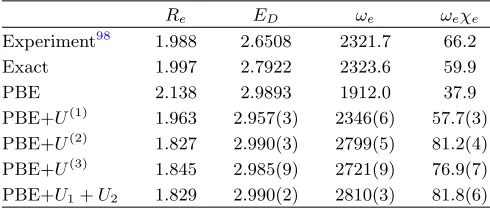
In order to further quantify the results of the vari-ous Hubbard U self-consistency schemes tested, we de-termined the equilibrium bond-length Re, dissociation energy ED, harmonic frequency ωe and anharmonicity
ωeχe, corresponding to each, as shown in Table. II, by fitting a polynomial about the energy minima. As com-pared with the experimental data of Ref. 98, the exact calculations perform well in determining the bond-length and harmonicity in particular, with errors that reflect the inaccuracies due to our fitting scheme, finite com-putational basis set size, core pseudization, and absent physical effects, as well as experimental factors.
The PBE functional overestimates the equilibrium bond-length and dissociation energy, while
underestimat-Re ED ωe ωeχe
Experiment98 1.988 2.6508 2321.7 66.2
Exact 1.997 2.7922 2323.6 59.9
PBE 2.138 2.9893 1912.0 37.9
PBE+U(1) 1.963 2.957(3) 2346(6) 57.7(3) PBE+U(2) 1.827 2.990(3) 2799(5) 81.2(4)
PBE+U(3) 1.845 2.985(9) 2721(9) 76.9(7)
PBE+U1+U2 1.829 2.990(2) 2810(3) 81.8(6)
TABLE II. Equilibrium bond-lengthsRe(bohr), dissociation energyED(eV), harmonic frequenciesωe(cm−1), and anhar-monicitiesωeχe(cm−1) for each calculation scheme tested, for comparison with experimental values98.
ing the harmonic frequency and anharmonicity. The var-ious DFT+U schemes tested generally preserve the PBE dissociation energy (N.B., calculated with respect to the exact-functional one-atom total-energy, rather than to the PBE local maximum at 6-7 a0) but they reduce the
bond-length and increase the frequency and anharmon-ictiy. The U(2), U(3) and U1+U2 schemes over-correct
the latter three and remain as poorly predictive of the ex-perimental data as the uncorrected PBE is. We attribute this to imperfect DFT+U population analysis at shorter bond-lengths, featuring both double-counting across the two subspaces and spillage, as well as the breakdown of the subspace-bath separation. The double-counting, in particular, is not properly compensated for by self-consistently calculatedU parameters, since the formula forUoutfeatures no quantification of this effect. TheU(1)
scheme performs well here, as reflected also in Fig.2, ap-proximately recovering the exact bond-length, harmonic frequency and anharmonicity. We emphasise that this is due entirely to theU(1) parameter simply being smaller
be definition, so that the over-correction due to double-counting is less extreme. It therefore coincides with the exact regime serendipitously, and not by design.
V. THE COMPARABILITY OF DFT+U TOTAL ENERGIES AND THE CONNECTIONS BETWEEN THE SCF AND VARIATIONAL LINEAR-RESPONSE
In this section, we explore the relevance of first-principles calculated Hubbard U values, particularly at self-consistency, to the comparability of the DFT+U to-tal energies across different calculations in which the HubbardU is separately calculated due to the variation of external parameters such as stoichiometry and crystal-lographic geometry. We also clarify the technical similar-ities and differences between SCF linear-response23 and its derived variational linear-response method.
The open question of the rigorous comparability of DFT+U total-energies that are generated by calculations with differentU values, which ordinarily represent exter-nal parameters with the same status as ionic positions, is of considerable contemporary relevance. This is demon-strated by recent progress in calculating thermodynamic quantities41,99–103, in high-throughput materials infor-matics104–106, catalysis62,107–109, and in the study of ion-migration in battery materials31,47,51,52,54,84,110–112 by
means of DFT+U and its related methods.
The variational linear-response definition U =
dvint/dN, so-called as it is based on the variational
response of the ground-state density, demands that the subspace-averaged non-interacting response χ0 = dN/dvKS is calculated using the same set of
[image:9.612.53.298.563.668.2]the limit of small perturbations, that
Uout=χ−01−χ
−1= dvKS[ ˆρ] dN[ ˆρ]
ρˆ
0
− dvext dN[ ˆρ]
ρˆ
0
, (7)
where ˆρ0is the unperturbed Kohn-Sham density-matrix.
From this, it is clear that Uout[ ˆρ0] is a ground-state
density-functional, albeit not one of an explicit algebraic form. This definition is readily adaptable to orbital-free DFT, in which there is no Kohn-Sham Hamiltonian to di-agonalize but only a density (rather than a Kohn-Sham density-matrix) to optimize, and where ˆvKS is replaced
by the total potential. If we perform a variational linear-response calculation for a given Uin, notwithstanding,
then the resultingUoutmay thought of as a ground-state
density functional parameterised byUin. If we can then
uniquely determineUinby applying a self-consistency
cri-terion such asUout = 0 eV, we will thereby uniquely
de-termine the self-consistent ground-state DFT+U density-matrix (up to unitary transformations) ˆρ0(Uin), as well
as its derived properties such as the total-energy, in terms of the remaining parameters, e.g., ionic positions.
The comparability of total-energies between various crystallographic or molecular structures with differing self-consistent Hubbard U values, and the validity of thermodynamic calculations based on DFT+U, directly follows. In this way, given the underlying explicit al-gebraic xc functional such as PBE, together with the choice of a set of subspaces to target for SIE correc-tion, DFT+U is elevated to the status of a self-contained orbital-dependent density-functional in its own right, in-corporating the HubbardUas a non-algebraic but readily computable auxiliary ground-state variable.
The SCF23 and variational linear-response methods
are identical in terms of their applied external perturba-tion, the use of the Dyson equation for multi-site models, and issues of DFT+Upopulation analysis choice and con-vergence. While they are equally convenient for use with SCF-type DFT solvers, the variational approach is likely to be more convenient for use with direct-minimization solvers. They are also perfectly identical insofar as the calculation ofχis concerned. They differ only in the defi-nition and set of densities used to calculate the subspace-averaged non-interacting responseχ0.
A calculation of the non-interacting responseχ0
follow-ing the first step of the SCF cycle, as in state-of-the-art linear-response calculations, relies, by construction, upon the density (or Kohn-Sham orbitals, or density-matrix, as the case may be) not being converged to the varia-tional ground-state for each given external parameterα. A non-optimized density of this type will typically not correspond to the ground-state for any value of α, al-though its subspace-total N will be. As a result, the finite-difference data points forα6= 0 that build the SCF linear-responseχ0 are individually not properties of the
ground-states for their corresponding external potentials, noting that linear-response does not imply the sufficiency of first-order perturbation theory or first-order screening.
Put another way, the SCF χ0 (and hence the derived U) is not a ground-state property of the unperturbed ground-state density, but instead an excited-state prop-erty (in the simple sense of non-ground-state, rather than of a resonance) dependent on the eigensystem of the non-interacting Kohn-Sham Hamiltonian. The comparison of the resulting DFT+Utotal-energies thus remains well de-fined in terms of ground-state densities, since the Kohn-Sham eigenspectra are themselves ground-state proper-ties. However, by virtue of the SCF HubbardU not itself being a purely ground-state density-functional property, in general, the total energies are also not necessarily so.
The precise effects of the departure from the ground-state energy surface in the calculation of SCF χ0 have
not been quantified to date, to the best of our knowledge. Therefore, while the self-consistency scheme dubbedU(2)
seems to be optimal for use with the variational linear-response scheme, as we have shown, this result does not automatically extend to its SCF progenitor. Nonetheless, we may expect that the two inequivalent approaches for
χ0 should yield similar numerical results in practice.
VI. CONCLUSIONS
We have developed a simple, variational adaptation of the widely-used linear-response method for directly cal-culating the HubbardU of DFT+U, in which the U in-corporates only quantities calculated from ground-state densities. This method puts DFT+U on a first-principles footing within the context of direct-minimization DFT solvers, even the linear-scaling solvers of the type now routinely used to simulate systems which are simultane-ously spatially and electronically complex69–78
Our formalism simplifies the analysis of parameter self-consistency schemes considerably and, at least for this specific method, there emerges a clear best choice of self-consistency criterion,U(2), which has been explored
rela-tively little in the literature to date. We recommend the use of a more complicated criterion, the previously pro-posed U(3), particularly for density-non-self-consistent
methods such as post-processing DFT+DMFT. In strin-gent calculations of the dissociated limit of the purely SIE-afflicted system PBEH2+, where DFT+U operates under ideal conditions, we are able to directly observe that the method corrects the SIE in the total-energy very precisely, as foreseen in Ref.25. It does so entirely from first-principles when theU(2) scheme is used.
first-principles basis, extends the DFT+U(2) full SIE correc-tion of theH2+total-energy to the highest occupied eigen-value, approximately enforcing Koopman’s condition.
Finally, we note that to properly account for SIE in the total-energy across the bond-length range, one would need to fully take into account the effects of subspace charge spillage, overlap and double-counting, possibly through the use of Wannier functions81 generated
self-consistently with the DFT+U electronic structure36. At
least as important for correcting SIE in the bonding regime, perhaps, is the necessity to overcome the break-down of the single-site approximation. For this, the account of inter-subspace SIE offered by the multi-site method DFT+U+V67is a promising avenue for
investi-gation.
ACKNOWLEDGMENTS
This work was enabled by the Royal Irish Academy – Royal Society International Exchange Cost Share Programme (IE131505). GT acknowledges support from EPSRC UK (EP/I004483/1 and EP/K013610/1). GM and DDO’R acknowledge support from the Sci-ence Foundation Ireland (SFI) funded centre AMBER (SFI/12/RC/2278). We thank Edward Linscott, Fiona McCarthy, Mark McGrath, Thomas Wyse Jackson, and Stefano Sanvito for discussions. All calculations were performed on the Lonsdale cluster maintained by the Trinity Centre for High Performance Computing and funded through grants from Science Foundation Ireland.
1P. Hohenberg and W. Kohn, “Inhomogeneous electron gas,”
Phys. Rev.136, B864–B871 (1964).
2W. Kohn and L. J. Sham, “Self-consistent equations
includ-ing exchange and correlation effects,”Phys. Rev.140, A1133– A1138 (1965).
3R. O. Jones, “Density-functional theory: Its origins, rise to
prominence, and future,”Rev. Mod. Phys.87, 897–923 (2015).
4F. Esch, S. Fabris, L. Zhou, T. Montini, C. Africh, P.
For-nasiero, G. Comelli, and R. Rosei, “Electron localization de-termines defect formation on ceria substrates,” Science 309, 752–755 (2005).
5A. Jain, Y. Shin, and K. A. Persson, “Computational
predic-tions of energy materials using density-functional theory,”Nat. Rev. Mater.1, 15004 (2016).
6J. P. Perdew and A. Zunger, “Self-interaction correction to
density-functional approximations for many-electron systems,” Phys. Rev. B23, 5048–5079 (1981).
7J. P. Perdew, K. Burke, and M. Ernzerhof, “Generalized
gra-dient approximation made simple,”Phys. Rev. Lett.77, 3865– 3868 (1996).
8A. D. Becke, “Density-functional thermochemistry. III. The role
of exact exchange,”J. Chem. Phys.98, 5648–5652 (1993).
9T. Yanai, D. P. Tew, and N. C. Handy, “A new hybrid
exchange-correlation functional using the Coulomb-attenuating method (CAM-B3LYP),”Chem. Phys. Lett.393, 51 – 57 (2004).
10P. J. Wilson, T. J. Bradley, and D. J. Tozer, “Hybrid
exchange-correlation functional determined from thermochemical data and ab initio potentials,” J. Chem. Phys. 115, 9233–9242 (2001).
11S. L. Dudarev, G. A. Botton, S. Y. Savrasov, C. J. Humphreys,
and A. P. Sutton, “Electron-energy-loss spectra and the
struc-tural stability of nickel oxide: An LSDA+U study,”Phys. Rev. B57, 1505–1509 (1998).
12A. J. Cohen, P. Mori-S´anchez, and W. Yang, “Insights into
current limitations of density-functional theory,”Science 321, 792–794 (2008).
13J. P. Perdew, R. G. Parr, M. Levy, and J. L. Balduz,
“Density-functional theory for fractional particle number: Derivative dis-continuities of the energy,” Phys. Rev. Lett. 49, 1691–1694 (1982).
14A. Droghetti, I. Rungger, C. Das Pemmaraju, and S. Sanvito,
“Fundamental gap of molecular crystals via constrained density-functional theory,”Phys. Rev. B93, 195208 (2016).
15C. Toher, A. Filippetti, S. Sanvito, and K. Burke,
“Self-interaction errors in density-functional calculations of electronic transport,”Phys. Rev. Lett.95, 146402 (2005).
16S.-H. Ke, H. U. Baranger, and W. Yang, “Role of the
exchange-correlation potential in ab initio electron transport calcula-tions,”J. Chem. Phys.126, 201102 (2007).
17Y. Zhao, B. J. Lynch, and D. G. Truhlar, “Development and
assessment of a new hybrid density-functional model for ther-mochemical kinetics,”J. Phys. Chem. A108, 2715–2719 (2004).
18A. J. Cohen, P. Mori-S´anchez, and W. Yang, “Challenges for
density functional theory,”Chem. Rev.112, 289–320 (2012).
19V. I. Anisimov and O. Gunnarsson, “Density-functional
calcu-lation of effective Coulomb interactions in metals,”Phys. Rev. B43, 7570–7574 (1991).
20V. I. Anisimov, J. Zaanen, and O. K. Andersen, “Band theory
and mott insulators: Hubbard U instead of stoner I,” Phys. Rev. B44, 943–954 (1991).
21V. I. Anisimov, I. V. Solovyev, M. A. Korotin, M. T. Czy ˙zyk,
and G. A. Sawatzky, “Density-functional theory and NiO pho-toemission spectra,”Phys. Rev. B48, 16929–16934 (1993).
22W. E. Pickett, S. C. Erwin, and E. C. Ethridge, “Reformulation
of the LDA + U method for a local-orbital basis,”Phys. Rev. B
58, 1201–1209 (1998).
23M. Cococcioni and S. de Gironcoli, “Linear response approach
to the calculation of the effective interaction parameters in the LDA + U method,”Phys. Rev. B71, 035105 (2005).
24D. D. O’Regan, N. D. M. Hine, M. C. Payne, and A. A. Mostofi,
“Linear-scaling DFT+U with full local orbital optimization,” Phys. Rev. B85, 085107 (2012).
25H. J. Kulik, M. Cococcioni, D. A. Scherlis, and N. Marzari,
“Density-functional theory in transition-metal chemistry: A self-consistent Hubbard U approach,” Phys. Rev. Lett. 97, 103001 (2006).
26H. J. Kulik and N. Marzari, “Systematic study of first-row
transition-metal diatomic molecules: A self-consistent DFT+U approach,”J. Chem. Phys.133, 114103 (2010).
27Q. Zhao, E. I. Ioannidis, and H. J. Kulik, “Global and local
curvature in density-functional theory,”J. Chem. Phys. 145, 054109 (2016).
28V. I. Anisimov, F. Aryasetiawan, and A. I. Lichtenstein,
“First-principles calculations of the electronic structure and spectra of strongly correlated systems: the LDA + U method,”J. Phys. Condens. Matter9, 767 (1997).
29B. Himmetoglu, A. Floris, S. de Gironcoli, and M. Cococcioni,
“Hubbard-corrected DFT energy functionals: The LDA + U de-scription of correlated systems,”Int. J. Quantum Chem.114, 14–49 (2014).
30J. M. Garcia-Lastra, J. S. G. Myrdal, R. Christensen, K. S.
Thygesen, and T. Vegge, “DFT + U study of polaronic conduc-tion in Li2O2 and Li2CO3: Implications for Li-Air batteries,”
J. Phys. Chem. C117, 5568–5577 (2013).
31M. Shishkin and H. Sato, “Self-consistent parameterization of
DFT+U framework using linear response approach: Application to evaluation of redox potentials of battery cathodes,” Phys. Rev. B93, 085135 (2016).
32D. J. Cole, D. D. O’Regan, and M. C. Payne, “Ligand
33M. Setvin, C. Franchini, X. Hao, M. Schmid, A. Janotti,
M. Kaltak, C. G. Van de Walle, G. Kresse, and U. Diebold, “Direct view at excess electrons in TiO2 rutile and anatase,”
Phys. Rev. Lett.113, 086402 (2014).
34B. Himmetoglu, R. M. Wentzcovitch, and M. Cococcioni,
“First-principles study of electronic and structural properties of CuO,”Phys. Rev. B84, 115108 (2011).
35D. D. O’Regan, M. C. Payne, and A. A. Mostofi, “Subspace
representations inab initiomethods for strongly correlated sys-tems,”Phys. Rev. B83, 245124 (2011).
36D. D. O’Regan, N. D. M. Hine, M. C. Payne, and A. A. Mostofi,
“Projector self-consistent DFT + U using nonorthogonal gener-alized Wannier functions,”Phys. Rev. B82, 081102 (2010).
37I. V. Solovyev and P. H. Dederichs, “Ab initio calculations of
coulomb U parameters for transition-metal impurities,”Phys. Rev. B49, 6736–6740 (1994).
38Calculations were performed using the DFT+Ufunctionality24
available in theONETEPlinear-scaling DFT package69with a
hard (0.65 a0cutoff) norm-conserving pseudopotential113, 10 a0
Wannier function cutoff radii, and open boundary conditions114.
DFT+U was applied simultaneously to each an atom, using a separate 1sorbital subspace centred on each, defined using the occupied Kohn-Sham state of the pseudopotential for neutral hydrogen. The correct symmetry ofH2+ was maintained for all values ofUgiven a symmetric initial guess, i.e., we observed no tendency for the charge to localize on a single ion.
39H. J. Kulik and N. Marzari, “Accurate potential energy surfaces
with a DFT+U(R) approach,”The Journal of Chemical Physics
135, 194105 (2011).
40D. Lu and P. Liu, “Rationalization of the hubbard u parameter
in ceox from first principles: Unveiling the role of local structure in screening,” The Journal of Chemical Physics 140, 084101 (2014),http://dx.doi.org/10.1063/1.4865831.
41M. Aykol and C. Wolverton, “Local environment dependent
GGA+U method for accurate thermochemistry of transition metal compounds,”Phys. Rev. B90, 115105 (2014).
42I. Dabo, A. Ferretti, N. Poilvert, Y. Li, N. Marzari, and M.
Co-coccioni, “Koopmans’ condition for density-functional theory,” Phys. Rev. B82, 115121 (2010).
43G. Borghi, A. Ferretti, N. L. Nguyen, I. Dabo, and
N. Marzari, “Koopmans’-compliant functionals and their per-formance against reference molecular data,” Phys. Rev. B90, 075135 (2014).
44In all dissociation curves presented, the fully dissociated
ref-erence energy was fixed to the total-energy of a single exact-functional hydrogen atom placed at the midpoint of the dimer, which is equal to the occupied Kohn-Sham eigenvalue of the same system, or two half-charged exact hydrogen atoms. In this way, only the SIE specific to the PBE dimer is analysed, without the SIE present in isolated, half-charged PBE hydrogen atoms.
45G. Moynihan, G. Teobaldi, and D. D. O’Regan, “Inapplicability
of exact constraints and a minimal two-parameter generalization to the DFT+U based correction of self-interaction error,”Phys. Rev. B94, 220104 (2016).
46C. W. M. Castleton, J. Kullgren, and K. Hermansson,
“Tun-ing LDA + U for electron localization and structure at oxygen vacancies in ceria,”J. Chem. Phys.127, 244704 (2007).
47B. J. Morgan and G. W. Watson, “A DFT + U description of
oxygen vacancies at the TiO2 rutile (1 1 0) surface,”Surf. Sci.
601, 5034 – 5041 (2007).
48A. Rohrbach, J. Hafner, and G. Kresse, “Ab initiostudy of the
(0001) surfaces of hematite and chromia: Influence of strong electronic correlations,”Phys. Rev. B70, 125426 (2004).
49C. Loschen, J. Carrasco, K. M. Neyman, and F. Illas,
“First-principles LDA+U and GGA+U study of cerium oxides: Depen-dence on the effective U parameter,”Phys. Rev. B75, 035115 (2007).
50L. Wang, T. Maxisch, and G. Ceder, “Oxidation energies of
transition metal oxides within the GGA + U framework,”Phys. Rev. B73, 195107 (2006).
51S. P. Ong, V. L. Chevrier, G. Hautier, A. Jain, C. Moore,
S. Kim, X. Ma, and G. Ceder, “Voltage, stability and diffusion barrier differences between sodium-ion and lithium-ion interca-lation materials,”Energy Environ. Sci.4, 3680–3688 (2011).
52F. Zhou, M. Cococcioni, C. A. Marianetti, D. Morgan, and
G. Ceder, “First-principles prediction of redox potentials in transition-metal compounds with LDA+U,”Phys. Rev. B70, 235121 (2004).
53F. Zhou, M. Cococcioni, K. Kang, and G. Ceder, “The Li
inter-calation potential of LiMPO4and LiMSiO4 olivines with M =
Fe, Mn, Co, Ni,”Electrochem. Commun.6, 1144 – 1148 (2004).
54F. Zhou, K. Kang, T. Maxisch, G. Ceder, and D. Morgan, “The
electronic structure and band gap of LiFePO4 and LiMnPO4,”
Solid State Commun.132, 181 – 186 (2004).
55M. V. Ganduglia-Pirovano, J. L. F. Da Silva, and J. Sauer,
“Density-functional calculations of the structure of near-surface oxygen vacancies and electron localization on CeO2(111),”
Phys. Rev. Lett.102, 026101 (2009).
56J. L. F. Da Silva, M. V. Ganduglia-Pirovano, J. Sauer, V. Bayer,
and G. Kresse, “Hybrid functionals applied to rare-earth oxides: The example of ceria,”Phys. Rev. B75, 045121 (2007).
57Z. He and A. J. Millis, “Strain control of electronic phase in
rare-earth nickelates,”Phys. Rev. B91, 195138 (2015).
58L. Bjaalie, A. Verma, B. Himmetoglu, A. Janotti, S. Raghavan,
V. Protasenko, E. H. Steenbergen, D. Jena, S. Stemmer, and C. G. Van de Walle, “Determination of the Mott-Hubbard gap in GdTiO3,”Phys. Rev. B92, 085111 (2015).
59E. B. Isaacs and C. A. Marianetti, “Electronic correlations in
monolayer VS2,”Phys. Rev. B94, 035120 (2016).
60S. Curtarolo, G. L. W. Hart, M. B. Nardelli, N. Mingo, S.
San-vito, and O. Levy, “The high-throughput highway to computa-tional materials design,”Nat. Mater.12, 191–201 (2013).
61D. A. Scherlis, M. Cococcioni, P. Sit, and N. Marzari,
“Simula-tion of heme using DFT + U: A step toward accurate spin-state energetics,”J. Phys. Chem. B111, 7384–7391 (2007).
62M. Capdevila-Cortada, Z. Lodziana, and N. L´opez,
“Perfor-mance of DFT+U approaches in the study of catalytic materi-als,”ACS Catalysis6, 8370–8379 (2016).
63K. Nawa, Y. Kitaoka, K. Nakamura, H. Imamura, T. Akiyama,
T. Ito, and M. Weinert, “Search for the ground-state electronic configurations of correlated organometallic metallocenes from constraint density-functional theory,”Phys. Rev. B94, 035136 (2016).
64F. Aryasetiawan, K. Karlsson, O. Jepsen, and U. Sch¨onberger,
“Calculations of Hubbard U from first-principles,”Phys. Rev. B74, 125106 (2006).
65K. Karlsson, F. Aryasetiawan, and O. Jepsen, “Method for
cal-culating the electronic structure of correlated materials from a truly first-principles LDA+U scheme,”Phys. Rev. B81, 245113 (2010).
66M. Cococcioni, “The LDA+U approach: A simple Hubbard
cor-rection for correlated ground states,”Lecture Notes (2012).
67V. L. C. Jr and M. Cococcioni, “Extended DFT + U + V
method with on-site and inter-site electronic interactions,” Jour-nal of Physics: Condensed Matter22, 055602 (2010).
68In this work, since we find it necessary to use only single-site
DFT+Uwith no +V term, we treat the two 1satomic subspaces as decoupled, each comprising the majority of the screening bath for the other. Hence we use a pair of scalar Dyson equations (identical by symmetry, i.e., only one is treated numerically) to calculate the HubbardU, rather than selecting the diagonal of the 2×2 site-indexed HubbardU.
69C.-K. Skylaris, P. D. Haynes, A. A. Mostofi, and M. C. Payne,
“Introducing ONETEP: Linear-scaling density-functional sim-ulations on parallel computers,”J. Chem. Phys. 122, 084119 (2005).
70N. D. Hine, P. D. Haynes, A. A. Mostofi, C.-K. Skylaris, and