
Art and ephemera post-structuralist perspective: visual art, ephemera and environment
300
0
0
Full text
(2) Part Two. Themed Analysis.
(3) Chapter Five. 5.0 Precursors and Models for Art and Ephemera. Introduction to Models Key internationally recognised art between the 1950s to1990s has been chosen for this chapter to provide models for ‘art and ephemera’ where artists’ use of ephemera as material, and as processes in visual arts, overlap. The selected mix of material is from where artists borrow from time-based change or implement ephemera in artwork. Presenting these models responds to my first question ‘what artistic means could illuminate environmental fragility?’ Ephemeral materials, used in visual arts significantly over the last six decades, demonstrate change to communicate concepts, or act as metaphors for issues-based art. Influences for the incorporation of these less permanent materials come from older diverse cultures, and these precursor models for ‘art and ephemera’ are discussed in this chapter leading to post-1950s models.. Few works from a pre-1950s mainstream visual arts or fine art paradigm are relevant to this project to identify art practice that makes use of an ephemeral material. However artworks or icons from 700 to 1,400 years ago are relevant as precursors to appreciate the telling age in objects. These are from Tang and medieval art periods, and my study in these areas uncovers aesthetics of ephemera in partially preserved figures. Many of these would have lost much of their aged beauty if any restorative attempts had been made, and the signs of age and deterioration evident in these artworks and icons are relevant to art and ephemera as metaphors for environmental fragility and concern.. Chapter Five. 142. Anne Lord.
(4) Similarly, Aboriginal drawings on rock walls and ageing icons in Buddhist caves are contributing areas of iconic images because they are intimately connected with the eroding natural environment. Both inhabit ancient rock caves and are on eroding walls that give way to the natural elements. These precursors provide critical distance and act as aesthetic examples. The latter have relevance to anti-archive art for this study, and are discussed further in the next chapter in the context of revered icons as models. In addition, the Japanese concept wabi-sabi ˚ inherent in many art forms, either through a conscious adoption of the concept or an ambiguous borrowing from another culture is relevant for the appreciation of signs of age. These precursors contribute to an appreciation of the aesthetics and discourse for art and ephemera by challenging the cannon of archival and commodity-based systems for art.. Disparate art examples have been positioned with an escalating emphasis on ephemeral practices in this and the following chapters to focus on ephemera with a conceptual link to time-based change. I am not creating a chronological recount of art and ephemera, as it might be used in art history, but as stated in the methodology I review previous accepted practice in order to position ˚ a vital contemporary perspective. This chapter is not an exhaustive account of models for art and ephemera rather I adopt key art from specific art movements. These illustrate my points about how, and why ephemera, for material and concept, have come to be used intentionally in art. Comparative studies of a number of artworks will demonstrate this intentional use. Artists re-visited from the twentieth century provide concepts to generate discourse about new approaches to art and ephemera. Thus re-interpretation of art movements from Dada, Arte Povera, Fluxus and the Situationist International is relevant for this study due to the manner in which the artists produced an art statement against the grain of a conservative society by using unconventional and ephemeral processes. In my post-structuralist re-reading, these artists contradicted the society that supported the erection of the permanent monument, preserved structure or archived art. In this study signs of blind. Chapter Five. 143. Anne Lord.
(5) acceptance or preservation for its own sake are questioned. Relevant examples to present a case against unquestioning acceptance of archive are works where artists have conceptualised art and ephemera. This art is often proactive in subverting a precious commodity to the point where the ephemeral art piece speaks through the memory of an artist’s action.. Examples from previously defined genres are redefined in the processes and concepts of art concerned with ephemera. For Roemer (1995), ‘Once art is no longer privileged, it is open to the same deconstructive analysis as all our structures and can itself become an instrument of change’ (Roemer 1995, 187). The potential for art to be this instrument of change is addressed primarily from my visual artist’s perspective where earlier eroding art provides important associations with crisis in the natural environment. Lippard (1984) and Henri (1974) contribute to this discourse with reference to attitudinal change from 1945 to 1990 and explicate artists’ responses to changing times. Lippard (1983) brought attention to the influences of ancient cultures, in sculptural and ritualistic forms, on the visual arts in the 1970s and early 1980s. These ancient eroded artworks have implications for my study where I sought unintentional models of ephemera. Sonfist amongst other 1970s artists responded to these ancient art forms.. Plate 5.1 Alan Sonfist 1975 Pool of Virgin Earth, on chemical waste dump, Artpark, Lewiston, New York, Diameter 25’ x Depth 6’ [photograph Lippard 1985, 229]. Chapter Five. 144. Anne Lord.
(6) Sonfist’s (1975) Pool of Virgin Earth on a chemical waste dump is also relevant due to the artist’s materials and intention to repair the earth. The Green Museum provides facts 1 critical for Sonfist’s intended reclamation in New York City. In this way, models for art and ephemera showing beauty in decay are often those objects that are close to, or have started to merge with the earth, through states of disintegration, positively identified as reclamation. These works and statements were produced for a variety of reasons, though my key models for this study show concern for the natural environment.. Sections in this chapter; Precursors: art ~ ephemera; and Chinese Tang and European Medieval Icons, link culture with accidental occurrences of erosion in art. Examples from these have influenced my artwork and some of my subsequent practice is discussed in this chapter where art is specific to aged beauty and particular ageing processes that foster appreciation of art and ephemera.. Links with Aboriginal Art At the beginning of formal ceremonies in Australia, particularly cultural occasions, official speakers will firstly acknowledge the traditional elders of the local land and their ancestors. In this introduction to the analysis I pay tribute to ancient tradition and Aboriginal Australian art and the extraordinary changes it has endured in the Australian environment over millennia. Caves with Aboriginal Art near Laura in Northeast Queensland hold some images that are too fragile to risk potential intrusion by tourists. Some are protected through secrecy and visitors are only allowed on site with guides.. 1. In 1969, Sonfist monitored the air quality of four popular New York City intersections… and posted the results to alert passers-by … In 1973, Sonfist drew Seed Catcher, whose concept parallels Ono's 1961 Painting for the Wind and Haacke's 1970 Bowery Seeds. Seed Catcher …[is a]: "pool of virgin earth to collect the seeds of nearby forests through wind and animal migration."…Later realized as Pool of Earth (1975), it occupied a …deep hole in land that was tainted by chemicals leached from nearby Love Canal. Sonfist laid a clay-based, sealed environment (…untainted earth) over the wasteland to collect the seeds http://www.greenmuseum.org/c/ecovention/sect5.html.. Chapter Five. 145. Anne Lord.
(7) Plate 5.2 Models and influences: Aboriginal cave paintings (detail) [Chaloupka 2000, 11] Chaloupka states ‘This photograph was taken in 1979. Since then, further deterioration of the painted surface has occurred’ (Chaloupka 2000, 2). My inclusion of this art is for the respect people might develop through realisation of the vulnerability of the fading image and what this implies. Not all these images are available to Western eyes and some are not to be photographed. This respect for iconic images and their meaning or stories also influences my attitude to art and ephemera.. Plate 5.3 left Stones with grinding marks on site, right sharp rocks for toolmaking, Mount Isa [photographs Lord 2005] Rock sites, tools and castings (Plate 5.3) are often protected on sites through seclusion in an attempt to maintain rather than preserve a shifting icon, and these provide models for a consideration of new work. In some instances, with respect for. Chapter Five. 146. Anne Lord.
(8) old art objects that are rare and fragile, ‘landowners’ do not allow strangers into a place where artefacts are vulnerable to removal or defacement.. Plate 5.4 Joseph Beuys (1970) Thousand Oaks Documenta 7, Kassel, Germany [photograph right Günter Beer] <http://www.diacenter.org/ltproj/7000/dokumenta7.html> The opposite from the secluded imagery mentioned above as a model for art and ephemera is apparent in high profile art, such as the well publicised works by Beuys, Thousand Oaks (1970) Plates 5.4 and 5.5.. Plate 5.5 Models and influences: Beuys (1970) Thousand Oaks Documenta Kassel, Germany In contrast to Beuys, Aboriginal cave paintings and iconic religious artwork such as the Buddhist sculptures in China’s Yungang Caves near Datong, or caves near Hangzhou were not made to appear as disintegrating, but now attract tourists for their fragile but lasting quality in the landscape. Chapter Five. 147. Anne Lord.
(9) Precursors: art ~ ephemera Long surviving cultures contribute to concepts about time and age, and act as visual clues to how erosion and disintegration can operate as agentic metaphors. Poststructuralist theorising assisted in revisiting worn imagery and erosion as agents of change. In contemporary art these can act as potential metaphors for major global change.. Plate 5.6 Hangzhou cave wall with crouching figure [photograph Lord 2003] The old and disintegrating statues in Buddhist caves and their counterparts in various temples and shrines have survived in some cases for 1500 years. Worn areas indicate tactile touch as reverence and this idea of the worn object and appreciated age relates across cultures evidenced in concepts such as wabi-sabi.. The Japanese concept of wabi-sabi ˚ is an influence on the study as I observe the way cultures have a specific relationship to the imperfection of age in cultural icons. Wabi-sabi implies balance between a philosophical construct and an aesthetic ideal (Koren 1994). The concept values relics, unravelling garments or imperfections in silk cloth. The encompassing dichotomies are referred to in many art forms in contemporary culture, in ceramic as well as ‘fibre and fabric’. Some artists acknowledge the influence from the Japanese concept. I identify the idea in icons of change in Indonesian silks in the Art Gallery of New South Wales, Sydney, Thai silk in the Royal Museum in Bangkok, Thailand. A regional comparison is the fine fabrics altered by women in early 1900s that after years of wear show unravelled threads (Plate 5.7).. Chapter Five. 148. Anne Lord.
(10) Plate 5.7 Margaret Lyne (1920s) Cut Lace cloth – and unravelling threads from regional Queensland [photograph Lord 2009] These and the iconic and ageing images of change from Chinese Tang and European medieval art are precedents in the appreciation of an ephemeral object as visual art.. Plate 5.8 Medieval figures on the front entrance to Notre Dame Cathedral Paris [photograph Lord 2007]. Chapter Five. 149. Anne Lord.
(11) The chronology of these movements or art periods is not significant to the selection of the models. Significant is the ability these aged icons exhibit as models and clues to explicate an aesthetic of decay or ephemera.. The appreciation of art and ephemera emerges from viewing ageing artwork, such as a statue with evidence of woodborers or chipped stone. At other times it is an object photographed in a street gutter 2, of lowly origins and even lowlier event (Plate 5.9) where the object picked up from a beach could act as a turning point in practice to provide a conceptual leap about the link between erosion, ephemera, aesthetics and anti-commodity.. Plate 5.9 Lord 1998 Orange – Fold installation digital image floated in water and caustic soda 20 x 20 cm The aesthetics of garbage (Shohat and Stam 1998) invites aspects of art from the street and this varies from serious to subversive. Lippard put forward that ‘artists. 2. Images include Cornelia Parker’s Drowned Monuments (1985) and Lord, Orange (1998) Plate 5.9.. Chapter Five. 150. Anne Lord.
(12) can be good at slipping between the institutional walls’ (Lippard 2006, 14), and while Lippard was referring to the capacity artists have to ‘expose the layers of emotional and aesthetic resonance in our relationships to the world’ (ibid.), in my contextualisation of the issues this also refers to meaningfully investigating crossdisciplinary activities. Thus where Simons (2004) and Hawkins (2006) both look at the business of waste with humour, as well as a commitment to create healthier responses to these facts of life, these examples mirror concepts I use to create a balance in my work and draw on humour to address serious issues. Not least is the capacity to look afresh at garbage and our spoils, in an age of abundant waste, particularly in affluent societies.. Post-structuralist theorising brings together art over ages that belong in an ascendant ~ descendent relationship with respect to who has the privilege to make, preserve, display and appreciate artwork. The historically recognised and reproduced image or icon is dominantly positioned as powerful, over and above the lesser known ephemeral or disintegrating artwork, sometimes made from recycled material or literally from garbage. These historical models provide a recognisable affinity through their shared decomposing or absent elements visible in icons in museums and second-hand markets, or literally found in the earth.. Plate 5.10 Lord Backless Axe eroding rusted object retrieved from Townsville studio garden. Chapter Five. 151. Anne Lord.
(13) Objects recovered from the earth in my studio garden (Plate 5.10) are discussed in Chapter Nine and are visual links to age and earlier artwork or artefacts. They assist a celebration of the potential empowering of art showing signs of ephemerality and using base materials.. Chinese Tang and European Medieval Icons My review of older and literally deteriorating icons presents ways to appreciate an aesthetic of erosion, through revisiting and appreciating work made by earlier artists, while contemporary artists who make similar art challenge the canon through intentionally providing metaphors for change.. Plate 5.11 Tang lady Art Gallery New South Wales [photograph Lord 2006] Sculptures made in the Tang dynasty were once painted and glazed with colours, and examples in the Shanghai Museum and state galleries within Australia are. Chapter Five. 152. Anne Lord.
(14) delicate figurines and animals that show traces of, for instance, powder colours that are preserved and only just staying on the object. Some wooden statues reveal splitting and chipping, and painted images show flaking and evidence of lost pieces. These eroding or fading images I refer to as ‘aged icons’ and they present reminders of art from the past and a world that constantly changes.. Similarly in medieval artwork, paintings show traces of the layers involved in preparation of wood and sealed surfaces. The evidence of construction, sealing, priming treatment, layers of plaster or gesso and then the application of layers of pigment, precious minerals, metals adorning spiritual icons or leaders, show their age through signs of unravelling and lifting. Their condition is preserved in a state of maintained age in museums such as France’s Cluny Museum and the Louvre, or Italy’s Vatican Museum and Uffizi Galleries. Both European and Asian spiritual deities, respectively the saints and bodhisattvas, with ageing haloes and gestures of adoration and reconciliation, are revered visually. The fact that these are often missing large pieces of the figures, and show altered colouring or splitting across a form adds to the mystery of the timeless quality of these pieces.. Revered deities, angels, saints, kings, queens, environment, ecology, flora and fauna meant particular things to the people at the time they were made. Now in their aged appearance a twenty-first century viewing of these icons might vary due to changed responses to religion and spiritual beliefs. However the acceptance in this millennium of the broken marble or wood split apart, the missing fragment of a figure and the fissured form are not only signs of age and authenticity, they provide alternative sources of pleasure and wonder. Pleasure arises from the experience of observing how something from a particular age has changed with time and that the splitting or disintegration, the ephemeral nature of the piece, is a mark of this age ~ change. The estimation of the age of a piece provides a measure of time and what happens over time. Wonder may arise from the acceptance of visual signs of age but also of survival against odds. The flaking paint is fragile and vulnerable to changes, small or more extreme. A split piece of wood is a visible sign of something that is. Chapter Five. 153. Anne Lord.
(15) coming apart but still manages to stay whole. Museums preserve such icons and present them to the public. Some museums such as the Confucian Temple in Beijing are themselves vulnerable places with fragile ceiling tiles about to give way to gravity. In some museums the deities and ancestor figures are not always shown in the best lighting or condition, though they still convey the sense of importance and signs of another age.. While silencing and gaps in historical detail have occurred in many cultures, these Chinese statues have survived. They provide surprise and delight to people and especially to my perception that they might not have survived catastrophes of recent times, even after the many historical upheavals of Chinese culture. One of my questions when visiting China for the first time in 2003 was how much of the old cultural heritage icons could have survived the Cultural Revolution. My library searches revealed famous images and revered religious icons in China. The surviving authentic pieces in public museums in Beijing, Shanghai, Xi’an, Pingyao and Datong provide icons relevant for this study.. In 2003, new and banal religious icons in China were apparent, as were superficial re-developed icons. Though many people were revering the statues of Buddha and ancestral figures, the new figures appeared to have a formula that was about copying a style for tourism, thus less relevant for my study. Like post-colonial Australian popular icons, the big pineapple and the big banana, the largest deities could impress the tourist. Visitors not accustomed to older and refined versions of cultural heritage from earlier periods might accept the new ~ shiny as authentic.. Chapter Five. 154. Anne Lord.
(16) Plate 5.12 left Medieval figure Notre Dame Paris front door [photograph Lord 2007] right Standing figure of a Buddha Northern Qi (550–77) limestone, 150 x 40 x 25cm Courtesy of Qingzhou Municipal Museum, Shandong Provincial Museum and Art Gallery New South Wales, http://www.artgallery.nsw.gov.au/?p=11581 Medieval figures of the 1400s are visual examples of grace and metaphysical proportions, though missing pieces from their form. Similarly, the enlightened gesture and pose of the Tang sculptures from 600, the Buddha, the Bodhisattvas, and a ceramic camel with a whole band of musicians playing their instruments on its back, are valuable reminders of another culture and another time. Their faded colours and fragmentation are significant as signs of age and time past.. Preserved art pieces are now in secure positions in powerful museums with guards and lighting, temperature and humidity control. Many were not intended to be preserved in this way, for instance, Tang sculptures survive to the twenty-first century through earlier acts that placed them in the ground as funeral figures, to safeguard the dead in afterlife. Buried in the earth they have accumulated signs of age and decomposition. These signs are a link that connects the Tang and medieval artwork to my contemporary notion of the art of ephemera, to an idea of return. The signs of age and of long deep time 3 are illuminated in a new perspective about something that gains beauty through proximity to a disintegration process. This. 3. 17th January 2007 in a discussion with Ross Gibson about the search for my quest.. Chapter Five. 155. Anne Lord.
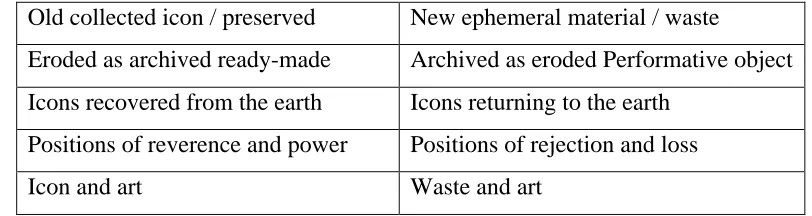
(17) theorising facilitates a connection where the past ~ present binary is suspended due to an appreciation of the similar processes of change inherent in old and new.. The crumbling artefact, signs of age and gradual return to the earth are a key to deriving pleasure from something that is in a way recycled as an object of desire, an aesthetic object. Thus models for art and ephemera or the ‘performative object’ include Tang Dynasty Yungang caves, medieval sculpture and aged icons showing signs of age. Re-visited as ready-mades, they assisted my recognition of erosion as archived and archived as erosion, shown in Table 5.1 and Plate 5.13. Table 5.1 Collapsing binaries of new and old, archive and ephemera Old collected icon / preserved. New ephemeral material / waste. Eroded as archived ready-made. Archived as eroded Performative object. Icons recovered from the earth. Icons returning to the earth. Positions of reverence and power. Positions of rejection and loss. Icon and art. Waste and art. Table 5.1 provides some insight into re-aligning a power issue, or rethinking ways of viewing commodity and art. In relation to power groups, the icons of reverence or rejection, repositioned by language and knowledge, transpose the perception of the icon. In this way the ephemeral artwork is a model for contemporary issues of ownership and recycling, enacting a balance between revered and despised. Archived art has a binary opposite and post-structuralist theory accepts the dominant and less privileged ephemeron. The acceptance of humus for art or relics of the gutter is influenced by the eroded archive. In Plate 5.13 the remains of sacred Buddhist iconography hold signs of chisel marks that indicate the removal of parts of the figurative sculpture from the cave wall. Here erosion, religious intolerance and vandalism contribute to signs of disintegration.. Chapter Five. 156. Anne Lord.
(18) Plate 5.13 Readymade iconography eroded Buddha, photograph #34 from Yungang Caves near Datong [photograph 2003 Lord] Revising a dominant discourse about preservation of art facilitates the acceptance of fragile icon and eroding land in contemporary art where ephemera is central to an appreciation of shifting balances. The ephemeron shows connections between the environment and land / earth – and acts as model or precursor for art with ‘environmental and ephemeral’ components. A deteriorating precious object can be relevant as a model for ‘art and ephemera’.. The earth pays a significant role and where gardener, Peter Cundall, (2008) celebrates the significance of soil and reveres things that provide nutrition in the ground for plants, my similar enjoyment comes from the freshness of furrowed soil inviting growth. Relevant in sites for my interpretation of art and ephemera is the unmistakable odour of rain on dry earth in opposition to humidity control in a gallery. In relation to art that is close to the earth, and artists who recycle icons from the streets or garbage, Shohat and Stam (1998) refer to the ‘aesthetics of garbage’ and revisit the way artists use disposed items that are rarely revered. These and similar models for art and ephemera exist in twentieth century art.. Chapter Five. 157. Anne Lord.
(19) 5.1 Twentieth Century Influences Art historian Herbert Read (1968) distinguished ‘two lines of development’ in twentieth century art: … one proceeding towards a fragmentation of perception and a reconstruction of form according to laws of the imagination; the other towards a ‘realisation’ of the motif, a composition after nature (Read 1968, 106).. The distinction assists in creating links between the catastrophic events contributing to formative art movements from the 1900s and development of major events to the present. For Read (1968) the twentieth century was ‘a period of intense fermentation’ where art movements gained the freedom to respond. For instance, Marinetti’s 1909 manifesto in ‘brave rhetorical phrases proclaimed the end of the art of the past (le Passéisme) and the birth of the art of the future (le Futurisme)’ (Read 1968).. The proclamation and manifesto emerge for artists as powerful communication strategies. Artists’ discourses furthered the concepts and causes behind their working with socio-political concerns or issues of their time. Manifestoes, important for Futurism and following art movements, link to issue-based art for art and ephemera post-2000. The implications of the manifesto and the artist’s ability to present issues in publication are essential to recognise, in the developing research, in order to communicate ‘art and ephemera’ to an audience beyond those immediately witnessing the art.. The comparison between Fluxus and Arte Povera, involves publication as well as investigative areas of poor material and challenge to bourgeois art of the time. Both are relevant to seeking ‘change’ as concept and as an anti-style ‘model’ for art and ephemera. Christov-Bakargiev (2002) mentions the lack of an over-arching style for Arte Povera artists ‘… often moving from one medium and technique to another without concern for a signature style’ (Christov-Bakargiev 2002, 11). Fluxus and Arte Povera artists have been crucial for this investigation and for many contemporary artists they provide the initial assurance to develop their own. Chapter Five. 158. Anne Lord.
(20) investigation based on experimental processes and less traditional methods. These models are selected in order to lead to the contemporary models in the study.. In Arte Povera the execution of art from ‘poor’ materials was a unifying factor in concept and action. Though Arte Povera did not include ephemeral processes as a condition for the work it was often an aspect of the work. More importantly the issues that underlie the movement share some common ideology with issue-driven practice of the twenty-first century and are thus linked to my argument for art and ephemera. The experiences of the Arte Povera artists (Christov-Bakargiev 2002) are relative to the concerns of contemporary artists who refer to similar experiences that impact on their lives and, in this capacity, make use of ephemeral material.. Some key artists from the Dada, Arte Povera, Fluxus and the Situationist International movements attempted to make use of ephemera or disintegration as a metaphor for issues conceptually linked to political, socio-economic and environmental issues, and conflict such as war. Specific features from these previous historical movements is appropriate, for instance, the Situationist International (the SI) employed the process of psychogeographical 4 investigation, and this parallels an opportunity for artists to integrate art and the natural environment and ecology they live in, or near. In my interpretation of the SI’s theories for art and ephemera, the chance encounters of many artists are turned into significant realisation of the impact of certain instances or things in their work. Significantly, their word derive 5 was used as an idea in incorporate everyday surroundings in art. For many artists encounters on urban streets are triggers for the investigation of cultural metaphors. Detritus from the street, disintegration and humus in the garden are of great value to contemplate a way forward for many. 4. The word “psychogeographical” described that which “manifests the geographical environments direct emotional effects” and a psychogeographer was simply one who explores and reports on psychogeographical phenomena (Ford 2005, 34). 5 The derive involves artists engaging in chance travel or wandering without plan (Ford 2005). Chapter Five. 159. Anne Lord.
(21) artists. This is especially so for my art in relation to this thesis, discussed in Chapter Eleven.. Thus, models for art and ephemera emerge in the art movements of the twentieth century and similarities re-emerge significantly in 2000 to 2009. Artists who choose to work with poor materials or take an anti-archive and anti-commodity stance, for whatever reason, often consider economic rationalisation in art and these strategies contradict the opportunities provided by a sterile gallery interior.. Material Influences Artists in the mid-twentieth century investigated a variety of materials that could be related to low cost and unprivileged material especially in relation to the nonarchiving of art. Christov-Bakargiev (2002) describes Arte Povera as an art of ‘heterogeneous and poor materials’ where artists employed simple techniques; ‘covering a surface with a ballpoint pen’ (Boetti), using ‘humble materials such as coal’ (Kounellis), ‘and simple processes such as freezing’ (Calzolari), or creating ‘chemical reactions’ (Zorio). They used ‘everyday techniques to shape humble materials – both natural and artificial – into artworks that generate meaningful experiences in the audience’ (Christov-Bakargiev 2002, 11).. Many factors contributed to the artist’s desire to create using a mix of poor material and reactionary elements in artwork. Lippard (2006), Tucker (2004) and ChristovBakargiev (2002) considered the economic and political influences of artists’ surroundings. Celant (2002), an authority on Arte Povera, presents a background of the time, as well as a motive for the artists’ rejection of concurrent art movements: The term ‘Arte Povera ’ … arises from these operative conditions, which tend to overlap with working conditions, and thus it has leftist political connotations. From this comes the rejection, or at least the non-acceptance, … of the industrialization represented by Pop and Minimalist art. And from this also comes the use of found materials (Celant 2002, 26).. Chapter Five. 160. Anne Lord.
(22) Artists considerations of pluralist, spiritual and cultural difference, major art debates, interdisciplinary approaches and contact with many international art genres, contributes to the development of this study for art and ephemera. These relationships facilitate ways to look at material changes for concepts that reflect issue-based art. This collection of models adds to understanding art that does not need to be archived. The relationship between artists’ practices and their theoretical contributions could emerge through numerous methods. For Boettger (2002) the Italian artists use of … lowly materials was a kind of rebellion against the aestheticization of high art as a decorative object from which both the artist and the consumer are emotionally detached. The prominently “poor” materiality challenged viewers to a more engaged and authentic response to art and to life (Boettger 2002, 15).. Boettger’s insight to the binary – the aesthetic of archived art and (anti-) aesthetic of ephemera – relates to Celant’s (1967) perspective where artists gained … a new attitude aimed at regaining possession of a ‘real’ control of being. It leads the artist to shift his [/her] position continuously, to throw off the cliché that society has attached to him [/her]. The artist who was exploited before now becomes a guerrilla warrior 6 (Celant 1967 cited in Boettger 2002, 15).. These connections to the concept of ephemera in art are through artists’ intentional relating of ideas to a place, rather than national or political boundaries or histories that would create irrelevant distinctions. Continuing influences from international movements such as Fluxus for Madonna Staunton7 and Arte Povera for Mario Reis8 are crucial to the networking of artists and their ability to work with radical art precepts and contribute to an international dialogue. Christov-Bakargiev (2002) provides a critical contemporary re-contextualisation when she states: Arte Povera is becoming invested with a political meaning once again, as it comes to be recognised as an example of artistic freedom – something to look. 6. Germano Celant Arte Povera: Notes for a Guerrilla War 1967 in Christov-Bakargiev (ed.) Arte Povera 2002, original publication Flash Art 1967.. 7. Staunton’s work was at Bellas Gallery, Brisbane and MCA Sydney 2005. Mario Reis’ works were at Multiple Box Sydney, http://www.2danksstreet.com.au/multiple.box.sydney/gallery.html, Conny Dietzschold’s second gallery, Sydney 2005. 8. Chapter Five. 161. Anne Lord.
(23) towards when attempting to formulate resistance to the consumer society of our ‘globalised’ world (Christov-Bakargiev 2002, 11).. This relates significantly to the developing concept for art and ephemera. Lumley (2004) and Christov-Bakargiev (2002) discuss the development of work in Arte Povera from an art using simple materials to an art that ‘…leave[s] no usable or exploitable trace. They no longer last as objects, but occur as varied and continuously changing episodes’ (Christov-Bakargiev 2002, 224). The significance of this statement demonstrates how artists were prepared to use materials that could alter during the time of the exhibition, contributing to non-consumerist attitudes to art and material: thus including ephemera and disintegration in some capacity in their work.. Giovanni Anselmo’s Untitled, Eating Structure, (1968 granite, copper wire, lettuce), and Penone’s Stone Rope Sun (1968) can be considered models for this study. Lumley mentions Penone’s outdoor work: Rope tied to a tree at one end and to a square piece of metal at the other, changes length depending on whether the weather is wet or dry. The metal object is lowered and raised accordingly. The energy intrinsic in hemp is thus ‘externalised’ through a simple structure and its exposure to natural forces (Lumley 2004, 55).. Penone has some affinity with Zorio and Anselmo, and the desire to work with mega-scale permanent artwork or humble ephemeral material exists side by side in many art movements. Similarly, lowly materials associated with dirt and garbage, also the potentially life giving, such as dust, have been included by a number of artists. Lippard (1973) listed chronological work involving dust as an ephemeral material William Wiley and Terry Fox (among others working with Wiley) make Dust Exchange, dust having been used as a medium by Marcel Duchamp in 1920, by Barry Le Va in 1968, and Bruce Nauman (flour dust) 1968 (Lippard 1973, 23).. I acquire models for art and ephemera that are eclectic in material choice. This situation includes the problematic area of slippage ˚ in relation to artists, and how. Chapter Five. 162. Anne Lord.
(24) they fit or disrupt a dominant trend or movement in art. The following section presents examples.. An Argument for Slippage and Non-categorisation Re-categorisation of artwork is barely relevant when working with disparate art concepts and materials under the realm of ephemeral material. Elkins (1999, 2000) and Duncum and Bracey (2001) have discussed the necessity for art history to be reinvestigated in relation to disciplines or contexts other than art (history). Many artists are now reinvigorated by the capacity to work with professionals in disciplines separate from the creative arts. This scope for artists working with ephemeral materials and engaging in activity irrespective of categorisation or visual documentation assists my investigation. Though missing documentation is problematic for contributions to research and is followed up separately.. It follows that creating art on the margins away from a privileged centre may be intentionally subversive. Lippard (2006) discusses how artists who choose to work in small communities run the risk of being ignored by a centre, and states that Artists are complicit in the way the world is seen, and the real problem is that contemporary art has no real genuine social context. Artists straddling classes and cultures are living out the conflicts of the entire polity. They’ve taken upon themselves an almost shamanic task – that of entering another world, doing so for the communal good, aware that return to the high art context could be impossible (Lippard 2006, 15).. In addition to the idea that some artists are less interested in working in a centre, even if this is where mainstream art is promoted, is the chance for artists to contribute to ecological wellbeing from this distance. Artists’ collectives operating outside a metropolis show that many artists reject belonging to an urban sprawl, and intentionally use an isolated place for their creative work. This involves the Internet as a new provider for artists’ manifestoes, taken up in subsequent chapters.. Further, there is the consideration for artists’ resistance to categorisation. Such categorisation denies the innate reluctance of many creative practitioners to have Chapter Five. 163. Anne Lord.
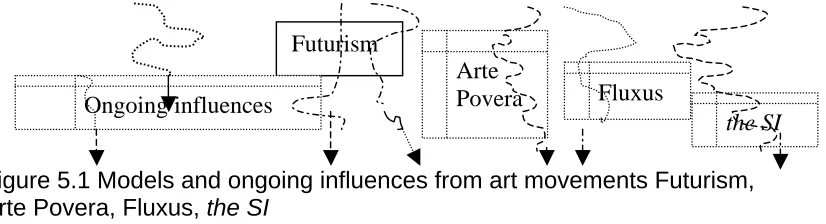
(25) them or their work slotted into a particular ‘box’. Buskirk (2003) has referred to the ‘absurdity of isolating’ certain genres, in order to identify … each with the brief period of initial formulation … [and where] success becomes apparent in the slippage of artists from one designation to another and…in the ongoing production over many decades by artists identified with these categories (Buskirk 2003,11).. Aspects of slippage ˚ recur in the various ways that diverse ephemeral material for artwork can be invested with a concept. Thus I refer to slippage and the concept of slippage between genres and promote discussion about the work of artists in relation to the idea of ‘art and ephemera’. This study supports artists who are not in any way intending to remain within a style or code and resist directions from commercial streams of rigid stylistic commercialism. Artists’ resistance to being categorised is evident in ephemeral practice in art. This practice contributes to a sense of aesthetics that is not bound by genre but by a number of questions potentially addressed by material change. In this respect my thesis acknowledges the absurdity of adding yet another name to a potential genre, however, I identify that art and ephemera, as a practice, comes in many variations of form and scale. What becomes important is the way art can be used to address urgent environmental and ecological issues for the twenty-first century.. Though many artists over the last five decades had a relationship to practice and theories of creating impermanent art and using this art as a statement about timely issues, there were many aspects to these different categories. This study reflects on shifts in categorisation, and blurring boundaries of previously discrete genres and styles, in order to see the potential for new readings. Making or seeking links across previously siloed genres facilitates a new perspective on art with impermanent features.. Figure 5.1 below indicates via visual text boxes the potential for a rhizome model, that is, multiple readings for considering art and ephemera. For instance, Long and Penone were represented in Land Art and Art Povera respectively though curatorial decisions (Lumley 2004) whereas these two artists in discrete movements could Chapter Five. 164. Anne Lord.
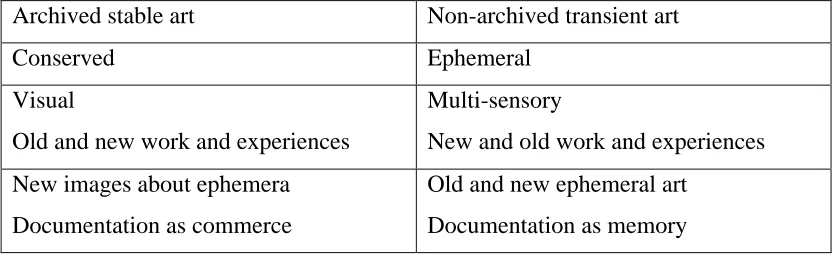
(26) have contributed to either. Thus my re-investigation of models across accepted genres broadens ways to look at art and ephemera and concepts about time-based change.. Futurism Arte Povera. Ongoing influences. Fluxus the SI. Figure 5.1 Models and ongoing influences from art movements Futurism, Arte Povera, Fluxus, the SI The post-structuralist approach assists a blurring of boundaries where previously unrecognised areas are given agency and entrance to discourse. Figure 5.1 shows concurrent models, multiple and parallel lines of practice, to clarify my use of the rhizome model as a re-reading in searches for models for ephemera. It demonstrates potentially common elements in four parallel art movements, an idea referred to for the development for this study. Similarly, commonalities link the East and West where art, and aged icons, show signs of age, unravelling or disintegration.. ~. Tang. ~. Icons. ~. Medieval. ~. Revered - lost - found - preserved - earthy - aged elements. Figure 5.2 Tang and Medieval similarities The relationship of the previous art styles, genres and periods impacts on my interpretation of these earlier situations. These ideas are developed in the analysis. Drawing and revealing aspects of Archived drawing, Searching. Refuse and return Digging and Finding Breaking and healing. Non-archived artwork, Findings. Figure 5.3 Archived and Non-archived. Chapter Five. 165. Anne Lord.
(27) Figure 5.3 in an interpretation of key findings and my reflection on the capacity of art and ephemera to provide new ways to look and learn for the contemporary. “Breaking and healing” relates to a broken limb and contributes to art making through reflection on healing, through growth. Rhizoid interpretation for five areas of ephemera gutter. waste. humus. garbage. earth. Figure 5.4 Gutter Waste Humus Garbage Earth These figures are interrelated through my concern for aesthetics of visual elements that can be seen in detritus, humus and regeneration. The manner in which these are cyclical and return to the earth in Figure 5.4 are critical for the pursuant analysis. They contribute to the next section as visual elements to communicate concepts, and bring contradictions in relation to why artists document their work.. Contradictions arise for artists in relation to their increased ability to document photographically and to archive. The choice exists for artists to resist this documentation or archiving of their work. Institutional models of preserving work required for referencing and collecting, that is, the archiving of the object and information about artwork require that artists document their artwork. This could be through exhibitions ~ installations that include archival or photogenic work to be documented for archival purposes. The practice of visual documentation is not always the rule, for artists such as Emilio Prini produced limited work and chose often to destroy it. Flood and Morris (2001) stated …from early on, Prini was as concerned with exploring hypothetical projects as he was with realising finished work, and the erasing of work or the covering of its traces was often more important than its production (Flood and Morris 2001, 17).. With the increased options to document and communicate, it seemed for some artists that to deny this opportunity could thus be a strategy for their creative art. Similar connections to hypothetical projects and denial of evidence, such as the artist’s intentional erasure of art, have arisen from Arte Povera and Fluxus to Chapter Five. 166. Anne Lord.
(28) Christian Capurro’s erasure artwork titled, Another Misspent Portrait of Etienne de Silhouette (2005 - 2007), shown at the Venice Biennale 2007. These models reveal concerns about how artists might adopt ephemera or change as a concept and method of practice for their work. In this way Prini’s attempts to leave no trace and Capurro’s to erase his art offer ways of revising ephemera and archive in art.. Movements such as Fluxus are relevant, due to their ability to break with specific doctrines while suggesting creative and logical concepts for art and ephemera. For Kirker (1993), Fluxus proposes, ‘ways of thinking about art and life from which other ideas and approaches could grow, … [and it was] rather was fluid and open ended’ (Kirker 1993, 5). International artists George Maciunas, Dick Higgins and his publishing enterprise ‘Something Else Press’, Alison Knowles, Marcel Duchamp, John Cage, Emmett Williams and Henri Chopin, figuratively speaking set the stage for art involving ephemera and time-based change. Though the Fluxus movement incorporated many more artists, an interest for this research is the development of an art form promoting ‘no costs, no waste, and lots of surprises’ (Kirker 1993, 6). The Fluxus ethos … had no stylistic identity, but its activities were in many respects a revival of the spirit of Dada, though not nihilistic. Anti-art in the conventional sense, figures connected with the Fluxus movement emphasised the paradoxical, humorous and ephemeral in their practice. They represented a collective struggle against bourgeois aesthetics (Kirker 1993, 5).. The dissemination of experimental activity in the 1960s and 1970s via ‘Something Else Press’ according to Kirker ‘…became one of the most important…serving happenings, poetry, events, art theory, music and literature (Kirker 1993, 6). The struggle to speak out against a status quo is reflected in more recent artwork that encompasses the ephemeral and contributes to my data. This emerges through mentors who acclaim art for environmental benefits.. In addition to or in contrast with the background of the time, many artists from these movements chose to look at mundane aspects of life in order to consider the basics and bring about reflection on quotidian activity. In this respect the art acts as. Chapter Five. 167. Anne Lord.
(29) a model for my reflection on ephemera and aspects of the natural environment. Kirker (1993) comments that the Fluxus artists treated ‘everyday life… as a model for creative expression, [where] the most mundane experiences become relevant and a spirit of freedom, openness and humour is engendered (Kirker 1993, 5). The humour and subversive nature of much of Fluxus work provides an important background for my study. For, though the quotidian is mentioned as important, it is often the case that a serious problem can also be addressed by a less than serious image. The almost benign notions of allowing an object to become part of a performance turned into a new volatile art form with Gustav Metzger. Henri (1974) acknowledges Metzger as undoubtedly the most energetic and influential figure in the area of destruction and art (Plate 5.14).. Plate 5.14 Gustav Metzger 1965 Auto-destructive Art Demonstration of Acid Nylon Technique [Cited Henri 1974, p. 167 Plate 136] Metzger’s (1965) publication Auto-destructive Art, ‘prints a long lecture, manifesto and photographs’ (Metzger 1965 cited in Henri 1974, 167), and provides a description of his activity: A sheet of nylon, stretched against a plate of glass about 4 ½ feet high and 8 feet in length, was painted with nitric and/or hydrochloric acid. Duration of acid application about 20 minutes (Metzger 1965 cited in Henri 1974).. Chapter Five. 168. Anne Lord.
(30) A black and white film in the exhibition ‘British Art in the 1960s’ National Gallery Victoria International (NGVI), (2005), showed Metzger with gas mask and protective clothing spraying acid onto two dimensional material. Shreds of nylon appear as the acid is shot from Metzger’s apparatus and the remains of nylon become archived footage even though the artist was intent on its disintegration. Metzger’s model produces some variance to the theme of environmental wellbeing, however this work is important for its bold statement about anti-archive, and influential for my practice. Metzger’s oeuvre ˚ referenced from 1960s to 2008 covers a significant time span for art and ephemera, and his work is discussed in Chapter Seven, Mentors.. Processes and making use of changing elements play a role for some artists better known as traditionally archivist, painters and sculptors. Boettger (2002) refers to Oldenberg’s early site work Hole (1967) in Central Park New York City, as a transient, rectangular recession, …an almost apocryphal predecessor [to Earth art]… dug in the dirt in Manhattan’s pastoral Other encapsulates the fundamentals of a genre of contemporary sculpture that in ensuing years achieved prominence for being sited in distant desert terrain and became known as Earthworks (Boettger 2002, 2).. It also acts as ‘predecessor’ to the temporary site works of the eco-artists, though their work was linked with eco-feminism, and paid homage to the earth rather than identifying space or removal of earth for formalist ˚ propositions. Boettger (2002) finds ‘Characteristic of Oldenberg’s manner of dialectic play, the Hole’s six-footlong rectangular recession encompasses associations ranging from the formal to the funereal’ (Boettger 2002, 1). Whereas most prominent artists have made use of the archival in order to establish reputations as artists through tactile reminders of their work, the opposite ephemeral activity has been used by many artists and become accepted in many major international exhibitions. I elaborate on this thread of ephemera included as major contemporary artwork in Chapter Seven.. Chapter Five. 169. Anne Lord.
(31) East ~ West: an interface Post World War II art and radical practices of the 1960s and 1970s provide some new interface between Eastern philosophy and Western art 9. Artists’ use of ephemera from 1960 to 1970 was often concerned with formal aspects of art making, such as the questioning of ‘Art’ though issues were also referenced, such as war, conscription, apprehension of socio-economic behaviour and emphasis on problems in the natural environment. Joseph Beuys, one of the most prominent European artists of the twentieth century to act in favour of the natural environment and employ ephemeral acts, addressed environmental degradation with the Spurfeld Altenwerder pilot project (Hamburg 1983) a massive tree-planting project to help bind toxic substances and protect ground water (Adams 1992, 27). Similarly, for Beuys’ Thousand Oaks (1982), he …intended the Kassel project to be the first stage in an ongoing scheme of tree planting to be extended throughout the world as part of a global mission to effect environmental and social change; locally, the action was a gesture towards urban renewal http://www.diacenter.org/ltproj/7000/.. Henri (1974) identifies ‘transcendental’ aspects in Beuys’s work and this is worthy of note, for though many people discuss Beuys’ materials and performances, Henri refers to another aspect of his work: Through all Beuys’s work there runs a strain of what he and his interpreters are forced to call the ‘transcendental’. This is what distinguishes him from superficially similar artists working today: his work is not a demonstration of the nature of materials or processes but their use to express certain fundamental philosophical premises. Many of his ‘actions’ and objects involve the use of humble materials, of the sort that have become increasingly popular with sculptors in the last few years: felt, fat or earth. But Beuys uses them as part of a system of balances of energies and potentials, not simply as an extension of the sculptor’s normal materials (Henri 1974, 147).. This interpretation from Henri assists in my relating concepts from Beuys with those of Laib. Both Beuys and Laib have trained in science (biology and medicine respectively) and then prioritised their practice in the arts. Both have been described as deterred by the common translation of science in the west, and both sought new. 9. (Discussion with Ely at COFA, UNSW July 2006). Chapter Five. 170. Anne Lord.
(32) ways to practise or empower their ideas. Schama (1995) and Adams (1992) have discussed Beuys’ works as integral with his concerns for the natural environment and for ‘verwaldung: afforestation as redemption’ (Schama 1995, 124).. Works from Agnes Denes, Anselm Kiefer and Joseph Beuys are relevant for the investigation of models for art and ephemera. They act as suitable and viable means to expose artists’ concern about ecology. For instance, Agnes Denes’ diagram and text for Rice/Tree/Burial (1968) including buried Haiku, chained trees and rice planting, resonates with my current study. Denes’ manifesto announced her ‘commitment to ecological and environmental issues, human concerns and philosophical thought’ (Denes 1993, 338). Agnes Denes’ major work Wheatfield—A Confrontation (1982) has been a major influence for my research. It was simply a wheat field and conveyed important messages through its strategic location in New York City and intention as impermanent art.. Plate 5.15 Agnes Denes 1982 Wheatfield—A Confrontation Battery Park Landfill, Downtown Manhattan [photograph John McGrail] Wheatfield—A Confrontation (1982) remains for me one of the most elegant examples of an art project involving ephemerality and connecting ideas about ecology and place. In this work the planting, growing and harvesting of wheat form the ephemeral elements of an artwork. Denes (2008) is working on a twenty-five year project involving ephemera as it incorporates ‘water and flood management,. Chapter Five. 171. Anne Lord.
(33) urban planning, historical preservation, landscaping, and tourism into the plan (http://www.mu.edu/haggerty/exhibitions/denes.html).. Cembalest (1991) cites the close relationship between artist and ecology: in the work of artist Betty Beaumont Ocean Landmark Project (1978 - 80) a project indistinguishable from nature, a 300 feet long reef of coal waste, attracts certain kinds of fish. Beaumont worked with scientists at Bell Laboratories, having learnt from them that coal waste is non-toxic if stabilised and placed in water (Cembalest 1991, 101). Beaumont, like Denes, creates art for action in the environment rather than archive, thus was a model for my emergent concepts about ephemera in art. The responsibility artists took has implications for art activity today in caring for ecology and environment. Artists were bound by a respect for place, and making art a promotional tool for ecology. By not stipulating archival practice or not having the intention to archive their work in preference to ephemeral acts, they could make a strong statement about ‘maintenance’ of ecology through art.. Artist, Mierle Laderman Ukeles is a mentor and advocate for the area of art proposed in this study, and her continuing works are relevant as contemporary models. The handshake is Laderman Ukeles’ artwork.. Plate 5.16 Mierle Laderman Ukeles, 1977–1980, Touch Sanitation, New York City Sanitation Department www.feldmangallery.com Carsen’s (1963) Silent Spring is influential as an important warning and reference to an awakening of environmental tragedy. Silent Spring remains a milestone and a reminder, referenced by many artists. Eco-feminist writers, for instance Diamond and Orenstein (1990), also contribute through their work to the increased activity of. Chapter Five. 172. Anne Lord.
(34) art and concern for environment. These writers and artists contribute to my commitment to positioning discussed in the next section.. In response to the literature my artwork is pacifist and enjoys slow change in naturally occurring environmental activity with potential for regeneration. Artwork contrary to this, making use of explosive materials and acting for defaced or vandalised changes is less relevant due to some loss in the process of cyclical change or regeneration. The pacifist environmentalist model is one of the main concepts underlying mentor’s activities that I search for and aim to develop in my work. This was partly a reaction to the overwhelming archiving of art required by the art industry, and my personal reaction to archiving as a problematic issue or activity in contemporary ecology. A number of issues could be addressed through art and ephemera as a subversive statement for the plight of global environmental change caused by human activity. A re-consideration of abundance therefore is in my discussion of ephemera in art. Though my desire is on one hand to empower the ephemeral as a valid art statement, my concern is also to be able to subvert an art system that relies on commodity, archive and repeated presentation of an art activity that was intended to be ephemeral.. Any repeated showing of the ephemeral piece does not necessarily strengthen the case of the ephemeron as art, and is not necessary. I could, in my art practice, provide a format for a repeated showing or re-installation. However it would be more relevant if, after the performative object’s ephemeral event, I asked people to create their own ephemeral art piece, to empower a community to invest in their own art activity. My attitude is to provoke a questioning of art practice and what that practice is about or for. Additionally it is important to ask why art has become so attached to the business of making money in galleries when for many cultures the creative act was and is integrated into forms of reflection and memory.. I consider if the purpose of art is about commerce or if it can more importantly be a chance to communicate ideas. Neither is exclusive of the other, though sometimes. Chapter Five. 173. Anne Lord.
(35) art is beyond money. In many art forms or genres there is not any one way to suggest a solution for human troubles or actions, but there is the capacity to produce a change in attitude to many actions. My desire to create a paradigm shift in thinking, to break with accepted notions of art and commodity, has produced valuable responses from my audiences. For me, as an artist making use of ephemeral materials, audience interaction has become an activity that engenders new contradictions to conventional practice. It assists and generates potential to use the ephemeron in new ways. In the use of the ephemeral or performative object as a metaphor for our inherent problems in the natural environment, visual artists can occupy an area of slippage, a provocative place where non-artists or others do not always go. Artists take risks and suggest to people that risks are useful. Presenting issues with implications of the sacred, as in place, and of importance to the individual artist exposes the creative person to criticism not just at the level of art and aesthetics, but in the terrain of personal belief and commitment.. The concepts contributing to an art of anti-commodity can be adopted and discussed as attitudinal symptoms of the twentieth and twenty-first centuries. The strategy to make art that does not last can be a metaphor for many contemporary issues including the over-consumption of materials, over-production of goods, and preoccupation with materiality, leading to a heavy environmental footprint. Tucker and Williams (1997) and Stern (2007) compiled evidence that supports my claim that over-production is an important contemporary issue. There are times for artists when the ephemeral art process is a case of making do with the material at hand. This activity aligns with some artists’ practice and concepts through an intentional recycling of material in keeping with their statement and oeuvre and is one aspect of the models that emerge in art and ephemera. Politics, economics and environment all emerge as factors in these considerations. Similarly technology adds relevant emergent issues for art and ephemera.. Chapter Five. 174. Anne Lord.
(36) Technology Models and Ephemera Anti-commodity and anti-archive belong to complex notions in art. John Cage (1969) forecast that technology would play an important role to create some freedom from the archive. Cage’s model is a blurring of the technology essential for our culture, and acquiring technology as a tool, not necessarily a commodity. The concept leads to other important assumptions that art and life, enlightenment, and technological fluency in solving problems (of life, art) could be adopted to revisit accepted ideas. In a similar way Bourriaud’s (1998, 2002) discussion of ‘relational aesthetics’ brings complex relationships to art.. Friedman’s (1969) interview with Cage (1969) shows a scenario for adopting endeavours beyond art: Cage: … I think that what technology is, is what Fuller and McLuhan have said it is – an extension of our capacities and our present technology extends the central nervous system. So that I find this very heartening in terms of a change of society because it was through changing their minds that people, … in Buddhist terms became "enlightened," and it could be through changing the global mind, which is a mind because of the technology, because of the central-nervous-system extension, that can, then, change society, so that, well, one might call the equivalent of "enlightenment utopia." And in the past, … "utopia" was a lovely dream but impractical, and I think our technology is now making it practical (Cage interviewed by Richard Friedman 1969).. This dialogue relates to the idea of blurring boundaries taken up in Chapter Six. Cage added ‘I think our technology is, so to speak…a nervous connection between all of us … so that we can change the society (Cage interviewed by Friedman 1969).. The radio interview between Friedman and Cage is a model for the impact of new technology and change as an insight into complex connections with fields other than art. Cage’s concern for technology can also be seen as a window to alternatives. Similarly, Cage’s reference to the East and Post World War II influences from Japan such as Zen, and the lectures given by David Suzuki in the 1960s, are important in this study for appreciating links between East and West. These artists and writers also impact on developing art practice about environment since the 1960s. In an extension of Cage’s interpretation of new technology is the concept Chapter Five. 175. Anne Lord.
(37) that technology is an aid to ephemera as a device for visual art. New technology, as a means to support ephemera in art, is demonstrated in the themed analysis through artists such as Rirkrit Tiravanija (1998 - ongoing).. Changing Technology: ‘art and ephemera’ Formation of twentieth century art genres coincided with a growing capacity for artists to distribute concepts through engagement with broader international audiences. Initially, this went beyond a locality via printed textual and visual language to distribute compelling issues. Turbulent times for artists could be rapidly broadcast across a twentieth century information network in radio broadcasting. Though not previously obvious in visual art manifestoes, sound and image have exploded in parallel opportunities in the decades since the 1980s, with developments in Information Technology (IT). The explosion of communication opportunities that emerged with the IT industry has facilitated such things as blogs. These can be seen as Internet manifestoes, not least for artists who work with ephemera and the earlier references to the manifesto could be re-thought from radio waves to immateriality (Lillemose 2006). Simultaneously, with the increased opportunities to communicate about art practice in visual and textual literacy via an Internet manifesto, ‘art and ephemera’ has the increased ability to document and distribute image ~ issue as online messages. Thus concepts of anti-establishment, anti-commodity, anti-archive and an opposition to the ‘taste’ or ‘fashion’ of the commercial art industry disseminate through a new manifesto.. Concepts Related to Photo-documentation of Ephemera Access to technology enabled me to select from numerous images and show the performative object to new audiences. Henry (2005) 10 asked if artists making use of ephemera as a practice would do this work if they didn’t have the technology, especially digital photography to record the work. Henry added that she felt it was 10. James Cook University academic Dr Rosita Henry Head of School, Anthropology and Social Sciences (SASS), was responding to my talk on ‘Art and Ephemera’ October 5th 2007 for the (SASS) Research Seminar Series.. Chapter Five. 176. Anne Lord.
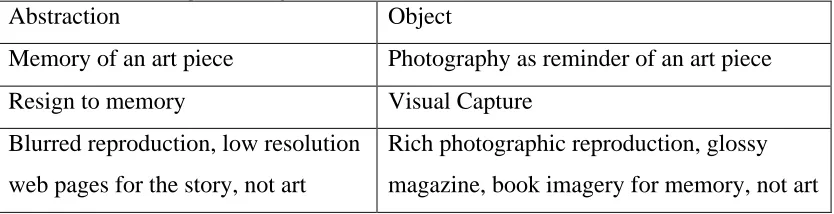
(38) important to ask the question though not necessary to find an answer to this. The discussion raised questions about memory and how artists wishing to make use of ephemera and disintegration can activate memory in response to their work. Connections between technology and memory recur in this themed analysis.. In post-structuralist theory there are multiple, and sometimes contradictory, discourses and these are apparent in ‘photo-documentation,’ and the areas across visual documentation and ‘photography as art’. ‘Memory’ of an artwork and ‘photography as reminder’ of this artwork are different interpretations of a ‘performative object’ or ‘ephemeral artwork’. The photograph can become a dominant visual, and silence an earlier enhanced memory. This power imbalance relates to the richly documented and archived reproduction of art, compared to the almost subconscious memory and subtlety of the slowly disintegrating ephemeral piece. Therefore documentation can be about imbalance, especially in the retelling or re-presentation of art. Table 5.2 Blurring a Binary Abstraction. Object. Memory of an art piece. Photography as reminder of an art piece. Resign to memory. Visual Capture. Blurred reproduction, low resolution. Rich photographic reproduction, glossy. web pages for the story, not art. magazine, book imagery for memory, not art. The roles of the museum as storage facility for archive of work, and art gallery as a venue for ephemera and art, are extensions of the concept that overlapping occurs in archival and ephemeral art. When the artwork is in progress, and has to be arrested visually for posterity, that implies an archiving of the image. Artist Robert Morris discusses where the photograph was a recording device for his work: Photographs function as a peculiar kind of sign. There is a strange relation between their reality and artificiality, the signifier-signified relation the set up is not at all clear or transparent. One of the things they do is give too much information and not enough at the same time (Morris cited in an interview October 1971 New York with Lippard 1973, 257).. Chapter Five. 177. Anne Lord.
(39) Following Morris’ point is the comment from Lippard elaborating on the difference between seeing things day after day and knowing them. The point for the ephemeral artwork and capturing a moment relates to the memory of the piece. Lippard (1973) says Then you see the photograph and it’s so completely different. Your memory fails you right at that point where the photograph replaces your memory. Five minutes before you have seen the photograph you remember a situation in such and such a way. The very second you are shown the photograph, that becomes the memory, and everything else, reality, bites the dust (Lippard 1973, 258).. My contemporary reiteration of this dilemma is that artists solve a problem in the documentation of art and ephemera in order to maintain integrity through the ephemeral nature of the art piece. For Lippard, the photograph initiates new memory. For me, one option is for the memory of art and ephemera to be a significant action and not a document. Laib’s work, discussed in Chapter Seven, posits the model for an event and not a photograph as the main outcome of the work. Whereas the non-recording of the ephemeral piece will not sit easily in a world of archived and administered art, more space can be made for the event and experience as a live experience rather than the record. Asia Pacific Triennials (1993, 1996, 1999, 2002 and 2007 Queensland Art Gallery and Gallery of Modern Art) have over a decade provided these experiences in performances on site, http://www.qag.qld.gov.au/apt/apt5.. Memory and (No) Documentation In my work, accessing documentation to record the ephemeral act extends the memory of the work but not the work. In this respect, memory, as an aid to recollection of an artwork in a particular environment is important. It does not exclude re-enacting the ephemeral artwork and many of my ice sculptures could be remade. Henry (2007) related the ephemeral artwork I had spoken of to the Malanggan tribe of New Ireland, Melanesia. In complex acts of kinship and heritage, a Malanggan sculptor re-enacts a memory handed on from an elder in order to create, from memory, icons as ephemeral sculptures. In relation to the Chapter Five. 178. Anne Lord.
(40) Malanggan ritual, Küchler and Melion (1991) discuss the intricate system of exchange and memory: The medium of exchange is the [anthropomorphic] sculpted image. It is not the sculpture itself that is transacted in the exchanges for money and indigenous currency, but the right to reproduce the image, which thus enters and defines networks of exchange across the region. The embeddedness of sculpting in gift exchange confers political and economic importance on image transmission (Küchler and Melion 1991, 32).. The significance of this relationship between exchange and memory, and discussion by Küchler and Melion about the increasing act of sculpting in a declining population, provides some parallel reading for my investigation. The declining Malanggan population contradicts our global twenty-first century expectations, where populations are predicted to keep rising astronomically. The global population is facing notions of uncertainty about ability to sustain large human populations and preserve natural environments, as we have known them (Gross 1997). The indications are that we have as a global population only two or three decades to avert the impending catastrophe of our own making (Stern 2007). Though for Lancaster (1997) this is a time of reappraisal.. A twenty-first century parallel to Malanggan sculptures, or ephemeral art production, involves the manner in which artists adopt ephemeral materials for their work, as well as who produces the ephemeral artwork, and artists’ reasons for making this work. In this respect an artist’s role may be to provide those symbols of exchange that enable a new acceptance of less material as commodity, through acceptance of the ephemeral object as an art form. It is only an alternative but in an age when we are looking for ways to produce with less finite resources and produce less of an environmental footprint (Stern 2007), it is an alternative for many artists. Recycling, though sometimes unwittingly enacted in relation to the environmental footprint and more an act of economic necessity, contributes to art of ephemera.. Chapter Five. 179. Anne Lord.
(41) Earth and Eco Art, and Ephemera My concern for the process of ephemera to heighten an idea led to asking if there could be any connection between the artist’s contribution to an art of ephemera and concepts of change in relation to land / earth art since the 1970s. Various models exist for art and ephemera in Earth Art and Land Art where artists created work with a conscious effort to bring attention to land, though not always in the best interests of the natural environment. Artist Robert Smithson, created some artwork with little concern for the environment, though at times as in the case of Robert Morris, was involved in land reclamation sites. Matsui (2007) states that Smithson was interested in Re-evaluating obsolete and defunct sites, or exploring situations intended to enhance ‘undifferentiated’ thought processes, [and] Smithson presented possibilities for redeeming the ephemeral through reality of the post-industrial age. [Smithson’s essays]…have provided inspiration for many new methods of critical intervention in social and cognitive processes (Matsui 2007, 439).. Matilsky’s (1992) accounts of earth and land art include that of Robert Smithson, however the reclamation work of Robert Morris (1979) is of more relevance to this study in relation to the potential direction of art, ephemera and the natural environment. Willette finds Morris’ (1979) Untitled, (Earthwork to reclaim gravel pit King County) was ‘a genuine reclamation of ruined land’ (Willette 1994, 15).. For Cyphers (1992) some of Smithson’s work proposed to improve devastated mining sites, and did provide an investigation into reclamation beyond the formalist qualities he sought. Though Smithson was interested in formal elements of sculpture, his writing and artwork were linked to environment and anti-commodity. Smithson (1969) states: I would postulate that waste and enjoyment are in a sense coupled. There’s a certain kind of pleasure principle that comes out of a preoccupation with waste. [For e.g., bigger cars, bigger waste productions] So there’s a kind of equation there between the enjoyment of life and waste. Probably the opposite of waste is luxury. Both waste and luxury tend to be useless. Then there’s a kind of middle class notion of luxury which is often called “quality”. And quality is sort of based on taste and sensibility. Sartre says Genet produces neither spit nor diamonds. I guess that’s what I’m talking about (Smithson 1969, 190-191).. Chapter Five. 180. Anne Lord.
(42) Driven by a number of concerns comprised of art and environmental issues, Smithson calls entropy a ‘condition that’s irreversible, it’s a condition that’s moving towards a gradual equilibrium and it’s suggested in many ways,’ and Smithson adds: One might say that the whole energy crisis is a kind of entropy. The earth being a closed system, there’s only a certain amount of resources and of course there’s an attempt to reverse entropy through the recycling of garbage (Smithson cited in Sky 1979,190).. Smithson’s 1970s concerns seek answers through balance, however, this was not always the action taken by Smithson, and my investigation of art and ephemera would not be complete without referring to Smithson’s large earthwork ‘Spiral Jetty’ (1970 - ongoing), a Land Art project. Since its implementation in a salt lake, ‘Spiral Jetty’ has disappeared below water and reappeared (Brook 2005 www.robertsmithson.com/). Further to his concern for waste and anti-commodity, the implementation of a major floating island artwork lies, figuratively, in a difficult position in the scheme of art and over-consumption. Even the commercial arm of posthumous web publishing does little to alleviate the impact of this work on the environment, and though elements of the piece are ephemeral, the whole remains as a gigantic legacy from the period of earth art, an uncomfortable precursor to art and ephemera.. It follows that many artists do not attempt to address or acknowledge the environmental problems confronted by contemporary society. Lacy (1995) acknowledged artists sympathetic to an art of renewal in the natural and built environments. These models offer an opportunity to discuss the artist’s ability and willingness to contribute to raising awareness of environmental concerns through addressing change as an overarching metaphor. The challenges of combining my awareness of environment with my artist’s desire to introduce traditionally acknowledged aesthetics, and knowledge of ethics provide an opportunity to develop my perspective about the processes of change through art and ephemera.. Chapter Five. 181. Anne Lord.
Figure

+7
![figure, [photograph Lord] People stopped when I was assembling the work or photographing it](https://thumb-us.123doks.com/thumbv2/123dok_us/182045.52080/163.595.120.222.401.578/figure-photograph-lord-people-stopped-assembling-work-photographing.webp)
Outline
East ~ West: an interface
Earth and Eco Art, and Ephemera
Developmental Processes for Art and Ephemera
Influences from Visual Collections
Digital Documentation as a Trigger
Entrepreneurs and Discourse
Art and Ephemera in Australia
Key Examples Strand Ephemera
Key Examples In Site Out
Cultural Metaphors and Ephemera
Related documents
