Markerless Feature Extraction for Gait Analysis
Imed Bouchrika and Mark S. Nixon
Department of Electronics and Computer Science
University of Southampton
Southampton, SO17 1BJ, UK
{
ib04r, msn
}
@ecs.soton.ac.uk
Abstract – Human motion analysis has received a great attention from researchers in the last decade due to its po-tential use in different applications. We propose a new ap-proach to extract human joints (Vertex positions)using a model-based method. The gait pattern is incorporated to aid the extraction process, where model templates are es-tablished through analysis of gait motion. People walk nor-mal to the viewing plane, as major gait information is avail-able in a sagittal view. Gait periodicity and other param-eters are estimated by finding the heel strikes. The ankle, knee and hip joints are successfully extracted with high ac-curacy for indoor and outdoor data. In this way, we have established a baseline analysis which can be deployed in recognition, marker-less analysis and other areas.
Keywords: Human motion analysis, gait analysis, marker-less feature extraction.
1
Introduction
Much research in computer vision is directed into the analysis of articulated objects and more specifically, the analysis of human motion. This research is fuelled by the wide range of applications where human motion analysis can be deployed such as virtual reality, smart surveillance, human computer interfaces and athletic performance. A vision-based system for human motion analysis consists of three main phases: detection, tracking and perception. In the last phase, a high-level description is produced based on the features extracted during the previous phases from the temporal video stream. In fact, it has been revealed by psychological studies that the motion of human joints con-tains enough information to perceive the human motion.
Currently, the majority of systems used for motion anal-ysis are marker-based and they are commercially available. This is mainly due to their accuracy. Marker-based solu-tions rely primarily on markers or sensors attached at key locations of the human body. However, most applications such as visual surveillance require the deployment of an au-tomated markerless vision system to extract the joints’ tra-jectories. On the other hand, automated extraction of the joints’ positions is an extremely difficult task as non-rigid human motion encompasses a wide range of possible mo-tion transformamo-tions due to its highly flexible structure and
to self occlusion [26, 10]. Clothing type, segmentation er-rors and different viewpoints pose a significant challenge for accurate joint localization.
As there have been many vision approaches aimed to ex-tract limbs, and a dearth of approaches specifically aimed to determine vertices, we propose a new method to extract hu-man joints with better accuracy then blobs via incorporating priori knowledge to refine accuracy. Our new approach uses a model-based method for modelling human gait motion us-ing elliptic Fourier descriptors, whereby the gait pattern is incorporated to establish a model used for tracking and fea-ture correspondence. The proposed solution has capability to extract moving joints of human body with high accuracy in both indoor and outdoor environments.
1.1
Related Work
For the non-model based method, feature correspondence between successive frames is based upon prediction, veloc-ity, shape, texture and colour. Shioet al. [21] proposed a method to describe the human body using moving blobs or 2D ribbons. The blobs are grouped based on the magnitude and the direction of the pixel velocity. Kurakake and Neva-tia [18] worked on the extraction of joint locations by es-tablishing correspondence between extracted blobs. Small motion between consecutive frames is the main assumption, whereby feature correspondence is conducted using various geometric constraints.
1.2
System Overview
[image:2.595.128.254.394.531.2]The system proposed in this paper consists of three stages as outlined in Figure (1). In the first stage, walking sub-jects are detected using background subtraction. The ap-proach we used for the segmentation of moving objects, is the adaptive background subtraction proposed by Stauffer and Crimson. It is assumed only one single moving sub-ject in the scene. The heel strikes are derived in the next stage after applying the Harris corner operator. Finally, the evidence gathering algorithm is applied to locate the joint positions.
Figure 1: System Overview
2
Extraction
of
the
Anatomical
Landmarks
2.1
Human Motion Analysis
The motion of the human body is known as a form of non-rigid and articulated motion [1], and therefore detec-tion and tracking the right informadetec-tion becomes an ex-tremely difficult task as non-rigid motion encompasses a wide range of possible motion transformations due to the highly flexible structure and self occlusion. During walking and running, people have the same global gait motion pat-tern. Therefore, gait motion can be considered as an ideal starting point for motion analysis due to its global nature and since it is periodic.
Psychological studies carried out by Johansson [15] showed that people are able to perceive human motion
from Moving Light Displays (MLD). An MLD is a two-dimensional video of a collection of bright dots attached to the human body taken against a dark background where only the bright dots are visible in the scene. An observer can recognise different types of human motion such as walking, jumping, dancing and so on. Moreover, the observer can make a judgment of the gender of the person [17], and even further identify the person if he or she is already familiar with his or her gait [11]. Although the different parts of the human body are not seen in the MLD, and no links exist be-tween the bright dots to show the structure, the human can recover the full structure of the moving object. Thereby, the motion of the joints contains enough information to per-ceive human motion [4], [8].
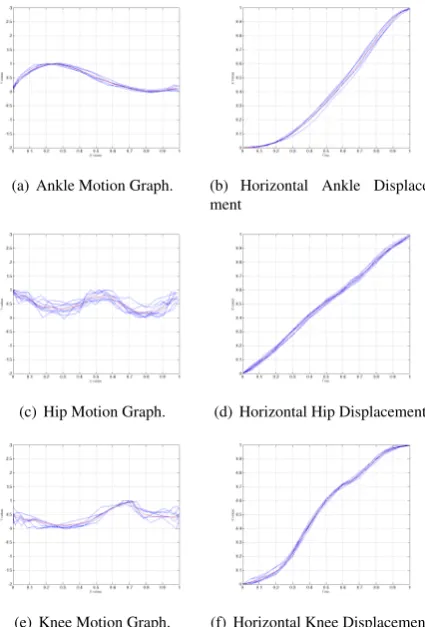
To analyse the human motion, the joint positions in 30 video sequences with people walking normal to the view-ing plane of the camera, have been manually labelled. The videos are taken from the SOTON database. In each frame of the video sequence, the position of the right and left an-kles, the right and left knees and the hip were labelled. The data for the ankle between to consecutive heel strikes of the same leg are normalized as shown in Figure 2(a). Whilst, we have normalized the data for the knee and hip extracted between two consecutive stances of the same leg as shown in Figures 2(c) and 2(e). The corresponding horizontal dis-placement for each joint is plotted against the motion graph of the joint in Figure (2).
(a) Ankle Motion Graph. (b) Horizontal Ankle Displace-ment
(c) Hip Motion Graph. (d) Horizontal Hip Displacement.
(e) Knee Motion Graph. (f) Horizontal Knee Displacement.
[image:2.595.332.545.437.751.2]It can be observed that people have more or less the same ankle motion pattern. Another graph 2(b) is plotted showing the horizontal displacement of the ankle, where it is noted that the graphs for all subjects nearly coincide, leading to the suggestion that for a normalized data set, subjects move their ankles forward with the same velocity. Figures 2(c) and 2(e) show the hip and knee motions respectively for the normalized extracted data. In contrast to the smooth graphs of the ankle, there is noise in the data for the hip and knee due the difficulties encountered during the manual labelling. Nevertheless, it can be observed that walking people have the same global pattern for the hip and knee motions. The horizontal displacement for the hip and knee are shown in Figures 2(d) and 2(f). The hip forward velocity is decimated to be constant for all subjects, in contrast to the knee veloc-ity, which varies for all subjects. However, with the data normalized, people have more or less the same knee hori-zontal velocity.
2.2
Heel Strike Extraction
The detection of the human gait period can provide im-portant information to determine the positions of the hu-man joints. Cutler et al[7] proposed a real time method for measuring periodicity for periodic motion based on self-similarity. Instead, the heel strikes of the subject can pro-vide an accurate measure for gait periodicity as well as the gait stride and step length. Moreover, the extraction of heel strikes can be used as a strong cue to distinguish walking people from other moving objects in the scene [5].
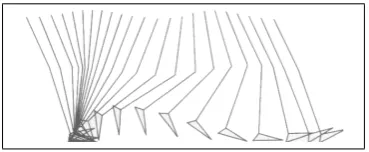
[image:3.595.98.283.550.626.2]During the strike phase, the foot of the striking leg stays at the same position for half a gait cycle, whilst the rest of the human body moves forward as shown in Figure (3). Therefore, if we use a low-level feature extraction method ( edges or corners), then a dense region will be accumulated at the heel strike regions.
Figure 3: Foot Displacement during one Gait Cycle [24]
Since the primary aim of this research is the perception of human motion, we have chosen to use corners instead of edges, as they maintain enough information to perceive the human motion, in contrast to edges which may cause ambi-guity in the extraction process due to the excess data they may contain. Furthermore, a robust vision system based on corner detection can work for low-resolution applications. We have applied the Harris corner detector on every frame
tfrom the video sequence and then accumulated all the cor-ners into one image using equation (1):
Ci= N
X
t=1
H(It) (1)
WhereH is the output of the Harris corner detector,Itis
original image at framet. Because the striking foot is stabi-lized for half a gait cycle, as result, a dense area of corners is detected in the region where the leg strikes the ground. In order to locate these areas, we have estimated a measure for density of proximity. The value of proximity at pointp
is dependent on the number of corners within the regionRp
and their corresponding distances fromp. Rp is assumed
to be a square area with centrep, and radius ofr that is determined as the ratio of total image points to the total of corners inCi which is about 10. We have first computed
proximity valuedp of corners for all regionsRp inCi
us-ing equation (2). This is an iterative process startus-ing from a radiusr. The process then iterates to accumulate proximity values of corners for pointp.
dr p=
Nr
r
di
p=di+1p + Ni
i
(2)
wheredi
pis the proximity value for rings of radiusiaway
from the centrep, andNi is the number of corners which
are of distanceifrom the centre, rings are single pixel wide. Afterwards, we accumulate all the densities for the subre-gionsRpfor all pointspinto one image to produce the
cor-ners proximity image using (3).
D=
X
X
x=0 Y
X
y=0
shif t(dp) (3)
whereX andY are the width and height of the image re-spectively.dpis the corners proximity value for regionRp.
Theshif tfunction places the proximity valuedpon a blank
image of size X×Y at the positionp. An output of the corner proximity for an example image is shown in Figure (4). The input image contains points spread all over the im-age with a number dense regions. The resulting imim-age has darker areas which correspond to the crowded regions in the input image.
(a) (b)
Figure 4: Example Results for the Corner Proximity Mea-sure: (a) Input Image, (b) Corner Proximity Image.
[image:3.595.323.549.603.698.2]camera, whilst the second subject is recorded in an oblique view walking away from the camera. A similar algorithm to [9] is used to derive the positions of the peaks as local maxima.
[image:4.595.76.303.155.254.2](a) (b)
Figure 5: Heel Strike Extraction using the Proximity Mea-sure: (a) Sagittal Indoor View, (b) Oblique Outdoor View.
2.3
Moving Joints Extraction
A new model-based approach is proposed to extract the joints trajectories of walking people. Although, the Fourier series is the most accurate way for modelling gait motion, most previous methods adopted simple models [6] to ex-tract gait angular motion via evidence gathering using a few parameters. This is mainly due to complexity and compu-tational cost. In our method, human gait is modelled us-ing the Fourier series. The heel strike data were used to reduce the number of parameters and therefore reduce sig-nificantly the computational cost. Model templates which describe joints’ motions are constructed from the analysis of manually labelled data.
The mean patterns for gait motion are represented using elliptic Fourier Descriptors [2]. The Fourier analysis pro-vides a means for extracting features or descriptors from images which are useful characteristics for image under-standing. These descriptors are defined by expanding the parametric representation of a curve in Fourier series. Let
f be the function for the boundary of the motion models, the functionf is represented using elliptic Fourier Descrip-tors [12, 2], where the Fourier series is based on a curve expressed by a complex parametric form as shown in equa-tion (4):
f(t) =x(t) +jy(t) (4) wherex(t)andy(t)are approximated via the Fourier sum-mation bynterms as shown in equation (5) :
x(t) =
n
P
k=1
axkcos(kt) +bxksin(kt)
y(t) =
n
P
k=1
aykcos(kt) +byksin(kt)
(5)
whereaxk,ayk,bxkandbykare the set of the elliptic phasors which can be computed by a Riemann summation [2]. In or-der to obtain a flexible motion model sufficient to describe
gait motion, spatial model templates are created via repre-sentingf in a parametrized form by applying appearance transformations (rotation, scaling and translation). A spa-tial model templateM describing gait motion is described in equation (6):
M =T+Rα(sxx(t) +syy(t)i)
T =a0+b0i
Rα= cos(α) + sin(α)i
(6)
where T is the translation transform whose vector is
(a0, b0). R is the rotation transform of angleα. sx and
syare the scaling factors across the horizontal and vertical
axes respectively.
The evidence gathering process [6] is usually used in conjunction with the Hough Transform consisting of two phases: i) global pattern extraction, and ii) local feature extraction. The aim of the global extraction is to find the best motion pattern based on the predefined model rep-resented using in a parametric form based on the elliptic Fourier Descriptors. The Hough Transform is used as a first stage to extract the spatial motion path of the joints using model templates. Because a 5-dimensional accumu-lator is needed to to store the votes for the set of parameters
< a0, b0, α, sx, sy>, the algorithm would be
computation-ally intensive and infeasible to implement. In spite of the fact that some methods were proposed to reduce the pro-cessing time of the Hough Transform [19, 2], the computa-tional load of these methods does not meet the requirements of most applications [2]. Alternatively, the heel strike data could be incorporated to reduce the complexity of the pa-rameter space and therefore, dramatically reduce the com-putational cost. The search for the ankle motion model is reduced to only one parametersy, while it is reduced to two
parametersb0andsyfor the case of the hip and knee motion
models.
The second stage of the process is to apply a local search within every frame to determine the position of the joints. The local search is guided by the motion of the joints ex-tracted in the first stage.
3
Experimental Results
(a) (b)
Figure 6: Experimental Results for Heel Strikes Extraction: (a) Walking subject. (b) Extracted strikes compared with data manually labelled
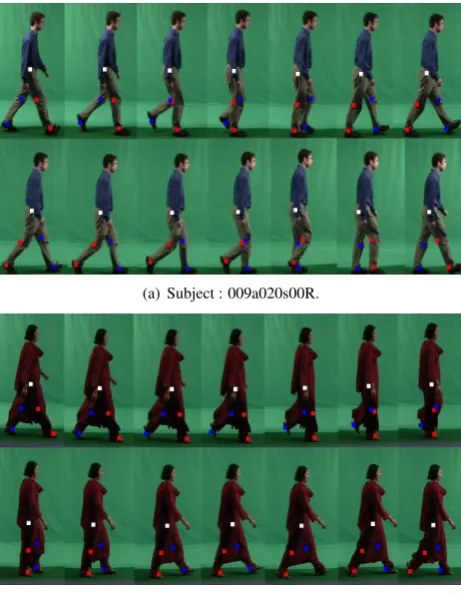
We have extracted the joints for the ankles, knees and hip as shown in Figure (7). The mean error for the posi-tions of the extracted joints compared with manual data of 10 subjects manually labelled is %1.36 of the height of the subject. The algorithm is tested on a subject wearing Indian clothes which covered the legs. The joints positions are ex-tracted successfully as shown in Figure 7(b) which reveals the potentials of this approach to handle occlusion.
(a) Subject : 009a020s00R.
[image:5.595.329.544.97.198.2](b) Subject : 012a031s00R.
Figure 7: Joints Extraction for Indoor Data.
Figure (8) shows the relative angle for both the hip and knee computed from the extracted joints of 10 subjects. The graphs show the results obtained via this approach are con-sistent with the biomechanical data by Winter [25] shown in bold in Figure (8).
We have conducted further experiments in outdoor
envi-(a) (b)
Figure 8: Gait Angular Motion during one Gait Cycle: (a) Hip, (b) Knee
[image:5.595.319.554.353.489.2]ronment to confirm the robustness of the proposed method. The algorithm is tested on outdoor data containing 20 sub-jects from the SOTON database. The heel strikes are ex-tracted successfully. The mean error for the positions of the joints extracted is estimated to %2 of the height of the per-son. Figure (9) shows the extraction results of the joints in outdoor data.
Figure 9: Joints Extraction for Outdoor Data.
4
Conclusions
We have proposed a new method to extract the positions human joints using a model-based method. The gait pattern is deployed to aid the extraction process, where model tem-plates are established through the analysis of gait motion. Gait periodicity and other parameters are estimated through the finding of the heel strikes. The joints of the ankle, knee and hip are successfully extracted with high accuracy for indoor and outdoor data.
References
[1] J. K. Aggarwal, Q. Cai, W. Liao, and B. Sabata. Non-rigid motion analysis: Articulated and elastic motion.
Computer Vision and Image Understanding, Vol 70, No. 2, pp. 142–156, 1998.
[image:5.595.75.306.365.664.2]and Image Understanding, Vol 69, No. 2, pp. 202– 221, 1998.
[3] K. Akita. Image sequence analysis of real world hu-man motion. Pattern Recognition, Vol 17, No. 1, pp. 73–83, 1984.
[4] G. P. Bingham, R. C. Schmidt, and L. D. Rosenblum. Dynamics and the orientation of kinematic forms in visual event recognition. Journal of Experimental Psychology: Human Perception and Performance, Vol 21, No. 6, pp. 1473-1493, 1991.
[5] I. Bouchrika and M. S. Nixon. People Detection and Recognition using Gait for Automated Visual Surveil-lance. London, UK, June 2006.
[6] D. Cunado, MS Nixon, and JN Carter. Automatic Ex-traction and Description of Human Gait Models for Recognition Purposes. Computer Vision and Image Understanding, Vol 90, No. 1, pp. 1–41, 2003.
[7] R. Cutler and L. S. Davis. Robust real-time periodic motion detection, analysis, and applications. IEEE Transactions on Pattern Analysis and Machine Intelli-gence, Vol 22, No. 8, pp. 781–796, 2003.
[8] W. H. Dittrich. Action categories and the perception of biological motion. Perception, Vol 22, pp. 15-22, 1993.
[9] H. Fujiyoshi, A. J. Lipton, and T. Kanade. Real-time human motion analysis by image skeletonization. IE-ICE Trans on Information and System, pp. 113–120, 2004.
[10] D. M. Gavrila. The visual analysis of human move-ment: A survey. Computer Vision and Image Under-standing, Vol 73, No. 1, pp. 82–98, 1999.
[11] N. H. Goddard.The perception of articulated motion: Recognizing moving light displays. PhD thesis, Uni-versity of Rochester, 1992.
[12] G. H. Granlund. Fourier preprocessing for hand print character recognition.IEEE T-Comp, Vol 21, pp. 195– 201, 1972.
[13] Y. Guo, G. Xu, and S. Tsuji. Understanding human motion patterns. InProceedings of the 12th IAPR In-ternational Conference on Pattern Recognition, Vol 2, pp. 325–329, 1994.
[14] N. Huazhong, T. Tan, L. Wang, and W. Hu. Peo-ple tracking based on motion model and motion con-straints with automatic initialization. Pattern Recog-nition, Vol 37, No. 7, pp. 1423–1440, 2004.
[15] G. Johansson. Visual perception of biological mo-tion and a model for its analysis. Perception and Psy-chophysics, Vol 14, pp. 201-211, 1973.
[16] I. A. Karaulova, P. M. Hall, and A. D. Marshall. A hierarchical model of dynamics for tracking people with a single video camera. In Proceedings of the 11th British Machine Vision Conference, pp. 262–352, Bristol, Septemeber 2000.
[17] L. T. Kozlowski and J. E. Cutting. Recognizing the gender of walkers from point-lights mounted on an-kles: Some second thoughts. Perception & Psy-chophysics, Vol 23, pp. 459, 1978.
[18] S. Kurakake and R. Nevatia. Description and tracking of moving articulated objects. In Proceedings. 11th IAPR International Conference on Pattern Recogni-tion, Vol 1, pp. 491–495, Octobor 1992.
[19] V. F. Leavers. Which Hough transform? CVGIP: Im-age Understanding, Vol 58, No. 2, pp. 250–264, 1993.
[20] K. Rohr. Towards model-based recognition of human movements in image sequences. CVGIP: Image Un-derstanding, Vol 74, No. 1, pp. 94–115, 1994.
[21] A. Shio and J. Sklansky. Segmentation of people in motion. InProceedings of the IEEE Workshop on Vi-sual Motion, Vol 2, pp. 325–332, Octobor 1991.
[22] J. D. Shutler, M. G. Grant, M. S. Nixon, and J. N. Carter. On a large sequence-based human gait database. InProceedings of Recent Advances in Soft Computing, pp. 66–71, Nottingham, UK, 2002.
[23] L. A. Wang, W. M. Hu, and T. N. Tan. Recent develop-ments in human motion analysis.Pattern Recognition, Vol 36, No. 3, pp. 585–601, 2003.
[24] M. Whittle. Gait Analysis: An Introduction. Butterworth-Heinemann, 2002.
[25] D. A. Winter. The Biomechanics and Motor Control of Human Movement. John Wiley & Sons, second edi-tion, 1990.