White Rose Research Online URL for this paper:
http://eprints.whiterose.ac.uk/43772/
Article:
Cooper, C.L, Hind, D., Parry, G.D et al. (9 more authors) (2011) Computerised cognitive
behavioural therapy for the treatment of depression in people with multiple sclerosis:
external pilot trial. Trials, 12 (1). Article no.259. ISSN 1745-6215
https://doi.org/10.1186/1745-6215-12-259
[email protected] https://eprints.whiterose.ac.uk/
Reuse
Unless indicated otherwise, fulltext items are protected by copyright with all rights reserved. The copyright exception in section 29 of the Copyright, Designs and Patents Act 1988 allows the making of a single copy solely for the purpose of non-commercial research or private study within the limits of fair dealing. The publisher or other rights-holder may allow further reproduction and re-use of this version - refer to the White Rose Research Online record for this item. Where records identify the publisher as the copyright holder, users can verify any specific terms of use on the publisher’s website.
Takedown
If you consider content in White Rose Research Online to be in breach of UK law, please notify us by
R E S E A R C H
Open Access
Computerised cognitive behavioural therapy for
the treatment of depression in people with
multiple sclerosis: external pilot trial
Cindy L Cooper
1*, Daniel Hind
1, Glenys D Parry
2, Claire L Isaac
3, Munyaradzi Dimairo
1, Alicia O
’
Cathain
2,
Anita Rose
4, Jennifer V Freeman
2, Leonie Martin
2, Eva C Kaltenthaler
2, Anna Thake
1and Basil Sharrack
5Abstract
Background:People with multiple sclerosis (MS) are at high risk of depression. We undertook a pilot trial of computerised cognitive behavioural therapy (CCBT) for the treatment of depression in people with MS to test the feasibility of undertaking a full trial.
Methods:Participants with a diagnosis of MS and clinical levels of depression were recruited through out-patient clinics and postal screening questionnaires at two UK centres and randomised to CCBT or usual care. Clinical outcomes included the Beck Depression Inventory (BDI-II) and Multiple Sclerosis Impact Scale (MSIS-29) at baseline, 8 and 21 weeks. Feasibility outcomes included: recruitment rate; reasons for refusal, withdrawal and dropout; feasibility and acceptability of the proposed outcome measures; sample size estimation and variation in and preferences for service delivery.
Results:Twenty-four participants were recruited. The recruitment rate, calculated as the proportion of those invited to fill in a screening questionnaire who were consented into the trial, was 4.1%. Recruitment through out-patient clinics was somewhat slower than through screening questionnaire mail-out but the overall recruitment yield was similar. Of the 12 patients in the CCBT arm, 9 (75%) completed at least four, and 6 completed all 8 CCBT sessions. For completers, the median time (IQR) to complete all eight CCBT sessions was 15 (13 to 20) weeks. Participants expressed concern about the face validity of the Beck Depression Inventory II for the measurement of self-reported depression in people with MS. The MSIS-29 was the patient-reported outcome measure which participants felt best reflected their concerns. The estimated sample size for a full trial is between 180 and 390 participants. NHS partners were not delivering CCBT in community facilities and participants preferred to access CCBT at home, with no one expressing a preference for use of CCBT in an alternative location.
Conclusions:A definitive trial, with a recruitment window of one year, would require the participation of around 13 MS centres. This number of centres could be reduced by expanding the eligibility criteria to include either other neurological conditions or people with more severe depression. The MSIS-29 should be used as a
patient-important outcome measurement.
Trial registration:ISRCTN: ISRCTN81846800
Background
Multiple Sclerosis (MS) is a chronic immune mediated disease of the central nervous system which affects around 0.1% of Caucasians of north and central Eur-opean ancestry [1]. MS is characterized by a variety of
symptoms including visual impairment, limb weakness, sensory disturbance, balance and postural problems, sphincter dysfunction, cognitive impairments, pain and fatigue [2]. In the majority of patients, the illness runs an initial relapsing remitting (RRMS) course character-ized by episodes of acute neurological dysfunction fol-lowed by full or partial recovery, usually culminating in a secondary progressive (SPMS) course during which disability progresses gradually with or without
* Correspondence: [email protected]
1
Clinical Trials Research Unit, ScHARR, University of Sheffield, Regent Court, 30 Regent Street, Sheffield, S1 4DA, UK
Full list of author information is available at the end of the article
occasional relapses, minor remissions and plateaus [3]. Reports suggest that 50% of patients with MS experience major depression during their lifetime and up to 40% may have depression at any one time [4,5]. A Cochrane review, last updated in mid-2005, suggested there was some evidence that cognitive behavioural therapy (CBT) could be effective for the treatment of depression in people with MS [6].
The UK National Institute for Health and Clinical Excellence (NICE) recommends Cognitive Behavioural Therapy (CBT) as a treatment for mild to moderate depression, and there has been an increasing interest in its use to help people to remain in the workplace [7-9]. As therapist-led CBT is often inaccessible or prohibi-tively expensive, computerised CBT (CCBT) is recom-mended by NICE as part of a stepped-care model for the management of mild or moderate depression, typi-cally delivered in a primary care setting [10,11]. NICE recommended one package in particular, Beating the Blues, for treatment of mild to moderate depression [10]. However, the management of mental health pro-blems is often complicated by the co-presence of chronic physical illness, and treatments which have been validated in populations without chronic physical illness may not be appropriate or effective in such circum-stances [12]. More recent NICE guidance recommends CCBT for the treatment of depression in people with chronic physical conditions whilst recommending that further randomised controlled trials of psychological interventions are undertaken for this population [13].
Because of the challenges inherent in evaluating com-plex interventions such as CCBT, the Medical Research Council’s Complex Intervention Framework recom-mends a stepwise approach to evaluation, with pilot work preceding a full randomised controlled trial (RCT) [14]. The full study would be an RCT with economic evaluation alongside the trial to test the hypothesis that CCBT is clinically and cost-effective, compared to usual treatment, for the treatment of depression in people with MS. In a previous paper we reported qualitative research assessing the target group’s views on the acceptability and appropriateness of CCBT [15]. In this paper we report the results of a pilot trial, designed to assess the feasibility of a research protocol for a multi-centre trial and to estimate the variance of the treat-ment effect. The pilot trial did not attempt to provide evidence for the clinical effectiveness of CCBT for the treatment of depression in people with MS. Therefore, we have written up our findings in accordance with recommendations for CONSORT-modifications for reporting the results of pilot studies and pragmatic trials [16,17].
The objectives of this pilot trial were to:
•identify recruitment rates and test practicalities of recruitment;
•identify withdrawal and dropout rates during treat-ment phase and three month follow up phase to estimate dropout over longer term;
• identify reasons for refusal, withdrawal and dropout;
•test feasibility and acceptability of the proposed outcome measures, including the client service receipt inventory (a questionnaire developed for the collection of information on costs, service utilisation and related matters) required for a full economic evaluation;
•identify effect size and its associated variability at end of treatment in order to calculate an appropriate sample size for the full trial;
•identify variation in use or delivery of the interven-tion both at home and in an external setting; •identify rate of preference for use of intervention at home or elsewhere
Methods
Participants and setting
We invited 582 people diagnosed with MS to screen for a study evaluating an intervention for low mood by completing a screening questionnaire including prognos-tic and eligibility criteria and a copy of the Beck Depres-sion Inventory II-21 Item (BDI) [18]. All invitees had relapsing remitting or secondary progressive MS, according to the modified McDonald criteria [19]. Invi-tations were made between October 2008 and July 2009: face-to-face by consultants in the Sheffield Teaching Hospitals NHS Foundation Trust MS clinic (n = 288); by the Sheffield MS nurses visiting patients (n = 4); and, using ink-signed personalised letters mailed out from a neuropsychologist at Sheffield (n = 40) as well as from consultant neurologists at the Walton Centre for Neu-rology and Neurosurgery NHS Trust, Liverpool (n = 250). At Sheffield potential participants were identified from clinic attenders, MS nurse patient visits and from patients with MS from the caseload of the neuropsy-chologist. At the Walton Centre potential participants were identified solely from the MS register. The MS ser-vices in both sites are specific entities and not general neurology clinics.
and treatment-seeking. Exclusion criteria were: poor English language skills or cognitive function (score of less than 24 on Mini Mental State Examination [20]); BDI score of at least 29 on two consecutive occasions; active suicidal ideas; current or life-time diagnosis of psychosis, organic mental disorder or substance depen-dency; Kurtzke Expanded Disability Status Scale (EDSS) score of 8.5 or above [21]). The EDSS is a tool for quan-tifying MS-related disability. Our threshold for ineligibil-ity was intended to exclude those who were restricted to bed for much of the day and had only limited use of their arms, thus effectively precluding use of a computer mouse and keyboard. The clinical psychologist assessed participants for major depressive disorder using the Mini-International Neuropsychiatric Interview (MINI) [22], but this was not an eligibility criterion.
Potential participants who were identified as having severe depression (BDI score of at least 29) or active suicidal ideas during the screening process were con-tacted by the study clinical psychologists and briefly assessed to understand whether the reported symptoms were typical and advised to contact their GP if deemed necessary. Once recruited to the study, active monitor-ing of Beck Depression Inventory responses was the responsibility of the study manager who contacted the PCT mental health lead on identifying responses indi-cating active suicidal ideation. Responses were dealt with according to the primary care trust’s individual protocols for handling suicidal ideation.
Interventions
After consent, we randomised participants either to CCBT using ‘Beating the Blues’®
(Ultrasis Ltd) or to usual care (Treatment as Usual - TAU). A central web-based randomisation service delivered by the Sheffield Clinical Trials Research Unit was used after patient elig-ibility had been confirmed. All TAU arm participants were offered the opportunity of accessing the interven-tion at the end of the trial. The study statisticians and principal investigator remained blinded to the treatment allocation codes until after the final analysis. Beating the Blues® consists of eight computer-interactive sessions, of approximately 50 minutes each in duration, designed to be taken weekly. Each session consists of a mix of cognitive and behavioural strategies, which the user cus-tomises to their individual problems. A client service receipt inventory was used at baseline, 8 weeks and 21 weeks to identify concomitant medication and service use in both arms: the research protocol did not manua-lise or restrict treatment as usual.
Clinical outcomes
The primary clinical endpoint was the mean change in self-reported symptoms of depression as measured on
the BDI. Specifically, we measured the mean change in scores between the two arms as measured at baseline, 8 and 21 weeks (13 weeks post intervention). Second-ary clinical endpoints, measured at the same time points, were: (1) MS specific Quality of Life (QoL), measured by the Multiple Sclerosis Impact Scale 29-item (MSIS-29 [23]) questionnaire (physical and psy-chological components); general health related QoL, measured by the summary score for the Short Form-36 items (SF-36 [24]); overall improvement of depression severity and anxiety, measured by Patient Health Ques-tionnaire-9 item (PHQ-9 [25]) and Generalised Anxiety Disorder 7-item (GAD-7 [26]) questionnaires respec-tively. A client service receipt inventory was used to capture concomitant use of health services and medi-cation between follow-ups, to test collection of cost and activity data.
Feasibility outcomes
The pre-specified primary outcome was the recruitment rate, calculated as the proportion of those invited to fill in a screening questionnaire who were consented into the trial. The practicalities of recruitment were assessed descriptively (see next paragraph). Refusal, withdrawal and dropout from the study protocol were recorded. The feasibility, acceptability and appropriateness of data collection strategies were assessed descriptively and through item response rates. Variation in the delivery of CCBT by Primary Care Trusts (PCTs) was documented, in terms of whether they made provision for use at home and the level of support. Rates of preference for use of the intervention at home and withdrawal from treatment were calculated as a percentage of those randomised.
A short semi-structured telephone interview was con-ducted with all study participants on completion of CCBT during which they were asked how they felt about the processes of recruitment and randomisation, the location of CCBT, their reasons for dropping out or not completing (where appropriate) and the appropriate-ness of the quantitative outcome measures used in the study. The methods for data collection and analysis of this qualitative component have been reported pre-viously [15].
Feasibility criteria
No criteria for evaluating the feasibility (in the sense of formal ‘stop/go’criteria) of a definitive study were iden-tified prospectively (see discussion).
Sample size
Statistical methods
Primary analysis was an Intention To Treat (ITT) analy-sis which analysed all 24 participants according to their randomised treatment assignment ignoring non compli-ance, protocol deviations and withdrawal. Statistical ana-lysis was mainly descriptive [16] with outcome variability and patient response profiles analysed using summary measures at different time points. For this study, and in planning future studies it is most useful to present the absolute final values for individuals, rather than by how much individuals change from their initial baseline values as this allows comparison with popula-tion norms and other populapopula-tion groups. For these rea-sons we have presented the former rather than the latter as it provides the necessary information about both change and absolute values. Response rates on question-naire items were high and last observation carried for-ward was used to impute the few missing items. Questionnaire response rates are given as a fraction of the total number of questions answered in a question-naire among patients followed up on a specific visit rela-tive to the total items. For example, the denominators for BDI and MSIS-29 are 21 and 29 questions respec-tively. Sample size calculation for a definitive trial was performed using an ANCOVA model, approximated standardised effect sizes corresponding to small, med-ium and large effect sizes, expected drop out rate, out-come variability and conservative correlation structure from this pilot study. All analysis was performed in Stata version 11.1.
Ethical approval
This study received ethics approval from Northern and Yorkshire Research Ethics Committee.
Results
Recruitment rates and practicalities of recruitment
Our initial aim was to recruit 24 participants between 22 October 2008 and 31 January 2009 (101 days; 7.1 participants/month) with candidates identified by three neurologists working in a single weekly specialist MS clinic (Sheffield Teaching Hospitals NHS Trust). We reached our recruitment target on 30 July 2009 (in 281 days; 2.6 participants/month) after adding a second cen-tre (The Walton Cencen-tre NHS Foundation Trust, Liver-pool). From the 288 invitation packs given out by Sheffield neurologists in the MS clinic, forms were com-pleted and returned by 63 (21.8%) candidates from which we randomised 13 in 281 days (4.5% recruitment yield), or 1.4 participants per month. From the 250 recruitment packs sent out by post from The Walton Centre, forms were completed and returned by 64 (25.6%) of recipients, from which 10 participants were randomised in 149 days (4.0% recruitment yield), or two
participants per month. Sheffield MS Nurses approached four patients and a further participant was identified and recruited in this way. A neuropsychologist, based in Sheffield also wrote to 40 patients, but none of the respondents were recruited. In the telephone interviews, no participants expressed any concern about the pro-cesses of recruitment and randomisation.
Participant characteristics
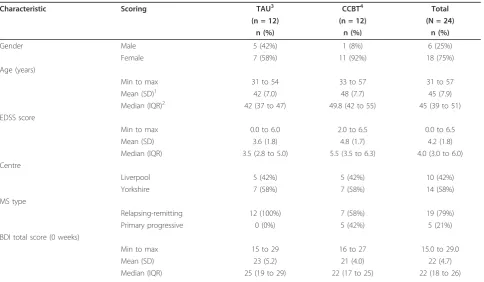
As this was a pilot study the sample size was small and by chance the random allocation of participants to the intervention and control groups resulted in imbalances between the groups at baseline with respect to gender, MS type and depression severity (Table 1).
Refusal, withdrawal and dropout
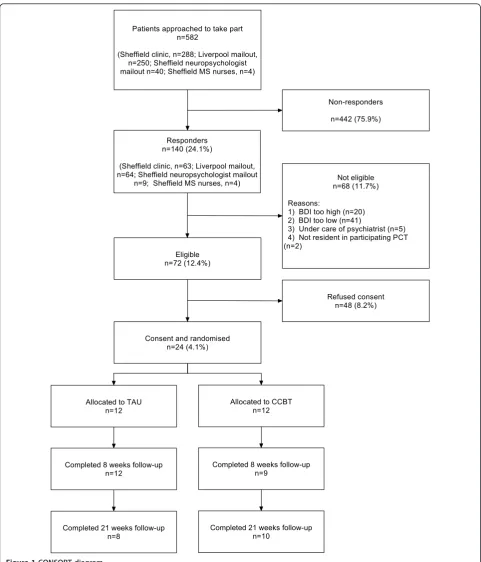
Of 582 patients invited to take part, 140 responded of whom 48 were not interested in participating, 68 were ineligible and 24 were randomised (Figure 1). Therefore the primary outcome, the recruitment rate, calculated as the proportion of those invited to fill in a screening questionnaire consented into the trial, was 4.1%. Of those who responded but were ineligible: 41 suffered from minimal depression (BDI of 13 or less); 20 were suffering from severe depression (BDI of 29 of more on two separate occasions); five were already seeing a psy-chiatrist or similar; and two were living in non-partici-pating PCTs. Two participants in each arm were lost to follow-up at 21 weeks post-randomisation. No patients were formally withdrawn from the study.
Feasibility, acceptability, appropriateness of data collection strategies
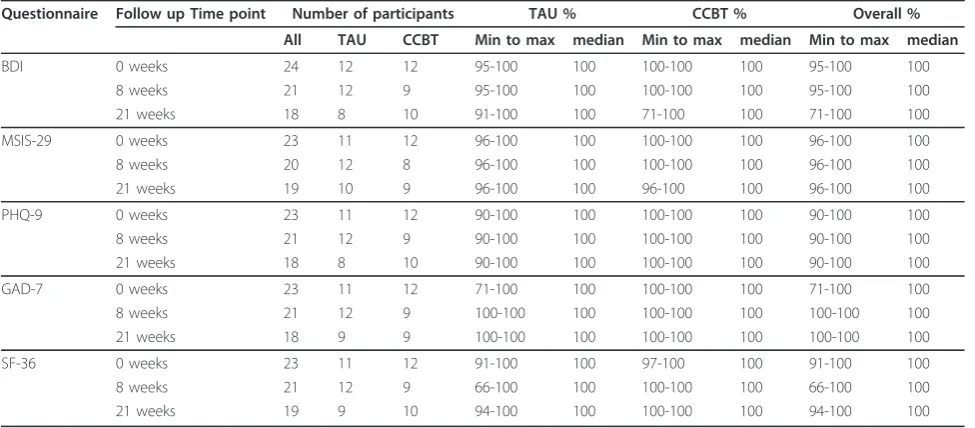
The collection of outcome data by postal questionnaire proved to be challenging, with multiple attempts to obtain data from many participants, particularly at later outcome assessment points. Nevertheless, primary outcome assessments were available for 21 (88%) parti-cipants at 8 weeks from randomisation (or end of treatment if later) and 18 (75%) participants at a further three months’ follow-up. Furthermore, the completion rate for those questionnaires returned was high (Table 2).
The patient reported outcome measure which the par-ticipants felt best reflected their concerns was the MSIS-29. During the telephone interviews, participants expressed concern about the face validity, for people with MS, of the questionnaires used for the measure-ment of self-reported depression, including the Beck Depression Inventory II. In particular they were con-cerned about the three symptoms, fatigue, sleep and concentration, which are also somatic symptoms of MS.
anyway. They’re not actually concerned with depression like not having good sleep. I mean, that’s a very com-mon problem with MS is you don’t have refreshing sleep.”(ID 271)
No issues were identified with the client service receipt inventory designed for the collection of cost and activity data. Identification of prognostic variables, parti-cularly the EDSS and MS Type, from patient records was not always possible and had to be obtained directly from participants’ neurologists for the purposes of the study in some cases.
Variability of outcome measures and sample size estimation
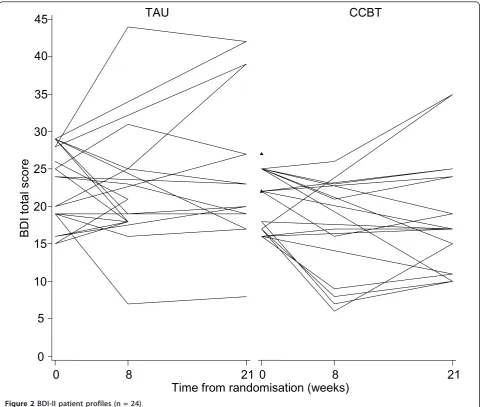
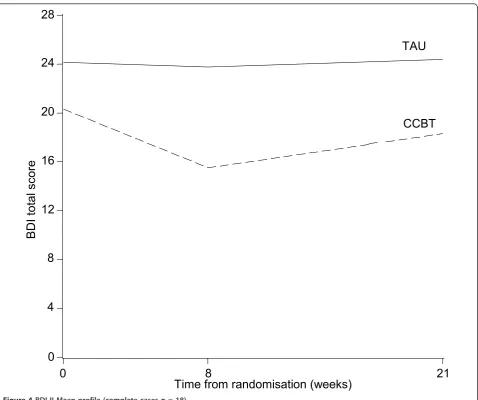
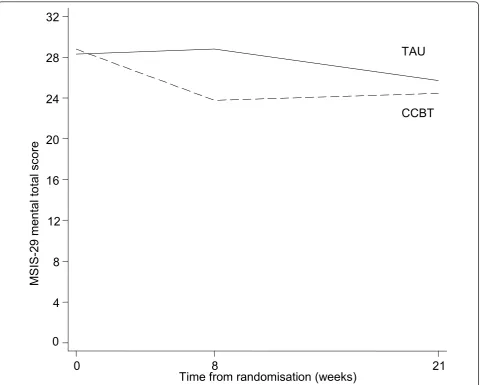
Patient profiles with respect to clinical outcomes are reported in Table 3 and Figures 2, 3, 4 and 5. The usual approach to estimating sample size is to base it on an important clinically significant change. However, the dif-ficulties of assessing a clinically significant change in BDI in the MS population have been reported previously with no available guideline [28]. An alternative approach is to base the effect size on the estimated mean change in BDI between the two groups. We decided against doing this as baseline imbalances with respect to gender and MS-type (Table 1) would produce bias in the esti-mated intervention effect.
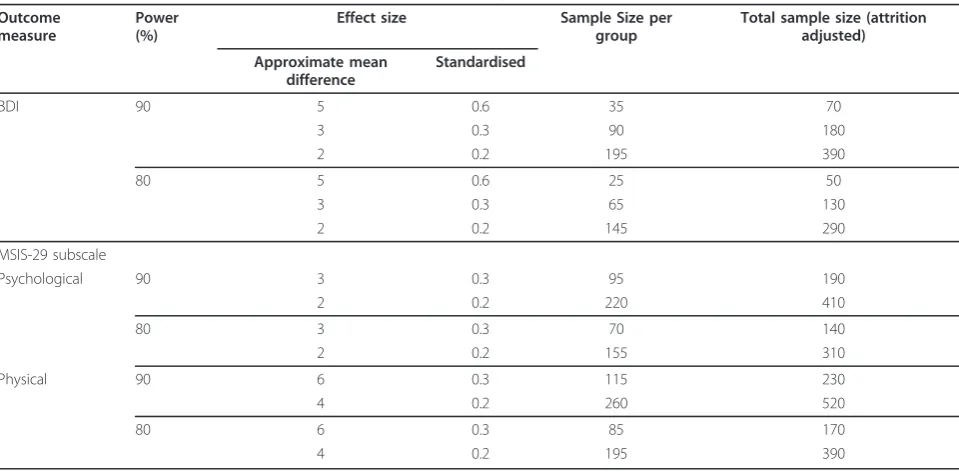
Instead we used approximate effect sizes expressed as a fraction of the pooled standard deviation of outcomes from this pilot which correspond to small, moderate and large standardised effect sizes. The standard deviations of the BDI, MSIS-29 psychological and physical domains were 8.3, 8.2 and 18.2 respectively, and variability of these outcome measures stratified by intervention group are shown in Table 4. Data at all time-points were included in these calculations and as such provide con-servative estimates of the true standard deviation for these measures. The results related to the change in BDI and MSIS among complete cases are given in Table 5.
[image:6.595.57.542.98.380.2]A mean difference of change in 5 points on the BDI corresponds to a moderate standardised effect size and equates to the upper estimate of the likely effect size [29]. To have 90% power to detect this effect size (assuming correlation between follow-up measurements of 0.75, an attrition rate of 25% and a fixed type 1 error rate of 5%) a total of 70 participants would be required. A difference between groups of 3 or 2 points would cor-respond to the lower estimates of the likely effect size and this would require a total sample size of 180 and 390 respectively at 90% power. The summary of sample size estimates at varying levels of power and effect size (expressed as an absolute value and as equivalent stan-dardised effect size) are given in Table 6.
Table 1 Participant baseline characteristics
Characteristic Scoring TAU3 CCBT4 Total
(n = 12) (n = 12) (N = 24)
n (%) n (%) n (%)
Gender Male 5 (42%) 1 (8%) 6 (25%)
Female 7 (58%) 11 (92%) 18 (75%)
Age (years)
Min to max 31 to 54 33 to 57 31 to 57
Mean (SD)1 42 (7.0) 48 (7.7) 45 (7.9)
Median (IQR)2 42 (37 to 47) 49.8 (42 to 55) 45 (39 to 51) EDSS score
Min to max 0.0 to 6.0 2.0 to 6.5 0.0 to 6.5
Mean (SD) 3.6 (1.8) 4.8 (1.7) 4.2 (1.8)
Median (IQR) 3.5 (2.8 to 5.0) 5.5 (3.5 to 6.3) 4.0 (3.0 to 6.0) Centre
Liverpool 5 (42%) 5 (42%) 10 (42%)
Yorkshire 7 (58%) 7 (58%) 14 (58%)
MS type
Relapsing-remitting 12 (100%) 7 (58%) 19 (79%)
Primary progressive 0 (0%) 5 (42%) 5 (21%)
BDI total score (0 weeks)
Min to max 15 to 29 16 to 27 15.0 to 29.0
Mean (SD) 23 (5.2) 21 (4.0) 22 (4.7)
Median (IQR) 25 (19 to 29) 22 (17 to 25) 22 (18 to 26)
Delivery of CCBT (home/external) and variation in delivery and use
In the Sheffield region, Primary Care Trust (PCT) men-tal health care teams administered the CCBT, facilitating
access and undertaking safety monitoring (PCTs were publicly funded organisations responsible for commis-sioning acute services for local populations). The CCBT service provided to trial participants was the routine
Patients approached to take part n=582
(Sheffield clinic, n=288; Liverpool mailout, n=250; Sheffield neuropsychologist mailout n=40; Sheffield MS nurses, n=4)
Responders n=140 (24.1%)
(Sheffield clinic, n=63; Liverpool mailout, n=64; Sheffield neuropsychologist mailout
n=9; Sheffield MS nurses, n=4)
Non-responders
n=442 (75.9%)
Eligible n=72 (12.4%)
Not eligible n=68 (11.7%)
Reasons:
1) BDI too high (n=20) 2) BDI too low (n=41)
3) Under care of psychiatrist (n=5) 4) Not resident in participating PCT (n=2)
Consent and randomised n=24 (4.1%)
Refused consent n=48 (8.2%)
Allocated to TAU n=12
Allocated to CCBT n=12
Completed 8 weeks follow-up n=12
Completed 8 weeks follow-up n=9
Completed 21 weeks follow-up n=8
[image:7.595.57.539.86.649.2]Completed 21 weeks follow-up n=10
service provided to all patients referred to the PCT mental health care teams. Only one out of the five parti-cipating PCTs around the Sheffield centre formally pro-vided any kind of community facility for accessing CCBT; PCT staff warned that clients rarely used the facility and it was closed during the course of the study. Although four out of five participating PCTs were happy to arrange alternative provision for those who did not have Internet access at home, all our participants requested home use of CCBT. In the Liverpool region, a specialist neuropsychologist, based in the acute hospital facilitated access to and provided technical advice on CCBT, but did not provide additional therapeutic input. No provision other than home-use was offered or sought.
No PCT with whom we worked offered advice or sup-port for defining problems on which to work or apply-ing the CBT model to individual problems. The advice
given was essentially technical, focusing on using the software. The PCTs delivering CCBT reported that they assumed that patients who were adherent and non-contactable beyond two weeks had discontinued treat-ment and made no further effort to contact them. Some but not all PCTs informed the patient’s GP in such a situation. Preference for use at home amongst users in the study was universal with no-one expressing a prefer-ence for use of CCBT in an alternative location. Only one participant in the TAU arm took up the offer of access to CCBT at the end of the trial.
Withdrawal from treatment
[image:8.595.56.544.100.314.2]Of the 12 patients in the CCBT arm, 9 (75%) completed at least four CCBT sessions. This translated to a reason-ably high compliance rate of CCBT although only six (50%) of the patients in this arm completed all intended eight CCBT sessions. Of these six patients, the median Table 2 Questionnaire item response rates for available questionnaires
Questionnaire Follow up Time point Number of participants TAU % CCBT % Overall %
All TAU CCBT Min to max median Min to max median Min to max median
BDI 0 weeks 24 12 12 95-100 100 100-100 100 95-100 100
8 weeks 21 12 9 95-100 100 100-100 100 95-100 100
21 weeks 18 8 10 91-100 100 71-100 100 71-100 100
MSIS-29 0 weeks 23 11 12 96-100 100 100-100 100 96-100 100
8 weeks 20 12 8 96-100 100 100-100 100 96-100 100
21 weeks 19 10 9 96-100 100 96-100 100 96-100 100
PHQ-9 0 weeks 23 11 12 90-100 100 100-100 100 90-100 100
8 weeks 21 12 9 90-100 100 100-100 100 90-100 100
21 weeks 18 8 10 90-100 100 100-100 100 90-100 100
GAD-7 0 weeks 23 11 12 71-100 100 100-100 100 71-100 100
8 weeks 21 12 9 100-100 100 100-100 100 100-100 100
21 weeks 18 9 9 100-100 100 100-100 100 100-100 100
SF-36 0 weeks 23 11 12 91-100 100 97-100 100 91-100 100
8 weeks 21 12 9 66-100 100 100-100 100 66-100 100
21 weeks 19 9 10 94-100 100 100-100 100 94-100 100
Table 3 Summary measures of patient profiles for primary and secondary outcomes stratified by intervention group
Outcome Measure Follow -up TAU CCBT
BDI n Mean(SD) Median(IQR) Min-Max n Mean(SD) Median(IQR) Min-Max
Baseline 12 23.3(5.2) 24.5(19.0-28.5) 15.0-29.0 12 21.0(4.0) 22.0(17.0-25.0) 16.0-27.0 8 weeks 12 22.1(9.1) 20.0(18.0-25.0) 7.0-44.0 9 14.8(7.5) 16.0(8.0-21.0) 6.0-26.0 21 weeks 8 24.4(11.4) 21.5(18.0-33.0) 8.0-42.0 10 18.3(7.9) 17.0(11.0-24.0) 10.0-35.0 MSIS-29 subscale
[image:8.595.57.539.576.731.2]time (IQR) to complete all eight CCBT sessions was 15 (13 to 20) weeks against an intended eight weeks time frame. Only one person receiving CCBT formally requested discontinuation of treatment (after Session 6 of 8) citing time and lack of enthusiasm as reasons. Of the other non-completers, three also contributed quali-tative data on their non-completion, one indicating lack of time, one that she no longer felt the need for treat-ment for her depression, and another citing computer hardware issues.
Other concomitant service and medication use
Four participants received some kind of talking therapy outside of the research protocol during the trial, one in the CCBT arm and three in the TAU arm. Thirteen par-ticipants received anti-depressants during the trial: seven in the CCBT arm; six in the TAU arm.
Discussion
Recruitment to this study was slower than expected. Dropouts and losses to follow-up were comparable with studies evaluating CCBT in non-MS populations: reported dropout rates for CCBT range from 0-75% (mean percentage dropout rate 32%, SD 16.52), which is comparable to dropout rates for other psychological therapies [30]. Data collection by postal questionnaire was challenging. Participants found problems with the face validity of the depression inventories which include somatic symptoms of depression which are also symp-toms of MS (the BDI-II and the PHQ-9), despite the fact that one has been psychometrically validated pre-viously for use in people with MS by several research teams [31,32]. The difficulties associated with assessing mood in people with physical illness is recognised and has been discussed previously [ 13,33]. However, the
0
5
10
15
20
25
30
35
40
45
0
8
21 0
8
21
TAU
CCBT
Time from randomisation (weeks)
BD
I
to
ta
l
sco
[image:9.595.58.541.88.495.2]re
important point from this study is that participants expressed concerns about completing the measures and this may affect completion rates and validity in terms of consistency of participants’ approach to responses throughout the course of the study. If a study is to eval-uate impact on a patient-important outcome measure relevant to patients with MS then it should include the MSIS-29, which provides a measure of the physical and psychological impact of the condition from the patient’s perspective [23]. This scale used on its own would reduce the ability to compare outcomes with other stu-dies so it should be used in addition to general popula-tion scales such as the BDI, which has been used extensively in the general population.
A recent systematic Cochrane review identified a number of strategies proven to be effective in increas-ing response to postal questionnaires [34]. Fortunately, we had employed a few of these strategies including
using a short, personalised (screening) questionnaire and including a second copy of the questionnaire at follow up. We also highlighted the University’s involve-ment in the study. However, any future study could also employ other proven methods including using fol-lowup contact, use of stamped returned envelopes (as opposed to franked return envelopes), first class mail-ing and assurance of confidentiality in the letter of invitation.
Only a small percentage of people meeting the eligibil-ity criteria for both MS and depression were successfully consented into the study. The population approached were not actively seeking treatment for mood-related symptoms and this may have been a contributing factor to the low consent rates. One other study has also iden-tified that people with MS, while at higher risk of depression, are rarely treatment-seeking, at least in a primary care context [35].
0
5
10
15
20
25
30
35
40
45
0
8
21 0
8
21
TAU
CCBT
Time from randomisation (weeks)
M
SI
S-2
9
me
n
ta
l
to
ta
l
s
c
o
[image:10.595.56.541.88.481.2]re
A limitation of this study is that it did not prospec-tively define formal ‘stop/go’ criteria for a definitive study, allowing researchers to assess the main study as not feasible, feasible with protocol modifications, or fea-sible without modifications (with or without close ongoing monitoring of protocol feasibility and imple-mentation). This was recommended as good practice for pilot studies by Thabane and colleagues subsequent to the finalisation of our protocol and our grant award [16].
This pilot trial has demonstrated that recruitment of the required sample size for a full trial from the relevant population would be challenging as the numbers of par-ticipants recruited per site were very low and a high proportion of the prevalent cases had been approached in the recruitment period. Consequently, extending the recruitment period at particular centres would result in diminishing returns in terms of participant recruitment.
Postal screening via the Walton Centre resulted in 10 participants in 5 months, face to face recruitment at STH resulted in 14 participants in 9 months. From this evidence a full trial of 180 participants would require at least 13 sites, particularly considering that recruitment may be slower in a full-scale trial, where a team is reli-ant on other centres, than in a pilot study. This would require the participation of all the large, research active MS centres. Assuming 13 centres would be sufficient to recruit the required sample, the time to obtain all the necessary approvals and set up the sites would be con-siderable and 12 months at minimum should be allowed for this stage alone. In addition, time and resources should be allocated to allow for recruitment of addi-tional sites if necessary
As we have tested recruitment using both identifica-tion of potential participants from an MS Register (Wal-ton Centre) and through patient presentation at clinic
TAU
CCBT
0
4
8
12
16
20
24
28
BD
I
to
ta
l
sco
re
0
8
21
[image:11.595.60.539.86.486.2]Time from randomisation (weeks)
(STH) either of these approaches could be utilised, so the service configuration would not be a limitation. However, the method of recruitment would also have to be considered carefully as we focused on a population who were screened for depression and not one which was actively seeking help for depression; this may have influenced the low uptake rate. In this regard, trialists may be in a difficult position: on the one hand, people
with MS show unusually low levels of help-seeking for their depression, making recruitment through systematic mass screening more appealing [35]; on the other hand, psychotherapeutic studies in which patients are recruited through systematic screening rather than their routine caregiver show significantly lower effect sizes
TAU
CCBT
0
4
8
12
16
20
24
28
32
M
SI
S-2
9
me
n
ta
l
to
ta
l
s
c
o
re
0
8
21
[image:12.595.59.545.88.473.2]Time from randomisation (weeks)
Figure 5MSIS-29 mean profile (complete cases n = 18).
Table 4 Variability in outcomes (all time points) by intervention group
Outcome measure Intervention group Mean (SD)
TAU CCBT All
BDI 24.1 (9.0) 18.0 (6.7) 20.7 (8.3) MSIS-29 subscale
Psychological 26.6 (8.6) 25.9 (7.7) 26.3 (8.2) Physical 59.9 (19.9) 59.5 (16.5) 59.7 (18.2)
[image:12.595.305.540.614.731.2]Mean and SD for BDI and MSIS-29 subscales based on data at all time-points
Table 5 Mean (SD) of change in primary and secondary outcomes relative to their baseline measurements.
Outcome measure Follow-up TAU CCBT
BDI N Mean (SD) n Mean (SD)
8 weeks 12 -1.17 (8.1) 9 -5.33 (4.7) 21 weeks 8 0.25 (8.8) 10 -2.00 (5.1) MSIS-29 subscale
Physical 8 weeks 11 -1.82 (7.8) 8 -7.00 (12.9) 21 weeks 10 -2.20 (11.0) 9 -7.89 (12.3) Psychological 8 weeks 11 0.18 (5.1) 8 -5.88 (9.5)
[image:12.595.57.291.642.723.2]and the results of such a trial have poorer external validity [36]. Considering all these factors for a future full trial it may be better to extend the participant popu-lation to include people with other neurological condi-tions or even chronic condicondi-tions more widely. In addition, the eligibility criteria could be extended to include people with severe depression as in the ongoing Randomised Evaluation of the Effectiveness and Accept-ability of Computerised Therapy (REEACT) Trial (ISRCTN 91947481). (Twenty respondents to our screening questionnaire, who might otherwise have been randomised, were excluded on the basis of experiencing severe depression at two measurement points). However, the sample size required to detect a difference may vary as our estimations are not based on this population.
It would be essential to maximise participant follow-up. A range of contact methods should be sought at the outset including mobile phone numbers and e-mail addresses. Sufficient resources would be required to ensure persistent followup of non-responders.
A further consideration for any future trial relates to the study design. The design of this study is described as CCBT vs TAU as the participants in the CCBT arm received CCBT in addition to any care, medication or services they would have received if they had not been part of the study. The TAU arm could be criticised as not reflecting usual treatment for depression but being a no-treatment arm (or TAU for MS) due to low levels of help-seeking for depression by people with MS [35]. An alternative approach would be to assess all participants for depression and to agree clinical management prior to randomisation. Those receiving TAU would therefore
be offered appropriate treatment for depression, those in the treatment arm would receive CCBT in addition. This would also ensure that screened patients who do not meet the eligibility criteria on the basis of severity of depression would receive the appropriate clinical care. The time taken for participants to complete the study intervention (13 to 20 weeks from randomisation) was longer than expected or than recommended in the pro-duct manual, due to the poor adherence of participants with the weekly schedule. Adherence to treatment pro-gramme timescales is difficult to guarantee where treat-ment is delivered by local NHS services and not delivered in ideal conditions by the trial team. Outcome assessment time-points of future studies should be fixed relative to the point of randomisation and not the jected end of the study intervention, as treatment pro-grammes often over-run. This minimises discrepancies between the timepoints at which the treatment and con-trol participants are followed up. Fixed timepoint out-come assessment should be supported by systems to minimise mis-timed outcome measurements, for instance automated follow-up reminders, pre-scheduled follow-up appointments and requesting alternative and preferred modes of contact (landline, mobile, text, e-mail).
[image:13.595.58.538.98.334.2]Participants in our previous related research reported that they would value more support in defining their problems and goals [15]. Since this research began, Spek and colleagues have demonstrated that CCBT pro-grammes are markedly more effective when delivered with therapist support. However, in the PCTs with whom we worked, therapist support was only available Table 6 Sample size estimates for a definitive trial stratified by outcome measure, power and effect size
Outcome measure
Power (%)
Effect size Sample Size per group
Total sample size (attrition adjusted)
Approximate mean difference
Standardised
BDI 90 5 0.6 35 70
3 0.3 90 180
2 0.2 195 390
80 5 0.6 25 50
3 0.3 65 130
2 0.2 145 290
MSIS-29 subscale
Psychological 90 3 0.3 95 190
2 0.2 220 410
80 3 0.3 70 140
2 0.2 155 310
Physical 90 6 0.3 115 230
4 0.2 260 520
80 6 0.3 85 170
where issues remain unresolved after a complete course of CCBT, although more recently, through the‘ Improv-ing Access to Psychological Therapies’service, the sup-port of a psychological wellbeing practitioner within primary care should be available within the stepped care model recommended by NICE [8]. Whether such sup-port is in fact available is likely to vary between sites [7]. Any future research protocol would have to balance the desire to provide and evaluate an optimised intervention (CCBT with concurrent therapist support) against the likelihood of therapist-supported CCBT becoming the norm in the UK healthcare setting. In either case, study teams should report any standardisation or variation in the implementation of the intervention (for instance in the level of therapist support) between study sites in line with the CONSORT modification proposed by Zwarenstein and colleagues [17]. We would not recom-mend evaluating the delivery of CCBT in community facilities as our experience here has shown that many NHS partners are not delivering it in this way and parti-cipants overwhelmingly chose to access CCBT at home.
More successful models of delivering CCBT and implementing future interventional research might be through either (a) the secondary care multi-disciplinary neurology teams (see for example work by Moss-Morris and colleagues [37]) or (b) Psychological Wellbeing Practitioners based in primary care trained by clinical neuropsychologists in the issues they need to know to support CCBT use in patients with MS. The commercial company which produces Beating the Blues® (Ultrasis) has indicated that it intends to address the issues of appropriateness and acceptability of Beating the Blues®
to people with MS identified in our previous work [14] in future product developments. The choice of CCBT to be used in any future full trial should take into consid-eration whether these issues have been addressed and the range of alternative CCBT packages which may be available in the future.
Conclusions
The results of this pilot study demonstrate that, if the intended full trial of the clinical and cost-effectiveness of CCBT for depression in people with MS were to pro-ceed, a number of amendments to the pilot trial proto-col would be required. A definitive RCT, with a recruitment window of one year, would require the par-ticipation of around 13 UK MS centres. This number could be reduced by expanding the eligibility criteria to include either other neurological conditions or people with more severe depression. The design of the defini-tive study will need to consider whether to optimise the delivery of CCBT through the provision of therapist support depending on the likelihood of this being deli-verable in routine practice. Participants should access
CCBT at home in line with patient-preference and because NHS partners are not typically delivering it in community facilities. Finally, the MSIS-29 should be used as a patient-important outcome measurement.
Acknowledgements
We thank the MS Society for funding the study and 24 generous participants who offered us their time. We would like to acknowledge the support of the following clinicians who facilitated participant recruitment to the study: Dr Mike Boggild, Consultant Neurologist at the Walton Centre NHS Trust, Liverpool; Drs Sian Price and Steve Howell, Consultant Neurologists, Diane Watts and the MS Specialist Nursing Team at Sheffield Teaching Hospitals NHS Foundation Trust. We would also like to acknowledge the support of the staff at the PCTs: Simon Bennett (Sheffield PCT); Linda Matthews, Liz Holdsworth, Matthew Swan (Barnsley PCT); Dawn White (Doncaster PCT); Georgina Horobin (Derbyshire County PCT); Sue Schmitz-Butler and Edward Randerson (Rotherham PCT). We would also like to acknowledge the technical, procedural and moral support of Kathy Griffiths (Australian National University), Charlie Martin and Despina Learmonth (Ultrasis). The following members of the Trial Steering Committee also provided invaluable expertise and advice throughout: Karen Beck (our study administrator); Professors John Brazier and Jon Nicholl of the University of Sheffield; Ray Stonehill, MS Society Kingston on Thames Branch.
Author details
1
Clinical Trials Research Unit, ScHARR, University of Sheffield, Regent Court, 30 Regent Street, Sheffield, S1 4DA, UK.2ScHARR, University of Sheffield,
Regent Court, 30 Regent Street, Sheffield, S1 4DA, UK.3Clinical Psychology Unit, Department of Psychology, The University of Sheffield, Western Bank, Sheffield S10 2TP, UK.4The Walton Centre of Neurology & Neurosurgery, Liverpool L9 7LJ, UK.5Department of Neurology, Royal Hallamshire Hospital,
Sheffield S10 2JF, UK.
Authors’contributions
CC was the chief investigator and drafted the manuscript. CC and GP conceived of the study. CC, GP, JF, BS, AO, CI, AR and EK designed the study. DH was the study co-coordinator, conducted qualitative research interviews and helped to draft the manuscript. The trial management group were CC, DH, AO, CI, AR, LM and all, together with BS, helped to implement the study on a day-to-day basis. MD and JF were the study statisticians and contributed to the statistical analysis plan. MD undertook the statistical analysis and helped to draft the manuscript. LM provided a perspective on living with multiple sclerosis. AT conducted qualitative research interviews. All authors read, commented on and approved the final manuscript.
Competing interests
The authors declare that they have no competing interests.
Received: 3 June 2011 Accepted: 14 December 2011 Published: 14 December 2011
References
1. Sadovnick AD, Dyment DA, Ebers GC, Risch NJ, the Canadian Collaborative Study Group:Evidence for genetic basis of multiple sclerosis.The Lancet
1996,347:1728-1730.
2. Sharrack B, Hughes RAC:Scale development and Guy’s Neurological Disability Scale.Journal of Neurology1999,246:226.
3. Confavreux C, Compston A:The natural history of multiple sclerosis.In
McAlpine’s Multiple Sclerosis..4 edition. Edited by: Compston A. London: Elsevier; 2006:183-272.
4. Benito-León J, Manuel Morales J, Rivera-Navarro J, Mitchell AJ:A review about the impact of multiple sclerosis on health-related quality of life.
Disability & Rehabilitation2003,25:1291-1303.
5. Siegert RJ, Abernethy DA:Depression in multiple sclerosis: a review.J Neurol Neurosurg Psychiatry2005,76:469-475.
7. Layard R:The case for psychological treatment centres.BMJ2006, 332:1030-1032.
8. National Collaborating Centre for Mental Health:Depression: Management of depression in primary and secondary care (National Clinical Practice Guideline Number 23).London, National Institute for Health and Clinical Excellence; 2008, Ref Type: Report.
9. Seymour L, Grove B:Workplace Interventions for People with Common Mental Health Problems.London, British Occupational Health Research Foundation; 2005, Ref Type: Report.
10. Care Services Improvement Partnership, Primary Care Services for Depression:A guide to best practice.London, Department of Health; 2006, Ref Type: Report.
11. National Institute for Health and Clinical Excellence, Technology Appraisal 97:Computerised cognitive behavioural therapy for depression and anxiety.Review of Technology Appraisal 51London, NICE; 2006, Ref Type: Report.
12. Creed F:Assessing depression in the context of physical illness.In
Perspectives in Psychiatry Volume 6: Depression and Physical Illness.Edited by: Robertson MM, Katona CLE. Baffins Lane, England: John Wiley; 1997:3-19. 13. National Collaborating Centre for Mental Health:Depression in adults with
a chronic physical health problem: Treatment and management.NICE Clinical Guideline 91London, National Institute for Health and Clinical Excellence; 2009.
14. Campbell NC, Murray E, Darbyshire J, Emery J, Farmer A, Griffiths F, Guthrie B, Lester H, Wilson P, Kinmouth AL:Designing and evaluating complex interventions to improve health care.BMJ2007,334:455-459. 15. Hind D, O’Cathain A, Cooper CL, Parry GD, Isaac CL, Rose A, Martin L,
Lharrack B:The acceptability of computerised cognitive behavioural therapy for the treatment of depression in people with chronic physical disease: A qualitative study of people with multiple sclerosis.Psychology & Health2010,25:699-712.
16. Thabane L, Ma J, Chu R, Cheng J, Ismaila A, Rios L, Robson R, Thabane M, Giangregorio L, Loldsmith CH:A tutorial on pilot studies: the what, why and how.BMC Medical Research Methodology2010,10:1.
17. Zwarenstein M, Treweek S, Gagnier JJ, Altman DG, Tunis S, Haynes B, Oxman DA, Moher D:Improving the reporting of pragmatic trials: an extension of the CONSORT statement.BMJ337.
18. Beck AT, Steer RA, Ball R, Ranieri WF:Comparison of Beck Depression Inventories-IA and-II in Psychiatric Outpatients.Journal of Personality Assessment1996,67:588-597.
19. Polman CH, Reingold SC, Edan G, Filippi M, Hartung H-P, Kappos L, Lublin F, Metz LM, McFarland HF, O’Connor PW, Sandberg-Wollheim M,
Thompson AJ, Weinshenker BG, Wolinsky JS:Diagnostic criteria for multiple sclerosis: 2005 revisions to the ldquoMcDonald Criteriardquo.
Annals of Neurology2005,58:840-846.
20. Folstein MF, Folstein SE, McHugh PR:“Mini-mental state": A practical method for grading the cognitive state of patients for the clinician.
Journal of Psychiatric Research1975,12:189-198.
21. Kurtzke JF:Rating neurologic impairment in multiple sclerosis: An expanded disability status scale (EDSS).Neurology1983,33:1444-1452. 22. Sheehan DV, Lecrubier Y, Sheehan KH, Amorim P, Janavs J, Weiller E,
Hergueta T, Baker R, Dunbar GC:The Mini-International Neuropsychiatric Interview (M.I.N.I.): the development and validation of a structured diagnostic psychiatric interview for DSM-IV and ICD-10.J Clin Psychiatry
1998,59:22-33.
23. Hobart JC, Riazi A, Lamping D, Fitzpatrick R, Thompson AJ:Hobart JCImproving the evaluation of therapeutic interventions in multiple sclerosis: development of a patient-based measure of outcome.Health Technol Assess2004,8:iii, 1-48.
24. Brazier JE, Harper R, Jones NM, O’Cathain A, Thomas KJ, Usherwood T, Westlake L:Validating the SF-36 health survey questionnaire: new outcome measure for primary care.BMJ1992,305:160-164.
25. Spitzer RL, Kroenke K, Williams JBW, and the Patient Health Questionnaire Primary Care Study Group:Validation and Utility of a Self-report Version of PRIME-MD: The PHQ Primary Care Study.JAMA: The Journal of the American Medical Association1999,282:1737-1744.
26. Spitzer RL, Kroenke K, Williams JBW, Lowe B:A Brief Measure for Assessing Generalized Anxiety Disorder: The GAD-7.Arch Intern Med2006, 166:1092-1097.
27. Julious SA:Sample Size Of 12 Per Group Rule Of Thumb For A Pilot Study.Pharmaceutical Statistics2005,4:287-291.
28. Mohr DC, Boudewyn AC, Goodkin DE, Bostrom A, Epstein L:Comparative outcomes for individual cognitive-behavior therapy, supportive-expressive group psychotherapy, and sertraline for the treatment of depression in multiple sclerosis.J Consult Clin Psychol2001,69:942-949. 29. Cohen J:Statistical power analysis and for the behavioral sciencesHillsdale
(NJ): Erlbaum; 1988.
30. Kaltenthaler E, Sutcliffe P, Parry G, Beverley C, Rees A, Ferriter M:The acceptability to patients of computerized cognitive behaviour therapy for depression: a systematic review.Psychological Medicine2008, 38:1521-1530.
31. Aikens JE, Reinecke MA, Pliskin NH, Fischer JS, Wiebe JS, McCracken LM, Maylor JL:Assessing depressive symptoms in multiple sclerosis: is it necessary to omit items from the original Beck Depression Inventory?
Journal of Behavioral Medicine1999,22(2):127-42.
32. Moran PJ, Mohr DC:The Validity of Beck Depression Inventory and Hamilton Rating Scale for Depression Items in the Assessment of Depression Among Patients with Multiple Sclerosis.Journal of Behavioral Medicine2005,28:35-41.
33. House A:Mood Disorders in the physically ill. Problems of definition and measurement.Journal of Psychosomatic Research1988,32(4/5):345-353. 34. Edwards PJ, Roberts I, Clarke MJ, Diguiseppi C, Wentz R, Kwan I, Cooper R,
Felix LM, Pratap S:Methods to increase response to postal and electronic questionnaires.Cochrane Database Systematic Review Database2009,3. 35. Sollom AC, Kneebone II:Treatment of depression in people who have
multiple sclerosis.Multiple Sclerosis2007,13:632-635.
36. Cuijpers P, van Straten A, van Schaik A, Andersson G:Psychological treatment of depression in primary care: a meta-analysis.British Journal of General Practice59:e51-e60.
37. Moss-Morris R, Dennison L, Yardley L, Landau S, Roche S, McCrone P, Chalder T:Protocol for the saMS trial (supportive adjustment for multiple sclerosis): a randomized controlled trial comparing cognitive behavioral therapy to supportive listening for adjustment to multiple sclerosis.BMC Neurology2009,9:45.
doi:10.1186/1745-6215-12-259
Cite this article as:Cooperet al.:Computerised cognitive behavioural
therapy for the treatment of depression in people with multiple sclerosis: external pilot trial.Trials201112:259.
Submit your next manuscript to BioMed Central and take full advantage of:
• Convenient online submission
• Thorough peer review
• No space constraints or color figure charges
• Immediate publication on acceptance
• Inclusion in PubMed, CAS, Scopus and Google Scholar
• Research which is freely available for redistribution