JOURNAL OF FOREST SCIENCE, 54, 2008 (11): 519–531
The hydraulic architecture of plants has to serve several functions and overcome certain limitations. The maintenance of a continuous column of water in the plant minimizes the risk of cavitation (Tyree, Sperry 1989; Melcher et al. 2003; Sperry et al. 2003) as well as provides a structural support to aboveground tissues (Tyree, Ewers 1991; Yang, Tyree 1993, 1994; Tyree, Zimmerman 2002).
Growth in height of woody plants is motivated to a considerable extent by competition for light. This competition is manifested by the social variation of trees in the community. It is possible thanks to the formation of a trunk or stem by woody plants, the role of which is to raise the crown of a tree to light. The site, climate, age of the tree, its height as well as hydraulic conductivity of xylem (its efficiency deter-mined by the structure of anatomical elements and
their modifications) are among many exo- and en-dogenous factors determining water transport in the plant (Nobel 1999; Sperry et al. 2003; McCulloh, Sperry 2005). Hydraulic conductivity of sapwood is determined e.g. by biometric traits of conductive ele-ments including basipetal reduction of tracheid and vessel diameters in the xylem (Zimmermann 1983; Ewers, Zimmermann 1984; Tyree, Ewers 1991). Thus in a healthy, physiologically active plant a de-crease in hydraulic conductivity is observed with an increase in the height of the plant (tree) (Mencuc-cini, Grace 1996; Ryan et al. 2000; McDowell et al. 2002). Changes (fluctuations) in the diameter of conductively active (conducing) xylem may gener-ally be described as the fourth-power relationship between the radius of the conductive system to the flow through capillary tubes, as described by the
The applicability of the
Pipe Model Theory
in trees
of Scots pine of Poland
T. Jelonek
1, W. Pazdrowski
1, M. Arasimowicz
2, A. Tomczak
1,
R. Walkowiak
3, J. Szaban
11
Department of Forest Utilisation, University of Life Sciences in Poznań, Poznań, Poland
2
Department of Plant Ecophsiology, Faculty of Biology, Adam Mickiewicz University,
Poznań, Poland
3
Department of Mathematical and Statistical Methods, University of Life Sciences
in Poznań, Poznań, Poland
ABSTRACT: In order to test the application importance of the Pipe Model Theory and to develop models for the share of sapwood in tree stems, a total of 114 Scots pines (Pinus sylvestris L.) were felled within the natural range of this spe-cies in three natural positions located in northern and western Poland. The analyses were conducted on wood coming from trees from the main layer of the stand, i.e. the first three classes according to the classification developed by Kraft. Dependences were analyzed between the biometric characteristics of model trees, e.g. tree height, diameter at breast height, crown length, crown basal area and the area and volume of sapwood in the stem. All the analyzed characteris-tics, both biometric traits and sapwood characterischaracteris-tics, were found to be correlated significantly (P < 0.05) positively. Conducted analyses indicate that the postulates proposed in the Pipe Model Theory and Profile Theory require certain modifications and regression models developed for each social class of tree position in the stand for dependences of sapwood area and volume on the above mentioned biometric variables indirectly include changes occurring in time.
Hagen-Poiseuille law (Zimmermann 1983; Tyree, Ewers 1991).
From the hydraulic model of plants a balance may be expected between the active area of sapwood and the transpiration surface of the leaf (Whitehead et al. 1984). Studies on the relationship between the leaf biomass and the conductive zone of the xylem were continued by numerous researchers (Burger 1929, 1937; Marks 1974; Mohler et al. 1978; Albrekt-son 1980), which has resulted in the development of several theories referring to the above mentioned de-pendences (Pipe Model Theory, Profile Theory). One of the primary theories is the Pipe Model Theory, proposed by Shinozaki et al. (1964a,b).
The Pipe Model Theory assumes that the relation-ship between the leaf mass and the pipe cross-sec-tion area in branches and in the stem of a tree does not change. This is evidenced by the highly signifi-cant regression between sapwood area and crown area or leaf mass.
If there is a constant relationship, then it may be used to model the allocation of growth in crowns (Mäkelä, Vanninen 2001). This dependence was verified for different species, sites and age classes. In order to estimate the leaf biomass of a tree and the production of sapwood the theory was considerably expanded (Waring et al. 1982; Marchand 1983; Albrektson 1984; Whitehead et al. 1984; Ro-bichaud, Methven 1992; Mäkelä, Albrektson 1992; Berninger, Nikinmaa 1994; Vanninen et al. 1996; Yukihiro 1998; Mäkelä, Vanninen 2001; Pretzsch 2001; Berninger et al. 2005).
Vanninen et al. (1996) studied the dependence of leaf biomass and tree age, height, sapwood area and crown basal area in view of growth and develop-ment conditions of a tree. Results proved the theses proposed by the Pipe Model Theory.
In turn, Cienciala et al. (2006) attempted to develop parameters for the functions of individual elements of biomass for Scots pine (Pinus sylvestris
L.) in Central Europe. Aboveground biomass and its individual components were analyzed in terms of different types of nonlinear regression models assuming the following independent variables: dbh, tree height, tree age, length and diameter of crown. Moreover, results of investigations conducted by Mäkelä and Vanninen (2001) indicated that crowns of pine trees are very regular, although cer-tain modifications of the Pipe Model Theory were required, taking into consideration the portion of sapwood excluded from the conduction processes.
The active area of pipes was ascribed to the entire sapwood area. However, there is evidence show-ing the incidence of pipes conductively inactive
or periodically inactive. In the dynamic model of crown structure it would be necessary to consider the model including the number of inactive pipes of sapwood and related changes in leafage (Mäkelä, Vanninen 2001).
Nikinmaa (1992) presented a hypothesis that sapwood pipes remain active much longer than the assimilation-transpiration apparatus. The hypothesis was empirically supported by the observations on Scots pine, in which it was found that the number of active sapwood rings is correlated with the number of live whorls. Björklund (1999) showed that the heartwood formation in Scots pine is more depend-ent on age. Moreover, the author suggested that a change in sapwood is slower than the change in leafage and this proportion is not constant in the entire stem.
The correctness of such hypotheses is also shown by the difference between the measured relative share of heartwood in comparison with the total stem diameter and the forecasted share of inactive pipes in sapwood. It is most probably the result of a gradual rather than rapid transition of sapwood into heartwood. Thus the pipe model should be modified to include the transitional, inactive sapwood zone (Mäkelä 2002).
The above results might be assumed as evidence against PMT or as an indication that active pipes may not always be identified with the entire sapwood area.
In their studies on the application importance of
PMT Robichaud and Methven (1992) indicated a significant dependence between leaf biomass and cross-section area of sapwood, which confirmed studies conducted so far and supported a hypothesis on the possibility to estimate biomass on the basis of conductive area.
There are also theories saying that the depen-dence of sapwood area on leaf area or crown size is determined by numerous other factors such as site, stand closure, social class of the tree position in the stand or crown class (Whitehead 1978; Thompson 1989).
The aim of the study was to test and apply the Pipe Model Theory to estimate the area and volume of the conductive (sapwood) zone in stems based on easily measurable biometric traits of Scots pines (Pinus syl-vestris L.) growing in northern and western Poland.
MATERIAL AND METHODS
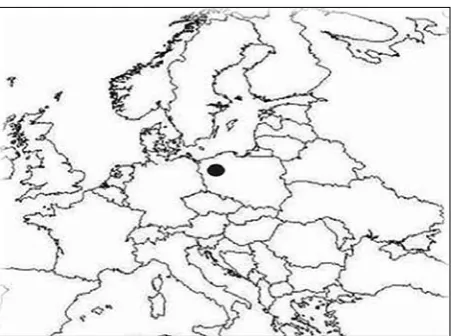
Investigations were conducted in northern and western Poland in production pine stands (Fig. 1). Mean sample plots were located in 38 pine posi-tions situated within the limits of the natural range of this species in Europe. Sixteen mean sample plots were established in the Miastko forest district (1) (54°01'N, 16°59'E), fourteen in the Bytnica forest district (2) (52° 9'N, 15°10'E) and eight in the Złotów forest district (3) (53°21'N, 17°02'E) (Table 1).
Analyses were conducted between October 2003 and December 2006. In the investigations a total of 114 Pinus sylvestris L. trees were used, aged from 32 to 114 years,growing under diverse growth and development conditions, including site fertility, the area occupied by a tree in the stand, microclimate, and intensity of tending interventions. Model trees were divided in terms of age into classes, adopted to be 20-year intervals. Thus trees belonging to age class II (21–40 years), III (41–60 years), IV (61 to 80 years), V (81–100 years) and VI (101–120 years) were analyzed.
In each analyzed stand a representative mean sample area of 1 ha was used on which diameter at breast height (dbh) was measured on all tress along with their height in proportion to the numbers in the adopted (2 cm) diameter sub-classes.
In order to recreate a complete picture of the plant community, model trees were selected simul-taneously on the basis of the Urich II dendrometric method (Grochowski 1973) and the classification developed by Kraft (1884) including the main stand, i.e. predominant, dominant and codominant trees.
Class I – predominant trees: trees dominate in height and they have a strongly developed crown; Class II – dominant trees: they form the main canopy
of the stand, have well-developed crowns;
Class III – codominant trees: crowns are still nor-mally developed, but laterally narrowed, they are not much lower in height than dominant trees according to Kraft (1884).
In the course of the study simple Kraft’s classifica-tion, based on the qualitative assessment of the crown and tree height in relation to its nearest vicinity, was used, which quite well characterizes the social position in the community. This classification assumes that the growth dynamics of a tree in the stand is reflected in tree height as well as the position and structure of its crown (Kraft 1884). The classification mentioned above is quite frequently used to investigate the re-lationship between crown and stem biomass, xylem structure or the intensity of physiological and biologi-cal processes taking place in the living tree.
In order to determine the biomass of the assimila-tion apparatus, a method was applied in the study in which the assimilation apparatus is estimated on the basis of crown size, assuming that there is a close di-rectly proportional dependence between the crown size expressed in biometric parameters and the vol-ume of the assimilation apparatus (Lemke 1966).
[image:3.595.306.532.53.221.2]A total of 114 model trees were selected and felled in the experimental plots. They were pines with healthy, straight stems and with symmetrical, well-developed crowns, adequately to the given biological class they occupied in the stand.
Fig. 1. Location of the study; http://www.varnabg.com/library/ maps/images/map_europa.jpg
Table 1. Characteristics of stands and sample trees
Site Sample trees Tree age (years) (cm)dbh Tree height (m) Crown
length (m) diameter (m) volume (m3)
1 48 32–114 8.5–37.0 11.8–28.3 2.6–11.9 1.2–6.2 2.1–168.2
2 42 34–76 12.0–35.0 12.0–28.0 1.9–10.2 1.5–6.0 4.2–100.1
[image:3.595.64.535.683.757.2]Prior to the felling of mean sample trees their di-ameters were measured on the basis of their crown projection area.
Next model trees were felled and the length of their stems was measured, which was assumed to be the distance between the kerf plane and the crown top. Then analyses of distribution were prepared for the basic biometric (taxation) characters of trees, i.e. diameter at breast height and tree height (Figs. 2 and 3).
Moreover, the length of live crown was also meas-ured, which was adopted to be the distance between the first live branch and the crown top (Fig. 2).
All stems of felled test trees were divided into sec-tions, from which experimental material was cut per-pendicularly to the longitudinal axis of the stem, in the form of discs approximately 3 cm in thickness.
The first disc was cut from the kerf plane of the tree, next at a distance of 1 m from the plane of the diameter at breast height (1.3 m) and from the cen-tres of the adopted 2-meter sections.
In the course of laboratory analyses sapwood ring width and disc diameter were measured on cut discs on two perpendicular diameters oriented in the north-south and east-west directions.
On the basis of obtained data the volume and area of sapwood as well as the volume of each section were calculated, which was used to calculate the stem volume and the volume of the zone conducting water with minerals in the stem.
Field measurements were also used to calculate the crown volume, which was assumed to be the volume of a paraboloid of revolution and calculated from the formula:
1
V = –––– πr2h 2
where:
r – crown basal radius,
h – crown height.
RESULTS
In this study in order to test the pipe theory sec-ondary indexes of leaf biomass were used, i.e. the length and diameter of the crown. Moreover, the ratios of the area (SA) and volume (SV) of sapwood to the diameter (CD) and height (CH) of the crown were also investigated (Table 2).
[image:4.595.69.292.59.252.2]First, one of the basic assumptions of the Pipe Model Theory was verified, stating there is a strong
Fig. 2. Characteristics of model trees Fig. 3. Characteristics of diameters and heights of model trees 45
40 35 30 25 20 15 10 5 0
dbh (cm) Tree height (m)
Mean Stand. deviation ±1.96*Stand.
deviation 0 5 10 15 20 25 30 35 40 45 50 0 20 40 dbh (cm)
Tr
ee heig
ht (m)
[image:4.595.306.524.61.254.2]34 32 30 28 26 24 22 20 18 16 14 12 10 8 40 20 0
Table 2. Characteristics of selected characters of model trees
SA(m2) S
V(m3) SA/CH SV/CH SA/CD SV/CD
Maximum 0.0667 1.0917 0.0056 0.1215 0.0087 0.1591
Minimum 0.0026 0.0174 0.0007 0.0046 0.0017 0.0145
Mean 0.0202 0.3691 0.0028 0.0496 0.0046 0.0815
Standard deviation 0.0125 0.2460 0.0011 0.0232 0.0016 0.0331
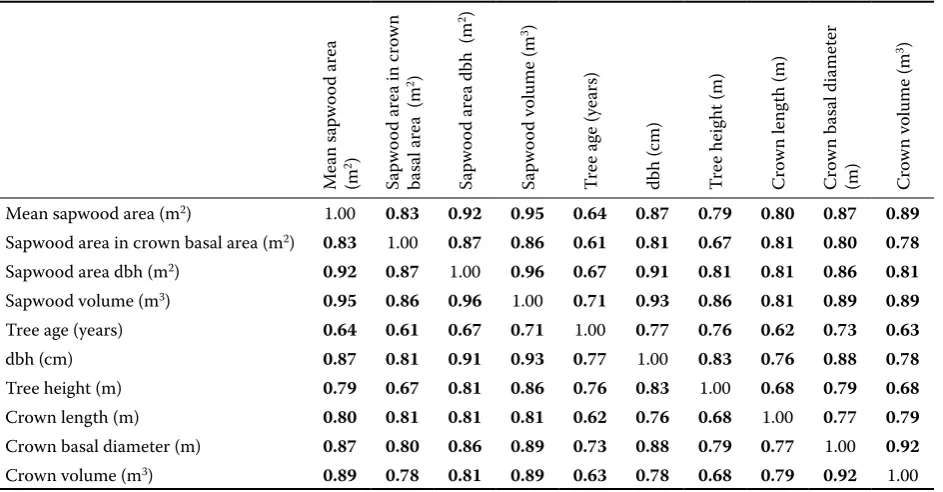
[image:4.595.64.532.665.756.2]dependence between the hydraulically conductive zone and the transpiration-assimilation part. All analyzed characters, both biometric traits and sap-wood characteristics, turned out to be significantly (P < 0.05) positively correlated (Table 3). Results confirm the hypothesis that biometric traits such as the length and basal diameter of the crown strongly correspond to the hydraulically conductive zone and are good indicators of leaf biomass.
The analysis included also the hypothesis on the invariance of quotients SA/CH, SV/CH, SA/CD and SV/CD, where SV, SA, CH and CD denote the area and volume of sapwood, and the height and diameter of the crown in relation to age classes and social classes of tree position. For this purpose a two-way analysis of variance with interaction was conducted for each of these quotients (Christensen 1987), where fac-tors were age class and social class of tree position in canopy.
[image:5.595.64.536.73.319.2]Next regression models were created for the dependence of the area and volume of sapwood on the above-mentioned biometric variables. The application of all biometric variables would highly complicate the models. In order to simplify them the existence of a dependence between the analyzed characteristics of trees was verified by standard methods, calculating liner correlation coefficients (Table 3).
All analyzed biometric characters and the area and volume of sapwood are traits of the same tree, changing
in time. It is a typical example of an allometric depend-ence (Huxley 1932; Reddy 1998), i.e. a dependdepend-ence between measurable traits of the same organism. It was found that a dependence of sapwood volume on biometric traits such as e. g. crown length is exponential and not linear (Fig. 4). The following model of multiple regression was thus assumed for sapwood volume:
Y = α X1β X
2γ (1)
where:
Y – denotes sapwood volume, X1, X2 – selected biometric variables, α, β, γ – unknown coefficients.
[image:5.595.311.526.591.747.2]After finding logarithms for both sides of the equation, the above model takes the form of a linear regression model (Seber, Wild 1989):
Table 3. A table of correlation coefficients
M
ean sa
pwo
od ar
ea
(m
2)
Sa
pwo
od ar
ea in c
row
n
ba
sal ar
ea (m
2)
Sa
pwo
od ar
ea dbh (m
2)
Sa
pwo
od volume (m
3)
Tr
ee age (ye
ars)
dbh (
cm)
Tr
ee heig
ht (m)
Cr
ow
n leng
th (m)
Cr
ow
n b
asal di
ame
ter
(m) Crow
n volume (m
3)
Mean sapwood area (m2) 1.00 0.83 0.92 0.95 0.64 0.87 0.79 0.80 0.87 0.89
Sapwood area in crown basal area (m2) 0.83 1.00 0.87 0.86 0.61 0.81 0.67 0.81 0.80 0.78
Sapwood area dbh (m2) 0.92 0.87 1.00 0.96 0.67 0.91 0.81 0.81 0.86 0.81
Sapwood volume (m3) 0.95 0.86 0.96 1.00 0.71 0.93 0.86 0.81 0.89 0.89
Tree age (years) 0.64 0.61 0.67 0.71 1.00 0.77 0.76 0.62 0.73 0.63
dbh (cm) 0.87 0.81 0.91 0.93 0.77 1.00 0.83 0.76 0.88 0.78
Tree height (m) 0.79 0.67 0.81 0.86 0.76 0.83 1.00 0.68 0.79 0.68
Crown length (m) 0.80 0.81 0.81 0.81 0.62 0.76 0.68 1.00 0.77 0.79
Crown basal diameter (m) 0.87 0.80 0.86 0.89 0.73 0.88 0.79 0.77 1.00 0.92
Crown volume (m3) 0.89 0.78 0.81 0.89 0.63 0.78 0.68 0.79 0.92 1.00
All coefficients are significantly different from zero
–2 0 2 4 6 8 10 12 14 16 0 20 40 Crown length (m)
Sa
pwo
od volume (m
3)
1.8 1.6 1.4 1.2 1.0 0.8 0.6 0.4 0.2 0.0 –0.2 40 20 0
lnY = lnα + β ln X1 + γln X2.
Such a model, with an appropriate analysis of regression, was developed for each of the analyzed social classes of tree position in the stand.
One of the postulates of the Profile Theory assumes invariability in time for the relation between the conductive zone and leaf biomass. This assumption was verified for all analyzed quotients and it was found that the relation of sapwood and biometric characters of the crown is not constant throughout the lifetime of a tree.
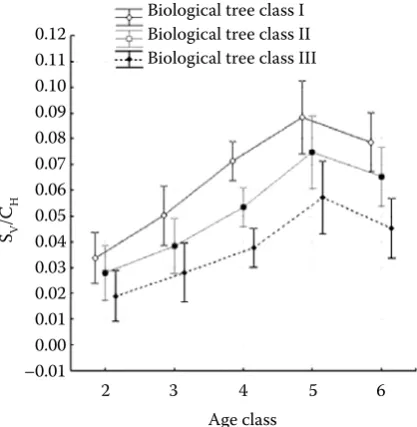
An analysis of the quotient SV/CH in terms of the age of a tree showed that in all biological classes this ratio increases with age, reaching its maximum in age class V, i.e. between 81 and 100 years, after which in age class VI (101–120 years) it decreases (Fig. 5). A similar dependence may also be found for the other ratios, i.e. SA/CH, SA/CD and SV/CD.
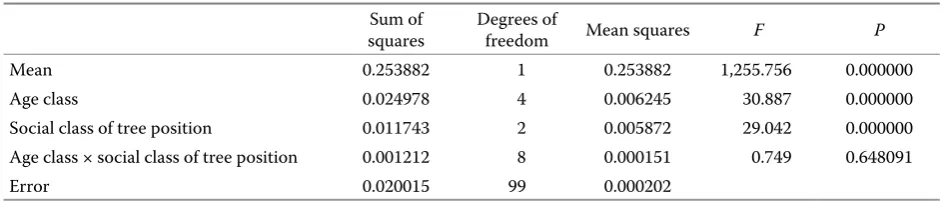
In order to determine whether the analyzed pro-portions differ significantly in different age classes and whether they are also affected by the social class of tree position in the stand, an analysis of variance was conducted on the above-mentioned two-way model with interaction. Since similar results were
[image:6.595.64.284.59.224.2]obtained in all analyzed cases, the study presents in detail an analysis of variance for the quotient SV/CH (Table 4).
It results from the above table that differences be-tween the values of the analyzed ratio in individual age classes (Fig. 5) and in individual social classes of tree position in the stand are significant (Fig. 7), while a lack of interaction between age classes and social classes of tree position indicates that the age of a tree affects the value of the ratio of SV/CH in the same way as in any social class of tree position (Fig. 7). At the same time statistically significant dif-ferences are found in the values of the analyzed ratio between all age classes.
[image:6.595.308.529.59.226.2]On the basis of the analysis it may be concluded that the coefficient SV/CH increases with the age of a tree, irrespective of its social class of tree position in the canopy. Moreover, irrespective of age, there are statistically significant differences between the values of this ratio in individual social classes of tree positions in the stand. As it results from Fig. 6, the highest values of the analyzed ratio were found for trees belonging to group I, i.e. predominant trees, while the lowest for codominant trees, i.e. class III.
Fig. 5. Mean values and confidence intervals for SV/CH in individual age classes
Fig. 6. Mean values and confidence intervals for SV/CH in individual social classes of tree position in the stand
I II III
Biological tree class
SV /CH
0.08
0.07
0.06
0.05
0.04
0.03
0.02
Table 4. Analysis of variance of the ratio SV/CH
Sum of
squares Degrees of freedom Mean squares F P
Mean 0.253882 1 0.253882 1,255.756 0.000000
Age class 0.024978 4 0.006245 30.887 0.000000
Social class of tree position 0.011743 2 0.005872 29.042 0.000000
Age class × social class of tree position 0.001212 8 0.000151 0.749 0.648091
Error 0.020015 99 0.000202
2 3 4 5 6
Age class
SV /CH
[image:6.595.62.538.656.757.2]The analyses and inference of conclusions for the other indexes (SA/CH, SA/CD, SV/CD) were performed following a similar model.
Linear correlation coefficients between biometric variables were analyzed in order to investigate a possible reduction in the number of independent variables (biometric variables) in the modelling of sapwood volume and area (Table 3).
Since all biometric traits of analyzed trees turned out to be significantly positively correlated, it is suf-ficient to select only some of them to describe sap-wood volume and area. From the theoretical point of view it is of no importance which traits are going to be selected, thus it was decided to choose those that are easiest to measure and at the same time yield a model with a good fit to observations. These are tree height (TH) and crown basal diameter (CD).
As a result of the multiple regression analysis the following linear regression equations were pro-duced.
The model of sapwood volume (SV):
Kraft class I (predominant trees)
ln(Sv) = –7.92 + 1.94 ln(TH) + 0.71 ln(CD)
where: TH – denotes tree height.
All coefficients were statistically significant. The coefficient of determination was R2 = 0.89.
Kraft class II (dominant trees)
ln(Sv) = –8.94 + 2.31 ln(TH) + 0.52 ln(CD)
All coefficients were statistically significant. The coefficient of determination was R2 = 0.87.
Kraft class III (codominant trees)
ln(Sv) = –7.81 + 1.68 ln(TH) + 0.98 ln(CD) All coefficients were statistically significant. The coefficient of determination was R2 = 0.84. The model of sapwood area (SA):
Kraft class I (predominant trees)
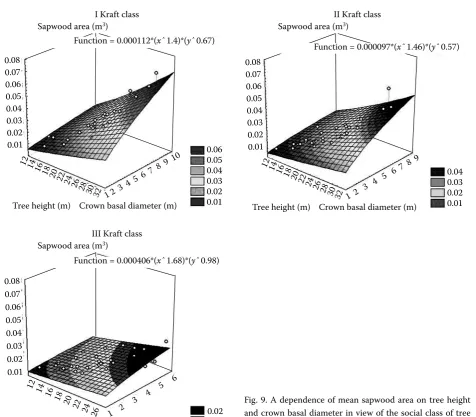
ln(SA) = –9.10 + 1.40 ln(TH) + 0.67 ln(CD) All coefficients were statistically significant. The coefficient of determination was R2 = 0.81.
Kraft class II (dominant trees)
ln(SA) = –9.24 + 1.46 ln(TH) + 0.57 ln(CD) All coefficients were statistically significant. The coefficient of determination was R2 = 0.80.
Kraft class III (codominant trees)
ln(SA) = –8.64 + 1.20 ln(TH) + 0.47 ln(CD). All coefficients were statistically significant. The
coefficient of determination was R2 = 0.67. The above equations, after being transformed to
(1), may be used to predict (model) the volume and area of sapwood in individual social classes of tree position in the stand on the basis of relatively easily measurable biometric traits (tree height, crown diameter), obviously within the range of variation of tree height and crown basal diameter investigated in this study.
These dependences, illustrated in Figs. 8 and 9, take the following forms:
Kraft class I (predominant trees)
Sv = 0.000364 TH1.94 C D0.71,
SA = 0.000112 TH 1.4 C D 0.67.
Kraft class II (dominant trees)
SV = 0.000131 TH 2.31 C D 0.52,
SA = 0.000097 TH 1.46 C D 0.57.
Kraft class III (codominant trees)
SV = 0.000406 TH 1.68 C D 0.98,
SA = 0.000177 TH 1.2 C D 0.47.
DISCUSSION
Assumptions proposed by the Pipe Model Theory
refer primarily to the estimation of leaf biomass on the basis of the conductive area in the xylem (sapwood), resulting from a constant, relatively high dependence between these variables. However, in the literature on the subject there is a shortage of more compre-hensive analyses which would make it possible to use the principal theses of the Pipe Model Theory to
2 3 4 5 6
Age class
SV /CH
0.12 0.11 0.10 0.09 0.08 0.07 0.06 0.05 0.04 0.03 0.02 0.01 0.00 –0.01
[image:7.595.73.282.64.278.2]Biological tree class I Biological tree class II Biological tree class III
estimate the area and volume of the conductive zone in the stem on the basis of secondary leaf biomass indexes, i.e. biometric traits of the tree crown. Such characteristics as the length and width of the crown according to Cienciala et al. (2006) are good leaf biomass indicators. This hypothesis is confirmed by the conducted investigations. High, statistically sig-nificant dependences described by regression equa-tions were recorded between the volume and area of sapwood in stems and biometric characters of trees such as dbh, tree height, the diameter and length of the crown. Thus it was assumed that biometric pa-rameters of the crown may be used to describe the area and volume of active pipes (sapwood).
If the assumptions of the pipe model theory and the profile theory are correct, then the analyzed correlations may constitute the basis not only for the creation of the model of crown growth alloca-tion (Osawa et al. 1991; Mäkelä, Vanninen 2001)
but also for the modelling of sapwood volume and area in tree stems on the basis of easily measurable biometric traits such as tree height, the diameter or length of the crown.
Postulates proposed by the Pipe Model Theory and the Profile Theory seem justified and partly coincide with the results of this study. However, certain modi-fications are required, connected first of all with the growth and development conditions of trees and stands undergoing successive development stages.
If the estimation of sapwood area and volume on the basis of secondary leaf biomass indexes is cor-rect and corresponds with the Pipe Model Theory
[image:8.595.70.287.284.480.2]and the Profile Theory to some extent (Robichaud, Methven 1992), then there are no constant propor-tions, unchanging in time, between hydraulically conductive pipes and leaf biomass manifested by biometric characteristics of the crown in this case. Statistically significant differences were recorded
Fig. 8. A dependence of sapwood volume on tree height and crown basal diameter in view of the social class of tree posi-tion in the community
1.0 0.8 0.6 0.4 0.2 I Kraft class
Sapwood volume (m3)
1.2 1.0 0.8 0.6 0.4 0.2
Tree height (m) Crown basal diameter (m)
12 14 16 18 20 22
24 26 28 30 32 2 3 4 5 6 7 8 9 10
Function = 0.000364*(xˆ 1.94)*(yˆ 0.71)
1.8 1.6 1.4 1.2 1.0 0.8 0.6 0.4 0.2
II Kraft class Sapwood volume (m3)
Tree height (m) Crown basal diameter (m)
1 2 3 4 5 6 7 8 9
12 14 16 18 20 22
24 26 28 30
1.0 0.8 0.6 0.4 0.2 Function = 0.000131*(xˆ 2.31)*(yˆ 0.52)
III Kraft class Sapwood volume (m3)
1.8 1.6 1.4 1.2 1.0 0.8 0.6 0.4 0.2
Tree height (m) Crown basal diameter (m)
0.7 0.6 0.5 0.4 0.3 0.2 0.1
10 12 14 16 18 20
22 24 2628 1 2 3 4 5 6
between adopted age classes and social classes of tree position in the ratio of sapwood area and volume to crown length and width. Thus these dependences and interactions between the conductive zone and the tree crown need to be considered separately, de-pending on the age of a tree and the occupied social class of tree position in the stand.
It was also observed that values of the analyzed ratios (SA/CH, SA/CD and SV/CD) are statistically sig-nificantly different in different age classes and they increase with age, only to drop rapidly after reaching the age of approximately 100 years (Fig. 10). This trend pertains to all investigated social classes of tree position and might be connected with the process of tree aging, in which first the genome is disturbed and next cell walls are destroyed and many enzymes become inactivated.
It may be assumed that in old pines (over 100 years old) changes occur in the dynamics of heartwood
formation, which leads to a general deterioration of metabolic efficiency and acceleration of aging proc-esses. In this stage the efficiency of the uptake of water with minerals decreases and problems occur with their transport as well as with the transport of assimilates. The accumulation of certain metabo-lites and degradation products is accompanied by a disruption of hormonal balance e.g. in favour of growth inhibitors. A reduced rate of metabolic proc-esses affects the transpirational productivity of the assimilatory apparatus, as a result of which the rela-tively large crown is not probably capable of pulling the column of water up such a wide zone of active pipes as it is the case in younger trees. Moreover, in older trees large losses of energy are suffered at their considerable height in order to support the transport from roots to the tree top and vice versa.
[image:9.595.60.537.49.466.2]This suggests that the size of the crown is closely related not only with the area of sapwood itself or
Fig. 9. A dependence of mean sapwood area on tree height and crown basal diameter in view of the social class of tree position in the community
I Kraft class Sapwood area (m3)
0.08 0.07 0.06 0.05 0.04 0.03 0.02
0.01 0.06
0.05 0.04 0.03 0.02 0.01 Tree height (m) Crown basal diameter (m)
12 14 16 18 20 22
24 26 28 30 32 1 2 3 4 5 6 7 8 9 10
Function = 0.000112*(xˆ 1.4)*(yˆ 0.67)
II Kraft class Sapwood area (m3)
Tree height (m) Crown basal diameter (m)
0.04 0.03 0.02 0.01
0.08 0.07 0.06 0.05 0.04 0.03 0.02 0.01
12 14 16 18 20 22
24 26 28 30 32 1 2 3 4 5 6 7 8 9
Function = 0.000097*(xˆ 1.46)*(yˆ 0.57)
III Kraft class Sapwood area (m3)
0.08 0.07 0.06 0.05 0.04 0.03 0.02 0.01
Tree height (m) Crown basal diameter (m)
0.02 0.01
12 14 16
18 20 22 24 26 1 2 3 4 5 6
the volume of active pipes but also with the height of the tree.
Conducted analyses indicate that in older trees a relatively smaller crown falls per unit of sapwood area or volume of active pipes than in the younger development phases. This probably results from the fact that the growth rate of trees decreases with age. The productivity of the stand also deteriorates (Zaehle 2005), which is a consequence of the reduc-tion in the hydraulic conductivity of sapwood as a re-sult of growth (increment) in height of trees (Ryan, Yoder 1997). This phenomenon may be explained, among other things, by the increasing resistance of water transport with the height of the tree as a result of friction forces (Whitehead, Hinckley 1991). Moreover, in trees at later stages of ontogen-esis a portion of sapwood is probably excluded from conduction processes and may not be considered equivalent to hydraulically active pipes (Mäkelä, Vanninen 2001).
Since water in plants, apart from other functions, serves also the role of a cooling agent (Mohr, Schopfer 1995), it seems justified that the water flow is rather fast in trees of considerable height (predominant trees) with large crowns. Thus, the hy-draulically conductive area has to be highly efficient, and in relation with this also relatively small, so that the column of water may be pulled to considerable heights promptly and with no risk of cavitation. This is a manifestation of the fact that the size of the zone conducting water and minerals exponentially follows the leaf biomass defined by the length and diameter of the tree crown (Fig. 4).
Thus, it cannot be stated unambiguously that the tree height has no effect on the relations between active pipes and the assimilation and transpiration apparatus. This is manifested e.g. by the strong curvi-linear relationship between sapwood, tree height and biometric characters of the crown (Figs. 8 and 9).
By gradual exclusion of the sapwood zone from conduction, in order to maintain the hydraulically conductive area – varying in time – the tree controls the heartwood formation process so that constant homeostasis is maintained between the analyzed dependences.
According to Zimmermann (1983), embolism is an impulse for the formation of heartwood as one of the factors controlling the area of active pipes, thus the ratio between heartwood and sapwood is fre-quently identified with the Pipe Model Theory. This suggests that for a tree with similar dimensions the share of heartwood in the stem in favour of sapwood should be smaller in trees with large crowns (Björk-lund 1999). This would mean that the process of heartwood formation, i.e. the reduction in the area of physiologically active pipes, remains in the state of dynamic equilibrium between the conductive capac-ity determined by the qualcapac-ity of tracheid elements and the transpiration productivity of the crown.
This was confirmed by the study of Nylinder (1961), who stated that the percentage of heartwood in Scots pine decreased with an increase in the length of the live crown and an increase in the widths of the last ten diameter growths. Moreover, according to the results reported by Sellin (1993), the sapwood zone may be much wider in dominant trees than in suppressed trees, and its width is connected with the growth rate of the tree.
This seems to be significantly probable. It was ob-served that between the trees belonging to different social classes of tree position in the stand there are statistically significant differences in the relations between sapwood and the crown. Thus, codominant trees, in relation to the predominant group in the tree community, have a statistically significantly lower ratio of sapwood volume to the height of the crown (SV/CH) (Fig. 11). Similar differences are found bet-ween all analyzed ratios (SA/CH, SA/CD and SV/CD).
-0.01 0.01 0.03 0.05 0.07 0.09
II III IV V VI
Age class
SV
/C
[image:10.595.63.285.586.729.2]H
[image:10.595.306.516.590.725.2]Fig. 10. The SV/CH ratio in terms of age class (results are sig-nificant at P ≤ 0.5)
Fig. 11. The SV/CH ratios in terms of social class of tree position in the stand (results are significant at P ≤ 0.5)
0.00 0.02 0.04 0.06 0.08 0.10
I II III
Kraft class
SV
/C
H
SV /CH
SV /CH
This indicates that the relative sapwood area or vol-ume is supported by a larger relative crown unit in codominant trees than in predominant trees.
Trees belonging to the lower social classes of tree position in the community are probably less produc-tive in terms of crown transpiration, which results from their vertical and horizontal position in the canopy. Crowns of these trees have a limited access to factors significantly affecting the course and rate of transpiration, i.e. light and wind. Since the water potential gradient inside the plant depends, among other things, on the susceptibility of the plant to water availability and groundwater level (Reyes-Santamar’ia et al. 2002), another factor possibly affecting the sapwood-to-crown ratio is soil water availability, lower for codominant trees in com-parison with predominant trees. The availability of water for trees is also determined by the fertility of the forest site; however, it may be assumed that the analyzed dependences and proportions will exhibit similar trends within the social classes of trees, ir-respective of trophic conditions.
The correlations and relationships analyzed in this study are probably determined simultaneously by whole sets of factors modifying the growth and de-velopment conditions of individual trees and entire forest biocoenoses, the effect of which is obviously impossible or at least extremely difficult to follow at this stage of investigations. Conducted analyses showed that based on the patterns described above it is possible to model the volume and area of sapwood in stems of growing trees, without need to apply invasive methods.
CONCLUSION
Results of this study show that the relationship between the investigated biometric characteristics of the crown and the xylem conductive volume and area (sapwood) is of curvilinear character. It may be assumed that the power and nature of the discussed relationships are determined by many factors, in-cluding the hydraulic conductivity of the conductive zone, the volume and efficiency of transpiration or-gans, the height and age of trees, the set of individual characters as well as individual adaptability.
Statistically significant differences were found between the analyzed social classes of tree position and age classes (within the adopted 20-year inter-vals) in terms of relationships between the biometric characters of the crown and the area and volume of sapwood.
On the basis of the trend observed for the analyzed ratios (SA/CH, SA/CD, SV/CH and SV/CD) in view of the
age and social position of trees in the stand it may be assumed that with the transition of the stand into the terminal phase a portion of sapwood is excluded from the conduction process and may not be identi-fied with the hydraulically conductive part of active pipes.
Performed analyses indicated that the postulates proposed by the Pipe Model Theory and the Profile Theory require certain modifications, which would take into account social classes of tree position within the stand and its development stage.
It was proposed in this study to model the area and volume of sapwood in pine stems using models of multiple regression, separately for each of the three investigated social classes of tree position. Easily measurable on site, biometric characteristics of the tree, changing in time, i.e. its height and crown basal diameter, were used to model the values of these variables.
References
ALBREKTSON A., 1980. Relations between tree biomass fractions and conventional silvicultural measurements. In: PERSSON T. (ed.), Structure and function of northern coniferous forest – an ecosystem study. Ecological Bulletin (Stockholm): 15–327.
ALBREKTSON A., 1984. Sapwood basal area and needle mass of Scots pine (Pinus sylvestris L.) trees in Central Sweden. Forestry, 57: 35–43.
BERNINGER F., NIKINMAA E., 1994. Foliage area – sapwood area relationships of Scots pine (Pinus sylvestris) trees in different climates. Canadian Journal of Forest Research,
24: 2263–2268.
BERNINGER F., COLL L., VANNINEN P., MÄKELÄ A., PALMROTH S., NIKINMAA E., 2005. Effects of tree size and position on pipe model ratios in Scots pine. Canadian Journal of Forest Research, 35: 1294–1304.
BJÖRKLUND L., 1999. Identifying heartwood-rich stands or stems of Pinus sylvestris by using inventory data. Silva Fennica, 33: 119–129.
BURGER H., 1929. Holz, Blattmenge und Zuwachs. 1. Mit-teilung: Die Weimouthsföhre. Mittelungen Eidgenössische Anstalt für das forstliche Versuchswesen, 15: 243–292. BURGER H., 1937. Kronenuntersuchungen. Schweizerische
Zeitschrift für Forstwesen, 88: 44–49.
CHRISTENSEN R., 1987. Plane answers to complex questions. The theory of linear models. Biometrics, 53: 1564. CIENCIALA E., ČERNÝ M., TATARINOV F., APLTAUER
J., EXNEROVÁ Z., 2006. Biomass functions applicable to Scots pine. Trees, 20: 483–495.
GROCHOWSKI J., 1973. Dendrometria. [Dendrometry.] Warszawa, PWRiL.
HUXLEY J.S., 1932. Problems of Relative Growth. New York, Mac Veagh.
KRAFT G., 1884. Beiträge zur Lehre von den Durchforstun-gen, Schlagstellungen und Lichtungshieben. Hannover, Klindworth’s: 26.
LEMKE J., 1966. Korona jako jedno z kryteriów wyboru drzew próbnych przy oznaczaniu bieżącego przyrostu miąższości drzewostanu. Folia Forestalia Polonica, (A), 12: 237–247. MARCHAND P.J., 1983. Sapwood area as estimator of
biomass and projected leaf area for Abies balsamea and
Picea rubens. Canadian Journal of Forest Research, 14: 85–87.
MARKS P.L., 1974. The role of pin cherry (Prunus pensyl-vanica L.) in the maintenance of stability in northern hard-wood ecosystems. Ecological Society of America, Ecological Monographs, 44: 73–88.
McCULLOH K.A., SPERRY J.S., 2005. Patterns in hydraulic architecture and their implications for transport. Tree Physiology, 25: 257–267.
McDOWELL N.G., PHILLIPS N., LUNCH C., BOND B.J., RYAN M.G., 2002. An investigation of hydraulic limita-tion and compensalimita-tion in large, old Douglas-fir trees. Tree Physiology, 22: 763–774.
MELCHER P., ZWIENIECKI M., HOLBROOK N., 2003. Vul-nerability of xylem vessels to cavitation in Acer saccharum
(Marsh.): scaling from individual vessels to whole branches. Plant Physiology, 131: 1775–1780.
MENCUCCINI M., GRACE J., 1996. Hydraulic conduct-ance, light interception and needle nutrient concentration in Scots pine stands and their relations with net primary productivity. Tree Physiology, 16: 459–468.
MOHR H., SCHOPFER P., 1995. Plant Physiology. Berlin, Heidelberg, New York, Springer-Verlag.
MOHLER C.L., MARKS P.L., SPRUGEL D.G., 1978. Stand structure and allometry of trees during self-thinning of pure stands. Journal of Ecology, 66: 599–614.
MÄKELÄ A., 2002. Derivation of stem taper from the pipe theory in a carbon balance framework. Tree Physiology,
22: 891–905.
MÄKELÄ A., ALBREKTSON A., 1992. An analysis of the relationship between foliage biomass and crown surface area in Pinus sylvestris in Sweden. Scandinavian Journal of Forest Research, 7: 297–307.
MÄKELÄ A., VANNINEN P., 2001. Vertical structure of Scots pine crowns in different age and size classes. Trees,
15: 385–392.
NIKINMAA E., 1992. Analyses of the growth of Scots pine; matching structure with function. Acta Forestalia Fennica, 235: 168.
NOBEL P.S., 1999. Physicochemical & Environmental Plant Physiology. San Diego, Academic Press,Elsevier: 373–402.
NYLINDER P., 1961. Influence of tree features and wood properties on basic density and bouyancy. I Scots pine. Report 35. Department of Forest Products. Royal College of Forestry, Stockholm, Sweden: 36. (In Swedish with English summary.)
OSAWA A., ISHIZUKA M., KANAZAWA Y., 1991. A pro-file theory of tree. Forest Ecology and Management, 41: 33–63.
PRETZSCH H., 2001. Modellierung des Waldwachstums. Berlin, Parey Buchverlag.
REDDY V.R., 1998. Alometric relationships in field-grown soyabean. Annals of Botany, 82: 125–131.
REYES-SANTAMAR´IA I., TERRAZAS T., BARRIENTOS-PRIEGO A.F., TREJO C., 2002. Xylem conductivity and vulnerability in cultivars and races of avocado. Scientia Horticulturae, 92: 97–105.
ROBICHAUD R., METHVEN I.R., 1992. The applicability of the pipe model theory for type prediction of foliage biomass in trees from natural, untreated black spruce stand. Cana-dian Journal of Forest Research,22: 1118–1123.
RYAN M.G., YODER B.J., 1997. Hydraulic limits to tree height and tree growth. Bioscience, 47: 235–242.
RYAN M.G., BOND B.J., LAW B.E., HUBBARD R.M., WOODRUFF D., CIENCIALA E., KUČERA J., 2000. Tran-spiration and whole-tree conductance in ponderosa pine trees of different heights. Oecologia, 124: 553–560. SEBER G.A.F., WILD C.J., 1989. Nonlinear Regression. New
York, Wiley.
SELLIN A., 1993. Sapwood-heartwood proportion related to tree diameter, age, and growth rate in Picea abies. Canadian Journal of Forest Research, 24: 1022–1028.
SHINOZAKI K., YODA K., HOZUMI K., KIRA T., 1964a. A quantitative analysis of plant from: the pipe model theory. I. Basic analyses. Japanese Journal of Ecology, 14: 97–105. SHINOZAKI K., YODA K., HOZUMI K., KIRA T., 1964b. A
quantitative analysis of plant form: the pipe model theory. II. Further evidence of the theory and its application in forest ecology. Japanese Journal of Ecology, 14: 133–139. SPERRY J.S., STILLER V., HACKE U., 2003. Xylem
hy-draulics and the soil – plant – atmosphere continuum: opportunities and unresolved issues. Agronomy Journal,
95: 1362–1370.
THOMPSON D.C., 1989. The effect of stand structure and stand density on the leaf area – sapwood area relationship of lodge pole pine. Canadian Journal of Forest Research, 19: 392–396.
TYREE M., SPERRY J., 1989. Vulnerability of xylem to cavita-tion and embolism. Annual Review of Plant Physiology and Plant Molecular Biology, 40: 19–38.
TYREE M.T., EWERS F.W., 1991. The hydraulic architec-ture of trees and other woody plants. New Phytology, 19: 345–360.
VANNINEN P., YLITALO H., SIEVÄNEN R., MÄKELÄ A., 1996. Effects of age and site quality on the distribution of biomass in Scots pine. Trees, 10: 231–238.
WARING R.H., SCHROEDER P.E., OREN R., 1982. Applica-tion of the pipe model theory to predict canopy leaf area.
Canadian Journal of Forest Research,12: 556–560. WHITEHEAD D., 1978. The estimation of foliage area from
sapwood basal area in Scots pine. Forestry, 51: 137–149. WHITEHEAD D., HINCKLEY T.M., 1991. Models of water
flux through forest stands: critical leaf and stand param-eters. Tree Physiology, 9: 35–57.
WHITEHEAD D., EDWARDS W.R.N., JARVIS G., 1984. Conducting sapwood area, foliage area, and permeability in mature trees of Picea sitchensis and Pinus contorta. Ca-nadian Journal of Forest Research,14: 940–947.
YANG S., TYREE M.T., 1993. Hydraulic resistance in Acer saccharum shoots and its influence on leaf water potential and transpiration.Tree Physiology, 12: 231–242.
YANG S., TYREE M.T., 1994. Hydraulic architecture of Acer saccharum and A. rubrum: comparison of branches to whole trees and the contribution of leaves to hydraulic resistance. Journal of Experimental Botany, 45: 179–186.
YUKIHIRO C., 1998. Architectural analysis of relationship between biomass and basal area based on pipe model theory. Ecological Modelling, 108: 219–225.
ZAEHLE S., 2005. Effect of height on tree hydraulic con-ductance incompletely compensated by xylem tapering. Functional Ecology, 19: 359–364.
ZIMMERMANN M.H., 1983. Xylem Structure and the Ascent of Sap. Berlin, Springer-Verlag.
Received for publication March 31, 2008 Accepted after corrections April 28, 2008
Corresponding author:
Ph.D. Tomasz Jelonek, University of Life Sciences in Poznań, Department of Forest Utilisation, Wojska Polskiego 71A St, 60-625 Poznań, Poland
tel.: + 48 61 848 7754, fax: + 48 61 848 7755, e-mail: [email protected]
Aplikovatelnost teorie „dopravní kapacity kmene“ na borovice v Polsku
ABSTRAKT: Cílem příspěvku je posoudit možnost aplikace teorie „dopravní kapacity” běle kmenů borovic. Celkem bylo smýceno 114 kmenů borovice na třech lokalitách v severním a západním Polsku. Analyzované kmeny patřily do hlavní korunové úrovně porostu (k prvním třem stromovým třídám ve smyslu Krafta). U každého kmene byly zjišťo-vány následující parametry: výška stromu, výčetní tloušťka, délka koruny, výčetní kruhová základna kmene v místě základu koruny a plocha a objem běle kmene. Výsledky ukazují, že biometrická data a údaje o běli jsou signifikant-ně (P < 0,05) pozitivsignifikant-ně korelovány. Provedené analýzy ukazují na to, že teorie „dopravní kapacity kmene“ a teorie „dostatečné vodivosti profilu“ vyžadují určité modifikace. Vytvoření regresních modelů pro každou stromovou třídu ve vztahu k ploše běle a objemu k uvedeným biometrickým veličinám nepřímo zahrnuje i změny v čase.