City, University of London Institutional Repository
Citation
:
Dattani, N., Datta-Nemdharry, P. and Macfarlane, A. J. (2012). Linking maternity data for England 2007: methods and data quality. Health Statistics Quarterly, 53, pp. 4-21.This is the unspecified version of the paper.
This version of the publication may differ from the final published
version.
Permanent repository link:
http://openaccess.city.ac.uk/1061/Link to published version
:
Copyright and reuse:
City Research Online aims to make research
outputs of City, University of London available to a wider audience.
Copyright and Moral Rights remain with the author(s) and/or copyright
holders. URLs from City Research Online may be freely distributed and
linked to.
City Research Online: http://openaccess.city.ac.uk/ [email protected]
Office for National Statistics 1
Linking maternity data for England
2007: methods and data quality
Nirupa Dattani, Preeti Datta-Nemdharry and Alison Macfarlane City University London
(School of Health Sciences)
Abstract
Background
Maternity Hospital Episode Statistics (HES) data for 2007 were linked to birth registration and NHS Numbers for Babies (NN4B) data to bring together some key demographic and clinical data items not otherwise available at a national level. This extended the time period 2005–06, for which data had previously been linked and reported.
Methods
Birth registration and NN4B records were linked to Maternity HES delivery records and also to Maternity HES baby records using the NHS Number when available. Other direct identifiers were used if the NHS Number was missing.
Data quality and completeness of Maternity HES were assessed in relation to birth registration data wherever possible. For information not collected at registration, NN4B data were used to validate the quality of Maternity HES.
Results
Overall, 93 per cent of Maternity HES delivery records could be linked to the birth registration/NHS Numbers for Babies records and 80 per cent of Maternity HES baby records were linked to these.
Two per cent of Maternity HES records had the mother’s NHS number missing compared with 22 per cent in the NN4B dataset. This did not reflect the extent to which other
Maternity HES data items were missing or inconsistent between the two data sets.
Office for National Statistics 2 Although NN4B records the ethnic category of the baby, as defined by the mother and Maternity HES records mother’s ethnic category, 75 per cent of the linked records had the same ethnic group recorded for the mother and her baby.
Conclusion
s
Office for National Statistics 3
Contents
Abstract...1
Introduction...4
Methods...5
Results...6
Discussion...12
Conclusion...14
Acknowledgement...14
References...16
Appendix A...17
List of Tables
Table 1 Number of linked records for singleton births with missing data items in common data fields, 2007...8Table 2 Comparison of plurality between birth registration and Maternity HES, 2007...8
Table 3 Comparison of live/ still birth status for singletons between birth registration and Maternity HES, 2007...9
Table 4 Comparison of sex for singletons in the linked records using birth registration and Maternity HES, 2007...9
Table 5 Comparison of birth weight distribution in the linked records using birth registration and maternity HES for singletons, 2007...11
Table A1 Comparison of gestational age in linked records using NHS numbers for babies and maternity HES for all births, 2007...17
Office for National Statistics 4
Introduction
The data recorded at birth registration are mainly socio-demographic: such as names, address of the mother’s and father’s usual place of residence, place of birth, occupations of the parents and dates of birth of the mother and baby (Office for National Statistics publication, DH3). As a result some key items needed for demographic and clinical purposes are not available at a national level. The opportunity to obtain gestational age and ethnicity data nationally resulted from the introduction of the NHS Numbers for Babies (NN4B) Service in 2002. This service collects a small dataset which contains key items which are not recorded at birth registration. Information on gestational age at birth is of key importance as babies born preterm, before 37 completed weeks of gestation, are at particularly high risk of morbidity and mortality in early years of life (Brocklehurst P, 1999; ISD Scotland report 2004; Confidential Enquiry into Maternal and Child Health, 2004).
Clinical information on maternity care at delivery could be obtained only from the Maternity Hospital Episode Statistics (HES) dataset for births that occurred in England and from the Community Child Health database (CHD) and Patient Episode Database for Wales (PEDW) for births that occurred in Wales.
Therefore a collaborative project was set up in 2004 between City University London, the Office for National Statistics (ONS) and the then Welsh Assembly Government to link these datasets for all births that occurred in England and Wales from 2005 to 2007. Stage 1 of the project involved linkage of birth registration data with NN4B dataset and assessment of data quality and
completeness of the NN4B data. This is reported elsewhere (Hilder et al., 2007; Moser K and
Hilder L, 2008).
Stage 2 of the project involved linkage of the linked dataset for the years 2005 and 2006, created in stage 1, to Maternity HES and assessment of data quality and completeness by comparison with birth registration or NN4B, where possible. At the time, 2007 birth registration-NN4B linked data were not available. Therefore these data were linked to Maternity HES and corresponding Welsh records at a later date using the experience gained in linking the first two years’ data. The article published earlier describes details of the method used for linkage to Maternity HES records (Dattani et al., 2011). This article reports on quality and completeness of the 2007 linked
data. The Welsh linkage for all three years, 2005–07, will be reported separately.
Linkage of data for further years and access to the 2005–07 linked data for other projects will involve seeking approval from the ethics and permission from the National Information
Governance Board to access individual patient identifiable records and securing new funding.
Several data items are common to all three data sources (Maternity HES, birth registration and NHS Numbers for Babies) as shown in Box 1. In addition, some data items are unique to each data source and linkage is enabling new analyses using these linked data. For example, it is now possible to analyse caesarean section rates by the father’s socio-economic classification,
Office for National Statistics 5
Box 1
Availability of selected data items from birth registration,
NN4B and Maternity HES
Data sources
Data items Birth
registration NN4B Maternity HES
Baby’s NHS number Mother’s NHS number Birth date of baby Delivery time Birth weight Gestational age (still birth) Gestational age (live birth) Sex of baby Number of babies born Live or still birth Parity (all births) Baby/mother’s postcode of usual residence Ethnic category of baby Ethnic category of mother Country of birth of mother Country of birth of father Father’s socio-economic status Type of delivery place
Mother’s date of birth Marital status of mother Method of delivery Complications in pregnancy
+ + + + + + + + + + + + + + + + + + + + + + + + + + + + + + + + + + + + + + + + + + + +
Methods
Details of the source data: birth registration, NHS Numbers for Babies and Maternity Hospital Episode Statistics (HES) can be found in the earlier article in Health Statistics Quarterly 49 describing the linkage of data for 2005 and 2006 (Dattani et al., 2011).
Record linkage
Record linkage was carried out by Northgate Solutions, which processes HES records under contract with the NHS Information Centre. The linkage algorithm previously compiled for 2005 and 2006 data was used, but the program was slightly amended to ensure that only one HES record was linked to each registration-NN4B linked record (Dattani et al., 2011).
Office for National Statistics 6 baby records in HES. These were accessed by researchers from City University London in the secure environment of the Virtual Microdata Laboratory (VML) facilities at ONS. Outputs of analyses undertaken in the VML were released by ONS in the form of disclosure controlled tables.
Data Quality
The review of the quality of Maternity HES was focussed on the completeness and consistency of the HES data, in relation to birth registration data where possible. Since all babies born in
England and Wales have to be registered, information collected at registration is subject to quality checks (Office for National Statistics, series DH3). However, where information was not available from registration, NN4B data were used to validate the quality of Maternity HES. The quality of the NN4B data in comparison to birth registration data is reported elsewhere (Moser et al., 2008)
The completeness of the main data items in all three sources was measured by identifying the extent to which data were missing.
The linked data for the mother’s file was split into singleton and multiple births, using the multiple birth status field from registration, to facilitate the assessment of data quality. In some instances the results are reported separately.
Data analyses were carried out using SAS version 9 and SPSS version 16 software products.
Results
Mother file
The Maternity HES record is a mother-based record containing the mother’s details in the core record. A maternity ‘tail’ and a baby ‘tail’, which can accommodate up to nine babies born in one maternity, are appended to the core record. In contrast, the registration and NN4B linked data consists of one record per baby. Therefore, the linkage was based on baby to mother records.
Northgate solutions returned 630,409 records that had linked to the registration and NN4B linked data. These included some multiple records for the same mother for each episode. Records with the most complete information were selected to ensure one to one linkage to the registration and NN4B linked dataset. This gave a file of 615,239 records.
In the registration and NN4B linked data file, there were 659,061 records for babies who were either born in England or resident in England. The resident in England category was used for births recorded as occurring at home in the registration and NN4B linked data.
Around 73 per cent of the linked registration and NN4B records were linked to Maternity HES records using the mother’s NHS number and her partial date of birth. A further 20 per cent of the linked registration and NN4B records were matched to Maternity HES using the mother’s
Office for National Statistics 7
Baby file
The linkage to the baby file was much more straightforward than to the mother file as it involved one to one linkage between baby records in registration and NN4B linked data, and in Maternity HES.
A total of 667,893 HES baby records were linked to registration and NN4B linked data by Northgate solutions. This included multiple HES birth records for the same baby linked to a registration and NN4B linked record. Again only records with the fullest information were kept and others were deleted. After deletion, 552,398 records remained.
In the 2007 registration and NN4B linked data there were 659,061 records for babies who were either born in England or resident in England. Of these, 541,677 registration and NN4B linked records were linked to HES baby records using the NHS number, partial date of birth and sex, and 7,010 were linked using the baby’s date of birth, postcode and sex. Over 16 per cent of registration and NN4B linked records could not be linked to HES baby records. Overall 552,313 of the 659,061 records were linked, giving a linkage rate of 83.8 per cent.
Data Quality
For HES, the extent to which data were missing or discordant was assessed only in the mother’s records as these included information on the baby and also because the linkage rate was far better than for the baby records. For multiple births, information was recorded only for the first baby. Data on other babies was either missing or the same as the first baby, suggesting there were problems in the linkage process in HES. Hence singleton and multiple births were analysed separately and only results for singletons are reported here.
Missing data
The mother’s NHS number is recorded only on the NN4B record and not recorded at birth
Office for National Statistics 8
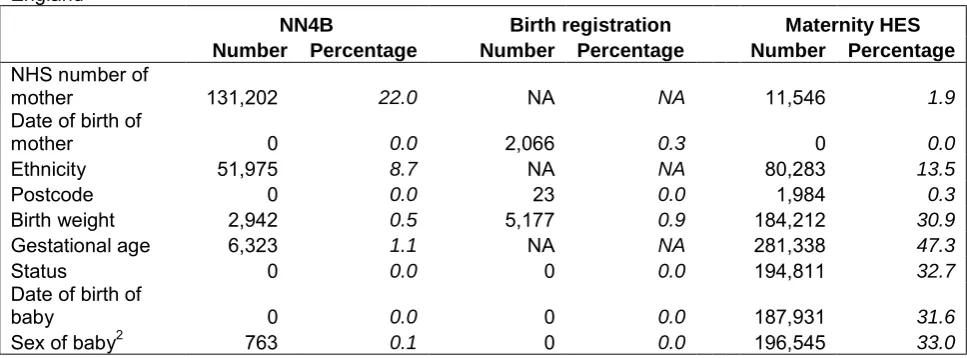
Table 1 Number of linked records
1for singleton births with missing
data items in common data fields, 2007
England
NN4B Birth registration Maternity HES
Number Percentage Number Percentage Number Percentage
NHS number of
mother 131,202 22.0 NA NA 11,546 1.9
Date of birth of
mother 0 0.0 2,066 0.3 0 0.0
Ethnicity 51,975 8.7 NA NA 80,283 13.5
Postcode 0 0.0 23 0.0 1,984 0.3
Birth weight 2,942 0.5 5,177 0.9 184,212 30.9
Gestational age 6,323 1.1 NA NA 281,338 47.3
Status 0 0.0 0 0.0 194,811 32.7
Date of birth of
baby 0 0.0 0 0.0 187,931 31.6
Sex of baby2 763 0.1 0 0.0 196,545 33.0
1. Out of 595,371 singletons
2. Includes 763 cases with indeterminate sex in NN4B and in Maternity HES 368 cases with indeterminate sex, 66 cases coded to 4 and 5 cases coded to 5,7 and 8.
Source: HES, registration and NHS numbers for Babies
Discordances in the data
Discordance in common individual data items
Discordance in each of the common data fields in the linked records was assessed using
information from birth registration rather than NN4B. Where data items were not recorded at birth registration, NN4B data were used.
Discordance in multiple birth status
[image:9.595.56.540.118.297.2]There were 14,274 records identified as relating to multiple births in birth registration and Maternity HES. Multiple birth status was discordant between the two data sources in 3,205 records (Table 2).
Table 2
Comparison of plurality between birth registration and
Maternity HES, 2007
England
Birth registration
Year Maternity HES Singleton Multiple Total
2007 Singletons 464,464 524 464,988
Multiple 2,681 14,274 16,955
Not stated 128,226 4,200 132,426
Total 595,371 18,998 614,369
Office for National Statistics 9 Discordance in live or still birth status
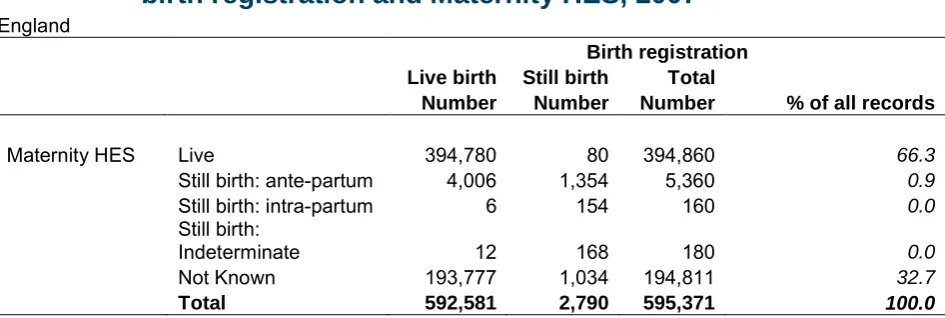
[image:10.595.58.531.185.344.2]For the records which had a stated live or still birth status in both data sources, one per cent of the records disagreed on birth status (Table 3). Around 33 per cent of linked Maternity HES records had no information on birth status.
Table 3
Comparison of live/ still birth status for singletons between
birth registration and Maternity HES, 2007
England
Birth registration
Live birth Still birth Total
Number Number Number % of all records
Maternity HES Live 394,780 80 394,860 66.3
Still birth: ante-partum 4,006 1,354 5,360 0.9
Still birth: intra-partum 6 154 160 0.0
Still birth: Indeterminate 12 168 180 0.0
Not Known 193,777 1,034 194,811 32.7
Total 592,581 2,790 595,371 100.0
Source: HES and registration
Discordance in baby’s sex
The sex of the baby recorded on birth registration for singleton births was compared with
Maternity HES. Where the baby’s sex was recorded in both data sources, an agreement of 98 per cent was observed (Table 4). Sex was indeterminate in 763 in NN4B records and 368 cases in Maternity HES. In the latter, sex was coded to unspecified codes in 71 cases (as shown in the footnote in Table 4).
Table 4
Comparison of sex for singletons in the linked records using
birth registration and Maternity HES, 2007
England
Birth registration
Male Female Total % of total
Maternity HES1 Male 201,224 1,806 203,030 34.1
Female 4,209 191,587 195,796 32.9
Not stated 101,062 95,483 196,545 33.0
Total 306,495 288,876 595,371 100.0
1. Includes 368 cases with indeterminate sex, 66 cases coded to 4 and 5 cases coded to 5,7 and 8.
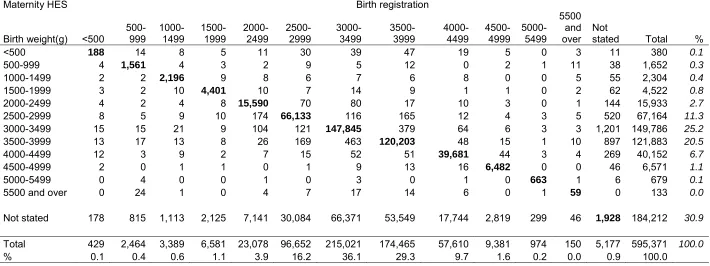
Office for National Statistics 10 Where birth weight was recorded, there was good concordance between Maternity HES and birth registration. In Maternity HES, birth weight was missing in a third of the records, however,
Office for National Statistics 11 England
Maternity HES Birth registration
Birth weight(g) <500 500-999 1000-1499 1500-1999 2000-2499 2500-2999 3000-3499 3500-3999 4000-4499 4500-4999 5000-5499
5500 and
over Not stated Total %
<500 188 14 8 5 11 30 39 47 19 5 0 3 11 380 0.1
500-999 4 1,561 4 3 2 9 5 12 0 2 1 11 38 1,652 0.3
1000-1499 2 2 2,196 9 8 6 7 6 8 0 0 5 55 2,304 0.4
1500-1999 3 2 10 4,401 10 7 14 9 1 1 0 2 62 4,522 0.8
2000-2499 4 2 4 8 15,590 70 80 17 10 3 0 1 144 15,933 2.7
2500-2999 8 5 9 10 174 66,133 116 165 12 4 3 5 520 67,164 11.3
3000-3499 15 15 21 9 104 121 147,845 379 64 6 3 3 1,201 149,786 25.2
3500-3999 13 17 13 8 26 169 463 120,203 48 15 1 10 897 121,883 20.5
4000-4499 12 3 9 2 7 15 52 51 39,681 44 3 4 269 40,152 6.7
4500-4999 2 0 1 1 0 1 9 13 16 6,482 0 0 46 6,571 1.1
5000-5499 0 4 0 0 1 0 3 0 1 0 663 1 6 679 0.1
5500 and over 0 24 1 0 4 7 17 14 6 0 1 59 0 133 0.0
Not stated 178 815 1,113 2,125 7,141 30,084 66,371 53,549 17,744 2,819 299 46 1,928 184,212 30.9
Total 429 2,464 3,389 6,581 23,078 96,652 215,021 174,465 57,610 9,381 974 150 5,177 595,371 100.0
% 0.1 0.4 0.6 1.1 3.9 16.2 36.1 29.3 9.7 1.6 0.2 0.0 0.9 100.0
[image:12.842.74.784.104.370.2]Office for National Statistics 12 Information about gestational age for all births was available from the NN4B and Maternity HES. In nearly 90 per cent of the records where it was recorded in both sources, gestational age was the same (see Table A1 in the Appendix). On the other hand, in Maternity HES, almost half of all records had gestational age missing. Gestational age differed by one week in around 6 per cent of the records and two weeks or more in about 9 per cent of the records. There was a wide variation in gestational age between the two data sources in the ‘tails’ for babies born before 22 weeks and over 42 weeks, but only 4 per cent of births occurred in these extremes of the
gestational age distribution. The difference was 23 per cent for those born before 22 weeks. At 42 weeks, gestational age differed in about a fifth of all records. For records of births at 43 weeks or over, gestational age was missing in 43 per cent of maternity HES records.
Discordance in ethnicity
The baby’s ethnicity recorded in the NN4B record and the mother’s ethnicity recorded in Maternity HES were compared (see Table A2 in the Appendix). There was agreement in three-quarters of the records which had a stated ethnic category. Among all the linked records, 13 per cent of records had no ethnicity recorded in Maternity HES and in 9 per cent of records ethnic group was not stated in the NN4B data.
Discussion
Three-quarters of the registration and NN4B records were linked to the HES mothers’ records using the NHS number and partial date of birth. This was not surprising as the mother’s NHS number was missing from nearly a quarter of the registration and NN4B linked records, and also from a very small proportion of Maternity HES records. A further fifth of the registration and NN4B linked records were linked using the date of birth or month and year of birth, and the postcode. There were concerns about using postcodes in the linkage algorithm, as the HES index used for linkage is derived using current postcode of residence of the mother and the postcode on
registration and NN4B linked data were recorded at the time of registration. It is possible the mother could have moved since having the baby and this variable is also subject to recording and reporting errors. Despite this, an overall linkage rate of over 90 per cent was achieved. This could have been improved further if there had been a shorter delay before linkage was carried out as HESID would have been less likely to have changed. Alternatively HESID at birth could be retained as a separate field for linkage. There are however about 20 Trusts that fail to submit any maternity data to HES because they have a stand-alone maternity system that is not linked to the Patient Administration System. Hence it would be impossible to obtain a much higher linkage rate until all Trusts in England submit data to HES.
The linkage rate for registration and NN4B linked records to HES baby records was slightly lower than the linkage rate for the mothers’ records. This was not surprising, as a large proportion of baby ‘tails’ are known to be missing in Maternity HES (HES website 2010).
Office for National Statistics 13 data on multiple births for all three years of linked data before they could be used for any
analyses.
Discrepancy in the recording of live/stillbirth status for singleton babies was found in 1 per cent of the linked records. This shows a deterioration compared with the data for the two previous years where it was 5 in 100,000 records in 2005 and 2 in 1,000 records in 2006. A third of the HES records for 2007 did not have any information on birth status, which is consistent with the 2005 and 2006 data.
Birth weight was missing in a quarter of all linked Maternity HES records for singleton babies compared with only 0.2 per cent at birth registration. There was however, good concordance between the two data sources where birth weight was stated, as the majority of the records were in the same 500g birth weight group. Missing birth weights are investigated by ONS by going back to registrars and also to child health departments. Therefore the quality of birth weight information on birth registration is better and more reliable than in Maternity HES.
Gestational age is not recorded at registration for live births but is available from the NN4B data. This records gestational age in weeks ‘calculated from relevant menstrual data held within the maternity system’ whereas Maternity HES specifies ‘time from the first day of the last menstrual period (LMP)’. Where this is not available an estimate is supposed to be recorded. However, it is likely the gestational age assessed by ultrasound is now used because second trimester scans are a routine part of antenatal assessment in the UK. A study of births at 27/28 weeks of
gestational age in England, Wales and Northern Ireland between 1998 and 2000 showed that 79 per cent of the mothers had had an ultrasound before 20 weeks gestation, and 85 per cent had had their menstrual history recorded (Confidential Enquiry into Stillbirths and Deaths in Infancy report, 2001).
Gestational age distributions have shown to differ according to the method used to assess gestational age. Studies have shown that if second trimester ultrasound is used rather than LMP, then the mean gestational age is one week lower, but recorded gestational age differed by one week in only 7 per cent of the linked records. Nearly half of the linked HES records had no information about gestational age, compared with only 1 per cent in the NN4B data. Sub-national analysis of the NN4B data for 2005–08 showed that majority of the Trusts had none or very few records with gestational age missing (Office for National Statistics publication, Quality of ethnicity and gestational age data for 2005–08). Where gestational age was stated in maternity HES, it was in good agreement with NN4B in majority of the records.
A past study using maternity HES data for 1990–91 showed that only 52 per cent of the deliveries were recorded on HES compared with the number of registered births and, within regions, the level of completeness varied from district to district (Middle C, Macfarlane A, 1995). There has been a vast improvement in the number of maternities recorded on HES since that time but the level of completeness still varies between NHS Trusts (NHS Information Centre, Maternity HES Statistics bulletin 2007–08).
The NN4B system records information about the ethnic category of the baby as defined by the mother, using the 2001 Census categories (Moser K, Stanfield KM, et al., 2008). On the Maternity
Office for National Statistics 14 sources or whether a health professional decided what to record without asking the mother. In practice it is likely to be a mixture of both. Although the ethnic group of the baby is requested in NN4B, it is not possible to know whose ethnic group was actually recorded, the mother’s or the baby’s.
A further consideration is that people’s identification with an ethnic group is not always straightforward. Individual responses, whether self-reported or not, may vary according to circumstances and over time.
Despite these limitations, in three-quarters of the linked records the mother’s ethnicity recorded was the same as that recorded for her baby. In 3 per cent of records, the mother’s ethnicity was categorised as ‘White British’ and baby’s ethnicity was categorised as ‘White other’ or vice versa. This suggests that the father’s ethnicity may have been taken into consideration in recording the baby’s ethnic category on the NN4B data and this is more likely to have been defined by the mother. Although recording of ethnicity is better on NN4B than in maternity HES, the level of completeness varies by Trusts ranging from zero to 98 per cent (Office for National Statistics publication, Quality of ethnicity and gestational age data for 2005–08).
Conclusion
This study shows that it is possible to link the majority of the Maternity HES records routinely to registration and NN4B linked records, but linkage would be considerably more valuable if there were further improvements in the quality and completeness of Maternity HES. Information about method of delivery and complications in pregnancy can only be obtained at a national level from Maternity HES, so linkage would be needed to access this information together with the data obtained from birth registration and NN4B.
Birth registration and NN4B are more reliable sources of data than Maternity HES. On the other hand, where data have been recorded they are in good concordance with birth registration or NN4B but there are a large proportion of linked records where information was not recorded on Maternity HES.
Acknowledgement
Office for National Statistics 16
References
Brocklehurst P (1999) Infection and preterm delivery. British Medical Journal 318, 548–549.
Confidential Enquiry into Maternal and Child Health. (2004) Stillbirth, neonatal and postneonatal mortality 2000–02, England, Wales and Northern Ireland.
Confidential Enquiry into Stillbirths and Deaths in Infancy (2001) 8th Annual Report, Maternal and Child Health Research Consortium: London.
Dattani N, Datta-Nemdharry P, and Macfarlane A. (2011) Linking maternity data for England, 2005–06: methods and data quality. Health Statistics Quarterly 49. Available on the ONS website
at
Hilder L, Moser K, Dattani N and Macfarlane A. (2007) Pilot linkage of NHS Numbers for Babies data with Birth registrations. Health Statistics Quarterly 33, 25–33.
ISD Scotland and Scottish Programme for Clinical Effectiveness in Reproductive Health (2004)
Scottish Perinatal and Infant Mortality and Morbidity Report 2003, SPERCH Publication No 21,
NHS Scotland: Edinburgh
“Maternity data in HES” available on the Information Centre website at:
Moser K and Hilder L. (2008) Assessing quality of NHS Numbers for Babies data and providing gestational age statistics. Health Statistics Quarterly 37, 15–23.
Moser K, Stanfield K M and Leon D A. (2008) Birthweight and gestational age by ethnic group, England and Wales 2005: introducing new data on births. Health Statistics Quarterly 39, 22–31.
NHS Information Centre, Maternity data, 2007–08. Available at:
Office for National Statistics, Mortality Statistics: Childhood, infant and perinatal, England and Wales, 2007. Series DH3 No. 40. Available on the ONS website at:
Office for National Statistics, Quality of ethnicity and gestation data subnationally for births and infant deaths in England and Wales, 2005–08. Available on the ONS website at:
Gestational age (weeks) <22 22 23 24 25 26 27 28 29 30 31 32 33 34 35 36 37 38 39 40 41 42 43 44 and over Not stated Total
<22 75 1 1 12 6 7 2 10 14 10 21 0 1 1 1 2 2 2 3 10 4 0 0 0 2 187
22 0 50 2 1 0 0 0 0 0 0 0 21 0 0 1 0 0 2 0 1 2 0 0 0 0 80
23 1 1 108 2 0 0 0 0 1 0 0 0 14 55 1 0 1 1 2 1 1 0 0 0 2 191
24 0 0 5 280 6 1 3 0 0 0 0 1 0 1 64 3 0 1 1 1 1 1 0 0 0 369
25 0 0 5 9 309 10 2 0 0 2 0 0 0 0 1 96 216 5 2 8 3 0 0 0 1 669
26 0 0 0 3 2 380 6 5 4 2 0 1 0 0 0 1 4 556 8 5 13 2 0 0 2 994
27 0 0 0 0 0 8 382 8 3 0 0 1 1 2 0 3 1 15 1,036 25 20 2 0 0 5 1,512
28 0 0 0 1 2 2 6 511 8 1 0 0 0 4 3 3 13 22 32 1,224 1,120 10 0 0 7 2,969
29 2 0 0 1 0 0 1 3 551 14 0 2 1 1 0 2 3 12 28 13 15 304 2 0 7 962
30 2 0 0 0 0 2 1 2 11 619 26 7 1 2 3 5 0 3 9 8 2 2 7 0 14 726
31 0 1 0 0 0 1 2 2 5 22 825 27 9 1 3 5 1 3 4 4 4 1 0 0 15 935
32 0 0 0 0 0 2 2 2 1 6 18 1,261 25 8 6 8 7 6 8 11 8 1 0 0 18 1,398
33 0 0 0 0 0 0 0 1 3 5 6 41 1,702 52 20 3 10 14 8 13 6 1 0 0 22 1,907
34 0 0 0 1 2 1 1 0 0 1 1 7 54 2,778 79 23 21 30 26 16 10 0 1 1 43 3,096
35 0 0 0 0 0 0 0 0 1 0 0 6 14 69 4,101 138 47 44 49 40 19 0 2 1 64 4,595
36 1 0 1 0 0 2 1 2 1 1 3 3 7 18 144 7,817 319 100 86 90 49 6 8 1 120 8,780
37 1 0 0 2 0 0 6 1 2 1 1 5 3 11 32 230 17,128 762 207 123 69 33 24 2 261 18,904
38 5 0 0 1 1 2 1 3 1 2 2 3 9 21 29 87 563 40,119 1,612 348 121 42 28 10 453 43,463
39 1 0 0 0 3 1 2 1 5 7 1 2 4 18 31 40 169 1,358 64,831 2,243 322 78 55 25 749 69,946 40 8 1 1 0 0 1 5 3 1 5 3 3 5 9 9 56 132 497 2,320 79,875 3,382 389 76 51 814 87,646 41 1 0 0 1 1 0 2 3 0 2 1 2 3 7 8 30 71 130 398 2,431 55,647 1,073 80 39 560 60,490
42 1 0 0 0 0 0 0 0 0 0 0 3 2 1 2 11 24 70 166 495 1,309 9,829 37 17 150 12,117
43 0 0 0 0 0 0 0 0 0 0 0 0 0 0 1 3 10 35 94 136 262 80 498 0 2 1,121
44 and over 0 0 0 0 0 0 0 0 0 0 0 0 0 6 2 4 20 50 115 226 260 49 8 236 4 980
Not stated 132 87 139 275 343 368 415 569 605 728 938 1,357 1,797 2,869 4,292 7,887 16,768 38,468 65,005 76,260 56,076 10,803 558 368 3,225 290,332 Total 230 141 262 589 675 788 840 1,126 1,217 1,428 1,846 2,753 3,652 5,934 8,833 16,457 35,530 82,305 136,050 163,607 118,725 22,706 1,384 751 6,540 614,369
Source: HES and NHS Numbers for Babies
[image:18.595.54.658.96.286.2]NHS Numbers for Babies
White British
White Irish
Any other White
White and Black Caribbean
White and Black African
White and Asian
Any other
mixed Indian Pakistani Bangladeshi
Any other
Asian Caribbean African
Any other
Black Chinese Any other Not stated Total
White British 322,195 1,319 9,485 296 99 309 576 248 256 48 202 175 226 120 124 1,848 50,392 387,918
White Irish 746 978 81 3 0 4 1 4 1 2 0 1 2 0 0 29 204 2,056
Any other White 5,278 207 24,964 42 66 63 624 32 36 8 222 30 89 44 41 2,402 4,477 38,625
White and Black Caribbean 2,695 20 178 785 34 11 171 4 2 2 11 484 87 141 2 120 633 5,380
White and Black African 1,259 12 256 42 416 6 58 14 3 1 12 45 804 143 0 137 492 3,700
White and Asian 2,060 33 309 9 5 371 96 482 150 50 495 11 11 10 157 349 782 5,380
Any other mixed 2,646 45 1,072 320 101 111 840 222 123 17 430 213 169 169 271 865 1,276 8,890
Indian 299 2 50 11 6 58 4112,020 861 284 1,152 15 39 19 6 307 1,828 16,998
Pakistani 324 2 36 2 3 83 38 501 20,185 289 936 6 21 26 1 308 2,251 25,012
Bangladeshi 92 1 10 3 3 11 6 178 469 7,105 254 2 10 7 2 90 478 8,721
Any other Asian 173 0 146 7 11 90 78 770 486 140 4,283 17 73 52 196 1,197 1,040 8,759
Caribbean 409 3 44 341 37 2 62 10 5 3 8 4,295 299 575 2 189 674 6,958
African 280 5 95 58 562 12 115 31 59 12 148 389 14,610 994 3 711 2,435 20,519
Any other Black 168 4 62 68 85 9 67 18 19 3 64 379 791 2,818 2 207 498 5,262
Chinese 44 0 27 0 0 12 39 4 3 0 118 0 3 1 2,040 155 407 2,853
Any other 1,466 23 1,701 91 101 93 292 188 208 30 1,180 103 396 140 216 4,978 1,885 13,091
Not stated 31,112 172 2,239 210 97 113 344 2,240 996 586 666 368 1,252 224 221 1,241 12,166 54,247
Total 371,246 2,826 40,755 2,288 1,626 1,358 3,448 16,966 23,862 8,580 10,181 6,533 18,882 5,483 3,284 15,133 81,918 614,369
Source: HES and NHS Numbers for Babies
[image:19.595.53.786.90.314.2]