City, University of London Institutional Repository
Citation: Borges, Rafael (2012). A neural-symbolic system for temporal reasoning with
application to model verification and learning. (Unpublished Doctoral thesis, City University London)This is the unspecified version of the paper.
This version of the publication may differ from the final published
version.
Permanent repository link: http://openaccess.city.ac.uk/1303/
Link to published version:
Copyright and reuse: City Research Online aims to make research
outputs of City, University of London available to a wider audience.
Copyright and Moral Rights remain with the author(s) and/or copyright
holders. URLs from City Research Online may be freely distributed and
linked to.
A Neural-Symbolic System for
Temporal Reasoning with
Application to Model Verification
and Learning
Rafael Vergara Borges
Dr. Artur d’Avila Garcez (supervisor)
Dr. Luis C. Lamb (co-supervisor)
A thesis submitted for the degree of
Doctor of Philosophy (PhD) in Computer Science
of the City University London
CITY UNIVERSITY LONDON SCHOOL OF INFORMATICS DEPARTMENT OF COMPUTING
Contents
Abstract 21
1 Introduction 23
1.1 Objectives . . . 26
1.2 Contributions . . . 27
1.3 Related Work . . . 29
1.4 Published Results . . . 32
1.5 Organization . . . 33
2 Background 35 2.1 Challenges in Artificial Intelligence . . . 35
2.2 Symbolic AI . . . 39
2.3 Nonclassical logics . . . 42
2.3.1 Temporal Logics . . . 43
2.4 Logic Programming . . . 48
2.5.2 Learning in neural networks . . . 58
2.6 Neural-Symbolic Systems . . . 61
3 A Neural-Symbolic Model for Temporal Reasoning and Learning 67 3.1 On Logic and Neural Networks . . . 67
3.1.1 Knowledge Representation in CILP . . . 74
3.1.2 Connectionist Modal Logics: CML and CTLK . . . 79
3.2 The sequential logic . . . 81
3.2.1 Semantics . . . 82
3.3 SCTL - Sequential Connectionist Temporal Logic . . . 86
3.3.1 Translating the immediate operators . . . 86
3.3.2 Differences between recurrent connections . . . 90
3.3.3 Full SCTL translation . . . 92
3.3.4 Comparing the different modal approaches . . . 94
4 Learning in SCTL 97 4.1 Temporal extensions of backpropagation . . . 98
4.1.1 The SCTL learning algorithm . . . 99
4.2 Integrating different information sources . . . 103
4.2.1 Constraining the learning process . . . 105
4.3 Extracting temporal knowledge . . . 110
4.3.1 A simple pedagogical approach - State diagrams . . . 115
4.3.2 Extracting logic programs . . . 117
4.4 Discussion . . . 118
5 Experimental Validation 121 5.1 The temporal XOR . . . 123
5.2 The Muddy Children Puzzle . . . 127
5.3 The Dining Philosophers . . . 133
5.3.1 Offline Learning . . . 136
5.3.2 Online Learning . . . 137
5.3.3 Constrained learning . . . 139
5.3.4 Extracting learned knowledge . . . 141
5.4 Discussion . . . 143
6 The Verification and Adaptation Framework 145 6.1 Formal methods and model checking . . . 145
6.1.1 Integrating machine learning and verification . . . 147
6.1.2 Our integrated verification/adaptation framework . . . 149
6.2 Representing temporal models . . . 150
6.2.1 Extending SCTL . . . 152
6.2.2 Translating between representations . . . 154
7.1 Black Box Checking . . . 161
7.1.1 Handling noise . . . 162
7.1.2 Analysis on non-deterministic scenarios . . . 164
7.2 Verification and learning of properties . . . 166
List of Tables
2.1 Different meaning for modal operators [56] . . . 43
3.1 Example of execution . . . 75
4.1 Example of a temporal model . . . 104
4.2 Input and output observations from an agent . . . 105
4.3 Definition of target outputs according to constraints . . . 108
4.4 Example of the different treatments for missing information . . . 110
4.5 Transitions extracted from the example . . . 117
5.1 Temporal XOR sequence . . . 124
5.2 Logic program describing the reasoning of each agent . . . 129
5.3 Confusion matrix of the Muddy Children example . . . 132
5.4 An agent’s temporal knowledge representation . . . 135
5.5 Offline Learning Results . . . 136
5.6 Constraints used in the learning experiments . . . 139
6.2 NuSMV description of the Pump System example . . . 152
7.1 Extracted transitions in the case of scalar state . . . 165
7.2 Illustration of counter-examples and the sequences to adaptation . . 167
7.3 Counter-example obtained . . . 167
7.4 NuSMV description adapted according to the counter-example . . . 169
List of Figures
2.1 Relations between intervals [1] . . . 46
2.2 Illustration of an acyclic logic program . . . 50
2.3 Image illustrating the computation steps in a perceptron . . . 54
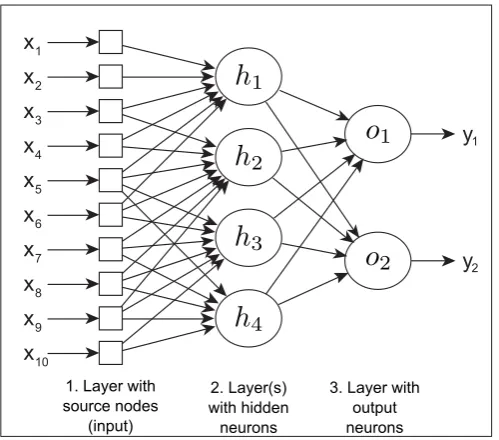
2.4 Example of a feed forward network with one hidden neuron . . . 55
2.5 Example of an Elman Network . . . 57
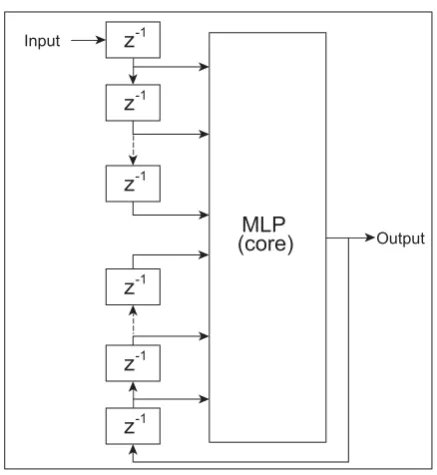
2.6 Example of a NARX network . . . 58
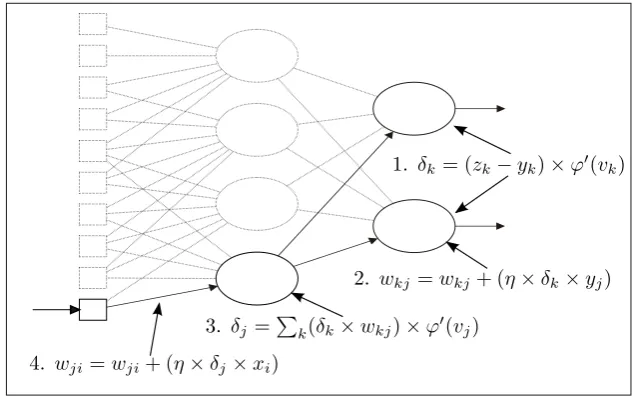
2.7 Illustration of the Backpropagation algorithm . . . 60
2.8 Taxonomy of Neural-Symbolic Systems . . . 63
2.9 Example of a KBANN network . . . 65
3.1 Information flow in a neural-symbolic system . . . 68
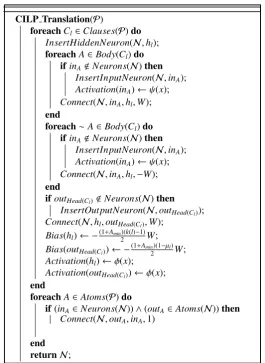
3.2 CILP translation algorithm . . . 71
3.3 Analysis ofTP of an accepable program . . . 76
3.8 Translation of-based programs . . . 89
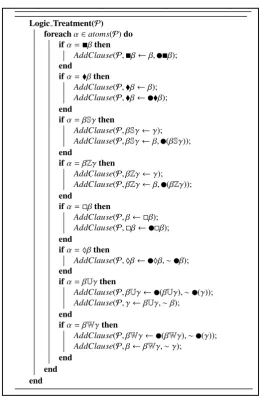
3.9 Example of the different kinds of recurrent links in the SCTL model 92 3.10 Logic treatment of different temporal operators . . . 93
4.1 Illustration of an unfolded NARX network . . . 100
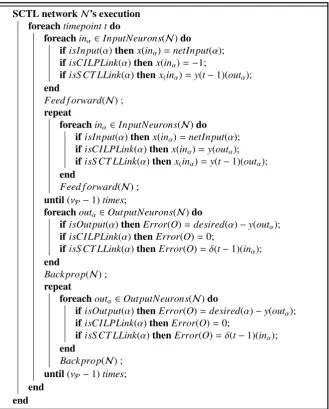
4.2 Propagation of values in a SCTL network during a timepoint . . . . 102
4.3 Algorithm for learning from multiple sources of information . . . . 111
4.4 Incompleteness and unsoundness of decompositional methods . . . 113
4.5 Example of extraction procedure . . . 117
5.1 SCTL Networks used for the temporal XOR case . . . 125
5.2 Error of the networks for the experiments without noise . . . 126
5.3 Error of the networks for the experiments with noise . . . 126
5.4 Architectures used on the Muddy Children example . . . 130
5.5 Evaluation of RMSE in learners on Muddy Children Puzzle . . . 131
5.6 Network architectures used to perform the Dining Philosophers . . . 135
5.7 Offline Learning Error in Time . . . 137
5.8 Online Error in Time . . . 138
5.9 Resource allocation in time . . . 138
5.10 Performance of the different approaches/possibilities . . . 141
6.1 Diagram of the framework for verification and adaptation . . . 150
6.2 Algorithm that reads the variables declarations from NuSMV . . . . 159
6.3 Translation from NuSMV into SCTL clauses . . . 160
7.1 Confidence of the learning according to the amount of noise . . . . 163
Acknowledgements
Whenever talking about this thesis, the words I use most are probably integration and
learning. Those are words that define not only the subject of my work, but also the
period of time deployed to achieve this goal. This PhD was marked by the integration
between the dream of traveling the world, living in a world capital as London, and
the strong connection with my home country and the people left there.
Living in London was an wonderful experience not only about the city, but
es-pecially for the amazing people I have met, people from all around the world from
whom I have learned so much, and who also gave me the chance so share a little
about my culture, my way of life. Thanks Ricardo, for being such a close friend,
sharing so many moments of both happiness and frustration (which was inevitably
overcome by the pints of Guinness). Thanks Tshiamo for trusting me to share so
many things at both work and home. Thanks Rafael, Davide, Marco, Vanessa, Mark,
Aravin, Olga and all the guys from City University, who made the working place
much more pleasant. Thanks Giulia, Horacio, David, Tomoko, who were amazing
people to share not only a home, but also part of the life. Thanks Michael, Carina,
Ibz, Chris, Kieran, Hollie, Dani, Andy, and so many other friends, for being such a
nice company, sharing relaxing moments of fun. You all have made my experience
in London unforgettable.
I have met on London, and who made me feel like having a small portion of home
when traveling overseas. For bringing the same feeling, I also would like to thank
the friends who visited me, or those who traveled with me during these years, like
Moser, D´ebora, Carla, Lorenzo, Luc´ıola, Germ´an, M´arcio, Adriel, Tha´ısa, Thom´as,
Fabiana, Fabr´ıcio, Milene e Clarissa - all of them being amazing company to brake
the daily routine, which sometimes was almost unbearable because of the loneliness.
On the other hand, I thank a lot all the people who were in Brazil giving me
full support even when I was so far. Let me thank my parents, that helped me so
much even though being away from me was so painful for them. Also, thank my
sister Raquel for the encouraging words and moments of laugh. Thanks also to all
the other people from my family, especially the cousin Lucas and the aunt Maristela,
and all the friends who kept contact and endorsed me in different manners: M´ario, Luciane, F´atima, Mar´ılia. For the recent support and friendship, I would like to
thank the people from my recent job, especially Tadeu, Lutz, Leite, Dalmir, Marcelo,
Fernanda and Daniel.
And for all the lessons learned, and the support given, and all the trust invested
on me, I am strongly thankful to my supervisors Lu´ıs Lamb and Artur Garcez. Also
for the lessons, of joy from simple things in life, of inspiration and hope in a better
future, I thank all the kids whom I hold so dear in my life: Bol´ıvar, Mathias, Daniel
and Pietro. In the end, all my love and gratitude to her, who has been the main source
of dream and inspiration in the last years of my life: Fl´avia, this work would not be
.
Declaration on consultation and copying
The following statement is included in accordance with the Regulations governing the ‘Physical format, binding and retention of theses’ of the City University London
I grant powers of discretion to the University Librarian to allow this thesis to be copied in whole or in part without further reference to me. This permission covers only single copies made for study purposes, subject to normal conditions of acknowledgement.
List of Abbreviations
ADALINE ADAptive LInear NEuron
AI Artificial Intelligence
ANN Artificial Neural Networks
BDD Binary Decision Diagram
BG Background
BPTT Backpropagation Through Time
CEGAR Counter Example Guided Abstraction Refinement
CILP Connectionist Inductive Learning and Logic Programming
CML Connectionist Modal Logics
CTL Computational Tree Logic
CTLK Connectionist Temporal Logic of Knowledge
DNF Discjunctive Normal Form
FK Fully Knowledgeable
ILP Inductive Logic Programming
KBANN Knowledge Based Artificial Neural Network
LTL Linear Temporal Logic
MLP Multi-Layer Perceptron
NARX Nonlinear AutoRegressive with eXogenous inputs
NK No prior Knowledge
NP Nondeterministic Polinomial time
NuSMV New Symbolic Model Verification
PK Partially Knowledgeable
PROLOG PROgramming in LOGic
PSSH Physical Symbols System Hypothesis
RMSE Root Mean Squared Error
RTRL Real Time Recurrent Learning
SAT SATisfiability of logic formula
SCTL Sequential Connectionist Temporal Logics
SE Software Engineering
SLD Selective Linear Definite clause resolution
SMV Symbolic Model Verification
TDNN Time-Delayed Neural Networks
XHAIL eXtended Hybrid Abductive Inductive Learning
Abstract
The effective integration of knowledge representation, reasoning and learning into a robust computational model is one of the key challenges in Computer Science and Artificial Intelligence. In particular, tempo-ral models have been fundamental in describing the behaviour of Com-putational and Neural-Symbolic Systems. Furthermore, knowledge ac-quisition of correct descriptions of the desired system’s behaviour is a complex task in several domains. Several efforts have been directed to-wards the development of tools that are capable of learning, describing and evolving software models.
This thesis contributes to two major areas of Computer Science, namely Artificial Intelligence (AI) and Software Engineering. Under an AI perspective, we present a novel neural-symbolic computational model capable of representing and learning temporal knowledge in re-current networks. The model works in integrated fashion. It enables the effective representation of temporal knowledge, the adaptation of tempo-ral models to a set of desirable system properties and effective learning from examples, which in turn can lead to symbolic temporal knowledge extraction from the corresponding trained neural networks. The model is sound, from a theoretical standpoint, but is also tested in a number of case studies.
An extension to the framework is shown to tackle aspects of verifi-cation and adaptation under the SE perspective. As regards verifiverifi-cation, we make use of established techniques for model checking, which allow the verification of properties described as temporal models and return counter-examples whenever the properties are not satisfied. Our neural-symbolic framework is then extended to deal with different sources of information. This includes the translation of model descriptions into the neural structure, the evolution of such descriptions by the application of learning of counter examples, and also the learning of new models from simple observation of their behaviour.
Chapter 1
Introduction
This thesis contributes to two major areas of Computer Science, namely Artificial
In-telligence (AI) and Software Engineering (SE). The work focuses on the development
of methodologies and techniques of AI in the representation, learning and reasoning
about temporal models. These methodologies are then applied to the verification and
adaptation of models used for requirements and behaviour specifications in software
engineering.
Artificial Intelligence has been developed by gathering contributions from
dif-ferent areas such of the natural sciences and engineering. Drawing inspiration from
natural sciences and philosophy, AI can be defined as the search for artificial
mod-els of different human cognitive abilities such as reasoning, learning and adaptation [92]. Researchers in biology, neuroscience, psychology and philosophy have given
important contributions to the field, improving the general understanding of diff er-ent approaches to knowledge manipulation, as well as the actual cognitive aspects
[51]. On the other hand, incorporating such aspects into computer tools can impact
on a range of applications, especially in tasks where expert knowledge is considered
More specifically, the integration of knowledge representation, reasoning and
learning into a robust and effective computational model is one of the key challenges in Computer Science [43, 106]. Computational models of single cognitive tasks have
been applied to several situations in different knowledge areas, but a general method-ology for the integration several cognitive abilities remains an open problem [106].
One of the main issues to be tackled to achieve such integration is the specificity of
many existing techniques. Systems based on logics, for instance, are very suitable
and broadly used in representation and reasoning tasks, but are considered by several
authors as too brittle to learning in certain domains [74].
A fruitful approach to the unification of cognitive abilities consists in
integrat-ing the representation structures and reasonintegrat-ing capacities from symbolic logics with
numeric (quantitative) systems. Such systems are capable of numeric representation
and manipulation, which will give the necessary flexibility that enables more
plas-ticity to the learning task [74]. Examples of this integration can be found in fuzzy
systems [114] and probabilistic logics [112]. Other approaches using numeric
repre-sentation for such integration consist of probabilistic techniques which are based on
graph structures such as Markov models and Bayesian networks [57].
Artificial Neural Networks (ANNs), also known as connectionist intelligent
sys-tems, are a good example of a graph structure for numeric data manipulation. They
are biologically inspired in the functioning of the human brain. They have been used
to model systems capable of flexible, robust learning in several domains. ANNs have
been applied to domains where the available information is incomplete, noisy or
in-correct [51]. They are broadly used in several domains for numeric learning and
pattern recognition [59]. However, ANNs have as main disadvantage their limited
knowledge representation capability. All the information learned by the networks is
usually stored in the structure as numeric weights, and therefore may not be clear to
These limitations of ANNs have led to an intense research programme which
aims at an effective integration of ANNs with symbolic reasoning and knowledge representation systems [19, 29, 53]. Besides unifying the plasticity and robustness
of connectionist systems and the representation and reasoning performance of
sym-bolic models into a single tool, integrated neural-symsym-bolic systems also provide new
insights into the capacity of connectionist structures to perform symbolic inference,
bringing useful inspiration to research in neurosciences and reaffirming the impor-tance of connectionism as a useful approach to Artificial Intelligence [19].
While these integrated neural-symbolic systems have shown considerable
perfor-mance and applicability in propositional domains [53], the extension of these systems
to deal with other knowledge domains remains an open problem. In the specific case
of temporal domains, several techniques were proposed to extend existing neural
network architectures to consider time as a dimension of knowledge to be learned
[41, 95]. Also, logic systems which are capable to represent time have found a large
number of applications in Computer Science since the pioneering works several
au-thors, such as Pnueli [22, 44, 85]. The construction of neural-symbolic systems which
are capable of dealing with temporal knowledge is therefore a natural step forward in
AI research: the learning performance of (temporal) neural networks and the broad
applicability of temporal logics make this integration a strong candidate to respond
to the challenge of building robust intelligent tools which are applicable to a broad
range of domains.
In Software Engineering,formal methodsinclude a range of activities, including
system specification, analysis and proof, transformational development and program
verification [101]. The use of formal, logical systems in specifications allows for
the application and use of representation and reasoning tools towards a more reliable
process of software development, especially in the case of safety-critical systems
A successful example of the use of logic-based techniques in SE is model
check-ing [22]. Model checkcheck-ing consists of the use of formal strategies to the verification of
properties in models described through a formal language [56]. The formal
verifica-tion of specificaverifica-tions not only brings more reliability to the developed products, but
also allows the use of inference techniques to the identification of scenarios in which
the system is subject to errors, and therefore speeding up the development process
and reducing costs [101].
While formal specification and inference techniques are broadly applied in
soft-ware engineering, a considerable research effort has recently targeted the application of machine learning techniques in SE. In particular, machine learning has been used
to estimate external and internal aspects in a software project, as well as the analysis
of features of a product [115]. More specifically, the proper integration of learning
techniques and formal specification tools have been considered by several authors
[83, 35, 23, 3] as a means to provide automated verification, refinement and
adap-tation of software models. This makes software specification a potential case study
for the applicability of robust intelligent techniques, capable of integrating
represen-tation, reasoning and learning of temporal knowledge models.
1.1
Objectives
The main goal of our work is to construct a general framework for representing,
learning and reasoning about temporal knowledge models. The framework consists
of an integrated neural-symbolic system. Our work not only describes all the steps
necessary to effect this integration, but also illustrates how the general framework can be adapted to applications in the verification and learning of software models. This
1.2. CONTRIBUTIONS
• Investigating and describing different languages for representing temporal knowl-edge.
• Analysing and extending existing techniques used in the literature for the
in-tegration between symbolic temporal languages with connectionist learning
engines.
• Analysing learning strategies for neural networks, focusing on temporal
knowl-edge learning.
• Specifying how to integrate the proposed neural-symbolic framework with
techniques for the verification of properties in temporal models (more
specifi-cally, with model checking techniques)
• Evaluating the developed framework through the analysis of each individual
framework step, as well as the framework as a whole.
1.2
Contributions
Due to its multidisciplinary nature, our work contributes to multiple fields. The main
contribution of this thesis consists of a general, unified framework for representation,
learning and reasoning about temporal models. This framework is capable of
acquir-ing knowledge from different sources (such as the abstract description of a temporal model, and examples of its behaviour), reasoning about this model, learning and
evolution according to newly acquired information, and representation in different languages for integration with other techniques. This allows the proper integration
with tools for property verification in temporal models, therefore bringing new
con-tributions to the area of software engineering. More specifically, we contribute to
con-tributions which are associated to the aforementioned objectives of our work, are as
follows:
• We present different languages for symbolic representation of temporal knowl-edge, discuss different aspects regarding their syntax, semantics, applicability in different domains and interchangeability of knowledge among them. The considered representations include temporal logics, state diagrams and
descrip-tion languages for software specificadescrip-tion.
• We investigate the integration between temporal symbolic knowledge and
ar-tificial neural networks, presenting and analysing different strategies to both translating a symbolic specification of a temporal model into a neural network
architecture, and extracting the learned information from the corresponding
neural networks.
• We investigate temporal learning strategies for neural networks, focusing on
domains where the the learning stage is integrated to the representation of
sym-bolic knowledge; we also investigate the possibility of using temporal
dimen-sions to the represent of other forms of structured knowledge. This
investiga-tion led to the choice of the techniques and algorithms to be used for knowledge
acquisition throughout the work.
• We show how to integrate the representation and learning framework with
ex-isting techniques of model checking, rendering an iterative process of
verifica-tion and evoluverifica-tion of temporal models which is capable of integrating different sources of knowledge in order to generate an improved model description.
• We perform a comparative, theoretical and experimental evaluation of the
pro-posed framework, through the analysis of each individual step in an isolated
1.3. RELATED WORK
evaluation considers a broad range of domains, including traditional testbeds
of temporal synchronization and software specification, as well as variations
where the available knowledge is incomplete or incorrect, showing good
re-sults in aspects as learning performance, robustness and noise tolerance.
1.3
Related Work
Throughout this work, we start from the definitions of integrated methodologies for
temporal reasoning and learning and validate the ideas by applying them into the
cy-cle of verification and adaptation of software specifications. Integrating connectionist
and symbolic methodologies for modeling intelligent behaviour has been, in the last
decades, a widely investigated approach. However, this work is the first that applies
the methodology to a significant number of testbeds in software engineering.
The gap between the knowledge representation of the symbolic and connectionist
paradigms has been bridged through a broad range of works in the last decades. For
instance, Smolensky [100], Towell and Shavlik [103], Holldobler and Kalinke [54]
and d’Avila Garcez and Zaverucha [36] proposed different ways to represent sym-bolic knowledge in neural networks. Andrew at al [4], Craven and Shavlik [28] and
d’Avila Garcez et al [37] investigated how to make the information learned by ANNs
available in a symbolic manner. Browne and Sun [18, 19] survey these techniques,
categorizing them into different aspects such as knowledge locality (also reviewed by Page [82]) and variable binding.
In our work, we give special attention to the temporal dimension under a discrete,
linear point of view. The importance of temporal reasoning and learning systems has
been highlighted by several works like those of Fisher et al [44] and Gabbay et al
GaHoRe94 as an important objective to be pursued, helping to improve the
this regard come from temporal modal logics, especially imperative approaches that
consider the future as a consequence of the past, as seen in the work of Barringer et al
[6, 7]. Also, connectionist extensions that propagate information and allow learning
through time can be found at the works of Elman [41], Lin et al [66] Siegelmann et
al [95].
All these ideas collected from different areas of AI and integrated into a unique framework can then be applied to the representation, adaptation and evolution of
temporal models. In the work of d’Avila Garcez et al [34, 35] we can find a general
methodology where the use of verification and learning steps lead to improved
tem-poral models. In this case, as in many others, the main focus is on automating the
verification and refinement of software.
Temporal logic-based tools have been consistently used in the formalization of
software models, and therefore in the automation of the verification process. Model
checking [21, 22, 113] has been an important breakthrough in Software Engineering,
providing formal languages for describing temporal models and also for the
specifi-cation of properties over these models, as well as reasoning procedures to allow the
verification of these given properties.
One of the issues to be tackled by model checking is the state explosion problem,
that can occur in particular when the system performs parallel transitions. Although
symbolic representation structures such as BDDs (Binary Decision Diagrams) have
been used and improved to tackle such issues [71, 113], it still remains a considerable
hurdle when applying model checking to large domains. An interesting approach to
deal with the state explosion problem is to focus on an assumption of reachable states,
instead of the overly pessimistic view of considering the whole state space, as
pro-posed by [47]. This assume-guarantee approach is followed also by [78, 79], which
1.3. RELATED WORK
such assumptions.
Abstraction techniques, which are based on removing or simplifying details which
are not relevant to the property being verified, are considered general and flexible to
handle the state explosion problem [10]. One of the approaches used to automate the
process of abstraction is CEGAR - Counter example based abstraction refinement
[23]. The idea of CEGAR consists in acquiring an initial abstraction of the model
from its original description and then deploying an iterative process of verification
and adaptation. Such process considers the use of lateral information from counter
examples for the refinement of the abstraction.
Other approach that makes use of iterative cycles of verification and adaptation
can be found in [2, 3]. In these works, the authors propose the use of inductive
and abductive reasoning for the refinement of temporal models representing software
requirements. The process also considers the use of a model checking tool for the
verification of properties of the temporal models, and subsequent use of symbolic
learning for the adaptation purposes.
Under the same perspective, the works of [104, 61] illustrate a rich application of
verification and adaptation in the area of controller synthesis. Although there are
dif-ferences between the areas, especially in the sense that synthesis is mainly concerned
with complete models, similarities can be found in the objectives and algorithms used
for synthesis and learning. These similarities are clear when considering the
adapta-tion of existing models seeking to satisfy a given property or goal.
Two important, common features of these methodologies can be pointed out as
limitations for certain domains. At first, they require an initial, abstract description
of the temporal model to be considered, which may not be available in some cases.
[49, 83] considered this as a major hurdle for the application of model checking
proposed the use ofblack box checking, which consists on the use of empirical
learn-ing techniques in order to acquire an original description of a temporal model from
examples of its behaviour.
The second important feature to be highlighted is the exclusive use of adaptation
for the refinement of models. This highlights one of the more significant differences of our framework when compared with the other methodologies for iterative
verifi-cation and adaptation. Neural networks, by their distributed representation of
knowl-edge, will naturally perform revision instead of refinement of the knowledge base,
and therefore will be capable of performing changes on incorrect models, as well as
filtering the effects of incorrect examples in noisy data used for empirical learning. This constitutes an important reason for our choice of connectionist structures for
performing learning and adaptation.
1.4
Published Results
The work described in this thesis has been the subject of a number of publications
in the recent years. In 2007, the theoretical foundations of our work have been
pub-lished in conference proceedings such as IJCNN-07 [16] and AAAI-07 LaBodAg07.
These works focus on the semantic definitions of the proposed temporal logics, their
translation into neural networks and the experimental analysis of the learning
perfor-mance.
The integration of learning abstract properties was the theme of a paper published
in the ICANN’10 conference proceedings [15]. In that paper, we presented the first
insights for using the co-called SCTL framework in more general applications for
learning and adaptation of temporal models, allowing for the possibility of
1.5. ORGANIZATION
This possibility was further investigated in the papers published at ASE 2010
[12] and at the NIER (New Ideas and Emerging Results) track at ICSE 2011 [14].
These papers present our neural-symbolic approach to learning and evolving software
descriptions, and the integration of these techniques with model checking tools, in the
development of the general framework of iterative verification and adaptation cycle.
Also, a general description of the developed work is accepted to appear in the
journal IEEE Transactions on Neural Networks (special issue on white box non-linear
prediction models) [13] in 2012. In that paper, several aspects from our framework
is described, including the temporal logic representation, learning in the recurrent
neural networks, extraction of knowledge and integration with other representation
systems.
1.5
Organization
The remainder of the thesis divided into eight chapters.
In Chapter 2, we present a comprehensive description of background and related
work which is relevant to the understanding of our work. The chapter starts with a
general description of current challenges in AI which are relevant to our research; we
then discuss some important techniques on both symbolic and connectionist AI
ap-proaches. In the end, we give a general idea of the features and advantages of existing
approaches to the integration between the symbolic and connectionist approaches to
AI.
In Chapter 3, we explain our proposal to integrate temporal knowledge with
re-current neural networks. At first, we present the temporal syntax we use for
knowl-edge representation. We also explain a translation algorithm for propositional logic
temporal extension used by SCTL, discussing and comparing it with other existing
techniques.
In Chapter 4, we focus on temporal learning in neural networks, focusing mainly
on the case of SCTL, NARX-based networks. The chapter starts with an overview of
temporal learning in neural networks, followed by the presentation of the algorithms
and learning techniques proposed and used in the thesis. Moreover, we present and
discuss elements related to the extraction of learned knowledge from neural networks,
and other aspects related to learning.
In Chapter 5 we bring several experiments used in the analysis of the
function-alities of our framework. We start by simple experiments illustrating the learning
performance and how it is affected by the insertion of symbolic knowledge. Several experiments will allow an extended analysis, as well as an understanding of the
ex-traction techniques. We also compare the results with other temporal neural-symbolic
techniques.
In Chapters 6 and 7, we focus on applications to Software Engineering,
illustrat-ing all the steps necessary to the unification of a model checkillustrat-ing tool with learnillustrat-ing
techniques. Chapter 6 will illustrate the languages used for representing software
models properties and counter-examples, and how to allow the communication with
SCTL. Chapter 7 will illustrate the iterative process of verification and adaptation,
with the use of examples and experimental results to better explain the proposed
techniques. In the end, Chapter 8 will enumerate the conclusions and possible paths
Chapter 2
Background
2.1
Challenges in Artificial Intelligence
Since the conception of the term Artificial Intelligence, in the 1950s, the area has
grown considerably, incorporating several techniques and approaches to tackle the
ultimate problem of reproducing intelligence in computer systems. Nowadays,
re-search in Artificial Intelligence is related not only to Computer Science, but also
Biology, Neurosciences, Psychology, Philosophy and Social Sciences, among others
[92]. Given this great variety of perspectives, the foundations of the area are defined
differently, depending on the approach to be considered. In this section, we propose some basic definitions that will be used to guide the remaining of the work.
To guide our definitions, consider a basic agent as a entity capable to perceive
information from an environment and take decisions based on the perceived
informa-tion, acting back to the environment. Under this perspective, we can qualify
intelli-gence as a property of an agent’s decision-making process. Taking as reference the
original description of Russell and Norvig [92], there are two main concepts that can
taking the logically correct decision. This concept can be softened and interpreted as
the process of taking decisions that increase the chances of getting the best possible
result. The second concept usually associated with intelligence is cognition, which
we define here as the information processing faculties associated to an human agent.
Intelligent behaviour can also be analysed in terms of the inference capacities
of an agent. Inference can be described as the process of using logical or
proba-bilistic reasoning to derive consequences from existing information in a domain [92].
Usually, the term inference is associated with deductive inference, which consists
in deriving a conclusion from a set of premises through the application of existing
inference rules.
Computational implementations of deductive inference have been subject to
re-search and implementation under many approaches. More specifically, the capacity to
perform reasoning in a general case, independently of specific knowledge, is central
to expert or knowledge based systems [98]. In these systems, while the actual
im-plementation of inference techniques is fundamental, other aspects play an important
role, such as the choice of a suitable language to represent the existing knowledge,
the availability of this knowledge and the integration between the representation and
reasoning.
Although the process of deductive reasoning is central to the establishment of
intelligent behaviour, other forms of inference are also important to be considered.
Inductive reasoning, the search from general rules from the presentation of its
associ-ated elements, is essential in many aspects when modeling intelligent and adaptable
behaviour.
For the development of knowledge-based systems, one of the main challenges
consists in obtaining and coding the necessary knowledge base for the
2.1. CHALLENGES IN ARTIFICIAL INTELLIGENCE
bottleneck”, intense research has been undertaken towards the automated acquisition
of knowledge, also known as Machine Learning [72]
Learning is an essential component of intelligent behaviour [106], and can be
defined as the capacity of an agent to adapt to stimuli from or changes in the
environ-ment, seeking for improvements on her performance regarding some objective [92].
The capacity of performing inferential reasoning is central to the process of
learn-ing: the generalization of rules from the observation of examples allows an agent
to build or adapt a knowledge base according to the information perceived from the
environment.
In the same way deduction can be described as inferring the conclusions (effects) from premises (causes) and inference rules, induction can be defined as inferring
rules from a series of associated causes and effects. Under this analysis, a third kind of inference can be foreseen: given a set of rules, and the effects of the application of such rules, a set of possible causes can be inferred. Thisabductivereasoning has
been considered in the AI community as a non-monotonic reasoning paradigm to
address some of the limitations of deductive reasoning [38]. Developments in the
area include the implementation of abductive reasoning in logic programming and its
integration with inductive logic programming, providing tools with a broader range
of alternatives to perform synthetic reasoning and learning [89].
This focus on the reasoning processes and the drive to develop rational tools
pro-duced a broad range of results in logic, statistics and correlated areas. The approach
was dominant from the birth of AI, with important definitions from McCarthy [70],
who gave important insights regarding the relation between philosophical and
com-putational concepts, and Newell and Simon [80], which established the importance
of the symbolic treatment of the information process.
Hypothesis (PSSH), which states that “A physical symbol system has the necessary
and sufficient means for general intelligent action”. A physical symbol system may be defined as a set of entities (symbols) which follow the basic rules of physics and
are realizable by engineered systems. This means that, upon due analysis, any
intel-ligent action can be rewritten under a symbolic structure, and performed by artificial
means.
On the other hand, the inspiration drawn from the human cognitive capacities is
also relevant to a great number of AI scientists. The complex nature of animal brains,
and their capacity to perform several complex tasks at the same time fascinates and
inspires new solutions to the development of artificial information-processing tools.
The observation of human behaviour, and capacities such as analogy and language,
were taken as reference for many works. A historical example of such inspiration
is the Turing Test, devised by Alan Turing as the ultimate challenge to an artificial
system that reproduces intelligence [105]. Turing suggests we should ask if the
ma-chine can win a game, called the “Imitation Game”, where three participants are set
in isolated rooms: a computer (which is being tested), a human subject, and a
(hu-man) judge. The human judge can converse with both the human and the computer,
while both try to convince the judge that they are human. If the judge cannot
consis-tently tell them apart, then the computer is considered to be able to “think”, i.e., to
demonstrate an actual intelligent behaviour.
The search for developing artificial systems to perform cognitive tasks also led to
more literal interpretations, with different scientists seeking in the complex structure and massive connectivity of animal brains the best approach to perform tasks such
as learning and adaptation. Smolensky [99], for instance, proposed the subsymbolic
hypothesis as a response to the conceptual, symbolic approach to AI. This hypothesis
states that “The intuitive processor is a subconceptual connectionist dynamic system
2.2. SYMBOLIC AI
as the cornerstone of the subsymbolic (connectionist) paradigm to AI.
Even though some challenges are common to the different approaches of AI, the complementary nature of the symbolic and subsymbolic paradigms makes their
inte-gration an interesting alternative to unify their individual advantages to tackle difficult problems [18]. More specifically, incorporating connectionist learning into the
repre-sentation and reasoning structures from symbolic systems have been considered as an
important approach to tackle the issue of robustness in the development of Intelligent
Systems [107].
Throughout the remaining of this chapter, we will present a review of some ideas
developed throughout the last decades in both paradigms of AI, as well as the
integra-tion between these areas. We will focus on those which are central in the definiintegra-tion of
our work, as well as those necessary to the understanding of the new ideas presented
in the remaining chapters.
2.2
Symbolic AI
In several areas of Computer Science and more specifically in the symbolic modeling
of intelligent behaviour, logics play a fundamental role, which is comparable to the
role played by calculus in physical sciences and traditional disciplines of
Engineer-ing. In the same way that differential equations can be used to model the behaviour of continuous systems, mathematical logic can be used as a non-ambiguous language
to specify the structure and behaviour on discrete domains [50, 5]. Huth and Ryan
[56] consider, as the main goal of logics in Computer Science, the development of
languages to model the different situations, in such a way that formal reasoning can be applied to them.
Philos-ophy, Mathematics and Computer Science, consider first-order logic (FOL). These
systems are very expressive, allowing for functions and relations over elements in
the domain to be represented. They also allow for quantification over these elements,
but are different from higher-order logics for not allowing quantification over the used predicates [56]. Although first-order logic is undecidable, several fragments are
broadly used for automated reasoning in Computer Science [50].
As a specific case of computational implementation of inference in first-order
logics, we may consider logic programming. Although the term has been used in a
broader sense to designate different symbolic systems with a strong logic component [67], a logic program is nowadays considered in a more strict sense, usually referring
to sets of Horn clauses. A Horn clause is defined as a logic disjunction, with at most
one positive literal. For instance, a definite Horn clause can be written in the form
α∨¬β1∨¬β2∨...∨βn, and also can be rewritten as a logic implicationβ1∧β2∧...∧βn →
α
In the next chapter, we give more details about logic programming systems
lim-ited to the propositional case, which will be used in this work. For inference in
first-order representation, there are several implementations of Prolog (PROgramming in
LOGic), which incorporate mechanisms such as SLD-resolution to solve queries
ex-pressed as a simple positive literal. Resolution consists in an iterative process of
application of a resolution rule as a theorem proving technique based on refutation
[67]. SLD-resolution (Selective Linear Definite clause resolution) is a refinement of
the resolution procedure, which is sound and complete for refutation in Horn clauses.
While resolution and its refinements are used for deductive inference in logic
domains, several techniques have been proposed also to incorporate inductive and
abductive reasoning into logic programming systems. Inductive Logic Programming
2.2. SYMBOLIC AI
programming, i.e., building new theories from background knowledge and positive
and negative examples, using logic programs to represent all the knowledge involved
in the process [77]. Existing ILP implementations include Progol, Golem and FOIL
(First-Order Inductive Logic) [76, 87], which are used for applications such as pattern
recognition and data mining [17]. Besides, extensions based on the SLD-resolution
and integration of constraint specifications have also been proposed to perform
ab-duction in logic programs [60]. Integration between both forms of reasoning have
also been proposed under a logic programming structure, as in the eXtended Hybrid
Abductive Inductive Learning (XHAIL) system [89].
One of the main reason sto restrict first-order logics to the case of conjunctions of
Horn clauses is the undecidability of first-order logics [56]. This mean that, in order
to allow a computational implementation of sound and complete inference systems,
one needs to restrict the representation power of the used background logic. Other
important approach to the case of deductive inference in logics consists in converting
the domain problem into a propositional representation, and then using inference
techniques for propositional logic.
The most common example of propositional inference regards satisfiability
veri-fication (SAT), in which a propositional formula is examined to determine whether if
there exists at least one assignment of values to the variables that makes the formula
true. Although SAT is a NP-complete problem [26], this problem is widely studied,
and there are many techniques developed to reduce complexity in the average case
[69].
Regarding logic domains, graph-based structures are also widely used for
repre-sentation and inference purposes. Graphs allow for the reprerepre-sentation of relational
structures, while several techniques to transformation or simplification of such
example is the use of decision diagrams or trees.
A decision tree is an acyclic, directed graph, in which each node represents a
variable from the domain. The set of edges from a node represent a decision regarding
the variables, i.e., the possible values of the variable. Each path on the graph, from
the root to one of the leaves, will then represent an assignment of values to all the
variables. For the representation of propositional logic formulae, decision trees might
be compressed in such a way that the terminal nodes can be grouped to two nodes,
representing whether the assignment to the variables makes the formula true or false.
This compressed representation, called BDD (Binary Decision Diagram), allows for
operations without the need of decompressing the whole tree, and are used for formal
verification and logic synthesis of circuits [113].
Decision trees are also broadly used for applications such as data mining, which
require empirical learning. In traditional algorithms such as ID3 [86, 88], examples
from the domain are used to define, for each variable, its information gain: a metric
which represents the influence of such variables to the definition of the output classes
of the domain. This information is then used to define the structure of the decision
trees, seeking for a small representation of the domain and therefore allowing the
extraction of a simple explanation for the desired classification.
2.3
Nonclassical logics
Three main components can define the structure of a logic: the associated proof
the-ory, its syntax and semantics. The syntax regards which expressions are well formed,
whereas the proof theory provides syntactic proof rules (and axioms) to identify
which formulae are theorems of the logical system. Semantics, on the other hand,
refers to the meaning of the terms and the symbols composing them, as well as the
2.3. NONCLASSICAL LOGICS
Modal logics are among the most important examples of logic systems used in
Computer Science, due to their simplicity and expressiveness, giving an internal,
lo-cal perspective to the representation of relational structures [9]. Modal logics extend
conventional logical systems by adding operators to express one or more truth modes
[56]. In modal logics operators likeand♦are usually defined to represent necessity and possibility, respectively. The semantics of these operators will vary according to
the logic in which they are used, as shown in Figure 2.3.
Logic ϕ ♦ϕ
Temporal ϕis always true ϕis sometimes true Epistemic The agent knowsϕ The agent believesϕas possible
Alethic ϕis necessarily true ϕis possibly true
Deontic ϕis mandatory ϕis allowed
Table 2.1: Different meaning for modal operators [56]
One of the most traditional approaches to analyse the semantics of nonclassical
logics consists in the possible world semantics. The approach was originally
pro-posed by Saul Kripke in the 1950s, and considers a relational structure of possible
worlds. Each propositional variable can have a different value assigned in each of the possible worlds, and the modal operators can be defined regarding the existing
relation among such worlds. Usually, an expression Ais considered as true in a worldwiif, and only if,Ais true in every worldwj such thatR(wi,wj) is true, where
Ris the relation between worlds that is defined in the used relational structure [56].
2.3.1 Temporal Logics
Representation of time can be considered as a fundamental issue the development of
knowledge-based systems [85, 1]. Representing and manipulating time can be seen
as essential to several areas in Computer Science, such as Databases, Artificial
Systems, among others [45]. Several different approaches have been proposed to rep-resent time into a logical framework, although the term temporal logic usually refers
to the modal treatment proposed originally by Arthur Prior under the name of Tense
Logic [46].
As an alternative approach, first-order logics can be used in the representation
and manipulation of time-related knowledge, through the use of parameters that
as-sociates a temporal reference to the predicates of the domain. In this case, an explicit
set of predicates and axioms are necessary to represent the time flow and its
proper-ties. This constitutes the main difference when compared with the modal approach, which has the time flow intrinsically represented into the structure.
Another important difference between the approaches is the perspective under which the time is considered. Modal systems provide a local perspective to the time
flow, characterizing it in concepts such as present, past and future. On the other hand,
the representation based on predicates consider an external perspective, considering
only the relations (earlier or later) between the time points without taking any of them
as a reference to the present [46].
Other aspects are also very important when defining a logical system applied to
temporal domains. The relation between time flow and changes in the environment,
for instance, is very important to define the primitive concepts of the representation
language [45]. One of the possible approaches consists in defining the events and of
the system as the primary concepts, with the time flow being considered as an effect of these events. Representing, for instance, moments in time as equivalence classes
of states, would indicate that the position in the time flow is kept the same until some
change happens in the environment.
One example of the first-order representation that takes the events and states as
2.3. NONCLASSICAL LOGICS
a set of predefined predicates which define relations between events, fluents and time
points [63]. For instance, a predicate Happens(e,t) would indicate that an event e
happens in a time pointt, andInitiates(e,f,t) represents that an evente, initiates the
fluent f (makes it start happening), at the time pointt. The event calculus is broadly
used under a first-order logic programming syntax, allowing for traditional inference
mechanisms to be applied in the temporal case [75, 3]
On the other hand, if the time flow is taken as primitive, two different primitives can be considered to represent time units: points or intervals. The use of intervals
will consider that actions and events do not occur in specific instants, but actually are
associated to a certain duration in time. Still, an interval can then be defined by its
initial and final points, or by the set of instants (time points) that happen between the
beginning and the end.
However, some other aspects need to be taken into consideration when intervals
are used as primitives of representation. While comparing points requires only three
relations (earlier, later, and at the same time), comparing intervals requires at least
13 different relations [1]: the seven shown in Figure 2.1 and the converse of the first six relations in the figure. Also, when working with intervals, the idea of
homo-geneity needs to be taken in consideration: an eventeis considered homogeneous if,
whenever it is true during an intervali, it is also true for any subinterval ofi.
For the sake of simplicity and for a broader applicability of our system, we will
consider a representation that takes the time flow as reference, using time points
as primitives and under a modal perspective. Two important temporal logic
frame-works with these features are LTL (linear temporal logic) and CTL (computational
tree logic) [45]. While LTL considers a linear, deterministic approach to the time
expres-Figure 2.1: Relations between intervals [1]
sions, to represent if the expression is valid for at least one the possible ramifications
of time (existential), or if it needs to be considered at every branch (universal) [65, 8].
In this work, we focus on the linear approach to temporal representation. More
specifically we propose a logic programming language to the representation of linear,
sequential aspects of time. In our proposed framework, the assignment of values
to variables in the present can only be computed after the semantics of every time
point in the past was already computed. More specifically, when assigning values to
variables in a time pointt, we consider that the information in the previous time point
t−1 is already known an can be used for the computation. Besides the simplicity and
the suitability to the representation of a broad range of domains, including models of
reactive systems [7, 44], the choice for such language also takes into consideration
its adequacy to the connectionist representation, as we will see in the next chapter.
[image:47.595.175.393.127.371.2]Tem-2.3. NONCLASSICAL LOGICS
poral Logics), we consider a broad set of past and future temporal logic operators.
The past operators includes the representation of the previous time point, always in
past, sometimes in past, and the weak and strong variations of the operator since,
ZandS respectively. The complementary operators in the future are, respectively,
next time point, always in the future , sometimes in the future ♦, unless Wand untilU. Therefore the syntax of a logic program can be kept as described before, but
replacing the role of atom by the concept of temporal formulas:
Definition 1 An expressionαis defined as a temporal formula if, and only if, one of
the following is true:
• α= A, where A is a propositional variable;
• α = β, α = β, α = β, α = βSγ orα = βZγ; where β andγ are also
temporal formulas;
• α = β, α = β, α = ♦β, α = βUγ orα = βWγ; where β andγ are also
temporal formulas;
In our work, we consider a non-strict concept of past and future, i.e, they both
include the present. In such a way, our operators are defined as follows:
• αis true attiffαis true att−1
• αis true attiffαis true at every time pointt0≤t
• αis true attiffαis true at some time pointt0≤t
• αSβis true attiffβis true at some time pointt0 ≤t, andαis true at every time pointusuch thatt0<u≤t
• αis true attiffαis true att+1
• αis true attiffαis true at every time pointt0 ≥t
• ♦αis true attiffαis true at some time pointt0 ≥t
• αUβis true attiffβis true at some time pointt0≥t, andαis true at every time pointusuch thatt≤u<t0
• αWβis true attiffαUβorαare true
2.4
Logic Programming
The use of a symbolic representation of knowledge and the manipulation of such
symbolic structures provides a powerful tool to perform reasoning. Logics provide
a clear and non ambiguous language to represent knowledge, as well as the proof
mechanisms to perform inference [56]. In a general sense, logic programming can be
considered as any strategy that uses logic-based languages to represent the behaviour
to be performed by a computer program. For instance, in one of the early influential
works in AI, McCarthy [70] proposes such a logic-based language as adequate to the
representation of complex computational tasks. In our work, however, we consider a
more strict definition of logic programming, as follows:
Definition 2 An atom A is a elementary formula, that cannot be broken into
subfor-mulae. A literal is an atom (A) or the negation of an atom (∼A).
In our work, we will consider specifically the propositional case, where an atom
is defined as a propositional variable. In first-order logics, an atom may also be a
2.4. LOGIC PROGRAMMING
Definition 3 A logic programPis a set of Horn clauses. Each Horn clause is an
expression in the form A ←L1,L2, ...,Ln, where A is an atom and Li, for1 ≤ i≤ n,
are literals.
Each clause might be considered as a logic implication, i.e., if the conjunction
of the expressions in the right hand side of←is true, so the left hand side must also
be true. For evaluating logic queries, expressed in the form of clauses without head,
logic programming systems such as Prolog make use of inference systems based on
resolution [68]. However, we are interested in evaluating the semantics of a program,
as described below:
Definition 4 An interpretation IPof a programPis a mapping from the atoms of the
program to truth values. A model is an interpretation IPsuch that every clause in the
program is satisfied, i.e, if when the conjunction of literals in the body of the clause
is true, the atom in the head is also true.
An interpretationIPmay also be represented through the set of atomsAsuch that
IP(A) is true. The semantics of logic programs may be defined, denotationally, w.r.t.
the models of the program. More specifically, one may consider the denotational
semantics of a programPas the minimum Herbrand model ofP.
Definition 5 The minimum Herbrand model of a programPis a model IP such that,
for each other model IP0 ofP, IP has, at most, the same number of elements of I0P
(|IP| ≤ |IP0|).
Before further definitions of the semantics of logic programs, we will describe
different classes of programs that will be used throughout the work:
Definition 6 A level mapping | | of a logic program P is any mapping from the
A ← L1,L2, ...,Ln inP, the following is valid for 1 ≤ i ≤ n: if M Vij−=11Lj then
|A| ≥ |Li|. A programPis called acyclic w.r.t. a level mapping| |if, for every clause
A←L1,L2, ...,Ln,|A| ≥ |Li|, for1≤i≤n.
The class of acceptable programs consists in every programPthat is acceptable
with relation to, at least, one level mapping and one model. Also, a program is called
acyclic if it is acyclic w.r.t., at least, one level mapping. One can easily verify that
every acyclic program is also acceptable. For both classes of programs, a method for
calculating the minimal Herbrand model is through the fixed point of a Immediate
Consequence OperatorTP.
Definition 7 The Immediate Consequence OperatorTPis a mapping from an
inter-pretation IP of Pto another, such that TP(IP)(A) is true if, and only if, there is a
clause A←L1,L2, ...,Lnsuch thatVni=1(IP(Li))is true.
For acceptable programs, we may find in [29] a proof that successive applications
ofTPconverge to a fixed point, for acceptable programsP. Also, such fixed point is a
minimal Herbrand model ofP. Therefore, in order to perform a sound computation of
the semantics of a program, one can develop a system that is capable of computingTP
several times until the convergence. To define the number ofTPexecutions necessary
to reach the convergence, we will focus on the case of acyclic programs.
2.4. LOGIC PROGRAMMING
Any acyclic program can be represented in the form of a directed acyclic graph,
where each vertex represents an atom and a directed arc fromAtoBrepresents that
there is a clause withBas head and in which body Aappears, either in positive or
negated form. For the sake of clarity, we will refer to this relation byA“is body” of
B. In Figure 2.2 we illustrate this relation between program and graph, as well as the
assignment of a valueνto the variables according to the following definition.
Definition 8 For each atom A in a logic programP, we define a constantνAin such
a way that νA = 0 if A does not appear as head of any clause in P. Otherwise,
νA = max(νB)+1, where max(νB)is the maximum value of νB among all atoms B
that appear (in either positive or negative form) in the body of a clause where A is
the head.
One can notice that the assignment of a νvalue to each variable of the program
serves as a level mapping sufficient to meet the condition of the definition of acyclic program. Also, the graph representation helps to notice that, if a programPhas a
finite number of atoms A, it will also have a finite maximum value ofνA, which is
more specifically the size of the greater path between two vertices in the directed
graph. This value we callνP, and it is important in the definition of the number of
executions of theTPoperator for reaching the convergence to the fixed point.
Lemma 9 For any initial interpretation IP of an acyclic program P, a number νP
of successive executions ofTP over IP is sufficient to compute the fixed point ofTP,
whereνPis defined as the greatest value ofνAamong all atoms inP.
Proof: We prove this lemma inductively. For each atom A such that νA = 1, the first execution ofTP overIPwill lead to a new interpretation that assignsAtofalse,
becauseAis not head of any clause. Any new execution ofTPwill lead to the same
interpretation. This means thatνA = 1 applications ofTP guarantees a convergence
Now, whenAappears as head of a clause, if we consider that a convergence point
was reached regarding every atom Bin the body of every clause which A is head,
then one more execution ofTPwill lead to the convergence point regardingA, since
it will assign values that will not change (according to the definition ofTP). In other
words, ifmax(νB) executions ofTPensures a convergence point regarding all atoms
Bthat are body of a clause withAas head, thenνA= max(νB) executions ofTP will
guarantee such convergence regardingA. Since we have thatνAis a finite number for
every atomAin an acyclic programP, thereforeνP executions ofTPwill be enough
to the computation of its fixed point.
2.5
Neural Networks
The human brain processes information in a completely different manner than con-ventional digital computers. The connectionist approach to Artificial Intelligence
takes the massively connected and parallel structure of the brain as inspiration to
model intelligent behaviour [59].
ANNs are massively distributed parallel processors, built upon
sim-ple processing units (artificial neurons), and having the natural
propen-sity to store experimental knowledge and make it available to use. These
networks are similar to the human brain in two aspects: the first regards
the process of knowledge acquisition, which is performed from the
envi-ronment through a learning process. The second aspect is related to the
storage of the acquired knowledge, which happens through the
connec-tion strength between neurons, also called synaptic weights.
In the same work, we can find the description of several useful properties and
2.5. NEURAL NETWORKS
• Capacity of non-linear computation
• Parallel processing to perform input-output mapping
• Adaptability, capacity of generalizing from the presented examples
• Contextualized information storage
• Tolerance to noisy or incomplete data
• Uniformity of analysis and project for similar networks.
The basic unit for the operation of neural networks is the artificial neuron as
illustrated in Figure 2.3. As shown in the figure, its behaviour can be analysed in
three different steps:
1. Each synapse (connection) represents the input of a neuron, being defined by a
real-valued weight, in such a way that a value applied to the input is pondered
(multiplied) by this weight. Besides these values received from external
con-nections, the neuron also receives another constant value, called bias, which is
also pondered by a variable weight;
2. A junction of the pondered inputs and the bias is performed, usually through
the sum of these values, obtaining a new valuev;
3. An activation functionϕis applied to the valuevobtained before, defining the
output (activation) value of the neuron
Despite being based on a very simple processing unit, a neural network is
capa-ble of complex non-linear mapping from input to output, due to the use of non-linear
activation functions, to the number of neurons and the connectivity structure among
![Figure 2.1: Relations between intervals [1]](https://thumb-us.123doks.com/thumbv2/123dok_us/1564249.109029/47.595.175.393.127.371/figure-relations-between-intervals.webp)