City, University of London Institutional Repository
Citation
:
Benetos, E. and Weyde, T. (2013). Explicit duration hidden Markov models for
multiple-instrument polyphonic music transcription. Paper presented at the 14th International
Society for Music Information Retrieval Conference, 4 - 8 Nov 2013, Curitiba, Brazil.
This is the unspecified version of the paper.
This version of the publication may differ from the final published
version.
Permanent repository link:
http://openaccess.city.ac.uk/2938/
Link to published version
:
Copyright and reuse:
City Research Online aims to make research
outputs of City, University of London available to a wider audience.
Copyright and Moral Rights remain with the author(s) and/or copyright
holders. URLs from City Research Online may be freely distributed and
linked to.
City Research Online:
http://openaccess.city.ac.uk/
[email protected]
EXPLICIT DURATION HIDDEN MARKOV MODELS FOR
MULTIPLE-INSTRUMENT POLYPHONIC MUSIC TRANSCRIPTION
Emmanouil Benetos and Tillman Weyde
Music Informatics Research Group, Department of Computer Science, City University London
{
emmanouil.benetos.1, t.e.weyde
}
@city.ac.uk
ABSTRACT
In this paper, a method for multiple-instrument automatic music transcription is proposed that models the temporal evolution and duration of tones. The proposed model sup-ports the use of spectral templates per pitch and instrument which correspond to sound states such as attack, sustain, and decay. Pitch-wise explicit duration hidden Markov models (EDHMMs) are integrated into a convolutive prob-abilistic framework for modelling the temporal evolution and duration of the sound states. A two-stage transcrip-tion procedure integrating note tracking informatranscrip-tion is per-formed in order to provide more robust pitch estimates. The proposed system is evaluated on multi-pitch detection and instrument assignment using various publicly available datasets. Results show that the proposed system outper-forms a hidden Markov model-based transcription system using the same framework, as well as several state-of-the-art automatic music transcription systems.
1. INTRODUCTION
Automatic music transcription (AMT) is the process of converting an acoustic musical signal into some form of music notation [13]. In the music information retrieval literature, AMT typically involves the detection of mul-tiple concurrent pitches (multi-pitch detection), the esti-mation of note onsets and offsets (note tracking) and the estimation of instrument identities (instrument identifica-tion/assignment). It is generally considered to be an open problem, especially for highly polyphonic music signals and multiple instruments. For a recent review of AMT sys-tems, the reader is referred to [12].
A large part of AMT systems employ spectrogram fac-torization methods for multi-pitch detection. These sys-tems attempt to decompose an input time-frequency repre-sentation as a series of spectral components and pitch acti-vations, using a variety of constraints (regarding polyphony
E. Benetos is supported by a City University London Research Fel-lowship.
Permission to make digital or hard copies of all or part of this work for personal or classroom use is granted without fee provided that copies are not made or distributed for profit or commercial advantage and that copies
bear this notice and the full citation on the first page. c
2013 International Society for Music Information Retrieval.
level, instrument identities, spectral envelopes, and tempo-ral continuity among others); systems related to the pro-posed work will be presented below.
In [6], Dessein et al. propose an AMT system for pi-ano music which uses non-negative matrix factorization (NMF) with beta-divergence and pre-extracted note tem-plates, which is able to transcribe pieces in real-time. Vin-cent et al. [16] propose a harmonic variant of NMF for decomposing a spectrogram into a series of narrowband harmonic spectra, which are also smooth across frequency (also called the spectral smoothness assumption [13]). In [4], Carabias-Orti et al. propose a system for multi-pitch detection and instrument identification using NMF with source-filter model constraints. Grindlay and Ellis [11] uti-lize a probabilistic variant of NMF called probabilistic la-tent component analysis (PLCA) for decomposing a spec-trogram into a series ofeigeninstrument templates, pitch activations, and source contributions, and evaluate their method for multi-pitch detection and instrument assign-ment. Yoshii and Goto [17] proposed a non-parametric model for music signal analysis which decomposes an in-put spectrogram as a series of source-filter templates de-rived from an autoregressive model. Finally, in [2] Bene-tos and Dixon proposed a variant of convolutive PLCA for modelling the evolution of notes using sound state tem-plates (such as attack, sustain, decay) with hidden Markov model-based constraints.
In this paper, we integrate explicit duration hidden Mar-kov models (EDHMMs) [7,18] within the spectrogram fac-torization framework of [2], in order to model the duration of sound states within a note. Contrary to hidden Markov models (HMMs), where the state duration is (implicitly) geometrically distributed, EDHMMs form a specific case of hidden semi-Markov models [18], where each state has a variable duration. Alternatively, it can be viewed that an EDHMM can emit a sequence of observations instead of a single one. The additional information in EDHMMs is modelled through the use of a duration probability per state. EDHMMs have been shown to overcome the limita-tions posed by HMMs regarding state duralimita-tions and have been successfully used in a variety of applications (see [18] for a review).
addi-AUDIO
CQT MODEL POSTPROCESSING OUTPUT
[image:3.595.59.293.45.125.2]TEMPLATES
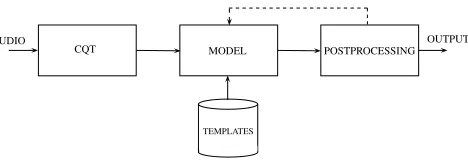
Figure 1. Proposed system diagram.
tion, we propose a two-stage transcription procedure in or-der to eliminate spurious pitch detections. The proposed model is trained on note samples from the RWC database [10] and is tested using recordings from the MAPS database [8], the TRIOS dataset [9], and the MIREX MultiF0 record-ing [1]. Multi-pitch detection and instrument assignment results show that the proposed EDHMM-based system is able to model the durations of sound states and the overall evolution of notes, and its temporal constraints lead to im-proved performance compared to hidden Markov models (HMMs) used in the same framework. Finally, the pro-posed system outperforms several AMT methods in the lit-erature for the same experiments.
The outline of this paper is as follows. Section 2 presents the proposed EDHMM-based transcription model, along with the postprocessing steps. The datasets used for train-ing and testtrain-ing, as well as the evaluation metrics and exper-imental results, are presented in Section 3. Finally, con-clusions are drawn and future directions are indicated in Section 4.
2. PROPOSED METHOD
In this section, the proposed EDHMM-constrained auto-matic transcription model is described, along with the up-date rules for estimating the various model parameters and the steps used for post-processing; the proposed system di-agram can be seen in Fig. 1.
2.1 Model
The proposed model aims to express the evolution of notes in multiple-instrument polyphonic music as a succession of sound state templates, further constrained by the ordering and the expected duration of each sound state. These tem-poral constraints are incorporated into a model which sup-ports multiple templates per pitch and instrument, and also supports shift-invariance across log-frequency in order to model tuning changes and frequency modulations. In or-der to achieve this, we integrate independent pitch-wise explicit duration hidden Markov models (EDHMMs) [18] into the HMM-constrained automatic transcription model of [2]. Thus, the proposed model can be called EDHMM-constrained shift-invariant PLCA.
More formally, the normalized magnitude log-frequency spectrogramVω,t(ω denotes log-frequency andtdenotes
time) which is used as input, is decomposed into a series of sound state spectral templates per instrument and pitch, a time-varying pitch shifting parameter, a time-varying in-strument contribution per pitch, a pitch activation, and
fi-nally a sound state activation per pitch, which is controlled by its respective EDHMM. If we denote the collection of observations for all time frames asω¯, the proposed model in terms of the observations is given by:
P(¯ω) = X
¯
q(1),···,q¯(P)
X
¯
d(1),···,d¯(P)
P(q(1)1 )· · ·P(q (P) 1 )
P(d(1)1 )· · ·P(d(1P))
Y
t
P(qt(1)|q
(1)
t−1, d (1)
t−1)P(d (1)
t |q
(1)
t , d
(1)
t−1)
· · ·
Y
t
P(qt(P)|q
(P)
t−1, d (P)
t−1)P(d (P)
t |q
(P)
t , d
(P)
t−1)
Y
t
P(¯ωt|q(1)t , . . . , q
(P)
t )
(1)
wherep= 1,· · ·,Pdenotes pitch,q(p)denotes the sound
state for thep-th pitch,d(p)denotes the duration distribu-tion for thep-th pitch,P(q(1p))is the sound state prior for the p-th pitch, P(d(1p))is the duration prior for the p-th pitch,q¯is the sequence of draws ofq,d¯is the sequence of draws ofd, and finallyP(¯ωt|q(1)t , . . . , q
(P)
t )is the
obser-vation probability for a given obserobser-vationω¯t.
An EDHMM has state transitions only at the end of a segment, and its duration distributions generate segment lengths only at every state switch [7]:
P(qt(p+1)|qt(p), d
(p)
t ) =
(
δ(q(t+1p), q (p)
t ), dt>1
P(qt(p+1)|q (p)
t ), otherwise
P(d(tp+1)|q (p)
t+1, d (p)
t ) =
(
δ(d(t+1p), d (p)
t −1), dt>1
P(d(tp+1)|q(t+1p)), otherwise
whereP(qt(p+1)|q (p)
t )is the pitch-wise sound state transition
matrix, andP(d(tp)|q
(p)
t )is the pitch-wise sound state
du-ration distribution. Also,δ(x, y) = 1ifx=yand 0 other-wise.
Since in the PLCA-based models Vω,t represents the
number of timesω has been drawn at thet-th time frame, the observation probability is calculated as:
P(¯ωt|q
(1)
t , . . . , q
(P)
t ) =
Y
ωt
Pt(ωt|q
(1)
t , . . . , q
(P)
t )
Vω,t
(2) In the proposed model, Pt(ωt|qt(1), . . . , q
(P)
t ) is
decom-posed as:
Pt(ωt|q
(1)
t , . . . , q
(P)
t ) =
X
st,pt,ft
Pt(pt)Pt(st|pt)P(ωt−ft|st, pt, q
(pt)
t )Pt(ft|pt)
(3)
wheresdenotes the instrument source,fis the pitch shift-ing parameter, Pt(pt)is the pitch activation, Pt(st|pt)is
the time-varying instrument contribution for each pitch,
source s, pitch p, and sound state q(p), and Pt(ft|pt)is
the log-frequency shifting distribution per pitch over time. The subscripttinft, ωt, st, ptdenotes the values of
vari-ablesf, ω, s, ptaken at timet. The shifting parameterf is constrained to a semitone range around the ideal tuning po-sition of each pitch. Since in the proposed system the time-frequency representation used is the constant-Q transform (CQT) with a log-frequency resolution of 60 bins/octave and a 40ms step [15], this implies thatf ∈[1,5]. We also set a maximum duration for each sound state: d∈[1,20], which means that the maximum duration of each sound state is 800ms.
2.2 Parameter Estimation
The unknown model parameters of Section 2.1 can be es-timated using the Expectation-Maximization (EM) algo-rithm [5]. For the E-step, the posterior for all hidden vari-ables is:
Pt(ft, st, pt, qt(1), . . . , q
(P)
t |ω¯) =
Pt(q(1)t , . . . , q
(P)
t |ω¯)Pt(ft, st, pt|ωt, q(1)t , . . . , q
(P)
t ) (4)
We assume that the pitch-wise EDHMMs are indepen-dent, thus the joint probability of all sound states is decom-posed as:
Pt(q(1)t , . . . , q
(P)
t |ω¯) =
P Y
p=1
Pt(q(tp)|ω¯) (5)
where:
Pt(q(tp)|ω¯) =
P
τ <t α
∗(p)
τ (q(τp+1) )β
∗(p)
τ (qτ(p+1) )−α(τp)(qτ(p))βτ(p)(q(τp))
P
q(tp),τ <t
α∗τ(p)(qτ(p+1) )β
∗(p)
τ (qτ(p+1) )−α(τp)(qτ(p))βτ(p)(q(τp))
(6)
where α∗
τ(qτ+1), ατ(qτ)are the EDHMM forward
vari-ables and β∗
τ(qτ+1), βτ(qτ) are the EDHMM backward
variables; all aforementioned forward-backward variables can be computed using recursive formulae [18].
The second term of (4) can be computed using Bayes’ theorem and the notion thatP(ωt|ft, st, pt, q(
pt)
t ) =P(ωt−
ft|st, pt, q( pt)
t ):
Pt(ft, st, pt|ωt, q
(1)
t , . . . , q
(P)
t ) =Pt(ft, st, pt|ωt, q
(pt)
t ) =
Pt(pt)P(ωt−ft|st, pt, q
(pt)
t )Pt(ft|pt)Pt(st|pt)
P
pt,st,ftPt(pt)P(ωt−ft|st, pt, q (pt)
t )Pt(ft|pt)Pt(st|pt)
(7)
For the M-step, the update equations for the unknown parameters are as follows:
Pt(pt) =
P
ωt,ft,st,q (1) t ,···,q
(P) t
Vω,tPt(ft, st, pt, q
(1)
t , . . . , q
(P)
t |ω¯)
P
pt,ωt,ft,st,q (1) t ,···,q
(P) t
Vω,tPt(ft, st, pt, qt(1), . . . , q
(P)
t |ω¯)
(8)
Pt(st|pt) =
P
ωt,ft,q (1) t ,···,q
(P)
t Vω,tPt(ft, st, pt, q (1)
t , . . . , q
(P)
t |ω¯)
P
st,ωt,ft,q (1) t ,···,q
(P) t
Vω,tPt(ft, st, pt, q
(1)
t , . . . , q
(P)
t |ω¯)
(9)
Pt(ft|pt) =
P
ωt,st,q (1) t ,···,q
(P) t
Vω,tPt(ft, st, pt, qt(1), . . . , q
(P)
t |ω¯)
P
ft,ωt,st,q (1) t ,···,q
(P) t
Vω,tPt(ft, st, pt, q
(1)
t , . . . , q
(P)
t |ω¯)
(10)
P(q1(p)) = P1(q
(p) 1 |ω¯)
P
q(1p)P1(q
(p) 1 |ω¯)
(11)
P(q(tp+1)|q
(p)
t ) =
P
tα
(p)
t (q
(p)
t )P(q
(p)
t+1|q
(p)
t )β
∗(p)
t (q
(p)
t+1)
P
qt(p+1),tα
(p)
t (q
(p)
t )P(q
(p)
t+1|q
(p)
t )β
∗(p)
t (q
(p)
t+1) (12)
P(d(tp)|q
(p)
t ) =
P
tα
∗(p)
t (q
(p)
t+1)P(d
(p)
t |q
(p)
t )β p t+d(q
(p)
t+d)
Q
τP(¯ωτ|q( p)
τ )
P
d(tp),tα
∗(p)
t (q
(p)
t+1)P(d
(p)
t |q
(p)
t )β p t+d(q
(p)
t+d)
Q
τP(¯ωτ|q
(p)
τ )
(13)
whereτ =t+ 1,· · ·, t+d.
It should be noted that we consider the sound state tem-plates to be fixed, so no update rule forP(ω|s, p, q(p))
ex-isits. Using fixed templates, 10-15 iterations using the up-date rules presented in the present section are sufficient for convergence. The output of the system is a pitch activation which is scaled by the energy of the log-spectrogram:
Pt(p)X ω
Vω,t (14)
In order to further constrain the model so that it reaches more meaningful solutions, sparsity is enforced in Pt(p)
andPt(s|p), by modifying the update rules in (8) and (9), where a power greater than 1 is applied to the numerators and denominators, which leads to sharpened distributions, thus encouraging sparsity [2]. Even though convergence is not guaranteed, it is observed in practice. This procedure implies that only few pitches need to be active at each time frame, and also that for a note at a given time frame, only few instruments are responsible for producing it.
qt qt+1
(c)
ω
q
(b)
d
q
(a)
1 2 3
100 200 300 400 500
5 10 15 20
1
2
3 1
2 3 1
2
[image:5.595.73.518.50.182.2]3
Figure 2. EDHMM parameters learned for note D4 using the ‘MAPS MUS-alb se2 ENSTDkCl’ piece from the MAPS database. (a) The duration distribution matrixP(d|q). (b) Pre-computed piano sound state templates for note D4. (c) The sound state transition matrixP(qt+1|qt).
2.3 Post-processing
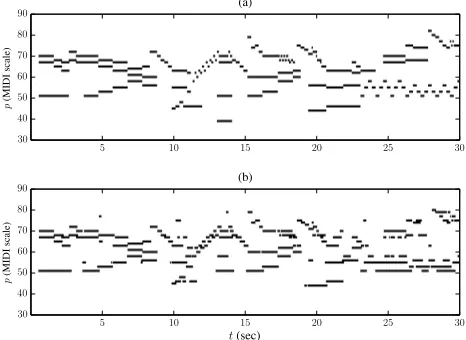
Since the resulting pitch activation from (14) is non-binary, a postprocessing procedure needs to take place in order to convert it to a binary piano-roll or a MIDI-like representa-tion (this procedure is also called note tracking). As in the vast majority of spectrogram factorization-based automatic transcription systems (e.g. [6, 11]), we perform threshold-ing on the pitch activation, followed by a process for re-moving note events with a duration less than 80ms. We should note that the HMM-based postprocessing method of [2] was found not to perform well on pieces with fast tempo and rapid note changes. An example of the output of the post-processing step compared with a ground-truth transcription is given in Fig. 3, using a segment from a piano sonata.
A system variant is also proposed, where after detecting all active pitches in the final piano-roll, the update rules of subsection 2.2, are run again, but instead of settingpas to cover the entire pitch range, we only use the list of active pitches estimated in the first run. This two-stage process also helps in further constraining the solution by removing any pitches that might appear inPt(p)but are nevertheless removed in the postprocessing step.
3. EVALUATION
3.1 Training Data
Sound state templates are extracted for several orchestral instruments, using isolated note samples from the RWC database [10]. Specifically, we extract templates for bas-soon, cello, clarinet, flute, guitar, harpsichord, oboe, or-gan, piano, tenor sax, and violin, using the CQT as a time-frequency representation [15]. The complete note range of the instruments is used, given the available training data. The sound state templates are computed in an unsupervised manner, using a single-pitch and single-instrument variant of the model of (3), where the number of sound states is set toQ(p)= 3.
p
(MI
DI
sc
al
e)
t(sec) (b)
p
(MI
DI
sc
al
e)
(a)
5 10 15 20 25 30
5 10 15 20 25 30
30 40 50 60 70 80 90 30 40 50 60 70 80 90
Figure 3. (a) The ground-truth piano-roll of the first 30sec of W.A. Mozart’s Piano Sonata K.333, 2nd movement (from the MAPS database). (b) The piano-roll computed from the proposed transcription system.
3.2 Test Data
For testing, we use recordings from three publicly available transcription datasets. Firstly, we used thirty 30sec piano segments from the MAPS database [8], specifically from the ‘ENSTDkCl’ subset that has been used in the past for multi-pitch evaluation in [4, 17].
We also utilized the woodwind quintet recording used as a development set in the MIREX multiF0 and note track-ing task [1]. Instruments present include bassoon, clarinet, flute, horn, and oboe, while manually-aligned ground truth for each instrument track is available online [1].
[image:5.595.307.540.250.420.2]3.3 Metrics
For evaluating the performance of the proposed system for multi-pitch detection, we employ two sets of metrics: frame-based and note-based ones. For note-based evalu-ation, we use the onset-based transcription metrics which are used in the MIREX note tracking task [1]. A detected note is considered correct if its pitch matches a ground truth pitch and its onset is within a 50ms tolerance of a ground-truth onset. The resulting note-based precision, re-call, and F-measure are defined as:
Pren= Ntp
Nsys
Recn= Ntp
Nref
Fn= 2RecnPren
Recn+Pren
(15) whereNtpis the number of correctly detected pitches,Nsys
is the number of pitches detected by the system, andNref
is the number of reference pitches.
For the frame-based metrics, evaluations are performed in a 10ms step as in the MIREX multiF0 evaluations [1], and we use the frame-based precision, recall, and F-measure, which are defined in a similar way to (15) and are denoted asPref,Recf, andFf, respectively.
3.4 Results
Experiments are performed using the proposed system of Section 2 using two variants; a one-stage version (using the update rules and the note tracking step) and the two-stage version presented in subsection 2.3. The proposed EDHMM-based system is compared with the HMM-based system of [2] using the same time-frequency representation and note tracking steps. In all cases, the Markov models were initialized as ergodic, with uniform priors and state transition probabilities.
In Table 1, multi-pitch detection results using the MAPS recordings are shown. It can be seen that using both sets of metrics, the EDbased systems outperform the HMM-based one. It can also be seen that the two-stage version of the system makes a significant improvement in terms of performance. The differences in performance are not as clear using the frame-based metrics, but they are still evi-dent. In all cases, the precision is higher compared to recall (e.g. for the two-stage EDHMM case, Pren = 74.73%
andRecn= 64.46%), which signifies that there is a larger
number of missed detections compared to the number of false alarms. When comparing the reported results with other methods using the same dataset, it can be seen that the proposed system outperforms both the infinite compos-ite autoregressive system of [17] (which reported Ff = 48.4%) and the source-filter NMF model of [4], which reported Ff = 52.4% (where the best reported
perfor-mance in [4] was reported using the using the SONIC algo-rithm [14], reachingFf = 58.0%). Finally, the note-based
accuracy measure for the MAPS recordings is 53.42%; the accuracy reported in [3] for the MAPS-Disklavier dataset was 68.7%, although it should be stressed that in [3] the dataset was also used for training the system.
Results using the MIREX woodwind quintet recording are shown in Table 1; again it can be seen that the
EDHMM-Method/Instrument HMM-based EDHMM-based Bassoon 47.72% 41.42% Clarinet 64.33% 67.68% Flute 51.18% 57.53%
Horn 39.86% 44.59%
Oboe 23.84% 22.17%
[image:6.595.311.543.48.137.2]Mean 45.39% 46.68%
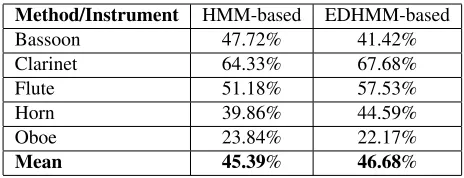
Table 2. Instrument assignment results (Ff) using the first
30sec of the MIREX MultiF0 recording.
based system outperforms the HMM-based one. In the lit-erature, an experiment using the first 30sec of the MIREX recording was made in [16], whereFf = 62.5%. Using
the first 30sec in the 2-stage EDHMM system, the frame-based F-measure reaches 66.95%.
Also, using the TRIOS dataset, similar results are re-ported, as can be seen in Table 1. It should be noted though that there is a large difference between the note-based met-rics and the frame-based metmet-rics, which can be attributed to the fact that the TRIOS dataset contains notes with long durations, which get oversegmented in the proposed sys-tem (where small gaps do not significantly affect the frame-based metrics).
Finally, we perform experiments on instrument identi-fication using information from matrixPt(s|p). In the in-strument assignment task [11], a detected pitch is consid-ered to be correct if, in addition to pitch and timing con-straints, it is assigned to a correct instrument source. We performed experiments using the MIREX woodwind quin-tet, using a system variant which utilizes templates found in the recording (bassoon, clarinet, flute, horn, oboe). The output (for instruments) is given byPt(p)Pt(s|p)P
ωVω,t.
For comparative purposes, we evaluated the first 30sec of the MIREX recording, as in [4], using the frame-based F-measure. Instrument assignment results are shown in Table 2, where it can be seen that the proposed EDHMM-based method performs better compared to the HMM-based one. It can be seen that the best performance is reported for clar-inet, which has a relatively different spectral shape com-pared to the other instruments. It should be noted though that the HMM-based method performs better for bassoon and oboe, while the EDHMM-based method performs bet-ter for clarinet, flute, and horn. The reportedFf for the
method in [4] is 37.0%, which indicates that the proposed method (which uses pre-extracted spectral templates in-stead of source-filter models within a spectrogram factor-ization framework) is more appropriate for the task.
4. CONCLUSIONS
tem-Dataset MAPS ‘ENSTDkCl’ MIREX TRIOS
Method / Metric Fn Ff Fn Ff Fn Ff
[image:7.595.105.494.48.113.2]HMM-based 65.93% 66.41% 63.64% 66.01% 55.94% 67.76% EDHMM-based 67.12% 66.82% 65.14% 66.42% 56.95% 69.54% EDHMM-based (2-stage) 68.61% 67.99% 66.60% 66.98% 57.66% 71.17%
Table 1. Multi-pitch detection results (inFnandFf) using the three employed datasets.
poral constraints posed by the EDHMMs resulted in im-proved multi-pitch detection and instrument identification performance when compared to HMM-based constraints. Evaluation results outperformed state-of-the-art multi-pitch detection methods using the MAPS and MIREX datasets. Finally, a proposed two-stage transcription procedure helps in further eliminating transcription errors.
One of the main drawbacks of the proposed method is its computational complexity. Even with independent EDHMMs, the proposed method performs about 60× real-time, which is prohibitive for large-scale experiments or real-time applications. In the future, we will attempt to cre-ate computationally-efficient versions of the proposed sys-tem using more compact time-frequency representations and by replacing the expensive expectation-maximization algorithm with variational Bayesian methods. Finally, we will expand the existing spectrogram factorization frame-work in order to introduce additional constraints via musi-cological models, for example integrating information from chord and key detection for improving multi-pitch detec-tion performance.
5. REFERENCES
[1] Music Information Retrieval Evaluation eX-change (MIREX). http://music-ir.org/ mirexwiki/.
[2] E. Benetos and S. Dixon. Multiple-instrument poly-phonic music transcription using a temporally-constrained shift-invariant model.J. Acoustical Society of America, 133(3):1727–1741, March 2013.
[3] S. B¨ock and M. Schedl. Polyphonic piano note tran-scription with recurrent neural networks. InIEEE Int. Conf. Audio, Speech and Signal Processing, pages 121–124, March 2012.
[4] J. J. Carabias-Orti, T. Virtanen, P. Vera-Candeas, N. Ruiz-Reyes, and F. J. Ca˜nadas-Quesada. Musi-cal instrument sound multi-excitation model for non-negative spectrogram factorization. IEEE J. Selected Topics in Signal Processing, 5(6):1144–1158, October 2011.
[5] A. P. Dempster, N. M. Laird, and D. B. Rubin. Max-imum likelihood from incomplete data via the EM al-gorithm.J. Royal Statistical Society, 39(1):1–38, 1977.
[6] A. Dessein, A. Cont, and G. Lemaitre. Real-time poly-phonic music transcription with non-negative matrix factorization and beta-divergence. In11th Int. Society
for Music Information Retrieval Conf., pages 489–494, August 2010.
[7] M. Dewar, C. Wiggins, and F. Wood. Inference in hid-den Markov models with explicit state duration distri-butions. IEEE Signal Processing Letters, 19(4):235– 238, 2012.
[8] V. Emiya, R. Badeau, and B. David. Multipitch estima-tion of piano sounds using a new probabilistic spectral smoothness principle.IEEE Trans. Audio, Speech, and Lanhuage Processing, 18(6):1643–1654, August 2010.
[9] J. Fritsch. High quality musical audio source separa-tion. Master’s thesis, UPMC / IRCAM / Tel´ecom Paris-Tech, 2012.
[10] M. Goto, H. Hashiguchi, T. Nishimura, and R. Oka. RWC music database: music genre database and musi-cal instrument sound database. InInt. Conf. Music In-formation Retrieval, October 2003.
[11] G. Grindlay and D. Ellis. Transcribing multi-instrument polyphonic music with hierarchical eigeninstruments. IEEE J. Selected Topics in Signal Processing, 5(6):1159–1169, October 2011.
[12] P. Grosche, B. Schuller, M. M¨uller, and G. Rigoll. Au-tomatic transcription of recorded music.Acta Acustica united with Acustica, 98(2):199–215, March 2012.
[13] A. Klapuri and M. Davy, editors. Signal Process-ing Methods for Music Transcription. Springer-Verlag, New York, 2006.
[14] M. Marolt. A connectionist approach to automatic tran-scription of polyphonic piano music.IEEE Trans. Mul-timedia, 6(3):439–449, June 2004.
[15] C. Sch¨orkhuber and A. Klapuri. Constant-Q transform toolbox for music processing. In7th Sound and Music Computing Conf., Barcelona, Spain, July 2010.
[16] E. Vincent, N. Bertin, and R. Badeau. Adaptive har-monic spectral decomposition for multiple pitch es-timation.IEEE Trans. Audio, Speech, and Language Processing, 18(3):528–537, March 2010.
[17] K. Yoshii and M. Goto. Infinite composite autoregres-sive models for music signal analysis. In13th Int. So-ciety for Music Information Retrieval Conf., pages 79– 84, October 2012.