Short running title: Hidden Markov models for accelerometer data
Analysis of animal accelerometer data using hidden Markov
models
Vianey Leos-Barajas
a∗, Theoni Photopoulou
b, Roland Langrock
c, Toby A. Patterson
d,
Yuuki Y. Watanabe
e,f, Megan Murgatroyd
gand Yannis P. Papastamatiou
h,ia
Department of Statistics
Iowa State University
Ames, IA, USA
b
Centre for Statistics in Ecology, Environment and Conservation
Department of Statistical Sciences
University of Cape Town
Cape Town, South Africa
c
Department of Business Administration and Economics
Bielefeld University
Bielefeld, Germany
d
CSIRO, Oceans and Atmosphere
Hobart, Tasmania, Australia
e
National Institute of Polar Research
Tachikawa, Tokyo, Japan
f
SOKENDAI (The Graduate University for Advanced Studies)
Tachikawa, Tokyo, Japan
g
Animal Demography Unit
University of Cape Town
Cape Town, South Africa
h
School of Biology, Scottish Oceans Institute
University of St Andrews
St Andrews, UK
i
Department of Biological Sciences
Florida International University
North Miami, Fl, USA
Word Count: –
∗corresponding author:
e-mail: [email protected]
Abstract
1
1. Use of accelerometers is now widespread within animal biotelemetry as they provide a means 2
of measuring an animal’s activity in a meaningful and quantitative way where direct observation is 3
not possible. In sequential acceleration data there is a natural dependence between observations of 4
behaviour, a fact that has been largely ignored in most analyses. 5
2. Analyses of acceleration data where serial dependence has been explicitly modelled have largely 6
relied on hidden Markov models (HMMs). Depending on the aim of an analysis, an HMM can be 7
used for state prediction or to make inferences about drivers of behaviour. For state prediction, 8
a supervised learning approach can be applied. That is, an HMM is trained to classify unlabelled 9
acceleration data into a finite set of pre-specified categories. An unsupervised learning approach can 10
be used to infer new aspects of animal behaviour when biologically meaningful response variables 11
are used, with the caveat that the states may not map to specific behaviours. 12
3. We will provide the details necessary to implement and assess an HMM in both the supervised 13
and unsupervised learning context and discuss the data requirements of each case. We outline 14
two applications to marine and aerial systems (shark and eagle) taking the unsupervised learning 15
approach, which is more readily applicable to animal activity measured in the field. HMMs were 16
used to infer the effects of temporal, atmospheric and tidal inputs on animal behaviour. 17
4. Animal accelerometer data allow ecologists to identify important correlates and drivers of animal 18
activity (and hence behaviour). The HMM framework is well suited to deal with the main features 19
commonly observed in accelerometer data, and can easily be extended to suit a wide range of types 20
of animal activity data. The ability to combine direct observations of animal activity with statistical 21
models, which account for the features of accelerometer data, offers a new way to quantify animal 22
behaviour, energetic expenditure and deepen our insights into individual behaviour as a constituent 23
of populations and ecosystems. 24
Keywords: animal behaviour; activity recognition; latent states; serial correlation; time series 25
1
Introduction
26
Accelerometers are becoming more prevalent in the fields of animal and human bio-logging (Bao & 27
Intille, 2004; Raviet al., 2005; Shepardet al., 2008; Altunet al., 2010). The potential of accelerometers 28
lies in the fact that they provide a means of measuring activity in a meaningful and quantitative way 29
where direct observation is not possible (Shepardet al., 2008; Nathanet al., 2012; Brownet al., 2013). 30
While these instruments are cheap and compact, recording acceleration at a high temporal resolution and 31
in up to three dimensions quickly results in terabytes of data that present various challenges regarding 32
transmission, storage, processing and statistical modelling. 33
Much of the focus in the analysis of acceleration data has been on identifying patterns in the 34
observed waveforms that correspond to a known behaviour or movement mode. This can be achieved 35
by employing statistical classification methods and can entail observing the animal, manually assigning 36
data in order to subsequently classify remaining unlabelled data. Many studies that have shown the 38
effectiveness of various machine learning algorithms for classification of human acceleration data (Bao & 39
Intille, 2004; Raviet al., 2005; Altunet al., 2010; Mannini & Sabatini, 2010). Algorithms such as support 40
vector machines (SVM), classification trees, random forests, among others, have also recently been used 41
for classification of animal acceleration data (Nathanet al., 2012; Carrollet al., 2014; Grafet al., 2015). 42
For example, Nathan et al. (2012) compared the effectiveness of five machine learning algorithms to 43
distinguish between eating, running, standing, active flight, passive flight, general preening and lying 44
down, for griffon vultures. 45
Most machine learning algorithms assume independence between individual observations. However, 46
in sequential acceleration data there is a natural dependence between observations of behaviour — 47
once initiated, particular animal behaviours often last for periods longer than the sampling frequency. 48
This fact has been largely ignored in most applications of classification approaches. The studies where 49
serial dependence has been explicitly modelled have mostly relied on hidden Markov models (HMMs) 50
(Wardet al., 2006; Heet al., 2007; Mannini & Sabatini, 2010, 2011). HMMs are stochastic time series 51
models which assume that the observed time series, the so-called state-dependent process, is driven by 52
an unobservable state process. In this scenario, the former corresponds to the acceleration data and the 53
latter to the behavioural classes. Typically, and in common with the aforementioned machine learning 54
approaches, in the training stage, the states of the HMM were known a priori, requiring corresponding 55
data derived from direct observations. 56
There are two main difficulties with such a supervised learning approach. First, while there has been 57
much success in classification of human acceleration data, where training data can usually be obtained 58
with minimal effort, this may not be feasible for some animals. Humans can easily be observed in a 59
laboratory setting, given instructions or monitored in more realistic settings, such as walking outdoors or 60
in their home (e.g. Leenderset al., 2000). In certain cases, animals can also be monitored in a laboratory 61
setting (Wilsonet al., 2008), but movement patterns recorded in the lab from free-ranging animals may 62
not appear exactly the same as in data collected while in more natural settings. Conversely, many 63
behaviours can only be observed in natural settings, although there has been success using surrogate 64
species for classification of behavioural modes (Shepardet al., 2008; Nathanet al., 2012; Campbellet al., 65
2014; Brownet al., 2013). 66
Second, human acceleration data has commonly been used as a tool for health monitoring and other 67
situations where the focus is on (state) prediction, as opposed to learning how external factors drive 68
the behaviours. Classification of behavioursalone, while certainly of interest in many scenarios, may 69
not lead to biologically interesting inference. Once the classification has been done, the task of relating 70
these states to environmental (and other) covariates in order to identify drivers in behaviours remains. 71
Moreover, it is difficult to make appropriate inferential statements as the classifications are not without 72
error, propagating the state uncertainty through to the modelled effect of the covariates. 73
the HMM to recognize specific behaviours. Alternatively, HMMs can also be used in an unsupervised 75
learning context, i.e. when there are no labelled data. In an unsupervised learning context the states 76
are not pre-defined to represent a specific behaviour. Instead, the states will be allocated such that the 77
model captures as much as possible of the marginal distribution of the observations, i.e. the distribution 78
of an observation at a randomly chosen time point, not conditional on the previous history of the 79
process, as well as their correlation structure. If biologically meaningful response variables from the 80
acceleration data are considered, then the HMM states will usually represent interpretable activity levels 81
or even proxies of behavioural modes. Being data-driven the states can be as, if not more, informative 82
in the unsupervised learning setting than the alternatives. We can then incorporate exogenous or, 83
where available, endogenous variable(s) of interest, to make inferential statements. HMMs and related 84
state-switching models, in particular state-space models, have successfully been implemented to identify 85
drivers of movement based on tracking data (Pattersonet al., 2009), and can similarly be applied in the 86
context of accelerometer data. For example, Phillips et al.(2015) applied HMMs in an unsupervised 87
learning context to understand the behaviour of free swimming tuna from vertical movement data 88
collected by data-storage tags. We will implement an unsupervised learning approach for another 89
difficult to observe marine species, the blacktip reef shark, and a volant species, the black eagle. 90
In this paper we review HMM-based approaches to the analysis of animal accelerometer data. In 91
Section 2 we will provide an overview of accelerometer data and connect the data processing step to the 92
HMM-based approaches described in Section 3. We will typically refer to the termbehavioural class, 93
rather than differentiate between identification of specific movements (e.g. wing flapping) or behaviours 94
(e.g. foraging). In Section 4 we demonstrate the use of HMMs with real data examples from marine 95
and aerial systems. 96
2
Accelerometer data
97
Accelerometer devices measure in up to three axes, which can be described relative to the body of the 98
animal; longitudinal (surge), lateral (sway) and dorso-ventral (heave). Acceleration recorded along one 99
or two axes can be used to measure movement in parts of the body, e.g. the mandible (Suzukiet al., 100
2009; Naitoet al., 2010; Iwata et al., 2015), or aspects of whole body acceleration, e.g. longitudinal 101
surge (Sakamotoet al., 2009). Currently, acceleration is most commonly recorded in three axes and, to 102
a lesser degree, in two axes (Brownet al., 2013), to measure locomotion. 103
104
2.1
Data Processing for Classification
105
While the observed acceleration data can be used to identify specific movements in animals, HMMs and 106
other machine learning algorithms require more information to accurately classify the unlabelled data. 107
of observations. The derived features should be driven by the classes of movements that have been 109
defined and chosen in such a way to accentuate the differences in observed acceleration measurements. 110
There are many commonalities between the features used in applications of classification of accelera-111
tion data, though naturally no one optimal set exists (Bao & Intille, 2004; Martiskainenet al., 2009; 112
Nathanet al., 2012; Brownet al., 2013). For instance, Nathan et al.(2012) used thirty-eight features 113
in order to distinguish between eating, running, standing, active flight, passive flight, general preening 114
and lying down, for griffon vultures, while Grafet al.(2015) used eight features to distinguish between 115
standing, walking, swimming, feeding, diving and grooming of Eurasian beavers. In each case, means 116
and variances of each of the three axes are used, as well as overall dynamic body acceleration (ODBA), 117
the sum of dynamic body acceleration from the three axis, among others. 118
119
2.2
Connecting Measures to Behaviours
120
When the aim is to classify the acceleration data, data processing is driven by identifying a set of features 121
that can be used to distinguish between specific behaviours, even if those features are not themselves 122
interpretable as a specific behaviour when considered on their own. However, there are metrics derived 123
from accelerometer data that, on their own, can be used as proxies for behaviour and as input to an 124
HMM. Repeating patterns in at least one axis tend to arise from behaviours such as stroking (Sakamoto 125
et al., 2009), flapping, running or walking (Shepardet al., 2008), whereas sudden changes, corresponding 126
to bursts of acceleration, are often associated with prey pursuits or capture (Suzukiet al., 2009; Simon 127
et al., 2012; Ydesenet al., 2014; Heerahet al., 2014), as well as predator avoidance or conflict. 128
In addition to behaviour, several measures can be used to summarise effort or exertion and relate 129
acceleration to activity levels, such as ODBA (Wilsonet al., 2006; Gleisset al., 2011; Elliottet al., 2013; 130
Gleisset al., 2013) and vectorial dynamic body acceleration (VeDBA) (Qasem et al., 2012). Minimum 131
specific acceleration (MSA) (Simonet al., 2012) can be used to disentangle the gravitational component 132
of acceleration (static acceleration) from the movement signal or specific acceleration (also dynamic 133
acceleration). One of the simplest and most unambiguous interpretations of static acceleration data is 134
body posture, which in many cases can be directly interpreted as a specific behaviour (Wilsonet al., 135
2008; Shepardet al., 2008). 136
Both ODBA and MSA are used to reduce the dimensionality of 3D acceleration data while retaining 137
important information (e.g. Wilsonet al.(2008); Simonet al.(2012)). They remove the gravitational 138
component from the acceleration signature and produce an overall value of the dynamic acceleration 139
experienced by the animal. ODBA is derived by smoothing over a time period, e.g. 1 sec, making it 140
useful for continuous data, whereas MSA is calculated point-wise (as the norm of the three vectors 141
3
Analysis of accelerometer data
143
We will first provide a brief overview of the HMM framework (Section 3.1). Subsequently, in Section 3.2, 144
we will review how HMMs can be used for state prediction, i.e. classification of animal accelerometer 145
data. In Section 3.3, we focus on the implementation of HMMs in a setting where the meaning of the 146
states is driven entirely by the data and the focus lies on general inference rather than classification 147
only. 148
3.1
Hidden Markov models
149
An HMM is a stochastic time series model involving two layers: an observablestate-dependent process, 150
denoted by{Yt}Tt=1(in the univariate case), and an unobservablestate process, denoted by{Ct}Tt=1. The
151
state-dependent process models the observations, while the state process is a latent factor influencing the 152
distribution of the observations. In our case, the observations are the accelerometer metrics considered, 153
and the latent states are closely related to the animal’s behavioural state. More specifically, the state 154
process{Ct} takes on a finite number of possible values, 1, . . . , M, and its value at timet, ct, selects
155
which ofM possible component distributions generates observationyt. The Markov property is assumed
156
for{Ct}, i.e. the (behavioural) state at time t only depends on the (behavioural) state at timet−1,
157
such that evolution of the process over time is completely characterized by the one-step state transition 158
probabilities. These models are natural and intuitive candidates for modelling animal accelerometer 159
data, for two reasons: 1) they directly account for the fact that any corresponding observation will 160
be driven by the underlying behavioural state, or general activity level, of the animal, and 2) they 161
accommodate serial correlation in the time series by allowing states to be persistent. HMMs seek 162
to capture the strong autocorrelation in accelerometer data in a mechanistic way, rather than either 163
neglecting this feature completely or only including it in a nuisance error term. HMMs can therefore be 164
used for inference on complex temporal patterns, including the behavioural state-switching dynamics 165
and how these are driven by environmental variables (Pattersonet al., 2009; McKellaret al., 2015). 166
To complete the basic HMM formulation, we first summarize the probabilities of transitions between 167
the different states in the M ×M transition probability matrix (t.p.m.) Γ = (γij), where γij =
168
Pr Ct+1 = j|Ct = i
(for any t), i, j = 1, . . . , M. Note that here we are assuming that the state 169
transition probabilities are constant over time; this assumption will be relaxed in Section 3.3. The 170
initial state probabilities are summarized in the row vectorδ, where δi= Pr(C1=i),i= 1, . . . , M.
171
Second, we need to specify state-dependent distributions (sometimes called emission distributions), 172
p(yt|Ct = m), or more succinctly pm(yt), for m = 1, ..., M. These distributions can be discrete or
173
continuous, and possibly also multivariate (in which case we write yt = (y1t, . . . , yRt)). Usually, the
174
same parametric distribution is assigned to all M states, such that each state differs in terms of its 175
associated values of the parameters. Selection is driven by the data itself, e.g. count data or continuous 176
3.2
State prediction
178
HMMs provide a solid framework for the classification of data with strong serial dependence, such as 179
sequential acceleration data, which are often processed to represent movements over a few seconds, or 180
less, at a time (Wardet al., 2006; Heet al., 2007; Mannini & Sabatini, 2010). In this section, we will 181
cover the implementation and testing of an HMM when the focus of the analysis is state prediction. A 182
full example and R code implementing this approach is provided in the Supplementary material. 183
State prediction can be accomplished in three manners, commonly referred to as supervised, semi-184
supervised, or unsupervised learning. We will discuss the implementation of an HMM in the supervised 185
learning case, such that each state will correspond to one behaviour of interest, and briefly comment 186
on the other two cases at the end of the section. Hastie et al. (2001) detail how to split the labelled 187
time series into training, validation, and testing data, in order to estimate the prediction error. Other 188
approaches to estimating prediction error, such as a leave-one-out cross-validation (here treating a time 189
series as an observation), are also provided in detail. 190
Since the states are known, the maximum likelihood estimates (MLEs) of the HMM parameters are 191
obtained by maximizing the complete-data likelihood, which conveniently splits into several independent 192
parts, each of which is fairly straightforward to maximize (details provided in the Appendix). First, the 193
m-th entry of ˆδis simply the proportion of the time series that start in statem. Second, the entries of 194
the t.p.m. are estimated by 195
ˆ
γij =
# transitions from stateito statej
total # transitions from statei ,
196
fori, j = 1, ..., M. (Note this is the MLE conditional on the initial state, c1.) Finally, for each m =
197
1, . . . , M, the parameters of the state-dependent distribution given statemare estimated using only the 198
observations allocated to statem. As a multivariate normal distribution (MVN) is a common choice in 199
these cases, we cover the steps to fit the HMM with MVN state-dependent distributions in the Appendix 200
and Supplementary material. Given a fitted HMM, we can use the Viterbi algorithm to decode the most 201
likely state sequence, thereby assigning each observation to a state, at low computational effort. Full 202
details for state decoding are provided in Zucchiniet al.(2016). The state predictions can be compared 203
to the known states, and the proportion of correctly decoded states serves as an estimate of the prediction 204
accuracy. 205
As mentioned previously, there are two other approaches to state-prediction: semi-supervised and 206
unsupervised learning. In a semi-supervised approach, classes are pre-defined, as in the supervised 207
learning context, but there is additional flexibility provided in that the data do not have to be assigned 208
to one of the pre-defined classes. Instead, multiple additional states can be estimated from the data. In 209
an unsupervised learning approach, classes are not pre-defined in any manner. In these two cases, one 210
objective can be to identify the number of distinct movement patterns exhibited by the animal, with 211
multiple movement modes can correspond to the same behaviour (e.g foraging), interpretation of the 213
estimated states should be made with caution. In the next section, we will detail the implementation 214
of the unsupervised learning approach where the focus is to construct biologically relevant classes of 215
animal behaviour in order to make inferential statements. 216
3.3
Inference
217
So far, we have mostly focused on the case where there is a training sample, i.e. acceleration data together 218
with the associated behavioural states. Corresponding analyses involve training the HMM based on such 219
labelled data and then using that HMM to categorize incoming new, unlabelled data. While certainly of 220
interest in some settings, in practice, more often than not, labelled data will not be available but only the 221
accelerometer data. In such unsupervised learning settings, the HMM framework can be equally useful, 222
but is typically applied for different purposes than in classification. More specifically, the meaning of the 223
states in such cases is often not of interestper se. Instead, an HMM is used simply as an approximate 224
representation of the real data-generating process, and this may or may not entail that the nominal 225
HMM states are biologically meaningful. (However, metrics derived from the accelerometer data, as 226
described in Section 2, have been shown to provide insight into activity levels or correspond to classes 227
of behaviours, such that when used as response variables in the HMM these can lead to biologically 228
interpretable states.) Unsupervised learning of HMMs for accelerometer data has the advantage that 229
the states are estimated in a data-driven manner. In particular, for many of the metrics described in 230
Section 2 that are connected to behaviours, assignment of classes is difficult, to say the least, especially 231
for animals where behaviours are not well-defined. These include animals which cannot be directly 232
observed for long periods such as aquatic organisms. 233
There are three different possible purposes of having an approximate representation of the real pro-234
cess: (i) a mathematical description of the dynamics of the system (e.g. in order to have a concise 235
description of how accelerometer measurements evolve over time, in terms of a small number of in-236
terpretable parameters and associated stochastic distributions); (ii) extraction of information (e.g. a 237
hypothesis test on whether or not some environmental covariate increases the probability of an animal 238
switching to a particular behavioural state); (iii) prediction of future or missing values (e.g. behavioural 239
state prediction given accelerometer data) — see Konishi & Kitagawa (2008). In the ecological litera-240
ture on animal movement modelling, HMMs are used primarily to address (i) and (ii), the former in the 241
sense that concise descriptions of movement patterns are sought, the latter in the sense that inference 242
on the interaction of animals with their environment is drawn. In general, the ability to make inferential 243
statements provides an avenue to answer questions about the behavioural processes, movement patterns 244
and transitions between behaviours under different in relation to covariates. 245
Addressing a research question related to aim (ii) usually involves the incorporation of covariates 246
into the statistical model. In the HMM setting, this is commonly done at the level of the hidden states. 247
probability matrixΓ(t)= (γ(ijt)), whereγij(t)= Pr(Ct+1=j|Ct=i). The transition probabilities at time
249
t, γ(ijt), can then be related to a vector of environmental (or other) covariates, ω1(t), . . . , ω(pt)
, via the 250
multinomial logit link: 251
γij(t)= exp(ηij) PN
k=1exp(ηik)
, where ηij =
β0(ij)+Pp
l=1β (ij)
l ω
(t)
l ifi6=j;
0 otherwise.
252
Essentially there is one multinomial logit link specification for each row of the matrix Γ(t), and the
253
entries on the diagonal of the matrix serve as reference categories. 254
While with labelled data the likelihood of interest is the complete-data likelihood, for unlabelled 255
data the likelihood of interest is the density of the observations only,L=p(y1, . . . ,yT), the evaluation
256
of which requires the consideration of all possible state sequences that might have given rise to these 257
data. The powerful forward algorithm, detailed in the Appendix, can be applied to accomplish this, 258
opening up a straightforward and usually feasible avenue to MLEs, namely direct numerical maximiza-259
tion of the likelihood. In practice, one needs to consider multiple starting values in order to make 260
sure to have found the global maximum. The Expectation-Maximization algorithm provides a popular 261
alternative route to MLEs, despite being much more technically involved and having no clear practical 262
advantages (MacDonald, 2014). Since it is our view that users are better off focusing on the simpler 263
direct maximization approach, it is only this approach that we present in detail in the Appendix and 264
Supplementary material (for a more comprehensive introduction to maximum likelihood estimation for 265
HMMs, see Zucchiniet al., 2016). 266
Model selection techniques, in particular information criteria, can be used to choose an adequate 267
family of state-dependent distributions, to select an appropriate number of states or to determine 268
whether or not a covariate should be included in the model. However, users should not blindly follow 269
such information criteria, especially with regard to the selection of the number of states. For animal 270
behaviour data, it is our experience that such formal model selection approaches tend to favour models 271
with more states than would be expected based on biological intuition, often to an extent such that 272
selected models become near-impossible to interpret and very difficult to work with in practice (Langrock 273
et al., 2015). One explanation for this is that often additional states are included to compensate for a 274
model formulation that ignores some pattern in the data. These patterns can be due to the influence of 275
an unobserved covariate, within-day variation or individual heterogeneity which is not accounted for, a 276
violation of the Markov assumption or outliers — which usually cannot be avoided in data structures 277
as complex as those studied here, and which may not be pertinent to the ultimate aim of the study. 278
Further, accelerometer data is directly connected to the movement of an animal, such that an HMM 279
with a large number of states may reflect multiple movement modes, or general classes of movement, 280
connected to the same behavioural class, e.g. foraging or active behaviour. In such cases a healthy dose 281
of pragmatism is required. If the choice of the number of states turns out to be difficult, then it is often 282
model checking tools, in order to understand what exactly it is that the more complex models capture 284
that is not already captured by the simpler models. Langrocket al. (2015) discuss this issue in detail, 285
demonstrating many of the points made above in a real data example. 286
The HMM framework encompasses various other useful tools for drawing inference. In particular, 287
incorporating random effects into the model formulation will be crucial when there is substantial hetero-288
geneity across multiple individuals observed. There are various ways in which this can be accomplished 289
within the class of HMMs — see McKellar et al. (2015) and Chapter 13 in Zucchiniet al. (2016) for 290
comprehensive overviews, including discussions on the importance of acknowledging any potential het-291
erogeneity. Furthermore, the dependence structure can be modified in various ways, e.g. allowing for 292
more complex memory in the state process without losing the ability to efficiently calculate the likeli-293
hood using the forward algorithm (Langrocket al., 2012). Assessment of the model adequacy, i.e. model 294
checking, is commonly done using (pseudo-)residuals, which can reveal any notable lack of fit (Zucchini 295
et al., 2016). 296
4
Real data examples
297
4.1
Modelling activity in a soaring raptor
298
Large soaring birds, like raptors, depend on favourable meteorological conditions, as well as the un-299
derlying topography, for generation of updrafts required for low-energy flight (Pennycuick, 2008). Lift 300
availability is known to be driven largely by wind speed and temperature, as well as their interaction 301
with the underlying topography, though other factors also contribute. Lift adequate for soaring flight is 302
generated by two mechanisms; (1) by upward thermal convection of air warmed by solar radiation ( ´Akos 303
et al., 2010) (thermal soaring), and (2) by the movement of air over slopes and ridges in the landscape 304
(orographic or ridge soaring). 305
Recently, empirical studies relating bird activity patterns to weather conditions have become pos-306
sible due to advances in bio-logging technology that allows for collection of high-resolution movement 307
(e.g. acceleration) data. In particular, acceleration data can be used to distinguish between different 308
movement modes or, more simply, as a proxy of overall activity level, even if they do not correspond 309
clearly to different behaviours (Williamset al., 2015). 310
An adult Verreaux’s eagle(Aquila verreauxii)was instrumented with a remotely downloadable multi-311
sensor data-logger (UvABiTS, University of Amsterdam, The Netherlands, Boutenet al.(2013)) in the 312
Western Cape, South Africa, in 2013. The data-logger recorded 3D acceleration (at 20 Hz) for 1 second 313
directly after recording GPS location. The GPS location sampling rate depended on the solar-powered 314
battery charge and thus was higher during the mid-day. Data were collected over 9 consecutive days, 315
with a variable amount of acceleration data sampled each day and none collected overnight. 316
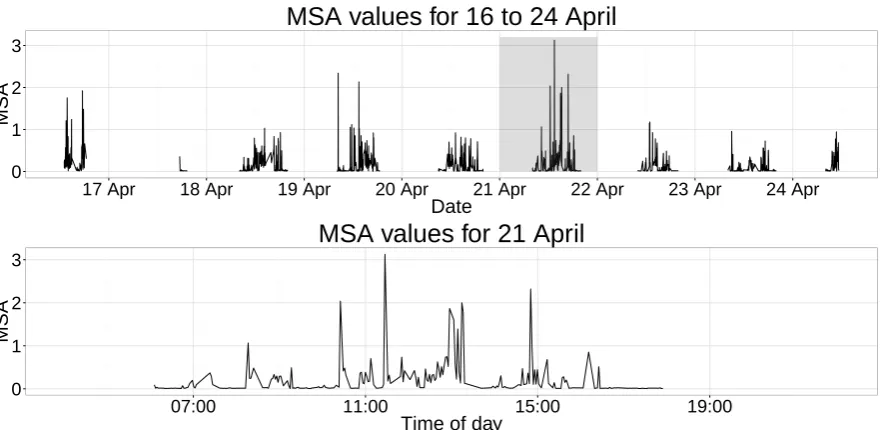
We were primarily interested in identifying potential drivers of activity level. As such, we extracted 317
On average, each day produced approximately 135 observations (s.e. 23.32). Before fitting an HMM to 319
the time series of MSA values, we first needed to resolve the irregular sampling of the acceleration data, 320
as this is a clear violation of the HMM assumptions. The time series of MSA across days were taken to 321
be independent and, within a day, the acceleration data was subsampled to produce one value of MSA 322
every 112 seconds. Only 1 consecutive missing value was allowed before splitting the daily MSA time 323
series into two or more segments. 324
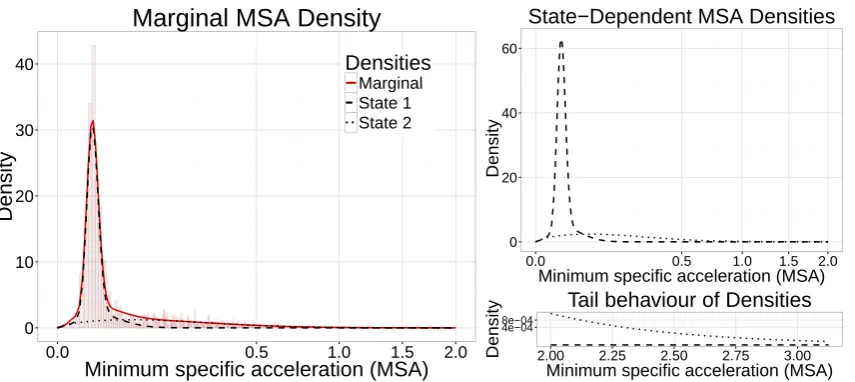
The histogram of MSA values revealed two peaks close to zero, which may reflect general low-active 325
behaviours such as roosting and preening. As we did not wish to discriminate between these two general 326
types of behaviours, we fit a 2-state HMM with state 1 represented by a mixture of gamma distributions 327
and a gamma distribution for state 2. The fitted state-dependent densities are shown in Figure 2, which 328
wepost-hoc interpreted as low-activity and high-activity behaviour. Although we do not connect state 329
2 to a specific flight behaviour, such as orographic soaring, we expect that behaviours requiring more 330
energy are reflected by larger MSA values. 331
In order to examine the effect of wind speed and temperature on the state-switching dynamics be-332
tween the two activity levels, we obtained hourly observations from the South African Weather Services 333
(Lambert’s Bay Station). The station is approximately 30 km from the general area in which the eagle 334
was tracked, which lead to a slight spatial and temporal mismatch between the available weather data 335
and the conditions actually experienced by the eagle. The range of temperatures and wind speeds expe-336
rienced by the eagle during the study period was between 12.3–31.5◦C, and 0–7.4 m/sec, respectively. 337
We allowed the entries of the t.p.m. to be a function of up to wind speed, temperature and their inter-338
action. The wind-only model is written as logit(γij(t)) =β0i+β1ix1t, for i= 1,2,j 6=i,t= 1, . . . , T,
339
with the intercept termβ0,i reflecting the t.p.m. when wind speed is at 0 m/sec. The model including
340
wind speed alone was favoured by the Bayesian Information Criterion (BIC) and the full model, with 341
temperature and the interaction term, favoured by the Akaike Information Criterion (AIC) (Table 1). 342
After examination of the (pseudo-)residuals of the models selected by AIC and BIC, we selected the 343
model favoured by BIC as there was a similar lack-of-fit evident in both models. Further, we may 344
not have captured a large enough range of temperatures in order to make general inferences about its 345
effect on the activity levels of the eagle, and as such were cautious of over-fitting or over-interpreting 346
the model results. We present confidence intervals and a plot of the (pseudo-)residuals for assessment 347
of goodness-of-fit in the Appendix for the model with only wind speed included. R code to simulate 348
MSA data and fit a 2-state HMM with the t.p.m. entries as functions of wind speed is included in the 349
Supplementary material. 350
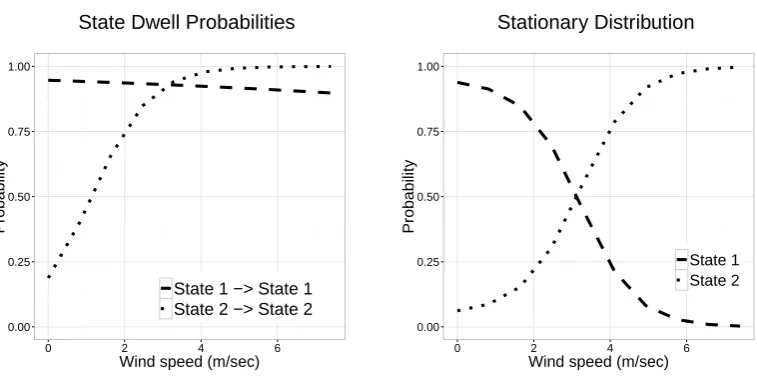
The estimated state transition probabilities suggest that, as wind speed increases, (i) the eagle has a 351
very slightly increased chance of switching to the high-activity state when in the low-activity state, and 352
(ii) spends much longer periods of time, on average, in the active state. As a consequence, the equilibrium 353
(stationary) distribution for fixed wind speeds (Pattersonet al., 2009) indicates that the eagle spends 354
orographic soaring, as demonstrated by studies on migrating golden eaglesAquila chrysaetos, which is 356
a more active behaviour (Lanzone et al., 2012). There is also theoretical evidence to suggest that, in 357
general, flying is more energetically demanding in high winds (Pennycuick, 1972). 358
4.2
Diel activity changes in a reef-associated shark
359
Many species of shark are upper trophic level predators may serve an important role in marine ecosys-360
tems. However determining the intensity of their predatory behaviour requires modelling the temporal 361
component as their activity levels are likely to follow a diel and/or tidal cycle (e.g. Gleisset al., 2013; 362
Papastamatiouet al., 2015). Acceleration sensors provide a direct measure of activity, however, many 363
species of shark swim continuously making it difficult to define specific behaviours (e.g. they are never 364
truly at rest), making conventional classification methods problematic. HMMs can identify changes 365
in behavioural states and how these may be related to time of day, tidal state, swimming depth, or 366
water temperature. To demonstrate this, we applied HMMs to accelerometry data obtained from a 367
free-ranging blacktip reef shark (Carcharhinus melanopterus) at Palmyra Atoll in the central Pacific 368
ocean (data taken from Papastamatiouet al., 2015). A multi-sensor package was attached to the dorsal 369
fin of a 117 cm female shark. The multi-sensor data-logger (ORI400-D3GT, Little Leonardo, Tokyo, 370
Japan) recorded 3D acceleration (at 20 Hz), depth and water temperature (at 1 Hz) and was embedded 371
in a foam float which detached from the shark after four days (see Papastamatiou et al., 2015). The 372
package also contained a VHF transmitter allowing recovery at the surface after detachment. 373
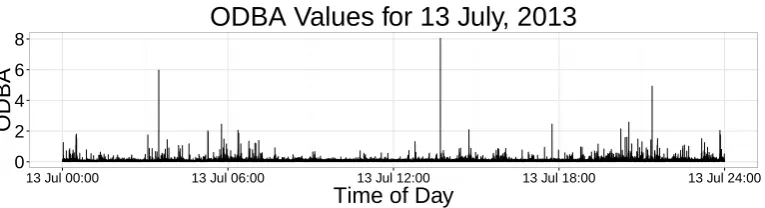
In order to examine active behaviour, we calculated the average ODBA of the shark over 1 second 374
intervals, which resulted in 321,815 observations (after removing the first four hours of data). Figure 375
4 displays the ODBA time series of one day. Compared to metrics such as tail-beat frequency, ODBA 376
has the advantage of measuring change in behaviour in all axes. For example, if the shark is nose down 377
at the seafloor, attempting to capture prey, its tail-beat frequency may be low but it is still active. As 378
we are interested in the times of day the shark was more active, as well as tide effects, we applied a 379
2-state HMM with one statepost-hoc interpreted as representing less active behaviour and the other 380
more active behaviour. 381
Although there are clear spikes in ODBA that point to higher energetic activities, various combi-382
nations of parametric distributions for state 1 and 2 led to vastly different state-dependent densities. 383
Further, the ODBA values had many extreme values that needed to be accommodated, which further in-384
creased the difficulties of selecting appropriate state-dependent distributions. As ODBA is not a metric 385
that can easily be divided into active/inactive behaviours in sharks, we estimated the state-dependent 386
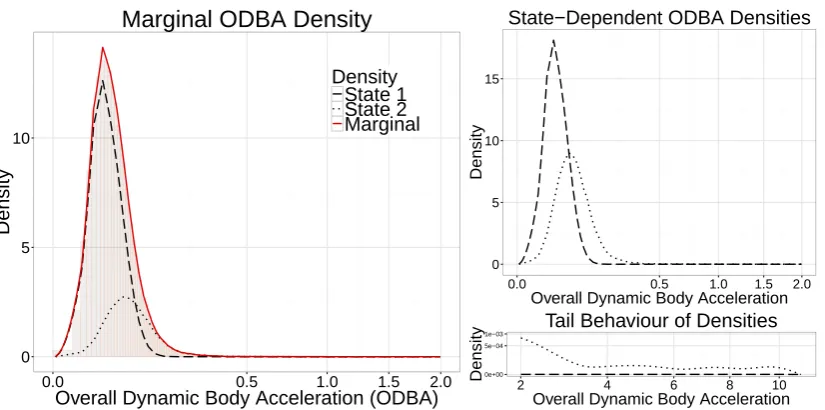
densities nonparametrically, in both states, in order to minimize the bias introduced by assigning inad-387
equate parametric distributions (Langrocket al., 2015). Figure 5 displays the fitted distributions. 388
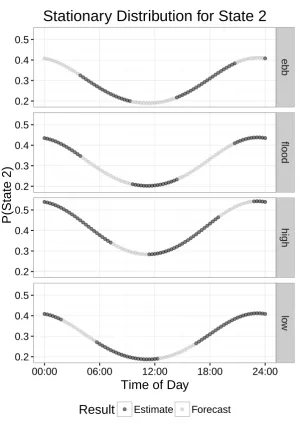
To examine potential diel and tide effects on activity levels, we let the entries of the t.p.m. be 389
functions of up to two covariates: time of day and tide level (ebb, flood, low, and high). Tide data was 390
high or low tide as±1 hour from reported high or low tide times. Time of day is represented by two 392
trigonometric functions with period 24 hours, cos(2πt/86400) and sin(2πt/86400) (86,400 is the number 393
of seconds in a day). We use three indicator variables,x1t, x2tand x3t, for tide levelshigh,flood, and
394
ebb, respectively, such thatx1t= 1 when tide level is high andx1t= 0 otherwise, and so on, which gives
395
the entries of the t.p.m. the following form 396
logit(γij(t)) =β0i+β1icos(2πt/86400) +β2isin(2πt/86400) +β3ix1t+β4ix2t+β5ix3t
397
fori= 1,2,j6=i,t= 1, . . . ,86400. The intercept term β0,i corresponds tolow tide.
398
Based on the selected model (cf. Table 2), with confidence intervals and (pseudo-)residuals provided 399
in the Appendix, the shark’s activity levels were, on average, lowest from approximately 9:00 – 13:00 400
and highest from 21:00 – 1:00. In Figure 6, we see that the shark was more active during high tide in 401
general when compared to flood, low or ebb tide. While the equilibrium (or stationary) distribution 402
associated with low and ebb tide overlap, the state-dwell probabilities, i.e. the diagonal entries of the 403
t.p.m. corresponding to the probability of remaining in the same state, are higher during ebb tide than 404
in low tide. Naturally in a short time series the tide levels will be correlated with certain times of the 405
day, but a longer time series or a joint modelling of multiple time series, with tide levels observed during 406
all times of day, can provide robust estimates of the effect of tide on activity level using the HMM 407
formulation provided here. 408
Using the Viterbi algorithm, we decoded the optimal state sequence to underlie the ODBA time 409
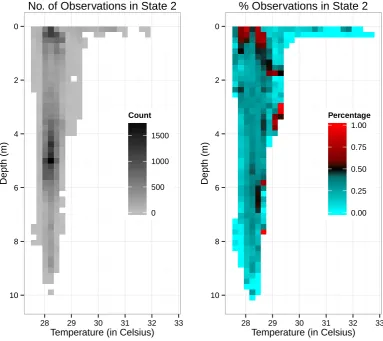
series. To further understand the effect of vertical habitat on behaviour, we related the decoded state 410
sequence to a grid of depth and temperature values, shown in Figure 7. The shark spent most of its time 411
over the nearly five day period in depths of about 3-6 metres and between 28-29◦C, with some higher 412
counts also in shallower waters, which is reflected in the state 2 counts. However, the percentages of 413
state 2 observations reveals that the shark was generally more active when near the surface in waters of 414
28-29◦C. There was generally less active behaviour exhibited when the individual was in very shallow 415
warm water (>29◦C). 416
5
Discussion
417
We detailed two approaches for analysing animal accelerometer data with HMMs: a supervised learning 418
approach for state prediction, such that classification is of primary interest, and an unsupervised learning 419
approach, where the states reflect biologically meaningful classes of behaviour, in order to infer drivers 420
of animal behaviour. The aim of a study and the type of data available will determine which of the two 421
is to be preferred. When the objective is to do classification and there is a set of pre-defined behaviours 422
of interest, then the model’s ability to correctly predict and categorize behaviours is of main interest. In 423
this instance, a supervised learning approach may be applied. One of the benefits of such an approach 424
Alternatively, if the objective is to infer (or, colloquially speaking, to ‘learn’) new aspects of animal 426
behaviour, then the unsupervised learning approach provides an excellent framework. The latter comes 427
with the implicit caveat that the states will not necessarily map directly to specific animal behaviours. 428
Any post-hoc behavioural interpretation of the estimated states is directly connected to the metric(s) 429
used, and must draw from background biological knowledge of the species of interest. In many cases, 430
behaviours such as foraging may not be exclusive to one state or another. Nonetheless, if the model is 431
able to identify bouts of behaviour which consistently re-appear, then it is often likely that these signify 432
something important in the animal’s behavioural repertoire and are worthy of further investigation. 433
Even when classification is the goal of an analysis, there are certainly practical scenarios which 434
preclude the use of an HMM, e.g. if the training data do not reflect the transitions between behaviours 435
or if there is insufficient data. Moreover, multiple studies have shown that other machine learning 436
algorithms, e.g. support vector machines (SVM) or random forests, can work well for classification of 437
animal acceleration data (Martiskainenet al., 2009; Nathanet al., 2012; Carrollet al., 2014; Grafet al., 438
2015). However, disregarding the serial dependence in the acceleration data usually is an unrealistic 439
assumption, which often goes unmentioned or is treated as an afterthought. Adopting the assumption 440
of independence is particularly risky if inferential statistics are applied to the output of say a machine 441
learning algorithm. In these cases, secondarily applied statistical tests will implicitly assume that 442
the machine learning categorizations contain more information content than is warranted, potentially 443
leading to spurious results. This is not just a statistical nuance and can be a crucial point. Such tests 444
are often applied as decision making tools to sort out “what matters” and setting the direction for 445
much further research effort. Also, in assuming independence, one allows for classifications that may 446
not be biologically realistic or must filter the classifications to properly identify a specific behaviour. 447
For instance, Carroll et al. (2014) used a SVM where one of the primary interests was to identify 448
prey handling/capture for penguins at sea. To confirm a prey capture event, they ruled that if the 449
SVM classified three consecutive observations as prey-handling this counted as a true prey capture. In 450
contrast, an HMM would have bypassed the need to filter through the classification results by accounting 451
for the serial dependence in observations corresponding to prey handling. In general, many behaviours 452
persist over longer stretches of time than those at which the data is processed, also necessitating the 453
use of a model that can account for the serial dependence. It may be difficult for any machine learning 454
algorithm that assumes independence to properly classify a sequence of observations into the same class, 455
unless the boundaries between classes are well-defined. In the context of recognition tasks, e.g. speech 456
or pattern recognition, HMMs have proven to be extremely successful tools for classification precisely 457
because they do account for the serial dependence in the signal of interest (Rabiner, 1989). 458
In the literature, inference on behavioural state-switching dynamics has sometimes been made using 459
two-stage (or even three-stage) analyses, where HMMs (or other machine learning algorithms) are used to 460
decode the behaviours underlying given observations, and subsequently a logistic regression is conducted 461
appeal of such an approach lies in the ease of implementation: fairly basic HMMs, without covariates, 463
are fitted to the accelerometer data and used to decode the states, and, subsequently, standard regression 464
software packages can be used to conduct a regression of the behavioural states on covariates. However, 465
it is our view that such a multi-stage analysis is less suited to relating accelerometer data to covariates 466
than the joint modelling approach presented in Section 3.3, for two reasons: (i) in the multi-stage 467
analyses, the uncertainty in state estimates is usually not propagated through the different stages of 468
analysis, and (ii) a regression analysis on decoded states needs to take into account the high serial 469
correlation in those states. Rather than ignoring these issues or trying to address them within a multi-470
stage analysis (which will render such an approach technically challenging), a direct joint modelling 471
approach, where neither of the problems arise, seems preferable. 472
Using a direct joint modelling approach in Section 4 we were able to learn about the effects that 473
atmospheric variables have on activity levels of a soaring raptor, while for the blacktip reef shark 474
we examined temporal and tidal inputs effects on its activity levels. The HMM produced similar 475
temporal patterns of activity to a previous analysis of the blacktip reef shark data set using GAMMs 476
(Papastamatiouet al., 2015). Both analytical methods revealed crepuscular and/or nocturnal increases 477
in activity with a tidal component, with the shark most active at the high tide or as tide was about to 478
ebb. By incorporating swimming depth and temperature, it was also revealed that highest activity was 479
seen when the shark was at the surface in waters of 28-29◦C. More importantly, the analysis showed that
480
the shark was inactive when in very warm (>29◦C) shallow water or deeper water. These results agree 481
with a previous hypothesis that sharks are ‘hunting warm, and resting warmer’ and use warmer water 482
(> 29 ◦C) to increase the rate of some physiological function such as digestion, and not for foraging 483
(see Papastamatiouet al., 2015). The HMM in this case allows us to explain the drivers of activity in 484
the shark and move beyond just describing its movements, but rather explain ‘why’ it may be moving 485
or selecting certain habitats. The HMM also provided a measure of the change in probability of the 486
individual being in active states. Although there was a clear temporal pattern of activity, the HMM 487
identified the shark as 30% more likely to be in an active state during the late evening hours. For the 488
adult black eagle, the HMM provided a direct modelling approach to examine the effect of wind speed 489
and temperature on its activity level. The results suggests that the black eagle spent more time in the 490
relatively active state overall, and was more likely active in windier conditions. These results are in line 491
with theoretical (Pennycuick, 1972) and empirical (Lanzoneet al., 2012) studies. 492
We have covered the basic HMM framework here, but the popularity of the HMM framework is 493
due in part to its many extensions. In particular, there are two HMM extensions that have been 494
proven useful in classification of human activities: the hidden semi-Markov model (HSMM) (Langrock 495
& Zucchini, 2012) and the hierarchical hidden Markov model (HHMM) (Fineet al., 1998). The HSMM 496
models the time spent within a state by some probability distribution with support on the positive 497
real integers, thereby allowing for more complex state dwell time distributions than can be provided 498
spent in a resting behaviour adequately if the animal is known to rest for long periods of time. The 500
HHMM provides the framework necessary to identify composite behaviours. For instance, lunge feeding 501
in baleen whales is a composite behaviour made up of (1) initial increase in acceleration with (2) a 502
positive pitch angle, as animals commonly approach prey schools from below, followed by (3) a rapid 503
deceleration after the whale opens its mouth increasing its drag (Owenet al., 2015). The HHMM models 504
each composite behaviour as its own HMM, and models the transitions between composite behaviours, 505
i.e. switches between HMMs. 506
6
Acknowledgements
507
YYW was funded by Grants-in-Aid for Scientific Research from the Japan Society for the Promotion of 508
Science (grant reference 25850138). TP was supported by a South African National Research Foundation 509
Scarce Skills postdoctoral research fellowship, and TP and YPP received funding from the MASTS 510
pooling initiative (The Marine Alliance for Science and Technology for Scotland) and their support is 511
gratefully acknowledged. MASTS is funded by the Scottish Funding Council (grant reference HR09011) 512
and contributing institutions. TP and MM gratefully acknowledge the hardware, software, support 513
and expertise contributed by Prof. Willem Bouten and his research group UvA-BiTS (University of 514
Amsterdam Bird Tracking System). The authors are grateful to Orr Spiegel, the Associate Editor and 515
an anonymous referee for their useful comments that substantially improved the manuscript. 516
7
Data Accessibility
517
Data deposited in the Dryad repository: http://datadryad.org/resource/doi:10.5061/dryad.6bm2c 518
References
519
´
Akos, Z., Nagy, M., Leven, S. & Vicsek, T. (2010) Thermal soaring flight of birds and unmanned aerial 520
vehicles. Bioinspiration & Biomimetics,5, 045003. 521
Altun, K., Barshan, B. & Tun¸cel, O. (2010) Comparative study on classifying human activities with 522
miniature inertial and magnetic sensors.Pattern Recognition,43, 3605–3620. 523
Bao, L. & Intille, S.S. (2004) Activity recognition from user annotated acceleration data. Pervasive 524
computing, pp 1–17. Springer, Berlin Heidelberg. 525
Bouten, W., Baaij, E.W., Shamoun-Baranes, J., Camphuysen, K.C.J. (2013) A flexible GPS tracking 526
system for studying bird behaviour at multiple scales. Journal of Ornithology,154, 571-–580. 527
Broekhuis, F., Gr¨unew¨alder, S., McNutt, J.W. & Macdonald, D.W. (2014) Optimal hunting conditions 528
Brown, D., Kays, R., Wikelski, M., Wilson, R. & Klimley, A.P. (2013) Observing the unwatchable 530
through acceleration logging of animal behavior. Animal Biotelemetry,1, 1–16. 531
Campbell, H.A., Gao, L., Bidder, O.R., Hunter, J. & Franklin, C.E. (2014) Creating a behavioural 532
classification module for acceleration data: using a captive surrogate for difficult to observe species. 533
Journal of Experimental Biology,216, 4501–4506. 534
Carroll, G., Slip, D., Jonsen, I. & Harcout, R. (2014) Supervised accelerometry analysis can identify 535
prey capture by penguins at sea.Journal of Experimental Biology,217, 4295–4302. 536
Elliott, K.H., Le Vaillant, M., Kato, A., Speakman, J.R. & Ropert-Coudert, Y. (2013) Accelerometry 537
predicts daily energy expenditure in a bird with high activity levels.Biology letters,9, 20120919. 538
Fine, S., Singer, Y. & Tishby N. (1998) The hierarchical hidden Markov model: Analysis and applica-539
tions.Machine Learning,32, 41–62. 540
Gleiss, A.C., Wilson, R.P. & Shepard, E.L.C. (2011) Making overall dynamic body acceleration work: 541
on the theory of acceleration as a proxy for energy expenditure. Methods in Ecology and Evolution, 542
2, 23–33. 543
Gleiss, A.C., Wright, S., Liebsch, N., Wilson, R.P. & Norman, B. (2013) Contrasting diel patterns in 544
vertical movement and locomotor activity of whale sharks at Ningaloo Reef. Marine Biology, 160, 545
2981–2992. 546
Graf, P.M., Wilson, R.P., Qasem, L., Hackl¨ander, K. & Rosell, F. (2015) The use of acceleration to 547
code for animal behaviours; A case study in free-ranging Eurasian beavers Castor fiber.PLoS ONE, 548
10, e0136751. 549
Hart, T., Mann, R., Coulson, T., Pettorelli, N. & Trathan, P.N. (2010) Behavioural switching in a 550
central place forager: patterns of diving behaviour in the macaroni penguin (Eudyptes chrysolophus). 551
Marine Biology,157, 1543–1553. 552
Hastie, T., Tibshirani, R. & Friedman, J. (2001)The Elements of Statistical Learning, New York, NY: 553
Springer. 554
He, J., Li, H. & Tan, J. (2007) Real-time daily activity classification with wireless sensor networks 555
using hidden Markov model. Engineering in Medicine and Biology Society, 2007. EMBS 2007. 29th 556
Annual International Conference of the IEEE, pp. 3192–3795. IEEE. 557
Heerah, K., Hindell, M., Guinet, C. & Charrassin, J.B. (2014) A new method to quantify within dive 558
foraging behaviour in marine predators. PLoS ONE, 9, e99329. 559
Iwata, T., Sakamoto, K.Q., Edwards, E.W.J., Staniland, I.J., Trathan, P.N., Goto, Y., Sato, K., Naito, 560
Y. & Takahashi, A. (2015) The influence of preceding dive cycles on the foraging decisions of Antarctic 561
Katzner, T., Johnson, J.A., Evans, D.M., Garner, T.W.J., Gompper, M.E., Altwegg, R., Branch, T.A., 563
Gordon, I.J. & Pettorelli, N. (2013) Challenges and opportunities for animal conservation from re-564
newable energy development.Animal Conservation,16, 367–369. 565
Konishi, S. & Kitagawa, G. (2008) Information Criteria and Statistical Modeling, New York, NY: 566
Springer. 567
Langrock, R., King, R., Matthiopoulos, J., Thomas, L., Fortin, D. & Morales, J.M. (2012) Flexible and 568
practical modeling of animal telemetry data: hidden Markov models and extensions. Ecology, 93, 569
2336–2342. 570
Langrock, R., Kneib, T., Sohn, A. & DeRuiter, S.L. (2015) Nonparametric inference in hidden Markov 571
models using P-splines. Biometrics,71, 520–528. 572
Langrock, R. & Zucchini, W. (2012) Hidden Markov models with arbitrary state dwell-time distributions. 573
Computational Statistics and Data Analysis,55, 715–724. 574
Lanzone, M.J., Miller, T.A., Turk, P., Brandes, D., Halverson, C., Maisonneuve, C., Tremblay, J., 575
Cooper, J., O’Malley, K., Brooks, R.P. & Katzner, T. (2012), Flight responses by a migratory soaring 576
raptor to changing meteorological conditions Biology Letters,8, 710–713. 577
Leenders, N.Y.J.M., Sherman, W.M. & Nagaraja, H.N. (2000) Comparisons of four methods of estimat-578
ing physical activity in adult women.Medicine & Science in Sports & Exercise,32, 1320–1326. 579
Leos-Barajas, V., Photopoulou, T., Langrock, R., Patterson, T.A., Watanabe Y.Y., Murtroyd, M., 580
Papastamatiou, Y. (2016) Data from: Analysis of animal accelerometer data using hidden Markov 581
models. Methods in Ecology and Evolution doi:10.5061/dryad.6bm2c 582
MacDonald, I.L. (2014) Numerical maximisation of likelihood: A neglected alternative to EM? Inter-583
national Statistical Review,82, 296–308. 584
Mannini, A. & Sabatini A.M. (2010) Machine learning methods for classifying human physical activity 585
from on-body accelerometers.Sensors,10, 1154–1175. 586
Mannini, A. & Sabatini A.M. (2011) Accelerometry-based classification of human activities using Markov 587
modeling.Computational Intelligence and Neuroscience,2011, 647858. 588
Martiskainen, P., J¨arvinen, M., Sk¨on, J., Tiirikainen, J., Kolehmainen, M. & Mononen, J. (2009) Cow 589
behaviour pattern recognition using a three-dimensional accelerometer and support vector machines. 590
Applied Animal Behaviour Science,119, 32–38. 591
McKellar, A.E., Langrock, R., Walters, J.R. & Kesler, D.C. (2015) Using mixed hidden Markov models 592
Naito, Y. Bornemann, H., Takahashi, A, McIntyre, T. & Pl¨otz, J. (2010) Fine-scale feeding behavior of 594
Weddell seals revealed by a mandible accelerometer.Polar Science,4, 309–316. 595
Nathan, R., Spiegel, O., Fortmann-Roe, S., Harel, R., Wikelski, M. & Getz, W. (2012) Using tri-axial 596
acceleration data to identify behavioral modes of free-ranging animals: general concepts and tools 597
illustrated for griffon vultures. The Journal of Experimental Biology, 215, 986–996. 598
Owen, K., Dunlop, R.A., Monty, J.P., Chung, D, Noad, M.J., Donnelly, D., Golditzen, A.W. & Macken-599
zie, T. (2015) Detecting surface-feeding behavior by rorqual whales in accelerometer data. Marine 600
Mammal Science,32, 327–348. 601
Papastamatiou, Y.P., Watanabe, Y.Y., Bradley, D., Dee, L.E., Lowe, C.G. & Caselle, J. (2015) Drivers 602
of daily routines in an ectothermic marine predator: hunt warm, rest warmer? PLoS ONE, 10, 603
e0127807. 604
Patterson, T.A., Basson, M., Bravington, M.V. & Gunn, J.S. (2009) Classifying movement behaviour 605
in relation to environmental conditions using hidden Markov models.Journal of Animal Ecology,78, 606
1113–1123. 607
Pennycuick, C. J. (2008)Modelling the Flying Bird London: Academic Press, Elsevier. 608
Pennycuick, C. J. (1972) Soaring behaviour and performance of some east african birds, observed from 609
a motor-glider Ibis,114, 178-–218. 610
Phillips, J.S., Patterson, T.A., Leroy, B., Pilling, G.M. & Nicol, S.J. (2015), Objective classification 611
of latent behavioral states in bio-logging data using multivariate-normal hidden Markov models. 612
Ecological Applications, 25(5), 1244–1258. 613
Qasem, L., Cardew, A., Wilson, A., Griffiths, I., Halsey, L.G., Shepard, E.L.C., Gleiss, A.C. & Wilson, 614
R. (2012) Tri-axial dynamic acceleration as a proxy for animal energy expenditure; Should we be 615
summing values or calculating the vector? PLoS ONE,7, e31187. 616
Rabiner, L.R. (1989), A tutorial on hidden Markov models and selected applications in speech recogni-617
tion.IEEE Proceedings, 77, 257–286. 618
Ravi, N., Dandekar, N., Mysore, P. & Littman, M.L. (2005) Activity recognition from accelerometer 619
data. American Association for Artifical Intelligence,5, 1541–1546. 620
Sakamoto, K.Q., Sato K., Ishizuka, M., Watanuki, Y., Takahashi, A., Daunt, F. & Wanless, S. (2009) 621
Can ethograms be automatically generated using body acceleration data from free-ranging birds? 622
PLoS One,4, e5379. 623
Sato, K., Daunt, F., Watanuki, Y., Takahashi, A. & Wanless, S. (2008) A new method to quantify prey 624
acquisition in diving seabirds using wing stroke frequency.The Journal of Experimental Biology,211, 625
Sato, K., Mitani, Y., Cameron, M.F., Siniff, D.B. & Naito, Y. (2003) Factors affecting stroking patterns 627
and body angle in diving Weddell seals under natural conditions.The Journal of Experimental Biology, 628
206, 1461–1470. 629
Shepard, E.L.C., Wilson, R., Quintana, F., Laich, A.G., Liebsch, N., Albareda, D.A., Halsey, L.G., 630
Gleiss, A., Morgan, D., Myers, A.E., Newman, C. & Macdonald, D. (2008) Identification of animal 631
movement patterns using tri-axial accelerometry.Endangered Species Research,10, 47–60. 632
Simon, M., Johnson, M. & Madsen, P.T. (2012) Keeping momentum with a mouthful of water: behavior 633
and kinematics of humpback whale lunge feeding.The Journal of Experimental Biology, 215, 3786– 634
3798. 635
Suzuki, I., Naito, Y., Folkow, L.P., Nobuyuki, M. & Blix, A.B. (2009) Validation of a device for accurate 636
timing of feeding events in marine animals. Polar Biology,32, 667–671. 637
Watanabe, Y.Y., Lydersen, C., Fisk, A.T. & Kovacs, K.M. (2012), The slowest fish: swim speed and 638
tail-beat frequency of Greenland sharks. Journal of Experimental Marine Biology and Ecology,426, 639
5–11. 640
Watanuki, Y., Niizuma, Y., Gabrielsen, G.W., Sato, K. & Naito, Y. (2003), Stroke and glide of wing-641
propelled divers: deep diving seabirds adjust surge frequency to buoyancy change with depth. Pro-642
ceedings of the Royal Society of London B,270, 483–488. 643
Ward, J.A., Lukowicz, P., Troster, G. & Starner, T.E. (2006) Activity recognition of assembly tasks 644
using body-worn microphones and accelerometers.Pattern Analysis and Machine Intelligence, IEEE 645
Transactions,28, 1553–1567. 646
Williams, H.J., Shepard, E.L.C., Duriez, O. & Lambertucci, S.A. (2015) Can accelerometry be used to 647
distinguish between flight types in soaring birds? Animal Biotelemetry,3, 1–11. 648
Wilson, R.P., Shepard, E.L.C. & Liebsch, N. (2008) Prying into the intimate details of animal lives: use 649
of a daily diary on animals.Endangered Species Research,4, 123–137. 650
Wilson, R.P., White, C.R., Quintana, F., Halsey, L.G., Liebsch, N, Martin, G.R. & Butler, P.J. (2006) 651
Moving towards acceleration for estimates of activity-specific metabolic rate in free-living animals: 652
the case of the cormorant. Journal of Animal Ecology,75, 1081–1090. 653
Ydesen, K.S., Wisniewska, D.M., Hansen, J.D., Beedholm, K., Johnson, M. & Madsen, P.T. (2014) 654
What a jerk: prey engulfment revealed by high-rate, super-cranial accelerometry on a harbour seal 655
(Phoca vitulina).The Journal of Experimental Biology,217, 2239–2243. 656
Zucchini, W., MacDonald, I.L. & Langrock, R. (2016), Hidden Markov Models for Time Series: An 657
8
Supporting Information
659
Supporting Information Description
Appendix Further mathematical details for HMMs.
(Pseudo-)residual plots and model checking for both HMM applications presented in manuscript.
Comparing Supervised Learning Approaches
A comparison of four supervised learning ap-proaches when there is varying levels of auto-correlation present in the data.
9
Tables & Figures
Model Log-likelihood AIC ∆ AIC BIC ∆ BIC
No covariates 2000.2 -3980.4 21.6 -3929.4 21.6
Temperature 2001.9 -3979.9 22.1 -3918.6 17.0
Wind speed 2010.4 -3996.9 5.1 -3935.6 0
Wind speed, Temperature 2011.6 -3995.2 6.8 -3923.7 11.9
Wind speed, Temperature, 2017.0 -4002.0 0 -3920.3 15.3
Wind speed * Temperature
Model Log-likelihood AIC ∆ AIC BIC ∆ BIC
No covariates 639299.2 -1278370 779 -1277178 692
Time 639558.1 -1278872 277.2 -1277645 225
Time, High 639657.6 -1279063 86.2 -1277819 51
Time, High, Flood 639695.2 -1279130 19 -1277869 1
Time, High, Flood, Ebb 639708.7 -1279149 0 -1277870 0
0 1 2 3
17 Apr 18 Apr 19 Apr 20 Apr 21 Apr 22 Apr 23 Apr 24 Apr
Date
MSA
MSA values for 16 to 24 April
0 1 2 3
07:00 11:00 15:00 19:00
Time of day
MSA
[image:25.595.80.521.84.299.2]MSA values for 21 April
0 20 40 60
0.0 0.5 1.0 1.5 2.0
Minimum specific acceleration (MSA)
Density
State−Dependent MSA Densities
4e−04 8e−04
2.00 2.25 2.50 2.75 3.00
Minimum specific acceleration (MSA)
Density
Tail behaviour of Densities
0 10 20 30 40
0.0 0.5 1.0 1.5 2.0
Minimum specific acceleration (MSA)
Density
Densities
Marginal State 1 State 2
[image:26.595.88.516.83.274.2]Marginal MSA Density
0.00 0.25 0.50 0.75 1.00
0 2 4 6
Wind speed (m/sec)
Probability
State 1 −> State 1 State 2 −> State 2
State Dwell Probabilities
0.00 0.25 0.50 0.75 1.00
0 2 4 6
Wind speed (m/sec)
Probability
State 1 State 2
[image:27.595.111.490.80.268.2]Stationary Distribution
0 2 4 6 8
13 Jul 00:00 13 Jul 06:00 13 Jul 12:00 13 Jul 18:00 13 Jul 24:00
Time of Day
ODBA
[image:28.595.110.493.97.201.2]ODBA Values for 13 July, 2013
0e+00 5e−04 1e−03
2 4 6 8 10
Overall Dynamic Body Acceleration
Density
Tail Behaviour of Densities 0
5 10 15
0.0 0.5 1.0 1.5 2.0
Overall Dynamic Body Acceleration
Density
State−Dependent ODBA Densities
0 5 10
0.0 0.5 1.0 1.5 2.0
Overall Dynamic Body Acceleration (ODBA)
Density
Density State 1 State 2 Marginal
[image:29.595.95.508.82.287.2]Marginal ODBA Density
0.2 0.3 0.4 0.5
0.2 0.3 0.4 0.5
0.2 0.3 0.4 0.5
0.2 0.3 0.4 0.5
eb
b
flood
high
lo
w
00:00 06:00 12:00 18:00 24:00
Time of Day
P(State 2)
Result
Estimate Forecast [image:30.595.150.451.80.505.2]Stationary Distribution for State 2
0
2
4
6
8
10
28 29 30 31 32 33
Temperature (in Celsius)
Depth (m)
0 500 1000 1500
Count
No. of Observations in State 2
0
2
4
6
8
10
28 29 30 31 32 33
Temperature (in Celsius)
Depth (m)
0.00 0.25 0.50 0.75 1.00
Percentage
[image:31.595.105.489.112.453.2]