MSc Thesis(Afstudeerscriptie) written by
Jan Rooduijn
(born the 30th of May, 1992, in Amsterdam, The Netherlands)
under the supervision of Dr Benno van den Berg, and submitted to the Board of Examiners in partial fulfillment of the requirements for the degree of
MSc in Logic
at theUniversiteit van Amsterdam.
Date of the public defense: Members of the Thesis Committee:
Contents
Introduction 5
1 Semisimplicial sets 9
1.1 The combinatorial study of geometry . . . 9
1.2 Semisimplicial sets . . . 12
1.2.1 The presheaf categoryssSet . . . 13
1.2.2 Geometric realisation . . . 16
1.2.3 Geometric product and exponential . . . 17
1.3 Simplicial sets . . . 18
2 (Semi)model categories 27 2.1 Lifting problems . . . 27
2.2 Model structures . . . 29
2.3 Semimodel structures . . . 34
2.4 Locally finitely presentable categories . . . 35
2.5 Quillen’s small object argument . . . 39
2.6 Left-induced right semimodel structures . . . 43
2.7 Leibniz product and exponential . . . 44
3 Left-induced model structures on semisimplicial sets 49 3.1 Negative results for a left-induced model structure . . . 50
3.2 Semisimplicial cofibrations and trivial fibrations . . . 51
3.3 A structure generating theorem . . . 53
3.3.1 Connectedness . . . 54
3.3.2 Homotopy . . . 56
3.3.3 Weak equivalences . . . 60
3.3.4 Proving the theorem . . . 63
3.4 Applying Theorem 3.3.1 . . . 64
3.4.1 Three saturated classes of morphisms . . . 64
3.4.2 The left-induced right semimodel structuressSet𝑄 . . . 66
3.5 Some properties ofssSet𝑄 . . . 67
3.5.1 Quillen equivalence . . . 67
3.5.2 Characterisation of the fibrations between fibrant objects . . . 70
3.5.3 Simplicial versus semisimplicial anodyne extension . . . 71
I thank my supervisor Benno van den Berg for introducing me to the interesting topic of this thesis, and for guiding me in my attempt to form some worthwhile ideas. He was always open to discuss my work, even when I found it hard to express my ideas clearly and when I required some extra time to work on this project. Whenever I had a moment of clarity, he encouraged me to follow that line of thought.
Gratitude is also owed to Simon Henry, with whom I had a fruitful discussion during the lunch of the 104th Peripatetic Seminar on Sheaves & Logic. It was refreshing to talk to someone who had spend as much time thinking about semisimplicial sets as I did.
Thanks further to the members of the committee for taking the time to read this thesis and for the teaching I have received from most of them during my time as a student.
Introduction
In [EZ50], S. Eilenberg and J.A. Zilber first introduced simplicial sets, then called complete semisimplicial complexes. Meant as an addition to the already familiar simplicial complexes, they are abstractions of topological spaces that serve as technical tools for the calculation of certain topological properties.
Most of the applications of simplicial sets lie within the field of homotopy theory, which is concerned with the study of continuous deformations of continuous maps. In the language of category theory (also co-invented by Eilenberg), [Qui67] provides an axiomatic framework for studying homotopy theory, distinguishing three fundamental classes of morphisms: cofibra-tions, fibrations andweak equivalences. Categories that satisfy the given axioms are called (Quillen) model categories. Among the three key examples given by Quillen are the category of topological spaces and the category of simplicial sets. In fact, he showed that, as model categories, these two are equivalent under the relevant notion of equivalence.
In recent years this abstract homotopy theory has attracted the attention of logicians. In-terpreting types as spaces, notably identity types as path spaces, a connection can be made between the formal language of intensional type theory, and homotopical structures, like Quil-len model structures. The project of investigating this connection is referred to ashomotopy type theoryand is a very active field of research at the moment. Unsurprisingly, the first cat-egory found to be a suitable model for the specific type theory studied in this regard, is the category of simplicial sets (see [KL12]).
A downside of the model of homotopy type theory in simplicial sets (and also of the Quillen model structure on simplicial sets) is that its standard existence proof is non-constructive. This fact is proven in [BC15] and has the consequence that there is no universal method for con-structing this modelinternallyto some other model of type theory, for type theory is generally constructive.
The key fact preventing this existence proof to be constructive, is that simplicial sets come with certain maps calleddegeneracy maps. An element of a simplicial set is calleddegenerate whenever it lies in the image of a degeneracy map. However, constructively it is not always decidable whether a given element is degenerate, a fact that is needed in the proof.
should be noted there is another important difficulty with internalising homotopy type theory. Namely, even if semisimplicial sets could provide a model of type theory constructively, it is still far from trivial to construct semisimplicial sets within homotopy type theory. Work on this topic has been done by for instance [ACK16].
There are many ways in which a category can be equipped with a model structure and therefore we must make one further restriction to the scope of our question. There is a free-forgetful adjunction between simplicial and semisimplicial sets of which the left adjoint pre-serves the abstracted topological space. We will concentrate on a model structure that is left-induced by this adjunction, meaning that certain Quillen model-theoretic properties will be preserved and reflected by the ‘free’ functor from semisimplicial into simplicial sets.
Our main result will be that, within the bounds of left-induced structures, there is no model structure on semisimplicial sets, but there is something slightly weaker, aright semimodel struc-ture.
We assume that the reader is familiar with the basic notions of category theory, including functors, natural transformations, (co)limits and adjoints, as well as some standard construc-tions, such as the (co)monad of an adjunction and the colimit-diagonal adjunction. Beyond this only some very elementary knowledge of algebraic topology is assumed, in particular the notion of contractible spaces and some of their properties.
Structure and original contributions
• In Chapter 1 we introduce semisimplicial sets and show how they relate to their simpli-cial counterparts. Most of the results in this chapter appear already in [RS71], but are here presented from a more modern categorical point of view. A particular observation that, to our knowledge, is an addition to the existing literature is that the free-forgetful adjunction is both monadic and comonadic.
• Chapter 2 introduces the necessary abstract homotopy theory. We prove some standard results on model categories and extend them to right semimodel categories. The stand-ard reference for semimodel categories is the thesis [Spi]. While there are some dis-cussions of this kind of structure in the literature, it has been studied considerably less than standard model structures. Simple, but to our knowledge novel, are the sufficient conditions for two interacting weak factorisation systems to induce a right semimodel structure, and the characterisation of the weak equivalences of such structures in terms of the other constituent morphisms.
The rest of the Chapter covers standard Quillen model-theoretic techniques that will be needed in Chapter 3, including thesmall object argument, some results onlocally finitely presentable categoriesand theLeibniz adjunction. Particularly interesting is a relatively recent conceptual proof from [RR15] that in suitable model categories weak equivalences are closed underdirected colimits.
the ones that work in the general Theorem 3.3.1. This new theorem gives a range of structures on𝑠𝑠𝑆𝑒𝑡 that are almost left-induced right semimodel structures. Combined with a powerful result from [MR14] concerning left-induced weak factorisation systems, our theorem can be used to establish the desired right semimodel structure, which is the main result of this thesis.
We then use a result from [KS17] to show that this structure is equivalent to the right semimodel structure on semisimplicial sets and a result from [Sat18] to prove a recog-nition lemma for a certain class of its morphisms. We demonstrate with an example from [Mos15] that, in the category of semisimplicial sets, the class ofsimplicial anodyne extensionsis strictly larger than the class ofsemisimplicial anodyne extensions. It follows that the semisimplicial structure considered in [Sat18] (which can also be obtained using Theorem 3.3.1) is not a right semimodel structure. Finally, we prove the novel result that the smaller classes ofstrong semisimplicial anodyne extensionsandstrong simplicial anodyne extensions, in contrast, do coincide.
In this thesis we use the following notation. In any category:
• 0is the initial object and∗𝐴 ∶ 0 → 𝐴is the unique morphism from0to𝐴;
• 1is the terminal object and!𝐵 ∶ 𝐵 → 1is the unique morphism from𝐵to1.
In the context of model structures, we shall often use the following decorated arrows. Morphism Fibration Cofibration
Morphism → −−↠ −→
Trivial −−↠triv triv
−→
Weak equivalence −−→∼ −−↠∼ ∼−→
Trivial and weak equivalence −−↠triv
Semisimplicial sets
In this chapter we introduce the main objects of study of this thesis, semisimplicial sets. These objects once arose from the study of topological spaces by considering them as the result of gluing together several𝑛-dimensional generalisations of triangles, called𝑛-simplices. Though not all topological spaces admit such atriangulation, the study of those that do is simplified by the nice combinatorial properties that simplices possess.
Conceptually, and, as can be seen in [EZ50], also historically, semisimplicial sets form the middle link of a three-part sequence of developments:
Simplicial complexes → Semisimplicial sets → Simplicial sets.
For the purpose of completeness, we begin this chapter in Section 1.1 by introducing the objects that form the leftmost link.
In Section 1.2, we generalize to semisimplicial sets. We will see that semisimplicial sets can not only be studied geometrically, as topological spaces, or combinatorially, as a collection of simplices, but also categorically, for the category of semisimplicial sets conveniently arises as a presheaf category. This last point of view will be the dominant one for the rest of this thesis. In Section 1.2.2 we use categorical methods to show how to construct the topological space corresponding to some semisimplicial set. The categorical product of semisimplicial sets unfor-tunately does not respect thisgeometric realisation, which is why, in Section 1.2.3, we introduce an operation, called thegeometric product, that does. We show that under this product opera-tion semisimplicial sets form a symmetric closed monoidal category.
Finally, in Section 1.3, we generalize further to simplicial sets and show how they relate to their ‘semi’-counterparts. Simplicial sets have some additional desirable properties, which has made them more popular tools for several applications, and therefore also more well-studied. In Chapter 3 we will use known results stemming from this line of research to derive some (Quillen) model-theoretic results for semisimplicial sets.
1.1 The combinatorial study of geometry
in this section is standard, but we roughly follow [Fri12].
We begin by defining the building blocks of any triangulation of a topological space, the 𝑛-dimensional simplices. First let us consider them as concrete spaces living in the category
Topof topological spaces and continuous functions between them.
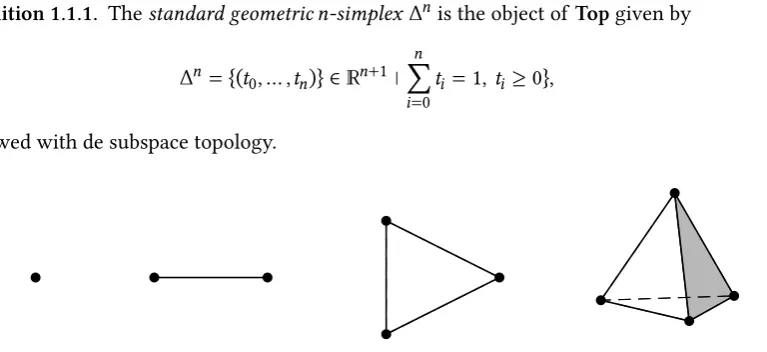
Definition 1.1.1. Thestandard geometric𝑛-simplexΔ𝑛is the object of Topgiven by
Δ𝑛 = {(𝑡0, … , 𝑡𝑛)} ∈ ℝ𝑛+1∣ 𝑛
∑
𝑖=0
𝑡𝑖= 1, 𝑡𝑖≥ 0},
[image:10.595.114.498.164.340.2]endowed with de subspace topology. ■
Figure 1.1: The standard geometric 0-, 1-, 2- and 3-simplices.
In Figure 1.1 the standard simplices in the first four dimensions are depicted. Note that sim-plices are solid objects and not merely boundaries. Consequently, every𝑛-simplex is homeo-morphic to the𝑛-ball.
A standard geometric simplex is the convex hull of the points corresponding to the 𝑛 -dimensional unit vectors. In general, we define:
Definition 1.1.2. Ageometric𝑛-simplex𝐶 is a topological space that can be written as
𝐶 = {(𝑡0𝑢0, … , 𝑡𝑛𝑢𝑛)} ∈ ℝ𝑛+1∣ 𝑛
∑
𝑖=0
𝑡𝑖= 1, 𝑡𝑖≥ 0}
with𝑢0, … , 𝑢0affinely independent. ■
Again, another way to describe a geometric simplex𝐶 is as the convex set spanned by the points𝑢0, … , 𝑢𝑛. We call the simplex that is the convex spanned by a subset𝑢𝑖0, … 𝑢𝑖𝑘 of these
points afaceof𝐶. In particular, the empty set is a face of every simplex.
Note, and this can be seen as the first step in our sequence of abstractions, that the only relevant information determining a simplex is the set of its vertices. This means that we may refer to the simplex spanned by the points𝑣0, … , 𝑣𝑛simply as the set{𝑣0, … , 𝑣𝑛}.
Example 1.1.3. If𝑥 = {𝑣0, … , 𝑣𝑛}is an𝑛-simplex, then its(𝑛−1)-dimensional faces are precisely
the(𝑛 − 1)-simplices that are determined by all but one of its vertices. We write {𝑣0, … , ̂𝑣𝑘, … , 𝑣𝑛}
The following standard topological definition encapsulates those spaces that can be ob-tained by taking a set of simplices and gluing them together along their faces.
Definition 1.1.4. Ageometric simplicial complex𝑋 is a set of geometric simplices such that 1. Every face of a simplex of𝑋 is in𝑋;
2. For any two simplices𝑥, 𝑦 ∈ 𝑋, their intersection is a face of both𝑥and𝑦. ■
Example 1.1.5. Every simplex{𝑣0, … , 𝑣𝑛}gives rise to a simplicial complex, consisting of itself
and its faces.
▲
We now have everything we need to abstract away from the realm of topological spaces. Note that the data determining a simplicial complex𝑋 may be organised by, for each𝑛 ∈ ℕ, letting𝑋𝑛be the set of all𝑛-simplices of𝑋. Then, by the fact that𝑋 is a simplicial complex,
each face of an𝑛-simplex{𝑣0, … , 𝑣𝑛} ∈ 𝑋𝑛occurs in some𝑋𝑚for𝑚 ≤ 𝑛. For instance, we have 𝑣𝑖∈ 𝑋0for every𝑖 ∈ [0, 𝑛].
Definition 1.1.6. Anabstract simplicial complex is a graded set(𝑋𝑛)𝑛∈ℕ such that every𝑋𝑘 consists of subsets𝑥
⊆
𝑋0 with|𝑥| = 𝑘 + 1, and such that for every non-empty𝑥′⊆
𝑥with|𝑥′| = 𝑗 + 1, we have𝑥′∈ 𝑋𝑗. ■
It is easy to see that every geometric simplicial complex naturally corresponds to an abstract simplicial complex. There is then a canonical way to recover a geometric simplicial complex (up to homeomorphism) from the corresponding abstract simplicial complex. Note also: the one(−1)-simplex, the empty set, is only implicitly part of every abstract simplicial complex.
In case the set𝑋0is totally ordered, every𝑘-simplex of an abstract simplicial complex𝑋𝑘
can be uniquely written as a tuple [𝑣𝑖0, … , 𝑣𝑖𝑘]with 𝑣𝑖0 < … < 𝑣𝑖𝑘. We call this an ordered simplicial complex.
Example 1.1.7. Any partially ordered set𝑃 can be made into an ordered simplicial complex 𝐶(𝑃)set by setting
𝐶(𝑃)𝑘= {[𝛼(0), … , 𝛼(𝑘)] ∣ 𝛼 ∶ [𝑘] → 𝑃is injective and order-preserving}. The simplicial complex𝐶(𝑃)is called thenerveof𝑃.
In particular, every finite ordinal[𝑛]gives rise to an ordered simplicial complex of which the𝑘-simplices are the tuples
[𝛼(0), … , 𝛼(𝑘)]
given by some injective order-preserving map𝛼 ∶ [𝑘] → [𝑛]. This ordered simplicial complex, which we call the standard abstract 𝑛-simplex, consists of precisely one 𝑛-simplex, together
with all of its faces.
▲
Definition 1.1.8(Face maps). Let𝑋 be an ordered simplicial complex. Then for every𝑛and𝑘 there is a map𝑑𝑘 ∶ 𝑋𝑛+1→ 𝑋𝑛given by
𝑑𝑘([𝑣𝑖0, … , 𝑣𝑖𝑛]) ↦ [𝑣𝑖0, … , ̂𝑣𝑖𝑘, … , 𝑣𝑖𝑛].
Lemma 1.1.9. Of every ordered simplicial complex𝑋, the face maps satisfy the relation
𝑑𝑖𝑑𝑗 = 𝑑𝑗−1𝑑𝑖 if𝑖 < 𝑗.
Proof. For any𝑘-simplex[𝑣𝑖0, … , 𝑣𝑖𝑘], we have
𝑑𝑖𝑑𝑗[𝑣𝑖0, … , 𝑣𝑖𝑘] = 𝑑𝑖[𝑣𝑖0, … , ̂𝑣𝑖𝑗, … , 𝑣𝑖𝑛] = [𝑣𝑖0, … , ̂𝑣𝑖𝑖… , ̂𝑣𝑖𝑗, … , 𝑣𝑖𝑛]
= 𝑑𝑗−1[𝑣𝑖0, … , ̂𝑣𝑖𝑖, … , 𝑣𝑖𝑛] = 𝑑𝑗−1𝑑𝑖[𝑣𝑖0, … , 𝑣𝑖𝑛],
as required.
1.2 Semisimplicial sets
Semisimplicial sets are simply a generalisation of the ordered simplicial complexes defined in Section 1.1.
Definition 1.2.1. A semisimplicial set 𝑋 is an ℕ-graded set 𝑋 = (𝑋𝑛)𝑛∈ℕ, together with for
every𝑛 ≥ 0and0 ≤ 𝑖 ≤ 𝑛a map𝑑𝑖∶ 𝑋𝑛+1→ 𝑋𝑛such that
𝑑𝑖𝑑𝑗 = 𝑑𝑗−1𝑑𝑖if𝑖 < 𝑗. ■
The𝑑𝑖are again calledface mapsand can be intuitively thought of as sending an𝑛-dimensional simplex to its𝑖-th(𝑛 − 1)-dimensional face.
It follows from Lemma 1.1.9 that the ordered simplicial complexes are semisimplicial sets. It is, however, not the case that all semisimplicial sets are also simplicial complexes, for we no longer require the faces of a given simplex to be distinct. Consider, for instance, the semisim-plicial set𝐴, given by:
𝐴0= {𝑎} 𝑑0𝐼 = 𝑑1𝐼 = 𝑎
𝐴1= {𝐼 }
•
Figure 1.2: The semisimplicial set𝐴.
This semisimplicial set may be pictured as a line of which the endpoints are glued together and is not a simplicial complex. Another property of simplicial complexes that fails for semisimpli-cial sets is that in the former a given simplex is uniquely determined by its vertices. In contrast, two distinct simplices of a semisimplicial set may have precisely the same faces.
There is a natural definition of morphisms between semisimplicial sets:
Definition 1.2.2. Let𝑋and𝑌 be semisimplicial sets. Asemisimpicial morphism𝑓 ∶ 𝑋 → 𝑌 is a graded morphism that commutes with the face maps,i.e. such that
𝑑𝑘𝑓𝑛+1(𝑥) = 𝑓𝑛(𝑑𝑘𝑥),
1.2.1 The presheaf category ssSet
We are now ready to take a more categorical approach. The maps𝑑𝑘∶ 𝐶[𝑛]𝑛→ 𝐶[𝑛]𝑛−1, from
the top-dimensional simplex of𝐶[𝑛]to its 𝑛 − 1 dimensional faces, are dual to the injective order-preserving maps 𝜖𝑘 ∶ [𝑛 − 1] → [𝑛]skipping the 𝑘-th element. This gives rise to a directed graph
[0] [1] ⋯
𝜖1
𝜖0
(1.1)
Note that the𝜖𝑘verify a relation dual to the𝑑𝑘, namely
𝜖𝑗𝜖𝑖 = 𝜖𝑖𝜖𝑗−1 if𝑖 < 𝑗. (1.2)
Now letΔ𝑖be the category of nonempty finite ordinals[𝑛] = {0, 1, … , 𝑛}and injective
order-preserving functions between them.
Lemma 1.2.3. The categoryΔ𝑖is freely generated by the graph (1.1) subject to the relation (1.2).
Proof. We claim that every morphism𝜖 ∶ [𝑛] → [𝑚]inΔ𝑖admits a unique decomposition
𝜖 = 𝜖𝑖𝑘𝜖𝑖𝑘−1⋯ 𝜖𝑖1 (1.3)
such that𝑘 = 𝑚 − 𝑛and𝑚 ≥ 𝑖𝑘 > … > 𝑖1 ≥ 0. Indeed, a straightforward inductive argument
shows that each𝑖𝑘must be the𝑘-th highest number skipped by𝜖, which suffices.
Now letΔ′𝑖 be the freely generated category in question. Because the relation(1.2)is veri-fied in Δ𝑖, the unique canonical mapping Δ′𝑖 → Δ𝑖 that is the identity both on objects and
on morphisms, is a functor. It is clearly bijective on objects and, by the above, surjective on morphisms. We will show that it is also injective on morphisms, after which we are done. To this end, suppose that two arrows𝑢, 𝑣 ofΔ′𝑖 get sent to the same morphism ofΔ𝑖. Repeatedly
using the relation (1.2), we can rewrite (not necessarily uniquely) both𝑢 and𝑣into the form (1.3). But then, by the uniqueness of the decomposition inΔ𝑖, these decompositions must be
the same inΔ′𝑖 and thus𝑢 = 𝑣.
LetssSetdenote the category of semisimplicial sets and semisimplicial morphisms between them.
Lemma 1.2.4. The presheaf category[Δ𝑜𝑝𝑖 ,Set]is isomorphic tossSet.
Proof. Consider the assignment[Δ𝑜𝑝𝑖 ,Set] → ssSet, sending a presheaf𝑃 to the simplicial set 𝑋𝑃with𝑋𝑛𝑃 = 𝑃([𝑛])and face maps𝑃(𝜖𝑘) ∶ 𝑋𝑛+1𝑃 → 𝑋𝑛𝑃. For𝑖 < 𝑗, we have
𝑃(𝜖𝑖)𝑃(𝜖𝑗) = 𝑃(𝜖𝑗𝜖𝑖) = 𝑃(𝜖𝑖𝜖𝑗−1) = 𝑃(𝜖𝑗−1)𝑃(𝜖𝑖),
of𝑃𝑋 on all arrows inΔ𝑖. Finally, it defines a functor because, by the dual to Lemma 1.2.3, each sequence of𝑑𝑘′𝑠admits a unique dual decomposition. It is easily verified that𝑋(𝑃𝑋)= 𝑋.
The last thing to show is that the described functor is bijective on morphisms. This is once more a direct consequence of Lemma 1.2.3.
In this thesis we shall take both points of view on the categoryssSet, depending on which is more convenient in the given context. As seen in Example 1.1.7, every standard abstract 𝑛-simplex lives in the category of semisimplicial sets as the ordered simplicial complex𝐶[𝑛]. We shall denote it by Δ𝑖[𝑛]. Another way to describeΔ𝑖[𝑛] is as the representable functor Δ𝑖[𝑛] =HomΔ𝑖(−, [𝑛]). In fact, the representable presheaves ofssSetare precisely the standard simplices. Because of this, we will writeΔ𝑖 ∶ Δ𝑖 → ssSetfor the Yoneda embedding into the
category of semisimplicial sets.
By the Yoneda lemma, the set𝑋𝑛of𝑛-simplices of a semisimplicial set𝑋corresponds to the
set of morphisms𝑥 ∶ Δ𝑖[𝑛] → 𝑋. If, for a map𝛼 ∶ [𝑚] → [𝑛]inΔ𝑖such that𝑋 (𝛼)(𝑥) = 𝑦, we
view the simplex𝑦 ∶ Δ𝑖[𝑚] → 𝑋 as a morphism, then, by naturality, we have𝑦 = 𝑥Δ𝑖(𝛼). We frequently omit theΔ𝑖and write𝑦 = 𝑥𝛼. For𝜖𝑖∶ [𝑛] → [𝑛 + 1]the function that skips the𝑖-th
element, we will often write𝜖𝑖where we actually mean its image underΔ𝑖,i.e. the morphism
Δ𝑖𝜖𝑖∶ Δ𝑖[𝑛] → Δ𝑖[𝑛 + 1].
The following fact is easy to take for granted, but does not hold in every functor category. It does hold in every presheaf category.
Lemma 1.2.5. A semisimplicial morphism is monic if and only if it is monic in every dimension.
Proof. The implication from right-to-left is immediate. The converse is easy, using the notation we have just fixed. Let𝑓 ∶ 𝑋 → 𝑌 be a monic semisimplicial morphisms and𝑥, 𝑥′ ∈ 𝑋𝑛such
that𝑓𝑛(𝑥) = 𝑓𝑛(𝑥′). Then, by the Yoneda lemma,𝑓 𝑥 = 𝑓 𝑥′and thus𝑥 = 𝑥′.
We end this section with two standard results that hold for any presheaf category. While these results are very elementary category theory, we believe that their important role in the theory of semisimplicial sets makes it beneficial to write out the proofs for this specific case.
We begin by defining what is generally called thecategory of elements.
Definition 1.2.6. For𝑋a semisimplicial set, itscategory of simplices(denotedΔ𝑖𝑋) is the comma
category(Δ𝑖 ↓ 𝑋 ). ■
Example 1.2.7. The category of simplicesΔ𝑖𝐴of the semisimplicial set described above has
two object,𝐼and𝑎, and may be pictured as follows:
𝑎 𝐼
𝑖𝑑[0]
𝜖0
𝜖1 𝑖𝑑[1]
▲
Proposition 1.2.8. For any semisimplicial set𝑋,
lim −−→
𝑥∶Δ𝑖[𝑛]→𝑋
inΔ𝑖𝑋
Proof. It immediately follows from the Yoneda lemma that 𝑋 forms a cocone to the colimit. Now suppose that we are given another cocone
(𝑌 , {Δ𝑖[𝑛] 𝜑𝑥
−−→ 𝑌 }𝑥∶Δ𝑖[𝑛]→𝑋
inΔ𝑖𝑋 ).
Then a mediating morphism𝑓 ∶ 𝑋 → 𝑌 must be such that for each𝑥 ∶ Δ𝑖[𝑛] → 𝑋, it holds
that𝑓 𝑥 = 𝜑𝑥, which, by naturality, is equivalent to𝑓𝑛(𝑥) = 𝜑𝑥. It suffices to show that this𝑓 commutes with the face maps, which is demonstrated by the following chain of equalities:
𝑑𝑘𝑓𝑛+1(𝑥) = 𝑑𝑘𝜑𝑥 = 𝜑𝑥𝜖𝑘 = 𝜑𝑥𝜖𝑘 = 𝜑𝑑𝑘𝑥 = 𝑓𝑛(𝑑𝑘𝑥),
in which the third equality holds due to the fact that𝑌 forms a cocone and the others by the Yoneda lemma.
Proposition 1.2.9. Letℰ be a cocomplete category and𝑓 ∶ Δ𝑖 → ℰ a functor. Then there is a
unique left adjoint𝑓!∶ssSet→ ℰsuch that the following diagram commutes:
ssSet ℰ
Δ𝑖
𝑓!
Δ𝑖
𝑓
Proof. Since𝑓!must make the above diagram commute and be cocontinuous, we must set:
𝑓!(𝑋 ) ∶= lim−−→ 𝑥∶Δ𝑖[𝑛]→𝑋
inΔ𝑖𝑋
𝑓 ([𝑛]),
where an arrow𝑋 → 𝑌 is sent to the unique arrow out of the limit. We denote the aimed-for right adjoint by𝑓∗. Because we want HomssSet(Δ𝑖[𝑛], 𝑓∗(𝐸)) ≅Homℰ(𝑓 ([𝑛]), 𝐸), we must set:
𝑓∗(𝐸)𝑛∶=Homℰ(𝑓 ([𝑛]), 𝐸).
On arrows𝑓∗ is defined by postcomposition. It follows that we have the following chain of natural isomorphisms:
Homℰ(𝑓!(𝑋 ), 𝐸) ≅Homℰ( lim−−→ Δ𝑖[𝑛]→𝑋
𝑓 [𝑛], 𝐸) (Definition of𝑓!)
≅ lim←−−
Δ𝑖[𝑛]→𝑋
Homℰ(𝑓 [𝑛], 𝐸) (Hom(−, −)preserves limits)
≅ lim←−−
Δ𝑖[𝑛]→𝑋
𝑓∗(𝐸)𝑛 (Definition of𝑓∗)
≅ lim←−−
Δ𝑖[𝑛]→𝑋
HomssSet(Δ𝑖[𝑛], 𝑓∗(𝐸)) (Yoneda Lemma)
≅HomssSet( lim−−→
Δ𝑖[𝑛]→𝑋
Δ𝑖[𝑛], 𝑓∗(𝐸)) (Hom(−, −)preserves limits)
≅HomssSet(𝑋 , 𝑓∗(𝐸)), (Proposition 1.2.8)
The morphism𝑓!is called theleft Kan extensionof𝑓 (alongΔ𝑖).
An important consequence of the previous proposition is that if one wants to define a functorssSet→ ℰ from semisimplicial sets to some cocomplete category, it suffices to define it on just the standard simplices. The following section gives an example of such a construction.
1.2.2 Geometric realisation
Just like the abstract simplicial complexes, a semisimplicial set can be seen as a recipe to build a corresponding topological space by gluing together its constituent simplices. To make that precise, we use the functor𝑟 from Δ𝑖 toTopthat sends the finite ordinal[𝑛]to the standard
geometric𝑛-simplex. On arrows,𝑟 is defined by
𝑟(𝛼 ∶ [𝑛] → [𝑚])(𝑡0, … , 𝑡𝑛) = (𝑠0, … , 𝑠𝑚),
where𝑠𝑖= ∑𝑗∈𝛼−1(𝑖)𝑡𝑗.
Proposition 1.2.10. This describes a covariant functor𝑟 ∶ Δ𝑖 →Top.
Proof. First note that for𝛼 ∶ [𝑛] → [𝑚], the function𝑟(𝛼)indeed maps intoΔ𝑚. After all, for ⃗𝑡 ∈ Δ𝑛and⃗𝑠 = 𝑟(𝛼)(⃗𝑡), we have
𝑚
∑
𝑖=0
𝑠𝑖 = 𝑚
∑
𝑖=0
∑
𝑗∈𝛼−1(𝑖) 𝑡𝑗 =
𝑚
∑
𝑗=0
𝑡𝑗 = 1,
which means that⃗𝑠 ∈ Δ𝑚. To show continuity, let𝜖 > 0and⃗𝑥 ∈ Δ𝑛. We abbreviate
t= (𝑡0− 𝑥0)2+ … + (𝑡𝑚− 𝑥𝑚)2,
and
s= ( ∑
𝑗∈𝛼−1(0)
𝑡𝑗 − ∑ 𝑗∈𝛼−1(0)
𝑥𝑗) 2
+ … + ( ∑
𝑗∈𝛼−1(𝑚)
𝑡𝑗 − ∑ 𝑗∈𝛼−1(𝑚)
𝑥𝑗) 2
.
Then for every𝑖 ∈ [0, 𝑛], we havet≥ (𝑡𝑖− 𝑥𝑖)2and thus√t≥ 𝑡𝑖− 𝑥𝑖. But then
s< (𝑚 + 1)((𝑛 + 1)√t)2= (𝑚 + 1)(𝑛 + 1)2t. So let𝛿 = (𝑚+1)(𝑛+1)𝜖 and suppose√t= 𝑑(⃗𝑡, ⃗𝑥) < 𝛿. We find
𝑑(𝑟(𝛼)(⃗𝑡), 𝑟(𝛼)(⃗𝑥)) = √s
< √(𝑚 + 1)(𝑛 + 1)2t
< (𝑚 + 1)(𝑛 + 1)√t< (𝑚 + 1)(𝑛 + 1)𝛿 = 𝜖.
Thus indeed,𝑟(𝛼)is a morphism inTop. Moreover,𝑟clearly preserves identity morphisms. To see that it also preserves composition, let𝛼 ∶ [𝑛] → [𝑚]and𝛽 ∶ [𝑚] → [𝑘]be morphisms in Δ𝑖. We write
(𝑠0, … , 𝑠𝑚) = 𝑟(𝛼)(𝑡0, … , 𝑡𝑛)and
Then for every𝑙 ∈ [0, 𝑘], we have 𝑢𝑙= ∑
𝑗∈𝛽−1(𝑙)
𝑠𝑗 = ∑
𝑗∈𝛽−1(𝑙) ∑
𝑖∈𝛼−1(𝑗)
𝑡𝑖= ∑
𝑖∈(𝛽∘𝛼)−1(𝑙) 𝑡𝑖,
as required.
As a corollary, we have by Proposition 1.2.9,
Corollary 1.2.11. There are unique adjoint functors| ⋅ | ⊣Topsuch that the diagram
ssSet Top
Δ𝑖
| ⋅ |
𝑆 Δ𝑖
𝑟
commutes.
For𝑋 a semisimplicial set, the topological space|𝑋 |is called thegeometric realisationof𝑋.
1.2.3 Geometric product and exponential
Being a presheaf category,ssSetof course has products. However, those products do not behave as we would like. For instance, for any semisimplicial set𝑌, the semisimplicial setΔ𝑖[0]
×
𝑌 hasno higher-dimensional simplices than points, while geometric intuition tells us that for any space its product with a point should be the space itself. For this reason we introduce the notion of thegeometric productof two semisimplicial sets. It already appears in [RS71, Section 3] and a very concrete formulation can be found in [Sch13].
We define the geometric product−
⊗
− ∶ssSet×
ssSetin a more abstract way, again making use of Proposition 1.2.9. First, let𝑁𝑖 ∶Pos𝑖→ssSetbe the functor from the category of posetsand injective monotone maps between them, given by (𝑁𝑖(𝑃))𝑛≅HomPos𝑖([𝑛], 𝑃). Note that this is precisely the nerve functor of Example 1.1.7.
For each[𝑛]inΔ𝑖[𝑛], we take the left Kan extension
ssSet ssSet
Δ𝑖
Δ𝑖[𝑛]⊗−
Δ𝑖
𝑁𝑖([𝑛]×−)
In the above diagram the symbol
×
denotes the categorical product inPos. We get a functor Δ𝑖[𝑛]⊗
− ∶ssSet→ssSetfor every[𝑛]inΔ𝑖[𝑛]. Next, we take another left Kan extensionssSet ssSet
Δ𝑖
−⊗𝑋
Δ𝑖
which gives us for each semisimplicial set𝑋 a functor−
⊗
𝑋 ∶ ssSet → ssSet. To make⊗
functorial in the second argument, we put𝑌⊗
𝑓 ∶=lim−−→Δ𝑖[𝑛]→𝑌(Δ𝑖[𝑛]
⊗
𝑓 ).The geometric product inherits its symmetry from the categorical product of posets. In-deed, there is a chain of isomorphisms
𝑋
⊗
𝑌 ≅ lim−−→Δ𝑖[𝑛]→𝑋
(Δ𝑖[𝑛]
⊗
𝑌 ) ≅ lim−−→ Δ𝑖[𝑛]→𝑋lim −−→
Δ𝑖[𝑚]→𝑌
𝑁𝑖([𝑛]
×
[𝑚])≅ lim−−→
Δ𝑖[𝑚]→𝑌
lim −−→
Δ𝑖[𝑛]→𝑋
𝑁𝑖([𝑚]
×
[𝑛]) ≅ lim−−→Δ𝑖[𝑚]→𝑌
Δ𝑖[𝑛]
⊗
𝑋 ≅ 𝑌⊗
𝑋 ,where the second to last isomorphism exists due to the fact that colimits commute with colimits (seee.g. [Rie17, Theorem 3.8.1]) and that the categorical product is symmetric in𝑃𝑜𝑠.
Moreover, we have Δ𝑖[0]
⊗
𝑋 ≅ lim−−→Δ𝑖[𝑛]→𝑋𝑁𝑖([0]
×
[𝑛]) ≅ 𝑋, which is conform thegeo-metric intuition as formulated in the introduction of this section. By construction, the functor −
⊗
𝑋 has a right adjoint[𝑋 , −] ∶ssSet→ssSet, which we will call thegeometric exponential. We have established (modulo some additional verification left to the reader):Theorem 1.2.12. The triple(ssSet,
⊗
, Δ𝑖[0])is a symmetric closed monoidal category.1.3 Simplicial sets
In this section we introduce simplicial sets and investigate their relation to semisimplicial sets. Along the way we will see how the former can also be seen as a generalisation of the latter.
LetΔbe the category of finite ordinals andallmonotone functions between them.
Definition 1.3.1. The presheaf category[Δ𝑜𝑝,Set]is called the category ofsimplicial setsand
is denotedsSet. ■
We adopt notational conventions analogous to the ones we have for semisimplicial sets. For instance, we letΔ ∶ Δ →sSetbe the Yoneda functor and we write𝑥𝛼for the𝑛-simplex
Δ[𝑛]−−→ Δ[𝑚]Δ𝛼 −→ 𝑋𝑥
of a simplicial set𝑋.
Lemma 1.3.2. Every morphism𝛼 ofΔcan be uniquely factored𝛼 = 𝜖𝜂as surjection followed by an injection.
Proof. Let𝑞 = |im𝛼|be the cardinality of the image of the function𝛼. Then there are obvious surjective𝜂and injective𝜖forming a commutative diagram
[𝑚] 𝜂 [𝑞] [𝑛].
𝛼
Namely,𝜂is the ‘flattening’ or ‘surjectification’ of𝛼in the sense that it increments in the same way as𝛼, yet leaves no gaps, so that it becomes a function onto[𝑞]. The injective function𝜖 reverses this flattening.
For uniqueness, suppose we have another factorisation𝛼 = 𝜖′𝜂′, then for𝜖′ ∶ [𝑞′] → [𝑛], we have
|im𝜖′| = |im𝜖′𝜂′| = |im𝛼|,
where the first equality holds due to the fact that𝜂′is surjective. It follows from the injectivity and order-preservingness of𝜖′that[𝑞′] = [𝑞]and𝜖′ = 𝜖. Finally, because𝜖 is mono, we have that𝜂′= 𝜂.
Definition 1.3.3. An𝑛-simplex𝑥of a simplicial set𝑋 is calleddegeneratewhenever there is a surjection𝜂 ∶ [𝑛] → [𝑚]with𝑚 < 𝑛and an𝑚-simplex𝑦of𝑋 such that𝑥 = 𝑦𝜂. ■
Remark 1.3.4. Like semisimplicial sets, a simplicial set𝑋 can also be described more combin-atorially as a graded set equipped with face maps and additionaldegeneracy maps, the latter corresponding to𝑋 (𝜂𝑘) ∶ 𝑋𝑛 → 𝑋𝑛+1where𝜂𝑘 ∶ [𝑛 + 1] → [𝑛]is the unique surjective order-preserving morphism covering𝑘 twice. The face and degeneracy maps are required to satisfy
certain relations extending (1.2).
▲
Lemma 1.3.5(Eilenberg-Zilber). Let𝑋 be a simplicial set. Then every𝑛-simplex𝑥 of𝑋 can be uniquely written as𝑥 = 𝑦𝜂, with𝜂a surjection and𝑦non-degenerate.
Proof. We start with existence. If𝑥is non-degenerate, then we can take𝜂 = 𝑖𝑑[𝑛]. Otherwise,
we have𝑥 = 𝑥0𝜂0for some lower-dimensional simplex𝑥0and surjection𝜂0. We ask the same
for𝑥0: if it is non-degenarate, we are done, and otherwise we have𝑥 = 𝑥0𝜂0 = 𝑥1𝜂1𝜂0. We continue this process until we reach a non-degenerate simplex, which we at some point will, since all0-simplices are non-degenerate.
For uniqueness, suppose that𝑦𝜂 = 𝑥 = 𝑦′𝜂′. Let𝜖and𝜖′ be sections of𝜂and𝜂′, respect-ively. We have
𝑦 = 𝑦𝜂𝜖 = 𝑥𝜖 = 𝑦′𝜂′𝜖 and, symmetrically 𝑦′= 𝑦′𝜂′𝜖′= 𝑥𝜖′= 𝑦𝜂𝜖′.
By Lemma 1.3.2, there are
𝑦 = 𝑦′𝜂′𝜖 = 𝑦′𝜎𝜏 and 𝑦′= 𝑦𝜂𝜖′= 𝑦𝜎′𝜏′,
with 𝜎, 𝜎′ injective and 𝜏, 𝜏′ surjective. By the non-degeneracy of 𝑦 and𝑦′, we have that 𝜏 = 𝜏′ = 𝑖𝑑. Thus, we also find that𝑦 = 𝑦′𝜎 = 𝑦𝜎′𝜎 and so𝜎 = 𝜎′ = 𝑖𝑑. It follows that𝜖′is a section of𝜂and𝜖 is a section of𝜂′and, for those were chosen arbitrarily, that𝜂and𝜂′have precisely the same sections, which means that𝜂 = 𝜂′.
As a result a simplicial morphism 𝑓 ∶ 𝑋 → 𝑌 is determined by what it does on the non-degenerate simplices. Indeed, if𝑥 = 𝑦𝜂with𝑦non-degenerate, then it follows from naturality that𝑓 (𝑥) = 𝑓 (𝑦𝜂) = 𝑓 (𝑦)𝜂.
• 𝑓 takes degenerates to degenerates.
• If𝑓 is a monomorphism, then𝑓 takes non-degenerates to non-degenerates.
Proof. The first part is simply by the fact that𝑓 is a natural transformation:
𝑓 (𝑥) = 𝑓 (𝑥0𝜂) = 𝑓 (𝑥0)𝜂.
For the second part, suppose that𝑓 is mono and𝑥a non-degenerate simplex of𝑋. Let𝜂be a surjective morphism such that𝑓 (𝑥) = 𝑦0𝜂for some simplex𝑦0of𝑌 and pick any right inverse
𝜖of𝜂. Then it holds that:
𝑓 (𝑥𝜖𝜂) = 𝑓 (𝑥)𝜖𝜂 = 𝑦0𝜂𝜖𝜂 = 𝑦0𝜂.
It follows that𝑥𝜖𝜂 = 𝑥and thus, by the non-degeneracy of𝑥, that𝜖 = 𝜂 = 𝑖𝑑.
Definition 1.3.7. For𝑋 a simplicial set, itscategory of simplices(denotedΔ𝑋) is the comma
category(Δ ↓ 𝑋 ). ■
Entirely analogous to the semisimplicial case, we have the following two propositions.
Proposition 1.3.8. For any simplicial set𝑋,
lim −−→
𝑥∶Δ[𝑛]→𝑋
inΔ𝑋
Δ[𝑛] ≅ 𝑋 .
Proposition 1.3.9. Letℰ be a cocomplete category and𝑓 ∶ Δ → ℰ a functor. Then there is a unique left adjoint𝑓!∶sSet→ ℰ such that the following diagram commutes:
sSet ℰ
Δ
𝑓!
Δ 𝑓
Let 𝑖 ∶ Δ𝑖 ↪ Δbe the inclusion functor. We call the induced precomposition functor
𝑖∗∶sSet→ssSettheforgetful functor. It sends a simplicial set𝑋 to the semisimplicial set with the same underlying set and face maps, ‘forgetting’ how it acts on the non-injective maps of Δ. The following is again an instance of a basic result of category theory.
Proposition 1.3.10. The functor𝑖∗ ∶sSet→ssSethas both adjoints
𝑖!⊣ 𝑖∗⊣ 𝑖∗.
Proof. First take the left Kan extension
ssSet sSet
Δ𝑖
𝑖!
Δ𝑖
to obtain a left adjoint𝑖! ∶ ssSet → sSet. We claim that its right adjoint is𝑖∗. Indeed, for 𝑋 a semisimplicial set and𝑌 a simplicial set, we have 𝑌𝑛 = 𝑌 (𝑖[𝑛]) = (𝑖∗𝑌 )𝑛 which gives the
following chain of natural isomorphisms: lim
←−−
Δ𝑖[𝑛]→𝑋
HomsSet(Δ[𝑛], 𝑌 ) ≅ lim←−−
Δ𝑖[𝑛]→𝑋
𝑌 (𝑖[𝑛]) ≅ lim←−−
Δ𝑖[𝑛]→𝑋
HomssSet(Δ𝑖[𝑛], 𝑖∗𝑌 ).
It follows that HomsSet(𝑖!𝑋 , 𝑌 ) ≅HomssSet(𝑋 , 𝑖∗𝑌 ). Next we take a left Kan extension insSet:
sSet ssSet
Δ
(𝑖∗∘ Δ) !
Δ
𝑖∗∘ Δ
We claim that(𝑖∗∘ Δ)!= 𝑖∗. Indeed, for any simplicial set𝑋, we have
(𝑖∗∘ Δ)!(𝑋 )𝑚 =lim−−→ Δ𝑋
(𝑖∗Δ[𝑛])𝑚≅lim−−→ Δ𝑋
((𝑖∗Δ[𝑛])𝑚) ≅lim−−→ Δ𝑋
(Δ[𝑛]𝑚) ≅ 𝑋𝑚.
Thus𝑖∗ has a right adjoint𝑖∗.
Example 1.3.11.
• For every representableΔ𝑖[𝑛], we have𝑖!Δ𝑖[𝑛] = Δ[𝑛].
• The right adjoint𝑖∗ ∶ssSet →sSetsends any finite semisimplicial set to the empty set
(the initial object of ssSet).
▲
Example 1.3.12(The simplicial set𝑖!𝑋). It will be useful to have a more concrete description of
simplicial set𝑖!𝑋, for some semisimplicial set𝑋. Roughly,𝑖!𝑋is the simplicial set𝑋∗generated by ‘freely adding degeneracies’ to𝑋. This can be made precise as follows:
𝑋𝑛∗ = {(𝑥, 𝜂) ∣ 𝑥 ∈ 𝑋𝑘, 𝜂 ∶ [𝑛] → [𝑘]surjective},
with(𝑥, 𝜂)𝛼 = (𝑥𝜖0, 𝜂0), where𝜂𝛼 = 𝜖0𝜂0 is the unique factorisation from Lemma 1.3.2. Note
that𝑋0 = 𝑋0∗ and𝑋𝑛
⊆
𝑋𝑛∗ for every𝑛 > 0.To see that indeed
𝑋∗ ≅ lim−−→
𝑥∶Δ𝑖[𝑛]→𝑋
inΔ𝑖𝑋
Δ[𝑛],
define the components𝜑𝑥 ∶ Δ[𝑛] → 𝑋, to be the morphisms determined by mapping𝑖𝑑[𝑛] to (𝑥, 𝑖𝑑[𝑛]). This is a cocone to the limits diagram, because for𝜖 ∶ 𝑦 → 𝑥inΔ𝑖𝑋, we have
𝜑𝑥𝜖(𝑖𝑑[𝑚]) = 𝜑𝑥(𝜖) = (𝑥, 𝑖𝑑[𝑛])𝜖 = (𝑥𝜖, 𝑖𝑑[𝑚]) = (𝑦, 𝑖𝑑[𝑚]) = 𝜑𝑦(𝑖𝑑[𝑚]),
as required. Now let(𝐶, Δ[𝑛]−−→ 𝑋 )𝜓𝑥 be another cocone to the same diagram. Then there is a unique cocone morphism𝑋∗ → 𝐶, sending each(𝑥, 𝑖𝑑[𝑛])to𝜓𝑥(𝑖𝑑[𝑛]).
Observe that the non-degenerate simplices of𝑖!𝑋 are precisely the(𝑥, 𝑖𝑑), or, equivalently, the simplices of the form𝑖!𝑥 ∶ Δ[𝑛] → 𝑖!𝑋, for some𝑥 ∶ Δ𝑖[𝑛] → 𝑋. The morphism𝑖!𝑓 ∶
Lemma 1.3.13. The functor𝑖!reflects isomorphisms.
Proof. Suppose that𝑖!𝑓 ∶ 𝑖!𝑋 → 𝑖!𝑌 has a two-sided inverse𝑔insSet. Then𝑔is a
monomorph-ism and thus, by Lemma 1.3.6, it sends non-degenerates to non-degenerates. Therefore, for each simplex𝑦of the semisimplicial set𝑌, we have𝑔(𝑦, 𝑖𝑑) = (𝑥, 𝑖𝑑)for some𝑥in𝑋. Letting 𝑔′(𝑦) = 𝑥defines a semisimplicial morphism𝑔′∶ 𝑌 → 𝑋 such that𝑖!𝑔′= 𝑔. It follows that𝑔′
is the two-sided inverse of𝑓.
It is also straightforward to show:
Lemma 1.3.14. The functor𝑖!preserves and reflects monomorphisms.
Both the functors 𝑖! and𝑖∗ are faithful and injective on objects, and can thus be see as
embedding semisimplicial sets in simplicial sets and vice-versa. A disadvantage of the embed-ding𝑖∗ is that it does not respect geometric realisation. For instance, the geometric realisation |𝑖∗Δ[0]|of the simplicial point gives the strange object that is an infinite-dimensional simplex of which each side is glued to the others.
In contrast, the functor𝑖!does preserve geometric realisation. Indeed, the function𝑟 from
Section 1.2.2 can easily be extended to𝑟Δ ∶ Δ → Top. Consequently, the Corollary 1.2.11 can be replicated to obtain a commutative diagram
sSet Top
Δ
| ⋅ |Δ
𝑆Δ
Δ
𝑟Δ
Since both| ⋅ |Δand𝑖!are left adjoints, their composition| ⋅ |Δ∘ 𝑖!is as well. By the uniqueness
of| ⋅ |, it follows that| ⋅ | ≅ | ⋅ |Δ∘ 𝑖!.
One way to further describe how the category of semisimplicial sets fits inside category of simplicial sets is by considering the comonad(𝐺, 𝜖, 𝛿) induced by the adjunction 𝑖! ⊣ 𝑖∗.
That is, the endofunctor𝐺is given by𝑖!𝑖∗, the counit𝜖is the counit of the adjunction, and the
comultiplication𝛿is𝑖!𝜂𝑖∗∶ 𝐺 → 𝐺2, where𝜂is the unit of the adjunction.
By standard abstract arguments, there is a functor𝐹 ∶ ssSet→CoAlg𝐺 into the category of coalgebras over𝐺, defined by mapping a semisimplicial set𝑋 to(𝑖!𝑋 , 𝑖!𝜂𝑋). A well-known
theorem (or its dual) by Beck implies that if the source category of a left adjoint has equalisers, the left adjoint preserves them and moreover reflects isomorphisms, then such a functor𝐹 is an equivalence of categories (and the adjunction is calledcomonadic). In light of Lemma 1.3.13, it remains in our case only to show that𝑖!preserves equalisers.
Proposition 1.3.15. The adjunction𝑖!⊣ 𝑖∗is comonadic.
Proof. Let
𝐸 𝑋 𝑓 𝑌
be an equaliser inssSet. For each𝑛, we have𝐸𝑛 = {𝑥 ∈ 𝑋𝑛∣ 𝑓𝑛(𝑥) = 𝑔𝑛(𝑥)}. It follows that:
(𝑖!𝐸)𝑛 = {(𝑥, 𝜂) ∣ 𝑥 ∈ 𝐸𝑘, 𝜂 ∶ [𝑛] → [𝑘]surjective}
= {(𝑥, 𝜂) ∣ 𝑥 ∈ 𝑋𝑘, 𝑓𝑘(𝑥) = 𝑔𝑘(𝑥), 𝜂 ∶ [𝑛] → [𝑘]surjective}
= {(𝑥, 𝜂) ∈ 𝑖!𝑋𝑛∣ (𝑖!𝑓 )𝑛(𝑥, 𝜂) = (𝑖!𝑔)𝑛(𝑥, 𝜂)},
and thus𝑖!𝐸is the equaliser of(𝑖!𝑓 , 𝑖!𝑔). Since, by Lemma 1.3.13,𝑖!reflects isomorphisms, the
result follows from Beck’s comonadicity theorem.
Now that we have established thatssSet≃CoAlg𝐺, it is worthwhile to take a closer look at the coalgebras over𝐺. First note that the unit and counit of𝑖!⊣ 𝑖∗are given by
𝜂 ∶ 1ssSet ⇒ 𝑖∗𝑖! 𝜖 ∶ 𝑖!𝑖∗ ⇒ 1sSet
𝜂𝑋 ∶ 𝑋 → 𝑖∗𝑖!𝑋 𝜖𝑌 ∶ 𝑖!𝑖∗𝑌 → 𝑌
∶ 𝑥 ↦ (𝑥, 𝑖𝑑) ∶ (𝑦, 𝜂) ↦ 𝑦𝜂
A𝐺-coalgebra(𝑋 , 𝜉 )consists of a simplicial set𝑋 together with a morphism𝜉 ∶ 𝑋 → 𝑖!𝑖∗𝑋
such that
𝑋 𝑖!𝑖∗𝑋
𝑋
𝜉
𝜖𝑋 and
𝑋 𝑖!𝑖∗𝑋
𝑖!𝑖∗𝑋 𝑖!𝑖∗𝑖!𝑖∗𝑋
𝜉 𝜉
𝑖!𝑖∗𝜉
𝑖!𝜂𝑖∗𝑋
(1.4)
commute.
It turns out that if a simplicial set 𝑋 admits a 𝐺-coalgebra structure, then it does so in a unique way.
Proposition 1.3.16. A simplicial set𝑋 admits a𝐺-coalgebra structure if and only if there is a simplicial morphism𝑋 → 𝑖!𝑖∗𝑋mapping each non-degenerate𝑥 ↦ (𝑥, 𝑖𝑑).
Proof. ⇒. Let(𝑋 , 𝜉 )be a G-coalgebra. For𝑥non-degenerate, the only preimage of𝑥under𝜖𝑋
is(𝑥, 𝑖𝑑). By the commutativity of the first diagram of (1.3.23), we must have𝜉 ∶ 𝑥 ↦ (𝑥, 𝑖𝑑). ⇐. Suppose there is such simplicial morphism 𝜉. We claim that (𝑋 , 𝜉 )is a𝐺-coalgebra. Clearly the first diagram of (1.3.23) commutes. For non-degenerate𝑥, we have,
(𝑖!𝜂𝑖∗𝑋 ∘ 𝜉 )(𝑥) = 𝑖!𝜂𝑖∗𝑋(𝑥, 𝑖𝑑) (𝑖!𝑖∗𝜉 ∘ 𝜉 )(𝑥) = 𝑖!𝑖∗𝜉 (𝑥, 𝑖𝑑) = (𝜂𝑖∗𝑋(𝑥), 𝑖𝑑) = (𝑖∗𝜉 (𝑥), 𝑖𝑑) = ((𝑥, 𝑖𝑑), 𝑖𝑑) = ((𝑥, 𝑖𝑑), 𝑖𝑑),
which means that also the second diagram commutes.
We now have two characterisations of simplicial sets that are also semisimplicial sets. Namely, as those simplicial sets that lie in the image of𝑖! and as those for which there is a canonical morphism𝑋 → 𝑖!𝑖∗𝑋 (i.e. those which admit a𝐺-coalgebra structure). We consider
Definition 1.3.17([RS71, p. 323]). A simplicial set 𝑋 is said to have anon-degenerate coreif every face of a non-degenerate simplex of𝑋 is again non-degenerate. ■
Proposition 1.3.18. An object lies in the image of𝑖!precisely when it has a non-degenerate core.
Proof. If𝑋 doesnothave a non-degenerate core, then there are non-degenerate simplices𝑥, 𝑦 and (respectively) injective and surjective functions𝜖 ≠ 𝑖𝑑 and𝜂 ≠ 𝑖𝑑such that𝑥𝜂 = 𝑦𝜖. But if (𝑋 , 𝜉 )were a𝐺-coalgebra, then, by Proposition 1.3.16, we would have
𝜉 (𝑥𝜂) = 𝜉 (𝑥)𝜂 = (𝑥, 𝑖𝑑)𝜂 = (𝑥, 𝜂); 𝜉 (𝑦𝜖) = 𝜉 (𝑦)𝜖 = (𝑦, 𝑖𝑑)𝜖 = (𝑦𝜖, 𝑖𝑑),
a contradiction.
For the converse, note that if𝑋 has a degenerate core, then the assignment of a non-degenerate𝑥to(𝑥, 𝑖𝑑)is not conflicting and determines a simplicial morphism.
Proposition 1.3.19. A simplicial morphism𝑖!𝑋 → 𝑖!𝑌 is in the image of𝑖!if and only if it maps
non-degenerates to non-degenerates.
Proof. According to the coalgebraic perspective𝑓 ∶ 𝑖!𝑋 → 𝑖!𝑌 is a semisimplicial morphism precisely when the diagram
𝑖!𝑋 𝑖!𝑖∗𝑖!𝑋
𝑖!𝑌 𝑖!𝑖∗𝑖!𝑌
𝑖!𝜂𝑋
𝑓 𝑖!𝑖∗𝑓
𝑖!𝜂𝑌
commutes. A simple calculation yields that this is the case if and only if each non-degenerate (𝑥, 𝑖𝑑)in𝑖!𝑋gets sent to(𝑦, 𝜂)such that
((𝑦, 𝜂), 𝑖𝑑) = 𝑖!𝑖∗𝑓 ∘ 𝑖!𝜂𝑋(𝑥, 𝑖𝑑) = (𝑖!𝜂𝑌 ∘ 𝑓 )(𝑥, 𝑖𝑑) = ((𝑦, 𝑖𝑑), 𝜂),
i.e.such that𝜂 = 𝑖𝑑, as required.
We again consider a nerve functor, this time fromCat → sSet. UnlikePos𝑖, which is the
codomain of the nerve functor𝑁𝑖, the categoryCatis cocomplete. As a consequence it arises
as a right adjoint. Indeed, the inclusion functorΔ → Catfrom the posets ofΔconsidered as categories, into the category of small categories, yields a left Kan extension with right adjoint 𝑁 ∶Cat→sSet, such that
(𝑁C)𝑛≅HomCat([𝑛],C).
In particular, for a poset𝑃 considered a category,(𝑁 𝑃)𝑛consists of the order preserving
func-tions from[𝑛]to𝑃. Since any such function𝑥 ∶ [𝑛] → 𝑃in𝑃𝑜𝑠may be factored
[𝑛]−→𝜂 im𝑥 −→ 𝑃𝜖
Theorem 1.3.20. For any two semisimplicial sets𝑋and𝑌 it holds that
𝑖!(𝑋
⊗
𝑌 ) ≅ 𝑖!𝑋×
𝑖!𝑌 .Proof. Since right adjoints preserve limits, we have 𝑁 ([𝑛]
×
[𝑚]) ≅ Δ[𝑛]×
Δ[𝑚] for any pair [𝑛], [𝑚]of objects ofΔ. Thus, we have the following chain of isomorphisms:𝑖!(𝑋
⊗
𝑌 ) ≅ 𝑖!( lim−−→Δ𝑖[𝑛]→𝑋
lim −−→
Δ𝑖[𝑚]→𝑌
𝑁𝑖([𝑛]
×
[𝑚]))≅ lim−−→
Δ𝑖[𝑛]→𝑋
lim −−→
Δ𝑖[𝑚]→𝑌
𝑁 ([𝑛]
×
[𝑚])≅ lim−−→
Δ𝑖[𝑛]→𝑋
lim −−→
Δ𝑖[𝑚]→𝑌
Δ[𝑛]
×
Δ[𝑛] ≅ 𝑋×
𝑌 ,as required.
In particular, for any two semisimplicial sets 𝑋 and 𝑌, it holds that 𝑖!𝑋
×
𝑖!𝑌 has a non-degenerate core. Thus, in light of Corollary 1.3.18, we could have also defined the geometric product as the preimage of𝑖!𝑋×
𝑖!𝑌 under𝑖!, which is how it is done in [RS71]. Note that thisalso means that we have proven that the categoryCoAlg𝐺 has products.
We obtain following corollary, and at the same time justification for the name of the geo-metric product.
Corollary 1.3.21. For any two semisimplicial sets𝑋and𝑌, it holds that:1
|𝑋
⊗
𝑌 | ≅ |𝑋 |×
|𝑌 |.Proof. It is well-known that|𝑋
×
𝑌 |Δ= |𝑋 |Δ×
|𝑌 |Δ(seee.g. Proposition 2.4 of[GJ99]). We find|𝑋
⊗
𝑌 | ≅ |𝑖!(𝑋⊗
𝑌 )|Δ≅ |𝑖!𝑋
×
𝑖!𝑌 |Δ≅ |𝑖!𝑋 |Δ
×
|𝑖!𝑌 |Δ ≅ |𝑋 |×
|𝑌 |,as desired.
The following is a standard result on the simplicial nerve functor that will be useful in Chapter 3.
Proposition 1.3.22. If𝜂 ∶ 𝐹 ⇒ 𝐺is a natural transformation between functors𝐹 , 𝐺 ∶C → D, then
|𝑁 (𝜂)|Δ∶ |𝑁 (𝐹 )|Δ→ |𝑁 (𝐺)|Δ is a homotopy|𝑁 (𝐹 )|Δ ∼ |𝑁 (𝐺)|Δ inTop.
1This result actually only holds when geometric realisation is considered as a functor into a more convenient
Proof. Let Ibe the category induced by the poset[1]. It is straightforward to check that the natural transformation𝜂is equivalently a functor
𝜂 ∶C
×
I→Csuch that the restriction to𝐶
×
{0}is𝐹 and the restriction to𝐶×
{1}is𝐺. But then, because 𝑁 preserves limits, we have 𝑁 (𝜂) ∶ 𝑁 (C)×
Δ𝑖[1] → 𝑁 (D). This already what is called ahomotopy insSet(see Section 3.3.2), but under geometric realisation it becomes
|𝑁 (𝜂)|Δ∶ |𝑁 (C)|Δ
×
𝐼 → |𝑁 (D)|Δ,which is a homotopy inTop.
We end this section with a remark about the monadicity of𝑖!⊣ 𝑖∗.
Remark 1.3.23. It is easy to see that𝑖! ⊣ 𝑖∗ is also monadic. By the dual of the theorem that
is used in the proof of Proposition 1.3.15, it suffices to show that𝑖∗ reflects isomorphisms and preserves coequalisers. The latter follows directly from the fact that, by Proposition 1.3.10, the functor 𝑖∗ is a left adjoint. To see that 𝑖∗ reflects isomorphisms, note that, because any 𝑖∗𝑓 ∶ 𝑖∗𝑋 → 𝑖∗𝑌 preserves the underlying sets, we only have to show that an inverse 𝑔 is a simplicial morphism. We make use of the fact that every isomorphism in a functor category is a pointwise isomorphism, and thus both𝑓 and𝑔are bijections on each level. For𝛼a morphism ofΔand𝑦some𝑛-simplex of𝑌, let𝑥be the unique𝑛-simplex of𝑋 such that𝑓𝑛(𝑥) = 𝑦. Then 𝑓𝑛(𝑥𝛼) = 𝑓𝑛(𝑥)𝛼 = 𝑦𝛼and therefore,
𝑔𝑛(𝑦𝛼) = 𝑥𝛼 = 𝑔𝑛(𝑦)𝛼,
as required.
It follows by Beck’s monadicity theorem thatsSetis equivalent to the category of algebras over the monad induced by the adjunction 𝑖! ⊣ 𝑖∗. That is, a semisimplicial set𝑋 admits a
system of degeneracies precisely when there is a morphism𝜆 ∶ 𝑖∗𝑖!𝑋 → 𝑋 such that
𝑋 𝑖∗𝑖!𝑋
𝑋
𝜂𝑋
𝜆 and
𝑖∗𝑖!𝑖∗𝑖!𝑋 𝑖∗𝑖!𝑋
𝑖∗𝑖! 𝑋
𝑖∗𝑖 !𝜆
𝑖∗𝜖 𝑖!𝑋
𝜆
𝜆
(Semi)model categories
This chapter introduces the abstract homotopy theory that will be used in this thesis. In par-ticular, we define the notion of amodel structure, introduced by Quillen in [Qui67]. A model structure imposed on a category gives one a general setting in which to study homotopy theory, with as archetypical example the model structure on the category of topological spaces.
The first two sections build up to this original definition, and further provide a more concise definition in terms of two interactingweak factorisation systems. This last definition is very common in the more recent literature.
In Section 2.3, we introduce the weaker notion of aright semimodel structure. This weaken-ing first appeared in [Spi], but is therein noted to be inspired by a notion that already appeared in [Hov98]. We will show that, given slightly more data, a right semimodel structure also admits a description in terms of weak factorisation systems.
The rest of this chapter is devoted to developing some general methods for constructing model structures. We will focus on the class oflocally finitely presentablecategories, introduced in Section 2.4. These categories, among which are all presheaf categories, admit two import-ant construction methods. First, there is a useful theorem for constructing weak factorisation systems for a given set generating set, which is the subject of Section 2.5. Second, we will state in Section 2.6 a theorem that for such categories allows weak factorisation systems to be transferred along a left adjoint. This inspired [Hes+17] to define the notion of aleft-induced model structure, which we adapt to include right semimodel structures.
In the final section we introduce the categorical operations of the Leibniz product and Leibniz exponential. When dealing with a monoidal category, which, as we have seen in Chapter 1, the semisimplicial sets are, the Leibniz operations can serve as tools for constructing (semi)model structures.
Throughout the chapter we assume to be working with a complete, cocomplete and locally small categoryC, unless indicated otherwise.
2.1 Lifting problems
Definition 2.1.1. Let𝑓 , 𝑔 be two morphisms. We say that𝑓 has the left lifting property with respect to𝑔 or, equivalently, that𝑔 has the right lifting property with respect to𝑓 if for every commutative square of the form
⋅ ⋅
⋅ ⋅
𝑓 𝑔 there is a dotted arrow such that
⋅ ⋅
⋅ ⋅
𝑓 𝑔 commutes.
We call that arrow the square’sdiagonal filler. ■
To ease the writing (and reading) about these lifting properties, we will use the following notation. If𝑓 has the left lifting property with respect to𝑔, we write𝑓 𝑔. Similarly, given two classes of morphismsFandG, we will takeFGto mean that every map inFhas the left lifting property with respect to any map inG. Finally, withF(F) we denote the class of all morphisms𝑓 such that{𝑓 }F(F{𝑓 }).
Definition 2.1.2. For𝛼an ordinal, an𝛼-sequenceinCis a functor𝐴 ∶ 𝛼 →Cfrom𝛼(considered as a category) intoC,i.e.a sequence
𝐴0→ 𝐴1 → … → 𝐴𝛽 → … (𝛽 < 𝛼)
such that moreover, for every limit ordinal𝜆 < 𝛼, the canonical morphism,
lim −−→
𝛽<𝛾
𝐴𝛽 → 𝐴𝛾
is an isomorphism. ■
Definition 2.1.3. Thecompositionof an𝛼-sequence𝐴 ∶ 𝛼 →Cis the canonical morphism
𝐴0 → 𝐴𝛼 ∶= lim−−→ 𝛽<𝛼
𝐴𝛽. ■
A morphism is said to be an𝛼-compositionif it can be written as the composition of an𝛼 -sequence. If it is an𝛼-composition for some (possibly finite) ordinal𝛼, then it is more generally called atransfinite composition.
Definition 2.1.4. Let𝑀 be a class of morphisms ofC. An𝛼-sequence𝐴 ∶ 𝛼 →Csuch that for every successor ordinal𝛽 + 1 < 𝛼, the morphism𝐴𝛽 → 𝐴𝛽+1is in𝑀is called an𝛼-sequence of
morphisms in𝑀. Its composition is an𝛼-composition of morphisms in𝑀 and morphisms that arise in this way are calledtransfinite compositions of morphisms in𝑀. ■
Definition 2.1.5. A classAof morphisms is said to besaturatedif it contains all isomorphisms and is closed under pushouts, arbitrary coproducts, transfinite composition and retracts. ■
Proof. Because these arguments are quite routine, we will prove only closure under pushouts. LetL =Rand suppose that we have the following lifting problem between the pushout of a morphism inL, and any morphism ofR.
⋅ ⋅ ⋅
⋅ ⋅ ⋅
∈L ∈R
⌜
The indicated diagonal filler is part of a cone for the pushout diagram, and the unique corres-ponding arrow from the initial cone is the desired diagonal filler. It follows that the pushout is inR=L, as required.
Remark 2.1.7. There is, of course, a dual version of the previous proposition for classes that can be writtenR = L. In particular, it holds that the right class ofRis closed under both
pullbacks and retracts.
▲
Lemma 2.1.8. Let 𝐹 ∶ C →−←− D ∶ 𝐺 be an adjunction and let 𝑓 , 𝑔 be morphisms ofC and D, respectively. Then
𝐹 𝑓 𝑔 ⇔ 𝑓 𝐺𝑔.
Proof. By naturality, the adjunction 𝜙 ∶ HomD(𝐹 𝐴, 𝐵) ≅ HomC(𝐴, 𝐺𝐵)gives rise to an
ad-junction Hom𝔻→(𝐹 𝑓 , 𝑔) ≅Homℂ→(𝑓 , 𝐺𝑔)on the corresponding arrow categories. Thus, any
lifting problem of the form
⋅ ⋅
⋅ ⋅
𝑎
𝐹 𝑓 𝑔
𝑏
𝑢 corresponds uniquely to one of the form
⋅ ⋅
⋅ ⋅
𝜙(𝑎)
𝑓 𝐺𝑔
𝜙(𝑏) 𝜙(𝑢)
as required.
2.2 Model structures
We are now ready give the original definition of a model structure.
Definition 2.2.1 (Model structure). A model structure on a category C consists of a triple (Fib,Cof,Weq)of classes of morphisms ofCsuch that:
(MS1) All ofFib,CofandWeqare closed under retracts;
(MS2) 2-out-of-3: if any two of the three morphisms 𝑓, 𝑔,𝑔𝑓 are in Weq, then so is the third;
(MS3) Cof
∩
WeqFibandCofFib∩
Weq;(MS4) Every morphism𝑓 ofCadmits a factorisation𝑓 = 𝑝𝑖in two ways: 𝑖 ∈Cof
∩
Weqand𝑝 ∈Fib, or𝑖 ∈Cofand𝑝 ∈Fib
∩
Weq. ■Example 2.2.2.
1. Every complete and cocomplete category admits a trivial model structure in which all morphisms are both cofibrations and fibrations, and the isomorphisms are the weak equi-valences.
2. There is a standard model structuresSet𝑄 on the categorysSetof simplicial sets. The cofibrations are the monomorphisms and the weak equivalences are thegeometric homo-topy equivalences: those𝑓 of which the geometric realisation|𝑓 |Δ is a weak homotopy
equivalence in Top. By Remark 2.2.5 this description uniquely determines the model structure.
3. For Ca model category, andD a small category, theprojective model structure on the functor category[D,C], if it exists, is determined by letting a natural transformation be a weak equivalence if it is a componentwise weak equivalence, and a fibration if it is a componentwise fibration. We will later give a sufficient condition onCandDfor the
projective model structure to exist.
▲
An alternative and more economical definition of a model structure can be given in terms ofweak factorisation systems.
Definition 2.2.3. Aweak factorisation systemon a categoryCconsists of a pair(L,R)of classes of morphisms ofCsuch that:
1. Every morphism𝑓 may be factored as𝑓 = 𝑝𝑖with𝑖 ∈Land𝑝 ∈R;
2. L=RandR=L. ■
We will prove that a model structure can equivalently be defined as follows.
Proposition 2.2.4. Let(Cof,TrivFib)and(TrivCof,Fib)be two weak factorisation systems onC
such thatTrivCof
⊆
CofandTrivFib⊆
Fib, and letWeqbe a class of morphisms satisfying 2-out-of-3. Then these classes define a model structure onCif and only if the following four inclusions hold:(A1)TrivCof
⊆
Cof∩
Weq (B1)TrivFib⊆
Fib∩
Weq(A2)Cof
∩
Weq⊆
TrivCof (B2)Fib∩
Weq⊆
TrivFibRemark 2.2.5. Several elements of the previous definition are determined by the other parts of the definition. By the four inclusions, this is obviously the case for the classesTrivCofand
TrivFib. Moreover, given the classes of cofibrations (fibrations) and weak equivalences, the remaining class of fibrations (cofibrations) is uniquely determined.
A slightly less evident redundancy that is important to note is that of the content ofWeq. Indeed, given all other conditions (including 2-out-of-3), it is easy to verify that the elements ofWeqare determined to be precisely the class of morphisms that may be factored⋅ triv
−→ ⋅−−↠ ⋅triv
Lemma 2.2.6. Suppose thatLandRare two classes of morphisms such that 1. Any morphism𝑓 may be factored as𝑓 = 𝑝𝑖with𝑖 ∈Land𝑝 ∈R; 2. LR.
Then(L,R)is a weak factorisation system if and only ifLandRare closed under retracts.
Proof. The implication from right to left follows from Proposition 2.1.6 and its dual. For the implication in the other direction, note that it follows from the second hypothesis thatL
⊆
R. In order to show the reverse inclusion, let𝑓 ∈R. Factoring𝑓 = 𝑝𝑖with𝑖 ∈Land𝑝 ∈R, we get a commutative square and thus a diagonal filler⋅ ⋅
⋅ ⋅
𝑖
𝑓 𝑢 𝑝
which gives rise to a commutative diagram
⋅ ⋅ ⋅
⋅ ⋅ ⋅
𝑓 𝑖 𝑓
𝑢 𝑝
that shows that𝑓 is a retract of𝑖and therefore that𝑓 ∈L. Dually, one may showR=L.
Example 2.2.7(Weak factorisation system onΔ). We claim that(Sur,Inj)is a weak factorisation system onΔ, whereSuris the class of surjective, andInjthe class of injective morphisms ofΔ. Factorisation is precisely Lemma 1.3.2. For the lifting property, observe that every com-mutative square
[𝑛] [𝑘]
[𝑚] [𝑙]
𝛼 ∈Sur
𝛽
∈Inj
admits a lifting𝛽𝛾, where𝛾is any section of𝛼. Again we can even show uniqueness, using the injectivity of the right map. Since epi’s and mono’s are closed under retracts, this, by Lemma
2.2.6, defines a weak factorisation system.
▲
Proof of Proposition 2.2.4. ⇒. The inclusions (A1,2) and (B1,2) are obtained by applying Lemma 2.2.6 twice.
⇐. First note that, by Lemma 2.2.6, both the classes FibandCof are closed under retracts. Therefore, the only thing left to show is that the class Weqis as well. For this we use an argument from [Rie] that is due to André Joyal.
Suppose we are given a map𝑤inWeqtogether with a retract𝑓, witnessed by the following diagram.
⋅ ⋅ ⋅
⋅ ⋅ ⋅
We first show that𝑓 is inWeqwhenever𝑓 is inFib, saving the general case for later. Factor 𝑤 = 𝑣𝑢with𝑢inTrivCofand𝑣inFib. SinceTrivCof=Cof
∩
Weq, we have, by 2-out-of-3, that 𝑣is inFib∩
Weq. This gives us arrows𝑠and𝑡as in the diagram⋅ ⋅ ⋅
⋅
⋅ ⋅ ⋅
𝑓 𝑠0
𝑠 𝑢
𝑓 𝑣
𝑡 (2.2)
where𝑠is simply𝑢𝑠0and𝑡is a diagonal filler of the square formed by𝑢 ∈TrivCofand𝑓 ∈Fib.
The triangles at the top of the diagram commute and thus𝑡𝑠is the identity. It follows that𝑓 is a retract of𝑣and therefore, by Lemma 2.2.6, that𝑓 is a weak equivalence.
We return to a diagram of the form 2.1 again, but this time𝑓 may be any morphism. First factor𝑓 = ℎ𝑔 with𝑔 ∈TrivCofandℎ ∈Fiband take the pushout as in the following diagram.
⋅ ⋅ ⋅
⋅ ⋅ ⋅
⋅ ⋅ ⋅
𝑔 𝑐
𝑤 𝑟0
𝑔
ℎ 𝑥
⌜
ℎ
𝑏
Note that, since𝑔 ∈TrivCof, it follows from Proposition 2.1.6 that𝑐is as well. We indicate two other cones of this pushout diagram, namely the one formed by𝑤and𝑏ℎ, and the one formed by𝑔𝑟0and the identity. Using the universal property, we obtain
⋅ ⋅ ⋅
⋅ ⋅ ⋅
⋅ ⋅ ⋅
𝑔 𝑐 𝑤
𝑟0
𝑔
ℎ 𝑥
⌜
𝑦
𝑑 ℎ
𝑏
wherein𝑑𝑐 = 𝑤and𝑦𝑥 = 𝑖𝑑. The former equality implies, by 2-out-of-3, that𝑑 ∈Weqand the latter thatℎis a retract of𝑑. Sinceℎ ∈ Fib, we can use the above argument to conclude and ℎ ∈Weq. Finally, it follows from 2-out-of-3 that𝑓 = 𝑔ℎ ∈Weq, as required.
Definition 2.2.8. An object 𝑋 of a model category is calledfibrant if the unique morphism !𝑋 ∶ 𝑋 → 1into the terminal object is a fibration. Dually, an object iscofibrantif∗𝑋 ∶ 0 → 𝑋
is a cofibration. ■
Example 2.2.9. Because every monomorphism insSet𝑄is a cofibration, every object is cofibrant.