On Compatible Multi-issue Group Decisions
Umberto Grandi
∗Gabriella Pigozzi
†Abstract
A crucial problem in the design of multi-issue group decisions is the definition of rules that select outputs that areconsistentwith existing correlations between multiple issues. A less known problem arises when the collective outcome is supported by none or by the fewest individuals, bringing into question the com-patibilityof a collective decision with respect to individual choices. The aim of this paper is to make a first step into providing a definition of compatible outcome for binary aggregation procedures. We provide several definitions of compatibility, both for complete binary ballots and for the more general case of al-lowing abstentions in the individual judgments. We define a number of rules that draw inspiration from the literature on argumentation theory, social choice theory and belief merging, and for each of these rules we investigate their behaviour with respect to compatibility and consistency, and we study their social choice theoretic properties.
1
Introduction
The problem of collective decision making received considerable attention in the literature on artificial
in-telligence in recent years, with a strong focus on problems arising from the use of multi-issue domains, in
which the structure of the alternatives has a combinatorial structure (Chevaleyre et al., 2008). We identify two
questions in the design of collective procedures for multi-issue domains: the problem ofconsistencyand that ofcompatibility. In this paper we focus on the latter, which received less attention so far.
The difficulty of defining consistent collective outcomes for group decisions was clear since the work
of Condorcet at the end of the XVIII century. Condorcet observed that pairwise majority voting, perhaps
the simplest example of a collective decision process, may give rise to cyclic collective preferences. Such a
situation is known in the literature as theCondorcet paradox. Suppose that there are three possible candidates
a,b, andcand three votersV1,V2andV3, who express their preferences in the following way:V1 ={a <
b, b < c},V2 = {b < c, c < a}andV3 ={c < a, a < b}. According to the Condorcet’s method,a < b
has the majority of the voters’ preferences, so doesb < c, and alsoc < a. This leads to a cyclic (and thus untenable) group preferencea < b < c < a.
Not only social choice theory, i.e., the discipline that studies methods for collective decision making, could
not make such difficulties disappear, but the situation even worsened when Kenneth Arrow proved his famous
impossibility theorem (Arrow, 1963), which states thatnoaggregation procedure that satisfies a few desirable
conditions exists. Impossibility theorems characterise also more recent disciplines inside social choice theory,
likejudgment aggregation(List and Puppe, 2009; Grossi and Pigozzi, to appear), where individuals express
opinions in the form of ‘yes’ or ‘no’ choices on a given agenda of logically related propositions. In similarity
with the Condorcet paradox, even if individuals submit judgments that are logically consistent by respecting
the rules that connect the issues, issue-by-issue majority voting cannot guarantee a logically consistent
out-come (a situation that out-comes under the name ofdiscursive dilemma). Both the Condorcet and the discursive
dilemma show that an aggregation function that takes a set of individual inputs and maps it to a group out-come cannot guarantee a consistent position, even though the individuals submitted consistent opinions. This
clearly represents a serious problem to be taken into consideration when defining group decision methods.
However, a guarantee of a consistent outcome is not the only obstacle to group decision-making. In the
multiple election paradox, introduced by Brams et al. (1998), individuals vote on issues that are logically
independent and no external constraint is imposed. In other words, both at the individual and collective
level, any combination of ‘yes’ and ‘no’ is acceptable. Thus, no consistency concern may arise here. Yet,
even in these situations, the group may face a problem. This happens when issue-by-issue aggregation
re-turns a combination thatnoneor the smallest number of individuals submitted. Brams, Kilgour and Zwicker provided several empirical examples of this paradox that appeared in federal elections in the US. We
illus-trate the multiple election paradox with an example by Brams et al. (1998). Y, N, Adenotes respectively a favourable/unfavourable vote to the issue and an abstention.
Suppose there are 52 voters who cast the following numbers of votes for the 27 combinations:
YYY:0 YYN:4 YNY:4 NYY:4 YYA:4 YAY:4 AYY:4 YNN:1 NYN:1 NNY:1 YAA:1 AYA:1
AAY:1 NAA:1 NAN:1 NNA:1 NYA:1 ANY:1 YAN:1 AAA:5 ANN:1 ANA:1 AAN:1 AYN:1
NAY:1 YNA:1 NNN:5
There is a complete-reversal paradox, because YYY wins under proposition voting by 20 votes to 16 on each proposition but, as a combination, it has the fewest (in this case 0) votes. On the
other hand, the other two “pure” combinations, AAA and NNN (the latter might be considered
the opposite of YYY), have the most votes (i.e., 5). The foregoing examples illustrate a range of
discrepancies between aggregating votes by proposition and aggregating them by combination.
(Brams et al., 1998, p.217)
A multiple election paradox may arise when the correlation between issues is not shared by all the individuals,
or when voters have different preferential dependencies between issues (Benoit and Kornhauser, 1991; Lacy and Niou, 2000). We illustrate this second case with an example. Consider a group of individuals who needs
to elect a 3-member committee for which there are 10 candidates. It is understood that people will submit
their most preferred committee composition. Let us assume thata1, a2, . . . , a10are the 10 candidates and that
votericasts(a1, a2, a3). It is perfectly reasonable forito have(a1, a2, a3)as top preference and(a1, a2, a4)
as bottom preference. This happens, for example, ifibelieves thata1, a2anda3would constitute a stable
and efficient committee, but at the same time she believes thata1anda2would not be able to work together
witha4, making(a1, a2, a4)the worst possible outcome. Since individuals submit only their most preferred
ballot, the information about(a1, a2, a4)beingi’s worst possible outcome gets lost. As a consequence, a
candidate-based aggregation procedure is vulnerable to return the outcome that was not submitted by any of the voters, or even the one that was ranked last by all voters.
ofcompatibility(to distinguish it from the problem of consistency). One way out of the problem is to increase
the expressive power of the individuals, enabling them, for instance, to compactly represent their full or
partial preferences or to state explicitly their preferential dependencies (Boutilier et al., 2004). This, however,
is often not practical or even feasible, and individuals may not be aware of their preferential dependencies
(and so they are unable to provide them). In those cases, voters will express only their top candidate. Hence,
a more general perspective on compatible aggregation seems to be necessary.
Aim of this paper is to make a first step towards providing a definition of compatibility for aggregation
procedures. Whereas the notion of consistent outcome has been extensively investigated, this is not the
case for the notion of compatibility. We claim that these are two separate problems and that, in order to
ensure fully rational group decision processes, we need procedures that ensure not only consistent but also
compatible decisions. If the outcome is inconsistent, no group decision can be taken. If the agents do not
accept the outcome, they might resist to perform the actions that are implied by the decision or might not
accept to be deemed responsible for the group decision. Both problems are of the utmost importance in the
design of well-behaved mechanisms for collective decisions.
The structure of the paper is as follows. In Section 2 we define the setting and we give basic definitions for
aggregation procedures and axiomatic properties. In Section 3 we put forward five notions of compatibility. In
Section 4 and 5 we define four rules and we study their behavior with respect to compatibility and consistency,
and we investigate their axiomatic properties. Section 6 gives an overview of related work and concludes the
paper.
2
The Framework
In this section we introduce the basic definitions of our framework for aggregation with multiple issues.
We build our setting on binary aggregation with integrity constraints (Grandi and Endriss, 2011), which constitutes a general framework for modeling aggregation problems on interconnected issues. In this setting,
a group of agents has to make decisions on a set of binary issues. Each agent expresses its acceptance
or rejection for each issue, and these choices are then aggregated into a collective one. We generalise the
original setting to allow individuals to abstain on single issues, and aggregation procedures to select more
than one possible collective outcome. We also introduce axiomatic properties for the study of aggregation
procedures, providing novel formulations of classical axioms for non-resolute aggregators.
2.1
Basic Definitions
LetN ={1, . . . , n}be a finite set ofindividualsand letI ={1, . . . , m}be a finite set of issues on which a decision needs to be taken.1 We consider two options: a first in which individuals submit a yes/no choice
about every issue in the agenda, and a second in which abstention is possible. In the first case, define a
complete ballotB as the choice of acceptance/rejection for each issue inI. Formally, a complete ballot is an element ofD = {0,1}I. Acomplete profileB is a vector of complete ballots, one for each individual inN. In the second case, define anincomplete ballotBas an element ofDA={0,1, A}I, i.e. the choice of acceptance, rejection or abstention for each of the issues. Anincomplete profileBconsists of the choice of
an incomplete ballot for each individual. We writebjto denote thejth element of a ballotB, andbi,jfor the
jth element of ballotBiwithin a profileB= (B1, . . . , Bn).
Given the choice of a ballot by each individual, aggregation procedureshave the task to merge this
in-formation into a collective choice for each of the issues. In our setting we focus onnon-resoluteaggregation
procedures, i.e., functions that associate with every profile a set of possible collective ballots. We give two
definitions, one for complete profiles and one for incomplete profiles. Callcomplete (non-resolute)
aggrega-tion procedurea functionF : DN →2D, mapping each profile to a set of complete ballots. Anincomplete
(non-resolute) aggregation procedureis a functionF :DN
A →2DA, mapping each profile to a set of incom-plete ballots.F(B)jdenotes the result of the aggregation on issuej, in case this is unique.
It is important to observe that we include the notion of universal domain directly in our definition, i.e.,
aggregation procedures are defined for every possible profile. Examples of standard aggregation procedures
studied in social choice theory are the majority rule, the unanimity rule, rules giving acceptance quotas for
every issue, etc.
2.2
Axiomatic Properties
In the literature on social choice theory there are several standard axiomatic properties for resolute aggregation
procedures (i.e., procedures whose outcome is a single ballot) that have been proposed (see, e.g., List and Puppe, 2009; Grossi and Pigozzi, to appear). In this section, we adapt their standard formulation to the case
of incomplete ballots and we generalise such properties to the case of non-resolute voting procedures.
The first property, unanimity, requires that if all individuals submit the same opinion on one issue in
the agenda, then the collective opinion on that issue should agree with the individuals. This does not apply
to abstentions, since, in case issues are logically connected, an individual abstention may be turned into
acceptance or rejection by using the logical connections between issues. The second property isanonymity,
which requires that all agents count the same in determining the outcome.
Unanimity(U): For any profileBand anyx∈ {0,1}, ifbi,j=xfor alli∈ N, thenF(B)j=x.
Anonymity(A): For any profileBand permutationσ:N → N,F(B1, . . . , Bn) =F(Bσ(1), . . . , Bσ(n)).
A crucial property isindependence, which requires that the collective decision on a certain issue depend only
on the individual inputs on that issue (and not on other “independent” issues). Monotonicityrequires that if
one agent switches from rejecting an issue to accepting it, all other judgments remaining the same, then if the
collective outcome accepted that issue in the first profile so should be in the second.
Independence (I): For all issuesj ∈ I and any two profiles B,B0, ifbi,j = b0i,j for alli ∈ N, then
F(B)j=F(B0)j.
Monotonicity(M): For anyj∈ I and any two profilesBandB0, ifbi,j = 1entailsb0i,j= 1for alli∈ N, and for somes∈ N we have thatbs,j= 0andb0s,j = 1, thenF(B)j= 1entailsF(B0)j = 1.
We now extend these axioms to the case of non-resolute aggregation procedures, in which the outcome is a set
of possible ballots. While the axiom of anonymity remains the same, we need to adapt the remaining ones:2
2Similar versions of the axioms of unanimity and monotonicity for non-resolute aggregation procedures have been proposed by Lang
Unanimity? (U?): For any profileBand anyx ∈ {0,1}, ifb
i,j =xfor alli ∈ N, thenbj =xfor all
B∈F(B).
Independence?(I?): For any issuej ∈ I,x∈ {0,1}and profilesB,B0, ifbi,j =b0i,jfor alli∈ N, then there exists aB∈F(B)such thatbj=xiff there existsB0∈F(B0)such thatb0j=x.
Consider the following notion of monotonicity: if there exists a ballotB in the collective outcome such that
bj = 1and we increase acceptance for issuejwhile keeping fixed the individual judgments aboutall other
issues, then there still exists a winning ballotB0such thatb0j = 1. This requirement can be formalised in the following axiom:
Weak Monotonicity?(M?): For anyj∈ Iand profileB, ifF(B)contains a ballotBsuch thatb
j = 1and B0 is obtained fromBby increasing acceptance of issuej keeping everything else fixed, then there also exists a ballotB0inF(B0)such thatbj= 1.3
2.3
Consistency
The paradoxical examples presented in the introduction highlight a crucial problem that can arise whenever
issues are correlated and the choice of individuals is bounded by a rationality assumption. Numerous studies
of aggregation problems focused on how to guarantee that the outcome of the aggregation satisfies the same
rationality constraint as the individuals. This condition is traditionally referred to as collective rationality
(Arrow, 1963; List and Puppe, 2009). In the case of preference aggregation, for instance, individuals are required to submit a weak order over a set of alternatives, and collective rationality requires that the outcome
should also be a weak order. In the case of judgment aggregation, collective rationality requires that the
outcome be a consistent and complete judgment set.
Frameworks like preference aggregation and judgment aggregation can be viewed as particular instances
of the framework for binary aggregation we presented, and requirements of collective rationality can be
trans-lated accordingly. An ordering over three alternatives, for instance, can be represented in binary aggregation
with a binary ballot over three issues, one for each pair of alternatives. IfPa>b,Pb>c andPa>c are three binary issues, with their natural interpretation, we can represent the rationality assumption of transitivity of a preference relation with a propositional formula like the following:Pa>b∧Pb>c→ Pa>c. The embedding is less straightforward for the case of judgment aggregation, and can be achieved by explicitly representing
the logical correlations between the propositional formulas that constitute the object of judgment (Grandi and
Endriss, 2011).
As shown in the previous paragraph for the specific case of preferences, the approach taken by Grandi and
Endriss (2010, 2011) is that of specifying with a propositional formula a subset of the domainDas the set of
rational ballots, and use this formula as a variable in the definition of collective rationality. Thus, collective
rationality ceases to be included as an axiom but becomes a property that an aggregation procedure can satisfy depending on the application at hand.
Here, we generalise this approach to cover the case of incomplete ballots and non-resolute procedures.
While working with propositional formulas guarantees succinteness and a direct potential implementation, its
3A similar property is presented in the context of judgment aggregation by Lang et al. (2011), under the name ofinsensitivity to
generalisation to the case of incomplete ballots is not straightforward. We therefore provide our definition by
explicitly introducing a set of rational ballots, rather than having it defined by a propositional formula. Thus,
we propose the following definition that applies to both complete and incomplete aggregation procedures:
Definition 1. Given a subsetR ⊆ D, respectively R ⊆ DA, an aggregation procedure F iscollectively rationalwith respect toRifF(B)∈ Rfor all profilesB∈ RN.
The literature on social choice theory is plagued with results showing that it is impossible to combine
col-lective rationality (on given specific domains) with other natural axiomatic conditions (Arrow, 1963; List and
Puppe, 2009; Grossi and Pigozzi, to appear). Similar results have been provided also for the case of judgment
aggregation with abstentions (Dietrich and List, 2008; Dokow and Holzman, 2010).
3
Compatibility
In this section we propose five definitions of compatibility both for complete and for incomplete aggregation
procedures. Our aim is not to prescribe a unique notion of compatibility, but rather to explore several
alterna-tives. We introduce and discuss several definitions whose aim is to formalise the notion of a decision being more or less connected with the individual opinions on a set of issues. Some of these notions are intended
to be applied to situations in which the set of individuals is small, even though they can be also applied to
cases of large groups (the empirical examples of the multiple election paradox given by Brams et al. (1998)
concerns, for instance, the electorate of an American state).
As shown by the introductory examples, the problem of compatibility arises when the collective choice
does not mirror the submitted individual views, and can occur in many different situations. A conceptual
clar-ification is necessary: in our model, individuals submit a binary ballot, their preferred one, without unveiling
any information concerning their preference about the remaining ballots. This models real world situations like multiple referenda, in which the only observable part of an individual’s preference is the ballot she cast.
Thus, when measuring compatibility, the definitions we put forward can only refer to those ballots submitted
by the individuals.
A second interpretation is although possible. Binary ballots, as mentioned in Section 2.3, can be employed
to represent preferences, judgments and sets of alternatives. Thus, under this second interpretation, a binary
ballot does not only represent the observable fragment of an individual’s preferences, but rather encodes an
entire individual expression, such as a judgment or a preference relation. The definitions of compatibility that
we put forward in this section become very strong requirements for aggregation procedures when interpreted
under this view. While we will consider the former interpretation as the primary one, we do not want to disregard this second possibility, leaving a more detailed discussion of the differences between these two
cases for future work.
3.1
Complete Procedures
We first give two definitions that are intended for complete aggregation procedures. The first definition that
we propose rules out situations in which the group outcome is a ballot that no individual has submitted:
Strong compatibility captures the basic intuition of a compatible outcome, that is, to avoid instances of a
multiple election paradox where the group decision is an outcome that no member submitted. Strong
compat-ibility can be generalised to a notion inspired by quota rules (although it refers to outcomes and not to issues,
as is customary for quota rules). This captures a notion of compatibility in which several individuals must
submit the ballot selected as group outcome for the group decision to be legitimate.
Definition 3. An aggregation procedure satisfiesk-strong compatibility(k 6|N |) if, for every profile, all ballots in the outcomeF(B)are supported by at leastkindividuals.
The notion ofk-strong compatibility can be seen as the second natural way out from instances of a multiple election paradox, in which the selected outcome is a ballot submitted by the fewest individuals. Note that
whenk= 1,k-strong compatibility coincides with strong compatibility, the case ofk=d|N |2+1eis majority-consistency on combinations, and the case ofk=|N |requires the outcome to be the same as the individuals’ one on unanimous decisions on the whole ballot. Both strong compatibility andk-strong compatibility are demanding notions that are not likely to be satisfied, especially in the case of small groups of individuals.
3.2
Incomplete Procedures
Let us now turn to the case ofincomplete ballots. The first notion we put forward draws inspiration from
a notion that was first introduced by Caminada and Pigozzi (2011). Call two incomplete ballotsBandB0
compatibleif they do not disagree on any issuej, i.e., it is never the case thatBj= 1−Bj0 while it is always possible thatBj = 1(resp.Bj = 0) andBj0 =A. The intuition is that there is disagreement only when one or more agents accept and one or more agents reject a certain issue. If one agent abstains on an issue, then
her judgment is compatible both with an acceptance or a rejection. So, for example, if there are three issues
and agent 1 submits ballot(1,0, A)and agent 2 submits(A,0,1), the two ballots are compatible because every time agent 1 accepts (or rejects) one issue, agent 2 either agrees with the first agent (for example on the
second issue of the ballot we are considering here), or abstains, andvice-versa.
Definition 4. An incomplete aggregation procedure satisfiesweak-compatibilityif for every profile the
out-comeF(B)is compatible with all the individual ballotsB1, . . . , Bn.
This notion can be generalised by requiring that the outcome is compatible with at leastkindividuals:
Definition 5. An incomplete aggregation procedure satisfiesk-weak compatibility(k6|N |) if the outcome
F(B)is compatible with at leastkindividual ballots inB1, . . . , Bn.
The last definition of compatibility we introduce focuses on single issues rather than on the whole ballots:
Definition 6. An aggregation procedure (complete or incomplete) satisfiesk-compatibility over issues(k6
|N |) if, for every profile and every issue, the outcomeF(B)jis compatible with at leastkindividuals.
4
The Average Voter Rule
In this section we provide the definition of an aggregation procedure that proves to be both collectively rational and satisfies a strong notion of compatibility. When defining the notion of strong compatibility, we required
the outcome to be equal to at least one of the individual ballots. If we take this as the notion of compatibility
we want to enforce, then every selection function that selects an individual ballot as the collective outcome is
a compatible rule. An interesting example of such a procedure is theaverage voter ruleproposed by Grandi
and Endriss (2011) in the context of binary aggregation, inspired by work on belief merging (Konieczny and
Pino P´erez, 2011). Note that this rule is only defined for complete ballots, but can be easily generalised to the
incomplete case.
Definition 7. Theaverage voter rule (AVR) chooses the individual ballot that minimises the sum of the
Hamming distance (i.e. the number of issues on which two agents disagree) to all other individual ballots:
AVR(B) = argmin
{Bi|i∈N } X
i0∈N
H(Bi, Bi0),
whereH(B, B0) =P
j∈I|bj−b0j|is the Hamming distance.
This rule is a non-resolute aggregation procedure. Even if it shares many properties with the classical
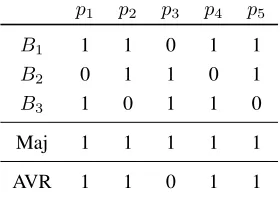
issue-by-issue majority aggregation, the AVR does not coincide with it. This can be seen in Table 1, in which the
outcome of the majority rule is different from all individual ballots.
p1 p2 p3 p4 p5
B1 1 1 0 1 1
B2 0 1 1 0 1
B3 1 0 1 1 0
Maj 1 1 1 1 1
[image:8.612.239.379.396.495.2]AVR 1 1 0 1 1
Table 1: Majority differs from AVR
According to the AVR, the first individual ballot is selected as the group outcome. The first ballot differs on
three issues from each of the remaining two ballots, having a sum of the Hamming distances of 6. The last
two ballots differ on 4 issues from each other, having a total distance of 7. The first ballot is therefore selected by minimisation.
As previously remarked, it is straightforward to see that the AVR satisfies the first notion of compatibility.
So we can state the following proposition:
Proposition 1. TheAVRsatisfies strong compatibility.
This rule also satisfies the following axiomatic properties:
Proof. The AVR is clearly anonymous and, as the outcome is composed by individual ballots, it is also
unanimous. To see that the AVR satisfies the monotonicity condition M?, assume thatBiis the ballot of one of the average voters in profileBand thatbij = 1, i.e., issuejis accepted. If we now increase acceptance ofj by modifying other individual ballots, then the Hamming distance ofBi from other individual ballots decreases, hence leavingBiin the collective outcome.
To see that the independence condition I?does not hold, consider the profile in Table 1. According to the AVR, the first individual ballot is selected as the group outcome. If we callBthe profile described in Table 1,
then we have that AVR(B)j3 = 0. We now construct a different profileB
0such that AVR(B0)
j3 = 1, while keeping the individual judgments about the same issuej3fixed, contradicting the axiom of independence I?.
Let thereforeB0 be obtained fromBby changing the third individual ballot toB30 = (1,1,1,1,1). We have thatH(B1, B2) = 3,H(B1, B30) = 1andH(B2, B30) = 2. The third ballotB30 has now the lowest total
Hamming distance with a value of 3, and is the only ballot that gets selected. This contradicts independence
I?, as there is no ballot in the outcome ofB0which rejects the third issuej3.
A straightforward generalisation of the definition of the AVR rule enables us to define a rule that complies with the notion ofk-strong compatibility introduced in Section 3. It is sufficient to define a rule by means of selection functions that choose between the ballots submitted by at leastkindividuals, outputting a general abstention in case no combination was supported by at leastkindividuals.
Having showed that the AVR satisfies a strong notion of compatibility, we now turn to investigate its
behavior with respect to consistency. It is sufficient to observe that, since all individuals are submitting
rational ballots, it is impossible for the AVR to choose an irrational outcome, as the minimisation is performed
over the individual ballots.4 Therefore, we can state the following proposition:
Proposition 3. TheAVRrule is collectively rational for all rationality assumptionsR ⊆ D.
We therefore conclude that the average voter rule (AVR) is a good candidate for a compatibleandconsistent
aggregation procedure (and the only rule in this paper that satisfies both notions).
5
Compatible Aggregation Rules
In this section we define three rules for incomplete profiles, corresponding to the three notions of compatibility
we have introduced in Section 3 for incomplete procedures.
The first rule we consider is theconflict-free rule(CFR). CFR selects as collective outcome the ballot that
is compatible with all ballots of the profile. In particular, if an agent accepts (resp.rejects) an issueiand no agent rejects (resp. accepts) it, the issueiwill be accepted at the collective level. In all the other cases, the group will abstain oni.
Definition 8(Conflict-free rule (CFR)). For everyj ∈ I, letbc
j be thejth element of the collective outcome
CFR(B):
4We can observe that this is a common property of aggregation procedures that are restricted to the individual ballots in the selection
bcj=
1 ∃i∈ N s.t.bi,j= 1and@l∈ N s.t.bl,j = 0
0 ∃i∈ N s.t.bi,j= 0and@l∈ N s.t.bl,j = 1
A otherwise
This rule shares similarities with thecredulousaggregation procedure introduced by Caminada and Pigozzi
(2011) in an abstract argumentation framework.
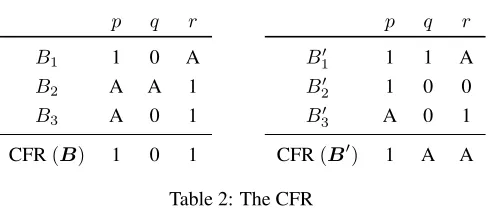
Example 1. To illustrate theCFR, consider two profilesBandB0in Table 2.
p q r
B1 1 0 A
B2 A A 1
B3 A 0 1
CFR(B) 1 0 1
p q r
B01 1 1 A
B02 1 0 0
B03 A 0 1
[image:10.612.188.432.215.321.2]CFR(B0) 1 A A
Table 2: The CFR
The collective decision onpis 1 in both profiles because, for an issue to be accepted (resp. rejected) at the group level, it suffices that there is one individual that accepts (resp. rejects) it and no one who disagrees with
her (abstention does not count as a disagreement inCFR). For the same reason,qis rejected under the first profile. However, the group abstains onqunder the second profile because there is a disagreement among the individuals aboutq.
The example above illustrates an interesting feature of the CFR. In the first profile, all individuals are
undecided on at least one issue. However, the collective outcome does not contain any abstention. In this
case, we have that the group is compatible with the individual positions and, at the same time, is more
committedthan any of the group’s members. On the other hand, it may seem disturbing that in the second
profile two agents are undecided about two different issues and yet, the group abstains on two issues. Is
this really something negative? Well, no. The reason is that the CFR selects themost committedamong the
compatible outcomes. To see that, it is enough to observe that for the second profile,(1, A, A)is the most committed compatible outcome. None of the individual ballots can be selected to be the group outcome since they are all incompatible with each other. The only compatible options are(A, A, A)and(1, A, A). Since the second one contains fewer abstentions (i.e.is more committed) than the first,(1, A, A)is the group’s position selected by CFR.
The second rule we consider is thek-conflict-free rule(k-CFR). We first need to define asubprofileofB.
Definition 9(Subprofile ofB). Given a profile B = (B1, . . . , Bn) and a subset of agentsK ⊆ N, the restriction ofBtoKisBK = (Bk, k∈K)and is called asubprofileofB.
Definition 10(k-conflict-free rule (k-CFR)). Thek-conflict-free rulemapsBtok-CFR(B)={CFR(BK) |
K⊆ N }, where CFR(BK)is the CFR over the subprofileBK.
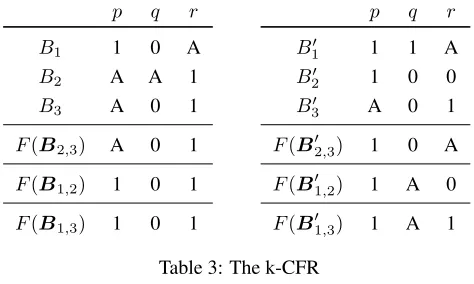
Example 2. Let the profile be the same as that of Example 1. Let us assume thatk=2.Frefers to thek-CFR. The two examples in Table 3 show that fork= 2we have three different outcomes on both profiles, depending
p q r
B1 1 0 A
B2 A A 1
B3 A 0 1
F(B2,3) A 0 1
F(B1,2) 1 0 1
F(B1,3) 1 0 1
p q r
B0
1 1 1 A
B20 1 0 0
B30 A 0 1
F(B02,3) 1 0 A
F(B01,2) 1 A 0
[image:11.612.189.426.137.279.2]F(B01,3) 1 A 1
Table 3: The k-CFR
on which subprofiles we consider. For example,k-CFR(B2,3)is the outcome obtained by thek-conflict-free
aggregation rule when the subprofile considered consists of agents 2 and 3.
Note that, whenkis bigger or equal to the number of individuals, thek-CFR coincides with the CFR. It is now sufficient to observe that the CFR selects the only ballot that is compatible with all individual
ballots to prove the following proposition:
Proposition 4. TheCFR satisfies weak compatibility. Thek-CFR rule satisfiesk-weak compatibility.
We now turn to study the behavior of the two rules with respect to axiomatic properties (recall that the CFR
is a resolute procedure while thek-CFR is not).
Proposition 5. TheCFRsatisfies U, I, A and M.
Proof. Let us start with unanimity: in case all individuals agree on a single issue on accepting it, rejecting
it or abstaining on it, then there obviously is no conflict and the CFR selects the same judgment as outcome.
Independence is verified since the rule is defined issue-by-issue, and, as the definition does not contain any
reference to specific individuals, the CFR is clearly anonymous. To prove that monotonicity holds, note that
wheneverbcj = 1for a certainc, then all individuals must either abstain or accept the same issuej. Therefore, increasing support for this same issue cannot create any conflict between individual judgments, and the result
does not change.
Thek-CFR satisfies the same set of axioms adapted for non-resolute procedures. The proof of the following proposition is a direct generalisation of the previous one:
Proposition 6. Thek-CFR satisfies U?, I?, A and M?.
The last rule we consider is an adaptation from quota rules (where a proposition is accepted if and only if that
proposition is accepted by a number of individuals greater than a prefixed threshold), as defined by Dietrich
Definition 11(k-quota rule (k-QR)). Let1 6 k 6 nandbc
j be thejth element of the collective outcome
k−QR(B):
bcj=
1 iff∃M⊆N,|M|>ks.t.∀i∈M, bi,j= 1
0 iff∃M0⊆N,|M0|>ks.t.∀i∈M0, bi,j= 0
A iff∃M00⊆N,|M00|>ks.t.∀i∈M00, bi,j=A
A otherwise
Note thatk-QR guarantees a unique result only whenk > |N |2 . This rule selects as outcome on a certain issue all the outcomes that are supported by at leastkindividuals. An abstention on an issue in the outcome means either that the initial profile contained too many abstentions to take a definitive stand on the issue, or
that there was not enough support for either its acceptance or its rejection. OutputtingAwhenever there is no
M of cardinalityksuch that all the individuals inM accepted, rejected or abstained on an issue, ensures that
k-QR is a well-defined aggregation function, i.e. it always returns an outcome. Suppose, for example, thatk
is set to be equal ton. Then, if we do not add the last condition in Definition 11, and if there is no unanimous vote on the issues, the rule would not be able to assign a group outcome to the given profile.
Thek-QR satisfies the last notion of compatibility and several axiomatic properties:
Proposition 7. Thek-QRsatisfiesk-compatibility over issues.
Proposition 8. Thek-QRsatisfies U?, I?, M?, A unlessk=|N |ork= 0.
Proof. For what observed in previous proofs, the k-QR is independent and anonymous since it is defined issue-by-issue and it does not make any reference to a specific individual in its definition. Unlessk=|N |or
k= 0, in which case the rule outputs a complete abstention or outputs all possible values on every issue, this rule is also unanimous. To see this, suppose for instance thatbi= 0for all individualsi, then there cannot be anyM ⊆ N such thatbi,j= 1orbi,j=Afor alli∈M. With similar arguments it can easily be shown that thek-QR is monotonic.
We now turn to analyse the behavior of the rules defined in this section with respect to consistency.
Unfor-tunately, we can easily conclude that the result is negative and we explain this with a very simple example.
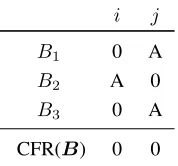
Consider the profile in Table 4, and assume that the rationality constraint rules out(0,0)as inconsistent.
i j
B1 0 A
B2 A 0
B3 0 A
[image:12.612.265.354.540.623.2]CFR(B) 0 0
Table 4: The CFR is not collectively rational.
This example shows that the CFR is not collectively rational with respect to the rationality constraint in
aggregators for the case of incomplete ballots. The authors proved that any such rule (including our CFR) is
oligarchic on non-trivial agendas, i.e., the outcome is obtained by copying the unanimous decision of a subset
of individuals in every profile, or by abstaining on the issue.
6
Related work and conclusions
While the literature on preference and judgment aggregation widely investigated the problem of defining
aggregation rules that can guarantee consistent outcomes, the issue of ensuring a compatible group decision received little attention. There is, however, some work that needs to be mentioned and with respect to which
our contribution has to be positioned.
Recently, Caminada and Pigozzi (2011) used an abstract argumentation framework to propose three
pro-cedures that ensure consistent and compatible collective positions. In their approach, given an argumentation
framework and a group of agents, the individuals may have divergent opinions on the status of the arguments.
The question is then how to combine individual evaluations of an argumentation framework into a collective
one. In particular, they introduced and studied three aggregation rules that ensure outcomes that are not in
conflict with the individuals’ positions. There are several important differences between the approach of this paper and the one in Caminada and Pigozzi (2011). Other than the different frameworks being used, the main
difference resides in the fact that in Caminada and Pigozzi (2011) cardinality considerations did not play a
role in the aggregation procedures. Those had to yield to outcomes that were not in conflict withanyof the
agents. Instead, we have provided definitions of compatibility on a wider spectrum, going from compatible
outcomes with respect to all the individuals, to some of the individuals or to only one. We indeed believe that
different applications require differentgraded concepts of compatibility.
Our definition of compatibility is related to the work of Meskanen and Nurmi (2008) and Elkind et al.
(2009) on distance rationalisability of voting rules. A voting rule associates a set of candidates to a profile of preference orders. Work on distance rationalisability of voting rules seeks justification for a collective decision
in its distance from a notion of consensus accepted by all individuals. Our concept of compatibility, although
being formulated in the different framework of multi-issue decisions, is strongly related, and a comparison
between the two lines of research constitutes a very promising direction for future work.
In this paper we have claimed that, when a group makes decisions, it is not only important that the outcome
is consistent in order to guarantee that the decision is transformable into actions, but also that it is perceived
as compatible by the group’s members, to ensure that the individuals agree to perform the action implied by
the collective decision. The literature in social choice theory focused on the first aspect, but seems to have neglected considerations regarding the notion of compatibility.
The multiple-election paradox explained in the introduction highlights the arbitrariness of an aggregation
procedure that selects an outcome that was submitted by none or by the fewest agents. In this paper we
started exploring the concept of compatibility of an aggregation rule. Our aim is not to impose one single
notion of compatibility, but rather to investigate possible declinations of such a notion. We have given several
definitions to capture the compatibility of a collective decision in binary aggregation, both for complete and
incomplete aggregation procedures. We then introduced five definitions of aggregation procedures, and we
for-mulations of compatibility. Other notions can be defined, and classical and new aggregation rules (see e.g.
Lang et al., 2011) should be tested with respect to these properties. An interesting feature is that our notions
of compatibility do not necessarily lead to undecided collective decisions. Indeed, we have seen that CFR
selects the most committed (i.e. containing fewest abstentions) among the compatible outcomes. Another
issue that remains to be explored is the relationship between compatible aggregation procedures and strategic
voting. Our intuition is that, if the collective outcome is ensured to be compatible with all the individuals, agents have less incentive to submit insincere ballots. This, however, needs to be formalized and investigated.
Acknowledgments
We would like to thank Ulle Endriss and the anonymous reviewers of LOFT for their useful comments.
References
K. Arrow.Social choice and individual values. Cowles Foundation Monograph Series, second edition, 1963.
J.-P. Benoit and L. Kornhauser. Voting simply in the election of assemblies.Technical Report RR 91-32. C.V.
Starr Center Working Papers, 1991.
C. Boutilier, R. Brafman, C. Domshlak, H. Hoos, and D. Poole. CP-nets: A tool for representing and reasoning
with conditional ceteris paribus preference statements. Journal of Artifcial Intelligence Research, 21:135–
191, 2004.
S. Brams, D. Kilgour, and W. Zwicker. The paradox of multiple elections.Social Choice and Welfare, 15(2):
211–236, 1998.
M. Caminada and G. Pigozzi. On judgment aggregation in abstract argumentation. Autonomous Agents and
Multi-Agent Systems, 22(1):64–102, 2011.
Y. Chevaleyre, U. Endriss, J. Lang, and N. Maudet. Preference handling in combinatorial domains: From AI
to social choice.AI Magazine, 29(4):37–46, 2008.
F. Dietrich and C. List. Judgment aggregation by quota rules: Majority voting generalized. Journal of
Theoretical Politics, 19(4):391–424, 2007.
F. Dietrich and C. List. Judgment aggregation without full rationality.Social Choice and Welfare, 31:15–39,
2008.
E. Dokow and R. Holzman. Aggregation of binary evaluations with abstentions.Journal of Economic Theory,
145(2):544–561, 2010.
E. Elkind, P. Faliszewski, and A. M. Slinko. On distance rationalizability of some voting rules. InProceedings
of the 12th Conference on Theoretical Aspects of Rationality and Knowledge (TARK-2009), 2009.
U. Grandi and U. Endriss. Lifting rationality assumptions in binary aggregation. InProceedings of the 24th
AAAI Conference on Artificial Intelligence (AAAI-2010), July 2010.
U. Grandi and U. Endriss. Binary aggregation with integrity constraints. InProceedings of the 22nd
Interna-tional Joint Conference on Artificial Intelligence (IJCAI-2011), 2011.
D. Grossi and G. Pigozzi. Introduction to judgment aggregation. In V. Goranko and N. Bezhanishvili, editors,
ESSLLI’11 Lecture Notes. Springer-FoLLI Lecture Notes in Computer Science, to appear.
D. Lacy and E. M. S. Niou. A problem with referendums.Journal of Theoretical Politics, 12(1):5–31, 2000.
J. Lang, G. Pigozzi, M. Slavkovik, and L. van der Torre. Judgment aggregation rules based on minimization.
InProceedings of the 13th Conference on Theoretical Aspects of Rationality and Knowledge, TARK XIII,
pages 238–246, 2011.
C. List and C. Puppe. Judgment aggregation: A survey. InOxford Handbook of Rational and Social Choice.
Oxford University Press, 2009.
T. Meskanen and H. Nurmi. Closeness counts in social choice. In M. Braham and F.Steffen, editors,Power,