The Rockefeller University Press, 0021-9525/2002/1/327/10 $5.00
The Journal of Cell Biology, Volume 156, Number 2, January 21, 2002 327–336 http://www.jcb.org/cgi/doi/10.1083/jcb.200107140
JCB
Article
327
Assembly and function of AP-3 complexes in cells
expressing mutant subunits
Andrew A. Peden, Rachel E. Rudge, Winnie W.Y. Lui, and Margaret S. Robinson
Department of Clinical Biochemistry, University of Cambridge, Cambridge Institute for Medical Research, Cambridge CB2 2XY, UK
he mouse mutants mocha and pearl are deficient in the AP-3 and 3A subunits, respectively. We have used cells from these mice to investigate both the assembly of AP-3 complexes and AP-3 function. In mocha cells, the 3 and 3 subunits coassemble into a heterodimer,
whereas the 3 subunit remains monomeric. In pearl cells,
the and 3 subunits coassemble into a heterodimer,
whereas 3 gets destroyed. The yeast two hybrid system was used to confirm these interactions, and also to demonstrate that the A (ubiquitous) and B (neuronal-specific) isoforms of 3 and 3 can interact with each other. Pearl cell lines
T
were generated that express 3A, 3B, a 3A2 chimera,two 3A deletion mutants, and a 3A point mutant lacking a functional clathrin binding site. All six constructs assembled into complexes and were recruited onto membranes.
However, only 3A, 3B, and the point mutant gave full
functional rescue, as assayed by LAMP-1 sorting. The
3A2 chimera and the 3A short deletion mutant gave
partial functional rescue, whereas the 3A truncation mutant gave no functional rescue. These results indicate that the hinge and/or ear domains of 3 are important for function, but the clathrin binding site is not needed.
Introduction
Adaptor proteins (APs)* are heterotetrameric complexes that facilitate cargo selection and coated vesicle budding from different membrane compartments. Four such complexes have been identified in mammals, all of which consist of two large subunits: a subunit and a more divergent, complex-specific subunit (, , , or ); a medium-sized or sub-unit; and a small or subunit. The subunits are assembled into a structure resembling Mickey Mouse, with a brick-like “head,” consisting of the NH2-terminal domains of the two
large subunits, the medium subunit, and the small subunit, out of which protrude the COOH-terminal “ear” domains of the large subunits, connected by flexible hinges. The AP-1 and AP-2 complexes were identified first as abundant com-ponents of clathrin-coated vesicles. More recently, the AP-3 and AP-4 complexes were identified, primarily by finding homologues of the AP-1 and AP-2 subunits in the EST
database, raising antibodies against recombinant proteins, and showing by coimmunoprecipitation experiments that the proteins were assembled into two novel complexes (Rob-inson and Bonifacino, 2001).
Although the AP-3 complex was identified relatively re-cently, it has been much more amenable to genetic analysis than the AP-1 or AP-2 complexes. When the subunit of the complex was first cloned, it was found to be the mam-malian homologue of the protein encoded in Drosophila by the garnet gene, one of the classical eye color genes (Ooi et al., 1997; Simpson et al., 1997). garnet mutants have defec-tive pigment granules, and because of similarities between pigment granules and lysosomes, this suggested a role for the AP-3 complex in the trafficking of proteins destined for lysosomes and related organelles. Subsequent studies in yeast showed that deleting any of the four AP-3 subunit genes causes missorting of a subset of proteins normally destined for the vacuole, the yeast equivalent of the lysosome (Cowles et al., 1997; Stepp et al., 1997). Two naturally occurring mouse mutants have also been identified with mutations in AP-3 subunits. The mocha (mh) mouse has a null mutation in the subunit of the complex (Kantheti et al., 1998), whereas the pearl (pe) mouse has effectively a null mutation in the 3A subunit (small amounts of mRNA can be de-tected which encode a trunctated protein, missing the last 125 amino acids, but the protein has not been detected on Western blots) (Feng et al., 1999; Zhen et al., 1999). The mouse mutants have a similar phenotype to the human
Address correspondence to Margaret S. Robinson, University of Cam-bridge, CIMR, Wellcome Trust/MRC Building, Addenbrooke’s Hospi-tal, Hills Road, Cambridge CB2 2XY, UK. Tel.: (44) 1223-330163. Fax: (44) 1223-762640. E-mail: [email protected]
Andrew A. Peden and Rachel E. Rudge contributed equally to this paper. Andrew A. Peden’s present address is Howard Hughes Medical Institute, Department of Molecular and Cellular Physiology, Stanford University School of Medicine, CA 94305-5426.
*Abbreviations used in this paper: AP, adaptor proteins; HPS, Herman-sky Pudlak syndrome.
328 The Journal of Cell Biology|Volume 156, Number 2, 2002
genetic disorder Hermansky Pudlak syndrome (HPS), and indeed a subset of HPS patients has been identified with mutations in 3A (Dell’Angelica et al., 1999). In both the mice and the humans, AP-3 deficiency results in hypopig-mentation because of abnormalities in melanosomes, pro-longed bleeding because of deficiencies in platelet dense granules, and reduced secretion of lysosomal enzymes into the urine. AP-3–deficient fibroblasts appear relatively nor-mal, but several studies have revealed that lysosomal mem-brane proteins in these cells show increased trafficking via the plasma membrane (Dell’Angelica et al., 1999, 2000;Le Borgne et al., 1998). The mh mouse also has neurological defects, although the pe mouse and the 3A-deficient hu-mans are neurologically normal. This is presumably because there is a second 3 isoform, 3B, which is specifically ex-pressed in neurons and neuroendocrine cells (Kantheti et al., 1998). Together, these findings indicate that the AP-3 com-plex facilitates the trafficking of certain types of cargo to ly-sosomes and lysosome-related organelles.
Whether or not AP-3 is associated with clathrin is still somewhat controversial. Unlike AP-1 and AP-2, AP-3 is not enriched in purified clathrin-coated vesicles (Newman et al., 1995; Simpson et al., 1996). However, a clathrin-binding consensus sequence, L[L,I][D,E,N][L,F][D,E], has been identified in the hinge domains of 1 and 2, and similar sequences are found in 3A and 3B which can interact with clathrin in vitro (Dell’Angelica et al., 1998; ter Haar et al., 2000). AP-3 is also able to coassemble with clathrin in vitro and to support clathrin recruitment onto liposomes (Dell’Angelica et al., 1998; Drake et al., 2000). On the other hand, an in vitro system for the budding of synaptic-like mi-crovesicles from endosomes has been shown to require AP-3 but not clathrin (Shi et al., 1998), indicating that the two can function independently. In addition, gene deletion stud-ies in yeast indicate that AP-3 and clathrin function on dif-ferent pathways; however, yeast 3 does not contain a clath-rin binding motif. Immunolocalization studies, at both the light and the electron microscope level, have yielded con-flicting results (Simpson et al., 1996, 1997; Dell’Angelica et al., 1998). Thus, the question of whether or not there is an
obligatory coupling between AP-3 and clathrin in mamma-lian cells has not yet been resolved.
Here we have taken advantage of the mouse mutants to address two questions. First, what happens to the other AP-3 subunits if one of them is missing? And second, to what ex-tent can we rescue the phenotype of mocha and pearl cells by transfecting them with either a wild-type copy of the missing subunit, or alternatively with one that has been al-tered in some manner? In particular, are 3A subunits that no longer have the clathrin binding motif still functional? These studies provide insights into the assembly and func-tion not only of the AP-3 complex, but of the other AP complexes as well.
Results
Assembly of AP-3 complexes in mh and pe cells
To investigate the mocha (mh) and pearl (pe) phenotypes at the cellular level, we have established an mh cell line and made use of a previously established pe cell line. Fig. 1 a shows Western blots of extracts from these cells probed for the four AP-3 subunits: , 3, 3, and 3. In the cells from the mocha homozygote (mh/mh), , 3, and 3 are all unde-tectable, while 3 is detectable but at reduced levels. In the pearl cells (pe/pe), 3 and 3 are both undetectable, while and 3 are both detectable at reduced levels. When the cells are labeled for immunofluorescence using a -specific anti-body, the typical punctate pattern can be seen in control cells ( ), the mh cells are unlabeled, and the pe cells show diffuse cytoplasmic labeling, indicating that although is present in
pe cells, it is unable to associate with membranes in the ab-sence of the 3 and/or 3 subunits (Fig. 1, b–d).
Previous studies have shown that in mh and pe mice, mRNAs encoding the three nonmutated subunits are expressed normally, indicating that the subunits are synthesized at wild-type levels but then get degraded because they are un-stable (Kantheti et al., 1998; Feng et al., 1999). Thus, trace amounts of the nonmutated subunits may be present in the
[image:2.612.106.528.66.195.2]mh and pe cells, which are below the limit of detection on whole cell Western blots. To try to concentrate the subunits,
Figure 1. AP-3 subunits in mh and pe cells. (a) Western blots of lysates from the mh and pe cells, as well as a wild-type control cell line
(melan-a cells), were probed with antibodies against all four AP-3 subunits and with an antibody against the AP-1 subunit as a control. Only
the 3 subunit is detectable in the mh cells under these conditions, while only the and 3 subunits are detectable in the pe cells. (b–d) The
same cells were labeled for immunofluorescence with an antibody against the AP-3 subunit. Control cells (b) have the typical punctate pattern,
mh cells (c) show no labeling, and pe cells (d) have diffuse cytoplasmic labeling, indicating that although the subunit is detectable, it is
AP-3 assembly and function | Peden et al. 329
and to determine whether they are associated with each other, we immunoprecipitated cell extracts with antibodies against the , 3, and 3 subunits under nondenaturing conditions, and with anti-3, which only recognizes the de-natured protein, in samples that had been dede-natured by boil-ing in SDS. Western blots of the immunoprecipitates were then probed with antibodies against all four of the AP-3 sub-units, as well as with an antibody against the subunit of AP-1 as a control.
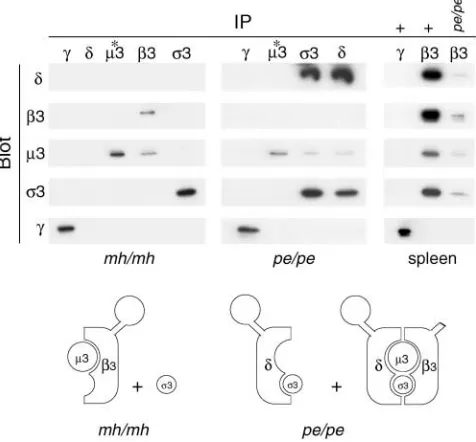
Fig. 2 (left) shows that under these conditions both 3 and 3 can be detected in the mh cells, and furthermore that they assemble into a heterodimer since both subunits come down with anti-3. In contrast, the 3 in these cells appears to exist as a monomer, since it does not coimmunoprecipi-tate with any of the other subunits. In the pe cells (Fig. 2, middle), and 3 form heterodimers which come down with antibodies against both subunits, and in addition, a small amount of 3 can be detected which coprecipitates with the /3 dimers. This suggests either that the 3 may be assembling with the and 3 subunits into a heterotri-mer, or alternatively, since the pe mutation is not a true null, that there are small amounts of truncated 3A expressed in these cells which can form heterotetramers. To distinguish between these two possibilities, we immunoprecipitated
ex-tracts from pe spleen under nondenaturing conditions with a
3A-specific antibody (the reason for using spleen for this experiment is that it is possible to get a more highly concen-trated extract from tissues than from cultured cells, and AP-3 is known to be expressed at particularly high levels in spleen). Fig. 2 (right) demonstrates that there are indeed small amounts of truncated 3A made in pe cells which can coassemble with the other three subunits to form a het-erotetramer, although we cannot rule out the possibility that some of the 3 may also be assembled into a heterotrimer. Together, these studies indicate that 3 and 3 can interact with each other, forming heterodimers in mh cells, and that
and 3 also interact with each other, forming het-erodimers in pe cells. The interactions that we can detect in the mutant cells are shown diagrammatically in the bottom part of Fig. 2.
Subunit interactions
To investigate interactions between the AP-3 subunits fur-ther, and also to determine whether the A and B isoforms of the various subunits can associate with each other, we cloned the cDNAs into the vectors pGBT9 and pGAD424 for anal-ysis using the yeast two-hybrid system. Fig. 3, a and b, shows that interacts under these conditions with 3A and 3B, both of which are expressed ubiquitously. In addition, 3A interacts both with the ubiquitously expressed 3A and with the neuronal-specific 3B (Fig. 3 c), and 3B interacts with
3A (Fig. 3 d). For reasons that are not clear, we were un-able to detect any interaction between 3B and 3B (un-published data). However, the observations that 3A can in-teract with 3B and that 3B can interact with 3A suggest that, instead of having a neuronal-specific complex and a nonneuronal-specific complex, the subunits can “mix and match” if they are coexpressed in the same cell. The interac-tions involving the AP-3 subunits appear to be complex-spe-cific, as we could detect no interactions between 3 and 1 (Fig. 3 c), or between and 1 (unpublished data). Other pairs of subunits were also tested, but the only interactions we were able to detect were those shown in Fig. 3.
Sorting of lysosomal membrane proteins
[image:3.612.52.290.62.283.2]Previous studies have shown that the steady-state distribu-tion of lysosomal membrane proteins, such as LAMP-1, LIMP-2, and CD63, appears normal in AP-3–deficient cells, but that they follow different trafficking routes to the lysosome. Le Borgne et al. (1998) demonstrated that cells that had been depleted of 3 by incubation with antisense oligonucleotides showed increased endocytosis of antibodies against LAMP-1 and LIMP-2 that had been added to the culture medium, indicating that these proteins had been re-routed to the cell surface. Dell’Angelica et al. (1999, 2000) reported similar findings on primary cultures of fibroblasts from 3A-deficient patients and from mh and pe mice. We have also found that antibodies against LAMP-1 are readily endocytosed by both the mh and the pe cell lines (see Figs. 4 and 8). However, because all cell lines are different from each other, we needed to confirm that the antibody endocy-tosis was a direct result of the AP-3 deficiency. Thus, we transiently transfected the cells with a wild-type copy of the
Figure 2. Immunoprecipitates and Western blots of AP-3 subunits
from mh and pe cells. Extracts of cultured mh cells (left), cultured
pe cells (middle), and spleens from both pe and control mice (right)
were immunoprecipitated with the indicated antibody. Most immuno-precipitations were performed under nondenaturing conditions,
with the exception of the anti-3 immunoprecipitations, which
were performed in the presence of SDS. The gels were then blotted onto nitrocellulose and probed with the indicated antibody. An
antibody against the AP-1 subunit was included as a control. The
mh cells can be seen to express trace amounts of 3 and 3, which
form a dimer, whereas the 3 subunit appears to be monomeric.
The and 3 expressed in the pe cells also form a dimer, and in
addition a small amount of complete heterotetramer is made. The
various subcomplexes that form in the mh and pe cells are indicated
330 The Journal of Cell Biology|Volume 156, Number 2, 2002
defective subunit. Cells transfected with both the and the
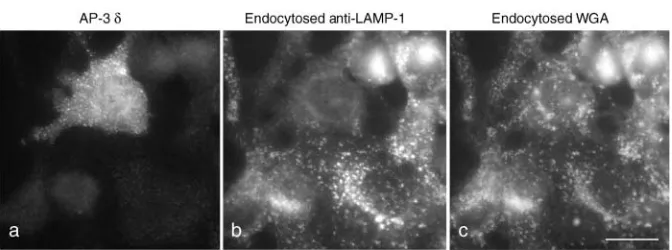
3A constructs could be identified with a -specific anti-body: the nontransfected mh cells were unlabeled, whereas the nontransfected pe cells gave diffuse rather than punctate labeling with the anti- antibody (see Fig. 1). Fig. 4 shows transiently transfected mh cells labeled for (a), endocytosed anti-LAMP-1 (b), and endocytosed WGA (c). The cell ex-pressing has taken up significantly less anti–LAMP-1 than its nontransfected neighbors, while all of the cells have taken up similar amounts of WGA, indicating that endocytosis in general is not impaired in the -expressing cell. Similar re-sults were obtained with pe cells transfected with 3A (see Fig. 8 a).
Introduction of altered subunits
The availability of an assay for AP-3–mediated sorting means that we can now test whether not only wild-type sub-units, but also subunits that have been altered in some way, are functional. Because some such subunits might be ex-pected to give intermediate rescue, we developed a quantita-tive assay based on FACS analysis for use on stably trans-fected cells (see below). Unfortunately, we have so far been unable to obtain any mh cell lines that were homogeneously expressing ; thus, we decided to concentrate on pe cells. In addition to cells expressing wild-type 3A, we have estab-lished pe cell lines expressing 3B, a 3A-2 chimera con-taining the 3A NH2-terminal domain (amino acids 1–686)
but the 2 hinge and ear domains (3A2); two 3A dele-tion mutants (3A807–831 and 3A807 stop); and a 3A point mutant (3A817AAA). The 3A807–831 mutant is missing a fragment of the distal part of the hinge, includ-ing the clathrin bindinclud-ing domain (amino acids 817–822), whereas the 3A807stop mutant is missing the distal part of the hinge, including the clathrin binding domain, and all of the ear. In the 3A817AAA mutant, the clathrin binding motif has been mutated from SLLDLD to AAADLD. This same mutation has been shown to abolish clathrin binding in vitro (Dell’Angelica et al., 1998; unpublished data). Sche-matic diagrams of the constructs are shown in Fig. 5 a.
We first investigated whether the constructs were capable of assembling into AP-3 complexes by immunoprecipitating cell extracts with an antibody against the subunit, then probing Western blots of the immunoprecipitates with antibodies against the other three subunits. Fig. 5 b shows that in the nontransfected cells, only 3 coprecipitated with at detect-able levels (see also Figs. 1 and 2), while in cells transfected with 3A, all three of the other subunits were detectable, indi-cating that the 3A had assembled into complexes together with 3, thus protecting the 3 subunit from degradation. Similarly, in cells transfected with the other five constructs, the construct itself and the 3 subunit came down with the and 3 subunits. These results are consistent with studies on the AP-1 and AP-2 complexes, which indicate that the NH2
[image:4.612.147.485.59.222.2]-terminal domains of the subunits are incorporated into the
Figure 3. Subunit interactions between AP-3 subunits detected using the yeast two-hybrid system. Yeast cells were transformed with cDNAs
in either pGBT9 or pGAD424, as indicated, and interactions were assayed by growth in the absence of histidine. Panels a and b show that the
subunit interacts with both 3A and 3B, panel c shows that the 3A subunit interacts with both 3A and 3B, and panel d shows that the
3B subunit interacts with 3A.
Figure 4. Phenotype of rescued and
nonrescued mh cells.mh cells were
transiently transfected with wild-type ,
then incubated with a mixture of rat anti–LAMP-1(b) and fluorescent WGA (c) for 6 h. Triple labeling shows that the
cell in the field that is expressing has
taken up less anti–LAMP-1 than its neighbors, indicating that there is less misrouting of LAMP-1 to the plasma membrane in this cell. Uptake of WGA
[image:4.612.227.563.619.744.2]AP-3 assembly and function | Peden et al. 331
“head,” where they can interact with the other subunits, while the hinge and ear domains have other functions. The 3 sub-unit in all of the immunoprecipitates is presumably 3A, since 3B is only expressed in neurons and neuroendocrine cells. Thus, this result is consistent with results from the two-hybrid experiments, which indicate that although 3B is nor-mally only expressed in the same cells that express 3B, it can interact with the ubiquitously expressed 3A.
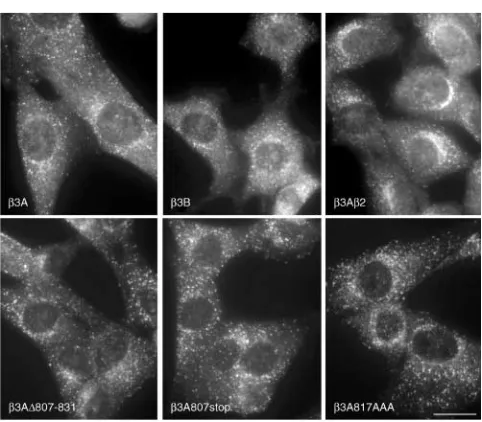
To determine whether the complexes could be recruited onto membranes, cells expressing each of the six constructs were labeled for immunofluorescence with anti-. In non-transfected pe cells, has a diffuse cytoplasmic distribution (Fig. 1 d); however, in cells expressing each of the five con-structs, the labeling was punctate, indicating that it was as-sociated with membranes (Fig. 6). We also compared the dis-tribution of AP-3 in cells expressing the various constructs with that of clathrin, using a confocal microscope (Fig. 7; AP-3
is green and clathrin is red). In cells expressing wild-type
[image:5.612.49.412.61.244.2]3A, AP-3 and clathrin were found to have distinct distribu-tions: (a) they are often in the same general vicinity, and in some cases there may be overlap (yellow), but much of the AP-3 labeling is negative for clathrin. In contrast, when cells are double labeled for the AP-1 adaptor complex and clathrin (b), essentially all of the structures that are positive for AP-1
Figure 5. (a) Schematic diagrams of six
3-based constructs that were stably transfected into pe cells. (b) Extracts from cell lines expressing each of the six constructs, as well as a cell line stably transfected with empty vector, were
immunoprecipitated with anti-, and blots
were probed with antibodies against , the
construct itself (in most cases anti-3A,
although the last two lanes were probed
with antibodies against 3B and 2,
respectively), 3, and 3. Only and 3
can be detected in the immunoprecipitate from the cell line transfected with the empty vector, whereas all four subunits can be detected in the cell lines expressing the six constructs, indicating that complete heterotetramers have been formed.
Figure 6. Immunofluorescence of cell lines expressing each of the
six constructs labeled with anti-. All of the cells show punctate labeling with some concentration in the perinuclear region, indicating that the AP-3 complexes assembled from all six constructs are
[image:5.612.306.550.355.626.2]recruited onto membranes. Bar, 20 m.
Figure 7. Confocal micrographs showing double labeling for AP
complexes and clathrin.pe cells expressing 3A (a), 3A2 (c), or
3A817AAA were double labeled with anti- (green) and anti-clathrin
(red), and COS cells were double labeled with anti- (green) and
anti-clathrin (red). Essentially all of the anti- labeling is also positive for clathrin (note how there are no green dots in b, only yellow). In
contrast, in all three cell lines expressing 3 constructs, much of the
AP-3 labeling is negative for clathrin. (Transfected pe cells could
not be double labeled with anti- and anti-clathrin because the
anti- mAb only recognizes the protein in nonrodent cells.) Bar: (a
[image:5.612.50.291.470.681.2]332 The Journal of Cell Biology|Volume 156, Number 2, 2002
(green) are also positive for clathrin (red; note that there is ex-tensive yellow labeling and very little green). In cells express-ing the various constructs, the extent of overlap between AP-3 and clathrin was very similar to that in cells expressing wild-type 3A. This is in spite of the fact that the 3A2 chimera (c) has more potential clathrin binding sites than wild-type
3A (not only the clathrin-binding consensus sequence LLNLD in its hinge domain, but also three copies of another motif implicated in clathrin binding, DLL [Morgan et al., 2000], as well as clathrin binding activity in its ear domain [Owen et al., 2000]). Constructs lacking a clathrin binding domain, like 3A817AAA (d), did not look appreciably dif-ferent from the other constructs: again, there were some yel-low structures, as well as red and green. However, at the light microscope level, it is impossible to resolve two structures that are less than 0.2 m apart from each other, so to quantify the true extent of overlap between AP-3 and clathrin in cells expressing the various constructs, it will be necessary to go to the electron microscope level.
Functional rescue of pe cells
Having established that all six constructs are able to coas-semble with the other AP-3 subunits and be recruited onto
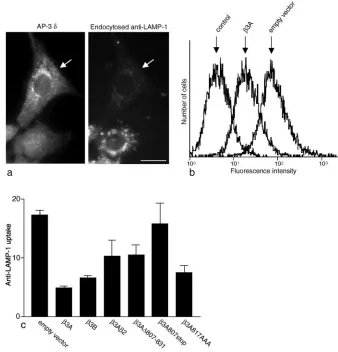
membranes, we went on to investigate their ability to rescue the LAMP-1 missorting phenotype. For these experiments, a rat monoclonal antibody against LAMP-1 was directly con-jugated to Alexa Fluor 488. Double-labeling immunofluo-rescence performed on a mixture of pe cells transfected with empty vector and pe cells expressing wild-type 3A, incu-bated with the antibody for 6 h, showed that the nonex-pressing cells took up significantly more antibody than the expressing cells (Fig. 8 a).
For quantitative studies, each stably transfected cell line was incubated for 6 h either with the anti–LAMP-1 anti-body or with an isotype control antianti-body (anti-KLH), which also had been conjugated to Alexa Fluor 488. The cells were then trypsinized, fixed, and analyzed by flow cytometry. Fig. 8 b shows the results obtained with one of the cell lines ex-pressing wild-type 3A. The peak marked “control” shows the fluorescence intensity of the 3A-expressing cells incu-bated with the control antibody, which is likely to be taken up by fluid phase endocytosis only. The peaks marked “3A” and “empty vector” show the levels of fluorescence intensity observed when the 3A-expressing line and one of the cell lines transfected with empty vector were incubated with the anti–LAMP-1 antibody. In both cases, the
fluores-Figure 8. Functional rescue of pe cells
by the various 3 constructs. (a) A mixture of cells transfected with empty vector
and cells expressing 3A were incubated
6 h with anti–LAMP-1 directly conjugated to Alexa Fluor 488, then double labeled
with anti-. 3A-expressing cells
(arrow), which could be identified by the
punctate, perinuclear distribution of ,
took up less anti–LAMP-1 than cells transfected with empty vector. (b) Anti–LAMP-1 uptake analyzed by flow cytometry. The control peak shows the
fluorescence intensity of a 3A-expressing
cell line incubated with a control anti-body (anti-KLH) conjugated to Alexa Fluor 488. The empty-vector peak shows the level of fluorescence intensity when
a nonexpressing pe cell line was
incu-bated with the anti–LAMP-1 antibody,
whereas the 3A peak shows the level of
fluorescence intensity when the pe cell
line expressing 3A was incubated with
the anti–LAMP-1 antibody. Anti–LAMP-1
uptake in the 3A-expressing cell line
was 27% that of the empty vector– transfected line. (c) Graph of the results obtained by flow cytometry. In each case three different cell lines, stably expressing each of the six constructs were analyzed, as well as three cell lines transfected with empty vector. In each experiment, 10,000 cells were counted and the experiments were repeated on different days and the results for each cell line were averaged. The values were obtained by dividing the geometric
mean fluorescent intensity of cells incubated with the anti–LAMP-1 antibody by that of cells incubated with the control antibody. Error bars
show the standard deviation from the mean. 3A, 3B, and 3A817AAA constructs all gave good rescue (P 0.0001); 3A2 and
3A807–831 both gave partial rescue (P 0.0059 and P 0.0015, respectively); and 3A807 stop gave no significant rescue (P 0.2523).
[image:6.612.222.560.59.411.2]AP-3 assembly and function | Peden et al. 333
cence intensity is higher than that observed with the control antibody, indicating that the anti–LAMP-1 has been taken up by receptor-mediated endocytosis as well as fluid-phase endocytosis. However, the fluorescence intensity of the
3A-expressing line is 4.41 times that of the control. In con-trast, the fluorescence intensity of the cell line transfected with empty vector is 16.61 times that of its own control (un-published data, but similar results were obtained with all of the cell lines incubated with the control antibody). Thus, the amount of specific uptake of anti–LAMP-1 in the 3A-expressing line is 27% of that in the empty vector–trans-fected line. This is comparable to results obtained by others who have investigated anti–LAMP-1 uptake in normal and AP-3-deficient primary fibroblasts from both mice and hu-mans: wild-type cells were reported to internalize between 20 and 45% as much antibody as mutant cells (Dell’Angel-ica et al., 1999, 2000).
Fig. 8 c shows the extent of functional rescue obtained with all six constructs. In each case, three different cell lines stably expressing each of the six constructs were analyzed, as well as three cell lines transfected with empty vector. The ex-periments were repeated on different days and the results for each cell line were averaged. 3A can be seen to give the best rescue, with anti–LAMP-1 uptake 4.89 0.237 (SD), as compared with 17.25 0.821 in cells transfected with empty vector. The 3B construct also rescued well, with anti–LAMP-1 uptake 6.58 0.421. Whether the difference between the 3A- and 3B-expressing cells reflects func-tional differences between the two 3 isoforms, or whether it reflects other differences between the various cell lines (since wild-type cell lines can vary at least this much in their anti-LAMP-1 uptake), is not at present clear. The 3A2 chimera and the 3A807–831 deletion mutant both par-tially rescued the missorting phenotype, with anti–LAMP-1 uptake 10.30 2.620 and 10.48 1.635 respectively. However, there was no significant difference in antibody uptake between cells expressing the truncation mutant,
3A807stop (15.73 3.512), and cells transfected with empty vector. Thus, the distal hinge and/or ear domain of the 3 subunit appears to be required for AP-3 function, even though the construct lacking these domains is still able to assemble into AP-3 complexes and be recruited onto membranes.
There are at least two possible explanations for the interme-diate level of functional rescue that we observed with the
3A807–831 mutant. One possibility is that the clathrin-binding consensus sequence, which is missing from this con-struct, is required for full functional rescue. Alternatively, the construct might be defective in some other way: for instance, the ear might not be correctly folded. The point mutant
3A817AAA enables us to distinguish between these two pos-sibilities. Instead of a 25-amino acid deletion, this construct has only 3 amino acid substitutions, but (at least in vitro) it is unable to bind clathrin (Dell’Angelica et al., 1998). Fig. 8 c shows that when this construct is expressed in living cells, anti– LAMP-1 uptake is 7.49 1.128, which is only slightly more than in 3A-expressing cells and not significantly different from 3B-expressing cells. Thus, although the hinge and/or ear domains of 3A are needed for protein function, the clath-rin-binding consensus sequence appears to be dispensable.
Discussion
The availability of mice with null, or effectively null, muta-tions in AP-3 subunits has enabled us to study AP-3 assem-bly and function in mammalian cells. In the past we and others have transfected mammalian cells with mutant AP-1 and AP-2 subunits for studies on both assembly and func-tion, but interpretation of these studies has been compli-cated by the presence of endogenous wild-type subunits (Robinson, 1993; Page and Robinson, 1995). In the present study, we have been able to introduce mutant subunits into cells with little or no background.
We first investigated whether partial AP-3 complexes were able to assemble in the absence of a particular subunit. We found that mh cells, missing the subunit, assembled het-erodimers from the 3 and 3 subunits, whereas the 3 subunit remained monomeric. The pe cells, which express very low levels of truncated 3A, mainly assembled het-erodimers consisting of and 3 subunits, as well as a very small amount of complete heterotetramer. All of the sub-units were destabilized to some extent by the absence of ei-ther or 3, but this was particularly striking in the case of the 3 subunit, which seemed to exist only as a dimer with the 3 subunit, even when the 3 subunit was barely detect-able.
In addition to the naturally occurring AP-3 mouse mu-tants, knockout mice have been generated which lack the AP-1 and 1A subunits. Both mouse strains die during embryogenesis; however, a fibroblast line has been estab-lished from the 1A knockout mice, and these cells were found to assemble a heterotrimer consisting of , 1, and
1 subunits. This complex appears to be fairly stable, al-though (like the /3 heterodimer) it is unable to be re-cruited onto membranes (Meyer et al., 2000). The knock-out mouse dies so early that it has not been possible to establish a null cell line, but cells from the heterozygote have been examined and found to express the subunit at
50% normal levels. Both 1 and 1 completely comigrate with by gel filtration in these cells, indicating that any ex-cess 1 and 1 are unstable and get degraded (Zizioli et al., 1999). Similarly, our own studies show that in the absence of the subunit, the stability of 3 and 3 is greatly duced. However, somewhat different findings have been re-ported in yeast. When the AP-3 , 3, or 3 subunits are deleted, the stability of 3 does not appear to be affected, al-though it fractionates differently by gel filtration, in particu-lar in the 3-disrupted strain, where it appears to be mono-meric (Panek et al., 1997). In contrast, deleting the -like subunit of the AP-2–related complex in yeast does not affect the 2 subunit, but it has a profound effect on the stability of 2 (Yeung et al., 1999). Thus, it is difficult to predict how a particular AP subunit will behave in a particular or-ganism; however, all of these studies consistently show that there are strong interactions between the /// subunits and the subunits, and between the and subunits.
Robin-334 The Journal of Cell Biology|Volume 156, Number 2, 2002
son, 1995; Aguilar et al., 1997; Hirst et al., 1999; Takatsu et al., 2001). In addition, in a previous study using the yeast two-hybrid system, we were able to demonstrate interactions between the two large subunits of the AP-1 and AP-2 com-plexes, / and (Page and Robinson, 1995). However, in-teractions between the large subunits appear to be more dif-ficult to reconstitute, and so far we have been unable to demonstrate any interactions between and 3, or between the and 4 subunits of the AP-4 complex (Hirst et al., 1999). and 4 have been shown recently to interact in the presence of 4 using the yeast three-hybrid system, however (Takatsu et al., 2001), so it is possible that 3 may promote the interaction between and 3. One observation that sup-ports the notion that and 3 interact in vivo is the finding that mh cells have greatly reduced levels of the 3 and 3 subunits. This suggests that 3 may be unstable in the ab-sence of , which in turn would destabilize 3.
We also used the yeast two-hybrid system to investigate whether the ubiquitously expressed (A) and neuronal-spe-cific (B) 3 and 3 subunits were capable of interacting with each other. Interactions were detected between 3A and 3A, between 3A and 3B, and between 3B and
3A, although surprisingly not between 3B and 3B. The ability of the A and B isoforms to interact under more physiological conditions was demonstrated in our transfec-tion experiments. When pe cells were transfected with 3B, they formed heterotetramers containing the ubiquitously expressed 3A subunit. Heterotetramers were also assem-bled from the other five constructs, as expected since they all contained the 3A NH2-terminal domain. Perhaps less
predictable was the ability of all the constructs to be re-cruited equally well onto membranes. Although studies from our own lab and others indicate that the COOH-ter-minal hinge and ear domains of the adaptor large subunits are not absolutely essential for membrane association, AP complexes containing earless or are compromised in their ability to bind to their respective membranes (Robinson, 1993); however, the earless 3A construct,
3A807stop, showed no increased cytosolic background. We were also interested in the extent to which the various complexes colocalized with clathrin, in particular com-plexes containing the 3A2 chimera, since multiple clath-rin binding sites have been identified and/or predicted in the 2 COOH-terminal hinge and ear domains (Dell’An-gelica et al., 1998; Morgan et al., 2000; Owen et al., 2000). However, this construct, like the others, was at least par-tially localized to structures that were negative for clathrin. In contrast, AP-1 and AP-2 both show essentially complete colocalization with clathrin (Fig. 7; Robinson, 1987), indi-cating that the presence of the 2 hinge and ear domains is not enough for a stable association with clathrin, and that there must be additional interactions, possibly involving the and subunits (Goodman and Keen, 1995; Morgan et al., 2000; Doray and Kornfeld, 2001).
Although all of the constructs assembled into complexes and were recruited onto membranes equally well, they varied widely in their ability to rescue the missorting phenotype of the pe cells. Using a quantitative assay for LAMP-1 mislocal-ization, we were able to show that 3B gave nearly as good functional rescue as 3A; indeed, the differences that we saw
could simply be due to variability from one cell line to an-other (Dell’Angelica et al., 1999, 2000). However, although
3B can functionally substitute for 3A, the opposite may not be true. Synaptic-like microvesicle budding from endo-somes has been shown to be dependent upon brain AP-3; liver AP-3 will not suffice (Faundez et al., 1998). This sug-gests that the neuronal-specific isoform of either 3 or 3, or both, is required for this activity. Brain AP-3 contains a mixture of A and B isoforms of both 3 and 3, while the stably transfected cells express only 3B and 3A; thus, it should be possible to test the relative importance of neu-ronal-specific 3 and 3 by determining whether AP-3 complexes from the transfected cells will substitute for brain AP-3 in the in vitro budding assay.
Two of our constructs gave partial rescue: the 3A2 chi-mera and the deletion mutant 3A807–831. In contrast, the premature truncation mutant 3A807stop was unable to rescue even partially. This finding indicates that the distal hinge and/or ear domains of 3 are essential for function. In the 3A807–831 mutant, part of the distal hinge is miss-ing, and this fragment may either contribute directly to 3 function, or alternatively may aid in the folding of the ear. Virtually nothing is known about the ear domain of 3, al-though the 2 ear has been shown to bind both clathrin and certain coated vesicle accessory proteins, including AP180, epsin, and Eps15 (Owen et al., 2000). We have shown that AP-3 complexes containing truncated 3A are recruited onto the membrane, and presumably they are able to select cargo since they contain 3A (Ohno et al., 1998). Thus, the lack of functional rescue suggests that they fail to produce coated vesicles, consistent with an inability to recruit struc-tural or accessory proteins that might be essential for this event. The ability of the 3A2 construct to give partial res-cue suggests that the 3 and 2 ears may recruit some of the same proteins. However, gels of GST pulldowns using the
3A ear showed no obvious candidate binding partners, and clathrin could not be detected on Western blots of the pull-downs (D. Owen, personal communication; unpublished data). Thus, the precise function of the 3 ear remains elu-sive. However, its importance is highlighted by its evolu-tionary conservation: the 3 ear domains of both Drosophila
and C. elegans are significantly homologous to the ear do-mains of mammalian 3A and 3B, although both S. cerevi-siae and S. pombe 3 subunits appear to lack any ear do-main.
AP-3 assembly and function | Peden et al. 335
there is any colocalization between the two in cells express-ing 3 with a mutated clathrin binding domain. However, much of the evidence in support of an association between AP-3 and clathrin comes from studies on the LLDLD quence, and the present study demonstrates that this se-quence is not essential for AP-3 function in vivo.
The large subunits of the AP complexes contain a number of other intriguing motifs and domains, including the “KRIGY” and “WIIGEY” sequences (Hirst et al., 1999). These motifs are found not only in every member of the
/// and families, but also in the very distantly related
-COP and -COP subunits of the coatomer complex. So far nothing is known about their function, but we are cur-rently mutating these motifs in both the and 3 subunits. By taking advantage of the mh and pe cell lines, it should be possible to assess the importance of these and other se-quences not only in the assembly and localization of coat protein complexes, but also in coated vesicle function.
Materials and methods
Cell lines
To generate an mh cell line, primary fibroblasts were first cultured by tak-ing muscle from 1–3-d-old mice and minctak-ing the tissue ustak-ing a scalpel blade, then transferring the tissue to culture dishes containing DME sup-plemented with 10% fetal calf serum, 50 IU/ml penicillin, 50 g/ml strep-tomycin, 2 mM L-glutamine, and 52 M mercaptoethanol. After 3–7 d the medium was changed on the cells. Once cells had grown out from the dis-rupted tissue, they were split and cultured in the above medium supple-mented with 200 nM TPA. In some cases the cells changed from slow growth to fast, noncontact-inhibited growth, and one of the fast-growing cell lines was cloned and aliquots were frozen for further experiments.
An immortal pe cell line was donated by R. Swank (Roswell Park Can-cer Institute, Buffalo, NY). Although this line was generated from skin using methods designed to select for melanocytes, we were unable to detect the melanocyte-specific proteins tyrosinase and TRP-1 in these cells, indicat-ing that they are another type of skin cell, most likely fibroblasts. The mouse melanocyte line, melan-a, was a gift from D. Bennett (St. George’s Hospital Medical School, London, UK).
Antibody-based methods
Immunoprecipitations were performed both on nondenatured proteins and in the presence of SDS, using antibodies against both AP-3 and AP-1 sub-units, as described previously (Simpson et al., 1996, 1997). Western blotting and immunofluorescence were also performed using previously published methods (Robinson and Pearse, 1986; Robinson, 1987). The polyclonal rab-bit antibodies against AP-3 subunits have already been described (Simpson et al., 1996, 1997); in addition, a mouse monoclonal antibody was raised against the hinge domain (amino acids 608–800) of the AP-3 subunit. The construct was expressed as a GST fusion protein and used to immunize fe-male BALB/c mice. Fusion of the spleen cells with myeloma cells and screening of the resulting antibodies were performed as described by Bock et al. (1997). Ascites fluid was prepared by Joseph Beirao (Josman Laborato-ries, Napa Valley, CA). The rabbit anticlathrin antibody has been described previously (Simpson et al., 1997). The monoclonal anti- antibody, mAb 100/3, was purchased from Sigma-Aldrich. The anti–LAMP-1 antibody (1D4B) was initially obtained from the Developmental Studies Hybridoma Bank developed under the auspices of the NICHD and maintained by The University of Iowa, Department of Biological Sciences, Iowa City, IA.
Yeast two-hybrid analysis
Most molecular biology techniques were performed as described by Sam-brook and Russell (2001). To construct the plasmids for yeast two-hybrid analysis, the AP-3 subunits , 3A, 3B, 3A, 3B, 3A, and 3B were all cloned into the yeast two-hybrid vectors pGBT9 and pGAD424 (CLON-TECH Laboratories, Inc.), using PCR to amplify the coding sequences and to introduce appropriate restriction sites. All constructs that had been made using PCR were sequenced by John Lester (University of Cambridge, Cambridge, UK) to confirm that no errors had been introduced. Interac-tions were monitored by assaying for growth in the absence of histidine.
Expression in mammalian cells
All plasmids for expression in mammalian cells were constructed using the vector pMEP (Girotti and Banting, 1996). The 3A2 construct consists of the NH2-terminal 686 amino acids of 3A fused to the last 334 amino acids of 2. The deletion constructs and the point mutant were made by PCR and sequenced as above to confirm that they were error-free. Cells were transfected using QIAGEN SuperFect transfection reagent and se-lected in DME plus 10% fetal calf serum with Hygromycin (0.2 mg/ml). At least three cell lines were selected for each construct.
Flow cytometry
A quantitative assay for AP-3 dependent sorting was developed using flow cytometry. Two rat monoclonal antibodies, anti–LAMP-1 (1D4B) and a control anti-KLH antibody (both IgG2as) were supplied by BD PharMin-gen. The antibodies were directly conjugated to Alexa Fluor 488 using the Molecular Probes Alexa 488 protein-labeling kit according to the manu-facturer’s instructions. Cells were then incubated with either anti–LAMP-1 or control antibody for 6 h at 37 in serum-free media. The cells were rinsed in PBS, trypsinized, fixed in 3% paraformaldehyde, and analyzed on a fluorescence-activated cell scanner (FACScalibur; Becton Dickinson). To ensure that differences in anti–LAMP-1 uptake were not due to differ-ences in LAMP-1 expression levels, Western blots of each cell line were probed with the LAMP-1 antibody. Although there was some variability from one line to another, there was no correlation between LAMP-1 ex-pression levels and the amount of anti–LAMP-1 uptake.
We are very grateful to Richard Scheller, who generously allowed us to use an unpublished monoclonal antibody against AP-3 raised in his lab. We thank Dick Swank for the pearl cell line, Dot Bennett for the melan-a cell line, and Margit Burmeister for advice on maintaining mocha mice. We also thank Paul Luzio, Matthew Seaman, David Owen, Rainer Duden, John Kilmartin, and members of the Robinson lab for reading the manu-script and for helpful discussions.
This work was supported by grants from the Wellcome Trust and the Medical Research Council.
Submitted: 31 July 2001 Revised: 4 December 2001 Accepted: 4 December 2001
References
Aguilar, R.C., H. Ohno, K.W. Roche, and J.S. Bonifacino. 1997. Functional do-main mapping of the clathrin-associated adaptor medium chains 1 and 2. J. Biol. Chem. 272:27160–27166.
Bock, J.B., J. Klumperman, S. Davanger, and R.H. Scheller. 1997. Syntaxin 6 functions in trans-Golgi network vesicle trafficking. Mol. Biol. Cell. 8:1261– 1271.
Cowles, C.R., G. Odorizzi, G.S. Payne, and S.D. Emr. 1997. The AP-3 adaptor complex is essential for cargo-selective transport to the yeast vacuole. Cell. 91:109–118.
Dell’Angelica, E.C., J. Klumperman, W. Stoorvogel, and J.S. Bonifacino. 1998. Association of the AP-3 complex with clathrin. Science. 280:431–434. Dell’Angelica, E.C., V. Shotelersuk, R.C. Aguilar, W.A. Gahl, and J.S. Bonifacino.
1999. Altered trafficking of lysosomal proteins in Hermansky-Pudlak syn-drome due to mutations in the 3A subunit of the AP-3 adaptor. Mol. Cell. 3:11–21.
Dell’Angelica, E.C., R.C. Aguilar, N. Wolins, S. Hazelwood, and W.A. Gahl. 2000. Molecular characterization of the protein encoded by the Hermansky-Pudlak syndrome type 1 gene. J. Biol. Chem. 275:1300–1306.
Doray, B., and S. Kornfeld. 2001. subunit of the AP-1 adaptor binds clathrin: implications for cooperative binding in coated vesicle assembly. Mol. Biol. Cell. 12:1925–1935.
Drake, M.T., Y. Zhu, and S. Kornfeld. 2000. The assembly of AP-3 adaptor com-plex-containing clathrin-coated vesicles on synthetic liposomes. Mol. Biol. Cell. 11:3723–3736.
Faundez, V., J.T. Horng, and R.B. Kelly. 1998. A function for the AP3 coat in synaptic vesicle formation from endosomes. Cell. 93:423–432.
336 The Journal of Cell Biology|Volume 156, Number 2, 2002
Girotti, M., and G. Banting. 1996. TGN38-green fluorescent protein hybrid pro-teins expressed in stably transfected eukaryotic cells provide a tool for the real-time, in vivo studt of membrane traffic pathways and suggest a possible role for rat TGN38. J. Cell Sci. 109:2915–2925.
Goodman, O.B., and J.H. Keen. 1995. The chain of the AP-2 adaptor is a clath-rin binding subunit. J. Biol. Chem. 270:23768–23773.
Hirst, J., N.A. Bright, B. Rous, and M.S. Robinson. 1999. Characterization of a fourth adaptor-related protein complex. Mol. Biol. Cell. 10:2787–2802. Kantheti, P., X. Qiao, M.E. Diaz, A.A. Peden, G.E. Meyer, S.L. Carskadon, D.
Kapfhamer, D. Sufalko, M.S. Robinson, J.L. Noebels, and M. Burmeister. 1998. Mutation in AP-3 in the mocha mouse links endosomal transport to storage deficiency in platelets, melanosomes, and synaptic vesicles. Neuron. 21:111–122.
Le Borgne, R., A. Alconda, U. Bauer, and B. Hoflack. 1998. The mammalian AP-3 adaptor-like complex mediates the intracellular transport of lysosomal mem-brane glycoproteins. J. Biol. Chem. 273:29451–29461.
Meyer, C., D. Zizioli, S. Lausmann, E.L. Eskelinen, J. Hamann, P. Saftig, K. von Figura, and P. Schu. 2000. 1A-adaptin-deficient mice: lethality, loss of AP-1 binding and rerouting of mannose 6-phsophate receptors. EMBO J. 19:2193–2203.
Morgan, J.R., K. Prasad, W. Hao, G.J. Augustine, and E.M. Lafer. 2000. A con-served clathrin assembly motif essential for synaptic vesicle endocytosis. J. Neurosci. 20:8667–8676.
Newman, L.S., M.O. McKeever, O.J. Hirotaka, and R.B. Darnell. 1995. -NAP, a cerebellar degeneration antigen, is a neuron-specific vesicle coat protein. Cell. 82:773–783.
Ohno, H., R.C. Aguilar, D. Yeh, D. Taura, T. Saito, and J.S. Bonifacino. 1998. The medium subunits of adaptor complexes recognize distinct but overlap-ping sets of tyrosine-based sorting signals. J. Biol. Chem. 273:25915–25921. Ooi, C.E., J.E. Moreira, E.C. Dell’Angelica, G. Poy, D.A. Wassarman, and J.S. Bonifacino. 1997. Altered expression of a novel adaptin leads to defective pigment granule biogenesis in the Drosophila eye color mutant garnet. EMBO J. 16:4508–4518.
Owen, D.J., Y. Vallis, B.M.F. Pearse, H.T. McMahon, and P.R. Evans. 2000. The structure and function of the 2-adaptin appendage domain. EMBO J. 19: 4216–4227.
Page, L.J., and M.S. Robinson. 1995. Targeting signals and subunit interactions in coated vesicle adaptor complexes. J. Cell Biol. 131:619–630.
Panek, H.R., J.D. Stepp, H.M. Engle, K.M. Marks, P. Tan, S.K. Lemmon, and L.C. Robinson. 1997. Suppressors of YCK-encoded yeast casein kinase 1 de-fine the four subunits of a novel clathrin AP-like complex. EMBO J. 16:
4194–4204.
Robinson, M.S. 1987. 100-kD coated vesicle proteins: molecular heterogeneity and intracellular distribution studied with monoclonal antibodies. J. Cell Biol. 104:887–895.
Robinson, M.S. 1993. Assembly and targeting of adaptin chimeras in transfected cells. J. Cell Biol. 123:67–77.
Robinson, M.S., and J.S. Bonifacino. 2001. Adaptor-related proteins. Curr. Opin. Cell Biol. 13:444–453.
Robinson, M.S., and B.M.F. Pearse. 1986. Immunofluorescent localization of 100K coated vesicle proteins. J. Cell Biol. 102:48–54.
Sambrook, J., and D.W. Russell. 2001. Molecular cloning, a laboratory manual. Cold Spring Harbor Laboratory Press, New York.
Shi, G., V. Faundez, J. Roos, E.C. Dell’Angelica, and R.B. Kelly. 1998. Neuroen-docrine synaptic vesicles are formed in vitro by both clathrin-dependent and clathrin-independent pathways. J. Cell Biol. 143:947–955.
Simpson, F., N.A. Bright, M.A. West, L.S. Newman, R.B. Darnell, and M.S. Rob-inson. 1996. A novel adaptor-related protein complex. J. Cell Biol. 133:749– 760.
Simpson, F., A.A. Peden, L. Christopoulou, and M.S. Robinson. 1997. Character-ization of the adaptor-related protein complex, AP-3. J. Cell Biol. 137:835– 845.
Stepp, J.D., K. Huang, and S.K. Lemmon. 1997. The yeast adaptor protein com-plex, AP-3, is essential for the efficient delivery of alkaline phosphatase by the alternate pathway to the vacuole. J. Cell Biol. 139:1761–1774. Takatsu, H., M. Futatsumori, K. Yoshino, Y. Yoshida, H.W. Shin, and K.
Na-kayama. 2001. Similar subunit interactions contribute to assembly of clath-rin adaptor complexes and copi complex: analysis using yeast three-hybrid system. Biochem. Biophys. Res. Commun. 284:1083–1089.
ter Haar, E., S.C. Harrison, and T. Kirchhausen. 2000. Peptide-in-groove interac-tions link target proteins to the beta-propeller of clathrin. Proc. Natl. Acad. Sci USA. 97:1096–1100.
Yeung, B.G., H.L. Phan, and G.S. Payne. 1999. Adaptor complex-independent clathrin function in yeast. Mol. Biol. Cell. 10:3643–3659.
Zhen, L., S. Jiang, L. Feng, N.A. Bright, A.A. Peden, A.B. Seymour, E.K. Novak, R. Elliott, M.B. Gorin, M.S. Robinson, and R.T. Swank. 1999. Abnormal expression and subcellular distribution of subunit proteins of the AP-3 adap-tor complex lead to platelet sadap-torage pool deficiency in the pearl mouse. Blood. 94:146–155.