Internet and Intranet Security Management: Risks and
Solutions
Lech Janczewski
University of Auckland, New Zealand
Senior Editor:
Mehdi Khosrowpour
Managing Editor: Jan Travers
Typesetter: Tamara Gillis
Cover Design: Connie Peltz
Printed at: BookCrafters
Published in the United States of America by Idea Group Publishing
1331 E. Chocolate Avenue Hershey PA 17033-1117 Tel: 717-533-8845 Fax: 717-533-8661
E-mail: [email protected]
http://www.idea-group.com
and in the United Kingdom by Idea Group Publishing
3 Henrietta Street Covent Garden London WC2E 8LU Tel: 171-240 0856 Fax: 171-379 0609
http://www.eurospan.co.uk
Copyright © 2000 by Idea Group Publishing. All rights reserved. No part of this book may be reproduced in any form or by any means, electronic or mechanical, including photocopying, without written permission from the publisher.
Library of Congress Cataloging-in-Publication Data Janczewski, Lech, 1943-
Includes bibliographical references and index. ISBN 1-878289-71-3
1. Internet (Computer network)—Security measures. 2. Intranets (Computer networks)—Security measures. 3. Computers—Access control. 4. Cryptography. I. Title.
TK5105.875.I57 J358 2000
005.8—dc21 00-022538
British Cataloguing in Publication Data
A Cataloguing in Publication record for this book is available from the British Library.
NEW from Idea Group Publishing
__ Instructional and Cognitive Impacts of Web-Based Education Bev Abbey, Texas A&M University/ISBN: 1-878289-59-4
__ Web-Based Learning and Teaching Technologies: Opportunities and Challenges Anil Aggarwal, University of Baltimore/ISBN: 1-878289-60-8
__ Health-Care Information Systems: Challenges of the New Millennium Adi Armoni, Tel Aviv College of Management/ISBN: 1-878289-62-4
__ Evaluation and Implementation of Distance Learning: Technologies, Tools and Techniques France Belanger, Virginia Polytechnic Institute; Dianne H. Jordan, Booz Allen & Hamilton/ISBN:
1-878289-63-2
__ Human Centered Methods in Information Systems: Current Research and Practice Steve Clarke and Brian Lehaney, University of Luton Business School/ISBN: 1-878289-64-0
Lauren Eder, Rider University/ISBN: 1-878289-65-9
__ World Libraries on the Information Superhighway: Preparing for the Challenges of the Next Millennium
Patricia Diamond Fletcher, University of Maryland Baltimore County
John Carlo Bertot, University at Albany, State University of New York/ISBN: 1-878289-66-7
__ Social Dimensions of Information Technology: Issues for the New Millennium G. David Garson, North Carolina State University/ISBN 1-878289-86-1
__ Object Oriented Technologies: Opportunities and Challenges Rick Gibson, American University/ISBN 1-878289-67-5
__ Process Think: Winning Perspectives for Business Change in the Information Age Varun Grover & William Kettinger, University of South Carolina ISBN: 1-878289-68-3
__ Community Informatics: Enabling Communities with Information & Communications Technologies
Michael Gurstein, University College of Cape Breton/ISBN: 1-878289-69-1
__ A Primer for Disaster Recovery Planning in an IT Environment Charlotte Hiatt, California State University, Fresno/ISBN: 1-878289-81-0
__ Information Technology Standards and Standardization: A Global Perspective Kai Jakobs, Technical University of Aachen/ISBN: 1-878289-70-5
__ Internet and Intranet Security, Management, Risks and Solutions Lech Janczewski, University of Auckland/ISBN: 1-878289-71-3
__ Managing Web-Enabled Technologies in Organizations: A Global Perspective Mehdi Khosrowpour, Pennsylvania State University/ISBN: 1-878289-72-1
Linda Lau, Longwood College/ISBN: 1-878289-80-2
__ Knowledge Management and Virtual Organizations Yogesh Malhotra, Florida Atlantic University/ISBN: 1-878289-73-X
__ Case Studies on Information Technology in Higher Education: Implications for Policy and Practice
Lisa Ann Petrides, Columbia University/ISBN: 1-878289-74-8
__ Auditing Information Systems
Mario Piattini, University de Castilla-La Mancha/ISBN: 1-878289-75-6
__ Electronic Commerce: Opportunity and Challenges
Syed Mahbubur Rahman, Monash University & Mahesh S. Raisinghani, University of Dallas ISBN: 1-878289-76-4
__ Internet-Based Organizational Memory and Knowledge Management
David G. Schwartz, Bar-Ilan University; Monica Divitini, Norwegian University of Science and Technology; Terje Brasethvik, Norwegian University of Science and Technology
__ Organizational Achievement and Failure in Information Technology Management Mehdi Khosrowpour, Pennsylvania State University/ISBN: 1-878289-83-7
__ Challenges of Information Technology Management in the 21st Century Mehdi Khosrowpour, Pennsylvania State University/ISBN: 1-878289-84-5
Excellent additions to your library!
Receive the Idea Group Publishing catalog with descriptions of these books by calling, toll free 1/800-345-4332 or visit the IGP web site at: http://www.idea-group.com !
Preface i
Part I: State of the Art 1
Jonathan W. Palmer, University of Maryland, USA
Jamie Kliewer and Mark Sweat, University of Oklahoma, USA Chapter 1
Security Risk Assessment and Electronic Commerce A Cross-Industry Analysis
2
Jairo A Gutierrez, University of Auckland, NZ Chapter 2
Securing the Internet in New Zealand: Threats and Solutions
24
Part II: Managing Intranet and Internet Security 38
Dieter Fink, Edith Cowan University, Australia Chapter 3
Developing Trust for Electronic Commerce
39
Lech Janczewski, University of Auckland, NZ Chapter 4
Managing Security Functions Using Security Standards
81
Fredj Dridi and Gustaf Neumann University of Essen, Germany Chapter 5
Managing Security in the World Wide Web: Architecture, Services and Techniques
Part III: Cryptography and Technical Security Standards
140
Henry B. Wolfe, University of Otago, NZ Chapter 6
Cryptography: Protecting Confidentiality, Integrity and Availability of Data
141
Dieter Gollmann, Microsoft Research, UK Chapter 7
Foundations for Cryptography
163
Chris Mitchell, University of London, UK Chapter 8
Developments in Security Mechanism Standards
185
Part IV: Security and the Law 247
Charles Prysby, University of North Carolina, USA Nicole Prysby, Attorney at Law, Virginia, USA
Chapter 9
Electronic Mail, Employee Privacy and the Workplace
251
Gehan Gunasekara, University of Auckland, NZ Chapter 10
Protecting Personal Privacy in Cyberspace: The Limitations of Third Generation Data Protection Laws Such as the New Zealand Privacy Act 1993
About the Authors 296
PREFACE
In information security, as in all areas of information technology, knowledge and practice is advancing rapidly. There is a need for up-to-date material, but the rate of change is so great that a textbook only a few years old will already be obsolete. Covering the most important changes in the field of information security to produce an updated text before it becomes obsolete is a lot to ask of one author, so we have asked several, each expert in their own speciality, to complete one chapter.
Overlaps are minimal, but chapters are substantially independent. Readers can, therefore, either follow the text from the beginning to end, or pursue only their special interests without having to read the whole text.
The book is divided into four separate parts:
Part I—
State of the Art
Here major issues concerning development of Internet and intranet are discussed. To present a balanced, world perspective, two points of view have been included: from the United States (J. Palmer et al) and from a much smaller country, New Zealand (J. Gutierrez). Despite their different situations both countries face surprisingly similar information security problems.
Interestingly, system malfunctions rather than hackers and similar unwelcome characters are still considered to be the greatest security threats.
Part II—
Three authors discuss issues related to efficient management of the security of distributed systems.
Electronic commerce requires not only technology but also people trusting this method of doing business. In his chapter Dieter Fink discusses the components of trust for electronic commerce and the methods of building and sustaining it.
The foundation of every security system is the information security policy (ISP). Lech Janczewski presents a method to allow rapid creation of an effective ISP. A variety of documents that standardise development and assessment of information security functions are discussed.
Fredj Dridi and Gustaf Neuman present an overview of Internet security issues with special emphasis on Web security. An architecture is presented in which security services are built to protect against threats and to achieve information security for networked systems. Basic security protocols like IPSec, SSL, Secure HTTP, and others are also presented.
Part III—
Cryptography Methods and Standards
Cryptography is the major technique allowing secure transport of data through insecure environments and secure storage of data. In this part three authors discuss a number of important issues related to cryptography:
Export of cryptography is restricted by a number of national and international agreements. Henry Wolfe in his chapter describes and discusses these restrictions. In his opinion, it is impossible to enforce these restrictions and they should be abolished. To allow a smooth introduction to more technically
challenging issues discussed later in the book, Dr. Wolfe presents a short description of the most popular types of ciphers.
Adequate security requires not only implementation of powerful cryptography (for instance the development of a DES replacement), but also an adequate solution for successful cryptography deployment. These issues are discussed by Dieter Gollmann.
Part IV—
Security and The Law
It is not enough to understand information security merely in terms of technology (like PKI) and psychology (trust). Understanding the law is also necessary. Technology is advancing so rapidly that law makers can't keep up and changes, which are often inconsistent, are made in haste. Issues such as the rights of an employee to keep data on his/her computer at work private, are not well understood. These issues are discussed by Charles and Nicole Prysby.
As professionals living in the USA, Charles and Nicole Prysby have an American viewpoint. To give the reader a wider perspective the last chapter of this book, written by G. Gunasekara from Auckland, presents similar issues in a New Zealand context.
Acknowledgments
The project could not have been successfully concluded without each author's contributions, and to each I give my heartfelt thanks. I feel privileged to call them my friends, a friendship that was tested by this project. The test must have been passed—they are still willing to talk to me.
Special thanks are due to Jan Travers from Idea Group Publishing for her help in advising me how to solve multiple problems and providing encouragement and to Robert Barnes for useful suggestions on how to organise the content.
There are many other people who deserve my gratitude for their inspirations, comments, and other forms of help. Professor Andrew Targowski from Western Michigan University gave me the decisive push for this project, and my employer, the University of Auckland graciously allowed me to use their facilities necessary for conducting the project. Finally, members of my family who survived my emotional stress during the life span of this work.
PART I—
STATE OF THE ART
Chapter I—
Security Risk Assessment and Electronic Commerce: A Cross-Industry Analysis
Jonathan W. Palmer
University of Maryland, USA
Jamie Kliewer and Mark Sweat University of Oklahoma, USA
The security issue has been a compelling one for many organizations. In two separate studies completed in April 1998, Fortune 1000 companies reported more financial losses due to computer vandalism and espionage in 1997 than they ever experienced before. Several corporations said they lost $10 million or more in a single break-in. And reports of system break-ins at the Computer Emergency Response Team site are the highest they've ever been.
Management objectives for security reflect the individual organization's situation. However, there are several common themes in the objectives for security:
• Safeguarding the organization's assets and resources.
• Complying with policies, procedures, laws, and regulations.
• Utilizing resources economically and efficiently.
• Ensuring the reliability and integrity of information.
environment has opened up several new security gaps in important industrial information. Vast amounts of information can be stolen or tampered with in just a matter of seconds. In addition, companies are facing new security issues regarding sharing of information; preventing unwanted intrusions; and avoiding unintentional mistakes.
More than a million systems are now connected to the Internet, and approximately 50 million people in 100 countries from all seven continents use Internet services (U.S. Department of Commerce, 1997). Currently, the most common use of the Web is for e-mail and advertisement; however, the Internet is quickly becoming a common communication tool in business, the average businessperson is quite familiar with many of the other benefits the Internet offers. As an extension of their Internet use, many companies have implemented their own intranets and have often experienced substantial improvements in information flow, performance, collaboration, teamwork, and customer-responsiveness.
The Internet offers many potential advantages, increases the level of business with current customers, helps to find new customers, and helps to conduct business at a lower cost. However, without
adequate security, the Internet involves many risks. Using the Internet for communication and advertising still necessitates isolating the corporate network to protect internal information. More firms are extending their network to include various forms of electronic commerce. Most often, electronic commerce transactions entail computer connections between known parties—various vendors, customers, and trading partners—however, without proper security in place, neither party can be certain of the transmission's authentication or content.
This chapter examines security issues across multiple organizations, focusing on the security concerns in an internetworked environment. The chapter examines current threats facing
organizations including alteration, denial of service, errors and omissions, system malfunctions, fraud or theft, unauthorized disclosure, and regulatory and contractual exposure. Basic solutions necessary to minimize or control the damage are also identified. This topic is approached through three levels: Internal, Business to Consumer, and Business to Business. A survey of 35 individuals across four industries (telecommunications, energy, retail, and the public sector) provides the basisfor analyzing general security perceptions, information management, and personal security activities.
Overview of Security
Security Policy
Primarily, a security policy should state the organization's overall information security objectives in writing. A security policy acts as a guide to the actual development and implementation of new systems and controls. Most users in an organization remain unaware of the extent of information security risks they face. Management can use written policies to clearly and definitively demonstrate the importance of information security to the organization. In addition, policies prevent managers from reallocating money in their budget originally intended for security purposes. Finally, a written policy can be used as proof that an organization has diligently addressed information security issues. This is an important piece of evidence in liability disputes.
The development of a security policy begins with an information security risk assessment. This risk assessment should indicate the value of the information in question and the risks to which this information is subjected. Once this is established, the physical, document, personal, hardware, and software securities must be alignedto protect the areas of risk. The finished product of a policy should include a definition of information security, a statement of management intention to support
information security, a definition of information-security responsibilities, and finally the specific policies themselves, with any accompanying examples or explanations (Wood, 1997).
The foundation for a secure environment is the implementation of a security policy. Often,
management is disappointed in the results of a new control system and becomes frustrated with the technology they have purchased. In many cases the fault is not that of the technology, but in the lack of established guidelines to the information. Before any security technology can be effective, an
organization must establish what information should even be stored on a system, and who is allowed access to the different levels of information.
Risk Assessment
Risk assessment and an active security awareness program are often key elements of an
organization's response to the threats posed by computer generated and managed information. Risk assessment is the process of determining if the system of internal controls is adequate. ''Adequate" means the controls a prudent person would put in place, taking into account both the risks and the cost of the controls. The objective of risk assessment is to provide an analysis of threats and components to establish vulnerability lists in ranked sequence.
Threats can be generally defined as any potentially adverse occurrence or an unwanted event that could injure either the system or the organization. Threats are of many different types:
• Denial of service. A facility or system is unavailable to users due to destruction or damage.
• Errors and Omissions. An intentional or unintentional error or omission in the system
• System Malfunction. Typically the result of hardware or software incompatibility or poor system design.
• Fraud or Theft. Theft of the system or access to the system resulting in a scheme to defraud.
• Unauthorized Disclosure. The system, data, or configuration is disclosed to unauthorized people or processes.
• Regultory and Contractual Exposure. Failure to comply with requirements resulting in penalties or damages
A component is one of the specific parts of the system. When assembled together, the components make up the entire processing facility. The objective is to segment all of the parts of a processing facility system into categories, allowing for a systematic review of the entire system and related threats and controls. Examples of components within an internetworked, client/server environment include:
• Clients: client computer hardware, system software and data.
• Servers: shared computer equipment, system software and data.
• Network: communications related equipment and software.
• Programs: application programs and utility software.
management, a visual cross-reference between the reasons for control tests and recommendations made, and provides the auditee with a methodology to perform self-review.
A control is a procedure or physical component that prevents a threat from occurring or mitigates its impact. The auditor's role is to identify the appropriate controls and examine them for adequacy and compliance. To facilitate communication between the client and the auditor, it is necessary to condense the thousands of potential controls into groups.
Recovery/Continuity Plan
Another essential element of a strong approach to information security is a recovery or continuity plan. These plans provide an organization the ability to resume and sustain operations in case disaster occurs within a system. Approaches include hotsites, warmsites, coldsites, mobile recovery, and partnering with other companies. A hotsite is a fully operational data-processing facility that is
available to an organization within a few hours of a disaster declaration in order to resume operations. Warmsites and coldsites are essentially downgraded hotsites. They will provide the space and
supplies needed to install a system, but will not be maintained at afully operational status. These alternatives are less expensive and are used when recovery time is not as essential. A mobile recovery system is yet another option. It is most popular in situations where companies cannot afford to leave and restart operations in another location. Therefore, recovery trailers which house basic
communication and computer facilities are brought into the vicinity in order to restore operations on site. Finally, one of the most inexpensive means of recovery is a contingency agreement between two companies. If two companies are using similar systems, a shared agreement can be drawn to allow them to rely on the other in a disaster situation. This method can be plagued by drawbacks though— especially if both companies need to enable their backup at the same time (Cain, 1997).
A recovery plan must be tested to insure its ability to function properly. Tom Garrison, business continuity planner with American Century Investments in Kansas City, Missouri suggested that, ''an untested plan is only a little better than no plan since our real-world environment changes so
rapidly" (Cain, 1997). Ernst & Young reported that a quarter of the companies they surveyed had no continuity plan in place. In addition, only about half of those companies with contingency plans in place have tested them (Ernst & Young, 1996). "Exercise" would be a more appropriate term to describe the process of continually improving a company's ability to maintain operations in the midst of disaster (Cain, 1997). A comprehensive and "well exercised" continuity plan is another security asset.
Key Issues
business-to-consumer, and business-to-business transaction issues.
Internal Security
Most security breaches still occur within company walls. The FBI estimates that about 85% of all information breaches are internal (O'Higgins, 1997). Viruses, natural disaster, and internal malicious acts were all reported as security cracks within individual companies that resulted in incidents creating losses of over $1 million (Ernst & Young, 1996).
There are multiple methods and tools to begin to reduce these internal losses. One practical and effective deterrence is to raise the awareness of security (Strassman, 1997). This is most often done through a security awareness campaign that informs employees about risks and reminds them to take precautions to prevent breakins. This approach can eliminate some of the biggest problems which are laziness with passwords and easy access to data centers (Earls, 1997). Another problem dealt with by security awareness is the dilemma of employees with laptops taking important information away from the company without it being secured and encrypted.
A second simple means of insuring information security is the actual physical security of the hardware involved. The following list contains suggestions which help prevent losses by physically placing equipment in secure positions:
• If possible, do not locate the computer room in the first floor or basement of a building. Water damage and theft are both more apt to occur on these two floors.
• Locate kitchen facilities on floors above, but not directly over the computer hardware to minimize water, smoke, and fire damage.
• Restrict all access to computers and telecommunications devices to authorized personnel only. Visits to facilities should always be supervised by a security administrator.
• Install card or badge access systems to large central computer rooms. Isolate and intensely secure areas with highest sensitivity and criticality (servers and private information).
Firewalls
A growing security concern is the management of intranets and external networks. With more
companies tying their networks into the Internet and allowing more remote access into their systems, security issues are increased. The primary solution to this dilemma has been firewalls. A firewall is a system that has the ability to control the flow of data in and out of a network. Basically, a firewall has two functions: 1) Controlling access and data coming into the network. 2) Controlling data going out of the network. There are two basic approaches to a firewall; either the firewall should permit
everything to pass through except what is expressly prohibited, or it should prohibit everything to pass through except what is expressly permitted.
The main component of most firewalls is a screening router. A screening router is a device which has the capability to filter packets of information based on their source and destination IP addresses. Some firewalls are composed of only a screening router using the router as a gateway between the private network and the Internet. However, a simple screening router based firewall does not allow for much flexibility. Therefore it is usually combined with a system to increase flexibility and the ability to control information flow. With the increased functionality, a system can create a firewall configured to control data flow specifically according to an organization's security policy.
Some examples of systems implemented into firewalls are a bastion host and a proxy application gateway. A bastion host, named for the highly fortified walls of a medieval castle, is a system designed to protect critical information areas. A higher level of security and auditing capabilities surround such places on a network and are best protected by a stronger firewall such as a bastion (Vacca, 1996). A proxy application gateway is a special server used primarily to access Internet applications such as the WWW from within a secure perimeter. As opposed to communicating
Business-to-Consumer
Inevitably, an organization must venture outside its corporate walls with information technology to relate to consumers. Whether this is done through the WWW, e-mail, payment systems, or some other form of networking, it is one more crack opened to potential security hazards. The essential security services that must be provided in this sort of transaction between two parties are non-repudiation, data integrity, authentication, and confidentiality.
1. Nonrepudiation is the capability to provide proof of the origin of data or proof of the delivery of data. This eliminates attempts by senders to falsely deny sending data, or recipients to falsely deny receiving data.
2. Data integrity detects the unauthorized modification of data whether by error or attack during transmission.
3. Authentication is the process used to verify the identity of the user.
4. Confidentiality is the process of protecting secret information from unauthorized disclosure (Ahuja, 1996).
These obstacles are currently being controlled by a multitude of developments in encryption and authentication.
Encryption
The leading trend in securing the transfer of data is encryption. Encryption is the process of mutating data so that it is unreadable until decrypted with a key. As with most security measures, there is more than one way to accomplish this task. First, there is private key cryptography. In private key
cryptography, there is one shared key that will both encrypt the data for the sender and decrypt data for the recipient. The difficulty with this method is the distribution of shared keys. Insuring that both parties have knowledge of one key is a problem itself, but when the amount of messages and keys increases, key management becomes a challenge. Keeping track of which key goes with which data and is shared with which partner becomes impractical for organizations dealing with thousands of customers.
and a private key. The public key, which is available to everyone, is used to encrypt the data, while the private key, known by only the user, is used by the recipient to decrypt their message. For example, Mary wants to send a message to Joe. Mary would encrypt the message using Joe's public key and then send the data. Then, Joe is the only one able to decrypt the message with his own private key. By this method, key management is refined to maintaining a directory of public keys of users to whom an organization wants to send coded information.
In addition, public key cryptography can be used to create digital signatures that authenticate the sender of information. To continue the previous example, Mary wants Joe to know that the message she sent Joe is really from her. Therefore, she also encrypts in the message her ''signature" with her private key. After Joe receives the message, the signature can only be decrypted with Mary's public key. This form of cryptography also enforces nonrepudiation. Since Mary is the only person who knows her private key, she is the only person that can leave her signature on a document. Therefore, she cannot later deny that she sent that particular document to Joe.
A similar authentication method implementing the same techniques in a broadened fashion is
certificates. A certificate is the equivalent of a driver's license or a passport in the electronic world. It is a digital document that acts as a form of identification for the user and is distributed by a trusted party known as a Certification Authority (CA). Information stored in the digital document includes the version number of the certificate, serial number of the user, the algorithm used to sign the certificate, the CA that issued the certificate, expiration date, user's name, the user's public key, and their digital signature (Ahuja, 1996). Certificates have provided a foundation for enhanced security on the Internet. Rather than maintaining a lengthy list of users and passwords at each server, administrators of a system can simply configure a server to accept only certificates signed by a certain CA (Andreesen, 1996). In addition, certificates have become a standard feature in web browsers such as the Internet Explorer and Netscape Navigator.
To further increase the level of security on the Internet, protocols (languages) have been designed to handle only the encryption and decryption of data. Netscape Communications' proposed protocol is called secure sockets layer (SSL). SSL provides an entire channel of communication between two systems that is devoted solely to exchanging encrypted data. It can be used as an underlying tool for other application protocols such as HTTP, SMTP, TELNET, FTP, etc. A similar protocol designed only for HTTP security is the secure hypertext transfer protocol (S-HTTP). Because the S-HTTP is designed only for the HTTP, it has greater flexibility on that particular level of security. In addition to encrypting and decrypting, S-HTTP includes authentication and verification methods that do not require public keys like SSL. However, the two can be used simultaneously. They complement each other well, and SSL can be used as an underlying security protocol for S-HTTP (Kalakota and Whinston, 1996).
this information over the Internet should be lower or equivalent to giving it out at a restaurant. Also, web security is enabling the use of electronic payment systems. Different forms of cybercash and netchecks are becoming safe means of payment. For those still not comfortable performing entire transactions on the web, another more tangible technology is becoming just as popular—smart cards.
Part III of this book discusses the issues of cryptography at length.
Smart Cards
Smart cards support a large variety of applications by performing three basic functions: information storage and management, authentication, and encryption and decryption. Primarily smart cards are used as extremely portable and relatively robust data-storage devices (Shoemaker, 1997). The security advantage of a smart card is that it operates in an isolated environment. IC (integrated circuit) smart cards have the ability to hold even larger amounts of data than traditional smart cards. This creates even greater flexibility in security. IC cards have the ability to hold biometric security profiles (such as fingerprints and iris scanning) which offer a higher degree of authentication. Entire authentication profiles can be housed as well. With this feature, an IC chip card can allow a user onto different levels of security based on their level of authentication (Fenn, 1997).
Business-to-Business
Encryption, authentication, and digital signatures are all a very important aspect of business to business relations. With more businesses moving to the Internet to exchange corporate information, security has become critical. In addition, the emergence of extranets and virtual organizations raise the need for heightened security measures. An extranet is defined as a collaborative network that brings suppliers, distributors, and customers together to achieve common goals via the web. This is much different from an ordinary web site or an Intranet which are focused on individual
organizational goals (Certicom, 1997). To achieve a successful extranet, data must be able to travel securely to the different parties involved. Securitypolicies that define what information is critical and should or should not be shared must be strictly adhered to in the cases of extranets.
Another important aspect of business to business security is electronic data interchange (EDI). EDI is the exchange of standard formatted data between computer application systems of trading partners with minimal manual intervention (Kalakota and Whinston, 1996). EDI attempts to eliminate the labor costs, supply costs, and time costs associated with the exchange of traditional paper-based business forms. The challenge faced with EDI is developing cryptographic standards and digital signatures that have the same legal status as handwritten signatures. Currently, the digital signatures that are in use are sufficient, but to be legally bound by digital contracts, trading partners often sign a paper contract in addition.
third party intermediary. Value added networks (VANs) now often act as the ''go-between" service for trading partners handling the exchange of their EDI documents. VANs are also another alternative for security measures. They take on a large portion of the security responsibility. However, the
overall shift of EDI in the business community seems to be drifting away from VANs and toward the Internet. Still, the concept of outsourcing security solutions to organizations that specialize in the field is a common practice.
The question addressed by this chapter is how security issues may differ across industries and across employees (managers, auditors, operational personnel). The following section reports on findings from a cross-industry study.
A View from the Field: What Matters to Managers
A pilot study of six firms was conducted to identify common themes in their security portfolios. Interviews and reactions to an initial questionnaire design resulted in agreement on major areas of security concerns and an amended questionnaire.
The Center for MIS Studies at the University of Oklahoma surveyed several member companies to gain a better understanding of some of the critical security issues, including user perceptions, protocols, and personal security activities. There were thirty-five respondents to the survey representing four industries: retailing, telecommunications, energy, and public sector.
Results by Position in Company
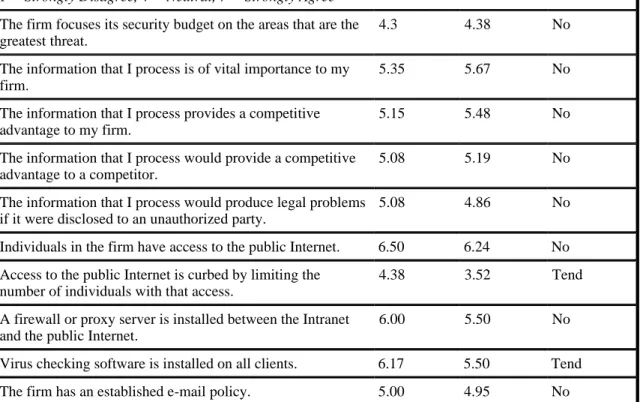
The results by position compare responses from those in a managerial position to those in technical, end user or systems auditing positions (See Table 1). In general, there was little difference in the responses across the two categories. However, there were some significant differences in the non-managers identification of the need for greater training on security issues. Non-managers also had a different opinion on the need for passwords for each application as they were more willing to accept multiple passwords than the managers. Non-managers also felt that there was significantly more contact between end users and systems auditors. Finally,
non-managers had significantly less access to the Internet and the organization's intranet. Surprisingly, non-managers were also significantly better about changing their passwords.
The survey results were analyzed by industry and by the position of the respondent in his/her company. The industry results suggest a wide variety of approaches to security, access, encryption, and protection techniques. The results on an industry basis are presented in Table 2.
Security policy responses were generally the same across the four industries. There was, again, a significant discrepancy on the amount of training, with public sector and telecom wanting more than was currently offered. There were also differences in password handling, with public sector and telecom having less stringent requirements for password protection.
Security implementation varied across the industries, with significant differences in access to the Internet, use of firewalls, virus checking, e-mail policies and data encryption. Respondents from energy suggested the strongest set of security measures including frequent contact between system auditors and end users, while the public sector seemed to have the least rigorous measures in place.
Personal security activities suggest there is high awareness of the importance of security. Public sector respondents had significantly more access to the Internet and made heavier use of encrypted information. There was also a significant difference in changing individual passwords, with
telecom lagging.
Respondents were also asked to identify the areas of greatest threat to their organizations. System malfunction was identified most often as the greatest risk, followed by unauthorized disclosure and denial of service. Respondents were also asked to identify the areas in which they felt their
organizations were focusing the majority of their security efforts. They identified alteration of material as the highest focus followed by unauthorized disclosure and denial of service. The unauthorized disclosure and denial of service overlap the threats and focus questions. Surprisingly, the major focus appears to be in an area these respondents did not feel was the greatest threat and the greatest threat; system malfunction was only fourth of the seven areas for focus. This may suggest some rethinking of the security issue (see Table 3).
Conclusions
The results of this study suggest that employees have a strong sense of the importance of the information asset, the need for all employees to be aware of security as an important issue, and a fairly strong general awareness of security issues.
Security policy responses were generally the same across the four industries. There was a significant discrepancy on the amount of training, with public sector and telecom wanting more than was currently offered. There were also differences in password handling, with public sector and telecom having less stringent requirements for password protection.
Security implementation varied across the industries, with significant differences in access to the Internet, use of firewalls, virus
Table 1. Differences between managers and other employees
Security Policy
1 = Strongly Disagree, 4 = Neutral, 7 = Strongly Agree
Others N = 15
Managers N = 20
Significant
I am familiar with the firm's published security policy. 5.35 4.78 No
I have access to an up-to-date copy of the firm's security policy.
4.92 4.76 No
I understand what is expected of me in the firm's security policy.
5.35 4.86 No
The firm's security policy is developed with input from a myriad of employees.
4.33 3.90 No
The security policy addresses all areas that I consider to be problematic security areas.
4.81 4.00 Tend
The security policy clearly states what steps will be taken by employees in the event of a security breach.
4.42 4.29 No
Current security policies tend to interfere with my work. 3.08 3.42 No
The security policy clearly identifies an individual or group responsible for correcting security problems.
4.45 4.72 No
I have had adequate training in company security policies. 4.69 3.65 Yes
General Security Perceptions
1 = Strongly Disagree, 4 = Neutral, 7 = Strongly Agree
Security is the responsibility of every employee. 6.15 6.50 No
Stronger security systems cause a reduction in the performance of business processes.
3.61 4.10 No
More effective security systems tend to have a higher monetary cost.
4.92 5.05 No
Passwords are required to be changed regularly. 5.62 5.20 No
Information is a major asset of my firm. 6.42 6.57 No
Security of Information in the Firm
1 = Strongly Disagree, 4 = Neutral, 7 = Strongly Agree
The firm focuses its security budget on the areas that are the greatest threat.
4.3 4.38 No
The information that I process is of vital importance to my firm.
5.35 5.67 No
The information that I process provides a competitive advantage to my firm.
5.15 5.48 No
The information that I process would provide a competitive advantage to a competitor.
5.08 5.19 No
The information that I process would produce legal problems if it were disclosed to an unauthorized party.
5.08 4.86 No
Individuals in the firm have access to the public Internet. 6.50 6.24 No
Access to the public Internet is curbed by limiting the number of individuals with that access.
4.38 3.52 Tend
A firewall or proxy server is installed between the Intranet and the public Internet.
6.00 5.50 No
Virus checking software is installed on all clients. 6.17 5.50 Tend
The firm has an established e-mail policy. 5.00 4.95 No
Table 1 continued
Security of Information in the Firm
1 = Strongly Disagree, 4 = Neutral, 7 = Strongly Agree.
Others N = 15
Managers N = 20
Significant
Adequate physical security (i.e. locked doors, video cameras) is in place for all rooms holding storage devices.
5.00 4.78 No
The firm uses established data encryption standards. 3.71 3.88 No
The system auditors have frequent contact with users on security problems.
4.86 3.29 Yes
The most effective security systems used in this firm are the most expensive.
2.50 3.56 Tend
Personal Security Activities
1 = Never, 4 = Sometimes and 7 = Always
I try to keep updated on security developments. 4.46 4.80 No
I try to follow what is expected of me in the security policy. 5.53 5.75 No
I ignore the security policy if it hinders my work. 2.71 2.90 No
I use encryption schemes when sending sensitive data over a network.
2.42 3.10 No
I use encryption schemes even when sending non-sensitive data over a network.
I access the public Internet. 3.07 4.00 Yes
I access the firm's Intranet. 3.50 4.85 Yes
I send or receive financial information over a network. 2.21 2.94 No
I transmit to or receive encrypted information from a business partner.
1.43 1.85 Tend
I transmit to or receive information that has not been encrypted from a business partner.
2.14 2.60 No
I change my password frequently 4.86 3.71 Yes
checking, e-mail policies and data encryption. Respondents from energy suggested the strongest set of security measures including frequent contact between system auditors and end users, while the public sector had the least rigorous measures in place.
The discrepancies occur in the area of training and specific implementations. The expressed desire for more training may give MIS groups a ready audience for improving and enhancing current security initiatives. The implementation differences are most obvious across differing industries, so this may account for most of the difference. However, the overall lack of encryption, firewalls, and e-mail policies suggest there are at least three areas that need to be addressed more effectively in most industries. Access to the Internet and the organizational intranet also appear to differ across
industries. With the continuing growth of both, this appears to be an important area as well.
Differences were found with a wide variety of approaches to
Table 2. Differences across industries
Security Policy
1 = Strongly Disagree, 4 = Neutral, 7 = Strongly Agree
Retail N = 10
Energy N = 10
Public Sector N = 7
Telecom N = 8
Significan
I am familiar with the firm's published security policy.
5.14 5.81 3.86 4.70 No
I have access to an up-to-date copy of the firm's security policy.
4.57 5.82 5.14 3.7 Tend
I understand what is expected of me in the firm's security policy.
5.29 5.45 4.71 4.70 No
The firm's security policy is developed with input from a myriad of employees.
3.20 4.80 4.00 3.63 No
The security policy addresses all areas that I consider to be problematic security areas.
The security policy clearly states what steps will be taken by employees in the event of a security breach.
5.00 4.36 3.80 4.33 No
Current security policies tend to interfere with my work.
4.60 3.63 2.83 2.5 Tend
The security policy clearly identifies an individual or group responsible for correcting security problems.
5.40 5.00 4.60 3.63 No
I have had adequate training in company security policies.
4.60 5.00 3.43 3.20 Yes
General Security Perceptions
1 = Strongly Disagree, 4 = Neutral, 7 = Strongly Agree
Security is the responsibility of every employee. 6.60 6.36 6.00 6.50 No
Stronger security systems cause a reduction in the performance of business processes.
4.60 4.45 3.17 3.40 No
More effective security systems tend to have a higher monetary cost.
5.20 4.64 5.00 5.33 No
Passwords are required to be changed regularly. 5.43 5.00 2.29 3.70 Yes
Different user passwords are required for each application.
2.00 4.18 2.43 2.90 Yes
Information is a major asset of my firm. 6.86 5.91 6.71 6.80 No
Security of Information in the Firm
1 = Strongly Disagree, 4 = Neutral, 7 = Strongly Agree.
The firm focuses its security budget on the areas that are the greatest threat.
4.25 4.80 3.60 4.29 No
The information that I process is of vital importance to my firm.
6.86 4.72 6.00 5.20 Yes
The information that I process provides a competitive advantage to my firm.
6.29 4.64 5.33 5.50 No
Security of Information in the Firm
1 = Strongly Disagree, 4 = Neutral, 7 = Strongly Agree.
Retail N = 10
Energy N = 10
Public Sector N = 7
Telecom N = 8
Significant
The information that I process would provide a competitive advantage to a competitor.
6.14 4.45 4.83 5.40 No
The information that I process would produce legal problems if it were disclosed to an unauthorized party.
6.42 4.27 5.33 4.40 No
Individuals in the firm have access to the public Internet.
7.00 5.45 6.71 6.6 No
the number of individuals with that access.
A firewall or proxy server is installed between the Intranet and the public Internet.
6.80 6.27 2.80 6.00 Yes
Virus checking software is installed on all clients. 5.40 6.10 4.43 6.56 Yes
The firm has an established e-mail policy. 5.50 6.10 2.43 5.30 Yes
Adequate physical security (i.e. locked doors, video cameras) is in place for all rooms holding storage devices.
5.75 5.00 3.80 4.88 No
The firm uses established data encryption standards. 1.75 4.50 3.40 4.75 Yes
The system auditors have frequent contact with users on security problems.
2.33 5.00 2.60 3.33 Yes
The most effective security systems used in this firm are the most expensive.
5.50 2.50 4.00 3.33 Yes
Personal Security Activities
1 = Never, 4 = Sometimes and 7 = Always
I try to keep updated on security developments. 4.40 4.91 5.00 4.30 No
I try to follow what is expected of me in the security policy.
6.20 5.81 5.29 5.50 No
I ignore the security policy if it hinders my work. 2.86 3.27 2.17 2.70 No
I use encryption schemes when sending sensitive data over a network.
2.14 3.27 4.00 2.00 Tend
I use encryption schemes even when sending non-sensitive data over a network.
1.14 1.91 3.14 1.90 Yes
I access the public Internet. 3.29 2.70 5.14 3.70 Yes
I access the firm's Intranet. 5.00 3.82 5.28 3.56 No
I send or receive financial information over a network.
3.00 2.56 2.71 2.40 No
I transmit to or receive encrypted information from a business partner.
1.29 1.30 2.43 1.80 No
I transmit to or receive information that has not been encrypted from a business partner.
1.86 2.30 4.29 1.60 Yes
I change my password frequently 6.80 5.73 5.29 4.30 Yes
Table 3. Threats and Responses
Areas considered the greatest security threats (1 = most prevalent)
Areas in which firms focus the majority of their security efforts
(1 = most prevalent)
Alteration 4.34 2.77
Denial of Service 3.57 3.91
Errors & Omissions 4.11 4.60
System Malfunction 2.83 4.29
Fraud or Theft 4.97 4.43
Unauthorized Disclosure 3.40 3.37
Regulatory or Contractual Exposures
4.77 4.63
security, access, encryption and protection techniques. Security policy responses were generally the same across the four industries.
Personal security activities suggest there is high awareness of the importance of security. Public sector respondents had significantly more access to the Internet and made heavier use of encrypted information. There was also a significant difference in changing individual passwords, with telecom lagging.
The results of this study suggest that employees have a strong sense of the importance of the information asset, the need for all employees to be aware of security as an important issue, and a fairly strong general awareness of security issues. The discrepancies occur in the area of training and specific implementations. The expressed desire for more training may give those charged with security policies and procedures a ready audience for improving and enhancing current security initiatives.
Implementation differences may be industry specific. However, the overall lack of encryption, firewalls, and e-mail policies suggest there are at least three areas that need to be addressed more effectively in most industries. Access to the Internet and the organizational intranet also appear to differ across industries. With the continuing growth of both, this appears to be an area that also needs to be addressed.
Figure 1.
Security Issues and Responses
we propose a model for directing security activities within a firm. A six-level model is proposed that identifies the role of security policy, continuity planning, security tools, internal organizational management, and external impacts on the security and integrity of organizational information (see Figure 1).
References
Ahuja, Vijay. Network & Internet Security. Boston, MA: AP Professional, 1996.
Andreessen, Marc. ''Interoperable Security." Netscape Communications. December 1996:
http://www.netscape.com:80/comprod/columns/technivision/interoperable_security.html.
Cain, Sarah L. "On the Road to Recovery." InfoSecurity News. 1997: http://www.infosecnews.com.
Certicom. "Overview of Security Concepts and Terminology."
Earls, Alan R. ''Between the Cracks." @Computerworld February 1997:
http://www.computerworld.com.
Ernst & Young. Information Security Survey: Analysis of Trends, Issues, & Practices: 1996.
Fenn, Herschel, and Lett. "Smart-Card Technology and Applications." January 24, 1997, Gartner Group: Strategic Analysis Report.
Jackson Higgins, Kelly. "Under Attack." Communications Week Interactive. March 1997:
http://techweb.cmp.com/cw/cwi.
Kalakota, Ravi, and Andrew B. Whinston. Frontiers of Electronic Commerce. Reading, MA: Addison-Wesley Publishing Company, Inc., 1996.
O'Higgins, Brian. "Intranet Security: Beyond Firewalls." Electronic Commerce World March 1997: 14.
Shoemaker, John. "Smart Cards and EDI-An Intelligent Combination." Electronic Commerce World February 1997: 32-37.
Straub, Detmer W., Jr., "Effective IS Security: An Empirical Study." Management Science September 1990: 255-275.
Strassman, Paul. "What's the Best IS Defense? Being Prepared." @Computerworld. February 1997:
http://www.computerworld.com.
U.S. Department of Commerce, National Institute of Standards and Technology, "Keeping Your Site Comfortably Secure: An Introduction to Internet Firewalls" http://csrc.nist.gov/nistpubs/800-10
Vacca, John. Internet Security Secrets. Foster City, CA: IDG Books Worldwide, Inc., 1996.
http://www.infosecnews.com.
This research was supported by the Center for MIS Studies, Michael F. Price College of Business, University of Oklahoma.
Chapter II—
Securing the Internet in New Zealand: Issues, Threats and Solutions
Jairo A. Gutiérrez
University of Auckland, New Zealand
The growing popularity of the Internet has taken many organisations by surprise. Established
mechanisms such as fax technology, electronic data interchange (EDI), electronic messaging, and file transfers over private networks have dominated electronic commerce until now.
The advantages of the Internet are changing that technological landscape very rapidly. Those advantages include:
a) Worldwide connectivity.
b) Hardware and software independence provided by ubiquitous Web browsers.
c) User friendliness.
d) Interactive nature of Web-aware technologies.
e) Affordable technology.
However, many of those advantages are shadowed by the lack of widespread use of security and data protection mechanisms. This chapter reviews the history of the Internet in New Zealand, discusses the main problems associated with data protection on the Internet, highlights some of the solutions being implemented in New Zealand, and reviews the main issues and challenges for the future of secure Internet communications.
One of the first attempts to link research organisations via computer networks was made during the early 1970s by the New Zealand Department of Scientific and Industrial Research (DSIR). The connections were made using dial-up lines and dumb terminal emulation programs.
In 1985 Victoria University of Wellington established a dial-up link to the University of Calgary in Canada for the transfer of electronic mail, and the University of Canterbury in Christchurch
established a link to the University of Waterloo (also in Canada). These connections preceded any interconnection among NZ universities (Wiggin, 1996).
In 1986 Victoria University established a link with the University of Melbourne and started carrying and reselling Usenet and e-mail access to several organisations in New Zealand, including other tertiary education entities and government research institutes.
In 1989 Waikato University in Hamilton established the first Internet linb to the US via a leased line running at 9600 bits per second.
In 1990 the Kawaihiko network was formed linking all seven New Zealand Universities. This network was later (1992) incorporated into TuiaNet connecting the universities to the government research units (Crown Research Institutes) and most of the remaining tertiary education
organisations.
Most of the Internet traffic between New Zealand and the rest of the world passes through facilities provided at The University of Waikato by NZGate, a nonprofit activity of that university. NZGate handed over management of the international links to Netway and Clear Communications in early 1996. The Internet gate, still operating out of Waikato, was renamed the New Zealand Internet Exchange (NZIX), and it provides several 2 Mbps links to the United States, and a 128kbps link to AARNET at the University of Melbourne in Australia.
Some organisations, such as Compuserve Pacific, Telstra and AT&T, provide their own overseas connections to link their customers to the Internet. A complete reference to Internet access in New Zealand, including a list of the Internet Service Providers (ISPs), can be found in Wiggin (1999). A somewhat more detailed list of majorISPs and their charges can also be located at (IDG
Communications, 1999).
service, and / or fraud, waste, and abuse (Kalakota and Whinston, 1996). Besides those threats, Internet users need to contend with a lack of international supervision, rules and standards. Some of the main issues are discussed below:
latest Internet Domain Survey (Internet Software Consortium, 1999). Figure 1 illustrates the rapid growth of the Internet in New Zealand.
Internet Security Threats
A security threat may be defined as a circumstance or event with the potential to cause economic hardship to data or network resources in the form of destruction, disclosure, modification of data, denial of
Figure 1.
Growth of the Internet in New Zealand Source: Victoria University of Wellington
Lack of International Supervision
Internet users can not rely on an internationally recognised set of regulations regarding data protection. There is no central mechanism or ''network control centre" that supervises the flow of data. Moreover, the increasing use of web technologies can only exacerbate this situation with users downloading software and data from an increasing number of sources located anywhere in the world.
The lack of a "network control centre" means the responsibility for data protection and data security is shared between millions of providers. Every message transmitted could be intercepted at any unsecured site it passes and could be modified, spoofed (falsified), cancelled or delayed. In most cases users have no control over the route a particular packet takes when it is transmitted to the Internet. Nevertheless the Internet use for business purposes is increasing exponentially, and many users are using it to transmit personal data.
Despite the increasing popularity of the Internet, an immense amount of work needs to be done at national and, especially, international levels to specify and implement data privacy regulations and laws.
Authentication/Identification Requirements
The use of Internet services does not allow for adequate anonymity nor adequate authentication. A typical Internet packet contains a header with information about the sender and the recipient (name and IP-address, host name, timestamp, etc). The header contains further information on the routing and the type of packet being transmitted. Web and e-mail users leave an electronic trace, which can be used to develop a profile of personal interests and tastes.
Although there is no central accounting of the access to news or World Wide Web sites, the
information behaviour of senders and recipients can be traced and supervised at least by the Internet Service Provider (ISP) to whom the user is connected. Most ISPs will denyusing this information, but the fact remains that they are technically capable of gathering it.
Although profiling users habits represents a real privacy threat, the major security risk related to the lack of proper identification and authentication features is the vulnerability of systems to hacker attacks. These attacks range from malicious pranks (such as displaying messages on particular dates), to destroying and / or compromising sensitive data. Another popular attack is to charge another user's account for Internet services.
Confidentiality Requirements
sensitive data such as credit card numbers and the integrity of electronic cash mechanisms.
Interruption of Service
Recent attackers to Internet sites have used a technique called ''SYN flooding". The attackers use the fact that TCP/IP protocols attempt to start data transmissions by using ACK and SYN ACK packets. The flooding takes place when the attacker's computer does not acknowledge the attacked computer's SYN ACK, and it continues to "flood" the computer with SYN packets. At the moment there are not accepted ways of combating this attack and in several cases complete sub-networks have been disconnected from the Internet in an attempt to control the problem. This is just an example of interruption or denial of service.
Masquerading
Masquerading takes place when a user pretends to be somebody else. The IP spoofing (using somebody else's IP address) attack has been used to charge another user for commercial services accessed via the Internet, or to cause damage to a remote computer while incriminating an innocent user. Some hackers use a ''chain" of spoofed IP addresses to hide their location or to hinder the tracing of their original network address.
Repudiation
Repudiation occurs when a user claims that a particular message has not been sent or that the received message is different from the original. For example, a user may argue that a withdrawal message was never sent to the bank, or that the amount withdrawn was different from the amount claimed by the bank for that transaction.
Existing Regulations and Guidelines
National Regulations/Provisions
The New Zealand Parliament introduced in 1994 the "Technology and Crimes Reform Bill" (NZ Technology and Crimes Reform Bill, 1994) as an attempt to legislate the use of telecommunications and networking. The emphasis of the Bill is on prohibiting and penalising the transmission of "objectionable" material 1, and provides for the Office of Film and Literature Classification to examine and classify images, sounds, and live shows "produced for pecuniary gain". The Bill also attempts to deal with "foreign" communication services carrying the same kind of objectionable material.
The Bill is basically a piece of censorship legislation, and it has been heavily criticised by several users and industry groups. The Internet Society of New Zealand (ISOCNZ) summarised its point of view in a paper (Hicks, 1996, p.1) delivered to the Commerce Select Committee (entity in charge of reviewing such submissions). ISOCNZ argues that:
1) The Bill does not address the technologies it is attempting to legislate, thus making parts of it impossible to comply with or to enforce.
2) The Bill is not consistent with attitudes and controls on other forms of communications. 3) The Bill's contents will soon require replacement as its basic premises are overtaken by new technology and international events.
Additionally, ISOCNZ recommend a complete revision of the Bill including a public discussion of any future amendments.
International Guidelines
There is a definitive lack of international regulations regarding data protection on the Internet.
Several national data protection authorities have already issued guidelines on the technical security of computer networks linked to the Internet. Such guidelines have been laid down, for example, in France, the United Kingdom and in Germany. The main topics can be summed up (International Working Group on Data Protection, 1996) as follows:
2) Before connecting a local computer network to the Internet the risks for the security of the local network and the data stored there have to be assessed in conformity with the national law. This may include drawing up a security plan and assessing whether it is necessary to connect the entire network or only parts of it to the Internet.
3) Technical measures should be taken to secure that only the data that could be published can be accessed on the Internet.
There are also a number of international legal regulations concerning data protection on the Internet (IWG on Data Protection, 1996):
1) European Council 90/387/EEC of 28 June 1990 on the establishment of the internal market for telecommunications services through the implementation of Open Network Provision (ONP) and ensuing ONP Directives (defining data protection as ''essential requirement").
2) Directive 95/46/EC of the European Parliament and of the Council of 24 October 1995 on the protection of individuals with regard to the processing of personal data and on the free movement of such data (EU-Data Protection-Directive).
3) General Agreement on Trade in Services (GATS) stating in Article XIV that Member States are not prevented by this world-wide agreement to adopt or enforce regulations relating to the protection of privacy of individuals in relation to the processing and dissemination of personal data and the protection of confidentiality of individual records and accounts.
Internet Community Code of Practice
Recently there has been an effort from the Internet Community to implement self-regulation measures by promoting and adopting codes of practice, informally known as ''Netiquette". These measures aim to make users, and in general organisations, aware of the privacy and confidentiality implications of being part of a global networking community. The Internet Service Providers Association of New Zealand is promoting the adoption of a voluntary Code of Practice that
(ISPANZ, 1999, p.1) tries "to improve the standard of conduct within the Industry". The standards relate to industry members (Internet Service Providers), and commercial and public sites.
The code of practice also lays out regulations to electronic commerce (e-commerce), and encourages the adoption of Internet Standards (Request For Comments or RFCs), and other international
A typical e-commerce ëpractice', as encouraged by ISPANZ, is to inform customers about the availability of secure transactions mechanisms whenever they intend to purchase goods via the Internet. Another practice advises ISPs to provide customers with a schedule of all planned service outages in advance.
Security Solutions
There is a common belief that lack of security is the major barrier to successful commercial use of the Internet. Businesses detest the kind of exposure provoked by attacks on the Internet. In 1996 Xtra, the largest Internet Service Provider in New Zealand, was forced to restrict access to their users to patch a security problem (Dias, 1996). It was a very simple problem. New passwords to users accounts were created disregarding normal precautions in those cases. However, users suffered from ''Denial of Service" while the problem was fixed. Recent Internet-related security attacks have also taken the form of malicious code transported as e-mail attachments. Notorious among those were the Melissa virus and the Happy99 worm (Malcolm and Fusaro, 1999). Obviously, an organisation planning to base an important part of their business on the Internet would think twice about doing so given that sort of media attention.
The advent of e-commerce as an important element of the business environment adds another
dimension: the web server as the weakest link in the security chain. Security holes in freely available web-server software creates a window of opportunity for hackers to get into the rest of an
organisation's network before the IT department has a chance to extend the security blanket in order to include the new system.
Although a basic Internet link may be a security risk, there are several ways of addressing the potential problems discussed above. The following is a summary of the main issues:
Encryption
Using encryption can protect sensitive data travelling over the Internet. Encryption is the transformation of readable text (also called clear or plain text) into an unintelligible form called cipher text, using mathematical algorithms. Only users with a digital key, and a program based on the encrypting algorithm, can decode an encrypted message.
There are several issues regarding the use of encryption techniques on the Internet.
Data encryption schemes are a good solution for protecting small amounts of data, such as credit card numbers or passwords, as they move from source to destination. However, encryption techniques present some practical difficulties for protecting, for instance, the contents of large computer
databases from remote access by an unauthorised user. In general, encryption must be used with other techniques to provide a secure networking environment.
The United States Government has proposed a relaxation on the restrictions to export strong encryption techniques by creating a Key Recovery Infrastructure which has been considered as ''overly
aggressive" by, among others, the US Public Policy Office of the Association for Computing (ACM). They (Simmons, 1997) suggest that the development of a policy that serves the long term interests of both the US and the global community, should not be one based on a Key Recovery Infrastructure, but rather one that promotes the use of strong encryption (if the US does not supply this technology, other countries will). The ACM is worried about restrictions, such as the need to include Key recovery mechanisms, which would limit the research and production of innovative encryption methods in the US. The issues of exporting strong encryption techniques are discussed at length in the Chapter 7 of this book.
The lack of world-wide standards for public key encryption plus the potential problems for US-based companies attempting to export strong encryption products has created an opportunity for a New Zealand start-up company. RPK New Zealand has created an industrial-strength security and encryption standard (Raike, 1999). The security of the system, based on a cryptographic engine called a "mixture generator", is described to rest on the computational difficulty of computing discrete logarithms over large finite fields.
Back in 1996 RPK New Zealand invited scrutiny of their product by challenging Internet users to break the code and win US$3000 in the process. As of the time of this writing the company claims nobody has broken their system, and they have raised the stakes to US$10,000. The company expects to fill the market gap left by companies shackled by the export restrictions placed upon them by the US government. It is important to note that Washington is under great pressure to modify those restrictions. In the meantime RPK has patented their system and it is being commercialised under the name "RPK Encryptonite Engine". It is said to combine all the features of public key systems
(authentication, digital signatures/certificates and key management) with the speed of secret key systems—in one algorithm.
Authentication and Non-Repudiation
Users communicating over the Internet must be able to feel confident that they are exchanging data with the intended party. Authentication can be provided by using ''digital signatures" and