This is a repository copy of
Generation of strongly-coupled plasma using Argon-based
capillary discharge lasers
.
White Rose Research Online URL for this paper:
http://eprints.whiterose.ac.uk/102845/
Version: Accepted Version
Proceedings Paper:
Rossall, Andrew K. orcid.org/0000-0002-0123-8163, Aslanyan, Valentin, Wilson, Sarah et
al. (1 more author) (2015) Generation of strongly-coupled plasma using Argon-based
capillary discharge lasers. In: Proceedings of SPIE - The International Society for Optical
Engineering. X-Ray Lasers and Coherent X-Ray Sources: Development and Applications
XI Conference, 12-13 Aug 2015 SPIE .
https://doi.org/10.1117/12.2188009
[email protected] https://eprints.whiterose.ac.uk/ Reuse
["licenses_typename_unspecified" not defined]
Takedown
If you consider content in White Rose Research Online to be in breach of UK law, please notify us by
Generation of strongly-coupled plasma using Argon-based
capillary discharge lasers
Andrew K. Rossall
*a, Valentin Aslanyan
a, Sarah Wilson
a, Greg J. Tallents
*aa
York Plasma Institute, University of York, Heslington, York, YO10 5DD, United Kingdom
ABSTRACT
Argon based capillary discharge lasers operate in the extreme ultra violet (EUV) at 46.9 nm with an output of up to 0.5 mJ energy per pulse and up to a 10 Hz repetition rate. Focussed irradiances of up to 1012W cm−2 are achievable and can be used to generate plasma in the warm dense matter regime by irradiating solid material. To model the interaction between such an EUV laser and solid material, the 2D radiative-hydrodynamic code POLLUX has been modified to include absorption via direct photo-ionisation, a super-configuration model to describe the ionisation dependant electronic configurations and a calculation of plasma refractive indices for ray tracing of the incident EUV laser radiation. A simulation study is presented, demonstrating how capillary discharge lasers of 1.2ns pulse duration can be used to generate strongly coupled plasma at close to solid density with temperatures of a few eV and energy densities up to 1×10⁵ J cm−3. Plasmas produced by EUV laser irradiation are shown to be useful for examining the equation-of-state properties of warm dense matter. One difficulty with this technique is the reduction of the strong temperature and density gradients which are produced during the interaction. Methods to inhibit and control these gradients will be examined.
Keywords: High energy density physics, EUV lasers, x-ray lasers, warm dense matter, strongly-coupled plasma, laser ablation
1. INTRODUCTION
Strongly coupled plasmas exist widely in the known universe. Such examples include Jovian planets, stellar interiors, laser heating of solids and capillary discharges to name a few. A strongly coupled plasma is such that the potential energy caused by the Coulombic interaction between the particles exceeds the kinetic energy of the particles. As a result, inter-particle interactions strongly affect the behaviour of individual particles, resulting in a regime which can no longer be treated as a screened Coulomb system such as a lower density or ’ideal’ plasma. The strength of the coupling in a plasma is defined using the ion-ion Coulomb coupling parameter (Γii) defined as
Γii= Z 2e2 4πǫ0akTi
(1)
where Z is the ion charge, Ti is the ion temperature and ais the Wigner-Seitz radius which defines the inter-particle spacing. A plasma with a coupling parameter of Γii≫1 is strongly coupled, Γii≈1 is typically in the warm dense matter regime and Γii≪1 is weakly coupled, i.e. behaves as a classical plasma.
Generation of strongly coupled plasma in the laboratory using laser irradiation as a heating source has typically involved irradiating buried layer targets1 to inhibit expansion of the target material. With advances in capillary discharge laser technology2–5 and an associated increase in fluence available, argon based capillary discharge lasers operating at 46.9nm can be used to directly generate strongly coupled plasma on a picosecond time-scale with simple single-layer planar targets. In reducing the photon wavelength to the extreme ultra-violet (EUV), the dominant heating mechanism changes from inverse bremsstrahlung to direct photo-ionisation and the critical electron density at this wavelength is typically higher than solid. The sub-critical electron density combined with a short penetration depth (<100nm in parylene-N at 26.4eV) and a smaller focal spot size due to the reduction in the diffraction limit improves the localisation of energy deposition within the target. A
*Further author information:
small volume is heated (approximately 5×10⁻⁴µm3 in parylene-N for a FWHM beam diameter of 500nm) until photo-ionisation is no longer energetically possible at which point the volume becomes mostly transparent to the incident EUV laser beam. It is worth noting that inverse bremsstrahlung can become non-negligible in regions where the electron density is within an order of magnitude of the critical electron density.
The simulation study presented here utilises a combination of 2D hydrodynamic modelling with an atomic physics algorithm to demonstrate how capillary discharge lasers of 1.2ns pulse duration with pulse energies up to 0.8mJ can be used to generate strongly coupled plasma at close to solid density with temperatures of a few eV and energy densities up to ∼106J cm−3.
2. POLLUX
2.1 General Overview
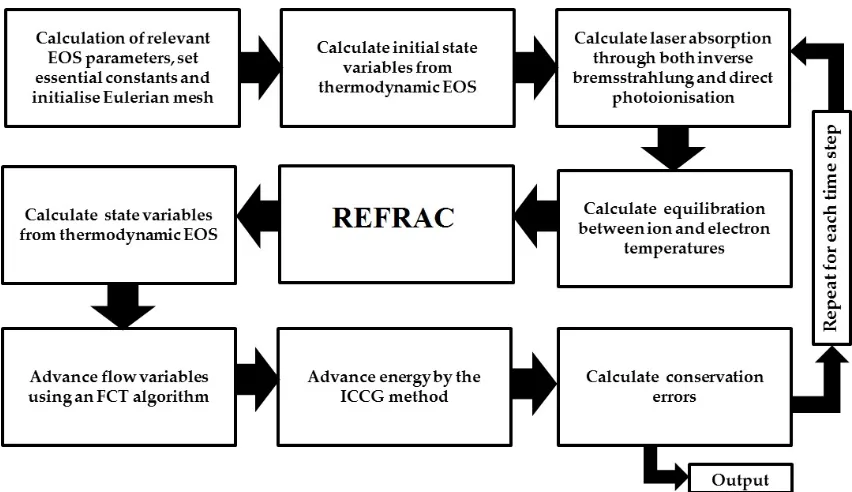
The 2D Eulerian radiative-hydrodynamic code POLLUX,6, 7 written at the University of York, was originally developed to model moderate irradiance (≥1010W cm−2) optical and infra-red laser irradiation of a solid target and the subsequently produced strongly ionised plasma. This code has been modified to include a rapid atomic physics algorithm,8, 9to enable the calculation of ionisation and energy level populations and atomic scattering factors in the EUV for partially ionised plasmas. The algorithm for the code is shown in figure 1. The code solves the three first-order quasi-linear partial differential equations of hydrodynamic flow using the flux corrected transport model of Boris and Book10 with an upwind algorithm11for the first term. Energy is absorbed by the plasma electrons through inverse bremsstrahlung and direct photo-ionization and distributed through electron-ion colliselectron-ions. The electron-electron-ion equilibratelectron-ion rate is determined by the Spitzer plasma colliselectron-ion rate12 and is limited to the electron-phonon collision frequency in the low temperature regime (<5eV). For calculation of the equation-of-state (EOS) variables, POLLUX utilizes in-line hydrodynamic EOS subroutines from the Chart-D13 equation-of-state package developed st Sandia National Laboratories and includes two-phase transitions. As this code uses an explicit solver, a Courant number of∼1 in both spatial directions increases numerical stability. We have for the Courant number,
C=ux∆t ∆x +
uy∆t
∆y ≈1 (2)
whereux and uy are magnitudes of the particle velocities in the respective directions, ∆t is the time step and ∆x,∆yare the cell spatial dimensions. This is not the only constraint on the simulation parameters, however it is the most restrictive.
2.2 Atomic Physics Algorithm
A superconfiguration approach15 allows for multiple electronic configurations that are close in energy to be grouped together, significantly reducing the number of levels to be considered. The average energyhEiSS ofm levels each with energyEm is weighted by the degeneracy, gm. Detailed atomic structure is calculated using the flexible atomic code (FAC) to solve the radial wave equation, this structure is then post-processed using the relationship shown in equation 3 to form a reduced set of configurations.
hEiSS = P
mgmEm P
mgm
, (3)
Ionisation and level populations are calculated assuming local thermodynamic equilibrium, an assumption which has been justified for hydrodynamic time scales (>1 ps), as the equilibration of the plasma occurs on a timescale of 10s of femtoseconds.16 Photoionisation cross-sections are calculated assuming anE−3 dependence, the atomic scattering factor, f0
Figure 1. Complete POLLUX algorithm using the flux corrected transport (FCT) algorithm,10
the incomplete Cholesky-conjungate gradient (ICCG) method14
and the REFRAC module, outlined in section
.
To enable ray tracing of the incident EUV laser pulse within the code, the Eulerian mesh is sub-divided into triangular cells with the Eulerian mesh center points at the triangle corners allowing for the refractive index and associated gradient within each cell to be calculated via direct differencing. The refractive index is continuous across cell boundaries and assumes a linear electron density variation within each cell. The (x, y) trajectory of each ray in the cell is then assumed to be parabolic dependent upon the refractive indexn0 and its derivative
n1, given by,
y2= 4
n0
n1
x. (4)
3. RESULTS AND DISCUSSION
To determine the potential of capillary discharge lasers for the generation of strongly coupled plasma, the EUV laser-solid interaction is simulated for irradiances of 1×10¹⁰W cm−2and 1×10¹⁴W cm−2incident on parylene-N and aluminium planar targets. The simulation environment is cylindrically symmetric (Z, r) with the laser propagating from positive to negative Z along r = 0, with the solid target in the region Z < 0. The linear density ramp for the target surface begins atZ= 0 and covers 2 cells in theZ direction.
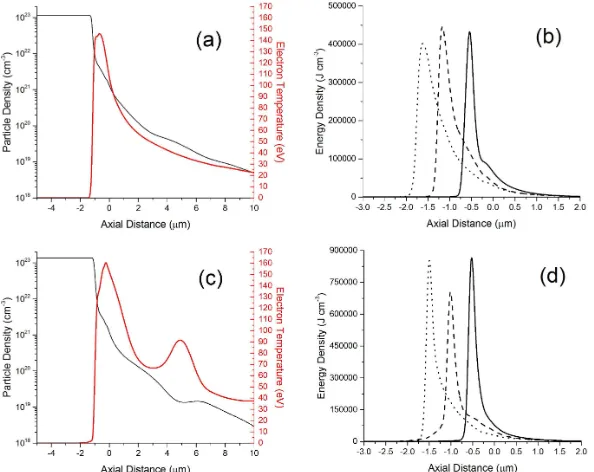
Figure 2. Particle density, electron temperature and energy density as a function of axial distance (distance along laser axis) for parylene-N ((a) and (b))and aluminium ((c) and (d)). For (a) and (c) the simulation time ist= 200ps and for
(b) and (d) the simulation times aret= 100ps (solid line),t= 200ps (dashed line), andt= 300ps (dotted line). The on target irradiance is 1010
W cm−2.
Figure 3. Particle density, electron temperature and energy density as a function of axial distance for parylene-N ((a) and (b))and aluminium ((c) and (d)). For (a) and (c) the simulation time ist= 200ps and for (b) and (d) the simulation times aret= 100ps (solid line),t= 200ps (dashed line), andt= 300ps (dotted line). The on target irradiance is 1014W
[image:5.612.157.454.382.618.2]Figure 4. Two-dimensional energy density plots for parylene-N with on-target irradiance of (a) 1010
W cm−2and (b)1014W cm−2, and aluminium with on-target irradiance of (c) 1010W cm−2 and (d) 1014W cm−2
.
[image:6.612.119.493.481.648.2]Figure 4 shows 2 dimensional plots of energy density for both parylene-N and aluminium. Small volumes of dense plasma are effectively heated where the volume of the high energy density region appears to decrease with increasing laser irradiance. Coupling parameters of up to Γii ≈45 can be observed in aluminium and up to Γii ≈18 in parylene-N as shown in figure 5. Due to emission having ann2 dependence, emission from these regions will dominate over the hotter less dense expanding plasma. The temperature and particle densities of the high energy density regions remain approximately constant for∼300ps, therefore a sufficiently fast camera or streak camera would be able to temporally resolve the emission from these regions.
Figure 5. Coupling parameter as a function of axial distance for (a) parylene-N and (b) aluminium, on target irradiance is 1014
W cm−2
When studying equation-of-state (EOS) parameters, perfect volumetric heating of the target would be ideal to ensure uniform heat flow within the target. Temperature and density gradients arising from non-uniformities associated with heat flow make simulations and/or analysis of experiments investigating warm or hot dense matter difficult. Using a capillary discharge laser to generate warm and hot dense plasma simplifies the problem as a linear approximation for the temperature and density gradients would be suitable for EOS and opacity modelling as done previously.19
4. CONCLUSIONS
The 2-dimensional hydrodynamic code POLLUX has been modified to include atomic physics processes relevant to the interaction of EUV photons with solid matter. Through this simulation study, it has been shown that capillary discharge lasers operating at 26.4eV can be used to generate warm and hot dense matter with a coupling parameter as high as Γii ≈50 and energy density of 9×10⁹J cm−3 in aluminium. This technique is shown to be useful for examining the properties of strongly coupled plasma as emission from this region is not masked by the hotter less dense expanding plasma as with optical and infra-red interactions. Linear approximations for temperature and density gradients are shown to be suitable to simplify the simulation and/or analysis of experiments investigating equation-of-state parameters or plasma opacity.
REFERENCES
[1] Gregori, G., Hansen, S. B., Clarke, R., Heathcote, R., Key, M. H., King, J., Klein, R. I., Izumi, N., Mack-innon, A. J., Moon, S. J., Park, H.-S., Pasley, J., Patel, N., Patel, P. K., Remington, B. A., Ryutov, D. D., Shepherd, R., Snavely, R. A., Wilks, S. C., Zhang, B. B., and Glenzer, S. H., “Experimental Characteri-zation of a Strongly Coupled Solid Density Plasma Generated in a Short-pulse Laser Target Interaction,” Contributions to Plasma Physics45(3-4), 284–292 (2005).
[2] Rocca, J. J., Hammarsten, E. C., Jankowska, E., Filevich, J., Marconi, M. C., Moon, S., and Shlyaptsev, V. N., “Application of extremely compact capillary discharge soft x-ray lasers to dense plasma diagnostics,” Physics of Plasmas10(5), 2031 (2003).
[3] Benware, B., Macchietto, C., Moreno, C., and Rocca, J., “Demonstration of a High Average Power Tabletop Soft X-Ray Laser,”Physical Review Letters81(26), 5804–5807 (1998).
[4] Heinbuch, S., Grisham, M., Martz, D., and Rocca, J. J., “Demonstration of a desk-top size high repetition rate soft x-ray laser,”Optics Express13(11), 4050 (2005).
[5] Macchietto, C. D., Benware, B. R., and Rocca, J. J., “Generation of millijoule-level soft-x-ray laser pulses at a 4-Hz repetition rate in a highly saturated tabletop capillary discharge amplifier,”Optics Letters24(16), 1115 (1999).
[6] Pert, G. J., “Two-dimensional hydrodynamic models of laser-produced plasmas,” Journal of Plasma Physics41(02), 263–280 (1989).
[7] Pert, G., “Quasi-Lagrangian rezoning of fluid codes maintaining an orthogonal mesh,” Journal of Compu-tational Physics49(1), 1–43 (1983).
[8] Rossall, A. K., Aslanyan, V., Tallents, G. J., Kuznetsov, I., Rocca, J. J., and Menoni, C. S., “Ablation of Submicrometer Holes Using an Extreme-Ultraviolet Laser,” Physical Review Applied3(6), 064013 (2015). [9] Rossall, A. K. and Tallents, G. J., “Generation of Warm Dense Matter using an Argon based Capillary
Discharge Laser,”High Energy Density Physics 15(2015).
[10] Boris, J. and Book, D., “Flux-corrected transport. III. Minimal-error FCT algorithms,”Journal of Compu-tational Physics20(4), 397–431 (1976).
[11] Courant, R., Isaacson, E., and Rees, M., “On the solution of nonlinear hyperbolic differential equations by finite differences,”Communications on Pure and Applied Mathematics5(3), 243–255 (1952).
[12] Spitzer, L. and H¨arm, R., “Transport Phenomena in a Completely Ionized Gas,” Physical Review 89(5), 977–981 (1953).
[14] Kershaw, D. S., “The incomplete Choleskyconjugate gradient method for the iterative solution of systems of linear equations,”Journal of Computational Physics 26(1), 43–65 (1978).
[15] Hansen, S. B., Bauche, J., and Bauche-Arnoult, C., “Superconfiguration widths and their effects on atomic models,”High Energy Density Physics 7(1), 27–37 (2011).
[16] Aslanyan, V. and Tallents, G. J., “Local thermodynamic equilibrium in rapidly heated high energy density plasmas,”Physics of Plasmas 21(6), 062702 (2014).
[17] Stewart, J. C. and Pyatt, K. D., “Lowering of Ionization Potentials in Plasmas,” The Astrophysical Jour-nal144, 1203 (1966).
[18] Preston, T. R., Vinko, S. M., Ciricosta, O., Chung, H.-K., Lee, R. W., and Wark, J. S., “The effects of ionization potential depression on the spectra emitted by hot dense aluminium plasmas,” High Energy Density Physics9(2), 258–263 (2013).