A Multi-Site Knowledge Attitude and Practice
Survey of Ebola Virus Disease in Nigeria
Garba Iliyasu1, Dimie Ogoina2, Akan A. Otu3, Farouq M. Dayyab4, Bassey Ebenso3,5, Daniel Otokpa3, Stella Rotifa6, Wisdom T. Olomo7, Abdulrazaq G. Habib1*
1Infectious and Tropical Diseases Unit, College of Health Sciences, Bayero University, Kano, Kano State, Nigeria,2Department of Internal Medicine, Niger Delta University/Niger Delta University Teaching Hospital (NDUTH), Okolobiri, Bayelsa State, Nigeria,3Department of Internal Medicine, University of Calabar, Calabar, Cross River State, Nigeria,4Infectious and Tropical Diseases Unit, Department of Medicine, Aminu Kano Teaching Hospital, Kano, Kano State, Nigeria,5Nuffield Centre for International Health and
Development, University of Leeds, Leeds, United Kingdom,6Department of Public Health, Federal Medical Center, Yenagoa, Bayelsa State, Nigeria,7Infection Control Unit, Niger Delta University Teaching Hospital, Okolobiri Bayelsa State, Nigeria
Abstract
Background
The 2014 Ebola Virus Disease (EVD) outbreak was characterised by fear, misconceptions and irrational behaviours. We conducted a knowledge attitude and practice survey of EVD in Nigeria to inform implementation of effective control measures.
Methods
Between July 30thand September 30th2014, we undertook a cross sectional study on knowledge, attitude and practice (KAP) of Ebola Virus Disease (EVD) among adults of the general population and healthcare workers (HCW) in three states of Nigeria, namely Bayelsa, Cross River and Kano states. Demographic information and data on KAP were obtained using a self-administered standardized questionnaire. The percentage KAP scores were categorised as good and poor. Independent predictors of good knowledge of EVD were ascertained using a binary logistic regression model.
Results
Out of 1035 study participants with median age of 32 years, 648 (62.6%) were males, 846 (81.7%) had tertiary education and 441 (42.6%) were HCW. There were 218, 239 and 578 respondents from Bayelsa, Cross River and Kano states respectively. The overall median percentage KAP scores and interquartile ranges (IQR) were 79.46% (15.07%), 95.0% (33.33%) and 49.95% (37.50%) respectively. Out of the 1035 respondents, 470 (45.4%), 544(52.56%) and 252 (24.35%) had good KAP of EVD defined using 80%, 90% and 70% score cut-offs respectively. Independent predictors of good knowledge of EVD were being a HCW (Odds Ratio-OR-2.89, 95% Confidence interval-CI of 1.41–5.90), reporting‘moderate OPEN ACCESS
Citation:Iliyasu G, Ogoina D, Otu AA, Dayyab FM, Ebenso B, Otokpa D, et al. (2015) A Multi-Site Knowledge Attitude and Practice Survey of Ebola Virus Disease in Nigeria. PLoS ONE 10(8): e0135955. doi:10.1371/journal.pone.0135955
Editor:Gerardo Chowell, Georgia State University, UNITED STATES
Received:February 22, 2015
Accepted:July 28, 2015
Published:August 28, 2015
Copyright:© 2015 Iliyasu et al. This is an open access article distributed under the terms of the
Creative Commons Attribution License, which permits unrestricted use, distribution, and reproduction in any medium, provided the original author and source are credited.
Data Availability Statement:All relevant data are within the paper and its Supporting Information files.
Funding:The authors have no support or funding to report.
to high fear of EVD’(OR-2.15, 95% CI-(1.47–3.13) and‘willingness to modify habit’ (OR-1.68, 95% CI-1.23–2.30).
Conclusion
Our results reveal suboptimal EVD-related knowledge, attitude and practice among adults in Nigeria. To effectively control future outbreaks of EVD in Nigeria, there is a need to imple-ment public sensitization programmes that improve understanding of EVD and address EVD-related myths and misconceptions, especially among the general population.
Introduction
Ebola Virus Disease (EVD) also referred to as Ebola haemorrhagic fever is a highly lethal hae-morrhagic disease named after a river in the Democratic Republic of the Congo (formerly Zaire) where it was first described in 1976 [1]. It is caused by a virus of the family Filoviridae, genus Ebola virus. The genus Ebola virus is divided into five different species (the Zaire, Sudan, Tai Forest, Bundibugyo, and Reston viruses), which differ in their virulence for humans. Its natural reservoirs are thought to include fruit bats and non-human primates. Since its discov-ery, over 20 confirmed outbreaks have been reported [1,2]. EVD is transmitted by physical contact with body fluids, secretions, breast milk, tissues or semen from infected persons that are alive or immediately following death especially during funeral rites. Transmission from patients within healthcare settings has followed a typical pattern as patients are often treated by unsuspecting healthcare personnel without the appropriate protective equipment. The typical natural history of the disease begins with an average incubation period of 2–21 days [2,3,4]. Patients present most frequently with initial flu-like symptoms, fever, asthenia, diarrhea, abdominal pain, headache, joint aches, muscle aches, sore throat and conjunctivitis [2,3,4]. Infected individuals receive limited care as no specific treatment or vaccine exists, and they typ-ically die within few variable number of days of their initial infection with 50–90% case fatality rate (CFR) [5,6]. There is a marked variation in clinical course of EVD across the different viral species with Zaire Ebola virus being the most lethal and causing CFR of up to 90% [4,7].
Nigeria was declared EVD free by the World Health Organization (WHO) on 20thOctober 2014
The emergence and spread of EVD was accompanied by fear, misconceptions and unusual behaviours by the general population and by health workers within and beyond affected coun-tries and continents [10,13,16]. In view of the unprecedented spread of the EVD and its signifi-cant negative consequences on the health and socioeconomic life of communities, countries and regions, the WHO had on 8thAugust 2014 declared EVD outbreak a Public Health Emer-gency of International Concern (PHEIC) [17]. The WHO had emphasized the need to improve EVD-related health information to dispel misconceptions and myths. The adopted strategies would mitigate fear, prevent stigma and discrimination, and ultimately halt the current and future outbreaks of EVD. To determine the awareness level and perceptions related to EVD in Nigeria, we aimed to ascertain the knowledge, attitude and practice of EVD in three states of Nigeria. We hope our findings will provide necessary information that might guide the devel-opment and implementation of public health strategies to prevent and control EVD in the sub-region.
Materials and Methods
Ethics approvals
[image:3.612.201.472.74.391.2]Ethics approval was obtained from the respective ethical committees of the tertiary hospitals: AKTH, Kano (Approval reference AKTH/MAC/SUB/12A/P-3/VI/1372), UCTH, Calabar Fig 1. Map of Nigeria showing states with Ebola reported cases (red) and sites of survey (green).
(Approval reference UCTH/HREC/33/192), FMC Yenagoa and NDUTH, Okolobiri (Approval reference NDUTH/REC/054/2014). These committees were certified by the Nigerian National Health Research Ethics Committee as contained in their database (http://nhrec.net/nhrec/ registered-health-research-ethics-committees-in-nigeria-hrec/). The responses of study partici-pants were treated confidentially. All potential participartici-pants were provided information about the survey and only those who gave written consent were included in the study.
Study design
This was a cross sectional analytical study undertaken between 30thJuly and 30th September 2015 among the general population and healthcare workers of three states in Nigeria, including Kano, Bayelsa and Cross Rivers States (Fig 1).
Study setting and sites
It was undertaken among the general population including participants in higher institutions in Kano city, Kano state and among healthcare workers of four tertiary hospitals in Kano, Bayelsa and Cross River States. The tertiary hospitals were Aminu Kano Teaching Hospital (AKTH) in Kano state, Niger Delta University Teaching Hospital (NDUTH) and Federal Med-ical Center (FMC), Yenagoa both in Bayelsa state and University of Calabar Teaching Hospital (UCTH) in Cross River state.
Kano is an urban metropolis located in the North-West zone of Nigeria and has the AKTH, a 550 bed hospital that serves as a major referral facility in the zone. The hospital served as the coordinating center of the study as well as a study site.
Bayelsa state is situated in the South-South zone of Nigeria. The NDUTH is a 200 bed State Government-owned tertiary hospital situated in Okolobiri, a semi-urban city in Bayelsa state while the FMC is a 400 bed Federal Government of Nigeria owned tertiary hospital situated in Yenagoa, the capital city of Bayelsa state.
The UCTH is the only tertiary health facility in Cross River State which is in the South-South zone of Nigeria. Located in the capital city of Calabar, the UCTH has 1000 beds and pro-vides specialist care for residents of Cross River and people from neighboring states.
Study participants
We studied the general adult population in Kano metropolis including participants in higher institutions of learning and healthcare workers in the four tertiary hospitals stated above. Study participants were recruited by convenience sampling.
Data collection
Data was collected from respondents using a standardized self-administered questionnaire (S1 Appendix), distributed as hard copies by trained research assistants. Research assistants explained the purpose of the study to respondents and obtained written consent for the ques-tionnaire to be filled anonymously and returned within an hour or when not possible, at the end of the working day. The questionnaire was pre-tested on a random sample of 10 persons in each tertiary hospital to ensure practicability and validity of questions and interpretation of responses. Following pre-testing, some questions and responses were revised for clarity or deleted as appropriate.
clinical features as well as prevention and treatment of EVD. Some questions in the sections on KAP were related to misconceptions and myths about EVD.
The questionnaire was developed using information from published literature on EVD, including publications by WHO and the Centers for Disease Control and Prevention (CDC) [1,4,6,7].
Scoring
Questions with correct and wrong responses were scored 1 and 0 respectively. Where there were grading (trend) of correctness, responses were scored as 0, 1, 2 or higher depending on the options. Questions that were open ended or lacked correct and wrong responses were not scored e.g., demography, source of information, e.t.c.
On fear of EVD, participants were asked to grade their fear of EVD on a scale of 0 to 10, with 0 representing no fear and 10 representing very high levels of fear. Fear of EVD was fur-ther categorized/collapsed into two groups at analyses to include‘little or no fear’(fear score of 3 or less) and‘moderate to high fear’(score of 4 and above). The KAP scores for each study participant were thereafter used to calculate percentage scores out of a possible maximum of 68, 7 and 32 for knowledge, attitude and practice respectively.
The validity of the KAP questionnaire was confirmed by a Cronbach’s alpha internal consis-tency coefficient of 0.73 for the 3 components.
Statistical analysis
Data was entered into Microsoft excel and cleaned. The demographic and other baseline char-acteristics of the study participants were summarized using medians and interquartile ranges (or means and standard deviation) for quantitative variables and proportions for qualitative variables. Percentage KAP scores were presented as median and interquartile ranges. Using the appropriate percentage KAP scores as cut off points based on performance, we categorised the percentage KAP scores into two groups including good KAP and poor KAP. Differences in study variables according to good or poor knowledge of EVD were explored using student’s t-test for quantitative variables while chi-square of fisher’s exact test was used for categorical var-iables. Predictors of good versus poor knowledge were determined using crude (univariate) measures of effect (Odds Ratio [95% Confidence Interval]). Covariates associated with good knowledge at 20% were imputed in a Logistic Regression model to determine independent pre-dictors of good knowledge of EVD. The model was constructed using backward stepwise approach using Likelihood Ratio Test (LRT) for covariate selection. Pearson’s coefficient of correlations and multivariable linear regression (MLR) were used to determine relationship between knowledge, attitude and practice (behaviour) scores. Level of significance (α) was set at 0.05. Analyses was done using Stata version 11.0 (Texas, USA).
Results
Study population and demographic characteristics
A total of 1322 questionnaires were distributed, out of which 287 were excluded because of non-response (108) or missing data (179). Consequently, 1035 participants were studied including 578 (55.8%), 218(21.1%) and 239(23.1%) from Kano, Bayelsa and Cross River states respectively. The characteristics of study participants according to study site are summarized inTable 1.
The studied population had a median age of 32 years (range 15–69 years). There were 62 (6.0%), 169 (16.3%), 166 (16.0%), 254 (24.5%), 129 (12.5%) and 255 (24.6%) respondents in the 15–19 years, 20–24 years, 25–29 years, 30–34 years, 35–39 years and 40 years or older age categories respectively.
Respondents were from several areas in Kano and comprised the least proportion of HCWs (5%). In Bayelsa state, they were drawn from NDUTH (78.9%) and FMC Yenagoa (21.1%). Data was collected from UCTH Calabar in Cross River state. Respondents from Bayelsa and Cross River states were predominantly HCWs.
Knowledge, Attitude and Practice (KAP) of EVD
Of 880 respondents, 440 (50.0%) correctly defined Ebola as an infection caused by a virus. Per-centages of scores for knowledge, attitude and practice were obtained. Based on the distribution of respondent scores, cut-off scores for Knowledge 80%, Attitude 90% and Practice 70%, were used to classify Knowledge, Attitude and Practice with respect to EVD as good or poor. The mean KAP scores and the proportion of respondents with good KAP scores are shown in Table 2.
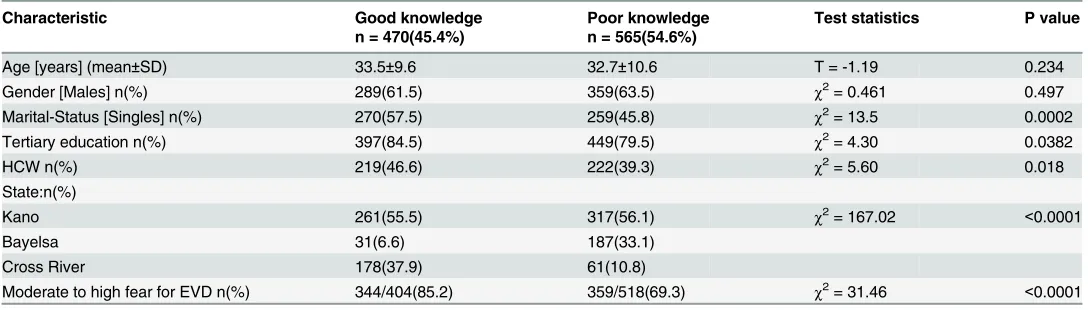
The differences in study variables in relation to level of knowledge of EVD (poor and good knowledge) are presented inTable 3.
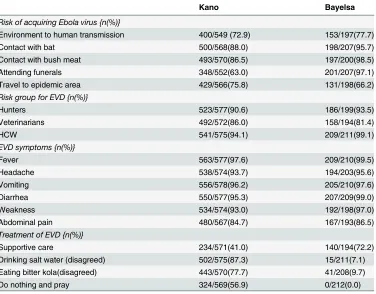
Most of the respondents; 465/509(91.4%), 205/208(98.6%) and 238/238(100%) from Kano, Bayelsa and Calabar respectively identified contact with patients secretion as a means of trans-mitting the infection (Table 4).
Only 7.1% and 9.7% of the respondent from Bayelsa disagreed with drinking salt water and eating bitter kola respectively as a means of treatment, compared to 87.3% and 77.7% of the respondents from Kano respectively (Table 5).
[image:6.612.35.581.89.264.2]Most of the respondents from Calabar said they had heard of (94.0%) and read about (81.3%) EVD, while the entire respondents 227/227(100%) agreed with use of face mask, gloves, outer garments, boots and eye protection as a means of protection. Majority 156/231 Table 1. Demographic characteristics of study participants.
Demographic variables Study sites
Kano Bayelsa Cross-River
n = 578(55.8%) n = 218(21.1%) n = 239(23.1%)
Demographic variables
Age [years], mean±sd 29.47±9.3 †36.39±9.26 †38.78±8.75
Gender, n (%) Male/Female 398(68.86)/ *104(47.71)/ **146(61.09)/
180(31.14) 114(52.29) 93(38.91)
Marital status,n(%)Single/Ever Married 297(51.38)/ *69(31.65)/ *163(68.20/
281(48.62) 149(68.35) 76(31.80)
Education, n(%)Tertiary/Non-tertiary 405(70.07)/ *218(100)/ *223(93.31)/
173(29.93) 0(0) 16(6.69)
Occupation,n(%)Health Care Workers 29(5.02)/ *189(86.70)/ *223(93.31)/
(HCW)/Non-HCW 549(94.98) 29(13.30) 16(6.69)
*Statistically significant difference at p<0.0001 in chi-square orfisher’s exact test compared to Kano **Statistically significant difference at p<0.05 in chi-square test compared to Kano
†Statistically significant difference at p<0.0001 in student’s t- test compared to Kano sd-standard deviation
(67.5%) of these respondents knew that; the only treatment for EVD is supportive care, while 234/571(41.0%) and 140/194(72.2%) of those from Kano and Bayelsa respectively knew there is no treatment for EVD.
Majority of the respondents from Calabar 169/235(71.9%) said they were not willing to work in a unit caring for EVD patients. Of 218 respondents in Cross River state, 19 (8.7%) had never used outer garment, gloves, face mask, boot or eye protection. Most of the respondents from Kano 552/576(95.8%) and Calabar 235/239(99.2%) identified EVD as a serious disease.
[image:7.612.37.590.90.275.2]Healthcare workers: There were 441 respondents who were healthcare workers with 29 (males 21), 189 (males 88) and 223 (males 135) from Kano, Bayelsa and Cross River states respectively. Their median ages were 33, 34 and 38 years from the three respective states. Among healthcare workers the proportion with good knowledge was 22 (75.9%), 27 (14.3%) and 170 (76.2%) from Kano, Bayelsa and Cross River states respectively. Their respective Table 2. Knowledge, Attitude and Practice Percentage Scores by Study Sites.
KAP scores Study sites
Kano n = 578(55.8%) Bayelsa n = 218(21.1%) Calabar n = 239(23.1%)
Mean knowledge score±sd 76.47±11.39(19.18- 71.92±10.16(23.63- 85.94±
13.10(13.32-%(range) 93.16) 98.17) 99.9)
*Proportion with good 261(45.2) 31(14.2) 178(74.5)
Knowledge n(%)
Mean attitude score±sd 90.54±17.66(0- 54.59±49.90(0–100) 74.18±14.85(28.57–
%(range) 99.99) 99.99)
†Proportion with good 414(71.6) 119(54.6) 11(4.6)
attitude n(%)
Mean practice score±sd 53.48±24.10(0–100) 33.15±14.26(0–81.81) 64.25±22.90(0–
%(range) 100) 99.90)
‡Proportion with good practice 143(24.7) 3(1.4) 106(44.4)
n(%)
*Knowledge score cut-off of80% used to define good knowledge
†Attitude score cut-off of90% used to define good attitude
‡Practice score cut-off of70% used to define good practice sd-standard deviation
doi:10.1371/journal.pone.0135955.t002
Table 3. Comparison of study variables in relation to level of knowledge of EVD.
Characteristic Good knowledge Poor knowledge Test statistics P value
n = 470(45.4%) n = 565(54.6%)
Age [years] (mean±SD) 33.5±9.6 32.7±10.6 T = -1.19 0.234
Gender [Males] n(%) 289(61.5) 359(63.5) χ2= 0.461 0.497
Marital-Status [Singles] n(%) 270(57.5) 259(45.8) χ2= 13.5 0.0002
Tertiary education n(%) 397(84.5) 449(79.5) χ2= 4.30 0.0382
HCW n(%) 219(46.6) 222(39.3) χ2= 5.60 0.018
State:n(%)
Kano 261(55.5) 317(56.1) χ2= 167.02 <0.0001
Bayelsa 31(6.6) 187(33.1)
Cross River 178(37.9) 61(10.8)
Moderate to high fear for EVD n(%) 344/404(85.2) 359/518(69.3) χ2= 31.46 <0.0001
[image:7.612.35.579.546.701.2]Table 4. Some KAP responses from the 3 sites.
Kano Bayelsa Calabar
Knowledge
Natural causative agent of Ebola 162/577 (28.0%)
47/66(71.2%) 231/237 (97.5%)
Breathing infected air 297/570
(42.1%) 6/20(30.0%) 28/239(11.7%) Secretions 465/509 (91.4%) 205/208 (98.6%) 238/238(100%) Bleeding 515/574 (89.7%) 204/207 (98.6%) 214/235 (91.1%)
Wash and disinfect surfaces 487/571
(85.3%) 193/204 (94.6%) 204/235 (86.8%) Attitude
Rate your fear for Ebola 450/575
(78.3%)
119/184 (64.7%)
134/163 (82.2%) Rate your family fear of Ebola 474/573
(82.7%) 119/184 (64.7%) 165/173 (95.4%) Behaviour
Willing to modify habit 225/511
(44.0%)
54/188(28.7%) 134/231 (58.0%) How often do you wash and disinfect surfaces/
utensils
520/564 (92.2%)
78/202(38.6%) 209/235 (88.9%) Information source(mass media) 376/573
(65.6%) 171/218 (78.4%) 122/156 (78.2%) doi:10.1371/journal.pone.0135955.t004
Table 5. Some Knowledge responses from Kano and Bayelsa.
Kano Bayelsa
Risk of acquiring Ebola virus {n(%)}
Environment to human transmission 400/549 (72.9) 153/197(77.7)
Contact with bat 500/568(88.0) 198/207(95.7)
Contact with bush meat 493/570(86.5) 197/200(98.5)
Attending funerals 348/552(63.0) 201/207(97.1)
Travel to epidemic area 429/566(75.8) 131/198(66.2)
Risk group for EVD {n(%)}
Hunters 523/577(90.6) 186/199(93.5)
Veterinarians 492/572(86.0) 158/194(81.4)
HCW 541/575(94.1) 209/211(99.1)
EVD symptoms {n(%)}
Fever 563/577(97.6) 209/210(99.5)
Headache 538/574(93.7) 194/203(95.6)
Vomiting 556/578(96.2) 205/210(97.6)
Diarrhea 550/577(95.3) 207/209(99.0)
Weakness 534/574(93.0) 192/198(97.0)
Abdominal pain 480/567(84.7) 167/193(86.5)
Treatment of EVD {n(%)}
Supportive care 234/571(41.0) 140/194(72.2)
Drinking salt water (disagreed) 502/575(87.3) 15/211(7.1)
Eating bitter kola(disagreed) 443/570(77.7) 41/208(9.7)
Do nothing and pray 324/569(56.9) 0/212(0.0)
[image:8.612.202.578.413.707.2]proportions with good attitude were 22 (75.9%), 105 (55.6%) and 11 (4.9%). While the propor-tions with good behavior were 12 (41.4%), 3 (1.6%) and 102 (45.7%) from Kano, Bayelsa and Cross River states respectively.
Similarly, the proportion of participants with good knowledge was 219/441 (49.7%) among healthcare workers compared to non-healthcare workers 251/594 (42.3%) (χ2= 5.60;
p = 0.018) while the proportion with good behavior was 117/441 (26.5%) compared to 135/594 (22.7%) respectively (χ2= 1.99; p = 0.159). However, the proportion of healthcare workers with good attitude was 138/441 (31.3%) compared to 406/594 (68.4%) among non-healthcare work-ers (χ2= 139.4; p<0.0001).
In a logistic regression model, the independent predictors of good knowledge of EVD were being a HCW, reporting‘moderate to high fear of EVD’and‘willingness to modify habit’ pre-Ebola epidemic habits (Table 6). Being single and having tertiary education were statistically significant in a univariate analysis, but not in the logistic regression model.
There was weak positive correlation between overall percent knowledge score and overall percent attitude score (r = 0.1366; p<0.001). However, there was a slightly better positive cor-relation between overall percent knowledge score and overall percent behaviour score
[image:9.612.50.578.83.309.2](r = 0.2757; p<0.0001). In MLR, there was a significant positive relationship between appropri-ate behaviour (practice) score to knowledge score, attitude score and to being single (Table 7). Table 6. Predictors of Good Knowledge of EVD in Multivariate analysis (Logistic Regression); Log Likelihood Ratio -472.06, R2= 17.36.
Crude Odds Ratio [95% CI]
Adjusted Odds Ratio [95% CI]
Marital Status Ever Married 1.0 (reference) 1.0 (reference)
Single 1.60 (1.24–2.05) 1.36 (0.94–1.97)
Age Groups [15-19y; 20-24y; 25-29y; 30-34y; 35-39y; 40y]
15–19 years 1.0 (reference) 1.0 (reference) For each Increasing Age
Group
1.02 (1.00–1.04) 1.01 (0.99–1.04)
Educational Level Non-Tertiary 1.0 (reference) 1.0 (reference)
Tertiary 1.41 (1.02–1.94) 1.38 (0.91–2.08)
Occupation Non-Health Care Worker 1.0 (reference) 1.0 (reference)
Health Care Worker 1.35 (1.05–1.73) 2.89 (1.41–5.90)
Fear of EVD Little or no fear 1.0 (reference) 1.0 (reference)
Moderate to high fear 2.54(1.81–3.56) 2.15 (1.47–3.13)
Willingness to modify habit Not willing 1.0 (reference) 1.0 (reference)
Willing 2.32(1.76–3.04) 1.68(1.23–2.30)
State Kano 1.0 1.0
Bayelsa 0.20(0.13–0.31) 0.06(0.03–0.14)
Cross River 3.54(2.51–5.03) 1.12(0.52–2.41) doi:10.1371/journal.pone.0135955.t006
Table 7. Multiple linear regression model of Appropriate Behaviour Score; F (6,1028) = 18.16, p< 0.0001, R29.58%, adjusted R216.6%.
Variable ß coefficient T p-value
Occupation: HCW vs non-HCW -1.325 -0.72 0.473
Marital status: Single vs Ever-married 3.85 2.38 0.017
Age group 0.16 1.43 0.153
Educational level: Tertiary vs non-tertiary -2.16 -1.04 0.298
% appropriate knowledge score 0.50 8.15 <0.0001
% appropriate attitude score 0.08 3.26 0.001
Constant -1.89
[image:9.612.202.579.606.709.2]Discussion
Currently, no approved antiviral drug or vaccine exists against EVD although there are various experimental treatments and vaccines at various stages of testing for safety and effectiveness. Therefore, the only options to curtail epidemics are to prevent transmission of infection by implementing effective containment measures in the community and healthcare settings. To achieve this, better understanding of people’s knowledge, attitude and practices (KAP) toward EVD is needed.
Apart from an unpublished descriptive technical report from Sierra Leone [18], to the best of our knowledge, this is the first comprehensive analytical KAP survey on EVD in sub Saharan Africa. Our survey confirms significant gaps in knowledge, attitude and practices of EVD among predominantly educated participants with over 80% of them having tertiary education and over 40% being HCWs. The deficiencies in KAP were observed in all the three study states in Nigeria.
For instance, only half of 880 respondents in our study knew the causative agent of EVD, with an even lower response among respondents in Kano compared to Bayelsa and Cross River State. These differences across the states may be attributed to the higher proportion of HCW in Bayelsa and Cross River states. Nonetheless majority of respondents correctly associated EVD with bats, monkeys and wild animals; recognized it as a very serious and fearful disease; and correctly identified its basic symptoms. Furthermore, a majority of respondents were aware of the means of transmission of EVD, albeit fewer respondents from Kano (a predominantly Muslim community) were aware of the risk of transmission during funerals. Similarly, respon-dents’overall knowledge of the means of personal prevention such as hand washing with soap and water, using facemask, eye protection, outer garment and boots was good. In spite of good knowledge of personal protection, very few people were willing to modify their habits.
Our study identified differences in knowledge about the treatment of EVD between the 3 sites perhaps partly influenced by the differing characteristics of the respondents in Kano, Bayelsa and Calabar. For example, it is understandable that most respondents from Bayelsa and Calabar (who are predominantly HCWs) recognized supportive care as the most appropri-ate means of management compared to very few people in Kano (with the least proportion of HCWs). Interestingly, most respondents from Bayelsa were uncertain about the value of drink-ing salt water or eatdrink-ing bitter kola for treatdrink-ing EVD, a situation which coincided with the prolif-eration of myths and phony cures for EVD on social media sites such as Facebook and Twitter [10,19]. Evidence reveals that myths and harmful misconceptions are not limited to Nigeria alone [16], as a recent survey in Sierra Leone indicated that 2 in 5 respondents believed that bathing with salt and hot water could protect them from Ebola [18]. The popularity of tradi-tional beliefs or remedies such as wearing dry banana leaves to protect against epidemics of infectious diseases has also been reported in Uganda [20]. It is possible that awareness cam-paigns implemented in Bayelsa during the EVD epidemic in Nigeria did not sufficiently dispel the misconceptions which were propagated via social media. While the proliferation of com-puters, tablets, and smartphones in the West African sub-region provide channels for the rapid dissemination of information through the internet and social media, the risk of blending facts with misinformation via these largely unregulated platforms is ever present [19]. Misinforma-tion arising from such sources may potentially confer on the populace a false sense of protec-tion whilst promoting resistance towards or even eroding confidence in proven preventive measures. Consequently, public health and government agencies should promptly and vigor-ously address such misinformation with correct health information and education [19].
generally good attitudes and behaviour towards key means of preventing EVD with exception of respondents from Bayelsa. The study showed that, overall appropriate or‘good knowledge’ was low (45%) and correlated poorly with attitude. Indeed, willingness to modify habits was generally low in all the three states (44–58%). The reasons are not clear however it is instructive that good knowledge of EVD was significantly higher among HCWs but the good attitude was significantly higher among the non-HCWs when compared with HCWs. Over 70% of HCWs from Calabar were unwilling to work in units caring for EVD. The reservations expressed by these workers about caring for EVD patients may stem from a fear of contracting EVD which has high mortality and no known cure. The lack of personal protective equipment (PPE) in their clinical settings may also be contributing to this reluctance among HCWs. Indeed, approximately 869 African HCWs have been infected and 507 (58%) have died since the begin-ning of the West African EVD epidemic [9]. A similar attitude was observed in Sierra Leone, among HCWs with poor access to PPE [18]. Our finding of poor attitude towards EVD among HCWs is undesirable and may be addressed by provision of PPE while intensifying education on infection prevention and control practices in healthcare settings. Governments should also explore provision of insurance policy, job security, incentives to motivate work and provision for families of HCW should the worst happen. These strategies may inspire greater confidence among HCWs in their ability to remain healthy while caring for such highly infectious patients.
Notwithstanding codes of ethics requiring health professionals not to abandon sick patients, Nancy Kass [21] points out that helping patients with an illness that is both highly contagious and usually fatal is“supererogatory', i.e., it goes above and beyond usual norms of good ethical conduct. However our study also showed that respondents with‘good knowledge’were more likely to have‘good behaviour’. Thus, improving knowledge can potentially improve behaviour and possibly attitude. Although our survey found non-HCWs were less knowledgeable about Ebola, interventions aimed at addressing critical knowledge gaps should target all sectors of the population regardless of age, education and occupation. These educational packages will need to be tailored to suit the perculiarities of various groups such as infection prevention and con-trol education for HCWs.
Despite recognition of funeral practices as a major source of EVD transmission [22], a sur-prising finding was that only 63% of respondents from Kano correctly identified attending funerals as a source of EVD transmission compared to 97.1% among mainly HCWs from Bayelsa. Furthermore only 10.1% of respondents from Kano reported reducing physical con-tact with others to less than 10 times during the day following the EVD outbreak in Nigeria. This is a concern especially as transmission may be facilitated in largely Muslim settings where funerals are hurriedly conducted immediately following a person’s death. In a similar but smaller unpublished survey in Sierra Leone, International Red Cross reported that only 26.7% of respondents in Kailahun and 21.4% in Kenema regions of sierra Leon knew that avoiding the dead remains of an infected individual could prevent transmission of EVD. These findings all support the need for greater communication and engagement of communities and local leaders in the promotion of safe burial rites during EVD outbreaks.
The proportion of respondents in our study, with positive change in behaviour such as hand washing with soap and water was lower than reported in the Sierra Leone survey [18]; however the proportions of respondents who reported reducing physical contact were comparable and generally low. These findings highlight the inherent difficulty in changing culturally
entrenched behaviours such as handshakes and hugs as forms of greeting in African communities.
Although the sample size obtained from multiple sites across Nigeria adds to the survey’s strengths, this study has some limitations. Firstly, though the survey was conducted about the same time (July-September 2014) in all 3 states, there were slight differences in actual duration and period of data collection in each site sites leading to variability in responses as global health information about EVD changed rapidly and often dramatically. Secondly, though the study provides essential insight into gaps in knowledge, attitude and practice, the findings should be generalized with caution as the study population was comprised mainly those with tertiary education and HCWs within the Nigerian sociocultural setting. Furthermore the study sites had no affected EVD cases and findings represent responses from just three states which might not be representative of the whole country. Thirdly, slight differences in the nature of the data between the sites precluded the analysis of some data from Cross River State. Lastly, the ques-tionnaire was comprehensive on knowledge but appeared less comprehensive on aspects per-taining to attitude and practice (behaviour).
In conclusion, we recommend the implementation of massive and sustained public aware-ness programmes to increase the knowledge of the general populace, focusing on mode of transmission, context-specific preventive measures such as addressing myths and misconcep-tions; and promoting safe burial practices. Health systems strengthening should be promoted by providing frontline HCWs with PPE and essential information about EVD while highlight-ing infection control measures to boost the morale and capacity of HCWs to respond to out-breaks of Ebola infection.
Supporting Information
S1 Appendix.(DOC)
Acknowledgments
We would like to thank our colleagues in the institutions where this work was conducted and also the Ethics Committees at the institutions for providing expedited reviews and approvals which facilitated the survey.
Author Contributions
Conceived and designed the experiments: AGH GI AAO BE D. Ogoina. Performed the experi-ments: GI D. Ogoina AAO FMD BE D. Otokpa WTO SR AGH. Analyzed the data: AGH GI D. Ogoina AAO. Contributed reagents/materials/analysis tools: GI D. Ogoina AAO AGH. Wrote the paper: GI D. Ogoina AAO FMD BE D. Otokpa WTO SR AGH.
References
1. Centers for Disease Control [CDC]. Ebola Virus Disease. Available:http://www.cdc.gov/vhf/ebola/ index.html. Accessed 10th December 2014
3. Ndambi R, Akamituna P, Bonnet M, Tukadila A, Muyembe-Tamfum J, Colebunders RL. Epidemiologic and clinical aspects of the Ebola virus epidemic in Mosango Democratic Republic of the Congo, 1995. The Journal of Infectious Diseases 1999; 179: S8–S10 PMID:9988156
4. Beeching NJ, Fenech M, Houlihan CF. Ebola Virus Disease. BMJ 2014; 349:g7348 doi:10.1136/bmj. g7348PMID:25497512
5. Birmingham K, Cooney S. Ebola: small, but real progress. Nature Medicine 2002; 8: 313. PMID: 11927920
6. World Health Organization [WHO]. Ebola Virus Disease. Available:http://www.who.int/csr/disease/ ebola/en/
7. Feldmann H, Geisbert TW. Ebola haemorrhagic fever. Lancet 2011; 377(9768):849–62. doi:10.1016/ S0140-6736(10)60667-8
8. Chan M. Ebola Virus Disease in West Africa—No Early End to the Outbreak. N Engl J Med 2014;:–2. doi:10.1056/NEJMp1409859
9. World Health Organization [WHO]. Ebola data and statistics. Available:http://apps.who.int/gho/data/ view.ebola-sitrep.ebola-summary-latest?lang = en. Accessed 20thJune 2015
10. All Africa—Nigeria: Hot Water, Salt Not an Ebola Cure (2014). Available:http://allafrica.com/view/ group/main/main/id/00031909.html
11. Fasina FO, Shittu A, Lazarus D, Tomori O, Simonsen L, Viboud C, et al. Transmission dynamics and control of Ebola virus disease outbreak in Nigeria, July to September 2014. Euro Surveill 2014; 19 (40):1–7.
12. Shuaib F, Gunnala R, Musa EO, Mahoney FJ, Oguntimehin O, Nguku PM, et al. Ebola virus disease outbreak—Nigeria, july-september 2014. MMWR Morb Mortal Wkly Rep 2014; 63(39):867–72.
13. World Health Organization [WHO]. Ebola: Experimental therapies and rumoured remedies; 2014 Avail-able at:http://www.who.int/mediacentre/news/ebola/15-august-2014/en/
14. United Nations Children’s Fund [UNICEF]. Situation report Ebola outbreak–Nigeria; 2014. Available: http://www.unicef.org/nigeria/NG_UNICEF_Nigeria_SitRep_Ebola_outbreak_24_September_2014. pdf
15. World Health Organization [WHO]. Ebola situation report; 2014. Available:http://www.who.int/csr/ disease/ebola/situation-reports/en/
16. Washington Post-ABC News Poll. Concern over Ebola epidemic in United States. The Washington Post 2014. Available:http://www.washingtonpost.com/page/2010-2019/WashingtonPost/2014/10/14/ National-Politics/Polling/release_366.xmlAccessedNovember 15, 2014, 2014.
17. WHO. Public Health Emergency of International Concern Declaration on 8thAugust 2014. Available: http://www.who.int/mediacentre/news/statements/2014/ebola-20140808/en/
18. Focus 1000–Technical report. Study on public knowledge,attitudes, and practices relating to Ebola Virus Disease (EVD) prevention and medical care in Sierra Leone; 2014. Available:http://newswire.crs. org/wp-content/uploads/2014/10/Ebola-Virus-Disease-National-KAP-Study-Final-Report_-fin.
19. Oyeyemi SO, Gabarron E, Wynn R. Ebola, Twitter, and misinformation: a dangerous combination? BMJ 2014; 349–http://dx.doi.org/10.1136/bmj.g6178
20. Hewlett BS, Amola RP. Cultural contexts of Ebola in northern Uganda. Emerging Infectious Diseases 2003; 9(10): 1242–8 PMID:14609458
21. Kass N.Ebola, Ethics, and Public Health: What Next? Ebola, Ethics, and Public Health. Annals of Inter-nal Medicine 2014; 161:744–5 doi:10.7326/M14-1864PMID:25133473
22. Ansumana R., Bonwitt J., Stenger DA, Jacobsen KH. Ebola in Sierra Leone: a call for action. Lancet 2014; 384(9940), 303.
23. Gostin LO, Lucey D, Phelan A. The Ebola epidemic: a global health emergency. JAMA2014; 312(11): 1095–1096
24. Colebunders R. and Borchert M. Ebola Haemorrhagic Fever: A Review, Journal of Infection 2000; 40: 16–20.
25. Rahnavardi M, Rajaeinejad M, Pourmalek F, Mardani M, Holakouie-Naieni K, Dowlatshahi S. Knowl-edge and attitude toward Crimean–Congo haemorrhagic fever in occupationally at-risk Iranian health-care workers. Journal of Hospital Infection 2008; 69:77–85 doi:10.1016/j.jhin.2008.02.007PMID: 18395295
26. Shuaib F, Todd D, Campbell-Stennett D, Ehiri J, Jolly PE. West Indian Med J. Knowledge, attitudes and practices regarding dengue infection in Westmoreland, Jamaica. West Indian Med J. 2010; 59(2): 139–146. PMID:21132094