controlled trial..
White Rose Research Online URL for this paper: http://eprints.whiterose.ac.uk/86009/
Version: Accepted Version
Article:
Hutchinson, J, Christian, MS, Evans, CE et al. (3 more authors) (2015) Evaluation of the impact of school gardening interventions on children's knowledge of and attitudes towards fruit and vegetables: a cluster randomised controlled trial. Appetite, 91. pp. 405-414. ISSN 0195-6663
https://doi.org/10.1016/j.appet.2015.04.076
[email protected] https://eprints.whiterose.ac.uk/
Reuse
Unless indicated otherwise, fulltext items are protected by copyright with all rights reserved. The copyright exception in section 29 of the Copyright, Designs and Patents Act 1988 allows the making of a single copy solely for the purpose of non-commercial research or private study within the limits of fair dealing. The publisher or other rights-holder may allow further reproduction and re-use of this version - refer to the White Rose Research Online record for this item. Where records identify the publisher as the copyright holder, users can verify any specific terms of use on the publisher’s website.
Takedown
If you consider content in White Rose Research Online to be in breach of UK law, please notify us by
Evaluation of the impact of school gardening interventions on children’s
knowledge of and attitudes towards fruit and vegetables: a cluster randomised
controlled trial
Jayne Hutchinson1,2*, Meaghan Sarah Christian1,3, Charlotte Elizabeth Louise Evans1, Camilla Nykjaer1, Neil Hancock1, Janet Elizabeth Cade1
*Corresponding author Dr Jayne Hutchinson, PhD email: [email protected]
1Nutritional Epidemiology Group, School of Food Science and Nutrition, University of
Leeds, Leeds, LS2 9JT Present Addresses:
2Department of Health Science, Seebohm Rowntree Building, The University of York,
Heslington, YO10 5DD
3School of Health and Wellbeing, Faculty of Health and Social Sciences, Leeds Metropolitan
University, City Campus, Calverley Street, Leeds, LS1 3HE
Highlights:
Abstract
Involvement of children in gardening has the potential to increase liking of fruit and vegetables (FV) and consequently intake, but research results are mixed. School gardening led by external specialists such as the Royal Horticultural Society (RHS) could have more impact than teacher-led gardening on children’s knowledge of, and attitudes towards, FV. Data from a cluster randomised controlled trial was used to compare a RHS-led school gardening intervention with a teacher-led gardening intervention amongst 7-10 year olds in 21 London schools. A short questionnaire was developed and used to identify children’s
knowledge and attitudes towards FV consumption before the garden intervention and 18 months afterwards. Results from multilevel regression models, both unadjusted and adjusted for baseline responses and socio-demographic factors were reported. Attitudes to FV intake were compared between groups. Change in FV knowledge was used to predict change in FV consumption assessed using 24-hour food diaries. In comparison with the RHS-led group (n=373), teacher-led children (n=404) were more likely to agree they ate lots of fruit (p<0.009) and tried new fruits (p=0.045), but RHS-led gardening was associated with a greater increase in the total number of vegetables recognised (p=0.031). No other differences in improvements in attitudes, or associations between change in FV recognition and intake were found. In relation to improvements in children’s recognition and attitudes towards eating FV, this trial produced limited evidence that gardening activity packages led by external specialists (RHS-led) provide additional benefits over those led by teachers trained by the RHS. Indeed, the latter were potentially more effective.
Five Keywords: School Gardening, Fruit & Vegetable intake, Children, randomised control
INTRODUCTION
Nutrition at various life stages has been associated with risk of chronic diseases later in life (World Health Organisation, 2003 ), therefore it is important for healthy eating patterns to be established in childhood since these are likely to track through adolescence into adulthood (Kelder, Perry, Klepp, & Lytle, 1994). Schools are a logical place to promote healthy eating habits such as the 5-A-Day fruit and vegetables (FV) recommended by the World Health Organisation (World Health Organisation, 2003). A recent systematic review of 27 school-based FV interventions stated that these interventions have moderate but significant effects on fruit intake, however, overall school based programmes show a lack of an effect on vegetable intake (Evans, Christian, Cleghorn, Greenwood, & Cade, 2012).
The design of many gardening interventions has been influenced by Social Cognitive Theory (SCT) (Morgan et al., 2010; Morris, Koumjian, Briggs, & Zidenberg-Cherr, 2002; Morris, Neustadter, & Zidenberg-Cherr, 2001; O’Brien & Shoemaker, 2006; Poston, Shoemaker, & Dzewaltowski, 2005; Ratcliffe et al., 2011), which incorporates the interaction of personal, environmental and behavioural factors (Bandura, 1986) and is the most common theory used to successfully change behaviour in children (Lytle & Achterberg, 1995). Personal factors such as nutrition knowledge, food preferences (including willingness to taste), attitudes towards food, self-efficacy in eating and preparing food have already been associated with increased FV consumption in children and adolescents in non-gardening research (Rasmussen et al., 2006). These factors have been evaluated in a number of gardening research projects, and US studies published to 2007 have been reviewed showing promising but some mixed results (Robinson-O'Brien, Story, & Heim, 2009). Compared to comparison groups, gardening interventions have been associated with an increase in children’s nutrition knowledge in the majority of the studies which assessed this (Cason, 1999; Koch, Waliczek, & Zajicek, 2006; Morgan et al., 2010; Morris & Zidenberg-Cherr, 2002; Parmer, Salisbury-Glennon, Shannon, & Struempler, 2009; Ratcliffe et al., 2011; Somerset & Markwell, 2008), though not all (O’Brien & Shoemaker, 2006; Poston et al., 2005). In some of the studies, identification of individual vegetables (Morgan et al., 2010; Parmer et al., 2009; Ratcliffe et al., 2011; Somerset & Markwell, 2008), or knowledge of food groups were tested (Morris et al., 2002; Morris & Zidenberg-Cherr, 2002; Parmer et al., 2009),however in other studies general knowledge relating to food or nutrition was assessed (Koch et al., 2006; O’Brien & Shoemaker, 2006; Poston et al., 2005).
attitudes towards FV. No research has compared the impact on children of gardening led by specialist gardeners with teacher-led gardening. Overall RHS staff, who are trained in horticulture, have greater access to resources and experience in improving and teaching gardening in schools than teachers who volunteer to teach gardening. The RHS staff have a set number of lessons and objectives to improve and promote involvement in gardening and to develop the garden during the academic year, whereas the teacher-led gardening objectives are determined by the school. Identifying the differences in these two types of programmes, if they have different outcomes, could help tailor delivery of cost-effective gardening in schools to improve children’s knowledge and attitudes towards FV, which in turn may positively
impact FV intake.
METHOD
Study population
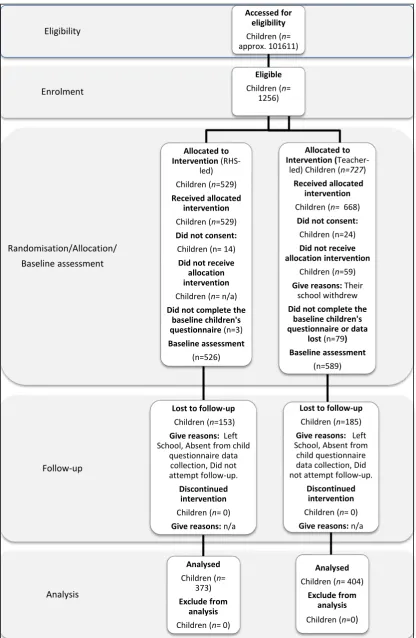
Children aged 7 to 10 years attending years 3 or 4 at 23 primary schools during the academic year from 2010 to 2011 from the following London boroughs: Wandsworth, Tower Hamlets, Greenwich and Sutton were allocated to a clustered randomised controlled trial to evaluate the impact of a school gardening programme (project number PHR Project 09/3001/19). Cluster randomisation at school level was undertaken. In total 1256 children were allocated to the trial to compare a teacher-led gardening intervention (727 children from 13 schools) with a RHS-led gardening intervention (529 children from 10 schools). In the teacher-led intervention one school withdrew and all data were lost in transit for another school (figure 1 shows the CONSORT flowchart for this current analysis of secondary outcomes). Further details of the trial and primary outcome analysis are described elsewhere (Christian et al., 2012; Christian et al., 2014a). Ethical approval was obtained through the Leeds Institute of Health Sciences and Leeds Institute of Genetics, Health and Therapeutic joint ethics committee (reference 09/012).
Interventions
RHS-led intervention
• A day visit from the RHS regional advisor each half term to work in the garden with
teachers and children (Summer Term 2010 to Summer Term 2011 inclusive) • The RHS advisor decided what fruit and vegetables to grow
• Follow up visits to aid lead teachers with planning
• General on-going advice on the school garden, free seeds and tools
• 1 twilight teacher training session each term based on seasonal tasks in the school
garden and free access to a wide range of teacher resources at www.rhs.org.uk/schoolgardening/
Teacher-led intervention
Teachers from the teacher-led intervention schools were asked to attend the after school ‘twilight’ training sessions once a term at their nearby RHS-led school, to help support them
in developing and using their school garden. The RHS did not participate with the teachers or children in the garden at the teacher-led schools but provided limited on-going advice if needed. Teachers decided what fruit and vegetables in grow in the teacher-led intervention.
Measurement
Measurement of FV knowledge
Children’s knowledge of FV was tested by their ability to recognise FV in photographs; the
majority of these fruit and all of vegetables could be grown in the UK, and all could readily be purchased in the UK. The children were asked to draw a line from the name of 12 different fruits and 16 different vegetables to connect them to a colour photo of each item. Apple was provided as an example. All the fruits were listed and pictured on one page: e.g. raspberries; blackberries; pears; blueberries; plums; and bananas. The vegetables were listed on another page: e.g. courgettes; spinach; French beans; and lettuces. For each item, correct responses were coded ‘1’ and incorrect responses coded ‘0’. To assess children’s knowledge of the 5-A-Day FV campaign, they were asked to circle on the child questionnaire a number between 1 and 8 in answer to the question “How many servings of fruit and vegetables do you think you
should eat every day to stay healthy?”
Measurement of FV attitudes
There were 10 statements relating to children’s attitudes and other potential mediating factors on FV intake, most of which were similar to questions previously tested for reliability by Somerset and Markwell (Somerset & Markwell, 2008), adapted from De Bourdeaudhuij et al (De Bourdeaudhuij et al., 2005). In the current study children were asked to circle whether they agreed a lot, agreed a little, disagreed a little or disagreed a lot with the statements (the headings were also represented by smiling or sad faces). The questionnaire was read out to the class, to help them with difficult words, but the children completed them individually. The statement ‘I’m good at preparing fruit and vegetables’ was used to assess children’s
self-efficacy i.e. their confidence in their ability to handle FV. ‘There’s usually lots of fruit and vegetables to eat at home’ assessed perceived physical environment, specifically availability
perceived active encouragement in their social environment. ‘I like trying new fruit’ and ‘I like trying new vegetables’ related to perceived barriers to eating FV, and was also classed as
an attitude statement piloted and checked for understanding by Australian children in the Tooty Fruit Vegie project (Newell et al., 2004).
Measurement of FV intake
Actual FV intake was assessed using a School and a Home Diary comprising of 115 separate food and drink types divided into 16 food and drink categories. To complete the diaries, participants ticked each item consumed, under the appropriate meal time heading within the 24-hour period. The School Food Diary was completed by a fieldworker at school for all school time meals, while the children were given the Home Food Diary to take home for their parents to complete. The diaries were the Child and Diet Evaluation Tool (CADET) which has been validated in 8-11 year olds with an emphasis on fruit and vegetable intake (Christian et al., 2014b). Power calculations for the trial based on FV intake, the primary outcome, were previously described, along with additional information (Christian et al., 2012; Christian et al., 2014a).
Statistical analysis
and index of multiple deprivation score (IMDS), where level of missing data was <1%, 6% and 6% respectively. The IMDS of the school was used if the child’s postcode, and therefore individual IMDS score, was not available. All small areas in England can be ranked according to their IMDS, a relative level of overall deprivation based on deprivation scores for income, employment, health, education, crime, access to services and living environment.
The change from baseline to follow-up for the total number of fruits recognised, the total number of vegetables recognised and the number and types of FV children listed as own-grown were calculated for each qualifying child and compared between interventions for both trials using independent samples t-tests. Multilevel mixed effects logistic regression models were also used to compare the results in different intervention groups; p values were adjusted for gender, ethnicity & IMDS were also tabulated.
Multilevel mixed effects regression analysis was also used to determine whether there was an association between the change in knowledge of FV and change in actual intake derived from the School and Home Diary. Analyses were presented unadjusted and adjusted for gender, ethnicity and IMDS. Pupils with intake above three standard deviations of the mean were excluded from this analysis.
Statistical analysis was performed using Stata SE version 12 (StataCorp, 2005). P-values of less than 0.05 were taken to represent statistical significance for all analysis, except relating to the recognition of individual FV where p-values of less than 0.010 were taken as statistically significant due to multiple testing.
Characteristics of children and schools
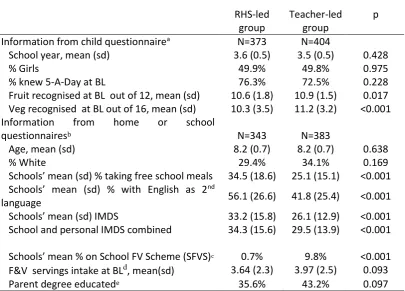
The child questionnaire was completed by 1115 children at baseline. There were 404 children from 11 schools in the teacher-led group and 373 children from 10 schools in the RHS-led intervention who attempted parts of the questionnaire both at baseline and follow-up. There were significant differences between the RHS-led and teacher-led gardening intervention groups for a number of characteristics at baseline. In the RHS-led intervention the children on average recognised fewer FV at baseline and were less likely to be at a school that had been part of the School Fruit and Vegetable Scheme (SFVS). However, they were more likely to attend a school with a higher deprivation score, or had a higher percentage of children on free school meals, or who spoke English as a second language (Table 1).
Insert Table 1
Attitudes and perceptions
Insert Table 2
Children’s knowledge of Fruit and Vegetables
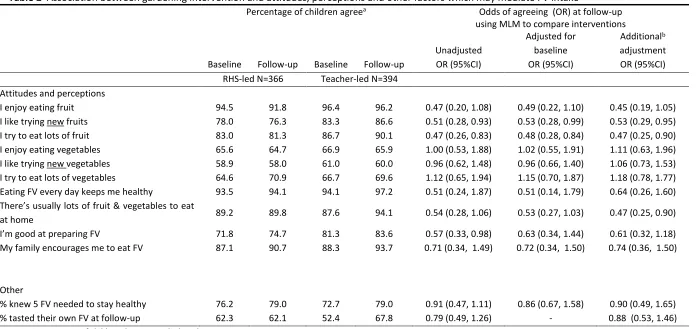
There was no significant difference between interventions in children’s knowledge that five servings of FV should be eaten every day to stay healthy (table 2).
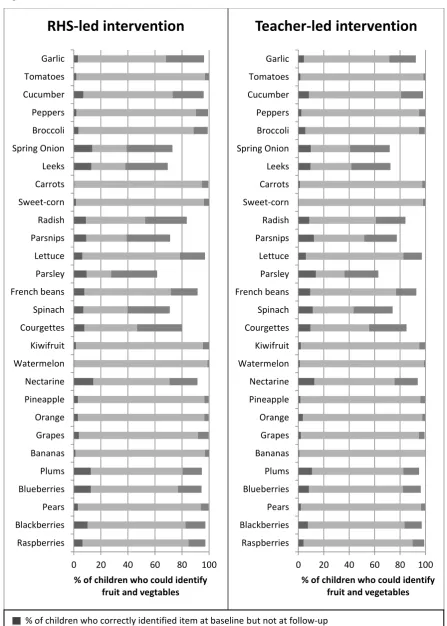
The children’s ability to recognise fruit was already very good at baseline, as observed in figure 2. In all the intervention groups each fruit type was recognised by 80% or more of the children who attempted the fruit identification sheet, apart from blueberries and nectarines (70% or more children identified these). Over 90% of the children could identify pears, bananas, grapes, oranges, pineapple, watermelon and kiwifruit. The ability to recognise vegetables was more varied. Sweet-corn, carrots, peppers and tomatoes were recognised by over 90% of children, but spinach, parsley, leeks and spring onions were identified by less than 50% of children in all trial groups. Nevertheless, as observed in figure 2, over 25% of children identified these latter four vegetables correctly for the first time at follow-up after the gardening intervention. However, as shown, a fair proportion (7-14%) of children could not identify these and half of the other items (such as plums and nectarines) at follow-up after previously identifying them correctly at baseline indicating that some children were guessing the right answer. At follow-up there were no differences between RHS-led and teacher-led interventions which were significant at less than p=0.01.
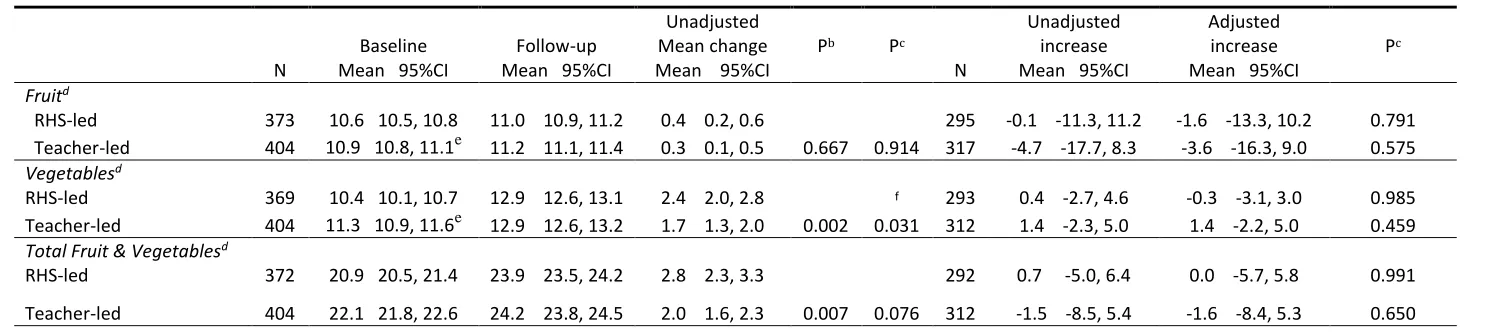
However the increase in the number of vegetables recognised from baseline to follow-up was significantly smaller for the teacher-led group compared to the RHS-led group (a mean increase of 1.7 vs 2.4 out of a total of 16 vegetables). This was statistically significant in multilevel analyses after adjusting for socio-demographic variables (OR (95%CI)=0.92 (0.09, 1.76), p=0.031). The result for vegetables may be due to the already significant difference in knowledge at baseline; adjustment for baseline answers produced non-significant results (OR (95%CI)=0.31 (-0.29, 0.90), p=0.311, see note (f) to table 3). Similarly, there was a significantly larger increase in the total number of FV recognised from baseline to follow-up for the RHS-led group compared to the teacher-led group (p=0.007 in the t-test), but this was not significant after adjusting for socio-demographic variables in multilevel models (Table 3).
Insert Table 3
Also observed in table 3, using multilevel mixed effects regression analysis there was no significant evidence for any of the gardening groups of an association between the change in identification and the change in actual intake of fruit and/or vegetables (as derived from the School and Home Diary) between baseline and follow-up. About 20% of children who answered the child questionnaire had not returned the School or Home Diary at one of the time points and therefore did not have complete FV intake data, and therefore were not included in this analysis.
DISCUSSION
and the first in UK children. The results from the trial provide limited evidence that a school based gardening intervention led by an independent gardening organisation increases children’s knowledge, awareness or attitudes towards eating FV, compared to interventions
led by teachers (trained and supported by the independent organisation). Knowledge and attitudes are important as they have the potential to mediate behaviour change in consumption of FV based on the principles of social cognition theory. No previous study has compared two types of gardening interventions, although some studies have compared gardening interventions with nutrition education interventions (McAleese et al., 2007; Morgan et al., 2010; Morris & Zidenberg-Cherr, 2002; Parmer et al., 2009; Poston et al., 2005), in addition to controls.
Children’s attitudes towards Fruit and Vegetables
Those in the teacher-led group appeared more willing to try to eat lots of fruit or to try new fruits than the RHS-led gardening group, even after adjusting for baseline responses. Children from schools where gardening was led by the teacher may have been exposed to greater levels of activity and modelling of behaviour by the teacher leading to more positive attitudes in this group. Somerset and Markwell (Somerset & Markwell, 2008) who also used questionnaire assessment rather than tasting food, found that the gardening intervention group were less likely to try new fruits than historical controls. It is possible that the additional exposure to gardening in the RHS-led intervention may make the children more certain of their dislikes; as additional gardening exposure may produce greater contemplation of FV (Somerset & Markwell, 2008).
teacher-led gardening group; though, again this was not confirmed through taste tests. Questionnaire assessment of preference/willingness to taste a larger list of FV showed gardening interventions have been associated with a preference for vegetables in some studies (Gatto, Ventura, Cook, Gyllenhammer, & Davis, 2012; Lineberger & Zajicek, 2000; Ratcliffe et al., 2011), but not associated with FV preferences in other studies (Koch et al., 2006; Morris et al., 2001; Poston et al., 2005). In taste tests, gardening interventions have been associated with an increased willingness to taste a small number of FV in kindergarten or first graders (Cason, 1999; Morris et al., 2001) in some studies, but not in older children (Morris & Zidenberg-Cherr, 2002; Ratcliffe et al., 2011), though gardening was associated with an increased taste rating in older children in other studies (Morgan et al., 2010; Parmer et al., 2009).
Other aspects of social cognitive theory, which have not been examined or controlled for in the study, such as modelling by parents or peers, may be more effective in changing children’s attitudes and behaviour towards food. For instance peer-modelling, rewards and repeated exposure to FV in a ‘Food Dudes’ intervention influenced the liking of food, and
produced a reduction of food neophobia (Laureati, Bergamaschi, & Pagliarini, 2014). Furthermore, factors such as those examined in our study have been found in other studies to have less influence over fruit and vegetable consumption than habit and availability, with fruit being most influenced by availability and vegetables being most influenced by habit (Reinaerts, de Nooijer, Candel, & de Vries, 2007).
Children’s knowledge of Fruit and Vegetables
The RHS-led gardening group was associated with an increase in the total number of vegetables recognised compared to the teacher-led group, however, this difference was not significant after adjustment for baseline measurement. This may be due to significantly more scope for improvement from baseline in the RHS-led intervention group. Additionally, there were no significant increases in the ability to identify individual vegetables. Furthermore, there was no evidence in either gardening intervention group that on average an increase in the number of fruit, vegetables or total FV recognised was associated with an actual increase in consumption of FV.
16 vegetables used in the current trials. Furthermore, studies that identified successful change in children’s nutrition knowledge combined health, science or nutrition education alongside
the gardening component of their intervention studies (Morgan et al., 2010; Parmer et al., 2009; Ratcliffe et al., 2011), whereas the RHS-led and teacher-led interventions focussed solely on gardening education. Decisions to integrate nutrition, cooking or other FV promoting activities with gardening education were made independently by schools in the current study. This might be one explanation for the lack of significant differences between the interventions, in addition to not using a non-gardening comparison group. Of two previous studies that found a significant change in children’s knowledge after implementing a gardening intervention (Koch et al., 2006; Morris et al., 2001), one did not include a comparison group (Koch et al., 2006) and was conducted on younger children (grade one) than this current sample (Morris et al., 2001). Only 320 or fewer children from one or two schools were involved in these trials, compared to the 777 children who took part from 21 schools in the current trial.
The increase in awareness of 5-A-Day in the RHS-led gardening intervention group was no greater than in the teacher-led gardening group, and no significant differences in awareness by these children that eating FV kept them healthy. Other gardening intervention studies did not report awareness of 5-A-Day separately, although this question was included in the ‘Health and Nutrition from the garden’ questionnaire developed for children by Genzer et al.
The definition of nutrition knowledge or fruit and vegetable knowledge varies between studies with some questions appearing less relevant to mediating FV intake than others, for instance knowing whether a tomato is a fruit or a vegetable (O’Brien & Shoemaker, 2006). There is a need for a consistent and meaningful test of nutrition or fruit and vegetable knowledge to be defined in order to aid the evaluation and comparison of interventions which aim to increase FV liking and intake.
It is likely that improvement in knowledge and attitudes do not immediately result in behaviour change, particularly for children where food intake is mediated through the family. The length of our intervention follow up of 18 months may not be sufficient to see follow through from attitudes to behaviour change, however cluster RCTs with longer follow up suffer from a high drop-out rate as a considerable number of children change school at the end of the year leading to biased results. In the primary outcome analysis the RHS-led intervention was not associated with an increase in FV intake compared to the teacher-led intervention (Christian et al., 2014a). Many interventions do not appear to have lasting impact and improvement in behaviour only lasts as long as the intervention itself (Evans et al., 2012).
Limitations and strengths
reduced selection bias, and the use of schools as a random effect variable in multilevel models to take into consideration the hierarchical structure of the data, caused by randomising by school rather than by individual. Self-selection of schools for interventions occurred in some previous studies which is likely to create bias (Morgan et al., 2010; Parmer et al., 2009). Most studies had follow-up periods which were less than a year, some being 16 weeks or less (Morgan et al., 2010; O’Brien & Shoemaker, 2006), whereas the follow-up period in this trial included two growing seasons and was 18 months from baseline to follow up. Randomised control trials are considered to be the strongest study design to assess causality. The random allocation of schools to interventions in our trial aimed to achieve similar baseline demographic factors, and similar recognition of and attitudes towards fruit and vegetables between intervention groups at baseline. There was some evidence of imbalances in these between the intervention groups, meaning there was a possibility of some residual confounding. However we made adjustments for baseline responses unlike previous
research (O’Brien & Shoemaker, 2006; Somerset & Markwell, 2008).
A limitation of measuring children’s knowledge is that naturally, children do guess if they
don’t know the right answer. The current questionnaire did not provide a “don’t know”
option which might have reduced the percentage of children guessing, and improved the questionnaire’s ability to accurately measure knowledge, and therefore its reliability. There
evidence of whether or not either gardening intervention in the RHS ‘Campaign for School Gardening’(Royal Horticultural Society, 2010) has a greater impact on the outcomes than
schools which do not garden. This was due to the RHS ethos requiring them to provide a gardening programme of some kind to all schools which were interested; nevertheless a second trial in this project compared a teacher-led group to a non-gardening group who benefitted from teacher-led (RHS trained) gardening activities after the trail (Christian et al., 2012). Whilst there were no overall significant differences in the primary outcome (FV intake) for the trial reported here, additional results which incorporated a process measure evaluation of the level of gardening intensity, indicated that substantial increases in the level of intensity of school gardening had a positive impact on FV intake (Christian et al., 2014a).
A large number of children from schools with pupils who spoke English as a second language could have resulted in many children struggling with the English names for fruit and vegetables. Another limitation is the high dropout rate (~30%) between baseline and follow-up due to a large number of children in London changing schools at the end of the academic year. Children without follow up data were more likely to be from schools that had higher percentages of pupils with English as a second language or were eligible for free school meals, compared with children who completed questionnaires at both time points which could have introduced bias.
Conclusion
teachers who were trained by RHS specialist were potentially more effective at influencing attitudes that RHS-led.
It is unlikely that a school gardening programme, on its own, is sufficient to change children’s attitudes towards FV. Other than climate, a fundamental difference in successful
gardening interventions in countries outside the UK is the inclusion of additional components such as in class nutrition education or cooking. Future school based programmes may be more successful if they integrate education, cooking and gardening elements as well as the home environment.
Funding
This project was funded by the National Institute for Health Research Public Health Research (NIHR PHR) programme (project number PHR Project 09/3001/19). Visit the PHR
programme website for more information.
Ethical Approval
Ethical approval was obtained through the Leeds Institute of Health Sciences and Leeds Institute of Genetics, Health and Therapeutic joint ethics committee (reference 09/012).
Acknowledgement
We would like to thank the research support office, Claire McLoughlin and the Royal Horticulture Society for their involvement in this project.
The views and opinions expressed therein are those of the authors and do not necessarily reflect those of the PHR programme, NIHR, NHS or the Department of Health.
Contributors
MSC managed the day-to-day running of the project and designed the questionnaires. JH conducted the analysis. JH and MSC wrote the initial draft of the manuscript. JEC secured funding and was guarantor of the project. Both JEC and CELE supervised the project, the interpretation of the data and the preparation of the manuscript. CN was the research assistant for the project. NH was the database manager for the project. All authors contributed to the final version of the paper.
Trial Steering Committee
Dr Cindy Cooper (Director, Sheffield Clinical Trials Research Unit Senior Research Fellow University of Sheffield) has agreed to act as chairperson. Graeme Slate (Learning Mentor – Forster Park Primary School) and Deirdre Walton (RHS Regions Manager) have agreed to act as independent members of the steering committee. The Trial Steering Committee will also act as the data monitoring committee.
Conflicts of Interest
There were no conflicts of interest.
REFERENCES
Anzman-Frasca, S., Savage, J. S., Marini, M. E., Fisher, J. O., & Birch, L. L. (2012). Repeated exposure
Appetite,
58(2), 543-553. doi: http://dx.doi.org/10.1016/j.appet.2011.11.012
Bandura, A. (1986). Social Foundations of Thought and Action. Englewood cliffs, NJ: Prentice-Hall. Cason, K. L. (1999). Children are "growing healthy" in South Carolina. Journal of nutrition education,
Christian, M. S., Evans, C. E. L., Conner, M., Ransley, J., & Cade, J. E. (2012). Study protocol: can a school gardening intervention improve children's diets? BMC Public Health, 12(1), 304. Christian, M. S., Evans, C. E. L., Nykjaer, C., Hancock, N., & Cade, J. E. (2014a). Evaluation of the
impact of a school gardening intervention on children's fruit and vegetable intake. A randomised controlled trial. International Journal of Nutrition Behavior and Physical Activity, Online Aug 16, 2014. doi: 10.1186/s12966-014-0099-7.
Christian, M. S., Evans, C. E. L., Nykjaer, C., Hancock, N., & Cade, J. E. (2014b). Measuring diet in primary school children aged 8-11 years: Validation of the Child and Diet Evaluation Tool (CADET) with an emphasis on fruit and vegetable intake. European Journal of Clinical Nutrition, Online 20 August 2014 doi:10.1038/ejcn.2014.160.
Cooke, L. (2007). The importance of exposure for healthy eating in childhood: a review. Journal of Human Nutrition and Dietetics, 20(4), 294-301. doi: 10.1111/j.1365-277X.2007.00804.x Davis, J. N., Ventura, E. E., Cook, L. T., Gyllenhammer, L. E., & Gatto, N. M. (2011). LA Sprouts: A
Gardening, Nutrition, and Cooking Intervention for Latino Youth Improves Diet and Reduces Obesity. Journal of the American Dietetic Association, 111(8), 1224-1230. doi: http://dx.doi.org/10.1016/j.jada.2011.05.009
De Bourdeaudhuij, I., Klepp, K. I., Due, P., Perez Rodrigo, C., de Almeida, M. D. V., Wind, M., . . . Brug, J. (2005). Reliability and validity of a questionnaire to measure personal, social and environmental correlates of fruit and vegetable intake in 10 11-year-old children in five European countries Public Health Nutrition, 8, 189-200. doi: 10.1079/PHN2004673
Evans, C. E. L., Christian, M. S., Cleghorn, C. L., Greenwood, D. C., & Cade, J. E. (2012). Systematic review and meta-analysis of school-based interventions to improve daily fruit and vegetable intake in children aged 5 to 12 y. American Journal of Clinical Nutrition, 96(4), 889-901. doi: 10.3945/ajcn.111.030270
Gatto, N. M., Ventura, E. E., Cook, L. T., Gyllenhammer, L. E., & Davis, J. N. (2012). LA Sprouts: A Garden-Based Nutrition Intervention Pilot Program Influences Motivation and Preferences for Fruits and Vegetables in Latino Youth. Journal of the Academy of Nutrition and Dietetics, 112(6), 913-920. doi: http://dx.doi.org/10.1016/j.jand.2012.01.014
Genzer, S., R. , Seagraves, L., Whittlesey, C. W., Robinson, S., & Koch, e. a. (2001). Junior Master Gardener Level 1 Golden Ray health and nutrition from the garden. . Bryan, TX: Newman Publishing.
Gibbs, L., Staiger, P. K., Johnson, B., Block, K., Macfarlane, S., Gold, L., . . . Ukoumunne, O. (2013). E C F E T I S -Based Kitchen Garden Program. Journal of Nutrition Education and Behavior, 45(2), 137-146. doi: http://dx.doi.org/10.1016/j.jneb.2012.09.004
Hermann, J. R., Parker, S. P., Brown, B. J., Siewe, Y. J., Denney, B. A., & Walker, S. J. (2006). After-school gardening improves children's reported vegetable intake and physical activity. Journal of Nutritional Education and Behavior, 38, 201-202.
Kelder, S. H., Perry, C. L., Klepp, K. I., & Lytle, L. L. (1994). Longitudinal tracking of adolescent smoking, physical-activity, and food choice behaviors. American Journal of Public Health, 84(7), 1121-1126. doi: 10.2105/ajph.84.7.1121
Koch, S., Waliczek, J., & Zajicek, J. (2006). The effect of a summer garden program on the nutritional knowledge, attitudes, and behaviors of children. Horticulture Technology, 16, 620-624. Laureati, M., Bergamaschi, V., & Pagliarini, E. (2014). School-based intervention with children.
Peer-modeling, reward and repeated exposure reduce food neophobia and increase liking of
fruits and vegetables. Appetite, 83(0), 26-32. doi:
http://dx.doi.org/10.1016/j.appet.2014.07.031
Lineberger, S., & Zajicek, J. (2000). School gardens: Can a
hands-attitudes and behaviors regarding fruit and vegetables? Horticulture Technology, 10, 593-597.
Lytle, L., & Achterberg, C. (1995). Changing the diet of America's children: What works and why? Journal of nutrition education, 27(5), 250-260.
McAleese, J. D., Rankin, L. L., McAleese, J. D., & Rankin, L. L. (2007). Garden-based nutrition education affects fruit and vegetable consumption in sixth-grade adolescents. Journal of the American Dietetic Association, 107(4), 662-665.
Morgan, P. J., Warren, J. M., Lubans, D. R., Saunders, K. L., Quick, G. I., & Collins, C. E. (2010). The impact of nutrition education with and without a school garden on knowledge, vegetable intake and preferences and quality of school life among primary-school students. Public Health Nutrition, 13(11), 1931-1940. doi: 10.1017/s1368980010000959
Morris, J. L., Koumjian, K. L., Briggs, M., & Zidenberg-Cherr, S. (2002). Nutrition to grow on: a garden-enhanced nutrition education curriculum for upper-elementary schoolchildren. Journal of Nutrition Education and Behavior, 34(3), 175-176.
Morris, J. L., Neustadter, A., & Zidenberg-Cherr, S. (2001). First-grade gardeners more likely to taste vegetables. California Agriculture, 43-46.
Morris, J. L., & Zidenberg-Cherr, S. (2002). Garden-enhanced nutrition cirriculum improves fourth-grade school children's knowledge of nutrition and preferences for some vegetables. Journal of the American Dietetic Association, 102, 91-93.
Newell, S. A., Huddy, A. D., Adams, J. K., Miller, M., Holden, L., & Dietrich, U. C. (2004). The tooty fruity vegie project: changing knowledge and attitudes about fruits and vegetables. Aust N Z J Public Health, 28(3), 288-295.
O B S S C A -school gardening club to promote fruit and vegetable consumption among fourth grade students: The assessment of the social cognitive theory constructs. Horticulture Technology, 16 24-29.
Ozer, E. J. (2007). The effects of school gardens on students and schools: conceptualization and considerations for maximizing healthy development. Health Education & Behavior, 34(6), 846-863.
Parmer, S. M., Salisbury-Glennon, J., Shannon, D., & Struempler, B. (2009). School gardens: an experiential learning approach for a nutrition education program to increase fruit and vegetable knowledge, preference, and consumption among second-grade students. Journal of Nutrition Education and Behavior, 41(3), 212-217.
Poston, S., Shoemaker, C., & Dzewaltowski, D. (2005). A comparison of a gardening and nutrition program with a standard nutrition program in an out-of-school setting. Horticulture Technology, 15, 463-467.
Rasmussen, M., Krolner, R., Klepp, K.-I., Lytle, L., Brug, J., Bere, E., & Due, P. (2006). Determinants of fruit and vegetable consumption among children and adolescents: a review of the literature. Part I: quantitative studies. International Journal of Behavioral Nutrition and Physical Activity, 3(1), 22.
Ratcliffe, M. M., Merrigan, K. A., Rogers, B. L., & Goldberg, J. P. (2011). The Effects of School Garden
Experiences on Middle School-A S K A B
Associated With Vegetable Consumption. Health Promotion Practice, 12(1), 36-43.
Reinaerts, E., de Nooijer, J., Candel, M., & de Vries, N. (2007). Explaining school children's fruit and vegetable consumption: The contributions of availability, accessibility, exposure, parental consumption and habit in addition to psychosocial factors. Appetite, 48(2), 248-258. doi: http://dx.doi.org/10.1016/j.appet.2006.09.007
Robinson-O'Brien, R., Story, M., & Heim, S. (2009). Impact of Garden-Based Youth Nutrition Intervention Programs: A Review. Journal of the American Dietetic Association, 109(2), 273-280. doi: 10.1016/j.jada.2008.10.051
Somerset, S., & Markwell, K. (2008). Impact of a school-based food garden on attitudes and identification skills regarding vegetables and fruit: a 12-month intervention trial. Public Health Nutrition, 12(2), 214-221. doi: 10.1017/s1368980008003327
StataCorp. (2005). Statistical software (Version 11). College Station: Stata Corporation.
Wang, M. C., Rauzon, S., Studer, N., Martin, A. C., Craig, L., Merlo, C., . . . Crawford, P. (2010). Exposure to a Comprehensive School Intervention Increases Vegetable Consumption. Journal of Adolescent Health, 47(1), 74-82. doi: http://dx.doi.org/10.1016/j.jadohealth.2009.12.014 World Health Organisation. (2003). WHO Fruit and Vegetable Promotion Initiative - report of the
meeting, Geneva, 25-27 August 2003. Geneva: WHO.
Table 1 Characteristics of children in gardening groups at baseline
RHS-led group
Teacher-led group
p
Information from child questionnairea N=373 N=404
School year, mean (sd) 3.6 (0.5) 3.5 (0.5) 0.428
% Girls 49.9% 49.8% 0.975
% knew 5-A-Day at BL 76.3% 72.5% 0.228
Fruit recognised at BL out of 12, mean (sd) 10.6 (1.8) 10.9 (1.5) 0.017 Veg recognised at BL out of 16, mean (sd) 10.3 (3.5) 11.2 (3.2) <0.001 Information from home or school
questionnairesb N=343 N=383
Age, mean (sd) 8.2 (0.7) 8.2 (0.7) 0.638
% White 29.4% 34.1% 0.169
S 34.5 (18.6) 25.1 (15.1) <0.001
S E nd
language 56.1 (26.6) 41.8 (25.4) <0.001
S IMDS 33.2 (15.8) 26.1 (12.9) <0.001 School and personal IMDS combined 34.3 (15.6) 29.5 (13.9) <0.001
S S FV S SFVSc 0.7% 9.8% <0.001 F&V servings intake at BLd, mean(sd) 3.64 (2.3) 3.97 (2.5) 0.093
Parent degree educatede 35.6% 43.2% 0.097
aPupils who attempted parts of both the baseline and follow-up child questionnaires
bPupils who attempted parts of both the baseline and follow-up child questionnaires, and for whom the home food diary
and/or school questionnaires were completed
cN=307, 327: Less than 92% answered question
dN=301, 318: Less than 86% answered question
Table 2 Association between gardening intervention and attitudes, perceptions and other factors which may mediate FV intake
Percentage of children agreea Odds of agreeing (OR) at follow-up
using MLM to compare interventions
Unadjusted
Adjusted for baseline
Additionalb
adjustment
Baseline Follow-up Baseline Follow-up OR (95%CI) OR (95%CI) OR (95%CI)
RHS-led N=366 Teacher-led N=394
Attitudes and perceptions
I enjoy eating fruit 94.5 91.8 96.4 96.2 0.47 (0.20, 1.08) 0.49 (0.22, 1.10) 0.45 (0.19, 1.05)
I like trying new fruits 78.0 76.3 83.3 86.6 0.51 (0.28, 0.93) 0.53 (0.28, 0.99) 0.53 (0.29, 0.95)
I try to eat lots of fruit 83.0 81.3 86.7 90.1 0.47 (0.26, 0.83) 0.48 (0.28, 0.84) 0.47 (0.25, 0.90)
I enjoy eating vegetables 65.6 64.7 66.9 65.9 1.00 (0.53, 1.88) 1.02 (0.55, 1.91) 1.11 (0.63, 1.96)
I like trying new vegetables 58.9 58.0 61.0 60.0 0.96 (0.62, 1.48) 0.96 (0.66, 1.40) 1.06 (0.73, 1.53)
I try to eat lots of vegetables 64.6 70.9 66.7 69.6 1.12 (0.65, 1.94) 1.15 (0.70, 1.87) 1.18 (0.78, 1.77)
Eating FV every day keeps me healthy 93.5 94.1 94.1 97.2 0.51 (0.24, 1.87) 0.51 (0.14, 1.79) 0.64 (0.26, 1.60)
T
at home 89.2 89.8 87.6 94.1 0.54 (0.28, 1.06) 0.53 (0.27, 1.03) 0.47 (0.25, 0.90)
I FV 71.8 74.7 81.3 83.6 0.57 (0.33, 0.98) 0.63 (0.34, 1.44) 0.61 (0.32, 1.18)
My family encourages me to eat FV 87.1 90.7 88.3 93.7 0.71 (0.34, 1.49) 0.72 (0.34, 1.50) 0.74 (0.36, 1.50)
Other
% knew 5 FV needed to stay healthy 76.2 79.0 72.7 79.0 0.91 (0.47, 1.11) 0.86 (0.67, 1.58) 0.90 (0.49, 1.65)
% tasted their own FV at follow-up 62.3 62.1 52.4 67.8 0.79 (0.49, 1.26) - 0.88 (0.53, 1.46)
aAgree=percentage of children that agree a little or lot
Table 3 Mean number of FV recognised at baseline and at follow-up. Increase in FV intake associated with increased FV recognition
Mean number of FV recognised at baseline and at follow-upa Increase FV intake (gs) associated with identifying one additional fruit or vegetable between baseline and follow-upa
N
Baseline Mean 95%CI
Follow-up Mean 95%CI
Unadjusted Mean change Mean 95%CI
Pb Pc
N
Unadjusted increase Mean 95%CI
Adjusted increase Mean 95%CI
Pc
Fruitd
RHS-led 373 10.6 10.5, 10.8 11.0 10.9, 11.2 0.4 0.2, 0.6
0.667 0.914
295 -0.1 -11.3, 11.2 -1.6 -13.3, 10.2 0.791
Teacher-led 404 10.9 10.8, 11.1e 11.2 11.1, 11.4 0.3 0.1, 0.5 317 -4.7 -17.7, 8.3 -3.6 -16.3, 9.0 0.575
Vegetablesd
RHS-led 369 10.4 10.1, 10.7 12.9 12.6, 13.1 2.4 2.0, 2.8
0.002 f 0.031
293 0.4 -2.7, 4.6 -0.3 -3.1, 3.0 0.985
Teacher-led 404 11.3 10.9, 11.6e 12.9 12.6, 13.2 1.7 1.3, 2.0 312 1.4 -2.3, 5.0 1.4 -2.2, 5.0 0.459
Total Fruit & Vegetablesd
RHS-led 372 20.9 20.5, 21.4 23.9 23.5, 24.2 2.8 2.3, 3.3
0.007 0.076
292 0.7 -5.0, 6.4 0.0 -5.7, 5.8 0.991
Teacher-led 404 22.1 21.8, 22.6 24.2 23.8, 24.5 2.0 1.6, 2.3 312 -1.5 -8.5, 5.4 -1.6 -8.4, 5.3 0.650
aOnly includes children who completed child questionnaire FV identification sheets at both time points (note that FV intake was not measured for all these children)
bIndependent t-tests used to test difference between interventions of mean change between baseline and follow-up
cMultilevel mixed regressions used to test difference between interventions of mean change between baseline and follow-up adjusting for gender, ethnicity, index of multiple deprivation
score
dTotal possible scores are for fruit 12, for vegetables 16, and for fruit and vegetables 28.
eSignificant differences for mean number of items recognised between different interventions at baseline using t-tests
fAdditional adjustment for baseline answers as well as the socio-demographic variables produced non-significant results (
Figure 1 Analysis Follow-up Randomisation/Allocation/ Baseline assessment Enrolment Eligibility Accessed for eligibility
Children (n= approx. 101611)
Eligible
Children (n= 1256)
Allocated to Intervention
(RHS-led) Children (n=529) Received allocated
intervention Children (n=529) Did not consent:
Children (n= 14)
Did not receive allocation intervention Children (n= n/a) Did not complete the
baseline children's questionnaire (n=3)
Baseline assessment
(n=526)
Lost to follow-up Children (n=153) Give reasons: Left School, Absent from child
questionnaire data collection, Did not attempt follow-up.
Discontinued intervention Children (n= 0) Give reasons: n/a
Analysed Children (n=
373)
Exclude from analysis Children (n= 0)
Allocated to Intervention
(Teacher-led) Children (n=727) Received allocated
intervention Children (n= 668)
Did not consent: Children (n=24)
Did not receive allocation intervention
Children (n=59) Give reasons:Their
school withdrew
Did not complete the baseline children's questionnaire or data
lost (n=79)
Baseline assessment (n=589)
Lost to follow-up
Children (n=185) Give reasons: Left School, Absent from child questionnaire data collection, Did not attempt follow-up.
Discontinued intervention
Children (n= 0) Give reasons: n/a
Analysed
Children (n= 404) Exclude from
analysis
Figure 2
0 20 40 60 80 100
Raspberries Blackberries Pears Blueberries Plums Bananas Grapes Orange Pineapple Nectarine Watermelon Kiwifruit Courgettes Spinach French beans Parsley Lettuce Parsnips Radish Sweet-corn Carrots Leeks Spring Onion Broccoli Peppers Cucumber Tomatoes Garlic
% of children who could identify fruit and vegtables
RHS-led intervention
0 20 40 60 80 100
Raspberries Blackberries Pears Blueberries Plums Bananas Grapes Orange Pineapple Nectarine Watermelon Kiwifruit Courgettes Spinach French beans Parsley Lettuce Parsnips Radish Sweet-corn Carrots Leeks Spring Onion Broccoli Peppers Cucumber Tomatoes Garlic
% of children who could identify fruit and vegetables
Teacher-led intervention
% of children who correctly identified item at baseline but not at follow-up % of children who correctly identified item at both baseline and follow-up