PROGRAMME OF RESEARCH AND
ACTIONS ON THE DEVELOPMENT
OF THE LABOUR MARKET
Comparative follow-up and evaluation of
current employment measures
COMMISSION
Cataloguing data can be found at the end of this publication
Luxembourg: Office for Official Publications of the European Communities, 1985 ISBN 9 2 - 8 2 5 - 5 5 4 2 - 9
Catalogue number: CB-44-85-040-EN-C
Articles and texts appearing in this document may be reproduced freely in whole or in part providing their source is mentioned.
Commission of the European Communities
PROGRAMME OF RESEARCH AND ACTIONS ON THE DEVELOPMENT OF THE LABOUR MARKET
COMPARATIVE FOLLOW-UP AND EVALUATION OF CURRENT EMPLOYMENT MEASURES
By
Centre de Recherche "TRAVAIL ET SOCIETE" Paris, France
Centro Studi di Politica Economica Rome, Italy
Forschungsstelle Sozialökonomik der Arbeit Berlin, Federal Republic of Germany
Policy Studies Institute London, United Kingdom
The r e s e a r c h on w h i c h t h e s e r e p o r t s w e r e b a s e d w a s f i n a n c e d by the C o m m i s s i o n of the E u r o p e a n C o m m u n i t i e s as p a r t of its p r o g r a m m e of R e s e a r c h and A c t i o n s on the D e v e l o p m e n t of the L a b o u r M a r k e t .
Foreword
This report was produced by a group of experts from the Federal Repub-lic of Germany, France, Italy and the United Kingdom.
The experts were asked by the Commission of the European Community to investigate selected investment policies for the economies aimed to stimulate growth and employment.
The starting point for the work was the recognition that investment has fallen too low in the four economies. Remarkable enough the decline of investment was not only due to the pattern of private investment. Given tight financial constraints to the public budgets, public investment was also reduced from the desired level. In recent years and in line with initiatives of the Commission of the European Communities there is, how-ever, a growing understandig that reductions in public investments are harmful for future growth and stable employment and will bring about negative impulses for the private economy.
The expert group did not investigate, in any detail, criteria for the allocation of public expenditures. From a more pragmatic point of view, the expert group analysed points of future growth in the four countries and corresponding investment programs. Special attention was paid to growth impulses and employment impacts of the different investment pro-grams proposed.
This report starts out with a joint expertise on the issues involved. The country reports are prepared on an individual basis. The experts of each country are responsible for their own country reports.
gene-ral interest shown in the work, especially by John Morley and Andy Chapman, formed a considerable part of the support given and were greatly appreciated.
Michael Bolle Forschungsstelle Sozialökonomik der Arbeit, Berlin, Federal Republic of Germany
Raffaele Brancati Cespe Center, Rom, Italy
Harry Cowie Policy Forecasting Unit, London, United Kingdom
Xavier Greffe Centre de Recherche , "Travail et Société", Paris, France
III
Summary of a Report on
"Investment Policy and Employment in the Federal Republic of Germany, France, Italy and the United Kingdom"
This report was produced by a group of experts from the Federal Republic of Germany, France, Italy and the United Kingdom.
The experts were asked by the Commission of the European Communi-ty to investigate investment policies for the corresponding economies aimed to stimulate growth and employment.
The starting point for the work was the recognition that invest-ment has fallen too low in the four economies. Remarkable the decline of investment was not only due to the pattern of private investment. Given tight financial constraints to the public bud-gets, public investment was also reduced from the desired level. In recent years and in line with initiatives of the Commission of the European Communities there is, however, a growing unter-standing that reductions in investment are harmful for future arowth and employment. The need for higher levels of both, private and public investment, has more widely accepted in all four coun-tries now. There is a growing demand of policies to stimulate private investment and to increase public investment with parti-cular emphasis on the move of the public budget towards capital exDenditures.
A policy mix , which stimulates both, the supply side and the de-mand side, should be the basis for an appropriate future recovery of the economies. There is a process to concentrate on (a) the improvement of private investment via appropriate forms of govern-ment action as well as (b) an increase of public investgovern-ment by the way of restructuring public budgets.
Policies aimed to increase private and public investment in
and social needs they intend to match. From a pragmatic point of view, the expert group anylized points of future growth in the four countries and corresponding investment programms. Special intention was paid to growth impulses and employment impacts of the different investment programms proposed. The report starts out with the joint expertise on the issues
in-volved. The country reports are prepared on an individual basis.
The main outcome of the report clearly shows that there exist comparable and common areas for future growth in all of the four economies which require appropriate forms of qovern? ment action to stimulate investment. The report emphasizes the the following: (i):The economies discussed here have to specia-lized on new product and sophisticated technological processes. The high technology sectors are similar in each countries, for example, electronics, biotechnlogy, engineering and elec-tronics communication technologies, chip and robot maufactu-ring, space, (ii): The are specific needs for public investT ment specially aimed to improve the infrastructure. This is
SOecially true in all four economies for new roads and motor-ways,commune trains and faster rail-links, (iii): The problem of producing and saving energy plavs an important role in all four economies. Public investment should be aimed toward the use of more efficiency production of energy via new technolo-gies as well as energy conservation.
ν
more dezentralized way. In some cases, there is an obvious oolitical desire to develope the culture sector and satisfy important needs in this field.
The report also stressed too important points : First, it became very clear, that any investment policy has to take into account the need for economic integration of different reaches of the economy. Second, in some cases much emphasis is laid on the nroblem of an unpayable high external deficit. Inputoutput links between the capital good sector and consumption good sector should be improved as a basis for the balance of futu re growth.
Most of the investment projects proposed in the reports can be carried out by governments of each of the four countries. But it should be evident, too, that in quite some cases joint efforts on a european level are more effectiv. The report clear ly states, that, if the investment projects proposed of to be carried out, as strenghts stimilus for future growth and compe titivness of the economies as well as an improvement of the patterns of the employment are most likely.
Michael Bolle Forschungsstelle Sozialökonomik der Arbeit, Berlin, Federal Republic of Germany
Raffaele Brancati Cespe Center, Rom, Italy
Harry Cowie Policy Forecasting Unit, London, United Kingdom
Xavier Greffe Centre de Recherche, "Travail et Société", Paris, France
VI
C O N T E N T S page
Α. Investment Policy and Employment in the Federal Republic of Germany, France, the United Kingdom and Italy: A Comparative View
by
Michael Bolle, Raffaele Brancati, Harry Cowie, Xavier Greffe
Β. The Country Reports
I. Investment Policy and Employment: The 23 Federal Republic of Germany
Michael Bolle Gunnar John
II. Investment Policy and Employment: France 86 Xavier Greffe
III. Investment Policy and Employment: Italy 13o Raffaele Brancati
IV. Investment Policy and Employment: The 173 United Kingdom
Harry Cowie
Investment Policy and Employment in the Federal Republic of Germany, France, the United Kingdom and Italy:
A Comparative View
by:
Michael Bolle Raffaele Brancati Harry Cowie
2
-List of tables
Table 1 : Unemployment
Table 2: Growth Rates of GDP
Table 3: Growth Rates of Employment and Productivity
Table 4: Growth Rates of Investment and Investment in per cent of GDP
Table 5: Public and Private Investment in per Cent
3
-1. The Need for More Investment
The FRG, France, the United Kingdom and Italy, the economies analized here, suffer from high and even growing levels of unemployment. Unemploy-ment puts a heavy burden on the performance of the economies as well as of the well-being of individuals. The costs of unemploment are unbearable high. Individuals are constrained by income losses, psychological, health and social prejudice. The public budget is subject to strain by necessa-ry transfer payments to the unemployed, the opportunity costs in terms of losses in production amount to a high percentages of GNP.
What is more, the average unemploment rates, ranging between 9 per cent in the FRG and 13 per cent in Italy in 1984 (see table 1), do not reflect the problems properly. Given the large number of people not included in official unemployment statistics and the dispersion of unemployment ra-tes, one may easily conclude that official statements often enough under-stand problems linked to unemployment. The share of long-term and un-skilled unemployed people is growing, the burden of being unemployed is destributed unequally.
High and unevenly distributed unemployment rates are the major challenge to economic policies in all of the four economies. Given the relevance of the problem, economic policies should make use of all appropriate mea-sures available and should develop new instruments at the same time.
Working time policies do play an important part in all of the four eco-nomies. In the UK and Italy, policies to increase the flexibility of working hours (part-time work, job sharing etc.) play a more important role; in France and the FRG, also developing new flexible working time patterns, policies to reduce working time are partly implemented (in France the 39-hour^week) or strongly demanded by major trade unions
(for example the 35-hour-week by the IG Metall in the FRG). However, more efforts should be undertaken in all four economies to develop those working times schemes even further, which will have positive employment
impacts and are in line with the attitudes of people and supprt the com-petitiveness of the economy.
Policies to stimulate growth are strongly debated in each of the four countries. Whereas the form of state intervention is questionable accor-ding to the economic philisophy policy believes in, there is a common understanding about the sense in which the term growth should be used. The quantitative approach, defining growth in terms of pure average figures of production, is history and replaced by the idea of qualitative growth. Growth should improve the quality of life as measured by -specific and well-defined economic; and social indicators. We consider this approach as useful indeed for an evaluation of policies to stimu-late growth: growth policies should define their targets in terms of economic and social needs. Clearly, economic and social needs will differ from country to country. But, dealing with the fields of action for a sensible investment policy in more detail at a later stage, there definitely exist common issues for all of the four economies with regard to growth policies.
employ5
-ment, economie policies have to stabilize the nexus between growth rates and changes of labour productivity: growth rates of real GNP should be higher than the increase of labour productivity.
During the seventies and at the beginning of the eighties remarkable structural changes effected growth and labour productivity. In the seventies annual averages growth rates of real GNP ranged between 3.6 per cent in France and 1.9 per cent in U.K. (see table 2). The pattern of labour productivity stabilized employment somewhat: with the excep-tion of the FRG, employment still increased (France, Italy) or was at least stabilized (United Kingdom) (see table 3).
It should be noticed, however, that in all of the four economies employ-ment patterns were not adequate to match the growing supply of labour. Unemployment grew because of the disappointing patterns of employment as compared with the increase of the supply of labour.
At the beginning of the eightieth, the economic performance of the four economies was even worse. Growth rates declined again, even showing ne-gative signs. Given the increase of labour productivity, employment de-creased (see table 3). With the exception of Italy, this downward move of employment was considerable high and contributed to the rise of un-employment given the ungoing growth of the labour force.
There are quite some reasons for the phenomenon of decreasing employ-ment levels due to unfavourable growth-productivity-links. The rise of oil prices, the decline of the old and the difficult rise of a new inter-national monetary system, a positive correlation of business cycles of the industrialized countries of the Western world, the new role of newly industrializing countries and dramatic technological changes, the "chips and robots phenomenon", challenged traditional economic policies and brought about a growing need for private and public investments to re-structure and to modernize the existing capital stock.
that structural changes do require an adequate adjustment of the types of products and the technologies used, that is a modernization and re-structuring of the existing capital stock via new investment.
What really happened, was exactly the opposite. Productivity grew not
because of higher investment, but because of laying off redundant labour or cf subsidizing traditional modes of production.Investment fell short of what was needed.
In each of the four countries, investment ratios as measured as the percentage of GDP, declined. Investment ratios range in the sixties in the average around 24.9 per cent of GDP (FRG) and 18.1 per cent (Uni-ted Kingdom), whereas in 1983 investment ratios were as low as 2o.8 per cent (FRG) and 16.o per cent in the UK (see table 4). The available data prove, too, that the United Kingdom and Italy suffer from underaverage investment ratios , whereas investment ratios in France and Germany are higher, but still much lower als compared with the sixties and even the seventies.
Remarkable enough, this decline of investment ratios was not only due to patterns of private investment. Private investment did fall, but so did public investment. Finding themselves in a position of increasing net borrowing requierements to the public budget, government of Italy, the UK and the FRG cut back capital expenditures trying to cope with current consumption demands. Thus, given the trend in private investment, employ-ment and growth were negatively effected by cut backs in public
expendi-tures which discriminated against capital expendiexpendi-tures in favour of cur-rent consumption (see table 6). This evaluation is only partly true for France: French government tried in a first time to raise public investment and public expenditure and in a second time to not cut back them . In 1981/82 economic policies reflected in the budgets in France were aimed to two goals: to promote employment and to increase competitiveness
7
-Given these pattern, the need for higher levels of both, private and public investment, has more widely accepted in all four countries now. There is a growing demand for policies to stimulate private investment and to increase public investment, with particular emphasis on the move of the public budget towards capital expenditures, among parties, govern-ments, employers' associations and trade unions. The recognition of the important role of investment for future growth and employment is also in line with initiatives of the Commission of the European Communities. Since 1982, the Commission emphasized the need for European policies to increase investment ratios, thereby stimulating competitiveness, growth and employment.
*
There is no easy way how the task to promote investment has to be done. In terms of strict economic philosophies, both, the traditional keynesi-an approach as well as the newly established supply -side approach fall short of an appropriate policy design facing the economic problems of the eighties. Given the needs for consolidating the public buddets and the unevitable adaption ot the existing capital stock to new modes of production and technologies, the simple return to orthodox demand mana-gement proves to be ineffective. On the other hand, the short-comings of a supply-side approach are evident, too: The reduction of costs and the demolition of investment barriers may be effective from the point of view of the individual firm but will not bring about the necessary stimulis for profitable future investment.
Higher profits on the existing capital stock do not increase the rate of profit for the future investment unless demand is growing. Thus, a policy mix, which stimulate both, the supply side and the demand side, should be the basis for an appropriate future recovery of the economies. This approach has to concentrate on
- the improvement of private investment via appropriate forms of state intervention as well as
8
-2. An Evaluation of Selective Investment Programs with Special Regard to Public Investment
It is most likely that financial constraints to the public budget will remain tight in all of the four countries. If this is true, it is even more
important to achieve an optimal use of scarce ressources. Unfortunately, there is a lack of information about the objectives and the allocation of public expenditures. This lack of information does seem to introduce some irrationalities in public expenditures programs.
Policies aimed to increase private and public investment in specific sectors of the economy have to make clear what economic and social needs they intend to match. We did not, however, present here a concise system of economic and social indicators appropriates to define in any detail what is needed and what should be done. Instead and from a more pragma-tic point of view, we do analyze growth poles which have been suggested by different groups in the corresponding economies. With regard to the specifics of each economy, details can be found in the country reports. In this joint report, some light will be thrown on comparable areas of growth and public expenditures.
i) Technological changes in all four economies require an adequate adap-tion of the existing capital stock via new investment. There are
common features with regard to the kind of adaption required: the economies have to specialize on new products and sophisticated tech-nological prozesses which are to be defined by a high share of re-search and development. The implementation of high technologies are of
growing importance for both, employment and future growth. The improvement of competitiveness is not restricted to specific economic sectors. It is true, that there exist out-of-date sectors to a much lesser extent than out-of-date technologies. But there still
are SOITB sectors in each economy in danger, sectors, which may not
be defined as growth sectors. To improve competitiveness even in
during the periods of adaption to new equilibirum pathes of growth and employment via a reduction in social charges and the launching of technological programs. It should be noticed, however, that these sec-tors are not the important ones for programs of future and stable reco-very.
Closely related to this aspect, one should also stress the need to reduce, in particular for countries (as for example Italy) with a strongly un-balanced economic structure the constraints to development stemming from considerable sectoral and regional disequilibirum.
There are specific sectors of growth in each economy, for which invest-ment programs have to be launched. These high technology sectors are similar in each country, for example in France electronics, biotechno-logiy, in the United Kingdom space, engineering and electronic develop-ment and communication technologies, electronics, chip and robot manu-facturing. It is especially here, where public and private investment is needed.The introduction of technological transfer agencies, the sti-mulation of research and development via financial funds, joint ventures and the financing of risk capital are important instruments to achieve the goals.
The encouragement of investment in the sectors of growth mentioned should be aimed especially towards small and medium-sized firms. Small and medium-sized firms, being an important factor for growth and employ-ment in all four economies, are often enough not able to
invest continuously in research and development and taking over high risk links to the implementation of expensive high technologies. Financial aids and new ways of technological transfers have to be considered as an effective way to improve growth and
I o
-li) There are specific needs for public investment especially aimed to improve the infrastructure. This is true in all four economies for transport. The case of the United Kingdom proves, that new truck roads and motorways als well as road building programs are badly needed given the quality of the existing capital stock in trans-port. With regard to the Federal Republic of Germany and France structural changes are perhaps more important. In France, the
project of the Atlantic train à grand vitesse proves to be use-ful and should be developed further. In the FRG, public invest-ment is needed for com trains and railroads.
iii) The problem of producing and saving energy plays an important role in all four economies. Public investment should be aimed to-wards the use of more efficient production of energy via new tech-nologies as well as towards a more efficient way to conserve ener-gy. With regard to France, programs for nuclear energy are probabe-ly more important than in the FRG. In the FRG, new technologies es-pecially based on medium-distance-heating systems are widely dis-cussed and seem to be efiicient. With regard to the conservation of energy, there are similar issues in the United Kingdom, France and FRG: insulation of private and public buildings will bring about savings of energy, are labour intensive and will involve considerable employment effects.
hundred years ago, have to be improved with regard to renewing cities sewerages and industrial treatment networks as well as tack-ling the waste of water ressources trough leakage and inefficient use of system. In the FRG a further move to a more effective sewerage system has to concentrate on new technologies. Waste recycling and waste disposal play important role as well as air clearing. With re-gard to air clearing, the emission of sulphur dioxid has to be con-trolled via appropriate technologies, the disposal of chemical waste requires further efforts. The search for, transportion and treatment of chemical warfare agents are important fields for public invest-ments in a considerable range.
v) In the case of the United Kingdom and the FRG, public investment is needed for socially desirable job creation. Socially desirable jobs such as homehelps, probation offices, neighbourhood centres etc. will bring down social costs and increase social benefits. Programs should, however, not carried out with a cumbersome bureaucracy which blunts their awareness of local needs. If more decentralized programs are implemented, a longterm low cost job creation with low costs for public funds is possible when account is taken of the savings because of decreasing unemployment benefits.
With regard to France, there is an obvious political desire to deve-lop the cultural sector and satisfy important needs in this field. The further development of already existing programs is most reaso-nable for the cultural development as well als job creation.
Uni 12 Uni
-ted Kingdom, public investment in FRG should concentrate on energy conservation and the production of energy, housing and urban renewal, environment orotection, transport, chemical waste and waste recycling, social service and air clearing. In France, areas of public investment are identified for conventional investment in sectors like electronics, construction in public works, machine tools, transport, agrar food in-dustries and wood. Energy and energy substitution, town environment, cultur and social activities are important areas of investment which are to be developed. In the case of Italy and besides of the importance of promoting technological innovation, public investment is needed to reduce social and economic bottlenecks as well as to improve the necessa-ry degree of economic integration.
Two further points must be mentioned: (a) the regional aspect and, (b) the international trade links.
a) Especially in the case of Italy it became very clear, that any invest-ment policy has to take into account the need for economic integration of different regions of the economy. At it is pointed out in the coun-try report, the Italian economy is disintegrated in terms of regional aspects. Thus, public investment policies have to consider the appro-priate competitive balance of regions.
b) In some country reports, especially in the case of France and Italy, much emphasis is laid on an open import substitution strategy. The argument runs as follows: due to unfavourable input-output-links be-tween the capital goods sector and consumption goods sectors there is a high tendency to import capital goods. Thus, policies, aimed to
- 13 —
Policy Conclusions
Probabely the most important problem of an evaluation of the proposed investment programs is related to the employment impacts. Evidently, an exact quantitative evaluation of employment impacts of selected in-vestment programs is not an easy task to do. The total job creation effect of higher investement depend on the macroeconomic performance of the
economies. This is especially true with regard to second round effects due to the income multiplier or investment accelerator as well as pattern of the international trade. Furthermore, the time-scope of employment functions play a decisive role. Due to unbalanced input-output-links and a high tendency of an economy (for example France, Italy) to import capital goods rather than producing them in the domestic economy, higher capital expenditures may involve an external deficit and a negative con-stribution to employment in the short run. In the medium term, however, the setting-up of more output capacity will lead to a more effective performance of the economy and eventually to higher employment. Any in-vestment policy has to consider carefully the domestic input-output-links between the consumption and capital goods sectors. We do think, that the proposed investment projects will not only improve employment in the medium, but also in the short run because of the amelioration of capital goods producing industries.
With regard to direct and first round employment effects of the proposed investment programs, the outcomes of an evaluation are much clearer. The intensity of labour of specific investment programs is well known in most cases and allows for a precise calculation of direct job creation effects. In most cases, investment programs proposed above are labour
intensive. This is especially true with reaard to two types of investments:
average in high technologies such as biotechnology, space, robot and chip production, technology transfer agencies and advanced in-formation technologies like computer and tele-communications manu-facturing. In these areas, there is a double advantage of investment programs: investment is labour intensive as well as highly productive. Jobs created in these areas are to be regarded as highly stable with regard to future patterns in the economy.
(ii) The direct job creating effect of investment programs is high in those areas, which are linked to environmental protection, energy conservation, housing and urban renewal as well as socially desira-ble job creation. The work to be done requires unskilled, semi-skilled and, to a lesser extent, semi-skilled labour with a special bias towards construction work.
Exact quantitative figures are given in country reports. The overall ef-fects of specific programs differ from country to country, but, to
summarize, positive employment effects are most likely in almost all cases. The overall employment impact of investment programs then depend on the size and magnitude of investment programs actually carried out. With re-gard to public investment and given the calculated stimuli for private investment and on the basis of some realistic assumptions on financial constraints of the public budget, one ends up with a considerablely high increase of employment in all four economies. The decrease of unemploy-ment may be lower because of reactions of the labour supply, but a re-markable relief for the labour market is most likely. According to the economic performance of the individual economies as well as the size and magnitude of investment projects to be carried out, figures vary, but
range around additional jobs of about one million with the next five years.
We also asked ourselves, whether there will be barriers on the labour market given the calculated additional demand for specific qualifications. First of all one has to remember, that unemployment in all four contries
15
-depends on the dispersion of skills linked to additional demand for labour The proposed investment projects involve a variety of skills. The addi-tional demand for labour is linked to skilled labour for investment pro-jects which are aimed towards high technologies. On the other hand, there is a bias in favour of semi-skilled labour linked to investment projects in the area of environmental protection, energy conservation and housing and urban renewal. There even will be an additional demand for unskilled and limited skilled labour. For example: projects in energy conservation require, apart from some operations such as heat control and lighting in installation and insulation, either no particular skills or only limited skills available after a short period of training. This is also true for housing and urban renewal programs and environmental protection with the further advantage, that these programs can be concentrated on depressed industrial and urban centres which tend to have exceptionally high levels of unemployment.
In all of the four economies analyzed here, unemployment is unequally dis-tributed. The share of unskilled or low skilled people being unemployed is above average. Thus, the additional demand for unskilled labour related to proposed investment projects will not be constrained by shortage on the labour market. As far as academic qualifications are concerned, no shortages are likely with regard to socially desirably job creation as well as cultural activities. As far as skilled labour in specific high techno-logy industries is concerned, scarceties on the labour market are likely if additional demand linked to investment projects is acceptionally high. We do think , that flanking measures, to improve the dynamics of labour market, are badly needed. These flanking measures should be related to improve mobility and flexibility of labour and should concentrate on grams which are aimed to improve qualifications in engineering, data pro-cessing, policies aimed at improving information/organization and managing access to jobs as well as reforms in the job placement system. They
Besides of the employment impacts of selective investment programs, the second important issue of this report is related to costs and revenue We tried to deal with several aspects of the problems simultaneously. First, internal rates of return of programs are calculated on a micro-economic basis, second, the financial burden for the public budget is made clear, and third, regard is paid to opportunity costs.
Starting with some cases broad ideas on internal rates of return, invest-ment programs should achieve at least a minimum rate of return. Some cal-culations of investment programs in the United Kingdom, suggesting a mini-mum rate of return of 5 per cent, may serve as an average figure. Using this as an indicator for rates of return to be achieved at a minimum by investment projects, one may distiniguish between three types of invest-ments:
i) Investment projects aimed to the modernization of the existing capital stock with special emphasize on high technologies and new products will have an internal rate of return above average. This is true in the medium and long run.In the short run, invest-ment in high technologies like space, advanced information technolo-gies, biotechnology etc. will have a high impact on costs. At the same time risk is above average, too. Especially small and medium-sized firms find themselves in the position not being able to take the risk and to finance the projects. Thus, economic policy has to encourage these types of investment with special regard to small and medium-sized firms by the way of tax relieves, subsidies, finan-cing risk capital and improving technology transfer by appropriate transfer agencies. In some cases, direct public investment proves to be useful, too.
econo 17 econo
-mically adequate internal rate of return.
iii) Somewhat lower internal rates of return are likely in the areas of socially desirable job creation and cultural activities. The problem involved in an evaluation of expenditures in these areas are mostly due to the definition of what is meant by costs and revenues.
In most cases (for example United Kingdom, FRG) , a social cost-bene-fit-analysis shows, that on the basis of an appropriate definition of social costs and social benefits rates of return are high with regard to socially desirable job creation as well as on cultural
activities (France).
With regard to the financial burden for the public budget the splitting of costs and revenues of investment projects heavily depend on the type of investment and the form of financing it. Given the differences of the four countries, it is somewhat hard to make general statements. But there are at least two points worth to be mentioned. We do think, that a) large part of public investment projects examined in this report such as hou-sing, urban renewal, energy conservation and even socially desirable job creation or cultural activities can and should be managed by private contractors. Given an administrative framework which assessed bids for grants and public subsidies for the kind of job creation programs we have been discussina, there will be a long lasting stimulus for the private economy. We do think, too, that b) in many cases like the ones mentioned, investment programs can be financed by using private as well as public funds. For example: Householders and firms are often enough well able to pay for more extensive improvements by contributing by their own funds. Different schemes are developed in more detail in the country reports as well as some quantitative calculations.
by separating current spending from capital spending as well as splitting current spending between payments to employed and to unemployed. It does seem to us, that this system is ineffective for the medium term recovery program because it does not take into account the links between the finan-cially seperated and isolated budgets. This is true with regard to spending for transfer payments to the unemployed as compared with expenditures aimed towards job creation programs. It is also true for the balance between current spending and capital spending. Given the importance of holding down the public sector borrowing requirements in money terms, the present system of cash planning in all countries is adverse to a medium term orien-tated investment expenditures program. Because of the fact, that direct expenditures on wages and current consumption should be fairly predictable, most countries cut back capital spending in the past. Thus, it does seem to be important to remove the bias against capital expenditures pre-vailing in the current system of cash planning. This can be done by a) improving the accuracy and timeless of the information to control public expenditure and, b) by increasing budget flexibility.
There is another point to be mentioned. The evaluation of investment pro-jects heavily depend on the calculation of offsetting costs and extra re-venues which would be generated from the employment effects. First of all, one has to take into account reductions in transfer payments to the unemploed
19
-The conclusion to be drawn from this report seem to be clear: in all of the four countries, there are a variety of investment projects with high employment effects and considerabele rates of return. Most of these
investment projects can be carried out by governments of each of the four countries. But it should be evident, too, that in quite some cases joint efforts are more effective. This is not only true for Furopean ventures like the Channel link,Ariane, an European railroadsystem, Airbus or joint energy production and environmental protection, but also for advanced information technologies and other areas of future growth like biotechno-logy. Joint ventures should be approached by bilateral politics as well as on an European level.
This investment policy will increase the efficiency of the economy and their competitiveness. This shows a contrario that competitiveness cannot be ensured by a systematic policy of reduction of real wages but that
Table 1
Unemployment (in per cent)
19718o+) 1981 1982 19831) 19841) France 3,8 7,8 8,7 8,9 9,7 Germany 2,8 4,7 6,8 8,4 7,8 Italy 6,o 8,8 9,1 1o,7 11,9 United Kingdom 4,4 9,6 11,o 11,7 11,4 1) Estimation
Source: Europäische Wirtschaft, Nr. 2, Februar 1984 +) average annual growth rate
Table 2
Growth Rates of GDP (in real terms)
19718o+) 1981 1982 19831) 19841) France 3,6 o,3 1,6 o,3 o,6 Germany 2,8 o,o 1,o 1,o 3,o Italy 3,1 0,1 o,3 1,4 2,2 United Kingdom 1,9 2,o 1,4 3,o 2,1 1) Estimation
Source: Europäische Wirtschaft, Nr. 2, Feruar 1984
21
Table 3
Growth Rates of Employment (E) and Productivity (Ρ)
19718o+) 1981 1982 1 ) 1983u France Ε Ρ
o,4 3,2 o,7 1,ο o,8 2,4 1,o 1,6
Germany
Ε Ρ
ο,1 2,9 ο,7 ο,7 1,9 ο,9 2,ο 3,ο
Italy
Ε Ρ
ο,5 2,6 ο,5 ο,6 ο,2 ο,1
ο,2 1,2
United Kingdom
Ε Ρ
o,o 1,9 5,3 3,3 1,7 3,1 o,6 3,6
1) Estimation
Source: Europäische Wirtschaft, Nr. 18, November 1983, FSA +) average annual growth rate
Table 4
Growth Rates of investment (real terms) (A) Investment in per cent of GDP (B)
19617o+) 19718o+) 1981 1982 19831) France
A Β
7,8 22,9 2,4 22,9 2,3 21,2 1,1 21,1 3,8 2o,3
Germany
A Β
4,5 24,9 1,6 22,3 3,9 22,o 5,4 2o,6 3,3 2o,8
Italy
A Β
5,1 21,3 1,1 2o,1 ο, 2 2o, 3 5,2 19,o 5,3 18,o
United Kingdom
A Β
5,o 18,1 o,5 18,6 8,2 15,9 4,8 15,7 5,1 16,o
1) Estimation
Table 5
Public (A) and Private (B) Investment in per Cent of GNP
196o 197o 198o 1981 1982 1983 France A Β 2,8 18,9 2,9 18,3 2,9 17,7 Germany A Β 3,2 21,1 4,6 2o,9 3,8 19,o 3,4 18,9 3,o 17,9 Italy A Β 3,6 24,7 3,1 23,1 3,4 25,o 3,8 21,4 4,1 2o,4 4,5 18,o United A 3,3 4,7 2,4 1,8 1,6 1,9 Kingdom Β 12,6 13,8 14,9 13,7 13,8 13,8
Source: SVR 1983/84, ISCO, INSEE
Table 6
Public Expenditures in per Cent of GNP (A) and Public Investment in per Cent of Public Expenditures
196o 197o 198o 1981 1982 1983 France A1} B2 )
36,o 34,o 42,8 44,o 44,9 46,o 16,4 17,1 13,8 14,o 14,o 15,o Germany A Β 32,o 9,8 37,6 11,8 46,9 7,7 46,3 6,8 49,5 6,o Italy A Β 31,1 11,7 35,4 8,8 46,9 7,3 51,9 7,3 54,4 7,5 57,7 7,8 United A 36,3 4o, 3 45,o 45,6 45,9 45,8 Kingdom Β 9,1 11,8 5,4 4,1 3,5 4,2
Source: SVR 1983/84, ISCO, INSEE 1) in terms of G.D.P
INVESTMENT POLICY AND EMPLOYMENT IN THE FEDERAL REPUBLIC OF GERMANY
Prepared by
Forschungsstelle Sozialökonomik der Arbeit FREIE UNIVERSITÄT BERLIN
for
The Commission of the European Community
Michael Bolle March 1984 Gunnar John
Albrechtstr. 36a D-I000 Berlin 41
24
-C O N T E N T S
page
1. The Need for More Investment 26 2. Alternative Projects: The Private 33
and Public Economy
3. Public Activities and Job Creation 38
3.1. Energy Conservation 38 3.2. Housing and Urban Renewal 46
3.3. Transport 49 3.4. Environmental Protection 53
3.5. Social Services 59 3.6. Information and Communication 63
Technology
3.7. Research and Development 66
4. The Impacts of Programmes: 69 Job Creation, Forms of Intervention
and Skill Requirements
5. A Brief Remark 75
Appendix 76
List of Tables page
no 1 Growth Rates of GDP, Employment, Unemployment 28 and Productivity
no no no no no no
2 3 4 5 6 7
Structure of Unemployment
Private and Public Investment 28 3o
Public Expenditures ,. Public Expenditures and Public Investment
Conservation of Energy: Housing
Employment + Effects of Investment in 44 Alternative Energy Programmes
no 8 Energy Conseravtion: Different Scenarios on 45 the impacts of Energy. Conservation,
Employ-ment Effects and InvestEmploy-ment
no 9 Urban Renewal: Investment 48 no 1o Urban Renewal: Investment and Employment 48
Effects
no 11 Infrastructure: Transport Investment and 51 Employment
no 12 RoadBuilding: Employment Effects 52 no 13 Traffic Control and Cycle Tracks: Investment 53
and Employment Effects.
no 14 Waste Disposal and Recycling: Investment and 55 Employment
no 15 Old Chemical Waste: Investment and Employment 56 no 16 Sewegare System: Investment and Employment 57
no 17 Social Services: Employment Effects 62
no 18 Forms of State Intervention 7o no 19 Investment and Employment Effects 71
no 2o Costs Due to Unemployment 72
no 21 Skill Reqirements 74 no 22 The Opinions of the Parties, Unions and Employers 77
Association to the Growth Areas in the Public and Private Economy.
- 26
1. The Need For More Investment
To understand unemployment patterns, one can easily rely on some basic ideas of economic theory. Unemployment is deter-mined by the links between growth of GNP and labour-producti-vity, by the supply of labour, and by working time patterns.
With regard to growth and labour productivity, the FRG
suffered from declining growth rates since the middle of the seventies (see table 1, page 28 )· This development was some-what similar to other EC-countries. There exist, however, a
special phenomenon, e.g. the effect of above average increases of labour productivity in German economy. Thus, the patterns of both, growth as well as labour productivity destabilized employment.
The phenomenon of declining growth rates of GNP can be ex-plained by quite some factors. The most well known are the restructuring of the economy due to higher oil prices, the patterns of exchange rates, satisfied demand for specific consumer goods and the growing competitiveness of newly in-dustrializing countries. Growing structural problems, that is the obsolescence of traditional products and a loss of com-petitiveness for new products, aggravated the employment pro-blem. Than, one should also notice, that redundancies espec-ially in manufacturing industries could be compensated less and less by an expansion of employment in the public sector.
In addition, unemployment increased because of the patterns of labour supply as well as working time developments. Since the middle of the seventies, labour force potential was
The fact, that unemployment rates did not respond more sensi-tively to the development of working time, the supply and growth-prodictivity-links during the seventies is easy to
explain. Firstly, foreign worker'· p.re moved back to their home countries, secondly, participation rates of women corresponded to discouragement effects, and, thirdly, due to reduction of the working age there was a considerable withdrawal of older workers from the labour market.
Finally, it should be stressed, that besides of the quanti-tive problem on the labour market, structural imbalances challenge economic policies. Unemployment is distributed un-equally across specific groups of the labour force. There exists a positive bias in favour of skilled, middle-aged male workers and a negative discrimination effect towards unskilled workers, foreign workers, women, part-time workers, and, more recently, towards young workers and new entrance on the labour market. Moreover, the share of long-term unemployed grows
steadily (see table 2, page 28 ) .
With regard to future patterns of employment resp. unemploy-ment a realistic prognosis depends on the patterns of labour
supply as well as labour demand.
Labour supply will at least until 1988 grow because of still prevailing demographical reasons. Besides of that, partici-pation rates of women will probably not decrease. Whether there will be an improvement of the unemployment situation because of the more flexible retirement age and an again massive move of foreign workers to their home countries, is unlikely. As far as labour demand is concerned, annual growth rates of about 2 % should be possible within the next years. If labour productivity increases more slowly than real GNP, a stabilization or even slight increase of the level of em-ployment should be possible.
28
Table 1
Growth Rates of GDP, Employment (Ε), Unemployment (U) and Productivity (P) (real terms) 19718o+) 1981 1982 19831) GDP 2,8 o,o 1,o 1,o E o,1 o,7 1,9 2,o Ρ 2,9 o,7 o,9 3,o υ 2,8 4,7 6,8 8,4 1) Estimation
+) average annual growth rates
Source: Europäische Wirtschaft 1983 Europäische Wirtschaft , ηοΛ
Table 2
Structure of Unemployment (in per cent)
foreign workers women
parttime employed average
men
youth under 2o years 1971 o,6 1,1 o,8 o,7 1974 2,9 3,1 2,6 2,2 1976 5,1 5,8 1o,6 4,6 3,9 1978 5,3 5,8 11,5 4,3 3,4 4,3 198o 5,o 5,2 1o,4 3,8 3,o 3,2 1982 12,o 8,6 11,o 8,2 7,9 7,6
would agree, that a more than 4 % growth rate of GNP is needed to regain full employment within the next ten years. A growth rate of GNP of at least 3 % is needed to stabilize employment. Given a more realistic assumption of a growth rate of GNP of 2 % and an ungoing growth of labour supply, unemployment will increase further.
Given these prospects, it is evident, that full employment will be of predominant concern of economic policies. Policy measures should be used to bring down unemployment as soon as possible, fresh looks are badly needed.
Firstly, working time policies should be aimed to increase the flexibility of working time as well as to reduce the working life or weekly working hours. As it is true in other countries, also in the FRG, these issues are widely discussed and partly implemented. It should be pointed out, however, that working time policies alone cannot solve the unemployment problem.
Secondly, policies to increase growth and to stabilize the link between rates of growth and the increase of labour productivi-ty have to be implemented. These policies must be aimed towards an improvement of the pattern of investment in a quantitative as well as in a qualitative sense.
3ο
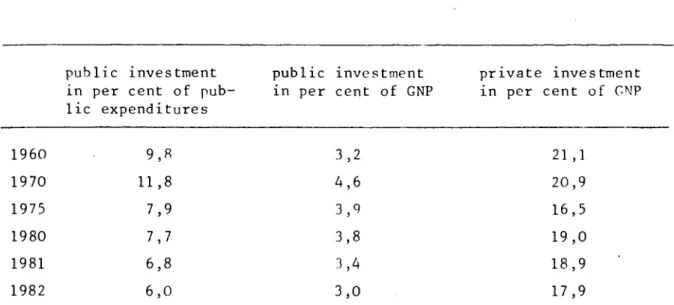
-Table 3 : Private and Public Investment (in per cent)
1960 1970 1975 1980 1981 1982
9,8 11,8 7,9 7,7 6,8 6,0
public investment public investment p r i v a t e investment in per cent of pub- in per cent of GNP in per cent of GNP l i e expenditures
3,2 21,1 A,6 20,9 3,9 16,5 3,8 19,0 3,4 18,9 3,0 17,9
Source: SVR Jg. 1983/84
Private investment in per cent of GNP mounted in 19 70 to 20.9 % of GNP. In 1982, the same figure declined to 17.9 %. This dramatic decrease of private investment was combined with a corresponding development of public investment. Public
investment in per cent of GNP decreased from 4.6 % in 1970 to 3.0 % in 1982. These developments of investment-ratios heavily contributed to the slowing-down of growth rates of GNP and to the development of employment in the West-German economy.
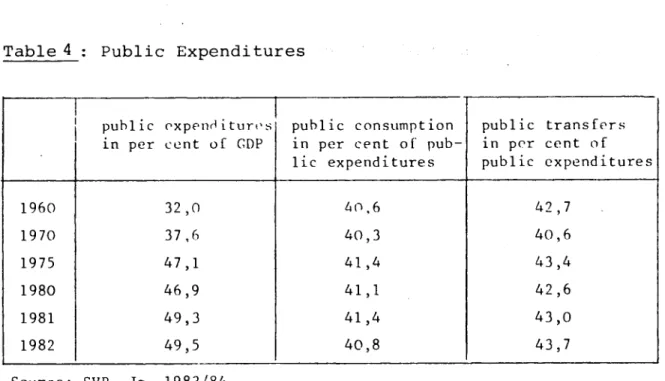
Table 4 ; Public Expenditures 1960 1970 1975 1980 1981 1982
public expend i turns in per cent of GDP
32,0 37,6 47,1 46,9 49,3 49,5 public consumption in per cent oÍ" pub-lic expenditures 40.6 40,3 41,4 41,1 41,4 40,8 public transfers in per cent of public expenditures 42,7 40,6 43,4 42,6 43,0 43,7 Source: SVR, Jg. 1983/84
It is easily to be seen (table 4) that public expenditures in per cent of GDP increased dramatically due to an increase of public consumption as well as public transfers. Thus, the decrease of public investment in per cent of public expendi-tures should be explained by (a) the efforts to consolidate the budgets, and (b) by a restructuring of public expenditures in disfavour of public investment.
The argument even holds true since 1982. With sharp cut-backs in public expenditures, West-German government tried to bring down public deficits. At the same time, public investment was not enhanced to the desired extent. There still is a consi-derable need to increase public investment as compared with public consumption.
A closer look on the structure of public expenditures and
public investment classified according to Federal Government and "Länder und Gemeinden" (local government), show, that the
decrease of public investment is mostly due to investment
Table 5:
Public Expenditures and Public Investment
Expenditures in Bill. DM Growth rate
(in per cent) Investment in Bill. DM Growth rate (in per cent)
Federal Government 1981 233,0 8,0 7,3 -11,3 1982 244,6 5,0 7,0 -4,5
1983ü 1984^
252,2 259,0 3,1 2,7 7,5 7,3 7,8 -2,7 Länder 1981 210,6 3,6 9,2 -5,5 1982 217,6 3,3 9,1 -1,5
19831) 1^84Ü
220,8 226,5 1,5 2,6 9,0 9,0 -0,5 0,0 Local Government 1981 136,5 4,9 37,9 -3,8 1982 135,7 -0,6 32,9 -13,1
19831) 1984l)
138,0 142,5 1,7 3,3 31,7 32,2 -3,7 1,6 1981 501,7 6,3 54,4 -5,2 Tota 1982 518,8 3,4 48,9 -10,0 1 1983I) 532,8 2,7 48,2 -1,5 i9841} 548,7 3,0 48,5 0,6 LO KJ 1) Estimation
on the level of "Gemeinden und Ländern" should be enhanced. But it is also true, that for an improvement of public invest-ment with considerable spinover-effects on private investinvest-ment does definitely require more efforts of Federal Government to restructure the Dublic budaet in favour of public investment.
The idea, that much emphasis has to be layed on the encourage-ment of private investencourage-ment and the enhanceencourage-ment of public in-vestment is agreed by almost all political decision-makers
(CDU, 1982; FDP, 1982; SPD, 1982; DGB, 1982; BDI, 1982 a) as well as economists (SVR, 1982/83). Different views certainly do exist with regard to the form, in which government should intervene and the balance between private and public investment, We will deal with those problems in the next paragraph.
7
Alternative Projects: Private and Public InvestmentWhereas a more traditional concept of employment policy de-fines targets in terms of the number of jobs created, a more sensible view tackles qualitative aspects. If economic and social needs are well defined one may determine areas of job creation which are aimed to future growth.
The relevance of specific growth areas in the public and pri-vate economy is highly disputed among economists and politi-cians (see Appendix, table22). But there is a consensus on future patterns of the German economy with regard to growth and.investment, which is based on
34
-a)
The market for new technologies will expand for two reasons: first, traditional industries will increase competitiveness by introducing new modes of productions and by an inforcement of rationalization; secondly, the German economy will regain its leading position on the world market only by opening up new markets. Therefore the basic technological changes are expected at micro-electronics, bio-technology, robot-techno-logy, and communication technologies.
It is definitely true, that the performance of the West-German economy heavily depend on the patterns of international trade This is true because of the rather high degree of economic
interdependencies of the German economy and the world market. Around one third of industrial production is exported, around 35 % of the total labour force in the FRG is working in the export sector.
Given these characteristics, it is easily to be seen that a worsening of the international competition of the West-German economy will be harmful. With regard to errors of futurai growth this worsening of the degree of competition of the West-German economy already happened. Only within the EC-countries, the patterns of exports are satisfying, but, con-cerning to export developments to newly industrializing countries, to Japan and the United States, export shares de-clined and are under average with regard to other EC-countries.
Industries which are supposed to dominate in the future like electronics, data processing, information technologies, chip and robot production, air and space industries etc. are char-acterized in the FRG by a worsening of the degree of compe-tition. The dynamics of growth in these industries are low: rates of growth of the FRG are economy with regard to the in-dustries mentioned under average compared to the rates of growth on the world market.
indu-stries are needed. This is especially true for the implementat-ion óf new technologies in specific industries like
electro-nics, engineering, tele-processing, and automotives, industries, which will be characterized by an increasing degree of imple-menting robots and chips. Chip production will increase all over
the world, the same is true for the market for electronics. With regard to the world market, the robot production, bio-technology, and micro-electronic are supposed to have rates of growth of about 15 to 20 % in the eighties (Wirtschafts-woche, 26/1983; Wirtschafts(Wirtschafts-woche, 15/1983; Wirtschafts(Wirtschafts-woche,
5/1984 a; BDI 1982 c) .
With regard to policy measures, the improvement of research and development as well as the implementation of new techno-logies are most important. As far as the employment impacts are concerned, there definitely will be a substitution effect between new jobs created on the one hand and other jobs
vanishing because of rationalization. Whether an overall em-ployment increase will occur, is uncertain. But it is almost certain, however, that the structure of qualifications de-manded will change significantly. There is no doubt, that
technological change will enforce the obsolescence of tradi-tional industrial skills and does require new qualifications of labour in the areas of research and development, systems engineering, data processing etc. Thus, policies to improve the creation of jobs in areas of future growth should be com-bined with and linked to measures to improve and change
qua-lification of labour, that is to embody technical progress also in human capital.
b)
36
-make financial sacrifices for an improvement of the environ-ment. Similar to that there is a growing demand for the pro-tection of urban life styles as well as high quality housing. Additionally, some social and economic needs are not met by the given supply of goods and services. This is especially true for public transport, energy protection, and the improve-ment of the social and cultural standard of living.
One should mention, too, that further need for new investment exists because of a somewhat aging capital stock of the FRG. economy. Empirical evidence shows, that, during the seventies, the average age of the capital stock did increase in the
West-German economy (RWI, 1983). A more cautious assessment still proves, that the process of renewal of the capital stock during the sixties has come to an end in the seventies (HWWA,
1983). If it is true (DIW, 1983), that investment in construc-tion and houses was lower than investment in the manufacturing industries, one may state, that there is a growing need for further investment in the infra-structure, especially in con-struction, road-building, houses etc. to prevent from a
further aging of this part of the capital stock.
Despite of the general acceptance of these patterns, it is heavily discussed which policy measures should be undertaken. The debate refers to the form of state intervention. West-German government nowadays believes more in some sort of
supply-side economies with the consequence of emphasizing the need for a consolidation of the public budget. More traditio-nal Keynesian views not being in the underdog, but in a mino-rity position, argue, that more deficit spending is needed. This does not contrast with the conservative idea of
disagree about the way this should be done as well as the distributional aspect.
One should learn something from past experiences. In the se-venties, most EC-countries reacted to a recession by imple-menting a kind of traditional Keynesian policies, that is demand stimulation by deficit spending policy. This is also true for the FRG, in which, in 1974/75 and 1977/78, a more expansionary policy pattern was pursued. Especially in 1977/ 78 emphases was layed on programs of investment in areas of future growth (Zukunftsinvestitionsprogramm, ZIP). Even a
cautious evaluation proves, that there was an additional employ-ment effect of around 160.000 workers in those years (DIW,
11/1980). This expansional policy pattern was removed from 1980. Empirical based simulations of possible effects of a more expansionally policy from the beginning of 198 0 show, however, that there could have been an additional employment impact of 200.000 people (DIW, 50/1982).
In this paper we argue that public policy should not rely on one of the competing economic philosophies, but has to look for a policy-mix-strategy:
if market forces are strong, a positive and high rate of profit will encourage private activities, and no state intervention is necessary;
if market forces are weak in the short run, but are supposed to improve in the medium term, state interven-tion can concentrate on tax relief and/or subsidies with special regard to risk-taking and research and develop-ment;
evidently there exist areas of production in which the principles of a market economy will not show acceptable results. The term acceptable reflects both, an economical as well as a distributional aspect.
38
-consensus, that industries for leisure goods and services are growing without any state intervention and that the adaption of new technologies should be enforced by public support of research and development as well as an improvement of the infrastructure through an extension of new information and communication systems. The main public activities will be in the area of social and economic needs: social services, energy conservation, housing and urban renewal, environmental pro-tection, transport, information and communcation systems, and research and development.
We will deal with these activities in more detail with regard especially to rates of return, employment impacts, and growth stimuli. Some ideas on the adequate form of state intervention are to be found at the end of this paper.
3 - Public Activities and Job Creation
3.1. Energy Conservation
Since the beginning of the worldwide recession, the job-argu-ment plays an increasing role within the energy policy debate. On the one hand, it is argued, that the production of more energy is needed not only because of growing demand of the economy, but especially because of a number of jobs which are additionally created in this areas. On the other hand, some economists argue, that future demand for energy is overstated as well as the number of jobs which could be created.by in-creasing energy. Today, there is a growing understanding, that the alternative between energy-saving versus more employment is^simply wrong. The relationship between the use of energy and the development of employment is more complex. It depends on the overall economic growth, the inter-sectoral changes
pro-duction or industries with low energy consumption) and last but not least the intra-sectoral developments of energy
con-servation and new forms of energy production.
To the same extent as the failure of prognoses of further in-creasing energy consumption became evident and the vision of a stagnating demand for energy became more realistic, the aspect of energy conservation became more important. More optimistic prognoses are expecting additional investments of 40 bill. DM (Krupp, 1983), and new employment possibilities for 950.000 persons (Roth,W3983). Concerning to more pessi-mistic estimations, there is a need for additional investment of 10 bill. DM per year (Spitzley, 1983), and lower employ-ment effects. Beyond the PROGNOS (Prognos AG, 1981) an improve-ment estimates of the balance of payimprove-ment of 5o bill. DM, if all proposed investment in energy conservation will be realized.
a) Insulation
It is widely accepted, that major parts of existing houses are to be insulated. PROGNOS estimates, that their share is about 80 - 90 % of all houses, that is 20 million dwellings (BMFT-PROGNOS, 1982). Some figures are even higher, they amount to 26 - 28 million dwellings (Roth et al., 1980) , some figures are lower (Spitzley, 1983).
According to various estimations, figures for investment nee-ded for insulation differ from 100 bill. DM to 400 bill. DM. Concerning to major statements, the PROGNOS estimations seem to be the most realistic ones. The following arguments are based on the PROGNOS figures.They are calculated on unit costs of insulation in the range of about 20.000 DM up to 40.000 DM, which gives a total amount of about 400 bill. DM
_ 4ο _
Table 6 : Conservation of Energy: Housing; Capital Expen ditures (bill. DM, real terms, basis 1976)
Industry Housing
Low Consumers Total
1976 - 1990 65,1 243,4 175,8 484,3 Source: FSA; PROGNOS AG, 19 78
There are at least two advantages of energy-saving by the way of an improvement of insulation. Firstly, the degree of self-financing is rather high, but evidently dependent on the future pattern of energy prices. Secondly, job creation in this area is rather high because investment is labour intensive.
With regard to the first argument, it is calculated, that around 18 % of primary energy or some 45 % of energy used for heating systems for residential premises can be saved. These figures are developped under the assumption of a rather stable oil price. Given the view of higher oil prices, the internal rate of return of investment in insulation will be higher.
But even given the assumption of rather stable prices of energy, self-financing of capital expenditure in insulation of dwellings amounts to some considerable 60 %. This figure only accounts for revenues from energy-saving, not taking into, account returns for the public budget because of a lower unemployment compensation, given a specific employment impact of investment.in energy-saving. This additional employment impact of investment in insulation amounts to 3 0O.COO workers per year (PROGNOS, 1982), taken into account direct, and, due to the income multiplier, indirect employment impacts of
This rather high employment impact of investment in insulat-ion is due to the fact, that investment is labour intensive. The degree of self-financing due to energy conservation and the impact on the public budget evidently depends not only on the patterns of energy prices, but also on the form of state intervention. A recent IFO-study on the efficiency of public energy saving policies shows, that public energy policy was just as important for energy-saving as the increase of energy prices. There are some well developed concepts of government intervention in this area:
Under the cover of a federal program a first and final subsidy of 25 % was paid for investment in insulation of dwellings. The "Länder" of the FRG now use different systems, for example in Berlin (West) annual subsidies are paid up to 30,6 % of total costs (maximum 12.000 DM per unit) for a period of nine years.
Zero-interest credits or credits with a low rate of interest, subsidized by government, are suggested, too
(Roth,w]983; Klauder, 1980).
The stabilization of energy import prices by introducing temporary import duties (Krupp, 1983).
To combine the interests of tenants with those of land-lords, it is suggested to introduce a splitted heating cost calculation (Roth,W,1983) Umweltrat und Enquête-Kommission, 1983; Hennicke, 1983).
42
-b) Production of Primary Energy
With regard to the degree of efficiency of using primary ener-gy, nev/ and more efficient systems may be used and developed Up to now the degree of efficiency of production of energy amounts to only 1/3. The key for higher efficiency lays in the simultaneous generation of heat and energy (cogeneration / Wärmekraftkopplung). With already existing technologies the exploitment rate of primary energy could be increased to 50 per cent and more. The degree of efficiency of using primary energy can be increased by improving the existing systems or developing new ones. At the moment two concepts are widely discussed :
• A more traditional concept is based on the idea to develope long-distance heating systems further on the grounds of the existing power plants. If this more traditional concept is used and simultaneously assumed that one fourth of the demand for heat should be provided for by long-distance heating systems, a direct employment effect of 60.000 workers can be calculated for a time period from 1980 up to 1985 (Spitzley, 1983; Ströbele, 1978). This fig-ure is not equivalent to other models, using different time periods and different patterns of supply.
Therefore,Roth calculates an employment effect of 550.000 persons (Roth,W.1983) . This employment effect is related to the construction of new, long-distance heating pipelines. Additionally, about 10.000 - 20.000 workers are needed for operating the system. Given the concept of the energy
producing companies (Energieversorgungsunternehmen) up to the end of the decade there is an overall investment gap of about 100 billion DM.
According to IFO-estimations, the share of public invest-ment subsidies are about 40 % of total investinvest-ments.
power plants. It was shown (Weiss, 1978), that at least in terms of operating plants, nuclear power stations re-quire a number of workers which is lower as compared to traditional power stations which are operated by coal. Power plants operated by coal require some addational 4.000 manyears to running the plants. In addition they will require about 80.000 new jobs in the mining indu-stry (Haak),
Somewhat more revolutionary concepts are based on the idea to develope smaller Power stations which are based on cogeneration (Wärmekraftkopplung). These new techno-logies require a more decentralized organization of the heating system in favour of medium-distance concepts. If it is true, that these technologies already exist (Schwei-zer Energiestiftung, 1977), the degree of efficiency of using energy can be increased. Positive and considerable employment effects are likely. On the basis of a rather moderate scenario with regard to future natterns of de-mand for energy, an employment effect of about one per cent of the labour force is assumed, given a decentralized concept.
Whereas the more traditional argument normally runs in favour of lower costs, for the centralized solution with somewhat bigger power plants whether they operate by
44
-and distribution to decentralized systems using the heat-electricity-model with small plantsare labour-intensive, are creating more jobs and are more cost-efficient at the same time.
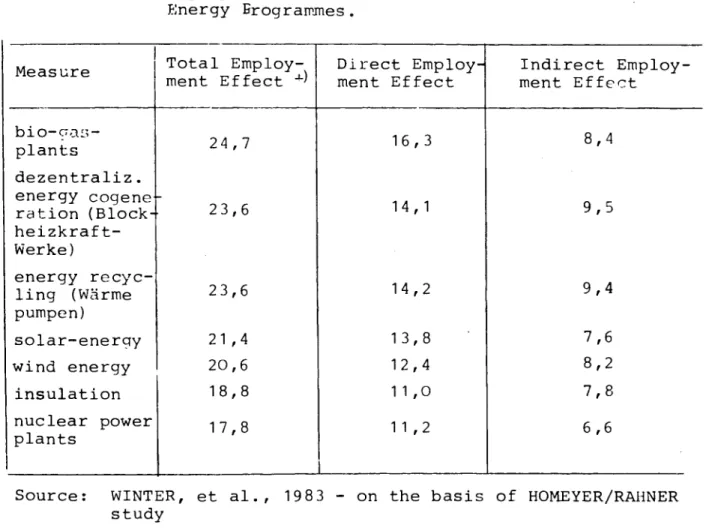
The same argument is stressed by the study of Homeyer and Rahmer on the basis of input-output-analysis of the DIW
(according to Binswanger, 1983). In a recent study by Homeyer and Rahmer the effects of seven different energy policy measures are compared as shown. The results are as follows:
Table 7 : Employment E ffects of Investments in Alternative Energy Programmes .
Measure bio-gas-plants dezentraliz. energy cogene ration (Block- heizkraft-Werke) energy recyc-ling (Wärme pumpen) solar-energy wind energy insulation nuclear power plants Total Employ-ment Effect +)
24,7 23,6 23,6 21 ,4 20,6 18,8 17,8 Direct Employ-ment Effect 16,3 14,1 14,2 13,8 12,4 1 1 ,0 1 1 ,2
Indirect Employ-ment Effect 8,4 9,5 9,4 7,6 8,2 7,8 6,6
Source: WINTER, et al., 1983 - on the basis of HOMEYER/RAHNER study
+) in 1.000 manyears per billion amount of investment