RESEARCH ARTICLE
The effects of temporal neck cooling
on cognitive function during strenuous exercise
in a hot environment: a pilot study
Soichi Ando
1,2*, Takaaki Komiyama
3, Mizuki Sudo
4,5, Akira Kiyonaga
1,4, Hiroaki Tanaka
1,4and Yasuki Higaki
1,4Abstract
Background: Heat stress potentially has detrimental effects on brain function. Hence, cognitive function may be impaired during physical activity in a hot environment. Skin cooling is often applied in a hot environment to counter-act heat stress. However, it is unclear to what extent neck cooling is effective for cognitive impairment during exercise in a hot environment. The purpose of this study was to examine the effects of temporal neck cooling on cognitive function during strenuous exercise in a hot environment.
Methods: Eight male young participants (mean ± SD, age = 26.1 ± 3.2 years; peak oxygen uptake = 45.6 ± 5.2 ml/ kg/min) performed Spatial delayed response (DR) task (working memory) and Go/No-Go task (executive function) at rest and during exercise in the Hot and Hot + Cooling conditions. After the participants completed the cognitive tasks at rest, they cycled the ergometer until their heart rate (HR) reached 160 beats/min. Then, they cycled for 10 min while keeping their HR at 160 beats/min. The cognitive tasks were performed 3 min after their HR reached 160 beats/ min. The air temperature was maintained at 35°C and the relative humidity was controlled at 70%. Neck cooling was applied to the backside of the neck by a wet towel and fanning. We used accuracy of the Spatial DR and Go/No-Go tasks and reaction time in the Go/No-Go task to assess cognitive function.
Results: Neck cooling temporarily decreased the skin temperature during exercise. The accuracy of the cognitive tasks was lower during exercise than that at rest in the Hot and Hot + Cooling condition (p < 0.05). There were no differences in the accuracy between the Hot and Hot + Cooling conditions (p = 0.98). Neither exercise (p = 0.40) nor cooling (p = 0.86) affected reaction time. These results indicate that temporal neck cooling did not alter cognitive function during strenuous exercise in a hot environment.
Conclusions: The present study suggests that temporal neck cooling with a wet towel and fanning is not effective for attenuating impairment of working memory and executive function during strenuous exercise with a short dura-tion in a warm and humid environment.
Keywords: Cognition, Exercise, Brain, Hot environment, Body temperature
© 2015 Ando et al. This article is distributed under the terms of the Creative Commons Attribution 4.0 International License (http://creativecommons.org/licenses/by/4.0/), which permits unrestricted use, distribution, and reproduction in any medium, provided you give appropriate credit to the original author(s) and the source, provide a link to the Creative Commons license, and indicate if changes were made. The Creative Commons Public Domain Dedication waiver (http://creativecommons.org/ publicdomain/zero/1.0/) applies to the data made available in this article, unless otherwise stated.
Background
Many sports and occupational settings require high level cognitive ability under physiological stress in a hot environment. For example, soccer players make deci-sions quickly and appropriately while running in a hot
environment. Occupational workers are often forced to carry out complex physical works in a hot summer. Physical activity in a hot environment imposes a severe burden on the cardiovascular system because of com-petition between the muscle, skin, and brain for the available systemic blood flow [1, 2]. It has been sug-gested that exercise in a hot environment may decrease arousal level [3], and the brain seems to be particularly vulnerable to hyperthermia [4]. Although our knowl-edge of cognitive function in a hot environment is
Open Access
*Correspondence: [email protected]
1 Faculty of Sports and Health Science, Fukuoka University, Fukuoka,
Japan
mainly based upon data from a resting condition [5–9], it is likely that exercise in a hot environment impair cognitive function.
Skin cooling is known to reduce thermal strain and dis-comfort at rest and during exercise [5, 9–13]. Hence, skin cooling is often applied in a hot environment to counter-act heat stress. Recent studies indicated that head cool-ing has the beneficial effects on short-term memory in a hot environment [6, 14]. Furthermore, neck cooling may enhance cognitive performance in complex tasks fol-lowing exercise-induced hyperthermia [15]. However, it is unclear to what extent skin cooling has beneficial effects on cognitive function during exercise in a hot environment. In many sports and occupational settings, cognitive function plays an important role under physi-ological stress in a hot environment. Thus, it is impera-tive to examine the effects of skin cooling on cogniimpera-tive function during exercise under various experimental conditions. In the present study, we used temporal neck cooling because brief neck cooling is easily available and practically applicable to situations where exercise or physical activity is actually performed in a hot environ-ment. Furthermore, this maneuver does not interfere with performing the cognitive task. In the present study, we hypothesized that if brief neck cooling has beneficial effects on cognitive function during exercise in a hot environment, the impairment in cognitive function may be attenuated by physiological and/or psychological changes induced by brief neck cooling.
When exercise duration is prolonged in a hot environ-ment, dehydration is inevitable. Dehydration may also impair cognitive function although the results in previ-ous studies are somewhat controversial [16–24]. Thus, we used strenuous exercise with a short duration to exclude the possibility that dehydration also influences cognitive function. This allows us to focus on the effects of tempo-ral neck cooling on cognitive function during exercise in a hot environment.
The purpose of the present study was to examine the effects of temporal neck cooling on cognitive function during strenuous exercise in a hot environment. This study will provide empirical evidence to demonstrate the effects of temporal neck cooling on cognitive function during strenuous exercise with a short duration in a hot environment, especially its validity and limitations.
Methods
Participants
Eight male young participants (mean ± SD, age = 26.1 ± 3.2 years; height = 1.75 ± 0.06 m; weight = 69.6 ± 8.3 kg; peak oxygen uptake = 45.6 ± 5.2 ml/kg/min) were fully informed of the risks and discomforts associated with this study before giving written informed consent to
participate. The participants were free of cardiovascular, cerebrovascular, or respiratory disease and were not tak-ing any medications. They were not acclimated to exer-cising in a hot environment. This study was approved by the ethics committee of Fukuoka University and was in accordance with the Declaration of Helsinki.
Cognitive task
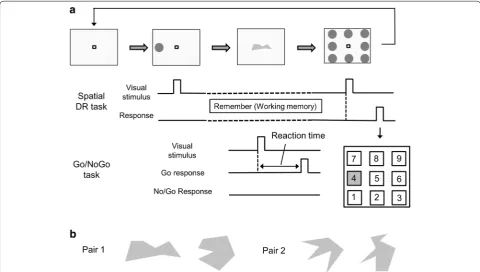
A laptop computer was used to present visual stimuli. The participants performed a combination of the Spa-tial delayed response (SpaSpa-tial DR) task and the Go/ No-Go task [25, 26], where working memory and execu-tive function were required. The participants performed the cognitive task while they faced a computer display at a viewing distance of approximately 80 cm on a cycle ergometer (75XLII, COMBI Wellness, Tokyo, Japan). Details in the present cognitive task were described else-where [26], and were summarized in Figure 1a. In brief, at the beginning of the cognitive task, the participants remembered the location where visual stimulus was pre-sented (Spatial DR task). Then, one of the paired figures (Figure 1b) was presented (Go/No-Go task). In the case of a Go-trial, participants released the shift button as quickly as possible. In the case of No-Go trials, partici-pants continued pressing the shift button. After the Go/ No-Go task, visual stimuli were presented at eight loca-tions surrounding the fixation point. The participants pressed the button of the ten-key corresponding to the remembered location (Spatial DR task). The cognitive task continued until participants completed 30 trials of both tasks. The participants pressed the ten-key with the right index finger (see right bottom of Figure 1a) and pressed the shift button on the keyboard with the left index finger. The ten-key and keyboard were horizon-tally situated above both sides of the handlebar of the ergometer.
reversed or one of the new paired figures was presented in the Go/No-Go task.
Experimental procedure
The experiment was performed on two non-consecutive days. A few days before the first experiment, participants completed a series of practice blocks of the cognitive tasks at rest and during cycling until they were familiar with the task. The familiarization period continued until reaction times fall within 3 SD from the mean. All experi-ments were conducted inside an environmental control chamber (FHC-20S, Fuji-ika Sangyo, Chiba, Japan). In the Hot condition, the air temperature was maintained at 35°C and the relative humidity was controlled at 70%. In the Hot + Cooling condition, the air temperature and relative humidity were the same as the Hot condition, but neck cooling was applied to the backside of the neck by a towel wet in 21°C water and also by fanning from the back of the neck with a small electronic fan. Once the neck cooling was applied to the participant, the towel was put on until the experiment was completed. The towel was not changed during the experiment. The order of experimental conditions was assigned in a counterbal-anced manner.
[image:3.595.57.538.89.361.2]At the beginning of the experiment, the participants performed the cognitive task at rest. One minute after they completed the first cognitive task, participants started to cycle the ergometer. For the first 5 min, exer-cise intensity increased at 30–32 W/min in a ramp man-ner, and then increased at 20–21 W/min in a step manner until participants’ heart rate (HR) reached 160 beats/min. An ear sensor (COMBI Wellness, Tokyo, Japan), which was connected to the ergometer, continuously meas-ured HR. Once the participants’ HR reached 160 beats/ min, exercise intensity was adjusted automatically to maintain the target HR through the ear sensor. The par-ticipants cycled for 10 min while keeping their HR at 160 beats/min. We recorded exercise intensity and HR each minute during exercise after the participants’ HR reached 160 beats/min. The pedalling rate during cycling was chosen freely by each participant. Participants per-formed the cognitive task 3 min after their HR reached 160 beats/min in the Hot and Hot + Cooling conditions. In the Hot + Cooling condition, immediately after the recording of exercise intensity, HR, and skin temperature at 2 min after the participants’ HR reached 160 beats/ min, neck cooling was started (approximately 2 min 10 s after the participants’ HR reached 160 beats/min). The
participants did not drink beverages throughout the experiment.
Other measurements
Skin temperature (O215-WT, Dretec, Saitama, Japan) was measured from the neck to evaluate the effects of the neck cooling. Probe of the thermometer was directly con-tacted to the backside of the neck. Skin temperature was recorded each minute during exercise after the partici-pants’ HR reached the target level. Ratings of perceived exertion (RPE; 6–20 Borg scale) [28] were recorded immediately after each cognitive task (within 10 s). Blood lactate concentrations were measured at rest and imme-diately after exercise. Capillary blood was collected from the right earlobe. Blood lactate concentration was deter-mined with the lactate oxidase method using an auto-mated analyzer (Lactate Pro, Arkray, Kyoto, Japan). Body weight was measured without clothes before exercise after emptying the bladder, and after exercise. Weight reduction was expressed as a percentage of body weight, and dehydration was assessed by weight reduction. Body temperature was measured from the tympanic mem-brane before and after exercise. We measured body tem-perature at the room outside the environmental chamber. In the room outside the chamber, the air temperature was maintained at 21°C and the relative humidity was controlled at 50%.
Data and statistical analysis
Two-way analysis of variance (ANOVA) with Exercise (rest and exercise) and Condition (Hot and Hot + Cool-ing) as the within-participants factors was performed for RPE, blood lactate concentration, body weight, body temperature, accuracy of the cognitive task, and reac-tion time in the Go-trial. We also performed two-way ANOVA with Time Course and Condition as the factors for exercise intensity, HR and skin temperature. Paired t tests were conducted to compare differences where
appropriate. All data are expressed as mean ± SD. The significance level was set at p < 0.05.
Results and discussion
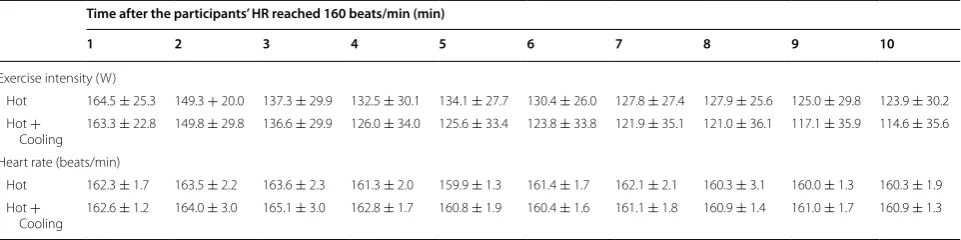
Exercise intensity and HR
Table 1 shows exercise intensity and HR after the par-ticipants reached a HR of 160 beats/min. We observed a significant main effect of Time Course (F [9,63] = 45.02, p < 0.001, η2 = 0.87) on exercise intensity. There were
no significant main effect of Condition (F [1,7] = 1.62, p = 0.24, η2 = 0.19) and interaction (F [9,63] = 1.01,
p = 0.44, η2 = 0.13). These results indicate that
exer-cise intensity decreased as time elapsed and the degree of decrease was not different between conditions. Simi-larly, we found a significant main effect of Time Course (F [9,63] = 6.39, p < 0.001, η2 = 0.48) on HR. There were
no significant main effect of Condition (F [1,7] = 2.91, p = 0.13, η2 = 0.29) and interaction (F [9,63] = 0.81,
p = 0.61, η2 = 0.10). The significant main effect of Time
Course may be ascribed to a slight higher HR around the first 3 min after the participants’ HR reached 160 beats/ min. Overall, HR appears to be well controlled around the target level in the present study.
RPE, blood lactate concentration, body weight, and body temperature
Table 2 shows RPE, blood lactate concentration, body weight, and body temperature. We found significant main effects of Exercise on RPE (F [1,7] = 174.49, p < 0.001, η2 = 0.96), blood lactate concentration (F
[1,7] = 43.02, p < 0.001, η2 = 0.86), body weight (F
[1,7] = 55.30, p < 0.001, η2 = 0.89), and body
tem-perature (F [1,7] = 56.82, p < 0.001, η2 = 0.89). In
con-trast, Condition did not affect these parameters. There were no significant interactions. Collectively, exercise increased RPE and blood lactate concentrations to the same extent in both conditions. The degree of dehydra-tion and increase in body temperature were not different
Table 1 Changes in intensity and HR during exercise after the participants’ HR reached 160 beats/min
Values are mean ± SD.
Time after the participants’ HR reached 160 beats/min (min)
1 2 3 4 5 6 7 8 9 10
Exercise intensity (W)
Hot 164.5 ± 25.3 149.3 + 20.0 137.3 ± 29.9 132.5 ± 30.1 134.1 ± 27.7 130.4 ± 26.0 127.8 ± 27.4 127.9 ± 25.6 125.0 ± 29.8 123.9 ± 30.2 Hot +
Cooling 163.3 ± 22.8 149.8 ± 29.8 136.6 ± 29.9 126.0 ± 34.0 125.6 ± 33.4 123.8 ± 33.8 121.9 ± 35.1 121.0 ± 36.1 117.1 ± 35.9 114.6 ± 35.6 Heart rate (beats/min)
Hot 162.3 ± 1.7 163.5 ± 2.2 163.6 ± 2.3 161.3 ± 2.0 159.9 ± 1.3 161.4 ± 1.7 162.1 ± 2.1 160.3 ± 3.1 160.0 ± 1.3 160.3 ± 1.9 Hot +
[image:4.595.58.539.590.710.2]between conditions. Indeed, we observed no difference in weight reduction between conditions (0.41 ± 0.07% in the Hot condition and 0.37 ± 0.22% in the Hot + Cooling condition).
[image:5.595.56.291.113.289.2] [image:5.595.303.540.374.689.2]Effects of neck cooling on skin temperature
Figure 2 illustrates the skin temperature during exer-cise. The main effects of Time Course (F [1,9] = 9.60, p < 0.001, η2 = 0.58) and Condition (F [1,7] = 8.03,
p < 0.05, η2 = 0.53) were significant. There was a
signifi-cant interaction between Condition and Time Course (F [9,63] = 8.88, p < 0.001, η2 = 0.56). These results
indi-cate that skin temperature changed in a different manner between conditions. We observed significant differences in skin temperature between conditions after neck
cooling. However, the effects of neck cooling were tem-poral and did not last until the end of the exercise.
[image:5.595.58.290.542.687.2]Cognitive function
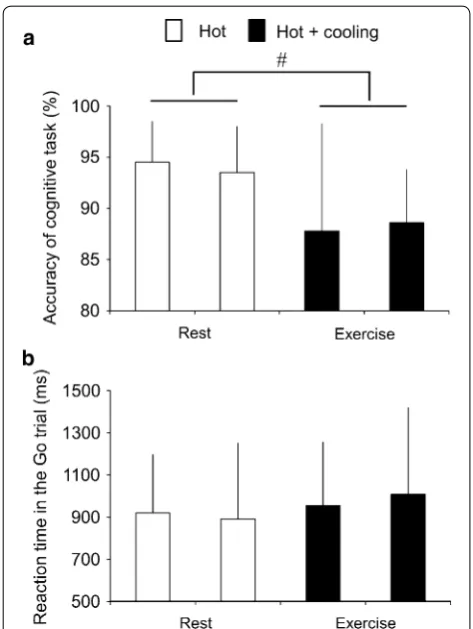
Figure 3 illustrates the accuracy of the cognitive task (A) and reaction time in the Go-trial (B). We observed a sig-nificant main effect of Exercise on the accuracy of the cognitive task (F [1,7] = 8.78, p < 0.05, η2 = 0.56). We
found neither a significant main effect of Condition (F [1,7] = 0.001, p = 0.98, η2 < 0.001) nor a significant
inter-action (F [1,7] = 0.27, p = 0.62, η2 = 0.04). These results
indicate that the accuracy of the cognitive task signifi-cantly decreased during exercise, and that temporal neck cooling had no effects on the accuracy of the cognitive task. Reaction time in the Go-trial was not affected by Exercise (F [1,7] = 0.802, p = 0.40, η2 = 0.10) or
Condi-tion (F [1,7] = 0.03, p = 0.86, η2 = 0.005) in the present
study.
To our knowledge, no studies have examined the effects of temporal neck cooling on cognitive impairment dur-ing strenuous exercise in a hot environment. We tested if temporal neck cooling with a wet towel and fanning has Table 2 RPE, blood lactate concentration, body weight,
and body temperature
Values are mean ± SD.
RPE ratings of perceived exertion. * p < 0.001, vs. rest.
Condition Variable Rest Exercise After
Hot RPE 7.3 ± 0.4 15.9 ± 2.0* Blood lactate
concentration, mmol/l
1.0 ± 0.2 5.3 ± 1.9*
Body weight, kg 69.1 ± 7.5 68.8 ± 7.5* Body temperature,
°C 36.1 ± 0.6 38.4 ± 0.4* Hot + Cooling RPE 7.1 ± 0.9 15.8 ± 1.7*
Blood lactate concentration, mmol/l
1.0 ± 0.2 5.5 ± 1.7*
Body weight, kg 68.9 ± 7.7 68.6 ± 7.7* Body temperature,
°C 36.5 ± 0.6 38.3 ± 0.3*
Figure 2 Neck skin temperature in the Hot and Hot + Cooling conditions during exercise. The upper dashed arrow indicates the time when neck cooling was started. ‡‡p < 0.01 between the conditions.
beneficial effects on cognitive function during strenuous exercise with a short duration in a hot environment. The main finding of this study was that temporal neck cool-ing did not attenuate the detrimental effects on cognitive function during strenuous exercise in a hot environ-ment. The present finding suggests that temporal neck cooling with a wet towel and fanning is not effective enough to attenuate cognitive impairment during strenu-ous exercise with a short duration in a warm and humid environment.
We assessed cognitive function using the combina-tion of spatial DR task and Go/No-Go task. The Spatial DR task requires working memory [25, 29]. The Go/ No-Go task requires executive function, including selec-tive attention, response inhibition and interference con-trol [30, 31]. The prefrontal and parietal cortices play a key role in spatial working memory [32–35]. Activation in the prefrontal cortex is crucial for executive function [36, 37]. Furthermore, the frontopolar cortex, which is located at the most anterior part of the frontal cortex, is selectively activated in multi-tasking where execution of the primary task was maintained in a pending state while performing a secondary task [38]. Given that the present cognitive task was a modified version of multi-tasking, the present cognitive task required activation of the fron-topolar cortex. Taken together, we can assume that the present cognitive task was appropriate to assess higher cognitive function in humans.
In the present study, HR was maintained at 160 beats/ min during exercise. Indeed, RPE was approximately 16 immediately after the cognitive tasks during exercise. Furthermore, blood lactate concentration increased above 5 mmol/l after exercise in both conditions. Hence, in the present study, we can assume that exercise inten-sity was classified as strenuous.
Skin cooling may reduce thermal strain and/or discom-fort at rest and during exercise [5, 9–13]. Thus, physio-logical as well as psychophysio-logical changes induced by skin cooling may somehow attenuate the impairment in cog-nitive function during exercise in a hot environment. Previous studies indicated that head and neck cooling with frozen packs prevented the impairment of short-term memory [14, 39]. In the present study, the accu-racy of the cognitive task decreased during exercise in the Hot and Hot + Cooling conditions. We observed no differences in the accuracy of the cognitive task during exercise between conditions. These results suggest that temporal neck cooling for a short period did not have beneficial effects on cognitive function during exercise in a hot environment under the present condition. In the present study, while neck cooling temporarily decreased skin temperature, neck cooling did not alter body tem-perature. These results mean that the neck cooling
applied in this study was not effective enough to decrease body temperature. The present results are in line with the findings showing that skin cooling did not reduce body temperature [9–11, 40]. Moreover, we found no differ-ences in RPE between conditions. Therefore, the lack of beneficial effects of temporal neck cooling on cognitive function would be ascribed to that physiological and/or psychological changes induced by brief neck cooling was not sufficient enough to attenuate the detrimental effects on cognitive function.
Dehydration is one of the potential factors that may impair cognitive function in a hot environment. Hence, we used strenuous exercise with a short dura-tion. We expected that severe dehydration is unlikely to occur even in a hot environment in the present study. Indeed, weight reduction was less than 0.5% in the Hot and Hot + Cooling conditions. Previous studies sug-gested that dehydration may impair complex cognitive tasks when weight reduction was greater than 2% [21,
22, 39]. Indeed, Gaoua et al. [39] suggested that, when weight reduction did not exceed 0.5%, fluid replace-ment is adequate and dehydration does not alter cog-nitive function. Hence, we can assume that the effects of dehydration on cognitive function were negligible in the present study.
In contrast to the accuracy of the cognitive task, reac-tion time in the Go-trial was not altered by exercise. These results suggest that the effects of strenuous exer-cise in a hot environment are different between accuracy and speed of response. Previous studies indicated that nerve conduction velocity increases in the hot environ-ment [14, 39]. Thus, exercise in a hot environment may increase in nerve conduction velocity, which leads to the decrease in reaction time. However, in the present study, it is unclear whether reaction time was not affected by strenuous exercise or whether increases in conduction velocity in a hot environment was not effective, possibly due to a short duration of exercise. Furthermore, we can-not rule out the possibility that increases in nerve con-duction velocity compensated for the negative effects of strenuous exercise on speed of response. Provided that multiple factors are responsible for changes in response speed during exercise, further studies will be required to elucidate these points.
the association between arousal level and cognitive function.
Limitation
Whereas the present study benefited from a simple experi-mental design, there are several limitations in the present study. First, we matched exercise intensity during exercise based on the participants’ HR. Thus, the present results may be ascribed to the HR matched exercise. This point is a limitation to extend this finding to exercise-cognition interaction in other experimental conditions. Second, we used neck cooling by a wet towel and fanning because this method is practical and easily applicable. Once the wet towel was applied to the backside of the neck, the wet towel was not changed. Thus, the decrease in skin tem-perature was small and did not last more than 5 min (Fig-ure 2). In contrast, in the previous studies that examined the effects of skin cooling on cognitive function, three cool frozen packs with a protective layer were applied to the head and neck [14, 39]. In another study, neck cooling was applied with neck cooling collar, and the cooling compo-nent was drained and replaced with a gel refrigerant [15]. Hence, cooling method in the present study was far less effective to counteract heat stress as compared with the method in the previous studies [14, 15, 39]. Furthermore, a previous study suggested that forehead cooling leads to the most beneficial effects on reducing thermoregulatory responses to a hot environment [43]. It is also suggested that the beneficial effects of head cooling may be more effi-cient with cognitive functions primarily involving the fron-tal cortex [39]. Accordingly, it is plausible that the absence of beneficial effects of neck cooling on cognitive function is attributable to the cooling method and cooled location in the present study. Future studies are needed to elucidate how skin cooling alters cognitive function during exercise in a hot environment with more effective cooling methods, including forehead cooling. Third, in the present study, exercise duration was short to avoid dehydration. Further investigation is necessary to clarify the effects of exercise with a longer duration in a hot environment on cognitive function. Finally, we measured tympanic temperature to evaluate body temperature. However, it is well known that tympanic temperature is not accurate as compared with rectal or oesophageal temperatures. Thus, accurate meas-urements of body temperature would be needed to reveal how and why cognitive function is altered during exercise in a hot environment.
Conclusion
We examined the effects of temporal neck cooling with a wet towel and fanning on cognitive function during strenuous exercise with a short duration in a hot envi-ronment. The present study suggests that temporal neck
cooling by a wet towel and fanning may not be effective for attenuating impairment of working memory and executive function during strenuous exercise with a short duration in a hot and humid environment.
Authors’ contributions
SA, TK, MS, and YH conceived of the study, carried out the experiment, per-formed data analysis, and drafted the manuscript. AK and HT participated in the design of the study and helped to carry out the experiment and draft the manuscript. All authors read and approved the final manuscript.
Author details
1 Faculty of Sports and Health Science, Fukuoka University, Fukuoka, Japan. 2 Present Address:Graduate School of Informatics and Engineering, The
Uni-versity of Electro-Communications, 1-5-1 Chofugaoka, Chofu, Tokyo 182-8585, Japan. 3 Graduate School of Sports and Health Science, Fukuoka University,
Fukuoka, Japan. 4 Fukuoka University Institute for Physical Activity, Fukuoka
University, Fukuoka, Japan. 5 Physical Fitness Research Institute, Meiji Yasuda
Life Foundation of Health and Welfare, Tokyo, Japan.
Acknowledgements
We are grateful to Dr. Kisou Kubota for providing software to assess cognitive function. This study was supported by a grant from the Uehara Memorial Foundation, JSPS KAKENHI Grant Number 25702039, and MEXT-Supported Program for the Strategic Research Foundation at Private Universities (2008–2012).
Compliance with ethical guidelines
Competing interests
The authors declare that they have no competing interests.
Received: 24 December 2014 Accepted: 22 May 2015
References
1. Gonzalez-Alonso J, Crandall CG, Johnson JM (2008) The cardiovascular challenge of exercising in the heat. J Physiol 586(1):45–53
2. Nybo L, Nielsen B (2001) Middle cerebral artery blood velocity is reduced with hyperthermia during prolonged exercise in humans. J Physiol 534(Pt 1):279–286
3. Nielsen B, Nybo L (2003) Cerebral changes during exercise in the heat. Sports Med 33(1):1–11
4. Brinnel H, Cabanac M, Hales JRS (1987) Critical upper levels of body temperature, tissue thermosensitivity and selective brain cooling in hyperthermia. In: Hales JRS, Richards DAB (eds) Heat stress: physical exer-tion and environment. Elsevier, Amsterdam, pp 209–240
5. Caldwell JN, Patterson MJ, Taylor NA (2012) Exertional thermal strain, pro-tective clothing and auxiliary cooling in dry heat: evidence for physiologi-cal but not cognitive impairment. Eur J Appl Physiol 112(10):3597–3606 6. Gaoua N (2010) Cognitive function in hot environments: a question of
methodology. Scand J Med Sci Sports 20(Suppl 3):60–70 7. Hancock PA, Vasmatzidis I (2003) Effects of heat stress on cognitive
performance: the current state of knowledge. Int J Hyperthermia 19(3):355–372
8. McMorris T, Swain J, Smith M, Corbett J, Delves S, Sale C et al (2006) Heat stress, plasma concentrations of adrenaline, noradrenaline, 5-hydroxy-tryptamine and cortisol, mood state and cognitive performance. Int J Psychophysiol 61(2):204–215
9. Simmons SE, Saxby BK, McGlone FP, Jones DA (2008) The effect of passive heating and head cooling on perception, cardiovascular function and cognitive performance in the heat. Eur J Appl Physiol 104(2):271–280 10. Mundel T, Bunn SJ, Hooper PL, Jones DA (2007) The effects of face cooling
11. Mundel T, Hooper PL, Bunn SJ, Jones DA (2006) The effects of face cool-ing on the prolactin response and subjective comfort durcool-ing moderate passive heating in humans. Exp Physiol 91(6):1007–1014
12. Nunneley SA, Maldonado RJ (1983) Head and/or torso cooling during simulated cockpit heat stress. Aviat Space Environ Med 54(6):496–499 13. Simmons SE, Mundel T, Jones DA (2008) The effects of passive heating
and head-cooling on perception of exercise in the heat. Eur J Appl Physiol 104(2):281–288
14. Racinais S, Gaoua N, Grantham J (2008) Hyperthermia impairs short-term memory and peripheral motor drive transmission. J Physiol 586(Pt 19):4751–4762
15. Lee JK, Koh AC, Koh SX, Liu GJ, Nio AQ, Fan PW (2014) Neck cooling and cognitive performance following exercise-induced hyperthermia. Eur J Appl Physiol 114(2):375–384
16. Adam GE, Carter R 3rd, Cheuvront SN, Merullo DJ, Castellani JW, Lieber-man HR et al (2008) Hydration effects on cognitive perforLieber-mance during military tasks in temperate and cold environments. Physiol Behav 93(4–5):748–756
17. Baker LB, Conroy DE, Kenney WL (2007) Dehydration impairs vigilance-related attention in male basketball players. Med Sci Sports Exerc 39(6):976–983
18. Cian C, Barraud PA, Melin B, Raphel C (2001) Effects of fluid ingestion on cognitive function after heat stress or exercise-induced dehydration. Int J Psychophysiol 42(3):243–251
19. Cian C, Koulmann N, Barraud PA, Raphel C, Jimenez C, Melin B (2000) Influence of variations in body hydration on cognitive function: effect of hyperhydration, heat stress, and exercise-induced dehydration. J Psycho-physiol 14(1):29–36
20. Edwards AM, Mann ME, Marfell-Jones MJ, Rankin DM, Noakes TD, Shillington DP (2007) Influence of moderate dehydration on soccer per-formance: physiological responses to 45 min of outdoor match-play and the immediate subsequent performance of sport-specific and mental concentration tests. Br J Sports Med 41(6):385–391
21. Gopinathan PM, Pichan G, Sharma VM (1988) Role of dehydration in heat stress-induced variations in mental performance. Arch Environ Health 43(1):15–17
22. Neave N, Emmett J, Moss M, Ayton R, Scholey A, Wesnes K (2004) The effects of protective helmet on physiology and cognition in young crick-eters. Appl Cognit Psychol 18:1181–1193
23. Szinnai G, Schachinger H, Arnaud MJ, Linder L, Keller U (2005) Effect of water deprivation on cognitive-motor performance in healthy men and women. Am J Physiol Regul Integr Comp Physiol 289(1):R275–R280 24. Tomporowski PD, Beasman K, Ganio MS, Cureton K (2007) Effects of
dehy-dration and fluid ingestion on cognition. Int J Sports Med 28(10):891–896 25. Harada T, Okagawa S, Kubota K (2004) Jogging improved performance
of a behavioral branching task: implications for prefrontal activation. Neurosci Res 49(3):325–337
26. Komiyama T, Sudo M, Higaki Y, Kiyonaga A, Tanaka H, Ando S (2015) Does moderate hypoxia alter working memory and executive function during prolonged exercise? Physiol Behav 139:290–296
27. Ando S, Hatamoto Y, Sudo M, Kiyonaga A, Tanaka H, Higaki Y (2013) The effects of exercise under hypoxia on cognitive function. PLoS One 8(5):e63630
28. Borg G (1975) Simple rating for estimation of perceived exertion. In: Borg G (ed) Physical work and effort. Pergamon, New York, pp 39–47 29. Jonides J, Smith EE, Koeppe RA, Awh E, Minoshima S, Mintun MA
(1993) Spatial working memory in humans as revealed by PET. Nature 363(6430):623–625
30. Chaddock L, Hillman CH, Buck SM, Cohen NJ (2011) Aerobic fitness and executive control of relational memory in preadolescent children. Med Sci Sports Exerc 43(2):344–349
31. Pontifex MB, Hillman CH, Fernhall B, Thompson KM, Valentini TA (2009) The effect of acute aerobic and resistance exercise on working memory. Med Sci Sports Exerc 41(4):927–934
32. Jerde TA, Curtis CE (2013) Maps of space in human frontoparietal cortex. J Physiol Paris 107(6):510–516
33. Klingberg T (2006) Development of a superior frontal-intraparietal network for visuo-spatial working memory. Neuropsychologia 44(11):2171–2177
34. Smith EE, Jonides J (1998) Neuroimaging analyses of human working memory. Proc Natl Acad Sci USA 95(20):12061–12068
35. Ungerleider LG, Courtney SM, Haxby JV (1998) A neural system for human visual working memory. Proc Natl Acad Sci USA 95(3):883–890
36. Hillman CH, Erickson KI, Kramer AF (2008) Be smart, exercise your heart: exercise effects on brain and cognition. Nat Rev Neurosci 9(1):58–65 37. Koechlin E, Summerfield C (2007) An information theoretical approach to
prefrontal executive function. Trends Cogn Sci 11(6):229–235 38. Koechlin E, Basso G, Pietrini P, Panzer S, Grafman J (1999) The role of the
anterior prefrontal cortex in human cognition. Nature 399(6732):148–151 39. Gaoua N, Racinais S, Grantham J, El Massioui F (2011) Alterations in cogni-tive performance during passive hyperthermia are task dependent. Int J Hyperthermia 27(1):1–9
40. Nybo L, Secher NH, Nielsen B (2002) Inadequate heat release from the human brain during prolonged exercise with hyperthermia. J Physiol 545(Pt 2):697–704
41. Brisswalter J, Collardeau M, Rene A (2002) Effects of acute physical exer-cise characteristics on cognitive performance. Sports Med 32(9):555–566 42. Tomporowski PD (2003) Effects of acute bouts of exercise on cognition.
Acta Psychol (Amst) 112(3):297–324
43. Katsuura T, Tomioka K, Harada H, Iwanaga K, Kikuchi Y (1996) Effects of cooling portions of the head on human thermoregulatory response. Appl Hum Sci 15(2):67–74
Submit your next manuscript to BioMed Central and take full advantage of:
• Convenient online submission • Thorough peer review
• No space constraints or color figure charges • Immediate publication on acceptance
• Inclusion in PubMed, CAS, Scopus and Google Scholar • Research which is freely available for redistribution