R E S E A R C H
Open Access
Echinococcus multilocularis
and
Echinococcus shiquicus
in a small mammal
community on the eastern Tibetan Plateau:
host species composition, molecular
prevalence, and epidemiological
implications
Xu Wang
1†, Jiayu Liu
1†, Qingqiu Zuo
1, Zhiqiang Mu
1, Xiaodong Weng
1, Xiaohui Sun
1, Junyao Wang
1,
Belgees Boufana
2, Philip S. Craig
3, Patrick Giraudoux
4, Francis Raoul
4and Zhenghuan Wang
1*Abstract
Background:The eastern part of the Tibetan Plateau is now recognized as an endemic region with the highest
reported human infection rates in the world of human alveolar echinococcosis (AE) caused byEchinococcus multilocularis. Existing epidemiological studies on AE have mainly focused on the synanthropic environment, while basic parasitological and ecological aspects in wildlife host species remain largely unknown, especially for small mammal hosts. Therefore, we examined small mammal host species composition, occurrence, and the prevalence of bothE. multilocularisandE. shiquicusin Shiqu County (Sichuan Province, China), eastern Tibetan Plateau.
Results:In total, 346 small mammals from five rodent and one pika species were trapped from four randomly set 0.
25 ha square plots. Two vole species,Lasiopodomys fuscus(n= 144) andMicrotus limnophilus(n= 44), and the plateau pika (Ochotona curzoniae) (n= 135), were the three most-dominant species trapped. Although
protoscoleces ofE. multilocularisandE. shiquicuswere only observed inL. fuscusandO. curzoniae, respectively,cox1 andnad1 gene DNA ofE. shiquicuswas detected in all the small mammal species except forNeodon irene, whereas
E. multiloculariswas detected in the three most-dominant species. The overall molecular prevalence ofEchinococcus
species was 5.8 (95% CI: 3.3–8.2%) ~ 10.7% (95% CI: 7.4–14.0%) (the conservative prevalence to the maximum prevalence with 95% CI in parentheses), whereas forE. multilocularisit was 4.3 (95% CI: 2.2–6.5%) ~ 6.7% (95% CI: 4. 0–9.3%), and 1.5 (95% CI: 0.2–2.7%) ~ 4.1% (95% CI: 2.0–6.1%) forE. shiquicus. The prevalence of bothE.
multilocularisandE. shiquicus, was significantly higher in rodents (mainly voles) than in pikas. Phylogenetic analyses revealed thatEchinococcushaplotypes ofcox1 from small mammal hosts were actively involved in the sylvatic and anthropogenic transmission cycles ofE. multilocularisin the eastern Tibetan Plateau.
(Continued on next page)
* Correspondence:[email protected] †Equal contributors
1School of Life Sciences, East China Normal University, Shanghai, China
Full list of author information is available at the end of the article
© The Author(s). 2018Open AccessThis article is distributed under the terms of the Creative Commons Attribution 4.0 International License (http://creativecommons.org/licenses/by/4.0/), which permits unrestricted use, distribution, and reproduction in any medium, provided you give appropriate credit to the original author(s) and the source, provide a link to the Creative Commons license, and indicate if changes were made. The Creative Commons Public Domain Dedication waiver
(Continued from previous page)
Conclusions:In contrast to previous studies, the current results indicated that rodent species, rather than pikas, are
probably more important natural intermediate hosts ofE. multilocularisandE. shiquicusin the eastern Tibetan Plateau. Thus, understanding interspecific dynamics between rodents and pikas is essential to studies of the echinococcosis transmission mechanism and human echinococcosis prevention in local communities.
Keywords:Echinococcus multilocularis,E. shiquicus, Small mammal, Prevalence, Tibetan Plateau
Background
Echinococcosis, caused by Echinococcus spp. tapeworms, is a severe zoonosis with a worldwide distribution. Among the ten recognized species [1], Echinococcus granulosus
(sensu stricto) and E. multilocularis are the two most widely distributed species, causing human cystic echino-coccosis (CE) and alveolar echinoechino-coccosis (AE), respect-ively [2]. Both CE and AE are significant public health problems in the pasture areas of China [3], especially AE on the eastern Tibetan Plateau, which is the most patho-genic form of echinococcosis, and lethal in the absence of treatment; 91% of new cases annually worldwide occurred in China [4]. The eastern part of the Tibetan Plateau is now recognized as an endemic region with the highest re-ported human infection rates in the world [5, 6]. Thus, echinococcosis has been listed as a critical endemic dis-ease, and patients are eligible for free treatment from the national medical system in China [7].
As a typical example of the endemicity of Echinococcus
spp. in the eastern Tibetan Plateau, the highest human echi-nococcosis infection rate in the world (12.9%) was detected in Shiqu County, Sichuan Province [5]. ThreeEchinococcus
species,E. granulosus(s.s.),E. multilocularis, andE. shiqui-cus, coexist in this region [5,6,8,9].Echinococcus granulo-sus (s.s.) was confirmed to be mainly transmitting among synanthropic hosts, such as dogs and livestock, while trans-mission patterns ofE. multilocularisandE. shiquicusinvolve complex sylvatic cycles that include several wildlife species [3]. The sylvatic transmission cycle of E. multilocularis in this area comprises the main definitive host species,Vulpes ferrilata (the Tibetan fox), and several intermediate host small mammals species (rodents and lagomorphs) [8, 10]. By preying on small wild mammals, dogs bring the parasite into a synanthropic transmission ecosystem [3,11]. Echino-coccus shiquicus was originally thought to be transmitted only betweenV. ferrilataandOchotona curzoniae(the plat-eau pika) [12]. However, although no human cases have yet been reported, dogs were found to have E. shiquicusDNA in their feces, and a role for dogs in the transmission ofE. shiquicusis unknown [13].
Nevertheless, existing epidemiological studies have mainly focused on human communities and their do-mestic animals (e.g. dogs). Parasitological and ecological studies on how echinococcosis is transmitted and main-tained in wildlife host species are rare [3, 10, 14]. For
example, ecological and parasitological information aboutE. multilocularisinV. ferrilata is lacking (but see [15]). The prey species of V. ferrilata comprise several small mammal intermediate host species, mainlyO. cur-zoniaeand vole species [16]. Reports ofE. multilocularis
prevalence in intermediate host species on the eastern Tibetan Plateau have mainly focused on O. curzoniae
and Lasiopodomys fuscus (the Smokey vole) [8, 17, 18]. However, other small mammals such as Phaiomys leu-curus (the Blyth’s mountain vole), Microtus limnophilus
(the lacustrine vole), Neodon irene(the Irene’s mountain vole), andCricetulus kamensis (the Kam dwarf hamster) can also be abundant locally and could contribute to transmission [19]. He et al. [20] and Zhao [21] reported infection rates of E. multilocularis in small mammal communities of western Sichuan and southern Qinghai Provinces, respectively, but without clear reports of sam-pling design and species identification, evaluation of the relative importance of each small mammal host species in transmission is difficult. The need to prevent and con-trol echinococcosis in local communities on pastures on the Tibetan Plateau requires improved understanding of the transmission ecology of Echinococcus spp. in their wildlife reservoir hosts. In particular, there is a crucial need to understand the composition of small mammal host species and the prevalence of E. multilocularisand
E. shiquicusin this region.
Therefore, we studied the occurrence and prevalence of E. multilocularisand E. shiquicus in the small mam-mal community in Shiqu County on the eastern Tibetan Plateau. The genetic diversity ofEchinococcusisolates covered from this region was analyzed. Based on our re-sults, we discuss the potential contribution of each host species during the transmission of echinococcosis in the local area.
Methods Study area
classified the vegetation in this region into four categor-ies: grassland; grassland and shrub; shrub; and disturbed areas. Grassland was the main vegetation type, covering > 90% of the study area [23]. The warm season extends from late June to mid-August, and is the suitable time for small mammal capturing.
Sampling of small mammals
Small mammals were collected between July and August 2014, during the annual wildlife plague (Yersinia pestis) surveillance, conducted by the Shiqu County Center for Disease Control (Shiqu CDC). Four 50 × 50 m trapping plots were randomly set on grassland at Yunbo Gou. Small mammals in the plot were trapped using break-back traps (size: 12 × 6.5 cm) set at the entrance of their dens. In total, 400 traps were set in each trapping plot. The trapping period of each plot was set for 24 h (10:00 h to 10:00 h the next day).
Each small mammal was sexed and its body measured; the head was stored in a 50 ml capped tube with 95% ethanol for further species identification in the labora-tory. The bodies were then dissected, and any lesions of
Echinococcus spp. in the thoracic and peritoneal cavities and organs were carefully checked. When a lesion was detected, a small portion was cut and checked under a microscope for presence of protoscoleces. To a typical
Echinococcus lesion, protoscoleces can be checked out, while to those atypical lesions, ones that were either too small (e.g. with a diameter < 1 mm) or calcified, proto-scoleces could not be observed. Therefore, to further confirm the existence of Echinococcus spp., samples of each typical and atypical lesion and from livers of small mammals without visible lesions were stored separately in 2 ml storage tubes in 95% ethanol and stored at -20 ° C for further PCR analysis.
Small mammal species identification
Small mammal species identification was based on pelt color patterns, body measurement data, and skull-mandible morphological characteristics (e.g. of the
molars) according to Luo et al. [24] and Smith & Xie [25]. To further confirm our identification, the specimens were compared with small mammal species specimens of the museum of the Northwest Institute of Plateau Biology, Xining.
DNA extraction and PCR
DNA extraction from samples (i.e. lesion and tissue sam-ples) was conducted using the MiniBEST Universal Gen-omic DNA Extraction Kit Ver.5.0 (TaKaRa) according to the manufacturer’s instructions. To identifyEchinococcus
spp., we used four primer pairs to perform parallel PCR tests of each sample. A Taeniidae family universal primer pair CO1JP2 (F/COI and R/COI, Table 1) [26] was used to amplify a region of approximately 874 bp in length of the mitochondrial cox1 gene. Three species-specific
nad1 gene primer pairs (ND1Eg, ND1Em and ND1Es) were used to detectE. granulosus(s.s.),E. multilocularis
and E. shiquicus, respectively (Table 1) [27]. All PCRs were performed in 50 μl volumes with 4 μl template DNA, 1 μl of the primers (10 μmol/l), 1 μl of bovine serum albumin (BSA, TaKaRa, Dalian, China), and 25μl Premix Taq (Ex Taq Version 2.0 plus dye, TaKaRa), made up to 50μl with deionized H2O (dH2O). PCR of CO1JP2 comprised 30 cycles of 30 s at 94 °C, 45 s at 52 °C, 90 s at 72 °C, and a final extension step of 72 °C for 5 min. Parameters of the PCRs for the three nad1 species-specific primer pairs were: 94 °C for 5 min followed by 35 cycles of 94 °C for 30 s, 45 s at the annealing temperature of each primer pair (Table 1), 72 °C for 90 s, and then 72 °C for 10 min. All PCRs were run on a DNA thermal cycler (Bio-Rad, Hercules, CA, USA).
Other samples for molecular analyses
[image:3.595.57.540.587.732.2]DNA of Echinococcus spp. from other host species in-volved in local transmission cycles was also used in this study. These samples included: three Echinococcus -posi-tive Tibetan fox fecal samples previously used by Jiang et al. [15]; four positive domestic dog fecal samples in-fected byE. multilocularispreviously used by Boufana et
Table 1Primer sequences, lengths of PCR amplicons and annealing temperatures
Primers Original code Species Target genes Primer sequences Amplicon length (bp)
Annealing temperature (°C)
Reference
CO1JP2 COIF Taeniidae gen. sp. cox1 TTGAATTTGCCACGTTTGAATGC 875 52 [26]
COIR GAACCTAACGACATAACATAATGA
ND1Em EmF19/3 E. multilocularis nad1 TAGTTGTTGATGAAGCTTGTTG 207 53 [27]
EmR6/1 ATCAACCATGAAAACACATATACAAC
ND1Es EsF50 E. shiquicus nad1 TTATTCTCAGTCTCGTAAGGGTCCG 442 60 [27]
EsR73 CAATAACCAACTACATCAATAATT
ND1Eg Eg1F81 E. granulosus nad1 GTTTTTGGCTGCCGCCAGAAC 226 62 [27]
Eg1R83 AATTAATGGAAATAATAACAAA
al. [13]; and AE lesion samples from six human patients living in Shiqu County between 2002 and 2007 [28]. The pretreatment and copro-DNA extraction protocols of Tibetan fox and dog fecal samples followed Jiang et al. [15] and Boufana et al. [13], respectively. Treatment of the human AE samples followed the small mammal sample pretreatment and DNA extraction protocol as described above.
PCR product cloning and sequencing
PCR products were subjected to agarose gel electrophor-esis and stained with ethidium bromide (EB); positive screening results indicated that the target gene frag-ments had been amplified. Positive amplicons were ex-cised carefully from the gel and purified with the TIAN gel Midi Purification Kit (TIANGEN, Beijing, China). Purified products were cloned into the T-Vector pMD 19 (TaKaRa) in strict accordance with product instruc-tions and transformed into competent Escherichia coli
cells. DNA sequencing was conducted by Shanghai Majorbio Bio-Pharm Technology Co. Ltd. The results were compared with the NCBI database. (http://www.
ncbi.nlm.nih.gov/BLAST).
Statistics
Percentages of each trapped mammal species were cal-culated and a Chi-square test was used to test the sex bias among them. Plateau pikas and vole species were main species of trapped mammals. Therefore, the differ-ent distribution patterns between voles and pikas were also tested using a Chi-square test.
Given that PCRs with different primer pairs might have different results, the prevalence of the same Echino-coccusspp. detected by different primers could be incon-sistent. Therefore, all the visually identified (i.e. individuals with typical and atypical lesions) and Echino-coccus DNA-detected individuals were analyzed using a Chi-square test for trends in proportions to determine if the detection of the sameEchinococcus spp. by different primers (i.e. cox1 and nad1) was significantly different. Meanwhile, we defined the conservative prevalence of
Echinococcus spp. by the percentage of positive samples detected by both cox1 andnad1 primers, and the max-imum prevalence by the percentage of positive samples detected using at least one of the two genes.
To study how body condition might influence the de-tection of echinococcosis, all the visually identified (i.e. individuals with typical and atypical lesions) and Echino-coccusDNA-detected individuals were analyzed using lo-gistic regression models with four variables: (i) relative body weight (RW): the body weight of each individual divided by the heaviest one of the same species collected in this study; (ii) relative head-body length (RHBL): the head-body length of each individual divided by the
longest one of the same species collected in this study; (iii) cross effect of relative weight and head-body length (CWL), expressed using the product of (ii) and (iii) of each individual; and (iv) lesions: three types, (typical, atypical, and no obvious lesion). The generalizedR2[29] and AICc [30] of each model were calculated. The model with the lowest AICc was selected as the best model, while models withΔAICc < 2 compared with the AICc of the best model were also selected.
The development of Echinococcus lesions is known to be positively related with age of the host [31–34]. Morris [35] recommended using the dry weight of eye lenses to evaluate age, as practiced by Burlet et al. [34, 36]. We could not use this method because no scrutinized age-eye lens weight analyses of our studied species have ever been reported in China. Thus, we used weight and body length to indicate the relative age of each trapped individ-ual [35]. Logically, it should be easier to identify Echino-coccus infection in larger, heavier and older individuals [35]. Given that body size can differ significantly among species, relative measurements (i.e. RW and RHBL) of each individual were calculated by dividing the measure-ment with the data of the largest or heaviest individual of its own species collected in this study.
All statistical analyses were conducted using R 3.4.0
(http://www.r-project.org).
Phylogenetic analyses
To analyze the phylogenetic relationships between E.
multilocularis collected from small mammal hosts and from other host species of both local and wider geo-graphical transmission cycles, maximum likelihood trees (ML trees) and Bayesian inference trees based on cox1 gene fragment haplotypes were constructed. Haplotypes ofcox1 sequences were acquired from this study and 18
E. multilocularis cox1 sequences were selected from GenBank. One E. shiquicus (from one of the three Ti-betan fox fecal samples, F12033) and one E. granulosus
(s.s.)cox1 sequences (GenBank accession ID: KJ628374. 1) were used as outgroups (Additional file 1: Table S1). When selecting sequences online, only data from indi-genous host species were used. We did not build trees based onE. multilocularis nad1 gene sequences because the nad1 amplicons in E. multilocularis were too short (Table1) and online data from different geographical re-gions were insufficient. Phylogenetic trees based on E. shiquicussequences were not given in this study because only limited molecular data from this species from only a small area of the eastern Tibetan Plateau are available on GenBank, which would result in trees ofE. shiquicus
Tajima’sDand Fu’sFstests were conducted by DnaSP v. 5 [39]. Substitution saturation of the sequence matrix was tested by DAMBE 5 [40]. jModelTest v.2.1.4 [41] was used to test for the best-fit models of nucleotide substitution. Finally, ML trees were constructed using MEGA 7 by setting a ‘GRT+I’ substitution model with 1000 bootstrap replications. Bayesian trees were con-structed using MrBayes 3.2.4 [42] by setting the ‘TIM3 +I’substitution model, using Markov Chain Monte Carlo (MCMC) posterior probability estimation for 2,000,000-generation with a 1000-2,000,000-generation sampling interval, and discarding the first 25% aging samples when sum-ming up each tree. The best Bayesian tree was then compiled and processed by FigTree 1.4.3 (http://tree.bio.
ed.ac.uk/software/figtree). Finally, a network diagram
was drawn using Network 5.0 (
http://www.fluxus-engin-eering.com).
Results
Small mammal species composition
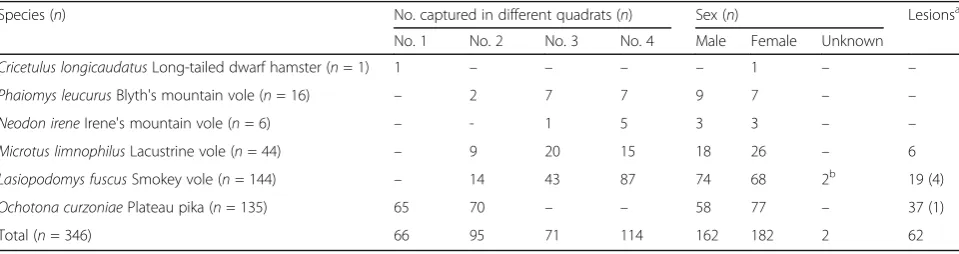
A total of 346 small mammals were captured from the four trapping plots in the study site in July and August 2014. Except for one, Cricetulus longicaudatus (long-tailed dwarf hamster), most small mammals trapped were pikas and voles:L. fuscus41% (144/346);O. curzo-niae 39% (135/346); M. limnophilus 13% (44/346); P. leucurus 5% (16/346); and N. irene 2% (6/346). No sig-nificant sex bias was detected from the trapped small mammal species (χ2 = 4.485, df = 5, P = 0.482). Pikas were only trapped in the first and second plots, whereas voles were mainly trapped from the third and fourth plots (Table 2). There were significant differences in the distribution of pikas and voles among the four trapping plots (χ2= 267.660,df= 3,P< 0.001).
Prevalence ofEchinococcusspp. in the small mammal community
Suspected Echinococcus lesions were found in 62 indi-viduals. Lesions in the lungs were found in five O.
curzoniaeand in both liver and lungs in another five O. curzoniae. All the other lesions of the remaining 52 individuals were in the liver. Molecular analyses later de-tectedEchinococcus mtDNA in 22 out of the 62 individ-uals, including all the 5 individuals with typical lesions (i.e.E. multilocularisin 4L. fuscusandE. shiquicusin 1
O. curzoniae), in whichEchinococcusprotoscoleces were checked out (Additional file 1: Table S2). Among these 22 individuals, E. multilocularis lesions in 20 voles (i.e. 15 L. fuscus and 5 M. limnophilus) were in the liver, whereas in the two O. curzoniae, one had typicalE. shi-quicuslesions in both liver and lungs and the other one had atypical E. multilocularis lesions in the lungs. In other individuals without visible lesions, E. shiquicus
mtDNA was detected in 13 individuals, whileE. multilo-cularis was detected in 2 (see Additional file 1: Table S2 for details). Therefore, the overall maximum prevalence of
Echinococcus in small mammals was 10.7% (37/346, 95% CI: 7.4–14.0%), and the conservative prevalence was 5.8% (20/346, 95% CI: 3.3–8.2%). The maximum prevalence of
E. multilocularis was 6.7% (23/346, 95% CI: 4.0–9.3%) with a conservative prevalence of 4.3% (15/346, 95% CI: 2. 2–6.5%), whereas the maximum prevalence ofE. shiquicus
was 4.1% (14/346, 95% CI: 2.0–6.1%) and the conservative prevalence was 1.5% (5/346, 95% CI: 0.2–2.7%) (Table3). NoE. granulosus(s.s.) infections were detected.
There was a significant difference between the use of
cox1 vs nad1 in the detection of Echinococcus infection. For E. shiquicus, significantly more infections were de-tected usingnad1 primers than with cox1 (χ2= 10.480,
df = 1, P = 0.001), whereas the use of cox1 primers detected more E. multilocularis infections than with
nad1 (χ2= 7.415,df= 1,P= 0.006).
There was a distinct pattern to the prevalence of E. multilocularis and E. shiquicus in each small mammal species. Cricetulus longicaudatus and P. leucurus were only detected with E. shiquicus DNA, whereas no Echi-nococcus infection was detected in N. irene (Table 4).
[image:5.595.58.538.581.708.2]For the three most-dominant small mammal host
Table 2Statistics of species, gender, and anatomy of captured rodents
Species (n) No. captured in different quadrats (n) Sex (n) Lesionsa
No. 1 No. 2 No. 3 No. 4 Male Female Unknown
Cricetulus longicaudatusLong-tailed dwarf hamster (n= 1) 1 – – – – 1 – –
Phaiomys leucurusBlyth's mountain vole (n= 16) – 2 7 7 9 7 – –
Neodon ireneIrene's mountain vole (n= 6) – - 1 5 3 3 – –
Microtus limnophilusLacustrine vole (n= 44) – 9 20 15 18 26 – 6
Lasiopodomys fuscusSmokey vole (n= 144) – 14 43 87 74 68 2b 19 (4)
Ochotona curzoniaePlateau pika (n= 135) 65 70 – – 58 77 – 37 (1)
Total (n= 346) 66 95 71 114 162 182 2 62
Abbreviation:nnumber of individuals
a
The number of individuals with distinct pathological features/lesions (number of individuals withEchinococcusprotoscoleces)
b
species (L. fuscus, O. curzoniae and M. limnophilus), both E. multilocularis and E. shiquicus were detected. There were no mixed Echinococcus spp. infections or DNA detected in a single host individual (Table 3). Among the three most-dominant host species, the prevalence ofE. multilocularisandE. shiquicuswere sig-nificantly higher in M. limnophilus, whereas the preva-lence of these twoEchinococcusspp. inO. curzoniaewas significantly lower. Lasiopodomys fuscus had an inter-mediate Echinococcus prevalence (Table 3). The max-imum prevalence of E. multilocularis and the overall
Echinococcus prevalence in L. fuscus were significantly higher than in O. curzoniae (Table 3). No significant prevalence bias was detected between male and female mammals, except forM. limnophilus, in which the max-imum prevalence of Echinococcus was significantly higher in females than in males (detected individuals, fe-male/male, 9/1;χ2= 4.189,df= 1,P= 0.041).
Regression model simulation revealed that Echinococcus
infection was detected in individual hosts with significantly longer RHBL (log odds ratio, 19.134), while their RBWs
were significantly lighter than those without infection (log odds, -16.010) (Table4). Moreover, although typical lesions were useful signs of infection (with a log odds ratio of -0. 556 relative to the molecular results), atypical lesions were misleading and caused significantly more misidentification of infections (log odds ratio of -21.982, Table4).
Phylogenetic relationships betweenE. multilocularis cox1 gene haplotypes
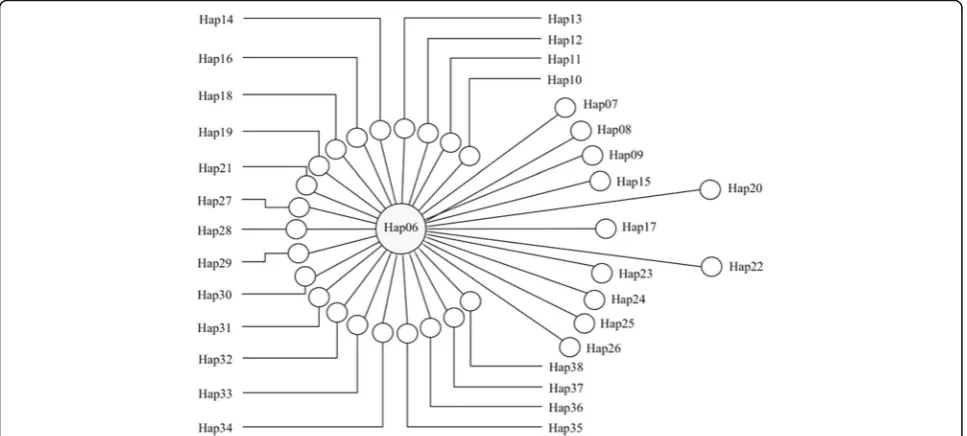
In total, 45 haplotypes of a 768 bp longE. multilocularis cox1 gene fragment were acquired from 23 small mammals (76 quences), six human AEs (6 sequences), four dog feces (4 se-quences), and two Tibetan fox fecal samples (5 sequences) in this study, with an additional 17 sequences from online sources. Among the 76 sequences from Shiqu County, 33 haplotypes ofE. multilocularis(i.e. Hap06-Hap38) were con-firmed (Additional file1: Table S1), of which Hap06 was the dominant haplotype, with 58 sequences covering all the hu-man AE, dog, and Tibetan fox fecal samples, and 21 small mammal samples fromL. fuscus,M. limnophilusandO. cur-zoniae(Fig.1, Additional file1: Table S1). The haplotype and
[image:7.595.58.542.111.165.2]Fig. 1Network of 33Echinococcus multilocularis cox1 gene haplotypes collected from samples in this study. The size of the circle represents the number of species of hosts with theE. multilocularisgene haplotype (Hap06 isolated from six species including humans, dogs, Tibetan foxes, two species of voles and plateau pikas, while each of the other haplotypes has only one host species, see Additional file1: Table S1 for details). The distance between the circle centers shows the variation between two haplotypes (i.e. 1 bp mutation between Hap06 and Hap36)
Table 4Variables of host body condition influencing the general maximum prevalence ofEchinococcusspecies as revealed by the best logistic regression model
Log odds of significant variables ± SE Model evaluation
Relative body weight
Relative head-body length
Lesionsa AICc GeneralizedR2of
the best model 1vs0 2vs0 Best model Null model
-16.010 ± 4.558 19.134 ± 8.521 -21.982 -0.556 49.677 108.473 0.572
a
Categorical data, no SE presented
[image:7.595.57.541.465.683.2]nucleotide diversities for theE. multilocularis cox1 gene from the small mammal community in this study were 0.655 ± 0. 064 and 0.0014 ± 0.0002, respectively. Significant negative values in both Tajima’sD(D= -2.83311,P< 0.001) and Fu’s
Fs(Fs= -46.942,P< 0.001) tests indicated that theE. multilo-cularispopulation in the small mammal community of Shiqu County is currently expanding, and the dominant Hap06 haplotype may be under strong purifying selection.
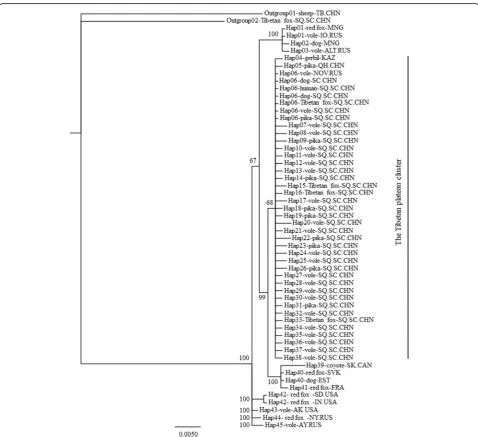
Both ML and Bayesian trees were constructed based on 56 sequences, including 54 E. multilocularis se-quences and twoE. granulosus(s.s.) and E. shiquicus se-quences as outgroups (Additional file 1: Table S1). Both trees demonstrated identical topological relationships
between haplotypes, but only the Bayesian tree is in-cluded here (Fig. 2) because of its more concise struc-ture. The Tibetan Plateau cluster was distinctive from other geographical regions of the world, and mainly comprised the Shiqu haplotypes Hap06-Hap38, the Qinghai Province haplotype Hap05 (also from the Ti-betan Plateau), and two other sequences (Hap04 and Hap06-Vole-NO.RUS, Additional file 1: Table S1) from neighboring geographical regions (Fig.2).
Discussion
Transmission ofE. multilocularis and E. shiquicusrelies on small mammal species as intermediate hosts [3].
[image:8.595.58.537.256.693.2]Although monographs of the comprehensive taxonomy of small mammal species with coarse resolution distribu-tion maps have been published [25,43,44], small mam-mal assemblages in western China still pose great challenges. Knowledge of the distribution, ecology, and even the basic taxonomy of these small mammals, espe-cially rodent species, is lacking. Consequently, epidemio-logical research focused on small mammal host species based on basic taxonomic and ecological methodologies in specific E. multilocularis-endemic areas of China is limited [8,10,14]. Thus, our understanding of the trans-mission ecology of echinococcosis in the Tibetan Plateau ecosystem is far from complete.
Small mammal host species community composition
Although all the six small mammal species reported in this study have been recorded previously on the Tibetan Plateau, information about small rodent species such as arvicolids and cricetids was largely lacking from Shiqu before the 21st century [45, 46]. He et al. [20] reported alveolar echinococcosis in the lagomorphs Ochotona curzoniae and Lepus oiostolus, and also in the com-mensal rodents N. irene, and Mus musculus in Shiqu. Raoul et al. [19] studied the habitat ecology of small mammal communities in Shiqu, reporting for the first time P. leucurus and C. kamensis in Sichuan Province. However, neither of these two studies reportedL. fuscus
in Shiqu. The distribution area of L. fuscus was judged to be restricted to southern Qinghai Province, and this was not considered to be a species distributed to Si-chuan [24, 25,43, 45]. However, in local plague surveil-lance studies [47,48] and pest control schemes [49,50],
L. fuscuswas judged to be a dominant rodent species in the high plateau pasture areas of northwest Sichuan.
Lasiopodomys fuscus is morphologically similar to other vole species, such as P. leucurus, and thus could be in-cluded in reports in error if an accurate morphological identification is lacking [51]. Shiqu is located at the northwestern point of Sichuan Province, on the southern border of Qinghai; therefore, it is possible that what is thought to be the southern limit of the range ofL. fuscus
is incorrect [46]. The current study confirmed the pres-ence ofL. fuscusin Shiqu County, where it was the most abundant species of the five trapped rodent species and is likely to have a larger population than that of O. cur-zoniaein this region (Table2).
Importance of rodent species in the transmission of echinococcosis
Although the potential importance of rodent species as intermediate hosts ofE. multilocularison the eastern Ti-betan Plateau has been mentioned previously elsewhere [10, 14, 51, 52], O. curzoniae were the most frequently examined small mammal host species with large sample
sizes [8,17,18,20,21,52–54]. For example, when evalu-ating the prevalence of E. multilocularis, Zhao [21] re-ported a prevalence of 15.2% in O. curzoniae (34/224) and 20% in L. fuscus (1/5 individuals). Similarly, Zhang & Wang [18] reported a prevalence of 5.3% inO. curzo-niae(62/1177), but only 0.4% in L. fuscus(1/269). Thus, much smaller sampling sizes might be an important rea-son for the reported low prevalence ofE. multilocularis
in rodent species. In terms of E. shiquicus, O. curzoniae
was previously the only confirmed intermediate host species [12, 54]. By contrast, our data revealed that, among the three most-abundant small mammal species, both M. limnophilus and L. fuscus had a significantly higher molecular prevalence of E. multilocularis and E. shiquicus than did O. curzoniae (Table 3). Moreover, E. shiquicusDNA was detected not only in the three most-abundant small mammal species, but also in the other two rodent species sampled (P. leucurus and C. longi-caudatus) (Table 3). Although trapping data might not reflect the exact abundance of each species, the higher molecular prevalence of both E. multilocularis and E. shiquicus(Table2) in rodents than in pikas suggests that rodent species are probably more important intermedi-ate host species than pikas during the transmission of bothE. multilocularisandE. shiquicus.
Traditionally, epidemiological studies of echinococco-sis in western China mainly focused on human and do-mestic animal populations because of their obvious direct interactions especially regarding transmission of human CE and a role for dogs in risk of human AE. Phylogenetic analyses revealed that all 33cox1 gene hap-lotypes from Shiqu County were closely related (Fig.1), and clustered with haplotypes from other studies to form the Tibetan Plateau group, which is distinct from haplotypes from other geographical regions (Fig. 2). Hap06 was the dominant haplotype of E. multilocularis
discovered in humans, domestic dogs, and almost all the wildlife host species tested in this study, including the three most dominant small mammal species (i.e.O. cur-zoniae, M .limnophilusand L. fuscus) (Fig.2, Additional file 1: Table S1). These results confirm that small mam-mal species and dogs together comprise a wildlife and peri-domestic ecosystem for transmission of E. multilo-cularis. Thus, understanding the epidemiology in wildlife host species is pivotal to understanding the life-cycles and transmission ecology of these parasites.
increases in small mammal populations and their inter-specific dynamics in western China?Ochotona curzoniae
and several vole species are the main prey of the Tibetan fox (V. ferrilata) on grasslands of the eastern Tibetan Plateau [16]. The significant differences in prevalence of
E. multilocularisamong voles andO. curzoniae(Table3) suggest that interspecific dynamics among these small mammal species could be essential factors influencing the predator-prey food chain, which would affect the epidemiology ofE. multilocularisacross all pasture areas on the Tibetan Plateau. For example, Wang et al. [56] re-ported a high density of both O. curzoniae and voles in open grassland areas within 2 km of villages. Ochotona curzoniae is usually blamed for degrading the grassland ecosystem of the eastern Tibetan Plateau and, conse-quently, has been a main target for poisoning to protect the grasslands [49, 50, 57]. Areas around villages are usually where poisoning programs are located. The fact that there was a significantly higher prevalence of E. multilocularis in vole species compared with O. curzo-niae (Table 3) suggests that pika may have a lesser role compared to voles in the transmission of E. multilocu-laris. Furthermore the deliberate poisoning ofO. curzo-niae could result in increased densities of vole species, accompanied by a higher prevalence of E. multilocularis
in wildlife, dogs and humans in local areas.
Small mammal body condition and detection of EchinococcusDNA
The regression model revealed that individuals with lar-ger RHBL were more likely to be detected with Echino-coccus, based on the molecular tests (Table 4). Linear body dimensions are more or less correlated with age, especially in animals with short lifespans [35]. Thus, the results of the current study showed that older small mammals were more likely to have E. multilocularis or
E. shiquicus infections. Similarly, Burlet et al. [34] re-ported that olderArvicola terrestris had a higher preva-lence ofE. multilocularisthan younger animals. In small mammal hosts,E. multilocularisrequires several months to grow from an oncosphere to a fertile metacestode [58]. Consequently, the development of metacestode le-sions can be synchronized with the aging process of its hosts, such as rodents and pikas, further confirming the importance of understanding the host population struc-ture and dynamics when evaluating the present infection burden and predicting the future trend of a specific parasitic species.
Although typical lesions were indicative of infection with specificEchinococcusspecies, as revealed by the regression model (Table4), they were harder to find than were the fre-quently detected atypical lesions (Additional file 1: Table S2). However, low values of atypical lesions for determining
Echinococcusinfection (Table4, Additional file1: Table S2)
required the use of molecular analyses. Nevertheless, such analyses provide the molecular-positive rate of the parasite, which is not equivalent to its true prevalence. For example,
E. shiquicus DNA was detected in several rodent species; however, if no typical lesions with metacestodes were ob-served (Additional file1: Table S2), then it was not possible to conclude that there was an established parasitic infec-tion. Thus, the function of rodent species as natural inter-mediate hosts of E. shiquicus still requires further study. Moreover, many primers have been designed to test various nuclear [59,60] and mitochondrial [15,26,27,61] genes of
Echinococcus species. In this study, the cox1 and nad1 genes were used. However, the significantly inconsistent re-sults achieved with both genes (Additional file1: Table S2) suggested that multiple parasite genes should be tested in the same epidemiological study. In addition, a prevalence interval that is based on the different levels of detection as determined by the available genes (e.g. the maximum and conservative prevalence defined in this study) would be more objective than using a single prevalence.
Conclusions
Our observations suggest that rodent (vole) species are probably more important natural intermediate hosts of both E. multilocularisand E. shiquicus in Shiqu County on the eastern Tibetan Plateau. In addition to O. curzo-niae, the small mammal community sustains echinococ-cosis transmission in the Tibetan ecosystem. Moreover, small mammal communities usually have complex intra-and interspecific relationships, which influence the population and spatial dynamics of each host species and, thus, the transmission patterns of alveolar echino-coccosis and E. shiquicus in local areas. Consequently, we recommend that future studies on the epidemiology of human AE must consider the basic transmission ecol-ogy of the small mammal community as an essential component of research and for control purposes.
Additional file
Additional file 1:Table S1.Information forcox1 sequences used in the Bayesian phylogenic tree in this study.Table S2.Echinococcusdetection results of each suspected small mammal sample based on necropsy and molecular analyses. (DOCX 35 kb)
Abbreviations
AE:alveolar echinococcosis; CDC: center for disease control; CE: cystic echinococcosis; CWL: cross effect of relative weight and head-body length; EB: ethidium bromide; ML: tree maximum likelihood tree; RHBL: relative head-body length; RW: relative body weight;s.s.:sensu stricto
Acknowledgements
Funding
National Science Foundation of China (NSFC #31071944 and #31470488): supporting the study from the design, field trips and allowance for Chinese authors, data collection in field, laboratory analysis, and data analysis, writing and language polishing. The National Key Program of Research and Development Ministry Science and Technology of China (2016YFC0503200): supporting field trips for Chinese authors, writing, and publishing. NSF EID (US) program (#TW001565) and the Wellcome Trust (#094325/Z/10/Z): supporting trips, data collection in field, laboratory analysis of the European authors.
Availability of data and materials
All data generated or analyzed during this study are included in this published article and its Additional file1.
Authors’contributions
XW: major writer of the manuscript, molecular analysis and data processing of the echinococcosis materials. JL: collecting echinococcosis materials in Shiqu, small mammal species identification and data processing. QZ, ZM and XW: molecular analysis of small mammal materials. XS and JW: small mammal species identification. BB: dog fecal and human AE sample processing and molecular data analysis. PSC, PG and FR: designing the study and contributing in the writing of the manuscript. ZW: main investigator of the study, designing the study, data analysis and writing the manuscript. All authors read and approved the final manuscript.
Ethics approval and consent to participate
The protocol used to collect the small mammals was approved by the East China Normal University Animal Care and Use Committee (identification number: Q20170501).
Competing interests
The authors declare that they have no competing interests
Publisher’s Note
Springer Nature remains neutral with regard to jurisdictional claims in published maps and institutional affiliations.
Author details
1School of Life Sciences, East China Normal University, Shanghai, China. 2Department of Infectious, Parasitic and Immuno-Mediated Diseases, Istituto
Superiore di Sanità, Rome, Italy.3School of Environment and Life Sciences, University of Salford, Greater Manchester, UK.4Chrono-Environment Lab,
University of Bourgogne-Franche-Comté and CNRS, Besançon, France.
Received: 27 November 2017 Accepted: 25 April 2018
References
1. Nakao M, Lavikainen A, Yanagida T, Ito A. Phylogenetic systematics of the genusEchinococcus(Cestoda: Taeniidae). Int J Parasitol. 2013;43:1017–29. 2. Thompson RCA. The taxonomy, phylogeny and transmission of
Echinococcus. Exp Parasitol. 2008;119:439–46.
3. Wang ZH, Wang XM, Liu XQ. Echinococcosis in China, a review of the epidemiology ofEchinococcusspp. EcoHealth. 2008;5:115–26. 4. Torgerson PR, Keller K, Magnotta M, Ragland N. The global burden of
alveolar echinococcosis. PLoS Negl Trop Dis. 2010;4:e722.
5. Li TY, Qiu JM, Yang W, Craig PS, Chen XW, Xiao N, et al. Echinococcosis in Tibetan populations, western Sichuan Province, China. Emegr Infect Dis. 2005;11:1866–73.
6. Li TY, Chen XW, Zhen R, Qiu JM, Qiu DC, Xiao N, et al. Widespread co-endemicity of human cystic and alveolar echinococcosis on the eastern Tibetan Plateau, northwest Sichuan/southeast Qinghai, China. Acta Trop. 2010;113:248–56.
7. National Health and Family Planning Commission of the People’s Republic of China. Echinococcosis prevention action plan (2010-2015). 2010.http:// www.gov.cn/zwgk/2010-12/14/content_1765485.htm. Accessed 1 Dec 2010. 8. Qiu JM, Chen XW, Ren M, Luo CX, Liu DL, Liu HT, et al. Epidemiological
study on alveolar hydatid disease in Qinghai-Xizang plateau. J Pract Parasit Dis. 1995;3:106–9.
9. Xiao N, Qui JM, Nakao M, Li TY, Yang W, Chen XW, et al.Echinococcus
shiquicusn. sp., a taeniid cestode from Tibetan fox and plateau pika in
China. Int J Parasitol. 2005;35:693–701.
10. Giraudoux P, Pleydell D, Raoul F, Quéré J-P, Wang Q, Yang YR, et al. Transmission ecology ofEchinococcus multilocularis: What are the ranges of parasite stability among various host communities in China? Parasitol Int. 2006;55:S237–46.
11. Craig PS. Epidemiology of human alveolar echinococcosis in China. Parasitol Int. 2006;55:S221–5.
12. Xiao N, Nakao M, Qiu JM, Budke CM, Giraudoux P, Craig PS, et al. Short report: dual infection of animal hosts with differentEchinococcusspecies in the eastern Qinghai-Tibet plateau region of China. Am J Trop Med Hyg. 2006;75:292–4.
13. Boufana B, Qiu JM, Chen XW, Budke CM, Campos-Ponced M, Craig PS. First report ofEchinococcus shiquicusin dogs from eastern Qinghai-Tibet plateau region. China. Acta Trop. 2013;127:21–4.
14. Giraudoux P, Raoul F, Afonso E, Ziadinov I, Yang YR, Li L, et al. Transmission ecosystems ofEchinococcus multilocularisin China and Central Asia. Parasitology. 2013;140:1655–66.
15. Jiang WB, Liu N, Zhang GT, Renqing PC, Xie F, Li TY, et al. Specific detection
ofEchinococcusspp. from the Tibetan fox (Vulpes ferrilata) and the red fox
(V. vulpes) using copro-DNA PCR analysis. Parasitol Res. 2012;111:1531–9.
16. Liu QX, Harris RB, Wang XM. Food habits of the Tibetan fox (Vulpes ferrilata) in the Kunlun Mountains, Qinghai Province. China. Mamm Biol.
2010;75:283–6.
17. Wang H, Zhao HL, Ma SM, Cao DP, Chai JJ. Investigation on infections of
Echinococcusin animals in Qinghai Plateau. Endem Dis Bull. 2000;15:29–33.
18. Zhang JX, Wang H. Epidemiology ofEchinococcusin animal host species of Qinghai province. Chin J Parasitol Parasit Dis. 2007;25:350–2.
19. Raoul F, Quéré JP, Rieffel D, Bernard N, Takahashi K, Scheifler R, et al. Distribution of small mammals in a pastoral landscape of the Tibetan plateaus (Western Sichuan, China) and relationship with grazing practices. Mammalia. 2006;70:214–25.
20. He JG, Qiu JM, Liu FJ, Chen XW, Liu DL, Chen WD, et al. Epidemiological survey on hydatidosis in Tibetan region of western Sichuan. II. Infection situation among domestic and wild animals. Chin J Zoonoses. 2000;16:62–5. 21. Zhao HL. Investigation on infections of alveolar hydatid in small mammals
at south Qinghai Plateau. J Qingh Med Colle. 2002;23:12–4.
22. Wang ZH, Wang XM, Lu QB. Selection of land cover by the Tibetan fox
Vulpes ferrilataon the eastern Tibetan Plateau, western Sichuan Province.
China. Acta Theriol. 2007;52:215–23.
23. Ma B, Wang XM, Liu XQ, Wang ZH. GIS analysis of the spatial relationship between plateau burrow distribution and vegetation distributional patterns. Biodivers Sci. 2011;19:71–8.
24. Luo ZX, Chen W, Gao W. Fauna Sinica Mammalia Vol. 6 Rodentia Part III: Cricetidae. Beijing: Science Press; 2000.
25. Smith AT, Xie Y, editors. A guide to the mammals of China. Princeton: Princeton University Press; 2008. p. 55–184.
26. Nakao M, Sako Y, Yokoyama N, Fukunaga M, Ito A. Mitochondrial genetic code in cestodes. Mol Biochem Parasit. 2000;111:415–24.
27. Boufana B, Umhang G, Qiu JM, Chen XW, Lahmar S, Boué F, et al. Development of three PCR assays for the differentiation between
Echinococcus shiquicus,E. granulosus(G1 genotype), andE. multilocularis
DNA in the co-endemic region of Qinghai-Tibet plateau, China. Am J Trop Med Hyg. 2013;88:795–802.
28. Nakao M, Li TY, Han XM, Ma XM, Xiao N, Qiu JM, et al. Genetic polymorphisms ofEchinococcustapeworms in China as determined by mitochondrial and nuclear DNA sequences. Int J Parasitol. 2010;40:379–85. 29. Nagelkerke NJD. A note on a general definition of the coefficient of
determination. Biometrika. 1991;78:691–2.
30. Burnhan KP, Anderson DR. Model selection and multimodel inference: a practical information-theoretic approach. 2nd ed. New York: Springer-Verlag; 2002. 31. Delattre P, Pascal M, LePesteur MH, Giraudoux P, Damange JP.
Caractéristiques éologiques et épidémiologiques de 1'Echinococcus
multilocularisau cours d'un cycle complet des populations d'un hôte
intermédiaire (Microtus arvalis). Can J Zool. 1988;66:2740–50.
32. LePesteur MH, Giraudoux P, Delattre P, Damange JP, Quéré J-P. Spatiotemporal distribution of four species of cestodes in a landscape of mid-altitude mountains (Jura, France). Ann Parasitol Hum Comp. 1992;67:155–60. 33. Giraudoux P, Delattre P, Takahashi K, Raoul F, Quéré J-P, Craig P, et al.
learned from comparative studies and multiscale approaches? In: Craig P, Pawlowski Z, editors. Cestode zoonoses: echinococcosis and cysticercosis: an emergent and global problem. Amsterdam: IOS Press; 2002. p. 251–66. 34. Burlet P, Deplazes P, Hegglin D. Age, season and spatio-temporal factors
affecting the prevalence ofEchinococcus multilocularisandTaenia
taeniaeformisinArvicola terrestris. Parasit Vectors. 2011;4:6.
35. Morris P. A review of mammalian age determination methods. Mammal Rev. 1972;2:69–104.
36. Burlet P, Deplazes P, Hegglin D. Efficient age determination: how freezing affects eye lens weight of the small rodent speciesArvicola terrestris. Eur J Wildlife Res. 2010;56:685–8.
37. Hall T. BioEdit: An important software for molecular biology. GERF Bull Biosci. 2011;2:60–1.
38. Larkin MA, Blackshields G, Brown NP, Chenna R, Mcgettigan PA, Mcwilliam H, et al. Clustal W and Clustal X version 2.0. Bioinformatics. 2007;23:2947–8. 39. Librado P, Rozas J. DnaSP v5: a software for comprehensive analysis of DNA
polymorphism data. Bioinformatics. 2009;25:1451–2.
40. Xia XH. DAMBE5: A comprehensive software package for data analysis in molecular biology and evolution. Mol Biol Evo. 2013;30:1720–8. 41. Darriba D, Taboada GL, Doallo R, Posada D. jModelTest 2: more models,
new heuristics and parallel computing. Nat Methods. 2012;9:772–2. 42. Ronquist F, Huelsenbeck JP. MrBayes 3: Bayesian phylogenetic inference
under mixed models. Bioinformatics. 2003;19:1572–4.
43. Zhang RZ, Jin SK, Quan GQ, Li SH, Ye ZY, Wang FG, et al. Distribution of mammalian species in China. Beijing: China Forestry Publishing House; 1997. p. 240–1. 44. Jiang ZG, Ma Y, Wu Y, Wang YX, Zhou KY, Liu SY, et al. China’s mammal
diversity and geographic distribution. Beijing: Science Press; 2015. p. 253– 373.
45. Hu QC, Wang YX. Sichuan fauna economica Vol. 2. Chengdu: Sichuan Science and Technology Press; 1984.
46. Wang YZ. Comparison of the mammal community composition based on surveys conducted in 1959 and 1987 in Shiqu County. In: Xia WP, Zhang J, editors. The successional changes of mammals in China under the influences of human activities. Beijing: China Science and Technology Press; 1993. p. 155–8.
47. Wang LM, Yang K, Xie F, Tan WM, Li GJ, Wu CX, et al. Surveillance result of natural foci ofMicrotus fuscusin Sichuan Province from 2000 to 2012. Chin J Control Endem Dis. 2013;28:335–7.
48. Qi T, Yang K, Wang LM, Duan YJ, Xie F, Yang J, et al. Epidemiology in plague foci of Shiqu County, China, 2001–2013. Chin J Zoonoses. 2015;31: 485–8.
49. Zhao L, Zhou S, Yan DH, Zhang TY, Tang ZY, Su J. Developing trend and controlling countermeasures of pests and mice of Sichuan grassland in 2015. Pratac Anim Husb. 2015;220:49–53.
50. Zhao L, Yan DH, Zhang XX, Zhou S. Actuality and control technology of prairie rodent pests in Sichuan. Pratac Anim Husb. 2015;221:1–7. 51. Giraudoux P, Raoul F, Pleydell D, Li TY, Han XM, Qiu JM, et al. Drivers of
Echinococcus multilocularistransmission in China: small mammal diversity,
landscape or climate? PLoS Negl Trop Dis. 2013;7:e2045.
52. Wang H, Zhang JX, Schantz PM, Ito A, Craig PS. Epidemiologic survey and analysis on echinococcosis in humans and animals from 1995 to 2005 in Qinghai province. Chin J Zoonoses. 2006;22:1129–34.
53. He DL, Wang H. A report on the epidemiological evaluation of hydatid disease in Zeku County, Qinghai Province. Endem Dis Bull. 2001;16:36–8. 54. Han XM, Wang H, Ma X, Cai HX, Liu YF, Wei BH, et al. Epidemiological
survey on echinococcosis in Darlag County of Qinghai Province. Chin J Parasit Dis. 2009;27:22–6.
55. Gandon S. Evolution of multihost parasites. Evolution. 2004;58:455–69. 56. Wang Q, Raoul F, Budke C, Craig PS, Xiao YF, Vuitton DA, et al. Grass height
and transmission ecology ofEchinococcus multilocularisin Tibetan communities. China. Chin Med J. 2010;123:61–7.
57. Smith AT, Zahler P, Hinds AA. Ineffective and unsustainable poisoning of native small mammals in temperate Asia: aclassic case of the science-policy divide. In: McNeely JA, McCarthy TM, Smith A, Olsvig-Whittaker L, Wikramanayake ED, editors. Conservation biology in Asia. Kathmandu: Society for Conservation Biology Asia Section and Resources Himalaya; 2006. p. 285–93.
58. Thompson RCA, Mcmanus DP. Aetiology: parasites and life-cycles. In: Eckert J, Gemmell MA, Meslin FX, Pawlowski ZS, editors. WHO/OIE manual on echinococcosis in humans and animals: A public health problem of global concern. Paris: World Health Organization; 2001. p. 1–17.
59. Saarma U, Jõgisalu I, Moks E, Varcasia A, Lavikainen A, Oksanen A, et al. A novel phylogeny for the genusEchinococcus, based on nuclear data, challenges relationships based on mitochondrial evidence. Parasitology. 2009;136:317–28.
60. Knapp J, Nakao M, Yanagida T, Okamoto M, Saarma U, Lavikainen A, et al. Phylogenetic relationships withinEchinococcusandTaeniatapeworms (Cestoda: Taeniidae): an inference from nuclear protein-coding genes. Mol Phylogenet Evol. 2011;61:628–38.