This is a repository copy of Speeding Up Evolutionary Multi-objective Optimisation
Through Diversity-Based Parent Selection.
White Rose Research Online URL for this paper:
http://eprints.whiterose.ac.uk/115996/
Version: Accepted Version
Proceedings Paper:
Covantes Osuna, E., Gao, W., Neumann, F. et al. (1 more author) (2017) Speeding Up
Evolutionary Multi-objective Optimisation Through Diversity-Based Parent Selection. In:
Proceedings of the Genetic and Evolutionary Computation Conference (GECCO 17).
Genetic and Evolutionary Computation Conference (GECCO 2017), 15/07/2017 -
19/07/2017, Berlin. ACM , pp. 553-560.
https://doi.org/10.1145/3071178.3080294
[email protected]
https://eprints.whiterose.ac.uk/
Reuse
Unless indicated otherwise, fulltext items are protected by copyright with all rights reserved. The copyright
exception in section 29 of the Copyright, Designs and Patents Act 1988 allows the making of a single copy
solely for the purpose of non-commercial research or private study within the limits of fair dealing. The
publisher or other rights-holder may allow further reproduction and re-use of this version - refer to the White
Rose Research Online record for this item. Where records identify the publisher as the copyright holder,
users can verify any specific terms of use on the publisher’s website.
Takedown
If you consider content in White Rose Research Online to be in breach of UK law, please notify us by
Through Diversity-Based Parent Selection
Edgar Covantes Osuna
Department of Computer Science University of Sheffield Sheffield S1 4DP, United Kingdom
Wanru Gao
Optimisation and Logistics, School of Computer Science, The University of Adelaide
Adelaide, Australia
Frank Neumann
Optimisation and Logistics, School of Computer Science, The University of Adelaide
Adelaide, Australia
Dirk Sudholt
Department of Computer Science University of Sheffield Sheffield S1 4DP, United Kingdom
ABSTRACT
Parent selection in evolutionary algorithms for multi-objective optimization is usually performed by dominance mechanisms or indicator functions that prefer non-dominated points, while the reproduction phase involves the application of diversity mecha-nisms or other methods to achieve a good spread of the population along the Pareto front. We propose to refine the parent selection on evolutionary multi-objective optimization with diversity-based metrics. The aim is to focus on individuals with a high diversity contribution located in poorly explored areas of the search space, so the chances of creating new non-dominated individuals are better than in highly populated areas. We show by means of rigorous runtime analyses that the use of diversity-based parent selection mechanisms in the Simple Evolutionary Multi-objective Optimiser (SEMO) and Global SEMO for the well known bi-objective functions
OneMinMaxandLotzcan significantly improve its performance. Our theoretical results are accompanied by additional experiments that show a correspondence between theory and empirical results.
KEYWORDS
Parent selection, evolutionary algorithms, multi-objective optimiza-tion, diversity mechanisms, runtime analyses, theory
ACM Reference format:
Edgar Covantes Osuna, Wanru Gao, Frank Neumann, and Dirk Sudholt. 2017. Speeding Up Evolutionary Multi-objective Optimisation Through
Diversity-Based Parent Selection. InProceedings of the Genetic and
Evo-lutionary Computation Conference 2017, Berlin, Germany, July 15–19, 2017 (GECCO ’17),9 pages.
DOI: 10.475/123 4
1
INTRODUCTION
Evolutionary algorithms have been shown to achieve high perform-ing results for problems from multi-objective optimization. The area of evolutionary multi-objective optimization (EMO) design population-based evolutionary algorithms where the population is used to approximate the so-called Pareto front. Given that evolu-tionary algorithms use a population which is a set of solutions for a given problem, evolutionary algorithms are suited in a natural way
GECCO ’17, Berlin, Germany
2017. 123-4567-24-567/08/06. . .$15.00 DOI: 10.475/123 4
for computing trade-offs with respect to two (or more) conflicting objective functions.
Multi-objective evolutionary algorithms (MOEAs) have two basic principles. First of all, the goal is to push the current population close to the “true” Pareto front. The second goal is to “spread” the population along the front such that it is well covered. The first goal is usually achieved by dominance mechanisms between the search points or indicator functions that prefer non-dominated points. The second goal involves the use of diversity mechanisms. Alternatively, indicators such as the hypervolume indicator play a crucial role to obtain a good spread of the different solutions of the population along the Pareto front.
In this paper, we explore the use of different parent selection mechanisms in EMO. The goal is to speed up the optimization process of an EMO algorithm by selecting individuals that have a high chance of producing beneficial offspring. In the context of EMO parent selection is usually uniform whereas offspring selection is based on dominance and the contribution of an individual to the diversity of the population.
The parent selection mechanisms studied in this paper use the diversity contribution of an individual in the parent population to select promising individuals for reproduction. The parent selection mechanisms include ignoring individuals with a low (or minimum) diversity score, rank of individuals in the parent population where the rank is given based on the dominance relation and its contribu-tion to diversity and the classical tournament seleccontribu-tion where the outcome of the tournament is defined according to the diversity score and not in the fitness values.
The main assumption is that individuals with a high diversity score (high hypervolume indicator or crowded-comparison method) are located in poorly explored or a less crowded areas of the search space, so the chances of creating new non-dominated individuals are better than areas where there are several individuals, in this sense we have designed a MOEA that focused on individuals where the neighbourhood is not fully covered and in consequence, force the reproduction in those areas and to the spread of the population along the search space.
GECCO ’17, July 15–19, 2017, Berlin, Germany Edgar Covantes Osuna, Wanru Gao, Frank Neumann, and Dirk Sudholt
algorithms [5, 7, 8] and allows to study different components of EMO methods from a rigorous perspective.
In order to gain insights into the potential benefits of the parent selection mechanisms, we study the classical functions OneMin-MaxandLotzproblem introduced in [7] and [9], respectively.
OneMinMaxgeneralizes the classicalOneMaxfunction andLotz
generalizes the well-knownLeadingOnesproblem to the multi-objective case. Both functions have been examined in a wide range of theoretical studies for variants of the Simple Evolutionary Multi-Objective (SEMO) algorithm. Other studies in the area of runtime analysis of MOEAs consider hypervolume-based algorithms [10] and MOEAs incorporating other diversity mechanisms for survival selection [8].
We show that the use of various parent selection mechanisms speeds up SEMO by a factor ofnforOneMinMaxandLotz. For
Lotzthe use of rank-based parent selection can reduce the runtime to compute the whole Pareto front fromΘ(n3)toO(n2). Study-ingOneMinMax, we show a similar effects, i.e. that the runtime reduces fromΘ(n2logn)toO(nlogn)for our best performing rank-based parent selection methods.
GSEMO needs timeΘ(n3)onLotz. Can we do better? Check work on FEMO [9]
2
PRELIMINARIES
We focus our analysis on two simple MOEAs, SEMO and its variant called Global SEMO (GSEMO) which uses a more general mutation operator. Our aim is to develop rigorous runtime bounds of SEMO and GSEMO introducing different parent selection mechanisms taking into account the diversity contribution of each individual in the population. We want to study how these diversity-parent selec-tion mechanisms help to improve the performance of the MOEAs. So, we first define the diversity contribution metrics and then the diversity-parent selection mechanisms.
Diversity metrics used Hypervolume indicator, how the hypervolume indicator helps to the spread of the popula-tion?
How about if we use HYP for parent selection?
Runtime bound for(µ+1)SIBEA whenµ≥n+1 isO(µn2). Drawbacks: Finding the individual with the approximately least contribution to hypervolume indicator is NP-hard [1, 2]. But we can define the contribution in a way that does not need the calculation of exact hypervolume indicator.
There is a paper [11] introducing an MOEA with parent selector using prospect indicator which is similar to hypervolume indicator. And for the survivor selection they use the hypervolume indicator. But they only focus on the experimental results.
If we give a biased possibility for the individual to be selected as parent to produce new offspring based on their contribution to hypervolume indicator, the possibility of getting new individual in the unexplored area should be higher(?). Larger contribution to the hypervolume indicator indicates that the neighbourhood is not fully covered.
Change the hypervolume contribution definition into al-gorithm format maybe?
Let the population be sorted according to the value off1(x)such
thatf1(x0)<f1(x1)<f1(x2)<· · ·<f1(xµ).
Definition 2.1. The contribution of an individualsi to the popu-lation diversity in objective space is defined as
c(si)=(f1(si) −f1(si−1)) · (f2(si+1) −f2(si)).
x0donotes the reference point and how to select a proper
refer-ence point is important as it influrefer-ences the decision involving the extreme points. For the initial experiment, my suggestion is to use
(−1,−1)as the reference point.
The calculation ofc(xi)is thenO(µlogµ)since only two objec-tives here. (the definition is similar to the crowding distance in NSGA2)
One possible mutator can select one of the individuals with the least contributionc(xi)and flip the last 1-bit or the first 0-bit. Before the population covers the whole Pareto Front, there should be at least one of the mutations that can improve the coverage. (not sure whether we can improve the runtime bound or not…)
Other diversity metric applied to our framework is thecrowding distanceused by the Nondominated Sorting Genetic Algorithm II (NSGA-II) defined in [4]. The crowding distance operator is a density metric of solutions surrounding a particular solution in the population used to determine their extent proximity with other solutions. So, a solution with a lower crowding distance value, imply that the region occupied by this solution is crowded by other solutions. The solutions with a higher crowding distance value are chosen/preferred for reproduction.
In the case of theNSGA-II, individuals are chosen for replace-ment by means of a binary tournareplace-ment selection operator but the selection criterion is according to the crowded-comparison opera-tor. Assuming that every individualsiin the population has two attributes, the nondomination rank (lower the rank, the better) and the crowding distance, two solutions with different nondomination ranks, the solution with the lower rank is selected. Otherwise, if both solutions have the same rank, then the solution that is located in a lesser crowded region is chosen.
Now, since both SEMO and GSEMO use a population of nondim-inated individuals, i.e., all individual have a nondimination rank of 0, we ignore the nondomination rank decision step and we directly apply the crowding distance as our diversity metric. In the same way that in [4], we apply the crowding distance operator as shown in Algorithm 1.
Algorithm 1Crowding Distance Operator
1: Letl:=|P|.
2: for alliindividuals∈Pdo 3: SetP[i].dist ance:=0 4: end for
5: for allmobjectivesdo
6: SortPaccording tomobjective function value in ascending order.
7: P[1].dist ance:=P[l].dist ance :=∞. 8: for i=2tol−1 do
9: P[i].dist ance := P[i].dist ance +(P[i +1].m −P[i − 1].m)/(f
max
m −fmmin)
Although both diversity metrics follow different ideas about how to provide define areas that have not being fully explored in the search space, both promote the spread of the population toward the Pareto front in the same way.
Let us focus on the hypervolume contribution metric, according to the definition provided previously, the reference point can be defined so that the current extreme individuals in the population and individuals in intermediate empty areas have a high diversity score, and a strong influence for the algorithm. In the case of the crowding distance operator the same behaviour applies, extreme points in the search space receive a high distance while intermediate individuals surrounded by empty areas receive a higher distance than the ones where the area is more crowded.
With this information we can define selection mechanisms ca-pable of selecting those extreme points and push the spread of the population toward the extreme areas of the search space, and once the extreme points on the Pareto front have been found, be flexi-ble enough to ignore the extreme points and select intermediate individuals surrounded by empty areas in the search space to fully populate the Pareto front.
The selection mechanisms defined in this paper use the previous diversity contribution metrics but any other metric can be easily applied that follows the behaviour mentioned before. In first place, we have defined a modified version of the uniform random selec-tion used by SEMO and GSEMO, we have called itnon-minimum uniform at random selection (NMUARS), where the individuals with the minimum diversity score are ignored and one individual is se-lected uniformly at random from the population with high diversity score, in this sense individuals with high diversity score have better chances to be selected and the approach is flexible enough to choose between extreme and intermediate individuals.
In second place, we have defined different ranking-based se-lection schemes in which the probability of selecting individuals with a high diversity score is higher than individuals with lower diversity score. For this selection mechanisms we have defined 3 selective pressures that provide different degrees of pressure to the best individuals. The first calledexponential, it strongly favours the best-ranked individuals with a very small tail. The second called
inverse quadratic, since͵j=1 ≤Í∞j=1 =π2/6, there is a fat tail and yet a constant probability of selecting the first constant ranks. And finally, the thirds ranking scheme calledharmonic, with a fat tail and only a probability ofO(1/(logµ))for selecting the best few individuals.
Definition 2.2 (Selective pressures). The probability of selecting thei-th ranked individual is
2−i
͵ j=12−j
, 1
i·Íµj=11j,
1
i2·Íµj
=1
1
j2
for the exponential, inverse quadratic and harmonic scheme, re-spectively.
And in third place, we use the classicaltournament selectionof sizeµ, we chooseµnumber of individuals uniformly at random from the population, then select the individual with the highest diversity contribution from this group.
Now that we have define the diversity contribution metrics, the parent selection methods, we can incorporate all these mechanisms
into the basic SEMO and GSEMO. In the case of SEMO (see Algo-rithm 2), it starts with a initial solutions∈ {0,1}nchosen uniformly
at random. All non-dominated solutions are stored in the popula-tionP. We estimate the diversity contribution for all the individuals in the population, and a new individual is selected according to the diversity- based parent selection method, and a new search points′its created due to the mutation step. The new population contains for each non-dominated fitness vectorf(s),s∈P∪ {s′}, one corresponding search point, and in the case wheref(s′)is not dominateds′is chosen.
Algorithm 2SEMO
1: Choose an initial solutions∈ {0,1}nuniformly at random. 2: Determinef(s)and initializeP:={s}.
3: loop
4: Estimate diversity contribution∀s∈P.
5: Chooses∈Paccording to parent selection mechanism.
6: Choosei∈ {1, . . . ,n}randomly. 7: Defines′by flipping theith bit ofs.
8: Determinef(s′).
9: LetPbe unchanged, if there is ans′′∈Psuch thatf(s′′) ≻
f(s′).
10: Otherwise, exclude alls′′wheref(s′) ≻ f(s′′)fromPand adds′toP.
11: end loop
As mentioned before, in the case of GSEMO (see Algorithm 3) the steps 6 and 7 from SEMO are replaced with a more general mutation operator. A new solutions′is created by flipping each bit from a solutionsindependently with probability 1/nand as in Algorithm 2 we estimate the diversity contribution for all individuals in the population, and replace the uniform random selection approach with our parent selection scheme.
Algorithm 3Global SEMO (GSEMO)
1: Choose an initial solutions∈ {0,1}nuniformly at random. 2: Determinef(s)and initializeP:={s}.
3: loop
4: Estimate diversity contribution∀s∈P.
5: Chooses∈Paccording to parent selection mechanism.
6: Defines′by flipping each bit ofsindependently of the other bits with probability 1/n.
7: Determinef(s′).
8: LetPbe unchanged, if there is ans′′∈Psuch thatf(s′′) ≻
f(s′).
9: Otherwise, exclude alls′′wheref(s′) ≻ f(s′′)fromPand adds′toP.
10: end loop
For our test functions we have considered the classical functions
GECCO ’17, July 15–19, 2017, Berlin, Germany Edgar Covantes Osuna, Wanru Gao, Frank Neumann, and Dirk Sudholt
version of the popularOneMaxproblem.OneMinMaxhas the par-ticularity that every single solution represents a point in the Pareto front, no search point is strictly dominated by another search point. The objective is to find all individuals in the search space{0,1}n.
Definition 2.3 (OneMinMax). TheOneMinMaxproblem is de-fined as a pseudo-Boolean function with the objective functions
OneMinMax(x1, . . . ,xn):= n−
n
Õ
i=1
xi,
n
Õ
i=1
xi
!
,
where the aim is to maximize both objectives (the maximum number of zeroes and number of ones) at the same time.
In the case ofLotz(see Definition 2.4), is the multi-objective version of the well-knownLeadingOnesfunction and was intro-duced in [9]. One particular feature ofLotzis that all non-Pareto optimal decision vectors only have 1-bit Hamming neighbours that are either better or worse, but never incomparable to it. This fact facilitates the analysis of the population-based algorithms, which certainly cannot be expected from other multi-objective optimisa-tion problems.
Definition 2.4 (Leading Ones, Trailing Zeroes,Lotz). The pseudo-Boolean functionLotz:{0,1}n→N2is defined as
Lotz(x1, . . . ,xn)=© «
n
Õ
i=1
i
Ö
j=1
xj,
n
Õ
i=1
n
Ö
j=i
(1−xj)ª®
¬
,
where the goal is to simultaneously maximize the number of leading ones and trailing zeroes in a bit- string.
3
FAST SPREAD ON PARETO FRONTS
We show that diversity-based parent selection mechanisms can achieve a fast spread on the Pareto front. The following arguments and analyses consider the situation where the population is located on the Pareto front. This is trivially the case forOneMinMaxas all search points are on the Pareto front. ForLotzwe later supply a separate analysis that covers the process of reaching the Pareto front.
ForOneMinMaxandLotzthe most promising parents on the are those that have a Hamming neighbour that is on the Pareto front, but not yet contained in the population. We call these search pointsgood:
Definition 3.1. With reference to a populationPwe call a search pointx ∈Pgoodif there is a Hamming neighbour ofxthat is on the Pareto front, but not contained inP. Otherwise,xis calledbad. A diversity measure should encourage the selection of such individuals.
Definition 3.2. We call a measureC(x,P)diversity-favouringon
S ⊆ {0,1}n if for all populationsPand allx,y∈ P∩Swe have
C(x,P)<C(y,P)if and only ifxisxis bad andyis good.
Note that the definition is restricted to a subsetSof the search space. The reason is to allow to exclude certain search points for which the property is not true. ForOneMinMaxandLotz, the property does not hold for the extreme points on the Pareto front, 0nand 1n.
We show that both hypervolume contribution and crowding distance contribution are both diversity-favouring.
Lemma 3.3. The hypervolume contributionHV C(x,P)is diversity-favouring on{0,1}n\ {0n,1n}if the reference point is dominated by (−1,−1).
Proof. To do
Lemma 3.4. The crowding distance contributionCDC(x,P)is diversity-favouring on{0,1}n\ {0n,1n}.
Proof. To do
Note that in both above measures 0nand 1n, if contained in the population, will always receive a high score, regardless of whether they are good or bad.
With this in mind, the probability of selecting a good individual can be bounded from below as follows.
Lemma 3.5. LetC(x,P)be a diversity-favouring measure on{0,1}n\ {0n,1n}. ImaginePbeing sorted according to non-increasingC(x,P) values. Consider a parent selection mechanism based onC(x,P)such thatriis the probability of selecting thei-th element ofPin the sorted
sequence. Then the probability of selecting a good individual is at leastmin{r1,r2,r3}unlessPalready covers the Pareto front.
Proof. To do
The parent selection mechanisms thus have the following proba-bility of selecting good individuals.
Lemma 3.6. In the setting described in Lemma 3.5, the probability of selecting a good individual is
(1) 1for NMUAR,
(2) Ω(1)for the exponential and inverse quadratic ranking schemes,
(3) Ω(1/log(n))for the Harmonic ranking scheme,
(4) Ω(1)for tournament selection with tournament sizeµ. Proof. To do
(we can be quite brief here, e. g. for exponential just write that the probability follows from Lemma 3.5 and
r1≥r2≥r3= 2
−3
͵ j=12−j
≥2−3=Ω(1)
)
4
ONEMINMAX PROBLEM
For any parent selection mechanism defined before, the parent selec-tion is focused on selecting an individual with a high diversity score. In the case of hypervolume contribution or crowding distance, hav-ing a high diversity contribution means that, the area around an individual is empty or it is in a less populated area of the search space, in this sense defining a selection mechanism that favours those individuals to populate that area, and select the next less populated area seems to be a good approach to find all individuals in the Pareto front which is the case forOneMinMax.
Definition 4.1 (Gap). In the objective space, we refer to a missing point in a population on the Pareto front as agap. In the follow-ing, we will denotepgapas (a lower bound on) the probability of
selecting a parentxthat is neighboured to a gap: formally, there is a Hamming neighbouryofxsuch thatyis Pareto-optimal, and the population does not include a search point with the same objective values asy.
Any gap can on any side of an individual in the Pareto front also, this gap increase the probabilities of selecting an individual as a parent.
Lemma 4.2. Suppose that the probability of selecting a parent on the Pareto front that is neighboured to a gap is at leastp. Then the expected runtime for SEMO or GSEMO to find all solutions in the Pareto front onOneMinMaxis bounded above byO((nlogn)/p).
Proof. We call a step arelevant stepif the algorithm selects a parent on the Pareto front such that it is neighbored to a gap on the Pareto front. We show in the following thatO(nlogn)relevant steps are sufficient for covering the whole Pareto front ofOneMinMax, regardless of irrelevant steps performed. This shows the claim as the expected time for a relevant step is 1/p.
We use theaccounting method(see, e. g. Section 17.2 in [3]) to bound the number of relevant steps. Specifically, we count the num-ber of relevant steps spent selecting a parent withiones. Summing up (upper bounds on) all these times across all 0≤i≤nwill imply the claim.
Note that, once potential gaps ati−1 andi+1 (if existent)
are filled, there can be no more relevant steps ationes, due to the definition of a relevant step. Hence the expected number of relevant steps ationes is bounded by the expected number of mutations fromineeded to fill both these gaps. If an individual withiones, 0<i<n, is selected as parent, the probability of mutation creating an individual withi−1 ones is at leasti/n· (1−1/n)n−1≥i/(en), and the probability of mutation creating an individual withi+1
ones is at least(n−i)/n· (1−1/n)n−1≥ (n−i)/(en)(this holds both for SEMO and GSEMO; for SEMO the factor 1/ecan be removed). The time for filling both gaps (if existent) is at mosten/i+en/(n−i). Hence the are at mosten/i+en/(n−i)relevant steps selecting a
parent withiones. In the special cases ofi=0 ori=nthe time to fill the neighbouring gaps simplifies toen/n=e.
Summing over alli, the expected total number of relevant steps is hence at most
2e+
nÕ−1
i=1
en
i + en n−i
=2e+2
nÕ−1
i=1
en i =2
n
Õ
i=1
en
i ≤2enH(n).
AsH(n)=O(logn)this completes the proof.
Now we define the expected runtime for all the parent selection mechanisms defined before.
4.1
Non-minimum uniformly at random
selection
Lemma 4.3. The probability of selecting anigood individual with non-minimum diversity score uniformly at random is
Prob(i=1)=1.
Prob(i=2)=12.
Prob(i=3)=12.
Prob(i≥4) ≥i−2
i ≥
1 2.
Proof. To proof this Lemma, first it is necessary to define the selection probabilityp. Due to the nature of the diversity mech-anisms used, extreme points are always included in the selection pool since they always are going to have a non-minimum diversity score. This behaviour do not present a problem since choosing these points will contribute to the spread of the population in the Pareto front.
However, once we have found the extreme points in the Pareto front and if there still exists gaps in intermediate zones of the Pareto front, the algorithms will need to select between the inter-mediate and extreme individuals, once we have reached this point we can distinguish between 2 types of individuals, good and bad individuals. Good individuals are the intermediate individuals with a non-minimum diversity score and its selection will allow us to close a gap (make an improvement and continue with the remaining ones if there are more gaps) and the extreme points became bad individuals since they have a non-minimum diversity score but its selection do not contribute any more to the expansion of the Pareto front.
Now, since we start with onlyi=1 good individual in the search
space, this individual is selected with probability 1, after we create another search point as a result of mutationi=2, both individuals
became the extreme points, from this several scenarios may arise according to the location of those points in the Pareto front, the worst case scenario is when both points are located in the furthest area of the Pareto front making 1 search point bad, and the other good for selection. In this case we have defined pessimistically the probability of selecting the good individual at least≥1/2. The same scenario applies fori=3, the intermediate individual is ignored
by the selection scheme and the extreme point are considered for selection but only one is considered as good and the other bad so the probability of selecting the good individual again is at least
≥1/2.
Finally, the probability of selecting a good individual may change according the position of the gaps in the search space, we have bounded pessimisticallyp≥i−2i ≥1/2 fori≥4 whereirepresents the number of individuals with a non-minimum diversity score, excluding the two extreme points. Again, the worst case scenario
GECCO ’17, July 15–19, 2017, Berlin, Germany Edgar Covantes Osuna, Wanru Gao, Frank Neumann, and Dirk Sudholt
4.2
Exponential scheme
Lemma 4.4. The expected runtime for finding all solutions on the Pareto front with SEMO or GSEMO with ranking-based exponential selection scheme onOneMinMaxis bounded below byΩ(1).
Proof. As in the previous Lemma, it is necessary to define the selection probabilityp. And as mentioned before, we still to deal with the extreme points during all the evolution process. For this case it is just enough to define the probability of selecting thei-th ranked individual for alli∈ {1,2,3}. So the probability of selecting thei-th ranked individual with the exponential scheme is defined as
Prob(selecti-th ranked individual)= 2 −i
͵ j=12−j
= 2
−i
1−2−µ.
The probability of selectingi-th ranked individual is at least 2−i. So the probability of selecting of selecting thei∈ {1,2,3}ranked
individual is
Prob(i=1) ≥2−1= 12=Ω(1).
Prob(i=2) ≥2−2= 14=Ω(1).
Prob(i=3) ≥2−3= 1
8=Ω(1).
4.3
Harmonic scheme
Lemma 4.5. The expected runtime for finding all solutions on the Pareto front with SEMO or GSEMO with ranking-based harmonic selection scheme onOneMinMaxis bounded above byO(1/logµ).
Proof. As on the previous Lemma, we define the selection prob-abilitypas 1/(i·Hµ) ≥1/(i· (ln(µ)+1)). So the probability of
selecting thei-th ranked individual with the exponential scheme is defined as
Prob(selecti-th ranked individual)= 1
i·Íµj=11j =
1
i·Hµ
≥ 1
i· (lnµ+1).
So the probability of selecting of selecting thei∈ {1,2,3}ranked
individual is
Prob(i=1)=1 1
· (lnµ+1) =O
1
logµ
.
Prob(i=2)= 1
2· (lnµ+1) =O 1
logµ
.
Prob(i=3)=3· (ln1µ
+1) =O 1
logµ
.
4.4
Inverse Quadratic scheme
Lemma 4.6. The expected runtime for finding all solutions on the Pareto front with SEMO or GSEMO with ranking-based inverse qua-dratic selection scheme onOneMinMaxis bounded below byΩ(1).
Proof. As on the previous Lemma, we define the selection prob-abilitypas 6/(i2·π2). So the probability of selecting thei-th ranked individual with the inverse quadratic scheme is defined as
Prob(selecti-th ranked individual)= 6
i2π2.
So the probability of selecting of selecting thei∈ {1,2,3}ranked
individual is
Prob(i=1) ≥ 6
π2 =Ω(1).
Prob(i=2) ≥ 23
π2 =Ω(1).
Prob(i=3) ≥ 2
3π2 =Ω(1).
4.5
Tournament selection
Tournament selection sizeµ
5
LOTZ PROBLEM
Definition 5.1. Define
L(x)=LO(x)+T Z(x),
which denotes the total number of leading ones and trailing zeros of a certain individualx.
5.1
SEMO with local search
Starting with a single initial solution, before reaching the Pareto front, SEMO keeps only one individual in the population.
Lemma 5.2. If a solution is not on the Pareto front, a1-bit flip can only generate an offspring which either dominates the parent or is dominated by the parent.
Proof. In order to generate a non-dominating or non-dominated solution, both objectives need to be changed by the 1-bit flip. In
Lotzproblem, the objective values is decided by position of the first 0-bit after the leading ones and the first 1-bit before the trailing zeros. However, through a 1-bit flip, the mutator can only change one of these 2 bits, which means it can only change one of the objectives. 1-bit flip leads to an offspring which has at least one objective that is the same as its parents, which implies the offspring either dominates the parent or is dominated by the parent.
The population size remains unchanged before there is a solution on the Pareto front. For a solution on the Pareto front, SEMO with local search only accepts its offspring which is also on the Pareto front since the possible offspring of such a solution from local search is dominated by it if not on the Pareto front.
Lemma 5.3. Assume the probability of selecting a solution on the Pareto front with a gap on either side in the population is at leastp. The expected runtime for SEMO with local search to reach a population covering the whole Pareto front is bounded above byO(n2/p).
L(x′)=nimplies this individual is on the Pareto front. Then when
Lmax=n, there is at least one solution in the current population
that is on the Pareto front. Flipping the first 0-bit or the last 1-bit of an individualxresults in an offspringx′withL(x′) ≥L(x)+1.
Therefore, the probability of increasingLmaxwhenLmax <n−1
is at least 2/n. The expected runtime for obtaining a solution on the Pareto front is at most
n−2
Õ
Lma x=0
n
2 =O(n
2).
When there exists at least one solution on the Pareto front, among all possible offspring from a solution on the Pareto front with a gap next to it, only the offspring that are also on the Pareto front will be accepted according to the algorithm. Letµrepresent the current population size. Since there are only solutions on the Pareto front in the population once reaching the front, whenµ=n+1,
the population covers the whole Pareto front. The probability of increasingµis at leastp·n1. The expected runtime for covering the whole Pareto front is bounded above by
n
Õ
µ=1
n p =O(n
2/p).
Hence, the overall expected runtime for SEMO with local search to achieve a population covering the whole Pareto front ofLotzis
upper bounded byO(n2/p).
If the parent selected to generate offspring is the one with maxx∈P(c(x)), the probabilitypof selecting a solution on the Pareto front with a gap on either side equals to 1, since an individual with no gaps on both sides hasc(x)=1 which is the smallest value thatc(x)can get. Then the expected runtime forSEMOto reach a population covering the whole Pareto front ofLotzis bounded above byO(n2).
5.2
Global SEMO
For GSEMO, we consider the parent selection scheme that considers the hypervolume indicator together with the value ofL.
Define an indicator r of individualx∈Pas
r(x)=(L(x),c(x)).
For two individualsx,y∈P, we definer(x)<r(y)ifL(x)<L(y)
orL(x)=L(y) ∧c(x)<c(y). The parent to be selected is a random
individual from arg maxx∈P(r(x)).
Lemma 5.4. The expected runtime for GSEMO with this selection scheme to reach the Pareto front is bounded above byO(n2).
Proof. According to the definition, before reaching the Pareto front, the solution with maxx∈P(L(x))is selected to generate an offspring. Consider the event of only flipping the first 0-bit or the last 1-bit of the selected individual. Since the offspring from this event has higher value of one of the objectives than its parent which is of the maximumL(x)in the population, the offspring is non-dominated by any individuals in the population and is accepted by the algorithm. Hence, the probability of increasing maxx∈P(L(x)) is at least
2· 1
n·
1−1
n
n−1 ≥ 2
en.
Throughout the process, the value of maxx∈P(L(x))in the popula-tion never goes down.
Therefore, the overall expected runtime for GSEMO with this selection scheme to reach the Pareto front is at most
nÕ−2
Lma x=0
en
2 =O(n
2).
Lemma 5.5. After there is at least one solution on the Pareto front, the parent to be selected is always on the Pareto front and has a gap on either side.
Proof. According to the selection scheme, the parent to be selected has the maximumL(x)value in the population. Since there is at least one solution on the Pareto front, the parent is selected from the individuals on the Pareto front which have the maximum
L(x)=n.
If an individual on the Pareto front does not have gaps on either side, its contribution to the hypervolume indicatorc(x)equals to 1 which is the minimum value. Before the whole Pareto front is covered, there should exist at least a gap on the front. The individu-als next to the gap have greater contribution to the hypervolume indicator than 1 from which a parent will be selected to generate
the offspring.
Lemma 5.6. The expected runtime of GSEMO with this selection scheme achieving a population covering the whole Pareto front of Lotzis bounded above byO(n2).
Proof. Before the population covers the whole Pareto front, the optimization process of GSEMO can be divided into two stages. The focuses of the two stages are obtaining one individual on the Pareto front and covering the Pareto front.
As proved in Lemma 5.4, the expected runtime for GSEMO with the certain selection scheme to reache the Pareto front is at most
O(n2).
In the second stage, the parent to be selected is on the Pareto front and has a gap on either side. Consider the event of generating an offspring in the gap. Since the offspring is on the Pareto front and different from the individuals existing in the population, it is accepted by the algorithm. The probability of such an event to happen is at least
p·1
n
1−1
n
n−1 ≥ p
en,
where p denotes the probablity of selecting the individual on the Pareto front and with a gap on either of its two sides. According to the selection scheme, the parent to be selected is in arg maxx∈P(r(x)). Since there is at least one individual on the Pareto front, the so-lution with maxx∈P(r(x))should haveL(x)=nand gap on either side, which impliesp=1.
There are(n+1)distinct points on the Pareto front ofLotz
GECCO ’17, July 15–19, 2017, Berlin, Germany Edgar Covantes Osuna, Wanru Gao, Frank Neumann, and Dirk Sudholt
covered points on the Pareto front never decrease. Therefore, the expected runtime of the second stage is at most
n
Õ
µ=1
en=O(n2).
To sum up, the overall runtime for GSEMO with the selection scheme choosing parent solution from arg maxx∈P(r(x))onLotz to reach a population covering the whole Pareto front is bounded
above byO(n2).
6
EXPERIMENTS
Aside of the theoretical results, we rely on experiments to test our theoretical affirmations. The experimental approach is focused on the analysis of the Algorithms 2 and 3 and its performance with and without the diversity-based parent selection mechanisms. We are interested in observing if we can speed up in the performance from the classical approaches.
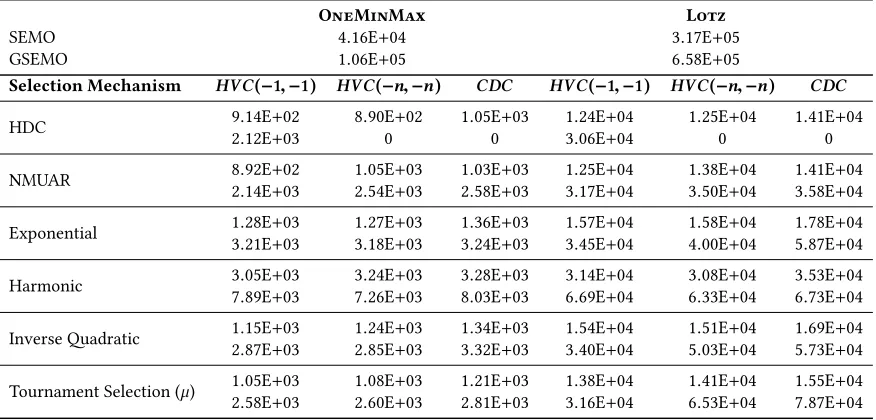
This also allows a more detailed comparison of the hypevolume contribution (HVC), the crowding distance contribution (CDC), and the parent selection methods. In the case of the HVC, we have defined two reference points,HV C(−1,−1)andHV C(−n,−n). For
the first reference point, we have provide a slightly preference to the extreme points while with the second reference point, the influence of the extreme points become very strong. This particular characteristic became an interesting feature to observe in the case of the ranking-based selection schemes, and expose a potential flaw for the case of HVC with low (or high in the case of minimisation) reference point or CDC (since it assign infinity value to the current extreme points) and the parent selection mechanisms that focus very aggressively toward the extreme points, as we shall see below. Since we are interested in the time requires to found the Pareto front, we have defined that outcome as a stopping criterion, and we repeat the experimental framework for 100 runs withn=100
for all algorithmic approaches and report the mean as our metric of interest.
In Table 1 we have summarized and divided the results of our experimental framework into 2 sections. The first section (upper part), refers to the mean of generations required to found the Pareto front for the classic SEMO and GSEMO that use uniform random selection for both test functions. The second section (lower part), refers to the mean of generations required to found the Pareto front for SEMO and GSEMO with the different diversity-based parent selection schemes.
As we mentioned before, a parent selection mechanisms that is extremely focused on the extreme point can be potentially dan-gerous, and to exemplify this, we have introduced a deterministic selection mechanism which we have named High Diversity Con-tribution (HDC), select the individual with the highest diversity contribution.
As can be seen in Table 1, HDC fails to found the Pareto front for
OneMinMaxandLotzin the case of GSEMO. Due to the mutation mechanism, once we start expanding the Pareto front, the algorithm may create an offspring far from the parent, leaving unexplored areas (or gaps) between them, and since the parent selection is only focused on the current extreme individuals, it will expand the Pareto front until it reaches the most extreme individuals, and it
will continue selecting those individuals ignoring the intermediate individuals, leaving the population in a stagnation state.
Finally, for any other parent selection defined in this paper, we have achieved an speeding up in the performance of SEMO and GSEMO. As can be observed in Table 1, SEMO and GSEMO with diversity-based parent selection mechanisms are able to find the Pareto front faster than its classical versions, i.e., significantly less generations are required for both test functions.
7
CONCLUSIONS
Future work: analyse Minimum Spanning Trees,SetCover, VertexCover
REFERENCES
[1] Karl Bringmann and Tobias Friedrich. 2010. An Efficient Algorithm for Comput-ing Hypervolume Contributions.Evol. Comput.18, 3 (Sept. 2010), 383–402. DOI: http://dx.doi.org/10.1162/EVCO a 00012
[2] Karl Bringmann and Tobias Friedrich. 2012. Approximating the least hypervol-ume contributor: NP-hard in general, but fast in practice.Theoretical Computer Science425 (2012), 104–116.DOI:http://dx.doi.org/10.1016/j.tcs.2010.09.026 [3] Thomas H. Cormen, Charles E. Leiserson, Ronald L. Rivest, and Clifford Stein.
2009.Introduction to Algorithms(3rd ed.). The MIT Press.
[4] K. Deb, A. Pratap, S. Agarwal, and T. Meyarivan. 2002. A fast and elitist multiob-jective genetic algorithm: NSGA-II.IEEE Transactions on Evolutionary Computa-tion6, 2 (2002), 182–197. DOI:http://dx.doi.org/10.1109/4235.996017 [5] Tobias Friedrich, Christian Horoba, and Frank Neumann. 2011. Illustration of
fairness in evolutionary multi-objective optimization.Theor. Comput. Sci.412, 17 (2011), 1546–1556.DOI:http://dx.doi.org/10.1016/j.tcs.2010.09.023
[6] Oliver Giel. 2003. Expected runtimes of a simple multi-objective evolutionary algorithm. InEvolutionary Computation, 2003. CEC ’03. The 2003 Congress on, Vol. 3. 1918–1925 Vol.3.DOI:http://dx.doi.org/10.1109/CEC.2003.1299908 [7] Oliver Giel and Per Kristian Lehre. 2010. On the Effect of Populations in
Evolu-tionary Multi-Objective Optimisation.Evolutionary Computation18, 3 (2010), 335–356.DOI:http://dx.doi.org/10.1162/EVCO a 00013
[8] Christian Horoba and Frank Neumann. 2010. Approximating Pareto-Optimal Sets Using Diversity Strategies in Evolutionary Multi-Objective Optimization. InAdvances in Multi-Objective Nature Inspired Computing, Carlos A. Coello Coello, Clarisse Dhaenens, and Laetitia Jourdan (Eds.). Studies in Computa-tional Intelligence, Vol. 272. Springer, 23–44. DOI:http://dx.doi.org/10.1007/ 978-3-642-11218-8 2
[9] Marco Laumanns, Lothar Thiele, and Eckart Zitzler. 2004. Running time analysis of multiobjective evolutionary algorithms on pseudo-Boolean functions.IEEE Trans. Evolutionary Computation8, 2 (2004), 170–182.DOI:http://dx.doi.org/10. 1109/TEVC.2004.823470
[10] Anh Quang Nguyen, Andrew M. Sutton, and Frank Neumann. 2015. Population size matters: Rigorous runtime results for maximizing the hypervolume indicator.
Theor. Comput. Sci.561 (2015), 24–36.DOI:http://dx.doi.org/10.1016/j.tcs.2014.06. 023
Table 1: First section. Mean of generations required to found the Pareto front for the classic SEMO and GSEMO onOneMinMax andLotzwithn = 100. Second section. Mean of generations required to found the Pareto front for SEMO (first rows) and GSEMO (second rows) with the diversity-based parent selection methods onOneMinMaxandLotzwithn=100.
OneMinMax Lotz
SEMO 4.16E+04 3.17E+05
GSEMO 1.06E+05 6.58E+05
Selection Mechanism HV C(−1,−1) HV C(−n,−n) CDC HV C(−1,−1) HV C(−n,−n) CDC
HDC 9.14E+02 8.90E+02 1.05E+03 1.24E+04 1.25E+04 1.41E+04
2.12E+03 0 0 3.06E+04 0 0
NMUAR 8.92E+02 1.05E+03 1.03E+03 1.25E+04 1.38E+04 1.41E+04 2.14E+03 2.54E+03 2.58E+03 3.17E+04 3.50E+04 3.58E+04
Exponential 1.28E+03 1.27E+03 1.36E+03 1.57E+04 1.58E+04 1.78E+04
3.21E+03 3.18E+03 3.24E+03 3.45E+04 4.00E+04 5.87E+04
Harmonic 3.05E+03 3.24E+03 3.28E+03 3.14E+04 3.08E+04 3.53E+04
7.89E+03 7.26E+03 8.03E+03 6.69E+04 6.33E+04 6.73E+04
Inverse Quadratic 1.15E+03 1.24E+03 1.34E+03 1.54E+04 1.51E+04 1.69E+04 2.87E+03 2.85E+03 3.32E+03 3.40E+04 5.03E+04 5.73E+04