Organized by C.O.E.T, Akola & IWWA, Amravati Center. Available Online at www.ijpret.com487
INTERNATIONAL JOURNAL OF PURE AND
APPLIED RESEARCH IN ENGINEERING AND
TECHNOLOGY
A PATH FOR HORIZING YOUR INNOVATIVE WORK
SPECIAL ISSUE FOR
NATIONAL LEVEL CONFERENCE
"SUSTAINABLE TECHNOLOGIES IN
CIVIL ENGINEERING"
FREE VIBRATION ANALYSIS OF THIN RECTANGULAR PLATES USING FINITE
ELEMENT TECHNIQUES
R. R. GADPAL
Department of Applied Mechanics, Govt. Polytechnic, Arvi Dist.(Wardha)
Accepted Date: 13/03/2015; Published Date: 01/04/2015
Abstract: A free vibration analysis of thin rectangular isotropic plate is presented in this paper. This presentation consists of determination of fundamental vibration frequencies of thin rectangular plates with simply supported or fixed edges. The frequencies are determined by the finite element method using iteration technique. The parameters considered in the analysis were the aspect ratio of the plate’s side lengths and the boundary conditions. The frequency coefficients are determined for the plate with classical boundary conditions, by numerical analysis and show good agreement with those determined by classical method. A simple design formula is proposed to aid structural engineers to estimate the fundamental frequencies of such rectangular plates.
Keywords-Fundamental natural Frequencies, Thin Rectangular Plate, Boundary Conditions, Shape Function and Algebraic Equation
Corresponding Author: MR. R. R. GADPAL
Co Author: Access Online On:
www.ijpret.com
How to Cite This Article:
Organized by C.O.E.T, Akola & IWWA, Amravati Center. Available Online at www.ijpret.com488
INTRODUCTION
Rectangular plates are one of the most important structural elements that are of interest in the field of civil, mechanical, automobile, aerospace, optical, marine, nuclear and structural engineering. Plates and their differential characteristics enable engineers to design better and lighter structures. The Study of their free vibration behaviour is very important to the structural engineers when these structures are subjected to external complicated dynamic loads such as earthquake, wind, impact and wave forces. An understanding of the free vibration frequencies of any system (especially, the fundamental frequency) is the prerequisite to the understanding of its response to forced vibration. In buildings, horizontal floors are usually in the form of rectangular plates, which are directly exposed to static and dynamic loadings.
II LITERATURE REVIEW
A long ago in 1823 Navier obtained the exact solution of bending of rectangular plate with all edges simply supported using a double trigonometric series [1]. In 1899, by using a single Fourier series Levy developed a method for solving plate bending problems with two opposite edges simply supported and the remaining two opposite edges with arbitrary conditions of support [2]. Cheung Y.K. and Cheung M.S. reported a paper on flexural vibrations of rectangular and other polygonal plates in 1971 [3]. Leissa, in 1973, analysed the rectangular plates for free vibration analysis, presented accurate analytical results for the cases having two opposite edges simply supported whereas the remaining two opposite edges with possible combinations of clamped, simply supported and free edge conditions by using Ritz method [4]. Gorman examined free vibration analysis of rectangular plates with combinations of clamped and simply supported end conditions in 1982 [5]. Fan S.C. and Cheung Y.K. presented a paper in 1984 on flexural free vibrations of rectangular plates with complex support conditions [6].
Recently, Jiu and Chen in 2007 gave exact solutions for free vibration analysis of rectangular plates using Bessel’s functions [7]. In 2013, Ezeh J.C. and others have presented dynamic analysis of isotropic SSSS plate using Tayler series shape function in Galerkin’s functional [8]. Ajay Patil has presented free vibration analysis of thin isotropic rectangular plate in 2014[9].
Organized by C.O.E.T, Akola & IWWA, Amravati Center. Available Online at www.ijpret.com489
Analytical solutions for dynamic response of plates are available for very few cases i.e. for plate with simple geometry and boundary conditions. But for plate with complex boundary and boundary conditions, solutions are possible only with the help of numerical methods. The most commonly used numerical method is finite element method. Due to edge beams, the rectangular plates are in a state of restrained conditions. Thus the present study presents the first mode of vibration frequencies of rectangular plates with fixed edges. The frequencies are determined by the finite element method. The parameters considered in the analysis are the
aspect ratio, λ , and fixity factor, and ƒ . The fixity factor, ƒ = 0.0 refers to a simply supported edge and ƒ = 1.0 a completely fixed edge. The changes of the fundamental frequency are
represented by the algebraic equation of three parameters, λ , and ƒ . The frequencies estimated by the proposed algebraic equation coincide well with those obtained by the finite element method, which can serve as a design aid for structural engineers.
III. FINITE ELEMENT FORMULATION
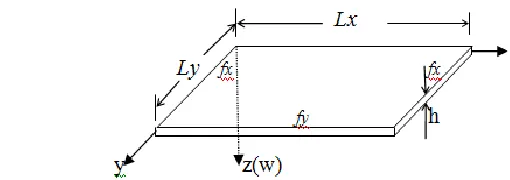
The floor slabs commonly encountered in buildings are usually modelled as thin rectangular plates where the effects of transverse shear deformation and rotary inertia are neglected. For the free vibration analysis, consider a thin rectangular plate of length Lx, width Ly and thickness = h , the x and y axes are made to be along the principal directions and the z axis is perpendicular to the xy plane as shown in Fig. 1 ,
Fig.1: Rectangular plate with dimensions and parameters
Fig. 2 shows a rectangular plate element having 4 displacement nodes. Each node is associated
with 3 degrees of freedom, namely the vertical deflection (
Organized by C.O.E.T, Akola & IWWA, Amravati Center. Available Online at www.ijpret.com490
The displacement function w within an element can be expressed through the use of shape functions and the nodal displacement vector {δ}:
w = [N1, N2...N12] T = [N] {δ} ...(1)
The shape functions [11] are given by
N1 = (1 – ξ) (1 – ɳ) (2 – ξ2– ɳ2– ξ– ɳ) / 8 , N2 = (1 – ξ) (1 – ɳ) (1 – ξ2) a / 8 ,
N3 = (1 – ξ) (1 – ɳ) (1– ɳ2) b / 8 , N4 = (1 – ξ) (1 + ɳ) (2 – ξ2– ɳ2– ξ+ ɳ) / 8 ,
N5 = (1 – ξ) (1 + ɳ) (1 – ξ2) a / 8 , N6 = – (1 – ξ) (1 + ɳ) (1– ɳ2) b / 8,
N7 = (1 + ξ) (1 + ɳ) (2 – ξ2– ɳ2 + ξ+ ɳ) / 8 , N8 = (1 + ξ) (1 + ɳ) (1 – ξ2) a / 8 ,
N9 = (1 + ξ) (1 + ɳ) (1 – ɳ2) b / 8 , N10 = (1 + ξ) (1 ɳ) (2 – ξ2– ɳ2 + ξ – ɳ) / 8 ,
N11 = (1 + ξ) (1 ɳ) (1 – ξ2) a / 8 , N12 = (1 + ξ) (1 – ɳ) (1 – ɳ2) b / 8 ,
where ξ = x /a and ɳ = y / b ...(2)
Using the above displacement functions, we can derive the following element stiffness matrices by equating the flexural strain energy of an element to the external work done by the inertia force. Thus,
[k] = [kb] – ω2 [mc] ...(3)
Organized by C.O.E.T, Akola & IWWA, Amravati Center. Available Online at www.ijpret.com491
[kb] = . [D] . [C] dxdy ...(4a)
[kb] = . [N] dxdy ...(4b)
and [C] and [D] are defined as
[C] = , [D] = ...(5a,b)
The explicit form of the final results of the integrals[12] indicated in Eqs. (4a) and (4b) are given by
[kb] =
...(6a)
[mc] =
Organized by C.O.E.T, Akola & IWWA, Amravati Center. Available Online at www.ijpret.com492 fx
fy fy
fx
The factors F=1 / (1- f ) introduced in Eq.6(a) has the fixity factor ‘f’ which is defined as when the member end is simply supported f = 0.0 and when the member end is completely fixed f
= 1.0.
IV FREQUENCY FORMULATION
When the plate is sub-divided into elements, the element stiffness and mass matrices are assembled using a standard assembly procedure and the proper boundary conditions are applied, we get the matrix equation in the following form for the complete plate.
( [Kb] − ω2 [Mc]{∆} = {Q} , where {Q} = 0 for free vibrations ...(8)
To obtain the fundamental frequency by iteration technique [13] and [14], the above equation is transformed into the following form
( [Kb]−1 [Mc] − {∆} = { 0} ...(9)
where [ I ] is the identity matrix
V REGRESSION FORMULA
The natural fundamental frequencies of the plate can be determined using classical methods as well as using finite element technique which is widely reported in the literature. It is well known that the numerical analysis results are valid only for particular values of the parameters considered in the analysis. The structural engineers concerned with dynamic analysis or design of rectangular plates need a design formula for rapid determination of the governing natural frequency. In view of this, the changes of the fundamental frequency coefficient were assumed to take the following form of the algebraic function given by Eq.10. The numerical values of the polynomial coefficients were determined by regression technique reported in literature and reproduced in Table 1.
Ly λ = Ly / Lx , , (C=Cfem= Creg )
Creg = (Ao+A1 λ+ A2 λ2)+ (Bo+B1 λ+ B2 λ2) fx+(Co+C1 λ+
Lx C2 λ2) fy +(Do+D1 λ+D2 λ2) fx2+(Eo+E1 λ+E2 λ2)
Organized by C.O.E.T, Akola & IWWA, Amravati Center. Available Online at www.ijpret.com493
Table 1: Regression Constants
Ao 31.950 Co 2.342 Eo -4.678
A1 -15.743 C1 12.414 E1 3.267
A2 2.994 C2 -2.191 E2 -0.594
Bo 29.275 Do -8.202 Fo 2.568
B1 -22.784 D1 6.069 F1 -7.515
B2 4.488 D2 -1.155 F2 1.291
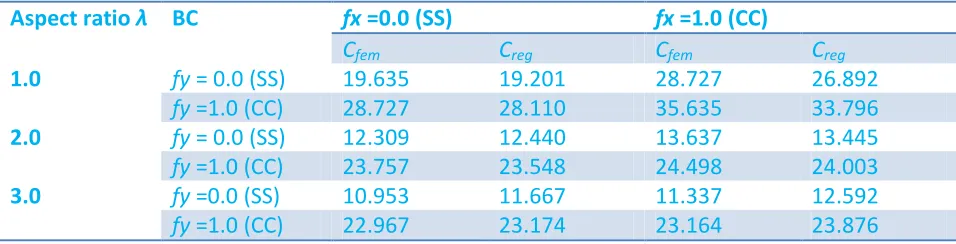
In columns shown in Table 2 Creg denote the frequencies estimated by the Eq.(10). On comparison with Cfem it shows good agreement with the results.
Table 2: Natural frequencies ‘ω’ for rectangular plates (non dimensional coefficients)
BC- Boundary Conditions, SS – Simply Supported, CC – Clamped.
VI CONCLUSIONS:
The fundamental frequencies for rectangular plate with different boundary conditions were determined by finite element method. In general the increase of fixity at the plate edges increase the plate dynamic stability. The fixity factor increase along the long side of the plate is more efficient than that of along short side of the plate. A design formula in the form of algebraic fraction is used to aid designer to estimate the fundamental frequencies of such plates.
Aspect ratio λ BC fx =0.0 (SS) fx =1.0 (CC)
Cfem Creg Cfem Creg
1.0 fy = 0.0 (SS) 19.635 19.201 28.727 26.892
fy =1.0 (CC) 28.727 28.110 35.635 33.796
2.0 fy = 0.0 (SS) 12.309 12.440 13.637 13.445
fy =1.0 (CC) 23.757 23.548 24.498 24.003
3.0 fy =0.0 (SS) 10.953 11.667 11.337 12.592
Organized by C.O.E.T, Akola & IWWA, Amravati Center. Available Online at www.ijpret.com494
REFERENCES:
1. Navier C.L.M.H. -“Extrait des recherché sur la flexion des plans elastiques”, Bull. Sci. Soc. Philomarhique de Paris, 5, pp 95-102, (1823).
2. Levy M. – “Sur L’equilibrie Elastique D’une Plaque Rectangulaire” , C. R. Acad. Sci., 129, pp 535-539,(1899).
3. Cheung Y.K. and Cheung M.S.- “Flexural vibrations of rectangular and other polygonal plates”, Journal of Engineering Mechanics Divisions, American Society of Civil Engineers, 97, pp 391- 411, (1971).
4. Leissa A. W. – “Free vibration of rectangular plates”, Journal of Sound and Vibration. 31(3), pp 257 -293, (1973).
5. Gorman D.J.- “Free vibration analysis of rectangular plates”, North Holland Elsevier (1982).
6. Fan S.C. and Cheung Y.K.- “Flexural free vibration of rectangular plates with complex support conditions”’ Journal of Sound and Vibration. 93, pp 81 - 94, (1984).
7. Jiu Hu Wu A. Q. Liu and H.L. Chen – “Exact solutions for free - vibration analysis of rectangular plates using Bessel’s functions”, Journal of Applied Mechanics, ASME , 74, pp 1247 -1252 (2007).
8. Ezeh J.C., Ibearugbulem O.M., Njoku K.O., Ettu L.O., - “Dynamic analysis of isotropic SSSS plate using Tayler series shape function in Galerkin’s functional , International Journal of Emerging Technology and Advance Engineering, 3, pp 372 – 375, (2013).
9. Ajay Patil – “Free vibration analysis of thin isotropic rectangular plate”, International Journal of Innovative Research in Science, Engineering and Technology and Advance, 3, pp 77 – 80, (2014)
10.IS 1893:2002 – Criteria for Earthquake Resistant Design of Structures (Part 1), pp 24-26, (2002).
11.Zienkiewicz O.C.-“The Finite Element Method”, Third Edition,Tata McGraw Hill Publishing Co.Ltd., pp 234-240, (1979).
Organized by C.O.E.T, Akola & IWWA, Amravati Center. Available Online at www.ijpret.com495
13.Klaus.-.Jurgen Bathe - Finite Element Procedures , Fourth Reprint, Prentice Hall of India Pvt. Ltd. pp 861-892, (1997).