This is a repository copy of Harmonious communitarianism or a rational public sphere: a content analysis of the differences between comments on news stories on Weibo and Facebook.
White Rose Research Online URL for this paper: http://eprints.whiterose.ac.uk/136992/
Version: Accepted Version
Article:
Bolsover, G orcid.org/0000-0003-2982-1032 (2017) Harmonious communitarianism or a rational public sphere: a content analysis of the differences between comments on news stories on Weibo and Facebook. Asian Journal of Communication, 27 (2). pp. 115-133. ISSN 0129-2986
https://doi.org/10.1080/01292986.2016.1214743
© 2016 AMIC/SCI-NTU. This is an Accepted Manuscript of an article published by Taylor & Francis in Asian Journal of Communication on 28 Jul 2016, available online:
https://doi.org/10.1080/01292986.2016.1214743.
[email protected] https://eprints.whiterose.ac.uk/ Reuse
Items deposited in White Rose Research Online are protected by copyright, with all rights reserved unless indicated otherwise. They may be downloaded and/or printed for private study, or other acts as permitted by national copyright laws. The publisher or other rights holders may allow further reproduction and re-use of the full text version. This is indicated by the licence information on the White Rose Research Online record for the item.
Takedown
If you consider content in White Rose Research Online to be in breach of UK law, please notify us by
Harmonious communitarianism or a rational public sphere: A content
analysis of the differences between comments on news stories on Weibo and
G. Bolsover
Oxford Internet Institute, University of Oxford, Oxford, United Kingdom.
This is an Accepted Manuscript of an article published by Taylor & Francis in the Asian Journal of Communication on 28 Jul 2016, available online at:
Abstract
In studying online political communication in China, many researchers apply theories generated in the West (particularly that of the public sphere) without questioning their applicability in the Chinese context. Others argue that new theories must be generated from the ground up, often basing these theories on traditional Chinese philosophies. However, the applicability of these approaches remains unproven. This research uses a content analysis to compare comments on news stories on Chinese and Western social media sites. It finds that there is little evidence to support either the use of public sphere theory in China or the use of traditional conceptions of Eastern styles of communication. Chinese netizens were no more subtle or harmonious (if anything they were more divisive) and were less likely to talk with others, attempt to understand others opinions or attempt to work toward consensus or resolution. Based on these findings, I propose that future research should attempt to build more appropriate theories based on an understanding of how political ideas are actually produced, transmitted and received in society, rather than continuing to apply foreign or ancient theoretical frameworks without a critical interrogation of their applicability in their context of application.
Keywords
online political communication; China; Weibo; social networking sites; public
Introduction
The Internet was invented in the U.S. and it was in a Western context that
this technology developed and matured. As part of its development, key U.S. values,
such as privacy and freedom of expression, were built into the code and structure of
the Internet (Norris & Inglehart, 2009). This discourse of the Internet as a
freedom-spreading technology has been accepted by the majority of Internet users across the
world, regardless of the conditions of the technology s use (Bolsover, Dutton, Law, &
Dutta, 2014). However, despite the influence of Western nations in shaping Internet
values, users in these countries no longer dominate the global Internet. China
surpassed the US in to become the world s largest population of )nternet users
and users in Asia now make up almost half of the world s )nternet population
Despite these huge shifts in the composition of the global Internet
population, communications scholarship has been slow to shift away from its
Western focus. Efforts to de-westernize scholarship are often hampered by a lack of
home-grown or area-specific theories of communication (Dissanayake, 2009). This
has led some scholars to uncritically apply communication theories generated in the
West in other contexts and others to reject existing scholarship in favour of calls for
the need to build an entirely new body of knowledge for each area under study.
Others simply produce atheoretical work that, thus, is highly exploratory and
descriptive, rather than explanatory.
All three of these approaches are problematic. It is likely to lead to spurious
conclusions if existing theories are applied uncritically without an interrogation of
whether they are appropriate in contexts very different to that of their generation.
But equally, in a globalized world interacting via the Internet, national and regional
counterparts as to justify throwing out existing theories to build new ones from the
ground up. Empirically based, comparative research is, thus, a necessary part of the
effort to de-westernize communications scholarship in that it can establish in what
ways Internet users in non-Western contexts differ from previously studied
populations. Knowledge of these differences and similarities can then be used to
inform the application and modification of existing theories.
One area in which this problem is particularly acute is in relation to the
study of Internet-based political activities in China. Despite the enormous
popularity and importance of this topic, research in this area is often highly
descriptive and based on of a handful of prominent case studies or topics. When
normative theoretical lenses are applied, most scholars use the concept of the
public sphere (Habermas, 1989) and of rational deliberation, despite the fact that
these theories were developed to describe communication in a democratic context.
While there have been many developments in public sphere theory since Habermas
(e.g. Fraser, 1992; Kluge & Negt, 2016; Mouffe, 2005), research that attempts to find
a Chinese public sphere tends to align with the traditional Habermasian conception,
and continues to hold rational, independent deliberation; ideal role taking; and
autonomy from state and economic powers as normative ideals.
The use of public sphere theory is often justified by authors arguing that it
can be usefully applied in China, despite its authoritarian system, (Jiang, 2009) or
the fact that these terms are used by Chinese Internet users and academics (G. Yang
& Calhoun, 2007). However, scholars often enthusiastically find an incipient public
sphere in Chinese cyberspace without discussing how China s political and social
One attempt to reconcile the popularity of the deliberative ideal with China s
political context has been the concept of authoritarian deliberation, which was put
forward by He (2006) as part of The search for deliberative democracy in China
(Leib & He, 2006). He argued that the Chinese government was driving a process of
democratization because, as He and Warren (2011) argue in a later article,
deliberation serves to provide information to the government, to prevent policy
errors, and to increase governmental authority and legitimacy.
However, others argue that the generation of new theories of political
communication in China is necessary to get rid of the baggage associated with
public sphere theory (Huang, 1993) or due to latent differences in Chinese netizens
approaches to communication (G. M. Chen, 2009; Shao & Zhang, 2013). Of the
scholars who look to generate or update existing theories many look toward
traditional Chinese philosophies and traditional conceptions of differences between
Eastern and Western styles of communication (e.g. S. Yang, Xu, & Qi, 2013) for their
starting material.
However these approaches are premature, for it remains to be established
whether the online political speech of Chinese netizens reflects the
Western-generated normative ideals of public sphere theory or, equally, whether traditional
conceptions of Eastern or Asian styles of communication are relevant when
examining online speech in modern China. It is, of course, true that the existence of
a discrepancy between the nature of observed political speech and a particular
normative ideal does not mean that the theory is not appropriate; this is exactly the
point of normative theories, to outline a framework of how things ought to be rather
than how they are. However, the tendency to set out to search for deliberative
missing important indications of other models of or developments in political
speech because it is too fixed on a particular end goal.
In an influential article, Freeden lays out three ways of constructing political
theories. The first two are working from normative ideals and charting the history
of political ideas. He criticizes both these approaches as taking insufficient account
of the ordinary and normal manifestations of political thought in any given society
(2008, p. 197). The third way of constructing political theory that Freeden proposes
is to work from an understanding of how political ideas are actually produced,
transmitted and received in society, and what individuals actually do and think
about politics. This third way can take into account the context of speech and avoid
importing normative ideals that are not appropriate or not shared by individuals in
the context under consideration.
The importance of context
Many early approaches to Internet research took a perspective that later
came to be called technological determinism. The Internet, as well as other related
communication technologies, were seen as (almost) automatically leading to certain
social outcomes due to their structures and affordances. In relation to political
speech and political power, the Internet was seen as a democratizing force that
would bring down authoritarian regimes; this perspective was encapsulated in then
US President Bill Clinton s famous quote that China s attempt to control the )nternet
was akin to trying to nail jello1 to a wall (U.S. Government Printing Office, 2000, p.
407).
However, this technologically deterministic optimism understated three
important facts: firstly, that the Internet, although constrained by code and
1 Jell-O is the brand name for a popular American brand of jello or gelatinous
structure, is a relatively impartial tool that can be used just as easily by
non-democratic forces as non-democratic ones; secondly, that the use and effects of
technologies are highly dependent on their context of use; and thirdly, that the
Internet is far from a monolithic entity and that different platforms and modes of
use will have vastly different affordances and social effects.
More recent approaches to studying the political and social effects of the
Internet have focused on the interactions of code and context (Kitchin & Dodge,
2011) and several scholars have started to use actor network theory (Latour, 2005),
which approaches Internet spaces and platforms as nonhuman actors, to investigate
how users and (so-called) non-human actors work together as a system (e.g. Poell,
de Kloet, & Zeng, 2014).
However despite this recognition of the importance of context in
understanding Internet usage and effects, there has been little empirical or
theoretical examination of whether the political theories being applied to the study
of the Chinese Internet are appropriate to their context.
Political speech in China and the West
Western normative frameworks for political speech took a deliberative turn
in the early 1990s, although these ideas are associated with earlier works by Rawls
(1971) and Habermas (1962). This deliberative ideal emphasizes that democratic
legitimacy should be based, not just on representation but, on rational deliberation
by citizens (Dryzek, 2002). Following this trend, communication theorists have
generally prioritized a deliberative model of political speech, with communitarian
and liberal individualist models sometimes also used in contrast (Dahlberg, 2001; D.
The role of political speech under a deliberative model is to allow
participants to share and be exposed to a diversity of views before drawing
conclusions based on the evidence given. Despite the fact that Western online
political speech has been generally accepted as falling far short of the deliberative
ideal (See, for instance, Dahlberg, 2001), this is still generally held up as the
idealized normative framework. This ideal is also often applied to online political
speech in China, without a justification of its appropriateness (Li, 2010; Wang &
Hong, 2010; Zhou et al., 2008).
However in both Western and Chinese contexts, the simplicity and rigidity of
the Habermasian public sphere has been problematized. As Fraser argues, the
concept of the public sphere is indispensible to critical social theory and
democratic practice but that the specific form in which (abermas elaborated it
is unsatisfactory (1992, p. 57). Drawing from these critiques, many scholars have
moved toward the concept of multiple public spheres, some stronger than others;
ad hoc public spheres and issue publics; and the concept of civil society, as a looser
and less prescriptive way of describing the intersection of state apparatuses and
that which grows out of society.
In his influential work on The Power of the Internet in China Guobin Yang
notes how terms such as public sphere, discourse space, and civil society are
emerging as new discourses related to online activism in modern China (2009, p.
217). However, as Huang (1993) argues, both the concepts of the public sphere and
civil society are value-laden terms that defy importation into new contexts and rely
on a dicotomous oppositon between the state and society that may not be
Traditional Chinese philosophies, as well as more modern traditions,
prescribe different roles for political speech than is found in the deliberative model.
In dynastic China, the Mandate of Heaven that gave emperors their right to rule
rested on the support of the people, obtained through acting benevolently and
providing for the people s livelihood (Perry, 2008). Under this structure, the role of
political speech was to raise awareness when these obligations are not being
fulfilled. Although Confucian philosophy recognized that the power of governments
should be derived from the people, it did not provide structures by which this
power could be realized (He, 2010). This lack of formal structures forced discontent
into extra-institutional channels (Hung, 2011) and led to a state-citizen relationship
based on ad hoc actions, such as traveling to the capital to makes one s case to the
Emperor.
In Maoist and post-Mao China, more formal structures have been created to
allow citizens to feed their opinions into government policies; however, acceptable
speech is highly prescribed and allowed only within the confines of Party
dominance of both political power and the political agenda (He & Warren, 2011).
The boundaries of what constitutes acceptable political speech in modern China are
opaque leading to uncertainty, self-censorship and uneven application; however,
this also results in a negotiation of the boundaries of acceptable speech between the
state and citizens (Stern & Hassid, 2012).
In attempting to construct a normative framework for the effects of the
Internet on Chinese political communication by combining theories of democracy
with traditional Chinese philosophy, S. Yang et al. (2013) focus on the role of the
)nternet as a source of information particularly in promoting an awareness of
22). Similarly, Guobin Yang finds that spontaneous online protests in China rest on a
sense of moral calling with the spontaneity in direct proportion to the (perceived)
gravity of the injustice (2009, p. 36).
While S. Yang et al.s efforts to move past public sphere theory in evaluating
political speech in China are sorely needed, the question of what normative
frameworks are evidenced in the way that Chinese netizens actually speak online
has yet to be addressed. Given the huge differences between the present day and
the time of generation of these theories and, in particular, the extent of the opening,
modernization and internationalization in China in the past decade, it is important
to think critically about whether these ancient Chinese theories prove might prove
any more relevant than imported Western ones?
The tale of two Internets
Popular and academic discourse often speaks of The )nternet as a
technology that spans the globe offering similar platforms and affordances to all
users but this discourse also includes the idea of The Chinese )nternet with a
semi-porous border created by censorship, linguistic barriers, and the prevalence of
strong, domestic alternatives to the Western-originated sites that are dominant
across much of the rest of the world.
This situation both enhances and complicates comparative studies. The use
of different platforms means that it is difficult to separate the effects of differing
political, social and cultural contexts from the effects of platform and structure.
However, these different platforms, which are often seen as clones with Chinese
characteristics of banned services, mean that, when a structural approach is taken,
these different political, social and cultural contexts can be seen reflected in the
In constructing a comparative analysis of political speech on the Chinese and
Western Internet, this study focuses on speech on social networking and
microblogging sites. These are not the locations that are specifically designed for
political speech, nor are they the locations in which the individuals who are most
involved in discussing political online gather. One important early criticisms of the
Internet as a potential public sphere was the small number of people who
participated in online political speech (Dahlberg, 2001) and the small amount of
Internet traffic that is associated with (a small number of) political sites (Hindman,
2009). However, these criticisms were developed before the emergence of social
networking and microblogging sites as (one of) the dominant mode(s) of Internet
communications. The protests and revolutions in the Middle East and North Africa
starting in 2010, in which social media tools were heavily used by protestors,
brought new hope to those who see the Internet and particularly social media
platforms as potentially facilitating a redistribution of political power (particularly
in non-democratic states) (Howard et al., 2011).
This study thus chooses Sina Weibo and Facebook as the two platforms to
compare in assessing what the differences and similarities in online political speech
between Chinese and Western social networking sites might be and whether the
type of speech exhibited on Chinese social media platforms seems to justify the
application of public sphere theory or traditional Chinese/Asian communication
theories.
Facebook, founded in 2004, has grown over the last decade to become one of
the most popular sites on the Internet. It is primarily used as a social networking
site, with the majority of online connections based on offline social connections and
socially based Internet platforms such as Twitter or YouTube. However, the social
basis of information sharing and contagion, and social influence on Facebook is very
strong, as Bond et al. (2012) demonstrated in a 61-million-person-strong
experiment on Facebook during the 2008 US presidential election. Social media is
now one of the major sources for news information for young people (Newman,
2012) and many studies have investigated the importance of these online social
networks for disseminating news information (e.g. Bakshy, Rosenn, Marlow, &
Adamic, 2012; Romero, Meeder, & Kleinberg, 2011).
In terms of the diffusion of news information in a Western context, Twitter is
generally seen as more important than Facebook, due to the greater openness of its
information publication and network connections (Kwak, Lee, Park, & Moon, 2010).
However, Twitter is not a platform on which users discuss the news stories that
they share, with news discussion on social networking sites in a Western context
generally taking place on Facebook (Bolsover, 2013)
)n China both Twitter and Facebook are censored wall jumping techniques
are required to access these sites, meaning that they are only used by a small and
specific population of mainland Chinese individuals. Instead of Twitter and
Facebook, most Chinese users use domestic platforms such as the microblogging
(Weibo) platforms provided by Sina and Tencent and the social networking
functions provided by QQ (QQ Space). Although often referred to as a Twitter clone,
Sina Weibo, the largest microblogging site in China, combines the microblogging
functions of Twitter with many of the social networking functions of Facebook,
providing a rich user experience that also reflects and incorporate features specific
to the Chinese context (Benney, 2014).
In order to investigate the differences between political speech on Facebook
and Weibo, comments on news articles were chosen as the unit of analysis because
they represent a bounded site at which discussion of political and social issues are
collected. Comments on news articles also represent an ideal site for comparison of
political speech because the structure and affordances both Sina Weibo and
Facebook are very similar in relation to this function.
Firstly, the methods by which an individual user will see a particular news
story is similar on both platforms: if they have chosen to follow that news provider,
if someone they choose to follow forwards or shares that post, or if they navigate to
the home page of that news provider through a search or link structure. Secondly,
the information published on each site is similar. While posts on Sina Weibo are
constrained to 140 characters (like on Twitter), posts on Facebook do not have a
similar limit. The ability to convey a great deal more information in 140 Chinese
characters than in 140 English characters is often given as a difference between
how the same structural constraint operates differently in different contexts, which
would complicate a comparison of news information on Sina Weibo and Twitter.
However, the soft-constraint of brevity on Facebook means that the amount of
information provided by news providers in their posts on Sina Weibo and Facebook
is similar: on both platforms news providers will generally post several sentences
that summarize the news story, an image accompanying that story and a link to the
story on the news provider s website Thirdly both sites offer similar affordances to
users to interact with news stories: users can like, comment on or forward/share
the news story. Sina Weibo also offers users the option to favourite a particular
post. Both sites provide a threaded commenting system at the site of the original
their profile. Both platforms also give users the ability to like or comment on
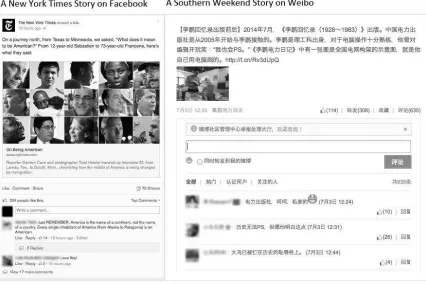
another user comment (Figure One).
Figure One: A Visual Comparison of the Structure and Affordances of
Comments on News Stories on Facebook and Weibo
While the information, structure and affordances of both Facebook and
Weibo are similar in relation to news articles, the appearance and importance
afforded to different aspects is somewhat different. On Facebook, the images related
to news stories are much larger and more space is given to the offsite link, with
information pulled directly from the linked site. In contrast on Weibo, the attached
image is much smaller and the link is shortened. This structure would likely mean
that fewer Weibo users navigate away from the microblog to the website of the
[image:15.595.85.511.217.501.2]On Weibo, more emphasis is put on user commentary; the box in which a
user would input their comment is much larger and the submit comment button far
more prominent. Weibo also allows users to filter comments to see popular
comments, comments by verified users, and comments by individuals that user
follows, which both puts greater emphasis on user submitted comments and allows
for easier viewing of the comments that might be deemed more important. Weibo
also seems to encourage user interaction with posts more than Facebook in that
they list the number of users who have liked, commented or reposed a particular
post or comment as part of the button that would allow a user to do the same. This
structural choice would likely increase the snowball effect of already popular
comments compared to Facebook where the number of users who have performed
one of these functions is presented in a different location to the button that would
allow the viewing user to do the same.
However, although the information, structure and affordances of both
Facebook and Weibo are similar in relation to news articles, the political, social and
demographic context in which these sites are used is quite different. Political speech
in more likely to be censored on Weibo, with one study finding that 12% of posts
from a group of users who were likely to post on sensitive topics were
eventually deleted (Zhu, Phipps, Pridgen, Crandall, & Wallach, 2013). The structure
and affordances of Sina Weibo are also more closely linked to the political priorities
of the Chinese government with, for instance, the commenting function on Sina
Weibo removed for three days in March 2012 following rumours about an
attempted coup by the then-powerful Politburo member Bo Xilai. However despite a
greater degree of political control and uncertainty on Weibo, the expression of
and some posters believe they risk little apart from having their comment removed
(Arsène, 2012).
Facebook, in contrast, is a US-based company that is used by individuals in
many different political and social contexts. In order to construct an appropriate
comparison, this study focuses on political speech on Facebook in a US context.
Chinese-style censorship by deletion on Facebook is very uncommon in the US.
According to the latest Facebook transparency report, the company received no US
government requests to restrict user comments during the second half of 2013 (in
comparison India made almost 5000 requests) (Facebook, 2014). However, the US
leads the world in terms of requests for users data on Facebook; making more than
12,000 requests in the second half of 2013 (3.5 times more than the next nearest
country India) (Facebook, 2014). With increasing awareness of the extent of US
government surveillance of online communications and the extent to which
information published online can be seen by unintended others, Western Facebook
users now engage more frequently in self-censorship (Das & Kramer, 2013; Sleeper
et al., 2013) and act to control the information that is published about them online
(Blank, Bolsover, & Dubois, 2014).
While the information, appearance, structure and affordances of both Weibo
and Facebook are similar with regards to accessing and interacting with news
information, it is important, however, to keep in mind the differences in offline
political and social contexts in interpreting the reasons for any differences found
between modes and styles of online political speech on these two platforms.
Methodology
This overview of theories of political speech both in China and the West, and
raises several issues: To what extent is it appropriate to apply the theory of the
public sphere (generated in a specific historical and cultural context) to the Chinese
Internet, given its different social, political, cultural and economic contexts of use?
To what extent do online communications reflect traditional conceptions of the
differences between Eastern and Western styles of communication? Does the way in
which people comment on political issues online differ between Eastern and
Western Internet users, what might be the reasons for these differences and what
might these differences mean for the way that theories of online political
communication are applied on the Chinese Internet?
In order to address these questions, comments on news articles on the social
media sites Sina Weibo and Facebook were chosen as the unit of analysis. The New
York Times and Southern Weekend were chosen as news providers with
comparable standing on each platform, each being seen as leading investigative and
liberal papers in their respective national contexts. News stories were selected
based on a quadrant sampling strategy, to include political, social and international
issues. Within each of these quadrants stories were selected so as to be roughly
comparable in each of their respective contexts. However, to ensure that a similar
number of comments were analysed on each platform four New York Times stories
were analysed compared to three stories from Southern Weekend, with two stories
on the same international issue combined in the New York Times data (Table 1). In
total, 835 comments were examined across both platforms.
Content analysis was chosen as the appropriate methodology to address this
question because it can provide an objective, systematic, and quantitative
description of the manifest content of communication, (Berelson, 1952, p. 52). A
assumptions of Eastern and Western communication differences, based on the
dichotomies summarized by G. Chen and An (2009). Typical indicators of
deliberative discourse were also included in the coding scheme, based on the
[image:19.595.72.518.258.754.2]operationalization put forward by Dahlberg (2001).
Table 1: News Stories Chosen for Analysis
The New York Times on
Southern Weekend on Weibo
Political issue Announcement of a proposed
change by President Obama to
the controversial Affordable
Care Act - 167 comments
Report of anti-corruption
investigations and arrests among Party
officials - 180 comments
Social issues Critique of America s prison
policy that results in offenders
being jailed for non violent
crimes - 95 comments
Official criticism of the practice of
buying brides from Vietnam - 66
comments
International
issue
Report of the destruction caused
in the Philippines by Typhoon
Haiyan - 80 comments
Report of the devastation caused by
Typhoon Haiyan in the Philippines and
the aid offered by China - 185
comments Report of the impediments to aid
distribution in the Philippines
following Typhoon Haiyan - 62
comments
Total number of comments
analysed - 404
Total number of comments analysed -
However, out of Dahlberg s six-part schema both autonomy from state and
economic power (i.e. that speech should be driven by the concerns of
publicly-oriented citizens rather than by money or administrative power) and reflexivity (i.e.
that participants should critically examine their cultural values, assumptions and
interests) were dropped from the final coding scheme because in the first case it
was too difficult to assess what considerations lay behind user posts simply from
the examination of such a short text and in the second case no comments were
found in preliminary tests that demonstrated the requisite level of reflexivity.
Therefore four of Dahlberg s six requirements are assessed in this study exchange
and critique of reasoned moral-practical validity claims, ideal role taking, sincerity,
and discursive inclusion and equality. The final coding scheme is shown in Table 2.
While content analysis generally has coders overlap on only a percentage of
the materials to be coded, in this study all of the posts were coded by two bilingual
coders: one British (the author) and one Chinese. While this choice meant that the
sampling frame was necessarily smaller, it was important to have both a Western
and a Chinese coder code each comment so that the codes assigned to comments
could be said to be true for individuals from both an Eastern and Western cultural
context. The coding scheme was refined over the course of three pilot tests that
used data from both platforms. After each test, the coders met to discuss changes to
the coding scheme.
In coding the final dataset, in cases where the coders disagreed both coders
were given a second opportunity to independently code that comment. If
disagreement was still present, that data was not included in the final analysis. (This
is the difference between the total coded and N columns of Table 2). Final
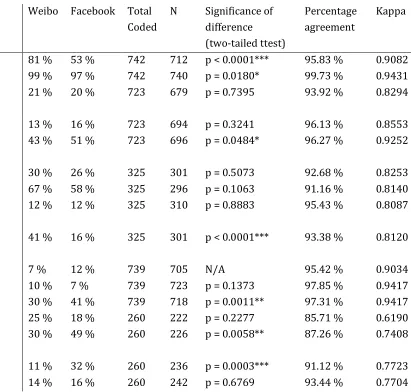
Table 2: Results, significance and agreements
Does the comment Weibo Facebook Total
Coded
N Significance of difference (two-tailed ttest)
Percentage agreement
Kappa
Talk at the original poster (as opposed to talking to others) 81 % 53 % 742 712 p < 0.0001*** 95.83 % 0.9082
Express a point of view 99 % 97 % 742 740 p = 0.0180* 99.73 % 0.9431
Express their point of view subtly (as opposed to directly)
21 % 20 % 723 679 p = 0.7395 93.92 % 0.8294
Use instructional language 13 % 16 % 723 694 p = 0.3241 96.13 % 0.8553 Provide reasons to support their point of view 43 % 51 % 723 696 p = 0.0484* 96.27 % 0.9252 Are these reasons
Subtle (as opposed to direct) 30 % 26 % 325 301 p = 0.5073 92.68 % 0.8253
Subjective (as opposed to objective) 67 % 58 % 325 296 p = 0.1063 91.16 % 0.8140 Based on universal truths (as opposed to dependent on
the situation)
12 % 12 % 325 310 p = 0.8883 95.43 % 0.8087
Evaluated based on ritual and tradition (as opposed to reason)
41 % 16 % 325 301 p < 0.0001*** 93.38 % 0.8120
Use the plural form (as opposed to singular or neither) 7 % 12 % 739 705 N/A 95.42 % 0.9034
Attempt to prevent others from speaking 10 % 7 % 739 723 p = 0.1373 97.85 % 0.9417 Make an individual argument as part of a debate 30 % 41 % 739 718 p = 0.0011** 97.31 % 0.9417 See distinct, opposing groups of opinion holders 25 % 18 % 260 222 p = 0.2277 85.71 % 0.6190 Show evidence of attempting to understand situation from
others' perspectives
30 % 49 % 260 226 p = 0.0058** 87.26 % 0.7408
Attempt to work toward a consensus or resolution 11 % 32 % 260 236 p = 0.0003*** 91.12 % 0.7723 Accept that others have the right to their own opinions 14 % 16 % 260 242 p = 0.6769 93.44 % 0.7704
that had agreements of 87 and 85% (Table 2). The Kappa scores for each question
were above 0.7, except for one question that had a kappa score of 0.62. These scores
are well within acceptable levels of intercoder agreement for this type of research
(Lombard, Snyder-Duch, & Bracken, 2002; Neuendorf, 2002).
Little support for the applicability of public sphere theory on Chinese
microblogs
An analysis of comments on news stories on Facebook and Weibo produced
little support for the idea that the concept of a Habermasian public sphere could be
meaningfully applied in this context. Although many studies based on Western
populations have noted a lack of rational, interpersonal discussion online,
comments on Facebook were much closer to these ideals than those on Weibo. For
instance, comments on Facebook were more than twice as likely as those on Weibo
to be addressed toward other participants as opposed to talking back to the original
poster: 47% of comments on Facebook were addressed towards other participants
compared to 19% on Weibo. This difference was highly significant (p < 0.0001)2.
However given that this research is based on a sample of a small number of
stories on each platform, any differences noted between the two platforms should
be examined to ensure that they are likely true cross-platform differences rather
than a result of the individual stories sampled. Examining individual story
percentages, it seems that the much greater tendency of Facebook commentators to
talk with others is really a platform difference. In the four stories analysed on
Facebook, the percentage of comments identified as talking to others were 56, 47,
32 and 44; compared to 14, 18 and 34 on Weibo. The higher frequency of talking to
others in the third Weibo story (concerning the practice of buying brides from
2 All p-values quoted here are based on a two-tailed ttest, the results of which are
Vietnam) was due to a high number of posters who used the article to make fun of
their friends love prospects rather than engaging in conversation with prior
posters. Examining the percentage of comments on each individual story that were
directed at others, we can conclude that comments on Facebook are more than
twice as likely to be talking with others, as opposed to simply talking back to the
original poster, and that this difference is likely a difference between the two
platforms rather than a result of the stories chosen.
Another indication of greater adherence to a rational, discursive
communicatory ideal on Facebook was the number of commentators that gave
reasons to support their point of view: 51% on Facebook compared to 43% on
Weibo (p = 0.0484). However, the percentage of comments that gave reasons to
support their point of view varied greatly by story and more investigation would be
necessary to confirm that this is a platform rather than sampling frame difference.
Despite the tentative nature of these results concerning the prevalence of
reason giving, it matches with previous research that concluded that Chinese
netizens use the Internet simply as an outlet to express their opinions rather than to
engage in debates with others. In their examination of Chinese blogs, Wang and
Hong concluded that this technology was overwhelmingly used to document
personal feeling and opinions and had relatively little value as a medium for
organized free speech writing that the key to the deliberative process is to allow
people to form opinions rather than simply express them and that Chinese
bloggers have relatively little experience in online public debate, contests, and
opinion forming (2010, p. 76). Other empirical research into comments on Weibo
similarly concluded that the flow and performativity of comments was much more
On a variety of measures, comments on Weibo were more divisive and less
constructive than those of Facebook, indicating a style of communication much
closer to a liberal, individualistic rather than a rationally, discursive model.
Comments on Facebook were much more likely to make an individual argument as
part of a wider debate, show evidence of attempting to see the situation from
others perspectives and attempt to work towards consensus or resolution in a
debate.
Comments on Weibo were also slightly more likely to attempt to prevent
others from speaking or being heard (for instance, by attacking the intelligence of a
previous poster) than those on Facebook: 10% on Weibo compared to 7% on
Facebook. However, this difference was not statistically significant (p = 0.1373) and
it is not clear if this difference is between platforms or simply between stories.
While conclusions should not be drawn from this result on its own, the conclusion
that comments on Weibo are more divisive and less constructive is supported by
strong and significant results in other areas.
Firstly, comments on Facebook were more likely to make an individual
argument as part of a wider debate, linking their argument to a wider social or
political issue: 41% on Facebook compared to 30% on Weibo (p = 0.0011). The
percentages for each story seem to suggest that this is different in platforms rather
than sampling frame, with 31, 32 and 19% of comments on the Weibo stories
making an individual argument as part of a debate compared to 46, 50, 23 and 44%
on Facebook. This finding lends more support to the conclusion that comments on
Facebook are more likely to align with a rational, discursive ideal than those on
In regards to whether the commentator showed evidence of trying to
understand the situation from others perspectives there was a large and significant
difference between platforms: 32% on Facebook as opposed to 11% on Weibo (p =
0.0058). However in examining the percentages of posters in each individual story
who showed evidence of trying to understand the situation from others
perspectives, it is not clear whether this difference is simply due to the sampling
frame. In the Weibo stories 40, 14 and 67% of comments that made an individual
argument as part of a debate showed evidence of trying to understand the situation
from others perspectives compared to 43, 46, 33 and 69% on Facebook. It seems
that it may have been that nationalistic tensions were heightened in the comments
on the story about China s aid to the Philippines after Typhoon Haiyan, resulting in
only 14% of relevant comments showing evidence of attempting to understand the
situation from the other s perspective and causing the difference between platforms
seen in the overall results that might not have been present if different stories were
chosen for analysis.
However, the number of commentators making an individual argument as
part of a debate who tried to work toward consensus or resolution shows a large
and highly-significant cross-platform difference. Only 15, 8, and 11% of applicable
comments on Weibo tried to work toward consensus or resolution, compared to 24,
25, 44 and 44 on Facebook. This difference, which is highly significant (p = 0.0003),
lends support to previous conclusions that discussions on Weibo are more divisive
and less constructive than those on Facebook.
These results, when examined together, provide strong support for the
conclusion that comments on Facebook align much more with public sphere ideals
assessments of the Internet in China; however, commentators on Weibo are much
less likely to be using the platform to engage in public sphere style communications
than those on Facebook. This result calls into question the applicability of pubic
sphere theory in studying political speech on the Chinese Internet and suggests that
political, social, economic and cultural context needs to be taken into account when
applying Western-generated theories in China.
Differences do not align with traditional dichotomies
Those who try to generate new normative frameworks for assessing political
speech on the Chinese Internet or explain the reasons for differences between
Chinese and Western populations often turn to traditional Chinese philosophies and
traditional conceptions of cultural differences. Chinese individuals are thought of as
expressing their ideas more subtly, being more tolerant of dissenting opinions,
being more interested in promoting in-group harmony, and using more ritualistic,
non-linear reasoning (G. Chen & An, 2009; Rosenberg, 2006). The section above has
already illustrated that comments on Weibo were actually more divisive and less
accommodating than comments on Facebook, in contrast to both public sphere
ideals and the idea of harmonious communitarianism.
Commentators on Weibo were no more likely to express their point of view
subtly than those on Facebook: 21% of comments on Weibo expressed their point of
view subtly compared to 20% on Facebook. There was also no difference in
whether reasons given to support a point of view were stated subtly or directly.
Although 30% of reasons given to support a point of view on Weibo were subtle
compared to 26% on Facebook, this difference was not large enough to be
The adage that Chinese people express themselves more subtly than
Westerners is extremely common; however, it appears that it does not hold when
comparing comments on news stories on Weibo (in a mainland Chinese context)
and Facebook (in a US context). There are many potential reasons for this
difference it could be that after a decade of opening up Chinese individuals have
lost their traditional subtleness; it could be a property of the demographics of
microblog users; or it could also be that traditional subtleness was linked to social
hierarchies that break down on microblogs, where commentators are less likely to
know the offline identities of those they communicate with or ever meet these
individuals in person.
Based on traditional dichotomies, it would be hypothesized that Facebook
users situated in a US context would be more likely to use instructional language,
being described as sermonic by G. Chen and An's 2009 dichotomy, compared to
Easterners more agreeable style of communication (owever no statistically
significant difference was found between the percentage of commentators who
used instructional language (13% on Weibo and 16% on Facebook). The potential
reasons for this may be similar to that of the lack of expected subtlety on Weibo. A
third result in contradiction of traditional dichotomies was that Chinese
commentators were no more likely than those on Facebook to give reasons that
were based on universal truths: 12% on both platforms.
There were, however, three places in which comments differed between
Weibo and Facebook in line with traditional conceptions of communicatory
differences. The first was that reasons given by Weibo commentators were more
than twice as likely to be evaluated based on ritual and tradition than comments on
highly significant (p < 0.0001) and there were clear differences between platforms
with 43, 41 and 42% of reasons evaluated based on ritual and tradition in each of
the Weibo stories, compared to 20, 6, 8 and 17% in the Facebook stories. This
difference is primarily due to the prevalence of the use of parables and idioms in
Chinese.
Also in line with traditional dichotomies, Chinese users were more likely to
base their reasons on subjective experience (such as a personal experience of the
individual): 67% on Weibo compared to 58% on Facebook. However, this difference
is not large enough to be statistically significant given the size of the sample and it is
not clear whether this difference is due to variations between Facebook and Weibo
or simply between stories. In the Weibo stories, 59, 67 and 72% of reasons were
based on subjective evidence. On Facebook, both the stories on healthcare policy
and prison policy had similar levels of subjectively supported points of view (both
63%); however both stories concerning Typhoon Haiyan on Facebook had lower
levels of subjectively supported reasons, 53 and 31%. In contrast, the story about
the typhoon on Weibo, whose content was essentially the same as those on
Facebook had the highest proportion of subjectively based reasons (72%) of all
three stories examined. This suggests that whether reasons given by commentators
to support their point of view are based on subjective or objective evidence may be
dependent more on the commentator s individual orientation toward the issue
rather than having a contextual basis. It is important to remember that differences
in the type of evidence given may also not be due to traditional cultural differences
but rather related to a lack of access to, ambiguity in or distrust of the objective
Thirdly, large differences were found between the pronouns (or lack thereof)
used on Facebook and Weibo that broadly, although not perfectly, align with
traditional dichotomies. Based on traditional conceptions, it would be hypothesized
that commentators on Weibo would use far more plural pronouns compared to a
greater frequency of singular pronoun use on Facebook. However, the real
difference was between singular pronouns and undirected statements. True to
predictions comments on Facebook were almost five times as likely as those on
Weibo to use (or imply) a singular pronoun: 34% on Facebook compared to 7% on
Weibo. While statistically significant, the difference between the proportion of
comments that used (or implied) a plural subject was not very large (12% on
Facebook and 7% on Weibo), a result that stands in contrast to the we/I dichotomy
presented in G. Chen and An (2009). The largest difference, however, was in the
number of comments that neither used nor implied either a plural or singular
pronoun: 87% on Weibo compared to 54% on Facebook, indicating a significantly
different style of speech and address.
In conclusion, the differences in comments on Weibo and Facebook often
align with traditional dichotomies in the way that points of view or reasons are
expressed: pronoun use, subjective evidence and the use of ritualistic reasons.
However in terms of interpersonal communication and group dynamics, Weibo
users are no more subtle or harmonious than those on Facebook and are no less
likely to use instructional language. This finding calls into question the applicability
of traditional theories to analyse or explain political speech on the Chinese Internet.
Implications for theory and practice
Two main conclusions can be drawn from the above results. Firstly,
communication. They are no subtler than comments posted on Facebook. They are
certainly no more harmonious; if anything, they are more divisive. This means that,
while those attempting to generate theories to apply to political communication on
the Chinese Internet should understand traditional philosophies, any theory that is
based solely on traditional ideas will be likely to be inadequate. Further research
efforts should investigate whether the high levels of divisiveness found in
comments on news stories on Weibo are present in other Chinese online spaces
and, if differences are found, evaluate the structural and demographic
particularities of these spaces. Another avenue for further inquiry would be to
investigate whether the style of communication found on Weibo is present in offline
contexts or whether it is a property of the online space (for instance, due to the lack
of offline social hierarchies).
These findings also call into question whether the concept of the public
sphere and the ideal of rational discursive dialogue are the most appropriate
normative frameworks for evaluating political speech in China. Commentators on
news stories on Weibo appear to adhere much less to these ideals than those on
Facebook and use the platform much less frequently to engage in reasoned
interpersonal debate with other users and with the aim of reaching a consensus or
resolution.
These findings align with much work, both quantitative (e.g. Asur, Yu, &
Huberman, 2011) and qualitative work that concludes that the Chinese online
public space is characteristic of highly organized centralization and a vibrant
proliferation of popular discourses and folk narratives, as well as a narrowing space
for rational deliberation (Li, 2010). However, as the Li quote demonstrates,
focus on the public sphere as a normative ideal may act to obscure an
understanding of the actual conditions of online political speech in China.
This research has shown that there are large and statistically significant
differences in the way in which users comment on news articles on the structurally
similar platforms of Facebook and Weibo. The empirical differences in the way that
commentators express their opinions and interact with each other suggest that both
Western-generated public sphere theory and traditional ideas about Chinese/Asian
styles of communication may not be the most appropriate theoretical lenses to use
to evaluate political speech on microblogs. These differences show that the context
of use of the platform needs to be taken into account when generating, modifying,
and applying theories and evaluating political speech on the Chinese Internet. The
continued use of public sphere theory as the primary means for evaluating online
political speech in China will likely result in important aspects of this speech (such
as performativity, community building, and self-expression) being overlooked
because the normative standards and goals being applied are not shared by the
commentators and these results suggest that future research is necessary to
develop normative theories of political participation that are applicable in modern
China.
Limitations and further directions
This research effort is not without limitations. Further empirical work could
clearly use larger sampling frames, examine different platforms, and construct
comparisons that can more clearly distinguish between the effects of case and the
effects of culture. In order to avoid coder assumption bias, a team with more
resources could translate materials so that coders would not know from which
It should also be noted that in this case platforms stand in for cultures and
nations. We cannot guarantee that all commentators on Weibo are Chinese nor that
all those on Facebook are Western (although this problem is more acute on
Facebook). Further research efforts could construct a sampling frame of comments
only from coders with a geocoded location in a specific country.
It would be possible to approach a similar research question using
automated content analysis, which would enable the use of much larger sampling
frames. This would be made more difficult by the amount of slang, dialects and
sayings used, particularly in the Chinese texts; the vast variability of texts, including
many very short texts; and the interdependence of the comments. However,
automated approaches would be an interesting venue for further research in this
area.
A parallel research strand should interview netizens about how they see
their online political speech before constructing theories, rather than simply
analysing texts, and should clearly consider the offline effects, both symbolic and
instrumental, of online speech and the legal, political and social regulatory context
in which the speaker is embedded.
While every effort has been made to be transparent and reflexive about this
research project, we must remain aware that if it is true that there are major
differences in communication styles between Eastern and Western individuals this
may preclude the effective addressing of the question of their existence. Although
this study used two coders who are both bilingual in Mandarin and English both
having spent significant time in mainland China and the UK, there were still points
upon which we had difficulty agreeing on how concepts should be operationalized
interpretation over the other. This was particularly true for operationalizing what
constituted both subtle and instructional language. A deeper analysis of these areas
of disagreement using alternative methodologies could provide more insight into
potential culturally based communicatory differences.
However despite these limitations, this study represents a significant step in
questioning the applicability of the theories of political speech often used to study
online political communication in China. Given the lack of empirical evidence about
the general nature of online political speech in China, the effort to generate new
theories is still premature. However, given the lack of applicable theories many
current research efforts are stuck in the descriptive and exploratory phases. This
article has shown that the oft-used concept of the public sphere and the implicit
standard of rational discourse may be inappropriate in the Chinese context.
However, equally, traditional theories of a Chinese-style of communication have
little relevance to the online speech of today s netizens which does not reflect
traditional ideas of harmonious, community-orientated communications. Further
research should work from these and other empirically based analyses of political
speech on the Chinese Internet to build more appropriate theoretical frameworks
based on an understanding of how political ideas are actually produced, transmitted
and received, rather than continuing to apply foreign or ancient theoretical lenses
without a critical interrogation of their applicability to their context of application.
Acknowledgements
I would like to thank Xinxin Long for her help in coding the dataset and for our
productive discussions that led to refinements in the coding scheme.
This research received no specific grant from any funding agency in the public,
commercial, or not-for-profit sectors.
References
Arsène, S. (2012). From self-censorship to social protest. Revue française de science
politique (English), 61(5), 53 74.
Asur, S., Yu, L., & Huberman, B. (2011). What trends in Chinese social media.
Available at SSRN 1888779. Retrieved from
http://papers.ssrn.com/sol3/papers.cfm?abstract_id=1888779
Bakshy, E., Rosenn, I., Marlow, C., & Adamic, L. (2012). The role of social networks in
information diffusion. In Proceedings of the 21st international conference on
World Wide Web (p. 519-528). New York, NY: ACM Press.
http://doi.org/10.1145/2187836.2187907
Benney, J. (2014). The aesthetics of Chinese microblogging: State and market
control of Weibo. Asiascape: Digital Asia, 1(3), 169 200.
Berelson, B. (1952). Content analysis in communication research. Glencoe, IL: Free
Press.
Blank, G., Bolsover, G., & Dubois, E. (2014). A new privacy paradox: Young people
and privacy on social network sites. Working Paper, University of Oxford,
Global Cyber Security Capacity Centre.
Bolsover, G. (2013). News in China s new information environment Dissemination
patterns, opinion leaders and news commentary on Weibo (SSRN Scholarly
Paper No. ID 2257794). Rochester, NY: Social Science Research Network.
Retrieved from http://papers.ssrn.com/abstract=2257794
Bolsover, G., Dutton, W. H., Law, G., & Dutta, S. (2014). China and the US in the new
(Eds.), Society and the Internet: How information and social networks are
changing our lives (pp. 117-134). Oxford: Oxford University Press.
Chen, G., & An, R. (2009). A Chinese model of intercultural leadership competence.
In D. Deardorff (Ed.), The SAGE handbook of intercultural competence (pp.
196 208). Thousand Oaks, CA: SAGE.
Chen, G. M. (2009). Beyond the dichotomy of communication studies. Asian Journal
of Communication, 19(4), 398 411.
http://doi.org/10.1080/01292980903293312
Dahlberg, L. (2001). The Internet and democratic discourse: Exploring the
prospects of online deliberative forums extending the public sphere.
Information, Communication & Society, 4(4), 615 633.
http://doi.org/10.1080/13691180110097030
Das, S., & Kramer, A. (2013). Self-Censorship on Facebook. In ICWSM. Retrieved
from
http://www.aaai.org/ocs/index.php/ICWSM/ICWSM13/paper/viewPDFInte
rstitial/6093/6350
Dissanayake, W. (2009). The production of Asian theories of communication:
Contexts and challenges. Asian Journal of Communication, 19(4), 453 468.
http://doi.org/10.1080/01292980903293411
Dryzek, J. S. (2002). Deliberative democracy and beyond. Oxford: Oxford University
Press.
Facebook. (2014). Rapport des demandes gouvernementales. [Report on government
Fraser, N. (1992). Rethinking the public sphere: A contribution to the critique of
actually existing democracy. In C. J. Calhoun (Ed.), Habermas and the public
sphere (pp. 109 142). Cambridge, MA: MIT Press.
Freelon, D. (2013). Discourse architecture, ideology, and democratic norms in
online political discussion. New Media & Society, , 17(5), 772-791.
http://doi.org/10.1177/1461444813513259
Freelon, D. (2010). Analyzing online political discussion using three models of
democratic communication. New Media & Society, 12(7), 1172 1190.
http://doi.org/10.1177/1461444809357927
Habermas, J. (1989). The structural transformation of the public sphere: An inquiry
into a category of bourgeois society. Cambridge: Polity Press.
He, B. (2010). Four models of the relationship between confucianism and
democracy. Journal of Chinese Philosophy, 37(1), 18 33.
http://doi.org/10.1111/j.1540-6253.2009.01561.x
He, B., & Warren, M. E. (2011). Authoritarian deliberation: the deliberative turn in
Chinese political development. Perspectives on politics, 9(2), 269 289.
Hindman, M. S. (2009). The myth of digital democracy. Princeton: Princeton
University Press.
Howard, P. N., Duffy, A., Freelon, D., Hussain, M., Mari, W., & Mazaid, M. (2011).
Opening closed regimes: what was the role of social media during the Arab
Spring? Retrieved from
http://ictlogy.net/bibliography/reports/projects.php?idp=2170
Huang, P. C. (1993). "Public sphere"/"civil society" in China?: The third realm
Hung, H. (2011). Protest with Chinese characteristics Demonstration riots and
petitions in the mid-Qing dynasty. New York, NY: Columbia University Press.
Jiang, M. (2009). Authoritarian deliberation on Chinese Internet (SSRN Scholarly
Paper No. ID 1439354). Rochester, NY: Social Science Research Network.
Retrieved from http://papers.ssrn.com/abstract=1439354
King, G., Pan, J., & Roberts, M. (2012). How censorship in China allows government
criticism but silences collective expression. In APSA 2012 Annual Meeting
Paper. Retrieved from
http://papers.ssrn.com/sol3/papers.cfm?abstract_id=2104894
Kitchin, R., & Dodge, M. (2011). Code/space: Software and Everyday Life. Cambridge,
MA: MIT Press.
Kluge, A., & Negt, O. (2016). Public sphere and experience: Analysis of the bourgeois
and proletarian public sphere. London: Verso Books.
Kwak, H., Lee, C., Park, H., & Moon, S. (2010). What is Twitter, a social network or a
news media? In Proceedings of the 19th international conference on World
wide web (p. 591 600). Retrieved from
http://dl.acm.org/citation.cfm?id=1772751
Latour, B. (2005). Reassembling the social: An introduction to actor-network-theory.
Oxford: Oxford University Press.
Leib, E. J., & He, B. (2006). The search for deliberative democracy in China.
Basingstoke: Palgrave Macmillan.
Li, S. (2010). The online public space and popular ethos in China. Media, Culture &
Lombard, M., Snyder-Duch, J., & Bracken, C. C. (2002). Content analysis in mass
communication: Assessment and reporting of intercoder reliability. Human
communication research, 28(4), 587 604.
Mouffe, C. (2005). On the political. London: Routledge.
Neuendorf, K. A. (2002). The Content Analysis Guidebook. New York, NY: SAGE.
Newman, N. (2012). Reuters Institute digital news report 2012: Tracking the future of
news. Oxford: Reuters Institute for the Study of Journalism.
Norris, P., & Inglehart, R. (2009). Cosmopolitan communications: Cultural diversity in
a globalized world. New York, NY: Cambridge University Press.
Perry, E. J. (2008). Chinese conceptions of "rights": From Mencius to Mao and now.
Perspectives on Politics, 6(1), 37 50.
http://doi.org/10.1017/S1537592708080055
Poell, T., de Kloet, J., & Zeng, G. (2014). Will the real Weibo please stand up? Chinese
online contention and actor-network theory. Chinese Journal of
Communication, 7(1), 1 18.
http://doi.org/10.1080/17544750.2013.816753
Rawls, J. (1971). A theory of justice. Cambridge, Ma.: Harvard University Press.
Romero, D. M., Meeder, B., & Kleinberg, J. (2011). Differences in the mechanics of
information diffusion across topics: idioms, political hashtags, and complex
contagion on twitter. In WWW Proceedings of the th international
conference on world wide web (p. 695). New York, NY: ACM Press.
http://doi.org/10.1145/1963405.1963503
Rosenberg, S. (2006). Human nature, communication and culture: Rethinking