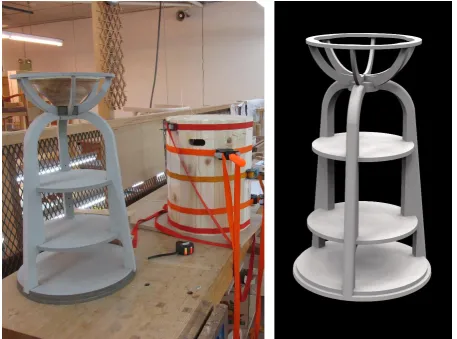
Collecting Ourselves
Bryan Nobu Harris
March 2019
A thesis submitted for the degree of Doctor of Philosophy of The Australian National University
Declaration
This thesis contains no material which has been accepted for the award of any other degree
or diploma in any university. To the best of the author’s knowledge, it contains no material
previously published or written by another person, except where due reference is made in the text.
Acknowledgements
This research is supported by an Australian Government Research Training Program (RTP) Scholarship.
This window of time for focussed investigation has been an enormous privilege
afforded me by the support of the people of Australia, the Australian Federal Government, the generosity of my wife Ashley Eriksmoen, and the understanding of my son Shepard Harris. The experience has transformed me fundamentally—all my expressions of gratitude seem hardly enough.
Collecting Ourselves would not have been possible without the guidance of my supervisory panel members. I extend my heartfelt appreciation to my Chair of Panel Richard Whitely, Primary Supervisor Professor Chris McAuliffe, and Associate Supervisor Wendy Teakel. I am also grateful for the support of the School of Art, including the guidance of Dr. Denise Ferris, and Dr. Rohan Nicol.
Many thanks for fruitful advice and discussion to Donald Fortescue, Jeremy Lepisto, Nick Stranks, Caren Florence, and Luke Taylor. Expert furniture restorer Greg Peters kindly tutored me in how to craft custom-colour timber stains. I thank Jon Stewart for his
friendship, for exemplifying a life committed to scholarship, and for still reading my papers
even though there’s no money in it anymore. I also owe much gratitude to John McManus
for his significant contributions to Collecting Ourselves, for his video work, for engaging several of the trial participants and for being a terrific friend.
I dedicate this work to my mother, Jean, whose prayers for me have ascended to heaven since the day I was born; to my fathers, Richard and Don, who graciously gave me more than they were given; to my sister, Cyndi, keeper of the bond; to Tammy and Jack, for
everything you’ve done and still do; and to Ashley and Shepard, the brightest stars in the
Abstract
Collecting Ourselves is a practice-led investigation into how furniture can support personal memory and identity by serving as a container for treasured possessions, and encouraging a practice of sharing the stories linked to the objects. I propose that a single locus within the home can provide a concentrated private or shared experience of the self through the curation of personally significant possessions; personal furniture can
encourage what Jennifer González calls an autotopography —an “array of physical signs in
a spatial representation of identity.”1
I argue that furniture comprises a boundary layer between people and things and between residents and domestic architecture. Formal barriers like cupboard doors and drawers thwart the close association between people and their most cherished possessions. In addition, conventional practices disperse possessions throughout the interior and into attic, basement, garage, and beyond, often co-mingling them with things of other household members. This creates the potential for crises of dispossession when catastrophe or illness necessitate the rapid dissolution of a home. Collecting Ourselves
develops “person-scaled” furniture as an alternative to bulky conventional forms like
bookcases, curio cabinets, and sideboards that are scaled to fill rooms.
Furniture’s boundary layer is an opportunity for representing one’s self; Collecting
Ourselves develops a sartorial approach as a method for enclosing furnitural space. I also reference the fabric bag or bundle as a human-scaled form for carrying possessions evidenced historically in peripatetic practices of soldiers, hobos, migrants and foragers— anyone who must gather things together and carry them.
The research culminates in a series of six pieces of furniture, Arks I-VI, that
demonstrate different strategies of textile and timber containment. Each piece was given to a different household to own in exchange for three months of feedback and images of the furniture in use. Engaging with participants affords a window into everyday practices within the home, with the arks acting as post-design “probes” to illuminate how people place furniture, memorialise loved ones, store and display their objects. Drawing on ideas
1 Jennifer A González, "Autotopographies," in Prosthetic Territories: Politics and Hypertechnologies, ed.
from practice theory and the emergent field of Practice-Oriented Design, the trial aspect focussed on furniture as a mediating artefact at the nexus of homes, people, possessions and practices of ordinary use.
Collecting Ourselves attempts to disrupt common usage by inserting unfamiliar furniture into participants’ homes. This strategy of introducing a novel mediating artefact has yet to reveal significant changes in how participants store their treasured possessions; however, it has proved successful in encouraging imaginative and diverse uses for the furniture. This result corroborates de Certeau’s assertion that consumers, as
“non-producers,” demonstrate creativity as users of things they acquire. The personal
Contents
Collecting Ourselves
i
Declaration ii
Acknowledgements iii
Abstract iv
Table of Illustrations
4
Preface
15
Introduction
16
Chapter Summary 21
Chapter 1: Furniture and the Experience of Being 21
Chapter 2: Furniture as Boundary Layer 22
Chapter 3: Designing to Support Memory and Identity 23 Chapter 4: Material Propositions and Experimentation 23
Chapter 5: Collecting Perspectives 24
Chapter 6: Conclusion 24
Chapter 1 Furniture and the Experience of Being
25
Liminality: En Route 26
Soldiers 26
Immigrants 29
Refugees 32
Liminality: Rites of Passage 34
Home-Making 34
Casser Maison: “Breaking the House” 36
Autotopography 39
John Locke on Identity 41
Possessions, Policy, and Modern Materiality 44
Summary 48
Chapter 2 Designing the Boundary Layer
51
Possessions Enclosed: The Box 52
Containing Art: Time Capsules by Andy Warhol 54
The Object Lesson by Geoff Sobelle 56
EMBANKMENT by Rachel Whiteread 59
Possessions Exposed: The Basket 61
Possessions Housed: The Cupboard 66
Summary 71
Chapter 3 Designing to Support Memory and Identity
73
A Collecting Ourselves Design Brief 73
Interior Landmark 74
Human Scale 76
Conceals and Reveals the Self 79
Inviting Engagement 81
Portability 83
Continuity: Memorialisation 85
Continuity: Clothing and Personal Narrative 90
Contemporary Makers 94
Wendy Maruyama: Turning Japanese and The Tag Project 95
Hella Jongerius 98
Jeremy Zietz 102
Chapter 4 Material Propositions and Experimentation
108
Making Time Totem 112
Vessel Designs 116
From Vessel to Tripod 122
The Tripod Table Meets the Boundary Layer 129
Chapter 5 Collecting Perspectives
144
Inviting Participation 144
The User Objectified 144
Practice-Oriented Design 147
Ark I (Participant S) 152
Ark II (Participant B) 153
Ark III (Participant SD) 155
Ark IV (Participant T) 157
Ark V (Participant D) 159
Ark VI (Participant C) 161
Outcome 163
Summary 167
Chapter 6 Conclusion
169
Bibliography 175
Table of Illustrations
0-1 A small collection of personal treasures kept in a drawer.
Photo credit: John Ware. ... 16
0-2 Cartoon by Bob Eckstein that reveals a cultural phenomenon. Source:
Courtesy of the artist. ... 17
0-3 People walk across a flooded St. Mark’s Square in Venice, Italy in October,
2018. Photo credit: Manuel Silvestri / Reuters. Source:
https://www.npr.org/2018/10/30/662284942/heavy-rains-wind-blamed-for-11-deaths-in-italy. ... 18
0-4 Wall hieroglyphs from the Tomb Chapel of Raemkai. Egypt, ca. 2446– 2389 B.C. Limestone, paint. Metropolitan Museum collection.
Author's photo... 20
1-1 Sgt. Jeremiah J. Rutledge, 101st Combat Aviation Brigade (Task Force Destiny), Kandahar, Afghanistan. Photo credit: Jeremiah J. Rutledge. Source: "Things they take to war," US Army, 30 November, 2010, accessed 9 March, 2019,
https://www.army.mil/article/48785/things_they_take_to_war. ... 26
1-2 U.S. Army Sgt. Jose Regalado from El Sereno, Calif., holds the ultrasound image of his unborn daughter, sent by his wife, in Mosul, northwest of Baghdad, Iraq on Sunday, March 30, 2008. Regalado says he carries the reminder of home to get him through the next day. Photo credit: Maya Alleruzzo / AP. Source: "Veterans' Good Luck Charms Haunt the Frame of War," #TimeVets,11 November, 2014, accessed 9 March, 2019,
http://time.com/collection-post/3531149/veterans-good-luck-charms/. ... 27
1-3 Jul 24, 2017 Marine Corps Recruit Depot San Diego - Recruits … hold their
sea bags during pick up. … Drill instructors ensure that the recruits fill
their bags with the appropriate items and that extra gear is emptied into the recruit’s footlocker. Photo credit: Cpl. Angelica I. Annastas. Source: Marine Corps Recruit Depot/ Western Recruiting Region,24 July, 2017, accessed 9 March, 2019,
1-4 (L) WWII footlocker belonging to US Army Capt. J G. Mitnick, 1944. 33.02 x 78.74 x 43.18 cm, wood, paint, metal, paper, leather. Source: "US Army footlocker used by a soldier," United States Holocaust Memorial Museum Collection, accessed 9 March, 2019,
https://collections.ushmm.org/search/catalog/irn518192.
(R) WWII duffel bag belonging to US Army Capt. J.G. Mitnick, 1944. 74.93 x 40.64 cm, cloth, thread, ink, adhesive. Source: "US Army duffel bag used by a soldier," United States Holocaust Memorial Museum Collection, accessed 9 March, 2019,
https://collections.ushmm.org/search/catalog/irn518201.. ... 28
1-5 (L) French Dominican sister's immigration trunk. 1880. Dimensions: 46 x 112 x 52 cm. Wood, paint, tin, paper, hide, horsehair, iron. Smithsonian Museum collection. Author's photo.
(R) Abandoned steamer trunk, California desert, 2015. The handles signal
portability, the stenciled letters denote ownership. Author's photo. ... 29
1-6 Sears, Roebuck and Company Catalog no. 120, Spring 1910, 268. Source: original from Princeton University, accessed 9 March, 2019,
https://babel.hathitrust.org/cgi/pt?num=268&u=1&seq=48&view=image&
size=100&id=njp.32101066804954. ... 30
1-7 Gert Berliner packed this toy monkey in a suitcase when he fled for his life nearly 80 years ago. It's now part of the collection at the Jewish Museum Berlin. Photo credit: Jacobia Dahm for NPR. Source: "All Things
Considered," National Public Radio,14 November, 2018, accessed 9 March, 2019,
https://www.npr.org/2018/11/14/663059048/a-toy-monkey-that-escaped-nazi-germany-and-reunited-a-family. ... 31
1-8 Nyika peoples, Giryama group, Kenya, "Memorial Post," 20th century. Dimensions: 170.8 x 14 x 7.6 cm, wood. Source: "Browse the Collection," The Metropolitan Museum, accessed 9 March, 2019,
https://www.metmuseum.org/art/collection/search/316829. ... 33
1-9 Betty Phillips' (nee Price) glory box, late 1940s. Photo credit: Betty Phillips. Source: Moya McFadzean, "Glory Boxes: Femininity, Domestic
Consumption and Material Culture in Australia, 1930-1960." (2009), 113. ...35
1-10 Mary Virgona’s glory box. Late 1940s. Author’s photo. ... 36
1-11 Simon Ramsey, The It'story Table, 2016. London plane, glass, personal
effects. Photo courtesy of the artist. ... 40
1-12 John Locke, lithograph by de Fonroug(...)? after H. Garnier, no date. Source: "Prints and Photographs Online Catalog," Library of Congress,
1-13 A corkboard "map of the self." 2018.
Photo credit: John Ware, used with permission. ... 44
1-14 Jean Carlu. America's answer! : production., 1942. Poster. Washington D.C. Source: University of North Texas Digital Library, accessed 9 March, 2019,
https://digital.library.unt.edu/ark:/67531/metadc575/. ... 45
1-15 The shelf outside Jackie Amadeo’s apartment at Brooksby Village, a
retirement community outside Boston. Photo credit: Adam Glanzman for the New York Times. Source: "A Retirement Home's Lessons in How to Keep in Touch," The New York Times, 22 September, 2018, accessed 9 March, 2019,
https://www.nytimes.com/2018/09/22/opinion/sunday/a-retirement-homes-lessons-in-how-to-keep-in-touch.html. ... 49
2-1 Author unknown,"Airflow separating from an airfoil at a high angle of attack, as occurs at the stall," 1915. Photograph. Source: "Stall (fluid dynamics)",Wikipedia, accessed 9 March, 2019,
https://en.wikipedia.org/wiki/Stall_(fluid_dynamics). ...51
2-2 Andy Warhol,Time Capsule 10. Photo credit: Lauren Ober for NPR. Source: "Dead Bees, Nail Clippings and Priceless Art in Warhol's 'Time Capsules'," National Public Radio,2 November, 2013, accessed 9 March, 2019,
https://www.npr.org/2013/11/02/242174661/dead-bees-nail-clippings-and-priceless-art-in-warhols-time-capsules. ... 55
2-3 Geoff Sobelle, The Object Lesson, 2015. Photo credit: Craig
Schwartz/Courtesy of The Center Theatre Group. Source: "Out of 'The Object Lesson,' An Education in the Power of Kept Things," National Public Radio,27 September, 2015, accessed 9 March, 2019,
https://www.npr.org/2015/09/27/443200222/out-of-the-object-lesson-an-education-in-the-power-of-kept-things. ... 57
2-4 French reliquary, Limoges, ca. 1200-1220. 11.4 x 5.7 x 7.3 cm., copper, gilt, enamel. Source: "Browse the Collection," The Metropolitan Museum, accessed 9 March, 2019,
https://www.metmuseum.org/art/collection/search/463680. ... 58
2-5 Rachel Whiteread, EMBANKMENT, 2006. Photo credit: Gryffindor. Source:accessed 9 March, 2019,
https://commons.wikimedia.org/wiki/File:Rachel_Whiteread,_Tate_Mode
2-6 (L) Rice harvesting basket, Hanunó'o culture, Philippines, early twentieth century.19H x 28.5W x 21 cm deep, buri palm leaf, cane, bark. Source: "Collection Online," The British Museum, accessed 9 March, 2019,
https://www.britishmuseum.org/research/collection_online/collection_ob ject_details.aspx?objectId=556836&partId=1&searchText=rice+harvestin g+basket&page=1.
(R) Storage basket, Melanau culture, Malaysia, 1959.
19.1H x 48.7W x 33 cm deep, reed , rattan, bamboo. Source:"Collection Online," The British Museum, accessed 9 March, 2019,
https://www.britishmuseum.org/research/collection_online/collection_ob ject_details.aspx?objectId=3549678&partId=1&searchText=storage+bask
et+melanau&page=1. ... 61
2-7 (L) Two-horned carrying basket, northern Queensland Aboriginal culture, before 1905. 30H x 33W x 24 cm Dia, ochre, cane. Source: "Collection Online," The British Museum, accessed 9 March, 2019,
https://www.britishmuseum.org/research/collection_online/collection_ob ject_details/collection_image_gallery.aspx?partid=1&assetid=800788001 &objectid=486800.
(R) Carrying basket, Choctaw culture, North America, early twentieth century. 30H x 29 cm Dia., cane. Source: "Collection Online," The British Museum, accessed 9 March, 2019,
https://www.britishmuseum.org/research/collection_online/collection_ob ject_details/collection_image_gallery.aspx?assetId=1212432001&objectId
=516555&partId=1. ... 61
2-8 A Basket of Flowers by Jan Brueghel the Younger, 1620s. 47 x 68.3 cm, oil painting on wood. Source: "Browse the Collection," The Metropolitan Museum, accessed 9 March, 2019,
https://www.metmuseum.org/art/collection/search/435814. ... 62
2-9 Native American women making baskets, Olympic Peninsula, 1926. Source: University of Washington, University Libraries, accessed 9 March, 2019, https://digitalcollections.lib.washington.edu/digital/collection/loc/id/98/re
c/35. ... 64
2-10 Two women carrying a basket filled with straw. Nagaland culture, 1936. Photo credit: Christoph von Fürer-Haimendorf. Source: "SOAS Digital Collections," School of Oriental and African Studies, Univ. of
London,accessed 9 March, 2019,
https://digital.soas.ac.uk/LOADI05105/00001. ... 65
2-11 Bryan Harris, Behrens Ware sideboard. 2008. Finland birch plywood,
wenge. Author’s photo. ... 67
2-12 Silas Kopf, Who’s Chicken Now? 2008. 58"L x 28"W x 41"H, birdseye
2-13 American kast, Bergen County, New Jersey, 1760-80. 77 '/2"H, red gum and yellow poplar with paint added later. Minneapolis Institute of Arts. Source: Peter Kenny, American Kasten (New York: The Metropolitan
Museum of Art, 1991), 1. ... 69
2-14 Dutch kast with olive wood and ebony, anonymous, c. 1676.
205H × 192W × 88 cm deep, oak, cedar, olive, ebony, iron, gilding. Source: Rijskmuseum collection, accessed 9 March, 2019,
http://hdl.handle.net/10934/RM0001.COLLECT.364106... 70
2-15 Reconstruction of the cabinet in which Michiel Hinloopen (1619-1708) kept his print collection in albums, 1988. Black and white photograph. Source: Rijksmuseum collection, accessed 9 March, 2019,
http://hdl.handle.net/10934/RM0001.HARCHIEF.11342. ... 71
3-1 (L) Haim Steinbach, An Offering -- Collectibles of Jan Hoet, Documenta IX, Neue Galerie, Kassel, 1992. Source: James Putnam, Art and Artifact: the Museum as Medium (London: Thames and Hudson, 2001), 151.
(R) Haida interior house post, by Bill Reid and Doug Cranmer, 1963. Museum of Anthropology collection, University of British Columbia.
Author's photo... 74
3-2 Charles Rohlfs, Desk, ca. 1898-1902. 142.24 × 64.77 × 60.33 cm, oak, iron,
brass. Virgina Museum of Fine Art collection. Author's photo. ... 76
3-3 IKEA Billy shelf units against a wall. Source: "Living Room," IKEA, accessed 9 March, 2019,
https://www.ikea.com/us/en/catalog/categories/departments/living_room
/tools/cols/roomset/20184_cols04a/. ... 77
3-4 (L) Kurt Gross, Throughsie, 2017.20"H x 17"W x 5" deep, brown oak, chestnut, ebony. Source: The Krenov School,
https://thekrenovschool.org/project/throughsie/.
(R) A portrait of James Krenov with one of his cabinets. Undated. Photo credit: Kevin Shea. Source: The Krenov Archive,
http://thekrenovarchive.org/jk.php. ... 78
3-5 Ashley Eriksmoen, Yeah, But Can She Type?, 1998.
68"H x 16"W x 14" deep, teak, white oak, cypress, stained glass, brass hardware. Source: accessed 9 March, 2019,
https://ashleyeriksmoen.com/section/215614-Yeah-But-Can-She-Type.html. ... 79
3-6 A collection of family artwork on the refrigerator door, 2018. Photo credit:
3-7 Chasse with the Life of Christ. French, ca. 1235-45, 34 x 34.3 x 13.5 cm, copper, gilt, enamel, glass, wood core. Metropolitan Museum collection.
Author's photo... 85
3-8 Doris Salcedo, Untitled, 1995. Guggenheim Museum retrospective
exhibition, NYC, 2015. Author's photo. ... 86
3-9 Doris Salcedo, Untitled, 1989-90. Guggenheim Museum retrospective
exhibition, NYC, 2015. Author's photo. ... 87
3-10 Doris Salcedo, detail from Untitled, 1995. Guggenheim Museum
retrospective exhibition, NYC, 2015. Author's photo. ... 88
3-11 Doris Salcedo, detail from Untitled, 1995. Guggenheim Museum
retrospective exhibition, NYC, 2015. Author's photo. ... 90
3-12 The arm of Mary Grace's couch. Source: Joshua Glenn, and Carol Hayes, eds., Taking Things Seriously: 75 Objects with Unexpected Significance
(New York: Princeton Architectural Press, 2007),87. ... 94
3-13 Wendy Maruyama, King of the Monsters, 2003. 60" h x 18" w x 22” deep. Polychromed wood, digital collage, godzilla figurine.
Source: accessed 1 August 2019,
(L) https://wendymaruyama.com/artwork/176343-King-of-the-Monsters.html.
(R)
https://wendymaruyama.com/artwork/176363-King-of-the-Monsters.html. ... 95
3-14 Dorothea Lange, for the US National Archives and Records
Administration, Photograph of Members of the Mochida Family Awaiting Evacuation, 5/8/1942. Source: “The National Archives Catalog”, accessed
22 July 2019, https://catalog.archives.gov/id/537505. ... 96
3-15 A completed tag from Wendy Maruyama’s The Tag Project. Source:
accessed 1 August 2019,
https://thetagproject.files.wordpress.com/2013/03/img_0471.jpg. ... 97
3-16 Volunteers inscribing and stamping tags for The Tag Project, 2009. Source: accessed 1 August 2019,
(L) San Diego Japanese Christian Church, August 30, 2009. https://thetagproject.files.wordpress.com/2013/03/img_0476.jpg
(R) Buddist Temple of San Diego, August 22, 2009.
https://thetagproject.files.wordpress.com/2013/03/p1020579.jpg. ... 97
3-17 Wendy Maruyama, The Tag Project at the Arkansas Art Center, 2013. Source: accessed 1 August 2019,
3-18 Hella Jongerius, Polder Sofa for Vitra. 2005, revised 2015. Source: accessed 22 July 2019,
https://www.vitra.com/en-mx/_storage/asset/2395591/storage/v_fullbleed_1440x/33120665.jpg. ... 99
3-19 Hella Jongerius, buttons designed for the Polder Sofa. Source: accessed
22 July 2019, http://www.jongeriuslab.com/work/polder-sofa. ... 100
3-20 Hella Jongerius, Backpack Sofa, rear view,.2007. Source: accessed 22 July 2019,
http://www.jongeriuslab.com/images/uploads/projects/_work_link/074_b
ackpacksofa_04.jpg. ... 101
3-21 Hella Jongerius, Backpack Sofa, front view, 2007. Source: accessed 22 July 2019,
http://www.jongeriuslab.com/images/uploads/projects/_work_link/074_b
ackpacksofa_02.jpg. ... 101
3-22 Hella Jongerius, Backpack Stool, 2007. Source: accessed 22 July 2019, http://www.jongeriuslab.com/images/uploads/projects/_work_link/074_b
ackpacksofa_07.jpg. ... 102
3-23 Jeremy Zietz, 300 Year Mantel, undated. Source: accessed 22 July 2019,
https://zietzfurniture.com/mantel. ... 103
3-24 Jeremy Zietz, Family Growth Chest, undated. Source: accessed
22 July 2019, https://zietzfurniture.com/growthchest. ... 104
3-25 Jeremy Zietz, Family Growth Chest, detail. Source: accessed 22 July 2019,
https://zietzfurniture.com/growthchest. ... 105
4-1 CAD model in process showing an outer truncated cone that rotates around an internal cylinder, with apertures for accessing internal shelves and compartments. At the top is a vessel for holding objects in a more
accessible area. ... 109
4-2 This composite image shows how access and view change as the outer
shell is rotated. These views are CAD rendered images. 190H x 55 cm dia. ... 110
4-3 Composite digital rendering of the second take on the initial design, showing less acute taper, greater accessibility, a more open bowl, and
exterior shelves added. ... 111
4-4 Modelling the barrel base and fingertip perch for Time Totem. This version shows a top suspended on loose ball bearings—an idea I did not pursue
4-5 Images from the studio while making Time Totem.
(L) Assembling the staves into cylinder form, then
(R) turning the cylinder smooth using the lathe and skew chisel.
Author’s photos. ... 113
4-6 Modelling different options for the upper portions of Time Totem. ... 113
4-7 (L) The jacket being fitted and the top access cut-out. (R) The components assembled with sample donut shelves made from MDF. Author’s photos. ... 114
4-8 Time Totem, 2017. Pine, linen/cotton fabric, wool felt, pigments, shellac, wax. Photo credit: David Lindesay. ... 115
4-9 (L) First CAD model of skeletal plywood bowl. (R) Version two, lighter and more open. These open bowl forms were my attempts at mimicking basketry using my furniture-making skillset. ... 117
4-10 Four segmented bowl designs. Bottom left was made in timber then lathe turned. Bottom right bowl was sewn using 2mm wool felt. I did not pursue the top two designs... 117
4-11 Time Totem top bowl, glued up from small blocks of pine, then lathe-turned. ... 118
4-12 Modeling bowls in box board. Bottom right shows 24 segment 2mm wool felt bowl sewn with zig-zag stitch. Author’s photos. ... 118
4-13 Simplified five-finger laser-cut poplar plywood bowl. Author’s photo. ... 119
4-14 Simplified 7 segment 3mm wool felt bowls. Stacks of laser-cut felt pieces are waiting to be sewn into bowls. Author’s photo. ... 119
4-15 Building competence and confidence with bowl-turning. Author’s photo. ... 120
4-16 Poplar, ash, and gum tree bowls. Author’s photo ... 120
4-17 Family, 2017. Golden ash and walnut. Author’s photo ... 121
4-18 Sundered Spheres. CAD model. ... 122
4-19 Bowls bisected, combined with a box form. Author’s photo. ... 122
4-21 Digital rendering of tripod display with table base. ... 124
4-22 Man carrying goods on a pole cross his shoulder, 1936. Tea plantation, Assam, India. Photo credit: Christoph von Fürer-Haimendorf. Source: Archives and Special Collections, SOAS, Univ. of London, accessed 9
March, 2019, https://digital.soas.ac.uk/LOADI05069/00001. ... 125
4-23 (L) Two hobos walking along railroad tracks, after being put off a train. Date and photographer unknown. Source: "Prints and Photographs Online Catalog," Library of Congress, accessed 9 March, 2019,
https://lccn.loc.gov/2006677423.
(R) Old man with carrying pole in Hainan, China, 2014. Photo credit: Anna Frodesiak. Source: Wikimedia Commons, 26 July, 2014, accessed
9 March, 2019,
https://commons.wikimedia.org/wiki/File:Old_man_with_carrying_pole.J
PG... 125
4-24 Digital renderings of bag variations suspended beneath the table. Top
shows single-bag versions, and bottom shows a three-bag approach. ... 126
4-25 Sewing pattern for seven panel tripod table bag, showing seam
allowances. ... 127
4-26 Seven-panel tripod table bags, using the same pattern with differing fabrics and different approaches to hanging them.
(L) Linen fabric with twill tape loops to capture the rope closure.
(R) Nylon sail cloth uses brass eyelets to capture the rope.
Author’s photos. ... 127
4-27 Ark I, 2018. Poplar plywood, wool felt, linen, hardware, cord, cork. Photo
credit: David Lindesay. ... 128
4-28 Ark II, 2018. Poplar plywood, wool felt, hardware, cord, cork. Photo
credit: (L) David Lindesay. (R) Author’s photos... 130
4-29 Ark III, 2018. Poplar plywood, wool felt, polyester interfacing, cotton,
hardware, cork. Photo credit: David Lindesay. ... 131
4-30 Ark IV rendered digital model showing jacket with exterior lattice. ... 132
4-31 Three-panel test shell made with interfacing and boxboard lattice.
Author’s photo. ... 133
4-32 Ark IV shell in process: fitting, quilting, hand trimming openings and
4-33 Ark IV completed shell. Author’s photo. ... 134
4-34 Ark V jacket panel in process, showing the addition of a pocket, and the
quilted construction. Author’s photo. ... 135
4-35 Trimming out the plackets for the Ark V button closure. Author’s photo. ... 136
4-36 Ark V in process, showing the new double density lattice attached directly to the table frame. Lattice is riveted together and nailed to the table
frame. Author’s photo. ... 137
4-37 Ark V, 2018. Poplar plywood, cotton and linen, polyester, wool felt,
hardware, cork. Photo credit: David Lindesay. ... 138
4-38 Proof of concept for the Ark VI shell, showing plywood lattice with
boxboard patterns for wool felt interlacing. Author's photo. ... 139
4-39 Using the boxboard patterns to cut the wool felt infill strips.
Author’s photo. ... 139
4-40 Weaving Ark VI. Lower right shows hand-stitching felt around the
openings to secure strips to the lattice. Author’s photos. ... 140
4-41 Ark VI, 2018. Poplar plywood, birch plywood, wool felt, hardware, cork.
Photo credit: David Lindesay. ... 142
4-42 Digital rendering, bird’s eye view of first tripod display design. ... 143
5-1 S experiments with placing Ark I.
(L) Near entry door.
(R) Beside stair adjacent to kitchen. Photo credit: Participant S. ... 152
5-2 Ark II as play space for Participant B’s daughter.
Photo credit: Participant B. ... 154
5-3 B experiments with displaying different objects. Photo credit:
Participant B. ... 155
5-4 Participants SD gave Ark III a maidenhair fern, and they placed inherited
items on display. Photo credit: Participants SD. ...156
5-5 (L)Participant T’s items on Ark IV.
(R) Engraved cowrie shells. Photo credit: Participant T. ... 158
5-6 Ark V in D’s home, functioning as a practical collection station.
5-7 (L) Sally cat occupying Ark VI.
(R) Participant C using the ark to extend the existing shelving unit.
Photo credit: Participant C. ... 162
5-8 Ark III remade by participants SD into their Christmas tree for the
holidays. Photo credit: Participant SD. ... 164
5-9 Ark IV as scaffold for dog toys. All participants contemplated uses for the storage areas that were unexpected by the designer.
Preface
What led me here is clear enough. After twenty years building cupboards, beds and tables for clients, I began to wonder what the future looked like for these objects I’d made. My clients would age, their kids would leave, their house would be too big. Downsizing is a phenomenon that many in the West will witness or experience firsthand, and it entails trading out a house full of goods for less furniture and fewer possessions; after all, the goal is to live in a smaller space.
As a furniture maker I subscribed to the concept of “timeless design” anchored in harmonious proportions and rooted in traditional woodworking forms and joinery. Yet each piece was made for a specific client, suited to its setting, satisfying a need at that moment in time. Downsizing and timelessness seem antithetical to one another, leading me to question if I was indeed creating pieces someone would own in perpetuity. What furniture would a person want to carry from one household to the next, through all the transitions that a life entails?
Perhaps I needed to question the programmatic linkage between person, house and furniture. I began to think of liberating furniture from architecture, even though it
Introduction
This project began as a paradoxical question: How can I, a furniture maker, assist people as they downsize and dispose of many of their household goods? Furniture constitutes the bulkiest items in a home; hence, whether fleeing from a bushfire, moving into aged care, or trading the family home for an apartment, furniture must often be sold, given away, or left to burn. How can someone who primarily makes furniture contribute in such situations?
0-2 Cartoon by Bob Eckstein that reveals a cultural phenomenon. Source: Courtesy of the artist.
near at hand. Maybe this could be my furniture contribution: to make a place for those tokens, talismans, treasure maps—the things you will always carry.
The crisis of dispossession and disposition manifests for a variety of reasons, some voluntary (immigrating, family separation, downsizing), and some forced (natural disaster, fleeing violence, illness, or incapacity). But the underlying presumption in Western society is that individuals require homes, which become the primary repository for personal possessions. A home is what one dissolves, and a home is what one must reconstitute in another form once a transition is complete.
Furniture is perhaps the biggest physical obstacle when moving from one residence to another. Bookcases, beds, dining tables, desks, chairs, and sofas—these pieces are made to be placed in the home and to remain in place. Furniture transforms the blank rectangular spaces of a house into places we can sit, sleep, eat, read, relax or play; it is also the
architecture for our things, providing the places for many of our possessions.
My prior design practice has focused on furniture as this nexus between a person, her things and her home; however, designing furniture for a specific home means it may not suit the character or space of a new residence. This brought me to consider another model for furniture, focusing simply on a person and a subset of her things, irrespective of the
character of the residence. The objects I aim to accommodate are “the things you will
always carry”; this new furniture form for collecting ourselves I designate as personal
furniture.
Anthropologist Annette Weiner argues that despite the West’s continuous output of new things, our attachment to special possessions remains:
The mass re-production of capitalism, with its need to generate
obsolescence, continually challenges the privileged position of inalienable possessions but the intense longing for possessions to mark who we are has not abated. … [A]uction houses like Sotheby’s and Christie’s now act as the authenticating purveyor in the transfer of one family’s documented heirlooms to another.1
One way to determine this subset of possessions is to ask, “What things would you grab in
the event of a fire?” Aside from practical items like bank cards and a change of clothes, it is
these other inalienable things that drive this design project. Researchers from diverse fields have investigated such possessions, calling them treasured or cherished objects; their studies focus on the dissolution of the home, the aged care environment, how family members participate in the downsizing process, or how such objects play a role in identity maintenance or self-narrativity.2 These themes are not discrete and unrelated.
Possessions, identity, the home environment, the life course, memory and forgetting, senescence and mortality, family, and the social environment are concepts that are inextricably interwoven and inform each other. Throughout my research I attempted to retain this complex perspective, allowing these threads to aggregate and inform the material propositions.
1 Annette Weiner, Inalienable Possessions (Berkeley: University of California Press, 1992), 154.
2 David J. Ekerdt and Julie F. Sergeant, "Family Things: Attending the Household Disbandment of Older
Adults," Journal of Aging Studies 20, no. 3 (2006); Sherry Ann Chapman, "A ‘New Materialist’ Lens on Aging
One method leading my investigation was defamiliarization, a term coined by literary theorist Viktor Schklovsky in 1917 to describe a process for invigorating perception when experience has become so routinised as to be automatic; by recasting phenomena to appear strange we may awaken to new possibilities. Bell, Blythe and Sengers describe different methods for defamiliarizing an area of research.3 They suggest looking outside
your own culture, researching other periods in human history, and conducting qualitative interviews as possible means for generating fresh perspectives within a thoroughly familiar territory.
Despite my ostensible focus on designing an object for containing objects, behind this material investigation is the complex question of how my propositions can affect social practices; because, we don’t simply own a set of special objects we also store them, display them, gift them, hide them, repair them, deploy them, embed them in stories. Objects, bodies, and cultural patterns coalesce in persistent ways that distinguish one society from
3 Genevieve Bell, Mark Blythe, and Phoebe Sengers, "Making by Making Strange: Defamiliarization and the
Design of Domestic Technologies," ACM Transactions on Computer-Human Interaction, 12, no. 2 (2005).
another. Hence, Collecting Ourselves isn’t only about a plurality of objects. It’s equally about the collecting, the contemplating, the sharing, the arranging, the transmitting of
these objects. Eckstein’s cartoon (0-2) makes light of the jumbled mass of one man’s
possessions, but it also foregrounds the cultural practice that ensures the next generation will shoulder the same burden: “One day Son all this will be yours.”
Chapter Summary
Chapter 1: Furniture and the Experience of Being
This chapter provides an important micro and macro view of how objects, lives and practices intersect—from the lone refugee clinging to an amulet, to the policies made at the highest levels of government aimed at creating economies of abundance. I begin by
examining how special possessions support people experiencing liminality in either mobile (en route) or static (rites of passage) states of being. The first section deals with people undergoing geographic dislocation (soldiers, immigrants, and refugees) and the practice of carrying lucky charms and talismans. Such persons face an unfamiliar environment,
managing transitions where home is a memory and the future is uncertain. For migrants and refugees, anthropologists Daniel Miller4 and David Parkin5 claim that transitional
objects can mitigate the anxiety of being in-between.
Analogously, individuals undertake rites of passage at points of uncertainty across the life course; for example, the adolescent girl preparing for marriage by making and
collecting furnishings in her glory box. At a later stage may come what anthropologist J.S. Marcoux calls “breaking the house.” This ritual can be instrumental for managing one’s legacy and identity through the gifting of possessions to family members and friends.
Following up on liminality, I examine how larger scale societal practices influence personal identity projects. Cultural theorist Jennifer González coins the term
autotopography to describe the material self-portraits people construct in their homes. I build on her foundation by looking at how government policies encouraging consumption
4 Daniel Miller, The Comfort of Things (Cambridge: Polity, 2008).
5 David Parkin, "Mementoes as Transitional Objects in Human Displacement," Journal of Material Culture 4,
and home ownership foster the acquisition of possessions. Furthermore, I argue that other destabilising forces motivate our cultural predisposition toward self-representation, from
John Locke’s philosophical position on personal identity, to other consequences of the
Enlightenment like Modernity’s pattern of continually remaking cities and infrastructure.
Chapter 2: Furniture as Boundary Layer
This chapter investigates physical containment, and how form, surface, lids, doors, drawers and openings affect our interaction with the contents of a container. It begins with my reappropriation of a concept from fluid dynamics, the boundary layer. I argue that between us and our possessions is a boundary layer, a mediating form and surface fostering
a vortex of engagement, or conversely, slippery “flow-by.”
The chapter has three segments: Possessions Enclosed (boxes), Possessions Exposed (baskets), and Possessions Housed (cupboards). My thrust here is multifold: I look at how containers engage us phenomenologically, psychologically, emotionally, and culturally.
My aim in describing the box is to sketch the psychological difference between
possessions kept hidden in a sealed container, and things held within view. The contrast is between remembering and forgetting—both active endeavours within memory practice. I begin with several artists whose work features boxes for different ends. The form and practices of Christian reliquaries are part of this discussion. Some references explored here highlight how containment helps individuals to forget horrific events while preserving the material evidence (and narrative) for future generations. Personal furniture must
accommodate this need for compartmentalisation.
Baskets exemplify the porous, open container. Appreciated for their aesthetic qualities and as practical, portable carriers, baskets also serve as strong identifiers of indigenous cultures. Skilled makers exhibit an embodied and embedded knowledge that belongs not to themselves alone but to the generations of makers that carried the knowledge forward.
I apply Bourdieu’s concept of bodily hexis to articulate how indigenous baskets reflect
ingrained patterns of body postures and movements.
orchestrate our movements within the home. Furniture forms can also speak of movement on a global scale, of immigration and colonisation patterns. Tracing the history of
cupboards can reveal how values and cultural affinities are maintained materially; in some colonies, allegiance to a country departed is demonstrated by re-creating furniture forms born in the motherland, as in the introduction of the 17th century Dutch kast in the
northeast American colonies.
Chapter 3: Designing to Support Memory and Identity
This section distils ideas from chapters 1 and 2 to formulate a design brief, establishing parameters to distinguish Collecting Ourselves furniture from conventional forms. The principal criteria I nominate are: Interior Landmark, Human Scale, Concealing and Revealing, Engagement, and Portability.
Another concept discussed here is Continuity/Memorialisation. Doris Salcedo’s sculptures are examples of memorialisation using furniture and clothing to evoke the missing bodies of victims of violence. I contrast her negation of furnitural space with the receptive quality that Collecting Ourselves furniture requires. I then discuss how fabric registers use and wear, how longevity and close association with our bodies means clothing can play an evocative role to stimulate personal narratives and memory.
I use continuity as a multivalent concept, applying it to the maintained physical contact between person and possessions (personal continuity), as well as the remembering and retelling of stories tied to artefacts (social continuity). Collecting Ourselves aims to support memorialisation and both senses of continuity.
Chapter 4: Material Propositions and Experimentation
Chapter 4 describes my design work and making within the ANU furniture workshop. I describe here the development of the first piece of Collecting Ourselves furniture, Time Totem, from earlier 3D computer models. Time Totem includes my first attempt to marry clothing with furniture, an effort to distinguish the piece with the unique design
opportunities that textiles afford.
The experience of making the coat for Time Totem led to strategies for using textiles to enclose volumes as storage spaces, integrating fabrics as thoroughly as the timber
(Arks I-VI) were gifted to participants for home trials in exchange for feedback and images of the arks in use.
Chapter 5: Collecting Perspectives
This chapter addresses my approach to involving participants in the Collecting Ourselves project. I first discuss aims and methods of User-Centred Design and offer a critical response to that framework. Next, I suggest how the cultural probe method from design researcher William Gaver helps frame participant input. Gaver introduced the cultural probe in 1997 as a tool to inspire and inform designers about their audience. I suggest that my arks can be considered a post-design research probe, continuing to collect data about how these artefacts affect practices within homes.
To examine the effect on practices, I borrow from the work of practice theory,
suggesting that thinkers like Pierre Bourdieu, Anthony Giddens, and research theorists like Elizabeth Shove and Davide Nicolini can clarify how possessions and furniture are
mediating artefacts that shape practices, correlated mental states and social order. Practice theory in turn informs Practice-Oriented Design, which I identify as the still nascent field most aligned with the aims of Collecting Ourselves.
This chapter also parses the written reflections and images given by the Collecting Ourselves participants over a period of three months. My assessment covers not only the implications of the participant reactions, but also an evaluation of the trial methods and how they might be improved upon in future research efforts.
Chapter 6: Conclusion
The conclusion summarises some implications of the research, including possible next steps beyond the initial prototype trials. I discuss an alternative method for
Practice-Oriented Design that focusses on encouraging discursive reflection and experimentation in practices. I also highlight the relevance of Collecting Ourselves to parallel cultural developments, like the emergent “tiny house” movement, and the
possibilities for expanding textile use in furniture in ways analogous to the tensile structures of contemporary architecture. Lastly, I cite the work of Michel de Certeau who developed theories about everyday life and consumption that argue for the creative productions of
Chapter 1
Furniture and the Experience of Being
He said that as a child he had traveled a good deal in the land of the gavacho. He said he’d followed his father through the streets of western cities and they collected odds of junk from the houses there and sold them. He said that sometimes in trunks and boxes they would come upon old photographs and tintypes. These likenesses had value only to the living who had known them and with the passage of years of such there were none. But his father was a gypsy and had a gypsy mind and he would hang these cracked and fading likenesses by clothespins from the crosswires above the cart.1
In this excerpt from McCarthy’s novel The Crossing, a man describes photos of people
now forgotten swinging above his father’s cart. The swaying pictures testify to a double dereliction of duty: the implied failure of still images as evidentiary documents, and the obvious failure of the prior owners to safeguard and transmit to kin the material traces of those depicted. McCarthy presents the dichotomy of nomadic versus settled life,
illustrating how symbols of stability like the photographs “in trunks and boxes” can shift from the supposed security of a lidded container to the precariousness of life on the wire.
McCarthy’s parable raises questions about states of being and how mnemonic aids like
photos serve us. This chapter examines being “at sea” (mobile) and being at home to understand how possessions support individual memory and identity. We begin with different examples of being in between, what cultural anthropologists call the state of liminality. Examples of transient living include peripatetic soldiers, immigrants en route, or persons traversing rites of passage like the transition from adolescence to married life, or the difficult move from independent living to managed care that some will make. These cases reveal how various bags, trunks, and forms of furniture serve as mediating artefacts, helping people carry their most essential possessions through passages into uncertainty.
Following on liminality I examine autotopography, Jennifer González’s theory about the practice of configuring certain domestic possessions to reflect one’s sense of self. I will argue that while arranging possessions is a highly personal activity, it is nonetheless a practice we can link to a series of cultural ideals and government policies associated with
Enlightenment philosophy and modernity. Alongside the theoretical exposition, I will show examples of contemporary autotopographies.
Liminality: En Route
Soldiers
There is a category of possessions soldiers carry on the battlefield that they call their
“lucky charms” — tokens from home and from loved ones brought to strengthen their
outlook and as sources of solace. These are typically simple objects with personally
transformative powers, carried in wallets, pockets, backpacks, “sea bag” duffels, and
footlockers.2 The US Army website features an article titled, “Things they take to war,”
describing some special objects US soldiers took to Iraq or Afghanistan. This story about Sergeant Jeremiah J. Rutledge is an example:
2 Marine Corps Recruit Depot, "Marine Corps Recruit Depot, San Diego Photos," US Marines,
https://www.mcrdsd.marines.mil/News/Photos/igphoto/2001782312/.
Rutledge has shared all of his deployments in the company of a moose. Back in 2005, Rutledge was getting ready for his first deployment. This required an explanation to his then- 10-year-old daughter. "I was explaining to her that I was going to Iraq, it was far from home-and far from her," said Rutledge. She immediately went to her room and came back with a plush moose. She asked her daddy to take Mike the Moose so
he would always have a part of home with him. …3
For Sergeant Rutledge at war (1-1), the toy is a link to home and a sign to his daughter during “webcam chats” that he carries her with him; thus, the plush toy exhibits a mythical power—it collapses the geographical distance between daughter and father. From the viewer’s perspective, the image of Rutledge in battledress holding a child’s toy frames him as a liminal subject, a person engaged in a distant war zone with a token from a home world—portraying US soldiers abroad as both warriors and guardians. Like Rutledge, Jose Regalado carried a reminder of his daughter back home (1-2). Time Magazine published this image in a web article consisting of photos and statements from several soldiers
interviewed by Maya Alleruzzo.4
3 Various Writers, "Things They Take to War," The US Army,
https://www.army.mil/article/48785/things_they_take_to_war.
4 Maya Alleruzzo, "Veterans’ Good Luck Charms Haunt the Frame of War," #TIMEVets, November 11 2014.
1-3 Jul 24, 2017 Marine Corps Recruit Depot San Diego - Recruits … hold their sea bags during pick up. … Drill instructors ensure that the recruits fill their bags with the appropriate items and that extra gear is emptied into the recruit’s footlocker. Photo credit: Cpl. Angelica I. Annastas.
Immigrants
Like the soldier’s sea bag and footlocker but made for civilians, the steamer trunk was used for immigration to America and Australia during the 19th and 20th centuries. The Oral History Library at Ellis Island Immigration Museum provides 1900 interviews with immigrants, describing their lives before, during and after the voyage to America. Many interviewees were children when they made the voyage, and few recall bringing any possessions other than clothes. Many, however, remember their families packed one or several trunks, and some brought only a bag closed with rope.5
One girl describes having but one dress for the journey after her parents sold all they could before leaving; most interviewees describe feeling poor. A Jewish girl from Russia conveyed her desire to own something special:
We were poor. … there were very few people that had anything. I visited with somebody and she had a beautiful little doll, you know. And I came home crying. I was a child. "I'd like to have a doll," you know. So my mother took some rags and a towel and, you know, wrapped it up for me. She said, "Here's your doll." You know, and that was my doll, my treasure (she laughs).6
5 Maisie (Mary) Lindsay Daly Pedersen, interview by Paul E. Sigrist, Jr., 1994.; Doreen Payne Stenzel,
interview by Paul E. Sigrist, Jr., 1993.; Nelson Misturini, interview by Janet Levine, 1992.; Josephine Strano Costanzo, interview by Debbie Dane, 1986.; Thomas Allan, interview by Jean Kolva, 1984.
6 Blanche (Bluma) Eskolsky Rothstein, interview by Paul E. Sigrist, Jr.,1991.
1-5 (L) French Dominican sister's immigration trunk. 1880. Smithsonian Museum. (R) Abandoned steamer trunk, California desert, 2015. The handles signal
Inside trunks and bags, immigrants, refugees, and soldiers en route carry special things with them. Gert Berliner was both immigrant and refugee. A Jewish boy in 1930s
Germany, he rode his bicycle around Berlin with his “good luck piece” toy monkey tied to his handlebars. After the violence of Kristallnacht, his parents sent fourteen-year-old Gert to a foster family in Sweden. His son Uri writes:
He boarded the train in Berlin…. He had a small bag and there wasn't much he could bring. But stashed away in his suitcase was the toy
monkey, his talisman. The monkey wasn't useful. But he took it with him anyway.7
His parents were murdered by the Nazis. At age 22, Gert immigrated to America. The Gripsholm passenger manifest shows Gerhard Eduard Berliner departed from Gothenburg,
7 Uri Berliner, "A Toy Monkey That Escaped Nazi Germany and Reunited a Family," in All Things Considered
(National Public Radio, 2018).
Sweden on March 1, 1947. Gerhard’s nationality is noted as “Stateless,” confirming his status as liminal subject.8
The monkey stayed with Gert on all his journeys, from New York to New Mexico, to Italy, and back to New York. Gert’s son Uri says the monkey is “the most tangible
connection to his childhood, to a fleeting moment of innocence. … And for more than half a century, his toy monkey … lived in drawers, existing only in a private space, so private that I
never even knew about his childhood toy, and all that it symbolized.”9 Uri admits there was
much about the past his father never shared with him.
In 2003 Gert decided to give his toy monkey to an archivist from the Jewish Museum Berlin. In 2015 a Swedish woman visiting the museum saw the monkey, read Gert’s story,
8 Gerhard Berliner, "S.S. Gripsholm Passenger Manifest, March 10, 1947," (National Archives Microfilm
Publication M1417, Roll 11: Records of the Immigration and Naturalization Service, Record Group 85), stamped page 80, line 2.
9 Berliner, "A Toy Monkey That Escaped Nazi Germany and Reunited a Family."
and noticed the last name matched her mother’s; hence, two sides of a family separated 80 years ago were reunited. By sharing a treasured object from a traumatised past marked by the loss of his parents, Gert says he’s received something significant in return: “It’s a gift. In
my old age, I have discovered I have a family.”10 Moreover, Uri welcomes a pivotal piece of
his father’s life story, which could easily have died in a drawer.
This toy monkey underscores how special objects support people during major transitions and crises. Migrations are critical junctures where we separate ourselves from possessions of lesser meaning; the monkey is not useful — its power is talismanic. The toy is also an object that anchors a story. Gert must weigh the pain of revisiting his past against his obligation to contribute to a cultural record through storytelling. This dialectic reveals that remembering and forgetting are at once personal and public activities inflected by perceived responsibilities to family and community. Furthermore, that Gert chose to hide the monkey inside a drawer indicates how furniture serves memory practices, sequestering an object connecting him to a lost place, a lost family, and to the imminently evolving story of his own survival.
Refugees
Refugees are another group caught in between, sometimes still seeking asylum years after fleeing their homes. Social anthropologist David Parkin describes what possessions can mean for the African refugees he worked with:
Even under these conditions of immediate flight or departure, people do, if they can, seek minimal reminders of who they are and where they come from. Alongside the items to sell or use in defence en route … are
sometimes the compressed family photos, letters and personal effects of
little or no utilitarian or market value. … When people flee from the threat
of death and total dispossession, the things and stories they carry with them may be all that remains of their distinctive personhood to provide for future continuity. Take those away, that little which they have, and
social death looms closer ….11
10 ibid.
Parkin argues that where social relations and trust cease to exist, what he calls a state of “precluded social personhood,” as in Nazi death camps like Auschwitz, people may transfer aspects of self-identity to objects or imagined worlds:
[I]t is open to that individual to inscribe their sense of a personal future and identity in whatever remains to hand of impersonal physical, mental and bodily bricolage: to invest emotionally, in other words, in accessible objects, ideas and dreams rather than in the living people around one.12
This investment of self in something material can be, according to Parkin, a form of reversible objectification, then as the future allows it, the person recalls through the thing the seeds (the shared songs, rituals, stories, etc.) leading to the rebirth of his or her social being.
As an example of adaptation to mobility and transition, Parkin cites the memorial rituals practiced by the Giryama culture of Kenya. The Giryama engrave softwood timber posts to commemorate deceased ancestors, moving the posts with them if they relocate
12 ibid., 308.
their homestead. Parkin claims, “The softwood posts are nevertheless thought of as portable objects consubstantial with the family and its health and future viability. They
literally make the death of loved ones bearable.”13 As some Giryama have migrated into
towns and urban residences away from their homeland, for practical reasons the posts are left behind and photographs and personal effects of the deceased are used by some instead as the new centres for ancestral storytelling. Parkin believes there is a fundamental
difference between forcible and voluntary being -in -the -world and that it is important to investigate how people adapt to these states.
Liminality: Rites of Passage
Home-Making
From immigrants and refugees, I turn now to a different form of liminality — the prenuptial rite of passage. Unlike the “forcible being in the world” Parkin’s refugees experience, some people on the threshold of marriage voluntarily follow a cultural practice to construct an idealised state of social being, manifest across many cultures as collecting goods prospectively in wedding chests. In Australia, this once involved women acquiring “glory boxes” and stocking them with household accessories. Moya McFadzean studied this practice of focussed collecting, her interviews revealing that a variety of containers were used, from fancy sideboards to simple cardboard boxes or wardrobe drawers.14 The
relevance for Collecting Ourselves is the furnitural space dedicated within the home for gathering objects to create an affective, symbolic and material image of a present and future self. Here furniture plays a central role in a prenuptial practice involving young men and women, where the glory box serves as the ground upon which partners and family members express through handcraft and purchased gifts their shared understanding of what is expected in the domestic life ahead.
The practice mediated by the glory box is notable for how many cultural threads it weaves together, which include: preparing young women for gendered roles as
13 ibid., 317.
14 Moya Patricia McFadzean, "Glory Boxes: Femininity, Domestic Consumption and Material Culture in
homemakers, marketing furniture to stimulate purchase of housewares, promoting married life as the desired goal for young women, and providing a shared activity linking a mother’s experience with a projected future for her daughter. Some glory box collections included items handed down from a grandmother, so a new home could carry forward possessions from the family past.
McFadzean’s research reveals another possible consequence of objectifying oneself in something like a glory box. She notes that for women who had glory boxes and got married, the boxes are usually repurposed within the home and drained of their
significance. However, in some cases where the glory box owner never marries, the box retains its original contents in perpetuity; hence, the box is maintained as a loaded memorial containing an unrealized self, complete with folded linens and lingerie never used. Like Gert Berliner’s toy hidden in a drawer, the glory box in suspended animation with folded linens reminds us that Collecting Ourselves is about composing a life story through objects, which may mean containing objects linked to losses, both real and imagined.
Casser Maison: “Breaking the House”
In contrast to young people collecting accoutrements for a new home, the other end of the life course involves dismantling the home and disposing of possessions. This may present as a voluntary exercise, as in downsizing, or it may involve family members after death or disability of a loved one leaves the home unoccupied. Relinquishing independence by moving into a managed care residence should be treated as a rite of passage within the life course and recognized as a liminal state of being for the subject. However, cultural anthropologist Grant McCracken asserts:
Cultural categories of age in the modern west have a marked ambiguity. … [T]here are no clear rites of passage that help conduct the individual
from age category to age category. … [And] the timing of the individual's
this culture. In other cultures this is often a matter of perfect clarity; in our
own it is … perfectly obscure.15
In the absence of any specific cultural practice guiding the timing and process of disbanding the house, the default mode is to continue living at home until one is forced to move for personal safety or health reasons, i.e. only when one is frail and vulnerable.
Many studies examining household dissolution and the impact on both householder and family find that the process is stressful for all involved; Ann McCracken found that for her sample of 75 women aged 65-75, possession loss was positively correlated with perceived difficulty of moving into a smaller retirement apartment.16 Nonetheless, some
researchers note that the disposition of possessions to other family members or friends can be a constructive activity where householders consolidate their legacy within their
community. Ranada and Hagsberg’s study discusses the transmission of treasured possessions:
Such things often had connections to their ancestors, especially their
grandparents, and had been inherited … . These objects were also the
ones the participants wanted their children and grandchildren to preserve for future generations of the family. They wanted to keep the transition chain unbroken. Some objects thus were given importance as connections over several generations, from the past to the future, between the
ancestors and heirs of the elderly.17
The work of Marcoux on the “casser maison” (breaking the house) ritual in Montreal also documents the process of dismantling homes preceding a move into managed care. Marcoux’s participants describe the distress that accompanies dissolving one’s home:
[T]he divestment process … can be experienced as a trauma or a crisis. … Mme Hebert, an 89-year-old widow who moved into care declared spontaneously at the eve of her move, almost in a strikingly grievous manner, that she was attached to ‘all’ the things surrounding her: her
15 Grant McCracken, "Culture and Consumption among the Elderly: Three Research Objectives in an Emerging
Field," Ageing and Society 7, no. 2 (1987): 209-10.
16 Ann McCracken, "Emotional Impact of Possession Loss," Journal of Gerontological Nursing 13, no. 2 (1987):
14-19.
17 Åsa Larsson Ranada and Jan-Erik Hagberg, "All the Things I Have — Handling One's Material Room in Old
family heirlooms … the sole souvenirs of her late husband … . Mme Hebert did not regret moving into an institution … as much as the obligation to part with her belongings and mnemonic artefacts.18
Like Ranada and Hagsberg, Marcoux concludes that dismantling the home is an opportunity for expression of agency and further identity construction:
[T]he emptying of the home is often used for creating the self. … Not only will ‘casser maison’ be a matter of deciding what to bring and what to leave behind, it will also be a matter of transmitting, donating, ‘placing’ those other things. ‘Casser maison’ will be a matter of constructing oneself in the family’s memory through the transmission of those things that do not accompany a person.19
A key finding by these and other researchers is that the identity of the “house-leaver” is in
play as they negotiate the transmission of possessions and the narratives attached to them. By downsizing while still mentally and physically able, the house-leaver can control the process and involve family members or friends as necessary in a practice of
decision-making, gifting and life-narrative reconstruction.
Once the transition to a care facility is made, certain possessions take a central place in the new residence. Catharina Nord describes the role special objects play:
All participants had a collection of decorative items of varying sizes ….
These items had embedded narratives … and often signified other people,
important events or a combination of the two. … The man born in 1920 had a formidable exhibition in a glass cabinet, detailing his whole life. He had an old calendar with his date of birth next to a photo of himself as a small child … awards … from his period as a bowler … a photo of a military
vehicle he had driven in the army … photos of …his daughter's wedding …
grandchildren at various ages and several photos of his deceased wife … .20
18 Jean-Sébastien Marcoux, "The ‘Casser Maison’ Ritual: Constructing the Self by Emptying the Home,"
Journal of Material Culture 6, no. 2 (2001): 215-16.
19 ibid., 216-17.
20 Catharina Nord et al., "A Day to Be Lived. Elderly Peoples' Possessions for Everyday Life in Assisted Living,"