Open Grid Computing Environments (OGCE) Annual Report:
September 1, 2003-August 31, 2007
Open Grid Computing Environments (OGCE) Annual Report: September 1, 2003-August 31,
2007... 1
1. Project Overview ... 3
1.1. Overview... 3
1.2. Highlights and Major Contributions ... 3
1.3. Participants... 4
1.3.1. University of Chicago ... 4
1.3.2. Indiana University... 4
1.3.3. University of Michigan ... 5
1.3.4. National Center for Supercomputing Applications... 5
1.3.5. San Diego State University... 6
1.3.6. Texas Advanced Computing Center ... 6
1.4. Project Organization ... 6
2. Year 1 (2003-2004) Project Overview... 7
2.1. Outreach Deliverables... 7
2.2. Open Grid Computing Environments Collaboratory... 8
2.3. Grid Portal Consortium Toolkit Deliverables... 9
2.3.1. Initial Delivery Set (November 2003) ... 9
2.3.2. Second Delivery Set (May 2004)... 10
2.4. Programmatic/Managerial Deliverables ... 11
3. Year 2 (2004-2005) Overview and Highlights ... 12
3.1. Sample Application Portal Projects ... 14
3.2. Collaborations ... 17
3.3. Activities and Findings ... 18
3.3.1. Summary of Activities ... 18
3.3.2. Supporting Collaborative Communities ... 19
3.3.3. Global Software Deliverables ... 20
3.3.4. Indiana University Local Deliverables ... 22
3.3.5. University of Chicago Local Deliverables... 24
3.3.6. SDSU Local Deliverables ... 26
3.3.7. TACC Local Deliverables... 27
3.3.8. NCSA Local Deliverables... 29
3.3.9. University of Michigan Local Deliverables... 29
3.3.10. Outreach Deliverables... 31
3.4. Products, Software, and Web Sites ... 34
3.5. Training and Outreach ... 34
3.6. Publications... 35
3.6.1. Presentations and Posters... 35
3.6.2. Book Chapters... 37
3.6.3. Conference Publications ... 37
3.6.4. Journal Publications and Technical Reports ... 38
4. Year 3 (2005-2006) Project Overview and Highlights ... 39
4.1. Collaborations ... 46
4.2. Activities and Findings ... 46
4.2.1. Supporting Collaborative Communities ... 46
4.3. Deliverables ... 46
4.3.1. Project-Wide Software Deliverables... 46
4.3.2. Project Wide Technical Outreach Deliverables ... 48
4.3.3. University of Chicago Deliverables... 51
4.3.4. Indiana Deliverables ... 52
4.3.5. University of Michigan Deliverables... 53
4.3.6. NCSA Deliverables... 55
4.3.7. San Diego State University Deliverables... 55
4.3.8. Texas Advanced Computing Center Deliverables... 56
4.3.9. Community Service and Outreach Deliverables... 57
4.4. Products, Software, and Websites... 58
4.4.1. OGCE2 Portal ... 58
4.4.2. Tupelo Metadata Services Releases... 58
4.4.3. PURSe Portlets Release 1.0 ... 59
4.4.4. GPIR 1.2.2 Release ... 59
4.4.5. OGCE Web Site Revision... 59
4.5. Training and Outreach ... 59
4.6. 2005-2006 Publications and Presentations ... 60
4.6.1. Presentations and Posters... 60
4.6.2. Books and Book Chapters... 62
4.6.3. Conference Publications (In chronological order)... 62
4.6.4. Journal Publications and Technical Reports ... 64
5. Year 4 (2006-2007) Project Summary and Highlights ... 65
5.1. Collaborations and Support for Portal Developers ... 65
5.2. Activities and Findings ... 65
5.2.1. University of Michigan Deliverables: Sakai JSR 168 Support... 66
5.2.2. San Diego State University Deliverables... 66
5.2.3. NCSA Deliverables... 67
5.2.4. Indiana University Deliverables ... 67
5.2.5. Science Portal Community Leadership: GCE Workshops ... 68
5.3. Products, Software, and Web Sites ... 68
5.4. Training and Outreach ... 68
5.5. Publications... 69
5.5.1. Presentations and Posters... 69
5.5.2. Book Chapters... 70
5.5.3. Conference Publications ... 70
1. Project
Overview
1.1. Overview
The Open Grid Computing Environments (OGCE) project consists of the following core constituent areas for developing powerful, Web-based Science Gateways to Grid resources such as the NSF TeraGrid.
• Development of interoperable, standards-based Web components (portlets) for Grid computing.
• Grid client programming libraries and tools development.
• Development of Web Services to support Grid portals’ information, metadata, and job execution and management requirements.
We develop, package, and release software for each of these component areas to enable Science Gateways and Grid portals to be easily built out of reusable, reliable software. We furthermore foster a community of users and developers through workshops, tutorials, courses, and development assistance. Finally, we track technology developments that will be the foundations for the next generation of Web portals.
1.2. Highlights and Major Contributions
The OGCE project has several major accomplishments and contributions to the field of Science Gateways and Grid Portals. We highlight these below. More detailed discussion are in the main body of the report.
• OGCE Grid Portal: We provide an “out of the box” Grid portal software package that contains all software a developer needs to create a simple Grid portal with clients to Globus GridFTP, GRAM, the Grid Portal Information Repository, Condor, Condor-G, and MyProxy.
• Grid Programming Interfaces and Abstraction Layers: We have developed a portal-compatible version of the Java CoG Kit that provides an extensible, high level programming abstraction layer to several Grid toolkits. The COG abstractions notably provide dynamic (runtime) binding to several different versions of the Globus toolkit services. We use the COG API to develop the OGCE portlets.
• Sakai Support for Standard Portlets: The Sakai Learning Management and Collaboration system, through OGCE funding, has added support for the JSR 168 portlet standard. This is based on the Apache Pluto 1.1 portlet container, which will also serve as the reference implementation for future versions of the portlet standard.
• TeraGrid Production Deployment of GPIR: The OGCE Grid Portal Information Repository (GPIR) Web Service and portlet (both included in the OGCE download) are both used by the TeraGrid as production Web components.
• Portlet Development: We provide several tools for developing portals and portlets. Highlights include our Velocity portlet bridge, which provides a way to convert Web applications developed using Apache Velocity into portlet components; Grid Tag Libraries and Beans (GTLAB), a set of Java Server Faces extensions that simplify the composition of Grid portlets using XML tags; and a container-independent solution to the inter-portlet communication that has been adopted by other portal developers.
Supercomputing 2005-2007. These will be extended in our follow-on OCI-funded project. These workshops give the community a forum for presenting peer-reviewed short papers on their work.
1.3. Participants
The following participants have worked on the project during its four-year duration.
1.3.1. University of Chicago
Participant Role Responsibilities
Gregor von Laszewski
Principal Investigator Management of the portion of the project conducted at University of Chicago. He lead the development of the Java CoG Kit and designed significant changes to its core
components in order to foster the needs of OGCE. He helped on the outreach to groups within ANL and also within the GGF where he was presenting OGCE related activities at the last three GGF. Mihael Hategan Developer Development of the components to
interface the Java CoG Kit with
multiple Globus toolkit versions. In all this reduced significantly the amount of time others had to spend because adaptations to new Globus Toolkit versions.
1.3.2. Indiana University
Participant Role Responsibilities
Marlon Pierce Principal Investigator Project management, velocity portlet development, portal build and test framework development.
Dennis Gannon Co-Investigator Advanced portal and service design for science application support (see
deliverables), TeraGrid and LEAD project liaison, GGF steering committee membership,
Geoffrey Fox Co-Investigator Outreach, collaboration technologies, participation in GGF and UK e-Science steering committees.
Beth Plale Co-Investigator Data services and portlet development Sunghoon Ko Developer GlobalMMCS Portlet development,
portal services development.
unit test development, maven integration.
Sangmi Lee Developer LEAD OGSA-DAI user interface development
Mehmet Nacar Developer Java Server Faces development, Globus administration, portal testing
Gopi Kandaswamy Grad Research Asst.. Application Factory Service (GFAC) Liang Fang Grad Research Asst. Security Portlets
Yin Hao Developer CIMA portlet/portal development
1.3.3. University of Michigan
Participant Role Responsibilities
Charles Severance Principal Investigator Project management. Coordination between uPortal, Sakai, NEES, and OGCE. High level design and architecture.
Joseph Hardin Co-investigator Research applications of Sakai.
Beth Kirschner Developer Liaison to the NEES project for OGCE. Primary developer and lead for Sakai WSRP activity.
1.3.4. National Center for Supercomputing Applications
Participant Role Responsibilities
Jay Alameda Principal Investigator Project management, TeraGrid liaison, LEAD liaison, CORE NCSA liaison Joe Futrelle Co-Investigator Project management, Tupelo
development, science community engagement, NEES engagement. Tupelo is a generalization of the NEESGrid metadata system. Joel Plutchak Developer Tupelo development
Shawn Hampton Developer Developer and maintainer of Trebuchet desktop file management tool, desktop development frameworks, service architecture
Albert L. Rossi Developer Developer and maintainer of Open GCE Runtime Engine (OGRE), service architecture, maven, NCSA tools and NCSA notification systems
1.3.5. San Diego State University
Participant Role Responsibilities
Mary Thomas Principal Investigator Project Management; developer of Portlets, and WSRF services; taught grid computing classes; portlet architecture research (AJAX); python portal framework investigations
Rob Edwards CS Faculty TeraGrid Open Life Sciences Gateway, Bioinformatics and web services Ray Regno Developer Developer and maintainer of SRB
Portlets; portlet architecture research (AJAX, CSS/Style)
Chongyang Zhao Student Intern Installation and testing of uPortal/GridSphere/GridPort Henry Chan Student Intern Installation and testing of
uPortal/GridSphere/GridPort Tarun Bansal Graduate Student Developer and maintainer of SRB
Portlets; portlet architecture research (AJAX, CSS/Style)
David Thomas Graduate Student Installation and testing of uPortal/GridSphere/GridPort
1.3.6. Texas Advanced Computing Center
Participant Role Responsibilities
Jay Boisseau Co-investigator Project Management
Eric Roberts Developer Velocity and JSP Portlet development, portal security development, TeraGrid User Portal lead/liaison, maven, JMeter performance tests; GridPort project manager
Akhil Seth Developer Velocity and JSP Portlet development, maven; SRB portlet work
Maytal Dahan Developer Velocity and JSP Portlet development, maven plugin development,
performance and quality testing, GridPort project developer, TeraGrid portal developer
1.4. Project
Organization
The OGCE members hold regular (weekly or bi-weekly) teleconferences and have frequent meetings at Global/Open Grid Forum and Supercomputing. We maintain a project website,
National Laboratory. The OGCE was approved as a dev.globus proto-project. However, we found the facilities and services of SourceForge to be preferable and so have moved the SVN project code repository and Bugzilla here. The SourceForge page is
http://sourceforge.net/projects/ogce, which has links to bug reporting, SVN, and other information. Note we do not use SourceForge for official releases.
We utilize the following abbreviations for institutions and participants:
• IU: University of IU, Extreme Computing Labs, Community Grids Lab • UC: University of Chicago, Argonne National Labs
• UI: University of Illinois, National Center for Supercomputing Applications • UM: University of Michigan, CHEF Project
• UT: Texas Advanced Computing Center
2.
Year 1 (2003-2004) Project Overview
Our primary activity in Year 1 was the development and release of the initial OGCE portal, based on the University of Michigan’s CHEF project (which was in turn derived from Apache Jetspeed). A more detailed discussion of this year’s deliverables and activities is below.
The Consortium divided its deliverables into the following categories:
1. Provide Outreach Deliverables: advertise our project and its goals through presentations and publications that are delivered to the Grid portal community.
2. Deploy Collaboratory Portal: create a project web site and other collaboration tools for internal project communications
3. Release Portal Building Toolkit: provide downloadable and easily installable Grid portal software.
4. Manage the Project: provide programmatic deliverables and management framework.
We now review each of these areas in more detail.
2.1. Outreach Deliverables
The project goal (from the proposal) is indicated with italic font.
1. Participation in UK e-Science Grid in Edinburgh, Scotland (July 2004). The following OGCE projects were represented:
• D. Gannon (IU) "The IU Alliance Portal and thePlan for OGCE" • C. Severance (UM.) "NEESGrid, CHEF and the Grid"
• E. Roberts (UT) "HotPage Portlet Development at UT" • T. Urban (UT) "GridPort 3.0 Plans"
• T. Urban (UT) "The Grid Portal Information Repository (GPIR) System." • G. Fox and M. Pierce (IU) "Portal Components for Distributed Collaboration"
2. Work within the GGF to develop an Open GCE set of best practices. The following GGF Informational Document was produced:
• G. Fox, M. Pierce, D. Gannon, M. Thomas, “An Overview of Grid Computing
Environments,” Global Grid Forum GFD-I.9.
3. Co-author GGF/GCE white paper surveying current best portal practices and makes recommendations to the community. The following GGF Informational Document was produced:
• D. Gannon, G. Fox, M. Pierce, B. Plale, G. von Laszewski, C. Severance, J. Hardin, J.Alameda, M. Thomas, J. Boisseau, "Grid Portals: A Scientist’s Access Point for Grid Services (DRAFT1)", bibl. GGF informational paper., (2003). GGF Informational paper. Submitted as a GGF informational paper.
4. We will work closely with GridLab and other teams on the above white paper through the GCE. Several members of the OGCE attended GGF meetings and contributed in workshops that produced the Outreach deliverables described above. In addition teams at UT, UM, and IU have installed and tested the GridLab software.
2.2. Open
Grid
Computing
Environments Collaboratory
The goal of this set of deliverables was to establish the online resources to enable our internal project communications, to establish a Web presence, and to establish a community. The project met and exceeded all deliverable expectations in this category including delivering 3 additional outcomes/deliverables. Goals are in italics.
1. Stand up an initial OGCE web site. This will be based on the CHEF version of Jetspeed with basic functional extensions derived from the Alliance Portal. The initial site’s primary purpose will be to provide information about the project. The initial collaboratory system was deployed at Argonne National labs for SC03. The collaboratory site was subsequently moved to IU servers mid-year due to Argonne National Labs security challenges. UC continues to maintain public and internal mailing lists for the project.
2. Analyze possible community solutions, analyze interoperability. Produce a whitepaper (1 month). The following GGF Informational Document was produced:
• D. Gannon, G. Fox, M. Pierce, B. Plale, G. von Laszewski, C. Severance, J. Hardin, J. Alameda, M. Thomas, J. Boisseau, "Grid Portals: A Scientist’s Access Point for Grid Services (DRAFT 1)", bibl. GGF informational paper., (2003). GGF informational paper. Submitted as a GGF informational paper.
3. Implement a repository based on the requirements. The OGCE CVS code repository was initially deployed at Argonne. The project has subsequently moved to SVN for code version management.
4. Initial deployment of the repository and monitor stability. The initial collaboratory system deployed at Argonne National labs by end of September, 2003.
5. Evaluate deployment and iteratively correct. Because of difficult installation policies at UC, the demonstration collaboratory was run by Indiana University. This collaboratory is built from OGCE software and serves as a demonstration of our system: http://www.collab-ogce.org. UC supports this effort remotely.
6. Upgrade functionality of OGCE software to include demonstration capabilities of April Toolkit deliverables. The OGCE Portal is based on most current OGCE release (See Deliverable 3 below).
7. Additional Outcomes
• Portlet Information: the OGCE project reorganized the website to include snapshots and information about each portlet.
download of different toolkit versions.
• OGCE Portal Services: The OGCE portal download is configured to run with a number of default remote services. Several default services are provided for clients to use as part of their development and testing cycles. The list included GPIR, OGRE, and XML Newsgroups. In subsequent releases we focused on GPIR information systems (see Year 2-4).
2.3. Grid Portal Consortium Toolkit Deliverables
This deliverable set focused on the development and release of Grid portal software. Efforts included portal packaging for easy installation.
2.3.1. Initial Delivery Set (November 2003)
• Basic Portal Capabilities: Supercomputing 2003 Beta release. The beta release utilized the CHEF Framework from NEESGrid project, which is Jetspeed 1.
• Standard Jetspeed capabilities for configuration, customization. CHEF Framework utilizes these features. In addition, modifications to the login process allow the OGCE toolkit to use a GSI authentication session proxy for the lifetime of the session (UM, UT). • MyProxy-based secure authentication: The portal uses GSI authentication with a portlet
that pulls a proxy from a MyProxy server. (IU)
• Individual and group portal capabilities (teamlets). Collaboration Portal Services and User Interfaces (UM and IU)
o Discussion boards, Discussion boards, announcements, chat and announcements, chat and instant messaging (UM) messaging portlets, calendar tools. These were delivered by UM along with the Chef 1.0.7 framework that we used as the portal container. These use an internal (to the portal) event system. This release also includes basic group sharing capabilities for these tools and the ability to create group spaces in the portal.
o Calendar tools (UM)
o Newsgroups and shared citation/reference management (IU) Newsgroup and citation browser portlets, developed and integrated by IU. These were coupled to external services that are included in a supplemental release.
o Event-based communication services (UM, IU) Collaborative tools use an internal event system (IU, UM)
• Remote File Management Interfaces and Services (UM, IU, UT). Both the GridPort Toolkit and the Java CoG toolkit provide middleware services and APIs that the portlets can utilize. These toolkits provide bridges to remote services such at Globus Toolkit version 2 and version 3. (UC, UT).
• Grid information and monitoring services browsing portlets (IU, UT) for accessing GRIS/GIIS. Grid Information and Monitoring services, including LDAP/GRIS/GIIS portlet interfaces (IU) and GPIR v0.9 portlet interfaces (UT).
• Portlet interface to MyProxy through Java CoG, supplementing initial login (UC, IU). COG developments during this period included an upgrade of the security libraries. • Portlet interfaces to GridFTP through Java CoG for remote file management (UC, IU,
redundant with the IU interface, so UT focused on additional deliverables (below).
• Initial Grid Portal Information Repository software (UT). The GPIR initial release (GPIR 0.9) points to UT resources for demonstration in this release. Full GPIR support was included in the May 2003 release.
2.3.2. Second Delivery Set (May 2004)
• Application Manager Web Service (AMWS): this a dynamically launched workflow engine for managing complex scientific jobs. NCSA developed the Open Grid Run-time Environment (OGRE) workflow system. This was renamed from the Application Manager Web Service in the cooperative agreement. The OGRE system is available for download and extensively documented as part of this deliverable.
• Sample application to demonstrate AMWS capabilities, including input file staging, batch job execution, and result archiving OGRE client portlets and a sample application for interacting with the NCSA OGRE system for managing applications. Deployed to the Modeling Environments for Atmospheric Discovery (MEAD) (Alliance Expedition, leads Bob Wilhelmson and Sara Graves) and Linked Environments for Atmospheric Discovery (LEAD) (ITR, lead Kelvin Droegemier) Projects.
• Science application tools with user interface portlets. Toolset will IU developed interfaces to the XDirectory system, called GridContext in this portal release (IU). XDirectory server side was packaged as a separate download and is available through the OGCE website.The GridContext system, in addition to serving as a general purpose notebook, acts as an interface to the application factory services, allowing users to launch jobs, browse results posted via XEvents, and interact with applets. This deliverable was actually included in the SC release.
• Sample earthquake simulation code portlets (IU) The sample earthquake simulation portlets were replaced with a more generalized application wizard in the May version (IU). IU worked with NCSA to provide an earthquake simulation workflow for the default OGRE example.
• Grid Portal Information Repository (UT) demonstrated across large systems such as TeraGrid UT released a production version of the GridPort v3 Toolkit. This included a GPIR v1.0, which also has a web based admin form. GPIR is deployed across NPACI grid and plans for TeraGrid deployment are underway. (UT)
• Additional Outcomes:
o Grid Application Portals Although not a deliverable for Year 1, the OGCE Toolkit is already in production use, and has been adopted (or plans are underway) by several large grid projects, including:
TeraGrid User Portal (UT, IU)
LEAD Portal (IU, IU)
MEAD Portal (IU)
DOE Fusion Portal (UT, IU)
SCEC Portal (UT working with SDSC)
NEESGrid Portal (UM, IU)
NMI Testbed Portal (UT/SURA)
UT User Portal v3.0 (UT)
integrated set of portlets that combine GRAM job submission and GridFTP interfaces.
o JSP compatible portlet type: IU developed a JSP compatible portlet type that can be used in place of the normal Velocity-based portlet tools used by the other portlets. This can be used to integrate pre-existing JSP web pages into the OGCE environment. JSP and Velocity portlet development documents are available through the portal collaboratory website.
o Newsgroup system services
o OGRE server-side tools: NCSA is developing metadata-management tasks, based on a client to a web-service currently being elaborated in conjunction with the LEAD project.
o XDirectory Grid Service: this is the backend of the GridContext portlet.
o GridPort 3 Community Scheduling Framework Job Submit Portlet: UT included portlets and services (via the GridPort 3 Toolkti) for interfacing with Community Scheduling Framework services. CSF is an interface for accessing generic job schedulers developed by Platform Computing through the GGF and freely available.
o GridPort 3 Job Sequencer Portlet: UT developed a job scheduling system, with portlet interfaces, that can be used to set up multi-staged jobs across several grid hosts.
o Grid Credential Login: UT developed and integrated a portal login system based on local Grid credentials rather than remote MyProxy credentials. This is set up as an optional build parameter. Use of this build allows clients to utilize the GP3 Credential repository and/or a MyProxy server for login.
o MyProxy-based login system. IU and UM developed a MyProxy-based login system: if you choose this build option, your portal login and password will be mapped to a MyProxy client authentication.
o CoG Workflow portlets The UC team developed workflow portlets on top of the COG kit.
o Condor Portlets: IU developed portlets that allow you to submit and monitor jobs through Condor.
o Single sign-on Investigations: The OGCE team investigated the use of alternative single sign-on technologies for the portal. The UM group has, in collaboration with the MGrid activities and CITI at the University of Michigan, investigated the use of KX.505 credentials as a single sign-on mechanism for the OGCE portal. This sign-on mechanism combines Kerberos and PKI that bridges Kerberos authentication with browser-compatible PKI certificates. KX.509 and mod_kx509 need to be improved to be made more general and simpler to install. Also, PKI certificate trust chains are complex to maintain. Initial support for KX.509 was includes in the second release of OGCE. More work is needed before this is simple to use. The support will be improved in the next release of OGCE.
2.4. Programmatic/Managerial Deliverables
implemented in the May release.
2. Testing and evaluation guidelines and technologies covering unit, integration, and system testing: Testing and evaluation guidelines were set at the April developers meeting.
3. Repository management guidelines: The OGCE set up a CVS repository for software versioning control and upload reporting. Additional guidelines were set at the April developers meeting.
4. External oversight committee members meetings: OGCE holds weekly telcons, where all members participate. Several OGCE meetings were held this year:
• Grid Portal Consortium PI kickoff meeting May 27-28, 2003 to finalize first year plans. • OGCE Developers meeting, April 2004.
• In addition, the OGCE PIs and developers held project meetings during the following: o SC03, Nov 04
o GlobusWORLD, Jan 04 o DOE Portals meeting, Feb 04 o NSF Sci PI, Feb 04
o Global Grid Forum 10, Mar 04 o DOE SciDAC PI meeting, Feb04
o Global Grid Forum 11/HPDC, Hawaii, Jun04
3. Year 2 (2004-2005) Overview and Highlights
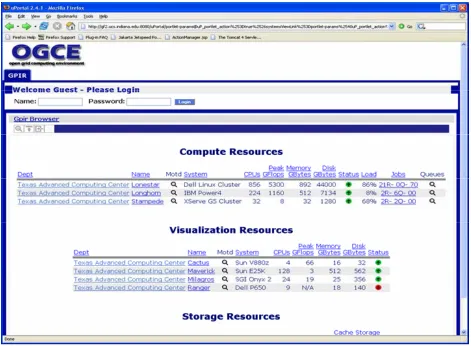
Figure 1: Sample login page and skin for the uPortal-based OGCE
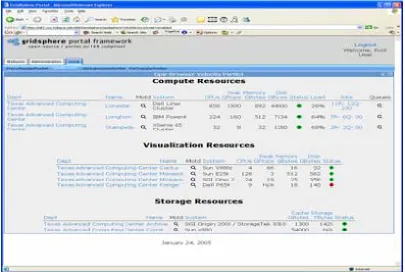
Figure 2: A sample screen of OGCE portlets deployed in the GridSphere portlet container.
Figures 1 and 2 show sample deployments of portlets into uPortal and GridSphere, two open source, JSR 168 compliant containers. OGCE portlets can be deployed into either with a single build process.
3.1. Sample Application Portal Projects
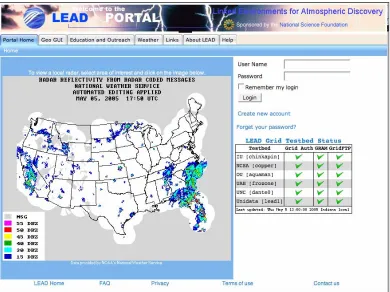
Figure 3: The LEAD portal prototype, built with OGCE and other portlets, is shown running in a GridSphere container.
[image:15.612.123.491.444.683.2]Figure 4 shows the MyLead data browser portlet running in the uPortal container. The workflow composer applet is shown in the bottom right corner.
OGCE team members work closely with the TeraGrid. Figure 5 shows the North Carolina Bioportal, a TeraGrid Science Gateway developed by the Renaissance Computing Institute, which was built using OGCE software.
Figure 5: The North Carolina Bioportal, built with OGCE software.
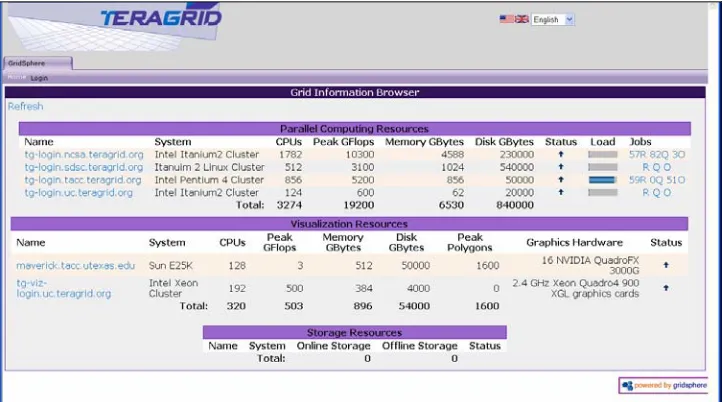
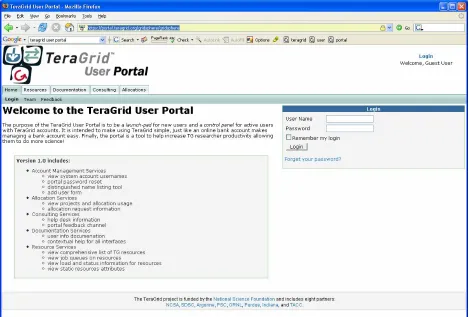
The TeraGrid User Portal prototype, shown in Figure 6, is being designed and developed by TACC using OGCE components. TeraGrid projects often result in feedback to the OGCE. For example, we began our investigation of systems such as PURSe, available from the NMI GRIDS Center, to assist new portal users obtain credentials.
[image:16.612.126.487.466.667.2]Figure 7 illustrates the Southern California Earthquake Center (SCEC) portal, built using OGCE software, provides browser-based interfaces to workflow mapping and execution techniques to map and execute SCEC’s Pathways 1 and 2 on SCEC Grid resources. These pathways are represented as application workflows and are generated using either custom web interfaces or the Composition Analysis Tool, and ontology-based workflow composer. The SCEC portal was based on OGCE’s Release 1.
Figure 7: The Southern California Earthquake Center (SCEC) portal is based on OGCE portal software.
3.2. Collaborations
The OGCE collaborates with a number of organizations. We list below some groups that are using the OGCE portal software.
Project Contact URL
SCEC Digital Libraries Project
Reagan Moore ([email protected]); Marcio Faerman ([email protected])
http://webwork.sdsc.edu:10081/sceclib /index.jsp
NSF TeraGrid
Charlie Catlett
http://portal.teragrid.org or
http://alpine.tacc.utexas.edu:14003/gri dsphere
UAB Grid John-Paul Robinson ([email protected])
http://lab.ac.uab.edu/uabgrid/
[image:17.612.68.519.560.718.2]Project ([email protected]) NanoGrom
acs
Eric Jakobsson ([email protected])
Under development.
Quest2 Robert Brunner ([email protected])
http://astronomy.ncsa.uiuc.edu/quest2/ index.php
North Carolina Bioportal
Lavanya Ramakrishnan ([email protected])
http://www.ncbioportal.org
QuakeSim Earthquake Portal
Andrea Donnellan
http://complexity.ucs.indiana.edu:8282
UC TeraGrid Application Portal
Mike Papka
Under development, in collaboration with UC/Laszewski.
Texas Internet Grid for Research and Education (TIGRE)
Phil Smith ([email protected]) Under development. TIGRE’s Grid and portal development will span several Texas university campuses. This project has recently been funded and will be an important collaboration for OGCE in Year 3. See
http://www.hipcat.net/Projects/tigre/vi ew?searchterm=tigre
Southeaster n
Universitie s Research Association (SURA) Grid
Mary Fran Yafchak ([email protected])
We are working with SURA to deploy an informational and Grid portal using OGCE portlets and GridPort services (TACC leads).
3.3. Activities and Findings
3.3.1. Summary of Activities
This section lists deliverables identified in the Year 1 Annual Report. In addition to the planned deliverables, we have aggressively pursued additional opportunities. We list these additional deliverables to give an idea of the project’s scope.
The OGCE’s main focus of effort during Year 2 was its transition to JSR 168 compatible Grid portlets. This was accomplished, and in the process we developed tools for porting older Jetspeed, CHEF, and OGCE1 portlets to the new standard. Below we summarize the core development work:
• Developed general-purpose Velocity support for JSR 168 portlets. All core OGCE2 portlets are written in Velocity. Velocity is the development tool of choice for Jetspeed 1 and CHEF-based portlets, so this provides a method of transition from the older framework.
• Developed high-level Grid programming interfaces, co-released in the Java CoG 4 Kit and OGCE2 downloads. These hide the differences between various Globus toolkit versions: GT2, GT3.0, GT3.2, and GT4.0.
• Developed support for multiple Grid client environments within the same portal. That is, the higher-level APIs may be bound to different GT versions within the same portlets. • Repackaged Open GCE Runtime Engine into component libraries, to ease subsequent
reuse.
• Released Trebuchet desktop data management application.
• Developed supplemental data sharing portlet capabilities that allow portals to share proxy credentials.
• Developed an Apache Maven-based build, documentation, and test environment. This allows single portlet builds using remote Java jar repositories and improves over our previous Apache Ant-based build system. Users can deploy into either uPortal or Gridsphere containers.
• Developed an extensible unit testing environment (based on HTTP Unit) that can be used to verify the portal release. This is integrated with Maven to test the portal builds and produce summary reports.
• On-line and downloadable documentation: all system documentation is written in XDoc format for easy distributions and management within the OGCE2 download. Documentation can be built with Maven.
• Developed new suite of JSR168 GridPort Portlets including GPIR, Job Sequencer, Comprehensive File Transfer, and SRB portlets.
3.3.2. Supporting Collaborative Communities
Below are the collaborative deliverables. The percentage completion refers to the status of the project at the end of Year 2.
Deliverable Lead Status % Complete
TeraGrid User Portal Design and
Development
TACC Eric Roberts/TACC
leads the design, documentation, and implementation efforts. Demos were given at
supercomputing. Documents are listed in the “Publications and Reports” section.
100% All Year 2 deliverables were met; work will continue in Year 3.
Integrate Selected NEESGrid and CMCS portlets
All Joe Futrelle (NCSA)
successfully ported his NEESGrid Metadata System to OGCE2
using OGCE’s Velocity tools.
commitment. (100% for NCSA NEESGrid work) Participate in DOE
SciDAC Portal Consortium
SDSU/TACC M. Thomas/SDSU
leads the DOEPC. Team successfully demonstrated collaborative tools (GlobalMMCS/IU, collaborative IDL/IU) as well as portal capabilities;
conceptualized and began work on
significant Fusion Data Grid portal activity.
100%
Deliverables were met. Plans for production Fusion portal delayed due to operation schedule of Tokamak, but will being during Summer 05
TeraGrid Science Gateway Portal efforts*
TACC, Indiana Roberts, Gannon, and Christie are on the Gateway’s
Requirement and Analysis Team. Documents are listed in the “Publications and Reports” section.
100% This is an ongoing effort.
3.3.3. Global Software Deliverables
Global deliverables involve the cooperation of most or all team members to develop and test. Starred deliverables are additions. The completion percentage gives the project status at the end of Year 2.
Deliverable Lead Status % Complete
Migrate Grid portlets to support JSR 168
Indiana, TACC, NCSA
This was completed and demonstrated at Supercomputing 2004 using both Grid Sphere and uPortal containers.
100%
Fully JSR 168 Compatible Release
All This is in preparation, will be available concurrently NMI R7.
90% This will be released in early June. Portal Services
Standards
Indiana We identified inter-portlet communication as the key missing service (needed to share portlet
credentials between
portlets). This was implemented and included in the current release.
Portal Support for GT2, GT3, and GT4
U. of Chicago This is available in the portal through the Java CoG Kit.
100% This is an ongoing task.
Simultaneous support for multiple Globus Toolkit Versions*
U. of Chicago Integrated CoG APIs support all major Globus toolkit releases; portal can be used to run jobs with several different GT versions. CoG classloading system was modified to work with portal and Tomcat environment.
100% This is an ongoing task.
Generic Portal API for major Grid services
U. of Chicago This is part of the co-released CoG 4 and OGCE2.
100%
Portal Support: GridPort Toolkit
TACC/SDSU Middleware support for subset of OGCE
portlets
100%
Unit Testing Framework *
All Develop using Maven
and HttpUnit. Included in current release. All core portlets have Maven tests. We have also done initial portal stress testing with JMeter.
100%
Velocity Portlet Support in JSR 168 *
Indiana Completed and available in current release. 100% Maven-based remote repository for software distribution.*
All All major
subcomponents of the OGCE are available through public Maven repositories.
100% This is an on-going task.
Integrated, Maven-based build system. *
All Available in current release. In addition, we have developed a Maven tool for simplifying
supplemental portlet deployment.
JMeter Performance Testing*
TACC, Indiana Tested performance OGCE portlets in GridSphere portal to handle large numbers (~800) of user sessions concurrently. Also performed similar JMeter testing of OGCE in uPortal. We tested multiple
simultaneous logins and credential fetching operations and were able to support over 1100 operations in uPortal. Extended test scripts are available in the OGCE tutorial material (see
Presentations below.
100%
3.3.4. Indiana University Local Deliverables
IU’s efforts during Year 2 focused on leading the overall portal build and deployment integration. We also developed a number of specialized portlet components outside the core release that are available for supplemental download.
Deliverable Outcome % Complete
Deliver A/V portlets to manage Polycom/H.323, Access Grid, and other connections
This was demonstrated at SC04 and is available as a supplemental portlet download from www.collab-ogce.org. Available now for uPortal, Gridsphere version available in early June 2005:
100%
GIS Portlets and Services We have developed version of the Web Feature Service, Web Map Service Open Geospatial Consortium Standard. WFS is available for download; WMS is being packaged; Portlet Map client is being packaged for release. All should be available for June 1. Releases are posted at www.crisisgrid.org and will be linked to the www.collab-ogce.org web site.
100%
Complete an application factory web service and associated portal.
The application factory allows an application designer to automatically generate a web service and a portal interface to configure and run the application.
See http://www.collab-ogce.org and http://www.extreme.indiana.edu/portals for a tutorial and download instructions. Provide a mechanism for
portlets to use web services security to authorize users to access remote services.
We have developed a “capability-based” authorization system that allows special authorization “capability tokens” to be assigned to portal users. When the user access a portlet for a remote web service, the user’s authorization tokens are sent to the service which verifies the tokens and allows the user access. If a user was not granted a capability, access is not permitted. A capability management portlet was also delivered. (This technology is used in the application factory.)
See http://www.collab-ogce.org and http://www.extreme.indiana.edu/portals
100%
Deploy an OGSA-DAI based metadata catalog and associated portlet.
We have developed a personal metadata catalog that allows user to keep track of files and scientific experiments that were conducted on the Grid. The user navigates their metadata space with a browser portlet with a rich query interface. The metadata catalog has been deployed in the LEAD portal where it is called “myLEAD”.
100%
Provide a portlet to search a service registry. *
We have developed a registry with a portlet interface to search registered web services and other data objects. The services may be applications of interest to the user and the data objects may be registred data streams. See http://www.collab-ogce.org and
http://www.extreme.indiana.edu/portals
100%
Provide a portlet that can be used to design and execute remote workflows. *
We have built an “Experiment Builder” portlet that can allow a user to compose a workflow from applications services and bind data values to the workflow parameters. The resulting workflow enactment is saved as an “experiment” in the metadata directory described above. The workflow composer has a “drop-and-drag” tool that allows the user to compose the workflow graphically. (See Figure 4.) See http://www.collab-ogce.org and http://www.extreme.indiana.edu/portals
3.3.5. University of Chicago Local Deliverables
Several of these deliverables were affected by (a) delays in the Globus Toolkit 4 release plans and (b) significant changes in the Toolkit in regards to functionality, semantics, and APIs. At the time the original proposal was written, none of these changes were foreseeable. We anticipate full completion of delayed deliverables. The frequent modifications to the GT4 toolkit resulted in significantly more development and testing time than originally anticipated.
Deliverable Outcome % Complete
Assist in the move of the Web site and code repository to Indiana University.
We moved part of the Web site to Indiana University. The CVS
repository is still maintained at ANL as the system support staff at IU is understaffed.
This task will be closed and can be considered completed.
100% Web site and downloads are available from IU. We left the CVS repository at ANL for better system support and won’t move.
Integrate Condor into the Java CoG Kit
Provided a direct port of Condor services within the Java CoG Kit allowing the development of Condor style job submissions directly
through the Java CoG Kit.
100% We have within the Java CoG Kit a provider that can submit to Condor. Provide a port of the Java
CoG Kit for different GT versions.
Developed CoG Kit providers for versions GT2, GT3.0, GT3.2.1, GT3.9.5, GT4.0, as well as eight additional intermediate releases
100%, Several additional releases were necessary as the design of newer Globus toolkit version changed and their design was not intended and thus not available at the time of the project planning. We estimate that we put in about 4 times the amount of effort to keep up with these unexpected changes. Integration of Java CoG
with new OGCE portlet deployment framework.
This was completed with assistance of IU. The JSR 168 standard requires modifications to our earlier (Year 1) Java JAR deployment. We also modified the CoG’s class loading methods to work inside the Tomcat servlet container.
100%
Continue the support of older Globus Toolkit
Provided support for CoG Kit providers for versions GT2, GT3.0,
versionsGT2.4 GT3.2.1, GT3.9.5, GT4.0, as well as eight additional intermediate
releases
in the GT releases we needed to spend more time on this item as originally anticipated and communicated to us by the GT project. Support for future Globus
toolkit versions
Due to the enormous effort to constantly update between GT versions we have improved our provider concept to make it easier to adapt to new GT versions
100% This is an ongoing effort.
Development of a File Access mechanism as part of the Java CoG Kit for the development of a File access portlet
It is now easy to conduct file access operations through a Java CoG Kit provider.
100%
Development of a prototype of a Grid Command manager that can be started through Webstart within the portal and is used to mange many user controlled jobs.
Due to Globus toolkit bugs and its software release postponement by 6 month this task was not started. The Web start component has not been started yet.
50% Due to the delay in the Globus Toolkit 4 deliverable this task has been started.
Improvement of the workflow services while using the newest service oriented Grid
technologies.
Due to the delays in the GT release this task has not been completed.
0% We will start this task over the
summer and expect a first version to be available in
September. Support of WebDAV in
the File access component as part of the Java CoG Kit
The CoG Kit has now integrated support for accessing WebDAV servers.
100%
Development of a Portlet to the Simple CA to allow other communities to more easily run their own certificate authority.
A new effort of the Grids center called PURSE was started. Therefore making this task unnecessary. We are currently examining OGCE/Purse integration. This effort will more naturally be led by TACC, and we are switching the TACCC Pegasus workflow deliverable with this one.
0% OGCE is investigating integration to use PURSE.
Investigate the possible integration of smart cards
It was determined that this task is of low priority and therefore was not
and other external devices as part of the security integration within the portal.
started no longer needed.
We do not anticipate further work on this deliverable.
Assist the GGF SAGA working group in formulating documents for a simplified API to the Grid.
This is an ongoing process.
Participated at GGF and in several meetings.
100% This is an ongoing task.
3.3.6. SDSU Local Deliverables
In September, 2005, PI Thomas moved from TACC to join the Computer Science Department faculty at San Diego State University. The grant was moved and TACC remained funded on project as a co-PI/subcontractor. PI Thomas started the Advanced Computing Environments Laboratory (ACEL: http://acel.sdsu.edu). With funding from SDSU, NSF and DOE grants, 4 Dell 1850 servers, a 6 TB storage facility and a Cisco Gig-E router were purchased. This hardware is used in a graduate level course, “Introduction to Grid Computing,” taught by Thomas in Spring 2005. The hardware currently hosts GT4/WSRF and pre-WS GT3.2, all OGCE/uPortal/GridSphere frameworks, as well as supporting toolkits such as GridPort3 (GP4) and JavaCoG, and an SRB/MCAT service.
Deliverable Outcome % Complete
GridPort Toolkit implementing OGCE Interfaces and supporting OGCE API
GridPort 3 using CoG 4 API for OGSI Job Submission interface to GT3
100%
Storage Resource Broker (SRB): working with SDSC team to create portlets and web services for SRB
Seth contributed to the design and implementation of the JSR168 SRB portlet interface.
100%
General Portlet interfaces Regno and Thomas developed SRB Portlets; collaborating with TACC to develop GP3 portlets
75% We anticipate completion by the end of Year 2. Secure GPIR Ingestor
Service
Prototyped GT4/GSI enable GPIR Ingestor service
20%. This prototype will be extended to GPIR query service and used by GPIR Portlets. Expect completion by SC|05 DOE Fusion portal SDSU migrating GP3/OGCE
JSR168 portal onto Fusion resources and integrating SRB
50%. Expect alpha portal by end of June, 2005. Development of OGCE
interfaces and patterns
This is part of the co-released CoG 4 and OGCE2.
(Working directly with Argonne)
Investigate use of
Advanced Javascript and XML Architecture (AJAX) for portlet client browser capabilities
SDSU has tested use of AXAJ on the client side and portlet hosting side. Both appear to work very well for SRB Portlets. Plan to extend in 05/06 to other GP4 portlets
50% for SRB Portlets. Expect integration into OGCE-2 by SC|05.
Cascading Style Sheets (CSS) for Portlet skins
Investigated how to change skins and style sheets for
uPortal/GridSphere
25%. Expect in Year 2 to deliver various skins.
Pegasus Workflow portlets
This task was exchanged with UC. SDSU/TACC are investigating user registration services and UC is investigating workflow.
0% TACC/SDSU expects significant progress on PURSE over the summer.
3.3.7. TACC Local Deliverables
Deliverable Outcome % Complete
GridPort Toolkit implementing OGCE Interfaces and supporting OGCE API
GridPort 3 using CoG 4 API for OGSI Job Submission interface to GT3
100%
General Portlet interfaces Seth and Roberts created comprehensive GridFTP file transfer, GRAM job submission, Condor job submission, GPIR Browser portlet; Regno and Thomas developed SRB Portlets
75% We anticipate 100% completion by the end of Year 2.
TeraGrid User Portal Roberts led a Requirements Analysis Team (RAT) to define requirements for integrating streamlined account management through the TeraGrid User Portal. See document authored by Roberts et al in publications and reports section
100%
Portal account creation and management portlets, including session to session persistence via GPIR.
Account creation and management portlets are included as part of the GridSphere and uPortal
distributions.
50% uPortal account management was developed in collaboration with UC and IU.
GridSphere account management
Pegasus Workflow portlets
Support for Pegasus workflow tools. We have switched this workflow deliverable with UC, in exchange for their Simple CA deliverable.
0% We are
evaluating PURSe and GAMA tools for certificate
management. This is a TeraGrid requirement. This deliverable is switched with UC, who will investigate Karajan workflow. We anticipate significant progress before the end of Year2.
TACC Molecular
Dynamics Portal: deliver portlets for the following MD applications: NAMD, AMBER and
GROMOCS.
Seth and Roberts gathered user requirements for NAMD portlet interface. Designed prototype interface, gathered user feedback. Developed and packaged v1.0 based on feedback.
33% NAMD completed. AMBER portlets delayed because we don’t have licenses yet. We expect the AMBER portlets to be done within year 3. GROMOCS portlets delayed because there is not a strong need from the UT Bio
community for this application. We will be reevaluating the level of need in Year 3.)
DOE Fusion portal Seth developed an application portlet used to submit jobs to the TRANSP application.
100%
TACC developing TACC User Portal, UTGrid User Portal and TIGRE User Portals based on OGCE software
Developed serial distributed job submission interface that will be rolled into the TACC User Portal which is planned for completion in Summer of ’05. The TIGRE project has not started yet because of delays in funding.
50% Completion of TIGRE project depends upon external funding. This project has recently been initiated and will be a significant
TACC User Portal (TUP) bundle
Currently deployed SURA portal uses this bundle which includes OGCE portlets
100%
3.3.8. NCSA Local Deliverables
Deliverable Outcome % Complete
Grid Desktop Graphical User Interface
We released NCSA Trebuchet, a desktop graphical user interface for data management. This is available as a Java Web Start application from the OGCE website. Development of more comprehensive desktop
interfaces is underway in support of LEAD; a subset of this will b released in the next OGCE release
75% File management complete, more comprehensive interface in
development, also, developing portlet interfaces to manage remote execution of OGRE. Expect prototype of more full-featured desktop GUI by end of project year 2) Extend Sample
Application to Show More Data Elements
In progress, as collaboration with tupelo and molecular dynamics, and with LEAD and myLEAD.
50% This has turned out to be
substantially more complex than initially estimated, we aim for
completion and delivery in year 3, continued
engagement with application teams critical for success here.
Portlet Client/NEESgrid metadata repository
Repository release June 2005, with sample portlet. More substantially, richer data functionality in support of molecular dynamics portal.
75% Core functionality in place, application-specific
functionality in progress.
3.3.9. University of Michigan Local Deliverables
the OGCE project. In order to move towards the more standard JSR-168 portal standards, OGCE versions 2.0 and later are based on JSR-168. Effectively this choice meant that all of the collaborative tools from CHEF no longer worked in OGCE version 2.0. At the same time, the CHEF project transformed into the Sakai project. Sakai is a far larger project than CHEF with hundreds of institutions involved and has resulted in significant improvement in the overall quality of the Sakai code base.
The primary contribution for Years 2 and 3 is to get Sakai "back into" the OCGE environment. There are several approaches to the re-integration of Sakai into OGCE. These include the use of iFrames, Web Services for Remote Portals (WSRP), and JSR-168. This integration will initially take place before the end of Year 2, following the release of Sakia 2.0 in mid-June. However, these are quite challenging and will likely be fully delivered in the year three timeframe.
Deliverable Outcome % Complete
iFrames for Sakai This is available in Sakai 1.5. But this base capability allows JSR-168 portals to include Sakai tool
instances to be presented in uPortal and other portals.
100%
Combine OGCE and Sakai through IFrames.
This will be a document aimed at system administrators showing how to install OGCE and Sakai and connect them together using iFrames. We will also assisit in setting this up for a select set of OGCE adopters.
5% - This will be completed by August 31, 2005.
WSRP For Sakai A very simple prototype of this was developed and demonstrated early in Year 2. Since then a very
significant effort has been mounted to build a native and fully functional WSRP producer for Sakai and to liason with the uPortal 3.0 developers to enhance the WSRP consumer in uPortal 3.0. The WSTP producer is expected to be delivered in Sakai 2.1 in October 2005.
75% - the major code issues have been resolved and are awaiting integration into the Sakai 2.0 kernel. This integration will be done summer 2005. There may be some required tool modifications for a few of the Sakai tools so as to work properly over WSRP. JSR-168 for Sakai This effort will port the Sakai 2.0
kernel into uPortal 3.0. Once this kernel port is done, many of the Sakai tools will be able to run native in uPortal as JSR-168 applications
and be instanced directly using uPortal administration mechanism.
will commence upon the successful
completion of the WSRP activity. Sakai Research
Discussion Group
The Sakai project has focused a great deal of effort on adding new learning oriented tools to the CHEF toolset. The Sakai Research DG is a group formed to focus attention on the needs and requirements for the use of Sakai in a Research context. The members founding members of this group are primarily from the NEES and UK E-Science effort.
100% complete.
Develop Sakai Grid Version
This effort produced a Sakai Grid kit for the Sakai 1.0 release to enable grid development in Sakai 1.0.
100% complete
3.3.10. Outreach Deliverables
Our major deliverables included demos, presentations and posters at Supercomputing 2004; the integration of OGCE and general grid material into graduate and undergraduate curricula; and numerous tutorials.
Deliverable Lead Status % Complete
Demonstrations at Supercomputing 2004
All We organized
demonstrations at the Alliance, Indiana, and TACC booths.
100%
TeraGrid tutorial at Supercomputing 2004
TACC Eric Roberts
demonstrated a
development version of the TeraGrid User Portal for current and potential TeraGrid users during a comprehensive TeraGrid tutorial.
100%
Participation at Globus World
All Gregor von Laszewski
gave two presentations
100%
Participation in Global Grid Forums
All Gannon and Fox both
serve on GGF steering committees. Gannon and Pierce participated
in the GGF 12 Portals tutorial. Gannon also gave a shorter portal tutorial at GGF 13. We are reviving the GCE group for GGF 14. Grid Portals Tutorial All Gannon and Pierce
gave a tutorial at GGF 12. Gannon gave a shortened version at GGF 13. Thomas and Pierce gave a tutorial at HPC 2005. See
Training and Outreach for more details.
100%
Supercomputing 2004 Posters*
IU and University. of Chicago
Pierce and Laszewski had three posters selected for SC04. Laszewski’s poster won the coveted “SC Best Poster” from 109 submissions.
100%
Distance Education* Indiana Pierce delivered a set of lectures on using portlets as part of a distance education course offered to Jackson State University.
100%
REU site on Grid computing and bioinformatics*
University of Chicago
8 undergraduates and 8 graduate students participated in an REU co-hosted by
University of Chicago (von Laszewski co-PI at Chicago) to learn about Grid computing. 3 undergraduates were part of the best poster award at SC2004
100%
GridPort Training* TACC Held multiple training classes throughout the year (see training and outreach section below). Hosted
Venezuelan visitors for
3 weeks training them in OGCE and GridPort. Built Gaussian
application portlet, and conducted GT4
evaluation. SDSU Course:
Introduction to Grid Computing*
SDSU Thomas taught a
semester-long graduate course on Grid
computing using OGCE, Globus, and Grids Center software.
100%
Attend uPortal Developers meeting
UM UM has attended each
of the iuPortal developer's meetings and provided direction w.r.t. uPortal's
directions in WSRP and acted as a liason w.r.t. OGCE's erequirements for uPortal.
100%, Ongoing
Liason with NEES Project
UM Interact with NEES
and NSF personnel regarding the directions of the NEESGrid software to move them to a Sakai and
ultimately OGCE based portal.
100%, Ongoing
Participate in the Sakai Research Discussion Group
UM The Sakai project has focused a great deal of effort on adding new learning oriented tools to the CHEF toolset. The Sakai Research DG is a group formed to focus attention on the needs and requirements for the use of Sakai in a Research context. The members founding members of this group are primarily from the NEES and UK
Science effort. Liason with the
CMCS project
UM The CMCS project
currently uses CHEF as its collaborative
environment. We would like them to evolve to an OGCE based solution. We are working with them and communicating as the CMCS project makes decisions regarding its future direction.
100%, Ongoing
3.4. Products, Software, and Web Sites
The OGCE’s primary website is http://www.collab-ogce.org/, with links to software downloads tutorials, publications, and related portal efforts. Several portals built with OGCE software are listed in Section 4.
3.5. Training
and
Outreach
1. Gregor von Laszewski, Jay Alameda, Greg Daues, and Marlon Pierce, meeting with NMI GridChem Team, NCSA, April 18, 2005. Primary topic of discussion was building workflow clients and tools using the Java CoG kit.
2. Eric Roberts, Akhil Seth, Maytal Dahan hosted 4 visitors from Venezuela April 10-30 training them in OGCE and GridPort. Built Gaussian application portlet, and conducted GT4 evaluation collaboratively.
3. Mary Thomas and Marlon Pierce, Tutorial on Grid Portals HPC2005 April 4 2005 and NCSA portals meeting, Jan 26 2005.
4. Charles Severance, Sakai Portal Approach, uPortal Developer Meeting, Los Angeles, California, March 22, 2005.
5. Charles Severance, Sakai and OGCE Directions, CMCS All Hands Meeting, Salt Lake City, Utah, February 3, 2005.
6. Beth Kirshner, Sakai Impact on CHEF Development, NEESGrid CHEF Development Workshop, San Diego, CA, May 6, 2005.
7. M. Thomas, Introduction to Grid Computing, SDSC graduate course CS696. Web site: http://rohan.sdsu.edu/faculty/~mthomas
8. Geoffrey Fox and Marlon Pierce, “High Performance Computing and Computational Science.” Spring 2005 Graduate Course taught in conjunction with Jackson State University. Course material included OGCE topics on portlet development and simple
computational services. Course Web Site: http://grids.ucs.indiana.edu/ptliupages/jsucourse2005/. Course funding was provided by
the DOD High Performance Computing Modernization Program.
of Molecular Dynamics codes. We will be building a portal and services to support grid applications surrounding the Quantum Espresso suite using the OGCE portal software. We also discussed other OGCE portlet efforts, particularly SRB portlets.
10.Eric Roberts, Akhil Seth. “Building Grid Enabled Portals using GridPort 3” TACC training Austin, Texas December 10, 2004
11.Maytal Dahan, Building Grid Enabled Portals using GridPort 3 Merida, Venezuela November, 2004
12.Eric Roberts, GridPort: A Toolkit for Building Grid-enabled Portals Supercomputing 2004, November 8-12, 2004. Presented at TACC booth throughout the week of Supercomputing 2004.
13.Eric Roberts, Maytal Dahan, Akhil Seth. Building Grid Enabled Portals using GridPort 3 TACC training Austin, Texas October 25, 2004.
14.Marlon Pierce and Dennis Gannon, Developing Grid Portals Using Portlets Global Grid Forum 12 Portal Tutorial Brussels September 21 2004.
15.Maytal Dahan, Eric Roberts, Akhil Seth. Building Grid Enabled Portals using GridPort 3 Monterey Grid Computing Conference at FNMOC, Monterey, California September, 2004.
16.von Laszewski. REU site for Grid Computing and Bioinformatics, U of Chicago and ANL Von Laszewski hosted an REU site at ANL in collaboration with University of Chicago and DePaul University. 8 undergraduates and 8 graduate students participated 17.von Laszewski, Course project on Grid computing, Illinois Institute of technology, Fall
2004. Von Laszewski supervised 5 students at IIT to conduct projects related to Grid computing.
18.Maytal Dahan, Eric Roberts, Akhil Seth. Building Grid Enabled Portals using GridPort 3 TACC training Austin, Texas August 17, 2004.
19.Charles Severance, Sakai and uPortal: Taking Collaboration to the Next Level, Keynote Speech uPortal User's Meeting, Denver Colorado, June 22, 2004.
20.Charles Severance, Grid Portals: Putting the User Interface on the Grid and Virtual Organizations, NEESGrid - A Grid Portal Study, and Sakai Architecture and Roadmap, Grid Summer School, Vico Equense, Italy, July 22, 2004.
3.6. Publications
3.6.1. Presentations and Posters
1. Gregor von Laszewski. Grid Workflow with the Java CoG Kit 4. Austin, TX, 13 May 2005.
2. M. Thomas. “Impact of Cyberinfrastructure on Grid Computing” Invited Talk: SDSU Colloquim, 28-Apr-05, San Diego, CA.
3. Eric Roberts, Steve Quinn, Von Welch, “TeraGrid Account Management through the TeraGrid User Portal”, TeraGrid All Hands Meeting April 5, 2005.
4. Dennis Gannon, Invited Speaker, "Grid Portals Mini Tutorial", Global Grid Forum, Seoul Korea, March 2005.
5. Marlon Pierce, “SERVOGrid and GIS Services,” SCIGN REASoN Team Meeting, NASA Jet Propulsion Laboratory, Feb 17, 2005. This overviewed portlet-based application portal work with SCIGN Data Portal development team,
6. Gregor von Laszewski. Grid Programming Patterns with the Java CoG Kit 4. GlobusWorld, Boston, Massachusetts, 7-11 February 2005.
7. Gregor von Laszewski. Workflow support in the Java CoG Kit 4. Boston, Massachusetts, 7-11 February 2005.
8. Eric Roberts, Invited Speaker, GridPort: A Toolkit for Building Grid-Enabled Portals
Portals, Portlets and GridSphere Workshop CCT, Louisiana State University, Feb 3-4 2005, Baton Rouge, LA, USA
9. Geoffrey Fox iSERVO International Solid Earth Research Virtual Observatory: Grid/Web Services and Portals Supporting Earthquake Science American Geophysical Union Fall Meeting, San Francisco, December 15 2004.
10.Geoffrey Fox and Marlon Pierce Data Grids for HPC: Geographical Information System Grids, Internet Seminar to Jackson State University, Florida International University, and University of Hawaii, 7 December 2004.
11.Marlon Pierce, Marcus Christie, and Eric Roberts: The Open Grid Computing Environments Collaboratory OGCE portal demo at SC04 Thursday, Nov 11, 12:30 pm to 1:30 pm. with Additional Material
12.Marlon Pierce, Greg Daues, Gopi Kandaswamy, and Liang Fang NCSA Alliance Portal Expedition Demo Alliance/OGCE portal demo at SC04 Wed, Nov 10, 1:00 pm - 1:30 pm with Additional Material.
13.Eric Roberts, GridPort: A Toolkit for Building Grid-enabled Portals Supercomputing 2004, November 8-12, 2004. Presented at TACC booth throughout the week of Supercomputing 2004.
14.Eric Roberts, Invited Speaker, TeraGrid: Learn Once Run Anywhere, TeraGrid Tutorial at Supercomputing 2004 Monday Nov 7, 2004 Gave demonstration of TeraGrid User Portal.
15.Marlon Pierce and OGCE Collaboration posters for SC04
a. OGCE Release 1 Combines Grid and Collaboration Portlets in CHEF Framework b. Standard Portlet Architecture Supports Reusable Components
c. OGCE Portal Applications for Grid Computing I d. OGCE Portal Applications for Grid Computing II
16.Gregor von Laszewski. Grid Computing. Illinois Institute of Technology, October 2004. 17.Marlon Pierce, Portals and Portlets DOD User Interface Specification group meeting
Atlanta September 27 2004.
18.Gregor von Laszewski. Keynote: Cog kit abstractions. Workshop on Grid Application Programming Interfaces in conjunction with GGF12, Brussels, Belgium, 20 September 2004. (Keynote). http://www.cs.vu.nl/ggf/apps-rg/meetings/ggf12.html.
19.Dennis Gannon, Keynote Speaker, "Building Grid Applications and Portals: An Approach Based on Components, Web Services and Workflow Tools," Europar, Pisa, Aug. 2004.
20.Geoffrey Fox and Marlon Pierce SERVO Grid: Solid Earth Research Virtual Observatory Grid/Web Services and Portals Supporting Earthquake Science Jade Palace Hotel Beijing (863 Project Grid) August 26 2004.
22.Geoffrey Fox, Marlon Pierce SERVO Grid: Solid Earth Research Virtual Observatory Grid/Web Services and Portals Supporting Earthquake Science Fourth ACES (APEC Cooperation for Earthquake Simulation) Workshop, Beijing China, July 13 2004. This was accompanied by an earthquake modeling application portal demonstration using the OGCE-based QuakeSim portal.
23.Geoffrey Fox iSERVO and SERVOGrid: (International) Solid Earth Research Virtual Observatory Grid/Web Services and Portals Supporting Earthquake Science US-Australia Workshop on High-Performance Grids and Applications, Swiss Grand Hotel, Bondi Beach, Sydney, June 8 2004
24.Dennis Gannon, Keynote Speaker, "Building Applications from a Web Service based Component Architecture". ICS 2004 Workshop on Component Models and Systems for Grid, St. Malo, France, June 2004.
25.Dennis Gannon, Invited Speaker, "Experience Building Grid Applications with the CCA Software Component", Second Reality Grid Workshop, Royal Society, London, June 2004.
26.Gregor von Laszewski. Java cog kit workflow abstractions. GGF Workshop Management Working Group, GGF11 - The Eleventh Global Grid Forum, Honolulu, Hawaii USA, 6-10 June 2004.
3.6.2. Book Chapters
1. Gregor von Laszewski and Kaizar Amin. Grid Middleware, chapter Middleware for
Commnications, pages 109–130. Wiley, 2004. http://www.mcs.anl.gov/~gregor/papers/vonLaszewski--grid-middleware.pdf.
2. Geoffrey Fox, Shrideep Pallickara, and Marlon Pierce Building a Grid of Grids: Messaging Substrates and Information Management to appear as chapter in book "Grid Computational Methods" Edited by M.P. Bekakos, G.A. Gravvanis and H.R. Arabnia. Includes sections on OGCE component-based portals and portal services.
3.6.3. Conference Publications
1. Gregor von Laszewski and Mikhail Sosonkin. A Grid Certificate Authority for Community and Ad-hoc Grids. In 7th International Workshop on Java for Parallel and Distributed Computing, published in the Proceedings of the 19th International Parallel and Distributed Processing Symposium, Denver, CO, 4-8 April 2005. IEEE. http://www.mcs.anl.gov/~gregor/papers/vonLaszewski-ca-workshop.pdf.
2. Kaizar Amin, Gregor von Laszewski, and Armin R. Mikler. Toward an Architecture for Ad Hoc Grids. In 12th International Conference on Advanced Computing and Communications (ADCOM 2004), Ahmedabad Gujarat, India, 15-18 December 2004. http://www.mcs.anl.gov/~gregor/papers/vonLaszewski-adhoc-adcom2004.pdf.
3. Sangmi Lee Pallickara, Beth Plale, Scott Jensen, Yiming Sun, “Structure, sharing, and preservation of scientific experiment data”, To appear IEEE 3rd International Workshop on Challenges of Large Applications in Distributed Environments (CLADE), July 2005. 4. Sangmi Lee Pallickara, Beth Plale, Scott Jensen, Yiming Sun, “Monitoring Access to