Abstract: This monograph is elucidated for the reference of shared sizing as well as power administration algorithms in support of electric vehicles provided with super capacitors and batteries. Focal objective is discovering the amount of cell quantity of every supply which reduces the fitting and EV operation expenditures, considering the output necessities outlined in favour of vehicle & technological limitations on the basis of energy. To embark upon this difficulty, two techniques will be examined. 1st takes into account an approach based on filter is used to carry o the power divide among the sources; it is revealed out that, beneath several realistic hypotheses, the consequential sizing difficulty can be pretence as a linear programming trouble and deciphered with the help of well-organized numerical methods. The second technique utilizes a finest non-causal force administration, that when incorporated with the sizing difficulty, capitulates a nonlinear optimizing difficulty. These two methods will later pave way to rate the EVs storage unit. Consequences signify that filter-based approach, even if straightforward as well as numerically competent, by and large needs an outsized storage unit. Likewise, it was further inferred that, whether the array requisites of the EV aren’t incredibly elevated (in our study, 50 km below); exploit of SCs facilitates saves power more than battery alone.
Index Terms: Electric vehicle; battery; super capacitor; driving cycle; particle swarm optimization algorithm, power sharing.
I. INTRODUCTION
Increasing development have been found in the hybrid electric vehicles and electric vehicles, because they produce new vehicles with the decrease in both the emission of pollution and reduction of energy consumption [1] Notwithstanding the ecological advantages made available by electric vehicles (EVs), the foremost impediment for asserting of electric driving force deceits on storing energy system ” . Accomplishment of this novel transport alternative would merely be accomplished whether ESS presents resonance characteristics, viz: long life cycle, rational price tag, speedy charging, as well as elevated power and force solidities. Using single energy source we can’t deliver the specific energy and the energy necessary for the function of electric vehicle which is used for general purpose vehicle, most viable energy sources are applied by the academic researchers in super capacitors, electric vehicles, fuel cells etc...[2].
Revised Manuscript Received on April 06, 2019.
Jiten K Chavda, Reasearch Scholar, Department of Electrical Engineering, S. V. National Institute of Technology, Gujarat, India 395007.
Varsha A Shah, Associate Professor, Department of Electrical Engineering, S. V. National Institute of Technology, Gujarat, India 395007.
However the current technology is not enough to combine these technologies into a class of solo storage, Because they are relatively expensive and can hold only limited quantity of charges . Though yet it remains as a preferred choice, the energy remaining in batteries are 1000 times lesser than the gasoline [3] which causes imperative restrictions on the vehicle. Alternatively, super capacitors prop up bigger numeral of charge/discharge cycles & possess high-quality capability to deal with elevated contemporary crests, owing to their condensed power hammerings, nevertheless the extremely squat power compactness obstructs their foundation [4]. Fuel cells and batteries can only be differentiated using the energy storage location and conversion. Batteries are the closed system which uses anode and cathode as the medium to transfer charge and in addition they actively takes part in the redox fuel cells , satisfy power peaks , and in the profit making expansion they are at the premature phase , they too face many challenging realistic hurdles associated with refuelling and hydrogen storage[5]. As a result, in nonattendance of idyllic power foundation, quite a few power source hybridization approaches are put forward in literature that are guided by notion of amalgamating storage mechanisms of engineering by accompanied characteristics. Super capacitors are developing as striking energy storage because of services like increased power density, unfailing service and increased life span. The super capacitor internal structure is also same as that of the battery [6]. In addition to this the efficiency of energy also gets improved because of the squat power losses of the peak power source [10]. Our well-thought out monograph deals in hybridization of batteries as well as SCs, coupled with the dc bus in the course of a dynamic analogous array (see Fig. 1). More exclusively, focal aspiration is to probe how the SCs & batteries ought to be controlled over:
Specific characteristics of FC’s are, due to processing time their occurs a delay in the output power response via subsidiary equipment Hence power supply are provided to changing loads by the hybrid system of the fuel cell, It requires an electric energy storage system to equals the gap occurred between the fuel cell output and the load .Previous researches have proven that hybridization of fuel cell along with the battery and super capacitor provides performance in cost , operational improvements along with the benefit of fuel economy [7]. Even though the electric vehicle development is
conducted actively,
application techniques of those batteries such as the
Combined Sizing & Energy Management of
Hess For An Electric Vehicle By PSO With
Novel Power Sharing Control Strategy
battery residual capacity indicator could not meet up the development steps. BRC (Battery residual capacity) can be defined as the amount of electricity gets left at the battery can be delivered before reaching the particular cut-off voltage at the temperature and current discharge. The capacity of battery can be denoted only after the fully charged state [8].
The global optimization techniques including advancements in optimization algorithms for solving the flow control problem are investigated widely. Examples like genetic algorithm optimization is used to minimize the emission and consumption of fuel. The tactics based on GA can be calculated using three different cycle driving’s. which proves that it can effectively reduce the cost of fuel without losing any dynamic performance. Particle swarm optimization based strategy are also followed up to reduce the fuel cost and increasing stability [9]. Simplicity while having the capability of delivering exact result continuously is one of the main advantage of PSO (particle swam optimization) [10, 11].
Because of the environmental and energy control vehicles like fuel cell, and hybrid electric vehicle are used as an alternatives to conservative vehicles which functions only by core ignition engines. HEV (hybrid electric vehicle) uses two energy converters for generating the energy needed to drive vehicle. In implementing HEV distributing torque and management of power flow is the major issue, HEV control strategy are used to solve the above mentioned problem. The energy can be produced, distributed and stored according to the control strategy algorithm [12-14]. The HESS use is limited only for shielding the batteries but HESS is also an expert in electric vehicle storage system. The efficiency of EVs (electric vehicles) by storing the energy from brakes during the deceleration of Evs, this storing is done by the hybrid energy storage system [15, 16]. For the efficient battery use, many HESS control schemes and architectures are proposed of [17, 18].
A. Electric Vehicle Model
In electric vehicle, energy and power consumed by the mechanical drive train system is depends on driving rotation & dynamics of the vehicles. So if we have to size the hybrid energy storage system first we have to ground a model of vehicle. The forces acting on the vehicle are gravitational force, aero dynamic drag force, tyre rolling, acceleration force etc. The total required forces that steer the vehicle is given by summation of all these forces, as depicted in Figure 2[1].Resistance forces are illustrated via subsequent points (1)-(4).
(1)
(2)
(3)
(4)
[image:2.595.309.552.160.270.2] [image:2.595.320.537.382.490.2]where ρ is air density (kg/ ), is vehicle frontal plane ( ), Cd is drag co-efficient, α is the slope of the road, Cris the rolling coefficient, V is the vehicle speed and M is the vehicle mass. The power requirement of the electric vehicle can be given by as follows: According to the following equation the necessary energy is achieved for electric vehicle to required driving range is given by (6). The weight of the hybrid energy storage system increases the power and energy consumption of the vehicle. Figure 1. Electric vehicle model B. Hess Model The general structure of HESS design is shown in Fig. 3, in which the DC/DC converter is employ with a control circuit that controls both the battery and SC simultaneously. However, the DC bus voltage should be a constant value which is greater than both the SC and battery voltages. Moreover, the key issue in HESS is how to control and protect the battery and SC. Figure 2. Structure of HESS design C. Battery Model Liner static model of battery has been considered here whose equations can be written as given below it is the simplest of all present models for analysis purpose. Vob = A+BSb(t) (7)
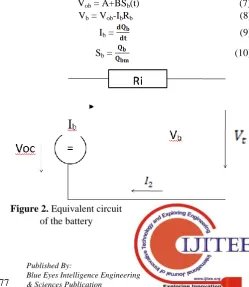
Vb = Vob-IbRb (8)
Ib = (9)
Sb = (10)
[image:2.595.296.546.542.830.2]As evident from the figure 3 Vob is the internal voltage of the battery, Vb is the batteryinternal voltage ,Rbis the battery internal resistance ,Sb is the state of charge (SOC) where is the charge at any instant and is the maximum charge , A and B are constants which can be determined from data sheet[19] with slope equation calculations or experimentally.
D. Supercapacitor Model
An easy voltage-resistor model of supercapacitor has been considered here with the following equations given below.
VOSC=A+BSSC(t) (11)
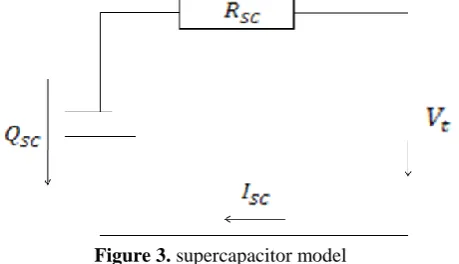
VSC = VOSC-ISCRSC (12)
ISC= (13)
SSC = (14)
[image:3.595.58.288.328.460.2]Where VOSC is the supercapacitor internal voltage ,VSC is the supercapacitor terminal volage ,RSCis its internal resistance ,SSC is the state of charge (SOC) where , is its charge at any instant and is the maximum charge contained in supercapacitor ,A and B are constants which depend on physical consideration of cell. Figure 3. supercapacitor model A and B parameters of supercapacitor can be obtained using data sheet [20] real graph data slopes with mathematical calculations such as using maximum and minimum supercapacitor internal voltages and its respective SOC. E. Losses Consideration in the System HESS has not only to provide power as per required output but also losses in the system apparatus such as losses in motor(PlM) ,HESS energy system (PlHESS) ,DC/DC converters(PlDC/DC),DC/AC(PlDC/AC) converters ,and transmission power loss(PlTR) described using equations (16)-(19), Hence total power losses can be summarized in one equation (15). Pl = PlDC/AC + PlDC/DC + PlM + PlTR + PlHESS (15)
PlHESS=NbI2bRb+NucI2ucRuc (16)
PlDC/DC=Pin(DC/DC)[1-ηDC/DC] (17)
PlDC/AC=Pin(DC/AC)[1-ηDC/AC] (18)
PlTR=Pin(TR)[1-ηTR] (19)
Except HESS losses in other systems can be obtained using output power of the vehicle. F. Power Supplied By Hess System Power supplied by HESS is not only the output power but losses in the system also and can be expressed as given below. Pin=Pout+Plosses (20)
Pin=Pb+PSC=VobIbNb+VOSCISCNSC (21) Where Plossesis the total power loss in the system , Poutis the total output power required ,and Pin (20) –(21) is the total
power provided by HESS system , Pbis the power supplied by battery cells while PSC is the power supplied by supercapacitor.
II. ENERGY MANAGEMENT STRATEGY
[image:3.595.322.528.356.552.2]To achieved long battery life cycle and improve overall efficiency it is important to pull off the utmost power allocation between hybrid energy storage mechanisms by designing the energy administration policies. Many researchers have been inventing energy management strategy of hybrid energy storage system which can be classified in to two categories, the ruled grounded & optimization based approach [2]. Ruled based approach generally derived in accordance with technological know-how, heuristics, inkling or math models. Optimization based approach further classified as worldwide optimization & actual time optimization. Global optimization includes neural networks, dynamic, convex programming & optimization algorithms of versatility. Here particle swarm optimization (PSO) (shown in figure 8) method is proposed for sizing and energy management of hybrid energy storage system. Figure 7 shows the optimal power distribution between battery and supercapacitor of hybrid energy storage system.
[image:3.595.307.550.478.827.2]Figure 5. Flow chart for power split between battery and SC.
A. Sizing of Hess
[image:4.595.59.277.268.666.2]Sizing mechanism depends on energy administration tactic exercised to rip power between the bases available. There are numerous probabilities to executing this fragmentation, optimized methods, & uncomplicated heuristic frequency depending the allocation [12], [13], [14]. Here the HESS sizing are carried out on the basis of particle swarm optimization method with some constraints derived from system. Here sizing can be tackled as the task of minimizing installation cost which leads to optimization problem also running cost may also be considered as an function which needs to be minimized as goal is to minimize both input power and installation cost hence this problem can be formulated as an optimization problem and keeping in mind several techniques already have been applied in literature but in this work particle swarm optimization technique has been applied.
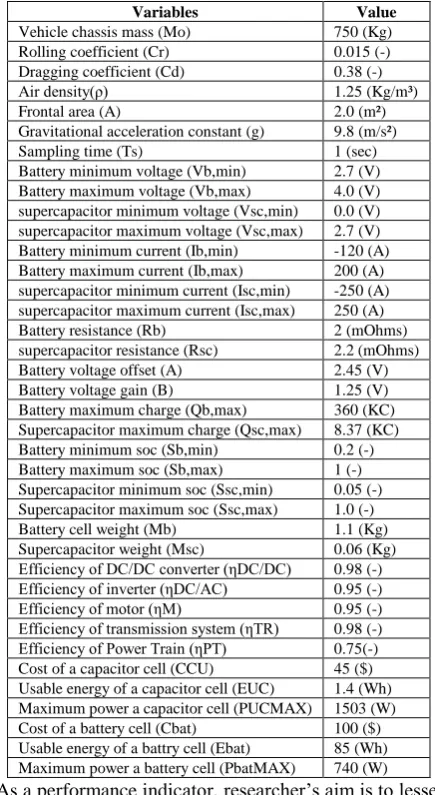
Table 1. Vehicle and Power train variables
Variables Value
Vehicle chassis mass (Mo) 750 (Kg)
Rolling coefficient (Cr) 0.015 (-)
Dragging coefficient (Cd) 0.38 (-)
Air density(ρ) 1.25 (Kg/m³)
Frontal area (A) 2.0 (m²)
Gravitational acceleration constant (g) 9.8 (m/s²)
Sampling time (Ts) 1 (sec)
Battery minimum voltage (Vb,min) 2.7 (V)
Battery maximum voltage (Vb,max) 4.0 (V)
supercapacitor minimum voltage (Vsc,min) 0.0 (V) supercapacitor maximum voltage (Vsc,max) 2.7 (V)
Battery minimum current (Ib,min) -120 (A)
Battery maximum current (Ib,max) 200 (A)
supercapacitor minimum current (Isc,min) -250 (A) supercapacitor maximum current (Isc,max) 250 (A)
Battery resistance (Rb) 2 (mOhms)
supercapacitor resistance (Rsc) 2.2 (mOhms)
Battery voltage offset (A) 2.45 (V)
Battery voltage gain (B) 1.25 (V)
Battery maximum charge (Qb,max) 360 (KC)
Supercapacitor maximum charge (Qsc,max) 8.37 (KC)
Battery minimum soc (Sb,min) 0.2 (-)
Battery maximum soc (Sb,max) 1 (-)
Supercapacitor minimum soc (Ssc,min) 0.05 (-)
Supercapacitor maximum soc (Ssc,max) 1.0 (-)
Battery cell weight (Mb) 1.1 (Kg)
Supercapacitor weight (Msc) 0.06 (Kg)
Efficiency of DC/DC converter (ηDC/DC) 0.98 (-)
Efficiency of inverter (ηDC/AC) 0.95 (-)
Efficiency of motor (ηM) 0.95 (-)
Efficiency of transmission system (ηTR) 0.98 (-)
Efficiency of Power Train (ηPT) 0.75(-)
Cost of a capacitor cell (CCU) 45 ($)
Usable energy of a capacitor cell (EUC) 1.4 (Wh) Maximum power a capacitor cell (PUCMAX) 1503 (W)
Cost of a battery cell (Cbat) 100 ($)
Usable energy of a battry cell (Ebat) 85 (Wh)
Maximum power a battery cell (PbatMAX) 740 (W)
As a performance indicator, researcher’s aim is to lessen a weighted edition of sum price of possession of the EV, together with the cells’ purchase outlay (NbCb+ NSCCSC) & charging price of the EV in its anticipated life span. Price is defined as
ℐ = βTs (22) ℐ 1 = NbCb+ NSCCSC (23) ℐ = ℐ 1+ ℐ 2 (24)
Where J (24) is the objective function needed to be minimized,J1(22)is the installation cost function while J2(23)is the running cost function.
with N is used to drive cycle discretization and γ (in $/Ws) as a steady factor which interprets the vehicle’s power utilization to an cost-effective rate. One probable technique to delineate the factor γ is to mull over (25).
β= (25) where Ny is the probable life span of HESS (in years) , is the quantity of drives that vehicle is anticipated to be performed in year y ∈[1, 2, . . . , Ny], & is the electricity cost ($/Ws) in the year y. Obviously, and Ny ought to be chosen with the discernment of restriction of either charges or discharge HESS cycles . At this juncture, it is significant to discuss a few of the inadequacies of the sizing of optimization are taken to consideration in the manuscript. Primarily it is to perceive that whilst the expenditure purpose & preponderance of the limitations are linear, the power equilibrium hurdles have similarities incorporating the decision variables product (e.g.,Nb, NSC), over and above current quadratic terms pounds trouble non-convex (bear in mind that a convex issue recognize only the sameness affine). Consequently, the optimization hitch is non-convex and nonlinear, that causes a few mathematical challenges to attain worldwide best possible elucidations. Nonetheless, we would illustrate afterwards that these (locally best possible) resolutions still execute enhanced than the resolutions gained with the easy filter-based sizing.
The difficulty formulation too presumes that the statistics of cells, Nb, NSC, are genuine amount, while in application, it ought to go to an integer array. This estimate fetches imperative benefits to the mathematical resolution of the difficulty mean while it permits to avoid the exercise of further intricates. Further, as the HESS is made up of super capacitors and batteries, it is expected that the turning Nb, NSC mistakes will have a slight impact in the ultimate resolution.
III. RESULTS AND DISCUSSION
Albeit sizing task was executed beneath the presumption of an insignificant cycle driving, its value inquiring in what way the resultant HESS achieves while driving circumstances diverge from supposed circumstances. With this objective in perception, quite a few mathematical replications were took out for some distinctive driving cycles, viz ARTEMIS Urban, EUDC, FTP, and UDDS. For every cycle driving, 03 sorts of ESS are mulled over: (1) battery alone (nbat = 145, nsc = 0); (2) HESS filter based sizing (nbat = 78, nsc = 45), and PSO based sizing (3) HESS (nbat = 85, nsc = 54), aiming a tradeoff amid price along with power effectiveness, w In all instances, the Energy Saving System were sized by exercising (23) for a 50 km range. Fig. 7 illustrates in general consequences of the diverse patterns beneath study. It is perceived that all the non-nominal cycle driving, the insertion of the Super Capacitors lowers the power
some point, those consequences are anticipated, in urban situations, along with squat remoteness & start and stop prototypes were recurrent, it was functional to avoid that support provided by SC will be advantageous for the power utilization of UV.
IV. SUM UP
In this manuscript, methods for the HESS sizing made up of SCs and batteries are created. Chief magnetism of particular techniques lies in the power administration difficulty mixture mutually with the job sizing. The technique, known as the filter-based sizing, uses power frequency breakdown to achieve the HESS and acknowledges the peak power and energy abilities of individual sources. This tactics, devised as programming trouble, is arithmetically competent. Nevertheless, because of the estimates and simplifications assumed in the formulation, it is only equipped offer a coarse estimation of the idyllic sizing.
To enlarge accurateness of the size course, complete method based optimization, i.e., for equal power administration & sizing troubles, was subsequently anticipated. This 2nd technique permits us to integrate further precise power failure representations of the power-train elements in the sizing job & additionally permits trailing the tradeoffs amid installation outlays & power effectiveness. For the exacting parametric pattern beneath study as well as believing that the everyday ranges lesser to 50 km, it was accomplished that, by summing Super Capacitors to the Energy Saving System, the by and large outlay of EV could be reduced to 20%. Moreover, basis on the sort of cycle driving, the HESS saves power up to 7.8%, putting forward an imperative input to an augment in the array of the vehicle.
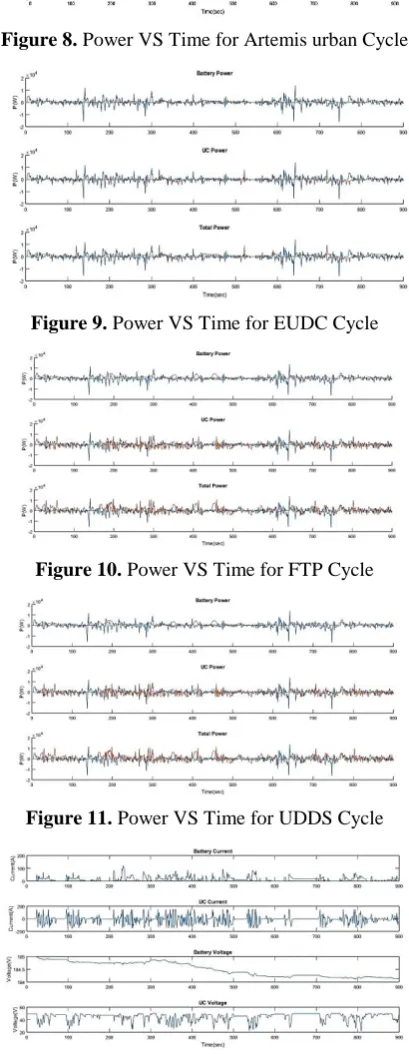
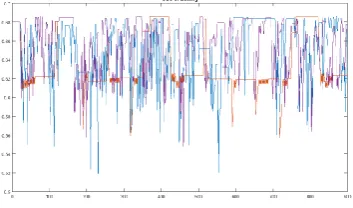
[image:5.595.324.529.170.698.2]With the aim of evaluating the Particle swarm optimization, researcher would apply this modus-operanding make battery – SC HESS competent provides requirement of different road driving cycle. All the cycles have been simulated for 900 sec duration though it may or may not be complete single cycle case and some important results such as energy requirements, battery and UC power sharing, battery and UC voltages and, battery and UC currents are obtained for different cycles and results are shown below, figure (7) represents Energy while Figures (8) – (11) represents power of battery, SCs and total power required by EV for respective cycles., (12)-(15) represents voltages and currents of battery and SCs different cycles. Figure (16) represents SOC of battery for different cycles for reference.
Figure 7. Energy VS Time for different cycles
Figure 8. Power VS Time for Artemis urban Cycle
Figure 9. Power VS Time for EUDC Cycle
Figure 10. Power VS Time for FTP Cycle
Figure 11. Power VS Time for UDDS Cycle
[image:5.595.55.283.636.773.2]Figure 13. Currents and Voltages VS Time for EUDC Cycle
Figure 14. Currents and Voltages VS Time for FTP Cycle
[image:6.595.65.279.53.406.2]Figure 15. Currents and Voltages VS Time for UDDS Cycle
Figure 16. SOC of battery for different cycles
IV. CONCLUSION
In this paper filter based and PSO based optimization approach for sizing and energy management of HESS comprised of batteries and super capacitors have been conceptualized. The PSO based optimization approach for sizing, takes into consideration an average and peak power fluctuation, decomposition of to administer HESS(Energy Saving System) and theorise both the peak power and energy potential of every source are perceivable.This technique abstracted as a programming snag, is statistically competent. It proffers insight into the indispensable systems allied with battery–SC hybridization. This method gives sizing and energy management for many driving cycles. The results shows that, beneath a few pragmatic hypothesis, the resulting hitch sizing are posed as a programming snag are concluded with adequate solutions via competent numerical methodologies.
REFERENCES
1. A.L. Allègre, R. Trigui, A. Bouscayrol, “Different energy management strategies of Hybrid Energy Storage System (HESS) using batteries and supercapacitors for vehicular applications”. In Vehicle Power and Propulsion Conference (VPPC), 2010 IEEE, 2010 Sep 1, pp. 1-6. 2. S. Karthick, E.S. Devi, R.V. Nagarajan, “Trust-distrust protocol for the
secure routing in wireless sensor networks ”. In 2017 International Conference on Algorithms, Methodology, Models and Applications in Emerging Technologies, ICAMMAET, 2017, pp. 1-5.
3. R.E. Araujo, R. de Castro, C. Pinto, P. Melo, D. Freitas, “Combined sizing and energy management in EVs with batteries and supercapacitors”. IEEE Transactions on Vehicular Technology. vol. 63, no. 7, 2014 Sep, pp. 3062-76.
4. M. Kabalo et al., “Experimental validation of a high-voltage-ratio low input current ripple converters for hybrid fuel cell supercapacitors systems,” IEEE Trans. Veh. Technol., vol. 61, no. 8, Oct. 2012, pp. 3430–3440.
5. Winter, Martin, and R.J. Brodd. "What are batteries, fuel cells, and supercapacitors?." 2004, pp. 4245-4270.
6. X. Zhang, H. Xue, Y. Xu, H. Chen, C. Tan, “An investigation of an uninterruptible power supply (UPS) based on supercapacitor and liquid nitrogen hybridization system”. Energy Conversion and Management. vol. 85, 2014 Sep 1, pp. 784-92.
7. P. Thounthong, S. Pierfederici, J.P. Martin, M. Hinaje, B. Davat, “Modeling and control of fuel cell/supercapacitor hybrid source based on differential flatness control”. IEEE Transactions on Vehicular Technology. vol. 59, no. 6, 2010 Jul 1, pp. 2700-10.
8. K.T. Chau, K.C. Wu, C.C. Chan, W.X. Shen, “A new battery capacity indicator for nickel–metal hydride battery powered electric vehicles using adaptive neuro-fuzzy inference system”. Energy Conversion and Management. vol. 44, no. 13, 2003 Aug 1, pp. 2059-71.
9. Z. Chen, R. Xiong, K. Wang, B. Jiao, “Optimal energy management strategy of a plug-in hybrid electric vehicle based on a particle swarm optimization algorithm”. Energies. vol. 8, no. 5, 2015 Apr 29, pp. 3661-78.
10. J. Soares, T. Sousa, H. Morais, Z. Vale, B. Canizes, A. Silva, “Application-Specific Modified Particle Swarm Optimization for energy resource scheduling considering vehicle-to-grid”. Applied Soft Computing. vol. 13, no. 11, 2013 Nov 1, pp. 4264-80.
11. J. Moreno, M. E. Ortuzar, and J. W. Dixon, “Energy-management system for a hybrid electric vehicle, using supercapacitors and neural networks,” IEEE Trans. Ind. Electron., vol. 53, no. 2, Apr. 2006, pp. 614–623.
12. F. Khoucha, M.E. Benbouzid, A. Kheloui, “An optimal fuzzy logic power sharing strategy for parallel hybrid electric vehicles”. In Vehicle Power and Propulsion Conference (VPPC), 2010 IEEE 2010 Sep 1, pp. 1-5.
13. C. R. Akli, X. Roboam, B. Sareni, and A. Jeunesse, “Energy management and sizing of a hybrid locomotive,” in Proc. Eur. Conf. Power Electron. Appl., 2007, pp. 1–10.
14. J. Curti, X. Huang, R. Minaki, and Y. Hori, “A simplified power management strategy for a supercapacitor/battery hybrid energy storage system using the half-controlled converter,” in Proc. 38th Annu. Conf. IEEE Ind. Electron. Soc., 2012, pp. 4006–4011.
15. L. Kouchachvili, W. Yaïci, E. Entchev, “Hybrid battery/supercapacitor energy storage system for the electric vehicles”. Journal of Power Sources. Vol.374, 2018 Jan 15, pp. 237-48.
16. A. Ravey, R. Roche, B. Blunier, and A. Miraoui, “Combined optimal sizing and energy management of hybrid electric vehicles,” in Proc. IEEE ITEC Expo, 2012, pp. 1–6.
17. E. Kim, K.G. Shin, J. Lee, “Real-time discharge/charge rate management for hybrid energy storage in electric vehicles”. InReal-Time Systems Symposium (RTSS), 2014 IEEE 2014 Dec 2, pp. 228-237.
18. N. Murgovski, L. Johannesson, J. Sjöberg, and B. Egardt, “Component sizing of a plug-in hybrid electric powertrain via convex optimization,” Mechatronics, vol. 22, no. 1, Feb. 2012, pp. 106–120.
19. Data sheet of super battery “SLPB100216216H_40Ah Nano”
20. Data sheet of super capacitor
[image:6.595.74.264.65.158.2] [image:6.595.82.259.438.542.2]