This is a repository copy of
Understanding Gentzen and Frege Systems for QBF
.
White Rose Research Online URL for this paper:
http://eprints.whiterose.ac.uk/98002/
Version: Accepted Version
Proceedings Paper:
Beyersdorff, O orcid.org/0000-0002-2870-1648 and Pich, J (2016) Understanding Gentzen
and Frege Systems for QBF. In: LICS '16: Proceedings of the 31st Annual ACM/IEEE
Symposium on Logic in Computer Science. 31st Annual ACM/IEEE Symposium on Logic
in Computer Science (LICS), 05-08 Jul 2016, New York, NY, USA. ACM , pp. 146-155.
ISBN 978-1-4503-4391-6
https://doi.org/10.1145/2933575.2933597
© 2016 ACM. This is the author's version of the work. It is posted here by permission of
ACM for your personal use. Not for redistribution. The definitive version was published in
LICS '16 Proceedings of the 31st Annual ACM/IEEE Symposium on Logic in Computer
Science, http://doi.acm.org/10.1145/2933575.2933597. Uploaded in accordance with the
publisher's self-archiving policy.
[email protected]
https://eprints.whiterose.ac.uk/
Reuse
Unless indicated otherwise, fulltext items are protected by copyright with all rights reserved. The copyright
exception in section 29 of the Copyright, Designs and Patents Act 1988 allows the making of a single copy
solely for the purpose of non-commercial research or private study within the limits of fair dealing. The
publisher or other rights-holder may allow further reproduction and re-use of this version - refer to the White
Rose Research Online record for this item. Where records identify the publisher as the copyright holder,
users can verify any specific terms of use on the publisher’s website.
Takedown
If you consider content in White Rose Research Online to be in breach of UK law, please notify us by
Understanding Gentzen and Frege Systems for QBF
Olaf Beyersdorff
J´an Pich
School of Computing, University of Leeds, United Kingdom
{o.beyersdorff,j.pich}@leeds.ac.uk
Abstract
Recently Beyersdorff, Bonacina, and Chew [10] introduced a nat-ural class of Frege systems for quantified Boolean formulas (QBF) and showed strong lower bounds for restricted versions of these systems. Here we provide a comprehensive analysis of the new ex-tended Frege system from [10], denotedEF+∀red, which is a nat-ural extension of classical extended FregeEF.
Our main results are the following: Firstly, we prove that the standard Gentzen-style systemG∗1 p-simulatesEF+∀redand that G∗1 is strictly stronger under standard complexity-theoretic
hard-ness assumptions.
Secondly, we show a correspondence ofEF+∀redto bounded arithmetic:EF+∀redcan be seen as the non-uniform propositional version of intuitionistic S21. Specifically, intuitionisticS21 proofs
of arbitrary statements in prenex form translate to polynomial-size
EF+∀redproofs, andEF+∀redis in a sense the weakest system with this property.
Finally, we show that unconditional lower bounds forEF+∀red
would imply either a major breakthrough in circuit complexity or in classical proof complexity, and in fact the converse implications hold as well. Therefore, the systemEF+∀rednaturally unites the central problems from circuit and proof complexity.
Technically, our results rest on a formalised strategy extraction theorem forEF+∀redakin to witnessing in intuitionisticS21and a
normal form forEF+∀redproofs.
Categories and Subject Descriptors F.2.2 [Analysis of algo-rithms and problem complexity]: Nonnumerical Algoalgo-rithms and Problems—Complexity of proof procedures
General Terms Proof complexity, bounded arithmetic, quantified Boolean formulas
Keywords QBF proof systems, sequent calculus, Frege systems, intuitionistic logic, strategy extraction, lower bounds, simulations
1.
Introduction
Proof complexityaddresses the main question of how hard it is to prove theorems in a given calculus, in particular: what is the length of the shortest proof of a given theorem in a fixed formal system, typically comprised of axioms and rules. This research bears tight and fruitful connections to computational complexity (separating complexity classes in an approach known as Cook’s programme
Permission to make digital or hard copies of part or all of this work for personal or classroom use is granted without fee provided that copies are not made or distributed for profit or commercial advantage and that copies bear this notice and the full citation on the first page. Copyrights for components of this work owned by others than ACM must be honored. Abstracting with credit is permitted. To copy otherwise, to republish, to post on servers, or to redistribute to lists, contact the Owner/Author. Request permissions from [email protected] or Publications Dept., ACM, Inc., fax +1 (212) 869-0481. Copyright 20yy held by Owner/Author. Publication Rights Licensed to ACM.
CONF ’yy Month d–d, 20yy, City, ST, Country Copyright c20yy ACM 978-1-nnnn-nnnn-n/yy/mm. . . $15.00 DOI: http://dx.doi.org/10.1145/nnnnnnn.nnnnnnn
[20]), to first-order logic (theories of bounded arithmetic [19, 31]), as well as to practical SAT- and QBF-solving [15].
While the bulk of activity in proof complexity concerns proposi-tional proofs, there has been intense research during the last decade employing proof-complexity methods to further logics, most no-tably non-classical logics (cf. [7]) and proof complexity of quanti-fied Boolean formulas (QBF).
Recent research inQBF proof complexityhas been largely trig-gered by exciting advances in QBF solving—powerful algorithms that solve large classes of formulas from industrial applications. Compared to SAT solving, due to thePSPACEcompleteness of QBF the success of QBF solvers even extends to further fields such as planning [24, 36] and formal verification [5]. To model the strengths of modern QBF solvers, a number of resolution-based proof systems have been recently suggested and analysed from a proof complexity perspective (cf. [3, 8, 9, 11]).
While we have a relatively good understanding of these weak resolution-type systems, much less is known for strong proof sys-tems, and this judgement applies to both propositional and QBF proof complexity. There are two main approaches for designing strong calculi: via sequent-style systems (Gentzen’sLK[25]) and axiom-rule based systems known as Frege or Hilbert-type calculi [20]. In propositional logic, both Gentzen and Frege systems are equivalent from a proof complexity point of view [20, 31].
The situation is more intricate for QBF; and indeed the main aim of the present paper is to shed light on this topic.
Gentzen systems for QBFwere already introduced in the late 80’s by Kraj´ıˇcek and Pudl´ak [32], of which we use slightly modi-fied versionsGiandG∗i due to Cook and Morioka [18]. These
sys-tems are known to be strictly more powerful than QBF resolution [23], but lower bounds are out of reach with current techniques.
As for strong propositional systems, the main source of infor-mation on QBF Gentzen systems stems from their correspondence to Buss’ theories of bounded arithmetic [13, 18, 32]. This corre-spondence allows to translate first-order formulas into sequences of QBFs, and indeed first-order proofs inSi
2orT2ito
polynomial-sizeG∗iorGiproofs, respectively [18, 32], thus providing the main
tool to construct short propositional proofs.
On the other hand, QBF Frege systems were only developed very recently [10]. Their definition is very elegant, adding to
classi-calFregejust one single∀redrule for managing quantifiers,
lead-ing to the QBF systemFrege+∀red. Alternatively, they can be seen as substitution Frege systems with substitutions allowed just for universally quantified variables.
As for classicalFrege, the strength ofFrege+∀redcan be cal-ibrated by allowing different classes of formulas (or more directly Boolean circuits [28]) as their underlying objects. With a novel technique [8, 10], uncovering a new and direct relation between circuit complexity and proof complexity, very strong lower bounds have been obtained for QBFFrege, the strongest of which yields an exponential lower bound forAC0[p]-Frege+
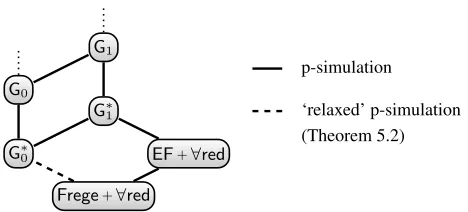
Frege+∀red G∗
0 EF+∀red
G0
G∗
1 G1
p-simulation
[image:3.612.56.290.70.176.2]‘relaxed’ p-simulation (Theorem 5.2)
Figure 1. The simulation order of QBF Gentzen and Frege systems
AC0-Frege[1, 33, 35], while lower bounds for the strongerAC0[p]
-Fregeconstitute a major problem, open for more than twenty years.
This exciting development prompts us to target at a better un-derstanding of the new QBF Frege systems. What is their relation to the well-studied QBF Gentzen calculi? Does QBF Frege also admit a correspondence to bounded arithmetic? Can we push lower bounds even beyond the current state-of-the-art bound forAC0[p]
-Frege+∀redfrom [10]?
In this paper we give answers to all of these three questions. 1.1 Our contributions
Below we summarise our main contributions of this paper, sketch-ing the main results and techniques.
A. Gentzen vs. Frege in QBF: simulations and separations. In classical proof complexityFregeand Gentzen’s sequent system
LKare p-equivalent, i.e., proofs can be efficiently translated be-tween the systems [20]. In contrast, our findings show a more com-plex picture for QBF. We concentrate on the most important stan-dard Gentzen-style systemsG∗0andG∗1 as well as the QBF Frege
systemsFrege+∀redand EF+∀red, forming QBF analogues of the classicalFregeand extended Frege systemEFfrom [20].
For these four systems the following picture emerges (cf. Fig-ure 1): We prove thatG∗1p-simulatesEF+∀red(Theorem 5.1) and
likewiseG∗0 p-simulatesFrege+∀red(although the latter under a
slightly more relaxed notion of p-simulation, Theorem 5.2). On the other hand, the converse simulations are unlikely to hold. Under a variety of standard complexity-theoretic assumptions we show that
EF+∀redis incomparable to bothG∗
0andG0(Theorems 3.1, 3.4,
3.3, 3.5). Hence, unlike in the propositional framework, Gentzen appears to be stronger than Frege in QBF.
While all these separations make use of complexity-theoretic assumptions, it will be very hard to improve these results to un-conditional lower bounds (see C. below). However, since we use a number of unrelated and indeed partly incomparable assumptions, our separations seem very plausible.
B. QBF Frege corresponds to intuitionistic logic.The strongest tool for an understanding of classical Frege as well as proposi-tional and QBF Gentzen systems comes from their correspondence to bounded arithmetic [19, 31]. Here we show such a correspon-dence betweenEF+∀redand first-order intuitionistic logicIS12, introduced in [14, 22]. For this first-order arithmetic formulas are translated into sequences of QBFs [32].
Our main result on the correspondence states that translations of arbitrarily complex prenex theorems inIS12admit polynomial-size EF+∀red proofs (Theorem 7.1). Informally, this says that allIS12consequences can be efficiently derived inEF+∀red, and moreover,EF+∀redis the weakest system with this property.
The second facet of the correspondence is thatIS12 can prove
the correctness ofEF+∀redin a suitable encoding (Theorem 7.2),
and in a certain senseEF+∀redis the strongest proof system that is provably sound in the theoryIS12.
Technically, the correspondence as well as the simulation re-sults mentioned under A. above rest on a formalisation of the Strategy Extraction Theorem for QBF Frege systems from [10]. This strategy extraction result states that for formulas provable in
EF+∀redone can compute witnesses for all existential quanti-fiers with Boolean circuits that can be efficiently extracted from theEF+∀redproof.
We provide two formalisations for this result: one in first-order logic, where we formalise strategy extraction inS21(Theorem 4.1),
and a second more direct one, where we constructFregeproofs for the witnessing properties (Theorem 4.3). While the second formal-isation applies to more systems and gives the simulation structure detailed in A., the first formalisation is stronger and enables the correspondence toIS12.
Although intuitionistic bounded arithmetic was already devel-oped by Buss in the mid 80’s [14], no propositional counterpart of this theory was found so far—in sharp contrast to most other arithmetic theories [19]. As we show here, the missing piece in the puzzle is the recent QBF Frege systemEF+∀red.
Indeed, the appealing link betweenIS12 andEF+∀redcomes via their witnessing properties: similarly asEF+∀redhas strategy extraction for arbitrarily complex QBFs [10], the theoryIS12admits
a witnessing theorem for arbitrary first-order formulas [22]. C. Characterising lower bounds for QBF Frege.The main question left open by the recent advances in strong QBF lower bounds [10] is whetherunconditionallower bounds can be obtained
forFrege+∀redor evenEF+∀red. We show here that such a result
would imply either a major breakthrough in circuit complexity (a lower bound for non-uniformNC1 or even P/poly) or a major breakthrough in propositional proof complexity (lower bounds for classicalFregeor evenEF); and in fact the opposite implications hold as well (Theorem 8.1).
This means that the problem of lower bounds for QBF Frege very naturally unites the hardest problem in circuit complexity with the hardest problem in proof complexity. Indeed, by our simula-tions shown in A. this also means that a lower bound for any of the QBF Gentzen systemsGi orG∗i fori ≥ 1would imply either a
circuit lower bound or a lower bound for propositionalFrege. This is conceptually very interesting as a direct connection be-tween progress in circuit complexity and proof complexity has been often postulated (cf. [4]). Our results show that this con-nection directly manifests inFrege+∀red, thus highlighting that
Frege+∀redis indeed a natural and important system.
Technically, this result uses a normal form that we achieve
forFrege+∀redproofs: these can be decomposed into a classical
Fregeproof followed by a number of∀redsteps (Theorem 6.1).
We further show that even∀redsteps suffice that only substitute constants (Theorem 6.3).
Conceptually, our work draws on the close interplay of ideas and techniques from proof complexity, computational complexity, and bounded arithmetic; and it is really the interaction of these areas and techniques that form the technical basis of our results (which enforces us also to include rather extensive preliminaries). 1.2 Organization
In Section 2 we provide background on proof complexity, bounded arithmetic, and QBF Gentzen and Frege systems. We prove the con-ditional separations and the simulations in Sections 3 and 5, re-spectively. Section 4 formalizes strategy extraction in QBF Frege
inS21andFrege, and Section 6 derives from this a normalisation
Sec-tion 8 we give the characterizaSec-tion ofFrege+∀redandEF+∀red
lower bounds in terms of lower bounds for Boolean circuits or propositionalFrege.
2.
Preliminaries
2.1 Notions from computational complexity
We use standard notation and concepts from computational com-plexity (cf. [2]). In particular, we use the circuit classP/polyof functions computed by polynomial-size Boolean circuits and the class NC1 of functions computed by polynomial-size circuits of logarithmic depth (cf. [37]). We say that a function is hard for
P/polyif it is not computable by a sequence of polynomial-size circuits.
ByFPΣpi[O(logn)]we denote the set of functions computed
by a polynomial-time Turing machine making at most O(logn)
queries to aΣpi-oracle.FPΣpi is defined analogously but without the restriction on the number of queries.
2.2 Notions from proof complexity
Proof systems.According to [20] aproof systemfor a languageL is a polynomial-time onto functionP :{0,1}∗→ L. Each string φ∈ Lis atheoremand ifP(π) =φ,πis aproofofφinP. Given a polynomial-time functionP : {0,1}∗ → {0,1}∗the fact that P({0,1}∗) ⊆ Lis thesoundness propertyforLand the fact that P({0,1}∗)⊇ Lis thecompleteness propertyforL.
Proof systems for the languageTAUTof propositional tautolo-gies are calledpropositional proof systemsand proof systems for the languageTQBFof true QBF formulas are calledQBF proof systems. Equivalently, propositional proof systems and QBF proof systems can be defined respectively for the languagesUNSATof unsatisfiable propositional formulas andFQBFof false QBF for-mulas, in this second case we call themrefutational.
Given two proof systemsPandQfor the same languageL,P p-simulatesQ(denotedQ≤pP) if there exists a polynomial-time
functiontsuch that for eachπ∈ {0,1}∗,P(t(π)) =Q(π). Two systems are called p-equivalent if they p-simulate each other.
A proof systemPforLis calledpolynomially boundedif there exists a polynomialpsuch that everyx∈ Lhas aP-proof of size ≤p(|x|).
Frege systems.Fregeproof systems are the common ‘textbook’ proof systems for propositional logic based on axioms and rules [20]. The lines in aFrege proof are propositional formulas built from propositional variables xi and Boolean connectives ¬, ∧,
and∨. AFregesystem comprises a finite set of axiom schemes
and rules, e.g., φ∨ ¬φ is a possible axiom scheme. A Frege
proofis a sequence of formulas where each formula is either a substitution instance of an axiom, or can be inferred from previous formulas by a valid inference rule.Fregesystems are required to be sound and implicationally complete. The exact choice of the axiom schemes and rules does not matter as any twoFregesystems are p-equivalent, even when changing the basis of Boolean connectives [20] and [31, Theorem 4.4.13]. Therefore we can assume w.l.o.g. that modus ponens is the only rule of inference.
UsuallyFregesystems are defined as proof systems where the last formula is the proven formula. Equivalently, we can view them as refutationFregesystems where we start with the negation of the formula that we want to prove and derive a contradiction, and we switch between the two different formulations when convenient.
A number of subsystems and extensions ofFrege have been considered in the literature (cf. [4]). An elegant framework for these systems was introduced by Jeˇr´abek [28], whereC-Frege directly operates with circuits from the setCusing a finite set of derivation
Fregerules. For example, if there are no restrictions onCthenC
-Fregeis p-equivalent to the extended Frege system EF, cf. [28].
IfCis restricted to formulas, i.e.,C = NC1, then
C-Fregeis just
Frege. Throughout the paper, whenever we speak ofEFwe indeed
meanP/poly-FregeandFregestands forNC1-Frege.
Sequent calculus.Gentzen’s sequent calculus [25] is another classical proof system, both for first-order and propositional logic (cf. [31]). Propositional sequent calculusLKoperates with sequents
Γ −→ ∆with the semantic meaningV
φ∈Γφ |= W
ψ∈∆ψ. An
important rule inLKis the cut rule
Γ−→∆, A A,Γ−→∆
(cut rule)
Γ−→∆
whereAis called the cut formula.
LKis well known to be p-equivalent toFrege(cf. [31]). 2.3 Quantified Boolean formulas
Quantified Boolean formulas(QBF) extend propositional formulas by propositional quantifiers∀x. φ(x)with the semantic meaning φ(0)∧φ(1), and∃x. φ(x)meaningφ(0)∨φ(1).
The quantifier complexity of QBFs is captured by setsΣqi and
Πqi, which are defined inductively.Σ q
0= Π
q
0is the set of
quantifier-free propositional formulas,Σqi+1is the closure ofΠ
q
i under
exis-tential quantification, andΠqi+1is the closure ofΣ
q
iunder universal
quantifiers.
Often it is useful to think of a QBF Q1X1. . .QkXk. φ as
agame between theuniversal and the existential player. In the i-th step of the game, the player Qi assigns values to all the
variablesXi. The existential player wins the game iff the matrixφ
evaluates to1under the assignment constructed in the game. The universal player wins iff the matrix φ evaluates to 0. Given a universal variableuwith indexi, astrategy foruis a function from all variables of index< ito{0,1}. A QBF is false iff there exists a winning strategyfor the universal player, i.e. if the universal player has a strategy for all universal variables that wins any possible game [27], [2, Sec. 4.2.2].
2.4 Sequent calculi for QBF
Quantified propositional calculus G, as defined by Cook and Morioka [18], extends Gentzen’s classical propositional sequent calculusLK, cf. [31, Chapter 4.3], by allowing quantified propo-sitional formulas in sequents and by adopting the following extra quantification rules for∀-introduction
φ(x/ψ),Γ−→∆
(∀-l) ∀x. φ,Γ−→∆
Γ−→∆, φ(x/p)
(∀-r)
Γ−→∆,∀x. φ
and∃-introduction φ(x/p),Γ−→∆
(∃-l) ∃x. φ,Γ−→∆
Γ−→∆, φ(x/ψ)
(∃-r).
Γ−→∆,∃x. φ
For the rules∀-l and∃-r,φ(x/ψ)is the result of substitutingψ for all free occurrences ofx in φ. The formula ψ may be any quantifier-free formula (i.e., without bounded variables) that is free for substitution forxinφ(i.e., no free occurrence ofxinφis within the scope of a quantifierQysuch thatyoccurs inψ). The variable pin the rules∀-r and∃-l must not occur free in the bottom sequent. Fori≥0,Giis a subsystem ofGwith cuts restricted to prenex
Σqi∪Π q
i-formulas.G
∗
i denotes the subsystem ofGiallowing only
tree-like proofs.
The systemsGandGiwere originally introduced slightly
differ-ently, cf. [30–32], not restricting the formulasψin∀-l and∃-r to be quantifier-free, and definingGias the systemGallowing onlyΣqi
-formulas in sequents. Hence,Gi’s could not prove all true QBFs.
Notably, (for Cook and Morioka’s definition) Jeˇr´abek and Nguyen [29] showed that the system Gi with cuts restricted to
prenex Σqi-formulas is p-equivalent toGi with cuts restricted to
prenexΠqi-formulas and p-equivalent toGiwith cuts restricted to
(not necessarily prenex)Σqi∪Π q
i-formulas. Moreover these
equiv-alences hold as well for the tree-like versions of these systems. Cook and Morioka [18] also proved that their definition ofGi
is p-equivalent toGifrom [32] fori ≥ 0and prenexΣqi ∪Π q i
-formulas (so by [29] also for non-prenex ones).
On propositional formulasG0is p-equivalent toFregeandG1
is p-equivalent to the Extended Frege systemEF, cf. [31]. Finally, the systemsGiandG∗i have quite constructive
witness-ing properties. Whenever there are polynomial-sizeG∗1 proofs of
formulas∃y. An(x, y)forAn(x, y)∈Σq1, there exist
polynomial-size circuitsCnwitnessing the existential quantifiers, i.e., the
for-mulaAn(x, Cn(x))holds, cf. [18, Theorem 7]. In case ofG0the
circuits witnessingΣq1-formulas are fromNC1, cf. [18, Theorem 9]. The witnessing theorems can be generalized to systemsG∗i andGi
fori≥1w.r.t.Σqi-formulas and witnessing functions
correspond-ing to higher levels of the polynomial hierarchy. 2.5 Frege systems for QBF
An alternative way how to define reasoning with QBFs was given in [10] by using systems denoted asC-Frege+∀red.C-Frege+∀red
is a refutational proof system augmenting the classical C-Frege
system by a∀redrule. Formally, aC-Frege+∀redrefutation of a QBFQ. φis a sequence of circuitsL1, . . . , Ll∈ CwhereL1=φ,
Ll = ∅, and each Li is derived from previous Lj’s using the
inference rules ofC-Fregeor using the following∀redrule Lj(u)
(∀red) Lj(u/B)
where u is a universal variable that is the innermost (wrt. the quantifier prefixQ) among the variables of Lj, and B ∈ C is
a circuit that contains only variables left of u. In particular, C
-Frege+∀reddoes not manipulate the prefix of the given QBF, so it
proves only QBFs in prenex form.
In principle, variables not quantified in the prefix of a QBF might appear in itsC-Frege+∀redrefutation as consequences of
C-Fregerules. However, all such variables can be substituted by
arbitrary constants without changing the proven QBF. Therefore, we assume that there are no such ‘redundant’ variables.
If there are no restrictions onC, we denoteC-Frege+∀redas
EF+∀red. IfCis restricted to formulas, we speak ofFrege+∀red. Note thatC-Frege+∀redis essentially a refutational substitu-tion Frege systemSF, cf. [31], with substitutions allowed only for rightmost universally quantified variables.
In Section 6.1 we will show that in fact restricting the substitut-ing circuitBto constants0,1results in a p-equivalent proof system denotedC-Frege+∀red0,1.
A characteristic property of theC-Frege+∀redsystems is the so calledStrategy Extraction Theorem. The theorem obtained in [10] says that whenever there is aC-Frege+∀redrefutationπof a QBF∃x1∀y1, . . . ,∃xk∀yk. φ(x1, . . . , xk, y1, . . . , yk), then there
areO(|π|)-size witnessing circuitsC1, . . . , Ck∈ Csatisfying n
^
i=1
(y′i↔Ci(x1, . . . , xi, y1′, . . . , y′i−1, π))
→ ¬φ(x1, . . . , xn, y1′, . . . , y′n).
2.6 Bounded arithmetic
In first-order logic we will work with the languageL={0, S,+,·,≤
,x
2
,|x|,#} where the function |x| is intended to mean ‘the length of the binary representation ofx’ andx#y= 2|x|·|y|.
A quantifier is bounded if it has the form∃x. x≤tor∀x. x≤t forxnot occurring in the termt. A bounded quantifier is sharply bounded ift has the form|s|for some terms. ByΣb
0 (=Πb0 = ∆b
0) we denote the set of all formulas in the languageLwith all
quantifiers sharply bounded. Fori ≥ 0, the setsΣb
i+1andΠbi+1
are defined inductively.Σb
i+1is the closure ofΠbi under bounded
existential and sharply bounded quantifiers, andΠb
i+1is the closure
ofΣb
i under bounded universal and sharply bounded quantifiers.
That is, the complexity of bounded formulas in the languageL (formulas with all quantifiers bounded) is defined by counting the number of alternations of bounded quantifiers, ignoring the sharply bounded ones. Fori >0,∆b
idenotesΣbi∩Πbi.
Bounded formulas capture the polynomial hierarchy: for any i >0thei-th levelΣpi of the polynomial hierarchy coincides with the sets of natural numbers definable byΣb
i-formulas. Dually for
Πpi andΠb i.
Buss [13] introduced theories of bounded arithmeticS2i,T2ifor i ≥ 1in the languageL. The axioms ofSi
2 consist of a set of
basic axioms defining properties of symbols fromL, cf. [31], and length inductionΣb
i-LIND, which is the following scheme forΣ b i
-formulasA(or equivalently, forA∈Πb
i, in which case we speak
ofΠb i-LIND):
A(0)∧ ∀x.(A(x)→A(x+ 1))→ ∀x. A(|x|).
TheoriesT2iare defined similarly, but here the induction scheme is
A(0)∧ ∀x.(A(x)→A(x+ 1))→ ∀x. A(x)
forA∈Σb i.
T2i proves the totality of FPΣpi functions, cf. [31, Theorem
6.1.2]. More precisely, for anyf ∈FPΣpi there is aΣb
i+1-formula
f(x) = y such thatTi
2 ⊢ ∀x∃y. f(x) = y. In the same way,
S2i proves the totality of functions in FPΣpi[O(logn)], cf. [31,
Theorem 6.2.2]. By Parikh’s theorem,T2i⊢ ∃y. f(x) =yimplies
Ti
2 ⊢ ∃y.|y| ≤p(|x|)∧f(x) =yfor some polynomialp, and the
same is true forSi
2(cf. [13, 34]).
S2ican be seen as a first-order non-uniform version ofG∗i,i≥1.
Firstly, forj ≥ 1anyΣb
j-formulaφ(x)can be translated into a
sequencekφ(x)knofΣq
j-formulas, wherendenotes the size of the
inputxin binary (cf. [31, Definition 9.2.1]). Then, fori, j ≥ 1
wheneverSi
2 ⊢ AforA ∈Σbj, there is a polynomialpsuch that
formulaskAkn
haveG∗i-proofs of sizep(n). This also holds forT i
2
in place ofS2iifG∗i is replaced byGi. The ability to use arbitrary
jis due to Cook and Morioka [18, Theorem 3] who generalized a standard result, cf. [31, Theorem 9.2.6], which worked forj=i.
IfA ∈ Πb
1, we abuse notation and also denote bykAkn the
propositional formulas obtained as inkAkn
, but leaving the uni-versally quantified variables free.S21 ⊢AforA∈Πb
1implies that
S21proves the existence of polynomial-sizeG∗1-proofs of
proposi-tional formulaskAkn
, cf. [31, Theorems 9.2.6 and 9.2.7].
3.
Separating Gentzen and Frege for QBF
We start with proving a number of conditional separations between Gentzen and Frege systems for QBF. As we will show later in Section 8, improving these separations to unconditional results tightly corresponds to major open problems in circuit complexity and proof complexity.
3.1 Formulas easy in Gentzen, but hard in Frege
We first provide three different properties that are easy for QBF Gentzen systems, but hard forEF+∀red. Our first conditional result shows that there areΣq
2-formulas with polynomial-sizeG∗1
Theorem 3.1. Leti≥1. Assumef ∈ FPΣpi is hard forP/poly.
Then formulas k∃y.|y| ≤ p(|x|) ∧f(x) = ykn
, where p is a polynomial and f(x) = y is expressed by a Σb
i+1-formula,
have polynomial-sizeGiproofs and require super-polynomial-size
EF+∀redproofs. Iff ∈FPΣip[O(logn)]thenGican be replaced
byG∗i.
Proof. AsT2iproves the totality ofFPΣpi functions [13], it proves the totality offand the proof can be transformed into a sequence of polynomial-size Gi proofs [18, 32]. If the totality of f can
be shown by polynomial-size proofs in EF+∀red, then, by the Strategy Extraction Theorem [10],fis inP/poly.
Similarly,S2i proves the totality ofFPΣpi[O(logn)] functions
and such proofs translate into sequences of polynomial-size G∗i
proofs [13, 18, 32].
It seems that the separation above of G∗1 and EF+∀red by Σq
2-formulas cannot be improved toΣ
q
1-formulas as it is tight in
the following sense. If we had Σq
1-formulas ∃y. An(x, y) with
polynomial-sizeG∗1proofs but without polynomial-sizeEF+∀red
proofs, this would imply thatEFis not polynomially bounded: by the witnessing theorem forG∗1, cf. [18, Theorem 7], there would be
polynomial-size circuitsCnsuch that formulasAn(x, Cn(x))are
true, and so¬An(x, Cn(x))would be hard to refute inEF.
G∗1 andEF+∀redcan be conditionally separated also on the
bounded collection scheme.
Definition 3.2. Thebounded collection schemeBB(φ)is the for-mula
∃i <|a|,∃w < t(a),∀u < a,∀j <|a|.(φ(i, u)→φ(j,[w]j))
whereφ(i, u)is a formula which can have other free variables,
[w]j is thej-th element of the sequence coded byw, and t(a)
is a concreteL-term depending on the choice of the encoding of sequences.
Roughly,BB(φ)says that u’s witnessing φ(i, u) can be
col-lected in a sequencew:
∀i <|a|,∃u < a, φ(i, u)→ ∃w < t(a),∀j <|a|, φ(j,[w]j).
Theorem 3.3. G∗1 has polynomial-size proofs ofkBB(φ)kn for
allφ ∈ Σb
1. In contrast, there existsφ ∈ Σb1such that formulas
kBB(φ)kn are hard forEF+∀redunless each polynomial-time
permutation withninputs can be inverted by polynomial-size cir-cuits with probability≥1−1/n.
Proof. The upper bound follows from theS21-provability ofBB(φ)
forφ ∈ Σb
1, cf.[13, Theorem 14], and its transformation toG∗1
proofs [18, 32].
For the lower bound we will use a result by Cook and Thapen [21] showing that Cook’s theoryPV does not proveBB(φ)for all φ∈Σb
0unless factoring is in probabilistic polynomial time.
Leta = 2n
and φ(i, u) be the formulaf(u) = [y]i for a
polynomial-time permutationf (defined by aΣb
1 formula), andy
encoding a sequence ofnstrings of lengthn.
Assume thatEF+∀redhas polynomial-size proofs ofkBB(φ)kn
. By the Strategy Extraction Theorem [10] there are polynomial-size circuitsB,Csuch that
∃u <2n. f(u) = [y]C(y)→ ∀j < n. f([B(y)]j) = [y]j.
To invertf we proceed as follows. Givenz ∈ {0,1}n
, pick ran-domlyn stringssi ∈ {0,1}n and leti0 be a position such that Pry∈{0,1}d[C(y) =i0]≤1/nwheredis the number of inputs in
C. Defineyz,sto be the sequence of elementsz, f(s1), . . . , f(sn−1) ordered so that [yz,s]i0 = z and let xz,s be the sequence of
z, s1, . . . , sn−1 ordered so thatf([xz,s]i) = [yz,s]i fori 6= i0.
ThenPrz,s1,...,sn∈{0,1}d[C(yz,s) = i0] ≤ 1/n. Therefore, with
probability ≥ 1−1/n, f([xz,s]C(yz,s)) = [yz,s]C(yz,s) and
f([B(yz,s)]i0) =z.
While the previous two results exhibited formulas easy forG∗1
and hard forEF+∀red, we now show that evenG∗0can proveΣq2
-formulas hard forEF+∀red(modulo hardness of factoring). For this we use a result by Bonet, Pitassi, and Raz [12], who showed thatFrege systems do not admit the so called feasible interpolation property unless factoring of Blum integers is solvable by polynomial-size circuits. (A Blum integer is the product of two distinct primes, which are both congruent 3 modulo 4.)
Theorem 3.4. There are Σq2-formulas with polynomial-sizeG∗0
proofs. However, assuming factoring of Blum integers is not computable by polynomial-size circuits, these formulas require
EF+∀redproofs of super-polynomial size.
Proof.In [12] it is shown that there are propositional formulas A0(x, y),A1(x, z)with common variablesxsuch thatA0(x, y)∨
A1(x, z) have polynomial-size Frege proofs but, unless factor-ing of Blum integers is computable by polynomial-size circuits, there are no polynomial-size circuitsC(x)recognizing which of A0(x, y)orA1(x, z)holds for a givenx.
Fregeis p-equivalent toG∗0on propositional formulas [31] and
so it is possible to derive inG∗0the sequents in Figure 2.
Therefore, theΣq2-formulas
∃b∀y, u.((A0(x, y)∧b)∨(A1(x, u)∧ ¬b))
have polynomial-sizeG∗
0proofs.
If these formulas had polynomial-sizeEF+∀redproofs, then, by the Strategy Extraction Theorem [10], there would be polynomial-size circuits computingbfromxand thus recognizing which of A0(x, y),A1(x, u)holds.
We remark that the assumptions of Theorems 3.3 and 3.4 are stronger than the assumption of Theorem 3.1. However, while fac-toring forms a good candidate for a one-way function, it is not known if the existence of one-way functions implies the existence of one-way permutations.
3.2 Formulas hard in Gentzen, but easy in Frege
We now give the opposite separation, exhibiting formulas (condi-tionally) hard forG0, but easy forEF+∀red. ThusG∗0 andG0
ap-pear to be incomparable toEF+∀red. Theorem 3.5. IfP/poly6=NC1
then there areΣq1-formulas with polynomial-sizeEF+∀redproofs but without polynomial-sizeG0
proofs.
Proof.Letfbe a function inP/poly. ThenEF+∀redhas simple polynomial-size proofs ofΣq
1formulas∃y,∃z. f(x) =y
express-ing the totality offwith auxiliary variableszrepresenting nodes of a polynomial-size circuit computingf. TheEF+∀redproof re-futes the propositional formulaf(x) 6= yby gradually replacing each variable fromz, yby the circuit it represents.
If the totality offhad polynomial-sizeG0proofs, by theΣq1
witnessing property, cf. [18, Theorem 9],fwould be inNC1.
Notably, in Section 6 we show thatFrege+∀redandEF+∀red
are p-equivalent to their tree-like versions. This is open forG0and G1, thus providing some further evidence for the incomparability
−→A0(x, y), A1(x, z)
−→(A0(x, y)∧ ¬0)∨(A1(x, u)∧0),(A0(x, v)∧ ¬1)∨(A1(x, z)∧1)
−→ ∀y, u.((A0(x, y)∧ ¬0)∨(A1(x, u)∧0)),(A0(x, v)∧ ¬1)∨(A1(x, z)∧1)
−→ ∀y, u.((A0(x, y)∧ ¬0)∨(A1(x, u)∧0)),∀y, u.((A0(x, y)∧ ¬1)∨(A1(x, u)∧1))
−→ ∃b∀y, u.((A0(x, y)∧ ¬b)∨(A1(x, u)∧b)),∃b∀y, u.((A0(x, v)∧ ¬b)∨(A1(x, z)∧b))
−→ ∃b∀y, u.((A0(x, y)∧ ¬b)∨(A1(x, u)∧b))
Figure 2. TheG∗0derivation in the proof of Theorem 3.4
4.
Formalized strategy extraction
In order to prove thatG∗1p-simulatesEF+∀redwe first formalize
the Strategy Extraction Theorem from [10]. We provide two differ-ent formalizations, one inS21and another one directly inEF. Both are sufficient for the simulation result. These formalizations guar-antee that the extracted strategy is not just correct, butEF(resp.
C-Frege) provably correct.
Theorem 4.1(Formalized Strategy Extraction). There is a linear-time algorithmAsuch thatS21proves the following. Assume thatπ is anEF+∀redrefutation of a QBFψof the form
∃x1∀y2. . .∃xn∀yn. φ(x1, . . . , xn, y1, . . . , yn)
where φ ∈ Σq
0. Then A(π) outputs circuits C1(x1, π), . . . ,
Cn(x1, . . . , xn, y1, . . . , yn−1, π) defining a winning strategy for
the universal player on formulaψ; that is,
∀x1, . . . , xn, y1, . . . , yn. n
^
i=1 (yi↔
Ci(x1, . . . , xi, y1, . . . , yi−1, π))→ ¬φ(x1, . . . , xn, y1, . . . , yn).
Proof. We will inspect the original proof of the Strategy Extraction Theorem from [10], and point out that it essentially uses a Πb
1
-induction on the number of steps in the proofπ, i.e.,Πb
1-LIND
available inS21.
Letπ = (L1, . . . , Ls)be anEF+∀redrefutation of the QBF
Q. φgiven as in Theorem 4.1 and put
πs:=∅, πi:= (Li+1, . . . , Ls)fori < s
φ0 :=φ, φi:=φ∧L1∧ · · · ∧Lifori >0.
We will show by downward induction oni, that fromπiit is
possible to construct in linear time a winning strategy σi=
{Ci
1(x1, πi), . . . , Cni(x1, . . . , xn, y1, . . . , yn−1, πi)}
for the universal player for the QBFQ. φi. The statement of the
Formalized Strategy Extraction Theorem corresponds to the case i= 0.
In the base case,φs contains a contradiction and the winning
strategy can be defined as the set of trivial circuits{0, . . . ,0}. Assume now thatσiis a winning strategy forQ. φ
i.
IfLiis derived by anEFrule, then we setσi−1:=σi.
Assume now thatLi=Lj[u/B]is the result of an application
of a∀redrule onLjwhereuis the rightmost variable inLj. We
defineCi−1
l :=C i
lifu6=yl, otherwise we set
Cli−1(z) :=
(
B(z) ifLj[u/B](z) = 0
Ci
l(z) ifLj[u/B](z) = 1.
This constructs circuitsCi
lfromπiby a standardO(|πi|)-time
algorithm.
To show that the strategiesσi
are winning for any0≤i≤ |π|, we need to analyze the inductive step.
Assume thatσiis the winning strategy for the universal player
onQ. φi. IfLiis derived by anEFrule, the winning strategy for
Q. φi works also forQ. φi−1 because a falsification ofLi by a
given assignment implies a falsification of one of its predecessors. IfLiis the result of an application of∀red,Cli−1(z)is redefined
only ifLj[u/B](z) = 0. Forz such thatLj[u/B](z) = 1, the
strategy σi has to work also for Q. φ
i−1. Therefore,σi−1 is a
winning strategy for the universal player onQ. φi−1.
The statement that a strategy σ is winning for the universal player onQ. ψis acoNPpredicate (givenπ) expressible as a well-behavedΠb
1-formula. The induction we used is on the number of
steps inπ. Hence, the presented proof is anS21-proof.
The statement provable inS21in Theorem 4.1 is acoNP predi-cate expressible by aΠb
1-formula. Consequently, translating theS21
proof toEF, the extracted strategy is evenEF-provably correct: Corollary 4.2. Given anEF+∀redrefutationπof a QBF
∃x1∀y2. . .∃xn∀yn. φ(x1, . . . , xn, y1, . . . , yn)
whereφ∈Σq0, we can construct in time|π|O(1)anEFproof of
n
^
i=1
(yi↔Ci(x1, . . . , xi, y1, . . . , yi−1))→
¬φ(x1, . . . , xn, y1, . . . , yn)
for some circuitsCi.
We will now show the same result as in the last corollary for
Frege+∀red(and in fact provide an alternative direct proof without
making use of bounded arithmetic forEF+∀redas well). Theorem 4.3. LetCbe the circuit classNC1
orP/poly.1Given a
C-Frege+∀redrefutationπof a QBF
∃x1∀y2. . .∃xn∀yn. φ(x1, . . . , xn, y1, . . . , yn)
whereφ∈Σq0, we can construct in time|π|O(1)aC-Fregeproof of
n
^
i=1
(yi↔Ci(x1, . . . , xi, y1, . . . , yi−1))→
¬φ(x1, . . . , xn, y1, . . . , yn)
for some circuitsCi∈ C.
Proof.Again, we will inspect the original proof of the Strategy Extraction Theorem.
Letπ= (L1, . . . , Ls)be aC-Frege+∀redrefutation of aQBF
Q. φgiven as in Theorem 4.3 and put
πs:=∅, πi:= (Li+1, . . . , Ls)fori < s
φ0:=φ, φi:=φ∧L1∧ · · · ∧Lifori >0.
1Indeed, the result can be generalised to further ‘natural’ circuit classesC
We will show by downward induction oni, that fromπiit is
possible to construct in linear time a winning strategy
σi={C1(i x1, πi), . . . , Cni(x1, . . . , xn, y1, . . . , yn−1, πi)}
for the universal player for theQBFQ. φi. Moreover, formula n
^
l=1
(yl↔Cli(x1, . . . , xl, y1, . . . , yl−1, πi))→
¬φi(x1, . . . , xn, y1, . . . , yn)
denotedσi(φ
i) will have aC-Fregeproof of sizeK|πi|K for a
constantKdepending only on the choice of theC-Fregesystem. The statement of the theorem corresponds to the casei= 0.
In the base case, φs contains a contradiction so the winning
strategy can be defined as the set of trivial circuits{0, . . . ,0}and it is trivially provably correct.
Assume now thatσi(φ
i)has aC-Fregeproof of sizeK(s+ 1−
i)|πi|K.
IfLiis derived by aC-Fregerule, thenσi−1:=σi.
Let nowLi=Lj[u/B]be the result of an application of a∀red
rule onLjwhereuis the rightmost variable inLj. Then define
Ci−1
l :=C i
lifu6=yl, otherwise set
Cli−1(z) :=
(
B(z) ifLj[u/B](z) = 0
Ci
l(z) ifLj[u/B](z) = 1.
This constructs strategiesσifromπby aD|π
i|-time algorithm
for a constantD. W.l.o.g.D < K. In fact, circuitsCi lare inC.
We want to show thatσi−1(φ
i−1)has aC-Fregeproof of size K(s+ 1−(i−1))|πi−1|K.
IfLiis derived by aC-Fregerule, thenσialso witnesses¬φi−1
because
¬Li→ ¬(L′1∧ · · · ∧L′t)
for some conjunctsL′1, . . . , L′tinφi−1. Note thatCli−1’s are then
Ci
l’s. The implications
¬φi→ ¬φi−1
σi(φ
i)∧(¬φi→ ¬φi−1)→σi−1(φi−1)
(1)
can be derived by a fixed sequence of C-Frege rules depending only on the choice ofC-Frege. Thus, the common size ofC-Frege
proofs of both these implications is≤K0|πi−1|K0 where w.l.o.g.
K0 < K. Therefore σi−1(φi−1) has a C-Frege proof of size
≤K(s+ 1−i)|πi|K+K1|πi−1|K1≤K(s+ 1−(i−1))|πi−1|K
whereK1 > K0 depends again on a fixed sequence ofC-Frege
rules needed to deriveσi−1(φ
i−1)from (1) andσi(φi), so w.l.o.g.
K1< K.
AssumeLi =Lj[u/B]is the result of an application of∀red
whereu = yl. Then there is a fixed sequence ofC-Frege rules
deriving implications
σi(φi)∧ ¬Lj[u/B]→Cli−1=B∧σ i−1(φ
i−1)
σi(φi)∧Lj[u/B]→Cli−1=C i l∧σ
i−1(φ
i−1). The total size of bothC-Frege derivations isK0|πi−1|K0 where
K0depends on the choice ofC-Fregeand the size ofCli−1’s. The
size of allCi−1
l ’s is bounded byK|πi−1| K
. Hence we can assume K0 < K. It follows thatσi−1(φi−1)has aC-Fregeproof of size
≤K(s+ 1−i)|πi|K+K1|πi−1|K1≤K(s+ 1−(i−1))|πi−1|K
where as beforeK1depends on a fixed sequence ofC-Fregerules
needed to simulate a fixed set of ‘cut’ rules, i.e., w.l.o.g.K1 <
K.
5.
Gentzen simulates Frege for QBF
We now apply the formalised Strategy Extraction Theorem from the last section to show that Gentzen systems simulate Frege sys-tems in the QBF context. Frege and Gentzen are well known to be equivalent in the classical propositional case [31]. However, in QBF the opposite simulations (Gentzen by Frege) are very likely false as shown by the conditional separations in Section 3. Theorem 5.1. G∗1p-simulatesEF+∀red.
Proof.By Corollary 4.2, anyEF+∀redrefutationπof aQBFψ (given as in Corollary 4.2) can be transformed in time|π|O(1)into
anEFproof of
n
^
i=1
(yi↔Ci(x1, . . . , xi, y1, . . . , yi−1))→
¬φ(x1, . . . , xn, y1, . . . , yn)
for certain circuitsCi.
Claim 1. There is a|π|O(1)-sizeG∗
1proof of the following sequent
{yi=Ci(x1, . . . , xi, y1, . . . , yi−1)}ni=1−→
¬φ(x1, . . . , xn, y1, . . . , yn)
where the encoding of circuitsCimight use some auxiliary
vari-ables.
Proof of claim.To see that the claim holds note first that by p-equivalence ofEFandG∗1 (cf. [31]), theEFproof obtained above
can be turned into a|π|O(1)-sizeG∗
1-proof of the formula
¬
n
^
i=1
yi=Ci(x1, . . . , xi, y1, . . . , yi−1)
!
∨ ¬φ.
This proof can be easily modified so that the∨connective is not introduced, leading to a|π|O(1)-sizeG∗
1-proof of the sequent
−→ ¬
n
^
i=1
yi=Ci(x1, . . . , xi, y1, . . . , yi−1)
!
,¬φ.
Moving ¬ Vn
i=1 yi=Ci(x1, . . . , xi, y1, . . . , yi−1) from the succedent to the antecedent we obtain
n
^
i=1
(yi=Ci(x1, . . . , xi, y1, . . . , yi−1))−→ ¬φ.
Finally,G∗1 derives the sequent we want by ‘not introducing’∧in
the antecedent. This proves the claim.
Applying∃-r and∃-l introductions,G∗1then derives Γ,∃yn. yn=Cn(x1, . . . , xn, y1, . . . , yn−1)−→
∃yn.¬φ(x1, . . . , xn, y1, . . . , yn)
whereΓ ={yi=Ci(x1, . . . , xi, y1, . . . , yi−1)}ni=1−1.
AsG∗1proves efficiently−→ ∃y. y =C(x)for any circuitC,
we can cut∃yn. yn = Cn(x1, . . . , xn, y1, . . . , yn−1) out of the antecedent and derive
{yi=Ci(x1, . . . , xi, y1, . . . , yi−1)}ni=1−1−→ ∃yn.¬φ.
Now, we use∀-r introduction to obtain
{yi=Ci(x1, . . . , xi, y1, . . . , yi−1)}ni=1−1−→ ∀xn∃yn.¬φ.
In this way we can gradually cut out all formulas from the an-tecedent, quantify all variables and derive¬ψin G∗1 by a proof
To introduce the quantifyer prefix ofψin the previous proof we needed to cutΣq1-formulas. We would like to use a similar proof to simulateFrege+∀redbyG∗0. However,G∗0is allowed to cut only Σq0-formulas. Therefore we obtain just a simulation ofFrege+∀red
byG∗0where the proven sequent inG∗0contains a nonempty (easily
derivable) antecedent.
Theorem 5.2. There is a polynomial-time functiont such that given anyFrege+∀redrefutation of a QBFψof the form
∃x1∀y2. . .∃xn∀yn. φ(x1, . . . , xn, y1, . . . , yn)
whereφ∈Σq0,t(π)is aG∗0proof of the sequent
∀x1∃y2. . .∀xn∃yn. n
^
i=1
yi=Ci(x1, . . . , xi, y1, . . . , yi−1)−→ ¬ψ
for some formulasCi. Note that the antecedent has aG∗0 proof of
size|π|O(1).
Proof. By Theorem 4.3, anyFrege+∀redrefutationπof aQBFψ can be transformed in time|π|O(1)into aFregeproof of
n
^
i=1
(yi↔Ci(x1, . . . , xi, y1, . . . , yi−1))→
¬φ(x1, . . . , xn, y1, . . . , yn)
for certain formulasCi.
Analogously as in the proof of Theorem 5.1, we efficiently obtain a|π|O(1)-sizeG∗
0proof of
n
^
i=1
yi=Ci(x1, . . . , xi, y1, . . . , yi−1)−→ ¬φ.
Applying rules∃-r,∃-l,∀-l,∀-r (in this order) we derive
∀xn∃yn. n
^
i=1
yi=Ci(x1, . . . , xi, y1, . . . , yi−1)−→ ∀xn∃yn.¬φ.
In this way we efficiently introduce all quantifiers and derive the required sequent inG∗0.
6.
Normal forms for QBF Frege proofs
In this section we apply results from Section 4 to obtain two normal forms for Frege+∀red and EF+∀red proofs. Firstly, we show that anyEF+∀redrefutation can be efficiently rewritten as anEF
derivation followed essentially just by∀redrules, and the same normalisation applies toFrege+∀red. Secondly, we show that in the∀redrule it is sufficient to only substitute constants.
Theorem 6.1. LetCbe the circuit classNC1orP/poly. For any
C-Frege+∀redrefutationπof a QBFψof the form
∃x1∀y2. . .∃xn∀yn. φ(x1, . . . , xn, y1, . . . , yn)
whereφ∈Σq0, there is a|π|O(1)
-sizeC-Frege+∀redrefutation of ψstarting with aC-Fregederivation of
n
_
i=1
(yi6=Ci(x1, . . . , xi, y1, . . . , yi−1)) (2)
for some circuitsCi, followed bynapplications of the∀redrule,
gradually replacing the rightmostyibyCi(x1, . . . , xi, y1, . . . , yi−1)
and cuttingyi 6=Ci(x1, . . . , xi, y1, . . . , yi−1)out of the disjunc-tion(2).
Proof.Given aC-Frege+∀redrefutationπofψ, by Theorem 4.3, there is a|π|O(1)-sizeC-Fregeproof of
n
^
i=1
(yi↔Ci(x1, . . . , xi, y1, . . . , yi−1))→
¬φ(x1, . . . , xn, y1, . . . , yn).
Havingψfreely available in the refutation,C-Fregecan derive (2) by applying the cut rule (derivable inC-Frege).
The refutation then continues by n applications of the ∀red
rule, which one by one replaces the rightmost variable yi by
Ci(x1, . . . , xi, y1, . . . , yi−1)and eliminates yi6=Ci(x1, . . . , xi, y1, . . . , yi−1)
from the disjunctionW
iyi6=Ci(x1, . . . , xi, y1, . . . , yi−1).
As theFrege(resp.EF) derivation can be efficiently replaced by a tree-likeFrege(resp.EF) proof, cf. [31], and the rest of the
C-Frege+∀red refutation given above is tree-like we obtain the
following.
Corollary 6.2.Frege+∀redis p-equivalent to tree-likeFrege+∀red. Likewise,EF+∀redis p-equivalent to tree-likeEF+∀red.
6.1 Substituting constants in∀redis sufficient
Frege+∀redandEF+∀redproofs can be further simplified so that
every∀redrule substitutes only constants instead of general cir-cuits. This shows that the systems are indeed very robustly defined. Theorem 6.3. Frege+∀red is p-equivalent to Frege+∀red0,1.
Likewise,EF+∀redis p-equivalent toEF+∀red0,1.
Proof.LetC be eitherNC1orP/poly. It is enough to show that
anyC-Frege+∀redrefutation can be transformed efficiently into
a refutation where the∀red rule substitutes only constants. By Theorem 6.1, for anyC-Frege+∀redrefutationπofQ. φthere is a|π|O(1)-sizeC-Fregederivation of
n
_
i=1
(yi6=Ci(x1, . . . , xi, y1, . . . , yi−1))
fromφ(x1, . . . , xn, y1, . . . , yn). Applying∀red0,1onynwe can
then derive
Cn(x1, . . . , xn, y1, . . . , yn−1)6=c∨
n−1 _
i=1
(yi6=Ci(x1, . . . , xi, y1, . . . , yi−1))
for both constantsc = 0,1. However, there is a polynomial-size
C-Fregeproof of
Cn(x1, . . . , xn, y1, . . . , yn−1) = 1∨
Cn(x1, . . . , xn, y1, . . . , yn−1) = 0,
so we can deriveW
i<n (yi 6= Ci(x1, . . . , xi, y1, . . . , yi−1)). In
this way we can efficiently cut all disjuncts and derive a contradic-tion inC-Frege+∀red0,1.
7.
Intuitionistic logic corresponds to
EF
+∀
red
The main information on strong propositional and QBF systems stems from their correspondence to first-order theories of bounded arithmetic (cf. [6, 19, 31]). In this sense,G∗
1corresponds toS21and G1toT21(cf. Section 2.6). Here we will establish such a
correspon-dence between first-order intuitionistic logic andEF+∀red. In [14] Buss developed an intuitionistic version ofS21, denoted
implies the existence of a polynomial-time functionf such that A(x, f(x))holds. This witnessing property resembles the Strategy Extraction Theorem forEF+∀red. Using the formalized Strategy Extraction Theorem we can make the correspondence between these systems formal.2
First, we recall the definition of IS12 by Cook and Urquhart
[22]. It is equivalent to Buss’ original definition, cf. [14].IS12 is
a theory in the languageL(likeS21), with underlying intuitionistic
predicate logic, cf. [22], a set of basic axioms defining properties of symbols fromL, cf. [22], and a polynomial induction scheme for
Σb+
1 -formulasA:
A(0)∧ ∀x.A(jx 2 k
)→A(x)→ ∀x. A(x).
Here,Σb+
1 -formulas areΣ
b
1-formulas without negation and
impli-cation signs.
S21isΣb
0-conservative overIS12, cf. [22, Corollary 1.7].
We will also use Cook and Urquhart’s conservative extension ofIS12denotedIPV, cf. [22, Chapter 4 and Theorem 4.12].IPV
is defined by adding intuitionistic predicate logic to Cook’s the-oryPV, cf. [17]. The language of IPV consist of symbols for
all polynomial-time functions. The hierarchy of formulasΠb i(PV)
is defined analogously asΠb
i but in the language ofIPV. Also,
propositional translationskAkn forΠb
1(PV)-formulasAare
de-fined analogously as in the case ofA∈Πb
1. Consequently,IPV ⊢
AforA∈Πb
1(PV)implies that propositional formulaskAknhave
polynomial-sizeEFproofs, cf. [31, Theorem 9.2.7].
Cook and Urquhart [22, Corollary 8.18] generalized Buss’ witnessing theorem: wheneverIPV ⊢ ∀x∃y. A(x, y) for an ar-bitrarily complex formula A, then there is a polynomial-time functionf (with an IPV function symbolf) such thatIPV ⊢ ∀x. A(x, f(x)).
We are now ready to derive the correspondence betweenIS12
andEF+∀red. The correspondence consists of two parts (cf. [6]). For the first part we translate first-order formulasφinto sequences of QBFs [32] and show that translations of provableIS12formulas
have shortEF+∀redproofs.
Theorem 7.1. IfIS12 proves a statementT in prenex form, then there exist polynomial-sizeEF+∀redrefutations ofk¬Tkn
.
Proof. By Cook and Urquhart’s improvements of Buss’ witnessing theorem, ifIS12provesT of the form
∀x1∃y1. . .∀xn∃yn. T′(x1, . . . , xn, y1, . . . , yn)
forT′ ∈ Σb
0, there is anIPV-functionf1(x1)such thatIPV ⊢
∀x1, x2,∃y2, . . . ,∀xn∃yn. T′(x1, . . . , xn, f1(x1), y2, . . . , yn).
Iterating this argument all existential quantifiers ofT can be wit-nessed provably inIPV by polynomial-time functionsf1, . . . , fn.
Therefore,IPV proves theΠb
1(PV)formula
n
^
i=1
(yi↔fi(x1, . . . , xi, y1, . . . , yi−1))→
T′(x1, . . . , xn, y1, . . . , yn) (3)
and the formulask(3)knhave polynomial-sizeEFproofs.EF+
∀red
can now refutek¬Tknin polynomial size by derivingW
i(yi 6=
2It could be tempting to expect that an adequate counterpart toIS1 2would
be intuitionistic propositional logic. However, intuitionistic propositional logic admits the feasible interpolation property, cf. [16], whileIS1
2 can
(constructively) prove∀x, z.[A(x, y)∨B(x, z)], in principle, without the existence of an efficient interpolant. It is also known, cf. [26], thatIS12 ⊢ ∀y. A(x, y)∨∀z. B(x, z)implies the existence of an efficient interpolating circuit, but moving the universal quantifiers inside the disjunction is a priori not allowed in intuitionistic logic.
fi(x1, . . . , xi, y1, . . . , yi−1))and cutting all the disjuncts as in the proof of Theorem 6.1.
The second part of the correspondence consists in proving the soundness of the proof systems in the first-order theory. For this we need to express the correctness ofEF+∀redby QBFs. This is typically done by thereflection principleof a proof systemP, stating that wheneverφhas aP-proof (resp. aP-refutation), then φis true (resp. false).
Here, the Formalized Strategy Extraction Theorem allows us to express the reflection principle ofEF+∀redby a Πb
1-formula Ref(EF+∀red). More precisely, we defineRef(EF+∀red)as the
Πb
1-formula expressing that ifπis a proof of aQBF, then circuits
Ci(x1, . . . , xi, y1, . . . , yi−1, π)obtained as in the Strategy
Extrac-tion Theorem witness the existential quantifiers in theQBFas in the statement of Theorem 4.1.
Theorem 7.2. IS1
2provesRef(EF+∀red).
Proof.The claim follows from Theorem 4.1 together with theΣb
0
-conservativity ofS21overIS12[22].
Theorem 7.2 implies thatEF+∀redis the weakest proof system that allows short proofs of allIS12 theorems, i.e., whenever Theo-rem 7.1 holds for a ‘decent’ proof systemP in place ofEF+∀red, thenPp-simulatesEF+∀redonQBFs: If Theorem 7.1 holds for a proof systemP, then by Theorem 7.2, there are polynomial-size P-proofs ofkRef(EF+∀red)kn. Hence, ifπis anEF+
∀redproof of aQBFψ, thenPhas|π|O(1)-size proofs ofψwith the
existen-tial quantifiers witnessed by some circuits. ByP being decent we mean thatP can introduce efficiently the existential quantifiers in place of the witnessing circuits and this way proveψefficiently in the size ofπ.
On the other hand,EF+∀redis intuitively the strongest proof system for whichIS12 proves the reflection principle. Technically,
this only holds for proof systems that admit the Strategy Extraction Theorem as for other systems we would need to define the reflec-tion principle as a more complex statement.
8.
Characterising QBF Frege lower bounds
We finally address the question of lower bounds forFrege+∀red
or evenEF+∀red. Our next result states that achieving such lower bounds unconditionally will either imply a major breakthrough in circuit complexity or a major breakthrough in classical proof complexity.
Theorem 8.1.
1.EF+∀redis not polynomially bounded if and only ifEFis not polynomially bounded orPSPACE6⊆P/poly.
2.Frege+∀redis not polynomially bounded if and only ifFrege
is not polynomially bounded orPSPACE6⊆NC1 .3
Proof.IfPSPACE6⊆P/polythenEF+∀redis not polynomially bounded by [10, Theorem 5.13]. Clearly, also ifEFis not polyno-mially bounded thenEF+∀redis not polynomially bounded.
In the opposite direction, assume thatEF+∀redis not polyno-mially bounded. Then there is a sequence of true QBFsQ. ψnsuch
that¬Q. ψndo not have polynomial-size refutations inEF+∀red.
LetQ. ψnhave the form
∀x1∃y1, . . . ,∀xn∃yn. ψn(x1, . . . , xn, y1, . . . , yn).
3ByNC1we meannon-uniformNC1. Note that by the space hierarchy
IfPSPACE6⊆P/poly, we are done. Otherwise, there are polynomial-size circuitsCiwitnessing the existential quantifiers inQ. ψn. That
is, for anyx1, . . . , xn, y1, . . . , yn n
^
i=1
(yi↔Ci(x1, . . . , xi, y1, . . . , yi−1))→
ψn(x1, . . . , xn, y1, . . . , yn). (4)
We claim that (4) is a sequence of tautologies without polynomial-sizeEFproofs. Otherwise, having¬ψn,EF can deriveWiyi 6=
Ci(x1, . . . , xi, y1, . . . , yi−1)by a polynomial-size proof, and so as in Theorem 6.1,EF+∀redcan efficiently refute¬Q. ψn.
The analogous argument works for item 2 of the theorem. This result also essentially answers the main question left open in [10], whether a lower bound for Frege+∀red can be shown by a different technique than the strategy extraction technique es-tablished in that paper. By Theorem 8.1, any such technique for
Frege+∀redwould immediately transfer to classicalFrege, thus
solvingthemain problem in propositional proof complexity.
9.
Conclusion
In this paper we have undertaken a comprehensive analysis of QBF Frege systems, clarifying their relationships to bounded arith-metic and to Gentzen systems. While the emerging picture clearly shows that Gentzen systems are strictly stronger than Frege in QBF, one question left open by our results is whether the simulation of
Frege+∀redbyG∗0 in Theorem 5.2 can be made to work in the
standard way, i.e., whetherG∗0p-simulatesFrege+∀red.
Acknowledgments
This research was supported by grant no. 48138 from the John Templeton Foundation and EPSRC grant EP/L024233/1.
References
[1] M. Ajtai. The complexity of the pigeonhole-principle.Combinatorica, 14(4):417–433, 1994.
[2] S. Arora and B. Barak. Computational Complexity: A Modern Ap-proach. Cambridge University Press, 2009.
[3] V. Balabanov, M. Widl, and J.-H. R. Jiang. QBF resolution systems and their proof complexities. InSAT’14, pages 154–169, 2014. [4] P. Beame and T. Pitassi. Propositional proof complexity: Past, present,
and future. In G. Paun, G. Rozenberg, and A. Salomaa, editors,
Current Trends in Theoretical Computer Science: Entering the 21st Century, pages 42–70. World Scientific Publishing, 2001.
[5] M. Benedetti and H. Mangassarian. QBF-based formal verification: Experience and perspectives.JSAT, 5(1-4):133–191, 2008.
[6] O. Beyersdorff. On the correspondence between arithmetic theories and propositional proof systems – a survey. Mathematical Logic Quarterly, 55(2):116–137, 2009.
[7] O. Beyersdorff and O. Kutz. Proof complexity of non-classical logics. In N. Bezhanishvili and V. Goranko, editors,Lectures on Logic and Computation - ESSLLI 2010 /ESSLLI 2011, Selected Lecture Notes, pages 1–54. Springer-Verlag, Berlin Heidelberg, 2012.
[8] O. Beyersdorff, L. Chew, and M. Janota. Proof complexity of resolution-based QBF calculi. InProc. Symposium on Theoretical As-pects of Computer Science (STACS’15), pages 76–89. LIPIcs, 2015. [9] O. Beyersdorff, L. Chew, M. Mahajan, and A. Shukla. Feasible
inter-polation for QBF resolution calculi. InProc. International Colloquium on Automata, Languages, and Programming (ICALP’15), pages 180– 192. Springer, 2015.
[10] O. Beyersdorff, I. Bonacina, and L. Chew. Lower bounds: From cir-cuits to QBF proof systems. InProc. ACM Conference on Innovations
in Theoretical Computer Science (ITCS’16), pages 249–260. ACM, 2016.
[11] O. Beyersdorff, L. Chew, M. Mahajan, and A. Shukla. Are short proofs narrow? QBF resolution is not simple. InProc. Symposium on Theoretical Aspects of Computer Science (STACS’16), 2016. [12] M. L. Bonet, T. Pitassi, and R. Raz. On interpolation and
automatiza-tion for Frege systems.SIAM J. Comp., 29(6):1939–1967, 2000. [13] S. R. Buss.Bounded Arithmetic. Bibliopolis, Napoli, 1986. [14] S. R. Buss. The polynomial hierarchy and intuitionistic bounded
arithmetic. InProc. Structure in Complexity Theory Conference, pages 77–103, 1986.
[15] S. R. Buss. Towards NP-P via proof complexity and search.Ann. Pure Appl. Logic, 163(7):906–917, 2012.
[16] S. R. Buss and G. Mints. The complexity of the disjunction and ex-istential properties in intuitionistic logic.Annals of Pure and Applied Logic, 99(1–3):93–104, 1999.
[17] S. A. Cook. Feasibly constructive proofs and the propositional calcu-lus. InProc. 7th Annual ACM Symposium on Theory of Computing, pages 83–97, 1975.
[18] S. A. Cook and T. Morioka. Quantified propositional calculus and a second-order theory for NC1.Arch. Math. Log., 44(6):711–749, 2005.
[19] S. A. Cook and P. Nguyen.Logical Foundations of Proof Complexity. Cambridge University Press, 2010.
[20] S. A. Cook and R. A. Reckhow. The relative efficiency of propositional proof systems.The Journal of Symbolic Logic, 44(1):36–50, 1979. [21] S. A. Cook and N. Thapen. The strength of replacement in weak
arithmetic.ACM Trans. Comput. Log., 7(4):749–764, 2006. [22] S. A. Cook and A. Urquhart. Functional interpretations of feasibly
constructive arithmetic.Ann. Pure Appl. Logic, 63(2):103–200, 1993. [23] U. Egly. On sequent systems and resolution for QBFs. InTheory and Applications of Satisfiability Testing (SAT’12), pages 100–113, 2012. [24] U. Egly, M. Kronegger, F. Lonsing, and A. Pfandler. Conformant
plan-ning as a case study of incremental QBF solving. InArtificial Intelli-gence and Symbolic Computation (AISC’14), pp. 120–131, 2014. [25] G. Gentzen. Untersuchungen ¨uber das logische Schließen.
Mathema-tische Zeitschrift, 39:68–131, 1935.
[26] K. Ghasemloo and J. Pich. A note on natural proofs and intuitionism. available at karlin.mff.cuni.cz/∼pich/natcons.pdf, 2013.
[27] A. Goultiaeva, A. Van Gelder, and F. Bacchus. A uniform approach for generating proofs and strategies for both true and false QBF formulas. InIJCAI, pages 546–553, 2011.
[28] E. Jeˇr´abek. Dual weak pigeonhole principle, Boolean complexity, and derandomization.Annals of Pure and Applied Logic, 129:1–37, 2004. [29] E. Jer´abek and P. Nguyen. Simulating non-prenex cuts in quantified
propositional calculus.Math. Log. Q., 57(5):524–532, 2011. [30] J. Kraj´ıcek and G. Takeuti. On induction-free provability.Ann. Math.
Artif. Intell., 6(1-3):107–125, 1992.
[31] J. Kraj´ıˇcek.Bounded Arithmetic, Propositional Logic, and Complexity Theory. Cambridge University Press, 1995.
[32] J. Kraj´ıˇcek and P. Pudl´ak. Quantified propositional calculi and frag-ments of bounded arithmetic.Zeitschrift f¨ur mathematische Logik und Grundlagen der Mathematik, 36:29–46, 1990.
[33] J. Kraj´ıˇcek, P. Pudl´ak, and A. Woods. Exponential lower bounds to the size of bounded depth Frege proofs of the pigeonhole principle.
Random Structures and Algorithms, 7(1):15–39, 1995.
[34] R. Parikh. Existence and feasibility in arithmetic. J. Symb. Log., 36 (3):494–508, 1971.
[35] T. Pitassi, P. Beame, and R. Impagliazzo. Exponential lower bounds for the pigeonhole principle. Computational Complexity, 3:97–140, 1993.
[36] J. Rintanen. Asymptotically optimal encodings of conformant plan-ning in QBF. InAAAI, pages 1045–1050. AAAI Press, 2007. [37] H. Vollmer.Introduction to Circuit Complexity – A Uniform Approach.