This is a repository copy of Formal mutation testing for Circus.
White Rose Research Online URL for this paper:
http://eprints.whiterose.ac.uk/102815/
Version: Accepted Version
Article:
Alberto, A., Cavalcanti, A. L. C. orcid.org/0000-0002-0831-1976, Gaudel, M.-C. et al. (1
more author) (2016) Formal mutation testing for Circus. Information and Software
Technology. pp. 1-23. ISSN 0950-5849
https://doi.org/10.1016/j.infsof.2016.04.003
[email protected] Reuse
Items deposited in White Rose Research Online are protected by copyright, with all rights reserved unless indicated otherwise. They may be downloaded and/or printed for private study, or other acts as permitted by national copyright laws. The publisher or other rights holders may allow further reproduction and re-use of the full text version. This is indicated by the licence information on the White Rose Research Online record for the item.
Takedown
If you consider content in White Rose Research Online to be in breach of UK law, please notify us by
Formal mutation testing for
Circus
Alex Albertoa, Ana Cavalcantib, Marie-Claude Gaudelc, Adenilso Sim˜aoa
aUniversidade de S˜ao Paulo, ICMC, S˜ao Carlos, Brazil bUniversity of York, Department of Computer Science, York YO10 5GH, UK
cLRI, Universit´e de Paris-Sud and CNRS, Orsay 91405, France
Abstract
Context: The demand from industry for more dependable and scalable test-devel-opment mechanisms has fostered the use of formal models to guide the generation of tests. Despite many advancements having been obtained with state-based models, such as Finite State Machines (FSMs) and Input/Output Transition Systems (IOTSs), more advanced formalisms are required to specify large, state-rich, concurrent systems.
Circus, a state-rich process algebra combining Z, CSP and a refinement calculus, is
suitable for this; however, deriving tests from such models is accordingly more chal-lenging. Recently, a testing theory has been stated forCircus, allowing the verification
of process refinement based on exhaustive test sets.
Objective: We investigate fault-based testing for refinement fromCircus
specifica-tions using mutation. We seek the benefits of such techniques in test-set quality asser-tion and fault-based test-case selecasser-tion. We target results relevant not only forCircus,
but to any process algebra for refinement that combines CSP with a data language. Method: We present a formal definition for fault-based test sets, extending theCircus
testing theory, and an extensive study of mutation operators forCircus. Using these
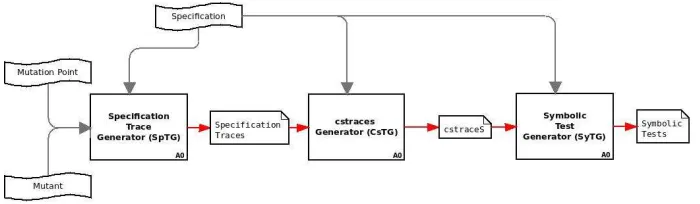
results, we propose an approach to generate tests to kill mutants. Finally, we explain how prototype tool support can be obtained with the implementation of a mutant gen-erator, a translator fromCircusto CSP, and a refinement checker for CSP, and with a
more sophisticated chain of tools that support the use of symbolic tests.
Results: We formally characterise mutation testing forCircus, defining the exhaustive
test sets that can kill a given mutant. We also provide a technique to select tests from these sets based on specification traces of the mutants. Finally, we present mutation operators that consider faults related to both reactive and data manipulation behaviour. Altogether, we define a new fault-based test-generation technique forCircus.
Conclusion: We conclude that mutation testing forCircuscan truly aid making test
generation from state-rich model more tractable, by focussing on particular faults.
Keywords: Circus, mutation, testing, formal specification
1. Introduction
mechanisms. For instance, Model-Based Testing (MBT) benefits greatly from a precise and clear semantics for models, as opposed to informal or semi-formal models whose
5
semantics is dependent on the particular tool in use.
Many advancements have been obtained with state-based models, such as Finite State Machines (FSMs) [1, 2, 3, 4, 5, 6, 7, 8, 9, 10] and Input/Output Transition Sys-tems (IOTSs) [11, 12, 13, 14, 15]. Those models, however, quickly become intractable when dealing with larger systems. Thus, more advanced formalisms are required to
10
facilitate the specification of large, state-rich, concurrent systems.
Circusis a state-rich process algebra combining Z [16], CSP [17], and a refinement
calculus [18]. Its denotational and operational semantics are based on the Unifying Theories of Programming (UTP) [19]. Circuscan be used to verify large concurrent
systems, including those that cannot be handled by model checking.Circushas already
15
been used to verify, for example, software in aerospace applications [20], and novel virtualization software by the US Naval Research Laboratory [21].
A theory of testing forCircus[22], instantiating Gaudel’s long-standing theory of
formal testing [23, 24, 25], is available. It is founded on theCircusoperational
se-mantics [26], described and justified in the UTP [27]. As usual in testing, it considers
20
divergence-free processes for the model and the system under test. More precisely, if a system under test diverges, since one cannot decide whether it is deadlocked or diver-gent, divergence is assimilated to an unspecified deadlock and detected as a failure.
TheCircustesting theory introduces potentially infinite (symbolic) exhaustive test
sets. To achieve practical usefulness, it is, therefore, mandatory to rely on selection
25
criteria both to generate and to select a finite set of tests.
Test-case generation in model-based testing is guided by testing requirements that should be met by a test suite. Usually, the requirements are either coverage criteria that state which elements of the model should be traversed (covered) by test execution, or fault models, which define specific faults that the test cases are supposed to reveal,
30
if present in the system. These approaches are usually complementary to each other. Coverage-based testing is proposed forCircusin [28]. It is worth investigating how
fault-based testing can complement the coverage testing.
Mutation testing is recognized as one of the most effective fault-detection tech-niques [29]. The systematic injection of feasible modeling faults into specifications
35
allows the prediction of potential defective implementations. The faults are seeded by syntactic changes that may affect the observable specified behavior. Such faulty models are “mutants”. A mutant is “killed” by a test case able to expose its observable behavior difference. Testing can benefit from mutation in two ways [30]: some quality aspects of a test set can be measured by the number of mutants it can kill, and the analysis of a
40
mutant model allows the selection of tests targeting specific faults or fault classes. In this paper, we introduce an approach to apply mutation testing toCircus
specifi-cations. Most of the presented mutation operators, that is, the fault-injection strategies, are based on previous works that have tackled similar challenges in related modeling languages [31, 32, 33]. The outcome of all mutation operators are, however, analyzed
45
considering the specific features and particularities ofCircus. Moreover, our results are
theory of testing. In particular, we face the challenge of associating mutations in the
50
text of aCircusspecification to traces of theCircusdenotational semantics that define
tests that cover the mutation. Even though mutation testing has already been applied to languages and theories upon whichCircusis based, such as CSP [31] and the UTP [36],
the consideration of a state-rich process algebra for refinement with a UTP semantics is novel. Second, we propose mutation operators forCircus, analysing and adapting
55
existing ones for the underlying languages and designing some that are specific to
Circus. Third, we describe prototype tool support for the application of the mutant
operators and two approaches to generate tests that can kill these mutants. When it is feasible to translate the consideredCircusspecification into CSP, we propose the use
of the FDR model checker. For the other cases, we identify a tool chain that copes
60
directly withCircusspecifications via slicing techniques and symbolic execution.
This paper is organized as follows. Section 2 gives an overview of the aspects of
Circusand its testing theory that we use here. Section 3 extends the testing theory
to consider mutation testing and describes our approach to generating tests based on mutants. The mutation operators used to generate the mutants themselves are defined
65
in Section 4. Tool support for automation of our approach is discussed in Section 5, and an extra complete example is introduced in Section 6. Finally, we present some related and future work and conclusions in Sections 7 and 8.
2. Circusand its testing theory
In this section, we give a brief description of theCircuslanguage, its operational
70
semantics [26], and its testing theory [22].
2.1. Circusnotation and operational semantics
As exemplified is Figure 1,Circusallows us to model systems and their
compo-nents via (a network of) interacting processes. In Figure 1, we define a single process Chronothat specifies the reactive behaviour of a chronometer. This is a process that
75
recognisestick events that mark the passage of time, a request to output the current time via a channeltime, and outputs minutes and seconds via a channelout.
ACircusspecification is defined by a sequence of paragraphs. Roughly speaking,
they define processes, but also channels, and any types and functions used in the pro-cess specifications. In Figure 1, we define a typeRANGE, including the valid values
80
for seconds and minutes, and the channelstick, time andout. The channelout is typed, since it is used to communicate the current minutes and seconds recorded in the chronometer as a pair. The final paragraph in Figure 1 definesChronoitself.
Each process has:
a state and some operations for observing and changing it in a Z style. InChrono, the
85
state is composed by a pairAStateof variables namedsecandminwith integer values between 0 and 59 (as defined byRANGE), and the data operations on this state are specified by the three schemasAInit,IncSec,IncMin.
actions that define communicating behaviours in a CSP style. The overall behaviour of a process is specified by the main action after the symbol•. In our example, it is a
RANGE==0. .59 channel tick,time
channel out:RANGE×RANGE
process Chronob=begin
state AState == [sec,min:RANGE]
AInit == [AState′|sec′=min′∧min′=0 ]
IncSec == [∆AState| sec′=(sec+1) mod 60∧min′=min]
IncMin == [∆AState| min′=(min+1) mod 60∧sec′=sec]
Runb= tick→IncSec; ((sec=0)NIncMin)
@
((sec,0)NSkip)
@
time→out!(min,sec)→Skip
•(AInit; (
µ
X •(Run; X))) endFigure 1: ACircusspecification of a chronometer
sequential composition of the schemaAInitfollowed by the repeated execution of theRunaction. TheCircusconstruct
µ
X •A(X) defines a recursive action A, in whichX is used for recursive calls.The initialisation schemaAInit defines the valuessec′ andmin′ of the state
com-ponents after the initialisation. These comcom-ponents are declared usingAState′. The
95
operation schemasIncSec andIncMin change the state, as indicated by the declara-tion∆AState. They also define valuessec′andmin′of the state components after the
operations. In each case, the seconds and minutes are incremented modulo 60. Runstarts with an external choice (@) between the eventstickandtime. If the en-vironment chooses the eventtick, this is followed by the increment of the chronometer
100
using the data operation IncSec. Afterwards, we have another choice between ac-tions guarded by the condiac-tionssec = 0 andsec , 0. If, after the increment, we havesec = 0, then the minutes are incremented using IncMin. Otherwise, the ac-tion terminates (Skip). If the eventtime occurs, then the values ofmin andsec are displayed (output), using the channelout, before termination.
105
Circuscomes with a denotational and an operational semantics, based on Hoare
and He’s Unifying Theories of Programming (UTP) [19], and a notion of refinement. We can useCircusto write abstract as well as more concrete specifications, or even
programs. A full account ofCircusand its denotational semantics is given in [37].
The operational semantics [26] plays an essential role on the definition of testing
110
strategies based onCircusspecifications. It is briefly introduced below, and a
con-c∧T ,∅ x<αs
(c|s|=d?x:T→A)d−→?w0(c∧w0∈T|s;var x:=w0|=let x•A)
c∧(s; g)
(c|s|=gNA)−→ǫ (c∧(s; g)|s|=A)
Figure 2: Examples of two transition rules: for inputs, and for guards
figurations and a label. The labels are either empty, represented byǫ, or symbolic
115
communications of the formc?worc!w, wherecis a channel name andwis a symbolic variable that represents an input (?) or an output (!) value.
The first componentcof a configuration (c|s|=A) is a constraint over symbolic variables that are used to define labels and the state. The constraints are texts that denoteCircus predicates over these symbolic variables. We use typewriter font for
120
pieces of text. For example,x:=w0is the text that describes an assignment of a value
represented by a symbolic variablew0to the variablex. On the other hand,x :=w0is
the predicative relation that defines the meaning ofx:=w0. The distinction is important
in the operational semantics, which manipulates pieces of text to define constraints. The second component s is a UTP predicate, which defines a total assignment
125
x:=wof symbolic variableswto all variablesxin scope, including the state compo-nents. State assignments, however, can also include declarations and undeclarations of variables using the constructsvar x :=eandend x. The state assignments define a value for all variables in scope. These values are represented by symbolic variables similarly to what is classically done in symbolic execution of programs [38].
130
Two examples of rules are given in Figure 2. The first rule defines the transitions arising from an input prefixingd?x:T→A; it is rule (A.3) of Appendix A. The label of the transition isd?w0, wherew0 is a symbolic variable. The constraint thatw0is of
the right type (w0 ∈ T) is added to the constraint of the new configuration. The state
of the new configuration is enriched, via the UTP sequence operator “; ”, by a new
135
componentx, which is assigned valuew0. The continuation of the new configuration
is the actionAin an environment enriched byxas defined bylet x•A.
The second rule of Figure 2 defines the transitions arising from a guarded action g &A. The label of such a transition is empty, since the evaluation ofgis not an observable event; gis added to the constraint of the new configuration taking into
140
account the assignments in the current states. The continuation isA.
Traces of a process are defined in the usual way, that is, as sequences of observ-able events. Due to the symbolic nature of configurations and labels, however, we can obtain from the operational semanticsconstrained symbolic traces, or cstraces, for short. These are pairs formed by a sequence of labels, that is, a symbolic trace,
145
cst1 :(hticki,true)
cst2 :(htime,out!α0!α1i, α0=0∧α1=0)
cst3 :(htick,time,out!α0!α1i, α0 =0∧α1=1)
cst4 :(hticki60,true)
cst5 :(hticki60ahtime,out!α0!α1i, α0=1∧α1=0)
Figure 3: Some constrained symbolic traces forChrono
variables used in the labels. Figure 3 gives some examples of cstraces ofChrono. A trace is an instantiation of a cstrace, where the symbolic variables used in the
150
labels are replaced by values satisfying the constraint. For instance, the two traces
htime,out!0!0iandhtick,time,out!0!1iare instances ofcst2 andcst3.
2.2. Testing inCircus
Gaudel’s long-standing testing theory [23] has been instantiated forCircusin [22].
The conformance relation considered in that work is process refinement: the UTP
no-155
tion of refinement applied to state-rich processes.
As previously explained, theCircustesting theory takes the view that, in
specifica-tions, divergences are mistakes. In addition, since in a system under test (SUT), they are observed as deadlocks, altogether the results in [22] consider divergence-free spec-ifications and SUT. For divergence-free models, theCircusrefinement relation can be
160
characterized by the conjunction of traces-refinement and the well knownconf rela-tion, as defined in [39], that requires reduction of deadlocks. This is proved in [40].
Accordingly, [22] defines separate exhaustive test sets for traces refinement and conf, namelyExhaustT(SP) andExhaustconf(SP), which we briefly present here.
A test for traces refinement is constructed by considering a trace of the Circus
165
specification and one of the events that cannot be used to extend that trace to obtain a new trace of theCircusspecification [41]. Such events are called the forbidden
con-tinuations of the trace. For a specificationSP, the exhaustive test setExhaustT(SP) includes all the tests formed by considering all the traces and all their forbidden con-tinuations and inserting some special verdict events, as explained below.
170
For a finite traces =ha1,a2, . . . ,aniand an event (forbidden continuation)a, we define the test processTT(s,a) as follows:
TT(s,a)=inc→a1→inc→a2→inc. . .an →pass→a→fail→STOP
Extra special eventsinc,passandfailare used to indicate a verdict. In the execution of a testing experiment, the test is run in parallel with the SUT and the last special event observed in a testing experiment provides the verdict. Due the possibility of
nondeter-175
minism, the submitted trace of theCircusspecification is not necessarily performed by
Example 1. For instance, a possible test ofChrono, based on the tracehtick,timei
180
and the forbidden continuationout.0.0is:
inc→tick→inc→time→pass→out.0.0→fail→Stop
This leads to the following definition of the exhaustive test set for traces refinement:
ExhaustT(SP)={TT(s,a)|s∈traces(SP)∧sahai<traces(SP)}
The exhaustivity, that is, the equivalence of traces refinement to the absence offail verdict when running all the tests ofExhaustT(SP), is proved in [41] and [22] under
185
– as usual in theoretical approaches to testing in the presence of nondeterminism –
thecomplete testing assumption[42]: when a test experiment is performed a sufficient
number of times all possible (nondeterministic) behaviours of the SUT are observed. Traces and forbidden continuations are characterised symbolically leading to the definition ofSExhaustT(SP), an exhaustive set of symbolic tests based on cstraces
190
and constrained symbolic forbidden continuations.
Example 2. An example of such a symbolic test forChrono, based on the cstrace
(htick,timei,true) and the forbidden constrained symbolic continuation defined as
out.α0.α1: (¬(α0=0∧α1=1))is as follows:
inc→tick :true→inc→time:true→pass
→out.α0.α1: (¬(α0 =0∧α1=1))→fail→Stop
195
In [22] it is proved thatExhaustT(SP) corresponds to all the tests that are valid in-stances (that is, that satisfy the constraints) of some symbolic test inSExhaustT(SP). Theconf relation captures reduction of deadlock. GivenSP1 andSP2, we have
thatSP1conf SP2if, and only if, wheneverSP2engages in a sequence of events, that
is, a trace that can be accepted bySP1as well, thenSP2can only deadlock ifSP1may
200
as well. Formally,conf can be defined as follows:
SP2conf SP1b=∀t :traces(SP1)∩traces(SP2)•Ref(SP2,t)⊆Ref(SP1,t)
whereRef(SP,t)b={X |(t,X)∈failures(SP)}
For a tracet of a processP and a subsetX = {a1, . . . ,an}of the set of events ofP, notedαP, the pair (t,X) belongs tofailures(P) if, and only if, after performingt, P may refuse all events ofX. In other words, the parallel composition below may deadlock just aftert. We useproc(t) to represent aCircusprocess that accepts just the
execution oftbefore finishing; it can be defined using prefixing, for example.
PJαPK(proc(t); (a1→P1@. . .@an →Pn))
Thus, given a system under testSUT and a specificationSP, forSUT conf SPto hold, the definition requires that, after performing every one of their common traces,
205
the failures ofSUT are failures ofSP. Consequently, after a trace t ofSP, SUT may refuse all events refused bySPor accept some of them. Testing forconf based on the refusals ofSPwould be, therefore, useless. What must be tested is that, after every tracet of SP, SUT cannot refuse all events in a set X of events such that (t,X)<failures(SP). Such sets of events are calledacceptance setsofSPaftert.
210
Thus, tests for conf are based on traces and acceptance sets. For a finite trace s =ha1,a2, . . . ,aniand a(n acceptance) setX ={x1, . . . ,xm}of events, we define the
Circustest processTF(s,X) as shown below.
TF(s,X)= inc→a1→inc→a2→inc. . .an →fail
→(x1→pass→Stop@. . .@xm →pass→Stop)
Example 3. An example of such a test forChrono, based on tracehtickiand on the
215
acceptance set{tick,time}is:
TF(hticki,{tick,time})= inc→tick →fail
→(tick →pass →Stop@time→pass→Stop)
An exhaustive test set of a specificationSP for conf is made of all tests formed by considering all traces ofSP, and all the acceptance sets after each of them:
{TF(t,X)|t ∈traces(SP)∧(t,X)<failures(SP)}
ActuallyExhaustconf(SP) is defined as a subset of the set above where only minimal
220
acceptance sets are considered, since as soon as some event in a setX is accepted after a trace, any set containingX is an acceptance set after this trace. For instance, the test in Example 3 is not inExhaustconf(Chrono), but the two tests below are:
TF(hticki,{tick})=inc→tick →fail →(tick →pass→Stop) TF(hticki,{time})=inc→tick →fail→(time→pass →Stop)
The symbolic counterpart ofExhaustconf(SP) isSExhaustconf(SP), defined in [22]. SExhaustT(SP) andSExhaustconf(SP) provide bases for defining strategies for
225
test selection as definitions of subsets of ExhaustT(SP) and Exhaustconf(SP) via uniformity or regularity hypotheses [23] and adequate instantiations [22], or coverage criteria of the specification [28]. This paper addresses fault-based selection techniques. TheCircustesting theory for traces refinement can be seen as a fault-based testing
approach, because tests are constructed from (minimal) invalid traces. The fault
consid-230
ered in a particular test is very specific: a single forbidden continuation; the exhaustive test set considers all such possible faults. The theory forconf testing considers other specific faults, namely refusals of the SUT that are not specified.
A practical question regards the use of more elaborated fault models. This is studied in the next section, and mutation operators are presented in Section 4.
3. Mutation testing inCircus
We assume that there is a specification (model), which is aCircusprocess that
de-scribes what the implementation should do. Amutantis also aCircusprocess,
some-how related to the original specification; it represents a fault in that specification. In what follows, we may also refer to mutants asfaulty models. In general, given a mutant
240
defined as aCircusprocess, it can be used to generate tests to identify the fault it
rep-resents, that is, to “kill the mutant”. We apply the approach in [36] by Aichernig at al. for mutation testing based on refinement, but consider the particular case of state-rich process algebraic models, andCircusin particular.
A mutantFM isof interestif there exists at least one test that can kill it. This is not
245
the case if it is a refinement of the specification. This is the counterpart at the model level of the well known problem of equivalent mutants at the program level. In such a case, the mutant is not a faulty model and so not relevant.
In Section 3.1 we formalise mutation testing when traces refinement is the confor-mance relation of interest. Section 3.2 presents an example: a mutant and the tests they
250
generate. Section 3.3 considers mutation when testing against theconf conformance relation. Finally, in Section 3.4, we introduce a new kind of trace, closer to the text of the specification, to relate tests and mutation points in the specification.
3.1. Killing faulty models against traces refinement
In the context of traces refinement, we consider a faulty modelFM to be of interest
255
if it is not a traces refinement of the specification modelSP. In this case, there is at least one trace ofFM that is not a trace ofSP; this is not the empty tracehi, because
hiis a trace of all processes. To detect the fault inFM, we can use a testTT(s,a) characterised by any of the minimal tracessahai of FM that are not traces ofS. Formally, we define the setFBTestsSP
T (FM) of fault-based tests characterised byFM
260
with respect to a specificationSPas shown below.
Definition 1.
FBTestsSP
T (FM)=
{s:traces(SP); a:Σ|sahai ∈traces(FM)\traces(SP)•TT(s,a)}
This is the set of all testsTT(s,a), formed from tracess ofSP and eventsa from Σsuch that s ahai is a trace of FM, but not of SP. A mutant FM is killed by any test fromFBTestsSP
T (FM). As a direct consequence of its definition, we have that FBTestsSP
T (FM) is a subset ofExhaustT(SP), since it contains testsTT(s,a), where
265
s∈traces(SP) andsahai<traces(SP).
Before generating tests based on a mutantFM, a first step is the confirmation that it is not a traces refinement of the modelSP. For that, it is of value to use a refinement model checker, like FDR [43] for CSP, for example, to checkSP ⊑T FM. If this does not hold, FDR provides a counterexample: a minimal trace ofFM that is not a trace of
270
process MutatedChronob=
...
Runb= (tick→IncSec; (¬(sec=0)NIncMin)
@((sec,0)NSkip)))
@(time→out!(min,sec)→Skip)
•(AInit; (
µ
X •(Run; X)))...
Figure 4: a mutated chronometer
3.2. A first mutant ofChronoand some tests that kill it
Figure 2 presents the mutantMutatedChrono of the Chrono process, which is obtained by the introduction of the negation (¬) operator in the first guard of the ac-tionRun. The following change in behavior arises from this mutation: likeChrono,
275
MutatedChronostarts with theAInitoperation that initialisesmin andsecto 0 and, after atick,IncSec increases the value ofsec to 1; afterwards, however, the mutant behaves nondeterministically, either likeChrono, that is, executingSkipand thenRun again, or performingIncMin and thenRun again, likeChronoin the casesec =0. This erroneously leads to a state wheremin =1 andsec =1. This mutated state can
280
be later observed via an output on the channeloutfollowing atimeevent.
Thushtick,time,out!(1,1)iis a trace ofMutatedChrono, but not ofChrono, for which the only accepted event after htick,timei is out!(0,1). As seen above such traces define tests that kill the mutant. An example is the test below:
inc→tick→inc→time→pass→out!(1,1)→fail→Stop
It is a member ofFBTestsChrono
T (MutatedChrono).
Actually, this testmaykill the mutant since it is nondeterministic due to the overlap of the guards in the choice operator (for the distinction between “may kill” and “must kill”, see [44]). The test kills the mutant under the complete testing assumption.
285
3.3. Killing faulty models against theconf conformance relation
Given a mutantFM, it is of interest if¬(FM conf SP). In this case, there is at least one common traces of SPandFM for which¬(Ref(FM,s) ⊆Ref(SP,s)). Therefore, according to the definition ofRef(P,s), there is at least one set of events X such that (s,X)∈failures(FM), but (s,X)<failures(SP).
290
The detection of the fault specified inFM with respect toconf is based on tests TF(s,X) characterized by (s,X)∈failures(FM), where (s,X)<failures(SP), and s is a traces of SPandFM. The full setFBTestsSP
Definition 2.
FBTestsSP
F (FM)=
{s :traces(SP)∩traces(FM); X :PΣ|
(s,X)∈failures(FM)\failures(SP)•TF(s,X)}
As a direct consequence of the above definition, we have thatFBTestsFSP(FM) is a
295
subset ofExhaustconf(SP), since it contains testsTF(s,X), where s ∈ traces(SP) and (s,X)<failures(SP). In words,X is an acceptance set ofSPafters.
Theorem 1. For every mutantFM of a specificationSP, the following statements are equivalent:
1. FM is of interest; and
300
2. FBTestsSP
T (FM),∅∨FBTests SP
F (FM),∅.
Proof. IfFM is of interest, it is not a refinement ofSP, that is, either it is not a traces
refinement ofSP, or it does not satisfyFM conf SP.
In the first case, as shown in [22], there exists someT ∈ExhaustT(SP) such that its execution againstFM yields afail verdict. By definition ofExhaustT(SP), there
305
aresanda, such thatT =TT(s,a) ands ∈traces(SP)∧sahai<traces(SP). From the definition ofTT(s,a), since thefailevent is reached,sahaiis a trace ofFM. Thus, from Definition 1,Tbelongs toFBTestsSP
T (FM), and soFBTests SP
T (FM),∅. With a similar argument, the second case impliesFBTestsSP
F (FM),∅. Conversely, if FBTestsSP
T (FM) , ∅, there exists some T = TT(s,a), where
310
s∈traces(SP) andsahai ∈traces(FM)\traces(SP).T belongs toExhaustT(SP) and by construction yields afailverdict when executed againstFM. Therefore, from the exhaustivity result of [22],FM is not a traces refinement ofSP.
The proof thatFBTestsSP
F (FM),∅implies that¬FM conf SPis similar.
In Theorem 1, we formalise the previously introduced notion of mutants of interest: a
315
mutant is of interest if its fault can be exposed by, at least, a test.
Example 4. Coming back toMutatedChrono, another change of behavior is that it introduces a deadlock. When the mutated external choice is reached in a state where
sec=0, because all the possible choices are guarded by the negation of this condition,
there is a deadlock. Due to the equationsec′=(sec+1)mod60in theIncSecschema,
320
it occurs after sixtytickevents. After such a trace,Chronomust accept one moretick
event, or onetimeevent, but the mutated specification refuses both. This leads to the
following tests, each of them killing the mutant under the complete testing assumption.
(inc→tick)60→fail→tick→pass→Stop
(inc→tick)60→fail→time→pass→Stop
We use(inc→tick)60to denote a prefixing action where the eventsincandtick are
offered in alternation, starting withinc, 60 times.
When generating tests based on given a mutantFM, a first step is the confirmation that it is a traces refinement, but not a failures refinement of SP. If we can use a refinement model checker, we can checkSP ⊑T FM, and then use the counterexample forSP⊑F FM. In the case of FDR, for example, the counterexample is a minimal set of acceptances ofFM that is not a set of acceptances ofSP. Alternatively, it gives a
330
set of refusals ofFM that is not a set of refusals ofSP. It is this set of refusals that can be directly used to define a test to detect the fault specified inFM.
In our framework, a set of mutantsM ofSPdefines a set
TM
T b={M •FBTests SP T (M)}
of subsets ofExhaustT(SP) and a set
TFM b={M •FBTestsFSP(FM)}
of subsets ofExhaustconf(SP). Therefore,M is the basis of a test selection method
335
in the sense of [22]. Besides, given a test suiteT, it is adequate forM if, for each m ∈M,T∩FBTestsSP
T (m),∅orT∩FBTests SP
F (m),∅. From Lemma 1, we know that for a setM of mutants of interest, there is always an adequate test suite.
3.4. Specification traces and mutation points
Mutations are related to the text of a specification. Traces and even constrained
340
symbolic traces, however, are not related to the text of the specification. They record a possible history of interactions, and it may well be the case that, in some specific situations, we can relate interactions to events and communications in the text of spec-ification. On the other hand, but there is no record of guards and data operations that may have been evaluated or executed in the path to that interaction.
345
As an example, we consider the constrained symbolic tracecst3 in Figure 3. Since there is only one communication viaoutin the text ofChrono, in this special case, we can relateout!α0!α1 to the anti-penultimate line of its definition. On the other hand,
cst3 has no record ofAInitandIncSec, and of the guardssec=0 andsec,0, which are considered in the path to that interaction and may be the object of a mutation.
350
Therefore, we use specification traces, as defined in [45, 28], to build the tests aimed at killing a mutant. In [28], specification traces are used to consider data-flow coverage, which is also based on the text of a specification. While cstraces are useful for trace selection based on constraints on the traces, they do not support selection based on the text of the specification, as we explain in the sequel.
355
In specification traces, labels are pieces of the specification: guards (predicates), communications, data operations (schemas) or simpleCircus actions. In case there
are repetitions of identical text pieces in theCircusspecification, different occurrences
are distinguished in the labels using textual tags. The syntactic category ofLabels is defined in Figure 5; the setsPred,Exp,CName,VName, andSchemaare those of
360
theCircuspredicates, expressions, channel and variable names, and Z schemas [46].
In Figure 6, we present two rules of the transition system that characterises specifi-cation traces. These transition rules correspond to those for the operational semantics shown in Figure 2. We note that, the same notion of configuration is used and the tran-sitions are the same, except for the labels. For instance, for an input, the labeld?w0
Label ::= Pred |Comm|LAct
Comm ::= ǫ|CName|CName!Exp|CName?VName
|CName?VName:Pred LAct ::= VName∗: [Pred,Pred
]|Schema|VName:=Exp
|varVName:Exp|varVName:=Exp|endVName
Figure 5: Syntax of specification labels.
c∧T ,∅ x<αs
(c|s|=d?x:T→A)=d⇒?x(c∧w0∈T|s; var x:=w0|=let x•A)
(1)
c∧(s; g)
(c|s|=gNA)=⇒gP(c∧(s;g)|s|=A)
(2)
Figure 6: Transition rules that define specification traces
in the operational semantics uses a symbolic variable w0, while in the specification
traces it refers to the variablexused in the specification. Moreover, the transition for a guarded actiongNAis no longer unlabelled, but records the guardg.
In Figures 7 and 8, we list some specification traces for the processesChronoand MutatedChrono. The use of text pieces from the specifications in labels allows the
370
identification and selection of traces that reach textual constructs affected by mutation.
Remark. In [28], a subset of specification traces,sptraces, is considered for the
def-inition of tests satisfying data-flow coverage criteria, namely, the set of specification traces where the last event is an observable event. Some of the specification traces given in Figures 7 and 8 are not sptraces. It is the case ofspect1 andspect′
1, and of
375
all the traces inSetspect′
5. The specification traces in this last set, for example, are of great interest since they lead to a deadlock that is not in the original specification, and thus provide bases for obtaining tests ofFBTestsChrono
F (MutatedChrono).
Converting a specification trace to a cstrace requires the definition of an operational
380
semantics for labels. Figure 9 presents its transition rules for input and guard labels. We refer to Figure 2 for the corresponding rules of the operational semantics. Like in the operational semantics, the configuration is a triple, but here, instead of a process or action, there is a label associated with a constraint and a state assignment. Labels with no guard, but with an input or output communication, are handled in the same way as
385
spect1 :hAInit,tick,IncSec,(sec,0)i
spect2 :hAInit,time,out!min!seci
spect3 :hAInit,tick,IncSec,(sec,0),time,out!min!seci
spect4 :hAInitiahtick,IncSec,(sec,0)i59ahtick,IncSec,(sec=0),IncMini
spect5 :hAInitiahtick,IncSec,(sec,0)i59a
htick,IncSec,(sec=0),IncMin,time,out!min!seci
Figure 7: Some specification traces forChrono
spect′
1 :hAInit,tick,IncSec,¬(sec=0),IncMini
spect′
2 :hAInit,time,out!min!seci
spect′
3 :hAInit,tick,IncSec,(sec,0),time,out!min!seci
spect′
4 :hAInit,tick,IncSec,¬(sec=0),IncMin,time,out!min!seci
Setspect′5 :hAInit,tick,IncSecia
(h¬
(sec=0),IncMin,tick,IncSeci | h(sec,0),tick,IncSeci)59[deadlock]
Figure 8: Some specification traces forMutatedChrono
transition is unlabelled, like in the operational semantics.
The similarity between the operational semantics of labels and of Circus is not
390
surprising. Conversion of specification traces (of labels) to a cstrace recovers the oper-ational semantics of theCircustexts captured in the specification traces.
In Figures 3 and 10 we give the constrained symbolic traces converted from those specification traces listed in Figures 7 and 8. The tracecst′4 is that used in Section 3.2
as a basis for the first test that killsMutatedChrono. The trace cst′
5 is the unique
395
translation of all the traces inSetspect′
5; it is the basis of the two other killer tests given in Section 3.2. The conversion procedure of sptraces into cstraces is given in [28] and trivially generalises to specification traces. As seen above, several specification traces may correspond to the same cstrace. This follows from the fact that cstraces record only observable symbolic events, while specification traces record internal events and
400
may distinguish different ways of enchaining the same observable events.
To summarise, in considering mutation testing in Circus we use three kinds of
traces: specification traces, cstraces, and standard traces. We perform the selection among specification traces and then generate from those some killer tests belonging toFBTestsSP
T (FM) andFBTests SP
F (FM), which are defined as sets of concrete tests
405
speci-c∧(s; g)
(c|s|=(g,e,A))−→ǫ (c∧(s; g)|s|=(e,A))
c∧T ,∅
[image:16.612.190.438.127.174.2](c|s|=(d?x:T,A))−→d?w0 (c∧w0∈T)|s; var x:=w0|=let x•A)
Figure 9: Operational semantics of labels
cst′1 :(hticki,true)
cst′2 :(htime,out!α0!α1i, α0=0∧α1=0)
cst′
3 :(htick,time,out!α0!α1i, α0=0∧α1=1)
cst′4 :(htick,time,out!α0!α1i, α0=1∧α1=1)
cst′
5 :(hticki60,true) [deadlock]
Figure 10: Constrained symbolic traces forMutatedChrono
fication as cstraces, there is an intermediate form of the tests based on cstraces, that is, symbolic killer tests, that need to be adequately instantiated into some concrete tests.
We must take into account that a specification trace corresponds to one cstrace, but that several specification traces may correspond to the same cstrace, as seen above, and
410
that a specification trace ofFM that is not a specification trace ofSP may lead to a cstrace that is the translation of another specification trace ofSP. Given a mutantFM ofSP, we define a notion of relevant specification trace ofFM.
Definition 3. Given a specificationSPand a faulty modelFM obtained by mutation ofSP, a specification trace ofFM isrelevantif:
415
• it is not a specification trace ofSP and its conversion into a cstrace is not a cstrace ofSP, or
• one of the instantiations of its conversion into a cstrace is part of some failure of FM that is not a failure ofSP.
The first case is the starting point for obtaining some tests inFBTestsSP
T (FM) and the
420
second case for some tests inFBTestsSP F (FM).
To determine whether a specification trace ofFM is relevant, we need to compare its cstrace to those ofSP. We note that in theCircustesting theory, we use unique (up
to predicate equivalence) symbolic representatives of these traces using a fixed ordered alphabet of symbolic variables. That allows a uniform account of these traces, and
425
simplifies the management of names by avoiding renaming complications.
The existence of non-relevant mutated specification traces is due to the possibility
430
of specifying systems in an abstract way, with hidden operations on some state: the con-sequences of a mutation of such operations may not be observable. This phenomenon is not specific toCircusand similar issues are likely to occur in model-based mutation
testing as soon as there is a significant abstraction gap between the model and the SUT. It is very likely that some mutations affecting the hidden state can be identified as
435
prone to producing non-relevant specification traces, and then avoided in a particular test-selection heuristic. These points are the subject of future work.
In conclusion, given a mutation of aCircusspecification, the principle of the
test-generation process that we propose is as follows:
1. Select a specification tracespectofFM that reaches the mutation point;
440
2. Convert it into its corresponding cstracecst; 3. Check whethercstis a cstrace ofSP;
4. If not, instantiatecst into a concrete trace and build the corresponding tests of FBTestsSP
T (FM) as defined in Section 3.1;
5. Check whether some instantiations ofcst leads to failures that are not failures
445
ofSPand build the corresponding tests ofFBTestsFSP(FM), as defined in Sec-tion 3.3.
We discuss in Section 5 some tools to support this process. First, in the next section, we present operators to produce mutants.
4. Mutation operators
450
A mutation operatorOp is a function that generates a set of mutants for a given specificationSP. In each mutant inOp(SP), one fault is inserted. Such an operator only yields well-typed, syntactically correct, mutants. A mutation operator isvalidfor a specification, if it generates at least one mutant of interest.
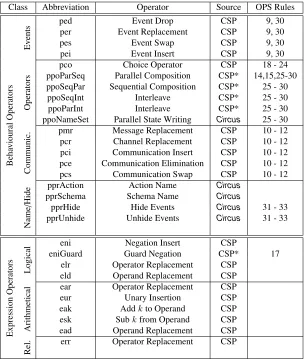
In this section, we present a list of mutation operators for Circus. Many of the
455
mutation operators of CSP presented in [31] by Srivatanakul et al. are directly appli-cable toCircus. These are discussed in Section 4.1. For the data and state aspects of Circus, we can benefit from some mutation operators based on fault classes for
predi-cates, like those presented by Kuhn in [32] and enriched by Black et al. in [33]. These are discussed in Section 4.2. We need to take into consideration, however, the specific
460
features and particularities of our target language,Circus.
4.1. Modification of behavioural operators
Three classes of mutation operators are suggested for CSP in [31]: process defi-nition, expression, and parameter modification operators. Each operator from the first two classes is considered in this section, and we introduce some variations better suited
465
toCircusmodels. When adequate, we refer to the rules of theCircusoperational
se-mantics that formalise the affected behaviors.
Parameters are not as important inCircusas they are in CSP. SinceCircusprocesses
Class Abbreviation Operator Source OPS Rules
Beha
vioural
Operators
Ev
ents
ped Event Drop CSP 9, 30
per Event Replacement CSP 9, 30
pes Event Swap CSP 9, 30
pei Event Insert CSP 9, 30
Operators
pco Choice Operator CSP 18 - 24
ppoParSeq Parallel Composition CSP* 14,15,25-30
ppoSeqPar Sequential Composition CSP* 25 - 30
ppoSeqInt Interleave CSP* 25 - 30
ppoParInt Interleave CSP* 25 - 30
ppoNameSet Parallel State Writing Circus 25 - 30
Communic.
pmr Message Replacement CSP 10 - 12
pcr Channel Replacement CSP 10 - 12
pci Communication Insert CSP 10 - 12
pce Communication Elimination CSP 10 - 12
pcs Communication Swap CSP 10 - 12
Name
/
Hide
pprAction Action Name Circus
pprSchema Schema Name Circus
pprHide Hide Events Circus 31 - 33
pprUnhide Unhide Events Circus 31 - 33
Expression
Operators
Logical
eni Negation Insert CSP
eniGuard Guard Negation CSP* 17
elr Operator Replacement CSP
eld Operand Replacement CSP
Arithmetical
ear Operator Replacement CSP
eur Unary Insertion CSP
eak Addkto Operand CSP
esk Subkfrom Operand CSP
ead Operand Replacement CSP
Rel.
[image:18.612.154.461.123.482.2]err Operator Replacement CSP
Table 1: Mutation operators forCircus
case, parameters play the role of global constants in the scope of the process definition.
470
We, therefore, do no consider parameter operators here.
Following the terminology in [31], synchronization events, that is, communications without value passing, are called simply “events”. When values are passed, we refer to the events as “communications”. Table 1 lists the operators presented in this section, identifying their classification, abbreviation, name, source and, when available in
Ap-475
pendix A, the associated operational semantics rules. The source column displays CSP for operators originally proposed for CSP, CSP∗ for operators adapted from CSP to
matchCircusconstructs, andCircusfor operators designed specifically forCircus.
We describe the operators as functions from texts (of actions) to texts, and identify conditions in which they can or cannot be applied. A mutated process is obtained by
480
process ChronoEDropTimeb=
...
Runb= (tick→IncSec; ((sec=0)NIncMin)
@((sec,0)NSkip)))
@(out!(min,sec)→Skip)
•(AInit; (
µ
X •(Run; X)))...
Figure 11: Mutation ofChronoafter droppingtime
In the sequel, we present mutations of events and communications, choice and concurrency operators, name references, and hiding.
4.1.1. Mutations of events
Event Drop. (ped) removes one (arbitrary) occurrence of a prefixing event. Such
muta-485
tion is likely to produce processes that are not a refinement of the original specification in two ways: the removal of observable events from some traces and the possibility of deadlock introduction in parallel compositions. This can be checked in the rules (A.2) and (A.6) of theCircusoperational semantics, reproduced in Appendix A, where
out-put and parallelism are described. The definition of thepedoperator is as follows.
490
ped(A[e→])=A[ ]
Remark. We useA[t1] to indicate that in the text of actionAthere is an occurrence
of termt1. There may be several such occurrences and we assume that we can
dis-tinguish them (via their position in the text, for example). A[t1] refers to a particular
occurrence. A subsequent reference toA[t2] denotes the action obtained by replacing
the occurrence oft1 originally singled out byt2. In particular,A[ ] as used above
de-495
notes the text ofAwith this occurrence replaced by an empty term.
In using the above operator and others to follow, the terms singled out in the action parameter, likee→inA[e→] above, for example, need to be chosen.
Example 5. Figures 11 and 12 show the mutants of theChronoprocess obtained via
500
the mutations: ped(Chrono[time→])and ped(Chrono[tick→]), which remove the
occurrences of the synchronization eventstimeandtickfrom theRunaction. Among
the traces ofChronoEDropTimethat are not traces ofChrono, there arehout!(0,0)i
andhtick,out!(0,1)i, which lead to the tests below:
pass→out!(0,0)→fail→Stop
inc→tick→pass→out!(0,1)→fail→Stop
They are members ofFBTestsChrono
T (ChronoEDropTime).
process ChronoEDropTickb=
...
Runb= (IncSec; ((sec=0)NIncMin)
@((sec,0)NSkip)))
@(time→out!(min,sec)→Skip)
•(AInit; (
µ
X •(Run; X)))...
Figure 12: Mutation ofChronoafter droppingtick
ChronoEDropTick is an example of a divergent mutant, sinceRun may recurse
indefinitely in an endless series of internal actionsIncSecandIncMin. without ever
communicating with the environment. Thus, it is discarded.
Event Replacement. (per) replaces an event by another one within the current local
510
scope (action) or the global scope (process). It affects traces in similar ways as theped operator, as described by the same rules of the operational semantics.
per(A[e→],f)=A[f→]
Event Swap. (pes) swaps two consecutive synchronization events in an action
defi-nition. If we apply it only to distinct events, this operator is prone to yielding mu-tants of interest, although this cannot be assured. For example, swappingaandbin
515
a→b→STOP@b→a→STOPleads to a traces refinement. The behavior is defined by the same rules (A.2) and (A.6) of theCircusoperational semantics.
pes(A[e→f→])=A[f→e→]wheree,f
Event Insert. (pei) inserts an event by duplication. The mutated action may not be of
interest if the duplication occurs inside a loop.
pei(A[e→])=A[e→e→]
This concludes our list of event mutation operators.
520
4.1.2. Mutations of choice and concurrency operators
The following operators target choice and concurrency operators.
Choice Operator. (pco) replaces the external choice by the internal choice operator.
From rules (A.4) and (A.8) to (A.11) of the operational semantics, we observe that such mutation may introduce deadlocks. The traces of the original and mutated actions
525
are the same, so we always have a traces refinement. Therefore, the only error that may be introduced by such a mutation is a forbidden deadlock.
pco(A[@])=A[⊓]
is refined byA@B, whether we consider traces or failures refinement.
Parallelism and sequence. (ppo) In [31], this operator can be used to replace an
inter-530
leaving, a parallel or a sequential composition with each other. ForCircus, we need to
consider manipulation of state values in concurrent actions. We, therefore, distinguish the possible mutations for each type of composition.
Parallel composition of actions requires the explicit specification of which variables are available for writing by each concurrent action. For instance, in theCircusparallel
535
compositionAJNSa |CS|NSbKBvalues written byAinto the state variables are only
kept for the variables with names in the name setNSa. The same holds for the action Band the name setNSb. These sets must be disjoint. Any change of value not match-ing a name in the respective specified set is cancelled after the parallel composition ends (see rules (A.5) to (A.7) of the operational semantics). There are several
inter-540
esting possibilities for injecting faults in parallel composition operators. For instance, to empty one or both name sets in a parallel composition is likely to yield unexpected state configurations and is defined by the following operation.
ppoNameSet(A[NS])=A[{}]
NSrefers to a name set in a parallel composition. Removing or inserting arbitrary elements inNSand other variations of this operator might also be of interest, provided
545
the disjointness of the sets on both sides of the composition is preserved.
We define some specific operators for mutating the nature of the compositions. Such mutations are likely to cause substantial observable changes, although there is no guarantee that the result is a mutant of interest. Specific operators for changing parallel to sequential and the inverse are defined as follows.
ppoParSeq(A[BJNSb|CS|NScKC])=A[B; C]
ppoSeqPar(A[; ],CS)=A[JCSK]
The new sequential composition introduced byppoParSeqignores the extra parame-ters of the original parallel composition, that is,NSa,CS, andNSb, and the new parallel
composition introduced byppoSeqParis designed to synchronize on all channels in a given setCSand has no write access to any state values. We also define operators for mutating any composition into an interleaving.
ppoParInt(A[JCSK])=A[9] ppoSeqInt(A[; ])=A[9]
Other forms of parallelism may be considered as well, but we do not pursue these here. The needed considerations in all cases are similar to those above.
4.1.3. Mutations of communications
The following mutation operators target communications, whose behaviours are
550
described in rules (A.2) and (A.3). For the sake of conciseness, we do not discuss communications with multiple inputs or outputs.
used, we may end up with references to variables that are not declared. For mutation
555
operators that change or remove input communications, we, therefore, introduce a dec-laration of the replaced or removed variable. ACircusvariable declaration introduces
the variable in scope initialised with an arbitrary value from the variable domain.
Message Replacement. (pmr) changes the name of a variable used in a communication
to another name of a variable of the same type, selected from the current scope. As explained above, missing variable names due to the introduced mutation are redeclared.
pmr(A[c!e[x]→],y)=A[c!e[y]→] pmr(A[c?x→],y)=A[var x:T•c?y→]
Tis the type of channelc(and, therefore, of the input variablex).
Channel Replacement. (pcr) changes the name of a communication channel to another
channel name of the same type.
pcr(A[c!e→],d)=A[d!e→] pcr(A[c?x→],d)=A[d?x→]
Communication Insert. (pci) is similar to the event insert (pei) operator, but applied to
a communication instead of a synchronization event. It inserts a new communication by duplicating an existing one.
pci(A[c!e→])=A[c!e→c!e→] pci(A[c?x→])=A[c?x→c?x→]
Communication Elimination. (pce) removes one arbitrary input or output
communi-560
cation from an action definition. As for the message replacement (pmr) operator, if the eliminated communication is an input, a variable declaration must be introduced to declare the input variable and avoid syntactic errors.
pce(A[c?x→])=A[var x:T•] pce(A[c!e→])=A[ ]
If the mutated action terminates or deadlocks, it has maximal traces. If the eliminated communication contributes only to the last events of maximal traces, its elimination
565
leads to an action that is a traces refinement of the original action.
Communication Swap. (pcs) swaps two consecutive communication events, similarly
to the event swap (pes) operator.
pcs(A[c1!e1→c2!e2→])=A[c2!e2→c1!e1→]
pcs(A[c1!e→c2?x→])=A[c2?x→c1!e→], providedxis not free ine pcs(A[c1?x→c2?y→])=A[c2?y→c1?x→]
pcs(A[c1?x→c2!e→])=A[var x:T•c2!e→c1?x→]
When swappingc1 andc2 wherec1 is used in an input that declares a variable that may be used in an expression communicated byc2, this change leads to a syntactic
570
4.1.4. Mutations of name references and hiding
Name Replacement. (ppr) substitutes name references in the right hand side of an
action definition by other process names in scope, includingSTOP andSKIP. For
Circus, we expand this operator to include the manipulation of schema names.
575
pprAction(A[A1],A2)=A[A2] pprSchema(A[S1],S2)=A[S2]
We also introduce two new operators for hiding and unhiding events and communi-cations. The impact of such mutations on observable behavior is similar to event and communication insertion or removal. The channel set for the hiding is an arbitrary sub-set of the channels in scope. The operational semantics rules describing the behavior of the hiding operator are (A.12) and (A.13).
pprHide(A1[A2],CS)=A1[A2
\
CS] pprUnhide(A1[A2\
CS])=A1[A2]Similar operators for hiding are also useful at the action level.
4.2. Expression modification operators
In Circus specifications, some logical and data aspects are modelled along with
the definitions of interactions via events. For instance, models typically include guard predicates, variable definitions and assignments, and also data operations defined using
580
Z schemas. We consider all these forms of data modelling in the design of mutation operators that capture data and logic faults.
Some fault classes for predicates occurring in software specifications have been proposed by Kuhn in [32]. They seem pertinent if we consider plausible modelling mistakes inCircus: variable reference, variable negation, expression negation,
asso-585
ciative shifting, operator reference, and missing expressions. We also consider the ex-pression operators introduced for CSP in [31], since they cover most of the mentioned fault classes. Finally, to complement the fault-classes coverage, we also introduce some syntactical operators forCircusexpressions inspired by the work of Black et al. [33].
Negation Insertion. (eni) inserts the logical negation operator (¬) before a boolean
590
variable. This mutation is specially interesting when it affects guards, so we have a more specific version of this operator targeting the negation of guards only.
eni(A[e])=A[¬e]
eniGuard(A[gN])=A[¬gN]
whereeis a boolean expression in anyCircuscontext, an action or a schema. For
ex-ample,MutatedChronois obtained fromChronoviaeniGuard(Chrono[(sec=0)N]).
Logical Operator. (elr) exchanges between the logical “and” (∧) and “or” (∨)
opera-595
tors. Other logical connectors might be considered, although the most used and more subject to modelling mistakes are these mentioned [31].
Logical Operand. (eld) introduces mutations by replacing variable and expression log-ical operands withtrueorfalseconstant values.
eld(A[b],true)=A[true] eld(A[b],false)=A[false]
Arithmetic Operator. (ear) replaces a basic arithmetic operator with one of the three
600
others. The four operators considered are sum, subtraction, multiplication and division.
ear(A[op1],op2)=op1, whereop2∈ {+,−,∗, /} ∧op1,op2 •P[op2]
Unary Insertion. (eur) inserts the minus modifier in front of an arithmetic expression.
The variableestands for an arithmetic expression in a processP.
eur(A[e])=A[−e]
Add to Operand. (eak) increments an arithmetic operand by an integer constantk. The
variablevstands for a numeric variable used in an expression in any schema or action.
605
eak(A[v],k)=A[(v+k)]
Subtract from Operand. (esk) is similar, but subtracts the integer constantk.
esk(A[v],k)=A[(v−k)]
Arithmetic Operand. (ead) arbitrarily replaces a numeric variable used as an
arith-metic operand with another, keeping the types compatible. The variablesvandustand for numeric variables of the same type.
ead(A[v],u)=A[u]
Relational Operator. (err) replaces any of the relational operators <,≤,>, ≥,=,,
610
with any of the others from this same set.
err(A[op1],op2)=op1, whereop2∈ {<,≤, >,≥,=,,} ∧op1,op2•A[op2]
A mutation operator isidealfor a specification if it generates only mutants of interest; an ideal operator never leads to a refinement. Ideality is a strong requirement, not always achievable. None of the operators above is ideal. In fact, there can be no ideal operator forCircus: a single change to a process definition can never be guaranteed to
615
lead to a non-refinement for every process. This can be seen by considering a process Q, an arbitrary mutation operatorOp, and a processP defined asP =Q⊓Op(Q). In applyingOptoP, it is always possible to obtainP′=Op(Q)⊓Op(Q). Properties of Circusguarantee thatP′=Op(Q), which does refineP.
4.3. Comparison with mutation testing based on LOTOS
620
specification language, whose mutations have been studied in [47], and whose testing theory is developed in [25]. In a few words, LOTOS combines algebraic data type
625
specifications and parameterised process definitions.
The LOTOS notation for process definition is syntactically close to those ofCircus
and CSP; however, there are semantic differences that arise, as far as testing is con-cerned, in the definition of refusals and acceptance sets. Given the definition of these sets, symbolic exhaustive test sets have been defined forconf [24] and for theioco[11]
630
conformance relation [25]. The main difference toCircusis the notion of state, which
does not exist in LOTOS, and is simulated by process parameters like in CSP.
In [47], the authors propose a set of mutation operators. Most of them are not special to LOTOS and, as ours, have been taken or slightly adapted from [33] and [31]. They correspond to those indicated with source CSP or CSP∗in Table 1, and seem to
635
provide a kernel of mutation operators for specification languages of this category. The few specific operators defined in [47] and here are related to parameters in LOTOS, and to action and schema names in the case ofCircus.
5. Tool support
To supportCircusmutation testing and explore the practical aspects of our
tech-640
nique, we have implemented a prototype tool in Java to mutate specifications using the mutation operators of Section 4. Syntax-tree manipulation is provided by the CZT framework [48], using theCircusparser extension [49].
At the current stage, the prototype provides a simple command line interface that takes as inputs a mutation operator reference and a LATEXCircus specification,
ac-645
cording to the CZT style guide forCircus1
. The output is presented as LATEXCircus
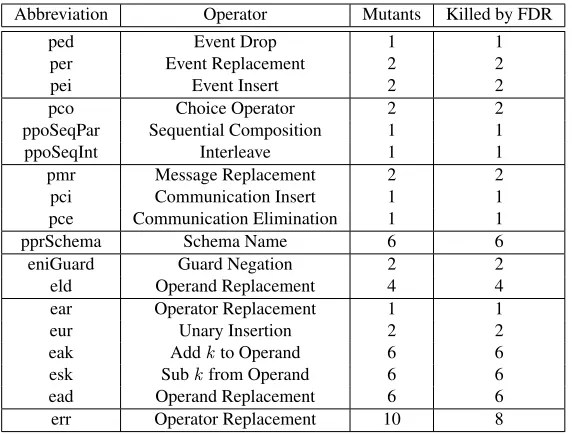
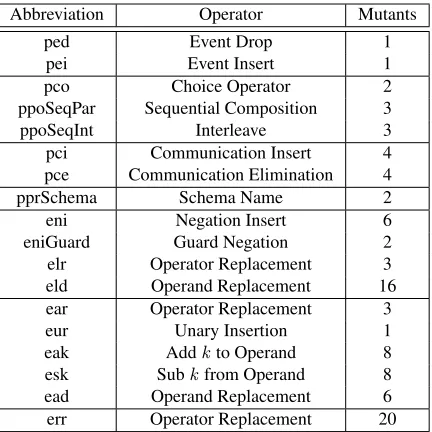
specifications, one for each mutation produced by the selected operator. In Table 2, we show the number of mutants produced by each operator when applied toChrono(in Figure 1). Operators not applicable to this example have not been considered.
Once the mutants are generated, we have to generate tests to kill them. We present
650
below two approaches for the generation of mutant-killing test cases.
The first approach requires the use of a model checker. Similar approaches for generating test cases using model checkers are popular; see, for instance, [50] for a survey. In our case, the checker is used to establish whether a generated mutant is a refinement of the original specification and, if not, to yield some counterexamples that
655
provide a basis for building killer tests as illustrated in Section 3.
ForCircus, there is no mature refinement model checker available at this time. It
is not the objective of our work to develop one (and there are ongoing efforts [51, 52] in this direction). However, for some Circus specifications, we can overcome this
barrier via a translation ofCircusmodels to CSP and the use of a well-known, mature
660
refinement checker for CSP, FDR [53]. We detail this approach in Section 5.1. The second approach for the generation of mutant-killing test cases is a (guided) generation of traces directly from theCircus specification. The traces are then
con-1Available at: http://czt.sourceforge.net/latex/circus/circus-guide.pdf, accessed:
Abbreviation Operator Mutants Killed by FDR
ped Event Drop 1 1
per Event Replacement 2 2
pei Event Insert 2 2
pco Choice Operator 2 2
ppoSeqPar Sequential Composition 1 1
ppoSeqInt Interleave 1 1
pmr Message Replacement 2 2
pci Communication Insert 1 1
pce Communication Elimination 1 1
pprSchema Schema Name 6 6
eniGuard Guard Negation 2 2
eld Operand Replacement 4 4
ear Operator Replacement 1 1
eur Unary Insertion 2 2
eak Addkto Operand 6 6
esk Subkfrom Operand 6 6
ead Operand Replacement 6 6
[image:26.612.164.450.123.340.2]err Operator Replacement 10 8
Table 2: Analysis of generated mutants forChrono
verted into test cases. Various techniques can be used to guide the trace generation in order to obtain relevant traces. We describe this approach in Section 5.2.
665
5.1. Test generation via CSP and FDR
This approach is applicable only toCircusspecifications with simple data models
that can be directly encoded in CSP without further refinement. It has been, in any case, very useful to validate our ideas and approach. We discuss below the translation fromCircusto CSP and the test-generation technique.
670
5.1.1. TranslatingCircusspecifications into CSP
As shown in [54], a subset ofCircuscan be automatically translated to CSP; the
main challenge is complex Z specifications. To carry out the experiments reported here and validate our approach to testing, however, we have carried out translation by hand. To work with FDR, the specifications must be translated into the machine readable
675
dialect of CSP [55] following the guidelines below:
• Channels and types are kept;
• The state components are encapsuled into a single data type with constructor AState, and passed as parameter to all processes and functions;
• ACircusaction is translated into a CSP process;
680
• Loops are translated as tail recursive calls;
• State changes defined by Z operations are performed by CSP functions from AStatetoAState.
685
Example 6. For instance, Figure 13 shows the translation of Chrono. TheAInit,
IncSecandIncMinCircusschemas are translated to theainit,incsecandincmin functions. Arguments and results of these functions are yielded by the type constructor
AState, encapsulating values for the two state componentssecandmin. The
anony-mous main action ofChronois translated into theCHRONOCSP process. The
initiali-690
sation is captured by the parameter of the call to processRUN. The loop is captured by
parameterised recursive calls at the end of each choice ofRUN. The references to the
schemasIncSecandIncMininside theRunaction are unfolded into the sub-process
RUN incsecandRUN incsec incmin.
695
5.1.2. Using FDR for fault-based test-case generation
In Section 3 we have explained that counterexamples yielded by a refinement check of a mutant against the original specification provide bases to build tests to kill the mutant. Figure 14 shows the output of FDR for the checkCHRONO ⊑F MCHRONO for failures refinement in the context of the definitions in Figure 13. It defines the
700
following traces, forbidden continuationa, and acceptance setX.
s =htick,timei a=out.1.1 X ={out.0.1}
For this experiment, the production of a counterexample gives rise to our account of the mutant as killed in Table 2. As stated in Theorem 1, finding such counterexamples is enough to assure thatMCHRONO is a mutant of interest: it gives us the necessary elements to build a test case for, at least, the failures fault-based set.
705
In the particular example of theCHRONO ⊑F MCHRONO analysis, we have both a failure and a forbidden continuation, allowing the construction of one test for each of the FBTestsCHRONO
T (MCHRONO) and FBTests
CHRONO
F (MCHRONO) sets. Such tests are constructed using theTTandTF functions.
TT(s,a)=inc→tick →inc→time→pass→out.1.1→fail →Stop TF(s,X)=inc→tick →fail→time→fail→out.0.1→pass→Stop
In the traces of the execution of a parallel composition between the mutantMCHRONO
710
and any of these tests the last verdict event isfail, thus the tests kill the mutant. All mutants generated forChrono(in Figure 1) have been translated to CSP and analysed with FDR. As shown in Table 2, only two of the mutants are not of interest. Both are generated by the relational operator replacementerr, and are in Figure 15. The changes introduced byerr in both ChronoErrEquiv1 andChronoErrEquiv2
715