Contents lists available atScienceDirect
European Journal of Operational Research
journal homepage:www.elsevier.com/locate/ejor
Production, Manufacturing and Logistics
Complexity results for storage loading problems with stacking
constraints
Florian Bruns
a, Sigrid Knust
a,∗, Natalia V. Shakhlevich
baUniversity of Osnabrück, Institute of Computer Science, Osnabrück 49069, Germany bSchool of Computing, University of Leeds, Leeds LS2 9JT, UK
a r t i c l e
i n f o
Article history:
Received 24 June 2014 Accepted 21 September 2015 Available online 30 September 2015
Keywords:
Storage loading Stacking Complexity Stacking constraints
a b s t r a c t
In this paper, we present complexity results for storage loading problems where the storage area is organized in fixed stacks with a limited common height. Such problems appear in several practical applications, e.g., in the context of container terminals, container ships or warehouses. Incoming items arriving at a storage area have to be assigned to stacks so that certain constraints are respected (e.g., not every item may be stacked on top of every other item). We study structural properties of the general model and special cases where at most two or three items can be stored in each stack. Besides providing polynomial time algorithms for some of these problems, we establish the boundary to NP-hardness.
© 2015 The Authors. Published by Elsevier B.V. This is an open access article under the CC BY license (http://creativecommons.org/licenses/by/4.0/).
1. Introduction
Storage loading problems arise in several practical applications, e.g., in the context of container terminals, container ships, ware-houses or steel yards. In such problems incoming items arrive at a storage area by trains, vessels or trucks and have to be assigned to stacks respecting certain constraints. Usually, only the topmost item of each stack can be directly retrieved, i.e., the items are accessed in last-in-first-out order. This implies that if an item stacked below has to be retrieved, a so-called reshuffling (relocation) operation is neces-sary. In this paper, we only consider the loading process and assume that no outgoing items have to be retrieved during this process.
We study problems where items have to be loaded into a two-dimensional storage area consisting of stacks where each stack has its own fixed position. This means that one cannot decide where to position a stack in the area, but which stack to choose for placing an item. Such a predefined arrangement of stacks is motivated by yard areas in maritime or rail-road terminals, which are often organized in a “fixed grid” layout. These layouts have fixed subareas with pre-defined lengths, and containers must be placed into these subareas without exceeding their borders. If we assume that only one stack may be opened in each subarea, this case is equivalent to the situa-tion with fixed posisitua-tions of stacks.
The items are usually relocated by cranes moving above the stacks, which imposes a restriction on the maximum height of a stack. We
∗ Corresponding author. Tel.: +49 541 969 2483.
E-mail addresses:fl[email protected](F. Bruns),
[email protected](S. Knust),[email protected]
(N.V. Shakhlevich).
assume that each stack cannot hold more thanbitems. In some
sce-narios the items may have additional characteristics like weights or
heights. Then, in addition to the numberbthat limits the number of
items in any stack, one has a height limit or a weight limit for each stack. Also, special restrictions on the containers’ locations may exist. For example, reefer containers need a power socket, so only locations with an appropriate configuration are feasible for them.
The main goal of a storage loading problem is to assign each in-coming item to a feasible position in a stack such that a given ob-jective function is optimized. Several aspects of such problems are of interest for practitioners. For example, the distances the cranes move should be minimized to reduce the energy costs for operating the cranes. Another objective is to achieve an allocation of contain-ers so that future reshuffles related to storage unloading are avoided because they are time- and energy-consuming. Since in general the exact number of required reshuffles cannot be easily determined in advance, this objective is often replaced by a lower bound on the number of reshuffles, which is easier to compute. For this purpose, the number of “unordered stackings” may be minimized, which is defined as the total number of vertically adjacent items ordered in the wrong way (e.g., with respect to retrieval times). Another objec-tive important in practice is to minimize the total number of items stacked on levels above the ground level (this reduces the risk of reshuffling). In contrast to that, some practitioners prefer to use as few stacks as possible to have more flexibility for the remaining stacks in the storage area.
As observed by Lehnfeld and Knust (2014), up to now almost
no complexity results for storage loading problems have been pub-lished. On the other hand, for storage unloading problems or com-bined loading/unloading problems some results are known (cf.
http://dx.doi.org/10.1016/j.ejor.2015.09.036
Lehnfeld & Knust, 2014). For example,Caserta, Schwarze, and Voß (2012)deal with a basic unloading problem (the “blocks relocation problem”) where items are stored in stacks and have to be retrieved in a given order. It is shown that minimizing the number of reshuf-fles is NP-hard. In the so-called “container stowage problem”, a vessel visits several ports consecutively. At each port, a set of containers has to be retrieved from the vessel and another set of containers has to be
stored on it.Avriel, Penn, and Shpirer (2000)derived complexity
re-sults by relating this problem to the coloring of special graphs: while
for the problem with unlimitedband at most 3 stacks it can be
de-cided in polynomial time whether there exists a solution without re-locations, for every fixed number of stacks greater than 3 the problem
becomes NP-complete.Delgado, Jensen, Janstrup, Høyer Rose, and
Høj Andersen (2012)consider a loading problem where a container ship has to be loaded with a set of items. According to the vessel’s stability, weight and height restrictions are given for each stack. Since some containers need a power socket, there are location restrictions as well. By a reduction from the bin packing problem, it is shown that minimizing the number of used stacks is NP-hard.
Kim, Park, and Ryu (2000)deal with a loading problem where a sequence of items has to be stored in a storage yard. It is assumed that each item belongs to one of three weight groups, but the weight group of each item is not known before its arrival. The objective is to minimize the expected number of reshuffles. A dynamic program-ming approach is described based on the probability of the weight
group of the next arriving item.Kang, Ryu, and Kim (2006)tackle a
similar problem by simulated annealing. In the context of rail-road
terminals,Jaehn (2013)considers a storage loading problem where
containers from a bundle of trains arriving simultaneously have to be placed into a storage area consisting of parallel lanes. After showing NP-hardness of two models, heuristic algorithms are presented and tested on real-world data. An overview of optimization approaches
in rail-road terminals has recently been provided byBoysen,
Flied-ner, Jaehn, and Pesch (2013). Storage loading problems in seaport
container terminals are considered inBorgmann, van Asperen, and
Dekker (2010)andDekker, Voogd, and van Asperen (2006). Depar-ture times are given and the aim is to avoid stacks that cause reshuf-fles when an item is stacked on top of another item with an earlier departure time.
The main objective of our paper is to provide first theoretical re-sults for storage loading problems with stacking constraints. In ad-dition to NP-hardness results, we derive polynomial time algorithms for special situations which may be used as building blocks in heuris-tic approaches for more general problems with additional constraints typical for real-world applications.
The remainder of the paper is organized as follows. InSection 2,
we formally introduce typical constraints and objectives that occur
in practical storage loading problems. InSection 3, we consider
spe-cial cases with the stacking limitb=2. We show that minimizing
the number of used stacks, minimizing the number of items stacked above the ground level and minimizing the number of unordered stackings, can be done in polynomial time even if there are
compat-ibility constraints for pairs of items. InSection 4, we prove that for
the stacking limitb=3 in the presence of stacking constraints it is
already strongly NP-complete to decide whether a feasible solution
exists or not. Afterwards, inSection 5, we consider the more general
situation of an arbitrary stacking limitband identify two special cases
that are polynomially solvable. Finally, conclusions are presented in
Section 6.
2. Problem formulation
In this section, we give a formal definition of storage loading prob-lems and introduce notations for its various versions. As mentioned before, we focus on problems where the storage area is arranged in stacks and the positions of the stacks in a two-dimensional area are
given. It is assumed that the yard layout is fixed and the stack posi-tions cannot be changed.
Letmbe the number of stacks where for each stack a position
in the yard is specified byx- andy-coordinates. Each stack can hold
at mostbitems. The set of all items is denoted byI=
{
1,2, . . . ,n}
where normally the inequalitym<nholds, i.e., some items have to
be stacked on others. We assume thatn≤bm; otherwise the problem
is infeasible.
For each itemi∈Iits original positionOiis given by itsx- andy
-coordinates. Typically, positionsOicorrespond to locations of items
on an arriving train or truck. Additionally, for a non-empty storage area the locations of the items already stored in the stacks are given, specified by a stack number and a level in the stack. We assume that
these positions are fixed and cannot be changed. We denote byIfix⊂I
the set of fixed items in the storage area and byIin⊆Ithe set of
incom-ing items. Since the items inIfixare not allowed to be re-allocated, we
exclude from consideration all stacks which are already completely
filled with items and assume that in each of the remainingmstacks
at least one free position exists; the corresponding items are removed from the setsIfixandI.
Usually, in practice there are restrictions concerning feasible stacking configurations. For example, heavier items are not allowed to be stacked on top of lighter ones, longer items are not allowed to be put on shorter ones, and items of different material or with different destinations may not be put on each other. All such stack-ing constraints may be encoded by a 2-dimensional binary matrix
S=
(
si j)n×n,wheresi j=1 ifican be stacked ontojandsi j=0other-wise. These constraints can also be represented by a directed graph
withnvertices and arcsi→jifsi j=1. Stacking constraints may be
transitive (i.e., if itemiis stackable on top of itemjand itemjis
stack-able on top of itemh, then alsoiis stackable on top ofh) or may have
an arbitrary structure. For example, restrictions coming from weights or lengths of the items are transitive, while restrictions induced by materials may be non-transitive. Weight or length restrictions have
the special property that all items are comparable (i.e., for alli=jwe
havesi j=1 orsji=1). Thus, these restrictions define a total order on
all items. Sometimes for the itemsi∈Ideparture (retrieval) timesdi
are known indicating the time at which itemiis expected to leave the
storage area. In this situation, it is advantageous to stack an itemion
top ofjonly ifdi≤djholds; otherwise, a reshuffle will be necessary
in the future.
Items stored in a stack are defined by a tuple
(
ik, . . . ,i1)
,whereiλdenotes the item stacked at level
λ
andλ
=1 corresponds to theground level. Such a tuple is feasible ifk≤bandsiλ+1,iλ=1 for all
λ
=1, . . . ,k−1.The simplest version of a storage loading problem is the feasibility problem which asks whether all items can be feasibly allocated to the
storage area respecting all constraints, e.g., the stack capacityb, the
stacking constraintsS, a weight limit per stack or location restrictions.
If this is possible, the objective is to assign each item to a feasible location (specified by a stack number and a level in the corresponding stack) minimizing one of the following objective functions:
• the total number #Stof used stacks;
• the total number #SI>1of items stacked at levels above the ground
level (to reduce the risk of reshuffling);
• the total number of “unordered stackings” #USwith respect to
de-parture timesdi(to minimize the number of reshuffles): we count
all pairs of items (i,j) where a less urgent itemiis stacked directly
on top of a more urgent itemj, i.e., one withdj<di;
• the total transportation costsTCfor moving items from their
orig-inal positionsOito the assigned locations in the storage area. In
general these costs depend on thex- andy-coordinates in the
storage area as well as the assigned level (z-direction). Special
x- andy-coordinates, the assigned level is negligible) orTC(x) (the
transportation costs only depend on thex-coordinates).
Note that the introduced functions can be considered
indepen-dently or in a combined way. For example,w1TC+w2#SI>1
repre-sents a weighted sum of transportation costs and the number of items
stacked above the ground level with associated weightsw1,w2≥0.
We use the three-field notation
α
|
β
|
γ
, introduced inLehnfeld andKnust (2014), to represent the described versions of the storage load-ing problem. The problem type (e.g., loadload-ing or unloadload-ing) is
speci-fied in the first field
α
. In this paper,α
=Lfor loading. Furthermore,we writeb=bif the stacking limitbis fixed tob∈N(e.g.,b=2 or
b=3).
The second field specifies the incoming items and characterizes additional storage restrictions. In loading problems, there is usually a
set of items, denoted byIin, which arrive simultaneously by a single
delivery vehicle (e.g., by a single train, ship or truck). Sometimes a
se-quence
π
inis given which means that the items have to be placed intothe storage area according to a fixed sequence (e.g., if all items arrive on different trucks or a train has to be unloaded from “left to right”
according to the original positionsOi). More generally, (Iin)Kdenotes a
sequence ofKincoming sets, e.g., if several trains arrive consecutively
and have to be unloaded in the order of their arrival. In this case, all items belonging to the same set have to be loaded into the storage area before any item of the next set can be stored. By default, we
as-sume that there may be fixed itemsIfixin the storage area and do not
includeIfixin the notation. Otherwise, we explicitly writeIf ix= ∅in
the
β
-field. Additional conditions in this field may include theen-trysijto denote stacking constraints, and the entries “weight-limit”
or “height-limit” indicating weight and height restrictions per stack, respectively.
Finally, the objective function is specified in the third field
γ
. Inthe feasibility version of a problem, no objective function is given
(indicated by “−”), and the task is to find a feasible assignment of
items to locations. For example,L,b=3
|
Iin,si j
|
−denotes thefea-sibility problem with stacking limitb=3 and arbitrary stacking
con-straintssij, whileL
|
Iin|
TC(x,y) denotes the problem of assigning itemsto stacks with limitb(an arbitrary value given as part of the input)
without stacking constraints minimizing transportation costs inx
-andy-directions.
3. Problems with stacking limitb=2
In this section, we consider problems where the stacking limit
isb=2. Such a situation is typical for rail-road container terminals,
where often at most 2 containers may be stacked. We consider arbi-trary stacking constraintssijand the objective functions #St,#SI>1,
and #US. The storage area may contain some fixed itemsIfixor may
be empty.
Theorem 1. Problem L,b=2
|
Iin,si j
|
#St with arbitrary stackingcon-straints sijcan be solved as a maximum cardinality matching problem in O
(
n2.5)
time. A solution minimizing#SI>1can be derived from a feasiblesolution to L,b=2
|
Iin,si j
|
#St inO(
n)
time.Proof.We introduce the undirected graphG=
(
V,E)
,in which thenodesVcorrespond to the itemsIand edgesE=
{{
i,j} |
i,j∈V}
con-nect two nodes if the corresponding items can be stored together in a stack. For incoming itemsi,j∈Iinan edge {i,j} exists ifican be stacked
onjor vice versa, i.e., ifsi j+sji≥1. For itemsi∈Iinandj∈Ifixan edge
{i,j} exists ifiis stackable on top ofj, i.e.,si j=1.
By calculating a matching of maximum cardinality in the graphG,
we get a solution with the largest number of stacks containing two items. Additionally, the items that are not matched have to be stored at the ground level. Thus, the total number of used stacks is
mini-mized. A feasible solution with at mostmstacks exists if and only if
the number of edges in the matching plus the number of unmatched
1 2 11 6 10 8 9 5 4 3 12 7 13
(a) A feasible solution
1 2 11 6 10 8 9 12 7 13 5 4 3
[image:3.595.303.555.55.85.2](b) An optimal solution minimizing #SI>1
Fig. 1. Constructing an optimal solution from a feasible one (Example 1).
nodes is not larger thanm. Since the number of nodes isn, a
maxi-mum cardinality matching can be computed inO
(
n2.5)
time (cf.Even& Kariv, 1975).
ProblemL,b=2
|
Iin,si j
|
#SI>1minimizing the number of itemsstacked above the ground level can be solved as follows. We start with a solution toL,b=2
|
Iin,si j
|
#Stand re-allocate as many itemsas possible to the ground level until all stacks contain at least one
item.
Example 1. In the following, we illustrate how a solution minimizing #SI>1can be constructed from a solution to problemL,b=2
|
Iin,si j
|
#St. We consider an example withm=10 stacks andn=13 items,
numbered from 1 to 13. We assume that in the maximum cardinality matching the edges {1, 5}, {2, 4}, {3, 11}, {6, 12}, {7, 10}, {8, 13} are chosen. Furthermore, item 9 is not matched at all.
The solution to the matching problem can be interpreted as the
stacking solution shown inFig. 1a. In this solution, three stacks are
left empty, so three stacked items can be moved to the ground level.
This results, for example, in the solution shown inFig. 1b, where the
number of items stacked above the ground level is 3=13−10.
Obvi-ously, form=10,b=2 andn=13 this is optimal.
Next, we consider the same problem setting but with the objective to minimize the number of unordered stackings. For this problem
ad-ditionally departure timesdiare given for all itemsi∈I.
Theorem 2. Problem L,b=2
|
Iin,si j
|
#US with arbitrary stackingconstraints sij can be solved as a minimum-weight perfect matching
problem inO
(
n3)
time.Proof. At first we introduce 2m−ndummy items, leading to 2m
items in total. These dummy items are used to represent empty po-sitions in a solution and can be stacked together with any other item (real or dummy), in both directions.
We introduce the undirected graphG=
(
V1∪V2,E1∪E2)
,whereV1 andV2 represent real and dummy items, respectively,
|
V1|
=n,|
V2|
=2m−n. Edges E1 connect nodes corresponding to pairs ofstackable real items, edgesE2=
{{
i,j} |
i∈V1∪V2,j∈V2}
contain allpairs involving at least one dummy item. For an incoming itemi∈Iin
and a fixed itemj∈Ifixan edge {i,j}∈E
1exists ifican be stacked onj,
i.e., ifsi j=1. The costscijfor these edges are set to
ci j:=
0, ifdi≤dj
1, otherwise.
For two incoming itemsi,j∈Iinan edge {i,j}∈E
1exists ifican be
stacked onjor vice versa, i.e., ifsi j+sji≥1. The costscijfor these
edges are set to
ci j:=
0, if
(
si j=1,di≤dj)
or(
sji=1,dj≤di)
,1, otherwise.
The costscijfor edges connecting two real itemsi,jof the setV1are 0
if these items can be stacked without inducing an unordered stacking.
Ifiandjcan only be stacked leading to an unordered stacking, the cost
cijis equal to 1. Furthermore, we setcij:=0 for all edges {i,j}∈E2, i.e., all dummy items can be stacked at no cost. Such an edge corresponds to the situation that a stack is completely empty (two dummy items) or a stack contains a real item stored at the ground level without a stacked item on top (one real and one dummy item).
Consider the minimum-weight perfect matching problem defined
on the graphG. Clearly, if a perfect matching does not exist, then also
1 2 3 4
5 6
1 0 1
1
(a) GraphGform= 3
1 2 3 4
5 6
1 1
1
(b) Perfect matching form= 3
1 2 3 4
5 6
D1 D2
1
1 1
(c) GraphGform= 4
1 2 3 4
5 6
D1 D2
1
0
0 0
(d) Perfect matching form= 4
1 2 3 4
5 6
D1 D2 D3 D4
1
1 1
(e) GraphGform= 5
1 2 3 4
5 6
D1 D2 D3 D4
0
0 0
0 0
[image:4.595.319.558.55.93.2](f) Perfect matching form= 5
Fig. 2. Graphs and matchings forExample 2.
perfect matching arranges items in pairs ensuring the minimum pos-sible number of unordered stackings. Indeed, due to the definition of
cij, each unordered stack has cost 1, while stacks without unordered
items or those containing only one item have cost 0.
Based on the solution to the minimum-weight perfect matching problem, we define a solution to the storage loading problem. For
edges {i,j}∈E1in the matching we define the order ofi,jin the stack
as follows. Ifi∈Iin,j∈Ifixori,j∈Iinare only stackable in one direction
(i.e.,si j+sji=1), then they are stored in the unique possible way
re-specting the stacking constraints (i.e., ifsi j=1,itemiis stacked on
itemj). On the other hand, if itemsi,j∈Iinare stackable in both
di-rections (i.e.,si j=sji=1), thenjis placed at the ground level andiis
stacked on top ifdi≤dj; otherwise the reverse order is selected.
For edges {i,j}∈E2in the matching involving two dummy items,
we introduce a completely empty stack; for edges {i,j}∈E2with one
dummy and one real item, we place the real item on the ground level without any item on top.
Since the number of nodes is 2mand we assume thatm<n, a
minimum-weight perfect matching can be computed inO
(
n3)
time(cf.Gabow, 1973; Lawler, 1976).
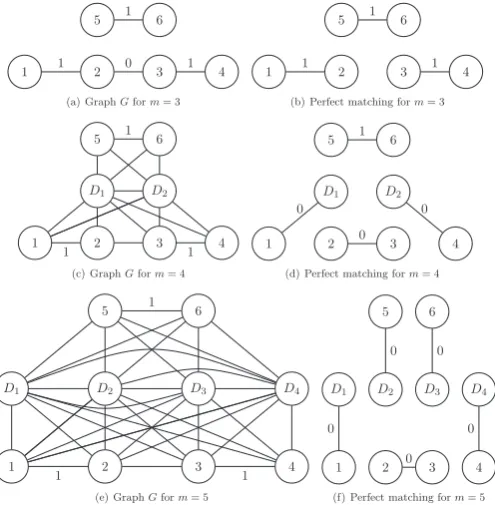
Example 2. Consider three instances withn=6 items andm∈{3, 4, 5}, respectively. Lets12=s23=s32=s34=s56=1 and all othersij
be zero. The delivery times ared1=4,d2=d4=1 ,d3=d6=2 and
d5=3. In the basic graph form=3 shown inFig. 2a items are
con-nected if they can be stored together in a stack. Furthermore, the edges between two items have cost 0 if the items can be stacked with-out an unordered stacking and cost 1 if an unordered stacking occurs
when stacking the items. In the case ofFig. 2a only item 2 can be
stacked on item 3 without inducing an unordered stacking.
The basic graph shown inFig. 2a is the graph that has to be
con-sidered ifm=3. Due to 2m=n,no dummy nodes have to be
intro-duced and a minimum-weight perfect matching with cost 3 is shown inFig. 2b. This matching can be transformed into the stacking
solu-tion shown inFig. 3a. For each stack the ordering of the two items is
unique since they can only be stacked in one direction.
Form=4 we introduce 2 dummy nodesD1andD2which are
con-nected by edges of cost 0 to the 6 nodes corresponding to real items.
6 2 4
5 1 3
(a) Stacks form= 3
6 3 1 4
5 2
(b) Stacks form= 4
3 1 4 5 6
2
[image:4.595.45.293.56.309.2](c) Stacks form= 5
Fig. 3. Stacking solutions forExample 2.
Additionally,D1 andD2 are also connected, which enables empty
stacks. The resulting graph is presented inFig. 2c. Here, we do not
label edges with 0 cost for clarity. In this situation, a perfect
match-ing with cost 1 exists, seeFig. 2d. This matching can be interpreted as
the stacking solution shown inFig. 3b. Item 5 has to be stacked on top
of item 6 since these items are in one stack and due tos65=0 item 6
cannot be stacked on top of item 5. For the second stack, items 2 and 3 are stackable in both directions, but putting 3 on top of 2 would
in-duce an unordered stacking due to the delivery times (d2<d3). Thus,
item 2 should be stacked on top of 3.
Form=5 we introduce the 4 dummy nodesD1toD4which are
again connected by 0-cost edges to all nodes corresponding to real items; they are also interconnected by 0-cost edges. The graph is
shown inFig. 2e, a perfect matching with cost 0 is presented inFig. 2f,
and the corresponding stacking solution is shown inFig. 3c. The only
stacked items are 2 and 3, where again 2 is on top of 3 as this direction does not induce an unordered stacking.
Up to now, we assumed that one setIinof incoming items is given
and arbitrary stacking constraintssijhave to be respected. If instead
a sequence
π
inor a sequence (Iin)Kof sets is given, the corresponding
problems can be solved by the same algorithms as inTheorems 1and
2. We simply use a modified stacking matrixS=
(
si j)withsi j:=
1, ifsi j=1 and itemidoes not arrive before itemj,
0, otherwise,
which guarantees that an item arriving at a later time is not placed underneath an item that arrives earlier. Thus, we have
Corollary 3.Problems L,b=2
|
(
Iin)K
,si j
|
#St and L,b=2|
(
Iin)K
,si j
|
#SI>1can be solved inO(
n2.5)
time. Problem L,b=2|
(
Iin)K
,si j|
#US is solvable inO
(
n3)
time.4. Problems with stacking limitb=3
In this section, we show that several problems with stacking limit
b=3 are strongly NP-complete.
Theorem 4. The feasibility problem L,b=3
|
Iin,si j
|
−is stronglyNP-complete even for an empty storage area (If ix= ∅) and transitive
stack-ing constraints sij.
Proof.We prove NP-completeness by a reduction from the strongly
NP-complete problem EXACT COVER BY 3-SETS (X3C), see (Garey &
Johnson, 1979). The idea of the proof is similar to that used inGarey and Johnson (1979)(Section 3.2.2) for proving NP-completeness of PARTITION INTO TRIANGLES.
An instance of X3C is given by a finite setXwith
|
X|
=3qfor someintegerq, as well as a collectionCof three-element subsets ofX. The
decision problem asks whetherCcontains an exact cover ofX, i.e., a
subcollectionC⊆Cwhere each element ofXis contained in exactly
one element ofC.
For an instance of X3C we construct an instance of the
stack-ing problem withm=q+3
|
C|
stacks, stacking limitb=3 andn=3
(
q+3|
C|
)
incoming itemsIin. There are no itemsIfixstored in thestacks. Note thatn=3mand hence in each feasible solution all
lo-cations in the stacks have to be filled with items. We specify the
instance of the stacking problem by a directed graphG=
(
V,A)
,inwhich nodesVcorrespond to the itemsIin,
|
V|
=n,and arcs (i,j)∈Aui vi wi ai1 ai2
ai3
ai4 ai5
ai6
ai7 ai8
[image:5.595.65.255.56.271.2]ai9
Fig. 4.Substitution graph.
ui vi wi
ai1 ai2
ai3
ai4 ai5
ai6
ai7 ai8
[image:5.595.332.521.60.153.2]ai9
Fig. 5.Stacks ifciis part of the cover. (For interpretation of the references to color in
the text, the reader is referred to the web version of this article.)
ui vi wi
ai1 ai2
ai3
ai4 ai5
ai6
ai7 ai8
ai9
Fig. 6.Stacks ifciis not part of the cover. (For interpretation of the references to color
in the text, the reader is referred to the web version of this article.)
There are two types of nodes inV: main nodes (one node per
el-ement fromX) and auxiliary nodes (9 nodes for each triple fromC).
Each tripleci=
{
ui,v
i,wi}
defines a so-calledsubstitution graphwith3 main nodes
{
ui,v
i,wi}
,9 auxiliary nodes{
ai1, . . . ,ai9}
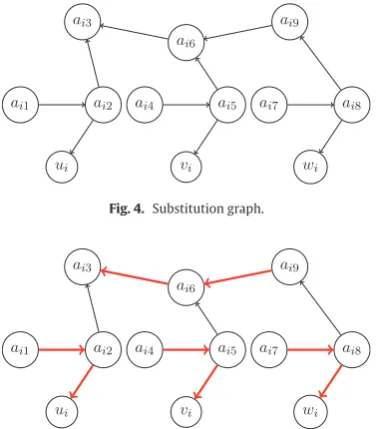
and thecol-lectionAicontaining the 11 arcs shown inFig. 4. Note that the main
nodes
{
ui,v
i,wi}
may belong to several substitution graphs, but thereare no arcs between theaij-nodes belonging to different substitution
graphs.
Thus, for the graphG=
(
V,A)
we haveV=X∪
|C|
i=1
{
ai j|1≤j≤9}
andA=|C|
i=1
Ai.
In the following we show thatCcontains an exact cover ofXif and
only if the stacking problem has a feasible solution.
“⇒”: Assume that X3C has an exact cover C ⊆ C. If ci=
{
ui,v
i,wi}
∈C, then in the stacking problem we build fourstacks, each containingb=3 elements: (ai1, ai2, ui),
(
ai4,ai5,v
i),(
ai7,ai8,wi),and (ai9,ai6,ai3). The corresponding paths within thesubstitution graph are drawn as thick red lines inFig. 5. Note that
the items corresponding to the main nodes ofciare now stored and
cannot be used in any other stack.
If on the other hand,ciis not part of the coverC, the items in the
corresponding substitution graph are stacked according to the thick red arcs shown inFig. 6. Here, the three stacks (ai1,ai2,ai3), (ai4,ai5,
ai6) and (ai7,ai8,ai9) are built. In this case, the items corresponding
to the main nodes ofciare not included in any stack, while the items
corresponding to all auxiliary nodes are stored.
ui vi wi
ai1 ai2
ai3
ai4 ai5
ai6
ai7 ai8
ai9
Fig. 7. Transitive substitution graph. (For interpretation of the references to color in
the text, the reader is referred to the web version of this article.)
“⇐”: Assume that conversely a feasible solution to the stacking
problem exists. We construct a partition into triples which defines a solution to X3C.
First we note that due to the stacking constraints imposed by the
arcsA, in any feasible solutions all main items are stacked at level 1,
and the items at levels 2 and 3 correspond to auxiliary nodes. Consider a stack with a main item at the ground level and an
aux-iliary item at level 2. Suppose that these items areui,ai2; the cases
of
v
i,ai5andwi,ai8are similar. LetGibe the substitution graph thatcontainsai2. We show that in this case there are four stacks
(
ai1,ai2,ui)
,(
ai4,ai5,v
i)
,(
ai7,ai8,wi)
,(
ai9,ai6,ai3)
(1) for the substitution graphGi, and hence we includeci={
ui,v
i,wi}
inthe exact cover.
First observe that the stack withuiandai2at levels 1 and 2 is of
the form (ai1,ai2,ui); thus there are 7 remaining auxiliary items ofGi,
not countingai1,ai2.
(i) If the item stacked on top of
v
idoes not belong toGiand thesame is true for the item stacked on top ofwi,then 7 auxiliary
items ofGicannot form full stacks containingb=3 items.
(ii) If the item stacked on top of
v
idoes not belong toGi, while theitem stacked on top ofwidoes, then
(
ai7,ai8,wi)forms a stackinGi, and the remaining 5 auxiliary nodes ofGicannot form
full stacks.
(iii) If the item stacked on top of
v
ibelongs toGi, while the itemstacked on top ofwidoes not, then
(
ai4,ai5,v
i)forms a stack inGi, and the remaining 5 auxiliary nodes ofGicannot form full
stacks.
Thus, in each of the above cases we get a contradiction to the as-sumption that there exists a feasible solution to the stacking problem,
and the only feasible stacking is given by(1).
In the following we prove that already the special case of transitive
stacking constraintssijis NP-complete by showing that the reduction
from X3C also holds if the graphG=
(
V,A)
is transitive. For thispur-pose, we consider the transitive substitution graph shown inFig. 7,
where the transitive arcs are added as thick blue arcs.
We use similar arguments as before. Consider an item
correspond-ing to the main nodeuiincluded in a stack together with itemai2
(note that there does not exist a stack containing 3 items with item
ai1at level 2). Again it can be shown that there are four stacks (ai1,
ai2,ui) ,
(
ai4,ai5,v
i),(
ai7,ai8,wi)and (ai9,ai6,ai3) for the substitutiongraphGi, which means thatci=
{
ui,v
i,wi}
should be included in theexact cover. Notice that property (i) remains the same; in (ii) we need
the additional observation thatai7cannot be stacked at level 2,
im-mediately on top ofwi; similarly in (iii) we observe thatai4cannot be
stacked at level 2, immediately on top of
v
i.In the following we show that if we have no stacking constraints
sij, but an additional weight or height limit per stack, the problem is
also strongly NP-complete.
Theorem 5. The feasibility problems L,b=3
|
Iin,weight-limit|
− [image:5.595.66.252.310.403.2]height limit per stack are strongly NP-complete even if the storage area is empty (If ix= ∅).
Proof. We prove NP-completeness of the first problem (the second problem can be tackled similarly) by a reduction from the strongly
NP-complete problem 3-PARTITION (3-PART), seeGarey and Johnson
(1979). An instance of 3-PART is defined by a setA=
{
1, . . . ,3k}
of 3kelements and a boundB∈N. Associated with the elementsi∈Aare
numbersaiwith
3k i=1
ai=kBandB/4<ai<B/2. The decision problem
asks whetherAcontains a partitionS1, . . . ,Sksuch that
i∈Sλ
ai=Bfor
λ
=1, . . . ,k. Note, that by the definition ofaieach setSλmust contain exactly three elements.For an instance of 3-PART we construct an instance of the stacking
problem with
|
A|
=3kitems and weightsaifori=1, . . . ,3k. Thereare no itemsIfixstored in the stacks. We introducem=kstacks with
stacking limitb=3 and weight limitBper stack. We show that
3-PART has a feasible solution if and only if a feasible solution for the stacking problem exists.
“⇒”: Assume that 3-PART has a feasible solution. Then thek=m
subsets can be interpreted asmstacks, each containing three items.
These stacks are feasible since each stack respects the weight limitB
and the stacking limitb=3.
“⇐”: Assume that conversely a feasible solution to the stacking
problem exists. Themstacks have to be filled by three items per stack
because the number of items is 3m. Since the maximum weight of a
stack is limited toBand the sum of the item weights isB·m, each
stack has a weight ofB. Thus, the items of a stack can be interpreted
as subsets with cardinality three for problem 3-PART, where for each
subset the sum of the weights isB.
Note that the same reduction also applies to problemL,b=3
|
Iin,height-limit
|
−where the heights of the items take the role of theweights. Thus, this problem is strongly NP-complete as well.
5. Problems with arbitrary stacking limitb
In this section, we consider an arbitrary stacking limitb≥2 which
is given as part of the input. We show that the problem without stack-ing constraints is polynomially solvable if the objective is to minimize
the transportation costsTC(x,y), the number of items stacked above
the ground level #SI>1,or a weighted sum of them. Additionally, we
prove that problemsL
|
Iin,si j
|
#StandL|
Iin,si j|
#SI>1arepolyno-mially solvable in the case that the stacking constraintssijdefine a
total order.
At first we consider problemL
|
Iin|
w1TC
(
x,y)
+w2#SI>1. Theorem 6. Problem L|
Iin|
w1TC
(
x,y)
+w2#SI>1 can be solved inO
((
n+mb)
3)
time for any stacking limit b.Proof. We show that the problem can be solved as a
minimum-weight matching problem in the bipartite graph G=
(
V1∪V2,E)
whereV1corresponds to the set of incoming itemsIinandV2
con-tains all free positions in the storage area (here, a “position” means a pair consisting of a stack and a level). If the storage area is empty,
we considermbpositions. If, on the other hand, the storage area is
partially filled, we do not consider those positions that are already
occupied with items from the setIfix.
We introduce edges {i,p} for alli∈V1andp∈V2. The weightcipis
defined as the cost of transporting itemifrom its originOito position
pmultiplied byw1. Additionally, if the positionpis not at the ground
level, we add the unit cost for a stacked item multiplied byw2.
The bipartite graph G has at most n+mb nodes, and the
minimum-weight bipartite matching problem for it can be solved in
O
((
n+mb)
3)
time (cf.Gabow, 1976). Since in practical settings thestacking limitbis usually smaller than the number of itemsn, this
complexity is polynomial.
1
2
3
4
5
6
p1
p2
p3
p4
p5
p6
p7
p8
(a) Bipartite graph
1
2
3
4
5
6
p1
p2
p3
p4
p5
p6
p7
p8
[image:6.595.322.552.54.305.2](b) An optimal matching
Fig. 8.Bipartite graph and an optimal matching forExample 3.
2 3
stack 1 1 4 5 6
stack 2
(a) Stacking solution according to matching
2 3
stack 1 1 4 5 6
stack 2
(b) Repaired stacking solution
Fig. 9.Original and repaired stacking solution forExample 3.
In an optimal solution to the matching problem it can occur that
an item is stored in thekth level without an item stored in the
(
k−1
)
th level in the same stack. Ifw2>0,then in an optimal solutionall suchksatisfy 2≤k≤b; ifw2=0,then 1≤k≤b. In either case,
in the corresponding actual solution to the stacking problem, we can just lower all items that are stacked in the “air” until they are stacked
on other items without increasing the cost.
Example 3. Consider an instance withm=2 stacks, stacking limit
b=4 andn=6 items. The vertex sets have cardinalities
|
V1|
=6 foritems and
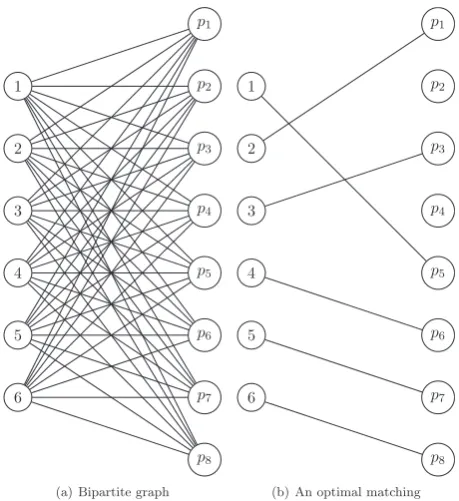
|
V2|
=8 for free positions.The corresponding bipartite graph is shown inFig. 8a. Item
ver-tices are numbered from 1 to 6, while position verver-tices are numbered
fromp1top8. Note, that the positionsp1 top4belong to the first
stack, while positionsp5top8belong to the second stack. Positions
p1andp5represent ground level positions, the other positions
repre-sent non-ground levels for stacked items.
Assume that an optimal matching is the one shown inFig. 8b. All
items are assigned and positionsp2andp4stay empty. This solution
can be interpreted as the stacking solution shown inFig. 9a. In that
solution, in the first stack, level three is filled but level two is empty, which is not feasible. However, the solution can be repaired by low-ering all items that are stored in the “air”. In the solution shown in
Fig. 9b the level of item 3 is changed from 3 to 2. The latter stacking
solution has the same cost as the one shown inFig. 9a since the costs
Now we consider the situation of special stacking constraintssij,
which define a total order on all items, i.e.,sijis transitive and for all
i=jwe havesi j=1 orsji=1. For example, this condition is satisfied
if thesijare based on weight or length restrictions of the items.
Theorem 7.Problems L
|
Iin,si jtotal order
|
#St and L|
Iin,si jtotalorder
|
#SI>1can be solved inO(
nlogn)
time.Proof.Since thesijdefine a total order, all items can be compared.
We define a comparator࣑for itemsiandj based on the stacking
restrictionssijas follows:
ij:=
⎧
⎨
⎩
i≈ j, ifsi j=1 andsji=1,
i≺j, ifsi j=1 andsji=0,
ij, ifsi j=0 andsji=1.
At first we consider the situation that the storage area is empty, i.e.,
If ix= ∅. By sorting the items non-increasingly according to the
de-fined comparator࣑, the list of items can always be transformed into
a feasible stacking solution by iteratively filling the stacks from the bottom to the top according to the sorted list. This means that the first (the “largest”) item is placed at the ground level in the first stack
and all items up to thebth item are stacked on top. The (b+1)st item
is at the ground level of the second stack and so on. In the following, we show that the stacking constraints are respected by this approach.
Whenever an itemiis stacked on another itemj, we haveijwhich
implies thatsi j=1 (forijwe have to distinguish the situationsi≺j
andi≈j, but according to the definition of the comparator for both
casessi j=1 holds). Sincesi j=1 for all itemsithat are stacked on
an-other itemj, the stacking constraints are not violated by processing
the ordered list. Obviously, the number of used stacks is minimized by this approach.
If the storage area is not empty (i.e.,Ifix= ∅), we consider all items
fromIinin non-decreasing order according to࣑and fill up all partially
filled stacks starting with the stack that has the smallest itemj∈Ifix
on top (according to the comparator࣑). We fill the empty positions in
this stack from the top to the bottom with the smallest feasible items
from the setIin(i.e., alli∈Iinwithij). We then proceed with the
stack with the second smallest item on top and so on. This strategy guarantees that incomplete stacks are filled as much as possible, up
to the maximum levelb. However, in the resulting solution still partly
filled stacks may exist if there are not enough items smaller than the topmost item in a partial stack. Having processed all stacks
contain-ing items ofIfix, the problem reduces to the problem with an empty
storage area discussed in the beginning of the proof. As a result, we either get a feasible solution or demonstrate that none exists. Again, the number of used stacks is minimized by this approach.
If a feasible solution to problemL
|
Iin,si jtotal order
|
#Stis found,a solution to problemL
|
Iin,si jtotal order
|
#SI>1with the minimumnumber of items stacked above the ground level can be obtained as
before by moving as many items of the setIinas possible from levels
above the ground level to the ground.
Sorting the items ofIinand sorting the topmost items ofIfix(in the
case that this set is not empty) requiresO
(
nlogn)
time, while fillingup the stacks can be implemented inO
(
n)
time. Thus, the problemcan be solved inO
(
nlogn)
time.Note that the ordered list in the proof defines a Hamiltonian path
through the directed graph of the items with arcs (i,j) forsi j=1. If
thesij-values do not define a total order, but the graph induced bysij
contains a Hamiltonian path, this path can be transformed into a fea-sible stacking solution, adopting the same strategy as in the proof of
Theorem 7. However, the existence of a total order or a Hamiltonian path is only a sufficient but not a necessary condition for the exis-tence of a feasible stacking solution. For a feasible solution the graph
has to be partitioned into at mostmchains of length at mostb, where
[image:7.595.303.552.75.167.2]each item is contained in exactly one chain.
Table 1
Summary of complexity results.
Problem Reference Complexity
L,b=2|(Iin)
K,si j|#Stor #SI>1 Corollary 3 O(n2.5)
L,b=2|(Iin)
K,si j|#US Corollary 3 O(n3)
L,b=3|Iin,If ix= ∅,s
i jtransitive|− Theorem 4 str. NP-complete
L,b=3|Iin,If ix= ∅,weight-limit|− Theorem 5 str. NP-complete
L,b=3|Iin,If ix= ∅,height-limit|− Theorem 5 str. NP-complete
L|Iin|w1TC(x,y)+w2#SI>1 Theorem 6 O((n+mb)3) L|Iin,s
i jtotal order|#Stor #SI>1 Theorem 7 O(nlogn)
L|(Iin)
2,If ix= ∅,si jtotal order|#Stor #SI>1 Theorem 8 O(nlogn)
Example 4. As a small real-world example, we consider three types of items: 40, 42 and 45-feet containers, where the number denotes the length of the container in feet. In this example, 40-feet tainers can be stacked on top of all container types, 42-feet con-tainer can be stacked on top of 42 and feet concon-tainers, but 45-feet containers can only be stacked on 45-45-feet containers. By sort-ing the containers accordsort-ing to non-increassort-ing lengths, we get a se-quence of containers starting with 45-feet containers, continuing with 42-feet ones and ending with 40-feet containers. The order of containers of the same type can be arbitrary. By splitting this
se-quence into stacks of heightb, the stacking constraints are respected
for all stacks since items are stacked within their groups and po-tentially a 42-feet container is stacked on top of a 45-feet container and a 40-feet container is stacked on a 42-feet container, which is feasible.
Theorem 7can be generalized to handle the situation where two
incoming setsIin
1 andIin2 are given. Then it is assumed that no item
i∈Iin
1 can be stacked on top of an itemj∈I2in,even ifsi j=1.
Theorem 8. Problems L
|
(
Iin)
2,If ix= ∅,si jtotal order
|
#St and L|
(
Iin)
2,If ix= ∅,si jtotal order
|
#SI>1, where the stacks are initiallyempty, can be solved inO
(
nlogn)
time.Proof. We use again the comparator࣑that has been defined in the
proof ofTheorem 7. Consider first the items of the setIin
1. Using the
approach described in the proof ofTheorem 7, create
|I1in|b
com-pletely filled stacks, containing the smallest items and create one
partly filled stack (if any) with
|
Iin1
|
modblargest items. The problemwith the remaining items of the setIin
2 reduces then to the problem
considered inTheorem 7withIf ix=Iin
1.
For the minimization of #SI>1,items of both setsIin
1 andI2incan be moved to the ground level. The complexity of the algorithm is
domi-nated by the sorting step, which is againO
(
nlogn)
.Note that this algorithm cannot be generalized to solve problem L
|
(
Iin)
3,If ix= ∅,si jtotal order
|
#St with three incomingsets Iin
1,I2in,Iin3; even the feasibility version of this problem is
open.
6. Concluding remarks
In this work, we derived first complexity results for storage load-ing problems motivated by practical settload-ings in container terminals or warehouses. The main assumptions are that the storage area is
or-ganized in fixed stacks with a limited heightband not every item
may be stacked on every other item. Our results are summarized in
Table 1.
Since in rail-road container terminals on average slightly above
1 up to 1.5 containers are stacked (cf. Ballis & Golias, 2002), in
practice the stacking limit b=2 may be sufficient. For this limit
#US,which are applicable even in the presence of arbitrary stacking
constraintssij. Additionally, if no stacking constraints are given,
min-imizing transportation costs is easy even for an arbitrary stacking
limitb. Another important efficiently solvable case is characterized
by stacking constraintssijdefining a total order. Such constraints
oc-cur in practice if length or weight restrictions have to be taken into account.
On the other hand, problems with stacking constraints sij
be-come NP-complete if the stacking limit isb≥3 or in the presence
of height/weight limits. Such problems are typical, for example, for maritime terminals or warehouses, where higher stacks are common.
The most interesting problems for which the complexity status
remains open are L,b=2
|
Iin,si j
|
TC(
x,y)
involvingtransporta-tion costs andL,b=3
|
(
Iin)K
,If ix= ∅,si jtotal order
|
−withK≥3sets of incoming items. It would also be interesting to study
spe-cial situations for the matrix S based on a partial order, i.e., S
is transitive, but not all items are comparable. For example, if
arrival times ai and departure times di are given, we may
de-fine si j=1 if ai ≥ aj anddi ≤ dj to model that no reshuffling is
allowed.
To conclude, we observe that the storage loading model studied in this paper is quite universal and context free. It is relevant to a broad range of scenarios: rail or maritime terminals, warehouses, storages, etc. Although the algorithms we propose are designed for rather spe-cial situations, they still might be useful as building blocks for more general problems with additional features and constraints typical for real-world applications.
Acknowledgement
This research was supported by the EPSRC funded project EP/K041274/1.
References
Avriel, M., Penn, M., & Shpirer, N. (2000). Container ship stowage problem: Complex-ity and connection to the coloring of circle graphs.Discrete Applied Mathematics, 103(1), 271–279.
Ballis, A., & Golias, J. (2002). Comparative evaluation of existing and innovative rail– road freight transport terminals.Transportation Research Part A: Policy and Practice, 36(7), 593–611.
Borgmann, B., van Asperen, E., & Dekker, R. (2010). Online rules for container stacking. OR Spectrum, 32(3), 687–716.
Boysen, N., Fliedner, M., Jaehn, F., & Pesch, E. (2013). A survey on container processing in railway yards.Transportation Science, 47, 312–329.
Caserta, M., Schwarze, S., & Voß, S. (2012). A mathematical formulation and complexity considerations for the blocks relocation problem.European Journal of Operational Research, 219(1), 96–104.
Dekker, R., Voogd, P., & van Asperen, E. (2006). Advanced methods for container stack-ing.OR Spectrum, 28(4), 563–586.
Delgado, A., Jensen, R. M., Janstrup, K., Høyer Rose, T., & Høj Andersen, K. (2012). A constraint programming model for fast optimal stowage of container vessel bays. European Journal of Operational Research, 220(1), 251–261.
Even, S., & Kariv, O. (1975). AnO(n2.5) algorithm for maximum matching in general graphs. In16th Annual Symposium on Foundations of Computer Science(pp. 100– 112). IEEE.
Gabow, H. (1973). Implementation of algorithms for maximum matching on nonbi-partite graphs.PhD thesis. Stanford, California: Department of Computer Science, Stanford University.
Gabow, H. (1976). An efficient implementation of Edmonds’ algorithm for maximum matching on graphs.Journal of the ACM, 23(2), 221–234.
Garey, M., & Johnson, D. (1979).Computers and intractability – A guide to the theory of NP-completeness. San Francisco: Freeman.
Jaehn, F. (2013). Positioning of load units in a transshipment yard storage area.OR Spec-trum, 35(2), 399–416.
Kang, J., Ryu, K. R., & Kim, K. H. (2006). Deriving stacking strategies for export contain-ers with uncertain weight information.Journal of Intelligent Manufacturing, 17(4), 399–410.
Kim, K. H., Park, Y. M., & Ryu, K. R. (2000). Deriving decision rules to locate export containers in container yards.European Journal of Operational Research, 124(1), 89– 101.
Lawler, E. (1976).Combinatorial optimization: Networks and matroids. New York: Holt, Rinehart and Winston.