DEVELOPMENT OF INTERACTIVE COMICS : BERSAMA EWAN, ERIKA & KELUARGA
NUR FARI-IANA BT SHABUDDIN
BORANG PENGESAHAN STATUS TESIS* JUDUL: DEVELOPMENT OF INTERACTIVE COMIC PROTOTYPE:
BERSAMA EWAN. ERIKA & KELUARGA SESI PENGAJIAN: 2009/20 10
Saya NUR FARHANA BT SHABUDDIN
mengaku membenarkan tesis (PSM) ini disimpan di Perpustakan Fakulti Teknologi Maklumat dan Komunikasi dengan syarat-syarat kegunaan seperti berikut:
1. Tesis dan projek adalah hakmilik Universiti Teknikal Malaysia, Melaka. 2. Perpustakaan Fakulti Teknologi Maklumat dan Komunikasi dibenarkan
membuat salinan untuk tujuan pengajian sahaja.
3. Perpustakaan Fakulti Teknologi Maklumat dan Komunikasi dibenarkan membuat salinan tesis ini sebagai bahan pertukaran antara institusi pengajian tinggi.
4. **Sila tandakan
(0
/
TERHAD(Mengandungi maklumat yang berdarj ah keselamatan atau kepentingan Malaysia seperti yang termaktub di dalam AKTA RAHSIA RASMI 1972)
(Mengandungi maklumat terhad yang telah di tentukan oleh organisasihadan di mana penyelidikan dijalankan)
TIDAK TERHAD
Tan&tangan Penulis: Tandatangan Penyelia: Alamat Tetap: K168, Kg.Pasir Puteh, (Pn.Farah Nadia Bt Azman) 3 1650 Ipoh, Perak.
Tarikh: Tarikh:
DEVELOPMENT OF INTERACTIVE COMIC PROTOTYPE : BERSAMA EWAN, ERIKA & KELUARGA
NUR FARHANA BT SHABUDDIN
This report is submitted in partial fulfillment of the requirements for the Bachelor of Computer Science (Interactive Media)
FACULTY OF INFORMATION AND COMMUNICATION TECHNOLOGY UNIVERSITI TEKNIKAL MALAYSIA MELAKA
I hereby declare that this project report entitled
~ 0 0 M 1 [ ( ~ ~ E W A N , E l u K A & K E W A R G A
is written by me and is my own effort and that no part has been plagiarized without citations.
STUDENT Date: _+.Jte
(NUR FARHANA
BT
SHABUDDIN)SUPERVISOR : Date:*/6/~G
DEDICATION
Specially dedicated to my beloved mother, sisters and family,
For my supervisor, Pn.Farah Nadia Bt Azman,
ACKNOWLEDGEMENTS
First and foremost, I would like to take this opportunity to express my highest gratitude to my supervisor Pn.Farah Nadia Bt A m a n for her considerable help and guidance during the development and writing of this thesis. She supports me a lot in
preparing my pfoject until ~eaching to this stage.
Besides that, I would like to express my appreciation to all the lecturers who has
shared their knowledge and skills with me which m b k s me to apply in this project.
ABSTRACT
TABLE OF CONTENTS
CHAPTER SUBJECT
DECLARATION DEDICATION
ACKNOWLEDGEMENTS ABSTRACT
ABSTRAK
TABLE OF CONTENTS LIST OF TABLES LIST OF FIGURES
LIST OF ABBREVIATIONS
CHAPTER I INTRODUCTION
1.1 Project Background 1.2 Problem Statements 1.3 Project Objective 1.4 Scope
1.5 Project Significance 1.6 Conclusion
PAGE
i ii iii iv v vi
Hi
vii
CHAPTER 11 LITERATURE REVIEW
AND
PROJECT METHODOLOGY2.1 Introduction 2.2 Domain
2.3 Existing System
2.3.1 Comparison of existing system 2.4 Project Methodology
2.4.1 Prototype Design 2.5 Project Requirements
2.5.1 Software Requirements 2.5.2 Hardware Requirements 2.6 Conclusion
CRAPTER
m
ANALYSIS3.1 Current System Analysis 3.2 Requirement Analysis
3.2.1 Project Requirements
3.2.1.1 Requirement Gathering 3.2.2 Software Requirements
viii
CHAPTER
IV
DESIGN4.1 Introduction
4.2 Scene Sequence Diagram
4.3 Preliminary Design
4.3.1 Storyboard Design
4.3.2 Character Profile
4.5 Conclusion
CHAPTER V IMPLEMENTATION 5.1 Introduction
5.2 Media Creation
5.2.1 Production of Texts
5.2.2 Production of Graphic
5.2.3 Production of Audio
5.2.4 Production of Animation
5.3 Media Integmtion
5.3.1 Production of Integration
5.4 Product Configuration Management
5.4.1 Configuration Environment Setup
5.4.2 Version Control Procedure
5.5 Implementation Status
5.6 Conclusion
CHAPTER VI TESTING AND EVALUATION
6.1 Introduction
6.2 Test Plan
6.2.2 Test Environment 6.2.3 Test Schedule 6.2.4 Test Strategy 6.3 Test Implementation
6.3.1 Test Description
6.3.2 Test Results and Analysis 6.3.3 Analysis Testing
6.4 Conclusion
CHAPTER
VII PROJECT CONCLUSION7.1 Observation on Weaknesses and Strengths
7.1.1 Project Weaknesses 7.1.2 Project Strengths 7.2 Prepositions for Improvement 7.3 Contribution
7.4 Conclusion
REFERENCES BIBLIOGRAPHY APPENDICES
APPENDIX A : Project Proposal APPENDIX B : Interface Design APPENDIX C : Gantt Chart
LIST OF TABLES
TABLE TITLE
Comparison of existing interactive comic Text production
Graphics Production Audio Production
Configurntion Environment Setup Version Control Procedure
Overall Duration Schedule
Implementation Status in Prototype Location of Testing
Minimum Hardware Requirement for Testing Testing Schedule
Type of Test Conducted
F o m s for Functionality Testing in Alpha Testing by Multimedia Expertise
Forms for Parent Forms for Children
Results of Functionality Testing Results of Usability Testing
Results of User Acceptance Testing Results of Observations
xiv
LIST OF FIGURES
DIAGRAM TITLE PAGE
23(a) 23(b) 23(c) 23(d) 23(e) 2-30 2-3(g) 23(h) 23(i) 23Cj) 23(k) 23(1) 2.4.1 3.l(a) 3.l(b) 3.1 (c)
43.1 (a) 43.1 (b) 43.1 (c) 43.1 (d) 43.1 (e) 43.1 (f)
Panel
Speech Balloon Font
Loading Page of Dead On Arrival Example Interface of Instruction Example Interface of Dead On Amval Example Interface of Interactive Panorama Main Page of Sabariah Tukang Sihir
Example Interface of Sabariah Tukang Sihir Main Page of Hotel
Loadiag Page of Hotel Example Interface of Hotel Prototype Methodology
Overall Main Flow Chart of Interactive Comic Main Flow C h a ~ of Interactive Comic
Main Flow Chart of Activity in Interactive Comic
43.1 (g) 43.1 (h) 43.1 (i) 4.3.1
Q)
43.1 (k) 43.2 (a) 43.2 (b) 43.2 (c) 43.2 (d)531a) 5.2(b)
5-w 5.2(d)
5 a e ) 5 3 w 5 3 m 6 . w 63(b) 6 4 ~ ) 63(d)
Page 5 Interface Page 6 Interface Page 7 Interface Page 8 Interface
End Interface
Father's View Character Mother's View Character Ewan's View Character Erika's View Character
Example of Text Used in the Prototype Graphics Integration Flow
Examples of graphic Used in Comics Example of Motion Tweening (bee)
Animation Effects Using Motion Tweening (car) Example of Coding
Example of .exe File Format Results of Fuactionality Testing Results of Usability Testing
Result of User Acceptance Testing (linear)
CD
-
CD-ROM-
ADDIE
-
LIST OF ABBREVIATIONS
Compact Disc
Compact Disc Read-Only Memory
Analysis, Development, Design, Implementation and Evaluation
Universiti Teknikal Malaysia Melaka Two Dimensional
CHAPTER I
INTRODUCTION
1.1 Project Background
This project is particularly developed for children in the age of between 6 - 9 years old. It is a flash based; a platform that easy to install and portable in any devices of
computer. By using this interactive comic, children can understand easily about what the story is telling and enjoy it in the mean time.
This interactive comic will make children more convenience to use and can save
their time. We know that, children like to see movement, sound and colorfi~l scenery that
will attract their attention at then this will built up their mind.
For years, comic books, graphic novels, and other related material was all done
on paper in a book, leaflet, or magazine format. With the advances of technology,
however, there has become a new voice in how comic are created. The digital format has
1.2 Problem Statement
Before this, story is telling by normal printed comics where comics are less
found because children are bored with all text and moral values. By using this interactive
comic, the children can understand easily about what the story is telling and enjoy it in
the mean time. By incorporating interactivity and animation in this comic, that can attract children to finish up their reading.
This Interactive comic will make children more convenience to use and can save
their time. Compare with printed comic, this interactive comic allows children to feel the real experience when go to travel. They also can learn and realize the knowledge at the
end of the story.
1.3 Objective
The objective of this project consists of:
Developed interactive comics that combine animation and transition effect.
Animation and transition effect will put together in this interactive comic
to make reading technique more interesting.
To test user acceptance of application.
This prototype becomes an alternative way for children to learn in and
practice inside or outside the classroom to replace the conventional
Apply teaching method in reading using story telling in digital comics.
Reading techniques are used to help the children to master basic skills of reading. Questions are presented in different formats to allow some transfer of learning across different stimuli situations.
Brings
fun and enjoyment to the viewers.Users have
fun
when they use this interactive comic and help them to read more than that.1.4 Scope
Our possible and potential market will be categorized into:
Pre-school and primary students. This interactive comic can instill the good values in their mind because they will tend to practice what they observe in their life.
1.5 Project Significance
The aim is to motivate children to learn about real life and increase their understanding. With its interesting and engaging presentation, this project will help children acquire a better understanding and at the same time they can learn to reading, listen and understand simple Malay language. In other hand, to facilitate children to memorize and identifjr animal only by hear it's sound.
They also can learn about danger of outside world especially in forest. By using graphics, animation, voice sound effects, children's interest, attention, and reading of this interactive comic, it can attract children to cultivate interest of them in reading.
1.6 Conclusion
LITERATURE REVIEW & PROJECT METHODOLOGY
2.1 Introduction
For this project, the methodology being implemented is prototype methodology. Prototype methodology is selected to develop this project. The selection of this methodology is because this model has a few unique phases which are different from other available methodologies, namely this model applies analysis, designing and implementation at the same time and iteration is used for the three phases mentioned in the life cycle until the project is completed.
2.2 Domain
Animation in flash is domain for this project. Based on the domain that has been chosen, this interactive comics is related to the reading and knowledge syllabus for children. The selected of this project is to find another technique to cultivate interest children in reading. For developing this project, standard program in creating interactive comics is Flash. Flash CS3 has been chosen because this software easy to use and manage it. This software consists many of requirement that can be use to develop an interactive comics. Flash CS3 is used mainly to create background and characters that are essential to the animation. Flash CS3 can manipulate vector and raster graphics, and
23
Existing SystemA comic book (often shortened to simply comic and sometimes called a funny book, comic paper or comic magazine) is a magazine made up of narrative artwork in the form of separate "panels" that represent individual scenes, often accompanied by dialog (usually in word balloons, emblematic of the comic book art form) as well as including brief descriptive prose. The first comic book appeared in the United States of America in 1934, reprinting the earlier newspaper comic strips, which established many of the story-telling devices used in comics. The term "comic book" arose because the first comic books reprinted humor comic strips, but despite their name, comic books do not necessarily operate in humorous mode; most modern comic books tell stories in a variety of genres. Webcomics, also known as online comics and internet comics, are comics that are available to read on the Internet. Webcomics can be compared to self-published print comics in that almost anyone can create their own webcomic and publish it. There are many types of online comics, one of that is interactive comics.
Interactive comic allows two-way interaction with multimedia course material, another computer, or another user with & i t response to the input,
as
opposed to one- way communication. It's not just access that makes this interactive comic powerfid, but the control over content given to users. Interactive comic enable the user to manipulate the materials through linking, sorting, searching and annotating activities. That also gives the user some navigational controls. Interactive attributes commonly include data or text entry, mouse input, touch screens, voice commands, video capture, and real-time interaction. For this prototype, technique mouse click and multiple choice activities are used to develop this interactive comics."-'xt
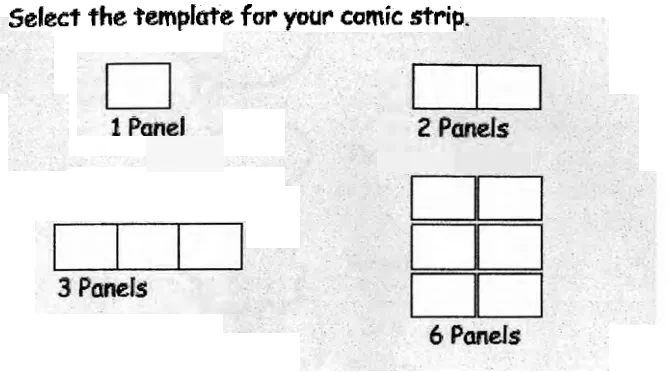
the ternplate
farvsur
cornis stfirFigure 2.3(a) Panel
Description:
A panel is an individual frame, or single drawing, in the multiple-panel sequence of a comic strip or comic book. A panel consists of one drawing that depicts a single moment. Comic strips in daily newspapers typically consist of either four panels or three,
all
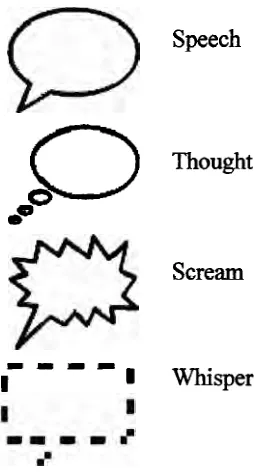
of the same size. In Asia, a vertical 4-panel arrangement is common in newspapers. In a comic book or graphic novel, the shapes of panels and the number of panels on a page may vary widely. [image:23.525.120.454.69.255.2]Speech balloons (also speech bubbles, dialogue balloons, or word balloons) are a graphic convention used most commonly in comic books, strips, and cartoons to allow words (and much less often, pictures) to be understood as representing the speech or thoughts of a given character in the comic. There is often a formal distinction between the balloon that indicates thoughts and the one that indicates words spoken aloud: the bubble that conveys subjective thoughts is often referred to as a thought balloon.
Speech
0
Thought0
OF'
Scream
1 - 11
[image:24.525.206.333.66.303.2]I I Whisper