White Rose Research Online URL for this paper: http://eprints.whiterose.ac.uk/93377/
Version: Accepted Version
Article:
Hartman, T.K. and Weber, C.R. (2009) Who said what? The effects of source cues in issue frames. Political Behavior, 31. 537 - 558. ISSN 1573-6687
https://doi.org/10.1007/s11109-009-9088-y
The final publication is available at Springer via http://dx.doi.org/10.1007/s11109-009-9088-y
[email protected] https://eprints.whiterose.ac.uk/
Reuse
Unless indicated otherwise, fulltext items are protected by copyright with all rights reserved. The copyright exception in section 29 of the Copyright, Designs and Patents Act 1988 allows the making of a single copy solely for the purpose of non-commercial research or private study within the limits of fair dealing. The publisher or other rights-holder may allow further reproduction and re-use of this version - refer to the White Rose Research Online record for this item. Where records identify the publisher as the copyright holder, users can verify any specific terms of use on the publisher’s website.
Takedown
If you consider content in White Rose Research Online to be in breach of UK law, please notify us by
Running Head: WHO SAID WHAT
Who Said What? The Effects of Source Cues in Issue Frames*
Todd K. Hartman
Department of Government and Justice Studies Appalachian State University
Boone, NC 28607
&
Christopher R. Weber Department of Political Science Manship School of Mass Communication
Louisiana State University 217 Stubbs Hall Baton Rouge, LA 70803
Abstract
Drawing on previous research concerning the role that source cues play in political information
processing, we examine whether an ideological identity match between the source of a framed
message and the respondent moderates framing effects. We test our hypotheses in two experiments
concerning attitudes toward a proposed rally by the Ku Klux Klan. In Experiment 1 (N = 274), we
test our hypothesis in a simple issue framing experiment. We find that framing effects occur for
strong identifiers only when there is a match between the ideology of the speaker and respondent. In
Experiment 2 (N = 259), we examine whether matched frames resonate equally well when
individuals are simultaneously exposed to competing frames. The results from this experiment
provide mixed support for our hypotheses. The results from our studies suggest that identity
Who Said What? The Effects of Source Cues in Issue Frames
Over the past two decades, public opinion scholars have accumulated strong evidence of
framing effects for a wide range of social and political issues (Gamson, 1992; Gamson and
Mogdigliani, 1987; Iyengar, 1991; Iyengar and Kinder, 1987; Kinder and Sanders, 1996; Nelson and
Kinder, 1996; Nelson, Clawson, and Oxley, 1997; Schuman and Presser, 1981). Consistent evidence
has demonstrated that subtle differences in the presentation of information can influence how
people form and change their political attitudes (for an excellent summary, see Druckman, 2004, as
well as Chong and Druckman, 2007a). This research has led some scholars to revisit models of
information processing and conclude that citizens do not possess concrete attitudes, per se; rather,
they construct opinions based upon whatever information is accessible at the time (Zaller and
Feldman, 1992). This “top-of-the-head” approach suggests that characteristics of the sender,
receiver, and message interact to produce attitude formation and change (Zaller, 1992). In this paper,
we extend this line of inquiry by considering the role of social influence in political communication.
Specifically, we explore whether ideological identities of the message source and recipient affect
susceptibility to issue frames.
Theory and Hypotheses
Scholars have traditionally defined framing as the process by which potentially relevant
considerations are made available, which, in turn, influence how an individual thinks about an issue
(Nelson et al., 1997). A framing effect occurs when the considerations highlighted in a frame move
people to endorse or oppose a specific policy (Gamson, 1992). A frame is said to be effective when
it shifts an opinion distribution in a particular direction. For example, individuals exposed to a
freedom of speech frame are more likely to allow a disliked group to demonstrate in public, while
rights (Nelson et al., 1997). Chong and Druckman (2007a) note that a "major premise of framing
theory is that an issue can be viewed from a variety of perspectives and be construed as having
implications for multiple values or considerations" (p. 104).
Framing effects have been documented in diverse contexts such as attitudes towards
unpopular social groups (Chong, 1993; Nelson et al., 1997; Nelson and Kinder, 1996; Schuman and
Presser, 1981), welfare (Brewer, 2001), campaign finance reform (Druckman and Nelson, 2003), and
moral issues (Feldman and Weber, 2008.). Indeed, issue framing is so ubiquitous that public opinion
can often be gauged based upon the frames used by elites. This has led many scholars to focus
almost exclusively on how the media and elites present political issues, assuming a priori that public
opinion will follow suit (Chong and Druckman, 2007a).
However, second-generation framing research has increasingly focused on instances of when
framing does (or does not) occur (Brewer, 2003, 2005; Chong and Druckman, 2007b; Druckman,
2001a, 2001b, 2004; Druckman and Nelson, 2003; Sniderman and Theriault, 2004). For example,
scholars find that framing effects are attenuated when individuals are immersed in heterogeneous,
cross-cutting social networks (Druckman and Nelson, 2003) or when the media outlet carrying a
message is viewed as untrustworthy (e.g., The National Enquirer; Druckman, 2001a). Recent work
has also demonstrated that multifaceted information environments reduce framing effects in what
has been called dual or competitive framing (Brewer, 2003, 2005; Chong and Druckman, 2007b;
Druckman, 2001a, 2004; Druckman and Nelson, 2003; Sniderman and Theriault, 2004; see also
Zaller, 1992). Evidence has also suggested that individual-level political and psychological factors
influence framing, such as motivation (Druckman and Nelson, 2003) and ability (Brewer, 2003).
Only recently have political scientists started to explore how social factors influence issue
framing (for a review, see Chong and Druckman, 2007a). Distal factors – social context, message
this research. In this paper, we explore an empirically overlooked aspect of issue framing: Whether
identification with the source of a message moderates framing effects.
Framing and Social Context
We start with the observation that political information is rarely reported without some type
of source information (Druckman, 2001b; McGuire, 1969; Zaller, 1992). Consider the heated
debates about immigration leading up to the midterm elections in 2006. News coverage discussed
the core issues at stake, as well as reported the positions, via direct statements or indirect
attributions, of the political groups involved (e.g., Democrats vs. Republicans; liberals vs.
conservatives, etc.). Source information placed the debate within a larger political context, and
simply knowing where like-minded individuals stood on the issue was likely integral to opinion
formation.
We examine the importance of source cues in two settings. First, we test the role of cues
when the information flow is asymmetric. Next, we create an environment in which information is
presented competitively—that is, participants are offered competing issue positions from different
sources. We draw heavily from theories of social influence and explore how the likeability of a
message source affects asymmetric and competitive framing environments.
Social psychological research has demonstrated the importance of source cues in attitude
formation and change (Kelman, 1958; French, 1956; French and Raven, 1959). Much of this
literature has found that source information can be arrayed on several qualitatively different
dimensions: Power, credibility, and identification (Eagly and Chaiken, 1993; Kelman, 1958, 1961;
Lazarsfeld, Berelson, and Gaudet, 1948; McGuire, 1969; Zaller, 1992). The distinction between these
three forms of social influence is empirically important, as each of them influences attitude change
authority figure is a qualitatively different process than changing one’s beliefs to maintain an
ongoing relationship—the former results in less stable beliefs, the latter in more durable beliefs. For
example, Kelman (1958) finds that conformity due to power differences leads to compliance, and
individuals maintain a given belief insofar as an authority figure is present or is perceived to be
surveying the situation (Bond and Smith, 1996; Milgram, 1974; Zimbardo, 2007; for a review, see
Cialdini, 1984).
Credibility induced conformity refers to the objective or subjectively perceived expertise of
the source—a credible source is generally rated as more trustworthy, persuasive, and convincing
(Eagly and Chaiken, 1993). In an issue framing experiment, Druckman (2001a) demonstrated
framing effects were attenuated when the source of the message was viewed as untrustworthy (e.g.,
The National Enquirer) but enhanced when the message was perceived as credible (e.g., The New
York Times). Credibility exerts its strongest influence when the participant’s motivation is on
forming accurate opinions (Kelman, 1961).
A third, and less explored, dimension is the degree of identification with the source.
Identification-produced conformity leads one to adopt a position to maintain an identity, and so
long as an identity is salient, the belief will be maintained. Whereas credibility hinges on source
expertise, identification stems from the desire to maintain a positive self- image and identity within a
particular group. Indeed, the social groups that one belongs to often serve as an important source of
information regarding the values one holds (Conover and Feldman, 1984; Hooghe and Marks, 2004;
Huddy, 2001; Shamir and Arian, 2000; Sniderman et al., 2003; Tate, 2003). Simply knowing how a
fellow partisan stands on a political issue is often sufficient in forming a belief. For example, Tomz
and Sniderman (n.d.) find that using political brand names (party or ideological labels) dramatically
increases the level of issue constraint across and within domains (irrespective of an individual's
hold logically contradictory beliefs—for instance, a conservative’s endorsement of the death penalty
but opposition to abortion; or a liberal’s position that abortion is a woman’s fundamental right but
that the death penalty is murder; or why conservatives generally favor more government spending in
the case of national defense but less for domestic issues, and vice-versa for liberals (Cohen, 2003; for
an interesting interpretation of these contradictions, see Lakoff, 2003). The very assumption that
one’s group holds similar moral-commitments is often a potent indicator of political beliefs. As
noted by Cohen (2003) “social meaning is not inferred but transferred [and] it is defined by the
judgments of other individuals who are trusted to share one’s moral allegiances—that is, individuals
who share one’s social identity” (p.809).
Since much of the extant work in political science has focused on how elites and experts
shape opinion, it remains an unanswered question as to whether people’s identification with the
message source facilitates political persuasion, in general, and framing, in particular. It is reasonable
that issue frames imbued with partisan cues may not moderate framing effects. This is because
psychological process underlying issue framing has been shown to result from greater importance
attached to a given set of considerations (cf., Slothuus, 2008). Usually, the considerations drawn
upon in issue frames are familiar, such as a set of core values common to the given political culture
(McClosky and Zaller, 1982). For this reason, it is conceivable that the values themselves could
overshadow the effects of any identity-relevant cues (Nelson and Garst, 2007).
Yet, empirical work has also suggested that identity cues affect persuasion. For instance,
Zaller (1992) notes that partisan predispositions often indicate how citizens consider political issues,
and cues offered by elites can be so powerful that they often define the political debate (see also
Brewer, 2005). Mondak (1993) similarly finds that source cues are frequently used as a heuristic in
source of the message moderates the intensity of framing effects.1 Here, framing effects were
reduced for Democrats who evaluated a Republican program and vice versa.
Because of these competing possibilities surrounding the effects of source cues in issue
frames, we sought to examine the role of ideological identification in this process. While there are
many identities we could have explored – such as party attachments, race, gender, and so on – we
opted to use ideological labels, since they are used so often in debates about political issues.
Moreover, we wanted to demonstrate that ideological identification can serve as an important source
of information in political communication. Note that this implies we view ideology in these studies
as a symbolic group label - an identity (Conover and Feldman, 1981) – rather than solely as indicator
of issue consistency or a constellation of values and beliefs (Converse, 1964).
We explore the role of source identification in two experiments: One in which asymmetric
frames were presented and only one source was offered to each subject; the second where dual,
competing frames were used. In these two experiments, we test an assimilation hypothesis, which states
that the stronger an individual identifies with a message source, the more likely that individual will demonstrate
framing effects (and vice versa). In other words, we expect that an identity match between the source and
respondent’s ideology will heighten framing effects, while an ideological mismatch will attenuate
such effects. The asymmetric framing experiment highlighted a single value: Whether the Ku Klux
Klan should be allowed to march on campus because of free speech or public orderconsiderations.
The competitive framing experiment drew on both values: While some feel the KKK should be able
to march and exercise their first amendment rights, others feel that the KKK are a threat to public
order and safety. What is more, we examine the role of identification by varying the position taken
by liberals and conservatives. 1
Experimental Design
Data
A total of 533 undergraduate students from Stony Brook University participated in our
studies for extra credit during the 2005-2006 academic school year (Experiment 1: N = 274;
Experiment 2: N = 259). Of this total, 56% of subjects were male and 44% were female. Forty-six
percent of subjects identified their race as “White,” 23% as “Asian,” 10% as “African-American,”
7% as “Hispanic or Latino,” and 13% chose to identify themselves as “Other.” The majority—
roughly 63%—of participants stated that they generally considered themselves to be Democrats,
with 20% listed as Republicans and 17% as non-leaning Independents.2
Procedure and Measures
We designed two experiments to test the extent to which source cues moderate framing
effects. In Experiment 1, we examined the impact of source cues in asymmetric, or one-sided,
information flows. Participants read a fictitious newspaper article about the KKK's recent petition to
hold a rally on campus (see the Appendix for the exact wording). Subjects were randomly assigned
to one of four experimental conditions formed by a simple 2 (value frame: free speech vs. public
order) x 2 (source ideology: liberal vs. conservative) between-subjects design. We coded these factors
as dummy variables so that value frame is 1 for the public order frame and 0 for the free speech
frame, and source ideological identity is 1 for a conservative speaker and 0 for a liberal speaker.
In Experiment 2, we tested the importance of source cues in symmetric, or two-sided,
information environments. Once again, participants read the fictitious article about the KKK's
recent petition to hold a rally on campus. This time, however, participants were exposed to both of
the free speech and public order frames, and we varied the ideological source that endorsed each
particular frame. In other words, participants either received a free speech frame from a liberal
source and a public order frame from a conservative speaker, or vice versa. We expected that the
relative weights attached to the free speech and public order frames would be a function of the
positions taken by the ideologically congruent source.
Before reading the experimental materials, subjects rated their feelings toward a number of
different groups (e.g., Blacks, Whites, homosexuals, Christian fundamentalists, etc.) on 9-point
scales. We used their responses to two key groups—liberals and conservatives—to create a measure
of ideological identification, since these items asked respondents to judge how “warm or favorable”
they felt to each of the two groups. We subtracted each subject’s feelings toward liberals from their
feelings toward conservatives and then rescaled this variable from 0 to 1, where higher scores
indicate warmer feelings toward conservatives. We use feeling thermometers – rather than
ideological self-placement – because research in social psychology has demonstrated that
identification is manifest in one’s degree of liking or disliking the source. It is important to note that
all our substantive findings are nearly identical when we use a self-placement measure of ideology.
The resulting identification measure was then mean-centered (see Aiken and West, 1991; Jaccard and
Turrisi, 2003). Throughout our analysis, we also control for a number of demographic variables:
Gender (males serve as the baseline category), party identification (measured on a 7-point scale and
rescaled from 0 to 1, where high scores indicate strong Republican identifiers), race (Whites serve as
the baseline). Our results are substantively identical if we exclude these controls, but by controlling
for them, we obtain a better estimate of framing effects.
After exposure to the framing manipulation, we asked respondents to answer several
questions that serve as our dependent variables. First, subjects indicated their level of support for
Brook University should or should not allow the Ku Klux Klan to hold a rally on this campus?”
Responses to this attitude item ranged from 1 (“Definitely Should be Allowed”) to 9 (“Definitely
Should NOT be Allowed”). We recoded this dependent variable from 0 to 1, where high scores
indicate greater support for the rally. In some ways, support for the rally could be thought of a
measure of context-specific tolerance.
We also measured each respondent’s general tolerance by creating a scale of 3 items concerning
the extension of rights to disliked groups (Experiment 1: KR-20 = 0.65; Experiment 2: KR-20 =
0.54). For example, participants had to choose whether to allow disliked groups, such as the
Neo-Nazis, to appear on public television. We combined these 3 items to create a 4-point scale that we
recoded from 0 to 1, where high scores indicate greater levels of general tolerance.
Results
Experiment 1: One-Sided Information Flows
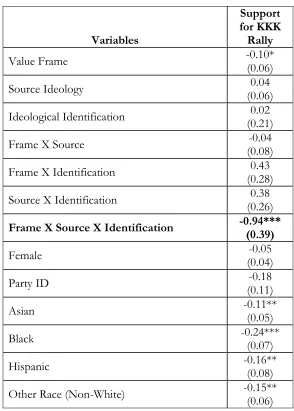
To test our assimilation hypothesis—that an identity match between message source and
recipient moderates framing effects—we regressed support for the KKK rally on the frame X source
ideology X ideological identification three-way interaction, along with all of its constituent terms and a set
of control variables (see Table 1).3 Looking at the results in Table 1, we find initial support for our
assimilation hypothesis with a statistically significant 3-way interaction (B = -0.94, SE = 0.39,p <
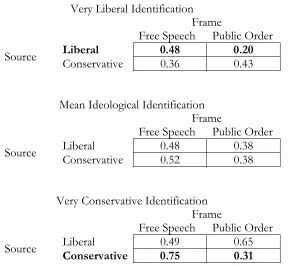
0.05). To further explicate this interaction, we calculated mean values of the frame X source ideology
2-way interaction at theoretically interesting levels of the ideological identification moderator variable
3 We also conducted a series of analyses with the standard 7-point NES ideology item in place of our differenced
ideological identification measure and found the same statistically significant 3-way interaction presented in Table 1 (B =
-0.78, SE = 0.36, p < 0.05). For subjects in the liberal matching condition, we found a statistically significant slope for
frame, B = -0.22, SE = 0.11, p<0.05; for conservatives this matching effect was even more pronounced, B = -0.43, SE =
0.17, p<0.01. For strong identifiers in the mismatched conditions, there were no framing effects: A conservative source
paired with liberal identifiers, B = 0.04, SE = 0.11, n.s.; a liberal source paired with conservative identifiers, B = 0.08, SE
(see Aiken and West, 1991; Jaccard and Turrisi, 2003 for a full methodological discussion). We
present these 2 X 2 tables in Table 2.
[INSERT TABLE 1 ABOUT HERE]
When there is an ideological match between the source of the framed message and the
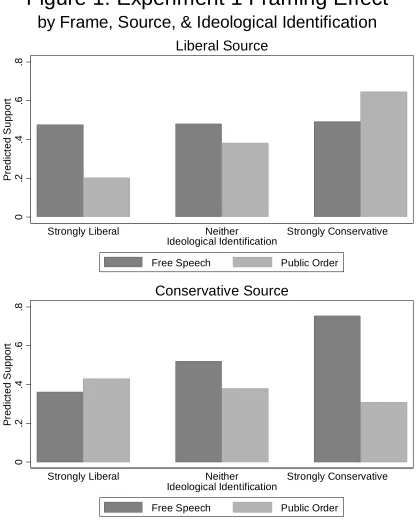
recipient, we find a strong assimilation effect. For instance, when the message source is liberal and
the recipient strongly identifies with liberals, individuals exposed to the free speech frame were
much more likely to support the KKK’s request to rally than those exposed to the public order
frame (MeanFree Speech = 0.48, SEFree Speech= 0.09; MeanPublic Order = 0.20, SEPublic Order= 0.11; t = 2.17,
p<0.05). Likewise, when the source is conservative and the recipient identifies strongly with
conservatives, we once again find an assimilation effect (MeanFree Speech = 0.75, SEFree Speech= 0.12;
MeanPublic Order = 0.31, SEPublic Order= 0.14; t = 2.67, p<0.01). In fact, the mean difference for
conservatives is quite large – a full 0.45 points on a scale ranging from 0 to 1.
[INSERT TABLE 2 ABOUT HERE]
In contrast, when there is an ideological mismatch between message source and recipient, we
find no evidence of framing effects. Liberal identifiers exposed to the frames from the conservative
source were no more likely to grant procedural protections to the KKK when presented with the
free-speech relative to public-order frame (MeanFree Speech = 0.36, SEFree Speech= 0.10; MeanPublic Order =
0.43, SEPublic Order= 0.11; t = 0.54, n.s.). Similarly, conservative identifiers showed no assimilation
effect when exposed to frames from a mismatched, liberal source (MeanFree Speech = 0.49, SEFree Speech=
0.14; MeanPublic Order = 0.65, SEPublic Order= 0.14; t = 0.86, n.s.).
Interestingly, subjects at the mean level of ideological identification—that is, those
individuals who neither identified strongly with liberals nor conservatives—showed a small framing
effect regardless of the source. When presented with the value frames from the liberal speaker,
Speech= 0.05; MeanPublic Order = 0.38, SEPublic Order= 0.05; t = 1.70, p<0.10). And, when non-identifiers were exposed to messages from the conservative source, a similar 0.12 point framing effect was
discovered (MeanFree Speech = 0.52, SEFree Speech= 0.05; MeanPublic Order = 0.38, SEPublic Order= 0.05; t = 2.44,
p<0.05). As one might intuitively expect, subjects who do not strongly identify with liberals or
conservatives appear to ignore or discount the ideological source information. This particular
finding fits well with existing research on source cues (Kelman, 1958; Zaller, 1992). The mean levels
of support for the frame X source interactions at levels of the identifier moderator variable are also
presented in Figure 1.4
[INSERT FIGURE 1 ABOUT HERE]
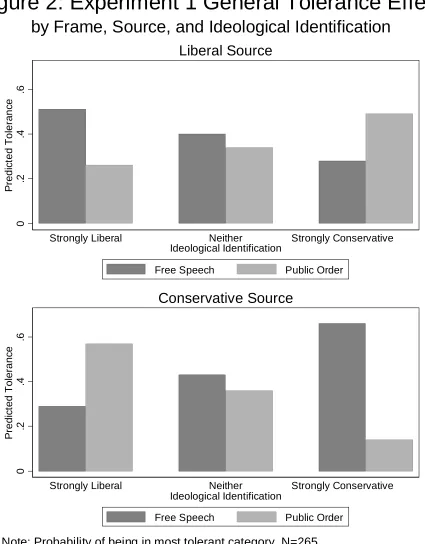
In addition to the moderated effects of attitudes toward the KKK rally, we also find similar
results when we examine measures of general tolerance. Since the categorical nature of our general
tolerance dependent variable—only 4 points—violates the assumptions underlying standard
regression procedures, we used an ordered logit (with all of the constituent terms and lower-order
interactions) to test our identity matching hypothesis (Brambor, Clark, and Golder, 2005). As with
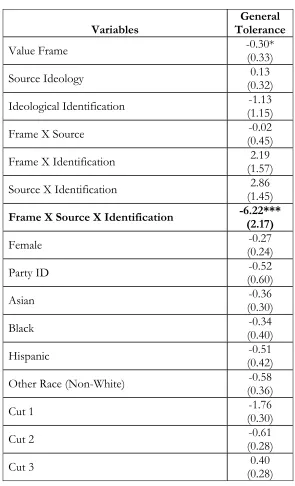
the specific measure of support for the KKK rally, we also find evidence that the value frames alter
levels of general political tolerance (frame X source X identification interaction: B = -6.22, SE = 2.17,
p<0.01).5 The results from this model are included in Table 3. As the coefficients from this ordered
logit are not directly interpretable, we generated predicted values (for being very tolerant) and
plotted them in Figure 2.
[INSERT TABLE 3 ABOUT HERE]
The results for the general tolerance dependent variable parallel our earlier findings. If
subjects identify strongly with the message source, they assimilate the specific value frame into their
4 Not surprisingly, we also find a main effect for all non-white subjects, such that they were less supportive (and tolerant)
of the KKK rally.
5 This 3-way interaction holds when we use the 7-point NES ideology item as a measure of ideological identification:
attitudes toward general tolerance. For example, when the message is delivered by a liberal and the
participant strongly identifies with liberals, the probability of expressing tolerance is significantly
greater following exposure to the free speech frame (0.51) versus public order frame (0.26), =
-1.18, SE = 0.68, p<0.10 (see Jaccard, 2001 for a methodological discussion of interpreting
interaction effects in logistic regression models). This pattern is even more pronounced for strong
conservatives identifiers exposed to a message from a conservative source—the probability of being
very tolerant is significantly greater following free speech (0.66) than public order (0.14), B = -2.72,
SE = 0.94, p<0.01. Once again, we find no framing effects for attitudes toward general tolerance
when the message comes from an uncongenial source. When the message comes from a
conservative source and is received by a liberal identifier, there is a statistically significant rejection of
the frame, such that it creates a contrast effect of the specific value frame (i.e., the frame has the
opposite intended effect; B = 1.30, SE = 0.69, p<0.10. When the reverse is true—that is, when a
liberal source presents frames to a strong conservative identifier, we find no evidence of framing
effects (B = 1.01, SE = 1.02, n.s.). Unlike before, we find no general tolerance framing effects for
our subjects that are ideologically unidentified. In sum, these results confirm our assimilation
expectation that an ideological match facilitates framing effects.
[INSERT FIGURE 2 ABOUT HERE]
Since the ideological match between message source and recipient appears to override the
main framing effect of considerations in the message, we sought to examine the process by which
this occurs. In accordance with previous work suggesting that framing is driven by the relative
weight attached to certain values addressed in the frame – rather than altering the core basis of one’s
importance attached to free-speech and public-order values. To examine this mediated-moderation, 6 we
first reproduced the significant frame X source X ideological identification interaction for attitudes toward
the KKK rally, B = -0.94, SE = 0.39,p < 0.05.7
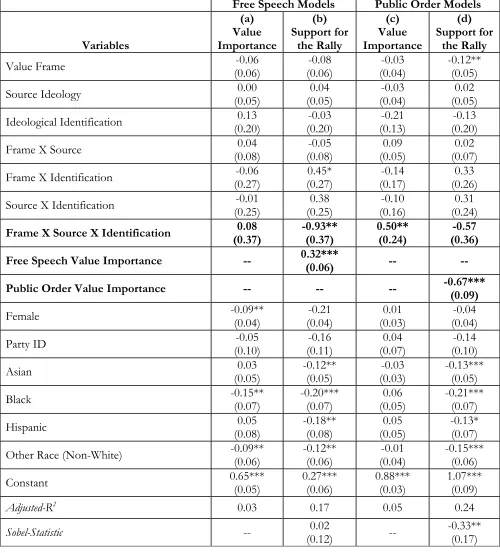
Next, we regressed each of the two value importance dependent variables (i.e., free speech
and public order) on the key 3-way interaction, as well as all of the lower order terms and control
variables (see Columns A and C of Table 4). This analysis yielded a statistically significant frame X
source X ideological identification interaction for public order values (B = 0.50, SE = 0.24, p<0.05) but
not for free speech values (B = 0.08, SE = 0.37, n.s.).8 A closer inspection of the interaction for
public order values reveals that the matching effect is driven largely by our conservative identifiers,
who demonstrated a 0.27 point difference (on a scale from 0 to 1) in mean public order importance
ratings when exposed to the public order frame relative to the free speech frame by a conservative
source (B = 0.27, SE = 0.10, p<0.01).
[INSERT TABLE 4 ABOUT HERE]
Finally, we regressed support for the KKK rally on each of the value importance measures,
the critical 3-way interaction, and all of the lower order terms and control variables.9 As evidenced in
Columns B and D of Table 4, the value importance ratings significantly predict support for the rally.
First, moving from the lowest to highest ratings of free speech values increases support for the
KKK rally by 0.32 on a scale from 0 to 1. In contrast, a one unit change in ratings of public order
values decreases support for the rally by 0.67, which is more than two-thirds of the entire scale.
More importantly, public order value importance ratings mediate our frame x source x ideological
6 According to Baron & Kenny (1986), mediated-moderation is tested as follows: (a) The dependent variable must be
significantly predicted by the independent variable in the absence of the mediator variable, (b) the mediator must be significantly predicted by the independent variable, and (c) in an equation with both the mediator and independent variable, the independent variable should have no effect and/or be significantly reduced, while the mediator should significantly predict the dependent variable.
7 This 3-way interaction satisfies Baron & Kenny’s (1986) first criterion of mediated moderation.
8 These models tests Baron & Kenny’s (1986) second criterion of mediated-moderation.
identification interaction, since the importance ratings are predicted by the 3-way interaction and
reduce its effect on support for the rally (see Columns C and D of Table 4). Substantively, this
means that the identity matching effect is conveyed by the relative importance attached to public
order values. These results suggest that the psychological process by which identity matching occurs
is quite similar to the processes documented in previous framing research (e.g., Druckman and
Nelson, 2003; Nelson et al., 1997).
Experiment 2: Two-Sided Information Flows
As we noted already, one of the criticisms of standard framing studies is their lack of
external validity. Only recently have scholars begun to explore the effects of competitive frames,
often finding that exposure to multiple sides of a debate reduce framing effects (Brewer, 2003;
Brewer and Gross, 2005; Druckman, 2004; Druckman and Nelson, 2003; Sniderman and Theriault,
2004). What remains unclear, however, is whether this “cancellation effect” would occur in the
presence of source cues and identity matching. To answer this question, we turn to the data from
Experiment 2, in which participants were exposed to both free-speech and public-order frames but
from different ideological sources.
Recall that we assigned participants to one of two competitive frame conditions
(frame-source: free speech-liberal source and public order-conservative source or public order-liberal source
and free speech-conservative source). Now we are primarily interested in the competitive frame X
participant ideology interaction. To examine the effects of the competitive frames with source cues on
attitudes toward the KKK rally, we regressed support for the KKK rally on the crucial 2-way
interaction, as well as its lower-order constituent terms and a set of control variables. The analysis
yielded a non-significant 2-way interaction (B = 0.30, SE = 0.20, n.s.), which appears to replicate the
we found similar nonsignificant findings for an ordered logit model of the 4-point general tolerance
dependent variable on the 2-way interaction (including main effects and controls, B = 0.23, SE =
1.09, n.s.).10 In sum, we failed to observe a framing effect even when a clear position was taken by
liberals and conservatives in the debate.
It is conceivable, however, that the relative importance attached to values of free speech or
public order vary as a function of source cue matching effects. To test this possibility, we regressed
each of the two value importance items on the competitive frame X ideological identification interaction, its
lower-order constituent terms, and a set of controls. Here, we do find a significant 2-way interaction
for public order values (B = -0.26, SE=0.12, p<0.05) but not quite for free speech values (B = 0.27,
SE=0.19, n.s.). To further explore this interaction, we calculated predicted values of endorsing the
public order values by experimental condition and ideological identification.
For subjects who strongly identify with liberals, public orderconsiderations were clearly
rated as important to the decision of whether to support the KKK rally request, and source cues
signaled that greater weight should be placed on this particular value (MeanLFS-CPO = 0.74, SELFS-CPO=
0.05; MeanLPO-CFS = 0.87 SELPO-CFS= 0.05; t = 2.28, p<0.05).
11 Similarly, our strong conservative
identifiers also demonstrated that the public order value importance ratings are moderated by source
cues. For instance, they show a 0.14 point difference in ratings of how important public order values
are when presented by a conservative versus liberal source (MeanLPO-CFS = 0.69, SELFS-CPO= 0.07;
MeanLFS-CPO = 0.83 SELPO-CFS= 0.06; t = 1.84, p<0.10).
Now if we substitute the standard 7-point NES measure of ideology as our variable for
identification with the message source, we find evidence that cues moderate ratings of value
importance for both free speech and public order values. For strong liberals, this amounts to a 0.14
10 We find no differences when we substitute the 7-point NES ideology item as a measure of ideological identification
for the frame-source X identification interaction, B = 0.16, SE=0.18, n.s. Likewise we report null results for the ordered logit
using the substituted measure of ideological identification, = 0.47, SE=0.97, n.s.
point difference for free speech values when a liberal source presents the free speech vs. public
order frame, regardless of the presence of the competitive frame (MeanLFS-CPO = 0.59, SELFS-CPO=
0.07; MeanLPO-CFS = 0.44 SELPO-CFS= 0.07; t = 1.84, p<0.10).
12 Strong conservative identifiers also
seem receptive to the values being expressed by conservative sources in our competitive frames, as
they rated the importance of free speech values by 0.29 points higher when a conservative source
presented the free speech frame compared to when the liberal presented the same information
(MeanLFS-CPO = 0.57, SELFS-CPO= 0.09; MeanLPO-CFS = 0.86 SELPO-CFS= 0.10; t = 2.59, p<0.01). For public
order value importance ratings, these source effects are present for our liberal and conservative
identifiers. For instance, strongly identified liberals indicated a difference in ratings of the
importance of public order values of 0.11 points (MeanLFS-CPO = 0.76 SELFS-CPO= 0.04; MeanLPO-CFS =
0.86 SELPO-CFS= 0.05; t = 2.14, p<0.05). Interestingly, we did not find any significant differences for
non-identifiers across competitive frame conditions for ratings of both free speech values (B = 0.02,
SE = 0.04, n.s.) and public order values (B = 0.02, SE = 0.03, n.s.).
While source cues do not resonate as heavily with ideologues exposed to two-sided
information flows (relative to one-sided flows), these cues did influence the relative weights attached
to free-speech versus public-order considerations. We believe that this is still an important, albeit
exploratory, finding. Although competing frames may attenuate the effect of the frame on specific
attitudes (i.e., they appear to “cancel” each other out), they can still influence the importance
attached to a particular consideration. As Brewer and Gross (2005) note, one reason why
competitive frames reduce net framing effects is that it is less clear to the individual which value to
rely upon when forming an evaluation. If this is true, then the relative weight attached to free speech
or public order values would be less influential in predicting support for the KKK rally following
exposure to both sides.
One way to test this is by examining the simple correlations between tolerance and the value
importance measures – free speech and public order- in the two experiments. The relation between
the value and the issue should be muted when exposed to competing sides vis á vis the competitive
frame experiment. In the asymmetric framing experiment, the zero-order correlation between
support for the rally and the importance attached to public order was -0.39; whereas in the
competitive experiment the correlation drops to -0.27. Similarly, the correlation between support for
the rally and freedom of speech was 0.46 in the asymmetric framing experiment, yet was 0.36 in the
competitive frame experiment. Overall, the relation between values and tolerance is reduced when
exposed to two sides of the debate.
Discussion
Although framing effects have been demonstrated in numerous experimental studies, critics
have been quick to point out that these designs fail to mimic how individuals actually receive
information and form opinions. Our study attempts to address this concern by providing message
source information that is common in media reports about political issues. We provided evidence of
an assimilation effect, such that an ideological match between message source and respondent
facilitates framing effects, while a mismatch attenuates these effects. We observe this ideological
matching effect regardless of the actual content of the issue frame or the ideology of the respondent.
In other words, liberals were just as quick to oppose the KKK's request to hold a rally on campus as
they were to support it, provided this political issue was framed by a liberal source. In contrast, a
conservative speaker was unable to significantly shift liberals’ attitudes in any direction, despite using
the exact same language of the liberal speaker. We interpret these results to mean that source
information – particularly a group political label – is crucial to the process of framing. With an
Our findings fit well with Druckman’s (2001b) work on framing and source credibility. On
the one hand, our research replicates Druckman’s finding that source credibility moderates framing
effects. Clearly, receiving information from a source with the same ideological leanings will be
viewed as more credible and trustworthy. On the other hand, we also view our findings as an
important extension of Druckman’s claims, since we examine the general case of identity matching
between message source and recipient. We also were able to demonstrate a novel moderating effect
with something as basic to politics as an ideological label.13 By simply manipulating how “liberals” or
“conservatives” framed the issue, we were able to show that this altered people’s specific attitudes
toward the KKK rally, as well as the importance ascribed to general tolerance values.
While we observed strong identity source cue effects in the asymmetric framing experiment,
these cues had a reduced effect in our competitive framing experiment. We included this experiment
as a boundary test of the importance of source cues in issue framing. Recall that we expected to
observe a polarizing effect, in which liberal respondents would readily accept the position of fellow
liberals and dismiss the position taken by conservatives (and vice versa for conservative
respondents). In our experiment, we found mixed evidence of identity matching. Although we did
not find a significant framing effect when looking at attitudes, we did, however, find a matching
effect for the importance attached to free speech and public order values among strong ideological
identifiers using two measures of identification. Recall that this was not the case for our
non-identifiers in the sample, who indicated no significant difference in the importance attached to free
speech and public order values across competitive conditions (i.e., the “cancellation effect”).
13
Our findings are somewhat at odds with rational updating of partisan attachments (Gerber and Green, 1999). Our experiments suggest that participants do not adjust their identities from the position taken by liberals and
conservatives; rather, participants adjust their positions depending on the position taken by liberals and
The results from these experiments are informative for two reasons. First, our results suggest
that individuals are susceptible to framing effects when exposed to a single consideration from an
ideologically congruent source. One could simply conclude that relying on source information leads
to less thoughtful and deliberative conclusions about political issues. In many respects, we believe
that source information serves as a valuable tool, indicating where fellow group members (with
similar beliefs) stand on important political issues. Second, our competing frame experiment
demonstrates that individuals do not mindlessly follow fellow ideologues in all cases. In an
even-handed debate, in which liberals and conservatives simultaneously present equally valid but opposing
concerns, our data show that ideological cues do not have as strong of an effect on political
attitudes. In other words, source cue effects are weakened when the information stream is
multifaceted.
While our analyses point to the importance of identity source cues, we feel obligated to note
the limitations of our work. We relied on a relatively common issue in the framing literature –
allowing the KKK to rally on campus– in order to demonstrate the bounds of framing effects when
source information is provided. To this end, we provided participants with ideological cues, though
it is unclear how additional source information would function in different framing scenarios. For
instance, with issues that are more crystallized, such as abortion and other emotionally evocative
issues, one might expect source cues to have less effect. Similarly, other source information may be
of greater (or lesser) importance when considering difference political issues. Would partisan source
cues outrival ideological source cues? How important is other source information such as race,
religion, ethnicity, and gender? And, it is unclear how various source cues interact to eventuate
attitude formation and change. Previous research has explored credibility (e.g., Druckman, 2001),
while our research explores identification, but it remains to be determined how credibility and
the moderators of framing effects, we will be better able to understand how political issues are
considered and under what conditions citizens rely on various types of information in formulating
Acknowledgments
This project was completed while we were graduate students at Stony Brook University, and we owe
thanks to our many discussions with the faculty and graduate students there. In particular, we would like
to offer a special thanks to Milt Lodge and Howie Lavine for their guidance, as well as Jamie Druckman
and Paul Brewer for their helpful suggestions. We also thank the editors and anonymous reviewers for
References
Aiken, L. S., and West, S. G. (1991). Multiple regression: Testing and interpreting interactions. Thousand
Oaks, CA: SAGE Publications, Inc.
Baron, R. M., and Kenny, D. A. (1986). The moderator-mediator variable distinction in social
psychological research: Conceptual, strategic, and statistical considerations. Journal of
Personality and Social Psychology, 51, 1173-1182.
Bond, R., & Smith, P.B. (1996). Culture and Conformity: A Meta-Analysis of Studies Using Asch’s
Line Judgment Task. Psychological Bulletin, 119, 111-137.
Brewer, P. R. (2001). Value words and lizard brains: Do citizens deliberate about appeals to their
core values? Political Psychology, 22, 45-64.
Brewer, P. R. (2002). Framing, value words, and citizens’ explanations of their issue opinions.
Political Communication, 19, 303-316.
Brewer, P. R. (2003). The shifting foundations of public opinion about Gay Rights.
Journal of Politics, 65, 1208-1220.
Brewer, P. R., and Gross, K. (2005). Values, framing, and citizens’ thoughts about policy issues:
Effects on content and quantity. Political Psychology, 26, 929-948.
Chong, D. (1993). How people think, reason, and feel about rights and liberties. American Journal of
Political Science, 37, 867-899.
Chong, D., and Druckman, J. N. (2007a). Framing theory. Annual Review of Political Science, 10, 103-
126.
Chong, D., and Druckman, J. N. (2007b). Framing public opinion in competitive democracies.
American Political Science Review, 101, 637-655.
Cohen, G. L. (2003). Party over policy: The dominating impact of group influence on political
beliefs. Journal of Personality and Social Psychology, 85, 808-822.
Conover, P. J. and Feldman, S. (1981). The origins and meaning of liberal/conservative
self-identifications. American Journal of Political Science, 25, 617-645.
Converse, P. E. (1964). The nature of belief systems in mass publics. In D. E. Apter (Ed.), Ideology
and discontent. New York: Free Press.
Druckman, J. N. (2001a). On the limits of framing effects: Who can frame? Journal of Politics,
63, 1041-1066.
Druckman, J. N. (2001b). The Implications of Framing Effects for Citizen Competence. Political
Behavior, 23, 225-256.
Druckman, J. N. (2004). Political preference formation: Competition, deliberation, and the
(ir)relevance of framing effects. American Political Science Review 98, 671-686.
Druckman, J. N., and Nelson, K. R. (2003). Framing and Deliberation: How Citizens'
Conversations Limit Elite Influence. American Journal of Political Science, 47, 729-745.
Eagly, A. H., and Chaiken, S. (1993). The psychology of attitudes. Fort Worth, TX: Harcourt Brace.
Feldman, S., and Weber, C. R. (2008). Understanding social conservatism: Values, threats, and
framing issue preferences. Paper Presented at the annual meeting of the International Society of Political
Psychology, July, 2008.
French, J.R.R., Jr. (1956). A Formal Theory of Social Power. Psychological Review, 63, 181-194.
French, J.R.R., Jr. & Raven, B. (1959). The Bases of Social Power. In D. Cartwright (Ed.), Studies in
Social Power (pp.150-167). Ann Arbor: University of Michigan.
Gamson, W. A. (1992). Talking politics. New York: Cambridge University Press.
Gamson, W. A., and Modigliani, A. (1987). The changing culture of affirmative action. Research in
Gerber, A., and Green, D.P. (1998). Rational Learning and Partisan Attitudes. American Journal of
Hooghe, L., and Marks, G. (2004). “Does Identity or Economic Rationality Drive Public Opinion
on European Integration.” PS.
Huddy, L. (2001). “From Social To Political Identity: A Critical Examination of Social
Identity Theory.” Political Psychology, 22, 127-156.
Iyengar, S. (1991). Is anyone responsible? : How television frames political issues. Chicago:
University of Chicago Press.
Iyengar, S, and Kinder, D. R. (1987). New that matters. Chicago: University of Chicago Press.
Jaccard, J. (2001). Interaction effects in logistic regression. Thousand Oaks, CA: SAGE Publications,
Inc.
Jaccard, J., and Turrisi, R. (2003). Interaction effects in multiple regression. Thousand Oaks, CA: SAGE
Publications, Inc.
Kelman, H.C. (1958). Compliance, identification, and internalization: Three processes of attitude
change. Journal of Conflict Resoluation, 2, 51-60.
Kelman, H.C. (1961). Processes of opinion change. Public Opinion Quarterly, 25, 57-78.
Kenny, D. A., Kashy, D. A., and Bolger, N. (1998). Data analysis in social psychology. In D.
Gilbert, S. Fiske, and G. Lindzey (Eds.), Handbook of social psychology (4th ed., Vol. 1, pp.
233-265). Boston, MA: McGraw-Hill.
Kinder, D. R., and Sanders, L. M. (1996). Divided by color: Racial politics and democratic ideals. Chicago:
University of Chicago Press.
Lazarsfeld, P. F., Berelson, B., and Gaudet, H. (1944). The people's choice; how the voter makes
up his mind in a presidential campaign. New York,: Duell.
McClosky, H., and Zaller, J. (1984). The American ethos : public attitudes toward capitalism and democracy.
McGuire, W. J. (1969). The nature of attitudes and attitude change. In G. Lindzey and E. Aronson
(eds.), Handbook of social psychology (2nd ed., Vol. 3, pp. 136-314). Reading, MA:
Addison-Wesley.
Milgram, S. (1974). Obedience to Authority: An Experimental View. New York: Harper & Row.
Nelson, T. E., Clawson, R. A., and Oxley, Z. M. (1997). Media framing effects of a civil liberties
conflict and its effect on tolerance. American Political Science Review, 91, 567-583.
Nelson, T. E., and Garst, J. (2005). Value-based political messages and persuasion: Relationships
among speaker, recipient, and evoked values. Political Psychology, 26, 489-515.
Nelson, T. E., and Kinder, D. R. (1996). Issue frames and group-centrism in American public opinion. Journal
of Politics, 58, 1055-1078.
Schuman, H., and Presser, S. (1981). Questions and answers in attitude surveys : experiments on question form,
wording, and context. New York: Academic Press.
Shamir, M. and Arian, A. (1999). “Collective Identity and Electoral Competition in Israel.”
American Political Science Review, 93, 265-277.
Slothuus, R. (2008). More Than Weighting Cognitive Importance: A Dual Process Model of
Issue Framing Effects. Political Psychology, 29, 1-28.
Sniderman, P. M., and Theriault, S. M, (2004). The structure of political argument and the logic of
issue framing. In W. Saris and P. Sniderman (Eds.), Studies in public opinion: Attitudes,
nonattitudes, measurement error, and change. Princeton: Princeton University Press.
Tate, K. (2003). Black faces in the mirror : African Americans and their representatives in the
U.S. Congress. Princeton, N.J.: Princeton University Press.
Tomz, M., and Sniderman, P. M. (n.d.). Brand names and the organization of mass belief systems.
Tversky, A., and Kahneman, D. (1981). The framing of decisions and the psychology of choice.
Science, 211, 453-458.
Zaller, J. R. (1992) The nature and origins of mass opinion. New York: Cambridge University Press.
Zaller, J. R., and Feldman, S. (1992). A simple theory of the survey response: Answering questions
versus revealing preferences. American Journal of Political Science, 36, 579-616.
Zimbardo, P. (2007). The Lucifer Effect: Understanding How Good People Turn Evil. New York: Random
Figures
0
.2
.4
.6
.8
P
red
ic
te
d S
up
po
rt
Strongly Liberal Neither Strongly Conservative
Ideological Identification
Free Speech Public Order
Liberal Source
0
.2
.4
.6
.8
P
red
ic
te
d S
up
po
rt
Strongly Liberal Neither Strongly Conservative
Ideological Identification
Free Speech Public Order
Conservative Source
Note: N=268.
[image:30.612.99.515.130.652.2]by Frame, Source, & Ideological Identification
0
.2
.4
.6
P
red
ic
te
d T
o
le
ran
c
e
Strongly Liberal Neither Strongly Conservative
Ideological Identification
Free Speech Public Order
Liberal Source
0
.2
.4
.6
P
red
ic
te
d T
o
le
ran
c
e
Strongly Liberal Neither Strongly Conservative
Ideological Identification
Free Speech Public Order
Conservative Source
Note: Probability of being in most tolerant category. N=265
[image:31.612.95.520.99.643.2]by Frame, Source, and Ideological Identification
Tables
Table 1: Experiment 1 Regression Results Testing Moderated Framing Effect
Variables
Support for KKK Rally
Value Frame -0.10*
(0.06)
Source Ideology 0.04
(0.06)
Ideological Identification 0.02
(0.21)
Frame X Source -0.04
(0.08)
Frame X Identification 0.43
(0.28)
Source X Identification 0.38
(0.26) Frame X Source X Identification -0.94***
(0.39)
Female -0.05
(0.04)
Party ID -0.18
(0.11)
Asian -0.11**
(0.05)
Black -0.24***
(0.07)
Hispanic -0.16**
(0.08)
Other Race (Non-White) -0.15**
(0.06)
Table 2: Experiment 1 Predicted Mean Values Demonstrating Moderated Framing Effect
Very Liberal Identification
Frame
Free Speech Public Order
Source Liberal 0.48 0.20
Conservative 0.36 0.43
Mean Ideological Identification
Frame
Free Speech Public Order
Source Liberal 0.48 0.38
Conservative 0.52 0.38
Very Conservative Identification
Frame
Free Speech Public Order
Source Liberal 0.49 0.65
Conservative 0.75 0.31
Table 3: Experiment 1 Ordered Logit Results for General Tolerance Scale
Variables
General Tolerance
Value Frame -0.30*
(0.33)
Source Ideology 0.13
(0.32)
Ideological Identification -1.13
(1.15)
Frame X Source -0.02
(0.45)
Frame X Identification 2.19
(1.57)
Source X Identification 2.86
(1.45) Frame X Source X Identification -6.22***
(2.17)
Female -0.27
(0.24)
Party ID -0.52
(0.60)
Asian -0.36
(0.30)
Black -0.34
(0.40)
Hispanic -0.51
(0.42)
Other Race (Non-White) -0.58
(0.36)
Cut 1 -1.76
(0.30)
Cut 2 -0.61
(0.28)
Cut 3 0.40
(0.28)
Note: Table entries are ordered logit coefficients with standard errors in parentheses. The
Table 4: Experiment 1 Models Testing Mediated Moderation.
Free Speech Models Public Order Models
Variables (a) Value Importance (b) Support for the Rally (c) Value Importance (d) Support for the Rally
Value Frame -0.06
(0.06) -0.08 (0.06) -0.03 (0.04) -0.12** (0.05)
Source Ideology 0.00
(0.05) 0.04 (0.05) -0.03 (0.04) 0.02 (0.05)
Ideological Identification 0.13
(0.20) -0.03 (0.20) -0.21 (0.13) -0.13 (0.20)
Frame X Source 0.04
(0.08) -0.05 (0.08) 0.09 (0.05) 0.02 (0.07)
Frame X Identification -0.06
(0.27) 0.45* (0.27) -0.14 (0.17) 0.33 (0.26)
Source X Identification -0.01
(0.25) 0.38 (0.25) -0.10 (0.16) 0.31 (0.24) Frame X Source X Identification 0.08
(0.37) -0.93** (0.37) 0.50** (0.24) -0.57 (0.36) Free Speech Value Importance -- 0.32***
(0.06) -- --
Public Order Value Importance -- -- -- -0.67***
(0.09)
Female -0.09**
(0.04) -0.21 (0.04) 0.01 (0.03) -0.04 (0.04)
Party ID -0.05
(0.10) -0.16 (0.11) 0.04 (0.07) -0.14 (0.10)
Asian 0.03
(0.05) -0.12** (0.05) -0.03 (0.03) -0.13*** (0.05)
Black -0.15**
(0.07) -0.20*** (0.07) 0.06 (0.05) -0.21*** (0.07)
Hispanic 0.05
(0.08) -0.18** (0.08) 0.05 (0.05) -0.13* (0.07)
Other Race (Non-White) -0.09**
(0.06) -0.12** (0.06) -0.01 (0.04) -0.15*** (0.06)
Constant 0.65***
(0.05) 0.27*** (0.06) 0.88*** (0.03) 1.07*** (0.09)
Adjusted-R2 0.03 0.17 0.05 0.24
Sobel-Statistic -- 0.02
(0.12) --
-0.33** (0.17)
APPENDIX
1. Stimulus Materials
Free Speech Headline
Headline: Liberals/Conservatives Say Ku Klux Klan Tests Stony Brook’s Commitment to Free Speech
Public Order Headline
Headline: Liberals/Conservatives Concerned about Safety at Ku Klux Klan Rally
Introductory Paragraph (Same for all respondents)
How far is Stony Brook University prepared to go to protect freedom of speech? The Ku Klux Klan has requested a permit to conduct a speech and rally on the Stony Brook campus during the Spring Semester of 2006. Officials and administrators will decide whether to approve or deny the request in January.
Numerous courts have ruled that the U.S. Constitution ensures that the Klan has the right to speak and hold rallies on public grounds, and that individuals have the right to hear the Klan’s message if they are interested. Many of the Klan’s appearances around New York have been marked by violent clashes between Klan supporters and counterdemonstrators who show up to protest the Klan’s racist activities. In one confrontation last July in Buffalo, New York, several bystanders were injured by rocks thrown by Klan supporters and protesters. Usually, a large police force is needed to control the crowds.
Free Speech Frame
Opinion about the speech and rally is mixed. Liberals/Conservatives worry about the rally, but support the group’s right to speak. One Liberal/Conservative remarked “I hate the Klan, but they have the right to speak, and people have the right to hear them if they want to. We may have some concerns about the rally, but the right to speak and hear what you want takes precedence over our fears about what could happen.”
Public Order Frame
Opinion about the speech and rally is mixed. Liberals/Conservatives have expressed great concern about campus safety and security during a Klan rally. One Liberal/Conservative remarked, “Freedom of speech is important, but so is the safety of the Stony Brook community and the security of the campus. Considering the violence at past KKK rallies, I don’t think the University has an obligation to allow this to go on. Safety must be our top priority.”
Note: Stimulus materials taken from Nelson, Clawson, and Oxley (1997). The underlined headings were not presented to subjects, nor was any of the text in bold. For Experiment 1, subjects were randomly assigned one headline and value frame, along with a liberal or conservative speaker. For Experiment 2 (counterframing), subjects received both frames and the headline: “Liberals and Conservatives Disagree about Ku Klux Klan Rally at Stony Brook University.”
2. Attitude toward Allowing the KKK Rally Item
Do you think Stony Brook University should or should not allow the Ku Klux Klan to hold a rally on this campus?
Definitely Should Definitely Should NOT
Be Allowed Be Allowed
3. General Tolerance Items
Free speech should be granted:
only to people who are willing to grant the same rights of free speech to
everyone else.
to everyone regardless of how intolerant they are of other people’s opinions.
Should groups like the Nazis be allowed to appear on public television to state their views? No, because they would offend certain racial or religious groups. Yes, should be allowed no matter who is offended.
A group that wants to buy advertising space in a newspaper to advocate war against another country: should be turned down by the newspaper.
should have as much right to buy advertising space as a group
that favors world peace.