~U1 ΓΡ
B U L L E T I N
OF Τ Η
M B |
" ( I l
m i
i t e r l y
I n f o r
> p e a n
A
t
e
>
m s. ti ï or» B u l l e t i n
=■-»
e
«".sy c ^ <
o f
t
h
e
n i t y
( E c j r
1934
2 .
F = a s t
r e a c t o r s
i r a t
h
e E
u
r o p e a n
n n u n i t
y
S
ι h e
E u r o p e a n
T r a n s u
r a n i u m I r a
i r *
K a r l s r u h e
1 2 .
r ^ l a r l < e c i
m o I e c= t i I e s ;
m
o
d
e
r
n
r <
"Ί Θ C h e m i c a l s y n t h e s e s
o
f m a r k e d
c u l e s
2 . Ί F» r e F > a r a t
ï o n
o
f
m a r k e d
m o l e c = c
b i o s y n t h e s i s
2 . ^
L a b e l l i n g fc> y
r a d i o c h e m i c a l
2 . ^
T ~ h e
s t o r a g e
o
f m a r k e d
m o l e c u l
3 1
E « J r a t o
m
« » ^ ' N / v s
s t i t u t «
o l e
-s b y
h o d s.
' «_i b l i s h ·
: u r a t o m ,
l e p h o n
D i s s e m i η :
t e , S i S 3 ι
e s t 3 «»O ^ O
o f I n f c
I l i a r e i ,
a t i o n
s s e l s .
>r s I_J L>s<= r ¡ p» t : o n r a t e s p l f ^ a ^ e s< » > r e r l e a f .
VcKrurcjr*»"» α p> p> a r α1t_/ s m car r A<: e d" mo / e c r t v Ies
for t / i e j t > r o d t v c r C / o / j «E»f*
< C o v ^ ^ * i Tl·»* {f^rcwM-a < r e ^
■ h ^
E u r a t o m
C Z o m
m
î s s
ί
ο
η ο ι - a n y p e r s o n s
a c t i n g o n i t s b e h a l f d i s c l a i m a l l l i a b i l i t y - w i t h
r e s p e c t t o t h «s c o m p> I « s t «s η e s s o f t h e
î η f o r m
a t ι ο η
c o n t a i n e d
i r u
t h i s
p e r i o d i c a l
=»«τ=
" W ^ l l
a s
t . c »
a n y
d a m a g e
v»v h i c h
m i g h t
r e s u l t
f r o m
t h «s
u s e s
o f
i r i f o r m
a t ι ο π
d i s c l o s e d
< » r
o f
e q u i p n n e n t ,
m e t h o d s
o r
p r o c e s s e s
d e s c r i b e d
t h e r e
i n .
X V r i y
a r t i c l e
p u b l i s h e d
i r »
t h i s
b u l l e t i n
r a r a s a v y
b e
r
e
p
r
o
d
u
c
e
d
i n
^ w h c » I e i
torn-
i r a
ρ
w
i t h c » u t
r e s t r
a c t ï o η ,
p
r
o
v
i
d
e
d
t
h
a
t
t i r a
I^iciOMrG
c r e d ' / t s F r o n t
c o > r e r :
C E I M ,
O a d a r a e h
e
( F r a n c e )
;
i η s î d e
f r o n t
c c » v e r :
C E l s l ,
r l o l
( B e l g i u
* " * Ό 5 p a g e 3 : « C I E r - J , d a d a r a c h e ; p a g e
2 0 : C E l v l , r ^ I o l
Î p a g e
2 4 : B i o l o g y
D e p a r t m e n t ,
C
E
N
,
S a c l a y
( F r a n c e )
;
p a g e
2 7 :
U
η
i v e r s i t y
o f
R . o m e ^
p a g e
3 1
:
S p i r a l e ,
P a r i s ;
p a g e
3 2 :
U
K >
Ä> . E > « ^ . ( U n i t e dK . Ï n g d o m )
;
p > a . g e
3
o f
c o v e r ζ
E u r a t o m ,
J o i n t
R e s e a r c h
d e n t r e
l s p > r a /
* — l l r ï c h
2 ^ ï m
m
e
r
m
a
n
η
i r t o r l y
i g l i s h ,
C B e r m a n ,
F r e n c h ,
I t a l i a n
a n d
D u t c h
S u b s c r i
. ^ w g e n c e
e t
M t s s s a g e r i e s
« d e
l a
P r e s s e
( y ^ w r l _ P . > ,
3 4 ,
r u e
d u
M a r a i s ,
B r u s s e l s ,
B e l g i u m .
Y
e
a
r
l
y
s u b s c r i p t i o n
r a t e s
=
U n i t e d
K L i n g d o m
t
S / — ;
U n i t e d
S t a t e s
^
3 . S O ;
B a s i c
r a t e :
E u r o p é s
"1 2 S
B e l g i a n
F r a n c s
« O t h e r
c o u
r i t r i G Ì s : 1 7 5
B e l g i a n
F r a n c s
S i n g l t s
c o p i a i s :
U n i t e d
K L ï n g d o ^ m
« S / — ;
U n i t e d
S t a t e s
&
1
_
P r i n t e d
i r a
t h e
I M e t h e r l a n d :
Quarterly Information Bulletin of the Euro-pean A t o m i c Energy C o m m u n i t y (Euratom)
1964-2
The Community's mission is t o create the conditions necessary for the speedy estab-lishment and g r o w t h of nuclear industries in the member States and thereby contrib-ute t o the raising of living standards and the development of exchanges w i t h other countries (Article 1 of the Treaty instituting the European Atomic Energy C o m m u n i t y ) .
aaioisotopes raaioiso topi radioisotopen s hip propulsion schiffs antrieb propulsion na vale propulsione nava le scheepsvoortstuwi
ng biology biologie
biologie biologia bio logie medicine medi zin médecine medicin a geneeskunde healt h protection gesundh eitsschutz protection sanitaire protezione s
anitaria bescherming
van de gezondheid automatic data proces sing automatische inf ormation information automatique informa zione automatica auto matische verwerking van gegevens insura nee versicherungswes en assurances assicura zione verzekeringen economics Wirtschaft économie economia e c o n o m i e e d u c a t i o n and training ausbildu ng enseignement inse gnamento onderwijs en opleiding power reactors Icistungsreak t o r e n réacteurs de pu issance reattori di po tenza energie reactor en nuclear fusion ke rnverschmelzung fusi on nucléaire fusione nucleare kernversmei ting radioisotopes r adioisotope radioisot opes radioisotopi ra dioisotopen ship pr opulsion schiffsantrie b propulsion navale propulsione navale scheepsvoortstuwing
biology biologie biolo
gie biologia biologie
medicine medizin mé
decine medicina gene eskunde health pro tection gesundheitssc hutz protection sanit aire protezione sanita ria bescherming van de gezondheid auto matic data processing automatische informa tion information auto matique informazione automatica automatis che verwerking van g egevens insurance v ersicherungswesen as surances assicurazioni verzekeringen econ omics Wirtschaft èco
nomie economia eco
nomie education and training ausbildung enseignement insegn amento onderwijs en opleiding power reac tors leistungsreakto ren réacteurs de pu issance reattori di po tenza energie reactor en nuclear fusion ke rnverschmelzung fusi on nucléaire fusione nucleare kcrnversmel ting radioisotopes r adioisotope radioisot opes radioisotopi ra dioisotopen ship pr
Fast breeder reactors and " m a r k e d " m o l e -cules share the pages of this issue. A p a r t f r o m t h e fact t h a t they both come under the heading of nuclear energy, t h e r e is l i t t l e in c o m -m o n b e t w e e n t h e -m .
In t h e case of t h e d e v e l o p m e n t of fast reac-tors, w e have to do w i t h an a d v e n t u r e , typical of t h e t i m e s in which w e are living, which involves hundreds of highly qualified special-ists, most of t h e m concentrated in large research centres, w o r k i n g t o w a r d s the so-lution of one big p r o b l e m . T h e size of this a d v e n t u r e is indeed such t h a t t h e countries of t h e European C o m m u n i t y have decided to e m b a r k upon it t o g e t h e r and not as sepa-r a t e entities.
" M a r k e d " molecules belong to a t o t a l l y different w o r l d , characterised by the modest scale of t h e apparatus required for t h e i r production and t h e r e l a t i v e l y unspectacular n a t u r e of t h e e x p e r i m e n t s which m a k e use of t h e m .
Whereas the efforts needed to develop fast reactors are expressed in a m o u n t s which t h e i m a g i n a t i o n can hardly grasp, t h e m o n e y required to pay for the m o r e easily produced m a r k e d molecules could be fetched o u t of one person's pocket.
A n d yet, if w e w e r e to add up all t h e c o n t r i -butions to knowledge which t h e various appli-cations of m a r k e d molecules have yielded and will yield in t h e f u t u r e , p a r t i c u l a r l y in t h e field of biology, t h e sum t o t a l would undoubtedly be impressive.
Figure 1—Schematic vertical section of the MASURCA fast critical assembly.
1 Reactor 2 Accelerator 3 Fuel
4 Tilting device for fuel loading
MASURCA, in Cadarache, is one of the two zero energy fast critical assemblies under construction in the European Community (the other is SNEAK in Karlsruhe).
The purpose of these critical assemblies is to provide accurate information on the behav-iour of neutrons in fast reactors. Their flexi-bility will make it possible to vary conditions so as to obtain the data corresponding to the different types of fast reactor which are being envisaged.
Sound experimental data of this kind are obviously indispensable when it comes to putting the design of an actual reactor on the drawing board.
The accelerator shown on the left of the picture is used to give short bursts of neutrons
to obtain "pulsed" conditions.
— a 1 M W loop / mocking-up the
re-— a 10 MW loop \ actor circuits
— a full-scale RAPSODIE reactor vessel.
The loops have been operating since 1962 and have been e x t r e m e l y useful in indicating several areas which had to be modified in the final reactor design; the experience so obtained has been recently reported by Mr. Vautrey at the Rome Symposium on Fast Reactors. The loops are now operating very smoothly and we t h i n k they are now well in hand. They will probably be con-verted in 1964 o r 196S so as t o test different components for future reactors.
The vessel mock-up has been over a year late and the very experience of its con-struction has indicated areas on which more
effort should be put into the real RAPSODIE
vessel. It is going to be used for flow d i s t r i b u t i o n measurement, loading and un-loading experience using the actual RAP-SODIE handling equipment, and, later o n , for thermal shock experiments where the stresses in cases simulating reactor scrams w i l l be measured. This vessel has already
been filled w i t h sodium and is now in operation.
The fuel for RAPSODIE has been developed
by the CEA Plutonium Department at Fontenay-aux-Roses. It has been and is still being extensively tested under irradiation
in the EL-3 reactor before fabrication is
started in 1964. Before it is used in
RAPSO-DIE, we hope t o be able to irradiate
RAPSODIE pins in theFER/V1/reactor(Detroit, USA) to burn-ups of the o r d e r of 20,000 t o 50,000 M W d / t in conditions closely
similar t o those which w i l l exist in
RAP-SODIE.
A critical experiment on the RAPSODIE
core is now under way in the ZPR /// reactor (Arco, Idaho, USA) and is the first plutonium critical e x p e r i m e n t at this facil-i t y ; we are grateful f o r the possfacil-ibfacil-ilfacil-ity offered by the USAEC t o carry out this essential experiment in t h e i r facility.
RAPSODIE should go critical in 1966 and we hope t o use it as a reactor e x p e r i m e n t and fuel irradiation facility f r o m 1967 on.
Research and d e v e l o p m e n t a i m i n g at f u t u r e p o w e r reactors
The research and development p r o g r a m -mes aiming at f u t u r e p o w e r reactors are
being initiated o r pursued in all t h r e e
associations: Cadarache w i l l concentrate on solid-fueled sodium-cooled reactors, Karlsruhe has been and w i l l continue looking into o t h e r cooling systems besides sodium, such as gas at high pressure and dry steam. The Casaccia C e n t r e in Italy is considering advanced fuel systems of the " p a s t e " type2.
The Cadarache effort w i l l soon start w i t h the design of large industrial reactors (500-1000 MWe) which w i l l be used for selecting the main lines of the p r o t o t y p e t o be built as an intermediate step, and t o guide the general research and develop-ment programme. It is planned that
trial companies w i l l share in this stage of the w o r k and some of t h e m are now presenting proposals.
The Cadarache programme will make full use of existing facilities at the site, which are t o be converted into more general testing facilities after having accomplished
t h e i r specific purpose for the RAPSODIE
programme. In addition, steam generation is being studied on a 5 M W sodium loop now being completed at Grand-Quevilly (near Rouen, France).
In addition, MASURCA, the Cadarache c r i t i -cal facility (of which more later) will be fully used for this programme.
The Karlsruhe w o r k started w i t h a prelim-inary gas-cooled conceptual design which has been presented by Mr. Smidt at the recent Argonne meeting.
The w o r k is now concentrated on the design of a sodium-cooled version, and a design study of a dry-steam-cooled reactor is being made in parallel.
These design studies will be carried out till the end of 1965, when it is hoped a decision will be made t o concentrate on one of them and take it t o the prototype stage.
The Karlsruhe programme includes the con-struction of experimental loops for helium and steam testing. Sodium testing is mainly concentrated on heat transfer w o r k since Karlsruhe has full access t o the Cadarache component testing experience as well as t o the experiment developed in the frame-w o r k of a programme supported by the German Government on sodium cooling
of thermal reactors. The SNEAK critical
facility will be extensively used for this programme.
Both programmes involve extensive fuel development. Cadarache w i l l w o r k on oxides, carbides, carbo-nitrides and metallic alloy. This will be mostly studied by the CEA Plutonium Department at Fontenay and Cadarache. The Karlsruhe programme will mostly concentrate on the mixed oxide solution and the w o r k will mostly be carried out w i t h i n the laboratories of
the Euratom Transuranium Institute in
Karlsruhe.
Casaccia has started only recently and is still in the preliminary evaluation stage.
Physics e x p e r i m e n t facilities
The physics experiment facilities have been
planned in p r o p o r t i o n w i t h the enormous problems which remain t o be solved (and which have been emphasised once more by the recent Argonne meeting). These facilities should supplement, rather than duplicate, those already existing elsewhere, and so allow the C o m m u n i t y t o play a significant role in the overall effort in the field.
These experiments include:
SNEAK (Schnelle Null-Energie-Anordnung Karlsruhe—Fast zero energy assembly Karls-ruhe)
SNEAK ¡s a 2,000 liter core critical facility, the construction of which has just started
in Karlsruhe w i t h Siemens as
architect-engineers. This facility will be ready by mid-1965. The plutonium-bearing elements will be in the f o r m of sintered PuOj-UCX pellets at 2 5 % PuCK, contained in stainless steel containers.
Internal cooling of the facility is provided to allow for use of " d i r t y "3 p l u t o n i u m .
MASURCA (MAquette SURgénératrice de CAdarache—Cadarache breeder assembly) MASURCA is a 5,000 liter core critical facility the construction of which has also
just started at Cadarache w i t h
Belgo-Nucléaire as architect-engineer. It will also be ready by mid1965. The p l u t o n i u m -bearing elements are t o be used in the shape of cylindrical rods of 12,5 mm dia-meter of an alloy (uranium-plutonium-iron) developed at Cadarache.
Internal cooling of the assembly is also provided t o allow for use of " d i r t y " p l u t o n i u m .
In both MASURCA and SNEAK a central
heated loop can be inserted for Doppler
and sodium coefficient measurements.4
Both facilities are using the same modular dimension for the tubes of the assembly (which are also compatible w i t h the ZPR's,
ECEL and ZEBRA). It is therefore possible
t o exchange fuel between the machines, and our t w o will actually share a common stock of approximately 400 kg of plutonium (for which negotiations are under way w i t h U K A E A and the USAEC) according t o the needs of a concerted programme.
Experimental fast oxide reactor for Doppler measurement
Because of the importance of the Doppler coefficient and of the difficulty of its evaluation at high temperatures, there was quite early the intention of having at
Karlsruhe another experiment, the "Pow-der Godiva". The aim was t o have an excur-sion reactor and t o measure the Doppler effect " i n a c t i o n " when it terminates the excursion. But the amounts of additional plutonium required for such an experiment, as well as safety considerations, made that project a difficult one. Instead, steps have been taken t o assure participation (finan-cial, scientific and staff contributions), in the SEFOR (South West Experimental Fast Oxide Reactor) project of the South West
Atomic Energy Associates which might be
built by General Electric and used w i t h the
USAEC's support for research and devel-opment and operational tests. The aim is t o measure the Doppler coefficient at high temperature in conditions representative of large fast reactors.
HARMONIE—fast source reactor
A 2 k W fast source reactor (HARMONIE)
is being built at Cadarache for instrument calibration purposes, as well as for driving fast subcriticai assemblies. Construction w i l l be terminated in mid-1965. Experimen-tal w o r k on pulsed and modulated sub-critical assemblies will also be initiated in the very near future at Cadarache.
SUAK (Schnelle Unterkritische Anordnung Karlsruhe—Fast subcriticai assembly Karls-ruhe)
A pulsed fast neutron subcriticai assembly
(SUAK) is being built at Karlsruhe. It is a 3. The conversion of UJ3S in a reactor does not lead
to the production of PuJ i l' only, but also of several
other isotopes of plutonium (Pu-'"', P u - " , etc). Isotopes such as Pu-1'' and Pu-11 are useful because
they are fissile; Pu-"" absorbs neutrons giving P u " . The term " d i r t y plutonium" refers to the fact that the element produced in a reactor is far from containing a single isotope.
It is of obvious interest to study the neutronic conse-quences of the presence of " d i r t y " plutonium and the design of SNEAK (and of MASURCA) provides for this. As the ct-radiation emitted by " d i r t y " plutonium generates heat, cooling has to be provided in order to maintain the temperature in the reactor at a uniform low level.
Figure 2—Schematic cross-section of the RAPSODIE reactor.
The central part (shown in full colour) is the core, where most of the fission reactions take place. The outer region (shown in lighter colour) is the blanket region, where most of the neutron captures by fertile material (U2M) occur, to produce fissile plutonium
(Pu239).
A full-scale prototype power reactor (the next logical step after the experience won from operating RAPSODIE) would typically be fueled with plutonium and natural uranium in the form of mixed oxide U02-Pu02, the plutonium
oxide accounting for about 25°/a of the total.
The RAPSODIE fuel will have the same characteristics. However, as it is smaller, a critical mass can only be obtained by enriching the uranium in the isotope U2 3 5.
rather ambitious flexible assembly housed in a special building t o be completed next year. Specialised pulsed techniques suc-cessfully developed at the C e n t r e f o r thermal reactors w i l l be extensively applied t o fast neutron problems.
STARK (Schnell-Thermischer Argonaut Reakter Karlsruhe—Fast-thermal coupled Argonaut reactor Karlsruhe)
The STARK fast-thermal coupled reactor is being obtained by replacing the central
graphite column of the Karlsruhe Argonaut
w i t h a fast n e u t r o n zone. This alteration w i l l be completed by the end of this year, and the experiment w i l l be used for fast-thermal coupled reactor study, and later on as a fast neutron source for i n s t r u m e n t calibration.
In addition, the experimental physics pro-grammes w i l l make use of facilities provided by the Italian C N E N ' s RB 3 (thermal fast coupled assembly obtained by transforming the existing RB 1 of Bologna) and possibly a steady state o r pulsed source reactor now/ in the preliminary design stage.
Van de Graaff accelerator installations ex-isting at Karlsruhe, Bologna and Cadarache w i l l also be extensively used in full support of the programmes.
Research and d e v e l o p m e n t s u p p o r t
The programmes carried o u t in the three
associations are receiving full support f r o m o t h e r sources. A m o n g the most i m p o r t a n t contributions we might in particular m e n t i o n :
— the CEA liquid metals section of Fon-tenay and Cadarache, where technological development as well as basic studies are carried o u t ;
— the Euratom heat transfer department at Ispra, which is concentrating on basic heat transfer w o r k ;
— the CEA plutonium department, which is carrying out the laboratory scale w o r k at Fontenay and the fabrication develop-ment w o r k at Cadarache in the new plu-t o n i u m hall ;
— the Euratom Transuranium Institute at
Karlsruhe w h i c h , now under construction, should be completed in 1965 but w i l l shortly start active w o r k in a small p r o t o -type laboratory ;
— the Euratorn-CEN Association for the high-flux BR 2 reactor in Mol, which is requested t o carry out a large programme of structural material irradiation tests. Fuel irradiation is also planned in the central hole of BR 2, in a cadmium shielded loop, so that the irradiation w o u l d be carried out in an epithermal and fast neutron e n v i r o n m e n t ;
— the C E N neutron spectroscopy group, which w i l l be fully employed in support of the Cadarache programme t h r o u g h a
unique arrangement by which the complete team has been t e m p o r a r i l y transferred to Cadarache;
— the Euratom Central Bureau of Nuclear
Measurements at Geel, w h i c h is devoting a major part of its effort t o the d e t e r m i n a -tion of the neutronic properties of ele-ments according t o priorities recommended by the European/American Nuclear Data C o m m i t t e e (where the representatives of our associations meet w i t h t h e i r colleagues in other fields).
In addition t o this list, we should also mention that we hope t o be able t o use the services of the reactor physics and technology departments at Ispra and maybe of the SORA pulsed fast source reactor should it be built there, and the irradiation services of the high-flux reactor of our Petten centre.
L o o k i n g t o t h e f u t u r e
the cornerstone of o u r effort in the t h i r d Euratom fiveyear p r o g r a m m e .
The first pinch w e feel in t r y i n g t o fulfill this objective concerns the special nuclear materials w h i c h are needed in considerable quantities in t h e very near f u t u r e , in particular t o fuel o u r critical facilities. In o r d e r t o start w i t h t h e active p l u t o n i u m w o r k before t h e end of 1965, when o u r critical assemblies should have been c o m pleted, we need a m i n i m u m of about 350 kg of p l u t o n i u m and t o n amounts of uranium235, at a t i m e w h e r e t h e r e still does n o t exist a free m a r k e t f o r these materials. W e are, as already m e n t i o n e d , negotiating f o r t h e supply of these materials and f o r possible m o r e general collaboration w i t h t h e USAEC as well as t h e U K A E A , since no C o m m u n i t y facility w i l l be in a position t o supply t h e quantities we need in due t i m e .
W e also shall lack fast n e u t r o n i r r a d i a t i o n facilities until RAPSODIE comes in t o fill this gap in 1966 o r 1967. As w e have men t i o n e d , t h e only fast n e u t r o n i r r a d i a t i o n facility n o w available in t h e C o m m u n i t y is t h e central hole of the BR 2 reactor, w h e r e a flux of about 5 ;■: 101 4 e p i t h e r m a l
and fast neutrons can be obtained in a rather confined g e o m e t r y which allows f o r the testing of only one pin at a t i m e . W e are eager t o find available space at reasonable conditions, in existing fast re actors outside of t h e C o m m u n i t y , in particular in the FERMI reactor, w h i c h we feel is e x t r e m e l y well adapted f o r this t y p e of testing. W e are happy t o have received the offer of making it accessible for C o m m u n i t y users. I should also mention that negotiations are under way w i t h the U K A E A f o r use of Dounreay. They are carried o u t by the CEA, acting on behalf of our Association.
The availability of DFR (Dounreay), FERMI, EBR II (Idaho) and RAPSODIE at a later date w i l l not in o u r o p i n i o n solve t h e p r o b l e m of finding the u l t i m a t e capability of the types of fast reactor fuel w e are now con sidering o r of f u t u r e advanced types. W e t h i n k t h a t i t may soon be necessary t o plan f o r a specialised fast fuel test facility which w i l l p e r m i t fully i n s t r u m e n t e d i r r a diation tests t o be carried o u t exhaustively. We are, as everybody else, q u i t e afraid of t h e large sums of money w h i c h w o u l d be involved in the c o n s t r u c t i o n and opera
t i o n of this type of facility. W e w o u l d t h e r e f o r e be e x t r e m e l y interested t o examine any possible j o i n t ventures w h i c h could be considered in this field. W e are also convinced t h a t the ultimate safety evaluation of fast reactors is far f r o m having been t h o r o u g h l y investigated. This was apparent at t h e recent A r g o n n e meeting and we are t h e r e f o r e encouraged t o go on l o o k i n g i n t o this w i d e field; we have received the o u t l i n e of a proposal f r o m BelgoNucléaire concerning an im proved TREAT5 reactor and o u r depart
ment of reactor physics at Ispra had been in t h e meantime evolving an independent and parallel concept. Even t h o u g h this type of facility can certainly accomplish a useful purpose in assessing t h e consequences of a fast reactor m e l t d o w n accident, w e t h i n k it necessary t o have a broader and deeper look in t h e safety field.
From the very beginning, we have been convinced t h a t t h e study of fast reactors is ideally suited f o r international coopera t i o n of the t y p e we are at present consoli dating w i t h i n the C o m m u n i t y and which we wish t o extend beyond the C o m m u n i t y . W e are close, I hope, t o the conclusion of an agreement of cooperation between the USAEC and Euratom and its associates; this agreement w o u l d p r o v i d e for full flow of i n f o r m a t i o n and exchange of personnel between t h e different centres of activity.6
W e w o u l d certainly welcome such an ex change p r o g r a m m e w i t h the U K A E A , and possibly t o be engaged i n t o f u t u r e j o i n t ventures such as a c o m m o n fast fuel test reactor and/or a safety test reactor. H o w ever dreamy these ideas m i g h t look today, we are confident that they should mate rialise in t h e f u t u r e and shall always be ready t o give t h e m t h e most earnest con sideration.
Cadarache 5. Thermal pulsed reactor for investigations reactor safety.
The European
Transuranium
Institute
L É O N STOULS, Karlsruhe Establishment of Euratom's Joint Research Centre
U r a n i u m long occupied the last place In the periodical table of t h e elements, ranking w i t h its atomic n u m b e r 92, as t h e heaviest among t h e m . H o w e v e r , d u r i n g t h e w i n t e r 1940/41 four scientists, G. T. Seaborg, E. M. MacMillan, J. W . Kennedy and A. C. W a h l , succeeded in producing artificial ele ments w h i c h w e r e even heavier: n e p t u n i u m w i t h atomic n u m b e r 93 and p l u t o n i u m w i t h atomic n u m b e r 94. These t w o f i r s t members of the family of " t r a n s u r a n i u m e l e m e n t s " as they soon came t o be called, w e r e joined as the years w e n t on by a m e r i c i u m , c u r i u m , b e r k e l i u m , c a l i f o r n i u m , e i n s t e i n i u m , f e r m i u m , m e n d e l e v i u m , nobelium and l a w r e n c i u m .
A m o n g all these t r a n s u r a n i u m elements p l u t o n i u m has received t h e greatest a t t e n t i o n . In fact p l u t o n i u m is not only fissile, in the same way as uranium235, b u t i t is produced f r o m uranium238 in appreciable quantities by reactors in t h e course of t h e i r o p e r a t i o n .
If we add the fact that natural u r a n i u m contains more than 9 9 % of uranium238, it is easy to see t h a t effective conversion of this isotope i n t o p l u t o n i u m is of p r i m a r y importance in meeting the w o r l d ' s long t e r m energy r e q u i r e m e n t s .
In the fairly near f u t u r e relatively large quantities of p l u t o n i u m w i l l already be
available. It w i l l naturally be i m p o r t a n t t o k n o w exactly h o w t o put t h e m t o t h e best use in f u t u r e reactors. This explains the creation in Karlsruhe of an Establish ment of Euratom's Joint Research C e n t r e , the European Transuranium Institute, w i t h the task not only of c a r r y i n g o u t basic research but m o r e particularly of perfecting pluto nium fuel elements.
This naturally implies the preparation of the a p p r o p r i a t e fuels, alloys, oxides, car bides, etc.), t h e c o n s t r u c t i o n of p r o t o t y p e fuel elements, t h e verification of t h e i r behaviour w h e n irradiated in a pile and, finally, t h e study of methods, machines and cost prices.
G e n e r a l d e s c r i p t i o n
The I n s t i t u t e is being b u i l t on a site ceded
t o Euratom in the northeast c o r n e r of the German A t o m i c C e n t r e about 8 miles n o r t h of Karlsruhe. The fact that t h e y are so close t o g e t h e r is obviously v e r y advan tageous for relations b e t w e e n t h e European I n s t i t u t e and t h e various G e r m a n institutes and at t h e same t i m e enables t h e I n s t i t u t e t o benefit f r o m t h e C e n t r e ' s general instal lations.
The various buildings of t h e I n s t i t u t e f r o m N o r t h t o South are as f o l l o w s :
A W i n g : Basic studies and analyses; Β W i n g : Studies in shielded cells of sam ples and fuel elements after inpile irradia t i o n ;
D W i n g : Dressing rooms, showers and connecting corridors between the wings; E W i n g : General workshops, services and cold laboratories;
F W i n g : Preparation of fuels (metallurgy and ceramics), recovery of non-irradiated p l u t o n i u m ;
G W i n g : Fabrication of p r o t o t y p e fuel elements.
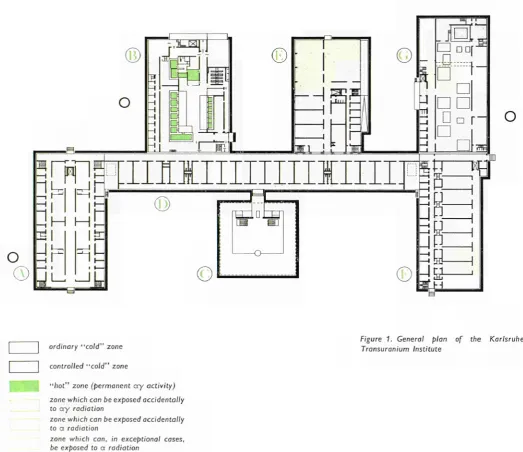
The laboratories have, of course, been grouped as far as possible following a functional plan. For example F W i n g , where the fuels will be prepared, and G W i n g , where the rods will be built, adjoin each other. However, it is primarily the security aspect which has determined the grouping of the laboratories. Thus all those in which relatively large quantities of plutonium are handled have been placed near each other in F W i n g , which thus includes metallurgy, ceramics and chemistry.
" H o t " and " c o l d " zones
It is well k n o w n that plutonium can be very dangerous if handled w i t h o u t proper precautions. Quantitative limitations must be observed, otherwise chain reactions can be set off. Once irradiated, moreover,
plutonium emits radiations which necessi tate using heavy biological protection (lead casks, shielded cells).
Above all, however, it is highly toxic. If It is absorbed by the organism it gathers most often in the bones, where its radiation can give rise t o forms of anaemia and leukaemia.
This makes numerous precautions necessa ry. The atmosphere is protected by isolating the plutonium in glove-boxes o r air-tight containers, and all premises in which plu t o n i u m may be present are surrounded by areas of controlled atmosphere, where the air is subjected t o continuous analysis and is filtered before being expelled. Access t o these " h o t areas" is through specially arranged air-locks fitted w i t h emergency showers and control apparatus and only f r o m an area w i t h controlled but " c o l d " atmosphere. It was considered that this last area could facilitate movements w i t h i n the Institute while also providing a rational link between the different hot areas and the exterior.
This controlled " c o l d " area branches out through all the wings. It includes all the corridors and cold premises used by per sonnel (offices, laboratories, workshops, etc.). Liaison w i t h outside is only possible by passing through the dressing rooms and
showers of D building. There is one single entrance f o r all personnel of the Institute, on the ground floor of the administrative
wing.
The aim has been to keep the movement of equipment separated f r o m that of per sonnel as systematically as possible by reserving an area of its o w n t o equipment. In each wing this includes a special c o r r i d o r linked by a goods-lift w i t h the central " e q u i p m e n t " corridor, which runs in the cellar of the Institute f r o m end t o end. A t the back of the building three doors are reserved for a, a y and " c o l d " materials, in the G, Β and E wings respectively.
V e n t i l a t i o n
The ventilation installations are of capital importance since they are linked with safety problems. It is thanks to them that air pollution can be prevented by main taining glove-boxes and premises suscep tible to contamination below atmospheric pressure.
Each wing of the Institute has Its own
subsequent-o
1 JM
[IIIMIIIIIII1
R
<D
1
I
1 piIIMf 1 rii II m
...
[image:12.595.33.557.216.668.2]II
|HIHI| |
innu 1
O
ordinary "cold" zone
controlled "cold" zone
"hot" zone (permanent cry activity)
zone which can be exposed accidentally
to cry radiation
zone which can be exposed accidentally
to α radiation
zone which can, in exceptional cases,
be exposed to α radiation
Figure 1. General plan of the Karlsruhe Transuranium Institute
ly maintain greater flexibility of operation. In each wing a blower plant draws in the external air and filters, warms and humidi-fies it before dispatching it t o the various premises. Before being expelled f r o m the building by the extraction plant, the air passes successively t h r o u g h t h r e e incom-bustible high performance filters if i t comes f r o m a glove-box. If it comes f r o m a laboratory the number of filters is reduced t o t w o .
A n overall regulation system maintains the depression in t h e premises at such values that it w o u l d be difficult for any r o o m accidentally contaminated t o infect a neigh-bouring " c l e a n " r o o m . Finally, in the event of an electricity supply breakdown, an emergency g r o u p starts up automatically t o maintain ventilation. A general control r o o m situated in the centre of the Institute at the entrance t o E wing groups all security and supervision installations f o r the whole complex and, in particular, enables the proper operation of all t h e ventilation circuits t o be checked.
Effluents and w a s t e
Everything that emerges f r o m the Institute must be checked to avoid any risk of radio-active pollution outside. This is particularly the case w i t h effluents. Those k n o w n in advance t o be radioactive—they w i l l gen-erally be of small quantity and originate f r o m specific operations—will be stocked in special bottles and then transported and treated in the German Nuclear Centre along w i t h similar residues of its o w n . All o t h e r effluents f r o m the Institute w i t h -out exception w i l l be considered as doubt-ful. They will all be led into a central depot in the cellars of D w i n g , where a number of reservoirs w i t h a total capacity
of 330 m3 will make possible complete
classification by origin and, after analysis, dispatch t o the Centre for appropriate treatment.
Solid waste will be gathered in special containers in stocking points close t o the exits before being evacuated by the Ger-man Nuclear Centre.
T i m e - t a b l e of t h e w o r k
Although the Institute is still building some dates might be of interest.
The agreement laying down the basis of collaboration between Euratom and Ger-many in building the Institute goes back t o 21 December 1960. But it was not until the f r a m e w o r k programme of December 1961 that the Euratom/German Karlsruhe Centre Joint Planning G r o u p could submit the
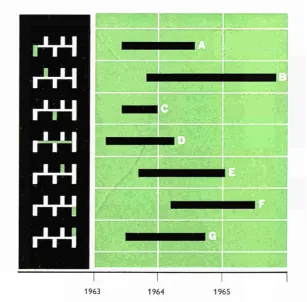
real preliminary project on 7 January 1962. The size of the I n s t i t u t e ' and the need t o bring a part of it into operation as soon as possible have, of course, led t o staggering of the w o r k , which began as soon as the building p e r m i t was received. Diagram 2 shows the w o r k schedule, which is subject t o the usual reservations, although we would point out that it has so far been adhered t o .
I. The volume of the Institute is 180,000 ml and
[image:13.595.246.554.405.707.2]covers a ground area of 16 000 m-.
Figure 2. Time-table of the work
1963 1964 1965
" M a r k e d " molecules:
modern research tools
JEAN SIRCHIS,
Directorate-General for Research and Training, Euratom
More than 160 specialists f r o m the countries of the European C o m m u n i t y and 13 non-member countries met in Brussels f r o m 13 to 16 N o v e m b e r 1963 at the invitation of Euratom for a conference in a field of interest t o many research w o r k e r s , the field of labelled compounds, o r " m a r k e d " molecules. This was the first international conference devoted exclusively t o the problems of preparing and conserving these products.
" M a r k i n g " a m o l e c u l e
To " m a r k " a product means introducing into the molecule a naturally rare nuclide, which may be stable o r radioactive, so as t o render i t easily recognizable. Thus, glycine (Figure 1) can be marked by introducing into its s t r u c t u r e radioactive carbon-14 in position 2, w h i c h is normally occupied by the most frequent isotope of this element,
carbon-12. Similarly, the nitrogen (14N)
of the molecule can be replaced by the stable isotope 1 5N .
To detect a molecule marked by a stable isotope requires the use of a mass spectro-meter, a costly apparatus difficult t o handle. As against this, radioactive marked molecules are betrayed by the rad iation they give off and thus detected much more easily. For this reason, they are the most generally used.
W h y produce " m a r k e d " molecules?
The preparation of marked molecules is not an end in itself. They are intended
as a t o o l for experiments by researchers in most fields of basic o r applied science. The generalisation of t h e i r use is explained by the possibility they offer of increasing the sensitivity and effectiveness of certain conventional techniques, but especially because they make it possible to attack and resolve problems which defy o t h e r methods. Some examples should therefore be men-tioned t o justify the efforts expended on t h e i r preparation.
A p p l i c a t i o n s in c h e m i s t r y
In o r d e r t o study the mechanism of chemical reactions involving complex organic
sub-stances, the intermediate compounds w h i c h f o r m must be identified, and atoms and radicals which are chemically identical but of differing origin must be distinguished. W i t h the exception of a few simple reactions for which physico-chemical methods could provide the answer, the organic chemist was reduced t o f o r m u l a t i n g hypotheses. Since marked molecules appeared on the scene i t has become possible t o differen-tiate the parts played in a reaction by the atoms of an element by following the trace of one of t h e m .
[image:14.595.216.522.126.246.2]Let us take the simple example of the hy-drolysis of esters, a c u r r e n t reaction in organic chemistry w i t h numerous appli-cations in industry. In t h e o r y , this reaction
Figure 1. Marked glycine
N H
2
—f§)H
2
— C O O H
© ©
glycine marked with carbon-14 (radioactive isotope) on carbon atom 2
H,
C
U - , —. - ~ J , glycine marked with nitrogen-15 (stableiso-M
2~ " L U U H tope)
can take place according to the t w o mecha-nisms outlined in Figure 2.
By utilising water marked w i t h oxygen-18
( H1 8O H ) , the behaviour of the three oxygen
atoms can be differentiated. In fact, it has been possible t o determine that oxygen-18 was found in the acid formed. Consequently, the reaction follows the second pattern. A n o t h e r example: the use of glucose
marked w i t h 14C has made it possible t o
establish the complex mechanism of its degradation under the effect of brewer's yeast and t o determine the part played by each of the 6 atoms of the molecule up t o the final stage of formation of acetic acid and
co
2.
The use of marked reagents also makes i t possible to specify the structure of high polymers and t o study the mechanism by which they are obtained. Certain chemical substances, when present in trace quanti-ties, have the property of acting on the speed of polymerisation by combining w i t h the monomer o r by initiating the formation of free radicals. By using these substances marked w i t h an isotope the number of molecules concerned can be evaluated and, consequently, the effective-ness of the substances determined. Study of the mechanism of reactions and of other problems of a chemical nature requires precise knowledge of the quant-ity of one o r several substances in a m i x t u r e . Here again the help of marked molecules is appreciable, since they make it possible t o dose the components of a complex m i x t u r e w i t h o u t any i m p o r t a n t
losses. The method k n o w n as "isotopie d i l u t i o n " consists of adding t o the m i x t u r e a small quantity, marked w i t h an isotope and of known specific activity, of the compound " A " t o be dosed. Product " A " Is then isolated in a sample taken f r o m the m i x t u r e and its specific radioactivity, which is necessarily lower than t h a t of the initial marked product, is measured. A simple formula relating this decrease In specific activity t o the total quantity of the product makes it possible t o calculate the latter rapidly.
The applications of marked molecules t o chemistry extend, of course, t o those sciences and techniques where chemical phenomena come into play.
Applications in biology and m e d i c i n e
It is particularly in biology and medicine that the use of marked molecules has led to considerable progress.
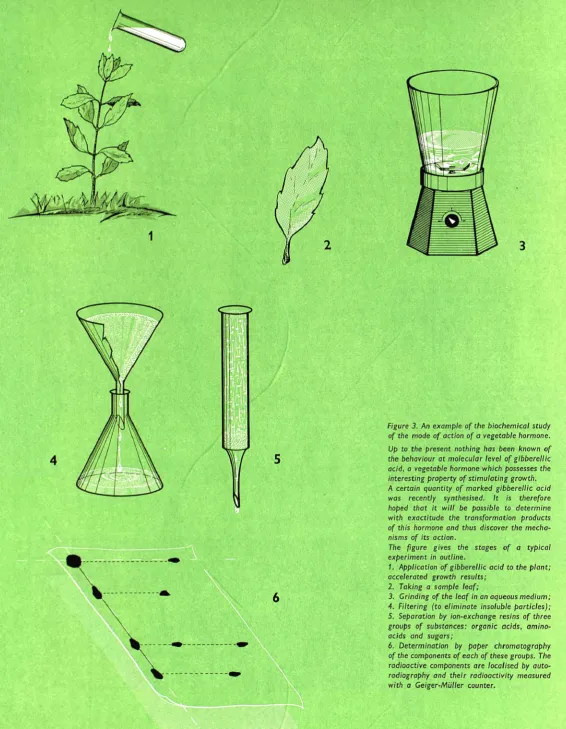
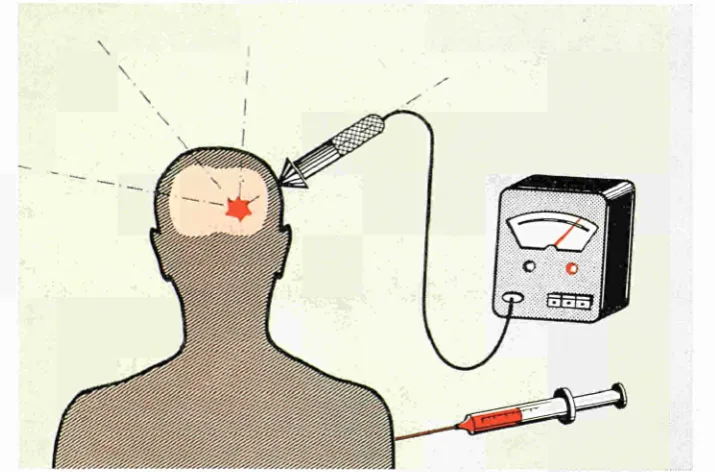
When a marked molecule is introduced into a biological system—a living being o r an isolated organism—it is possible t o follow its trace as it passes f r o m one cell or organ into other cells o r organs and t o study the processes by which it degener-ates, becomes reconstituted o r combines w i t h other substances (see Figure 3). It has thus been possible t o identify the majority of the intermediaries formed in the course of photosynthesis f r o m the carbon dioxide of the air up t o the most complex compounds of very high
molecu-lar weights, such as the proteins. In the same way it has been possible t o establish that blood pigments are formed on the basis of an amino-acid, the role played by each carbon atom being specified. Medical diagnosis has largely profited f r o m the utilisation of marked molecules. We may mention the detection of t u m o r s w i t h the help of albumin marked w i t h radio-active iodine (see Figure 4). This substance has the property of being fixed by the tumors, whose membrane is more per-meable than o t h e r tissues. Thus it is possible t o localise a t u m o r rapidly and precisely by detecting where the radio-active iodine is concentrated, w i t h the help of a counter o r a photographic plate. Studies now going on p e r m i t the hope that by using a similar method it w i l l be possible not only t o detect malignant t u m o r s but also t o treat them internally by fixing selectively on them a marked molecule of high radioactivity whose radiation will be able t o destroy t h e m ' .
O t h e r uses of marked molecules could be mentioned. Several are finding a recog-nised place in industries using certain physico-chemical processes. A n example is given in Figure 5.
However, t h e very diversity of the possible uses of marked molecules gives rise t o obstacles t o their full exploitation.
[image:15.595.191.550.549.714.2]I. The applications of marked molecules in biology are innumerable. Professor Lettre gave some examples in an article published in Euratom Bulletin 1962, No. 4.
Figure 2. Determination of the hydrolysis mech-anism of esters. Thanks to the use of water marked with oxygen-18 (H*"OH) we can deter-mine that the drolysis reaction follows the second pattern.
^
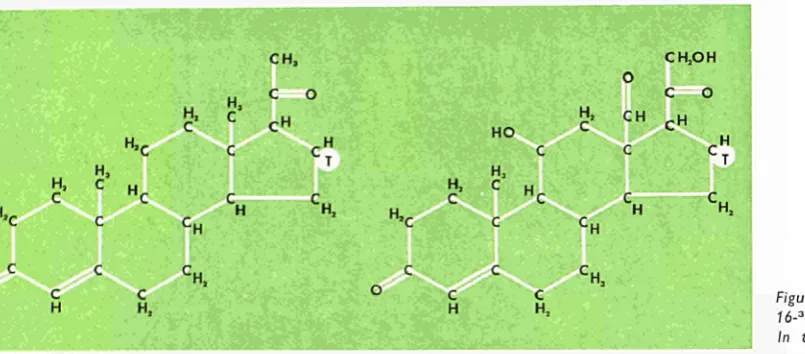
Figure 3, An example of the biochemical study of the mode of action of a vegetable hormone. Up to the present nothing has been known of the behaviour at molecular level of gibberellic acid, a vegetable hormone which possesses the interesting property of stimulating growth. A certain quantity of marked gibberellic acid was recently synthesised. It is therefore hoped that it will be possible to determine with exactitude the transformation products of this hormone and thus discover the mecha-nisms of its action.
The figure gives the stages of a typical experiment in outline,
1. Application of gibberellic acid to the plant; accelerated growth results;
2. Taking a sample leaf;
3. Grinding of the leaf In an aqueous medium; 4. Filtering (to eliminate Insoluble particles);
5. Separation by ion-exchange resins of three groups of substances: organic acids, amino-acids and sugars;
T h e obstacles
Very often a given product interests only a small number of research workers. Quite irrespective of the extra problems inherent in the manipulation of radioactive sources, all these products, like most organic compounds, are particularly deli-cate and difficult t o produce; it w i l l there-fore be understood that the restricted market for them results in very high prices and very long delivery dates.
To these t w o drawbacks must be added a t h i r d : when products of high specific activity have t o be stocked, they destroy themselves. The effect of radiation involves a degradation of the molecule, so that it cannot be conserved beyond a certain time w h i c h , in some cases, is no more than a few days.
Finally, an even more serious problem arises: i t very often happens that resear-chers need compounds which no laboratory, private or public, has ever produced. It is t r u e that specialised laboratories are making a considerable effort t o remedy this difficult situation, but most of them are very naturally anxious t o cover t h e i r pro-duction costs and can hardly be expected t o launch into the synthesis of products which interest too few clients.
nationalisation". It is therefore no surprise that Euratom has been given an important role in this field.
In the course of an address at the conference already mentioned, Professor Medi, Vice-President of the Euratom Commission, spoke as f o l l o w s : " . . . when referring t o the effort put f o r t h by Euratom t o harmonise research and industrial production in the field of atomic energy, the expression 'atomic energy' is not t o be taken literally. O u r role is t o p r o m o t e the study and utilisation of the properties of the atomic nucleus . . .
Consequently, marked molecules, radioiso-topes, and biology enter directly into our field of action; we are not here simply t o produce units of electricity of nuclear origin . . .".
Euratom's activity consists chiefly of a permanent inquiry among more than 5.000 specialists w h o are interested in the preparation and utilisation of marked molecules. The first stage in this activity
was a census of requirements in the six
C o m m u n i t y countries and an inquiry w i t h research laboratories w h i c h had already synthesised, for their o w n studies, marked molecules which they could not find in the trade.
A n impasse
All in all, we are threatened w i t h a vicious circle: producers observing the elementary rules of prudence hesitate t o bring into the market products which they are not practi-cally certain t o sell. On the other hand, research workers, however alive they may be t o the advantages of marked molecules, will tend t o make do w i t h o u t them if they have t o face constant problems of availabili-ty and delivery dates. It is evident that the unfavourable influence of this reflex on demand directly affects the attitude of producers. The vicious circle is thus com-plete.
A m a r k e d molecules " b a n k "
Products prepared by research workers for their o w n requirements and of interest t o others have been the subject of agree-ments under which the producing labor-atory prepares a surplus whose existence is widely publicised. In this way, a verit-able marked molecules " b a n k " has sprung up. Actually it has already done good ser-vice in procuring marked products f o r la-boratories in the European C o m m u n i t y and in non-member countries.
N e w syntheses
H o w t o get o u t of t h e impasse
To extricate ourselves f r o m this impasse we must first of all widen the " m a r k e t " for marked molecules, which is tantamount t o saying that we must encourage its " i n t e r
-Furthermore, research contracts ensure the synthesis of certain products which have never been prepared before. Once the synthesis is achieved, these products are included in the bank.
M. P. De G r o ó t e , member of the Euratom Commission, speaking of these research
contracts at the conference, specified that " i n o r d e r to avoid dispersion of effort, the stress is laid as far as possible on general
methods applicable t o the synthesis of
groups of products rather than the prepa
ration of particular compounds".
These measures, which are justified in themselves, since they enable several users of marked molecules t o find the product indispensable for their research w o r k , often result in an extension of the usefulness of the product. In fact, researchers w o r k i n g in the same field become interested in a new product as soon as it exists, and demand increases. This in t u r n can justify the pre paration of the product on a commercial scale. It can therefore be noted that in effect Euratom, far f r o m competing w i t h private bodies, tends on the contrary t o favour their activities by saving them over-costly research. Thus, certain commercial producers, after noting the interest shown for molecules p r o m o t e d in this way have decided t o prepare them on an industrial footing.
M e t h o d s of p r e p a r i n g m a r k e d m o l e cules
The present methods of preparing marked molecules may be grouped under three main heads: chemical synthesis, biosyn thesis and " r a d i o c h e m i c a l " methods.
C h e m i c a l synthesis
The synthetic methods of preparation follow the traditional techniques of organic chemistry, suitably adapted t o the small quantity of substances on which the w o r k is done. In the case of t 4C i t is generally a
matter of total syntheses—carried o u t , that is t o say, by progressively building up the molecular s t r u c t u r e f r o m very simple inorganic substances—while w i t h 3H less
complicated exchange and addition reactions are often possible.
Chemical synthesis is at present the method which furnishes the greatest number of labelled compounds. It has attained a very high degree of sophistication and efficiency,
and the labelled compounds prepared are generally very pure. F u r t h e r m o r e , the position of the radioactive element in t h e molecule is well k n o w n .
But chemical synthesis has its limits, w h i c h are the impossibility of producing very
complex marked molecules, which are precisely those most useful in biological research (proteins, enzymes, many alkaloids, etc.) and the laborious nature of the pro cesses needed t o obtain many marked molecules.
Biosynthetic m e t h o d s of m a r k i n g
O n the o t h e r hand, even very complex compounds can be obtained by biosyn thesis. By this technique a living organ ism is supplied w i t h a very simple la belled compound w h i c h it utilises t o synthesise o t h e r substances, in particular the product sought.
[image:18.595.33.391.466.702.2]There are no limits t o the molecular complexity of the compounds which can be
Figure 4. Detection of a tumor with the help of marked albumin.
— An iodised protein (most usually a human
albumin marked with iodine-131) is injected.
— The albumin molecules are distributed in
the body by blood circulation but, normally,
do not penetrate into the tissues and organs
because they are too big to pass through the membranes covering them.
— In a normal subject the product will there
fore be eliminated, but in the case of a tumor the membrane becomes permeable and the result is localisation which can easily be traced from outside thanks to the γ radiation of the iodine.
cd
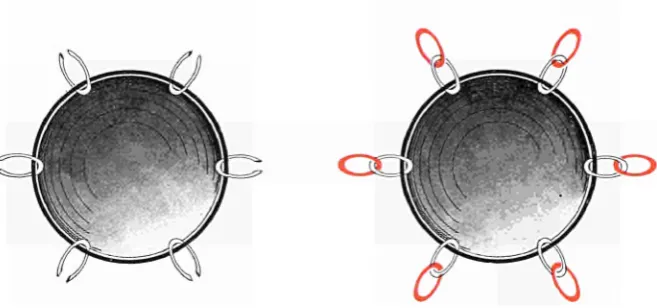
Figure 5. Determination of the chemically active sites on the surface of a particle of carbon black with the help of marked mole-cules.
It is often desirable, for instance in order to perfect an industrial process, to know exactly the chemical reactivity of a substance. In the case of substances like carbon black, which occur in the form of very finely divided solids, the traditional chemical methods have proved insufficiently sensitive. The idea of using marked molecules therefore emerged. The diagram on the left represents a particle of carbon black and the chemically active sites on Its surface.
After making the particle react with a marked product, bonds are obtained which are repre-sented in the diagram on the right: molecules of this product have fixed themselves on these sites.
The method therefore consists in bringing about the reaction of a known quantity of particles with a product marked with carbon-14 of known specific radioactivity. After burning the sample, it is sufficient to measure the radioactivity of the C02 produced in order
to calculate the initial number of active sites per gramme of matter.
labelled by biosynthesis. Enzymes, nucleic acids, proteins, steroids, alkaloids, etc. . . can be obtained.
However, the very nature of the biosyn-thetic methods imposes very severe limits on t h e i r employment. In the first place, the organism chosen t o receive the labelled compound utilises it t o synthesise a great number of molecules, w i t h the consequence that a very low fraction of the initial activity is found in the desired compound. Moreover, as the latter is accompanied by numerous other substances which are also labelled, careful purification has t o be undertaken. Finally, the position of the radioactive atom in molecules marked by biosynthesis is generally not k n o w n . A l l o w i n g for all these limitations biosyn-thetic methods are nevertheless the only ones available for labelling certain types of organic substances.
R a d i o c h e m i c a l m e t h o d s
Finally, there exists a t h i r d g r o u p of techniques for the i n t r o d u c t i o n of
radio-active atoms into an organic compound. These are the "radiochemical" marking methods.
Their essential feature is the direct i n t r o -duction of a radioactive atom into a mole-cule w i t h o u t recourse to synthesis. This substitution is sparked off w i t h the help of energy supplied either by external tion o r by the kinetic energy or the radia-tion of the radioisotope itself.
The advantages of this group of methods are evident when it is a matter of preparing compounds whose complexity precludes any appeal t o chemical procedures and in cases where biosynthesis cannot provide an adequate specific radioactivity.
In the following pages, eminent specialists f r o m the European C o m m u n i t y , whose contributions t o the conference attracted much a t t e n t i o n , describe the three groups of methods of preparing radioactive marked molecules and give an idea of the difficulties resulting f r o m the self-destruction of these molecules. Thus we now leave the plane of generalisation and enter the laboratories.
Chemical syntheses
of marked molecules
LOUIS P I C H A T , Head of the Marked Molecules Section, CEN, Saclay, France
A l t h o u g h they use methods w h i c h are already w e l l k n o w n , chemical syntheses of marked molecules present interesting and notable differences when compared w i t h syntheses in "classical" organic c h e m i s t r y .
H i g h cost o f t h e isotopes
Radioisotopes like t r i t i u m (3H) and sulphur 35 are relatively cheap. O n t h e o t h e r hand, carbon14, w h i c h is the most generally used radioisotope, is still a costly raw material. It is t h e r e f o r e essential t o obtain an o p t i m u m yield at every stage of a synthesis. Products of biological interest marked w i t h '4C can easily be w o r t h as much as 300 t o
500 dollars per m i l l i c u r i e . It is t h e r e f o r e no rare t h i n g in t h e course of syntheses on high activities at p r o d u c t i o n centres like Saclay f o r several thousand dollars' w o r t h of products t o be manipulated in microchemical apparatus d u r i n g each opera t i o n .
A n unusual r a w m a t e r i a l
Carbon14 is supplied t o t h e organic chemist in t h e f o r m of barium carbonate ( '4C 03B a ) . By decomposing this p r o d u c t
w i t h t h e help of an acid, '4C is obtained in t h e f o r m of '4C 02. It is t h e r e f o r e on t h e
basis of '4C 02 t h a t t h e chemist must
fashion molecules and i n t r o d u c e t h e 1 4C in very specific positions. In this way certain socalled basic molecules such as calcium carbide, potassium cyanide, sodium f o r m a t e and methanol can be obtained t o serve f o r t h e syntheses of m o r e complex mole cules.
The carbonation of an organomagnesium
c o m p o u n d is a reaction w i d e l y e x p l o i t e d f o r t h e synthesis of marked molecules, since t h e radical R can be e x t r e m e l y varied (see Figure 1).
H e a l t h c o n s i d e r a t i o n s
As soon as m i l l i c u r i e level is reached, p r o t e c t i o n by lead o r concrete screens must be p r o v i d e d w h e n preparing molecules marked w i t h iodine131 o r bromine82. Luckily, since t h e isotopes most c o m m o n l y used t o mark organic p r o d u c t s ('4C, 3 5S, 3H ) e m i t soft ßrays w h i c h are absorbed
by t h e glass walls of t h e apparatus, only
R
Μα X
'
4C O ,
M
c o
2
"CH
3OH
X H 3 I
M
CH,CN
,4
C H,CO,H
14
C0
2+ CH
3M
gl
î
CH
3,4C0
2H
|
precautions against i n t e r n a l c o n t a m i n a t i o n need t o be t a k e n . For this purpose t h e operations are carried o u t in w e l l v e n t i l a t e d hoods o r gloveboxes.
N e e d t o w o r k o n m i c r o q u a n t i t i e s
For biological e x p e r i m e n t a t i o n it is gen erally necessary t o obtain a p r o d u c t con taining m a x i m u m r a d i o a c t i v i t y (in m i I l i eu ries) f o r m i n i m u m of w e i g h t . If, t h e r e f o r e , i t is n o t possible t o b r i n g a large n u m b e r of millicuries i n t o play, w o r k has t o be done on v e r y small ponderal quantities ( f r o m 50 mg t o 1 g), and this seriously complicates t h e task.
O
,4
C
O Mg Χ
'
4C Ο, Η
Figure 1. Preparation of '4C labelled organo magnesium compound
Figure 2. Preparation of marked acetic acid: acetic acid i4C1 (marked on carbon atom 1);
Position of t h e m a r k e d a t o m and diffi-culty of synthesis
Even for very ordinary products like acetic acid the difficulties of preparation vary enormously w i t h the atom which it is
proposed t o mark. Acetic acid 14C-1 is
prepared by a single reaction, whereas t o obtain acetic acid '4C-2 f o u r stages must be
gone through (see Figure 2).
These differences in difficulty are reflected
in differences in price (acetic acid '4C-2
costs two-and-a-half times as much as acetic acid '4C-1).
P r e p a r a t i o n of t r i t i a t e d molecules by exchange reactions
W i t h a few exceptions molecules marked
w i t h '4C must be prepared by chemical
[image:21.595.203.553.124.320.2]or biological synthesis. In the case of t r i t i a t e d molecules it may be possible t o dispense w i t h synthesis and carry out a direct exchange of an atom of ordinary hydrogen w i t h an atom of t r i t i u m . This can be done by simple incubation w i t h pure gaseous t r i t i u m (Wilzbach m e h o d ) ' or by simple heating w i t h t r i t i a t e d water in the presence of a suitable catalyst such as platinum.
Figure 3. Working principle of the vacuum apparatus used for synthesising '4C carboxylic acids.
1. Taps 2. C02 generator
3. Flask containing the organo-magnesium compound (intermediary of the synthesis) 4. C02 trap
5. Nitrogen used to scour the apparatus after an operation is completed 6. Vacuum-gauge
"C02 is obtained from barium carbonate by sulfuric acid attack (2); it is then transferred to the
flask containing the organo-magnesium compound (3). Once the synthesis is completed the excess
i4C02 is trapped in sodium hydroxyde (4) and the vacuum line is scoured with nitrogen (5). Techniques f o r p r e p a r i n g
m a r k e d molecules
In many cases preparation is done in a vacuum apparatus in which the products move and react w i t h o u t escaping f r o m the enclosure. This precludes any loss o r any danger t o the operator.
Figure 5 gives t h e outline diagram of such an apparatus.
C h r o m a t o g r a p h i c m e t h o d s of purifi-c a t i o n and isolation
The need t o w o r k on small quantities calls for methods of isolation and purifica-tion which reduce losses t o a m i n i m u m , and chromatographic methods occupy a leading place. Use is made, according t o the case, of chromatography on alumina,
[image:21.595.200.552.526.707.2]I. See page 28.
Figure 4. Purification of methionine 35S by radioch romatography on Dowex 50 ion-exchange resin.
Methionine 35S with its impurities is adsorbed on a column of resin and the different components
of the mixture are separated one by one by using different reagents. The surface of each "peak" in the diagram represents one component. The one which corresponds to methionine 35S is shaded.
The product may not be considered "radio-chromatographically" pure until the "peak" of methionine 35S appears alone on the diagram.
Counts/second
10'
50 150 Number of
fractions of 10cc